
Distributed Systems CS 15 440 Consistency and Replication
Distributed Systems CS 15 -440 Consistency and Replication – Part II Lecture 12, Oct 21, 2015 Mohammad Hammoud
Today… § Last Session § Consistency and Replication- Part I § Today’s Session § Consistency and Replication – Part II § Continuous and Data-Centric Consistency Models § Announcements: § PS 3 is due on Sunday Oct 25 by midnight § P 2 is due on Sunday Nov 1 by midnight 2
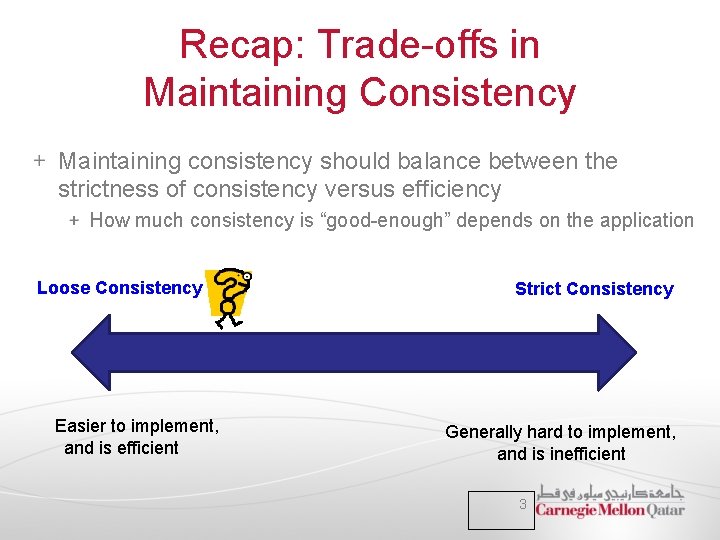
Recap: Trade-offs in Maintaining Consistency Maintaining consistency should balance between the strictness of consistency versus efficiency How much consistency is “good-enough” depends on the application Loose Consistency Easier to implement, and is efficient Strict Consistency Generally hard to implement, and is inefficient 3
Consistency Model A consistency model is a contract between the process that wants to use the data, and the replicated data repository (or data-store) A consistency model states the level of consistency provided by the data-store to the processes while reading and writing the data 4

Types of Consistency Models Consistency models can be divided into two types: Data-Centric Consistency Models These models define how the data updates are propagated across the replicas to keep them consistent Client-Centric Consistency Models These models assume that clients connect to different replicas at different times The models ensure that whenever a client connects to a replica, the replica is brought up to date with the replica that the client accessed previously 5
Overview Motivation Consistency Models Data-Centric Consistency Models Client-Centric Consistency Models Replica Management Consistency Protocols 6
Data-centric Consistency Models describe how the replicated data is kept consistent, and what the processes can expect Under Data-centric Consistency Models, we study two types of models: Consistency Specification Models: These models enable specifying the consistency levels that can be tolerated by the application Models for Consistent Ordering of Operations: These models specify the order in which the data updates are propagated to different replicas 7

Overview Motivation Consistency Models Data-Centric Consistency Models Consistency Specification Models for Consistent Ordering of Operations Client-Centric Consistency Models Replica Management Consistency Protocols 8
Consistency Specification Models In replicated data-stores, there should be a mechanism to: Measure how inconsistent the data might be on different replicas How replicas and applications can specify the tolerable inconsistency levels Consistency Specification Models enable measuring and specifying the level of inconsistency in a replicated data-store We study a Consistency Specification Model called Continuous Consistency Model 9

Continuous Consistency Model is used to measure inconsistencies and express what inconsistencies can be expected in the system Yu and Vahdat [1] provided a framework for measuring and expressing consistency in replicated data-stores 10

Continuous Consistency Ranges Level of consistency is defined over three independent axes: Numerical Deviation: Deviation in the numerical values between replicas Order Deviation: Deviation with respect to the ordering of update operations Staleness Deviation: Deviation in the staleness between replicas Numerical Deviation Example: Two copies a stock price should not deviate by more than $0. 02 Example: Weather data should not be more than four hours stale Staleness Deviation Example: In a bulletin board application, a maximum of six messages can be issued out-of-order Ordering Deviation 11
Consistency Unit (Conit) Consistency unit (Conit) specifies the data unit over which consistency is measured For example, conit can be defined as a record representing a single stock Level of consistency is measured by each replica along the three dimensions Numerical Deviation For a given replica R, how many updates at other replicas are not yet seen at R? What is the effect of the non-propagated updates on local Conit values? Order Deviation For a given replica R, how many local updates are not propagated to other replicas? Staleness Deviation For a given replica R, how long has it been since updates were propagated? 12
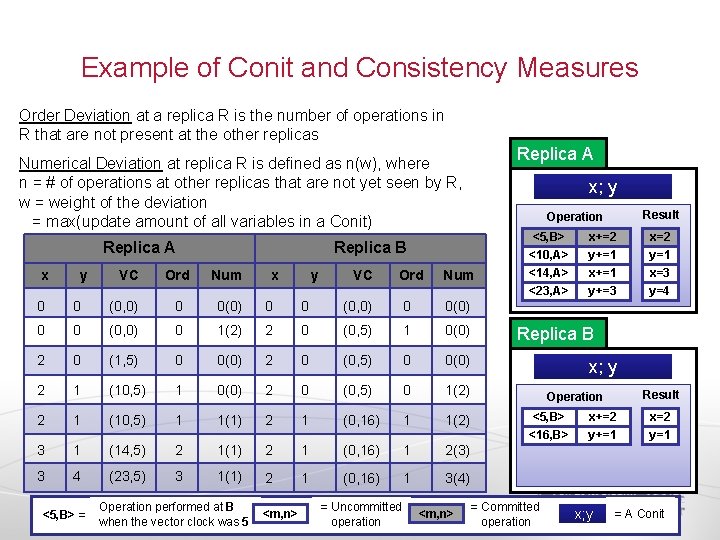
Example of Conit and Consistency Measures Order Deviation at a replica R is the number of operations in R that are not present at the other replicas Replica A Numerical Deviation at replica R is defined as n(w), where n = # of operations at other replicas that are not yet seen by R, w = weight of the deviation = max(update amount of all variables in a Conit) Replica A x y VC Ord Num 0 (0, 0) 0 0(0) 0 0 (0, 0) 0 1(2) 2 0 (0, 5) 1 0(0) 2 0 (1, 5) 0 0(0) 2 0 (0, 5) 0 0(0) 2 1 (10, 5) 1 0(0) 2 0 (0, 5) 0 1(2) 2 1 (10, 5) 1 1(1) 2 1 (0, 16) 1 1(2) 3 1 (14, 5) 2 1(1) 2 1 (0, 16) 1 2(3) 3 4 (23, 5) 3 1(1) 2 1 (0, 16) 1 3(4) Operation performed at B when the vector clock was 5 <m, n> = Uncommitted operation <m, n> Result Operation Replica B 0 <5, B> = x; y <5, B> x+=2 x=2 <10, A> <14, A> <23, A> y+=1 x+=1 y+=3 y=1 x=3 y=4 Replica B x; y Result Operation <5, B> <16, B> = Committed 13 operation x+=2 y+=1 x; y x=2 y=1 = A Conit
Overview Motivation Consistency Models Data-Centric Consistency Models Consistency Specification Models for Consistent Ordering of Operations Client-Centric Consistency Models Replica Management Consistency Protocols 14
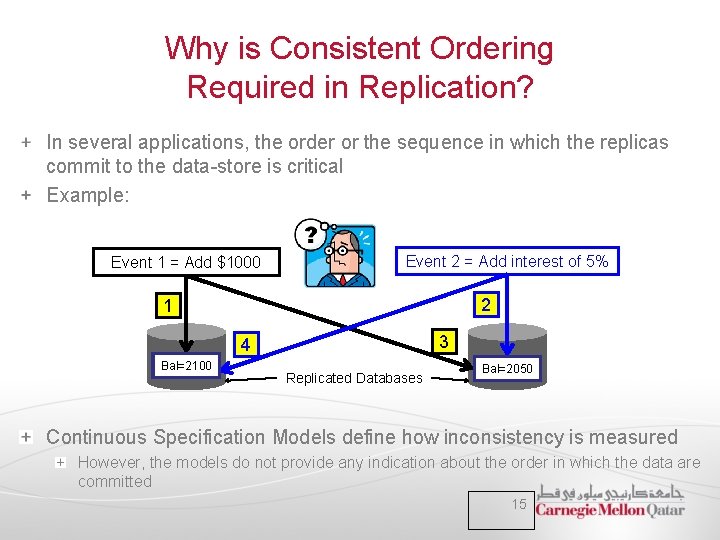
Why is Consistent Ordering Required in Replication? In several applications, the order or the sequence in which the replicas commit to the data-store is critical Example: Event 1 = Add $1000 Event 2 = Add interest of 5% 2 1 3 4 Bal=2000 Bal=2100 Bal=1000 Replicated Databases Bal=1000 Bal=1050 Bal=2050 Continuous Specification Models define how inconsistency is measured However, the models do not provide any indication about the order in which the data are committed 15
Consistent Ordering of Operations Besides continuous consistency, we need to express the semantics of parallel accesses when shared resources are replicated Before updates at replicas are committed, all replicas shall reach an agreement on a global ordering of the updates Replicas in shared data-stores should agree on a consistent ordering of updates What consistent ordering of updates can replicas agree on? 16
Types of Ordering § We will study three types of orderings, which can be utilized by consistency models to agree upon and meet the needs of different applications: 1. Total Ordering 2. Sequential Ordering i. Sequential Consistency Model 3. Causal Ordering i. Causal Consistency Model 17
Types of Ordering 1. Total Ordering 2. Sequential Ordering 3. Causal Ordering 18
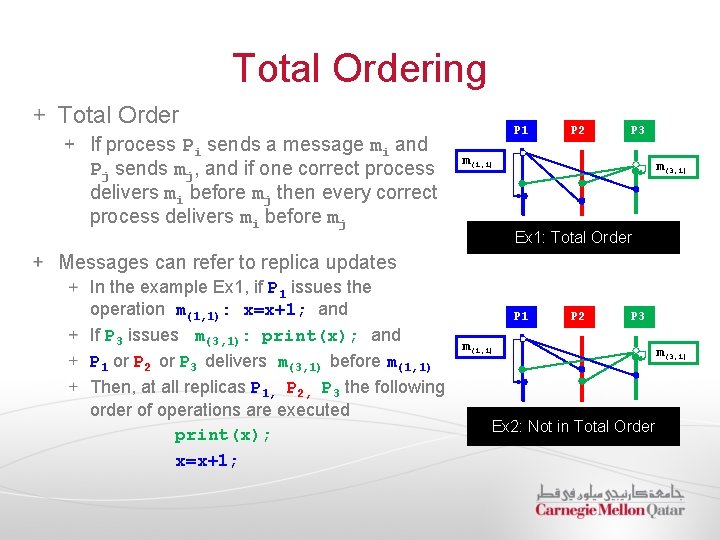
Total Ordering Total Order If process Pi sends a message mi and Pj sends mj, and if one correct process delivers mi before mj then every correct process delivers mi before mj P 1 P 2 P 3 m(1, 1) m(3, 1) Ex 1: Total Order Messages can refer to replica updates In the example Ex 1, if P 1 issues the operation m(1, 1): x=x+1; and If P 3 issues m(3, 1): print(x); and P 1 or P 2 or P 3 delivers m(3, 1) before m(1, 1) Then, at all replicas P 1, P 2, P 3 the following order of operations are executed print(x); x=x+1; P 1 P 2 P 3 m(1, 1) Ex 2: Not in Total Order m(3, 1)
Types of Ordering 1. Total Ordering 2. Sequential Ordering 3. Causal Ordering 20
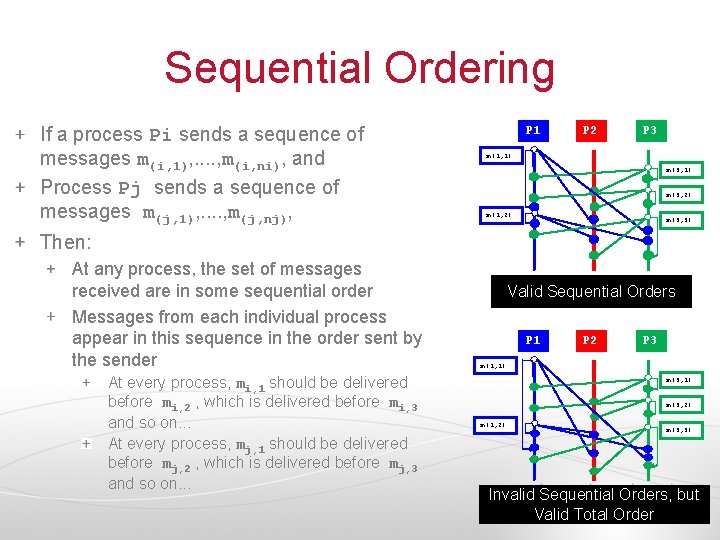
Sequential Ordering If a process Pi sends a sequence of messages m(i, 1), . . , m(i, ni), and Process Pj sends a sequence of messages m(j, 1), . . , m(j, nj), P 1 P 2 P 3 m(1, 1) m(3, 2) m(1, 2) m(3, 3) Then: At any process, the set of messages received are in some sequential order Messages from each individual process appear in this sequence in the order sent by the sender At every process, mi, 1 should be delivered before mi, 2 , which is delivered before mi, 3 and so on. . . At every process, mj, 1 should be delivered before mj, 2 , which is delivered before mj, 3 and so on. . . Valid Sequential Orders P 1 P 2 P 3 m(1, 1) m(3, 2) m(1, 2) m(3, 3) Invalid Sequential Orders, but Valid Total Order
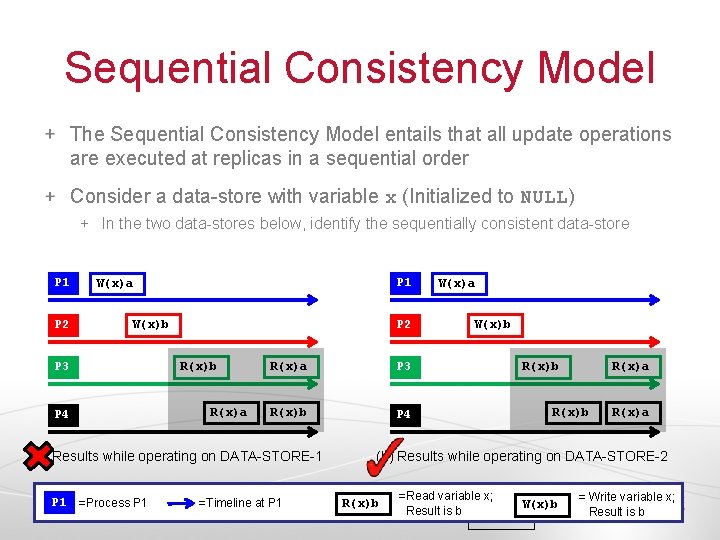
Sequential Consistency Model The Sequential Consistency Model entails that all update operations are executed at replicas in a sequential order Consider a data-store with variable x (Initialized to NULL) In the two data-stores below, identify the sequentially consistent data-store P 1 P 2 P 1 W(x)a W(x)b P 3 P 2 R(x)b R(x)a P 4 R(x)a P 3 R(x)b P 4 (a) Results while operating on DATA-STORE-1 P 1 =Process P 1 =Timeline at P 1 W(x)a W(x)b R(x)a R(x)b R(x)a (b) Results while operating on DATA-STORE-2 R(x)b =Read variable x; Result is b 22 W(x)b = Write variable x; Result is b
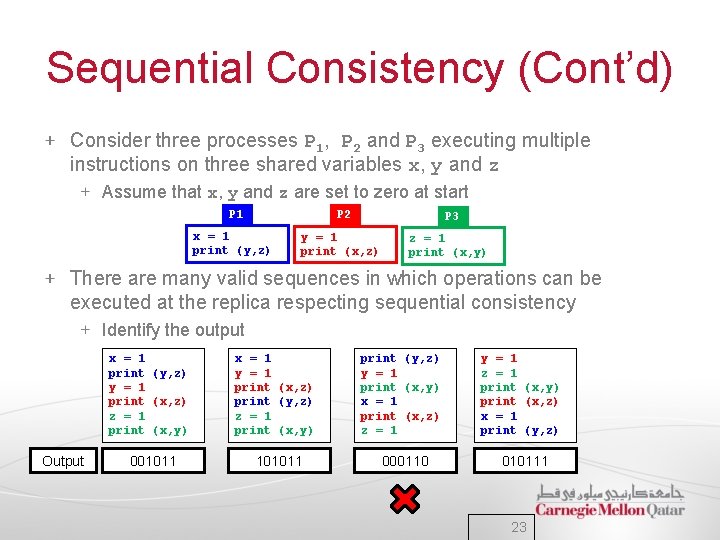
Sequential Consistency (Cont’d) Consider three processes P 1, P 2 and P 3 executing multiple instructions on three shared variables x, y and z Assume that x, y and z are set to zero at start P 1 P 2 P 3 x = 1 print (y, z) y = 1 print (x, z) z = 1 print (x, y) There are many valid sequences in which operations can be executed at the replica respecting sequential consistency Identify the output x = 1 print (y, z) y = 1 print (x, z) z = 1 print (x, y) Output 001011 x = 1 y = 1 print (x, z) print (y, z) z = 1 print (x, y) 101011 print (y, z) y = 1 print (x, y) x = 1 print (x, z) z = 1 000110 y = 1 z = 1 print (x, y) print (x, z) x = 1 print (y, z) 010111 23
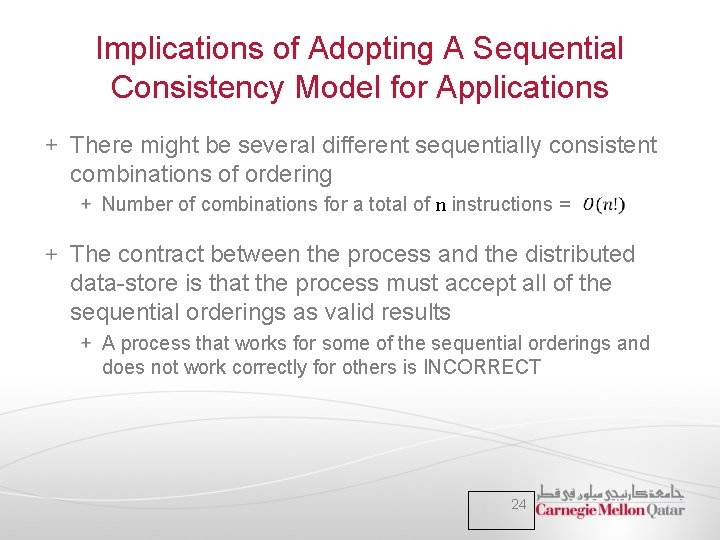
Implications of Adopting A Sequential Consistency Model for Applications There might be several different sequentially consistent combinations of ordering Number of combinations for a total of n instructions = The contract between the process and the distributed data-store is that the process must accept all of the sequential orderings as valid results A process that works for some of the sequential orderings and does not work correctly for others is INCORRECT 24
Types of Ordering 1. Total Ordering 2. Sequential Ordering 3. Causal Ordering 25
Causality (Recap) Causal relation between two events If a and b are two events such that a happenedbefore b (i. e. , a b), and If the (logical) times when events a and b occur at a process Pi are denoted as Ci(a) and Ci(b) Then, if we can infer that a b by observing that Ci(a)< Ci(b), then a and b are causally related Causality can be implemented using Vector Clocks 26
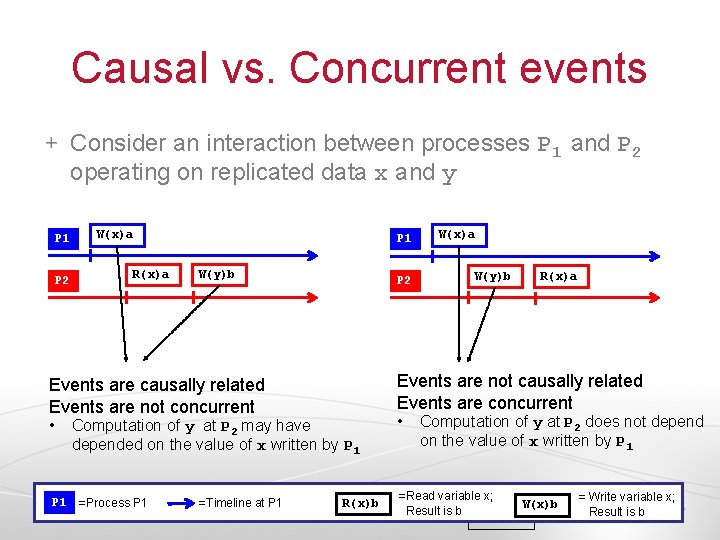
Causal vs. Concurrent events Consider an interaction between processes P 1 and P 2 operating on replicated data x and y P 1 P 2 W(x)a P 1 R(x)a W(y)b P 2 P 1 Computation of y at P 2 may have depended on the value of x written by P 1 =Process P 1 =Timeline at P 1 W(y)b R(x)a Events are not causally related Events are concurrent Events are causally related Events are not concurrent • W(x)a R(x)b • Computation of y at P 2 does not depend on the value of x written by P 1 =Read variable x; Result is b 27 W(x)b = Write variable x; Result is b
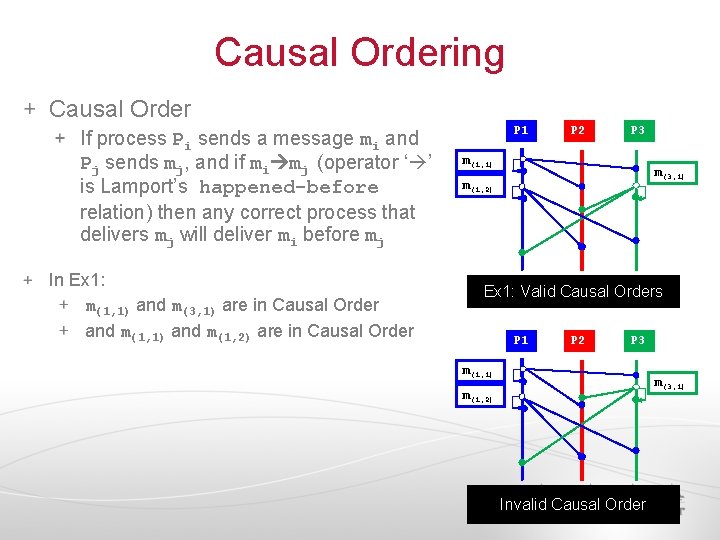
Causal Ordering Causal Order If process Pi sends a message mi and Pj sends mj, and if mi mj (operator ‘ ’ is Lamport’s happened-before relation) then any correct process that delivers mj will deliver mi before mj In Ex 1: m(1, 1) and m(3, 1) are in Causal Order and m(1, 1) and m(1, 2) are in Causal Order P 1 P 2 P 3 m(1, 1) m(3, 1) m(1, 2) Ex 1: Valid Causal Orders P 1 P 2 P 3 m(1, 1) m(3, 1) m(1, 2) Invalid Causal Order
Causal Consistency Model A data-store is causally consistent if: Writes that are potentially causally related must be seen by all the processes in the same order Concurrent writes may be seen in a different order on different machines 29
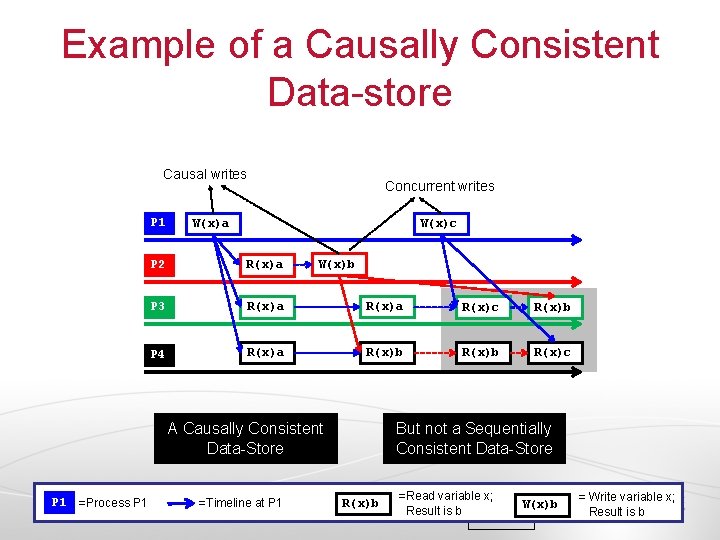
Example of a Causally Consistent Data-store Causal writes P 1 Concurrent writes W(x)c W(x)a W(x)b P 2 R(x)a P 3 R(x)a R(x)c R(x)b P 4 R(x)a R(x)b R(x)c A Causally Consistent Data-Store P 1 =Process P 1 =Timeline at P 1 But not a Sequentially Consistent Data-Store R(x)b =Read variable x; Result is b 30 W(x)b = Write variable x; Result is b
Implications of adopting a Causally Consistent Data-store for Applications Processes have to keep track of which processes have seen which writes This requires maintaining a dependency graph between write and read operations Vector clocks provides a way to maintain causally consistent data-base 31
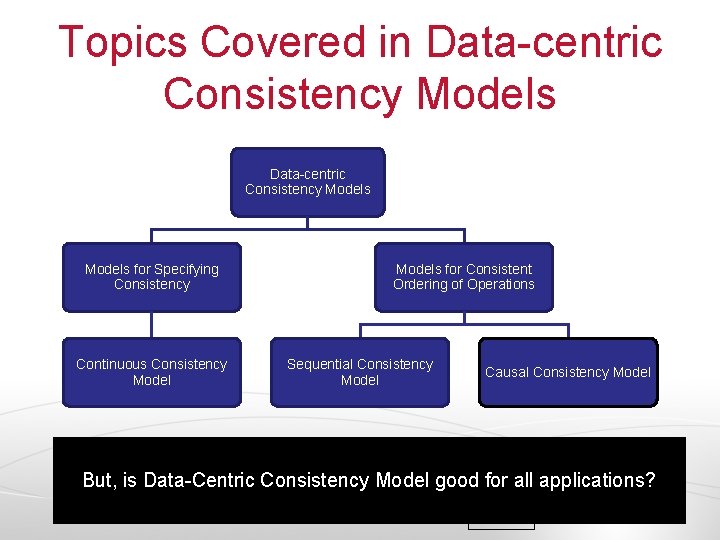
Topics Covered in Data-centric Consistency Models for Specifying Consistency Continuous Consistency Models for Consistent Ordering of Operations Sequential Consistency Model Causal Consistency Model But, is Data-Centric Consistency Model good for all applications? 32
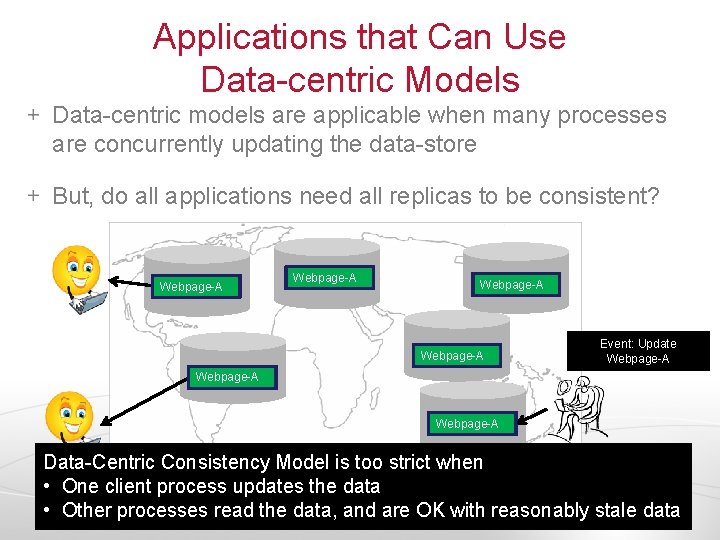
Applications that Can Use Data-centric Models Data-centric models are applicable when many processes are concurrently updating the data-store But, do all applications need all replicas to be consistent? Webpage-A Event: Update Webpage-A Data-Centric Consistency Model is too strict when • One client process updates the data 33 • Other processes read the data, and are OK with reasonably stale data
Overview Consistency Models Data-centric Consistency Models Client-centric Consistency Models Replica Management Replica Server Placement Content Replication and Placement 34
Client-Centric Consistency Models Data-centric models lead to excessive overheads in applications where: A majority operations are reads, and Updates occur infrequently, and are often from one client process For such applications, a weaker form of consistency called Client-centric Consistency is employed for improving efficiency Client-centric consistency models specify two requirements: 1. Eventual Consistency All the replicas should eventually converge on a final value 2. Client Consistency Guarantees A client should be guaranteed some level of consistency while accessing different replicas at different times 35
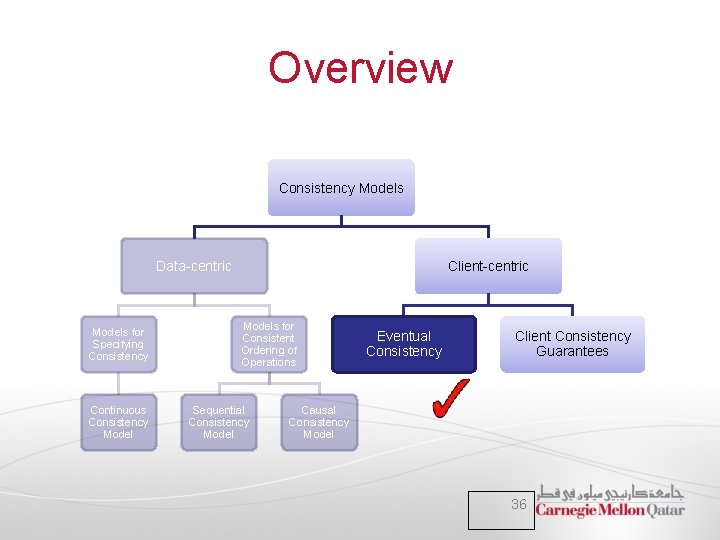
Overview Consistency Models Data-centric Models for Specifying Consistency Continuous Consistency Model Client-centric Models for Consistent Ordering of Operations Sequential Consistency Model Eventual Consistency Client Consistency Guarantees Causal Consistency Model 36
Eventual Consistency Many applications can tolerate inconsistency for a long time Webpage updates, Web Search – Crawling, indexing and ranking, Updates to DNS Server In such applications, it is acceptable and efficient if replicas in the data-store rarely exchange updates A data-store is termed as Eventually Consistent if: All replicas will gradually become consistent in the absence of updates Typically, updates are propagated infrequently in eventually consistent data-stores 37
Designing Eventual Consistency In eventually consistent data-stores, Write-write conflicts are rare Two processes that write the same value are rare Generally, one client updates the data value e. g. , One DNS server updates the name to IP mappings Such rare conflicts can be handled through simple mechanisms, such as mutual exclusion Read-write conflicts are more frequent Conflicts where one process is reading a value, while another process is writing a value to the same variable Eventual Consistency Design has to focus on efficiently resolving such conflicts 38
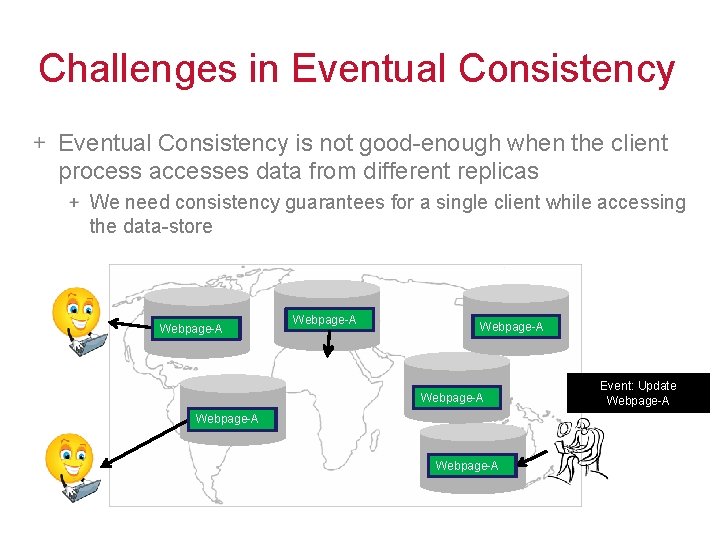
Challenges in Eventual Consistency is not good-enough when the client process accesses data from different replicas We need consistency guarantees for a single client while accessing the data-store Webpage-A Webpage-A Event: Update Webpage-A
Next Class + Client-Centric Consistency Models (Continue) + Replica Management + Consistency Protocols We study “how” consistency is enforced in distributed systems 40
References [1] Terry, D. B. , Demers, A. J. , Petersen, K. , Spreitzer, M. J. , Theimer, M. M. , Welch, B. B. , "Session guarantees for weakly consistent replicated data", Proceedings of the Third International Conference on Parallel and Distributed Information Systems, 1994 [2] Lili Qiu, Padmanabhan, V. N. , Voelker, G. M. , “On the placement of Web server replicas”, Proceedings of IEEE INFOCOM 2001. [3] Rabinovich, M. , Rabinovich, I. , Rajaraman, R. , Aggarwal, A. , “A dynamic object replication and migration protocol for an Internet hosting service”, Proceedings of IEEE International Conference on Distributed Computing Systems (ICDCS), 1999 [4] http: //www. cdk 5. net 41
- Slides: 41