ClusterGrid Computing Maya Haridasan Motivation for ClustersGrids Many
- Slides: 40
Cluster/Grid Computing Maya Haridasan
Motivation for Clusters/Grids Many science and engineering problems today require large amounts of computational resources and cannot be executed in a single machine. Large commercial supercomputers are very expensive… A lot of computational power is underutilized around the world in machines sitting idle.
Overview: Clusters x Grids Network of Workstations (NOW) - How can we use local networked resources to achieve better performance for large scale applications? How can we put together geographically distributed resources (including the Berkeley NOW) to achieve even better results?
Is this the right time? Did we have the necessary infrastructure to be trying to address the requirements of cluster computing in 1994? Do we have the necessary infrastructure now to start thinking of grids? More on this later…
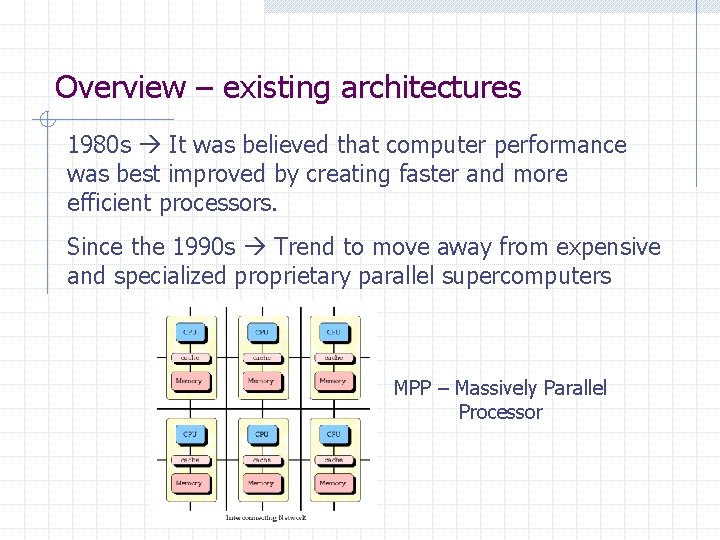
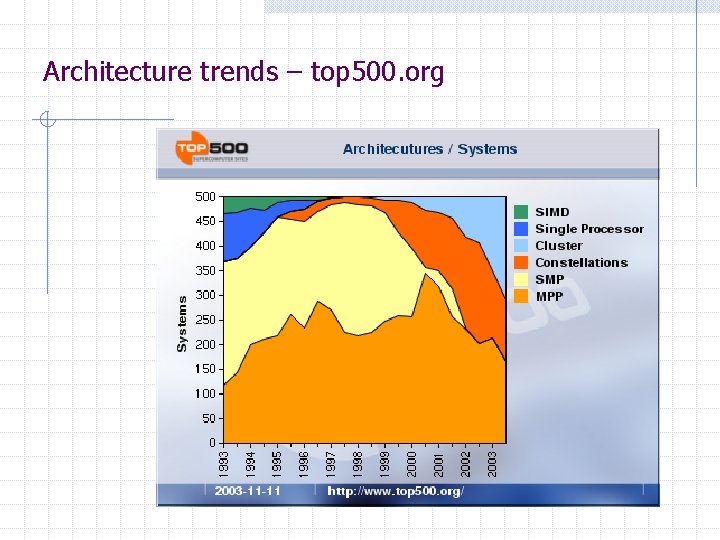
Overview – existing architectures 1980 s It was believed that computer performance was best improved by creating faster and more efficient processors. Since the 1990 s Trend to move away from expensive and specialized proprietary parallel supercomputers MPP – Massively Parallel Processor
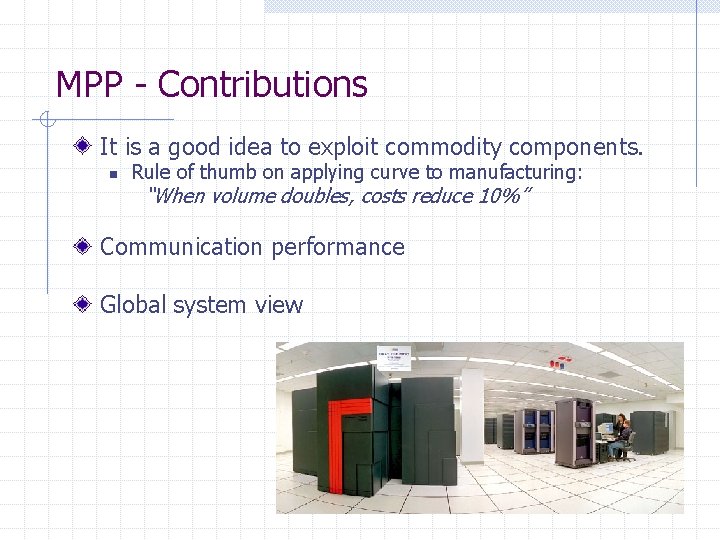
MPP - Contributions It is a good idea to exploit commodity components. n Rule of thumb on applying curve to manufacturing: “When volume doubles, costs reduce 10%” Communication performance Global system view
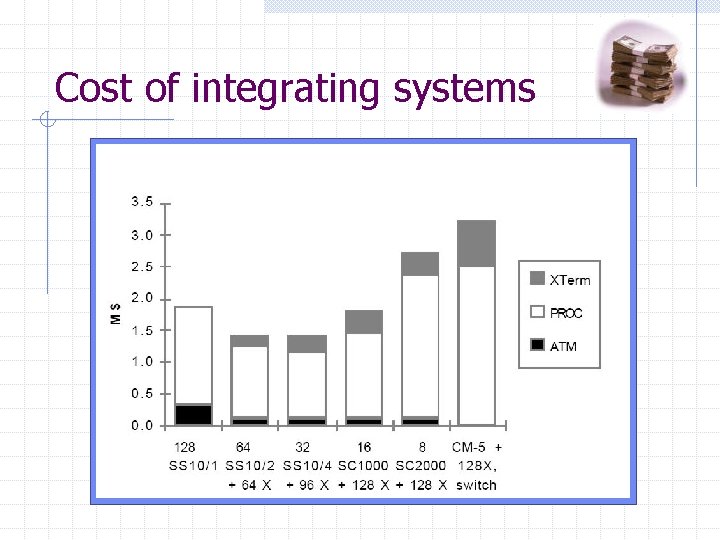
MPP-Lessons It is a good idea to exploit commodity components. But it is not enough. n Need to exploit the full desktop building block Communication performance can be further improved through the use of lean communication layers (von Eicken et al. )
Cost of integrating systems
Definition of cluster computing Fuzzy definition Collection of computers on a network that can function as a single computing resource through the use of additional system management software Can any group of Linux machines dedicated to a single purpose can be called a cluster? Dedicated/non-dedicated, homogeneous/nonhomogeneous, packed/geographically distributed? ? ?
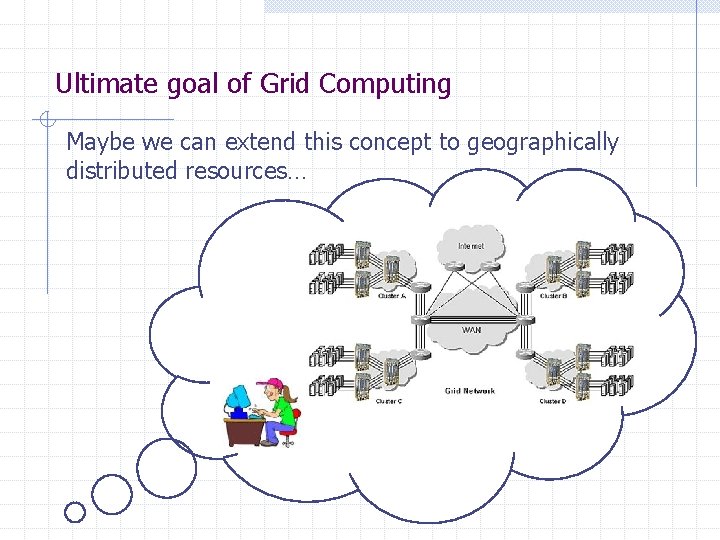
Ultimate goal of Grid Computing Maybe we can extend this concept to geographically distributed resources…
Why are NOWs a good idea now? The “killer” network n Higher link bandwidth n Switch based networks n Interfaces simple & fast The “killer” workstation n Individual workstations are becoming increasingly powerful
NOW - Goals Harness the power of clustered machines connected via high-speed switched networks Use of a network of workstations for ALL the needs of computer users Make it faster for both parallel and sequential jobs
NOW - Compromise It should deliver at least the interactive performance of a dedicated workstation… While providing the aggregate resources of the network for demanding sequential and parallel programs
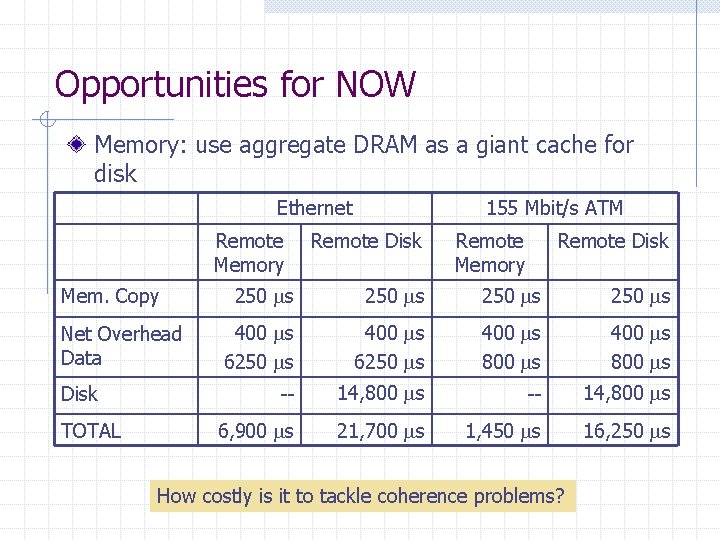
Opportunities for NOW Memory: use aggregate DRAM as a giant cache for disk Ethernet Remote Memory Mem. Copy Net Overhead Data Disk TOTAL 155 Mbit/s ATM Remote Disk Remote Memory Remote Disk 250 s 400 s 6250 s 400 s 800 s -- 14, 800 s 6, 900 s 21, 700 s 1, 450 s 16, 250 s How costly is it to tackle coherence problems?
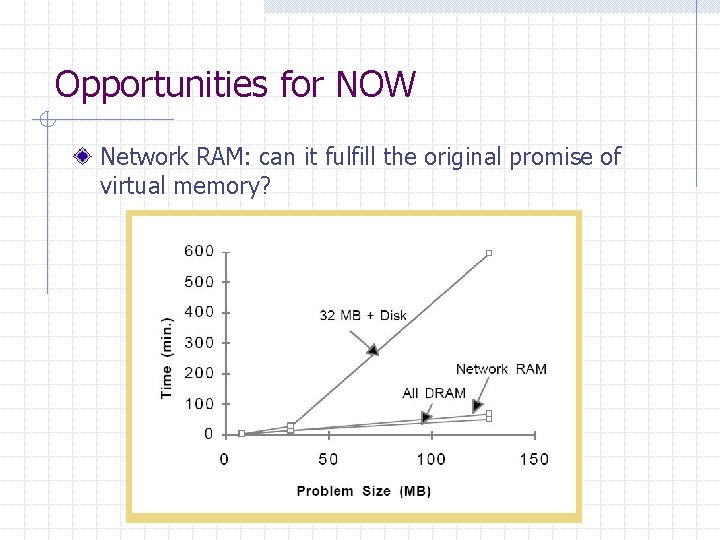
Opportunities for NOW Network RAM: can it fulfill the original promise of virtual memory?
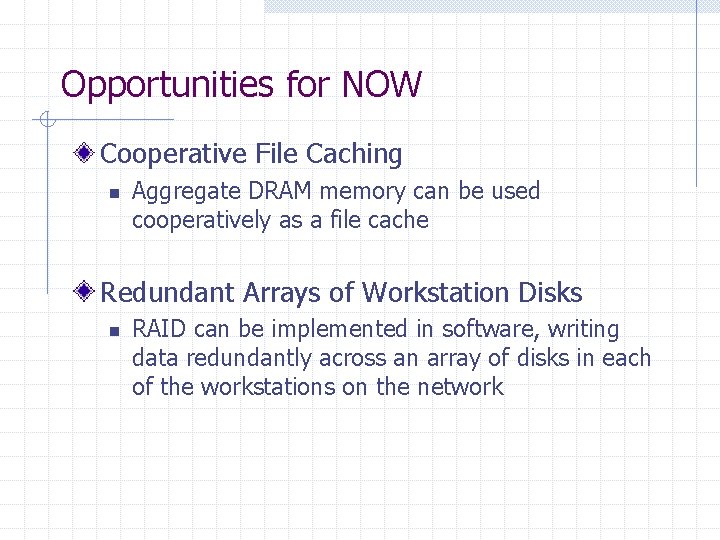
Opportunities for NOW Cooperative File Caching n Aggregate DRAM memory can be used cooperatively as a file cache Redundant Arrays of Workstation Disks n RAID can be implemented in software, writing data redundantly across an array of disks in each of the workstations on the network
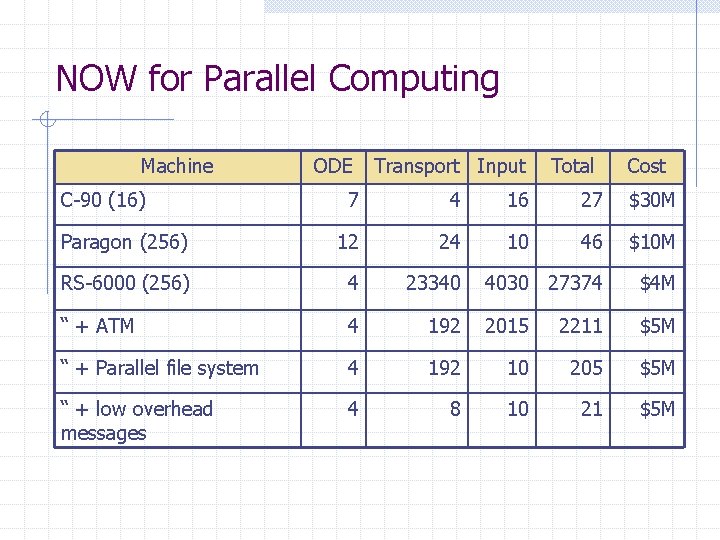
NOW for Parallel Computing Machine C-90 (16) ODE Transport Input Total Cost 7 4 16 27 $30 M Paragon (256) 12 24 10 46 $10 M RS-6000 (256) 4 23340 4030 27374 $4 M “ + ATM 4 192 2015 2211 $5 M “ + Parallel file system 4 192 10 205 $5 M “ + low overhead messages 4 8 10 21 $5 M
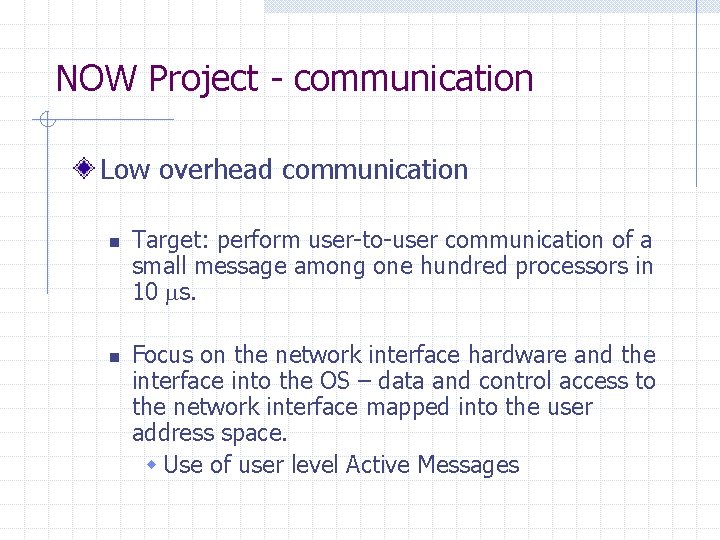
NOW Project - communication Low overhead communication n n Target: perform user-to-user communication of a small message among one hundred processors in 10 s. Focus on the network interface hardware and the interface into the OS – data and control access to the network interface mapped into the user address space. w Use of user level Active Messages
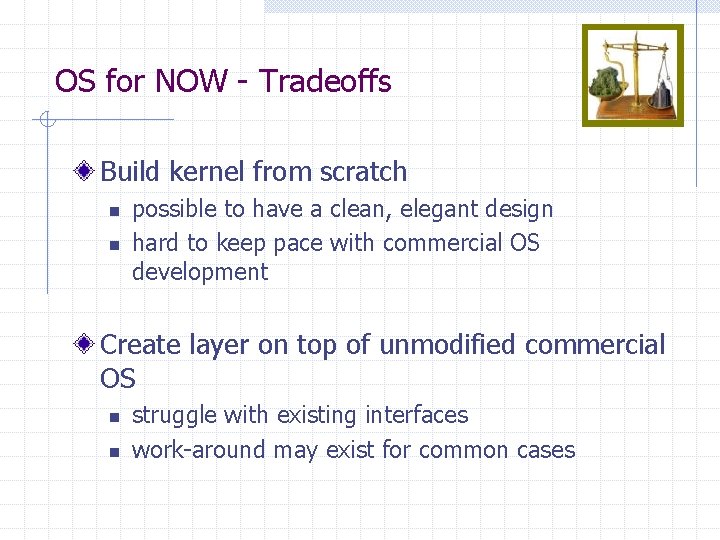
OS for NOW - Tradeoffs Build kernel from scratch n n possible to have a clean, elegant design hard to keep pace with commercial OS development Create layer on top of unmodified commercial OS n n struggle with existing interfaces work-around may exist for common cases
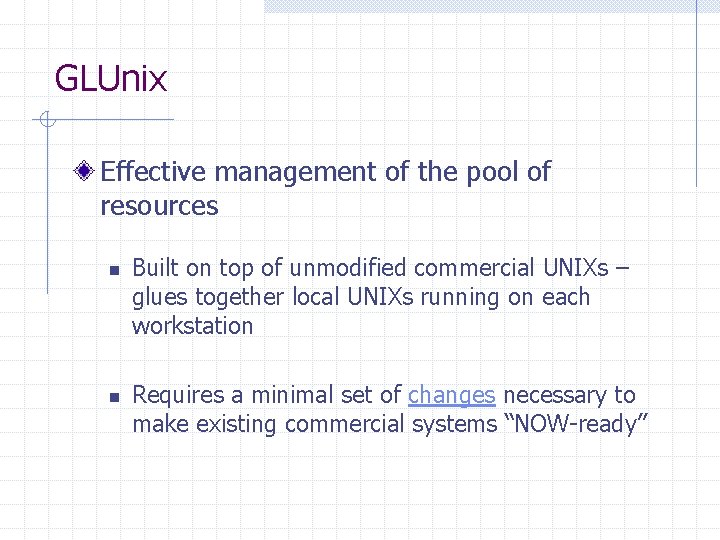
GLUnix Effective management of the pool of resources n n Built on top of unmodified commercial UNIXs – glues together local UNIXs running on each workstation Requires a minimal set of changes necessary to make existing commercial systems “NOW-ready”
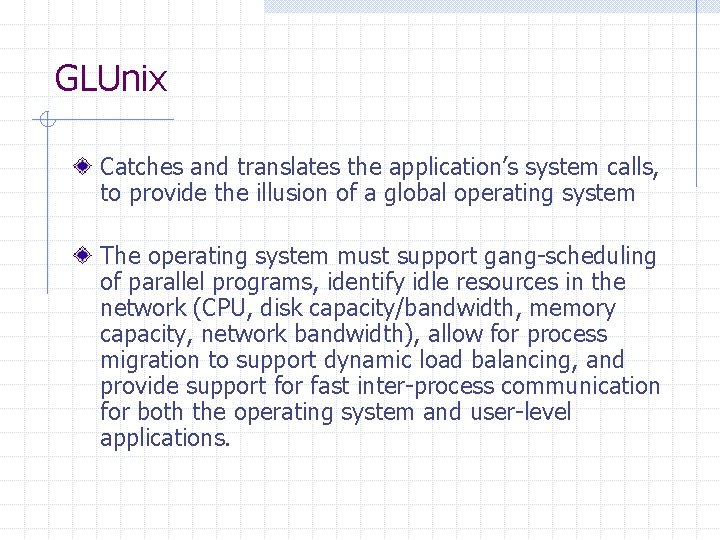
GLUnix Catches and translates the application’s system calls, to provide the illusion of a global operating system The operating system must support gang-scheduling of parallel programs, identify idle resources in the network (CPU, disk capacity/bandwidth, memory capacity, network bandwidth), allow for process migration to support dynamic load balancing, and provide support for fast inter-process communication for both the operating system and user-level applications.
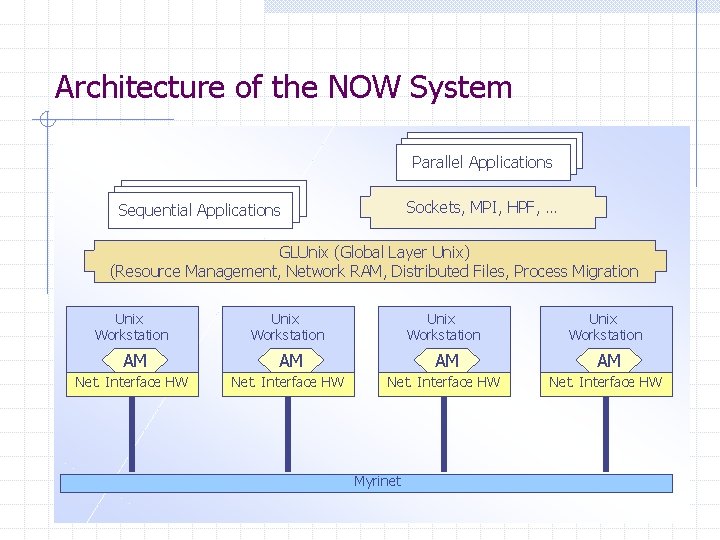
Architecture of the NOW System Parallel Applications Sockets, MPI, HPF, … Sequential Applications GLUnix (Global Layer Unix) (Resource Management, Network RAM, Distributed Files, Process Migration Unix Workstation AM AM Net. Interface HW Myrinet
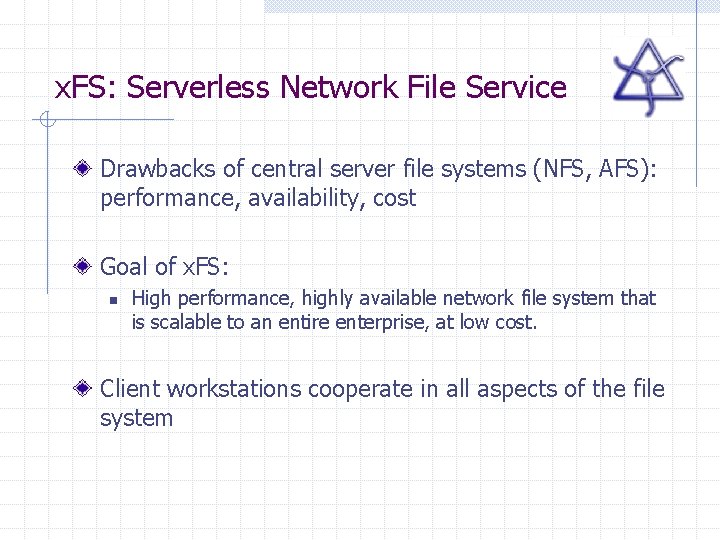
x. FS: Serverless Network File Service Drawbacks of central server file systems (NFS, AFS): performance, availability, cost Goal of x. FS: n High performance, highly available network file system that is scalable to an entire enterprise, at low cost. Client workstations cooperate in all aspects of the file system
Cluster Computing - challenges Software to create a single system image Fault tolerance Debugging tools Job scheduling All these have been/are being addressed since then and are leading towards a successful era for cluster computing
NOW - Similar work Beowulf project: approaches the use of dedicated resources (PCs) to achieve higher performance, instead of using idle resources - (more targeted towards high performance computing? ). Tries to achieve the best overall cost/performance ratio. What is the best approach? Is sharing of idle cycles (as opposed to a dedicated cluster) actually a practical and scalable idea? How to control the use of resources?
Architecture trends – top 500. org
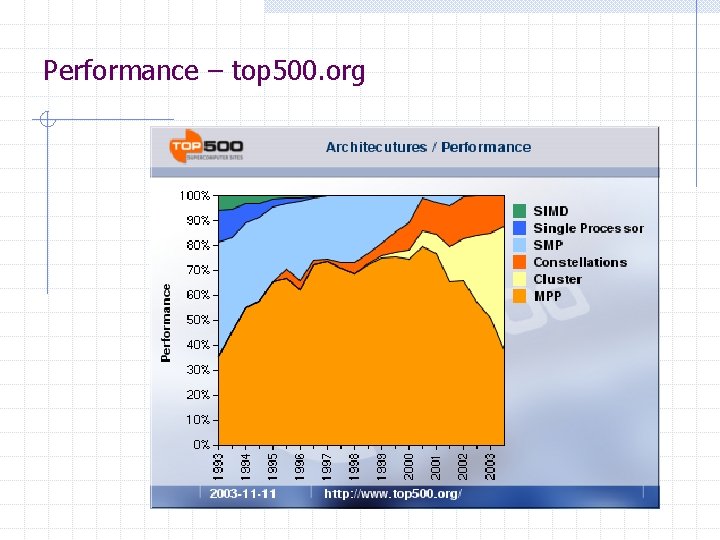
Performance – top 500. org
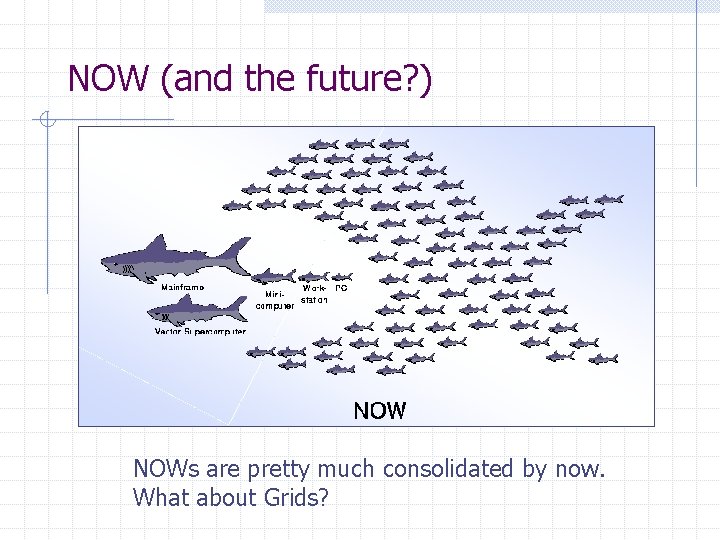
NOW (and the future? ) NOWs are pretty much consolidated by now. What about Grids?
Why are Grids a good idea now? Our computational needs are infinite, whereas our financial resources are finite. Extends the original ideas of Internet to share widespread computing power, storage capacities, and other resources Ultimate goal of turning computational power seamlessly accessible the same way as electrical power. Imagine connecting to an outlet and being able to use the computational resources you need. Challenging and attractive, isn't it?
But are we ready for grid computing? Can we ignore the communication cost in a large area setting? n Only embarrassingly parallel applications could possibly achieve better performance And once again: sharing idle resources can be unfair – can we control the use of resources? Many large scale applications deal with large amounts of data. Doesn’t this stress the weaker link between the end user and the grid? And what about security? ? ?
Up-to-Date Definition of a Grid (Ian Foster) A grid should satisfy three requirements: n Coordinates resources that are not subject to centralized control n Uses standard, open, general-purpose protocols and interfaces n Delivers nontrivial qualities of service Does Legion satisfy these requirements? ? ?
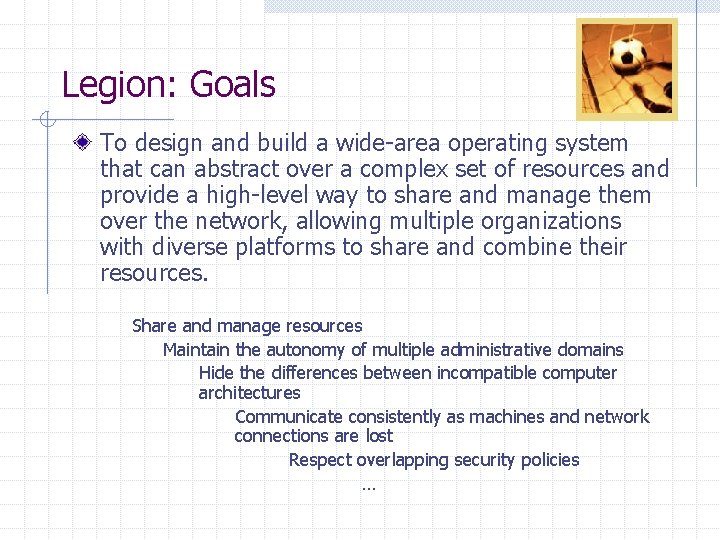
Legion: Goals To design and build a wide-area operating system that can abstract over a complex set of resources and provide a high-level way to share and manage them over the network, allowing multiple organizations with diverse platforms to share and combine their resources. Share and manage resources Maintain the autonomy of multiple administrative domains Hide the differences between incompatible computer architectures Communicate consistently as machines and network connections are lost Respect overlapping security policies …
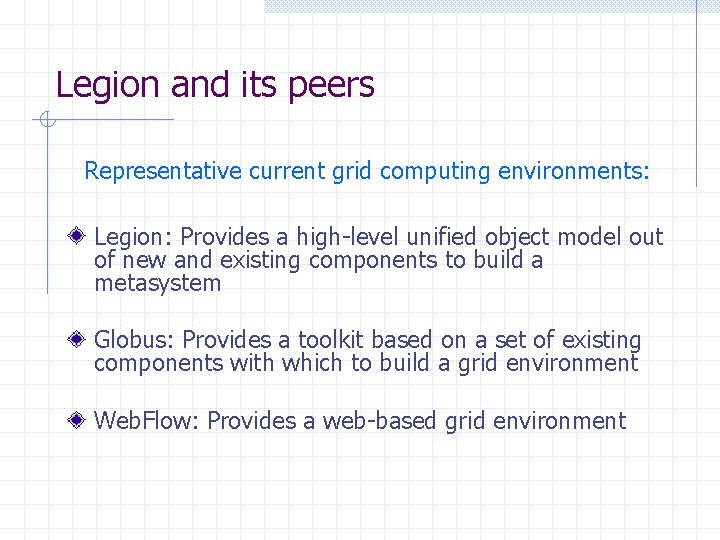
Legion and its peers Representative current grid computing environments: Legion: Provides a high-level unified object model out of new and existing components to build a metasystem Globus: Provides a toolkit based on a set of existing components with which to build a grid environment Web. Flow: Provides a web-based grid environment
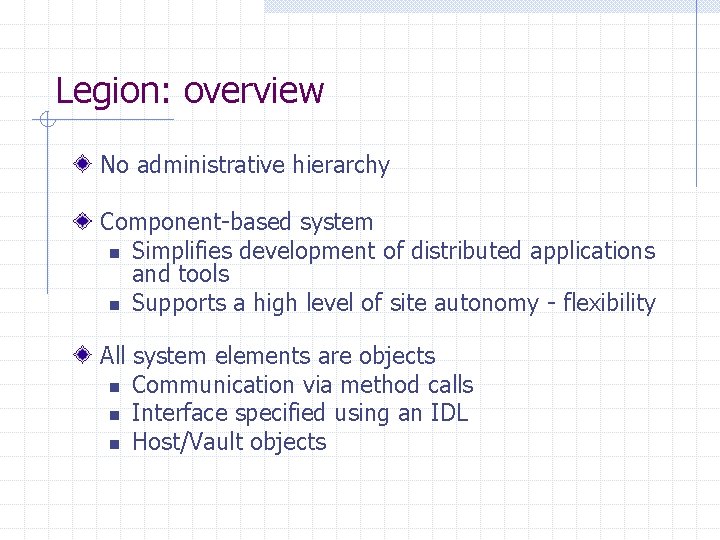
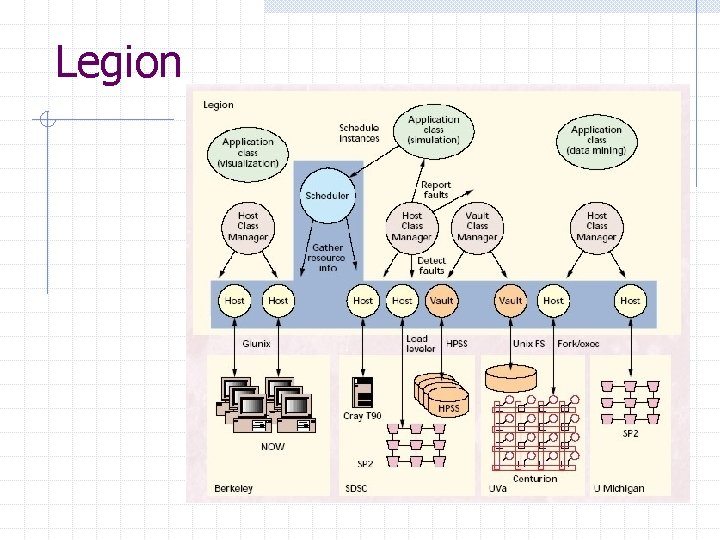
Legion: overview No administrative hierarchy Component-based system n Simplifies development of distributed applications and tools n Supports a high level of site autonomy - flexibility All system elements are objects n Communication via method calls n Interface specified using an IDL n Host/Vault objects
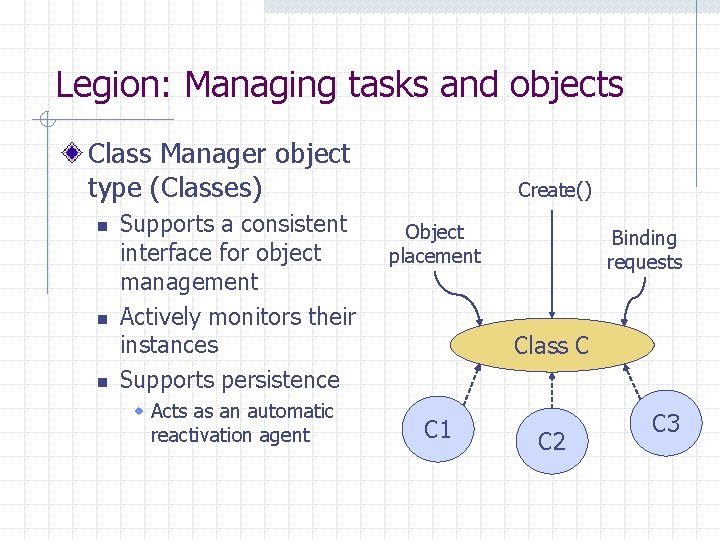
Legion: Managing tasks and objects Class Manager object type (Classes) n n n Supports a consistent interface for object management Actively monitors their instances Supports persistence w Acts as an automatic reactivation agent Create() Object placement Binding requests Class C C 1 C 2 C 3
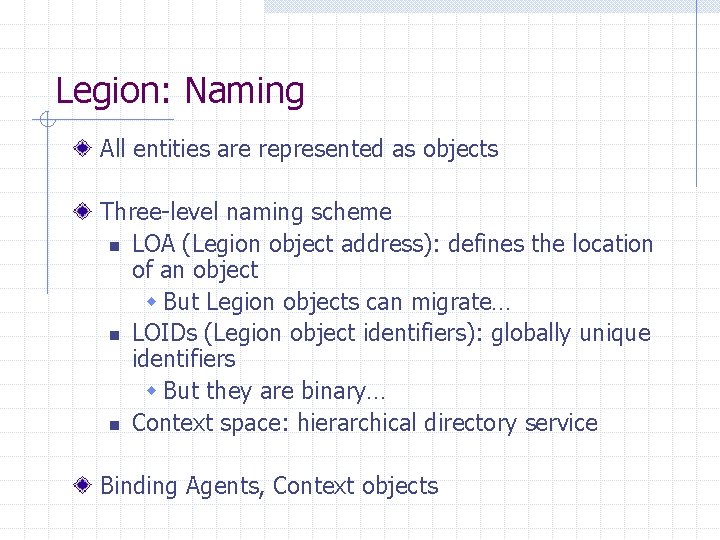
Legion: Naming All entities are represented as objects Three-level naming scheme n LOA (Legion object address): defines the location of an object w But Legion objects can migrate… n LOIDs (Legion object identifiers): globally unique identifiers w But they are binary… n Context space: hierarchical directory service Binding Agents, Context objects
Legion
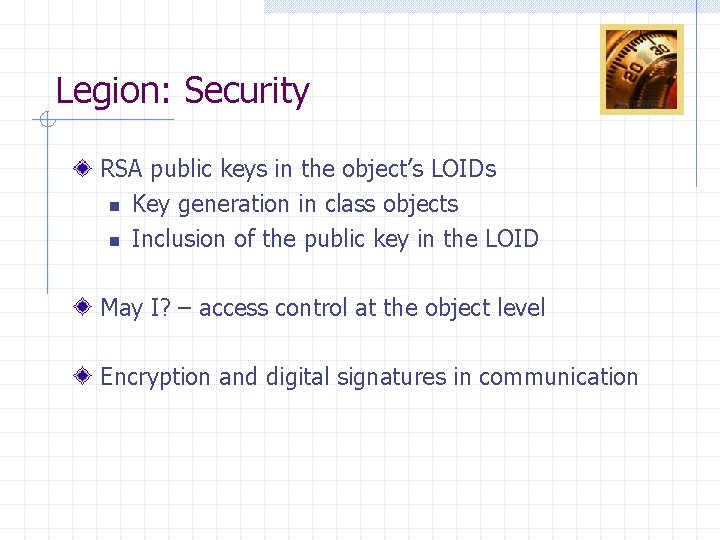
Legion: Security RSA public keys in the object’s LOIDs n Key generation in class objects n Inclusion of the public key in the LOID May I? – access control at the object level Encryption and digital signatures in communication
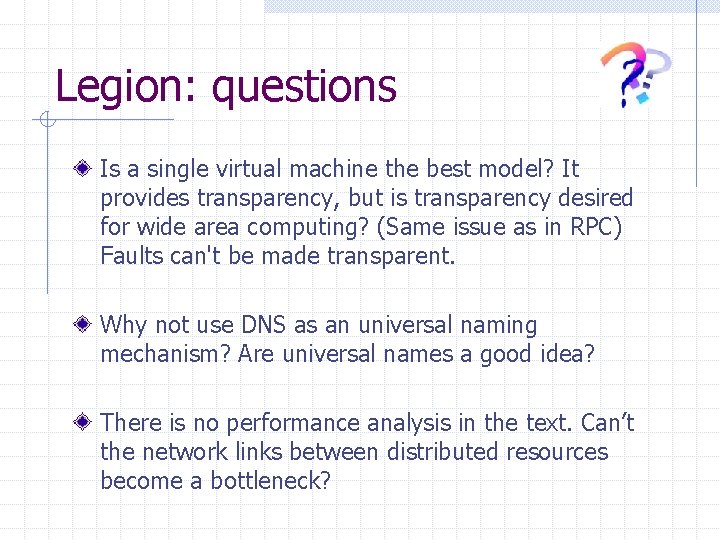
Legion: questions Is a single virtual machine the best model? It provides transparency, but is transparency desired for wide area computing? (Same issue as in RPC) Faults can't be made transparent. Why not use DNS as an universal naming mechanism? Are universal names a good idea? There is no performance analysis in the text. Can’t the network links between distributed resources become a bottleneck?
Conclusions? Cluster computing has already been consolidating its place in the realm of large scale applications – prone to be used in several different settings. Grid computing is still a very new field and has only been successfully used for embarassingly parallel applications. Do we know where we are heading (grid computing)? n It’s hard to predict if grid computing will actually become a reality as originally envisioned. Many challenges still need to be overcome, and the role it should play is still not very clear.