Chapter 2 The Judiciary Part II Constraints on
- Slides: 34
Chapter 2 - The Judiciary Part II: Constraints on Judicial Power
Chapter 2: Constraints on Judicial Power This will cover the second half of Chapter 2 on the Judiciary Pages 86 -120 In addition, you will need to skim the majority opinion in Evenwel v. Abbott (2016) of Justice Ginsburg. I want you to more carefully read the syllabus of the case (this is the summary). I would suggest reading this after you read Baker v. Carr. You can find the case here: http: //www. supremecourt. gov/opinions/15 pdf/14 -940_ed 9 g. pdf
This Lecture… This lecture is broken down into three section on Article III powers They are how federal courts decide whether they will hear a case Jurisdiction Authority to hear a case Justiciability Is it appropriate for a federal court to grant relief Standing Is it the right party bringing the case This is a bigger issue in criminal procedure cases
Jurisdiction is listed in Article III, Section 2 Marbury v. Madison is the final word on original jurisdiction Congress can alter appellate jurisdiction Exceptions Clause Can Congress remove appellate jurisdiction?
Ex Parte Mc. Cardle (1869) Question: Can Congress remove the Court’s appellate jurisdiction in a particular area of cases? Facts of the case The plaintiff wrote against anti-Reconstruction Acts He was a journalist and wrote against them and was jailed He sought relief under an 1867 act, but Congress repealed the act in 1868 which had granted up habeas corpus relief Answer Yes, the Congress can grant appellate jurisdiction, but also remove it
Is Mc. Cardle still good law? The answer is a definite “maybe” Hamdan v. Rumsfeld (2006) This is a long a complicated opinion with three dissents and two concurrences Could any court hear habeas corpus petitions from Guantanamo Bay detainees? Congress said no It was decided on other grounds Roberts recused himself The Court also did not address the question in Boumediene v. Bush (2008)
Justiciability There are no advisory opinions of the Court Mootness Sometimes a case may be no longer in controversy by the time it reaches the Court Roe v. Wade? Ripeness A case brought too early Hypothetical threat vs. harm
Political Questions The Court tends not to involve itself in what some deem “political questions” Luther v. Borden (1849) Case from Rhode Island involving the Guarantee Clause The United States shall guarantee to every state in the Union a Republican Form of Government … Chief Justice Taney said any cases involving the Guarantee Clause were non-justiciable Goldwater v. Carter (1979) Challenge by members of Congress as to whether President Carter could unilaterally challenge the Sino-American Treaty Court ruled this a political question Treaty replaced by the Taiwan Relations act of 1979
Colegrove v. Green (1946) Involved congressional redistricting in Illinois The variation in population of the seats ranged from around 100 k to over 900 k Justice Frankfurter (for a 4 -3 plurality) ruled that this was a political question, thus nonjusticiable “Courts ought not enter the political thicket” But: How could the urban dwellers, who were systematically underrepresented ever undo this? Why would the rural people give up their advantage? Compare this to the Texas primary cases Is this not a violation of the 14 th Amendment’s equal protection requirement Justice Black, dissenting: “it is a mere "play upon words" to refer to a controversy such as this as "political" in the sense that courts have nothing to do with protecting and vindicating the right of a voter to case an effective ballot. The Classic case, among myriads of others, refutes the contention that courts are impotent in connection with evasions of all "political" rights”. ”
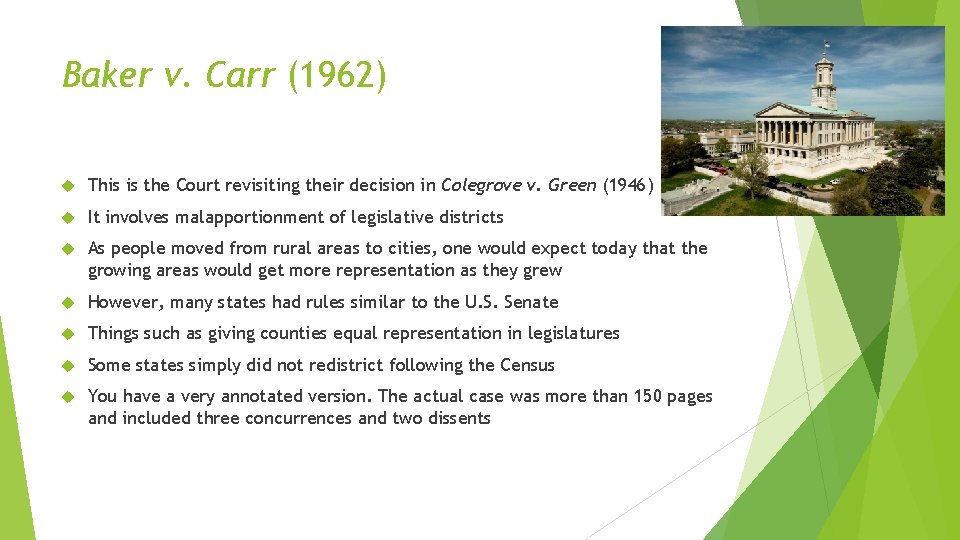
Baker v. Carr (1962) This is the Court revisiting their decision in Colegrove v. Green (1946) It involves malapportionment of legislative districts As people moved from rural areas to cities, one would expect today that the growing areas would get more representation as they grew However, many states had rules similar to the U. S. Senate Things such as giving counties equal representation in legislatures Some states simply did not redistrict following the Census You have a very annotated version. The actual case was more than 150 pages and included three concurrences and two dissents
Baker v. Carr- II The challenging party was from Shelby County (Memphis)- A Republican Tennessee failed to redistrict This led to rural overrepresentation (mostly Democratic at the time) Justice Clark, concurring: “The majority of voters have been caught up in a legislative straight jacket” Clark seemed to think judicial intervention was the only solution to this problem Colegrove had said that any challenges to legislative district maps was a political question- thus they would not touch it- leave it to the political process But- When a minority gains power and refuses to give it up- can the political process correct the situation? When is it proper for the judicial branch to step in? What does the Court base its decision on? Equal Protection or Guaranty Clause? Do they overrule Luther?
Baker v. Carr- III It turns out that this is one of the most important cases of Constitutional Law and the keystone of Voting Rights Law It establishes the doctrine of “one man, one vote” Notice what the Court did not do in this case- it was only a remand to the district court Leads to decisions in Wesberry v. Sanders and Reynolds v. Sims Those cases say U. S. House and State Legislative Districts must be of roughly equal size Failure to equalize population violates Equal Protection
Baker v. Carr- IV Notice the dissent of Frankfurter (joined by Harlan) He thinks that the majority is playing loose with terms That this is really a Guarantee Clause case But the majority is simply calling it equal protection They did not want to get into the weeds of apportionment and redistricting battles
Baker v. Carr- V Brennan tried to describe what he saw as what might constitute political questions on Page 217 of the opinion: "Textually demonstrable constitutional commitment of the issue to a coordinate political department; " Foreign affairs and executive war powers "A lack of judicially discoverable and manageable standards for resolving it; " "The impossibility of deciding without an initial policy determination of a kind clearly for non-judicial discretion; " "The impossibility of a court's undertaking independent resolution without expressing lack of the respect due coordinate branches of government; " "An unusual need for unquestioning adherence to a political decision already made; " "The potentiality of embarrassment from multifarious pronouncements by various departments on one question. "
Evenwel v. Abbott (2016) This is a case from Texas challenging the way that State Senate districts are drawn Districts are currently drawn with equal numbers of residents, not voters This means that districts with high amounts of citizens over the age of 18 will have the most potentially eligible voters And those with large populations of children and non-citizens will have less voters
On Political Gerrymandering… A Standard or Lack of? In Davis v. Bandemer (1986), the Supreme Court unanimously held that questions of political gerrymandering were justiciable When the got the case of Vieth v. Jubelirer (2004), four justices held that since no one could agree on a standard for review, it was therefore nonjusticiable However, they could not agree on a standard to measure it One got a similar outcome in League of United Latin American Citizens v. Perry (2006) These cases stand for the proposition that even if a subject is justiciable, one needs a majority of the Court do come up with a standard Wisconsin case
Nixon v. United States (1993) Nixon (he relation to Richard) was convicted of lying to a grand jury in a case where he had helped the son of a business partner get a drug case dismissed and for taking bribes in a sweetheart deal He was convicted and sentenced but refused to resign his judgeship He continued to receive a salary while serving a five year sentence He was impeached by the House and removed by the Senate He said they failed to hold a trial in Senate- that a committee could not hear the case The Court held that this was a political question Rehnquist goes right to the political questions in Baker v. Carr He focused on the word “sole” and “try”- They got to determine how they try a case No justifiably manageable standard The Legislature was chosen for impeachment, not the judiciary Checks and balances are the two braches roles Rehnquist was later the presider over the impeachment trial of President Clinton Nixon was re-admitted to the Mississippi Bar in 1993
More on Political Questions II Bush v. Gore (2000) Could this have been more political? It decided the election Were they ruling on Florida election laws? Based on dubious legal grounds, especially for the majority The conservative justices had never been big to rule for equal protection claims The Constitution sets the real arbiter of presidential elections to be the U. S. House See Article II, Section 1 Zivotofsky v. Clinton (2012) How would a US passport be listed for a citizen born in Israel? Jerusalem or Israel? The State Department said Jerusalem Federal said Israel The Court said Israel, saying it was an issue of statutory law
Standing to Sue If you take a course in criminal procedure with Professor Yates, this will be an enormous issue in search and seizure cases One has to allege some harm to bring a lawsuit Not everyone can bring a lawsuit Lujan v. Defenders of Wildlife (1992) facts to justify standing The party must have suffered a concrete loss or injury or be in imminent danger of such a loss The injury must be fairly traceable to the challenged action of the defendant The party must show a favorable result is likely to provide redress The Court found that the Defenders of Wildlife lacked standing
Taxpayer Standing? Frothingham v. Mellon (1923) This case involved a challenge to the constitutionality of the Towner Maternity Act of 1921 which was designed to reduce infant mortality by giving aid to states The plaintiff in the case said she had standing because she did not want her tax dollars to fund this program The Court said she did not have standing To have standing, the plaintiff has to show that she has sustained or immediately in danger of sustaining some direct harm as a result of the enforcement Specific harm, not general harm This case barred most “taxpayer” suits for 45 years
Flast v. Cohen (1968) Several plaintiffs challenged spending under the Elementary and Secondary Education Act of 1965 They were worried some of the funding would go to religious schools, thus violating the Establishment Clause of the First Amendment The Court ends up relaxing the rules from Frothingham The two part “nexus” test Taxpayer must establish a logical link between that status and the type of legislative enactment attacked Only exercises of the spending power under Article 1, Section 8 Taxpayer must establish a nexus between that status and the precise nature of the constitutional infringement alleged The enactment goes beyond powers delegated under Article 1, Section 8
Flast v. Cohen- II How is this distinguished from Frothingham? They say it is because in this case, the spending power is limited by the First Amendment Establishment Clause But didn’t Frothingham allege a violation of the 10 th Amendment? The Court says that Frothingham was different in that she wanted to simply air her grievances over the federal government spending money on programs she did not like them spending money on Justice Harlan would have kept the Frothingham doctrine in place and not given the taxpayers in this case standing
Subsequent Cases After Flast, the Court has tightened up on standing Hein v. Freedom from Religion Foundation (2007) Challenge to spending by the Office of Faith Based and Community Initiatives for using money to promote religious groups over secular ones The Court found no standing- did not meet the Flast standard Scalia, concurring, suggested either applying Flast or overruling it This has led some to believe that the Court is moving back towards Frothingham Arizona Christian School Tuition Organization v. Winn (2011) Tax credits were used to fund religious schools Court said no taxpayer standing because the state does not “extract” the funds Kagan said it looks like the goal is no taxpayer standing to bring lawsuits
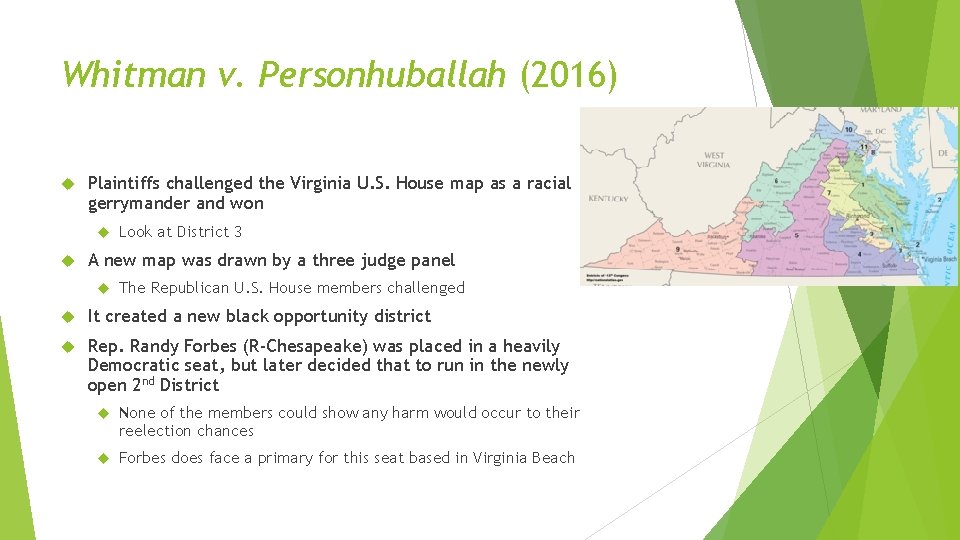
Whitman v. Personhuballah (2016) Plaintiffs challenged the Virginia U. S. House map as a racial gerrymander and won Look at District 3 A new map was drawn by a three judge panel The Republican U. S. House members challenged It created a new black opportunity district Rep. Randy Forbes (R-Chesapeake) was placed in a heavily Democratic seat, but later decided that to run in the newly open 2 nd District None of the members could show any harm would occur to their reelection chances Forbes does face a primary for this seat based in Virginia Beach
Government Based Lawsuits Raines v. Byrd (1997) Both of these cases dealt with the Line Item Veto Act of 1996 The person challenging in this case was Sen. Robert C. Byrd (D-West Virginia) The Court found that individual members of Congress do not in themselves have standing They have to show injury to themselves, not just institutionally They could find a plaintiff that did suffer injury They could also try to repeal the law Clinton v. City of New York (1998) President Clinton had cancelled several projects in a 1997 law The Court found that the City of New York, which suffered from loss of funding did have standing We will read more on this case as far as the merits in Chapter 4
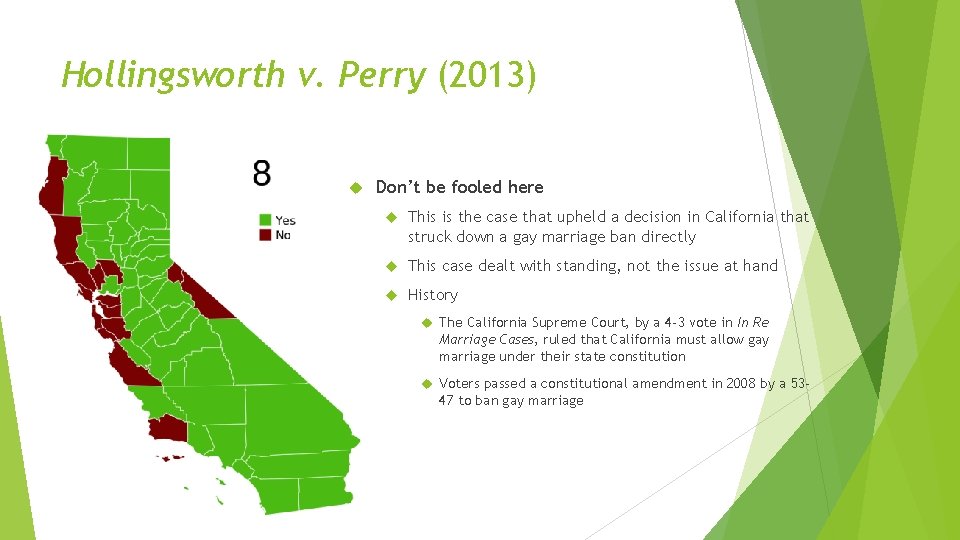
Hollingsworth v. Perry (2013) Don’t be fooled here This is the case that upheld a decision in California that struck down a gay marriage ban directly This case dealt with standing, not the issue at hand History The California Supreme Court, by a 4 -3 vote in In Re Marriage Cases, ruled that California must allow gay marriage under their state constitution Voters passed a constitutional amendment in 2008 by a 53 - 47 to ban gay marriage
Hollingsworth v. Perry- II The plaintiffs in the case challenged Prop 8 on federal constitutional grounds However, Gov. Schwarzenegger, and later Gov. Jerry Brown refused to defend the lawsuit on behalf of the State of California Also Attorney Generals Jerry Brown and Kamala Harris refused to defend it At the district court level, the plaintiff won the case on grounds of Equal Protection and Due Process and the state lacked a rational basis to deny licenses to same sex couples So the question is who (if anyone) would have standing to defend the ballot measure? No question the state had that right, but they decided not to on policy grounds Two groups backing the ban asked to intervene, one led by St. Sen. Dennis Hollingsworth (R-Riverside/San Diego) They were official sponsors of the ballot imitative The district court allowed them to defend the law
Hollingsworth v. Perry- III The California Supreme Court had said that the official backers of the initiative could defend it “they are authorized under California’s law to appear and assert the state’s interest in the initiative’s validity and to appeal a judgment invalidating the measure when public officials who ordinarily defend the measure decline to do so” The 9 th Circuit then said the proponents of Prop 8 had standing, but then also ruled in favor of the plaintiffs striking down Prop 8 The proponents then appealed to the Supreme Court Thus the Court faced two questions: Do the petitioners (proponents) have standing under Article III of the Constitution to argue this case? Does the Equal Protection Clause of the Fourteenth Amendment prohibit the state of California from defining marriage as the union of one man and one woman?
Hollingsworth v. Perry- IV If the Supreme Court answers Question #1 with a no, they do not have to answer Question #2 Look at the lineup of justices on the decision. You don’t see that makeup that often in a 5 -4 decision They find there was no standing in the 9 th Circuit, so they need not decide the ultimate issue Lujan- The litigant has to prove he has suffered a concrete and particularized harm that is fairly traceable to the challenged conduct and it can be redressed by a favorable court decision A sharp and acrimonious disagreement does not cut it Perry won the case and no longer has any injury, and the state refused to appeal The proponents had “no direct stake” in the outcome The Court says it is an interest in vindicating their position
Hollingsworth v. Perry- V But what of the initiative process in California? Proponents collect thousands of signatures and the votes can approve or reject But the Court says that the proponents have no role in the enforcement of Prop 8 There is no particularized interest of the proponents than any other citizen of the State of California under Article III Proponents say they were authorized under California law to defend Prop 8 What of Karcher v. May (1987) The Attorney General of New Jersey (appt. by the Governor) declined to defend the constitutionality of a law The Court found that legislative leaders (the Senate President and Assembly Speaker) could intervene to defend the law However, when they lost those leadership roles, they lost their ability to intervene Their successors declined to defend the law then They were little more than private citizens then
Hollingsworth v. Perry- VI Roberts mentions principal-agent theory The theory would say that the principal has a right to control the agent’s actions The proponents of Prop 8 answer to no one and decide for themselves, with no review They are not elected and cannot be removed People that voted for Prop 8 may have different motivations in how they did so They are thus not agents of the state California could set its own standing rules for state courts, but not in federal courts
Hollingsworth v. Perry- VII Kennedy’s dissent (Kennedy is from California) His father worked in and around state government, as did Kennedy as a lawyer Remember that this case was released the same day as U. S. v. Windsor, which struck down the Defense of Marriage Act and was also written by Kennedy In that case, the Obama Administration refused to defend the law, so the House Republicans ended up defending DOMA Alito mentions this in his Windsor dissent Can you distinguish the differences in these cases, where one had standing and the other did not? Karcher v. May? The Court says that the Congress could have injury because they had to refund Windsor money Kennedy thinks the proponents are a small, identifiable group Ballot initiatives are unique- they are to go around elected officials This gave the Governor and Attorney General a de facto veto over the initiative process The Court should have deferred to California’s interpretation of its elections code Kennedy thinks the majority fail to grasp the initiative process
Constraints on Power- Ashwander I The constraints we have discussed in this chapter are from the Court’s reading of Article III and are largely self-imposed Ashwander v. Tennessee Valley Authority (1936)- Brandeis, J. concurring The Court will not pass upon the constitutionality of legislation in a friendly, nonadversary, proceeding, declining because to decide such questions "is legitimate only in the last resort, earnest and vital controversy between individuals. The Court will not "anticipate a question of constitutional law in advance of the necessity of deciding it. It is not the habit of the Court to decide questions of a constitutional nature unless absolutely necessary to a decision of the case. " The Court will not formulate a rule of constitutional law broader than is required by the Precise facts to which it is to be applied.
Ashwander II More of the Ashwander principals The Court will not pass upon a constitutional question although properly presented by the record, if there is also present some other ground upon which the case may be disposed of. The Court will not pass upon the validity of a statute upon complaint of one who fails to show that he is injured by its operation The Court will not pass upon the constitutionality of a statute at the instance of one who has availed himself of its benefits. When the validity of an act of the Congress is drawn in question, and even if a serious doubt of constitutionality is raised, it is a cardinal principle that this Court will first ascertain whether a construction of the statute is fairly possible by which the question may be avoided.