Carpathian Summer School of Physics 2007 Sinaia Romania






- Slides: 56
Carpathian Summer School of Physics 2007 Sinaia, Romania, August 20 th-31 st, 2007 Mirror Nuclei: symmetry breaking and nuclear dynamics Silvia M. Lenzi Dipartimento di Fisica and INFN, Padova, Italy Silvia Lenzi, Carpathian Summer School of Physics 2007, Sinaia, Romania, 20 August 2007
Symmetries help to understand Nature Examination of fundamental symmetries: a key question in Physics conservation laws good quantum numbers In nuclear physics, conserved quantities imply underlying symmetries of the interactions and help to interpret nuclear structure features Silvia Lenzi, Carpathian Summer School of Physics 2007, Sinaia, Romania, 20 August 2007
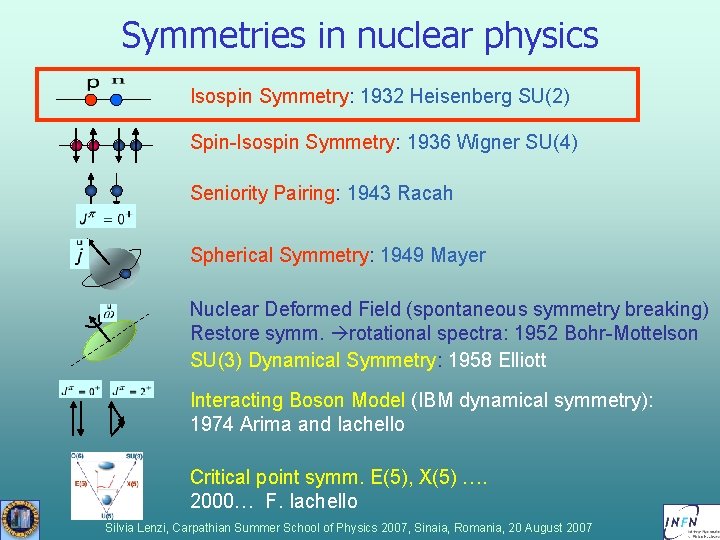
Symmetries in nuclear physics Isospin Symmetry: 1932 Heisenberg SU(2) Spin-Isospin Symmetry: 1936 Wigner SU(4) Seniority Pairing: 1943 Racah Spherical Symmetry: 1949 Mayer Nuclear Deformed Field (spontaneous symmetry breaking) Restore symm. rotational spectra: 1952 Bohr-Mottelson SU(3) Dynamical Symmetry: 1958 Elliott Interacting Boson Model (IBM dynamical symmetry): 1974 Arima and Iachello Critical point symm. E(5), X(5) …. 2000… F. Iachello Silvia Lenzi, Carpathian Summer School of Physics 2007, Sinaia, Romania, 20 August 2007
Outline • • What’s isospin symmetry? Why studying isospin symmetry? How do we study it? Experimental methods Theoretical methods What do we learn from the data? Few illustrative recent examples Silvia Lenzi, Carpathian Summer School of Physics 2007, Sinaia, Romania, 20 August 2007
Bibliography • Isospin in Nuclear Physics, Ed. D. H. Wilkinson, North Holland, Amsterdam, 1969. • Review article on CDE: J. A. Nolen and J. P. Schafer, Ann. Rev. Nucl. Sci 19 (1969) 471; S. Shlomo, Rep. Prog. Phys. 41 (1978) 66; N. Auerbach, Phys. Rep. 98 (1983) 273 • Recent on CDE: J. Duflo and A. P. Zuker, Phys. Rev. C 66 (2002) 051304(R) • Theory on CED: A. P. Zuker, S. M. Lenzi, G. Martinez-Pinedo and A. Poves, Phys. Rev. Lett. 89 (2002) 142502; • Theory on CED: J. A. Sheikh, D. D. Warner and P. Van Isacker, Phys. Lett. B 443 (1998) 16 • Shell model reviews: B. A. Brown, Prog. Part. Nucl. Phys 47 (2001) 517; T. Otsuka, M. Honma, T. Mizusaki and N. Shimitzu, Prog. Part. Nucl. Phys 47 (2001) 319; E. Caurier, G. Martinez-Pinedo, F. Nowacki, A. Poves, and A. P. Zuker, Rev. Mod. Phys. 77 (2005) 427 • Review article on CED: M. A. Bentley and S. M. Lenzi, Prog. Part. Nucl. Phys. (2006). • Review article on N~Z: D. D. Warner, M. A. Bentley, P. Van Isacker, Nature Physics 2, (2006) 311 - 318 Silvia Lenzi, Carpathian Summer School of Physics 2007, Sinaia, Romania, 20 August 2007
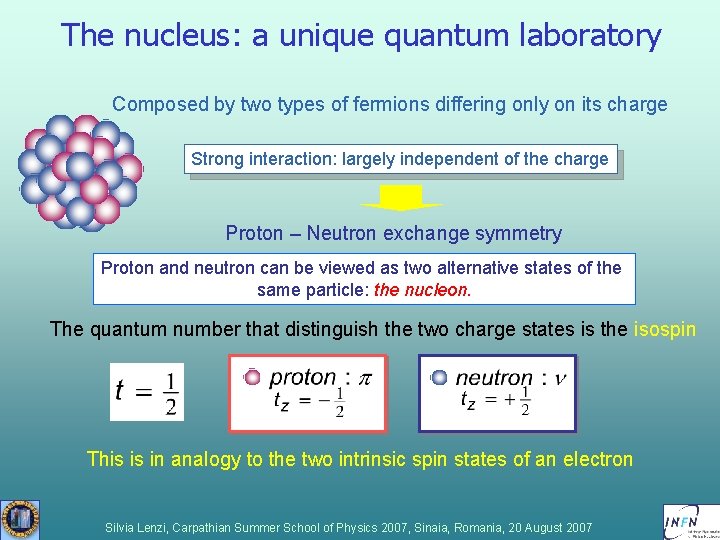
The nucleus: a unique quantum laboratory Composed by two types of fermions differing only on its charge Strong interaction: largely independent of the charge Proton – Neutron exchange symmetry Proton and neutron can be viewed as two alternative states of the same particle: the nucleon. The quantum number that distinguish the two charge states is the isospin This is in analogy to the two intrinsic spin states of an electron Silvia Lenzi, Carpathian Summer School of Physics 2007, Sinaia, Romania, 20 August 2007
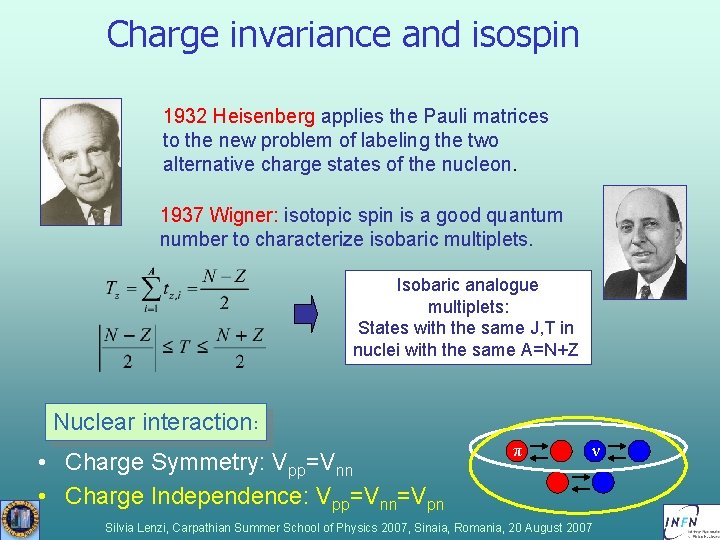
Charge invariance and isospin 1932 Heisenberg applies the Pauli matrices to the new problem of labeling the two alternative charge states of the nucleon. 1937 Wigner: isotopic spin is a good quantum number to characterize isobaric multiplets. Isobaric analogue multiplets: States with the same J, T in nuclei with the same A=N+Z Nuclear interaction: • Charge Symmetry: Vpp=Vnn • Charge Independence: Vpp=Vnn=Vpn π ν Silvia Lenzi, Carpathian Summer School of Physics 2007, Sinaia, Romania, 20 August 2007
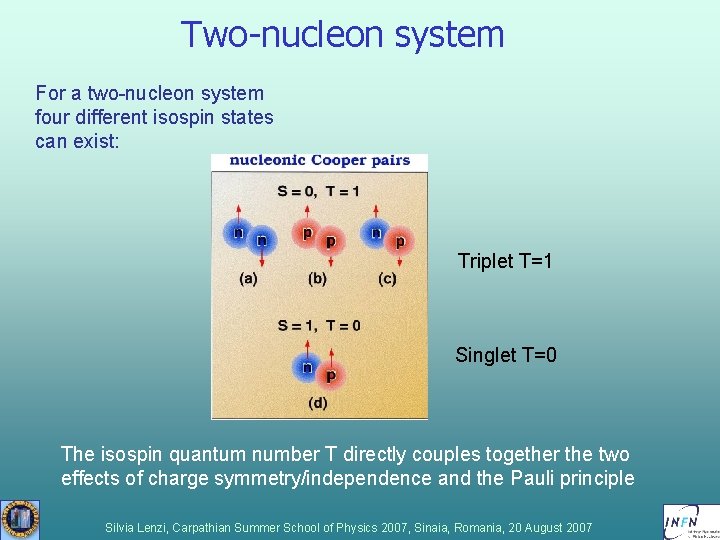
Two-nucleon system For a two-nucleon system four different isospin states can exist: Triplet T=1 Singlet T=0 The isospin quantum number T directly couples together the two effects of charge symmetry/independence and the Pauli principle Silvia Lenzi, Carpathian Summer School of Physics 2007, Sinaia, Romania, 20 August 2007
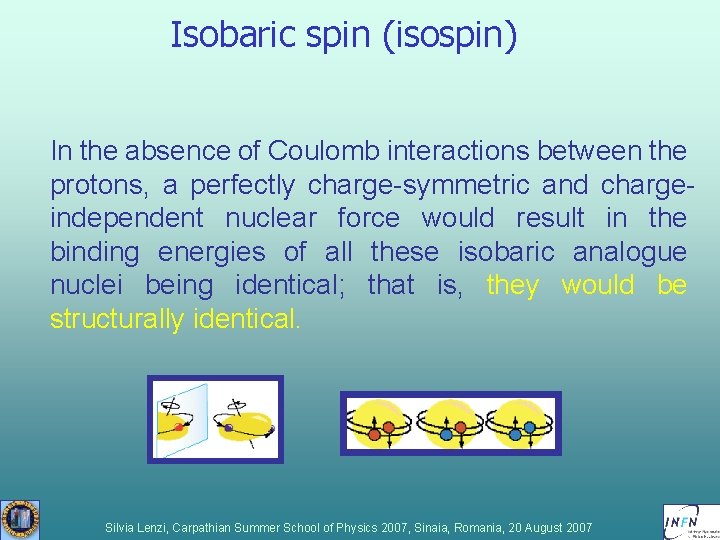
Isobaric spin (isospin) In the absence of Coulomb interactions between the protons, a perfectly charge-symmetric and chargeindependent nuclear force would result in the binding energies of all these isobaric analogue nuclei being identical; that is, they would be structurally identical. Silvia Lenzi, Carpathian Summer School of Physics 2007, Sinaia, Romania, 20 August 2007
Symmetry breaking… Isospin symmetry breakdown, mainly due to the Coulomb field, manifests when comparing mirror nuclei. This constitutes an efficient observatory for a direct insight into nuclear structure properties. Silvia Lenzi, Carpathian Summer School of Physics 2007, Sinaia, Romania, 20 August 2007
IMME and Coulomb Displacement Energies IMME: Isobaric Multiplet Mass Equation a: isoscalar (~100 Me. V) b: isovector (~10 Me. V) c: isotensor (~300 ke. V) For a set of isobaric analogue states, the difference between the masses or BE of two neighbours defines the CDE + /2 π= 5 J /2 T=3 CDE Nolen-Schiffer anomaly: calculated CDE underestimate the data by 7% (100’s ke. V) Recent works show that this discrepancy can be reduced to the order of ~200 ke. V The understanding of Coulomb effects at the level of less than 100 ke. V seemed likely to be very difficult… Silvia Lenzi, Carpathian Summer School of Physics 2007, Sinaia, Romania, 20 August 2007
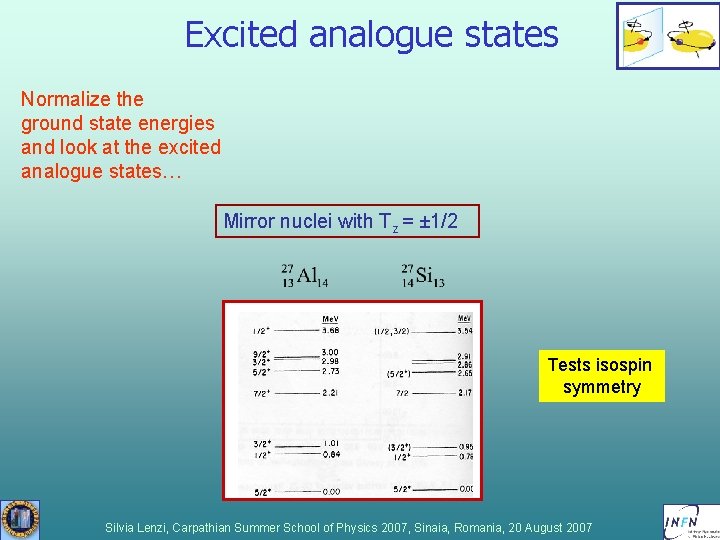
Excited analogue states Normalize the ground state energies and look at the excited analogue states… Mirror nuclei with Tz = ± 1/2 Tests isospin symmetry Silvia Lenzi, Carpathian Summer School of Physics 2007, Sinaia, Romania, 20 August 2007
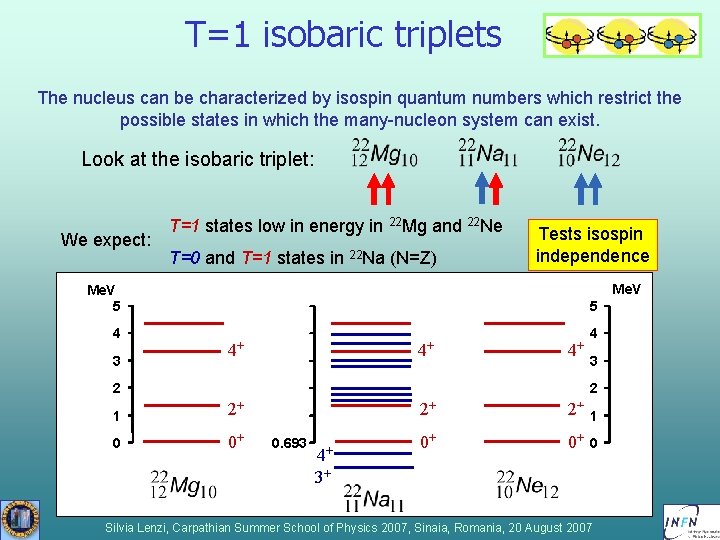
T=1 isobaric triplets The nucleus can be characterized by isospin quantum numbers which restrict the possible states in which the many-nucleon system can exist. Look at the isobaric triplet: We expect: T=1 states low in energy in 22 Mg and 22 Ne T=0 and T=1 states in 22 Na (N=Z) Tests isospin independence Me. V 5 4 3 5 4+ 4+ 4+ 2 4 3 2 1 2+ 0 0+ 0. 693 4+ 2+ 2+ 1 0+ 0+ 0 3+ Silvia Lenzi, Carpathian Summer School of Physics 2007, Sinaia, Romania, 20 August 2007
T=3/2 Isobaric quadruplets: the spectra T=3/2 T=1/2 Small differences in excitation energy due (mainly? ) to Coulomb effects Silvia Lenzi, Carpathian Summer School of Physics 2007, Sinaia, Romania, 20 August 2007
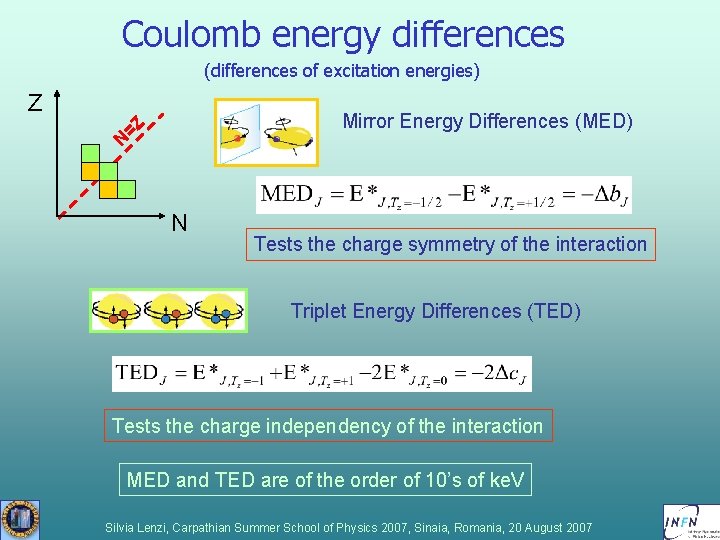
Coulomb energy differences (differences of excitation energies) Z N =Z Mirror Energy Differences (MED) N Tests the charge symmetry of the interaction Triplet Energy Differences (TED) Tests the charge independency of the interaction MED and TED are of the order of 10’s of ke. V Silvia Lenzi, Carpathian Summer School of Physics 2007, Sinaia, Romania, 20 August 2007
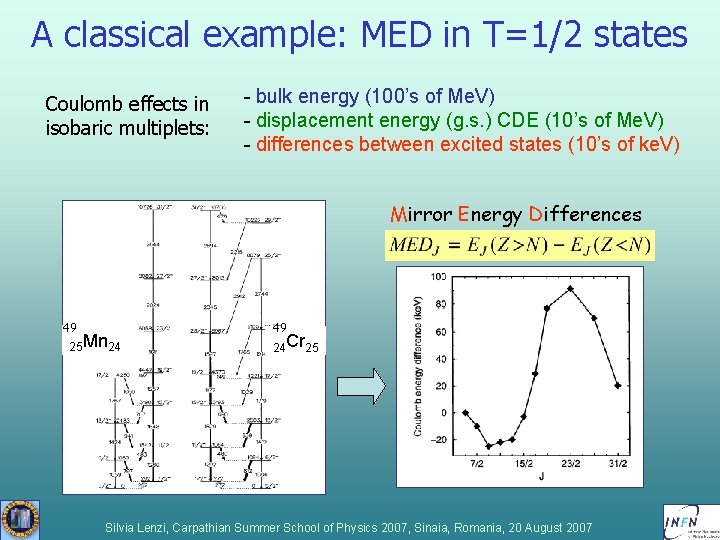
A classical example: MED in T=1/2 states Coulomb effects in isobaric multiplets: - bulk energy (100’s of Me. V) - displacement energy (g. s. ) CDE (10’s of Me. V) - differences between excited states (10’s of ke. V) Mirror Energy Differences 49 25 Mn 24 49 24 Cr 25 Silvia Lenzi, Carpathian Summer School of Physics 2007, Sinaia, Romania, 20 August 2007
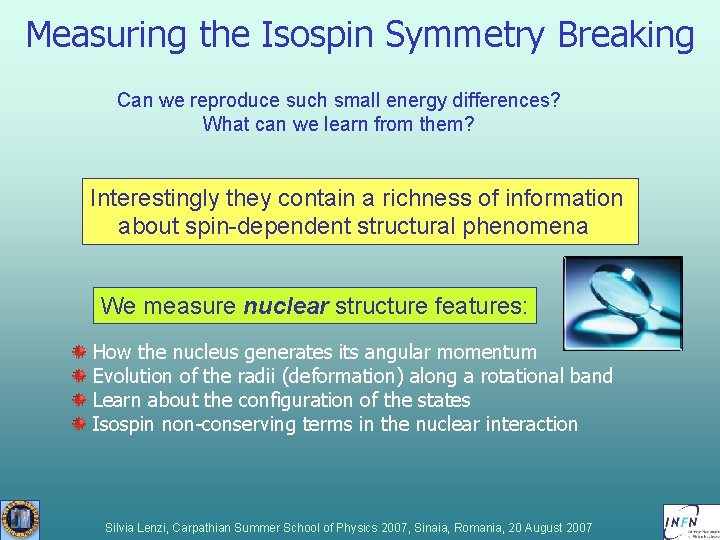
Measuring the Isospin Symmetry Breaking Can we reproduce such small energy differences? What can we learn from them? Interestingly they contain a richness of information about spin-dependent structural phenomena We measure nuclear structure features: How the nucleus generates its angular momentum Evolution of the radii (deformation) along a rotational band Learn about the configuration of the states Isospin non-conserving terms in the nuclear interaction Silvia Lenzi, Carpathian Summer School of Physics 2007, Sinaia, Romania, 20 August 2007
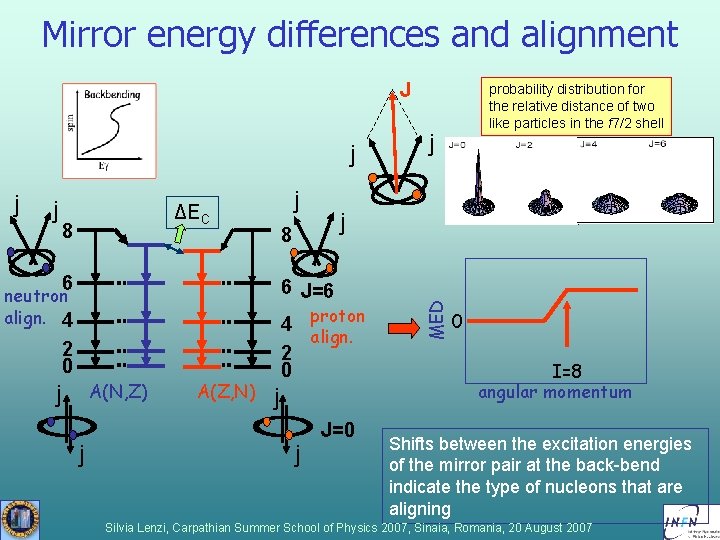
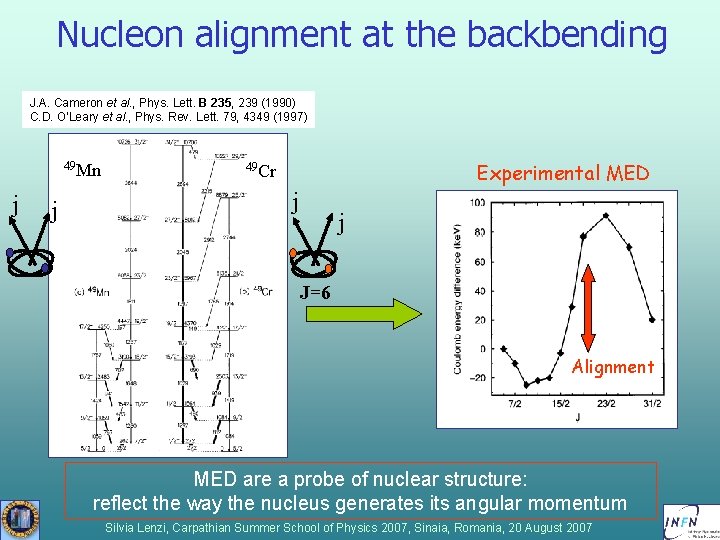
Mirror energy differences and alignment J j j j ΔEC 8 j 8 6 6 J=6 neutron align. 4 4 proton align. 2 0 A(N, Z) j j A(Z, N) j j j J=0 MED j probability distribution for the relative distance of two like particles in the f 7/2 shell 0 I=8 angular momentum Shifts between the excitation energies of the mirror pair at the back-bend indicate the type of nucleons that are aligning Silvia Lenzi, Carpathian Summer School of Physics 2007, Sinaia, Romania, 20 August 2007
Nucleon alignment at the backbending J. A. Cameron et al. , Phys. Lett. B 235, 239 (1990) C. D. O'Leary et al. , Phys. Rev. Lett. 79, 4349 (1997) 49 Mn j j Experimental MED 49 Cr j j J=6 Alignment MED are a probe of nuclear structure: reflect the way the nucleus generates its angular momentum Silvia Lenzi, Carpathian Summer School of Physics 2007, Sinaia, Romania, 20 August 2007
Coulomb energy differences: Experimental methods Silvia Lenzi, Carpathian Summer School of Physics 2007, Sinaia, Romania, 20 August 2007
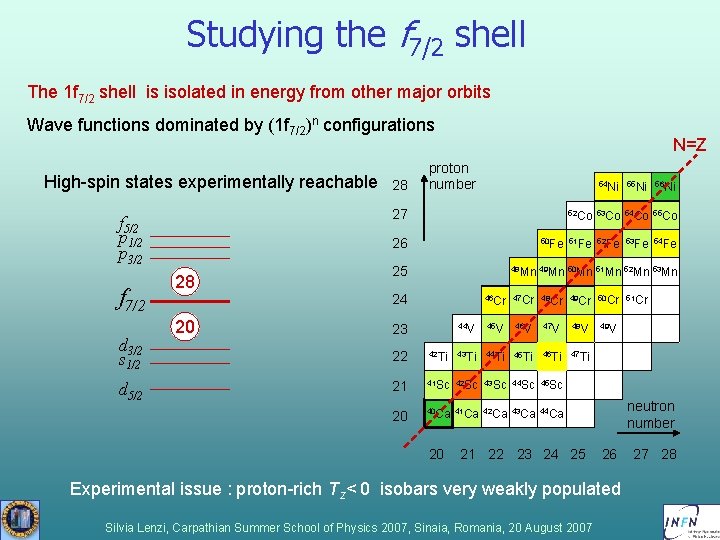
Studying the f 7/2 shell The 1 f 7/2 shell is isolated in energy from other major orbits Wave functions dominated by (1 f 7/2)n configurations High-spin states experimentally reachable f 5/2 p 1/2 p 3/2 f 7/2 d 3/2 s 1/2 d 5/2 28 20 28 N=Z proton number 54 Ni 55 Ni 56 Ni 27 52 Co 53 Co 54 Co 55 Co 26 50 Fe 51 Fe 52 Fe 53 Fe 54 Fe 25 48 Mn 49 Mn 50 Mn 51 Mn 52 Mn 53 Mn 24 46 Cr 47 Cr 48 Cr 49 Cr 50 Cr 51 Cr 23 44 V 45 V 46 V 47 V 48 V 43 Ti 44 Ti 45 Ti 46 Ti 47 Ti 22 42 Ti 21 41 Sc 42 Sc 43 Sc 44 Sc 45 Sc 20 40 Ca 41 Ca 42 Ca 43 Ca 44 Ca 20 21 22 23 24 25 49 V neutron number 26 Experimental issue : proton-rich Tz< 0 isobars very weakly populated Silvia Lenzi, Carpathian Summer School of Physics 2007, Sinaia, Romania, 20 August 2007 27 28
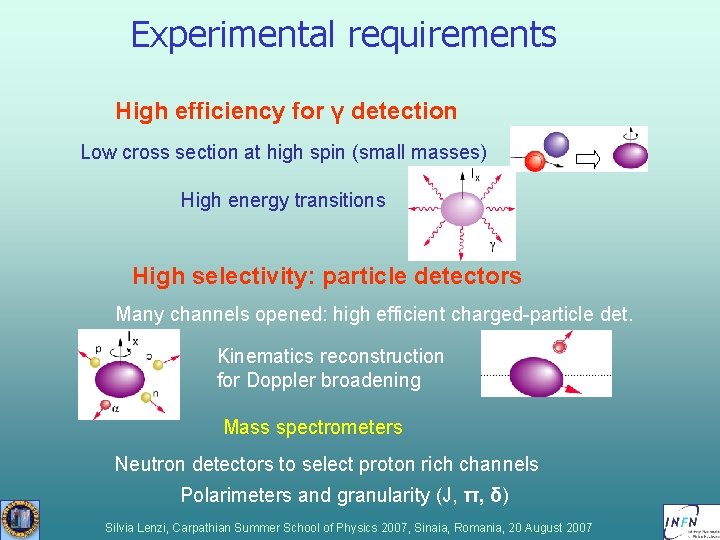
Experimental requirements High efficiency for γ detection Low cross section at high spin (small masses) High energy transitions High selectivity: particle detectors Many channels opened: high efficient charged-particle det. Kinematics reconstruction for Doppler broadening Mass spectrometers Neutron detectors to select proton rich channels Polarimeters and granularity (J, π, δ) Silvia Lenzi, Carpathian Summer School of Physics 2007, Sinaia, Romania, 20 August 2007
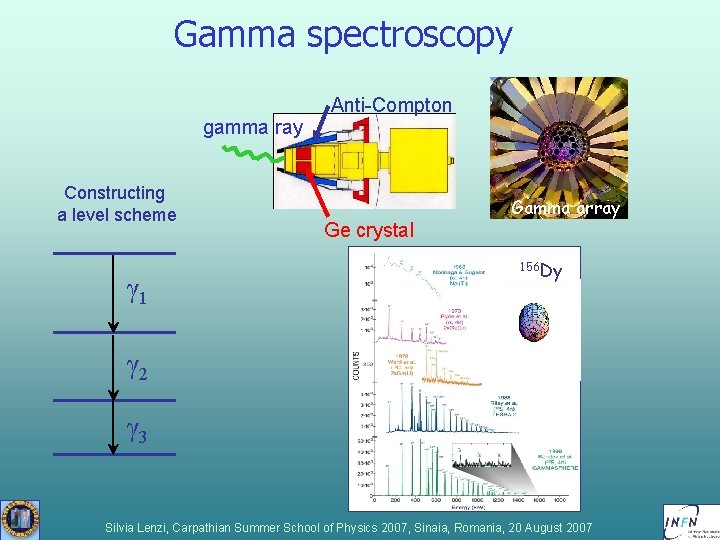
Gamma spectroscopy Anti-Compton gamma ray Constructing a level scheme γ 1 Gamma array Ge crystal 156 Dy γ 2 γ 3 Silvia Lenzi, Carpathian Summer School of Physics 2007, Sinaia, Romania, 20 August 2007
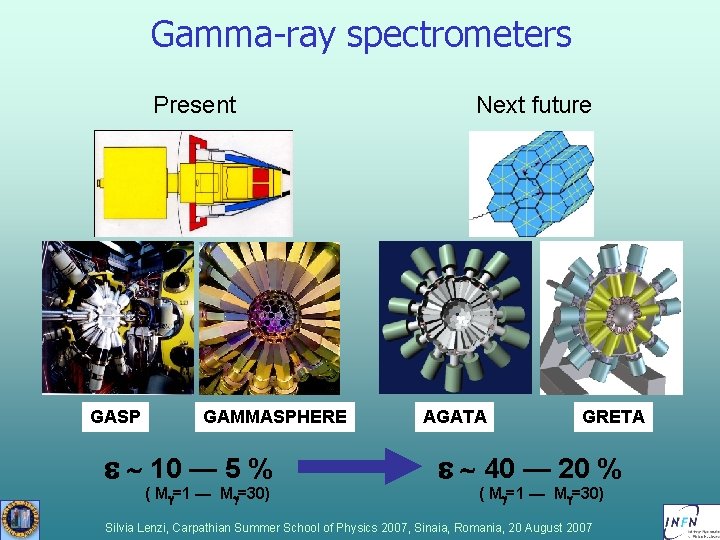
Gamma-ray spectrometers Present GASP GAMMASPHERE e ~ 10 — 5 % ( Mg=1 — Mg=30) Next future AGATA GRETA e ~ 40 — 20 % ( Mg=1 — Mg=30) Silvia Lenzi, Carpathian Summer School of Physics 2007, Sinaia, Romania, 20 August 2007
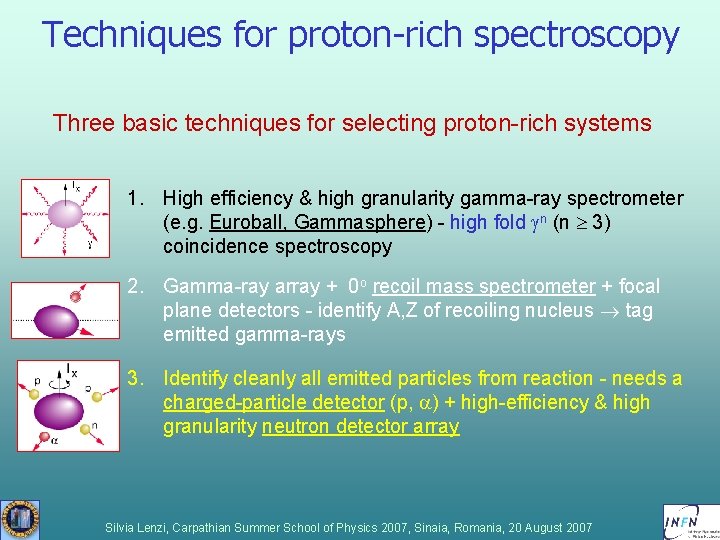
Techniques for proton-rich spectroscopy Three basic techniques for selecting proton-rich systems 1. High efficiency & high granularity gamma-ray spectrometer (e. g. Euroball, Gammasphere) - high fold gn (n 3) coincidence spectroscopy 2. Gamma-ray array + 0 o recoil mass spectrometer + focal plane detectors - identify A, Z of recoiling nucleus tag emitted gamma-rays 3. Identify cleanly all emitted particles from reaction - needs a charged-particle detector (p, a) + high-efficiency & high granularity neutron detector array Silvia Lenzi, Carpathian Summer School of Physics 2007, Sinaia, Romania, 20 August 2007
1. High fold gn (n > 3) coincidence spectroscopy Rely on the power of the array: • high-fold gamma ray coincidences • high granularity… and on the similarity between the energy of the transitions with those of the known mirror nucleus Double-coincidence spectra after gating on 2 analogue transitions S. J. Williams et al. , Phys. Rev. C 68 (2003) 011301 Silvia Lenzi, Carpathian Summer School of Physics 2007, Sinaia, Romania, 20 August 2007
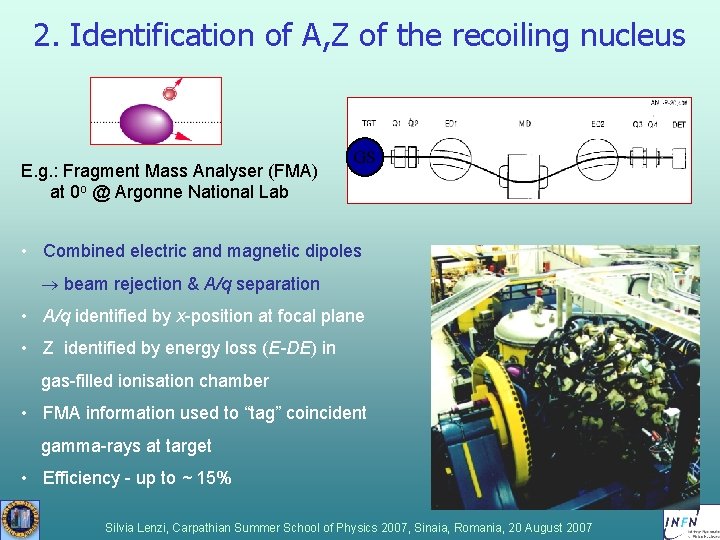
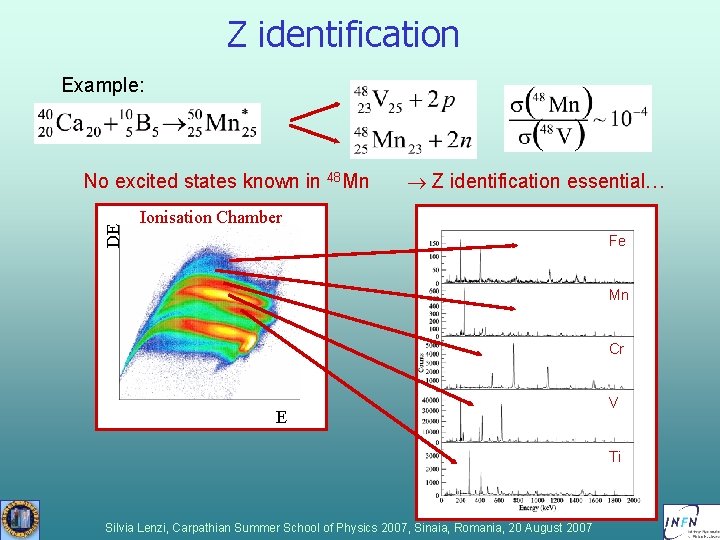
2. Identification of A, Z of the recoiling nucleus E. g. : Fragment Mass Analyser (FMA) at 0 o @ Argonne National Lab GS • Combined electric and magnetic dipoles beam rejection & A/q separation • A/q identified by x-position at focal plane • Z identified by energy loss (E-DE) in gas-filled ionisation chamber • FMA information used to “tag” coincident gamma-rays at target • Efficiency - up to ~ 15% Silvia Lenzi, Carpathian Summer School of Physics 2007, Sinaia, Romania, 20 August 2007
Z identification Example: DE No excited states known in 48 Mn Z identification essential… Ionisation Chamber Fe Mn Cr E V Ti Silvia Lenzi, Carpathian Summer School of Physics 2007, Sinaia, Romania, 20 August 2007
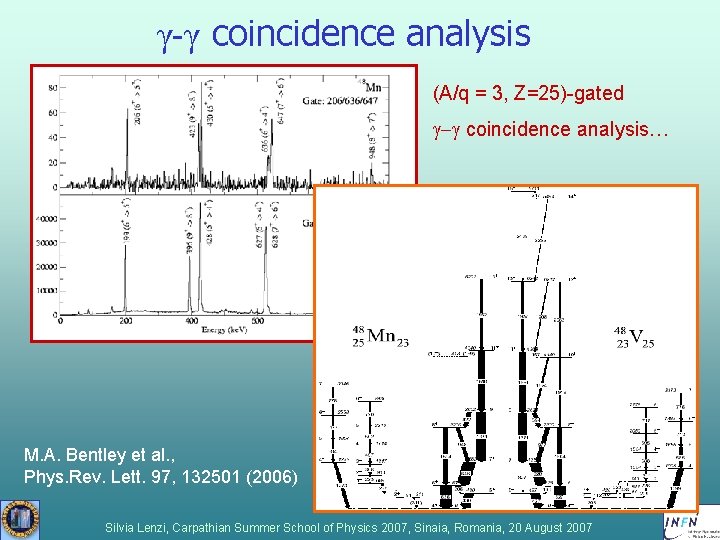
γ-γ coincidence analysis (A/q = 3, Z=25)-gated g-g coincidence analysis… M. A. Bentley et al. , Phys. Rev. Lett. 97, 132501 (2006) Silvia Lenzi, Carpathian Summer School of Physics 2007, Sinaia, Romania, 20 August 2007
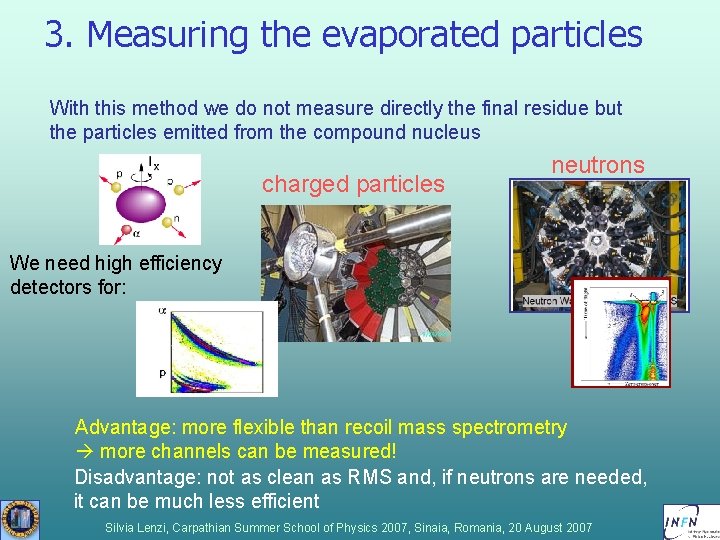
3. Measuring the evaporated particles With this method we do not measure directly the final residue but the particles emitted from the compound nucleus charged particles neutrons We need high efficiency detectors for: Advantage: more flexible than recoil mass spectrometry more channels can be measured! Disadvantage: not as clean as RMS and, if neutrons are needed, it can be much less efficient Silvia Lenzi, Carpathian Summer School of Physics 2007, Sinaia, Romania, 20 August 2007
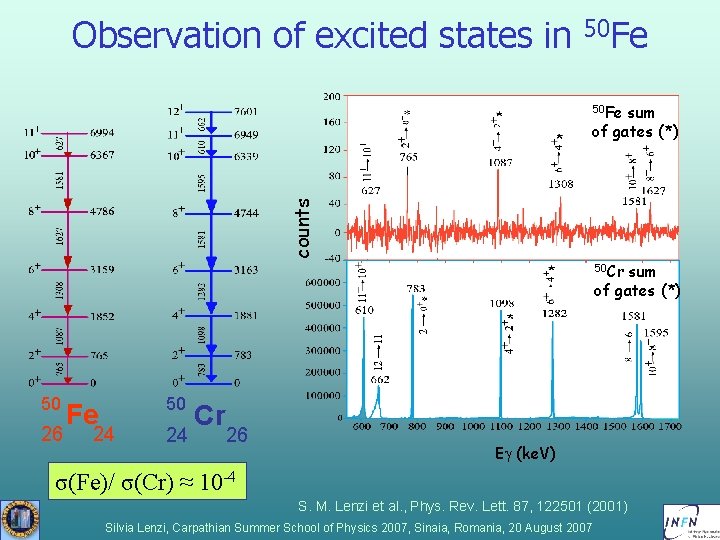
Observation of excited states in 50 Fe sum of gates (*) counts 50 Fe 50 Cr sum of gates (*) 50 26 Fe 50 24 24 Cr 26 Eg (ke. V) σ(Fe)/ σ(Cr) ≈ 10 -4 S. M. Lenzi et al. , Phys. Rev. Lett. 87, 122501 (2001) Silvia Lenzi, Carpathian Summer School of Physics 2007, Sinaia, Romania, 20 August 2007
Coulomb energy differences: Theoretical methods Silvia Lenzi, Carpathian Summer School of Physics 2007, Sinaia, Romania, 20 August 2007
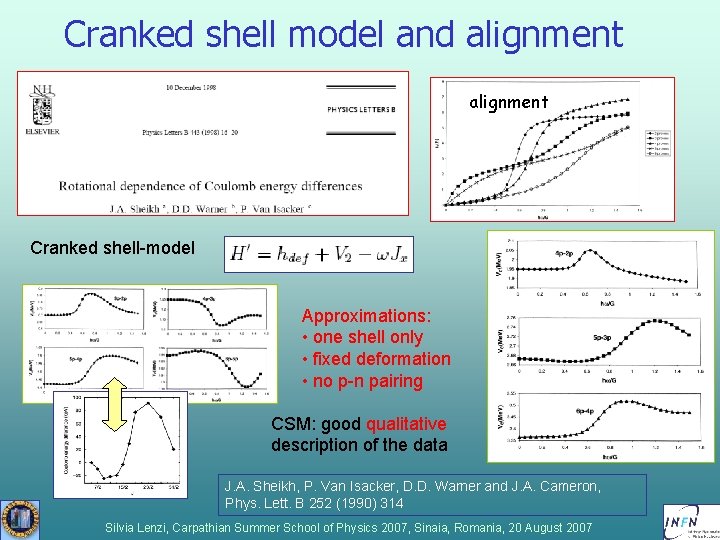
Cranked shell model and alignment Cranked shell-model Approximations: • one shell only • fixed deformation • no p-n pairing CSM: good qualitative description of the data J. A. Sheikh, P. Van Isacker, D. D. Warner and J. A. Cameron, Phys. Lett. B 252 (1990) 314 Silvia Lenzi, Carpathian Summer School of Physics 2007, Sinaia, Romania, 20 August 2007
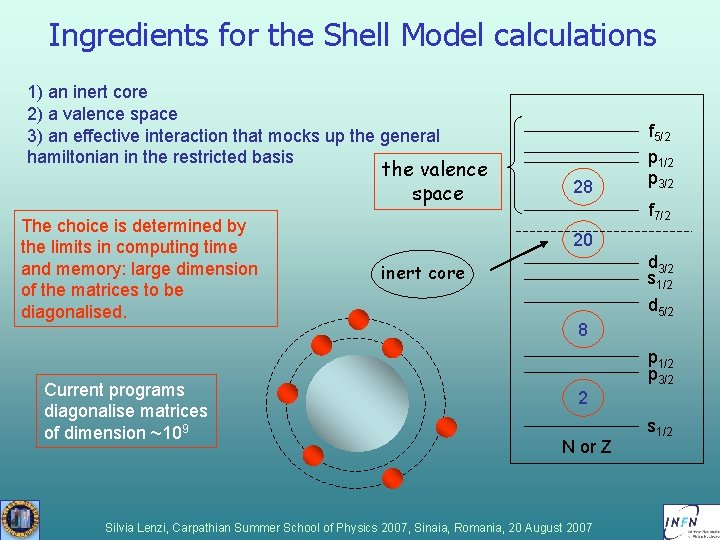
Ingredients for the Shell Model calculations 1) an inert core 2) a valence space 3) an effective interaction that mocks up the general hamiltonian in the restricted basis the valence space The choice is determined by the limits in computing time and memory: large dimension of the matrices to be diagonalised. Current programs diagonalise matrices of dimension ~109 28 f 5/2 p 1/2 p 3/2 f 7/2 20 d 3/2 s 1/2 inert core d 5/2 8 p 1/2 p 3/2 2 N or Z Silvia Lenzi, Carpathian Summer School of Physics 2007, Sinaia, Romania, 20 August 2007 s 1/2
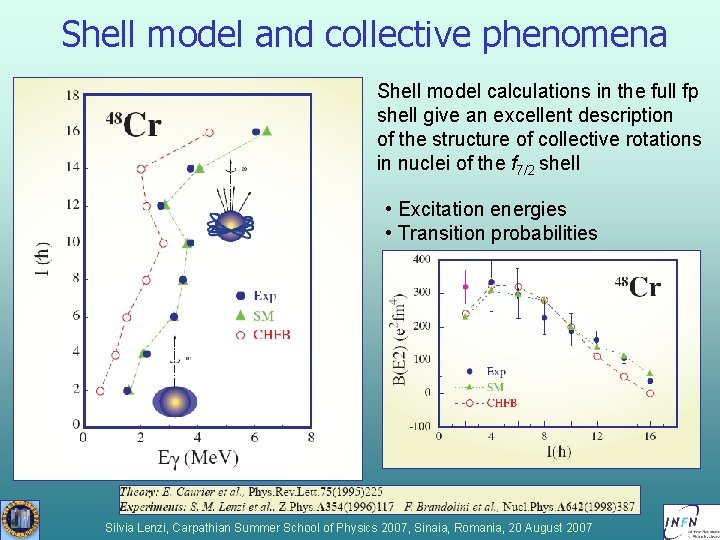
Shell model and collective phenomena Shell model calculations in the full fp shell give an excellent description of the structure of collective rotations in nuclei of the f 7/2 shell • Excitation energies • Transition probabilities Silvia Lenzi, Carpathian Summer School of Physics 2007, Sinaia, Romania, 20 August 2007
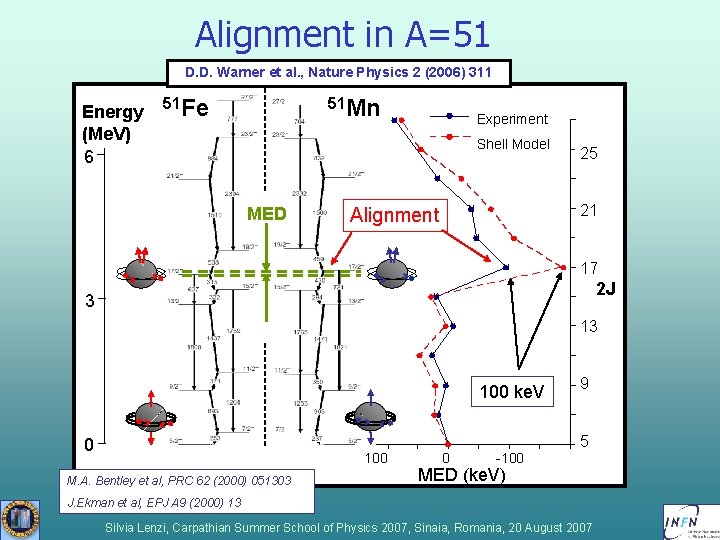
Alignment in A=51 D. D. Warner et al. , Nature Physics 2 (2006) 311 Energy (Me. V) 6 51 Fe 51 Mn Experiment Shell Model MED 25 21 Alignment 17 2 J 3 13 100 ke. V 9 5 0 100 M. A. Bentley et al, PRC 62 (2000) 051303 0 -100 MED (ke. V) J. Ekman et al, EPJ A 9 (2000) 13 Silvia Lenzi, Carpathian Summer School of Physics 2007, Sinaia, Romania, 20 August 2007
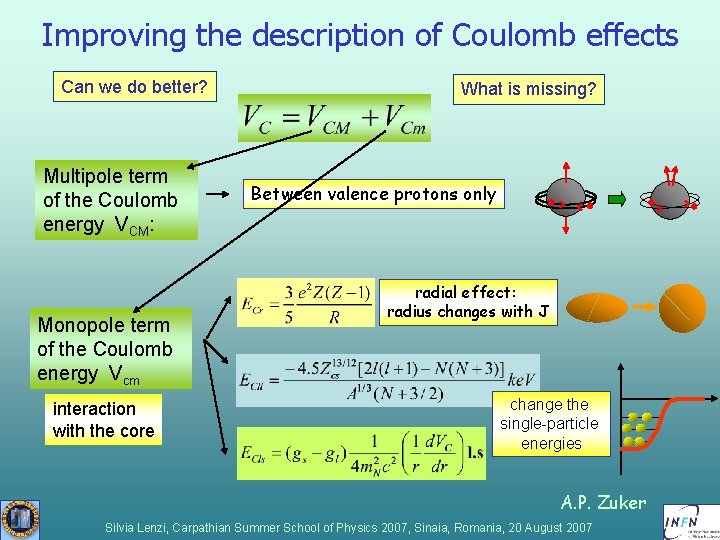
Improving the description of Coulomb effects Can we do better? Multipole term of the Coulomb energy VCM: Monopole term of the Coulomb energy Vcm interaction with the core What is missing? Between valence protons only radial effect: radius changes with J change the single-particle energies A. P. Zuker Silvia Lenzi, Carpathian Summer School of Physics 2007, Sinaia, Romania, 20 August 2007
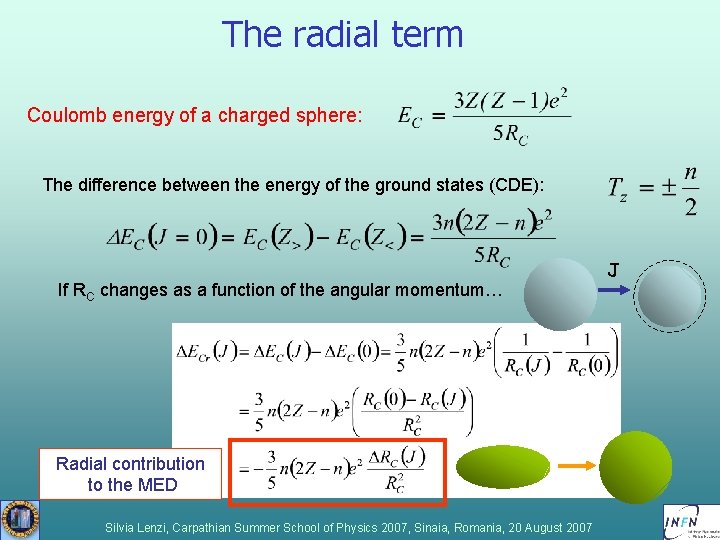
The radial term Coulomb energy of a charged sphere: The difference between the energy of the ground states (CDE): If RC changes as a function of the angular momentum… Radial contribution to the MED Silvia Lenzi, Carpathian Summer School of Physics 2007, Sinaia, Romania, 20 August 2007 J
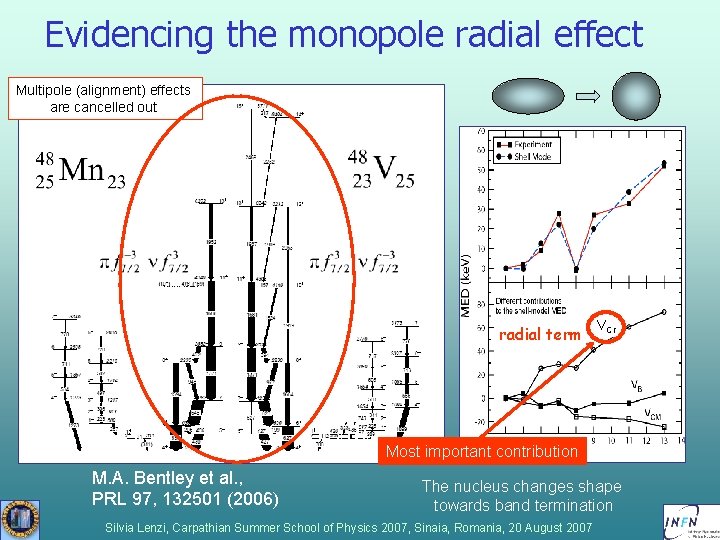
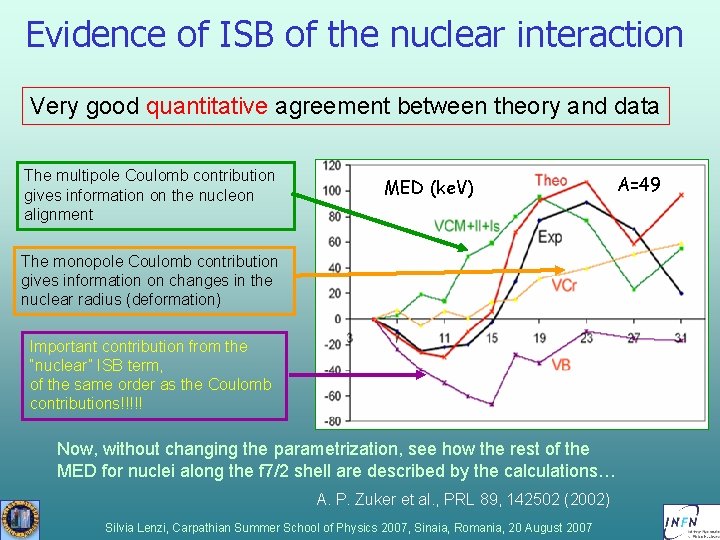
Evidencing the monopole radial effect Multipole (alignment) effects are cancelled out radial term VCr Most important contribution M. A. Bentley et al. , PRL 97, 132501 (2006) The nucleus changes shape towards band termination Silvia Lenzi, Carpathian Summer School of Physics 2007, Sinaia, Romania, 20 August 2007
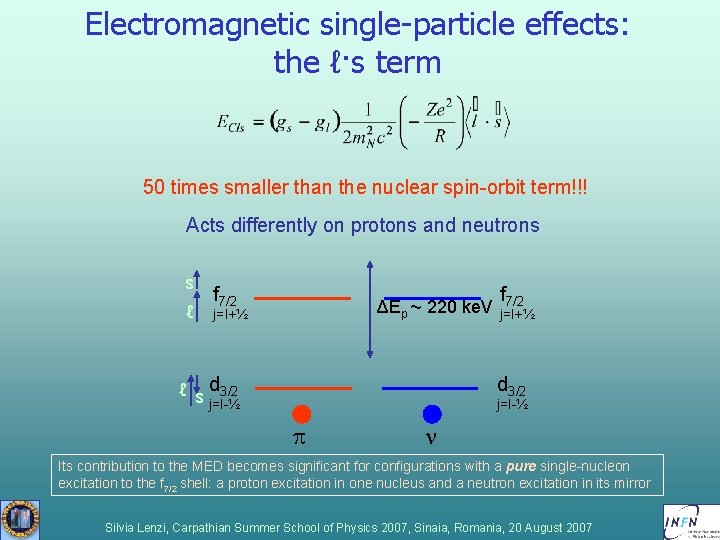
Electromagnetic single-particle effects: the ℓ·s term 50 times smaller than the nuclear spin-orbit term!!! Acts differently on protons and neutrons s ℓ f 7/2 ΔEp ~ 220 ke. V j=l+½ ℓ s d 3/2 j=l-½ f 7/2 j=l+½ d 3/2 j=l-½ p n Its contribution to the MED becomes significant for configurations with a pure single-nucleon excitation to the f 7/2 shell: a proton excitation in one nucleus and a neutron excitation in its mirror Silvia Lenzi, Carpathian Summer School of Physics 2007, Sinaia, Romania, 20 August 2007
The T=1/2 mirror nuclei A=35 35 Ar 35 Cl 23/2 - 19/2 - Large MED for the 13/2 - A=35 is found 15/2 in 15/2 state 2 F. Della Vedova et al. , PRC 75, 034317 (2007) 1 15/2 -2 >300 ke. V!!! 13/2 - 11/2 -2 J. Ekman et al. , PRL 92 (2004) 132502 Negative parity The two 11/2 states have very different configurations 13/2 - Measured very large MED values for all high spin states! Silvia Lenzi, Carpathian Summer School of Physics 2007, Sinaia, Romania, 20 August 2007
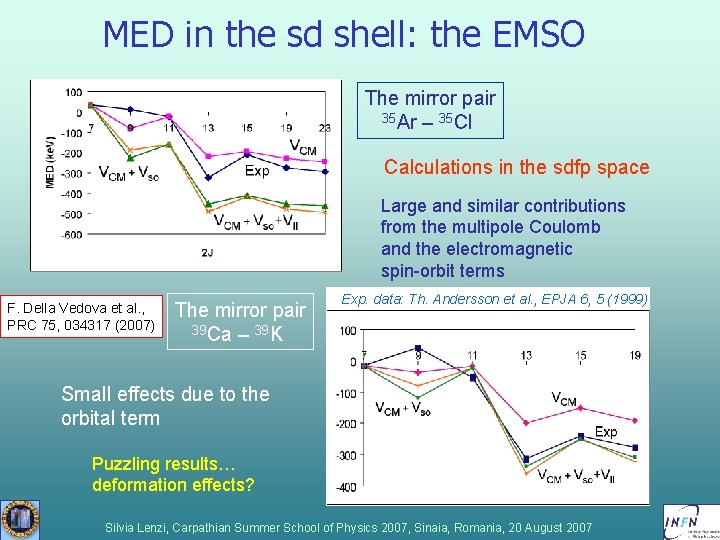
MED in the sd shell: the EMSO The mirror pair 35 Ar – 35 Cl Calculations in the sdfp space Large and similar contributions from the multipole Coulomb and the electromagnetic spin-orbit terms F. Della Vedova et al. , PRC 75, 034317 (2007) The mirror pair 39 Ca – 39 K Exp. data: Th. Andersson et al. , EPJA 6, 5 (1999) Small effects due to the orbital term Puzzling results… deformation effects? Silvia Lenzi, Carpathian Summer School of Physics 2007, Sinaia, Romania, 20 August 2007
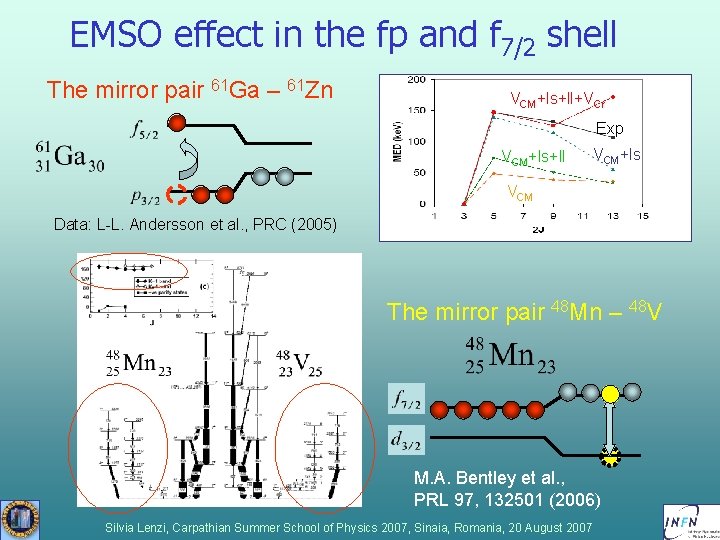
EMSO effect in the fp and f 7/2 shell The mirror pair 61 Ga – 61 Zn VCM+ls+ll+VCr Exp VCM+ls+ll VCM+ls VCM Data: L-L. Andersson et al. , PRC (2005) The mirror pair 48 Mn – 48 V M. A. Bentley et al. , PRL 97, 132501 (2006) Silvia Lenzi, Carpathian Summer School of Physics 2007, Sinaia, Romania, 20 August 2007
Are Coulomb corrections enough? sum of Coulomb terms Another term of nuclear nature is needed, but it has to be big! Silvia Lenzi, Carpathian Summer School of Physics 2007, Sinaia, Romania, 20 August 2007
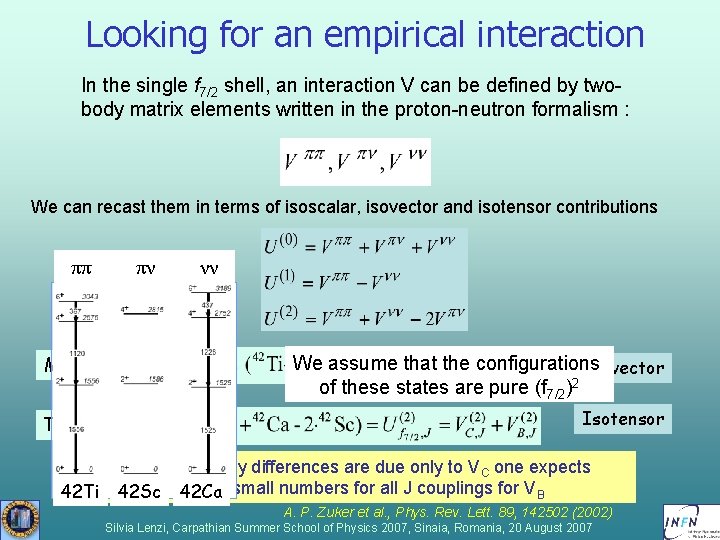
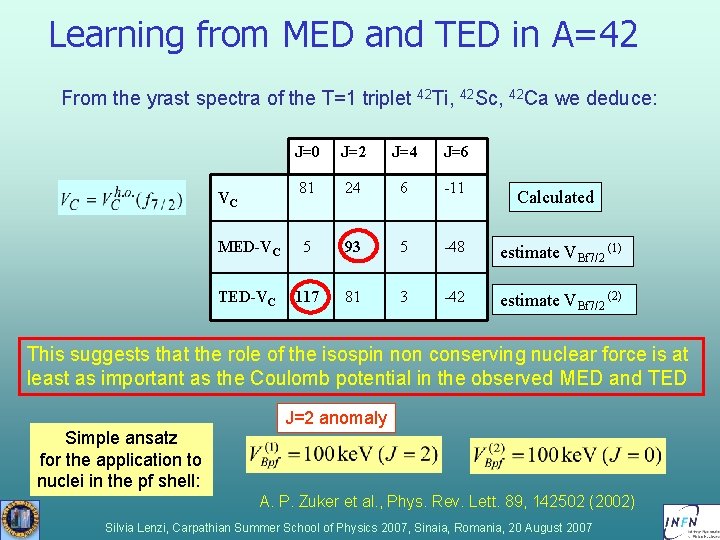
Looking for an empirical interaction In the single f 7/2 shell, an interaction V can be defined by twobody matrix elements written in the proton-neutron formalism : We can recast them in terms of isoscalar, isovector and isotensor contributions ππ πν Mirrors Triplet νν We assume that the configurations Isovector 2 of these states are pure (f 7/2) Isotensor If the energy differences are due only to VC one expects very small numbers for all J couplings for VB 42 Ti 42 Sc 42 Ca A. P. Zuker et al. , Phys. Rev. Lett. 89, 142502 (2002) Silvia Lenzi, Carpathian Summer School of Physics 2007, Sinaia, Romania, 20 August 2007
Learning from MED and TED in A=42 From the yrast spectra of the T=1 triplet 42 Ti, 42 Sc, 42 Ca we deduce: J=0 J=2 J=4 J=6 81 24 6 -11 MED-VC 5 93 5 -48 estimate VBf 7/2 (1) TED-VC 117 81 3 -42 estimate VBf 7/2 (2) VC Calculated This suggests that the role of the isospin non conserving nuclear force is at least as important as the Coulomb potential in the observed MED and TED Simple ansatz for the application to nuclei in the pf shell: J=2 anomaly A. P. Zuker et al. , Phys. Rev. Lett. 89, 142502 (2002) Silvia Lenzi, Carpathian Summer School of Physics 2007, Sinaia, Romania, 20 August 2007
Evidence of ISB of the nuclear interaction Very good quantitative agreement between theory and data The multipole Coulomb contribution gives information on the nucleon alignment MED (ke. V) The monopole Coulomb contribution gives information on changes in the nuclear radius (deformation) Important contribution from the “nuclear” ISB term, of the same order as the Coulomb contributions!!!!! Now, without changing the parametrization, see how the rest of the MED for nuclei along the f 7/2 shell are described by the calculations… A. P. Zuker et al. , PRL 89, 142502 (2002) Silvia Lenzi, Carpathian Summer School of Physics 2007, Sinaia, Romania, 20 August 2007 A=49
Coulomb energy differences (CED): Results Silvia Lenzi, Carpathian Summer School of Physics 2007, Sinaia, Romania, 20 August 2007
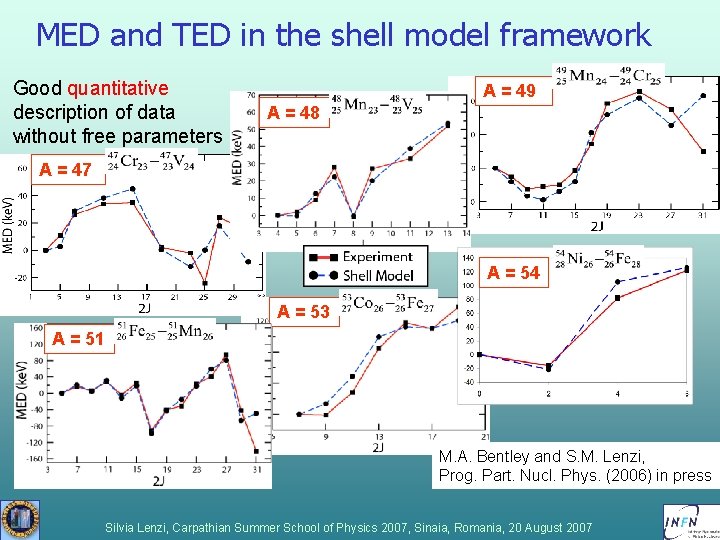
MED and TED in the shell model framework Good quantitative description of data without free parameters A = 49 A = 48 A = 47 A = 54 A = 53 A = 51 M. A. Bentley and S. M. Lenzi, Prog. Part. Nucl. Phys. (2006) in press Silvia Lenzi, Carpathian Summer School of Physics 2007, Sinaia, Romania, 20 August 2007
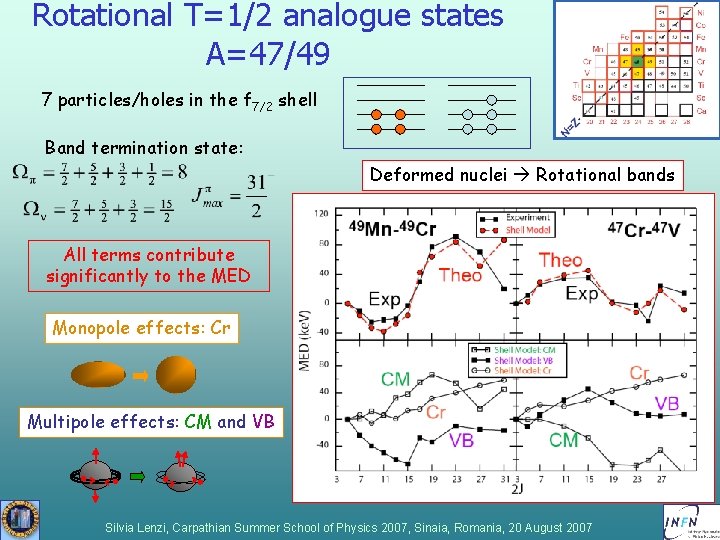
Rotational T=1/2 analogue states A=47/49 7 particles/holes in the f 7/2 shell Band termination state: Deformed nuclei Rotational bands All terms contribute significantly to the MED Monopole effects: Cr Multipole effects: CM and VB Silvia Lenzi, Carpathian Summer School of Physics 2007, Sinaia, Romania, 20 August 2007
T=1 A=54/42 triplet: MED and TED A=54 A=42 J=2 anomaly no collectivity: only multipole effects: smooth recoupling and J=2 anomaly 2 particles / holes A=54 A=42 A. Gadea et al. , PRL 97, 152501 (2006) Silvia Lenzi, Carpathian Summer School of Physics 2007, Sinaia, Romania, 20 August 2007
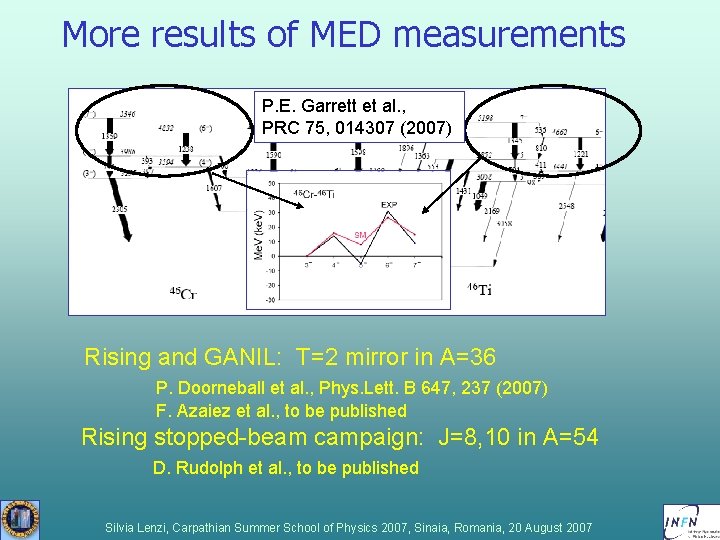
More results of MED measurements P. E. Garrett et al. , PRC 75, 014307 (2007) Rising and GANIL: T=2 mirror in A=36 P. Doorneball et al. , Phys. Lett. B 647, 237 (2007) F. Azaiez et al. , to be published Rising stopped-beam campaign: J=8, 10 in A=54 D. Rudolph et al. , to be published Silvia Lenzi, Carpathian Summer School of Physics 2007, Sinaia, Romania, 20 August 2007
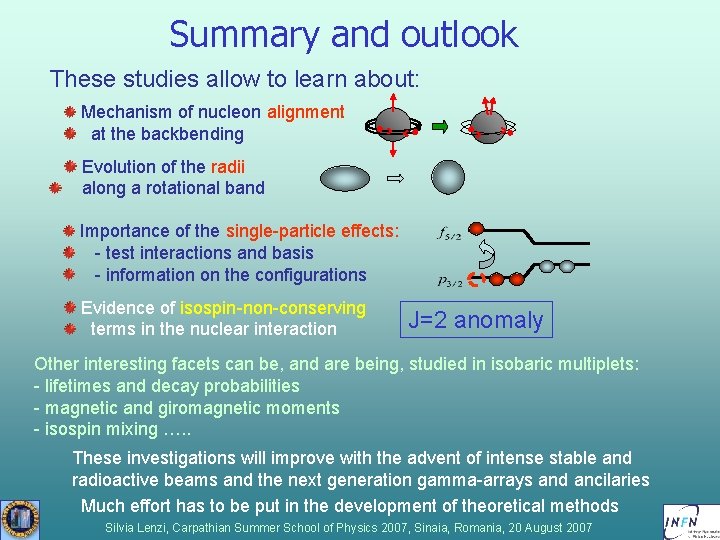
Summary and outlook These studies allow to learn about: Mechanism of nucleon alignment at the backbending Evolution of the radii along a rotational band Importance of the single-particle effects: - test interactions and basis - information on the configurations Evidence of isospin-non-conserving terms in the nuclear interaction J=2 anomaly Other interesting facets can be, and are being, studied in isobaric multiplets: - lifetimes and decay probabilities - magnetic and giromagnetic moments - isospin mixing …. . These investigations will improve with the advent of intense stable and radioactive beams and the next generation gamma-arrays and ancilaries Much effort has to be put in the development of theoretical methods Silvia Lenzi, Carpathian Summer School of Physics 2007, Sinaia, Romania, 20 August 2007
Thanks to… Theory: A. P. Zuker, F. Nowacki (Strasbourg) Experiments: M. A. Bentley (York) N. Marginean, A. Gadea, F. Della Vedova, (LNL and Padova) J. Ekman, D. Rudolph (Lund) P. E. Garrett (Guelph) Silvia Lenzi, Carpathian Summer School of Physics 2007, Sinaia, Romania, 20 August 2007
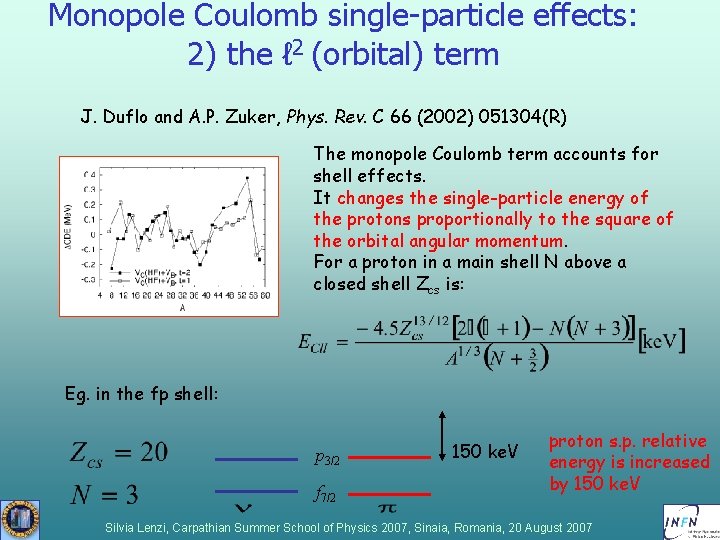
Monopole Coulomb single-particle effects: 2) the ℓ 2 (orbital) term J. Duflo and A. P. Zuker, Phys. Rev. C 66 (2002) 051304(R) The monopole Coulomb term accounts for shell effects. It changes the single-particle energy of the protons proportionally to the square of the orbital angular momentum. For a proton in a main shell N above a closed shell Zcs is: Eg. in the fp shell: p 3/2 f 7/2 150 ke. V proton s. p. relative energy is increased by 150 ke. V Silvia Lenzi, Carpathian Summer School of Physics 2007, Sinaia, Romania, 20 August 2007
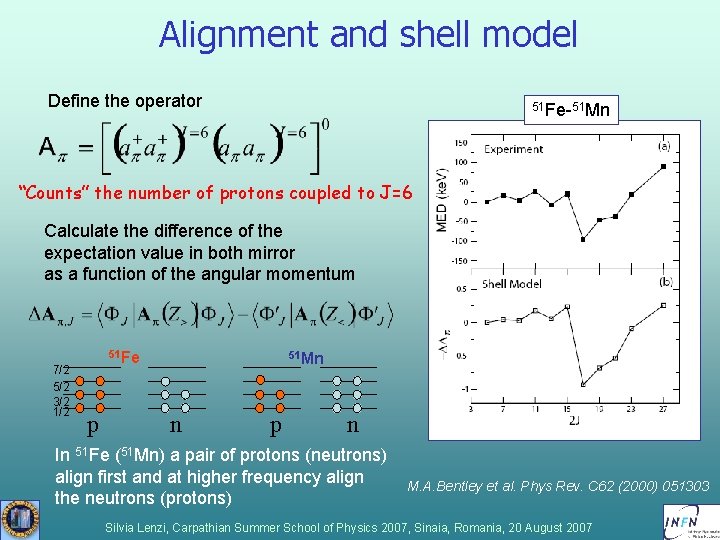
Alignment and shell model Define the operator 51 Fe-51 Mn “Counts” the number of protons coupled to J=6 Calculate the difference of the expectation value in both mirror as a function of the angular momentum 7/2 5/2 3/2 1/2 51 Fe p 51 Mn n p n In 51 Fe (51 Mn) a pair of protons (neutrons) align first and at higher frequency align the neutrons (protons) M. A. Bentley et al. Phys Rev. C 62 (2000) 051303 Silvia Lenzi, Carpathian Summer School of Physics 2007, Sinaia, Romania, 20 August 2007