
Imperial College London Structural Systems Analysis for Robustness
Imperial College London Structural Systems Analysis for Robustness Assessment Bassam A. Izzuddin Department of Civil & Environmental Engineering
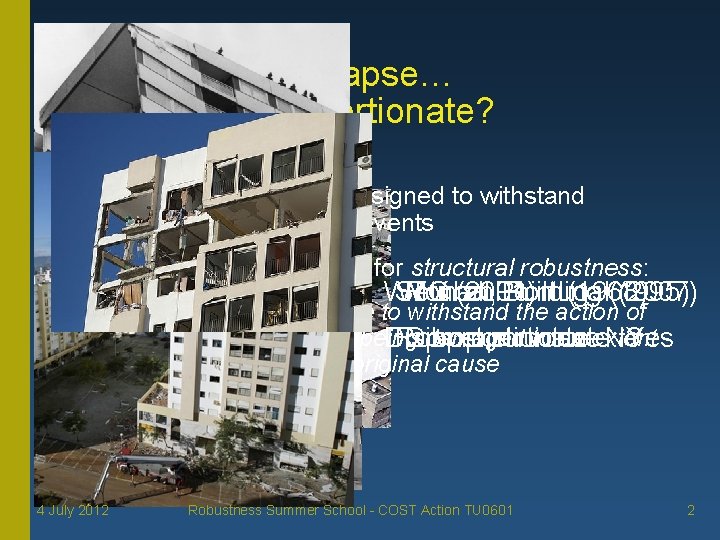
Progressive Collapse… But Is It Disproportionate? • Structures cannot be designed to withstand unpredictable extreme events • But should be designed for structural robustness: WTC Setúbal, Murrah Ronan (2001) Point Building Portugal (1968) (1995) (2007) the ability of the structure to withstand the action of extreme events without being damaged to an extent Disproportionate: Robust Disproportionate: structure No ? Yes disproportionate to the original cause 4 July 2012 Robustness Summer School - COST Action TU 0601 2
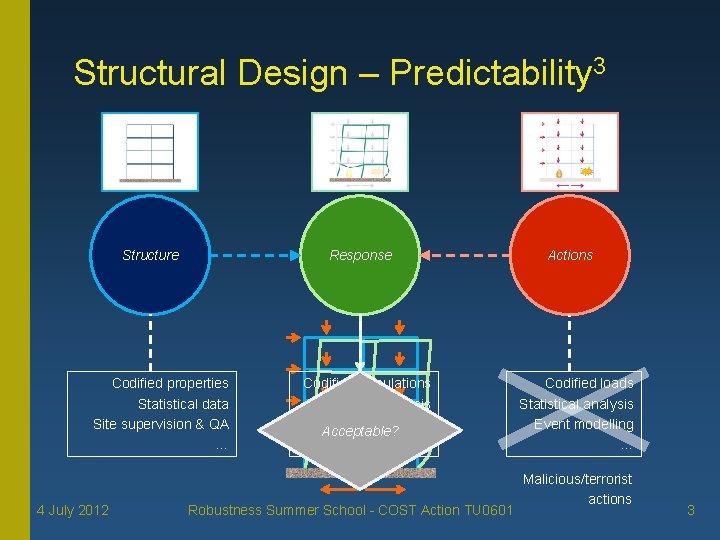
Structural Design – Predictability 3 Structure Response Codified properties Statistical data Site supervision & QA … 4 July 2012 Codified calculations Simplified analysis Detailed analysis Acceptable? … Robustness Summer School - COST Action TU 0601 Actions Codified loads Statistical analysis Event modelling … Malicious/terrorist actions 3
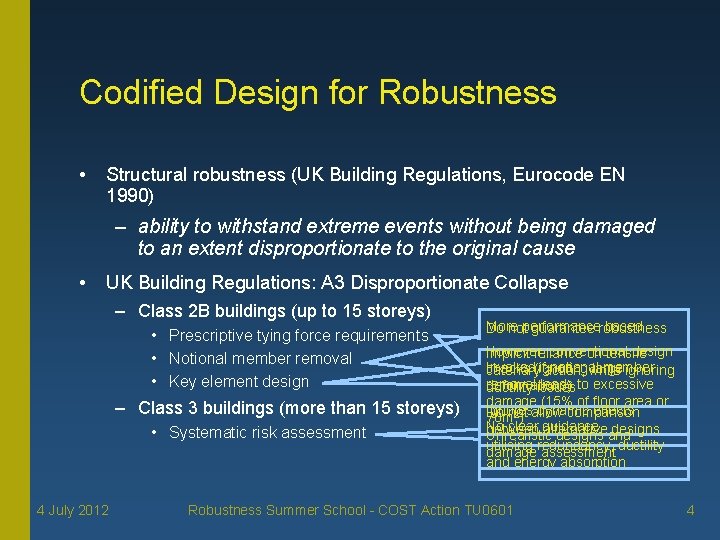
Codified Design for Robustness • Structural robustness (UK Building Regulations, Eurocode EN 1990) – ability to withstand extreme events without being damaged to an extent disproportionate to the original cause • UK Building Regulations: A 3 Disproportionate Collapse – Class 2 B buildings (up to 15 storeys) • Prescriptive tying force requirements • Notional member removal • Key element design – Class 3 buildings (more than 15 storeys) • Systematic risk assessment 4 July 2012 More based Do notperformance guarantee robustness However, conventional design Implicit reliance on tensile Invoked if notional member checks large ignoring catenary(ignoring action, while removal issues leads to excessive deformations) ductility damage (15% of floor area or Ignores dynamic effects Do comparison 2) allow 70 mnot No clear guidance between alternative designs Unrealistic designs and utilising damageredundancy, assessment ductility and energy absorption Robustness Summer School - COST Action TU 0601 4
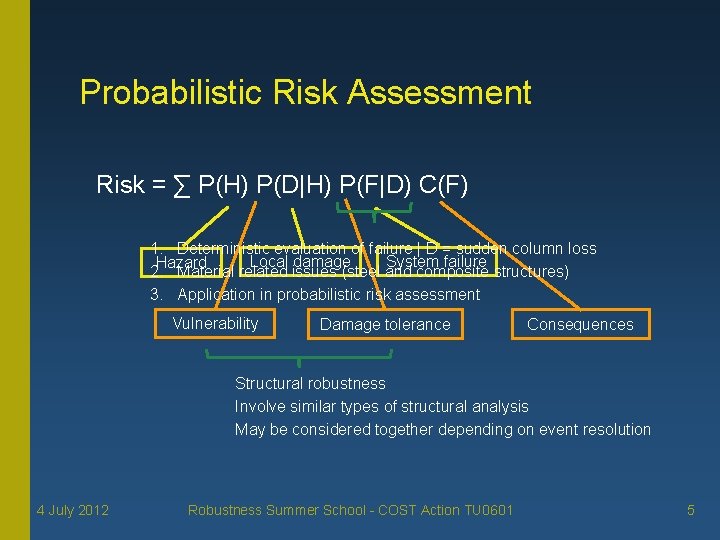
Probabilistic Risk Assessment Risk = ∑ P(H) P(D|H) P(F|D) C(F) 1. Deterministic evaluation of failure | D = sudden column loss Local damage System failure Hazard 2. Material related issues (steel and composite structures) 3. Application in probabilistic risk assessment Vulnerability Damage tolerance Consequences Structural robustness Involve similar types of structural analysis May be considered together depending on event resolution 4 July 2012 Robustness Summer School - COST Action TU 0601 5
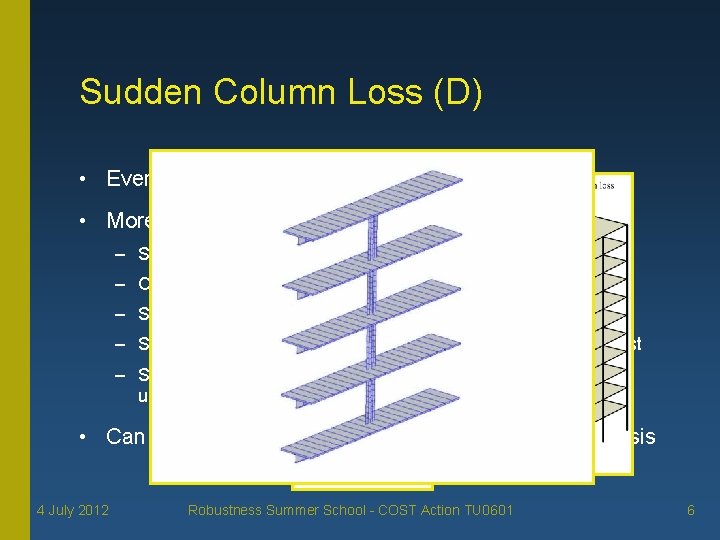
Sudden Column Loss (D) • Event-independent scenario • More than just a standard test of robustness – Sudden column loss (SCL) vs column damage by blast • Sudden • column loss – Comparison of deformation demands in upper floors – SCL presents an upper bound on floor deformations – SCL can be scaled to correspond to intermediate levels of blast – SCL realistic for multi-storey buildings even considering blast uplift and extended local damage • Can be assessed without full nonlinear dynamic analysis 4 July 2012 Robustness Summer School - COST Action TU 0601 6
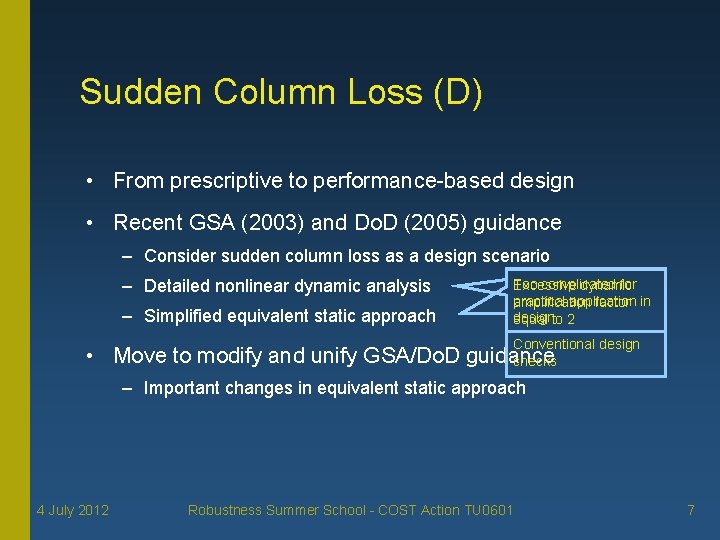
Sudden Column Loss (D) • From prescriptive to performance-based design • Recent GSA (2003) and Do. D (2005) guidance – Consider sudden column loss as a design scenario – Detailed nonlinear dynamic analysis – Simplified equivalent static approach Too complicated for Excessive dynamic practical application amplification factor in designto 2 equal Conventional design • Move to modify and unify GSA/Do. D guidance checks – Important changes in equivalent static approach 4 July 2012 Robustness Summer School - COST Action TU 0601 7
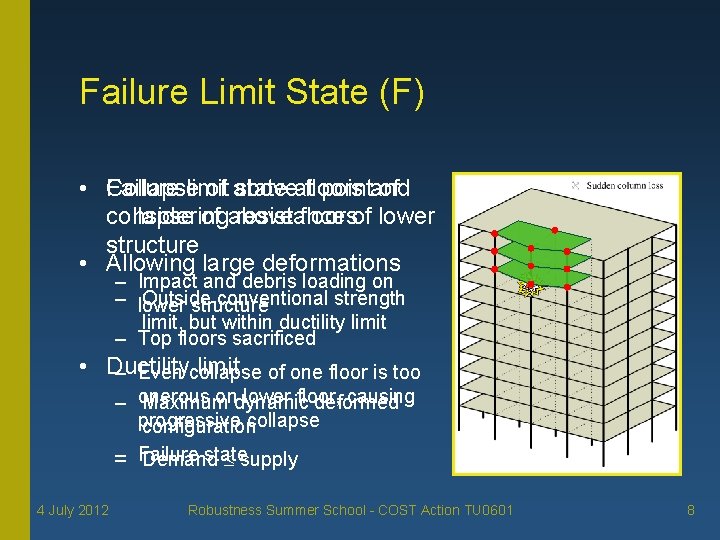
Failure Limit State (F) • Failure Collapse limit of above state atfloors pointand of collapse of above considering resistance floorsof lower structure • Allowing large deformations – Impact and debris loading on – lower Outside conventional strength structure limit, but within ductility limit – Top floors sacrificed • Ductility limit of one floor is too – Even collapse ondynamic lower floor, causing – onerous Maximum deformed progressive collapse configuration – state – Failure Demand supply 4 July 2012 Robustness Summer School - COST Action TU 0601 8
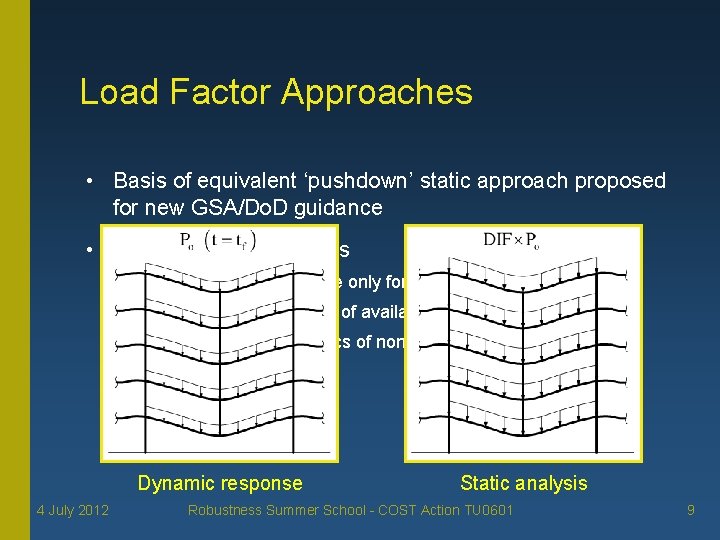
Load Factor Approaches • Basis of equivalent ‘pushdown’ static approach proposed for new GSA/Do. D guidance • Nonlinear static analysis – DIF equal to 2 applicable only for linear elastic response – Recognition of influence of available ductility on DIF – But not the characteristics of nonlinear static response Dynamic response 4 July 2012 Static analysis Robustness Summer School - COST Action TU 0601 9
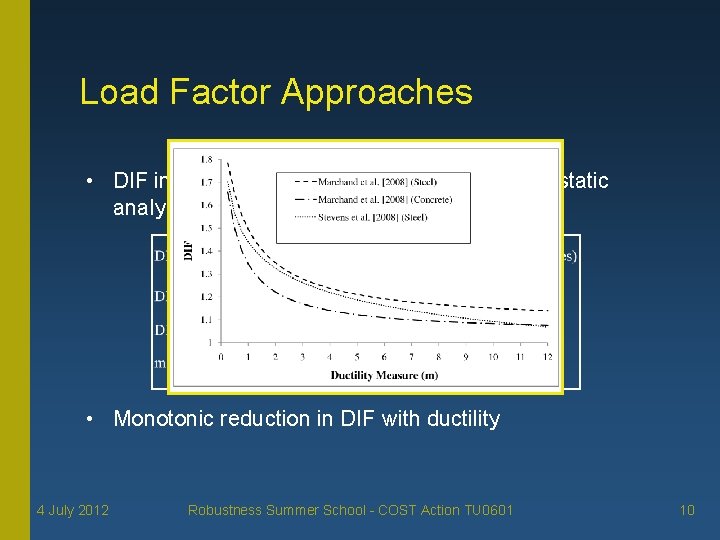
Load Factor Approaches • DIF in terms of ductility for use with nonlinear static analysis in new GSA/Do. D guidance • Monotonic reduction in DIF with ductility 4 July 2012 Robustness Summer School - COST Action TU 0601 10
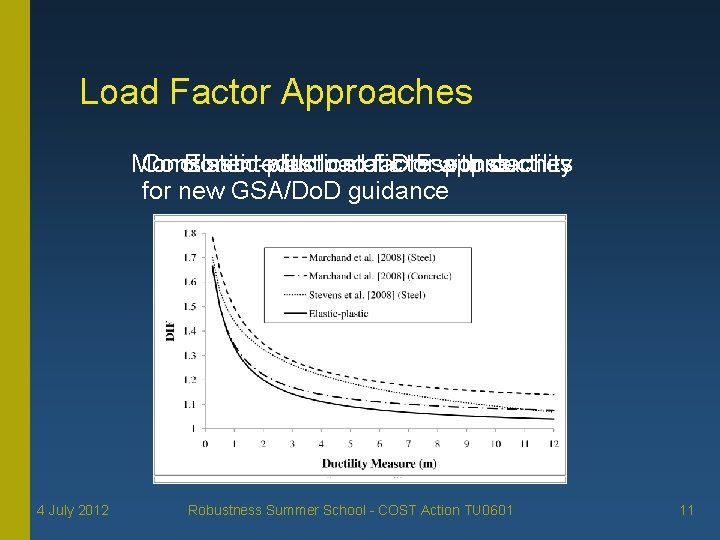
Load Factor Approaches Monotonic Consistent Elastic-plastic reduction with load static offactor DIF response with approaches ductility for new GSA/Do. D guidance Static resistance Dynamic resistance DIF = 1. 67 DIF = 2 4 July 2012 DIF = 1. 04 Robustness Summer School - COST Action TU 0601 11
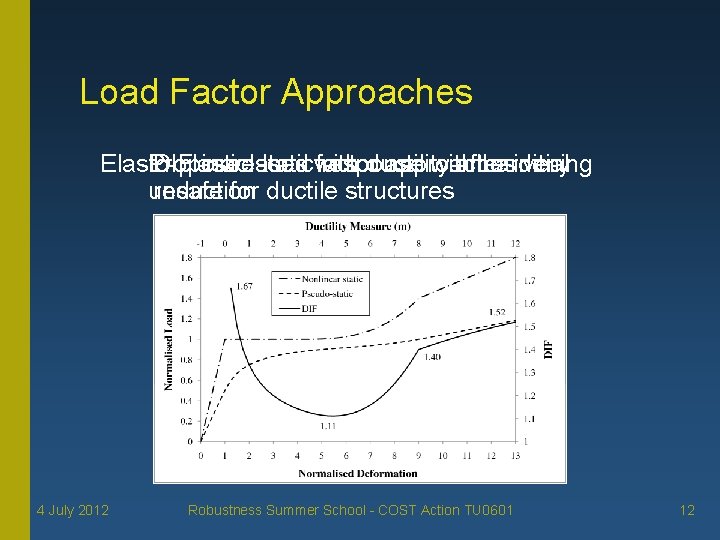
Load Factor Approaches Elasto-plastic Proposed DIF increases static load with factor response ductility approaches with after hardening initial very unsafe reduction for ductile structures 4 July 2012 Robustness Summer School - COST Action TU 0601 12
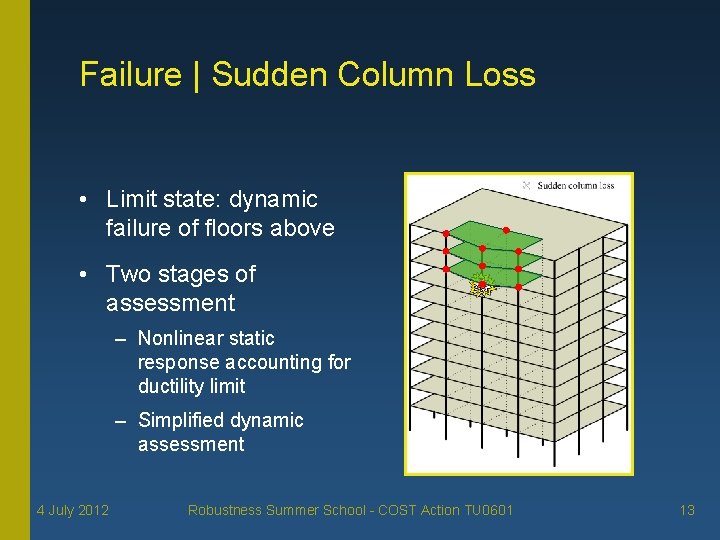
Failure | Sudden Column Loss • Limit state: dynamic failure of floors above • Two stages of assessment – Nonlinear static response accounting for ductility limit – Simplified dynamic assessment 4 July 2012 Robustness Summer School - COST Action TU 0601 13
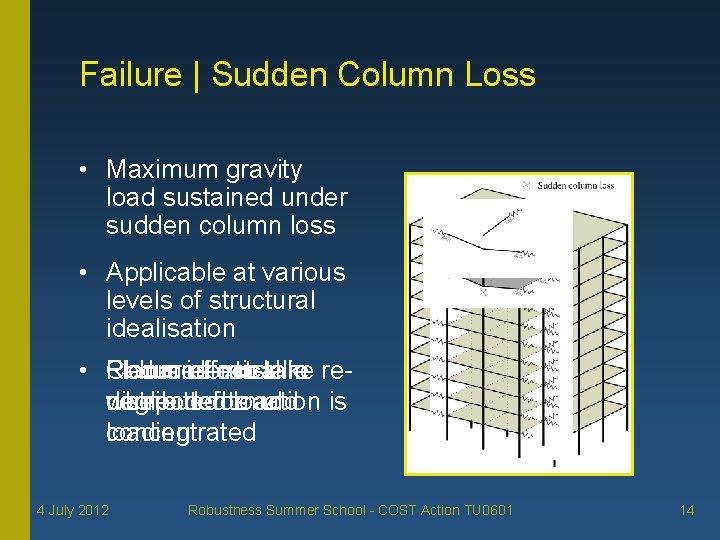
Failure | Sudden Column Loss • Maximum gravity load sustained under sudden column loss • Applicable at various levels of structural idealisation • Floors Planar identical Reduced Columns effects can model take are in rewhere deformation distributed components neglected load and is concentrated loading 4 July 2012 Robustness Summer School - COST Action TU 0601 14
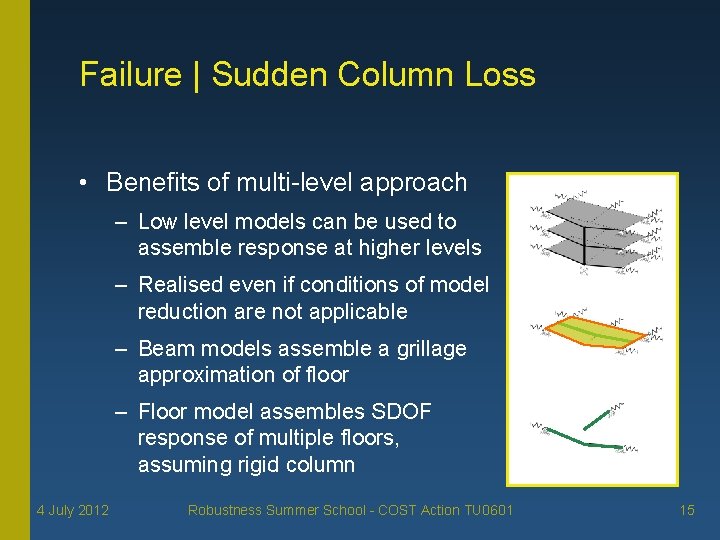
Failure | Sudden Column Loss • Benefits of multi-level approach – Low level models can be used to assemble response at higher levels – Realised even if conditions of model reduction are not applicable – Beam models assemble a grillage approximation of floor – Floor model assembles SDOF response of multiple floors, assuming rigid column 4 July 2012 Robustness Summer School - COST Action TU 0601 15
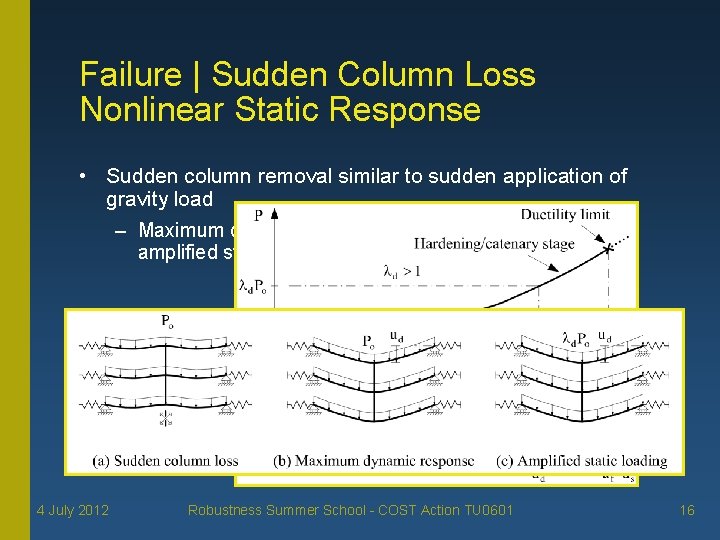
Failure | Sudden Column Loss Nonlinear Static Response • Sudden column removal similar to sudden application of gravity load – Maximum dynamic response can be approximated using amplified static loading (ld P) 4 July 2012 Robustness Summer School - COST Action TU 0601 16
Failure | Sudden Column Loss Nonlinear Static Response • Proposed framework supports detailed / simplified models • Detailed and simplified modelling may be combined – Detailed at lower levels to capture complex nonlinear response (connections, composite action, …) – Simplified assembly at higher levels 4 July 2012 Robustness Summer School - COST Action TU 0601 17
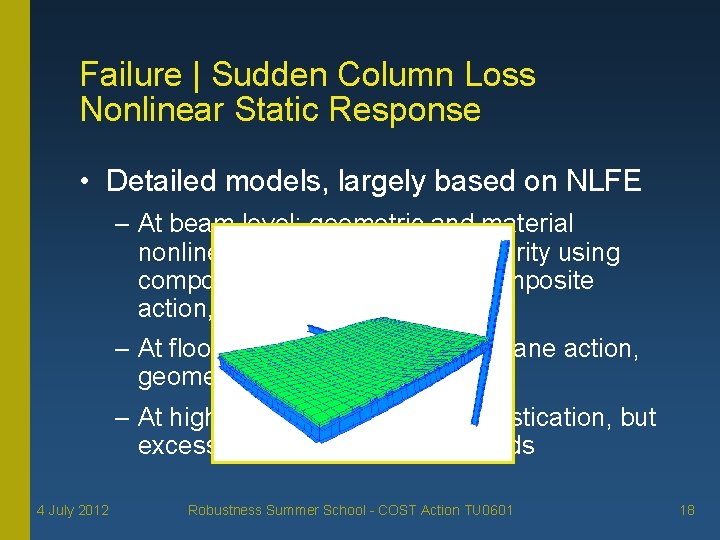
Failure | Sudden Column Loss Nonlinear Static Response • Detailed models, largely based on NLFE – At beam level: geometric and material nonlinearity, connection nonlinearity using component-based approach, composite action, … – At floor level: additionally membrane action, geometric orthotropy, … – At higher levels: additional sophistication, but excessive computational demands 4 July 2012 Robustness Summer School - COST Action TU 0601 18
Failure | Sudden Column Loss Nonlinear Static Response • Simplified modelling – Facilitates practical application in design – Applicable at various levels of structural idealisation – At lowest beam level • More sophisticated simplified models needed • Can be substituted by detailed models 4 July 2012 Robustness Summer School - COST Action TU 0601 19
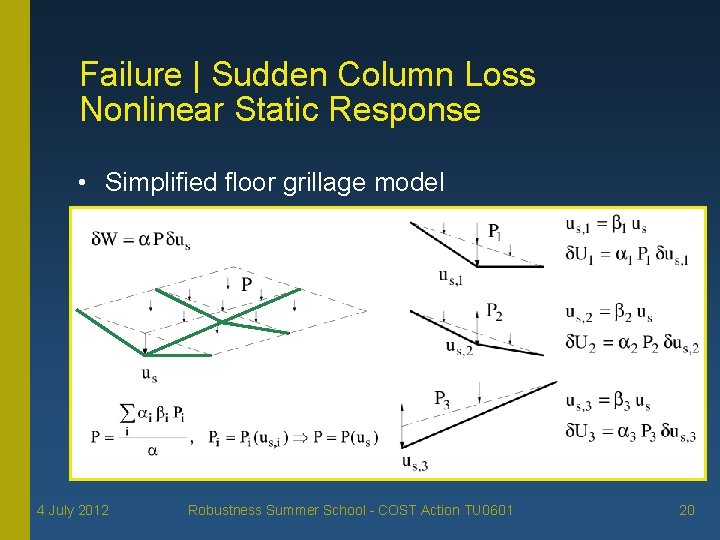
Failure | Sudden Column Loss Nonlinear Static Response • Simplified floor grillage model – Assumed SDOF mode, realistic at large deflections – Assume load distributions, but not intensities, on component beams • Accuracy of load distribution unimportant at large deflections – Nonlinear load-deflection response of floor system obtained as weighted sum of individual beam responses • Simplified / detailed beam models may be used 4 July 2012 Robustness Summer School - COST Action TU 0601 20
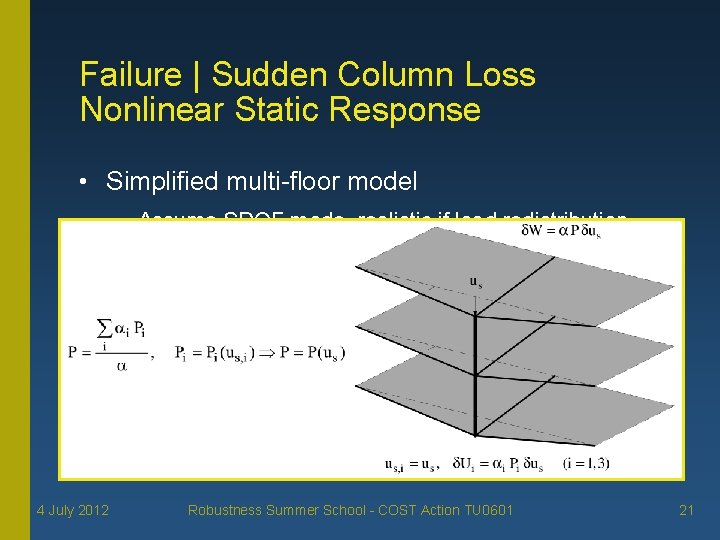
Failure | Sudden Column Loss Nonlinear Static Response • Simplified multi-floor model – Assume SDOF mode, realistic if load redistribution between floors well within column capacity – Assume load distributions on floors • For practicality, ignore force transferred via line of columns above failed column – Nonlinear load-deflection response of overall system as weighted sum of individual floor responses • Simplified / detailed individual floor models 4 July 2012 Robustness Summer School - COST Action TU 0601 21
Failure | Sudden Column Loss Nonlinear Static Response • Ductility limit – Ductility demands in connections and their components related to system displacements – Smallest displacement at which ductility demand exceeds supply in one of the connections – Importance of accounting for rotational and axial deformations – Need for extensive experimental data on connection ductility – Proposed framework accommodates refined data 4 July 2012 Robustness Summer School - COST Action TU 0601 22
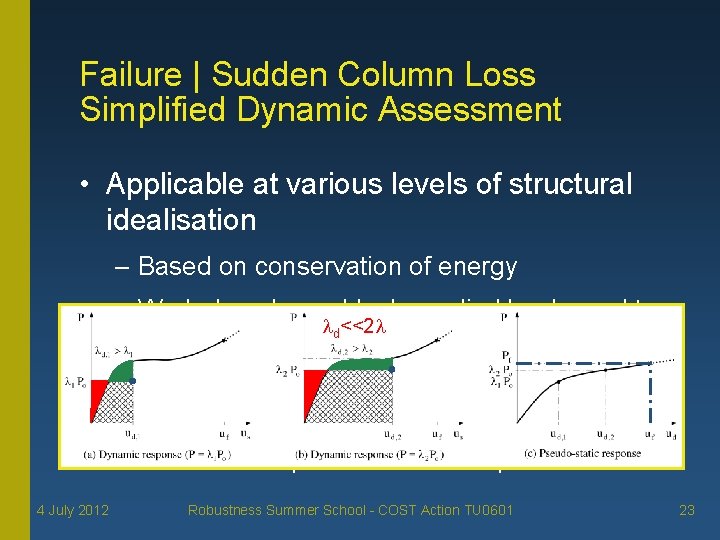
Failure | Sudden Column Loss Simplified Dynamic Assessment • Applicable at various levels of structural idealisation – Based on conservation of energy – Work done by suddenly applied load equal to ld<<2 l internal energy stored – Leads to maximum dynamic displacement (also to load dynamic amplification) – Definition of “pseudo-static” response 4 July 2012 Robustness Summer School - COST Action TU 0601 23
Failure | Sudden Column Loss Simplified Dynamic Assessment • Dynamic “pseudo-static” (P, ud) response constructed from corresponding nonlinear static (P, us) response – Represents response to sudden application of gravity load (P) – Provides valuable information about influence of different levels of gravity load under sudden column loss – Dynamic analysis would require excessive runs to obtain similar information 4 July 2012 Robustness Summer School - COST Action TU 0601 24
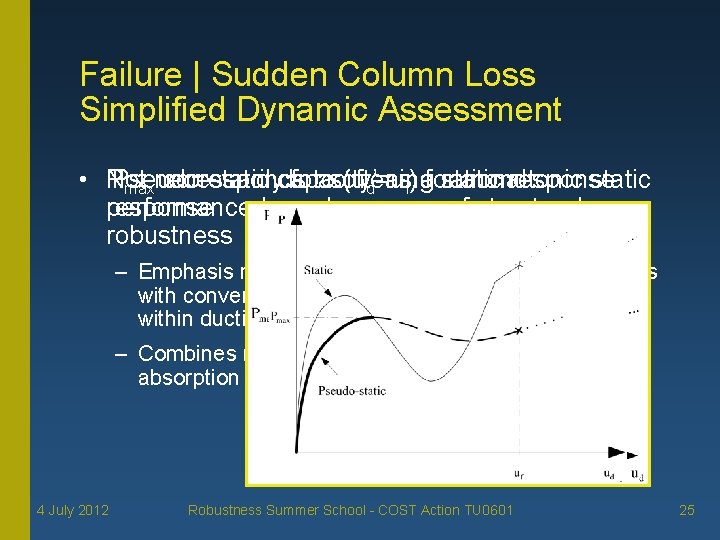
Failure | Sudden Column Loss Simplified Dynamic Assessment capacity’ asf) afor rational • ‘Pseudo-static Not P corresponds fortosoftening (ud=u static monotonic response static maxnecessarily performance-based measure of structural response robustness – Emphasis not on dynamic amplification of static loads with conventional design, but on dynamic demand within ductility limit – Combines redundancy, ductility and energy absorption within a simplified framework 4 July 2012 Robustness Summer School - COST Action TU 0601 25
Sudden Component Loss • Pseudo-static approach also applicable to sudden loss of other components – Provided dynamic response is dominated by a single mode – Pseudo-static response obtained from nonlinear static response of damaged structure, as before 4 July 2012 Robustness Summer School - COST Action TU 0601 26
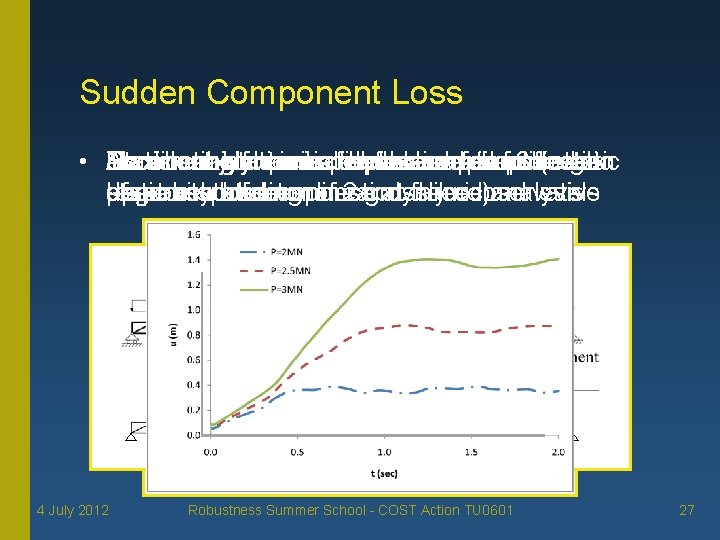
Sudden Component Loss and load amplification • Static Truss analysis Nonlinear Maximum Accounting Excellent subject comparison dynamic static fortounsafe initial response sudden response displacements deflections between brace and under pseudo-static failure pseudo-static in from pseudo 3 levels (e. g. based on aand factor of 2 grossly conservative of gravity response pseudo-static approach due toresponse sudden loading response nonlinear connection at dynamic three failure) load analysis levels 4 July 2012 Robustness Summer School - COST Action TU 0601 27
Successive Component Losses • Further component losses could occur during dynamic response, without necessarily defining overall dynamic system resistance • Pseudo-static approach can still be applied: – Single dominant mode – Nonlinear static response of initially damaged structures – Reduction in nonlinear static response due to component failure 4 July 2012 Robustness Summer School - COST Action TU 0601 28
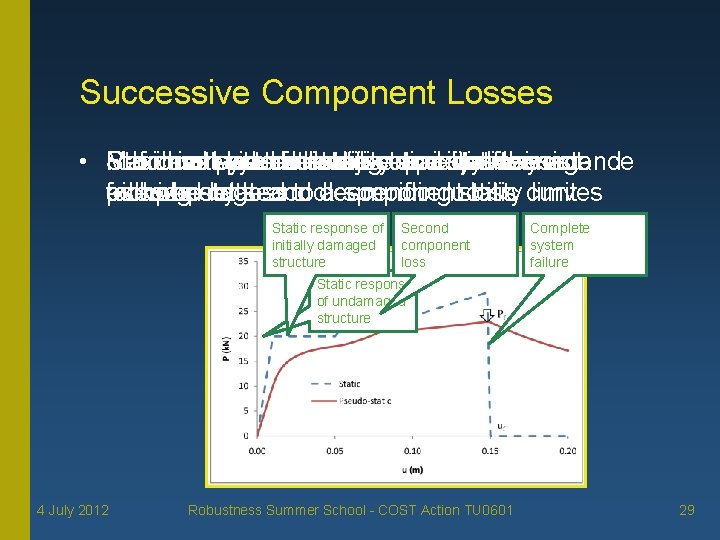
Successive Component Losses • Structural … for not Maximum Residual …but …unless instance pseudo-static system with system loadmore pseudo-static following atductility intersection subject severe capacity aand to compressive second initial static between after may damage resistance second not arching pseudo-static component picks followed even be upstage related by loss second and to descending acomponent specific ductility static loss curves limit Static response of initially damaged structure Second component loss Complete system failure Static response of undamaged structure 4 July 2012 Robustness Summer School - COST Action TU 0601 29
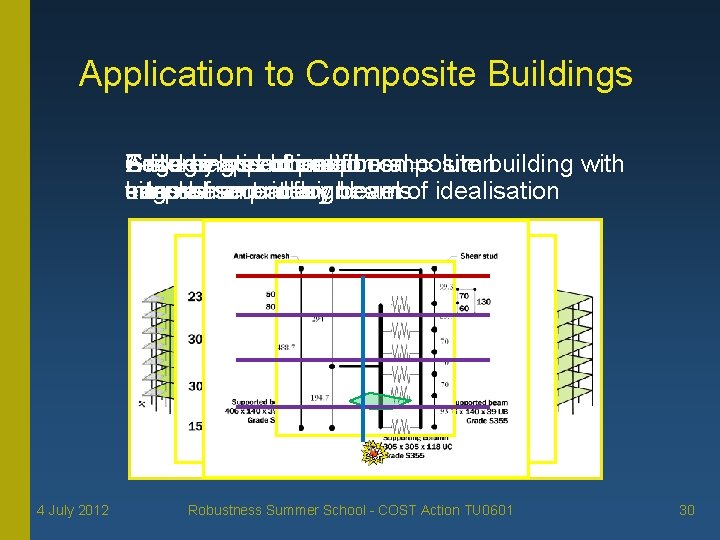
Application to Composite Buildings Edge beam 7 -storey Sudden Assuming Grillage approximation: loss steel identical connections offramed peripheral floors composite columnbuilding with simplebeam assessment edge internal transverse frame secondary primary atdesign floorbeams beam level of idealisation 4 July 2012 Robustness Summer School - COST Action TU 0601 30
Application to Composite Buildings • Pseudo-static response of individual beams • Simplified assembly to obtain pseudo-static capacity of floor slab • Importance of connection ductility, additional reinforcement and axial restraint • Inadequacy of prescriptive tying force requirements 4 July 2012 Robustness Summer School - COST Action TU 0601 31
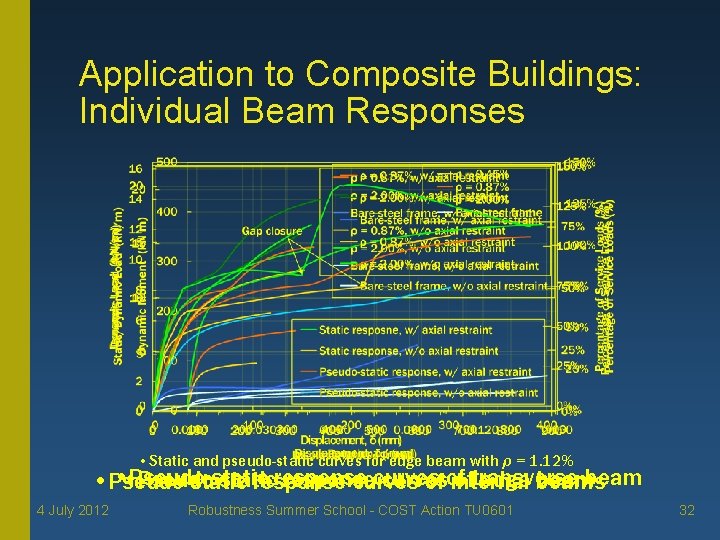
Application to Composite Buildings: Buildings Individual Beam Responses • Static and pseudo-static curves for edge beam with ρ = 1. 12% • • Pseudo-static response curves oftransverse edge beams beam • Pseudo-static response curves ofof internal 4 July 2012 Robustness Summer School - COST Action TU 0601 32
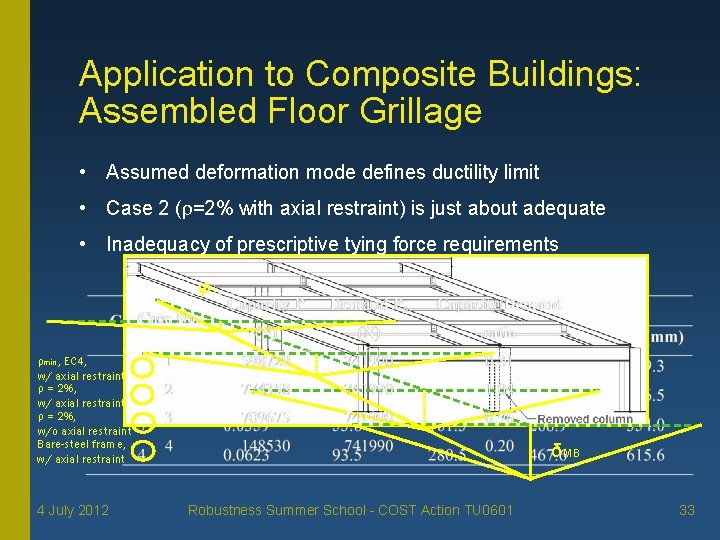
Application to Composite Buildings: Buildings Assembled Floor Grillage • Assumed deformation mode defines ductility limit • Case 2 (r=2% with axial restraint) is just about adequate • Inadequacy of prescriptive tying force requirements φj δSB 1 δSB 2 ρmin, EC 4, w/ axial restraint ρ = 2%, w/ο axial restraint Bare-steel frame, w/ axial restraint 4 July 2012 δSB 3 δMB Robustness Summer School - COST Action TU 0601 33
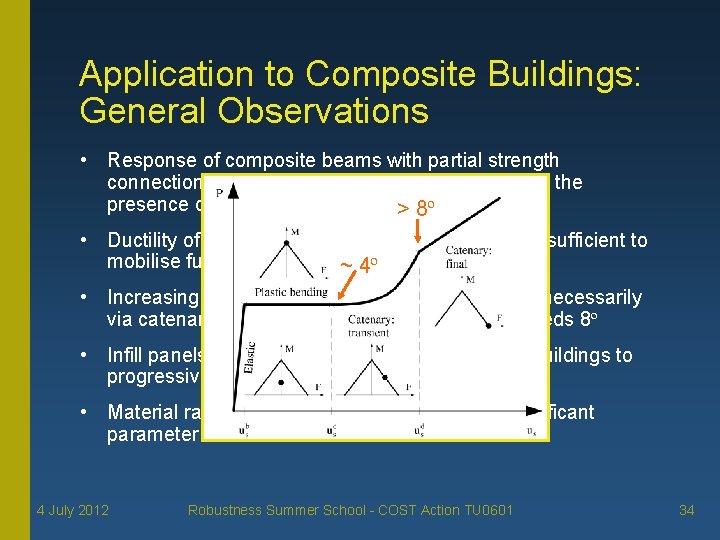
Application to Composite Buildings: Buildings General Observations • Response of composite beams with partial strength connections dominated by compressive arching in the presence of axial restraint > 8º • Ductility of partial strength connections typically insufficient to mobilise full catenary action ~ 4º • Increasing ‘tying force capacity’ is helpful but not necessarily via catenary action, unless rotation capacity exceeds 8º • Infill panels can double resistance of composite buildings to progressive collapse • Material rate-sensitivity is another potentially significant parameter 4 July 2012 Robustness Summer School - COST Action TU 0601 34
Probabilistic Risk Assessment Risk = ∑ P(H) P(D|H) P(F|D) C(F) 1. Deterministic evaluation of failure | D = sudden column loss 2. Material related issues (steel and composite structures) 3. Application in probabilistic risk assessment 4 July 2012 Robustness Summer School - COST Action TU 0601 35
References • Izzuddin, B. A. , Vlassis, A. G. , Elghazouli, A. Y. , and Nethercot, D. A. , "Progressive Collapse of Multi-Storey Buildings due to Sudden Column Loss — Part I: Simplified Assessment Framework“, Engineering Structures, Vol. 30, No. 5, May 2008, pp. 1308 -1318. • Vlassis, A. G. , Izzuddin, B. A. , Elghazouli, A. Y. , and Nethercot, D. A. , "Progressive Collapse of Multi-Storey Buildings due to Sudden Column Loss — Part II: Application“, Engineering Structures, Vol. 30, No. 5, May 2008, pp. 1424 -1438. • Vlassis, A. G. , Izzuddin, B. A. , Elghazouli, A. Y. , and Nethercot, D. A. , "Progressive Collapse of Multi-Storey Buildings due to Failed Floor Impact“, Engineering Structures, Vol. 31, No. 7, July 2009, pp. 1522 -1534. • Gudmundsson, G. V. , and Izzuddin, B. A. , "The ‘Sudden Column Loss’ Idealisation for Disproportionate Collapse Assessment“, The Structural Engineer, Vol. 88, No. 6, 2010, pp. 22 -26. • Izzuddin, B. A. , "Robustness by Design – Simplified Progressive Collapse Assessment of Building Structures“, Stahlbau, Vol. 79, No. 8, August 2010, pp. 556 -564. 4 July 2012 Robustness Summer School - COST Action TU 0601 36
Imperial College London Structural Systems Analysis for Robustness Assessment Bassam A. Izzuddin Department of Civil & Environmental Engineering
- Slides: 37