
The Economics of Entrepreneurship Innovation Nice Summer School





























- Slides: 56
The Economics of Entrepreneurship & Innovation: Nice Summer School David B. Audretsch
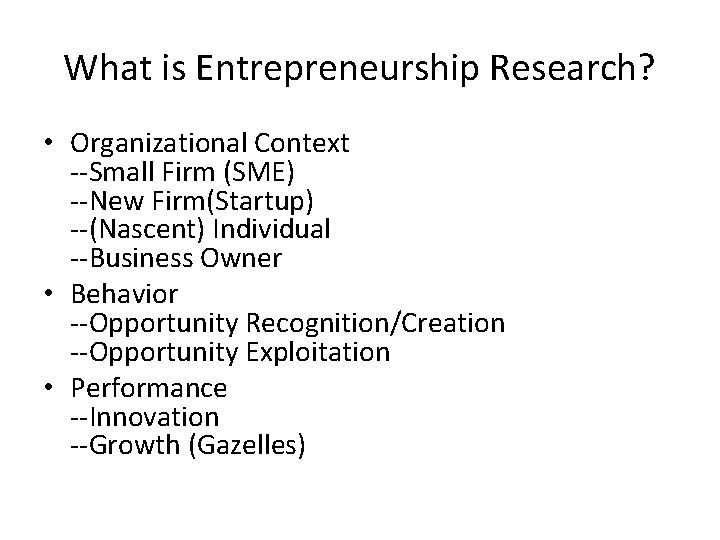
What is Entrepreneurship Research? • Organizational Context --Small Firm (SME) --New Firm(Startup) --(Nascent) Individual --Business Owner • Behavior --Opportunity Recognition/Creation --Opportunity Exploitation • Performance --Innovation --Growth (Gazelles)
Organizational Context • • Small Firm (SME) New Firm(Startup) (Nascent) Individual Business Owner
Behavior • • Opportunity Recognition Opportunity Creation Opportunity Evaluation Opportunity Exploitation
Performance • Innovation • Growth (Gazelles) • Social Goals (Social Entrepreneurship)
An Overview of Entrepreneurship Literature • Acs, Zoltan J. and David B. Audretsch, 2010, “Introduction to the Second Edition” in Z. J. Acs and David B. Audretsch (eds. ), The Handbook of Entrepreneurship Research (New York: Springer) • Parker, Simon, 2009, The Economics of Entrepreneurship (Cambridge: Cambridge University Press).
The Historical Perspective • Entrepreneurship as a Marginal or Invisible Field • Small Business Research • Mittelstandsforschung in Germany • KMU Forschung
The Historical Perspective
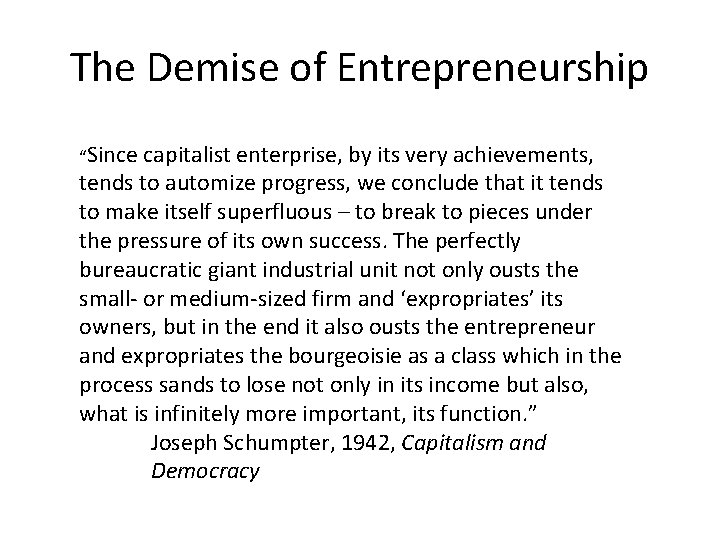
The Demise of Entrepreneurship “Since capitalist enterprise, by its very achievements, tends to automize progress, we conclude that it tends to make itself superfluous – to break to pieces under the pressure of its own success. The perfectly bureaucratic giant industrial unit not only ousts the small- or medium-sized firm and ‘expropriates’ its owners, but in the end it also ousts the entrepreneur and expropriates the bourgeoisie as a class which in the process sands to lose not only in its income but also, what is infinitely more important, its function. ” Joseph Schumpter, 1942, Capitalism and Democracy
Policy Mandate for Entrepreneurship to Promote Innovation & Economic Growth “Our lacunae in the field of entrepreneurship needs to be taken seriously because there is mounting evidence that the key to economic growth and productivity improvements lies in the entrepreneurial capacity of an economy” EU President, Romano Prodi 2002 www. davidaudretsch. com
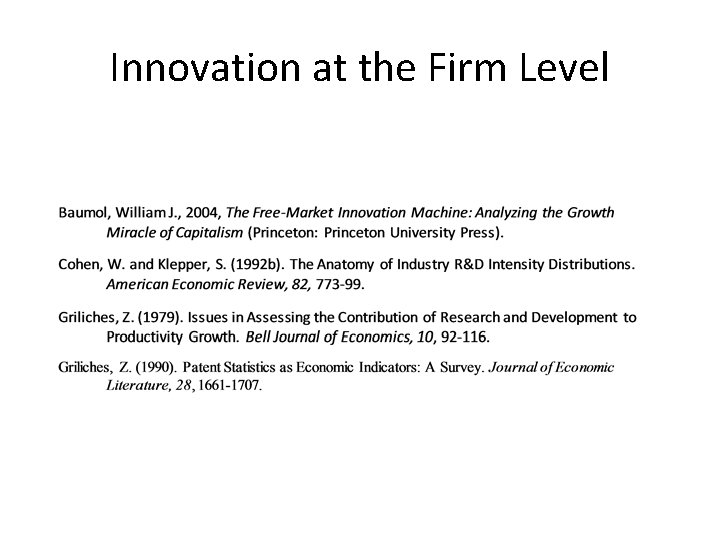
Innovation at the Firm Level
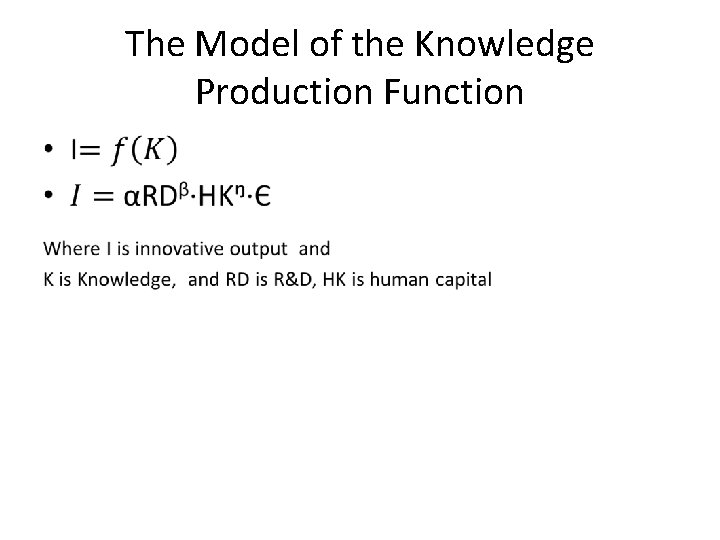
The Model of the Knowledge Production Function •
Testing the Schumpeterian Hypothesis • Firm Innovative Output is Positively Related to Firm Size • Empirical Evidence β≥ 0 • Measurement Issues • Innovation -- Inputs (R&D), Intermediate Outputs (Patents), Outputs
The Schumpeterian Paradox • Empirical Evidence for Innovative Output Measures find β≤ 0
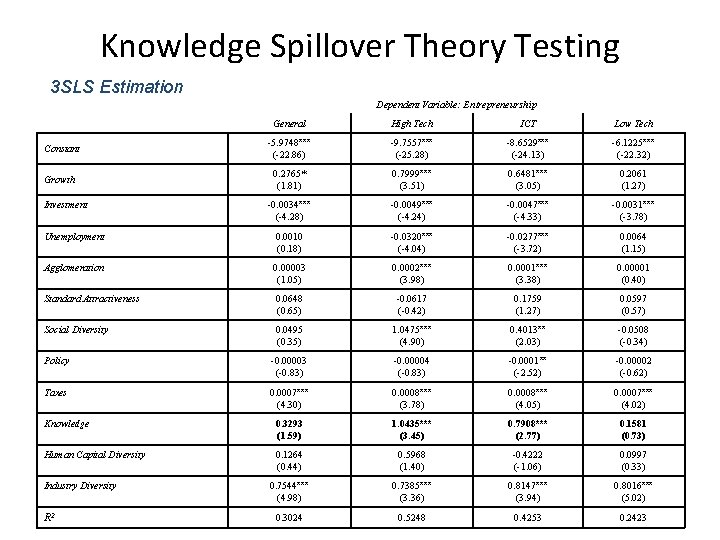
Resolving the Schumpeter Paradox: Knowledge Spillovers • Ei=f (Kj) Where E is the startup of a new firm i and j refers to an incumbent organization. • The knowledge production function reconsidered – the knowledge is exogenous and the creation of a new firm is endogenous
How is Knowledge Different? • Non-excludable & non-exhaustive (Arrow, 1962) • Hyper uncertainty, asymmetries & transactions cost (Arrow, 1962) 16
The Knowledge Filter “A wealth of scientific talent at American colleges and universities – talent responsible for the development of numerous innovative scientific breakthroughs each year – is going to waste as a result of bureaucratic red tape and illogical government regulations…What sense does it make to spend billions of dollars each year on government -supported research and then prevent new developments from benefiting the American people because of dumb bureaucratic red tape? ” U. S. Senator Birch Bayh, 1980
Xeorx PARC’s Discarded Inventions
Apple Computer Founders
Knowledge Spillover Theory of Entrepreneurship - Innovation - Growth Behavior- Organization- Performance
Knowledge Spillover Entrepreurship • Acs, Zoltan J. and David B. Audretsch, 2010, “Knowledge Spillover Entrepreneurship, ” in Z. J. Acs and D. B. Audretsch (eds. ), Handbook of Entrepreneurship Research (New York: Springer). • Cohen, W. and Levinthal, D. (1989). Innovation and Learning. The Economic Journal, 99, 569 -596. • Griliches, Z. (1992). The Search for R&D Spillovers. Scandinavian Journal of Economics, 94, 29 -47. • Zucker, L. , Darby, M. and Armstrong, J. (1998). Intellectual Human Capital and the Birth of U. S. Biotechnology Enterprises. American Economic Review, 88, 290 -306.
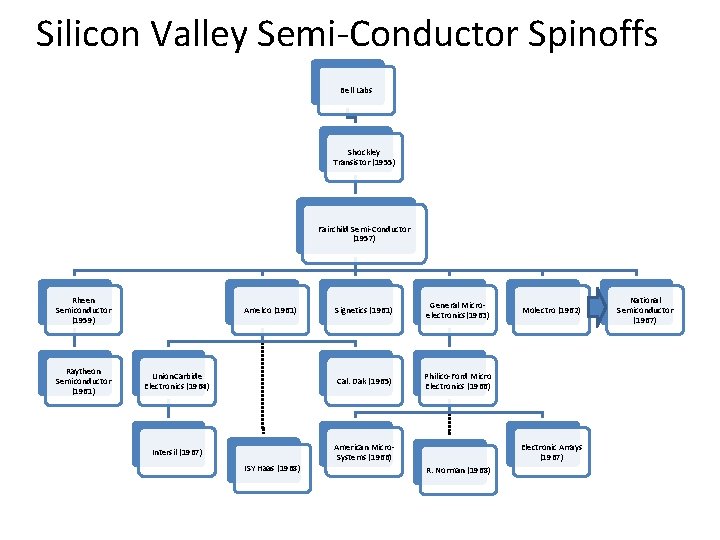
Silicon Valley Semi-Conductor Spinoffs Bell Labs Shockley Transistor (1955) Fairchild Semi-Conductor (1957) Rheen Semiconductor (1959) Raytheon Semiconductor (1961) Signetics (1961) General Microelectronics(1963) Union. Carbide Electronics (1964) Cal. Dak (1965) Philico-Ford Micro Electronics (1966) Intersil (1967) American Micro. Systems (1966) Amelco (1961) ISY Haas (1968) Molectro (1962) Electronic Arrays (1967) R. Norman (1968) National Semiconductor (1967)
Microsoft Founding Team
Spinoffs • Klepper, Steven, 1996, “Entry, Exit, Growth, and Innovation over the Product Life Cycle, ” American Economic Review, 86, 562 -583. • Klepper, Steven and S. Sleeper, 2005, “Entry by Spinoffs, ” Management Science, 21, 971016.
Two Dimensions of Knowledge Spillovers • Geography – Clusters within Close Spatial Proximity to Knowledge Source (Adam B. Jaffe, Manuel Trajtenberg, and Rebecca Henderson, 1993, “Geographic Localization of Knowledge Spillovers as Evidenced by Patent Citations, ” Quarterly Journal of Economics; Annalee Saxenian, 1994, Regional Advantage; Harvard University Press. ) • Organizational – Role of Entrepreneurial New Firms as Conduit of Knowledge Spillovers (R. Agarwal et al. , “The Process of Creative Construction: Knowledge Spillovers, Entrepreneurship and Economic Growth, ”, ” Strategic Entrepreneurship Journal, 2008.
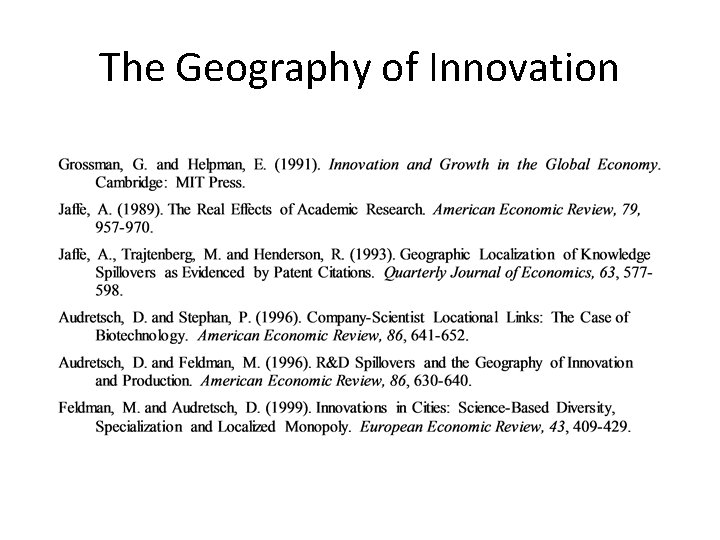
The Geography of Innovation
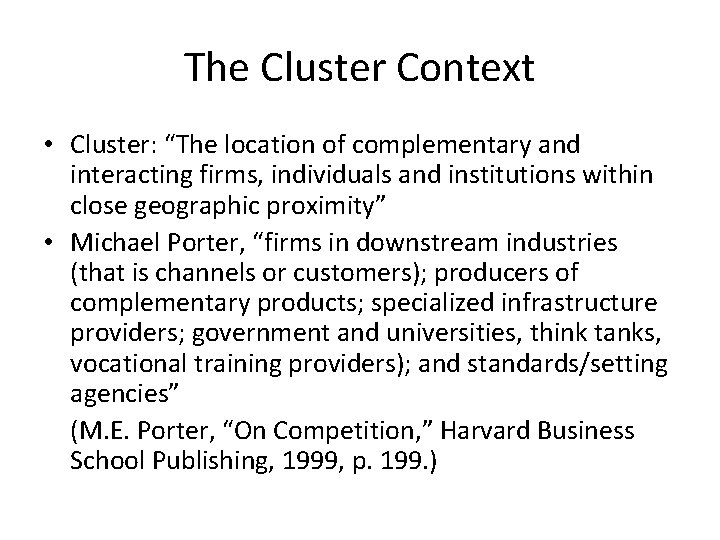
The Cluster Context • Cluster: “The location of complementary and interacting firms, individuals and institutions within close geographic proximity” • Michael Porter, “firms in downstream industries (that is channels or customers); producers of complementary products; specialized infrastructure providers; government and universities, think tanks, vocational training providers); and standards/setting agencies” (M. E. Porter, “On Competition, ” Harvard Business School Publishing, 1999, p. 199. )
Stylized Facts for Geographic Clusters • Emergence of Knowledge-Based Clusters (Anna. Lee Saxenien, Regional Advantage, Harvard University Press, 1994) • Innovative Activity Clusters within Close Geographic Proximity Around Knowledge Sources (D. Audretsch & M. Feldman, “R&D Spillovers and the Geography of Innovation and Production, ” American Economic Review, 1996, 630 -640)
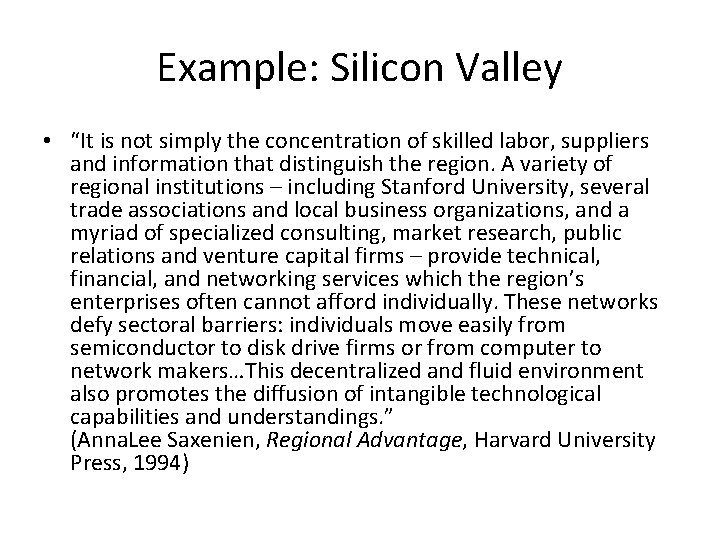
Example: Silicon Valley • “It is not simply the concentration of skilled labor, suppliers and information that distinguish the region. A variety of regional institutions – including Stanford University, several trade associations and local business organizations, and a myriad of specialized consulting, market research, public relations and venture capital firms – provide technical, financial, and networking services which the region’s enterprises often cannot afford individually. These networks defy sectoral barriers: individuals move easily from semiconductor to disk drive firms or from computer to network makers…This decentralized and fluid environment also promotes the diffusion of intangible technological capabilities and understandings. ” (Anna. Lee Saxenien, Regional Advantage, Harvard University Press, 1994)
Stylized Facts for Geographic Clusters - 2 • Knowledge-Based Clusters Exhibit Higher Rates of Economic Growth (Ed Glaeser et al. , “Growth of Cities, ” Journal of Political Economy, 1992) • Cluster Growth is Promoted by Diversity Rather than Specialization of Knowledge Resources (M. Feldmann & D. Audretsch, “Innovation in Cities, ” European Economic Review, 1999.
Stylized Facts for Geographic Clusters - 3 • New-Venture Growth Greater in Cluster Context than in Non-Cluster Context (B. Gilbert et al. , “Clusters, Knowledge Spillovers and New Venture Performance: An Empirical Examination, ” Journal of Business Venturing, 2007; D. Audretsch & E. Lehmann, “Does the Knowledge Spillover Theory of Entrepreneurship hold for regions? ”, Research Policy, 2005, 1191 -1202.
Stylized Facts for Geographic Clusters - 4 • New Venture Creation Greater in Cluster Context (D. Audretsch et al. , 2005, “University Spillovers and New Firm Location, ” with Erik E. Lehmann and Susanne Warning, Research Policy. ) • Locational Sources Provide Capabilities & Knowledge to New Ventures in Cluster Context Creating High Performing Firms (S. Klepper, 2007, “Disagreements, Spinoffs, and the Evolution of Detroit as the Capital of the U. S. Automobile Industry, ” Management Science, 616– 631 and R. Agarwal et al. , 2004. “Knowledge Transfer through Inheritance: Spin-Out Generation, Development and Performance. Academy of Management Journal, 501522. )
Industry Evolution
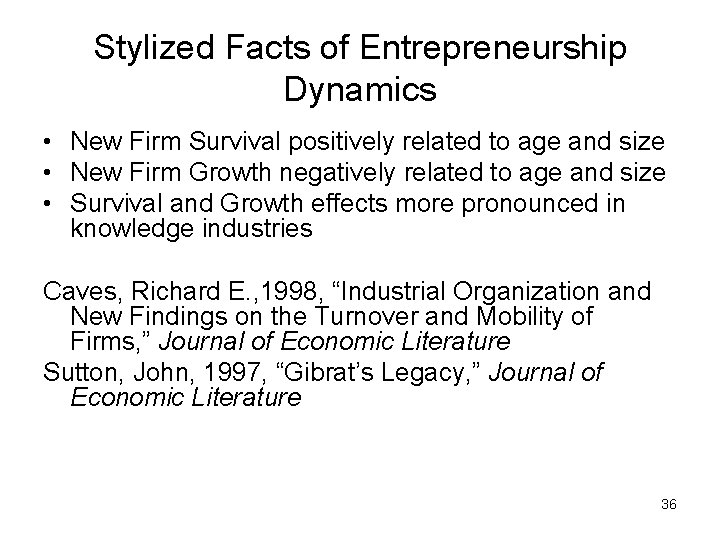
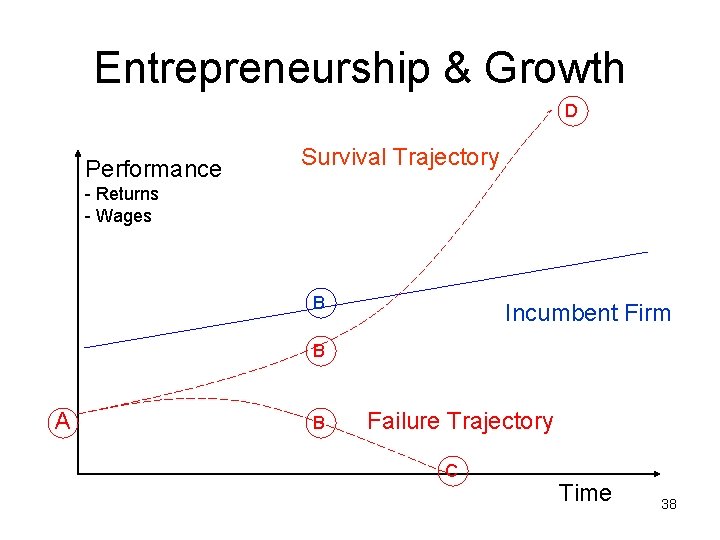
Stylized Facts of Entrepreneurship Dynamics • New Firm Survival positively related to age and size • New Firm Growth negatively related to age and size • Survival and Growth effects more pronounced in knowledge industries Caves, Richard E. , 1998, “Industrial Organization and New Findings on the Turnover and Mobility of Firms, ” Journal of Economic Literature Sutton, John, 1997, “Gibrat’s Legacy, ” Journal of Economic Literature 36
Theory of Noisy Learning & Selection • • • Jovanovic, Boyan, 1982, "Selection and Evolution of Industry, " Econometrica Richard Ericson and Ariel Pakes, 1995, “Markov. Perfect Industry Dynamics: A Framework for Empirical Work, ” Review of Economic Studies, Hugo A. Hopenhayn, 1992, “Entry, Exit and Firm Dynamics in Long Run Equilibrium, ” Econometrica 37
Entrepreneurship & Growth D Performance Survival Trajectory - Returns - Wages B Incumbent Firm B A B Failure Trajectory C Time 38
Entrepreneurship in Evolutionary Context • Model of Revolving Door – Turbulence • Model of Displacement • David B. Audretsch, Innovation and Industry Evolution (MIT Press, 1995) • Caves, Richard E. , 1998, “Industrial Organization and New Findings on the Turnover and Mobility of Firms, ” Journal of Economic Literature 39
Entrepreneurship: Model of Occupational Choice
Model of Entrepreneurial Choice Pr (E)= f(∏i* - Wj) Where E is the startup of a new firm ∏* is expected profits associated with new firm i Wis the wage associated with being a worker for an incumbent firm j
Entrepreneurial Opportunities • Alvarez, Sharon, Jay B. Barney and Susan L. Young, 2010, “Debates in Entrepreneurship: Opportunity Formation and Implications for the Field of Entrepreneurship, ” in Z. J. Acs and D. B. Audretsch (eds. ), Handbook of Entrepreneurship Research (New York: Springer). • Sarasvathy, Saras D. , Nicholas Dew, and S. Ramakrishna, 2010, “Three Views of Entrepreneurial Opportunity, ” in Z. J. Acs and D. B. Audretsch (eds. ), Handbook of Entrepreneurship Research (New York: Springer). • Shane, Scott and Johanthan T. Eckhardt, 2010, “An Update to the Individual-Opportunity Nexus, ” in Z. J. Acs and D. B. Audretsch (eds. ), Handbook of Entrepreneurship Research (New York: Springer).
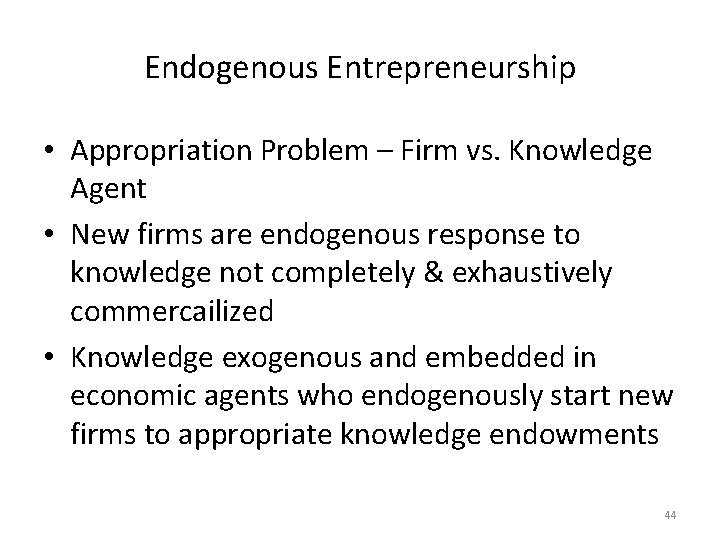
Where Do Entrepreneurial Opportunities Come From? • Knowledge Spillover Theory of Entrepreneurship: Knowledge embedded in economic agents is exogenous, and in an effort to appropriate the returns from that knowledge, the spillover of knowledge involves endogenously creating a new firm 43
Endogenous Entrepreneurship • Appropriation Problem – Firm vs. Knowledge Agent • New firms are endogenous response to knowledge not completely & exhaustively commercailized • Knowledge exogenous and embedded in economic agents who endogenously start new firms to appropriate knowledge endowments 44
The Labor Market View • Brown, C. and J. Medoff, 1989, “The Employer Size Wage Effect, ” Journal of Political Economy, 97, 1027 -1059. • Davis, S. , Haltiwanger, J. and Schuh, S. , 1996 a, Job Creation and Destruction. Cambridge: MIT Press. • Davis, S. , Haltiwanger, J. and Schuh, S. , 1996 b, Small Business and Job Creation: Dissecting the Myth and Reassessing the Facts. Small Business Economics, 8, 297 -315.
Linking Entrepreneurship to Economic Growth • Carree Martin A. and A. Roy Thurik, 2010, “The Impact of Entrepreneurship on Economic Growth, ” in Z. J. Acs and D. B. Audretsch (eds. ), Handbook of Entrepreneurship Research (New York: Springer). • Audretsch, David B. , 2007, “Entrepreneurship Capital and Economic Growth, ” Oxford Review of Economic Policy, Vol. 23 (1), 2007, 63 -78. • Audretsch, David B. , Max Keilbach and Erik Lehmann, 2008, Entrepreneurship and Economic Growth (New York: Oxford University Press). • Braunerhjelm, Pontus, Zoltan J. Acs, David Audretsch and Bo Carlsson, 2010, “The Missing Link: Knowledge Diffusion and Entrepreneurship in Endogenous Growth, ” Small Business Economics An Entrepreneurship Journal, 34 (2), February, 105 -125.
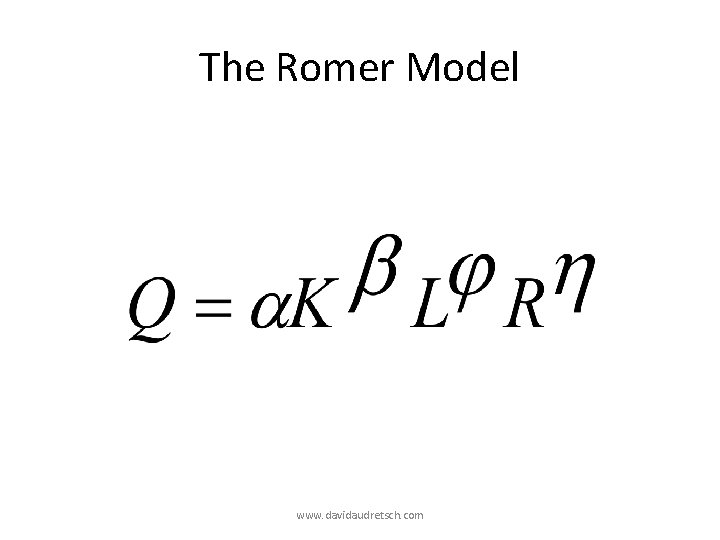
The Romer Model www. davidaudretsch. com
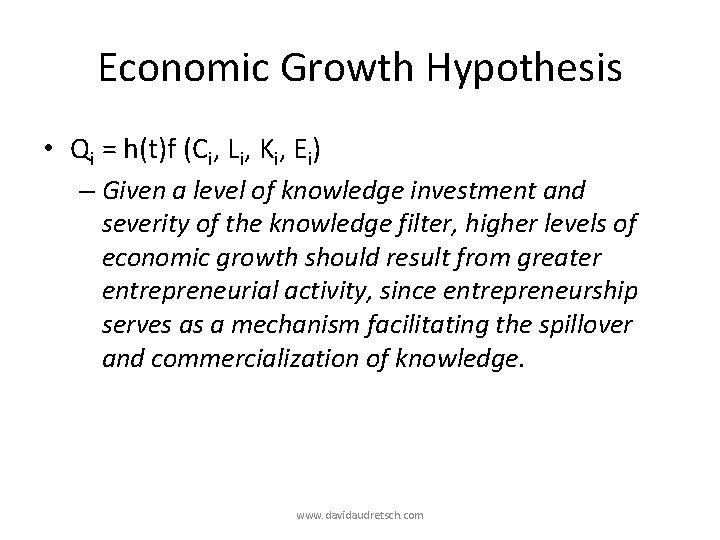
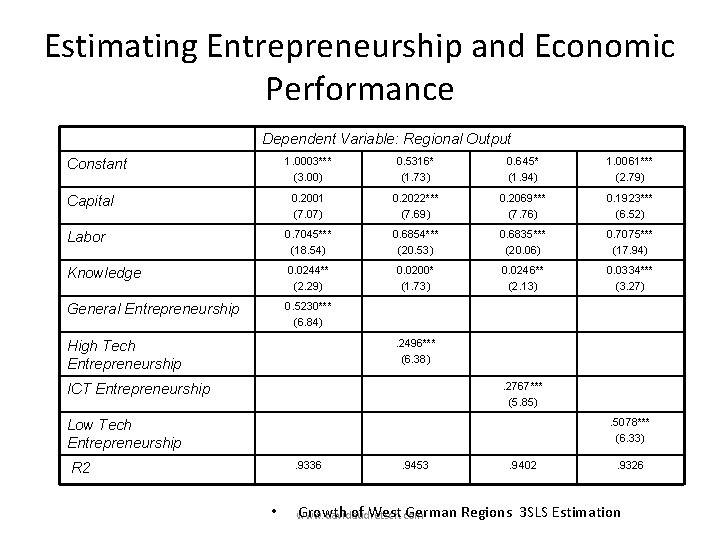
Economic Growth Hypothesis • Qi = h(t)f (Ci, Li, Ki, Ei) – Given a level of knowledge investment and severity of the knowledge filter, higher levels of economic growth should result from greater entrepreneurial activity, since entrepreneurship serves as a mechanism facilitating the spillover and commercialization of knowledge. www. davidaudretsch. com
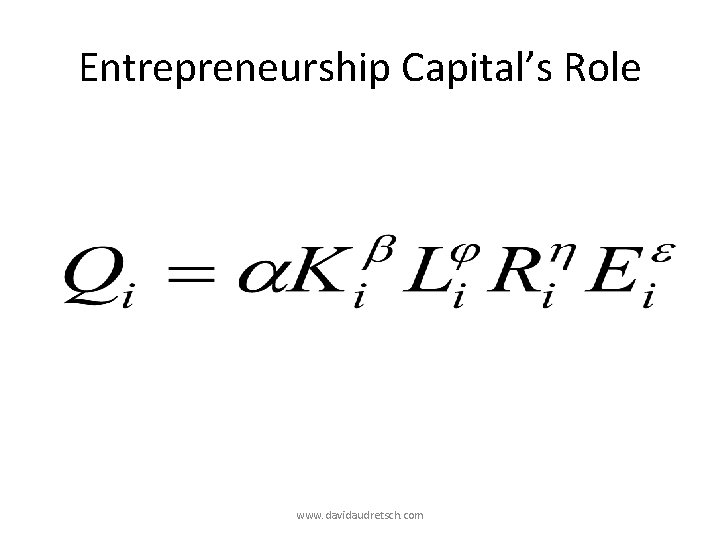
Entrepreneurship Capital’s Role www. davidaudretsch. com
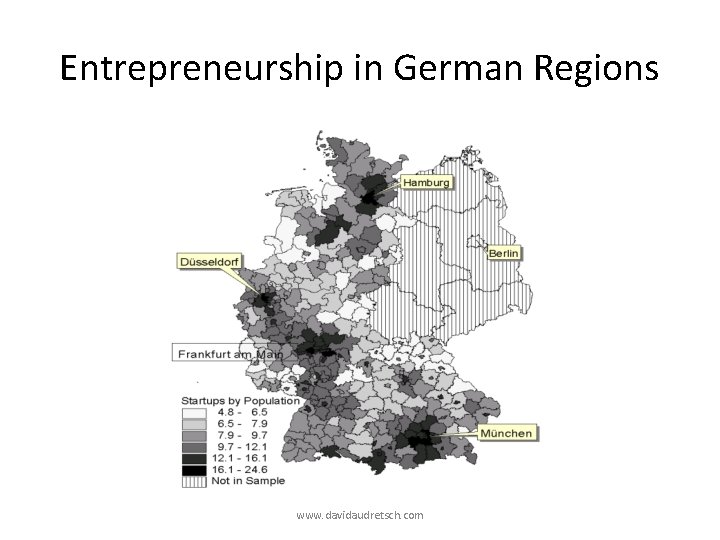
Entrepreneurship in German Regions www. davidaudretsch. com
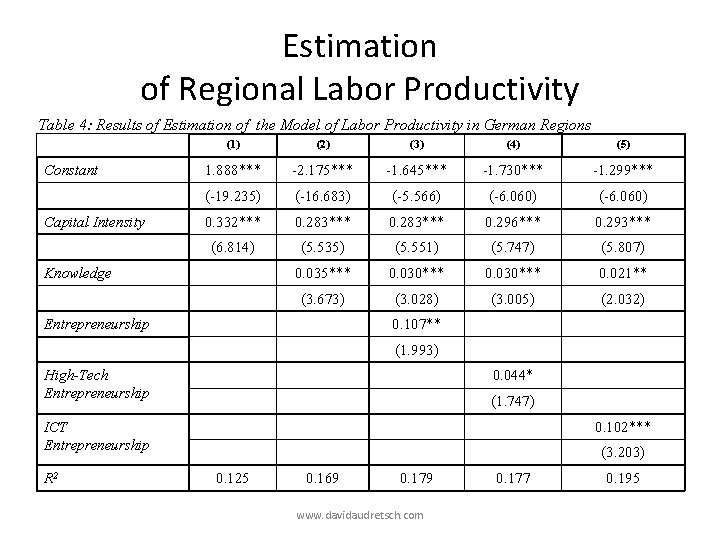
Estimation of Regional Labor Productivity Table 4: Results of Estimation of the Model of Labor Productivity in German Regions Constant Capital Intensity (1) (2) (3) (4) (5) 1. 888*** -2. 175*** -1. 645*** -1. 730*** -1. 299*** (-19. 235) (-16. 683) (-5. 566) (-6. 060) 0. 332*** 0. 283*** 0. 296*** 0. 293*** (6. 814) (5. 535) (5. 551) (5. 747) (5. 807) 0. 035*** 0. 030*** 0. 021** (3. 673) (3. 028) (3. 005) (2. 032) Knowledge Entrepreneurship 0. 107** (1. 993) High-Tech Entrepreneurship 0. 044* (1. 747) ICT Entrepreneurship R 2 0. 102*** (3. 203) 0. 125 0. 169 0. 179 www. davidaudretsch. com 0. 177 0. 195
Estimating Entrepreneurship and Economic Performance Dependent Variable: Regional Output 1. 0003*** (3. 00) 0. 5316* (1. 73) 0. 645* (1. 94) 1. 0061*** (2. 79) 0. 2001 (7. 07) 0. 2022*** (7. 69) 0. 2069*** (7. 76) 0. 1923*** (6. 52) Labor 0. 7045*** (18. 54) 0. 6854*** (20. 53) 0. 6835*** (20. 06) 0. 7075*** (17. 94) Knowledge 0. 0244** (2. 29) 0. 0200* (1. 73) 0. 0246** (2. 13) 0. 0334*** (3. 27) General Entrepreneurship 0. 5230*** (6. 84) Constant Capital . 2496*** (6. 38) High Tech Entrepreneurship . 2767*** (5. 85) ICT Entrepreneurship . 5078*** (6. 33) Low Tech Entrepreneurship. 9336 R 2 • . 9453 . 9402 . 9326 Growth of West German Regions 3 SLS Estimation www. davidaudretsch. com
Knowledge Spillover Theory Testing 3 SLS Estimation Dependent Variable: Entrepreneurship General High Tech ICT Low Tech Constant -5. 9748*** (-22. 86) -9. 7557*** (-25. 28) -8. 6529*** (-24. 13) -6. 1225*** (-22. 32) Growth 0. 2765* (1. 81) 0. 7999*** (3. 51) 0. 6481*** (3. 05) 0. 2061 (1. 27) -0. 0034*** (-4. 28) -0. 0049*** (-4. 24) -0. 0047*** (-4. 33) -0. 0031*** (-3. 78) Unemployment 0. 0010 (0. 18) -0. 0320*** (-4. 04) -0. 0277*** (-3. 72) 0. 0064 (1. 15) Agglomeration 0. 00003 (1. 05) 0. 0002*** (3. 98) 0. 0001*** (3. 38) 0. 00001 (0. 40) Standard Attractiveness 0. 0648 (0. 65) -0. 0617 (-0. 42) 0. 1759 (1. 27) 0. 0597 (0. 57) Social Diversity 0. 0495 (0. 35) 1. 0475*** (4. 90) 0. 4013** (2. 03) -0. 0508 (-0. 34) Policy -0. 00003 (-0. 83) -0. 00004 (-0. 83) -0. 0001** (-2. 52) -0. 00002 (-0. 62) Taxes 0. 0007*** (4. 30) 0. 0008*** (3. 78) 0. 0008*** (4. 05) 0. 0007*** (4. 02) Knowledge 0. 3293 (1. 59) 1. 0435*** (3. 45) 0. 7908*** (2. 77) 0. 1581 (0. 73) Human Capital Diversity 0. 1264 (0. 44) 0. 5968 (1. 40) -0. 4222 (-1. 06) 0. 0997 (0. 33) 0. 7544*** (4. 98) 0. 7385*** (3. 36) 0. 8147*** (3. 94) 0. 8016*** (5. 02) 0. 4253 0. 2423 Investment Industry Diversity R 2 www. davidaudretsch. com 0. 3024 0. 5248
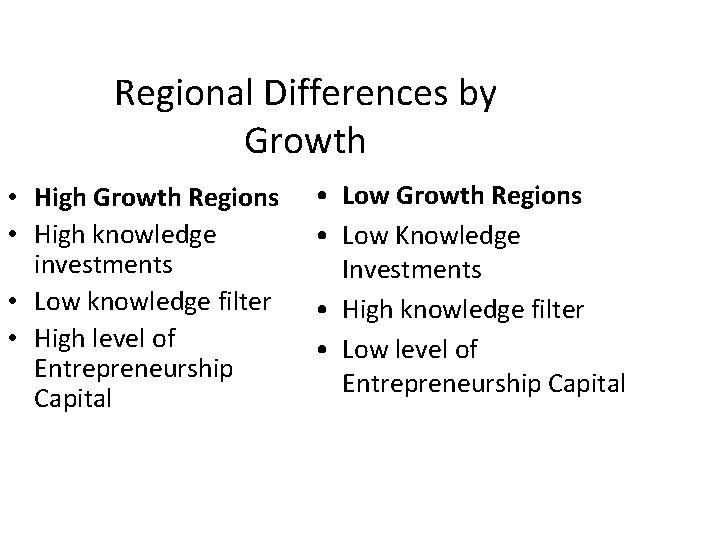
Regional Differences by Growth • High Growth Regions • High knowledge investments • Low knowledge filter • High level of Entrepreneurship Capital • Low Growth Regions • Low Knowledge Investments • High knowledge filter • Low level of Entrepreneurship Capital
The Role of Public Policy Henrekson, Magnus and Mikael Stenkula, 2010, “Entrepreneurship and Public Policy, ” in Z. J. Acs and D. B. Audretsch (eds. ), Handbook of Entrepreneurship Research (New York: Springer). Lerner, Josh, 2010, “Boulevard of Broken Dreams: Why Public Efforts to Boost Entrepreneurship and Venture Capital Have Failed –And What do Do About It, ” by Josh Lerner, Journal of Economic Literature, 98(4), December, 1053 -1054.
New Research Directions