
Aphrodite MISSION Alpbach Summerschool 2014 Team GREEN Aphrodite
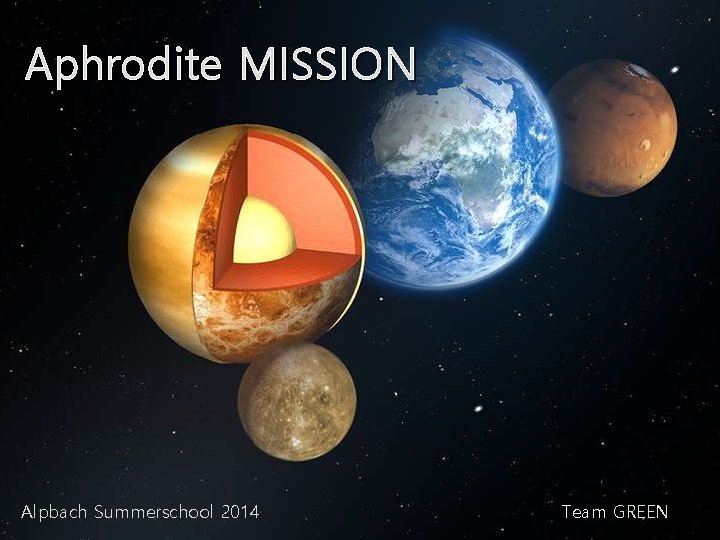
Aphrodite MISSION Alpbach Summerschool 2014 Team GREEN
Aphrodite Mission Introduction Mission Profile Orbiter and Balloon Design Scientific Objectives Payloads Conclusion

Introduction “Venus only looks like the Earth, in the same sense that the evil Mr. Hyde resembles the good Dr. Jekyll” “As we search for terrestrial-like planets elsewhere, we need to find out the reasons for these differences and the conditions that allows these diverse bodies (…) to form at all. ” Why is Venus so different from Earth?
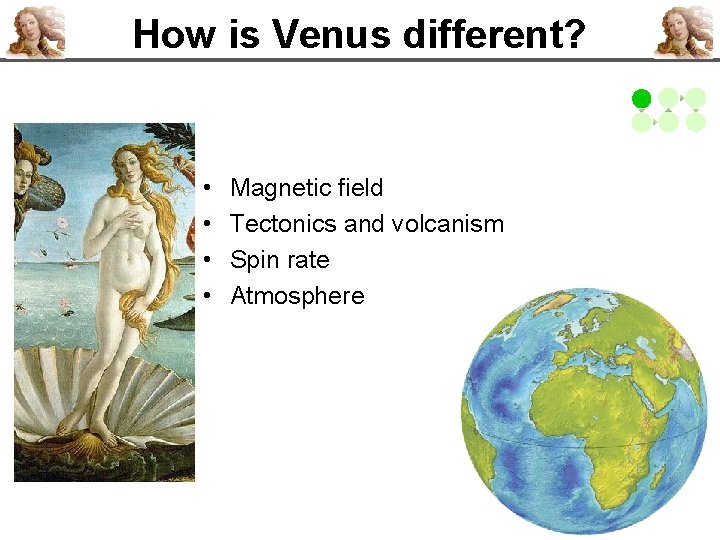
How is Venus different? • • Magnetic field Tectonics and volcanism Spin rate Atmosphere
Aphrodite Mission Introduction Scientific Objectives Mission Profile Orbiter and Balloon Design Payloads Conclusion
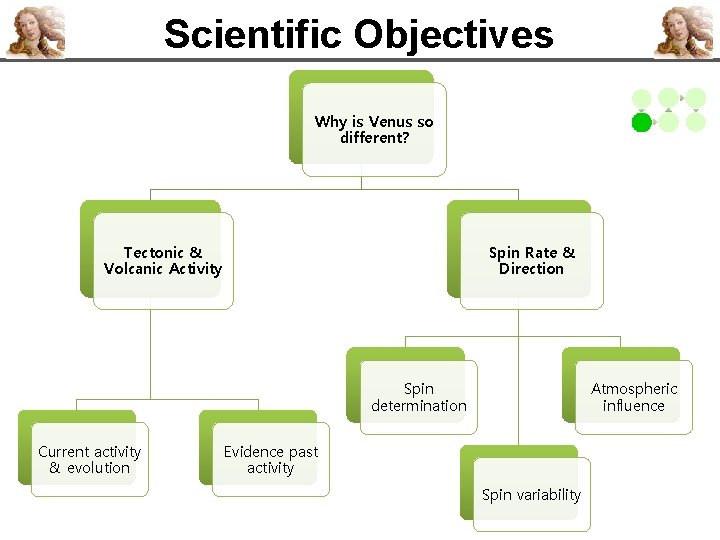
Scientific Objectives Why is Venus so different? Tectonic & Volcanic Activity Spin Rate & Direction Spin determination Current activity & evolution Atmospheric influence Evidence past activity Spin variability
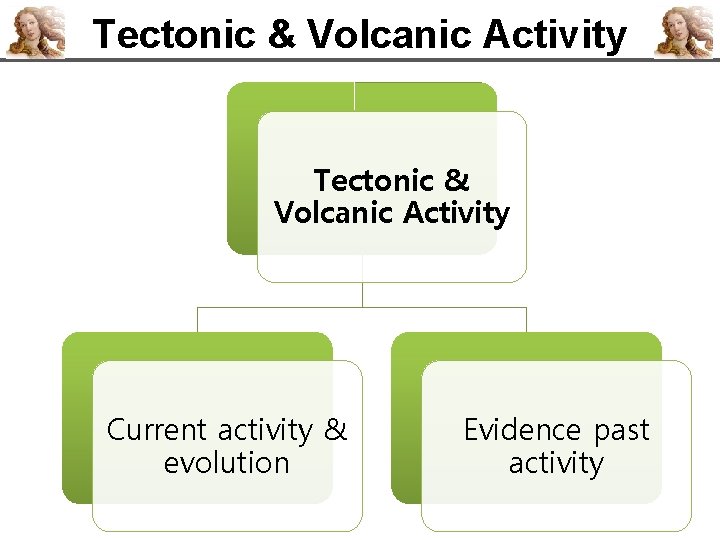
Tectonic & Volcanic Activity Current activity & evolution Evidence past activity
Tectonic & Volcanic Activity • • Study differences between Earth and Venus Volcanism on Venus unrelated to plate tectonics Type of volcanism we know the least about Concentration and variation in SO 2 - sign of large volcanic eruption - information about the plume and composition of source magma • Evolution of the planet • Volcanos effect atmosphere and climate
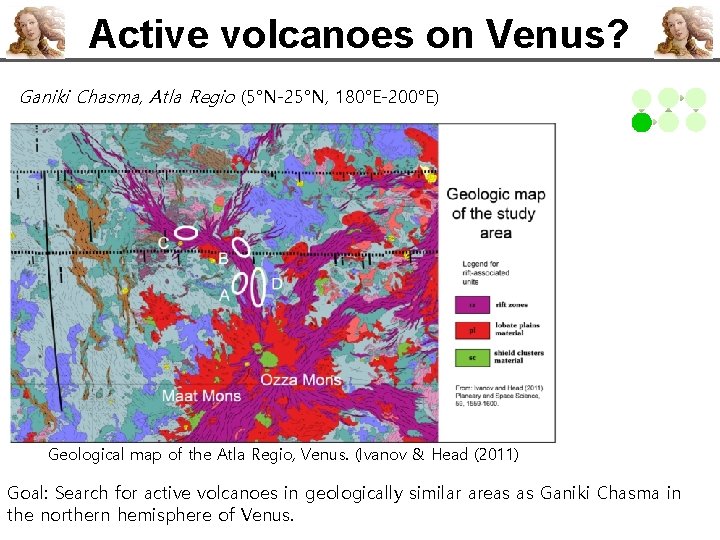
Active volcanoes on Venus? Ganiki Chasma, Atla Regio (5°N-25°N, 180°E-200°E) Geological map of the Atla Regio, Venus. (Ivanov & Head (2011) Goal: Search for active volcanoes in geologically similar areas as Ganiki Chasma in the northern hemisphere of Venus.
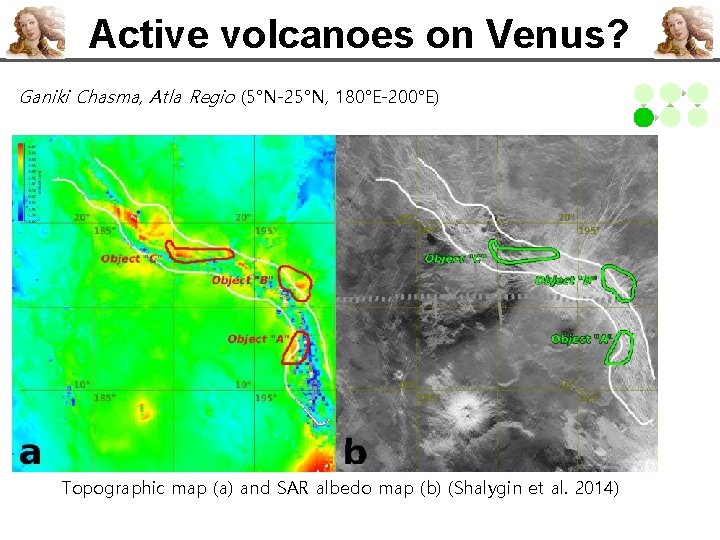
Active volcanoes on Venus? Ganiki Chasma, Atla Regio (5°N-25°N, 180°E-200°E) Topographic map (a) and SAR albedo map (b) (Shalygin et al. 2014)
Tectonics • Magellan (1990 -1994) + Venera-D (2024? ) • Scientific goals: topographical mapping of the surface. • Our Aim: – Study the (sub)surface to understand the volcanic and tectonic processes – Structure and stratigraphy of lava flows – Detect subsurface magmatic bodies – Depth/structure of the coronae, rift zones, wrinkle ridges and tessera regions
Thermal Imaging • Magma chambers • Eruptions • Lava flows • Smallest volcanoes • Coldest lava flows
Volcanic Signature Atmosphere Chemical and isotopic measurements of the atmosphere above, through and below the cloud layer (65 -45 km). - understand the evolution of the atmosphere and its link to volcanic processes gas species related to volcanic activity: H 2 O and SO 2 their respective isotopes: D/H, 16 O/18 O and 32 S/34 S the variability of SO 2 give clues to the rate of current volcanism refined measurements, obtained in-situ, provide constraints on volcanism link to volcanic processes via isotopic fractionation due to volcanic process recent interior degassing and processes controlling the sulfur cycle on Venus Identification of a volcanic ash layer at the lower cloud base - study the nature of the layer at the base of the cloud measure particle sizes of volcanic ash / dust particles distinguish between H 2 SO 4 aerosols measured chemically
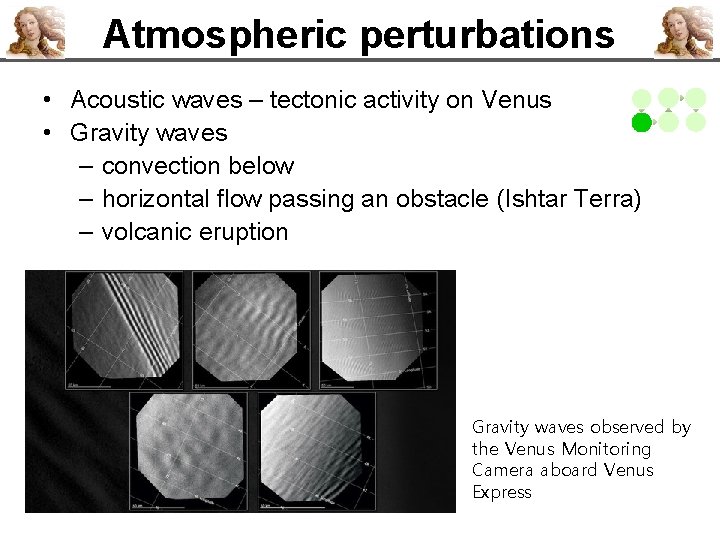
Atmospheric perturbations • Acoustic waves – tectonic activity on Venus • Gravity waves – convection below – horizontal flow passing an obstacle (Ishtar Terra) – volcanic eruption Gravity waves observed by the Venus Monitoring Camera aboard Venus Express
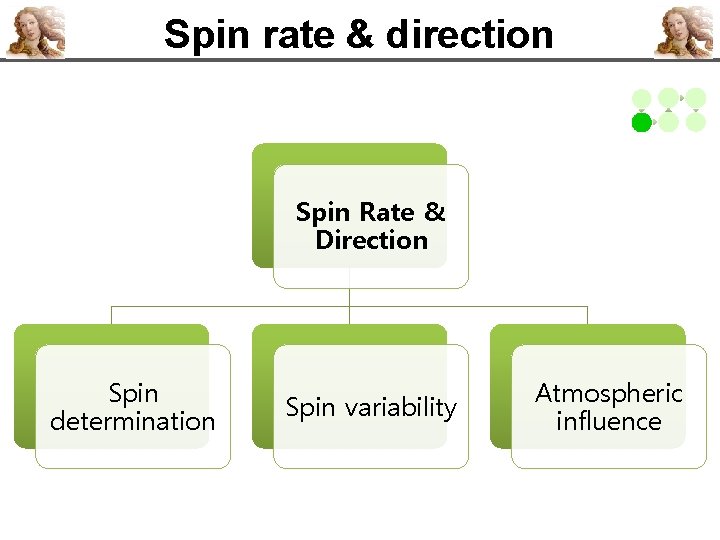
Spin rate & direction Spin Rate & Direction Spin determination Spin variability Atmospheric influence
Spin Rate & Direction • Cause for different spin rate & direction than Earth • Coupling with atmosphere or geological processes • Information about internal structure Moment of inertia
Determination & Variability • difficult to meassure not yet accurately determined • Changed from Magellan to Venus Express • Even changed during Magellan mission (3 years) • Apparent periodic change • Aim: confirm periodicity & determine cause
Atmospheric influence Atmospheric coupling to the surface → interaction spin ↔ global circulation Observation in-situ & from orbit Temperature Pressure Wind Speed
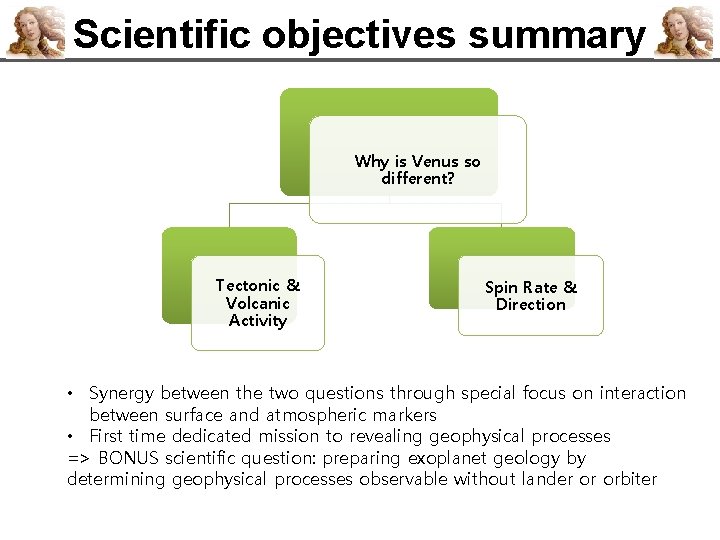
Scientific objectives summary Why is Venus so different? Tectonic & Volcanic Activity Spin Rate & Direction • Synergy between the two questions through special focus on interaction between surface and atmospheric markers • First time dedicated mission to revealing geophysical processes => BONUS scientific question: preparing exoplanet geology by determining geophysical processes observable without lander or orbiter
Aphrodite Mission Introduction Scientific Objectives Mission Profile Orbiter and Balloon Design Payloads Conclusion
Spin Rate measurement Package Principle: surface feature tracking and orbit determination to find spin and axis changes ->Accurate accelerometer to determine orbit: • Match orbit fluctuations for each Venus day • Find the shifts ("errors") in orbits • Sum shifts of all orbits for each Venus day • Find spin changes and axis changes ->Surface probe to ping with GPR for precise surface reference
Spin Rate measurement Package STAR Accelerometer: • Mass: ~< 15 kg (estimated) • Power: ~< 15 W (estimated) • Resolution: < 3 E-9 m/s^2 (measurement of the non -gravitational accelerations due to air drag, albedo and solar radiation • CHAMP heritage APS Star tracker (x 3): • Mass: 3 x 1. 5 kg = 5 kg • Power: 3 x 5 W = 15 W

u r e. P r m eo b ne t P r Pi an cc ki p
m e n. P t r o b Pe a c. D e ks ai g. Rg n e a: : d. M •
Ground Penetrating Radar Shallow Radar - SHARAD Requirements: surface and subsurface topography - Spatial resolution (0. 3 -3 km x 3 -7 km horizontal and 7. 5 -15 m vertical) as well as subsurface penetration range (100 m) meet the scientific requirements - Heritage : Mars Reconnaissance Orbiter - Expecting development : Radar Sounder for En. Vision (Bruzzone, et al. ). - Mass : 17. 1 kg (11. 6 kg Electronics + 5. 5 kg antenna and cabling) Power : 28 W – Operating 17 W – Stand-By
Balloon payload • Microflown Infrasound Detector: • • • In situ detection of seismic waves in atmosphere Mass: 38 g Total package: ~< 100 g (estimated) Temperatures up to 200°C
Balloon payload Small and lightwheight camera: • Pictures of/inside clouds. Give additional context to other measurements • Package mass: < 100 g (assumed) • Must tolerate at least 60 C
Aphrodite Mission Introduction Scientific Objectives Mission Profile Orbiter and Balloon Design Payloads Conclusion
Timeline • Launch – 7 Dec 2032 00: 00. 000 UTC • Launch Window: – 5/12/2032 at 18 h 00 to 23/12/2032 at 23 h 00 – Finish Hohmann Transfer to Venus SOI: 3 Apr 2033 06: 01: 49. 439 UTC • approx. 4 months – Target to Venus Perigee at 340 Km altitude and 78º inclination: 11 May 2033 23: 15: 22. 603 UTC – Aerobraking to an apogee altitude of 6000 km: 17 Jun 2033 19: 06: 35. 093 UTC – Lower the Perigee to 270 km: 17 Jun 2033 20: 38: 03. 691 UTC – Parking Orbit at Perigee altitude of 297 km and Apogee altitude of 6084 km: 18 Jun 2033 07: 37: 24. 094 UTC • approx. 6. 5 months final orbit
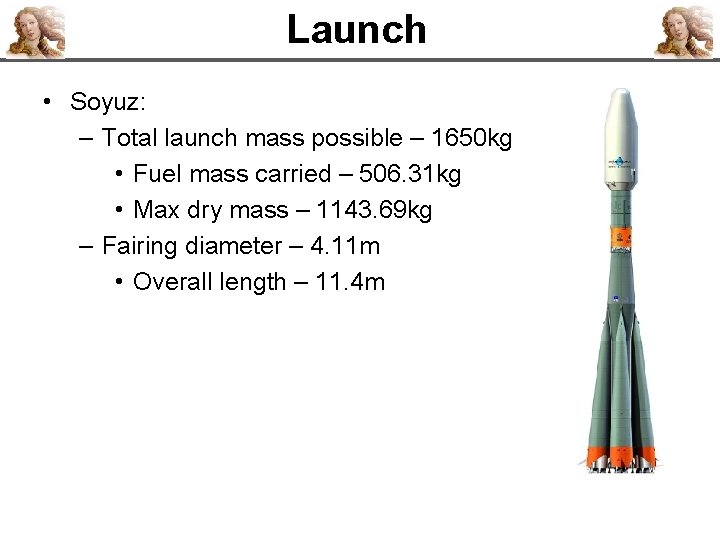
Launch • Soyuz: – Total launch mass possible – 1650 kg • Fuel mass carried – 506. 31 kg • Max dry mass – 1143. 69 kg – Fairing diameter – 4. 11 m • Overall length – 11. 4 m
Operations • Balloon separation – at 66, 000 km • Balloon altitude – 40 -60 km (day/night variation) – Probe separates and lands on surface • Balloon lifespan – 30 days • Orbiter lifespan – 3 years • Total mission – 4 years
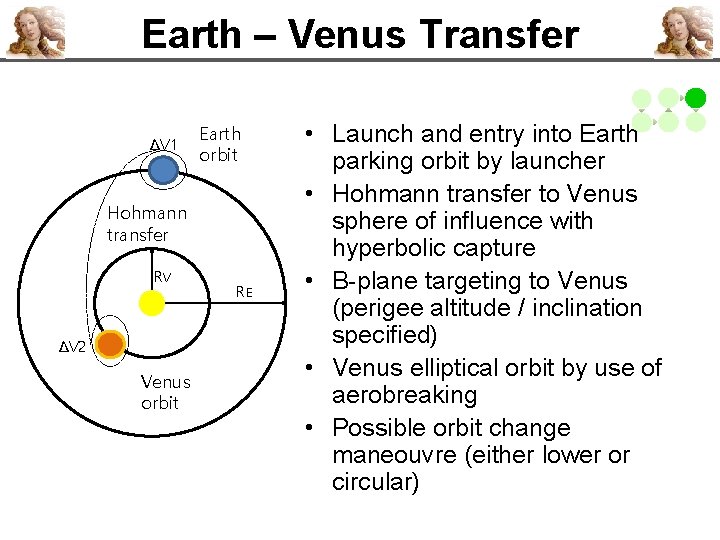
Earth – Venus Transfer ΔV 1 Earth orbit Hohmann transfer RV ΔV 2 Venus orbit RE • Launch and entry into Earth parking orbit by launcher • Hohmann transfer to Venus sphere of influence with hyperbolic capture • B-plane targeting to Venus (perigee altitude / inclination specified) • Venus elliptical orbit by use of aerobreaking • Possible orbit change maneouvre (either lower or circular)
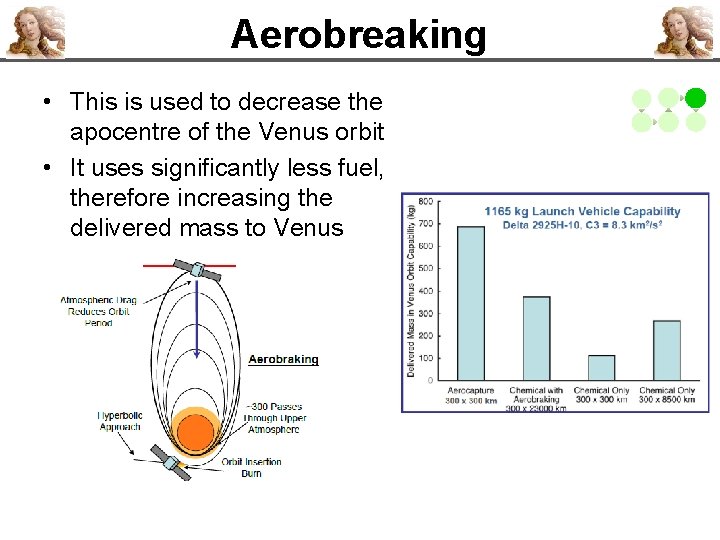
Aerobreaking • This is used to decrease the apocentre of the Venus orbit • It uses significantly less fuel, therefore increasing the delivered mass to Venus
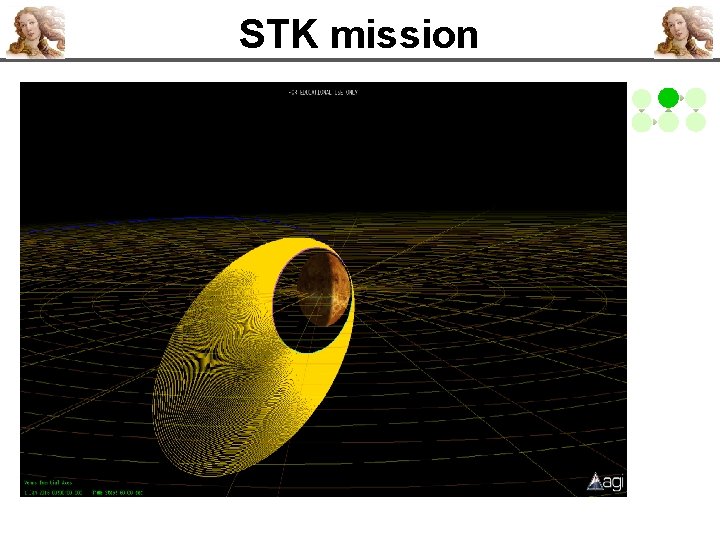
STK mission
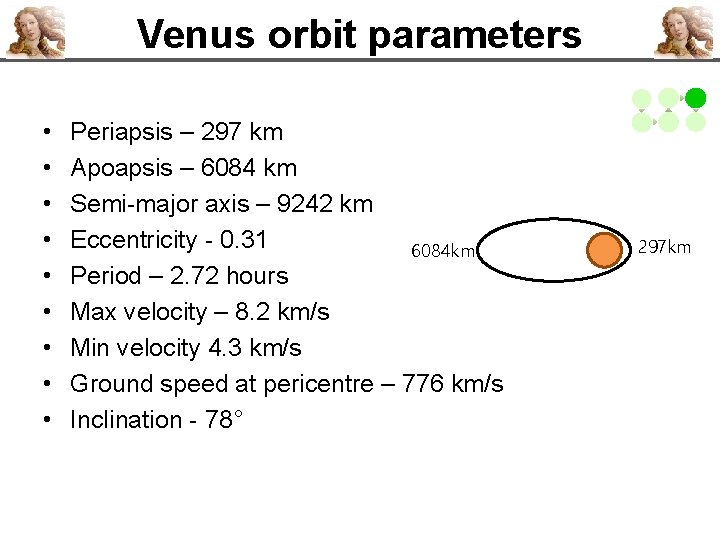
Venus orbit parameters • • • Periapsis – 297 km Apoapsis – 6084 km Semi-major axis – 9242 km Eccentricity - 0. 31 6084 km Period – 2. 72 hours Max velocity – 8. 2 km/s Min velocity 4. 3 km/s Ground speed at pericentre – 776 km/s Inclination - 78° 297 km
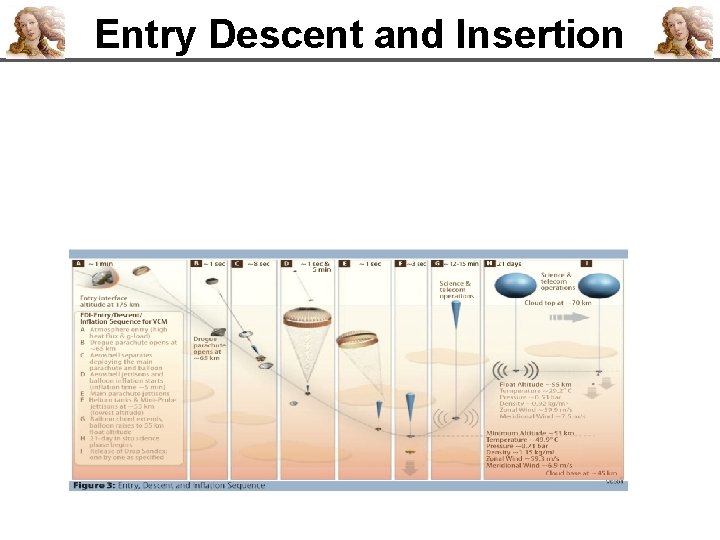
Entry Descent and Insertion
Aphrodite Mission Introduction Scientific Objectives Mission Profile Orbiter and Balloon Design Payloads Conclusion
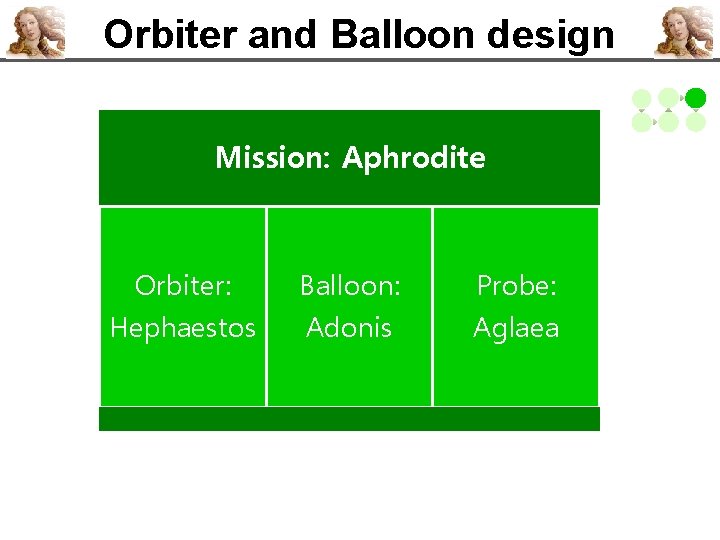
Orbiter and Balloon design Mission: Aphrodite Orbiter: Balloon: Probe: Hephaestos Adonis Aglaea
Hephaistos design • Design drivers: – Venus express bus to maximize heritage – As simple as possible – Twin solar arrays – Solar heat shield – Agility for balloon communication and instrument stability – Mass budget:
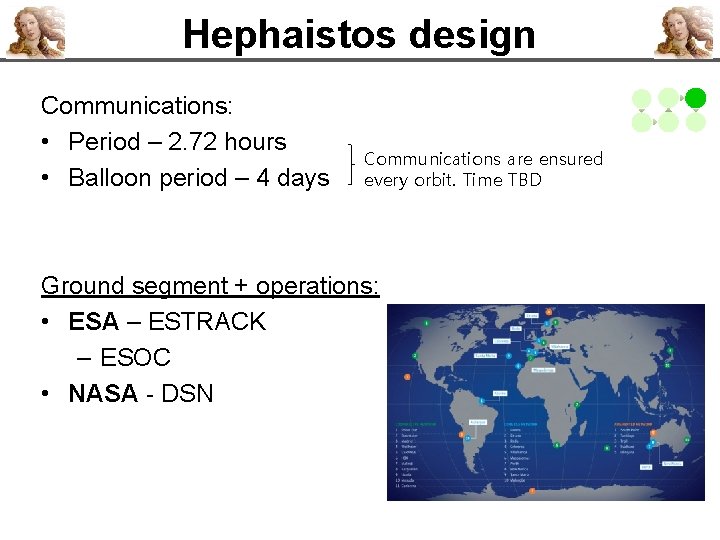
Hephaistos design Communications: • Period – 2. 72 hours • Balloon period – 4 days Communications are ensured every orbit. Time TBD Ground segment + operations: • ESA – ESTRACK – ESOC • NASA - DSN
Hephaistos design Data Handling System: - Radiation tolerant Processor / redundancy against SEUs and other radiation induced failures - Data: ~100 Gbit/day Max storage time: ~ 0. 25 years - Internal Data Storage: ~ 2 TB
Hephaistos design Attitude and Orbit Control (3 -axis-stabilisation): Venus. Xpress heritage Sensors: - 2 Star trackers, - Sun sensors ( safe mode) - Inertial measurement units Actuators: - 4 reaction wheels - 4 redundant thrusters (hydrazine, 10 N) - Bi-propellant European Apogee Motor (500 N, 325 Isp, 5 kg)
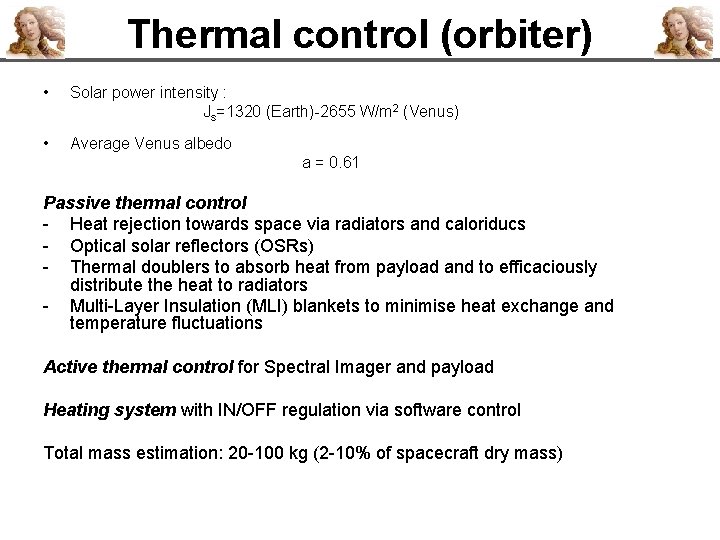
Thermal control (orbiter) • Solar power intensity : Js=1320 (Earth)-2655 W/m 2 (Venus) • Average Venus albedo a = 0. 61 Passive thermal control - Heat rejection towards space via radiators and caloriducs - Optical solar reflectors (OSRs) - Thermal doublers to absorb heat from payload and to efficaciously distribute the heat to radiators - Multi-Layer Insulation (MLI) blankets to minimise heat exchange and temperature fluctuations Active thermal control for Spectral Imager and payload Heating system with IN/OFF regulation via software control Total mass estimation: 20 -100 kg (2 -10% of spacecraft dry mass)
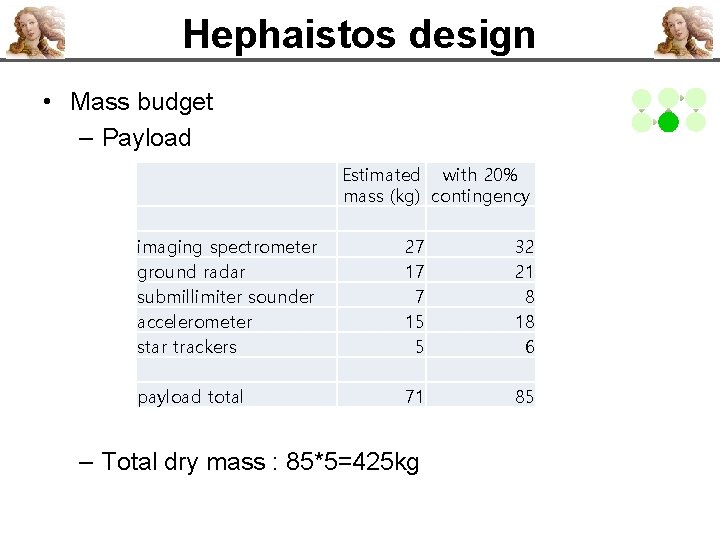
Hephaistos design • Mass budget – Payload Estimated with 20% mass (kg) contingency imaging spectrometer ground radar submillimiter sounder accelerometer star trackers 27 17 7 15 5 32 21 8 18 6 payload total 71 85 – Total dry mass : 85*5=425 kg
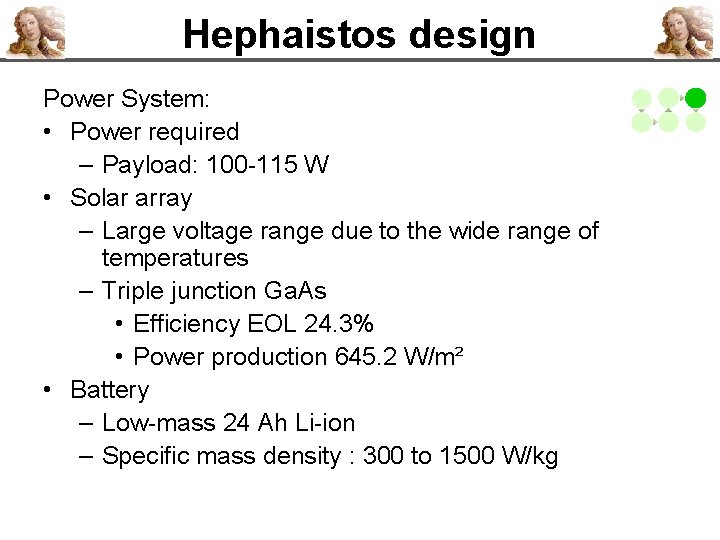
Hephaistos design Power System: • Power required – Payload: 100 -115 W • Solar array – Large voltage range due to the wide range of temperatures – Triple junction Ga. As • Efficiency EOL 24. 3% • Power production 645. 2 W/m² • Battery – Low-mass 24 Ah Li-ion – Specific mass density : 300 to 1500 W/kg
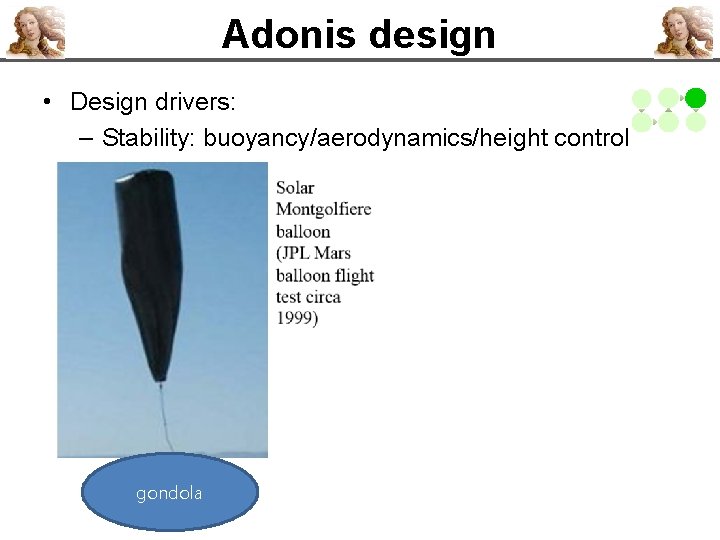
Adonis design • Design drivers: – Stability: buoyancy/aerodynamics/height control gondola
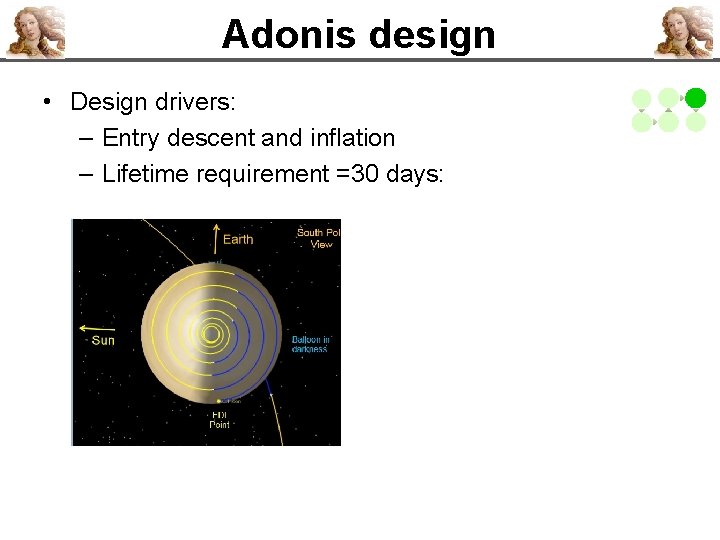
Adonis design • Design drivers: – Entry descent and inflation – Lifetime requirement =30 days:
Adonis design • Design drivers: – Power generation • Solar panels + battery • Relative wind + battery – Communication with orbiter through S-band – Passive probe release mechanism
Thermal control (orbiter) • Solar power intensity : Js=1320 -2655 W/m 2 (Earth - Venus) • Avg Venus albedo a = 0. 61 Passive thermal control - Heat rejection towards space via radiators and caloriducs - Optical solar reflectors (OSRs) - Thermal doublers to absorb heat from payload and to efficaciously distribute the heat to radiators - Multi-Layer Insulation (MLI) blankets to minimise heat exchange and temperature fluctuations Active thermal control integrated in the Spectral Imager (65 K) Heating system with IN/OFF regulation via software control Total mass estimation: 20 -100 kg (2 -10% of spacecraft dry mass)
Adonis design • Operation modes: – Nominal: science measurements from operations list previously sent by orbiter. – Com mode: data upload to orbiter – Safe mode: altitude is critical (30 km), all instruments and COM powered off. Power diverted to air heater
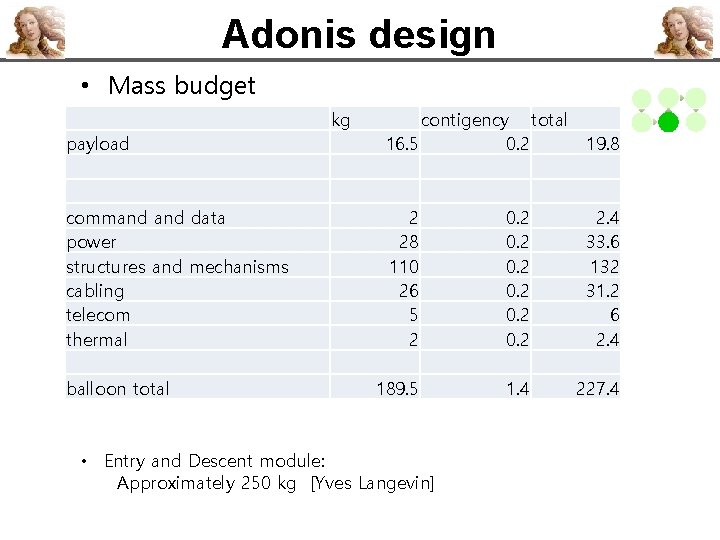
Adonis design • Mass budget kg payload contigency total 16. 5 0. 2 19. 8 command data power structures and mechanisms cabling telecom thermal 2 28 110 26 5 2 0. 2 2. 4 33. 6 132 31. 2 6 2. 4 189. 5 1. 4 227. 4 balloon total • Entry and Descent module: Approximately 250 kg [Yves Langevin]
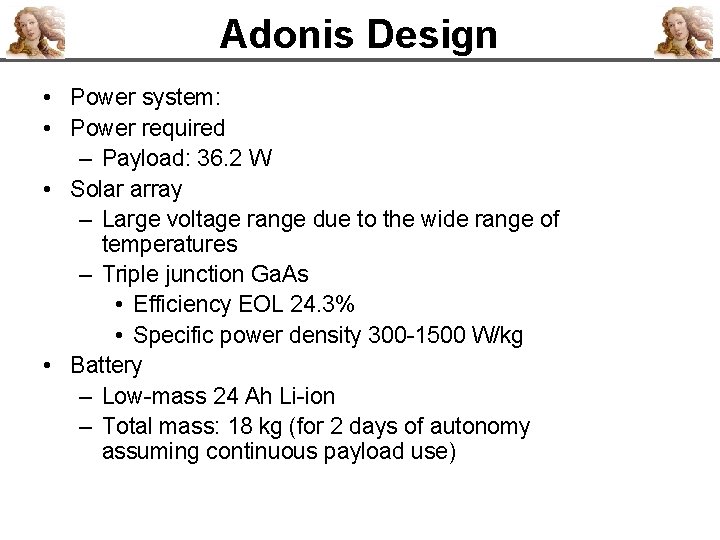
Adonis Design • Power system: • Power required – Payload: 36. 2 W • Solar array – Large voltage range due to the wide range of temperatures – Triple junction Ga. As • Efficiency EOL 24. 3% • Specific power density 300 -1500 W/kg • Battery – Low-mass 24 Ah Li-ion – Total mass: 18 kg (for 2 days of autonomy assuming continuous payload use)
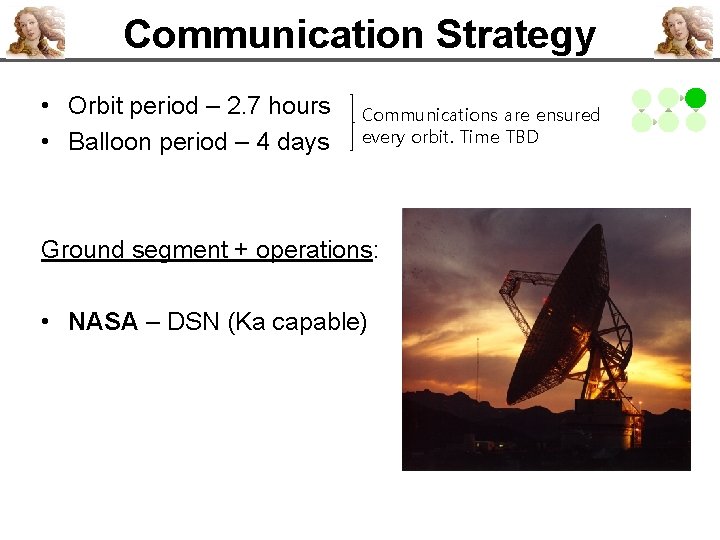
Communication Strategy • Orbit period – 2. 7 hours • Balloon period – 4 days Communications are ensured every orbit. Time TBD Ground segment + operations: • NASA – DSN (Ka capable)
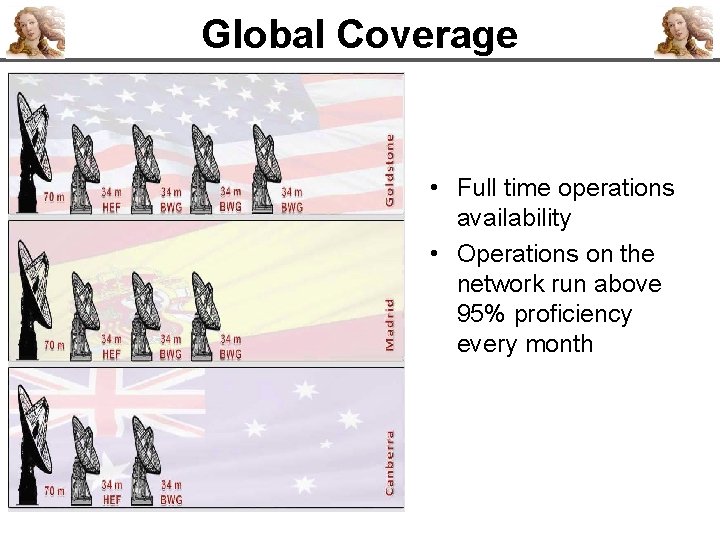
Global Coverage • Full time operations availability • Operations on the network run above 95% proficiency every month
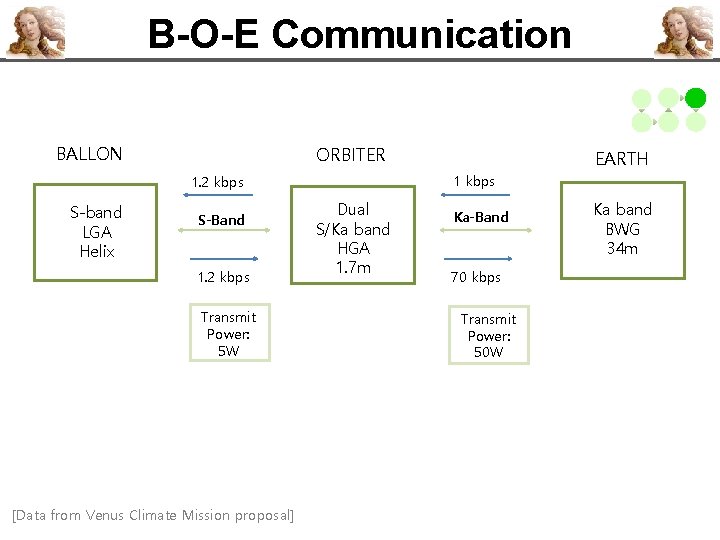
B-O-E Communication BALLON ORBITER 1 kbps 1. 2 kbps S-band LGA Helix S-Band 1. 2 kbps Transmit Power: 5 W [Data from Venus Climate Mission proposal] EARTH Dual S/Ka band HGA 1. 7 m Ka-Band 70 kbps Transmit Power: 50 W Ka band BWG 34 m
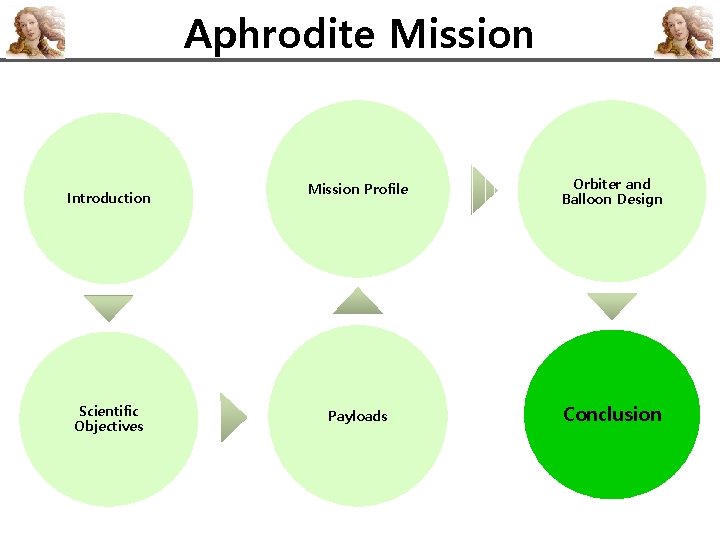
Aphrodite Mission Introduction Scientific Objectives Mission Profile Orbiter and Balloon Design Payloads Conclusion
Conclusion • recall introduction science questions • Unique mission characteristics

Extra slides
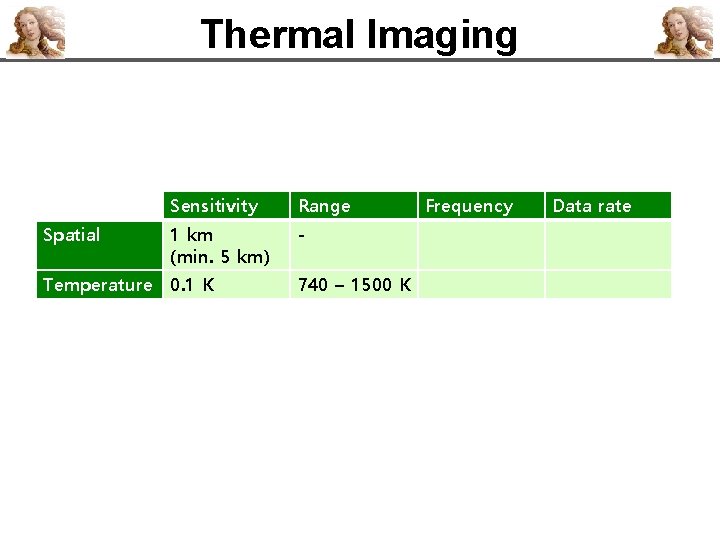
Thermal Imaging Spatial Sensitivity Range 1 km (min. 5 km) - Temperature 0. 1 K 740 – 1500 K Frequency Data rate
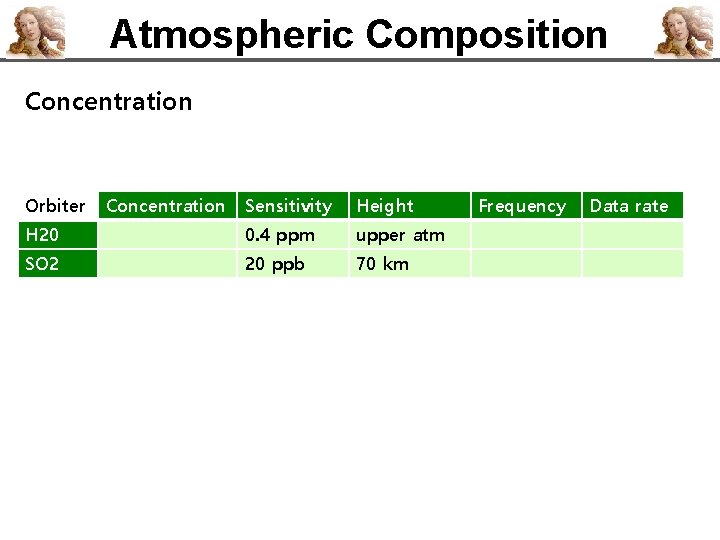
Atmospheric Composition Concentration Orbiter Concentration Sensitivity Height H 20 0. 4 ppm upper atm SO 2 20 ppb 70 km Frequency Data rate
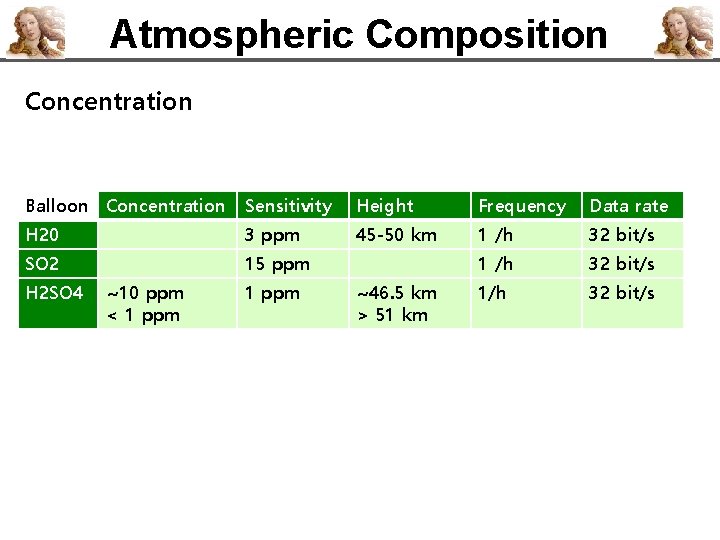
Atmospheric Composition Concentration Balloon Concentration Sensitivity Height Frequency Data rate H 20 3 ppm 45 -50 km 1 /h 32 bit/s SO 2 15 ppm 1 /h 32 bit/s 1/h 32 bit/s H 2 SO 4 ~10 ppm < 1 ppm ~46. 5 km > 51 km
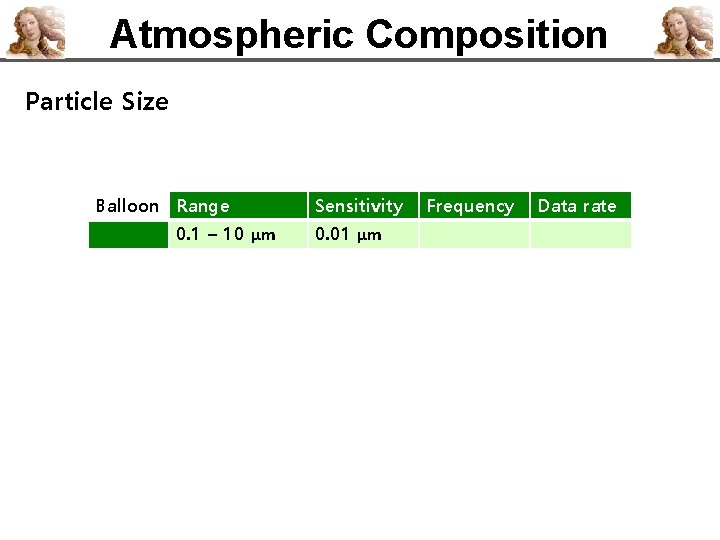
Atmospheric Composition Particle Size Balloon Range 0. 1 – 10 μm Sensitivity 0. 01 μm Frequency Data rate
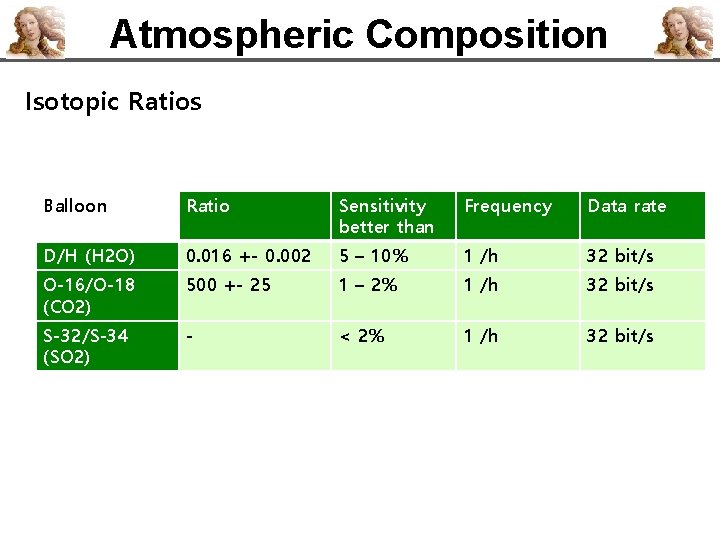
Atmospheric Composition Isotopic Ratios Balloon Ratio Sensitivity better than Frequency Data rate D/H (H 2 O) 0. 016 +- 0. 002 5 – 10% 1 /h 32 bit/s O-16/O-18 (CO 2) 500 +- 25 1 – 2% 1 /h 32 bit/s S-32/S-34 (SO 2) - < 2% 1 /h 32 bit/s
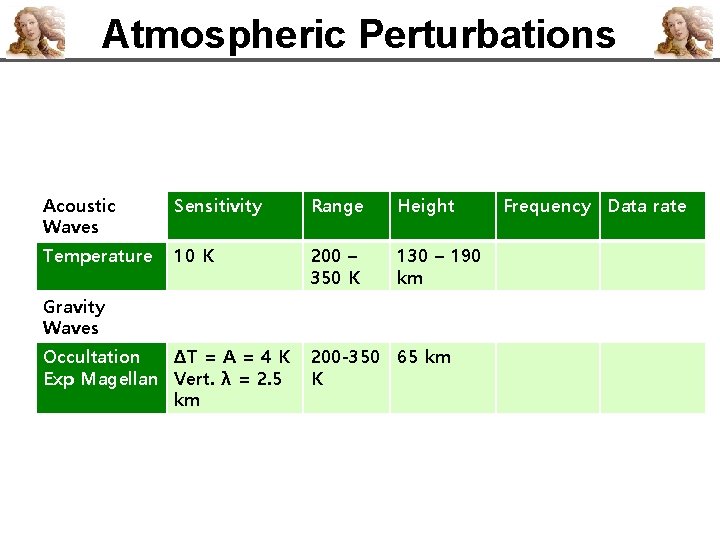
Atmospheric Perturbations Acoustic Waves Sensitivity Range Height Temperature 10 K 200 – 350 K 130 – 190 km Gravity Waves Occultation ΔT = A = 4 K Exp Magellan Vert. λ = 2. 5 km 200 -350 65 km K Frequency Data rate
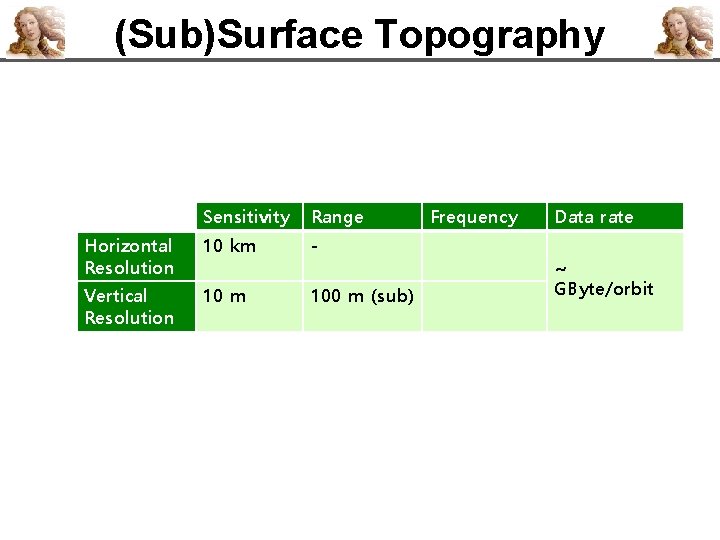
(Sub)Surface Topography Sensitivity Range Horizontal Resolution 10 km - Vertical Resolution 10 m 100 m (sub) Frequency Data rate ~ GByte/orbit
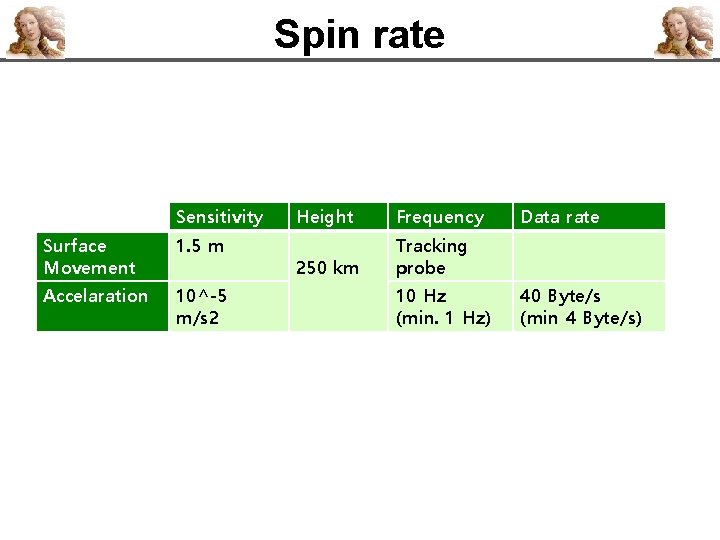
Spin rate Sensitivity Surface Movement 1. 5 m Accelaration 10^-5 m/s 2 Height Frequency 250 km Tracking probe 10 Hz (min. 1 Hz) Data rate 40 Byte/s (min 4 Byte/s)
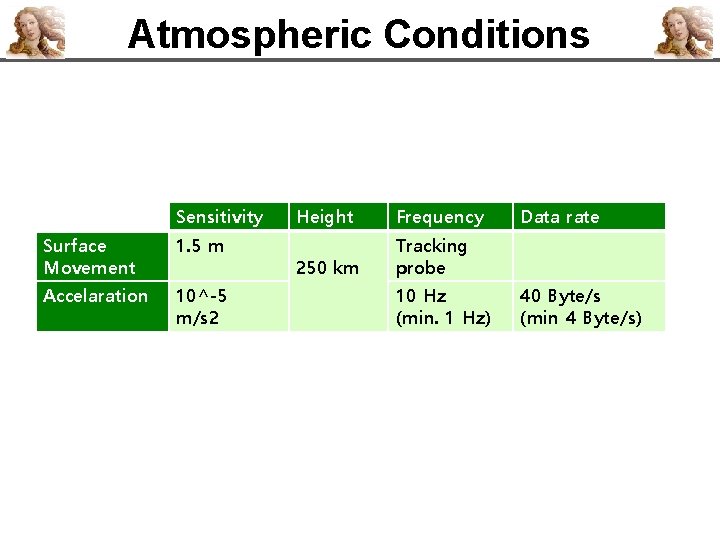
Atmospheric Conditions Sensitivity Surface Movement 1. 5 m Accelaration 10^-5 m/s 2 Height Frequency 250 km Tracking probe 10 Hz (min. 1 Hz) Data rate 40 Byte/s (min 4 Byte/s)
- Slides: 67