
The JTG Summer School in Information Theory Networks
- Slides: 9
The JTG Summer School in Information Theory, Networks, and Signal Processing
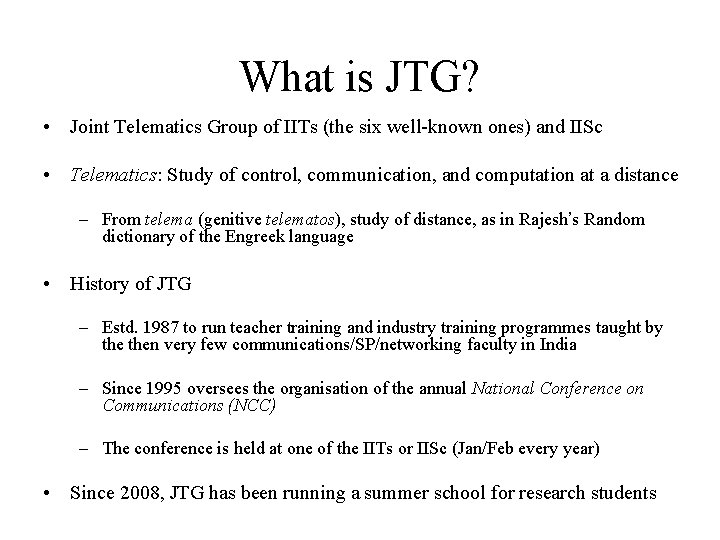
What is JTG? • Joint Telematics Group of IITs (the six well-known ones) and IISc • Telematics: Study of control, communication, and computation at a distance – From telema (genitive telematos), study of distance, as in Rajesh’s Random dictionary of the Engreek language • History of JTG – Estd. 1987 to run teacher training and industry training programmes taught by then very few communications/SP/networking faculty in India – Since 1995 oversees the organisation of the annual National Conference on Communications (NCC) – The conference is held at one of the IITs or IISc (Jan/Feb every year) • Since 2008, JTG has been running a summer school for research students
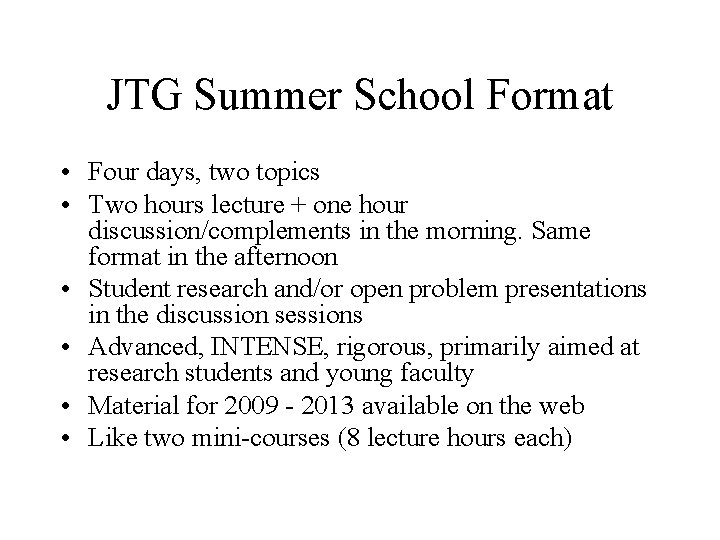
JTG Summer School Format • Four days, two topics • Two hours lecture + one hour discussion/complements in the morning. Same format in the afternoon • Student research and/or open problem presentations in the discussion sessions • Advanced, INTENSE, rigorous, primarily aimed at research students and young faculty • Material for 2009 - 2013 available on the web • Like two mini-courses (8 lecture hours each)
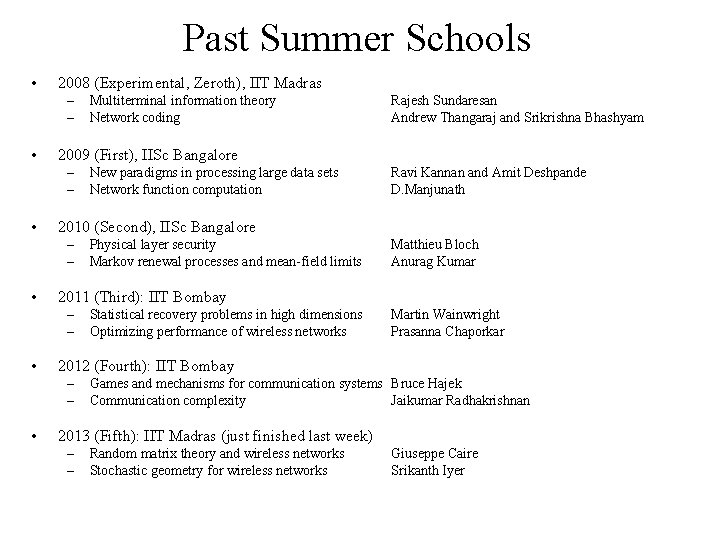
Past Summer Schools • 2008 (Experimental, Zeroth), IIT Madras – – • Physical layer security Markov renewal processes and mean-field limits Matthieu Bloch Anurag Kumar Statistical recovery problems in high dimensions Optimizing performance of wireless networks Martin Wainwright Prasanna Chaporkar 2012 (Fourth): IIT Bombay – – • Ravi Kannan and Amit Deshpande D. Manjunath 2011 (Third): IIT Bombay – – • New paradigms in processing large data sets Network function computation 2010 (Second), IISc Bangalore – – • Rajesh Sundaresan Andrew Thangaraj and Srikrishna Bhashyam 2009 (First), IISc Bangalore – – • Multiterminal information theory Network coding Games and mechanisms for communication systems Bruce Hajek Communication complexity Jaikumar Radhakrishnan 2013 (Fifth): IIT Madras (just finished last week) – – Random matrix theory and wireless networks Stochastic geometry for wireless networks Giuseppe Caire Srikanth Iyer
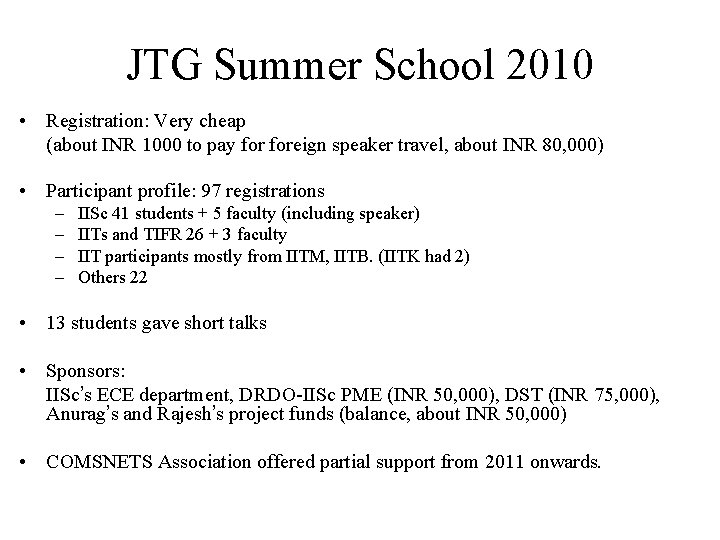
JTG Summer School 2010 • Registration: Very cheap (about INR 1000 to pay foreign speaker travel, about INR 80, 000) • Participant profile: 97 registrations – – IISc 41 students + 5 faculty (including speaker) IITs and TIFR 26 + 3 faculty IIT participants mostly from IITM, IITB. (IITK had 2) Others 22 • 13 students gave short talks • Sponsors: IISc’s ECE department, DRDO-IISc PME (INR 50, 000), DST (INR 75, 000), Anurag’s and Rajesh’s project funds (balance, about INR 50, 000) • COMSNETS Association offered partial support from 2011 onwards.
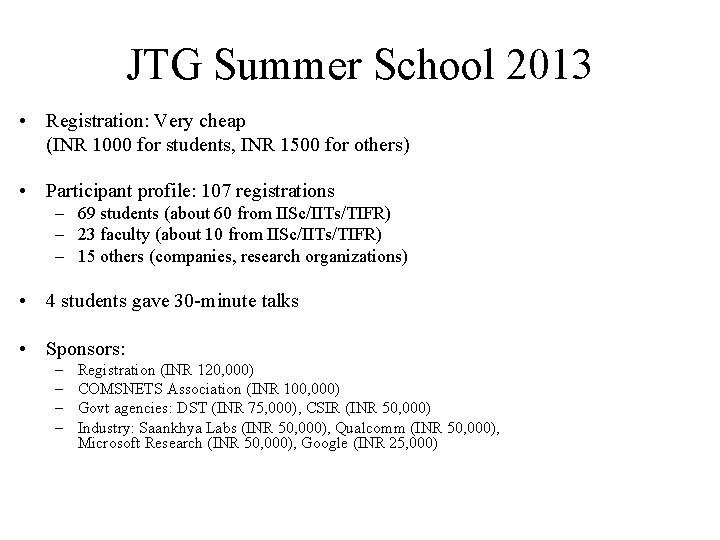
JTG Summer School 2013 • Registration: Very cheap (INR 1000 for students, INR 1500 for others) • Participant profile: 107 registrations – 69 students (about 60 from IISc/IITs/TIFR) – 23 faculty (about 10 from IISc/IITs/TIFR) – 15 others (companies, research organizations) • 4 students gave 30 -minute talks • Sponsors: – – Registration (INR 120, 000) COMSNETS Association (INR 100, 000) Govt agencies: DST (INR 75, 000), CSIR (INR 50, 000) Industry: Saankhya Labs (INR 50, 000), Qualcomm (INR 50, 000), Microsoft Research (INR 50, 000), Google (INR 25, 000)
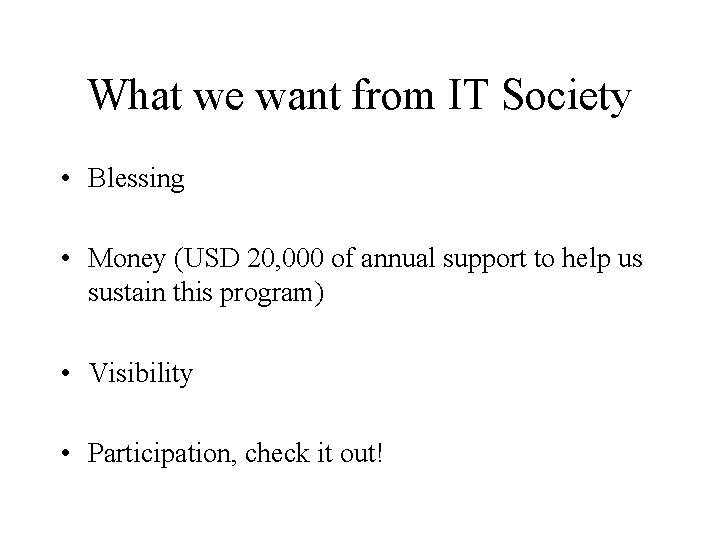
What we want from IT Society • Blessing • Money (USD 20, 000 of annual support to help us sustain this program) • Visibility • Participation, check it out!
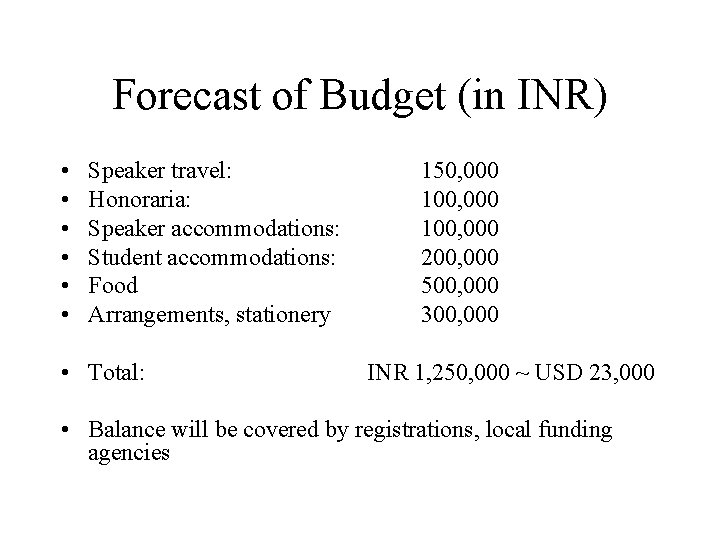
Forecast of Budget (in INR) • • • Speaker travel: Honoraria: Speaker accommodations: Student accommodations: Food Arrangements, stationery • Total: 150, 000 100, 000 200, 000 500, 000 300, 000 INR 1, 250, 000 ~ USD 23, 000 • Balance will be covered by registrations, local funding agencies
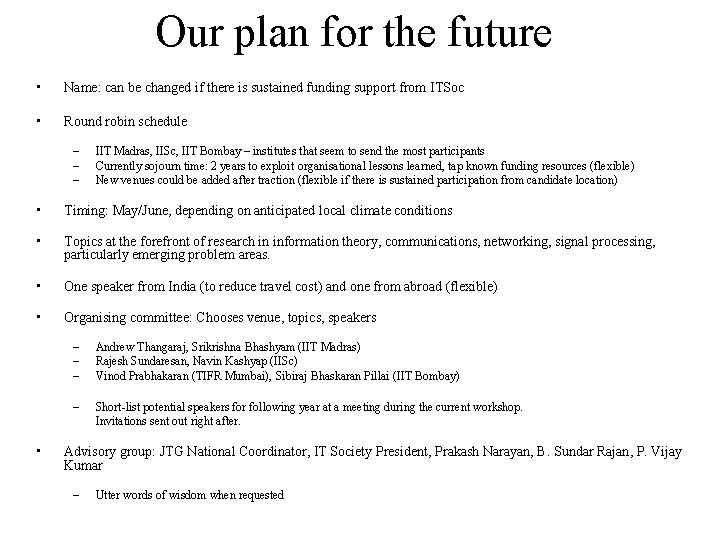
Our plan for the future • Name: can be changed if there is sustained funding support from ITSoc • Round robin schedule – – – IIT Madras, IISc, IIT Bombay – institutes that seem to send the most participants Currently sojourn time: 2 years to exploit organisational lessons learned, tap known funding resources (flexible) New venues could be added after traction (flexible if there is sustained participation from candidate location) • Timing: May/June, depending on anticipated local climate conditions • Topics at the forefront of research in information theory, communications, networking, signal processing, particularly emerging problem areas. • One speaker from India (to reduce travel cost) and one from abroad (flexible) • Organising committee: Chooses venue, topics, speakers • – – – Andrew Thangaraj, Srikrishna Bhashyam (IIT Madras) Rajesh Sundaresan, Navin Kashyap (IISc) Vinod Prabhakaran (TIFR Mumbai), Sibiraj Bhaskaran Pillai (IIT Bombay) – Short-list potential speakers for following year at a meeting during the current workshop. Invitations sent out right after. Advisory group: JTG National Coordinator, IT Society President, Prakash Narayan, B. Sundar Rajan, P. Vijay Kumar – Utter words of wisdom when requested