
Exotic Beam Summer School 2019 Nuclear Structure Experiment

Exotic Beam Summer School 2019 Nuclear Structure – Experiment THE SEQUEL! Christopher J. Chiara CCDC-ARL/ORAU
ORGANIZATION OF THESE LECTURES We will explore the six W’s of experimental nuclear structure: Ø Who? Ø What? Ø When? Ø Ø Where? Why? Ø ho. W? (but not necessarily in that order…) Selection of topics • • • Shell structure recap Ground-state properties (briefly) Excited-state properties • Pulling it all together: Case study 1 • Something different: Case study 2
NUCLEAR STRUCTURE (the HOW? ) In Wed’s lecture, we left off with HOW to study nuclear structure using g-spectroscopy techniques. • Ways to identify the origin of a g ray if nothing known Ø Auxiliary devices coupled to g-ray detectors providing nuclide/reaction information (Z, A/q, reaction products, decay products, Coulomb excitation of projectile) Ø Correlation with g rays from known reaction partner • Placing g rays in a level scheme Ø CJC perspective: It’s like putting together a jigsaw puzzle when you don’t know what the picture looks like and you don’t have all of the pieces. Ø Logic, guidance from systematics and/or theory (use with caution!), gn coincidences
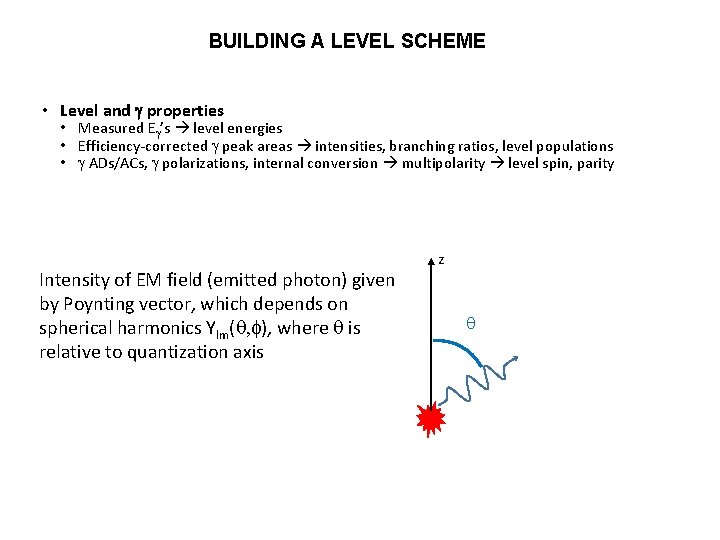
BUILDING A LEVEL SCHEME • Level and g properties • Measured Eg’s level energies • Efficiency-corrected g peak areas intensities, branching ratios, level populations • g ADs/ACs, g polarizations, internal conversion multipolarity level spin, parity Intensity of EM field (emitted photon) given by Poynting vector, which depends on spherical harmonics Ylm(q, f), where q is relative to quantization axis z q
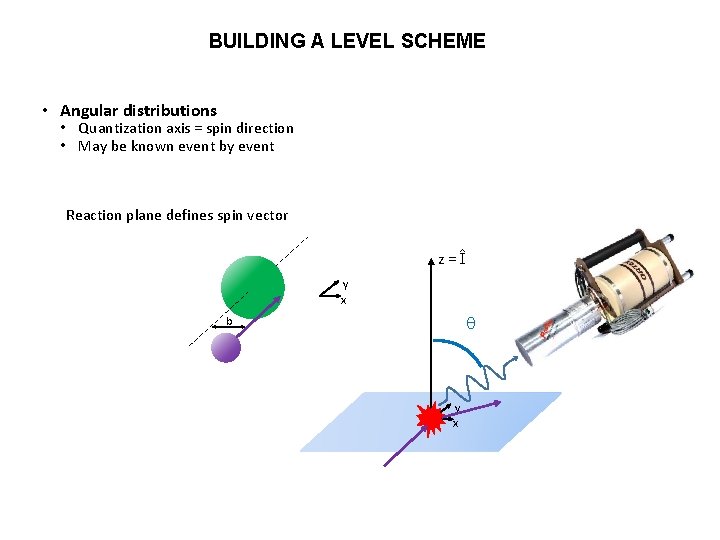
BUILDING A LEVEL SCHEME • Angular distributions • Quantization axis = spin direction • May be known event by event Reaction plane defines spin vector z = Î y x q b y x
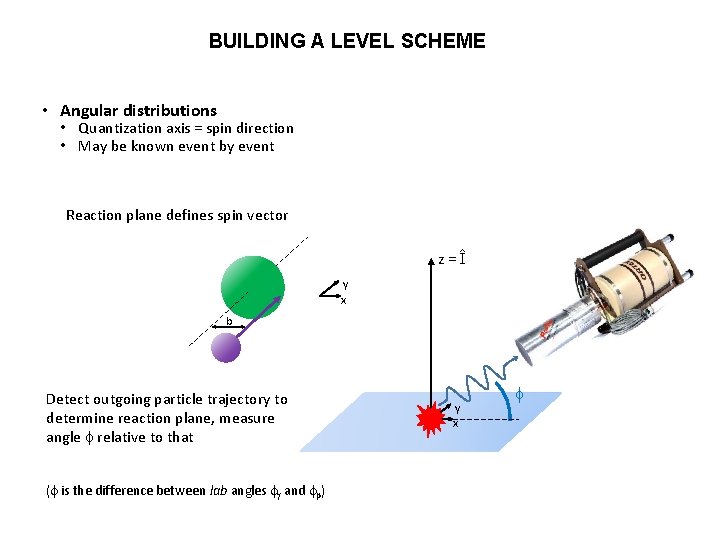
BUILDING A LEVEL SCHEME • Angular distributions • Quantization axis = spin direction • May be known event by event Reaction plane defines spin vector z = Î y x b Detect outgoing particle trajectory to determine reaction plane, measure angle f relative to that (f is the difference between lab angles fg and fp) y x f

BUILDING A LEVEL SCHEME • Angular distributions • Quantization axis = spin direction • May be known event by event Reaction plane defines spin vector z = Î Stone et al. , PRL 94, 192501 (2005) y x b Detect outgoing particle trajectory to determine reaction plane, measure angle f relative to that (f is the difference between lab angles fg and fp) y x f Measure intensity as a function of angle
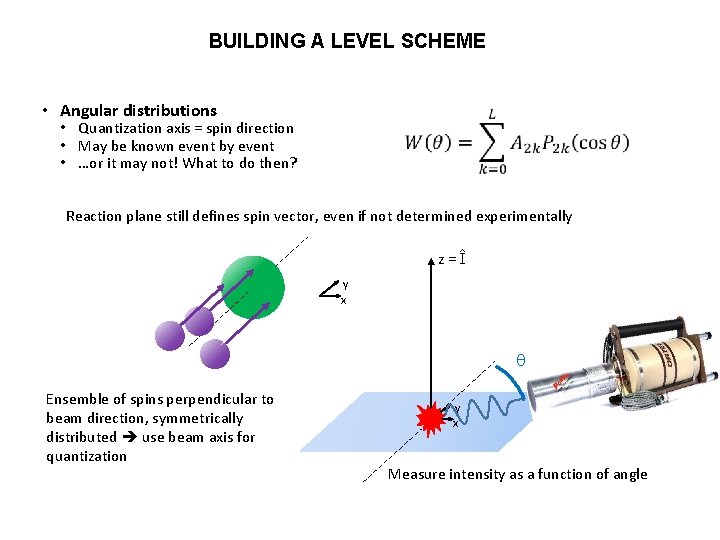
BUILDING A LEVEL SCHEME • Angular distributions • Quantization axis = spin direction • May be known event by event • …or it may not! What to do then? Reaction plane still defines spin vector, even if not determined experimentally z = Î y x q Ensemble of spins perpendicular to beam direction, symmetrically distributed use beam axis for quantization y x Measure intensity as a function of angle
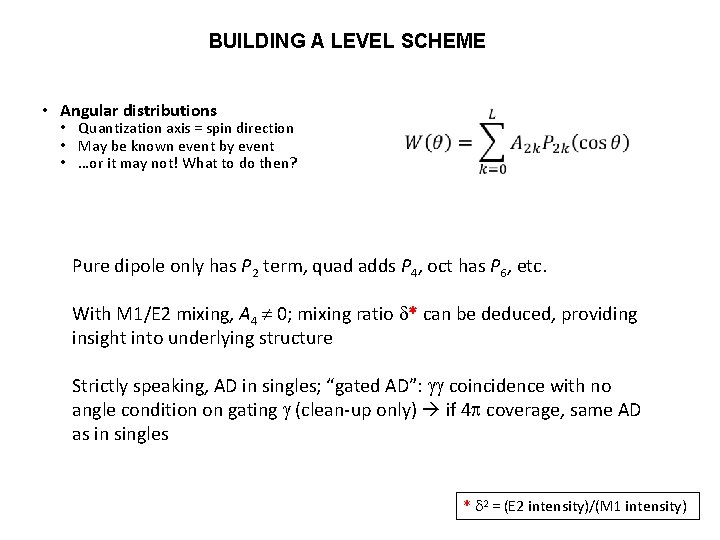
BUILDING A LEVEL SCHEME • Angular distributions • Quantization axis = spin direction • May be known event by event • …or it may not! What to do then? Pure dipole only has P 2 term, quad adds P 4, oct has P 6, etc. With M 1/E 2 mixing, A 4 0; mixing ratio d* can be deduced, providing insight into underlying structure Strictly speaking, AD in singles; “gated AD”: gg coincidence with no angle condition on gating g (clean-up only) if 4 p coverage, same AD as in singles * d 2 = (E 2 intensity)/(M 1 intensity)
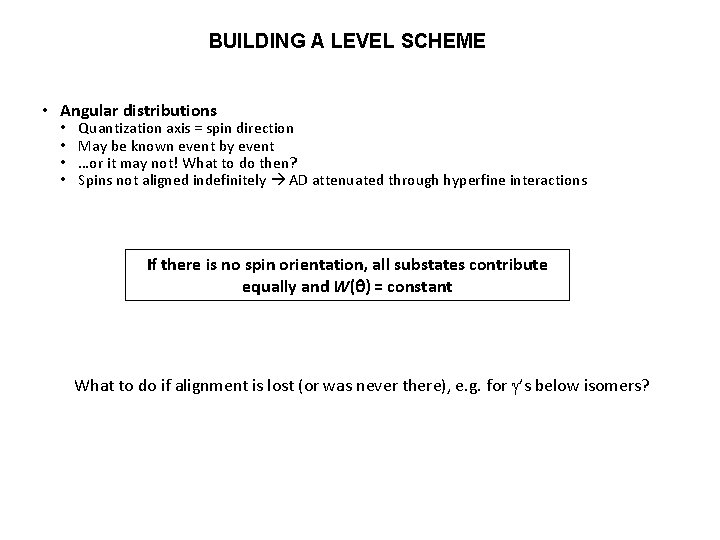
BUILDING A LEVEL SCHEME • Angular distributions • • Quantization axis = spin direction May be known event by event …or it may not! What to do then? Spins not aligned indefinitely AD attenuated through hyperfine interactions If there is no spin orientation, all substates contribute equally and W(q) = constant What to do if alignment is lost (or was never there), e. g. for g’s below isomers?
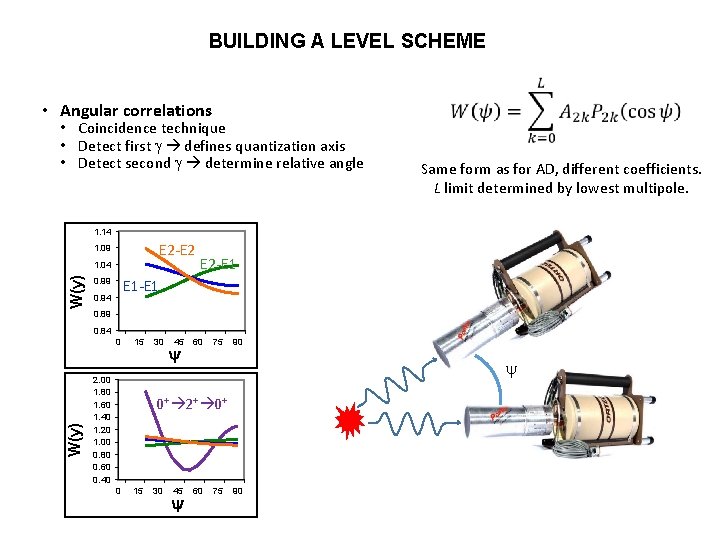
BUILDING A LEVEL SCHEME • Angular correlations • Coincidence technique • Detect first g defines quantization axis • Detect second g determine relative angle Same form as for AD, different coefficients. L limit determined by lowest multipole. 1. 14 E 2 -E 2 1. 09 W(y) 1. 04 E 2 -E 1 E 1 -E 1 0. 99 0. 94 0. 89 0. 84 W(y) 0 15 2. 00 1. 80 1. 60 1. 40 1. 20 1. 00 0. 80 0. 60 0. 40 30 45 y 60 75 90 y 0+ 2+ 0+ 0 15 30 45 y 60 75 90
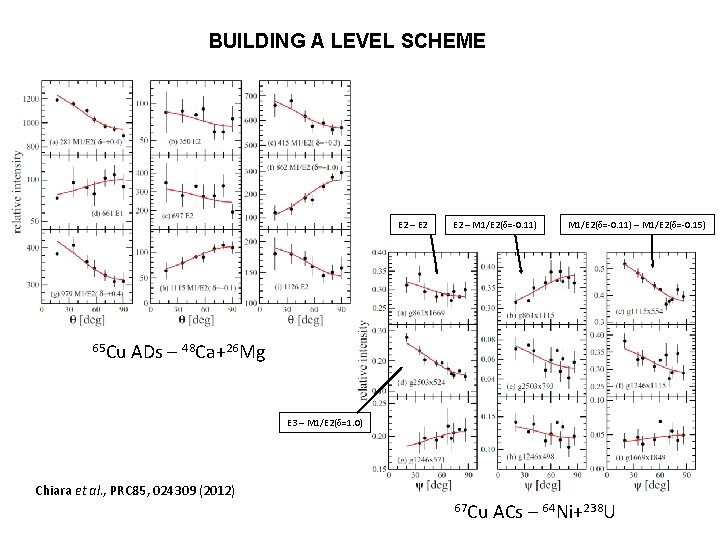
BUILDING A LEVEL SCHEME E 2 – M 1/E 2(d=-0. 11) – M 1/E 2(d=-0. 15) 65 Cu ADs – 48 Ca+26 Mg E 3 – M 1/E 2(d=1. 0) Chiara et al. , PRC 85, 024309 (2012) 67 Cu ACs – 64 Ni+238 U

BUILDING A LEVEL SCHEME • ADs/ACs multipole order L, but do not directly distinguish E vs M • • Pure DI=1 E 1, e. g. , looks the same as pure DI=1 M 1 Nonzero mixing ratio may change that, as M 1/E 2 far more likely than E 1/M 2 For more direct determination of E or M: measure polarization (e. g. Clover detectors) …or internal-conversion electrons Continuum Initial state L shell K shell Atomic System Nuclear level decay via internal conversion (IC) Ø first observed over 100 y ago [van Baeyer and Hahn, Physik. Z. 11, 488 (1910)] * Ø ubiquitous process Ø usable as analysis tool (cf. Br. Icc, http: //bricc. anu. edu. au/) Instead of g emission, energy transferred to atomic electron, which is ejected * nucleus discovered in 1911!
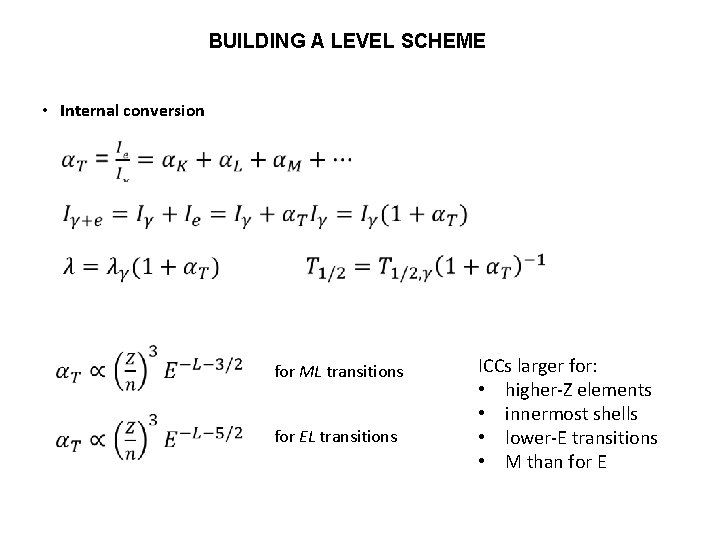
BUILDING A LEVEL SCHEME • Internal conversion for ML transitions for EL transitions ICCs larger for: • higher-Z elements • innermost shells • lower-E transitions • M than for E
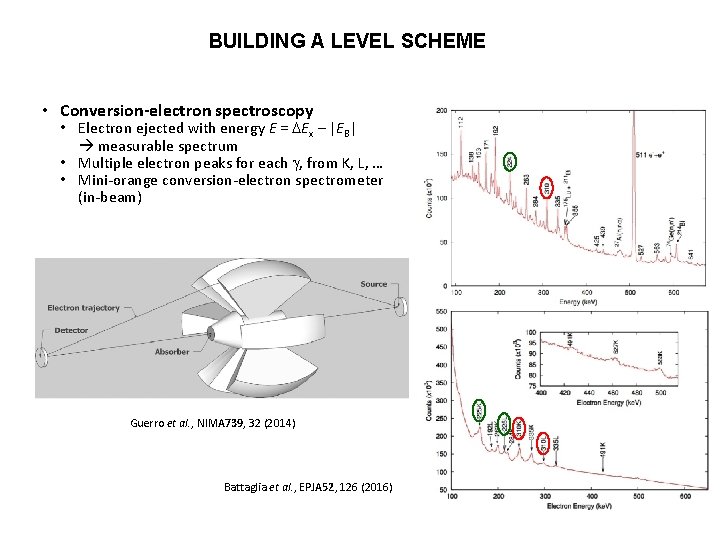
BUILDING A LEVEL SCHEME • Conversion-electron spectroscopy • Electron ejected with energy E = DEx – |EB| measurable spectrum • Multiple electron peaks for each g, from K, L, … • Mini-orange conversion-electron spectrometer (in-beam) Guerro et al. , NIMA 739, 32 (2014) Battaglia et al. , EPJA 52, 126 (2016)
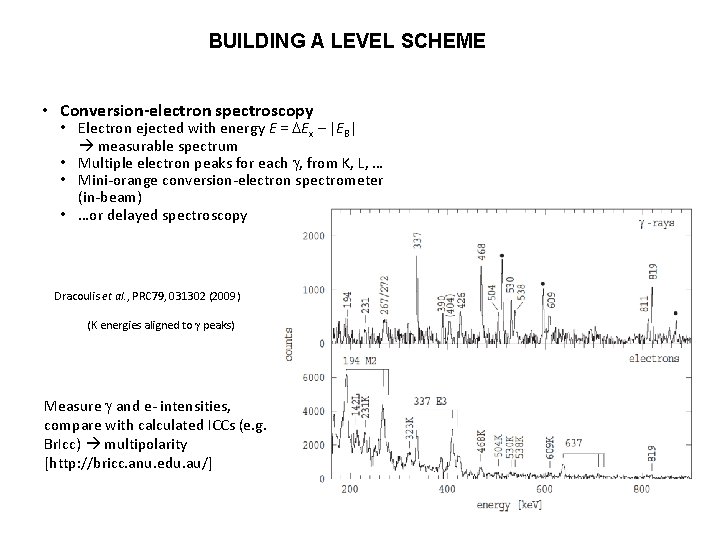
BUILDING A LEVEL SCHEME • Conversion-electron spectroscopy • Electron ejected with energy E = DEx – |EB| measurable spectrum • Multiple electron peaks for each g, from K, L, … • Mini-orange conversion-electron spectrometer (in-beam) • …or delayed spectroscopy Dracoulis et al. , PRC 79, 031302 (2009) (K energies aligned to g peaks) Measure g and e- intensities, compare with calculated ICCs (e. g. Br. Icc) multipolarity [http: //bricc. anu. edu. au/]

BUILDING A LEVEL SCHEME • E 0 decays • Most transitions have g vs e- competition, but one case that “never” has a g: 0+ • Transition would be E 0 (monopole moment = charge), which cannot radiate to points external to nucleus Andreyev et al. , Nature 405, 430 (2000)
BUILDING A LEVEL SCHEME • E 0 decays • Most transitions have g vs e- competition, but one case that “never” has a g: 0+ • Transition would be E 0 (monopole moment = charge), which cannot radiate to points external to nucleus Why “never” and not never? If E > 2 mec 2 = 1. 022 Me. V, internal pair (e+e-) production is possible. e+ subsequently annihilates with another e-, yielding 511 -ke. V g’s.

BUILDING A LEVEL SCHEME • Level and g properties • • Measured Eg’s level energies Efficiency-corrected g peak areas intensities, branching ratios, level populations g ADs/ACs, g polarizations, internal conversion multipolarity level spin, parity Relative g times level half-lives, B(XL)’s Reduced transition rates can be a sensitive probe of matrix elements connecting initial and final states:
MEASURING HALF-LIVES Excited-state half-lives range from ~10 -23 s (>10 -Me. V resonances) to >4. 5 x 10¹⁶ y (180 m. Ta). That’s over 47 orders of magnitude! Most excited states have sub-ns half-lives; why are some exceptionally long? • Low transition energy • Large spin difference • Large difference in underlying configurations • K-forbiddenness (change in spin projection on symmetry axis DK > L) No single approach to measuring half-lives will apply to all cases.

MEASURING HALF-LIVES • Observe exponential decay for half-lives of ~tens of ps or longer • • • Measure g-ray time relative to a fast START signal START with preceding b decay in e. g. fast plastic …or START with RF (clock tick marking reaction) …or START with preceding g in e. g. Ge (T 1/2 > ns) or La. Br 3 (sub-ns) Get half-life from slope of exponential T 1/2 = 728(21) ps Kondev et al. , PRC 85, 027304 (2012) Zhu et al. , NIMA 652, 231 (2011)
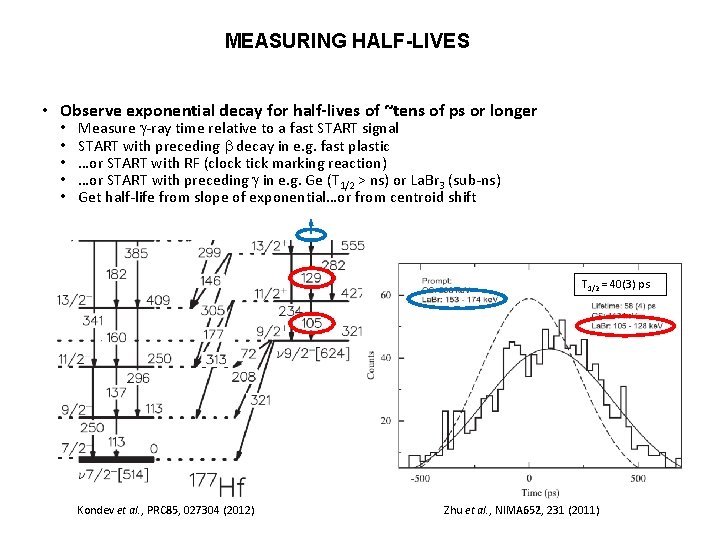
MEASURING HALF-LIVES • Observe exponential decay for half-lives of ~tens of ps or longer • • • Measure g-ray time relative to a fast START signal START with preceding b decay in e. g. fast plastic …or START with RF (clock tick marking reaction) …or START with preceding g in e. g. Ge (T 1/2 > ns) or La. Br 3 (sub-ns) Get half-life from slope of exponential…or from centroid shift T 1/2 = 40(3) ps Kondev et al. , PRC 85, 027304 (2012) Zhu et al. , NIMA 652, 231 (2011)
MEASURING HALF-LIVES • For ~ps half-lives, instrumentation not fast enough • Exploit physics of in-beam measurement: Doppler shifts Brief Doppler diversion…
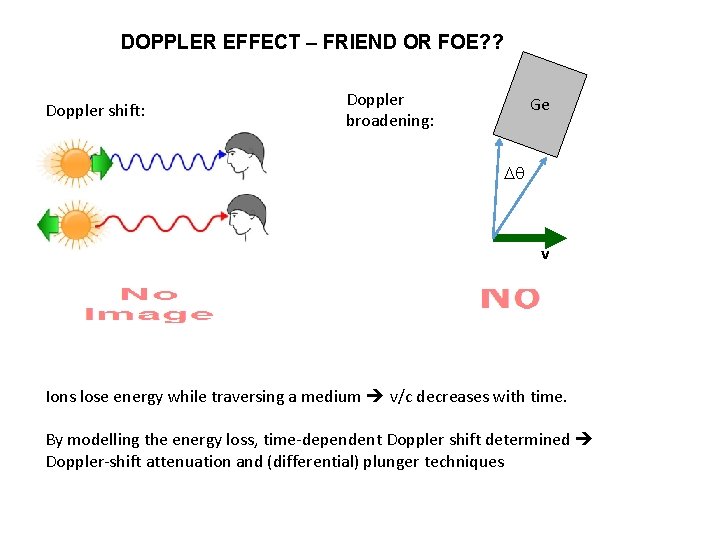
DOPPLER EFFECT – FRIEND OR FOE? ? Doppler shift: Doppler broadening: Ge Dq v Ions lose energy while traversing a medium v/c decreases with time. By modelling the energy loss, time-dependent Doppler shift determined Doppler-shift attenuation and (differential) plunger techniques
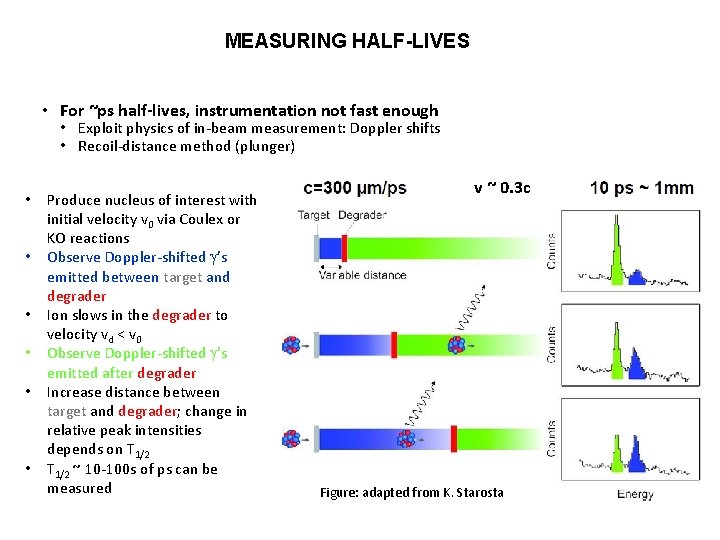
MEASURING HALF-LIVES • For ~ps half-lives, instrumentation not fast enough • Exploit physics of in-beam measurement: Doppler shifts • Recoil-distance method (plunger) • • • Produce nucleus of interest with initial velocity v 0 via Coulex or KO reactions Observe Doppler-shifted g’s emitted between target and degrader Ion slows in the degrader to velocity vd < v 0 Observe Doppler-shifted g’s emitted after degrader Increase distance between target and degrader; change in relative peak intensities depends on T 1/2 ~ 10 -100 s of ps can be measured v ~ 0. 3 c Figure: adapted from K. Starosta
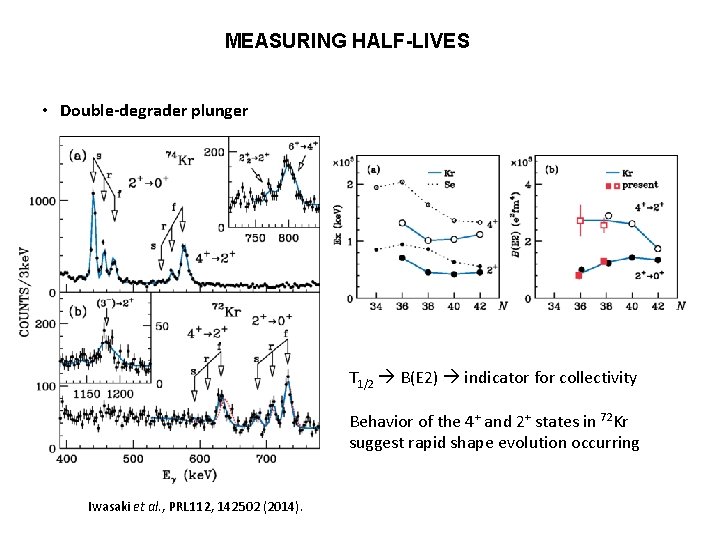
MEASURING HALF-LIVES • Double-degrader plunger T 1/2 B(E 2) indicator for collectivity Behavior of the 4+ and 2+ states in 72 Kr suggest rapid shape evolution occurring Iwasaki et al. , PRL 112, 142502 (2014).
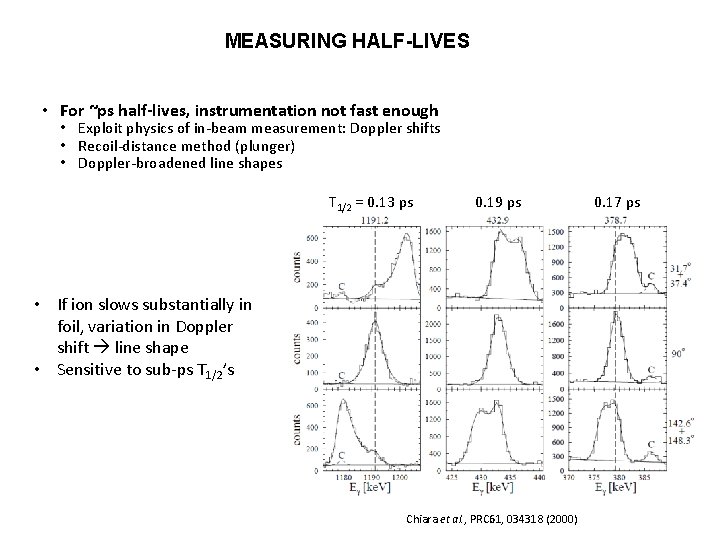
MEASURING HALF-LIVES • For ~ps half-lives, instrumentation not fast enough • Exploit physics of in-beam measurement: Doppler shifts • Recoil-distance method (plunger) • Doppler-broadened line shapes T 1/2 = 0. 13 ps 0. 19 ps 0. 17 ps • If ion slows substantially in foil, variation in Doppler shift line shape • Sensitive to sub-ps T 1/2’s Chiara et al. , PRC 61, 034318 (2000)
With all of that in mind, let’s now consider a case study….
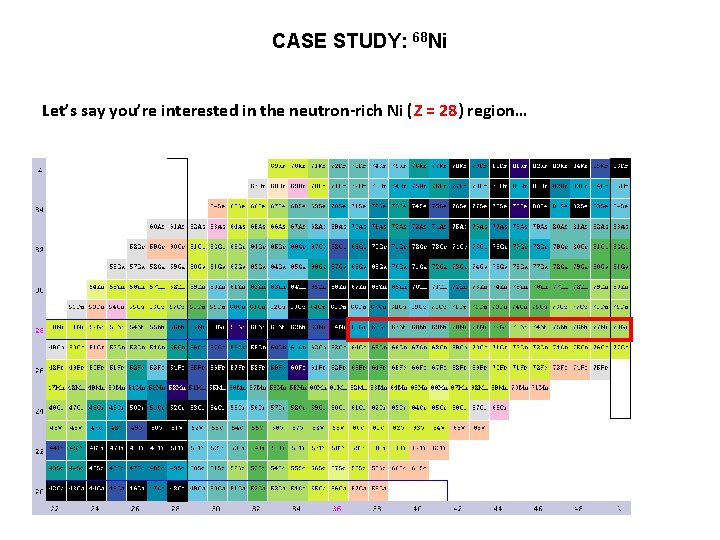
CASE STUDY: 68 Ni Let’s say you’re interested in the neutron-rich Ni (Z = 28) region…
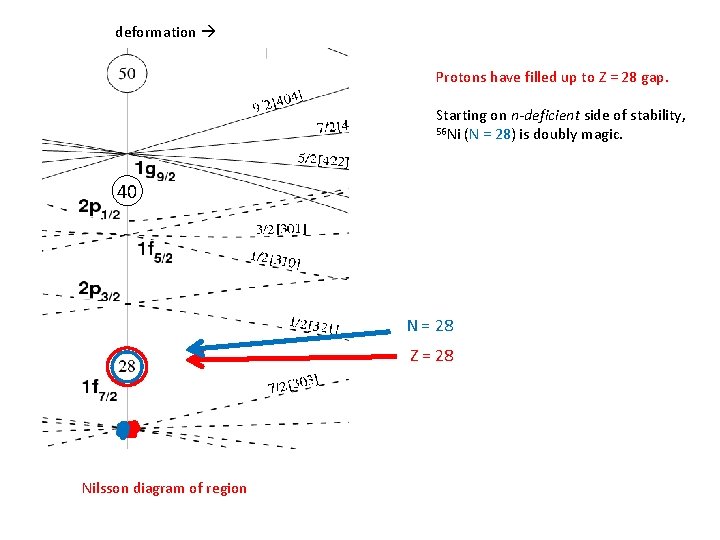
deformation Protons have filled up to Z = 28 gap. Starting on n-deficient side of stability, 56 Ni (N = 28) is doubly magic. 40 N = 28 Z = 28 Nilsson diagram of region
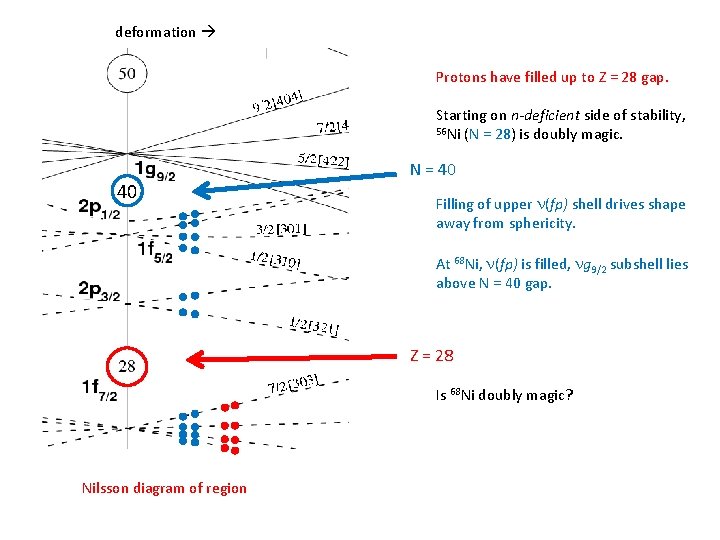
deformation Protons have filled up to Z = 28 gap. Starting on n-deficient side of stability, 56 Ni (N = 28) is doubly magic. 40 N = 40 Filling of upper n(fp) shell drives shape away from sphericity. At 68 Ni, n(fp) is filled, ng 9/2 subshell lies above N = 40 gap. Z = 28 Is 68 Ni doubly magic? Nilsson diagram of region
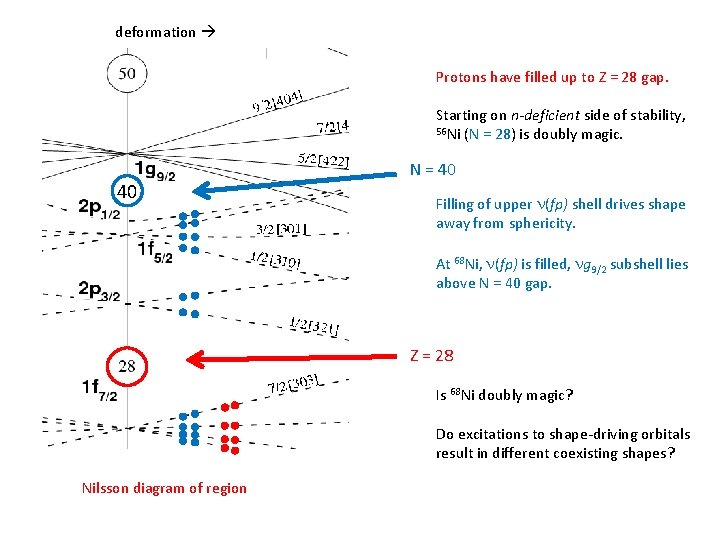
deformation Protons have filled up to Z = 28 gap. Starting on n-deficient side of stability, 56 Ni (N = 28) is doubly magic. 40 N = 40 Filling of upper n(fp) shell drives shape away from sphericity. At 68 Ni, n(fp) is filled, ng 9/2 subshell lies above N = 40 gap. Z = 28 Is 68 Ni doubly magic? Do excitations to shape-driving orbitals result in different coexisting shapes? Nilsson diagram of region
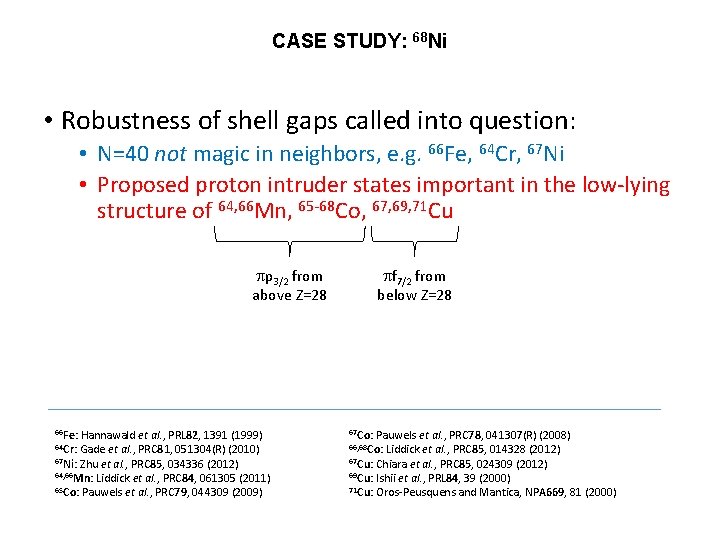
CASE STUDY: 68 Ni • Robustness of shell gaps called into question: • N=40 not magic in neighbors, e. g. 66 Fe, 64 Cr, 67 Ni • Proposed proton intruder states important in the low-lying structure of 64, 66 Mn, 65 -68 Co, 67, 69, 71 Cu pp 3/2 from above Z=28 66 Fe: Hannawald et al. , PRL 82, 1391 (1999) 64 Cr: Gade et al. , PRC 81, 051304(R) (2010) 67 Ni: Zhu et al. , PRC 85, 034336 (2012) 64, 66 Mn: Liddick et al. , PRC 84, 061305 (2011) 65 Co: Pauwels et al. , PRC 79, 044309 (2009) pf 7/2 from below Z=28 67 Co: Pauwels et al. , PRC 78, 041307(R) (2008) al. , PRC 85, 014328 (2012) 67 Cu: Chiara et al. , PRC 85, 024309 (2012) 69 Cu: Ishii et al. , PRL 84, 39 (2000) 71 Cu: Oros-Peusquens and Mantica, NPA 669, 81 (2000) 66, 68 Co: Liddick et
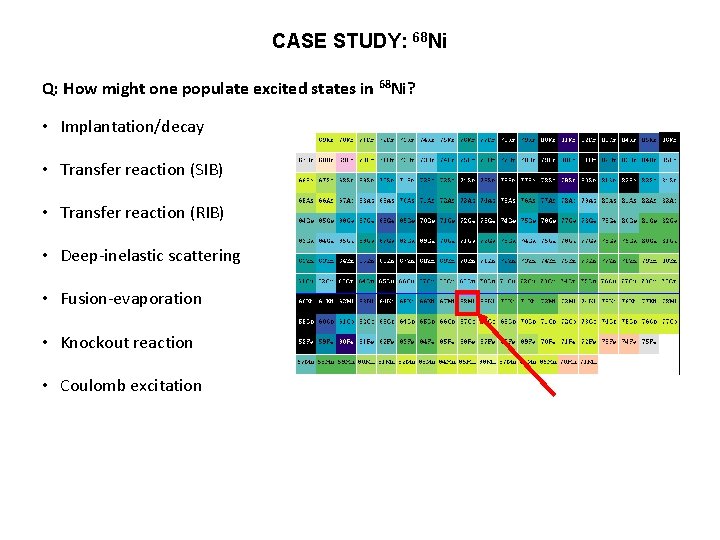
CASE STUDY: 68 Ni Q: How might one populate excited states in 68 Ni? • Implantation/decay • Transfer reaction (SIB) • Transfer reaction (RIB) • Deep-inelastic scattering • Fusion-evaporation • Knockout reaction • Coulomb excitation
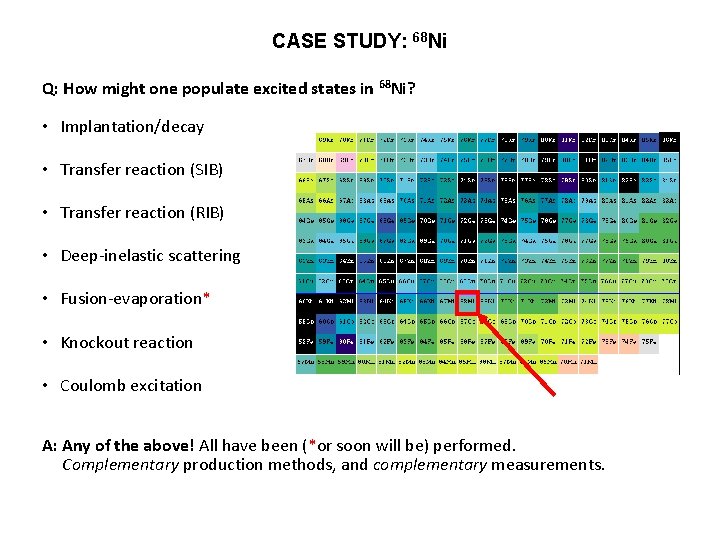
CASE STUDY: 68 Ni Q: How might one populate excited states in 68 Ni? • Implantation/decay • Transfer reaction (SIB) • Transfer reaction (RIB) • Deep-inelastic scattering • Fusion-evaporation* • Knockout reaction • Coulomb excitation A: Any of the above! All have been (*or soon will be) performed. Complementary production methods, and complementary measurements.
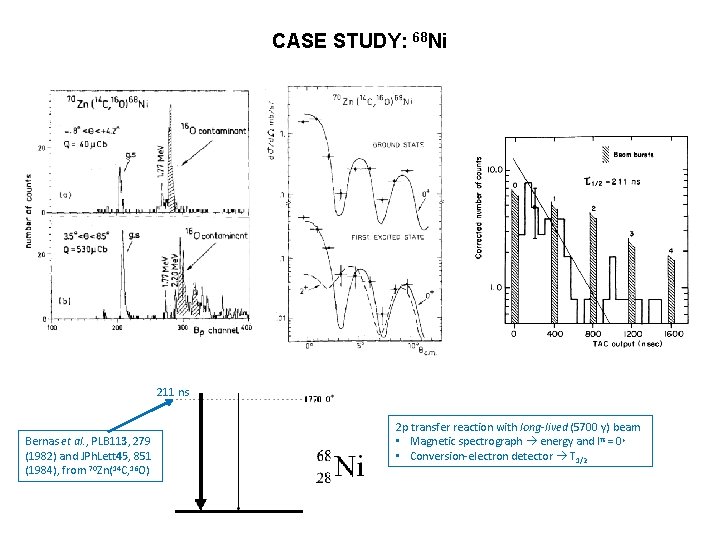
CASE STUDY: 68 Ni 211 ns Bernas et al. , PLB 113, 279 (1982) and JPh. Lett 45, 851 (1984), from 70 Zn(14 C, 16 O) 2 p transfer reaction with long-lived (5700 y) beam • Magnetic spectrograph energy and Ip = 0+ • Conversion-electron detector T 1/2
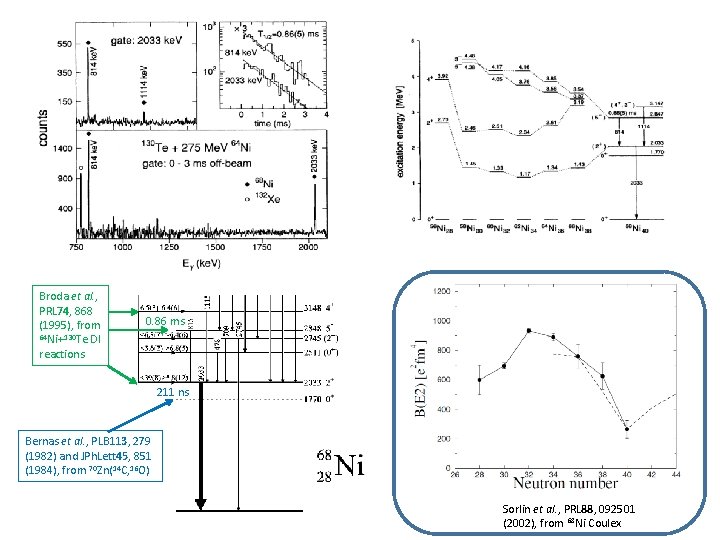
Broda et al. , PRL 74, 868 (1995), from 64 Ni+130 Te DI reactions 0. 86 ms 211 ns Bernas et al. , PLB 113, 279 (1982) and JPh. Lett 45, 851 (1984), from 70 Zn(14 C, 16 O) Sorlin et al. , PRL 88, 092501 (2002), from 68 Ni Coulex
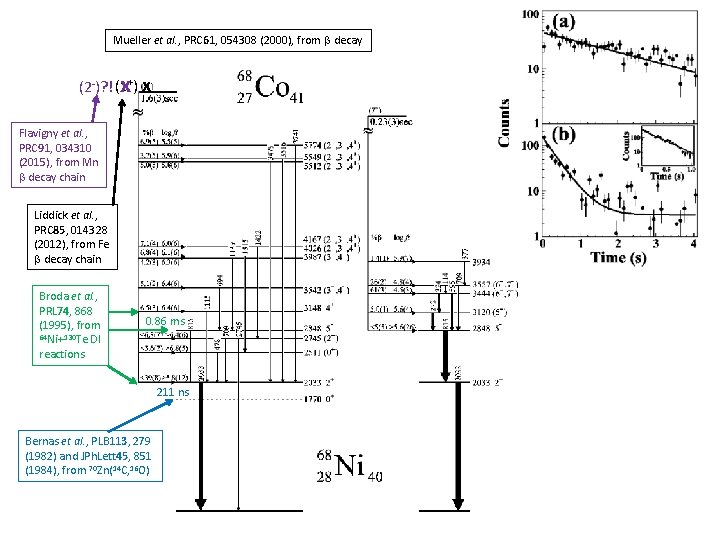
Mueller et al. , PRC 61, 054308 (2000), from b decay (2 -)? ! (1 x+) x Flavigny et al. , PRC 91, 034310 (2015), from Mn b decay chain Liddick et al. , PRC 85, 014328 (2012), from Fe b decay chain Broda et al. , PRL 74, 868 (1995), from 64 Ni+130 Te DI reactions 0. 86 ms 211 ns Bernas et al. , PLB 113, 279 (1982) and JPh. Lett 45, 851 (1984), from 70 Zn(14 C, 16 O)
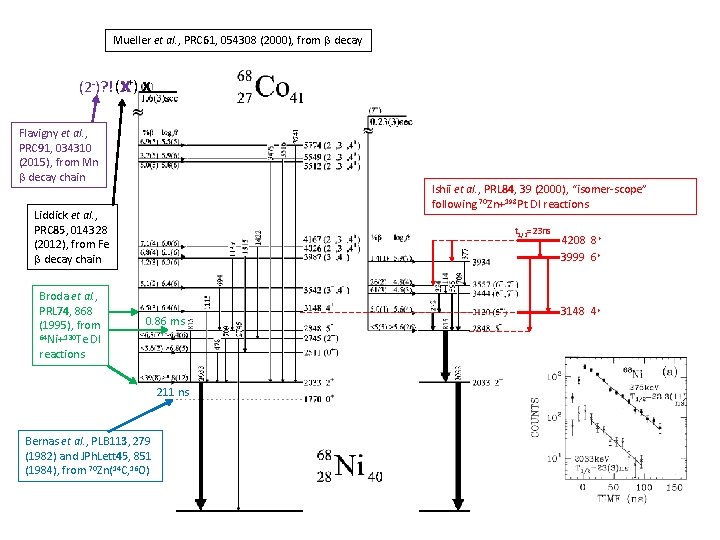
Mueller et al. , PRC 61, 054308 (2000), from b decay (2 -)? ! (1 x+) x Flavigny et al. , PRC 91, 034310 (2015), from Mn b decay chain Ishii et al. , PRL 84, 39 (2000), “isomer-scope” following 70 Zn+198 Pt DI reactions Liddick et al. , PRC 85, 014328 (2012), from Fe b decay chain Broda et al. , PRL 74, 868 (1995), from 64 Ni+130 Te DI reactions t 1/2=23 ns 0. 86 ms 211 ns Bernas et al. , PLB 113, 279 (1982) and JPh. Lett 45, 851 (1984), from 70 Zn(14 C, 16 O) 4208 8+ 3999 6+ 3148 4+
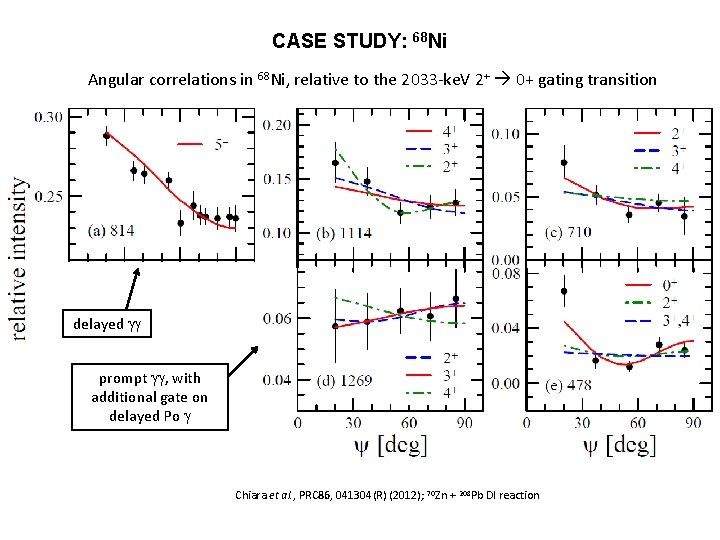
CASE STUDY: 68 Ni Angular correlations in 68 Ni, relative to the 2033 -ke. V 2+ 0+ gating transition delayed gg prompt gg, with additional gate on delayed Po g Chiara et al. , PRC 86, 041304(R) (2012); 70 Zn + 208 Pb DI reaction
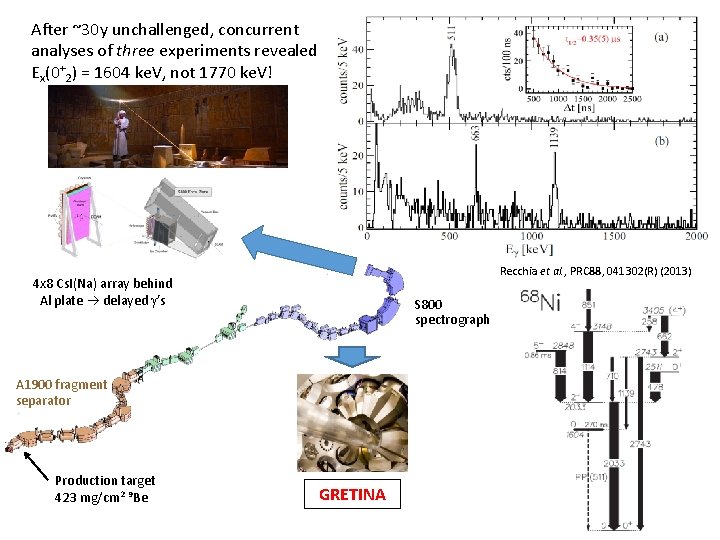
After ~30 y unchallenged, concurrent analyses of three experiments revealed Ex(0+2) = 1604 ke. V, not 1770 ke. V! Recchia et al. , PRC 88, 041302(R) (2013) 4 x 8 Cs. I(Na) array behind Al plate delayed g’s S 800 spectrograph A 1900 fragment separator Production target 423 mg/cm 2 9 Be GRETINA
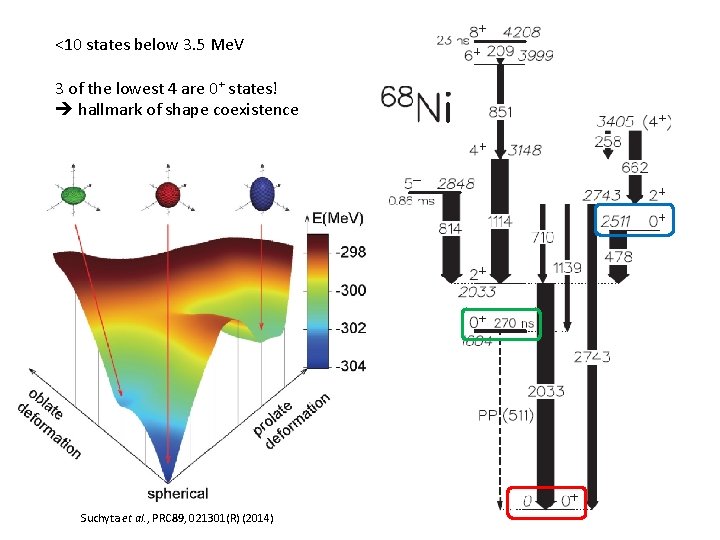
<10 states below 3. 5 Me. V 3 of the lowest 4 are 0+ states! hallmark of shape coexistence Suchyta et al. , PRC 89, 021301(R) (2014)
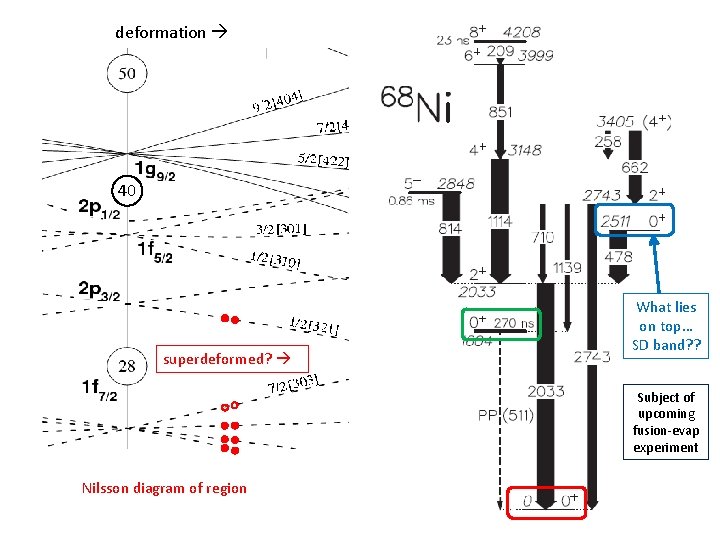
deformation 40 superdeformed? What lies on top… SD band? ? Subject of upcoming fusion-evap experiment Nilsson diagram of region

NUCLEAR PHYSICS WITH NOT-SO-EXOTIC BEAMS It may seem strange to say this at an Exotic Beam Summer School, but: Don’t be misled into believing that the only remaining pursuits worth taking lie out at the very extremes, requiring RIBs to access. Sometimes “run-of-the-mill” stable beam + target combos reveal surprises. (Such experiments can still be challenging!) Case study: Nuclear Excitation by Electron Capture in 93 Mo
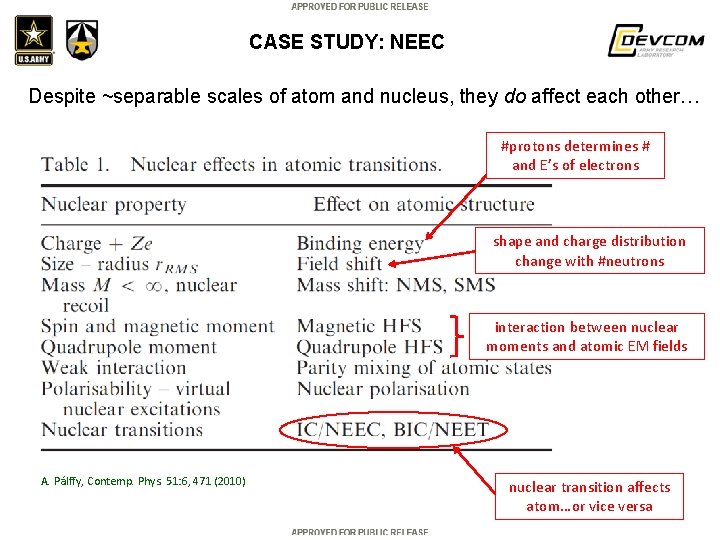
CASE STUDY: NEEC Despite ~separable scales of atom and nucleus, they do affect each other… #protons determines # and E’s of electrons shape and charge distribution change with #neutrons interaction between nuclear moments and atomic EM fields A. Pálffy, Contemp. Phys. 51: 6, 471 (2010) nuclear transition affects atom…or vice versa
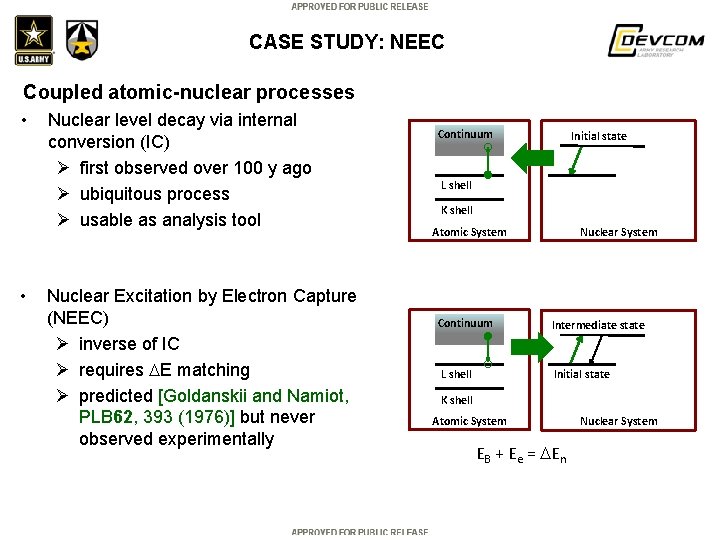
CASE STUDY: NEEC Coupled atomic-nuclear processes • • Nuclear level decay via internal conversion (IC) Ø first observed over 100 y ago Ø ubiquitous process Ø usable as analysis tool Nuclear Excitation by Electron Capture (NEEC) Ø inverse of IC Ø requires DE matching Ø predicted [Goldanskii and Namiot, PLB 62, 393 (1976)] but never observed experimentally Continuum Initial state L shell K shell Atomic System Continuum L shell Nuclear System Intermediate state Initial state K shell Atomic System EB + Ee = DEn Nuclear System
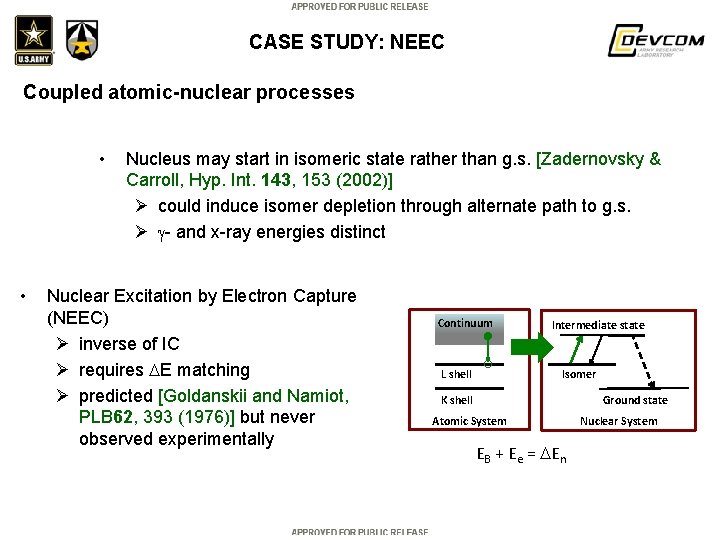
CASE STUDY: NEEC Coupled atomic-nuclear processes • • Nucleus may start in isomeric state rather than g. s. [Zadernovsky & Carroll, Hyp. Int. 143, 153 (2002)] Ø could induce isomer depletion through alternate path to g. s. Ø g- and x-ray energies distinct Nuclear Excitation by Electron Capture (NEEC) Ø inverse of IC Ø requires DE matching Ø predicted [Goldanskii and Namiot, PLB 62, 393 (1976)] but never observed experimentally Continuum L shell Intermediate state Isomer K shell Ground state Atomic System EB + Ee = DEn Nuclear System
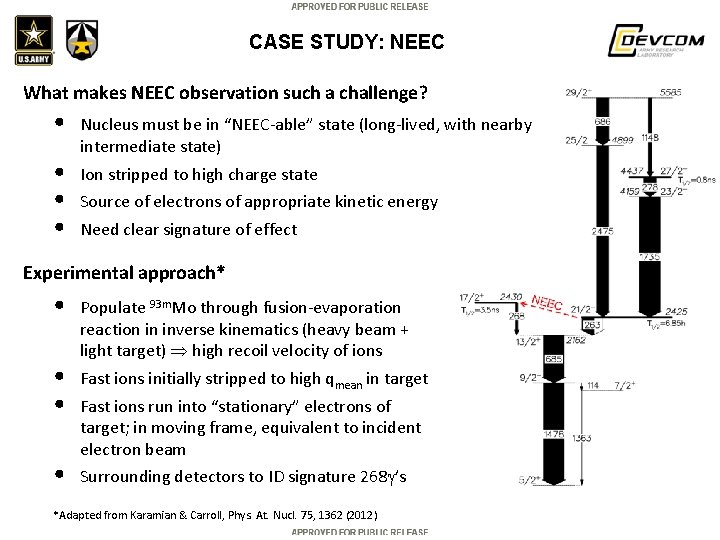
CASE STUDY: NEEC What makes NEEC observation such a challenge? • • Nucleus must be in “NEEC-able” state (long-lived, with nearby intermediate state) Ion stripped to high charge state Source of electrons of appropriate kinetic energy Need clear signature of effect Experimental approach* • • Populate 93 m. Mo through fusion-evaporation reaction in inverse kinematics (heavy beam + light target) high recoil velocity of ions Fast ions initially stripped to high qmean in target Fast ions run into “stationary” electrons of target; in moving frame, equivalent to incident electron beam Surrounding detectors to ID signature 268 g’s *Adapted from Karamian & Carroll, Phys. At. Nucl. 75, 1362 (2012)
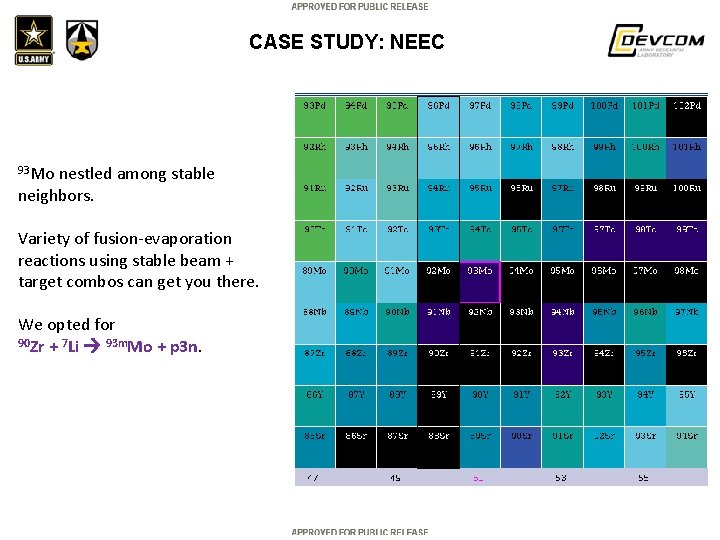
CASE STUDY: NEEC 93 Mo nestled among stable neighbors. Variety of fusion-evaporation reactions using stable beam + target combos can get you there. We opted for 90 Zr + 7 Li 93 m. Mo + p 3 n.
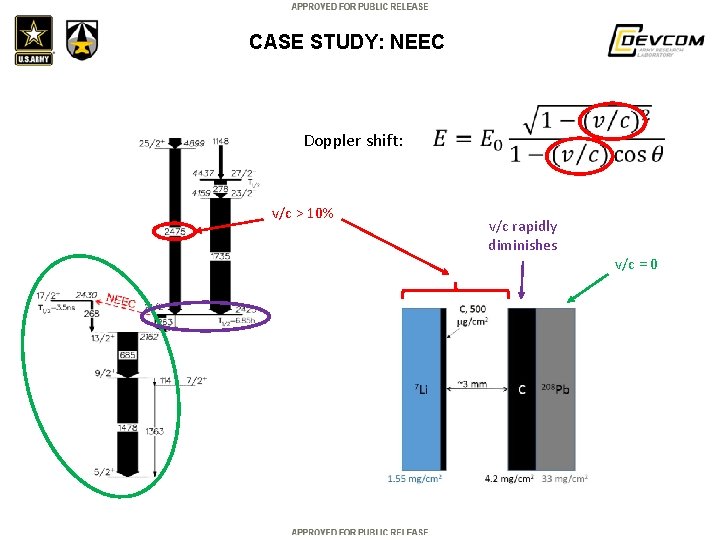
CASE STUDY: NEEC Doppler shift: v/c > 10% v/c rapidly diminishes v/c = 0
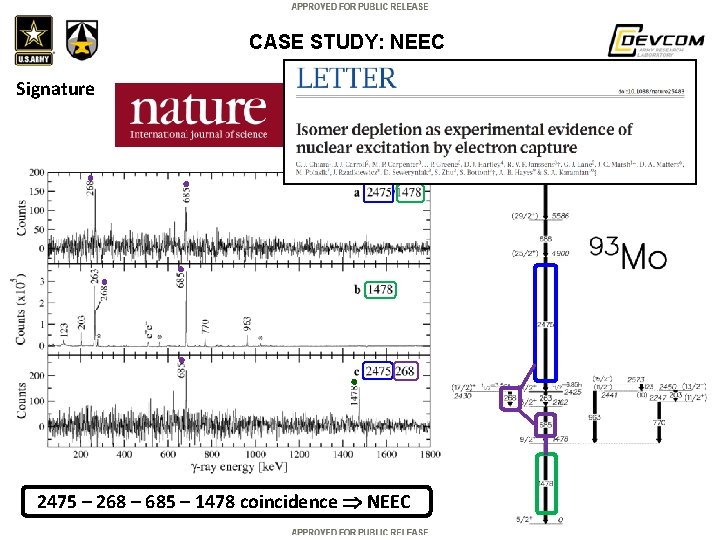
CASE STUDY: NEEC Signature 2475 – 268 – 685 – 1478 coincidence NEEC
ORGANIZATION OF THESE LECTURES We will explore the six W’s of experimental nuclear structure: Ø Who? Ø What? Ø When? Ø Ø Ø Where? Why? ho. W?
REFERENCES Electroweak Interactions Group Department of Physics Colorado School of Mines http: //electroweak. mines. edu + full treatment of ADs/ACs/polarizations in “In-Beam Gamma-Ray Spectroscopy” by Morinaga & Yamazaki
Backups

BUILDING A LEVEL SCHEME • ADs/ACs multipole order L, but do not directly distinguish E vs M • Pure DI=1 E 1 looks the same as pure DI=1 M 1, e. g. • Nonzero mixing ratio may change that, as M 1/E 2 far more likely than E 1/M 2 • For more direct determination of E or M: measure polarization Measure Compton scattering within and perpendicular to reaction plane (a corrects for different intrinsic count rates)
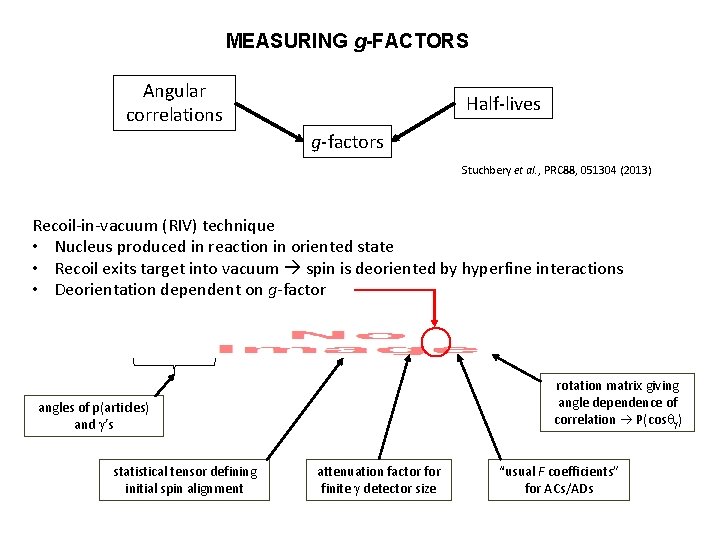
MEASURING g-FACTORS Angular correlations Half-lives g-factors Stuchbery et al. , PRC 88, 051304 (2013) Recoil-in-vacuum (RIV) technique • Nucleus produced in reaction in oriented state • Recoil exits target into vacuum spin is deoriented by hyperfine interactions • Deorientation dependent on g-factor rotation matrix giving angle dependence of correlation P(cosqg) angles of p(articles) and g’s statistical tensor defining initial spin alignment attenuation factor finite g detector size “usual F coefficients” for ACs/ADs
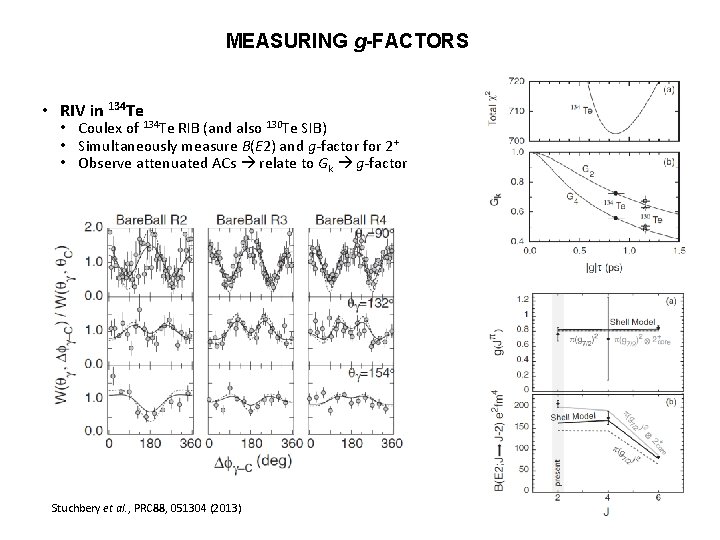
MEASURING g-FACTORS • RIV in 134 Te • Coulex of 134 Te RIB (and also 130 Te SIB) • Simultaneously measure B(E 2) and g-factor for 2+ • Observe attenuated ACs relate to Gk g-factor Stuchbery et al. , PRC 88, 051304 (2013)
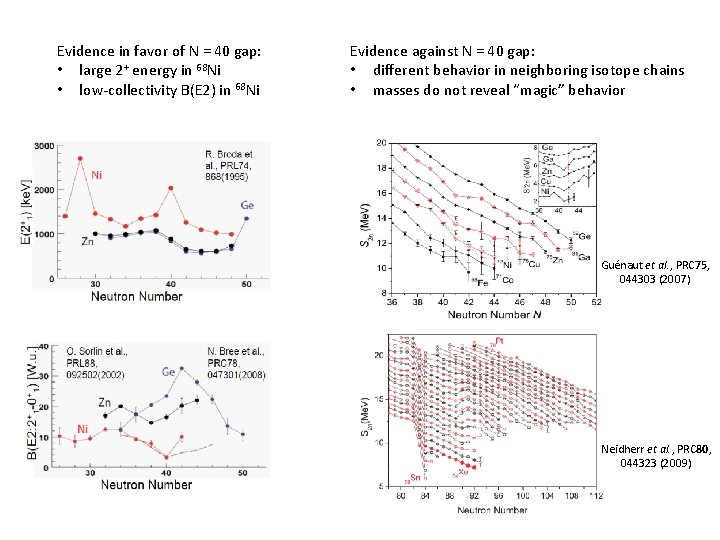
Evidence in favor of N = 40 gap: • large 2+ energy in 68 Ni • low-collectivity B(E 2) in 68 Ni Evidence against N = 40 gap: • different behavior in neighboring isotope chains • masses do not reveal “magic” behavior Guénaut et al. , PRC 75, 044303 (2007) Neidherr et al. , PRC 80, 044323 (2009)
The Progression of Gamma-Ray Detection K. G. Leach EBSS 2018: Nuclear Structure Experiment - II Wednesday, June 27, 2018 Electroweak Interactions Group Department of Physics Colorado School of Mines http: //electroweak. mines. edu KGL
Nuclear Excited State Decay EURICA Decay Spectroscopy at RIBF (RIKEN) Heavy Element Studies at RITU Nucleon knockout at the S 800 β Decay at NSCL Heavy-ion reactions with the FMA HLC
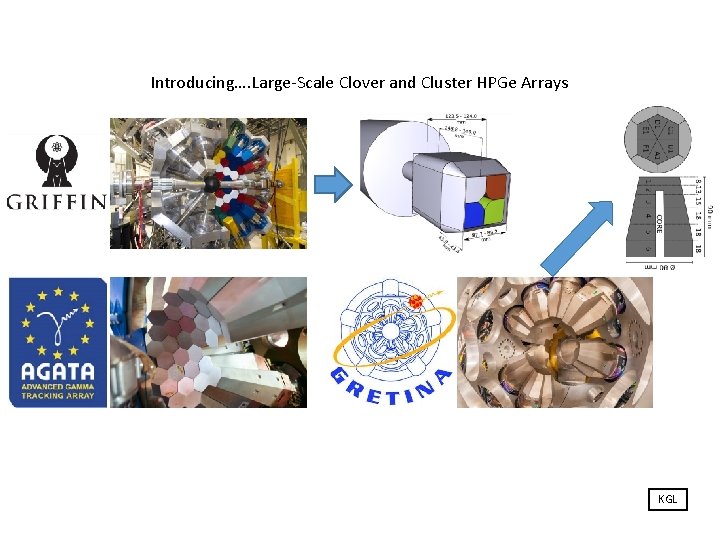
Introducing…. Large-Scale Clover and Cluster HPGe Arrays K. G. Leach EBSS 2018: Nuclear Structure Experiment - II Wednesday, June 27, 2018 Electroweak Interactions Group Department of Physics Colorado School of Mines http: //electroweak. mines. edu KGL
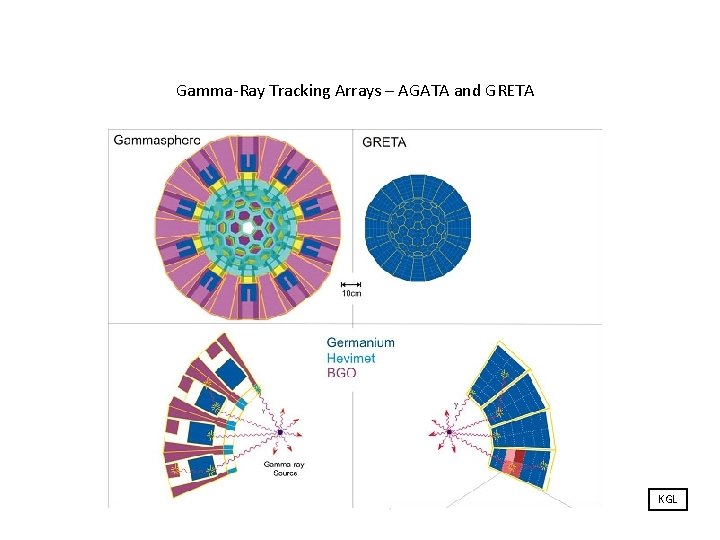
Gamma-Ray Tracking Arrays – AGATA and GRETA KGL
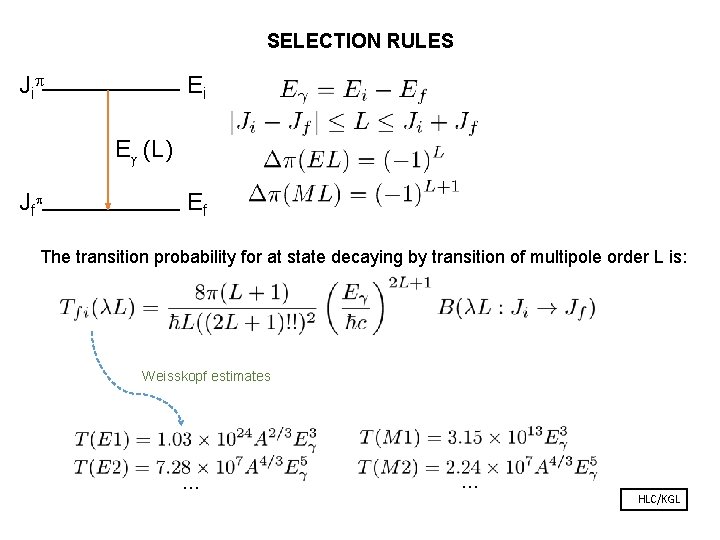
SELECTION RULES Jip Ei Eγ (L) Jfp Ef The transition probability for at state decaying by transition of multipole order L is: Weisskopf estimates … … HLC/KGL
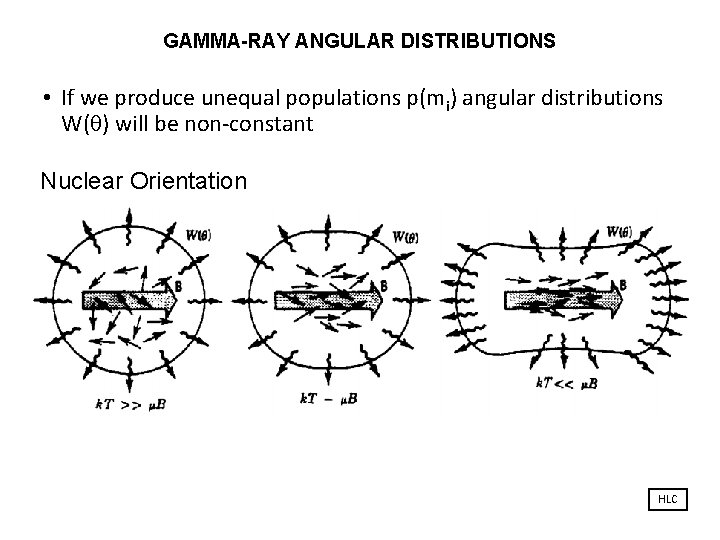
GAMMA-RAY ANGULAR DISTRIBUTIONS • If we produce unequal populations p(mi) angular distributions W(q) will be non-constant Nuclear Orientation HLC
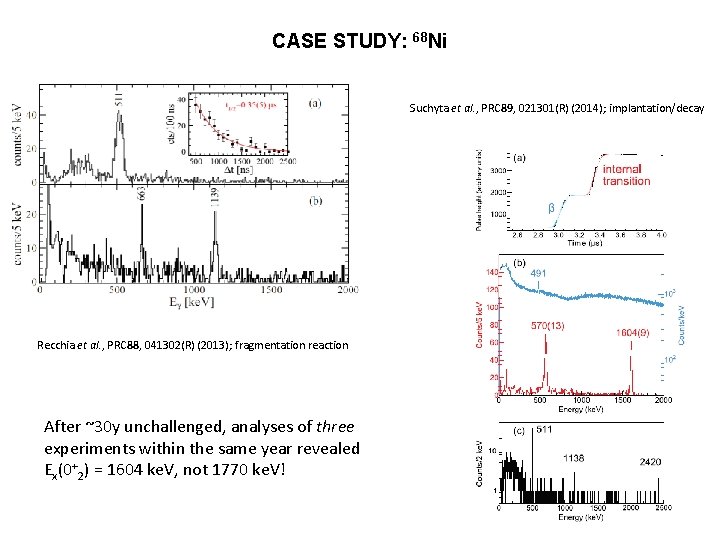
CASE STUDY: 68 Ni Suchyta et al. , PRC 89, 021301(R) (2014); implantation/decay Recchia et al. , PRC 88, 041302(R) (2013); fragmentation reaction After ~30 y unchallenged, analyses of three experiments within the same year revealed Ex(0+2) = 1604 ke. V, not 1770 ke. V!
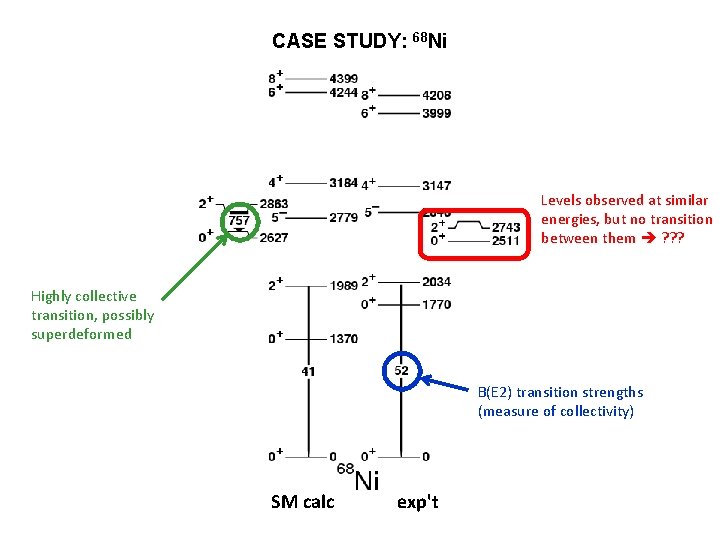
CASE STUDY: 68 Ni Levels observed at similar energies, but no transition between them ? ? ? Highly collective transition, possibly superdeformed B(E 2) transition strengths (measure of collectivity) SM calc exp't
- Slides: 66