
SOUTH AFRICAS SCHOOL CRISIS UCT SUMMER SCHOOL LECTURE



- Slides: 36
SOUTH AFRICA'S SCHOOL CRISIS UCT SUMMER SCHOOL , LECTURE 2 Tuesday 8 th January 2018
1 2 3 4 How do we get there by 2030? YESTERDAY - 4 KEY NDP GOALS: HOW ARE WE DOING?
TODAY…. . REMEMBER? THE PLAN IN BRIEF 1 of 10 key critical actions
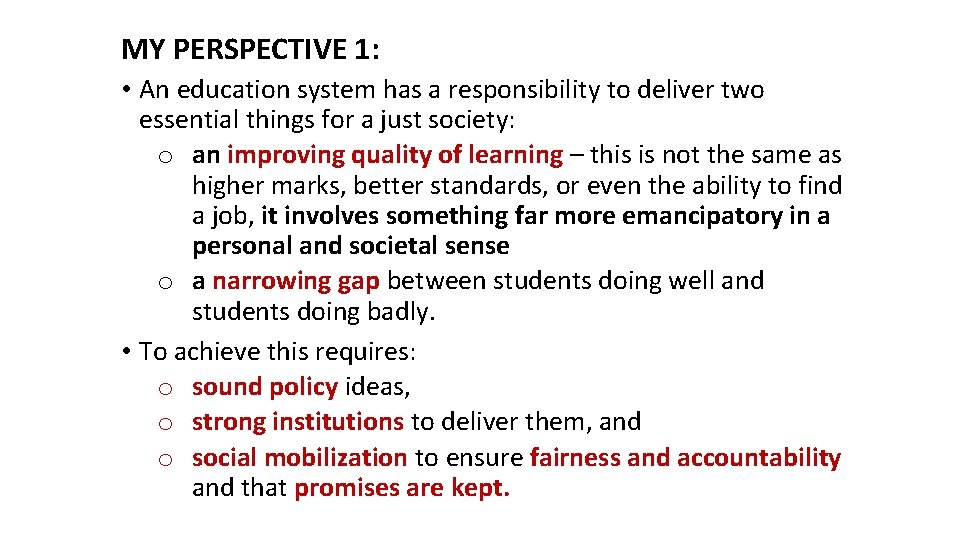
MY PERSPECTIVE 1: • An education system has a responsibility to deliver two essential things for a just society: o an improving quality of learning – this is not the same as higher marks, better standards, or even the ability to find a job, it involves something far more emancipatory in a personal and societal sense o a narrowing gap between students doing well and students doing badly. • To achieve this requires: o sound policy ideas, o strong institutions to deliver them, and o social mobilization to ensure fairness and accountability and that promises are kept.
MY PERSPECTIVE 2: “It is a common error for policy documents to give the impression that policies are matters for governments only, both to determine and to execute. In democratic systems of government, policies must be arrived at through open social and political processes which involve all major stakeholders and interest groups, and which citizens feel free to influence, for example through the media. Implementation has to be steered by the public service or statutory bodies, but can only succeed if the affected organs of civil society feel that they are partners with a stake in the outcome” “For a policy to have a chance of success, sufficient people must be persuaded that it is right, necessary and implementable. Almost any education and training policy will come to grief in practice if it does not win the support of two essential constituencies: • Those who are expected to benefit from it, and • Those who are expected to implement it”
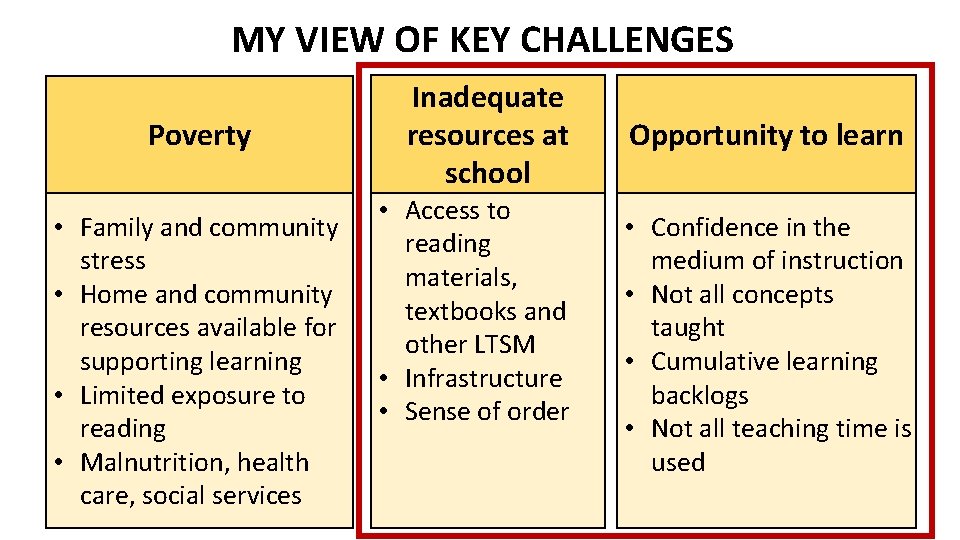
MY VIEW OF KEY CHALLENGES Poverty • Family and community stress • Home and community resources available for supporting learning • Limited exposure to reading • Malnutrition, health care, social services Inadequate resources at school • Access to reading materials, textbooks and other LTSM • Infrastructure • Sense of order Opportunity to learn • Confidence in the medium of instruction • Not all concepts taught • Cumulative learning backlogs • Not all teaching time is used
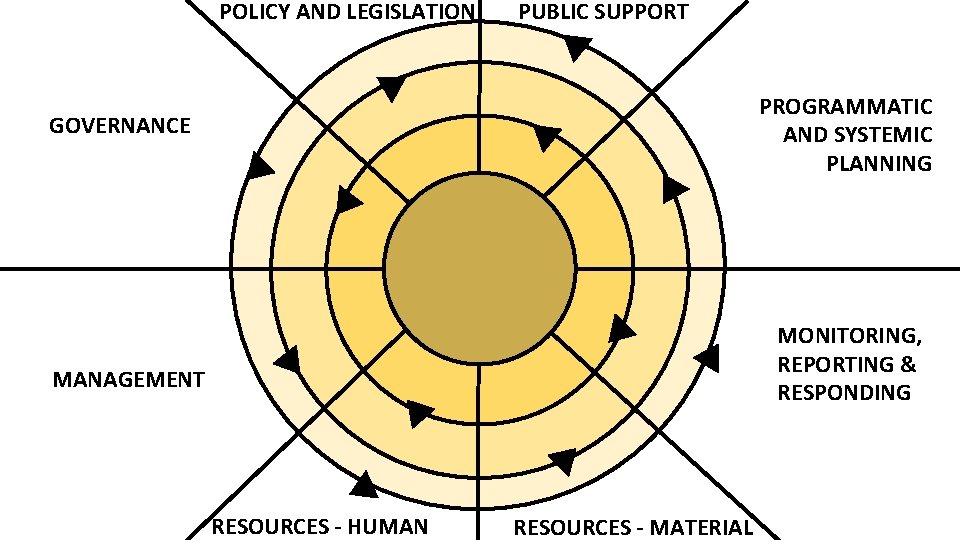
Infrastructure Language Policy Resources - Textbooks Strong Foundations School Management Support Teacher support Open processes to determine policy, and to win the support of both that must implement the policies, and those that will benefit from them • sound policy ideas, • strong institutions to deliver them, and • social mobilization to ensure fairness and accountability and that promises are kept.
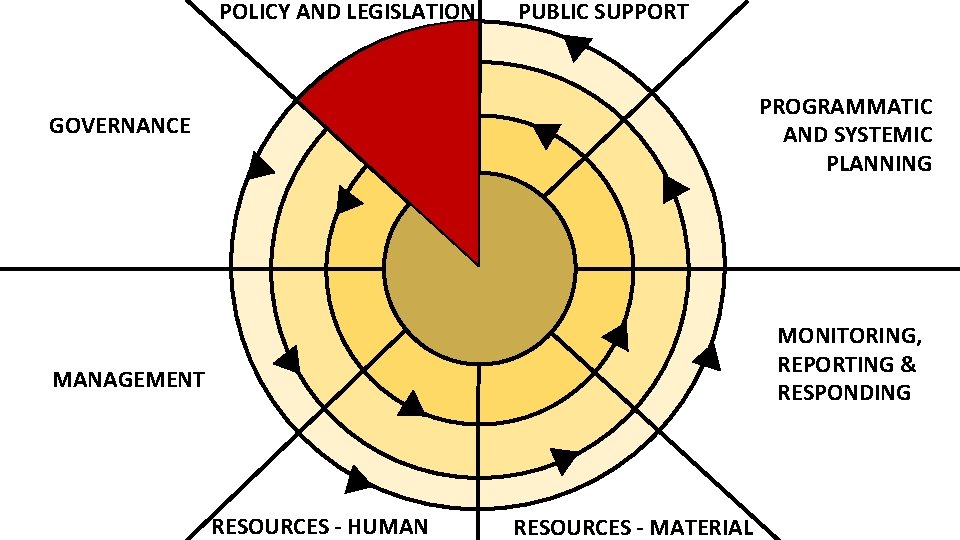
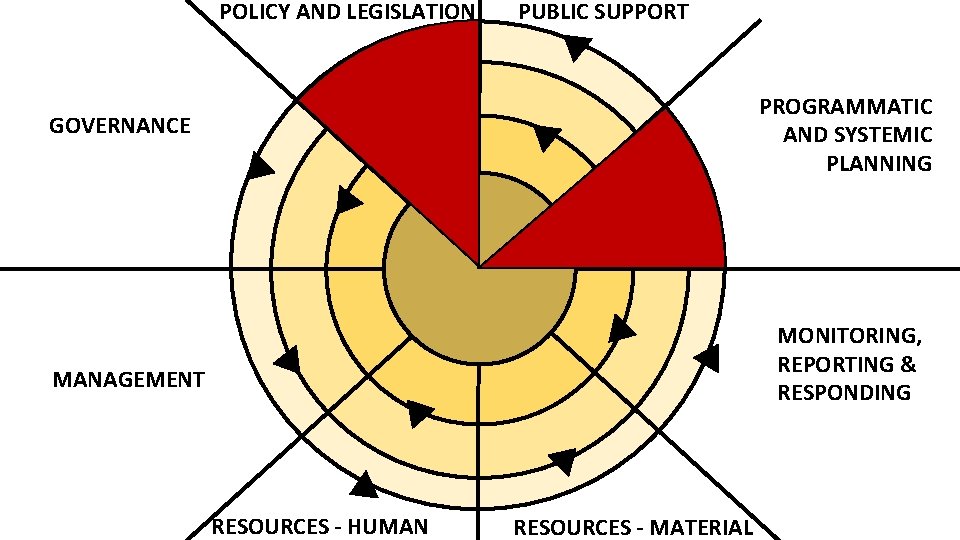
POLICY AND LEGISLATION PUBLIC SUPPORT PROGRAMMATIC AND SYSTEMIC PLANNING GOVERNANCE MONITORING, REPORTING & RESPONDING MANAGEMENT RESOURCES - HUMAN RESOURCES - MATERIAL
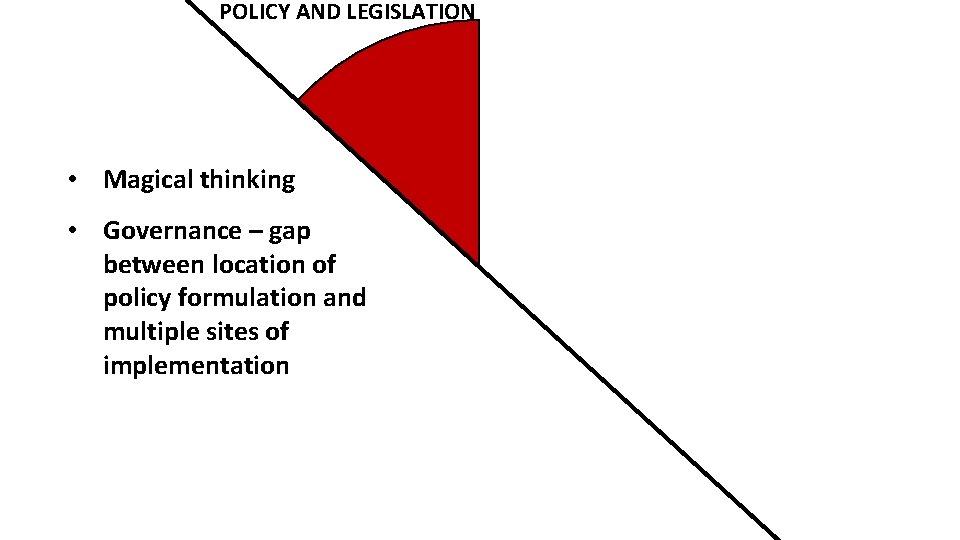
POLICY AND LEGISLATION • Magical thinking • Governance – gap between location of policy formulation and multiple sites of implementation
POLICY AND LEGISLATION PUBLIC SUPPORT PROGRAMMATIC AND SYSTEMIC PLANNING GOVERNANCE MONITORING, REPORTING & RESPONDING MANAGEMENT RESOURCES - HUMAN RESOURCES - MATERIAL
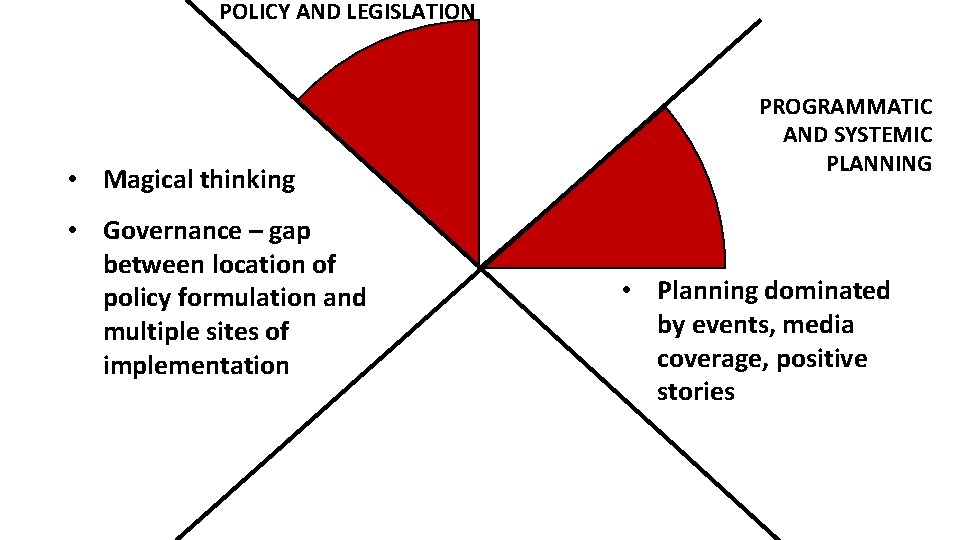
POLICY AND LEGISLATION • Magical thinking • Governance – gap between location of policy formulation and multiple sites of implementation PROGRAMMATIC AND SYSTEMIC PLANNING • Planning dominated by events, media coverage, positive stories
POLICY AND LEGISLATION PUBLIC SUPPORT PROGRAMMATIC AND SYSTEMIC PLANNING GOVERNANCE MONITORING, REPORTING & RESPONDING MANAGEMENT RESOURCES - HUMAN RESOURCES - MATERIAL
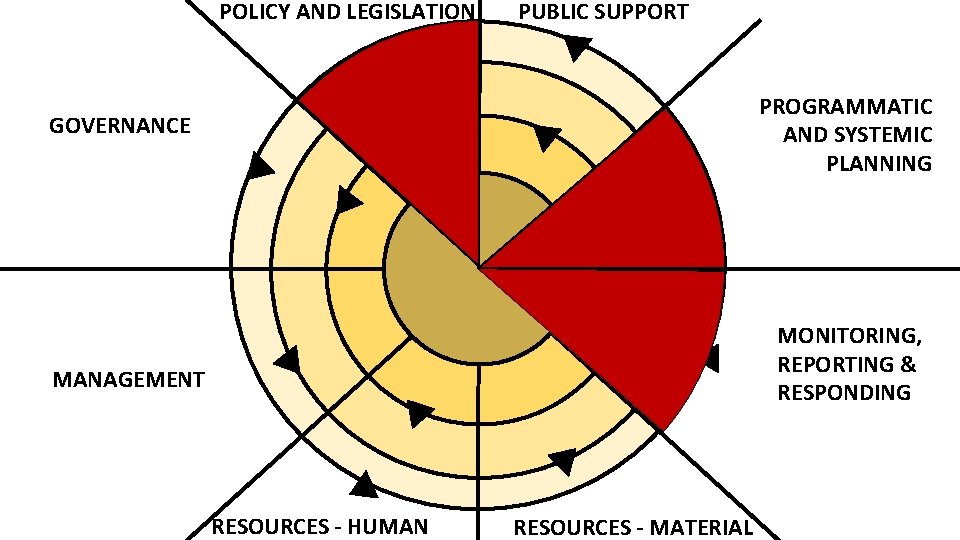
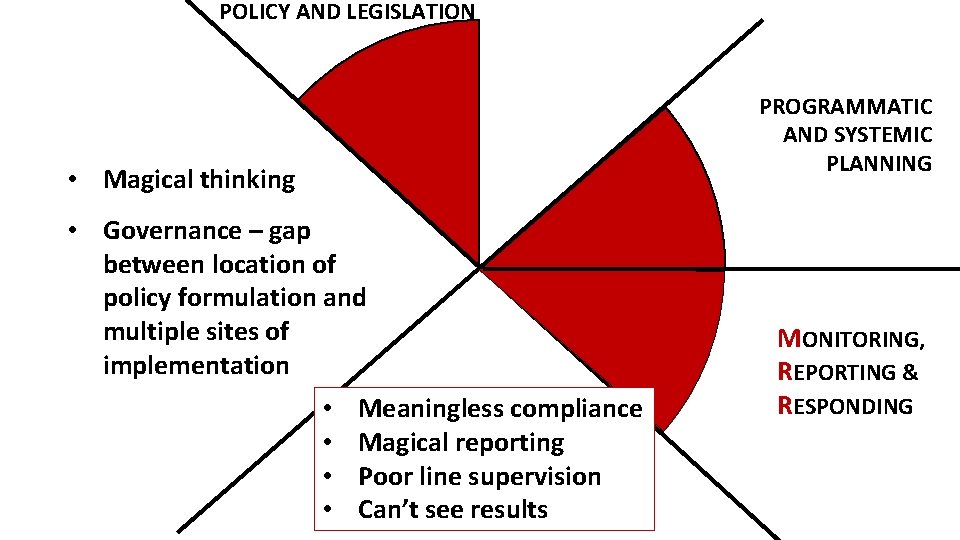
POLICY AND LEGISLATION PROGRAMMATIC AND SYSTEMIC PLANNING • Magical thinking • Governance – gap between location of policy formulation and multiple sites of implementation • • Meaningless compliance Magical reporting Poor line supervision Can’t see results MONITORING, REPORTING & RESPONDING
POLICY AND LEGISLATION PUBLIC SUPPORT PROGRAMMATIC AND SYSTEMIC PLANNING GOVERNANCE MONITORING, REPORTING & RESPONDING MANAGEMENT RESOURCES - HUMAN RESOURCES - MATERIAL
GOVERNANCE • Constitutional Framework 1. Bill of Rights 2. Concurrent National and Provincial Powers BILL OF RIGHTS 29. Education (1) Everyone has the right(a) to a basic education, including adult basic education; and (b) To further education, which the state, through reasonable measures, must make progressively available and accessible. … social mobilization to ensure fairness and accountability and that promises are kept Civil Society has played a critical role in mobilizing and giving definition to the content of the right to a Basic Education
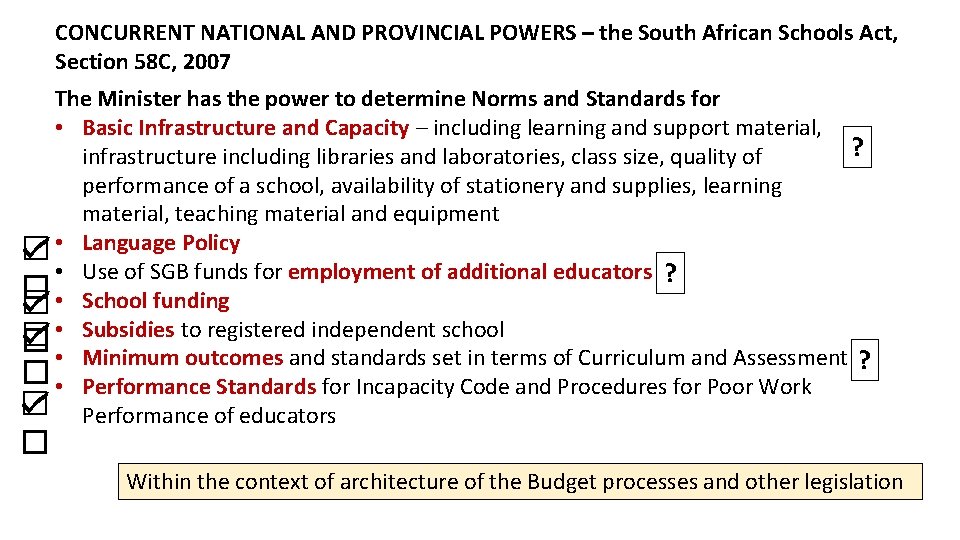
CONCURRENT NATIONAL AND PROVINCIAL POWERS – the South African Schools Act, Section 58 C, 2007 The Minister has the power to determine Norms and Standards for • Basic Infrastructure and Capacity – including learning and support material, ? infrastructure including libraries and laboratories, class size, quality of performance of a school, availability of stationery and supplies, learning material, teaching material and equipment ☑ • Language Policy • Use of SGB funds for employment of additional educators ? � ☑ • School funding ☑ � • • Subsidies to registered independent school Minimum outcomes and standards set in terms of Curriculum and Assessment ? � • Performance Standards for Incapacity Code and Procedures for Poor Work ☑ Performance of educators � Within the context of architecture of the Budget processes and other legislation
THE UNDER-UTILISED POWER OF NORMS & STANDARDS The South African Schools Act, Section 58 C, 2007 • The MEC must, annually, report to the Minister the extent to which the norms & standards have been complied with or, if they have not been complied with, indicate the measures that will be taken to comply. • The Head of Department must comply with all norms and standards within a year by: o identifying resources with which to comply with such norms and standards; o identifying the risk areas for compliance; o developing a compliance plan for the province, in which all norms and standards and the extent of compliance must be reflected; o developing protocols with the schools on how to comply with norms and standards and manage the risk areas; and o reporting to the Member of the Executive Council on the state of compliance and on the measures contemplated above before 30 September of each year.
POSSIBLE EXAMPLES OF THE APPLICATION OF S 58 C OF SASA NATIONAL 1. Set incremental goals by province/ district 2. Secure public and key stakeholder support 3. Establish indicators to measure progress 4. Establish systems to monitor, report, respond PROVINCIAL 1. Establish indicators to measure progress – by Or district/ school Infrastructure? 2. Establish systems to monitor, report & respond 3. Secure public and key stakeholder support 4. Plan programmatically within realistic material and human resource constraints 5. Communicate and maintain cohesion
Infrastructure Resources Textbooks
GOVERNANCE PUBLIC SUPPORT AND ACCOUNTABILITY
GOVERNANCE PUBLIC SUPPORT AND ACCOUNTABILITY Infrastructure MICHAEL KOMAPE, 5 years, 2014 LUMKA MKETWA, 5 years, March 2018
GOVERNANCE PUBLIC SUPPORT AND ACCOUNTABILITY Infrastructure Furniture
GOVERNANCE PUBLIC SUPPORT AND ACCOUNTABILITY Furniture Infrastructure
Infrastructure – The struggle for N&S 2008 SASA Section 58 C, Feb 2012: Court Case to 2007 demand Infrastructure N&S 2013 Nov 2012: Out of Court Settlement – Minister agrees July 2013: Bhisho Court Minister must publish Dec 2013: N&S Published
October 2014 May 2015
Infrastructure – The struggle for Implementation of N&S Bhisho High Court, March 2018 challenges loopholes in the Norms law, and in seeks an order from the Court that the Minister must take certain minimum steps to oversee and monitor implementation of a binding set of standards for school infrastructure. Norms and Standards court victory – July 2018 Judgment was finally delivered in our #Fix. The. Norms case. This affirmed that all organs of government are collectively responsible for implementing the Norms and Standards for School Infrastructure; it widened the definition of inappropriately built schools that need immediate attention from government; and also ensured that the DBE makes school infrastructure progress reports public every year. The judgment affirmed all EE’s legal arguments, supported by five years of EE members’ activism. Despite this, the DBE and all the provincial education departments decided to appeal the judgment. 2013 Dec 2013: N&S Published 2018 July 2018: Bhisho Court affirmed government’s collective responsibility and widened definition of schools needing immediate attention. Government appeals judgment Dec 2018: Constitutional Court refuses to hear Governments appeal
GOVERNANCE PUBLIC SUPPORT AND ACCOUNTABILITY Resources - Textbooks 2012 2013 2015 Johannesburg, 2 December 2015 – This morning a full bench of the Supreme Court of Appeal delivered a beautiful, globally significant judgment. It said that the DBE’s failure to provide learners in Limpopo with their textbooks directly infringed on their rights to basic education, equality & dignity & amounted to unfair discrimination. The DBE’s appeal in the Limpopo textbooks saga was therefore dismissed and Basic Education For All’s cross appeal was upheld. The Court also found that the DBE was in breach of previous court orders.
GOVERNANCE Resources - Textbooks Infrastructure PUBLIC SUPPORT AND ACCOUNTABILITY ?
Language Policy POLICY AND LEGISLATION CONSTITUTION – Bill of Rights 29. Education. (2) Everyone has the right to receive education in the official language or languages of their choice in public educational institutions where that education is reasonably practicable. In order to ensure the effective access to, and implementation of, this right, the state must con- sider all reasonable educational alternatives, including single medium institutions, taking into account- (a) equity; (b) practicability; and (c) the need to redress the results of past racially discriminatory laws and practices. SOUTH AFRICAN SCHOOLS ACT • The Minister determines norms and standards for language policy in public schools. • The governing body of a public school determines the language policy of the school (subject to the Constitution, SASA, and any applicable provincial law)
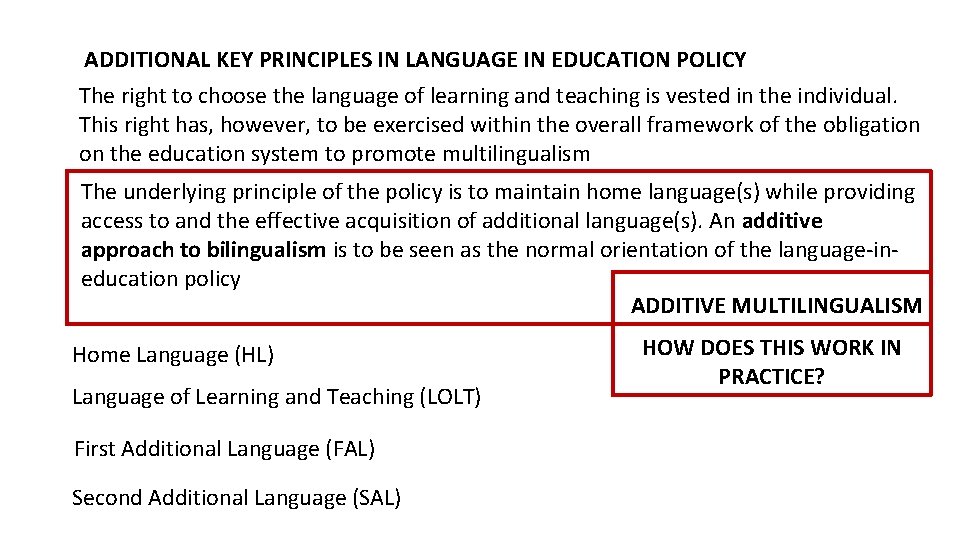
ADDITIONAL KEY PRINCIPLES IN LANGUAGE IN EDUCATION POLICY The right to choose the language of learning and teaching is vested in the individual. This right has, however, to be exercised within the overall framework of the obligation on the education system to promote multilingualism The underlying principle of the policy is to maintain home language(s) while providing access to and the effective acquisition of additional language(s). An additive approach to bilingualism is to be seen as the normal orientation of the language-ineducation policy ADDITIVE MULTILINGUALISM Home Language (HL) Language of Learning and Teaching (LOLT) First Additional Language (FAL) Second Additional Language (SAL) HOW DOES THIS WORK IN PRACTICE?
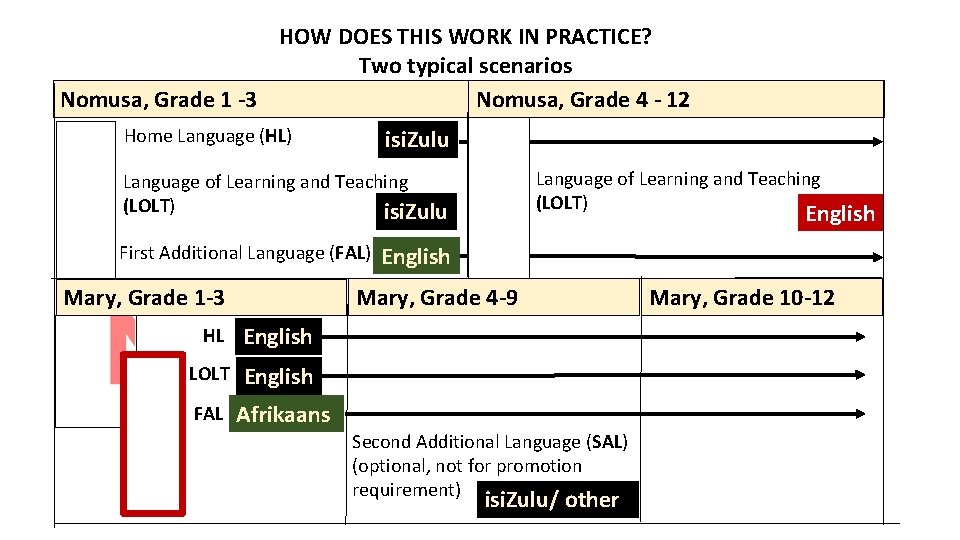
HOW DOES THIS WORK IN PRACTICE? Two typical scenarios Nomusa, Grade 4 - 12 Nomusa, Grade 1 -3 Home Language (HL) isi. Zulu Language of Learning and Teaching (LOLT) isi. Zulu First Additional Language (FAL) English Mary, Grade 4 -9 Mary, Grade 1 -3 HL English LOLT English FAL Afrikaans Second Additional Language (SAL) (optional, not for promotion requirement) isi. Zulu/ other Mary, Grade 10 -12
VIDEO: Sink or Swim – available on You Tube
GEOGRAPHICAL DISTRIBUTION OF HOME LANGUAGES IN JOHANNESBURG Alexandra Township Lenasia Eldorado Park Language key Soweto
Language Policy
TOMORROW LECTURE 3: POSSIBLE SOLUTIONS TO THE SCHOOLS’ CRISIS • What initiatives are underway? And finish today’s lecture!