15 th International Conference on Elastic Diffractive Scattering












- Slides: 67
15 th International Conference on Elastic & Diffractive Scattering (15 th "Blois Workshop") FINLAND (SAARISELKÄ) September, 09 -13 "Models of the hadron structure and Data of the TOTEM Collaboration O. V. Selyugin BLTPh, JINR
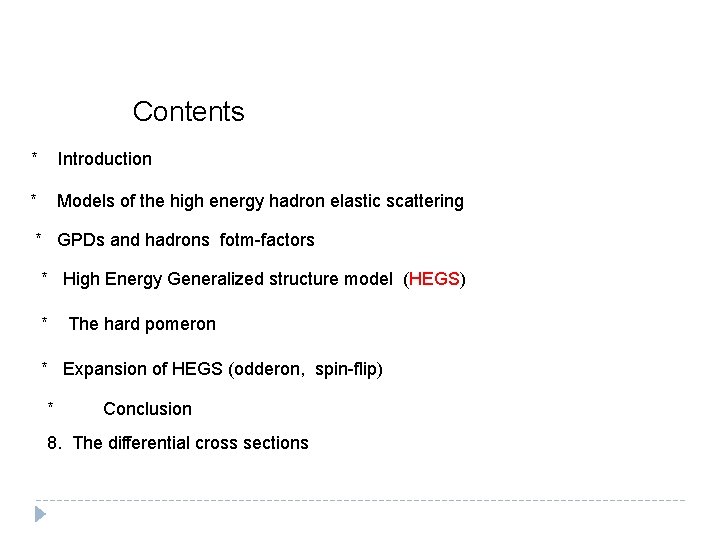
Contents * Introduction * Models of the high energy hadron elastic scattering * GPDs and hadrons fotm-factors * High Energy Generalized structure model (HEGS) * The hard pomeron * Expansion of HEGS (odderon, spin-flip) * Conclusion 8. The differential cross sections
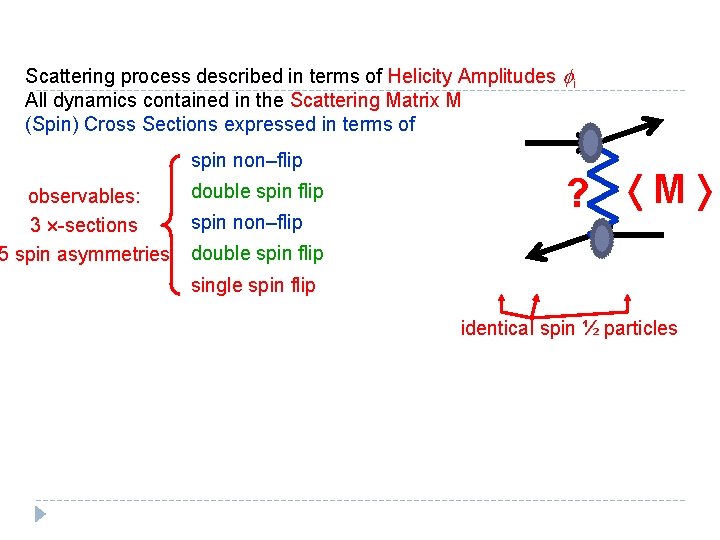
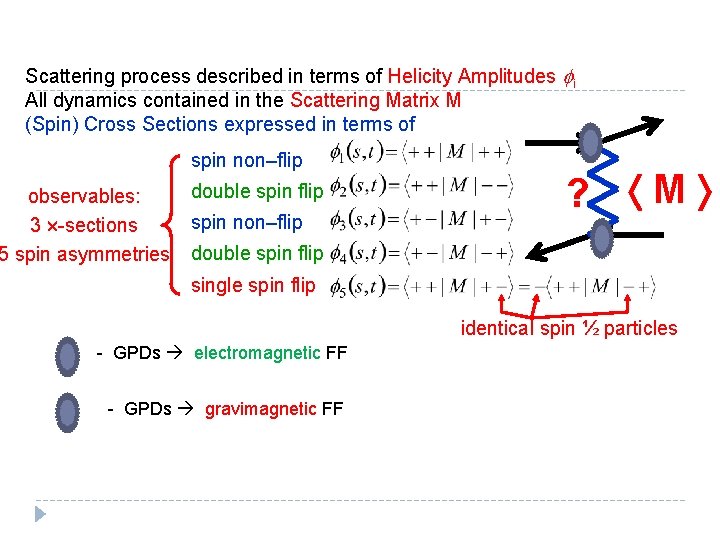
Scattering process described in terms of Helicity Amplitudes fi All dynamics contained in the Scattering Matrix M (Spin) Cross Sections expressed in terms of observables: 3 ´-sections 5 spin asymmetries spin non–flip double spin flip spin non–flip ? áMñ double spin flip single spin flip identical spin ½ particles
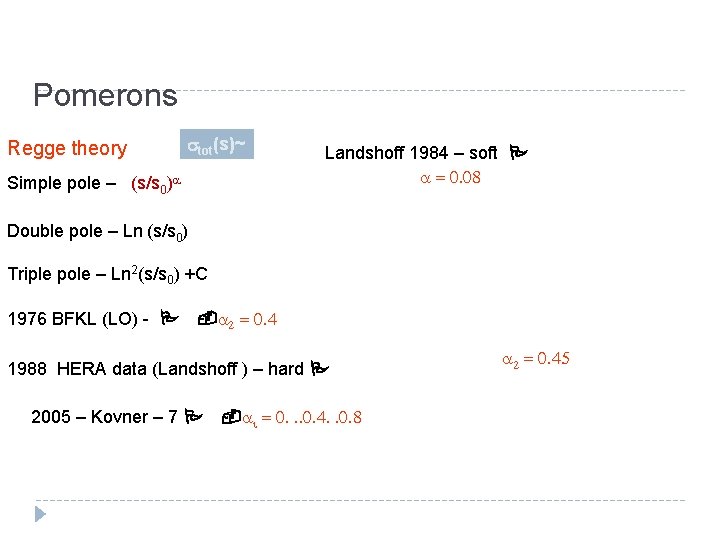
Pomerons Regge theory stot(s)~ Simple pole – (s/s 0)a Landshoff 1984 – soft P a = 0. 08 Double pole – Ln (s/s 0) Triple pole – Ln 2(s/s 0) +C 1976 BFKL (LO) - P -a 2 = 0. 4 1988 HERA data (Landshoff ) – hard P 2005 – Kovner – 7 P -ai = 0. . . 0. 4. . 0. 8 a 2 = 0. 45
Impact parameters dependence Saturation and non-linear equation J. -R. Cudell, E. Predazzi, O. V. S. , Phys. Rev. D 79: 034033, 2009 J. -R. Cudell, O. S. , Phys. Rev. Lett. 102: 032003, 2009 Factorization 6 The Froissart bound
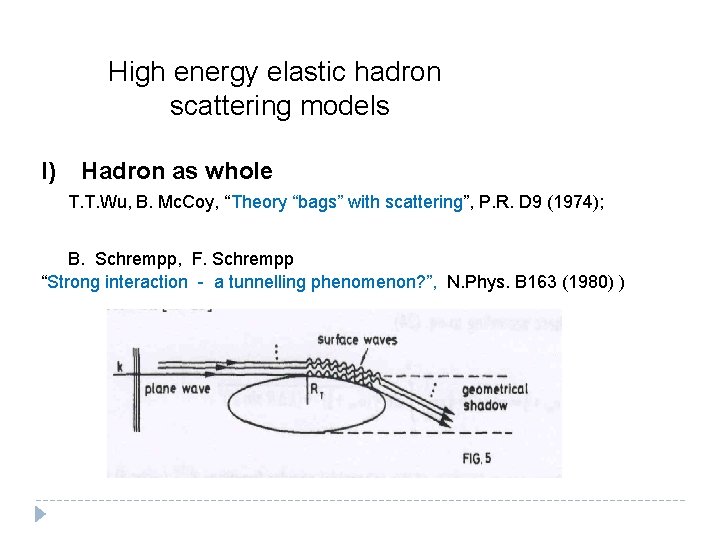
High energy elastic hadron scattering models I) Hadron as whole T. T. Wu, B. Mc. Coy, “Theory “bags” with scattering”, P. R. D 9 (1974); B. Schrempp, F. Schrempp “Strong interaction - a tunnelling phenomenon? ”, N. Phys. B 163 (1980) )
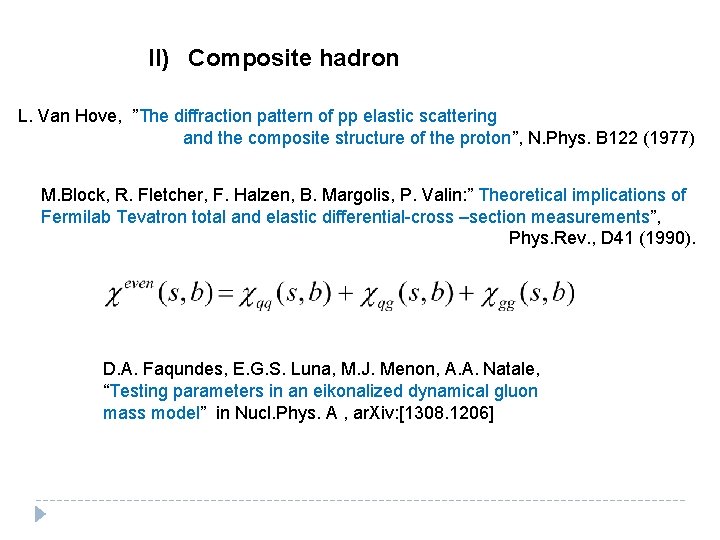
II) Composite hadron L. Van Hove, ”The diffraction pattern of pp elastic scattering and the composite structure of the proton”, N. Phys. B 122 (1977) M. Block, R. Fletcher, F. Halzen, B. Margolis, P. Valin: ” Theoretical implications of Fermilab Tevatron total and elastic differential-cross –section measurements”, Phys. Rev. , D 41 (1990). D. A. Faqundes, E. G. S. Luna, M. J. Menon, A. A. Natale, “Testing parameters in an eikonalized dynamical gluon mass model” in Nucl. Phys. A , ar. Xiv: [1308. 1206]
III) Factorization [Reggions + Form Factors (FF) ] Chow-Yang model (1968) - hadrom form factor Charge distributions - electromagnetic form factors T. T. Chou, C. N. Yang, Phys. Rev. Lett. 20 (1968) E. Leader, U. Maor, P. G. Williams, J. Kasman, Phys. Rev. D 14 (1976) “The Chou-Yang Hypothesis – A Critical Assessment”,
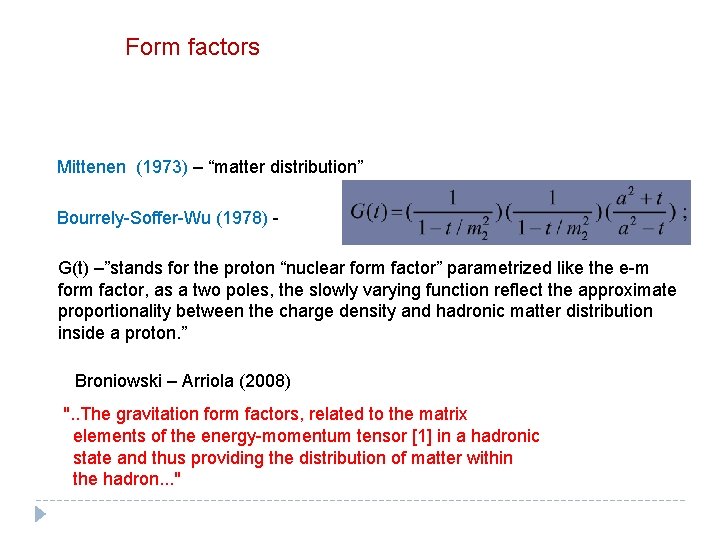
Form factors Mittenen (1973) – “matter distribution” Bourrely-Soffer-Wu (1978) G(t) –”stands for the proton “nuclear form factor” parametrized like the e-m form factor, as a two poles, the slowly varying function reflect the approximate proportionality between the charge density and hadronic matter distribution inside a proton. ” Broniowski – Arriola (2008) ". . The gravitation form factors, related to the matrix elements of the energy-momentum tensor [1] in a hadronic state and thus providing the distribution of matter within the hadron. . . "
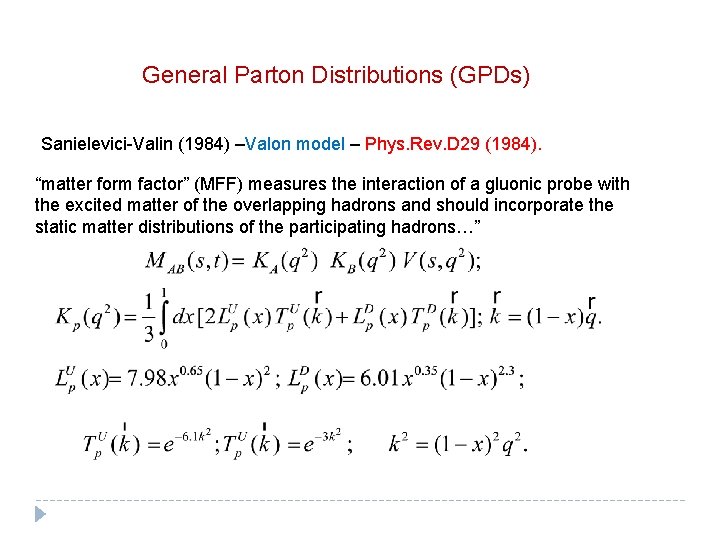
General Parton Distributions (GPDs) Sanielevici-Valin (1984) –Valon model – Phys. Rev. D 29 (1984). “matter form factor” (MFF) measures the interaction of a gluonic probe with the excited matter of the overlapping hadrons and should incorporate the static matter distributions of the participating hadrons…”
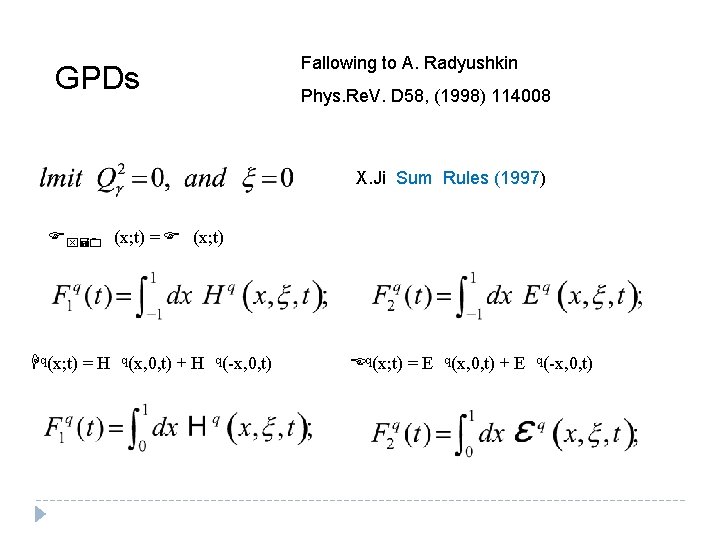
GPDs Fallowing to A. Radyushkin Phys. Re. V. D 58, (1998) 114008 X. Ji Sum Rules (1997) Fx=0 (x; t) = F (x; t) Hq(x; t) = H q(x, 0, t) + H q(-x, 0, t) Eq(x; t) = E q(x, 0, t) + E q(-x, 0, t)
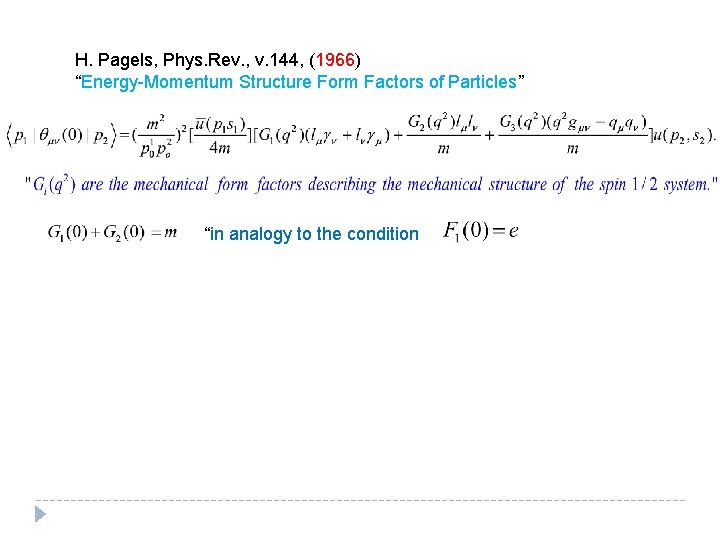
H. Pagels, Phys. Rev. , v. 144, (1966) “Energy-Momentum Structure Form Factors of Particles” “in analogy to the condition
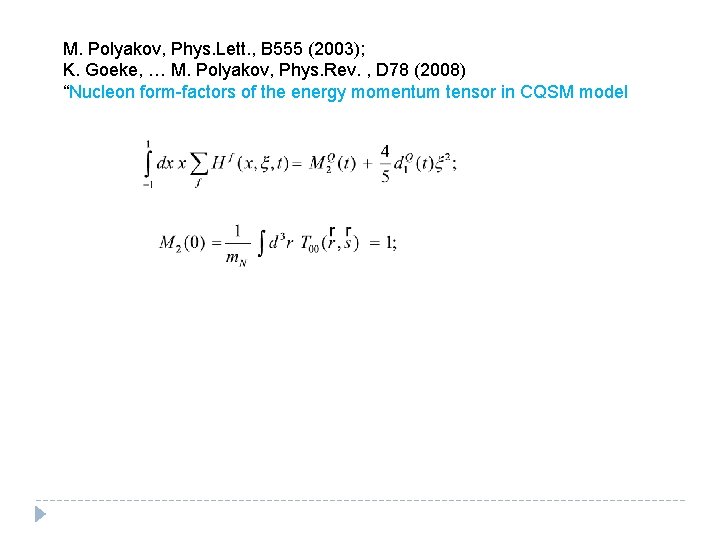
M. Polyakov, Phys. Lett. , B 555 (2003); K. Goeke, … M. Polyakov, Phys. Rev. , D 78 (2008) “Nucleon form-factors of the energy momentum tensor in CQSM model
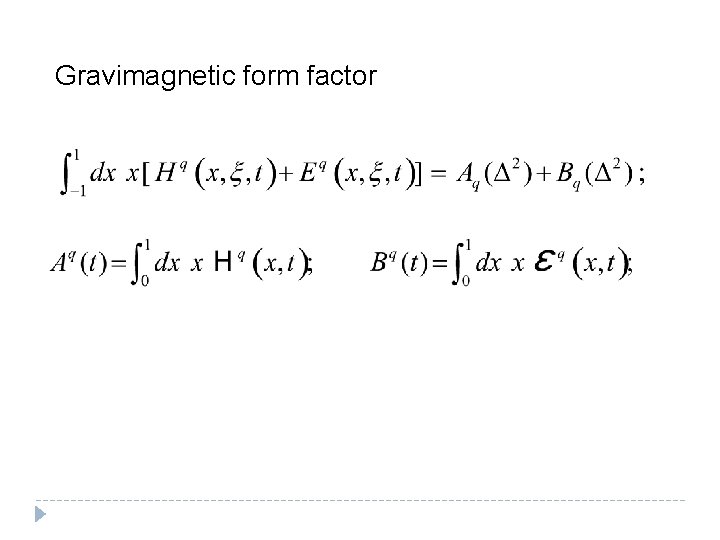
Gravimagnetic form factor
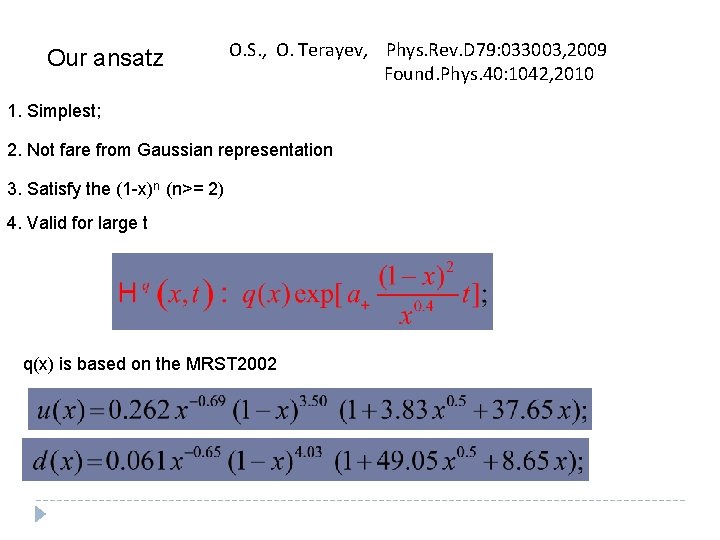
Our ansatz O. S. , O. Terayev, Phys. Rev. D 79: 033003, 2009 Found. Phys. 40: 1042, 2010 1. Simplest; 2. Not fare from Gaussian representation 3. Satisfy the (1 -x)n (n>= 2) 4. Valid for large t q(x) is based on the MRST 2002
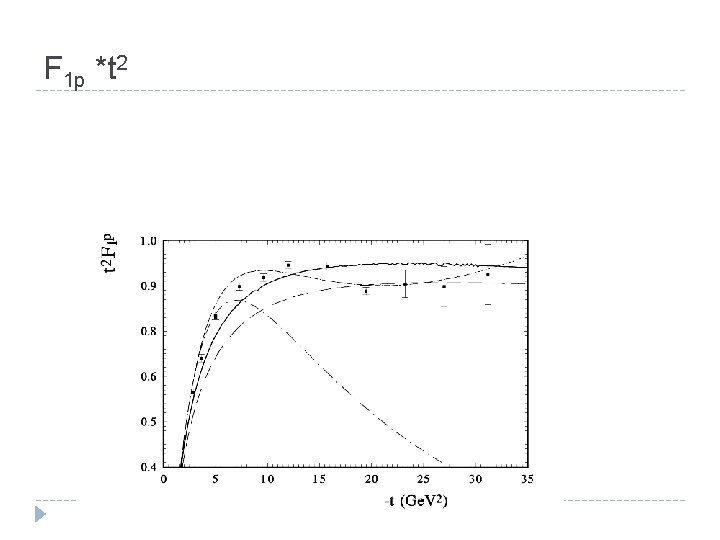
F 1 p *t 2
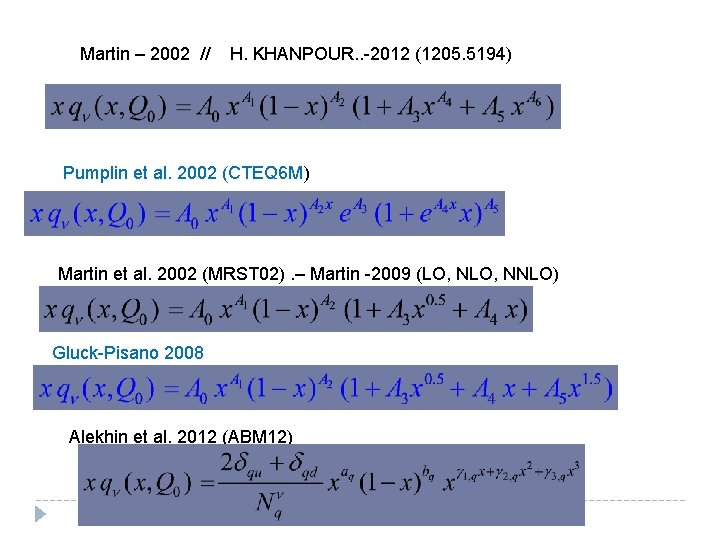
Martin – 2002 // H. KHANPOUR. . -2012 (1205. 5194) Pumplin et al. 2002 (CTEQ 6 M) Martin et al. 2002 (MRST 02). – Martin -2009 (LO, NNLO) Gluck-Pisano 2008 Alekhin et al. 2012 (ABM 12)
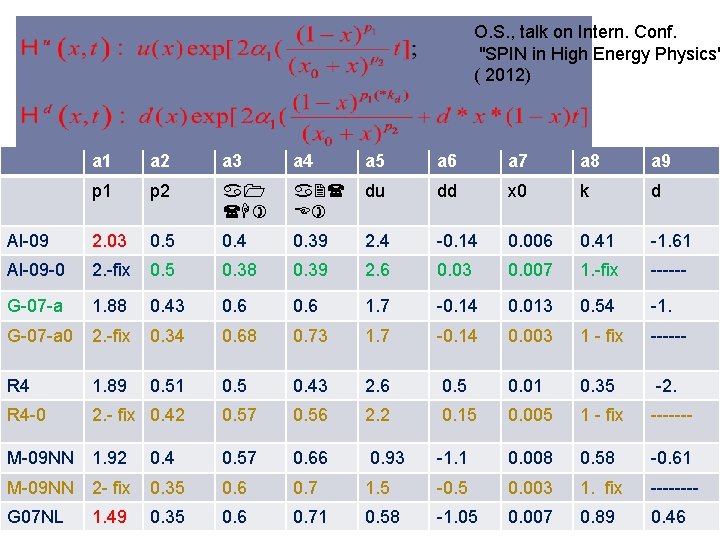
O. S. , talk on Intern. Conf. "SPIN in High Energy Physics" ( 2012) a 1 a 2 a 3 a 4 a 5 a 6 a 7 a 8 a 9 p 1 p 2 a 1 (H) a 2( E) du dd x 0 k d Al-09 2. 03 0. 5 0. 4 0. 39 2. 4 -0. 14 0. 006 0. 41 -1. 61 Al-09 -0 2. -fix 0. 5 0. 38 0. 39 2. 6 0. 03 0. 007 1. -fix ------ G-07 -a 1. 88 0. 43 0. 6 1. 7 -0. 14 0. 013 0. 54 -1. G-07 -a 0 2. -fix 0. 34 0. 68 0. 73 1. 7 -0. 14 0. 003 1 - fix ------ R 4 1. 89 0. 51 0. 5 0. 43 2. 6 0. 5 0. 01 0. 35 -2. R 4 -0 2. - fix 0. 42 0. 57 0. 56 2. 2 0. 15 0. 005 1 - fix ------- M-09 NN 1. 92 0. 4 0. 57 0. 66 0. 93 -1. 1 0. 008 0. 58 -0. 61 M-09 NN 2 - fix 0. 35 0. 6 0. 7 1. 5 -0. 5 0. 003 1. fix ---- G 07 NL 0. 35 0. 6 0. 71 0. 58 -1. 05 0. 007 0. 89 0. 46 1. 49
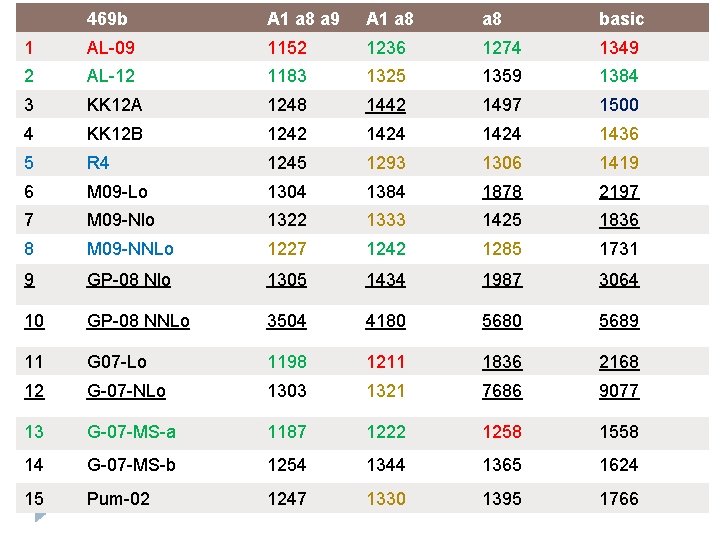
469 b A 1 a 8 a 9 A 1 a 8 basic 1 AL-09 1152 1236 1274 1349 2 AL-12 1183 1325 1359 1384 3 KK 12 A 1248 1442 1497 1500 4 KK 12 B 1242 1424 1436 5 R 4 1245 1293 1306 1419 6 M 09 -Lo 1304 1384 1878 2197 7 M 09 -Nlo 1322 1333 1425 1836 8 M 09 -NNLo 1227 1242 1285 1731 9 GP-08 Nlo 1305 1434 1987 3064 10 GP-08 NNLo 3504 4180 5689 11 G 07 -Lo 1198 1211 1836 2168 12 G-07 -NLo 1303 1321 7686 9077 13 G-07 -MS-a 1187 1222 1258 1558 14 G-07 -MS-b 1254 1344 1365 1624 15 Pum-02 1247 1330 1395 1766
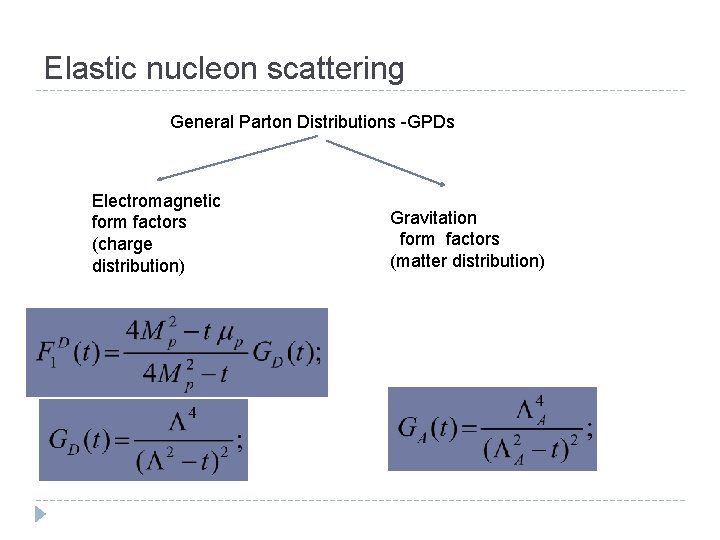
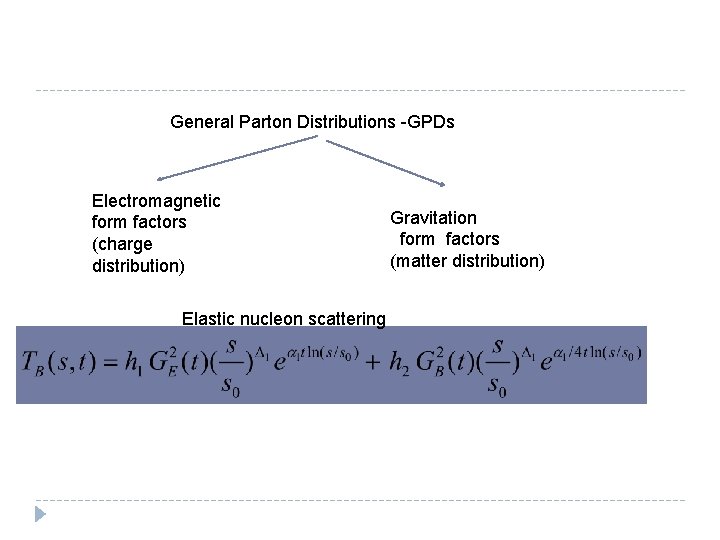
Elastic nucleon scattering General Parton Distributions -GPDs Electromagnetic form factors (charge distribution) Gravitation form factors (matter distribution)
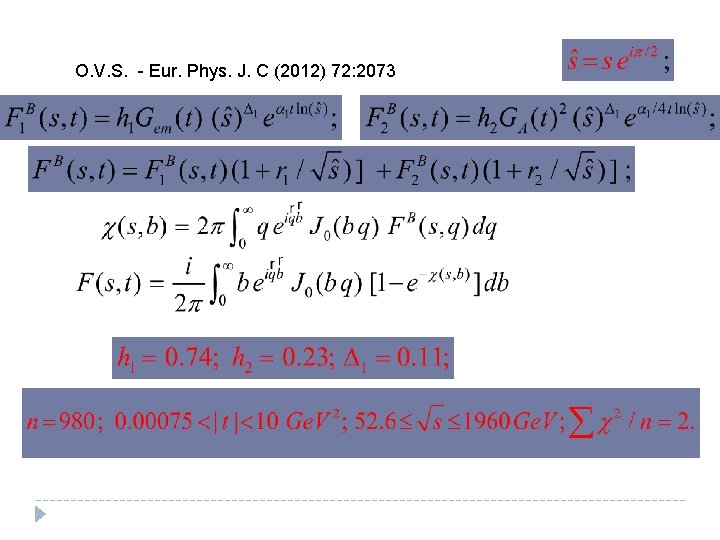
O. V. S. - Eur. Phys. J. C (2012) 72: 2073
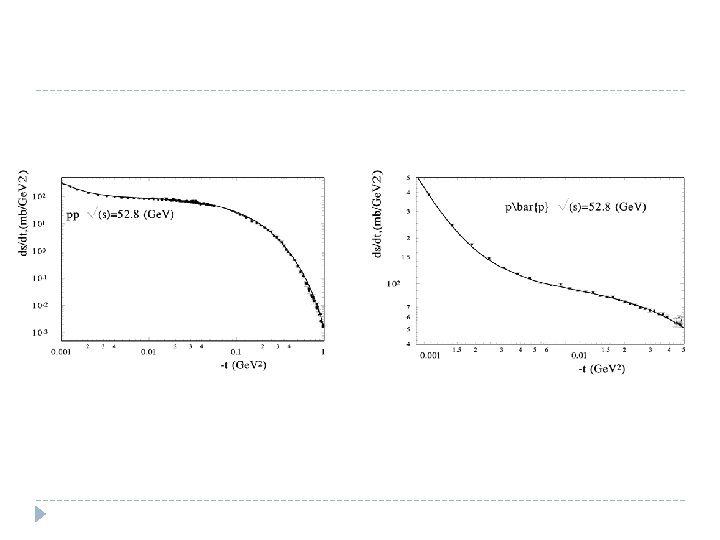
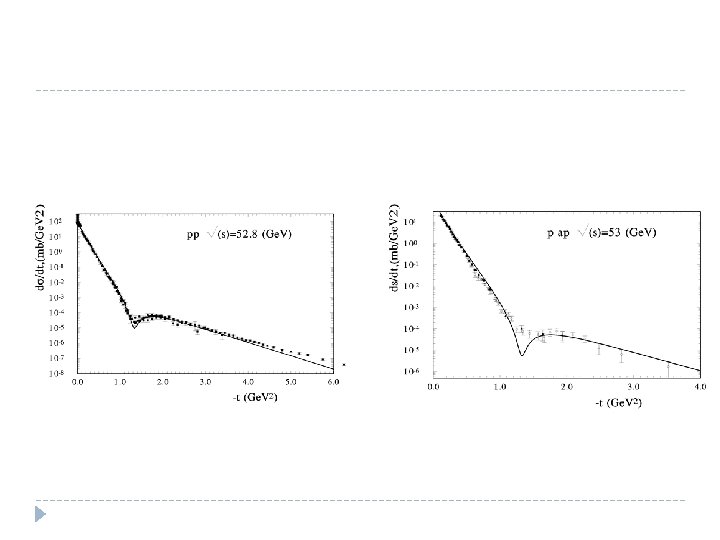
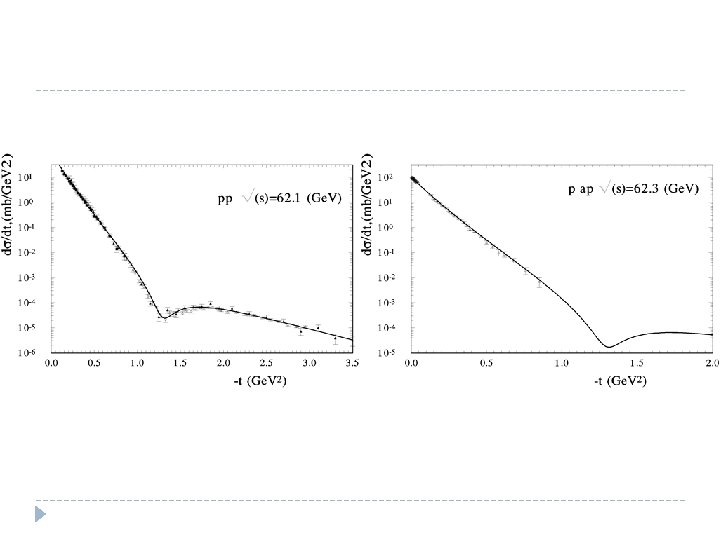
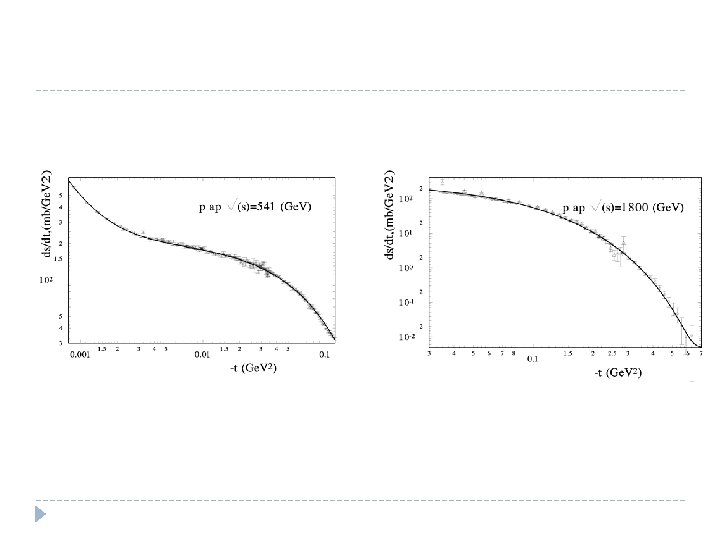
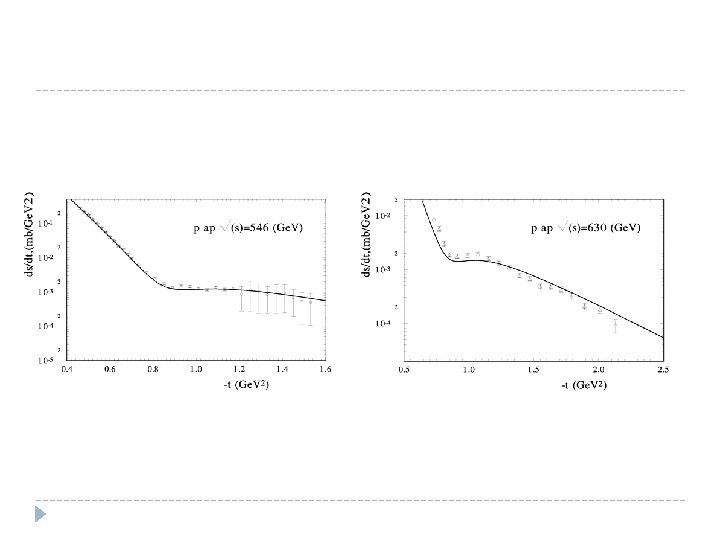
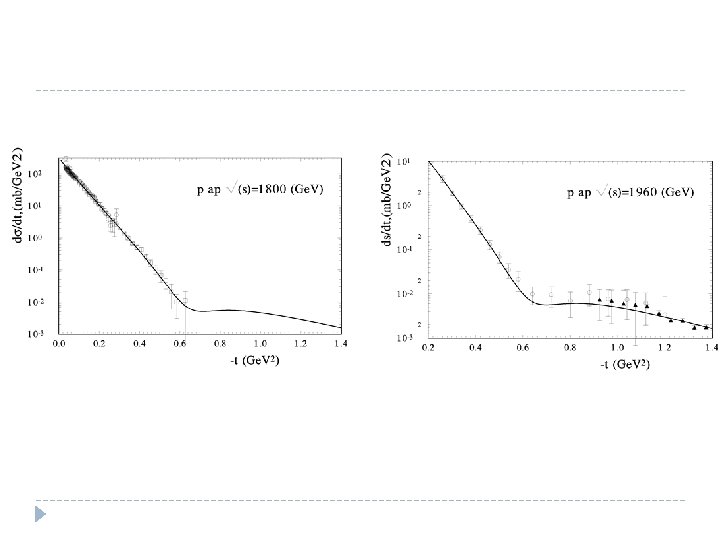
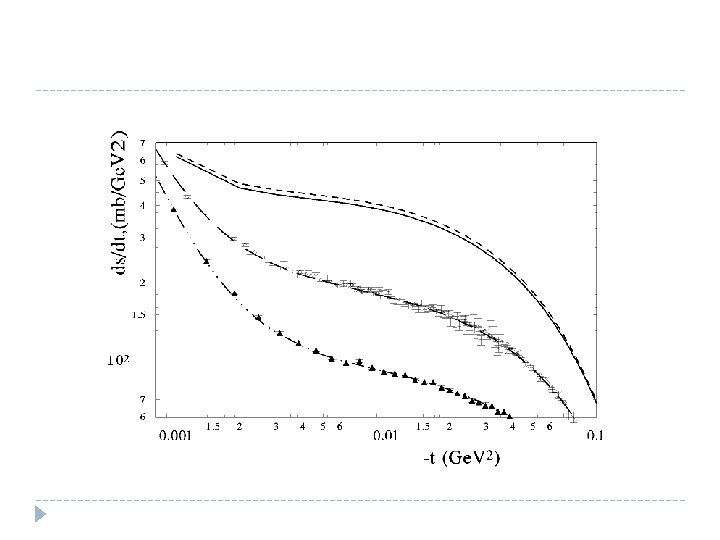
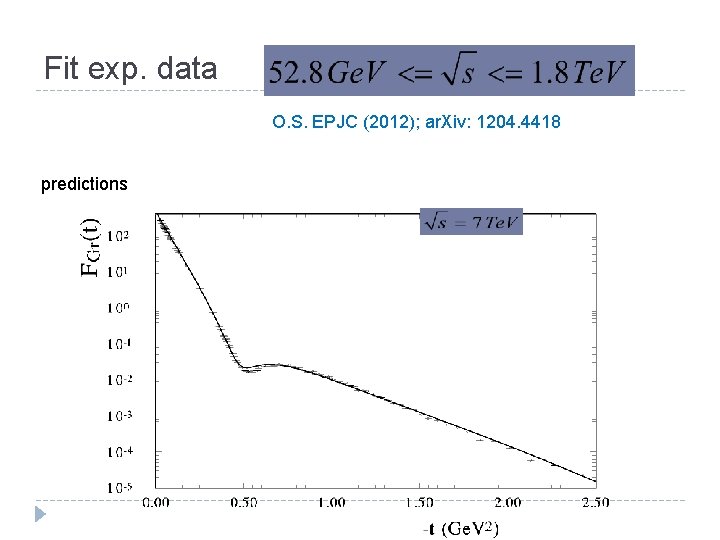
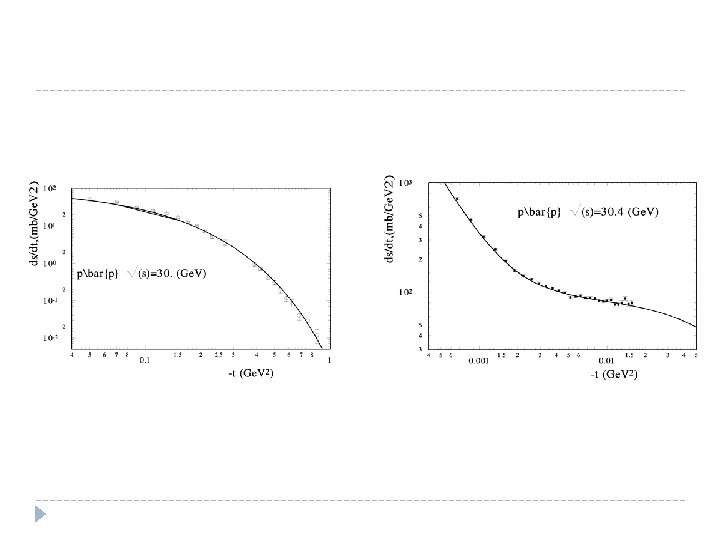
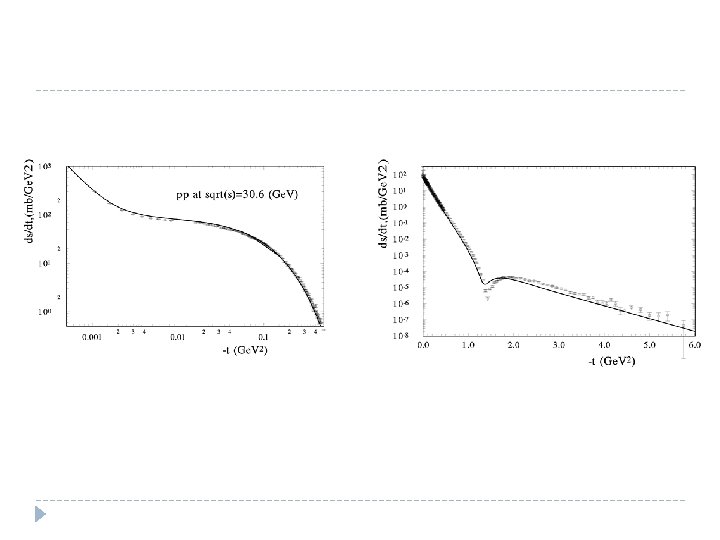
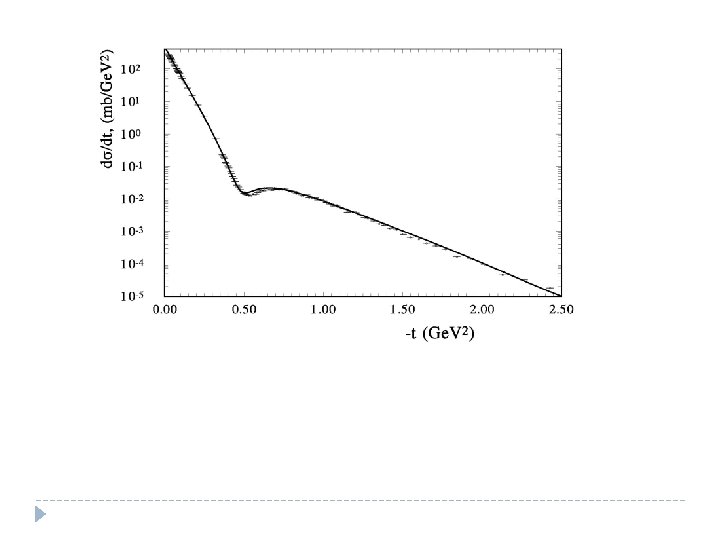
Fit exp. data O. S. EPJC (2012); ar. Xiv: 1204. 4418 predictions
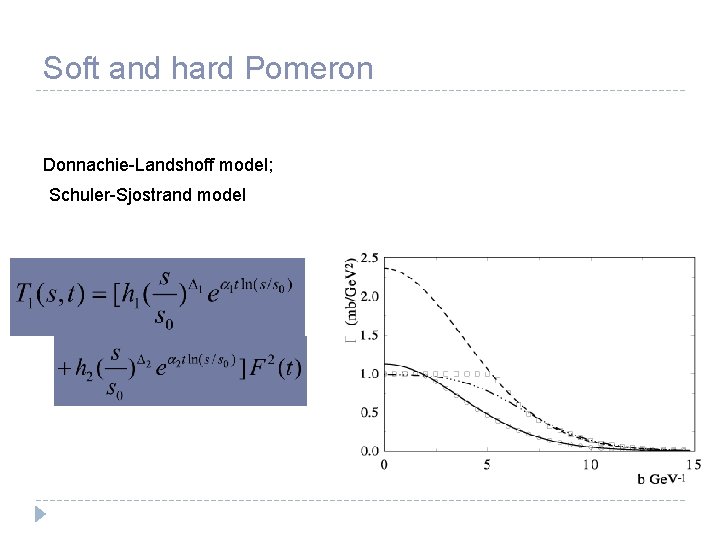
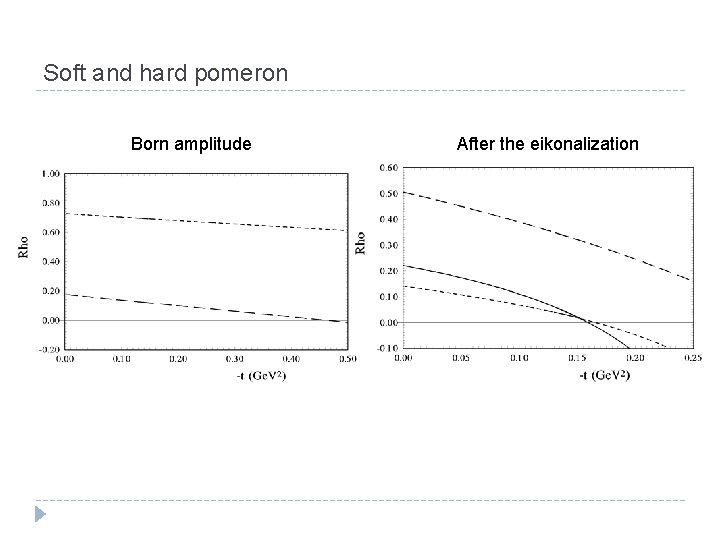
Soft and hard Pomeron Donnachie-Landshoff model; Schuler-Sjostrand model
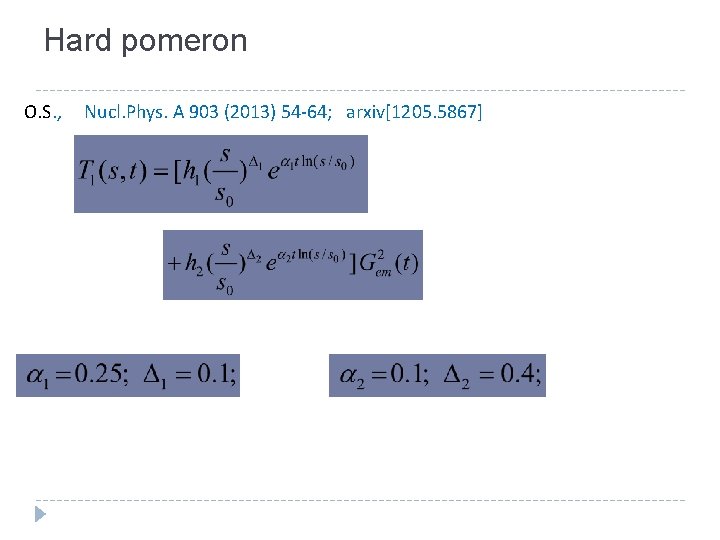
Hard pomeron O. S. , Nucl. Phys. A 903 (2013) 54 -64; arxiv[1205. 5867]
Soft and hard pomeron Born amplitude After the eikonalization
Hard Pomeron in the HEGS model calculation O. S. , Nucl. Phys. A 903 (2013) 54 -64; arxiv[1205. 5867] A. Donnachie, P. V. Landshoff- arxiv[1309. 1292]
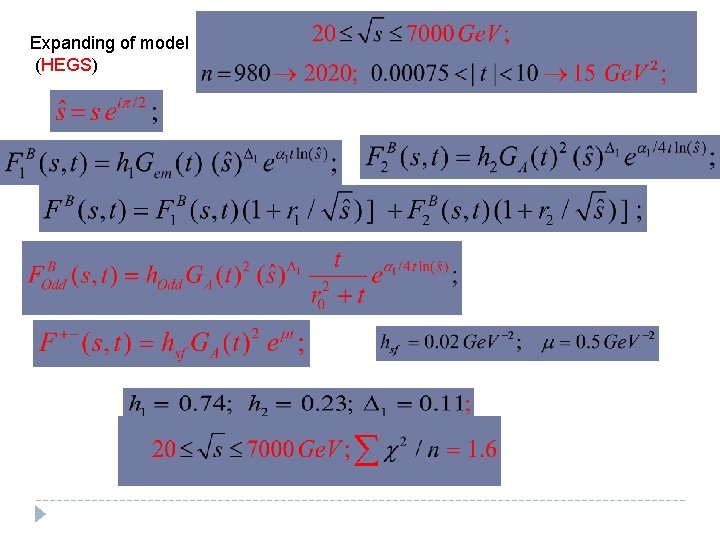
Expanding of model (HEGS)
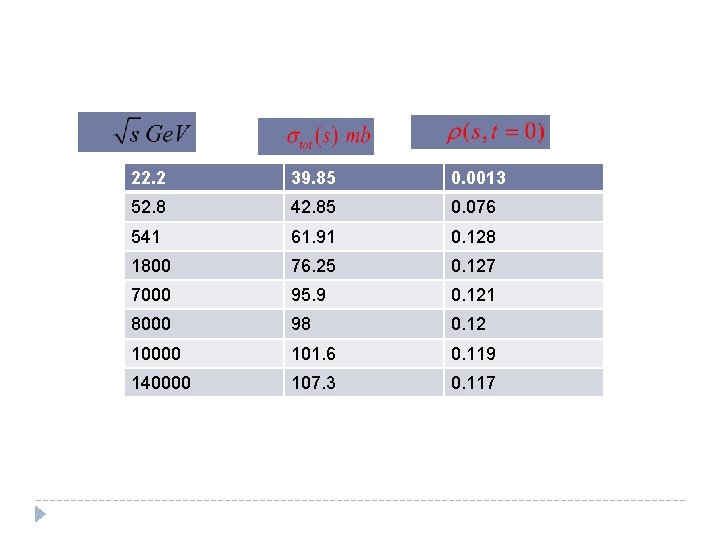
22. 2 39. 85 0. 0013 52. 8 42. 85 0. 076 541 61. 91 0. 128 1800 76. 25 0. 127 7000 95. 9 0. 121 8000 98 0. 12 10000 101. 6 0. 119 140000 107. 3 0. 117
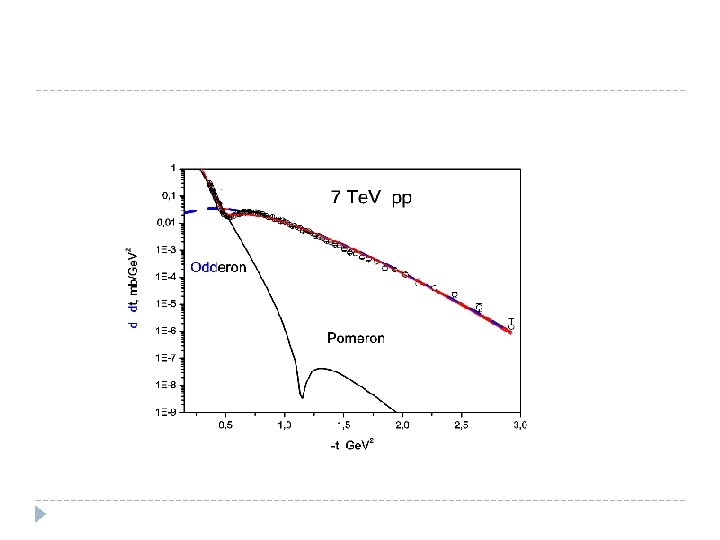
Summary 1. The elastic scattering reflects the generalized structure of the hadron. 2. The our model GPDs leads to the well description of the proton and neutron electromagnetic form factors and its elastic scattering simultaneously. 3. The new High Energy Generalized structure model (HEGS) gives the quantitatively description of the elastic nucleon scattering at high energy with only 3 fitting high energy parameters. 4. The model leads to the good coincides the model calculations with the preliminary data at 7 Te. V.
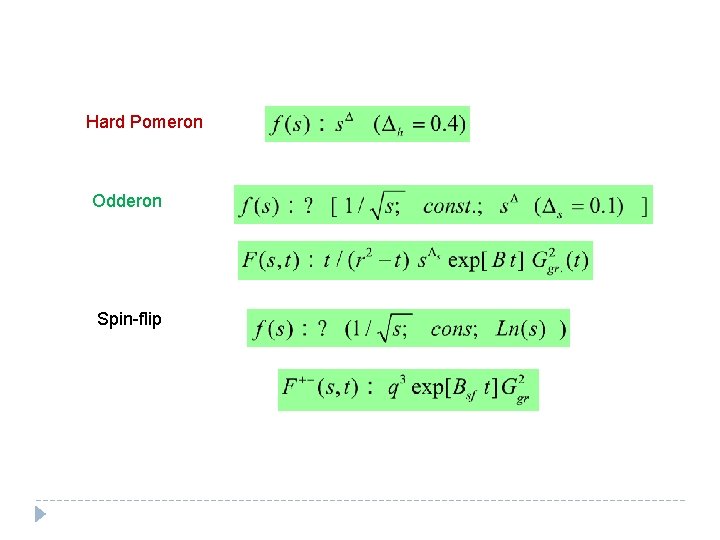
Summary 5. In the framework of the model the contribution of the hard pomeron do not feeling. 6. The extending variant of the model show the contribution of the odderon and the spin-flip amplitude with the small energy dependence. 7. The model open the new way to determine the true form of the GPDs and standard parton distributions.
END THANKS For your attention
Hard Pomeron Odderon Spin-flip
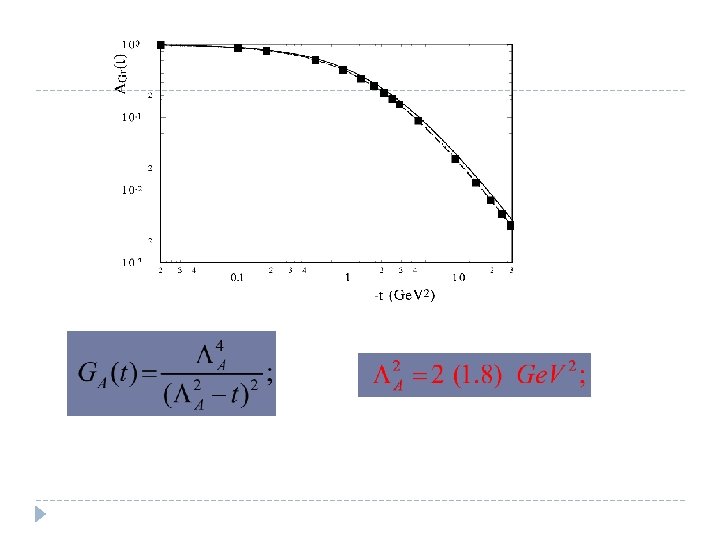
Ap(t) Gravitation form factor Ap and proton Dirac FF
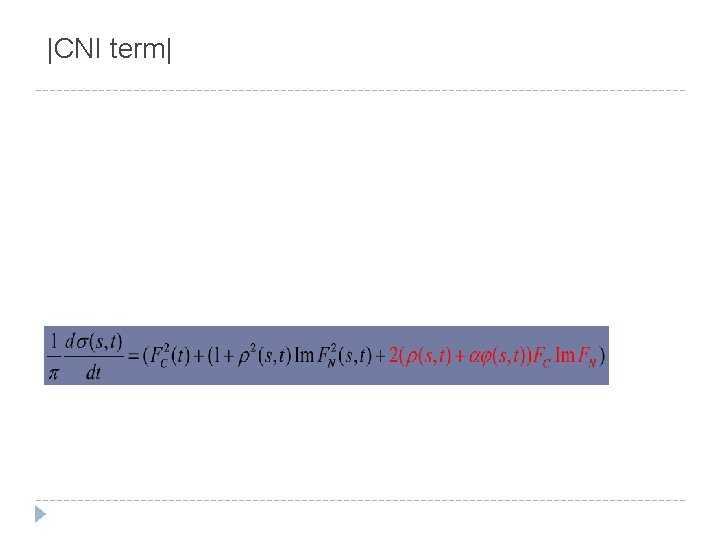
|CNI term|
A. Donnachie, P. V. Landshoff (ar. Xi. V: 1112. 2488)
Lengyel-Tarics (2012) –ar. Xiv: 1206. 5817 (odderon contribution)
General Parton Distributions -GPDs Electromagnetic form factors (charge distribution) Elastic nucleon scattering Gravitation form factors (matter distribution)
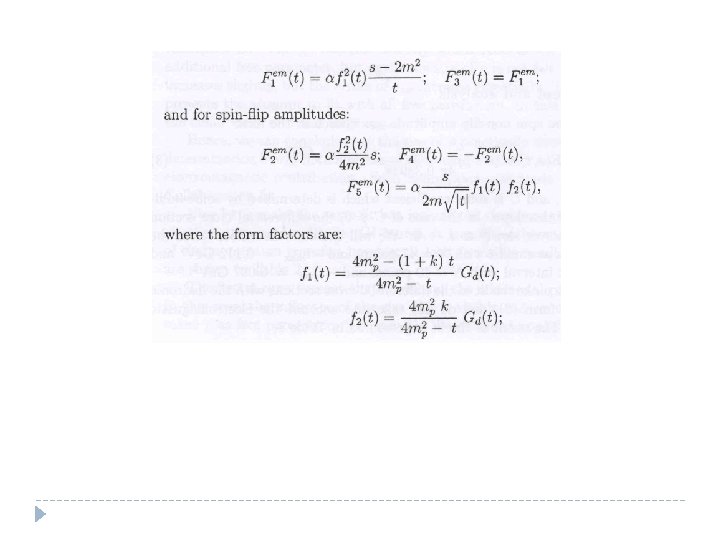
Scattering process described in terms of Helicity Amplitudes fi All dynamics contained in the Scattering Matrix M (Spin) Cross Sections expressed in terms of spin non–flip observables: 3 ´-sections 5 spin asymmetries double spin flip spin non–flip ? áMñ double spin flip single spin flip identical spin ½ particles - GPDs electromagnetic FF - GPDs gravimagnetic FF
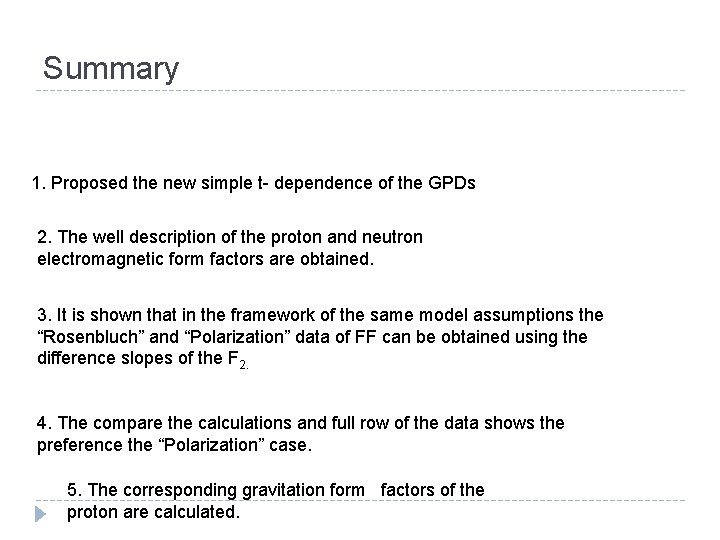
Summary 1. Proposed the new simple t- dependence of the GPDs 2. The well description of the proton and neutron electromagnetic form factors are obtained. 3. It is shown that in the framework of the same model assumptions the “Rosenbluch” and “Polarization” data of FF can be obtained using the difference slopes of the F 2. 4. The compare the calculations and full row of the data shows the preference the “Polarization” case. 5. The corresponding gravitation form factors of the proton are calculated.
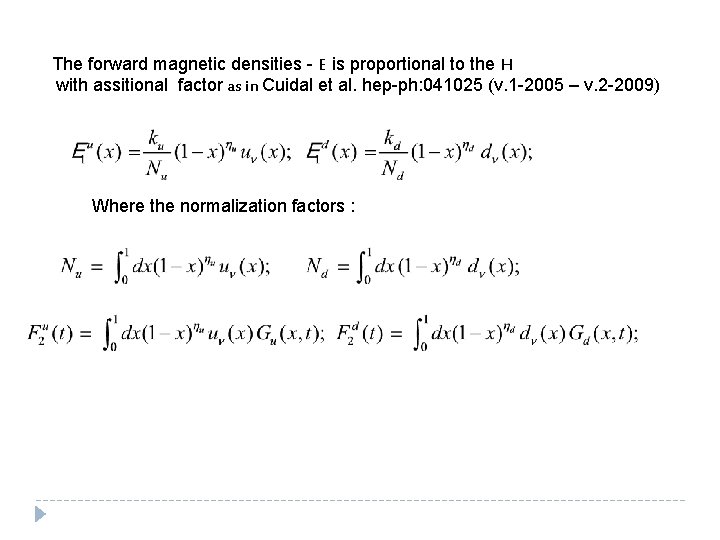
The forward magnetic densities - E is proportional to the H with assitional factor as in Cuidal et al. hep-ph: 041025 (v. 1 -2005 – v. 2 -2009) Where the normalization factors :
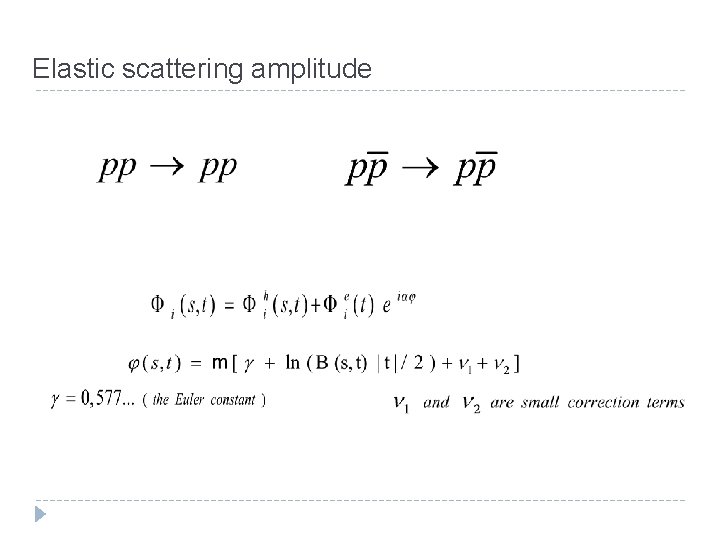
Elastic scattering amplitude