
Solutions Lots of vocabulary Unit 7 Solvents Solutes

Solutions (Lots of vocabulary) Unit 7
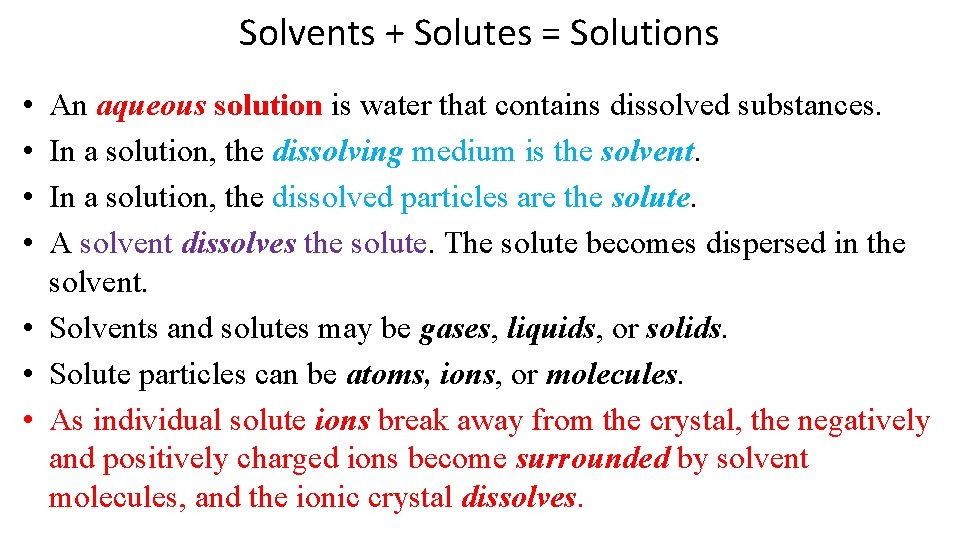
Solvents + Solutes = Solutions • • An aqueous solution is water that contains dissolved substances. In a solution, the dissolving medium is the solvent. In a solution, the dissolved particles are the solute. A solvent dissolves the solute. The solute becomes dispersed in the solvent. • Solvents and solutes may be gases, liquids, or solids. • Solute particles can be atoms, ions, or molecules. • As individual solute ions break away from the crystal, the negatively and positively charged ions become surrounded by solvent molecules, and the ionic crystal dissolves.
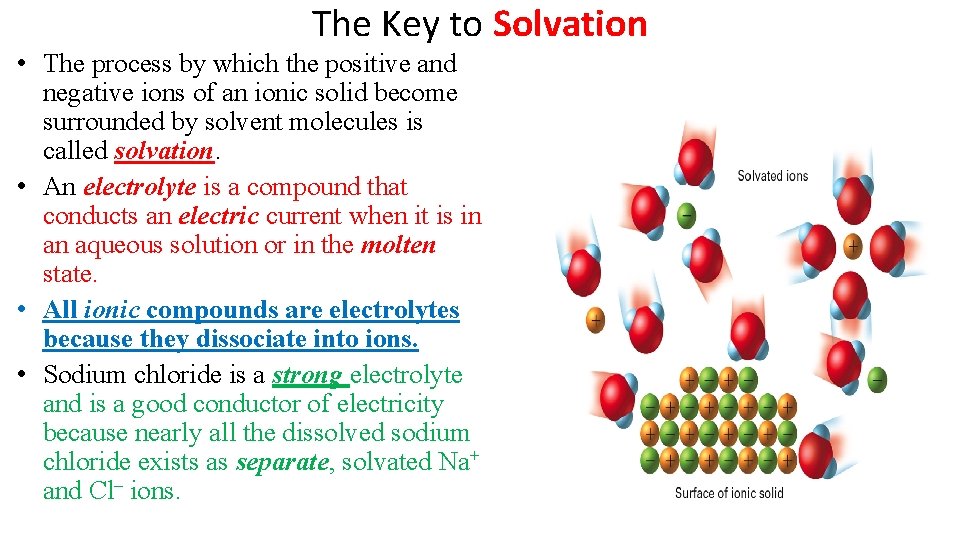
The Key to Solvation • The process by which the positive and negative ions of an ionic solid become surrounded by solvent molecules is called solvation. • An electrolyte is a compound that conducts an electric current when it is in an aqueous solution or in the molten state. • All ionic compounds are electrolytes because they dissociate into ions. • Sodium chloride is a strong electrolyte and is a good conductor of electricity because nearly all the dissolved sodium chloride exists as separate, solvated Na+ and Cl– ions.
Nonelectrolytes • A weak electrolyte conducts electricity poorly because only a fraction of the solute in the solution exists as solvated ions. • A compound that does not conduct an electric current in either aqueous solution or the molten state is called a nonelectrolyte.
Standards and Targets Standards • Utilize appropriate mathematical equations and processes to solve chemistry problems. • Identify and solve different types of stoichiometry problems (e. g. , volume at STP to mass, moles to mass, molarity). • Convert among the quantities of a substance: mass, number of moles, number of particles, molar volume at STP. Clear Targets & essential questions • Know and understand the vocabulary: – – – Aqueous Solute Solvent Dissociation solvation Electrolyte • Strong • Weak • Non • Know and be able to use Henry’s Law in solving problems
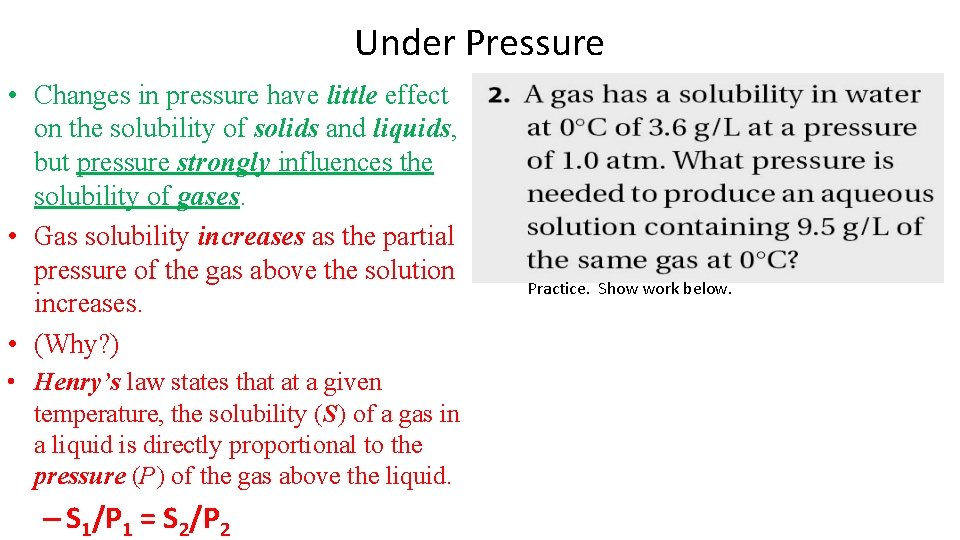
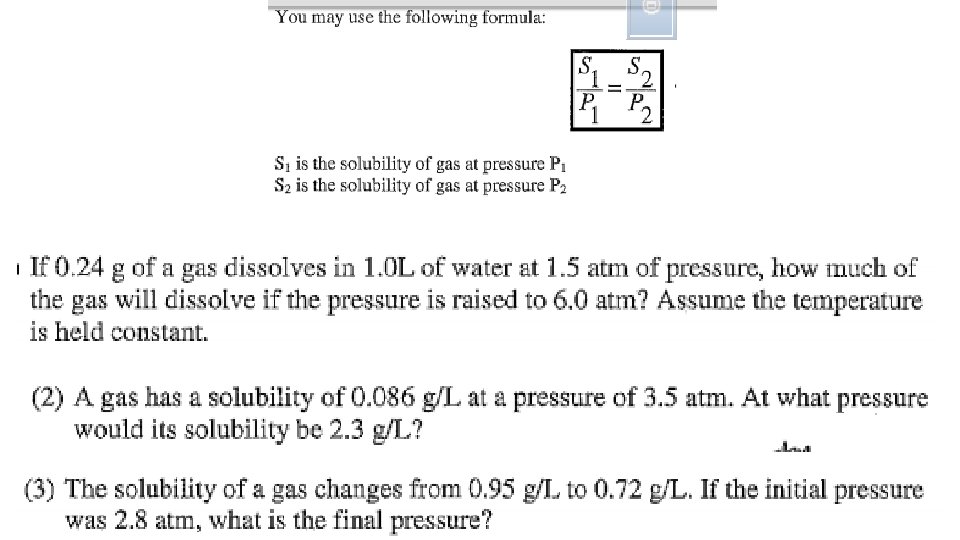
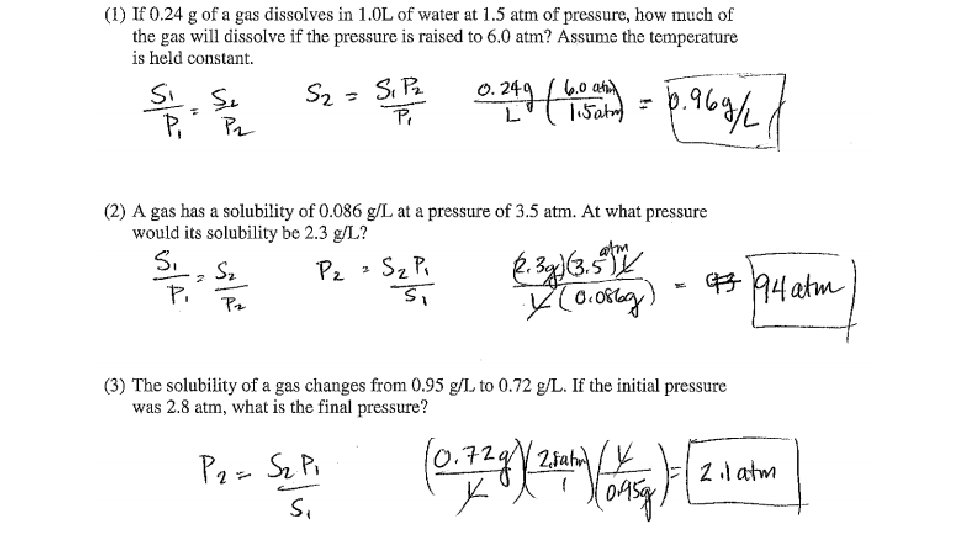
Under Pressure • Changes in pressure have little effect on the solubility of solids and liquids, but pressure strongly influences the solubility of gases. • Gas solubility increases as the partial pressure of the gas above the solution increases. • (Why? ) • Henry’s law states that at a given temperature, the solubility (S) of a gas in a liquid is directly proportional to the pressure (P) of the gas above the liquid. – S 1/P 1 = S 2/P 2 Practice. Show work below.
Standards and Targets Standards • Utilize appropriate mathematical equations and processes to solve chemistry problems. • Identify and solve different types of stoichiometry problems (e. g. , volume at STP to mass, moles to mass, molarity). • Convert among the quantities of a substance: mass, number of moles, number of particles, molar volume at STP. Clear Targets & essential questions • Know and understand the vocabulary: – – – Aqueous Solute Solvent Dissociation solvation Electrolyte • Strong • Weak • Non • Know and be able to use Henry’s Law in solving problems
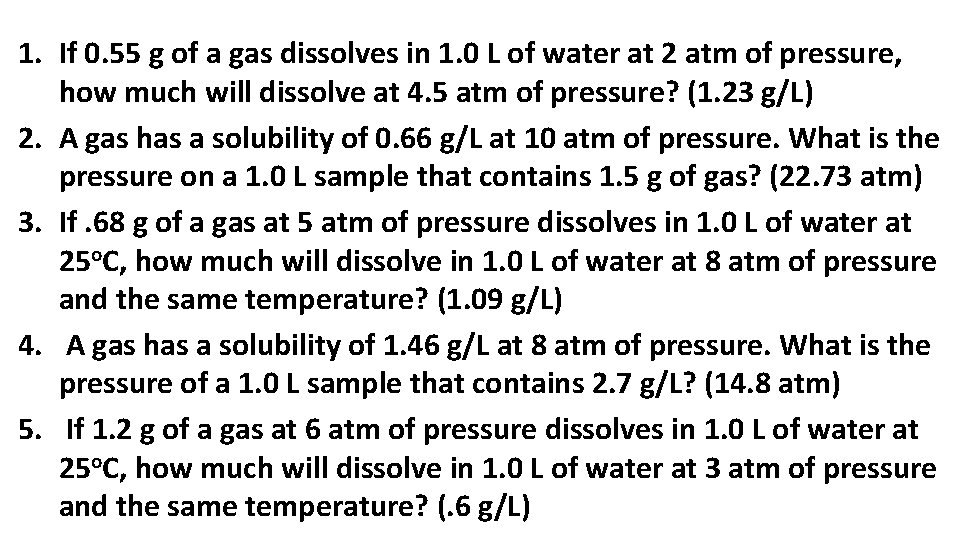
1. If 0. 55 g of a gas dissolves in 1. 0 L of water at 2 atm of pressure, how much will dissolve at 4. 5 atm of pressure? (1. 23 g/L) 2. A gas has a solubility of 0. 66 g/L at 10 atm of pressure. What is the pressure on a 1. 0 L sample that contains 1. 5 g of gas? (22. 73 atm) 3. If. 68 g of a gas at 5 atm of pressure dissolves in 1. 0 L of water at 25 o. C, how much will dissolve in 1. 0 L of water at 8 atm of pressure and the same temperature? (1. 09 g/L) 4. A gas has a solubility of 1. 46 g/L at 8 atm of pressure. What is the pressure of a 1. 0 L sample that contains 2. 7 g/L? (14. 8 atm) 5. If 1. 2 g of a gas at 6 atm of pressure dissolves in 1. 0 L of water at 25 o. C, how much will dissolve in 1. 0 L of water at 3 atm of pressure and the same temperature? (. 6 g/L)
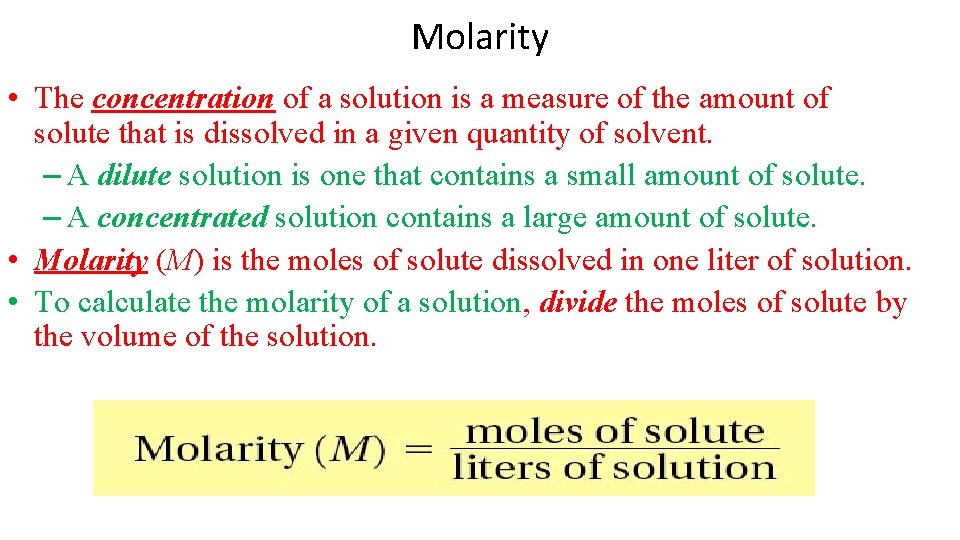
Molarity • The concentration of a solution is a measure of the amount of solute that is dissolved in a given quantity of solvent. – A dilute solution is one that contains a small amount of solute. – A concentrated solution contains a large amount of solute. • Molarity (M) is the moles of solute dissolved in one liter of solution. • To calculate the molarity of a solution, divide the moles of solute by the volume of the solution.
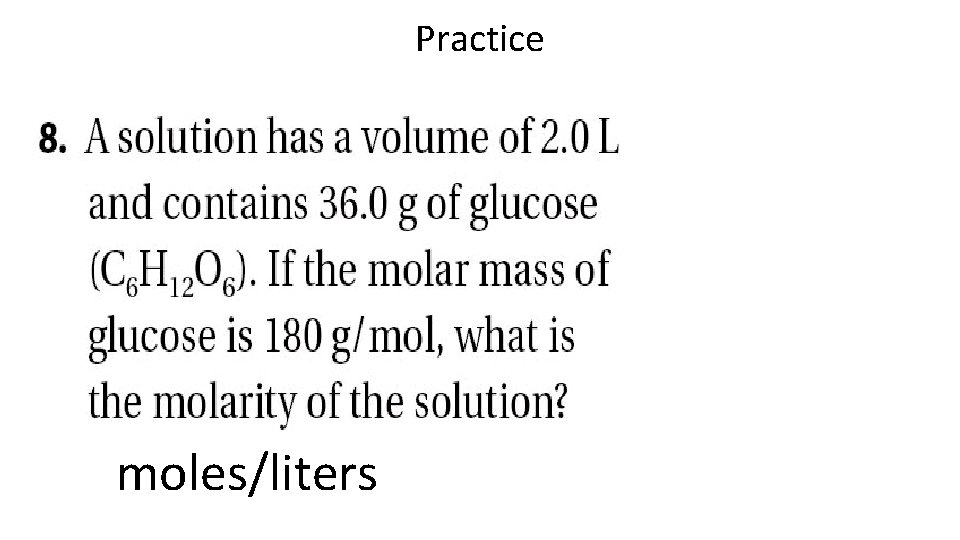
Practice moles/liters
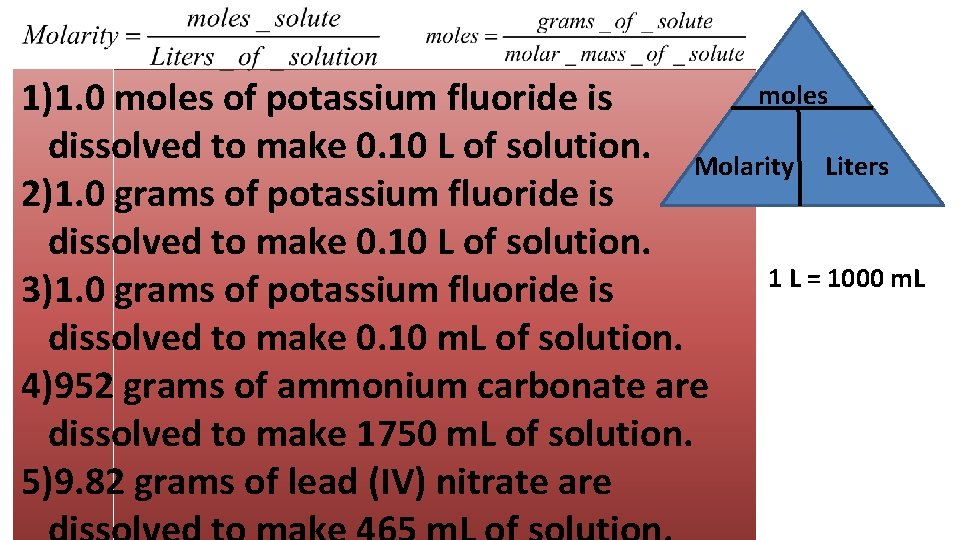
1)1. 0 moles of potassium fluoride is moles dissolved to make 0. 10 L of solution. Molarity Liters 2)1. 0 grams of potassium fluoride is dissolved to make 0. 10 L of solution. 1 L = 1000 m. L 3)1. 0 grams of potassium fluoride is dissolved to make 0. 10 m. L of solution. 4)952 grams of ammonium carbonate are dissolved to make 1750 m. L of solution. 5)9. 82 grams of lead (IV) nitrate are
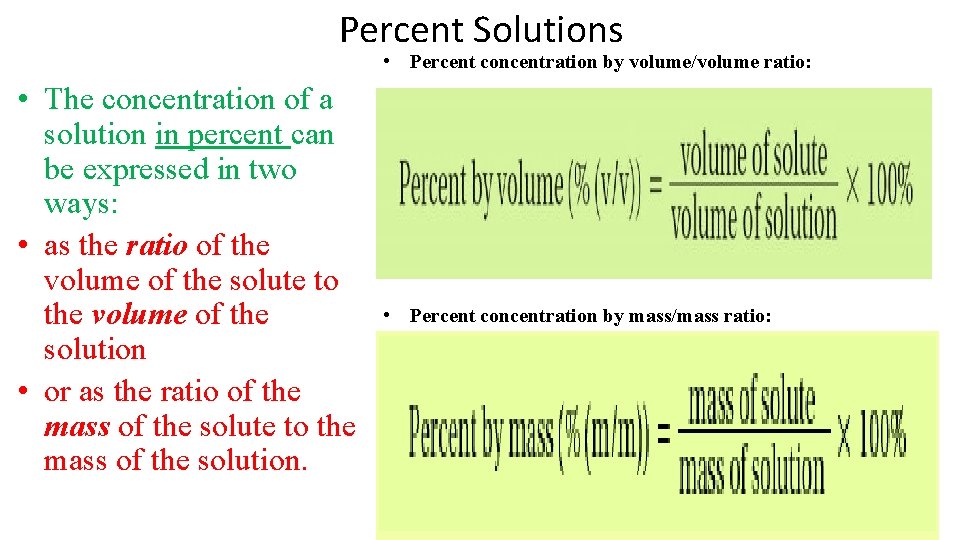
Percent Solutions • Percent concentration by volume/volume ratio: • The concentration of a solution in percent can be expressed in two ways: • as the ratio of the volume of the solute to the volume of the solution • or as the ratio of the mass of the solute to the mass of the solution. • Percent concentration by mass/mass ratio:
1. What is the percent by mass of 5. 0 g of Na. Cl mixed with 80. g of water? 2. What is the percent by mass of 25. 0 g of sodium acetate mixed with 40. g of water? 3. What mass of Na. OH is found in 40. g of a 10% by mass solution? How many moles of Na. OH is this? 4. What mass of lithium chloride is found in 85 g of a 25% by mass solution? 5. A group of friends finish an entire 750 m. L bottle of Jack Daniels, labeled 90. proof. Using this information, find out how much alcohol was in this bottle. 6. How many g of Na. Cl are found in 60. g of a 4. 0% (by mass) solution? 7. How many moles of Na. OH are needed to make 120 g of a 15% solution? 8. What is the percent solution (by volume) when 50. m. L of ethanol is diluted to 140 m. L with water?
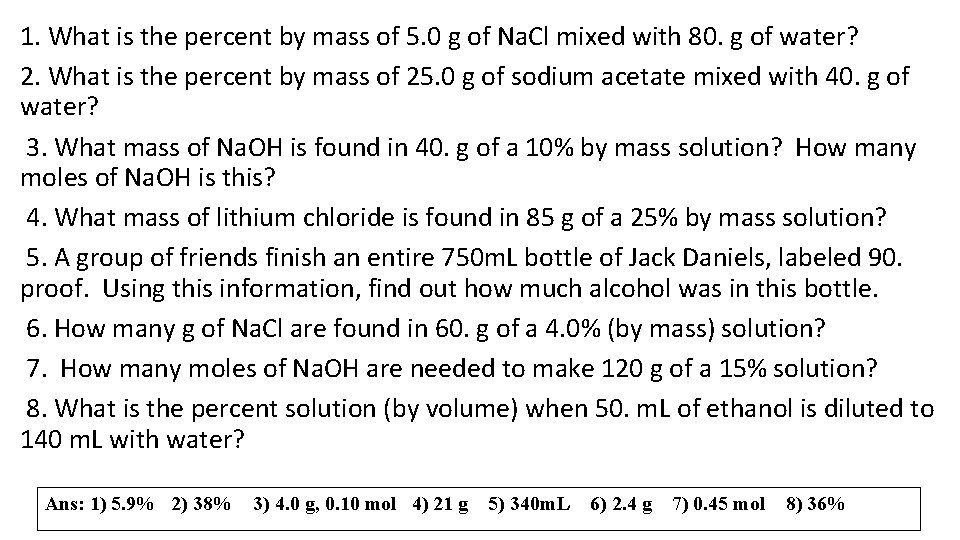
1. What is the percent by mass of 5. 0 g of Na. Cl mixed with 80. g of water? 2. What is the percent by mass of 25. 0 g of sodium acetate mixed with 40. g of water? 3. What mass of Na. OH is found in 40. g of a 10% by mass solution? How many moles of Na. OH is this? 4. What mass of lithium chloride is found in 85 g of a 25% by mass solution? 5. A group of friends finish an entire 750 m. L bottle of Jack Daniels, labeled 90. proof. Using this information, find out how much alcohol was in this bottle. 6. How many g of Na. Cl are found in 60. g of a 4. 0% (by mass) solution? 7. How many moles of Na. OH are needed to make 120 g of a 15% solution? 8. What is the percent solution (by volume) when 50. m. L of ethanol is diluted to 140 m. L with water? Ans: 1) 5. 9% 2) 38% 3) 4. 0 g, 0. 10 mol 4) 21 g 5) 340 m. L 6) 2. 4 g 7) 0. 45 mol 8) 36%
Standards and Targets Standards • Utilize appropriate mathematical equations and processes to solve chemistry problems. • Identify and solve different types of stoichiometry problems (e. g. , volume at STP to mass, moles to mass, molarity). • Convert among the quantities of a substance: mass, number of moles, number of particles, molar volume at STP. • • • Clear Targets & essential questions Determine the molarity (M) of a solution. Determine the molality (m) of a solution. Analyze a graph to determine the effects of concentration on solutions. Construct an appropriate graphical relationship for a data set. How is solubility of a solution expressed? What factors affect solubility? How do you calculate the molarity of a solution? What are three colligative properties of a solution? How does molality relate to colligative properties? In what ways are molarity and molality different? Similar?
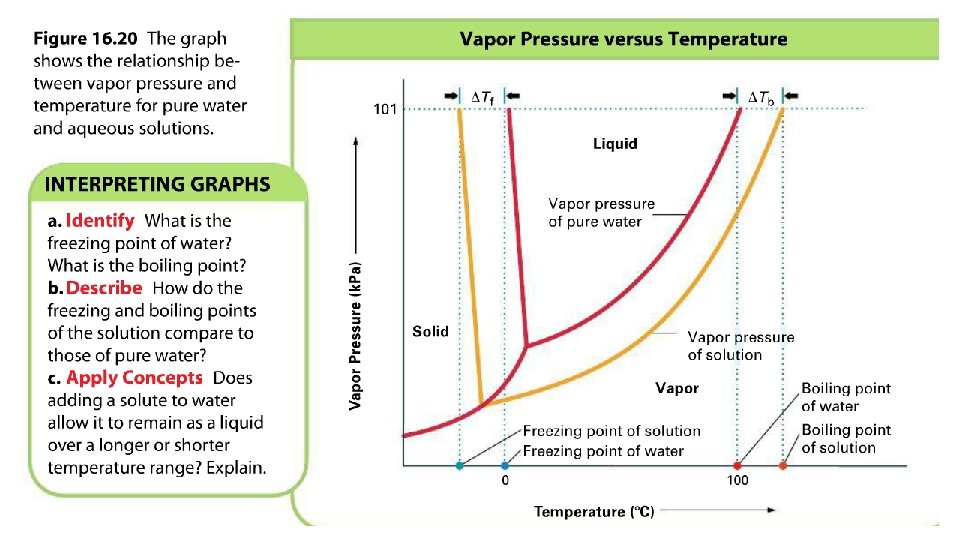
Solutions and Molality Colligative Properties • A property that depends only upon the number of solute particles, and not upon their identity, is called a colligative property. • Three important colligative properties of solutions are Øvapor-pressure lowering Øboiling-point elevation Øfreezing-point depression
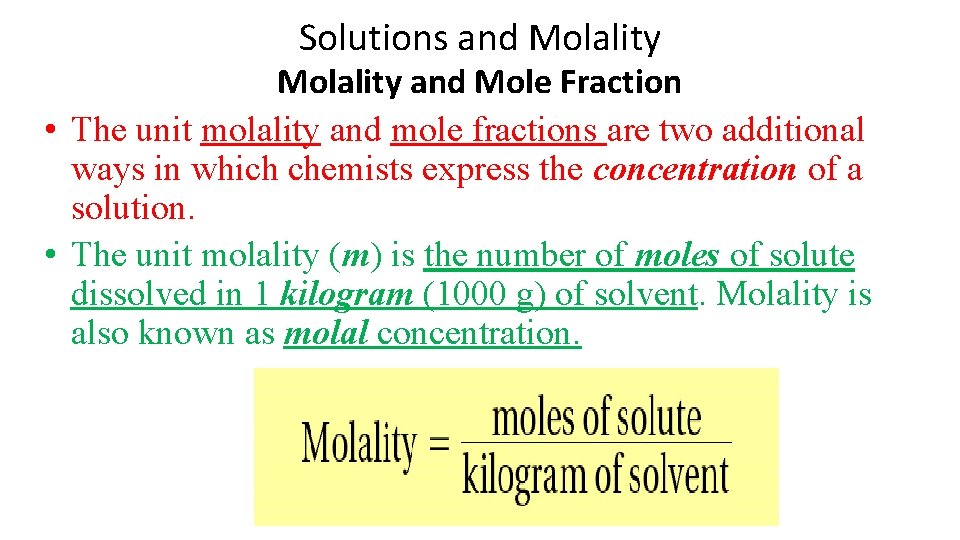
Solutions and Molality and Mole Fraction • The unit molality and mole fractions are two additional ways in which chemists express the concentration of a solution. • The unit molality (m) is the number of moles of solute dissolved in 1 kilogram (1000 g) of solvent. Molality is also known as molal concentration.
Standards and Targets Standards • Utilize appropriate mathematical equations and processes to solve chemistry problems. • Identify and solve different types of stoichiometry problems (e. g. , volume at STP to mass, moles to mass, molarity). • Convert among the quantities of a substance: mass, number of moles, number of particles, molar volume at STP. • • • Clear Targets & essential questions Determine the molarity (M) of a solution. Determine the molality (m) of a solution. Analyze a graph to determine the effects of concentration on solutions. Construct an appropriate graphical relationship for a data set. How is solubility of a solution expressed? What factors affect solubility? How do you calculate the molarity of a solution? What are three colligative properties of a solution? How does molality relate to colligative properties? In what ways are molarity and molality different? Similar?
Heterogeneous Aqueous Systems • A suspension is a mixture from which particles settle out upon standing. – A suspension differs from a solution because the particles of a suspension are much larger and do not stay suspended indefinitely. • Suspensions are heterogeneous because at least two substances can be clearly identified.
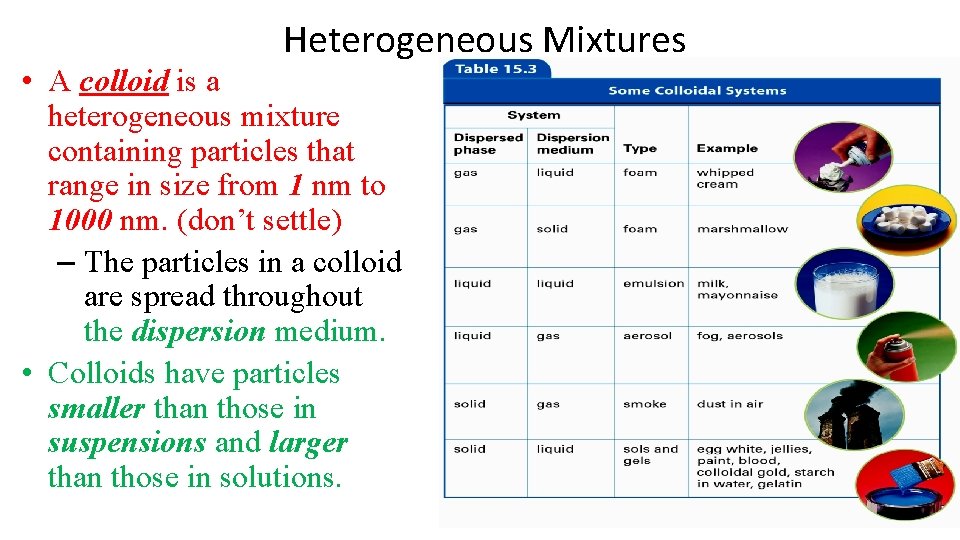
Heterogeneous Mixtures • A colloid is a heterogeneous mixture containing particles that range in size from 1 nm to 1000 nm. (don’t settle) – The particles in a colloid are spread throughout the dispersion medium. • Colloids have particles smaller than those in suspensions and larger than those in solutions.

Colloids • The scattering of visible light by colloidal particles is called the Tyndall effect. • Particles in colloids and suspensions reflect or scatter light in all directions. Solutions do not scatter light. • The chaotic movement of colloidal particles, which was first observed by the Scottish botanist Robert Brown, is called Brownian motion. • Brownian motion is caused by collisions of the molecules of the dispersion medium with the small, dispersed colloidal particles. (why they don’t settle)
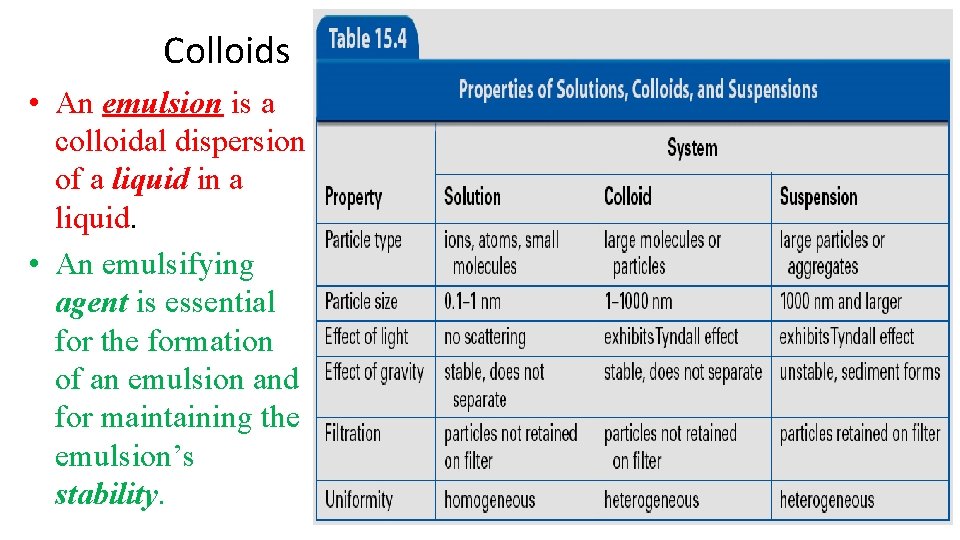
Colloids • An emulsion is a colloidal dispersion of a liquid in a liquid. • An emulsifying agent is essential for the formation of an emulsion and for maintaining the emulsion’s stability.
Standards and Targets Standards • Utilize appropriate mathematical equations and processes to solve chemistry problems. • Identify and solve different types of stoichiometry problems (e. g. , volume at STP to mass, moles to mass, molarity). • Convert among the quantities of a substance: mass, number of moles, number of particles, molar volume at STP. • • • Clear Targets & essential questions Determine the molarity (M) of a solution. Determine the molality (m) of a solution. Analyze a graph to determine the effects of concentration on solutions. Construct an appropriate graphical relationship for a data set. How is solubility of a solution expressed? What factors affect solubility? How do you calculate the molarity of a solution? What are three colligative properties of a solution? How does molality relate to colligative properties? In what ways are molarity and molality different? Similar?
Properties of Solutions • The compositions of the solvent and the solute determine whether a substance will dissolve. The factors that determine how fast a substance dissolves are • stirring (agitation) • temperature • surface area of the dissolving particles • Stirring speeds up the dissolving process because fresh solvent is continually brought into contact with the surface of the solute. – At higher temperatures, the kinetic energy of water molecules is greater. » Greater = faster = more frequent and forceful collisions
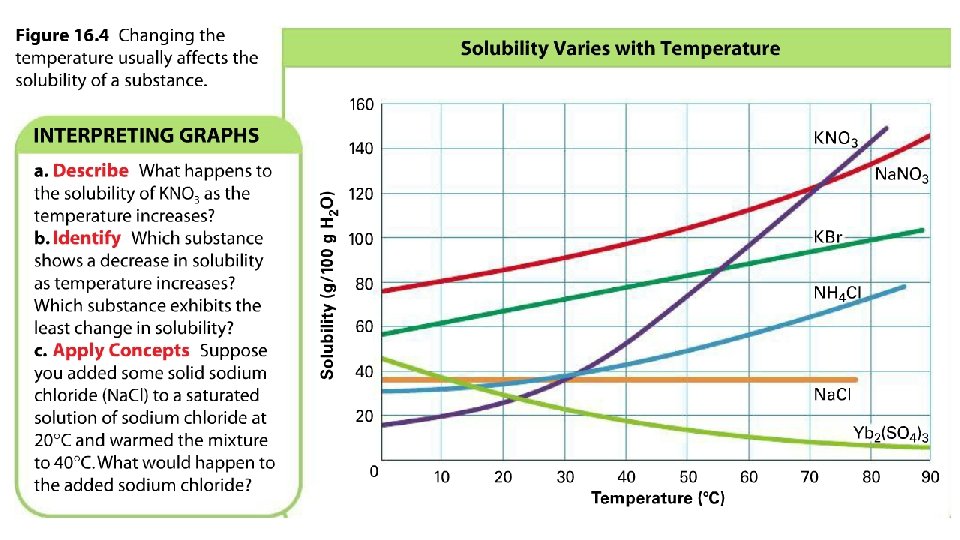
Properties of Solutions • A spoonful of granulated sugar dissolves more quickly than a sugar cube because the smaller particles in granulated sugar expose a much greater surface area to the colliding water molecules. • A saturated solution contains the maximum amount of solute for a given quantity of solvent at a given temperature and pressure. • An unsaturated solution contains less solute than a saturated solution at a given temperature and pressure. • The solubility of a substance is the amount of solute that dissolves in a given quantity of a solvent at a specified temperature and pressure to produce a saturated solution. – Solubility is often expressed in grams of solute per 100 g of solvent.
Standards and Targets Standards • Utilize appropriate mathematical equations and processes to solve chemistry problems. • Identify and solve different types of stoichiometry problems (e. g. , volume at STP to mass, moles to mass, molarity). • Convert among the quantities of a substance: mass, number of moles, number of particles, molar volume at STP. • • • Clear Targets & essential questions Determine the molarity (M) of a solution. Determine the molality (m) of a solution. Analyze a graph to determine the effects of concentration on solutions. Construct an appropriate graphical relationship for a data set. How is solubility of a solution expressed? What factors affect solubility? How do you calculate the molarity of a solution? What are three colligative properties of a solution? How does molality relate to colligative properties? In what ways are molarity and molality different? Similar?
Mixing it Up • Some liquids combine in • Temperature affects the solubility of solid, liquid, and gaseous solutes in a all proportions, while solvent others don’t mix at all. temperature and pressure affect – Two liquids are miscible • Both the solubility of gaseous solutes. if they dissolve in each – The solubility of most solid substances other in all proportions. increases as the temperature of the solvent increases. – Two liquids are – The solubilities of most gases are immiscible if they are greater in cold water than in hot. insoluble in each other. • Gas particles move less, so less likely to escape
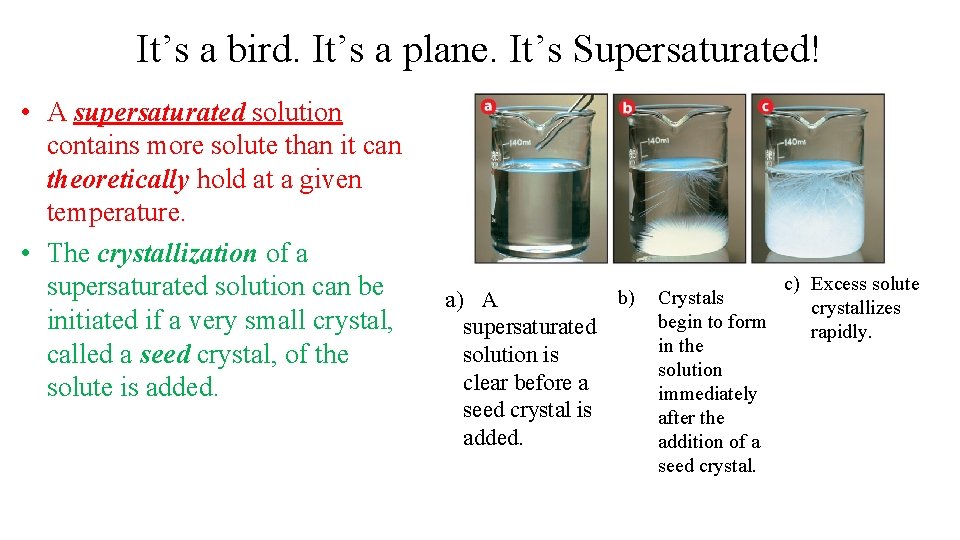
It’s a bird. It’s a plane. It’s Supersaturated! • A supersaturated solution contains more solute than it can theoretically hold at a given temperature. • The crystallization of a supersaturated solution can be initiated if a very small crystal, called a seed crystal, of the solute is added. b) a) A supersaturated solution is clear before a seed crystal is added. c) Excess solute Crystals crystallizes begin to form rapidly. in the solution immediately after the addition of a seed crystal.
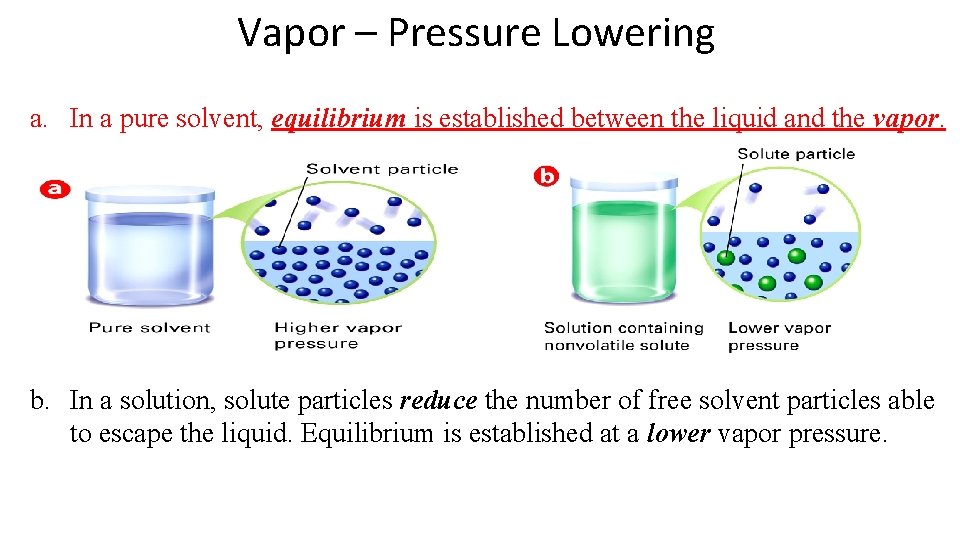
Vapor – Pressure Lowering a. In a pure solvent, equilibrium is established between the liquid and the vapor. b. In a solution, solute particles reduce the number of free solvent particles able to escape the liquid. Equilibrium is established at a lower vapor pressure.
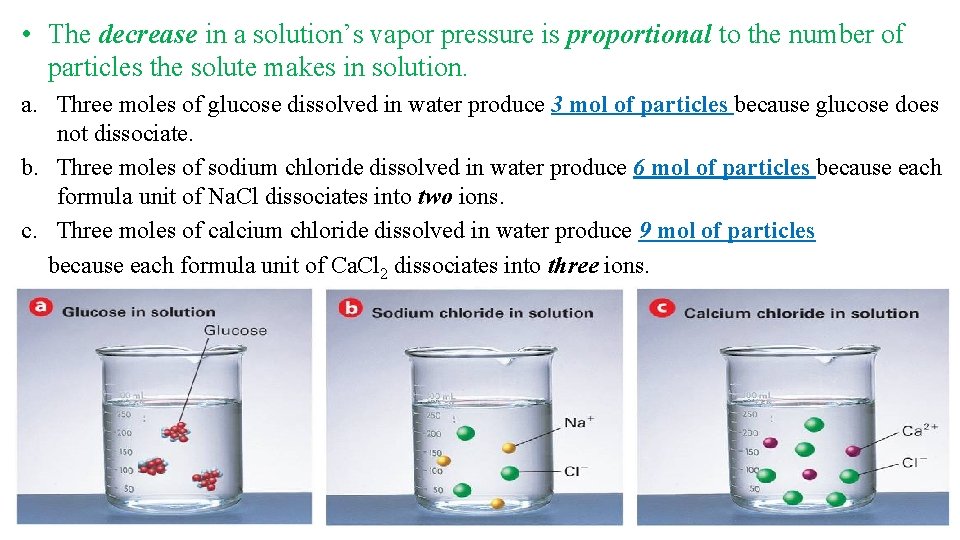
• The decrease in a solution’s vapor pressure is proportional to the number of particles the solute makes in solution. a. Three moles of glucose dissolved in water produce 3 mol of particles because glucose does not dissociate. b. Three moles of sodium chloride dissolved in water produce 6 mol of particles because each formula unit of Na. Cl dissociates into two ions. c. Three moles of calcium chloride dissolved in water produce 9 mol of particles because each formula unit of Ca. Cl 2 dissociates into three ions.

Boiling – Point Elevation • The difference in temperature between the boiling point of a solution and the boiling point of the pure solvent is the boilingpoint elevation. – The same antifreeze added to automobile engines to prevent freeze-ups in winter, protects the engine from boiling over in summer. • The magnitude of the boiling-point elevation is proportional to the number of solute particles dissolved in the solvent. • The boiling point of water increases by 0. 512°C for every mole of particles that the solute forms when dissolved in 1000 g of water.
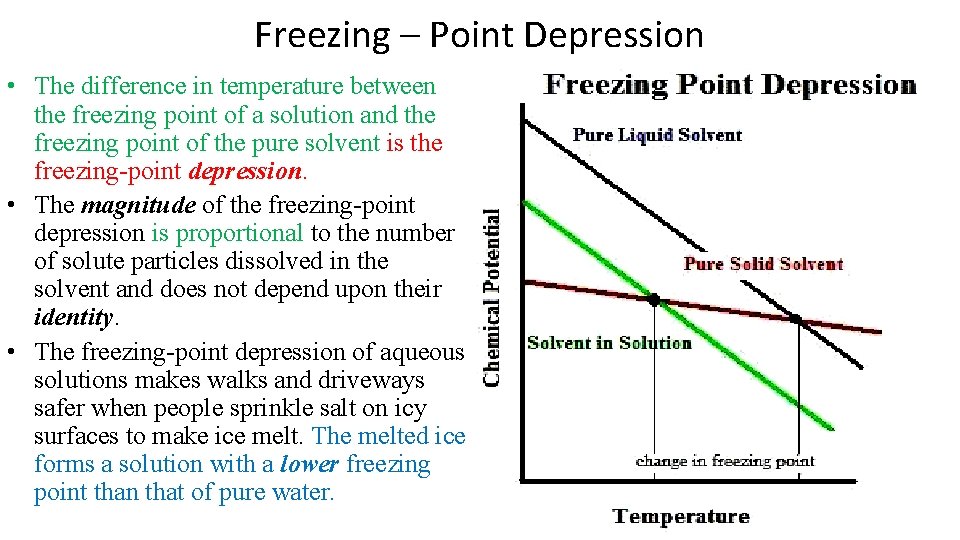
Freezing – Point Depression • The difference in temperature between the freezing point of a solution and the freezing point of the pure solvent is the freezing-point depression. • The magnitude of the freezing-point depression is proportional to the number of solute particles dissolved in the solvent and does not depend upon their identity. • The freezing-point depression of aqueous solutions makes walks and driveways safer when people sprinkle salt on icy surfaces to make ice melt. The melted ice forms a solution with a lower freezing point than that of pure water.
Standards and Targets Standards • Utilize appropriate mathematical equations and processes to solve chemistry problems. • Identify and solve different types of stoichiometry problems (e. g. , volume at STP to mass, moles to mass, molarity). • Convert among the quantities of a substance: mass, number of moles, number of particles, molar volume at STP. • • • Clear Targets & essential questions Determine the molarity (M) of a solution. Determine the molality (m) of a solution. Analyze a graph to determine the effects of concentration on solutions. Construct an appropriate graphical relationship for a data set. How is solubility of a solution expressed? What factors affect solubility? How do you calculate the molarity of a solution? What are three colligative properties of a solution? How does molality relate to colligative properties? In what ways are molarity and molality different? Similar?
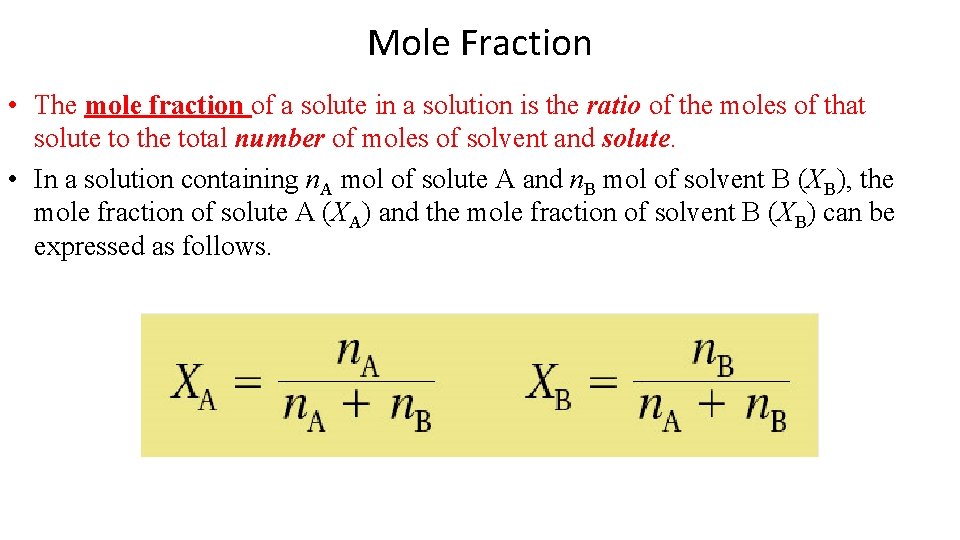
Mole Fraction • The mole fraction of a solute in a solution is the ratio of the moles of that solute to the total number of moles of solvent and solute. • In a solution containing n. A mol of solute A and n. B mol of solvent B (XB), the mole fraction of solute A (XA) and the mole fraction of solvent B (XB) can be expressed as follows.
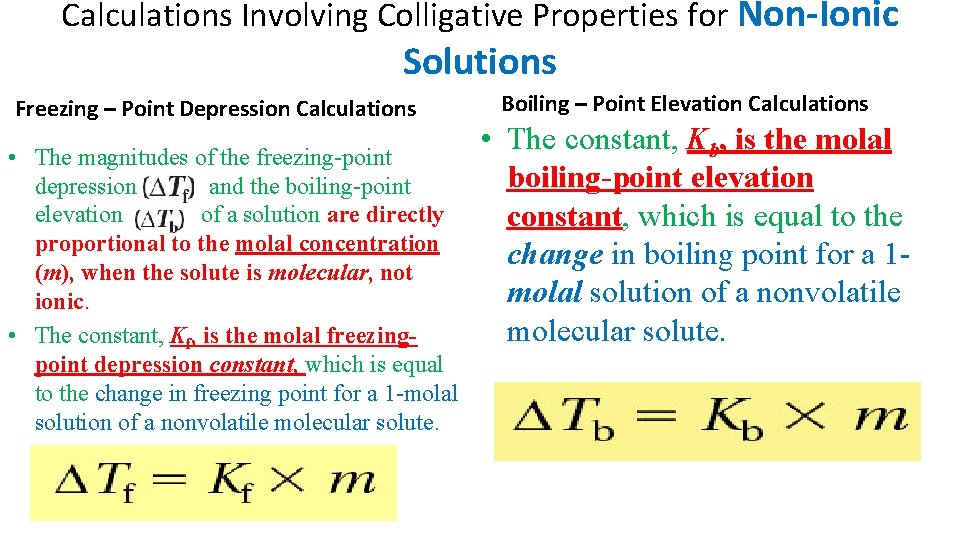
Calculations Involving Colligative Properties for Non-Ionic Solutions Freezing – Point Depression Calculations • The magnitudes of the freezing-point depression and the boiling-point elevation of a solution are directly proportional to the molal concentration (m), when the solute is molecular, not ionic. • The constant, Kf, is the molal freezingpoint depression constant, which is equal to the change in freezing point for a 1 -molal solution of a nonvolatile molecular solute. Boiling – Point Elevation Calculations • The constant, Kb, is the molal boiling-point elevation constant, which is equal to the change in boiling point for a 1 molal solution of a nonvolatile molecular solute.
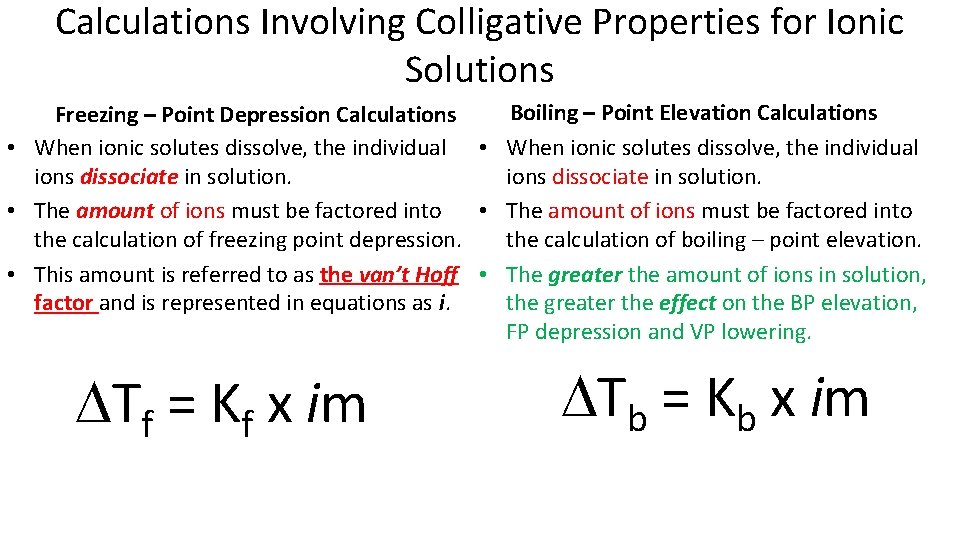
Calculations Involving Colligative Properties for Ionic Solutions Boiling – Point Elevation Calculations Freezing – Point Depression Calculations • When ionic solutes dissolve, the individual ions dissociate in solution. • The amount of ions must be factored into the calculation of boiling – point elevation. the calculation of freezing point depression. • This amount is referred to as the van’t Hoff • The greater the amount of ions in solution, the greater the effect on the BP elevation, factor and is represented in equations as i. FP depression and VP lowering. Tf = Kf x im Tb = Kb x im
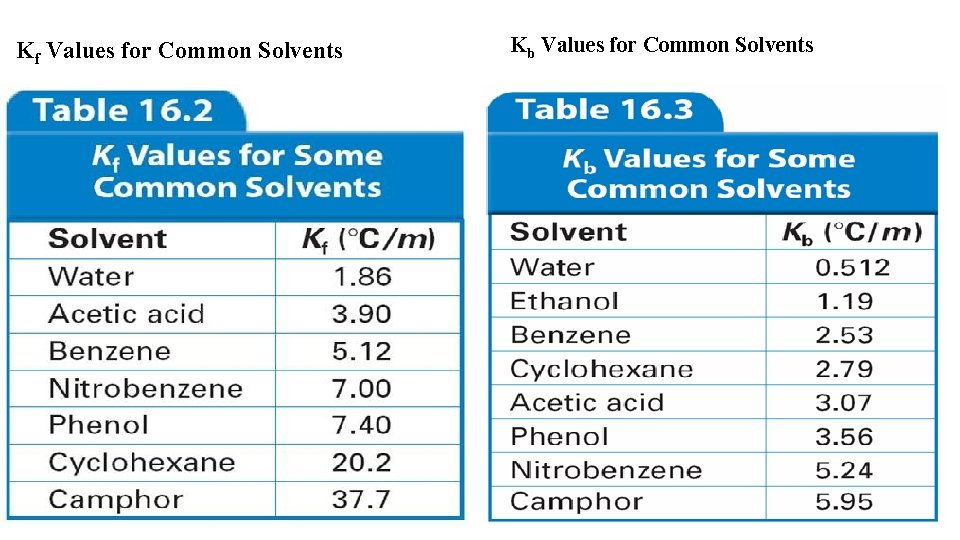
Kf Values for Common Solvents Kb Values for Common Solvents
Standards and Targets Standards • Utilize appropriate mathematical equations and processes to solve chemistry problems. • Identify and solve different types of stoichiometry problems (e. g. , volume at STP to mass, moles to mass, molarity). • Convert among the quantities of a substance: mass, number of moles, number of particles, molar volume at STP. • • • Clear Targets & essential questions Determine the molarity (M) of a solution. Determine the molality (m) of a solution. Analyze a graph to determine the effects of concentration on solutions. Construct an appropriate graphical relationship for a data set. How is solubility of a solution expressed? What factors affect solubility? How do you calculate the molarity of a solution? What are three colligative properties of a solution? How does molality relate to colligative properties? In what ways are molarity and molality different? Similar?
- Slides: 42