
Double Parton Scattering in Associate Higgs Boson Production
Double Parton Scattering in Associate Higgs Boson Production with Bottom Quarks at Hadron Colliders M Y Hussein Department of Physics University of Bahrain 1. SUSY 2007 2. The 15 th International Conference on Supersymmetry and the Unification of Fundamental Interactions July 26 -August 1, 2007 Karlsruha, Germany
I. Introduction: v. The discovery of the SM Higgs boson is one of the most important goals and pressing issues of present and future colliders. v. An important prerequisite for identifying the most convenient signatures for detecting Higgs boson needs a precise knowledge of the various production crosssections and decay branching ratios to derive their masses, their decay width, their couplings to other particles. v. The precision with which calculations of Higgs boson cross-sections are know for the most sub-process and improved over last years and has been widely discussed in the literature.
v In particular: 1) 2) 3) v Next-leading order corrections are now known for most sub-process. Knowledge of parton distribution functions has improved as more deep inelastic data become available. The range of possible input parameter values decreased. Recently, much progress has been made in the detection of a Higgs boson. The dominant production of a SM Higgs boson in hadronic interactins is gluon-gluon fusion.
v. Various channels can be explored to search for Higgs boson at hadron colliders. There are only a few Higgs production mechanism which lead to detectable cross-section. Each use the preference of coupling of the SM Higgs to heavy particles either massive vector bosons or massive quarks. They are: 1. Gluon-gluon fusion 2. WW, ZZ fusion 3. Associate production with W and Z 4. Associate production with bottom and top quarks
v The associated production of a Higgs boson with a pair of quarks has a small cross-section (due to small size of Yukawa coupling ) in the SM. v In some extensions of the SM, such as the MSSM, the Yukawa coupling of b-quarks can become strongly enhanced, the associate production of a Higgs boson with a pair of quarks can dominate over other production channels and this production mechanism can be a significant source of Higgs bosons. v Detecting two bottom quarks in the final state identifies uniquely the Higgs coupling responsible for the enhanced cross-section and drastically reduces the background. This corresponds to an experiment measuring the Higgs decay along two high pt bottom quark jets
v In a four-flavor-number scheme with no b quarks in the initial state, the lowest order process are the tree level contributions and , illustrated in Fig. 2. v Requiring one or two high pt bottom quarks in the final state reduces the signal cross-section, but it also greatly reduces the background, moreover, it assures that the detected Higgs boson has been radiated off a bottom or anti-bottom quark and the corresponding cross section is therefore unambiguously proportional to the bottom quark Yukawa coupling. v Therefore, a transverse momentum cuts on the bottom quark jets reduces the cross section , but also greatly reduces the background and ensure that the Higgs was emmitted from a bottom quark.
v At high energies and due to large flux in particular at the LHC, another type of scattering mechanism contributes to the cross section besides to single scattering. Thus, for production there would be two computing mechanisms: v single parton scattering and double parton scattering featuring two Drell. Yan processes happening simultaneously. ( P. Landshof and J. Polkinghone; F. Halzen, D. Hoyer and W. stirling; CDF Collaboration; ……)
v. The purpose of the present work is to point out that the same final state can be produced also by double parton scattering collision process. v. The large rate of production of pairs expected at the LHC gives rise to a relatively large probability of production of a in the process underling the H production. v. In fact as a result of the present analysis it is found that double parton scattering may represent a rather sizable source of background.
II. DOUBLE SCATTERING MECHANISM v. Multiple parton interaction processes, where different pairs of partons have hard scattering in the same hadronic collision, become experimentally important at high energies because of the growing flux of partons. Recently, the importance of double parton scattering at the Large Hadron Collider (LHC) has been redressed. ( D. Treleani, N Paver and A. Del Fabbro……. )
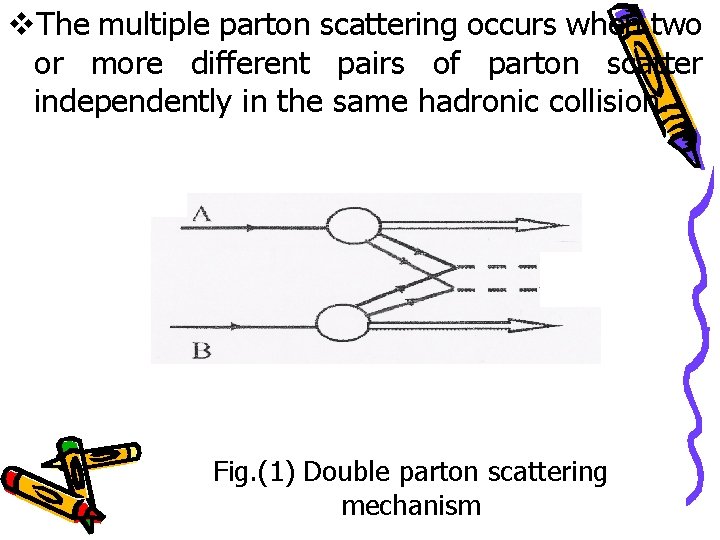
v. The multiple parton scattering occurs when two or more different pairs of parton scatter independently in the same hadronic collision. Fig. (1) Double parton scattering mechanism
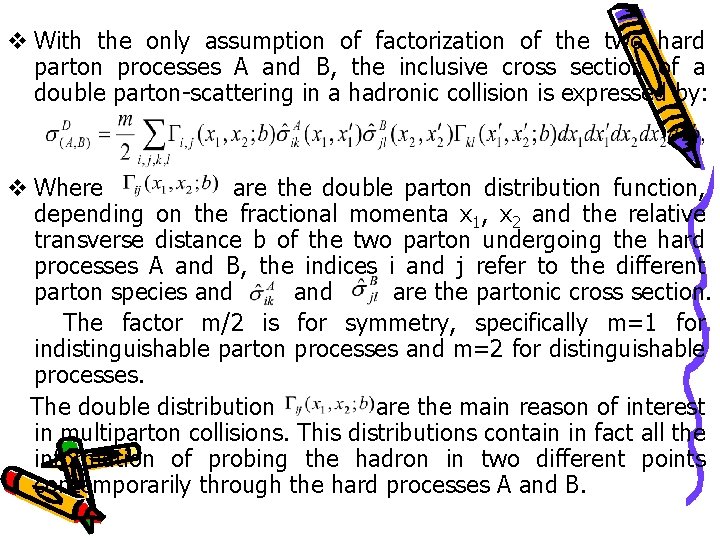
v With the only assumption of factorization of the two hard parton processes A and B, the inclusive cross section of a double parton-scattering in a hadronic collision is expressed by: v Where are the double parton distribution function, depending on the fractional momenta x 1, x 2 and the relative transverse distance b of the two parton undergoing the hard processes A and B, the indices i and j refer to the different parton species and are the partonic cross section. The factor m/2 is for symmetry, specifically m=1 for indistinguishable parton processes and m=2 for distinguishable processes. The double distribution are the main reason of interest in multiparton collisions. This distributions contain in fact all the information of probing the hadron in two different points contemporarily through the hard processes A and B.
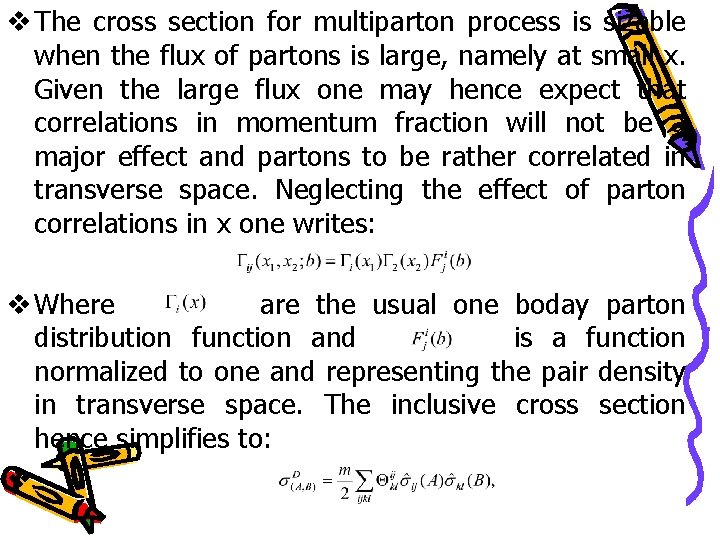
v The cross section for multiparton process is sizable when the flux of partons is large, namely at small x. Given the large flux one may hence expect that correlations in momentum fraction will not be a major effect and partons to be rather correlated in transverse space. Neglecting the effect of parton correlations in x one writes: v Where are the usual one boday parton distribution function and is a function normalized to one and representing the pair density in transverse space. The inclusive cross section hence simplifies to: v
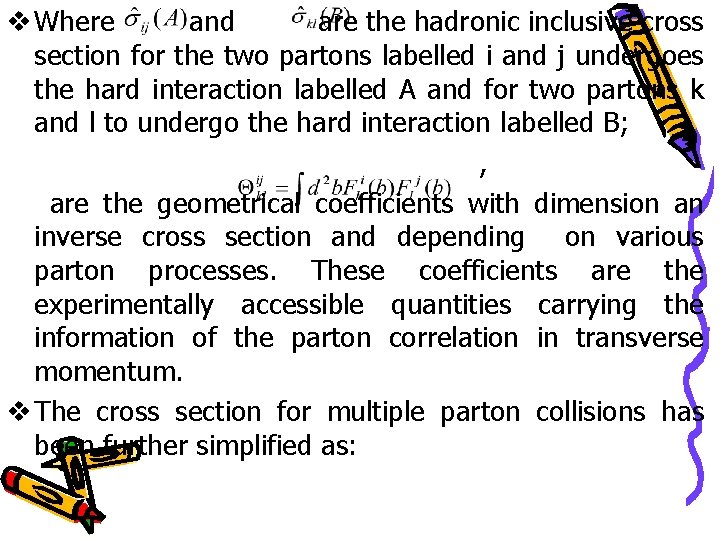
v Where and are the hadronic inclusive cross section for the two partons labelled i and j undergoes the hard interaction labelled A and for two partons k and l to undergo the hard interaction labelled B; , are the geometrical coefficients with dimension an inverse cross section and depending on various parton processes. These coefficients are the experimentally accessible quantities carrying the information of the parton correlation in transverse momentum. v The cross section for multiple parton collisions has been further simplified as:
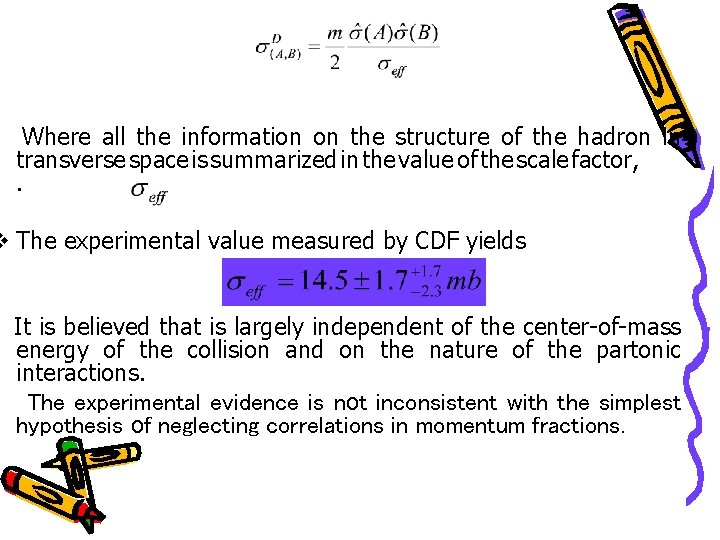
Where all the information on the structure of the hadron in transverse space is summarized in the value of the scale factor, . v The experimental value measured by CDF yields It is believed that is largely independent of the center-of-mass energy of the collision and on the nature of the partonic interactions. The experimental evidence is not inconsistent with the simplest hypothesis of neglecting correlations in momentum fractions.
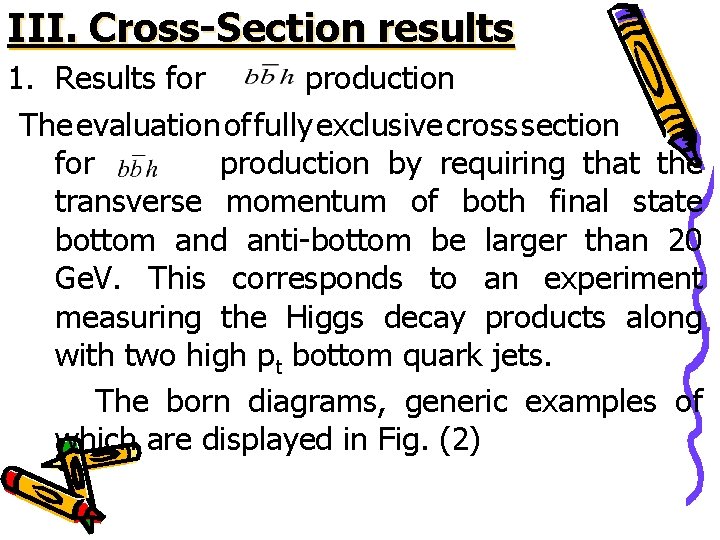
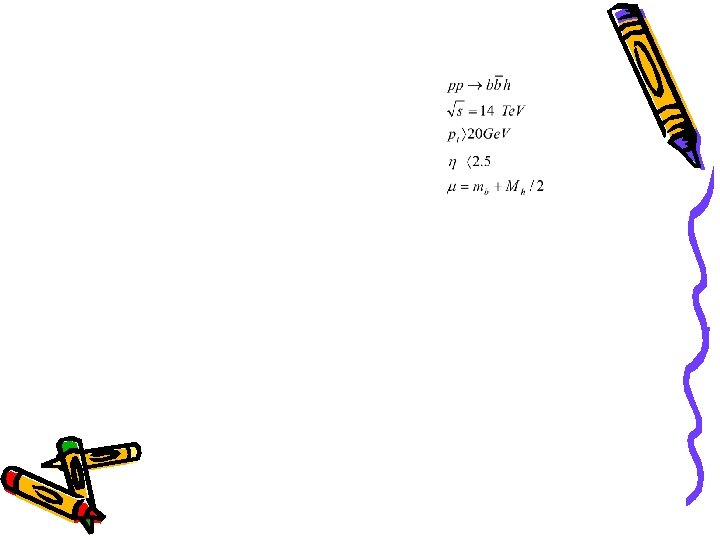
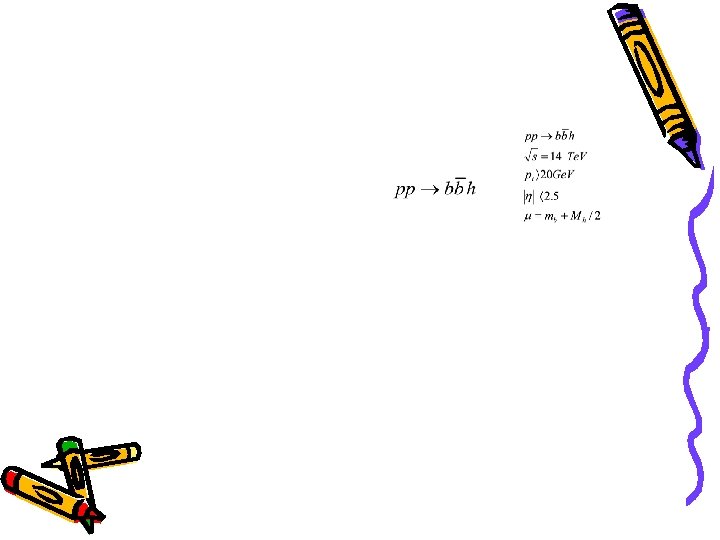
III. Cross-Section results 1. Results for production The evaluation of fully exclusive cross section for production by requiring that the transverse momentum of both final state bottom and anti-bottom be larger than 20 Ge. V. This corresponds to an experiment measuring the Higgs decay products along with two high pt bottom quark jets. The born diagrams, generic examples of which are displayed in Fig. (2)
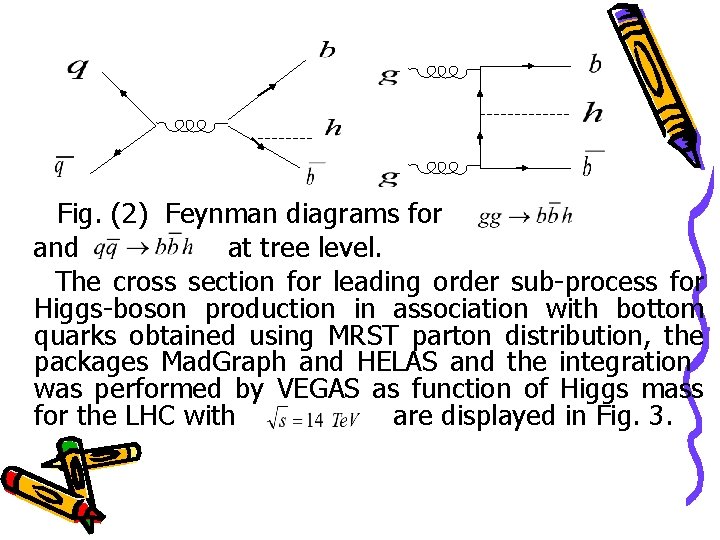
Fig. (2) Feynman diagrams for and at tree level. The cross section for leading order sub-process for Higgs-boson production in association with bottom quarks obtained using MRST parton distribution, the packages Mad. Graph and HELAS and the integration was performed by VEGAS as function of Higgs mass for the LHC with are displayed in Fig. 3.
v The cross-section for Higgs production in association with bottom quarks are not large but may be useful if high luminosity is available, since the Higgs boson can be “tagged’ by trigging on the bottom quarks. v A sizable rate of events where two bottom quarks associate with Higgs boson are produced contemporarily at the LHC, as a consequence of the large parton luminosity. v The corresponding integrated rate is evaluated by combining the integrated cross section for Higgs boson and production at LHC energy.
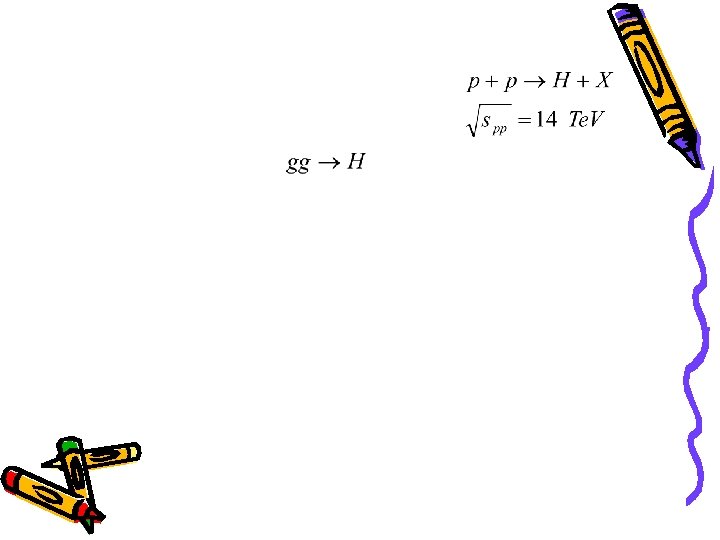
• If one use the cross section for Higgs boson production from Fig. (4), and as a value for the scale factor (the observed value is one obtain the cross section for a double parton collision producing a Higgs boson and a pair . • The large rate of pair at the LHC gives rise to a relatively sizable production of Higgs boson associated with . • Figure 4 shows the double parton scattering to the Higgs boson associated with bottom quarks.
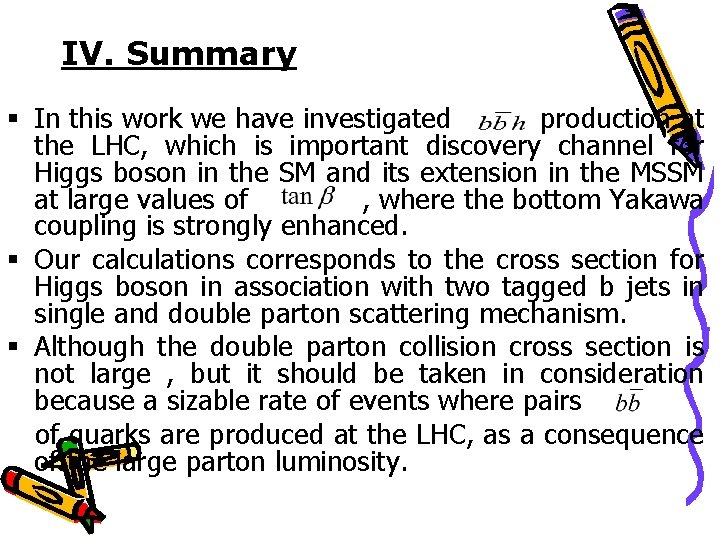
IV. Summary § In this work we have investigated production at the LHC, which is important discovery channel for Higgs boson in the SM and its extension in the MSSM at large values of , where the bottom Yakawa coupling is strongly enhanced. § Our calculations corresponds to the cross section for Higgs boson in association with two tagged b jets in single and double parton scattering mechanism. § Although the double parton collision cross section is not large , but it should be taken in consideration because a sizable rate of events where pairs of quarks are produced at the LHC, as a consequence of the large parton luminosity.
§ However, in the hadron collider environment, the large QCD backgrounds may cause the observation impossible for those events if Higgs bosons decay hadronically. Individual channels with hadronic decays should be studied on case by case.

- Slides: 24