
Further Mechanics 1 Elastic Strings and Springs Mr



- Slides: 28
Further Mechanics 1 : Elastic Strings and Springs Mr Ingall (the boss of www. drfrostmaths. com) Last modified: 24 th Jan 2019
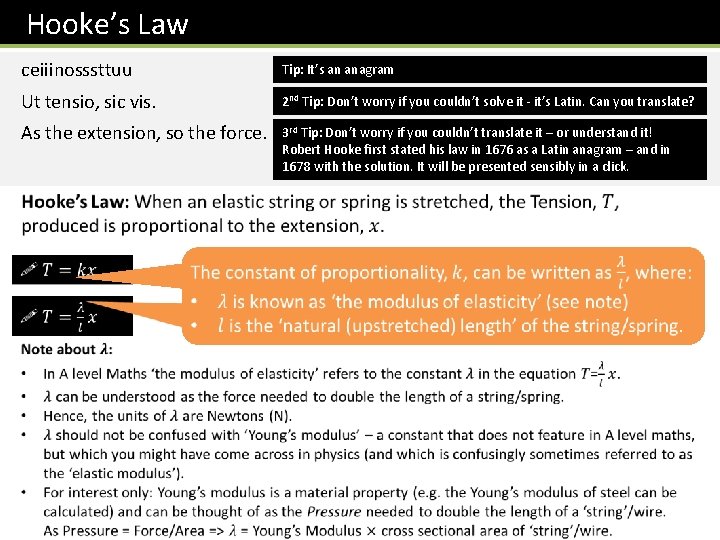
Hooke’s Law ceiiinosssttuu Tip: It’s an anagram Ut tensio, sic vis. 2 nd Tip: Don’t worry if you couldn’t solve it - it’s Latin. Can you translate? As the extension, so the force. 3 rd Tip: Don’t worry if you couldn’t translate it – or understand it! Robert Hooke first stated his law in 1676 as a Latin anagram – and in 1678 with the solution. It will be presented sensibly in a click.
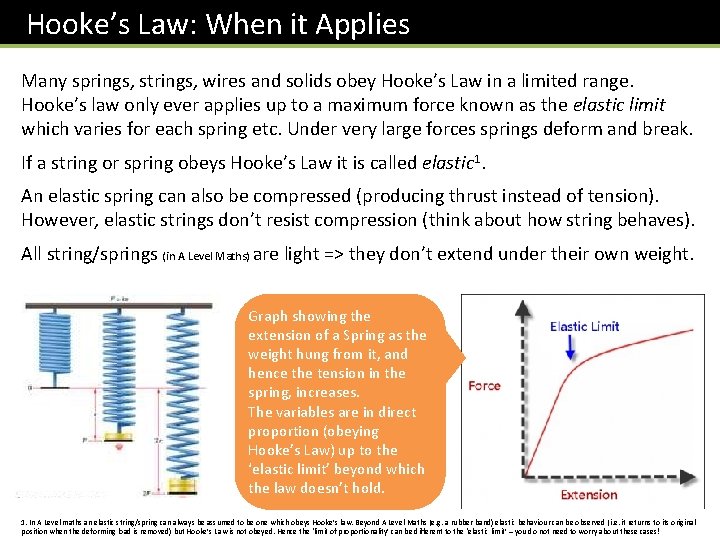
Hooke’s Law: When it Applies Many springs, strings, wires and solids obey Hooke’s Law in a limited range. Hooke’s law only ever applies up to a maximum force known as the elastic limit which varies for each spring etc. Under very large forces springs deform and break. If a string or spring obeys Hooke’s Law it is called elastic 1. An elastic spring can also be compressed (producing thrust instead of tension). However, elastic strings don’t resist compression (think about how string behaves). All string/springs (in A Level Maths) are light => they don’t extend under their own weight. Graph showing the extension of a Spring as the weight hung from it, and hence the tension in the spring, increases. The variables are in direct proportion (obeying Hooke’s Law) up to the ‘elastic limit’ beyond which the law doesn’t hold. 1. In A Level maths an elastic string/spring can always be assumed to be one which obeys Hooke’s law. Beyond A Level Maths (e. g. a rubber band) elastic behaviour can be observed (i. e. it returns to its original position when the deforming load is removed) but Hooke’s Law is not obeyed. Hence the ‘limit of proportionality’ can be different to the ‘elastic limit’ – you do not need to worry about these cases!
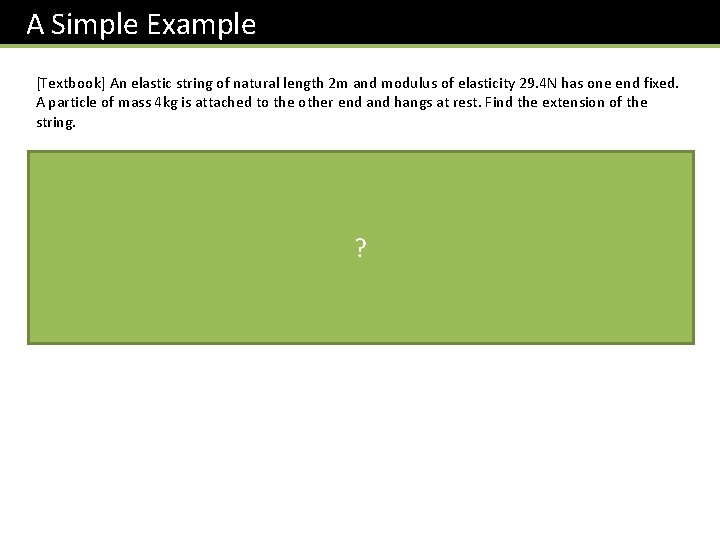
A Simple Example [Textbook] An elastic string of natural length 2 m and modulus of elasticity 29. 4 N has one end fixed. A particle of mass 4 kg is attached to the other end and hangs at rest. Find the extension of the string. T 2 4 g ?
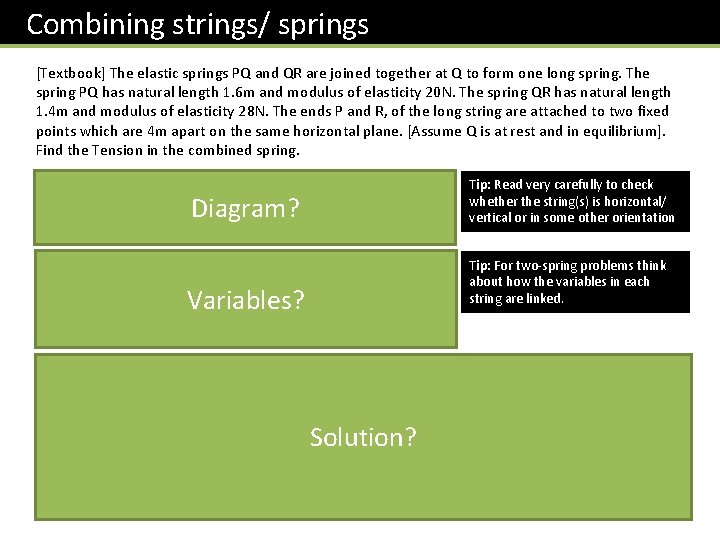
Combining strings/ springs [Textbook] The elastic springs PQ and QR are joined together at Q to form one long spring. The spring PQ has natural length 1. 6 m and modulus of elasticity 20 N. The spring QR has natural length 1. 4 m and modulus of elasticity 28 N. The ends P and R, of the long string are attached to two fixed points which are 4 m apart on the same horizontal plane. [Assume Q is at rest and in equilibrium]. Find the Tension in the combined spring. P Q Tip: Read very carefully to check whether the string(s) is horizontal/ vertical or in some other orientation R Diagram? Tip: For two-spring problems think about how the variables in each string are linked. Variables? Solution?
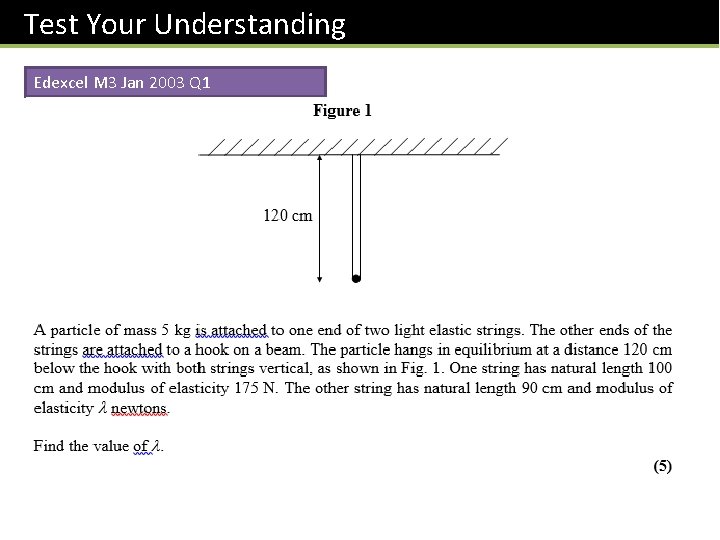
Test Your Understanding Edexcel M 3 Jan 2003 Q 1
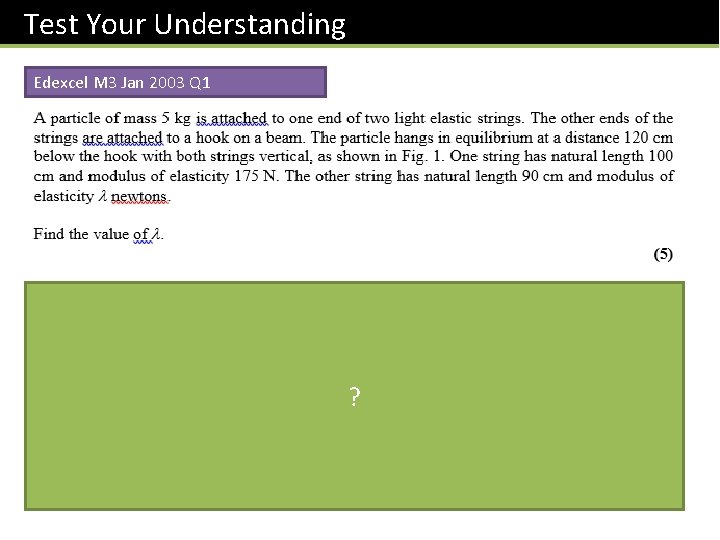
Test Your Understanding Edexcel M 3 Jan 2003 Q 1 ?
Exercise 3 A (part 1) Pearson Further Mechanics 1 Pages 44 -45 questions 1 -7
Slopes, Friction, Moments, Resolving Forces, etc. Elastic Strings and Springs can be introduced into similar problems to those encountered in A level Mechanics. e. g. • Ch 4: Moments • Ch 5: Forces and friction • Ch 7: Applications of forces The next few examples will also serve as useful revision of these ideas. Key ideas to Remember If an object is in equilibrium: • For any given point: The sum of the moments of all forces about that point = 0 • In any chosen direction: The sum of all component forces in that direction = 0
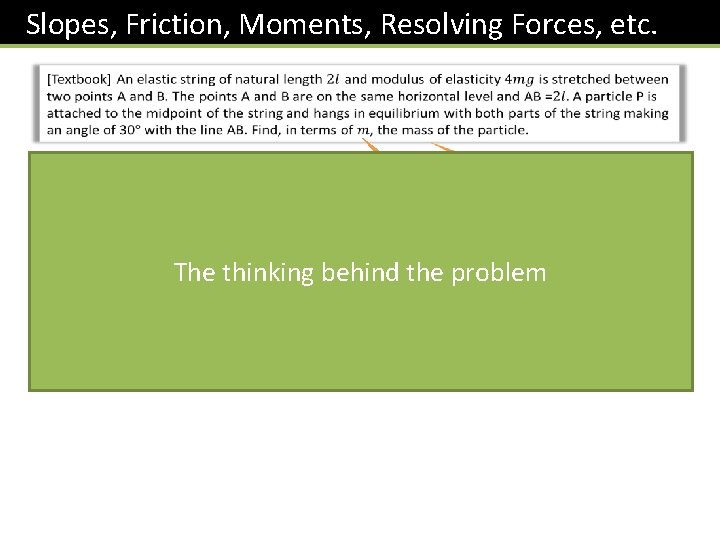
Slopes, Friction, Moments, Resolving Forces, etc. You will not always be told ‘in terms of m’ sometimes you just have to deduce that the answer must be in terms of a variable given in the question. The thinking behind the problem
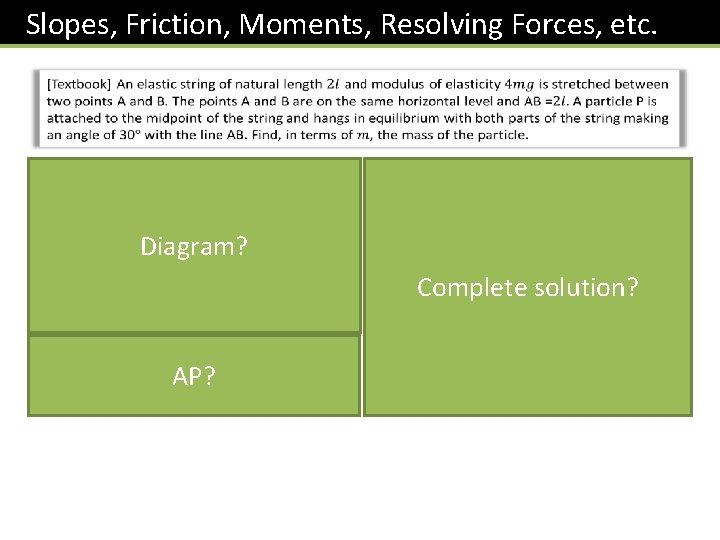
Slopes, Friction, Moments, Resolving Forces, etc. A C By symmetry the tension in both strings is the same. B Diagram? P Mg AP? Tip: You often need to work out some more detail for the diagram Complete solution?
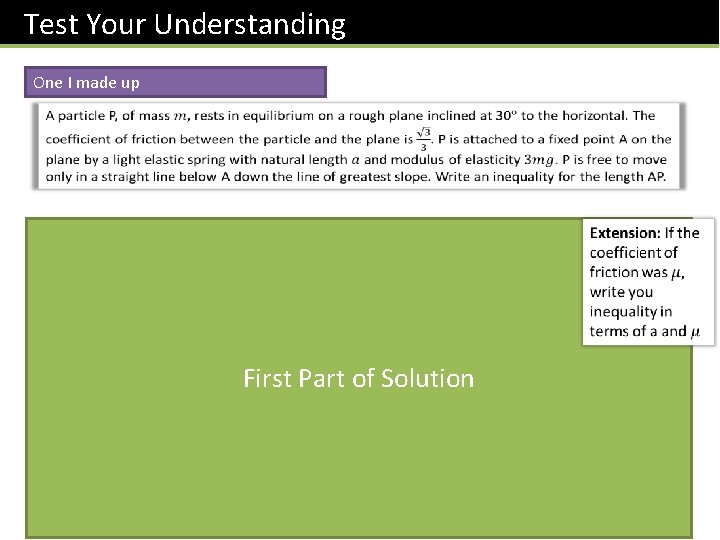
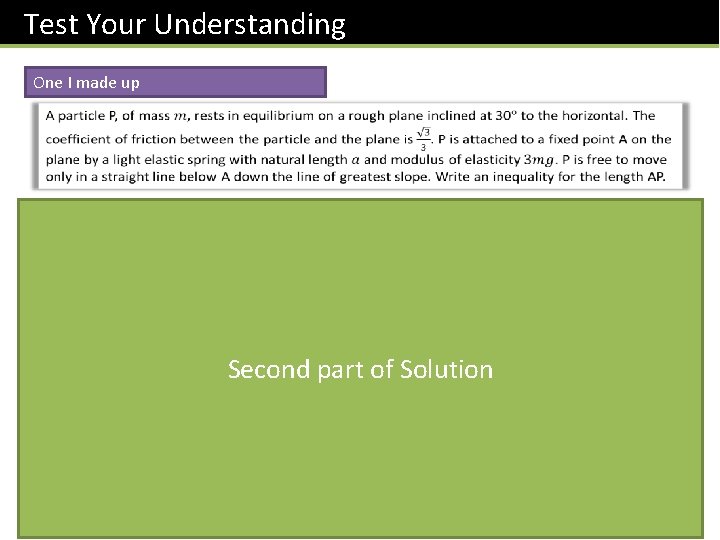
Test Your Understanding One I made up If P is on the point of moving up the plane: First Part of Solution …continued
Test Your Understanding One I made up If P is on the point of moving down the plane: Second part of Solution to extension
Exercise 3 A (Part 2) Pearson Further Mechanics 1 Pages 44 -45 questions 8 -11
Dynamics Problems (in a given direction)
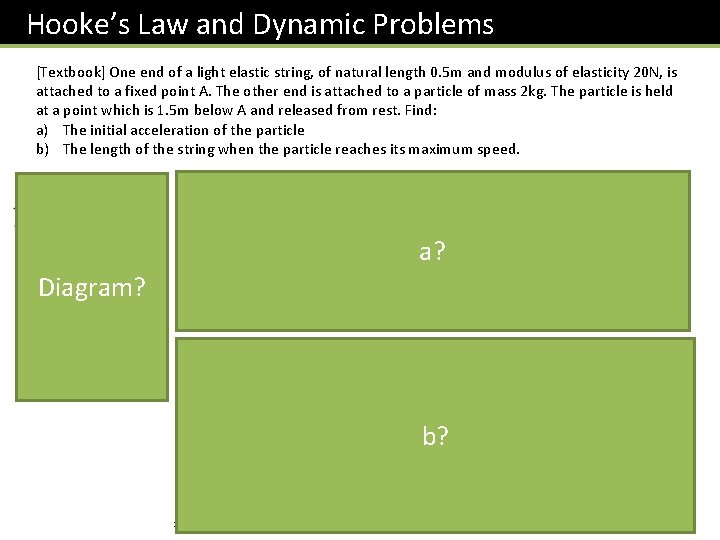
Hooke’s Law and Dynamic Problems [Textbook] One end of a light elastic string, of natural length 0. 5 m and modulus of elasticity 20 N, is attached to a fixed point A. The other end is attached to a particle of mass 2 kg. The particle is held at a point which is 1. 5 m below A and released from rest. Find: a) The initial acceleration of the particle b) The length of the string when the particle reaches its maximum speed. A T a 1. 5 a? Diagram? 2 g Maximum velocity occurs at the equilibrium position. b? => length of the string is 0. 5 m (original length) + 0. 49 m = 0. 99 m
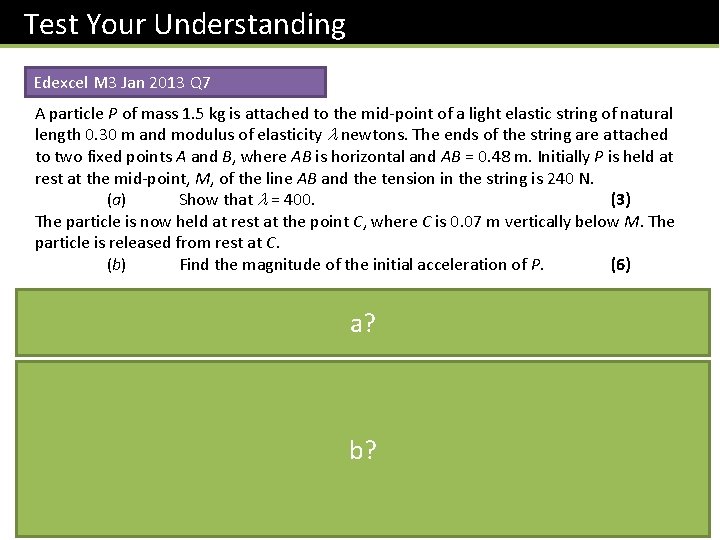
Test Your Understanding Edexcel M 3 Jan 2013 Q 7 A particle P of mass 1. 5 kg is attached to the mid-point of a light elastic string of natural length 0. 30 m and modulus of elasticity newtons. The ends of the string are attached to two fixed points A and B, where AB is horizontal and AB = 0. 48 m. Initially P is held at rest at the mid-point, M, of the line AB and the tension in the string is 240 N. (a) Show that = 400. (3) The particle is now held at rest at the point C, where C is 0. 07 m vertically below M. The particle is released from rest at C. (b) Find the magnitude of the initial acceleration of P. (6) a? b?
Exercise 3 B Pearson Further Mechanics 1 Pages 47 -48
Energy The Elastic Potential Energy (E. P. E. ) stored in a spring or string is equal to the work done in stretching /compressing it.
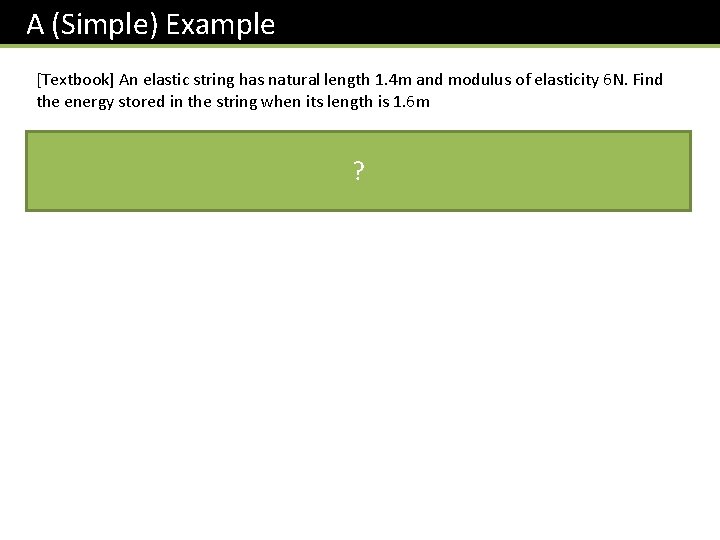
A (Simple) Example [Textbook] An elastic string has natural length 1. 4 m and modulus of elasticity 6 N. Find the energy stored in the string when its length is 1. 6 m ?
Exercise 3 C Pearson Further Mechanics 1 Pages 50 -51
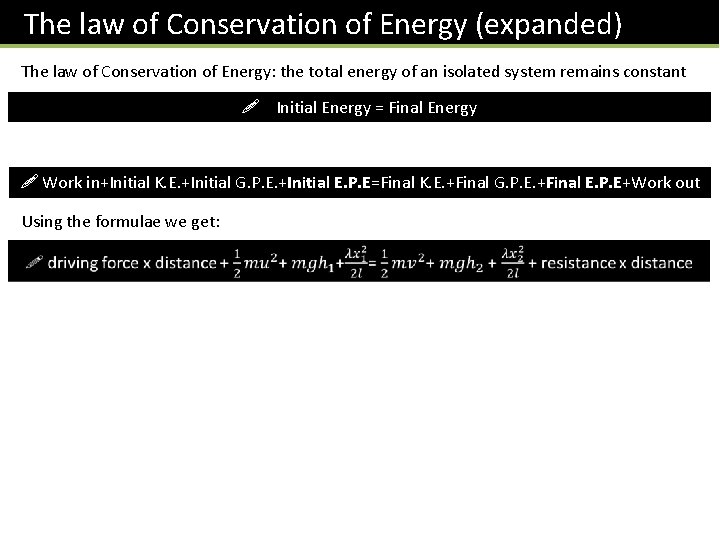
The law of Conservation of Energy (expanded) The law of Conservation of Energy: the total energy of an isolated system remains constant ! Initial Energy = Final Energy ! Work in+Initial K. E. +Initial G. P. E. +Initial E. P. E=Final K. E. +Final G. P. E. +Final E. P. E+Work out Using the formulae we get:
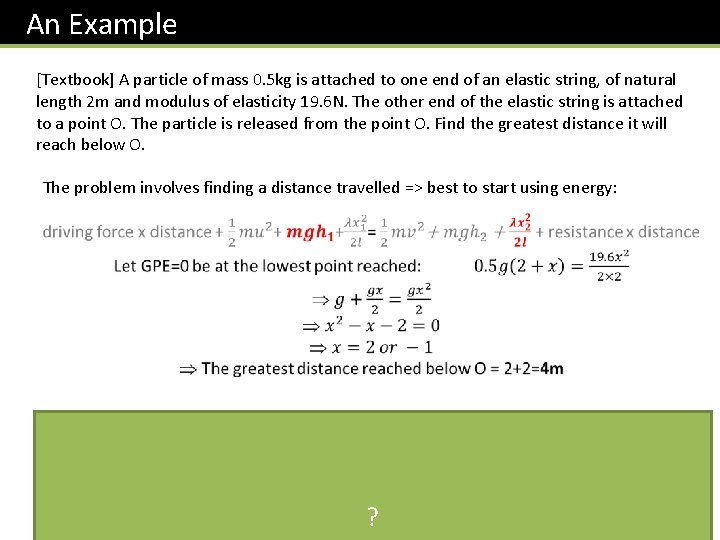
An Example [Textbook] A particle of mass 0. 5 kg is attached to one end of an elastic string, of natural length 2 m and modulus of elasticity 19. 6 N. The other end of the elastic string is attached to a point O. The particle is released from the point O. Find the greatest distance it will reach below O. The problem involves finding a distance travelled => best to start using energy: ?
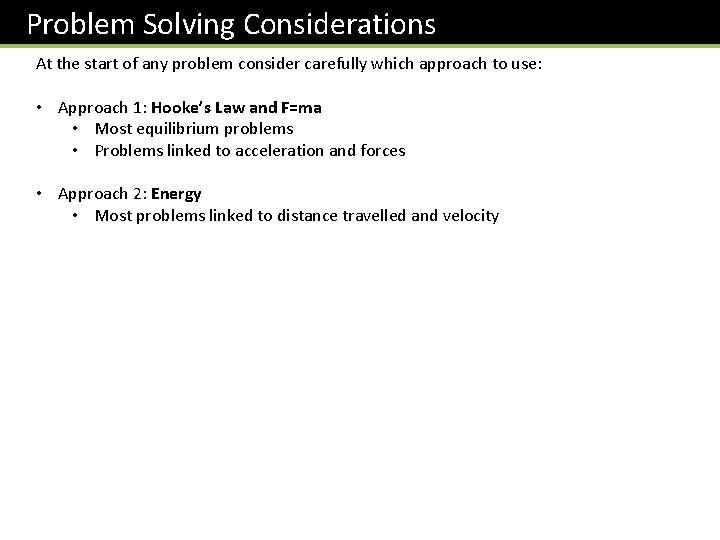
Problem Solving Considerations At the start of any problem consider carefully which approach to use: • Approach 1: Hooke’s Law and F=ma • Most equilibrium problems • Problems linked to acceleration and forces • Approach 2: Energy • Most problems linked to distance travelled and velocity
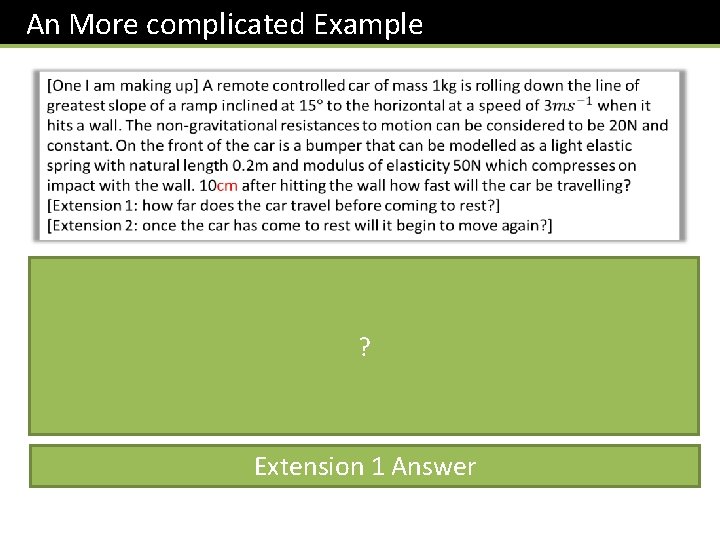
An More complicated Example The problem involves finding a distance travelled => best to start using energy: ? Extension 1 answer: 0. 132 m (3 SF) Extension 1 Answer
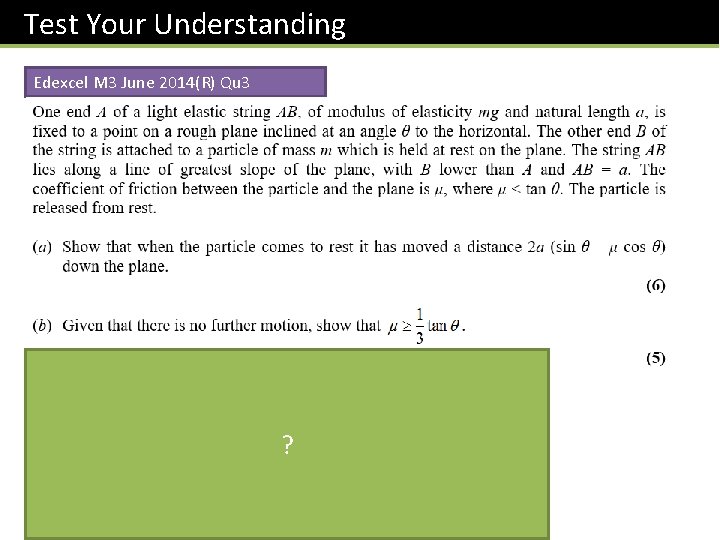
Test Your Understanding Edexcel M 3 June 2014(R) Qu 3 ?
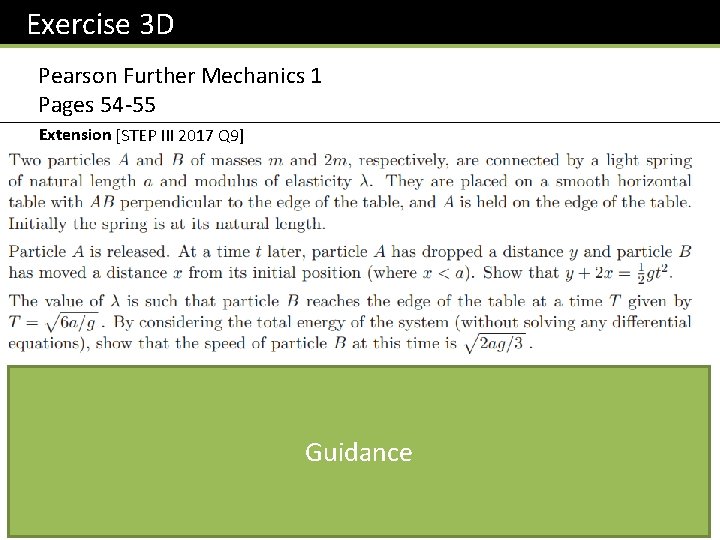
Exercise 3 D Pearson Further Mechanics 1 Pages 54 -55 Extension [STEP III 2017 Q 9] Guidance root