
Opportunities for Coherent Scattering in Ferroelectrics and Multiferroics
- Slides: 31
Opportunities for Coherent Scattering in Ferroelectrics and Multiferroics Paul G. Evans Department of Materials Science and Engineering University of Wisconsin, Madison evans@engr. wisc. edu University of Wisconsin-Madison Department of Materials Science and Engineering
Outline • Ferroelectrics and multiferroics – Manipulate electrical polarization and magnetism using applied fields – Time resolution is crucial – Knowing where the atoms are in steady state is helpful, but there are many other opportunities. • Our work: Dynamics in complex oxides (extreme conditions, short times, coupling of ferroelectricity with magnetism) • Goals: What can be uniquely probed by coherent techniques? University of Wisconsin-Madison Department of Materials Science and Engineering
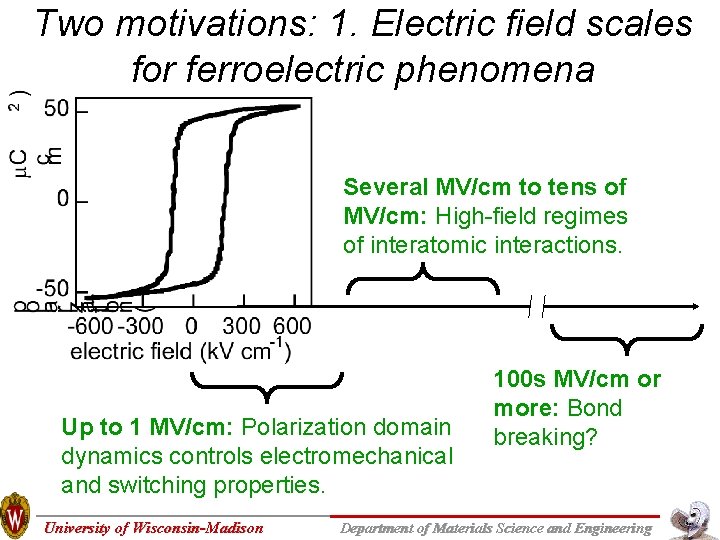
Two motivations: 1. Electric field scales for ferroelectric phenomena Several MV/cm to tens of MV/cm: High-field regimes of interatomic interactions. Up to 1 MV/cm: Polarization domain dynamics controls electromechanical and switching properties. University of Wisconsin-Madison 100 s MV/cm or more: Bond breaking? Department of Materials Science and Engineering
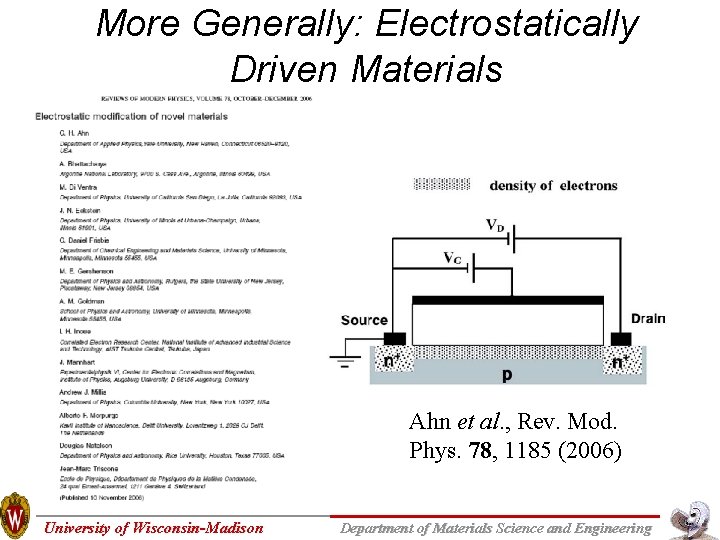
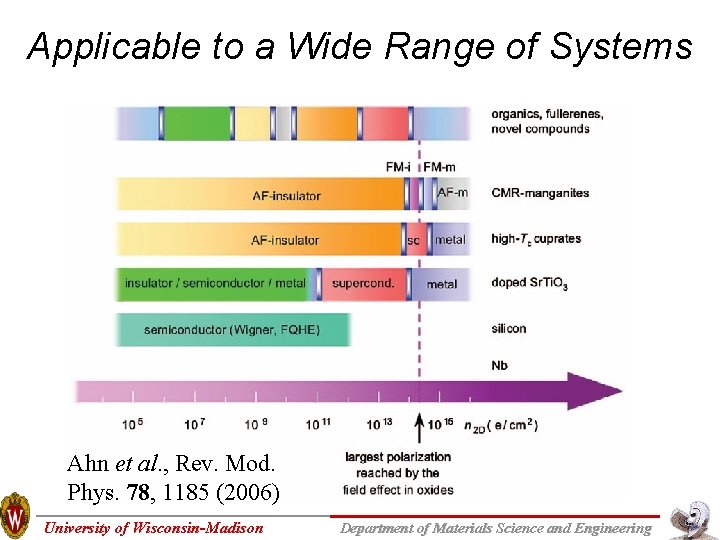
More Generally: Electrostatically Driven Materials Ahn et al. , Rev. Mod. Phys. 78, 1185 (2006) University of Wisconsin-Madison Department of Materials Science and Engineering
Applicable to a Wide Range of Systems Ahn et al. , Rev. Mod. Phys. 78, 1185 (2006) University of Wisconsin-Madison Department of Materials Science and Engineering
What Can be Learned? • How fast can these transitions be? How homogeneous are they in space? • What other structural transitions can be driven? • Fundamental physics of these phase transitions have been previously available only by changing T (or doping, or H, etc. ). Nothing fast! • Short pulses go along with high E fields. University of Wisconsin-Madison Department of Materials Science and Engineering
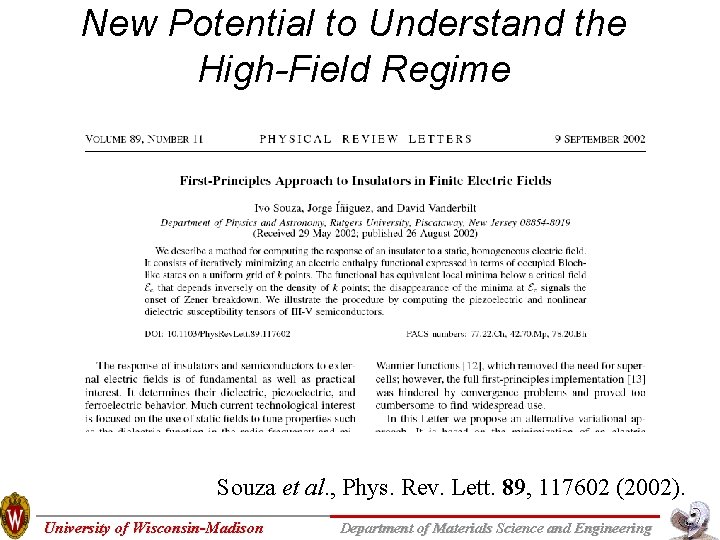
New Potential to Understand the High-Field Regime Souza et al. , Phys. Rev. Lett. 89, 117602 (2002). University of Wisconsin-Madison Department of Materials Science and Engineering
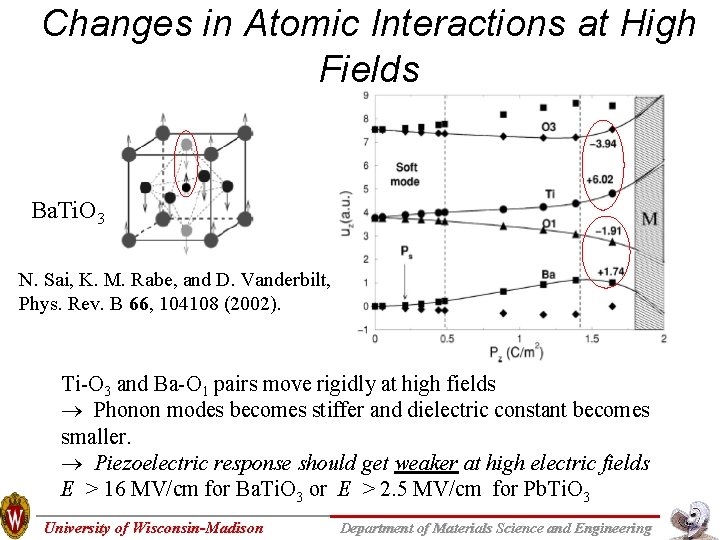
Changes in Atomic Interactions at High Fields Ba. Ti. O 3 N. Sai, K. M. Rabe, and D. Vanderbilt, Phys. Rev. B 66, 104108 (2002). Ti-O 3 and Ba-O 1 pairs move rigidly at high fields Phonon modes becomes stiffer and dielectric constant becomes smaller. Piezoelectric response should get weaker at high electric fields E > 16 MV/cm for Ba. Ti. O 3 or E > 2. 5 MV/cm for Pb. Ti. O 3 University of Wisconsin-Madison Department of Materials Science and Engineering
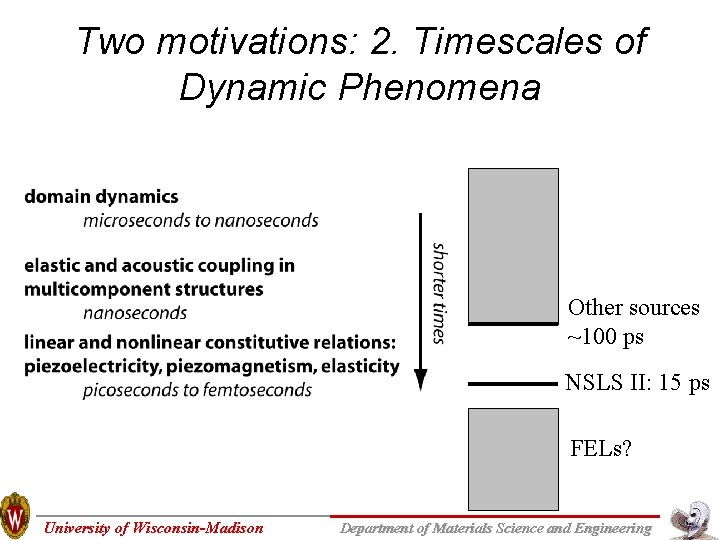
Two motivations: 2. Timescales of Dynamic Phenomena Other sources ~100 ps NSLS II: 15 ps FELs? University of Wisconsin-Madison Department of Materials Science and Engineering
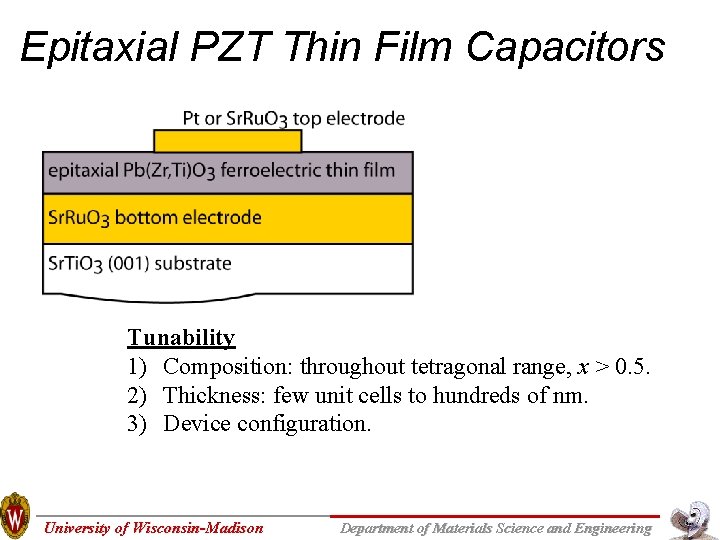
Epitaxial PZT Thin Film Capacitors Tunability 1) Composition: throughout tetragonal range, x > 0. 5. 2) Thickness: few unit cells to hundreds of nm. 3) Device configuration. University of Wisconsin-Madison Department of Materials Science and Engineering
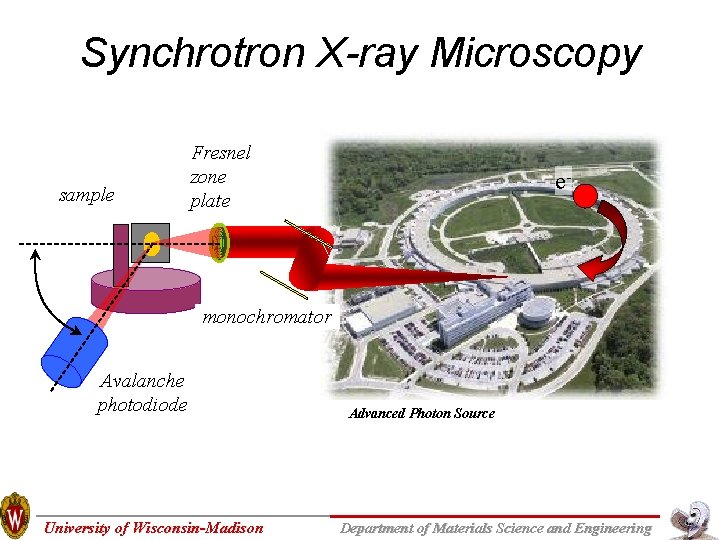
Synchrotron X-ray Microscopy sample Fresnel zone plate e- monochromator Avalanche photodiode University of Wisconsin-Madison Advanced Photon Source Department of Materials Science and Engineering
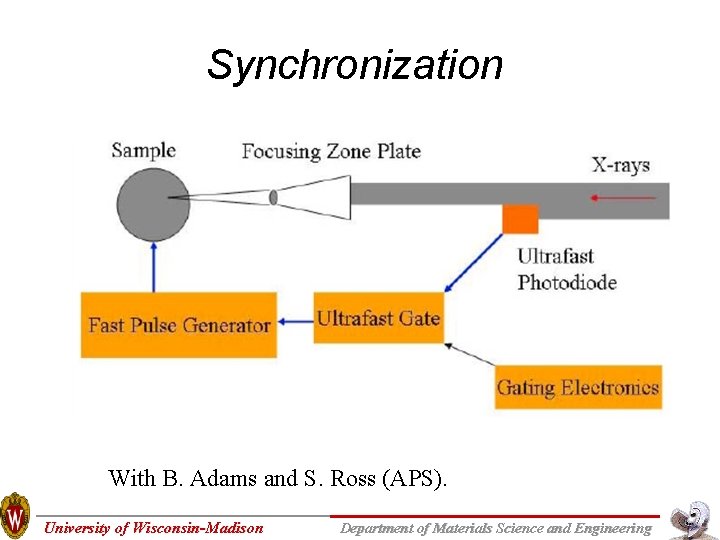
Synchronization With B. Adams and S. Ross (APS). University of Wisconsin-Madison Department of Materials Science and Engineering
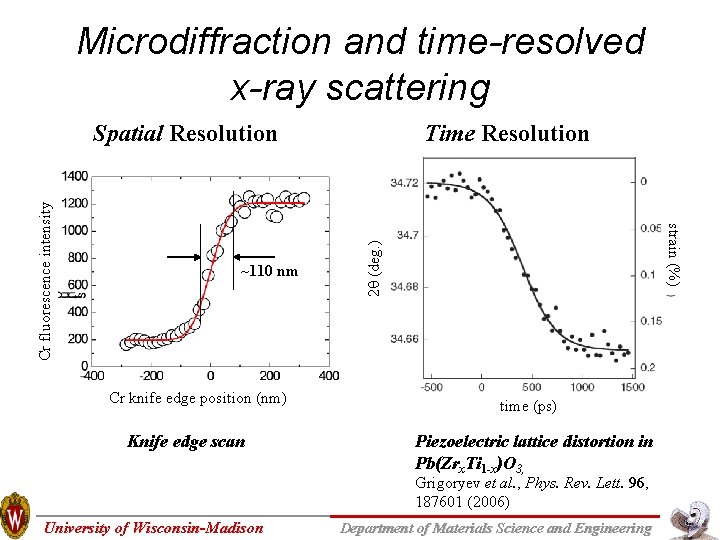
Microdiffraction and time-resolved x-ray scattering Cr knife edge position (nm) Knife edge scan 2 (deg. ) ~110 nm Time Resolution strain (%) Cr fluorescence intensity Spatial Resolution time (ps) Piezoelectric lattice distortion in Pb(Zrx. Ti 1 -x)O 3, Grigoryev et al. , Phys. Rev. Lett. 96, 187601 (2006) University of Wisconsin-Madison Department of Materials Science and Engineering
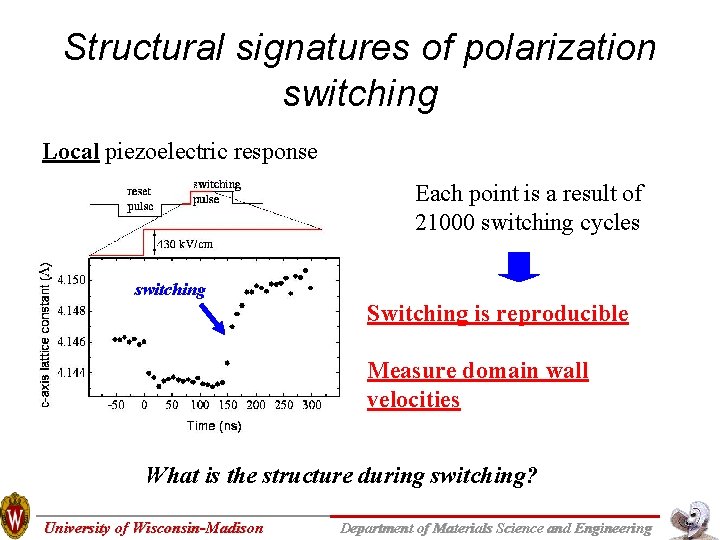
Structural signatures of polarization switching Local piezoelectric response Each point is a result of 21000 switching cycles switching Switching is reproducible Measure domain wall velocities What is the structure during switching? University of Wisconsin-Madison Department of Materials Science and Engineering
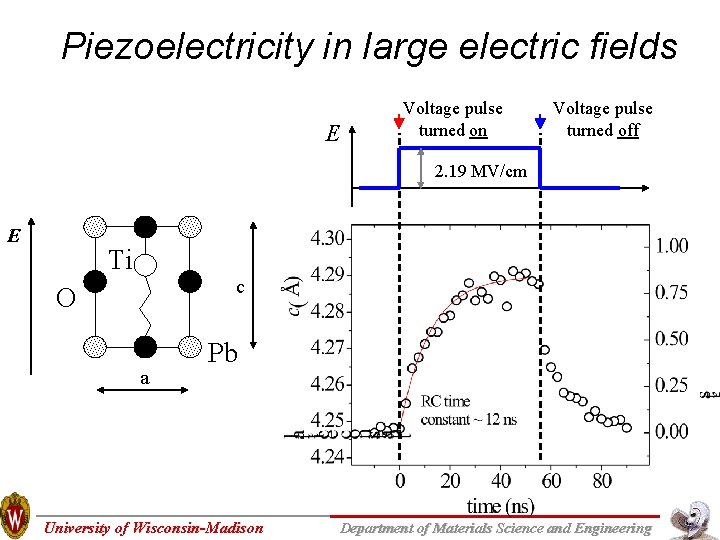
Piezoelectricity in large electric fields E Voltage pulse turned on Voltage pulse turned off 2. 19 MV/cm E Ti c O a Pb University of Wisconsin-Madison Department of Materials Science and Engineering
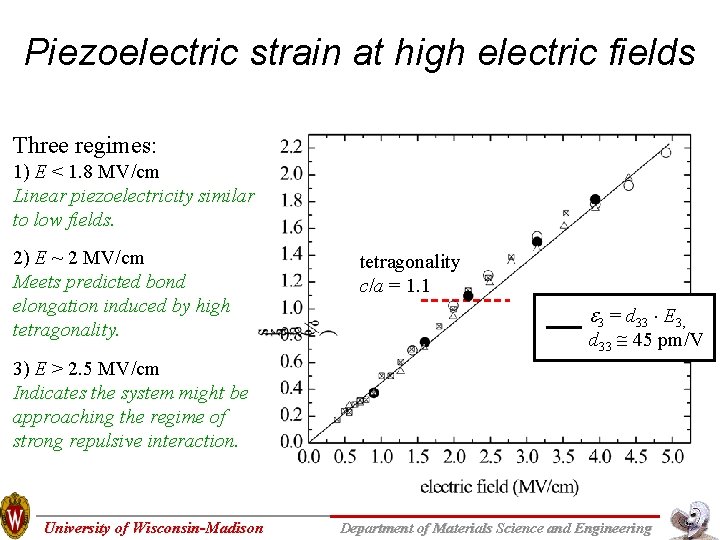
Piezoelectric strain at high electric fields Three regimes: 1) E < 1. 8 MV/cm Linear piezoelectricity similar to low fields. 2) E ~ 2 MV/cm Meets predicted bond elongation induced by high tetragonality c/a = 1. 1 e 3 = d 33 E 3, d 33 45 pm/V 3) E > 2. 5 MV/cm Indicates the system might be approaching the regime of strong repulsive interaction. University of Wisconsin-Madison Department of Materials Science and Engineering
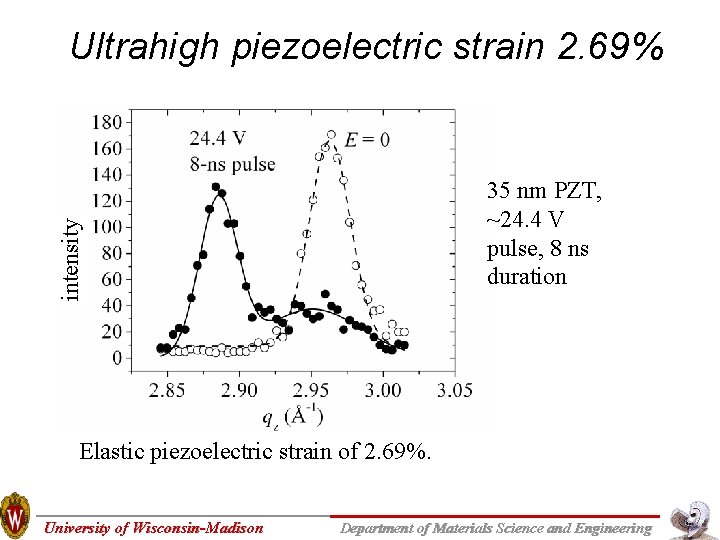
Ultrahigh piezoelectric strain 2. 69% intensity 35 nm PZT, ~24. 4 V pulse, 8 ns duration Elastic piezoelectric strain of 2. 69%. University of Wisconsin-Madison Department of Materials Science and Engineering
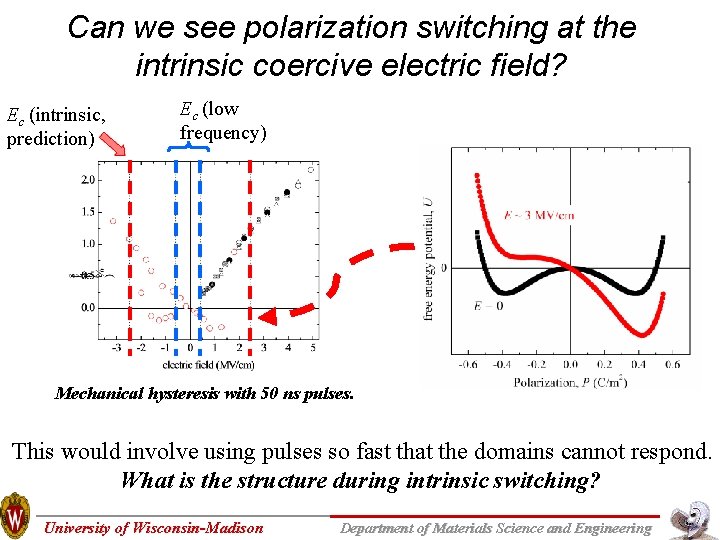
Can we see polarization switching at the intrinsic coercive electric field? Ec (intrinsic, prediction) Ec (low frequency) Mechanical hysteresis with 50 ns pulses. This would involve using pulses so fast that the domains cannot respond. What is the structure during intrinsic switching? University of Wisconsin-Madison Department of Materials Science and Engineering
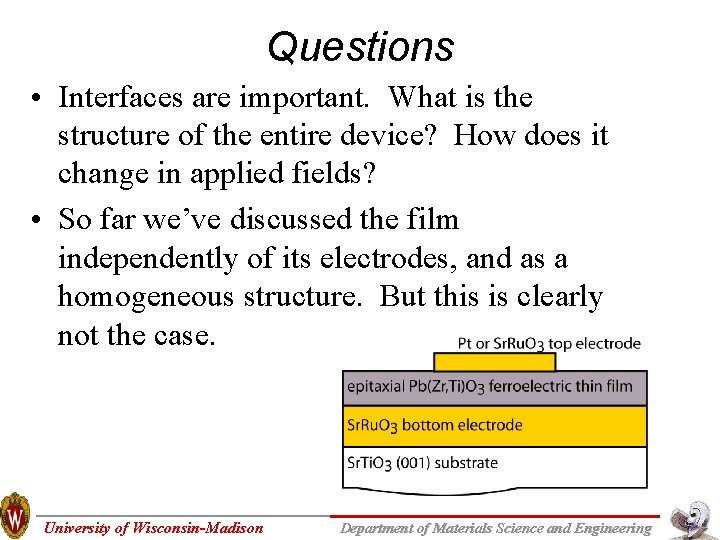
Questions • Interfaces are important. What is the structure of the entire device? How does it change in applied fields? • So far we’ve discussed the film independently of its electrodes, and as a homogeneous structure. But this is clearly not the case. University of Wisconsin-Madison Department of Materials Science and Engineering
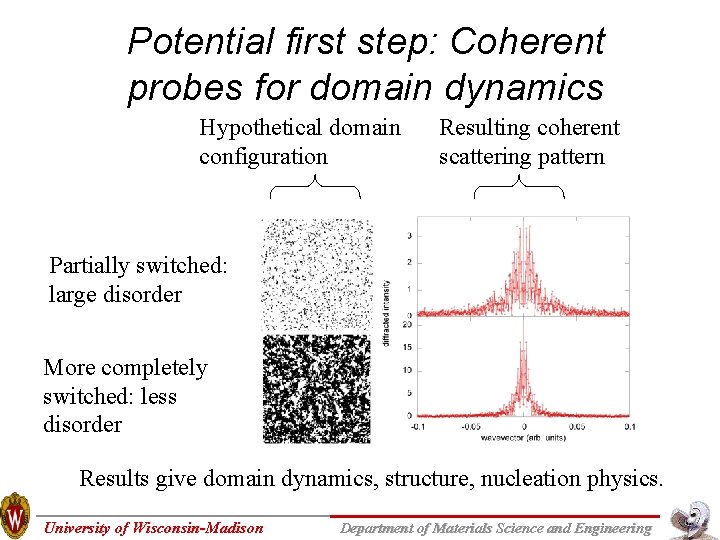
Potential first step: Coherent probes for domain dynamics Hypothetical domain configuration Resulting coherent scattering pattern Partially switched: large disorder More completely switched: less disorder Results give domain dynamics, structure, nucleation physics. University of Wisconsin-Madison Department of Materials Science and Engineering
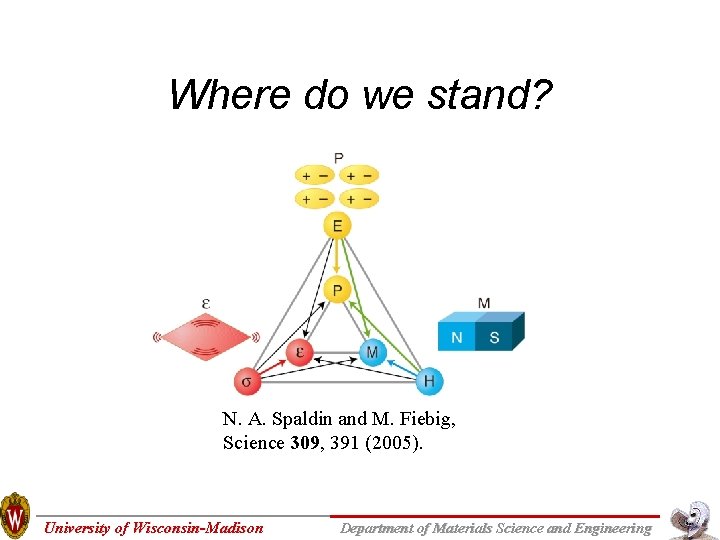
Where do we stand? N. A. Spaldin and M. Fiebig, Science 309, 391 (2005). University of Wisconsin-Madison Department of Materials Science and Engineering
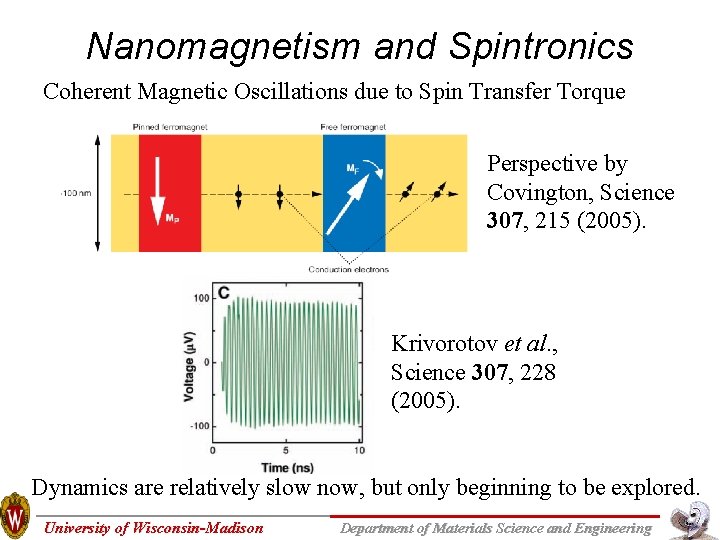
Nanomagnetism and Spintronics Coherent Magnetic Oscillations due to Spin Transfer Torque Perspective by Covington, Science 307, 215 (2005). Krivorotov et al. , Science 307, 228 (2005). Dynamics are relatively slow now, but only beginning to be explored. University of Wisconsin-Madison Department of Materials Science and Engineering
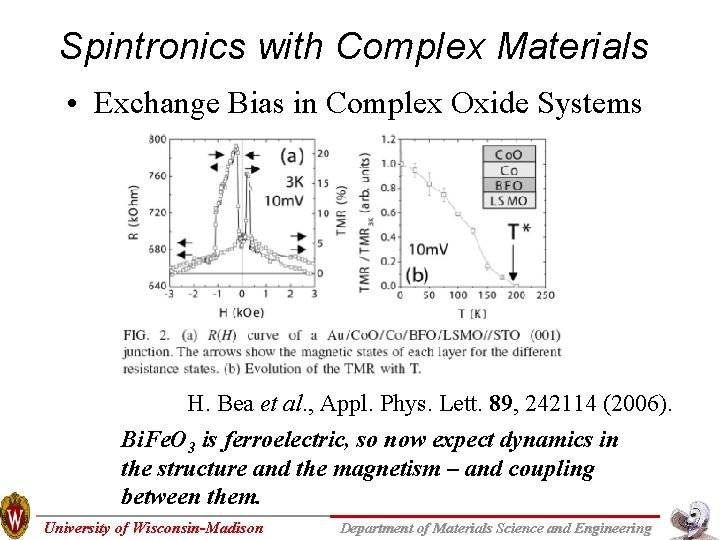
Spintronics with Complex Materials • Exchange Bias in Complex Oxide Systems H. Bea et al. , Appl. Phys. Lett. 89, 242114 (2006). Bi. Fe. O 3 is ferroelectric, so now expect dynamics in the structure and the magnetism – and coupling between them. University of Wisconsin-Madison Department of Materials Science and Engineering
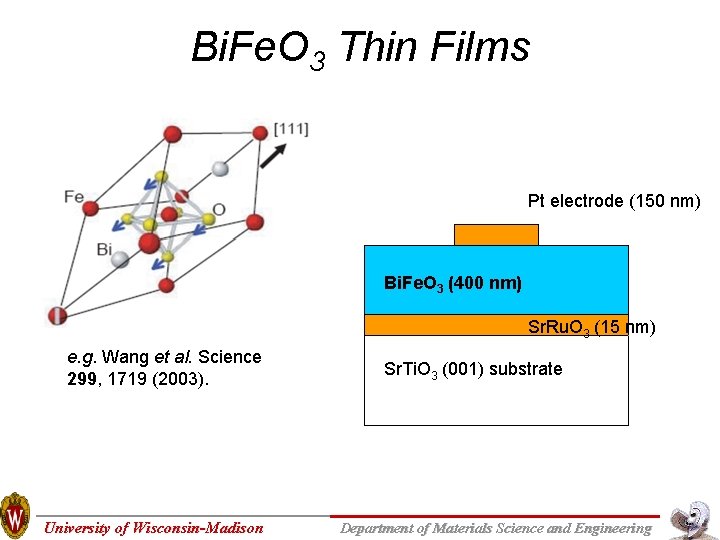
Bi. Fe. O 3 Thin Films Pt electrode (150 nm) Bi. Fe. O 3 (400 nm) Sr. Ru. O 3 (15 nm) e. g. Wang et al. Science 299, 1719 (2003). University of Wisconsin-Madison Sr. Ti. O 3 (001) substrate Department of Materials Science and Engineering
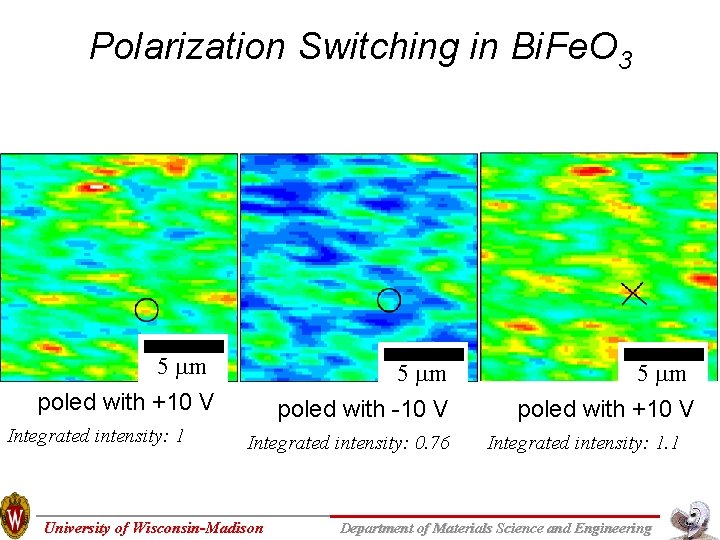
Polarization Switching in Bi. Fe. O 3 5 m poled with +10 V Integrated intensity: 1 poled with -10 V Integrated intensity: 0. 76 University of Wisconsin-Madison 5 m poled with +10 V Integrated intensity: 1. 1 Department of Materials Science and Engineering
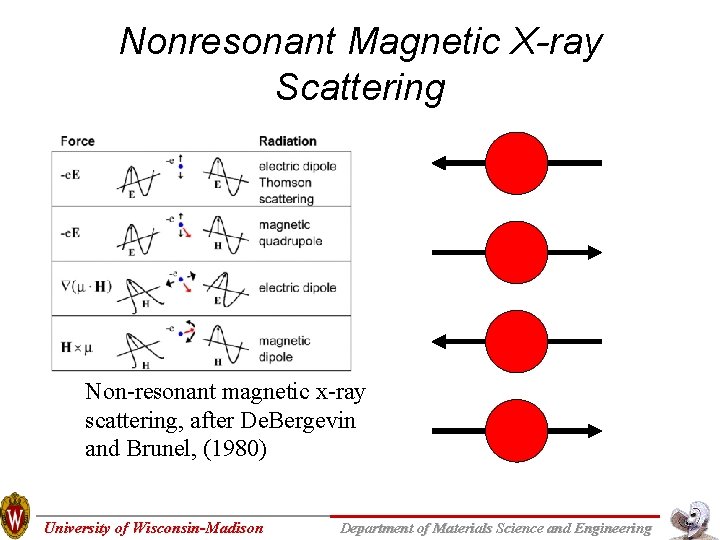
Nonresonant Magnetic X-ray Scattering Non-resonant magnetic x-ray scattering, after De. Bergevin and Brunel, (1980) University of Wisconsin-Madison Department of Materials Science and Engineering
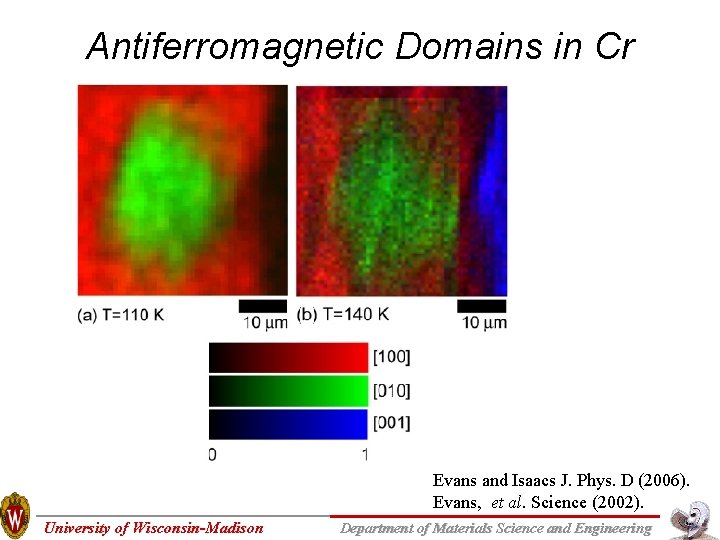
Antiferromagnetic Domains in Cr Evans and Isaacs J. Phys. D (2006). Evans, et al. Science (2002). University of Wisconsin-Madison Department of Materials Science and Engineering
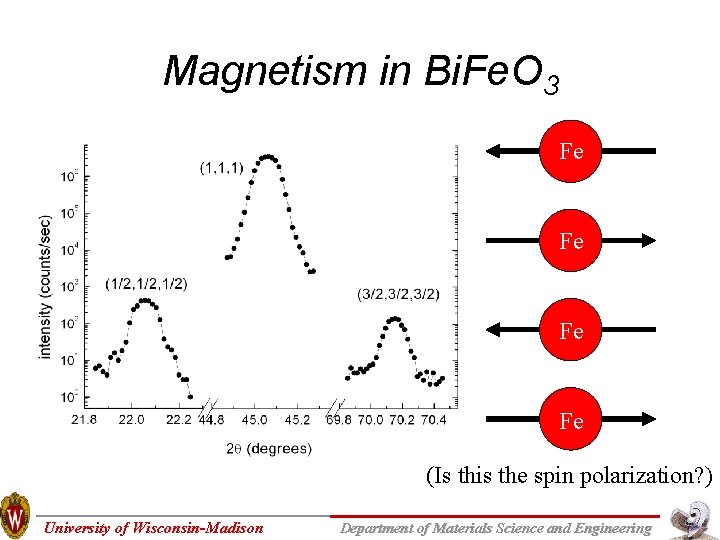
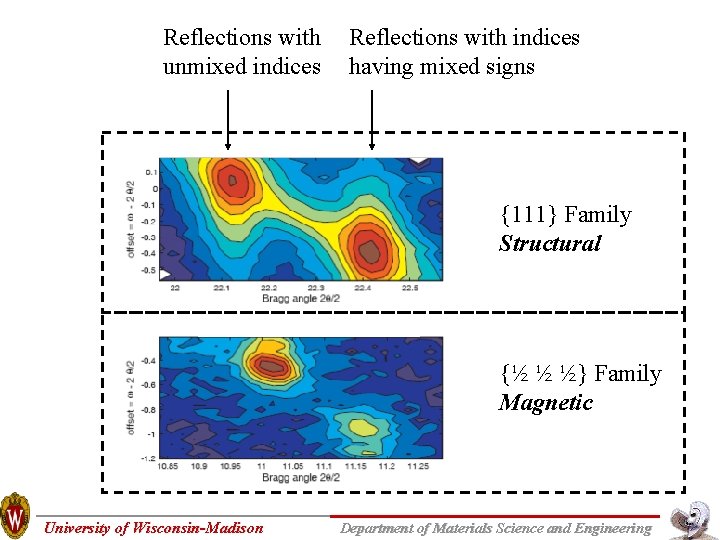
Magnetism in Bi. Fe. O 3 Fe Fe (Is this the spin polarization? ) University of Wisconsin-Madison Department of Materials Science and Engineering
Reflections with unmixed indices Reflections with indices having mixed signs {111} Family Structural {½ ½ ½} Family Magnetic University of Wisconsin-Madison Department of Materials Science and Engineering
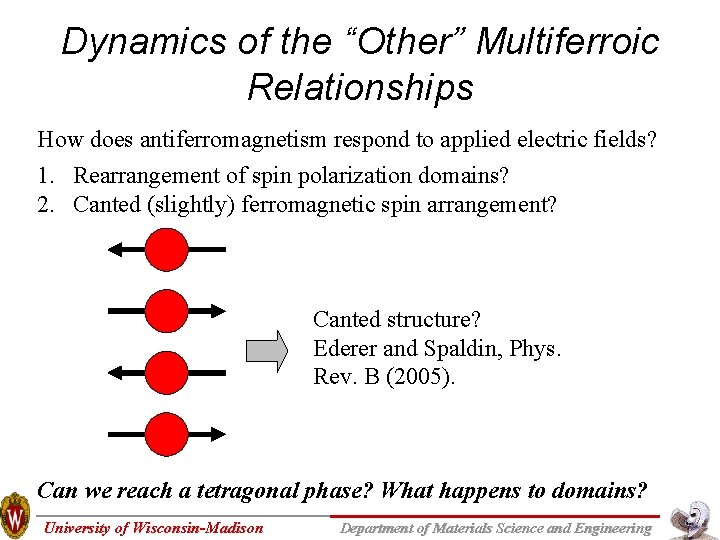
Dynamics of the “Other” Multiferroic Relationships How does antiferromagnetism respond to applied electric fields? 1. Rearrangement of spin polarization domains? 2. Canted (slightly) ferromagnetic spin arrangement? Canted structure? Ederer and Spaldin, Phys. Rev. B (2005). Can we reach a tetragonal phase? What happens to domains? University of Wisconsin-Madison Department of Materials Science and Engineering
Conclusion • Ferroelectrics in extreme electric fields: non-linear piezoelectricity. Can we exploit high strains (2. 7% so far) and high bandwidths (few GHz so far)? Other phenomena in extreme electric fields? What is the structure under high electric fields? • Multiferroics: piezoelectricity, switching. Dynamics of relationship between magnetism and polarization? What is the magnetic structure? Can we probe magnetism coherently? This work was supported by DOE through the BES X-ray and Neutron Scattering Program and by NSF through the Ceramics program of the Division of Materials Research. University of Wisconsin-Madison Department of Materials Science and Engineering