12 1 The Arithmetic of Equations Chapter 12







- Slides: 30
12. 1 The Arithmetic of Equations > Chapter 12 Stoichiometry 12. 1 The Arithmetic of Equations 12. 2 Chemical Calculations 12. 3 Limiting Reagent and Percent Yield 1 Copyright © Pearson Education, Inc. , or its affiliates. All Rights Reserved.
12. 1 The Arithmetic of Equations > Using Equations Balanced Chemical Equations Chemists use balanced chemical equations as a basis to calculate how much reactant is needed or how much product will be formed in a reaction. 2 Copyright © Pearson Education, Inc. , or its affiliates. All Rights Reserved.
12. 1 The Arithmetic of Equations > Using Equations Balanced Chemical Equations Chemists use balanced chemical equations as a basis to calculate how much reactant is needed or how much product will be formed in a reaction. • When you know the quantity of one substance in a reaction, you can calculate the quantity of any other substance consumed or created in the reaction. 3 Copyright © Pearson Education, Inc. , or its affiliates. All Rights Reserved.
12. 1 The Arithmetic of Equations > Using Equations Balanced Chemical Equations The calculations of quantities in chemical reactions is a subject of chemistry called stoichiometry. 4 Copyright © Pearson Education, Inc. , or its affiliates. All Rights Reserved.
12. 1 The Arithmetic of Equations > Using Equations Balanced Chemical Equations The calculations of quantities in chemical reactions is a subject of chemistry called stoichiometry. • For chemists, stoichiometry is a form of bookkeeping. • It allows chemists to tally the amounts of reactants and products using ratios of moles or representative particles. 5 Copyright © Pearson Education, Inc. , or its affiliates. All Rights Reserved.
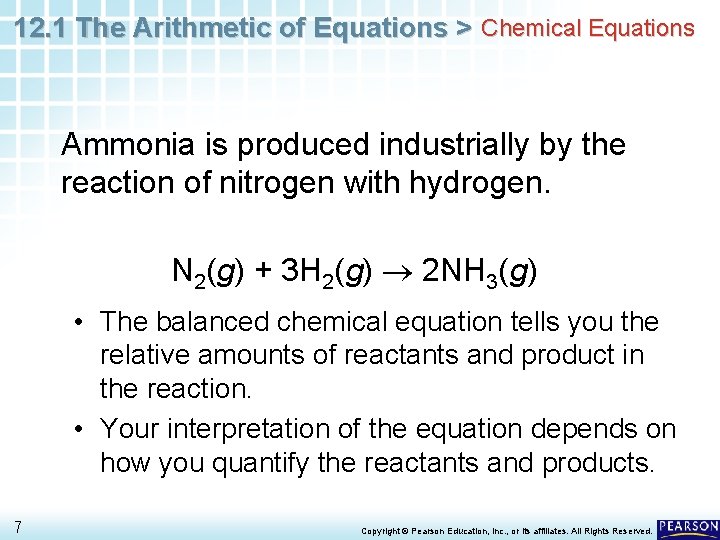
12. 1 The Arithmetic of Equations > Chemical Equations Ammonia is produced industrially by the reaction of nitrogen with hydrogen. N 2(g) + 3 H 2(g) 2 NH 3(g) • The balanced chemical equation tells you the relative amounts of reactants and product in the reaction. 6 Copyright © Pearson Education, Inc. , or its affiliates. All Rights Reserved.
12. 1 The Arithmetic of Equations > Chemical Equations Ammonia is produced industrially by the reaction of nitrogen with hydrogen. N 2(g) + 3 H 2(g) 2 NH 3(g) • The balanced chemical equation tells you the relative amounts of reactants and product in the reaction. • Your interpretation of the equation depends on how you quantify the reactants and products. 7 Copyright © Pearson Education, Inc. , or its affiliates. All Rights Reserved.
12. 1 The Arithmetic of Equations > CHEMISTRY & YOU How can you determine the amount of each reactant you need to make a product? 8 Copyright © Pearson Education, Inc. , or its affiliates. All Rights Reserved.
12. 1 The Arithmetic of Equations > CHEMISTRY & YOU How can you determine the amount of each reactant you need to make a product? A recipe or an equation, such as a balanced chemical equation, is used to determine how much starting material is needed or how much product will be made. 9 Copyright © Pearson Education, Inc. , or its affiliates. All Rights Reserved.
12. 1 The Arithmetic of Equations > Chemical Equations A balanced chemical equation can be interpreted in terms of different quantities, including numbers of atoms, molecules, or moles; mass; and volume. 10 Copyright © Pearson Education, Inc. , or its affiliates. All Rights Reserved.
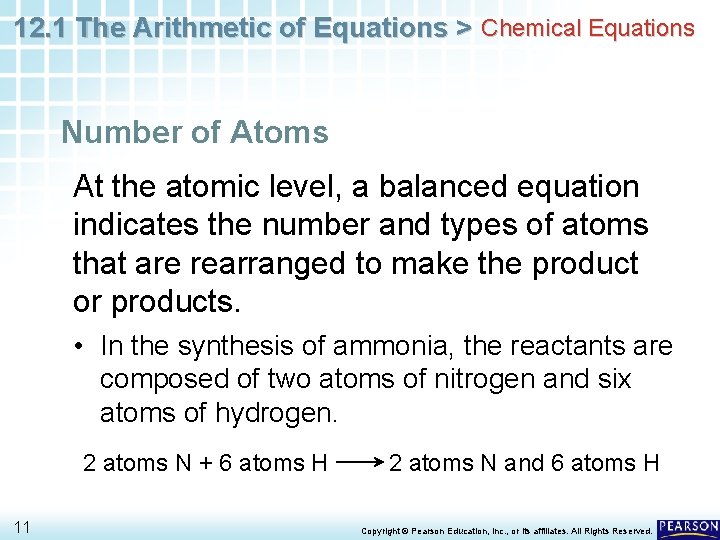
12. 1 The Arithmetic of Equations > Chemical Equations Number of Atoms At the atomic level, a balanced equation indicates the number and types of atoms that are rearranged to make the product or products. • In the synthesis of ammonia, the reactants are composed of two atoms of nitrogen and six atoms of hydrogen. 2 atoms N + 6 atoms H 11 2 atoms N and 6 atoms H Copyright © Pearson Education, Inc. , or its affiliates. All Rights Reserved.
12. 1 The Arithmetic of Equations > Chemical Equations Number of Molecules Nitrogen and hydrogen will always react to form ammonia in a 1: 3: 2 ratio of molecules. • You could take Avogadro’s number (6. 02 1023 molecules) of nitrogen molecules and make them react with three times Avogadro’s number of hydrogen molecules. 1 12 ( 6. 02 1023 molecules N 2 )+3 ( ) 3 ( 6. 02 1023 molecules N 2 ) 6. 02 1023 molecules NH 3 Copyright © Pearson Education, Inc. , or its affiliates. All Rights Reserved.
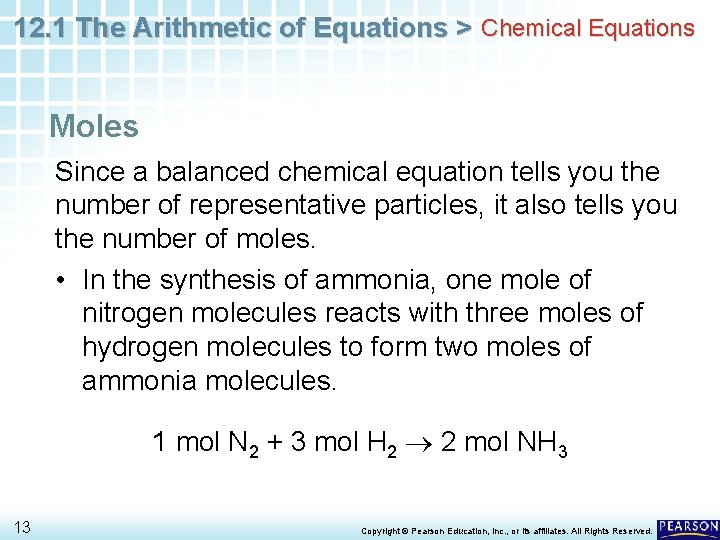
12. 1 The Arithmetic of Equations > Chemical Equations Moles Since a balanced chemical equation tells you the number of representative particles, it also tells you the number of moles. • In the synthesis of ammonia, one mole of nitrogen molecules reacts with three moles of hydrogen molecules to form two moles of ammonia molecules. 1 mol N 2 + 3 mol H 2 2 mol NH 3 13 Copyright © Pearson Education, Inc. , or its affiliates. All Rights Reserved.
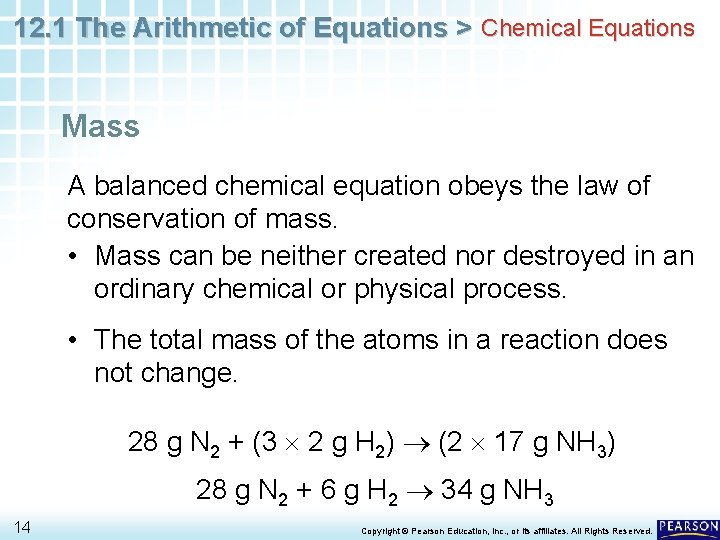
12. 1 The Arithmetic of Equations > Chemical Equations Mass A balanced chemical equation obeys the law of conservation of mass. • Mass can be neither created nor destroyed in an ordinary chemical or physical process. • The total mass of the atoms in a reaction does not change. 28 g N 2 + (3 2 g H 2) (2 17 g NH 3) 28 g N 2 + 6 g H 2 34 g NH 3 14 Copyright © Pearson Education, Inc. , or its affiliates. All Rights Reserved.
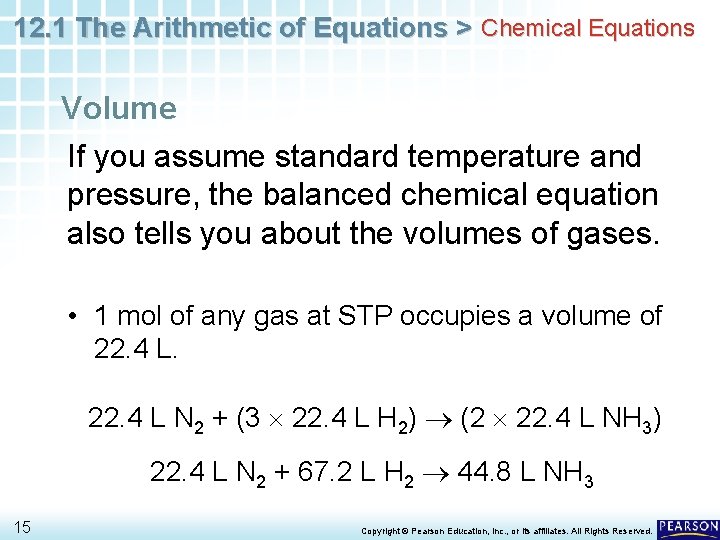
12. 1 The Arithmetic of Equations > Chemical Equations Volume If you assume standard temperature and pressure, the balanced chemical equation also tells you about the volumes of gases. • 1 mol of any gas at STP occupies a volume of 22. 4 L N 2 + (3 22. 4 L H 2) (2 22. 4 L NH 3) 22. 4 L N 2 + 67. 2 L H 2 44. 8 L NH 3 15 Copyright © Pearson Education, Inc. , or its affiliates. All Rights Reserved.
12. 1 The Arithmetic of Equations > Sample Problem 12. 2 Interpreting a Balanced Chemical Equation Hydrogen sulfide, which smells like rotten eggs, is found in volcanic gases. The balanced equation for the burning of hydrogen sulfide is: 2 H 2 S(g) + 3 O 2(g) 2 SO 2(g) + 2 H 2 O(g) Interpret this equation in terms of a. numbers of representative particles and moles. b. masses of reactants and products. 16 Copyright © Pearson Education, Inc. , or its affiliates. All Rights Reserved.
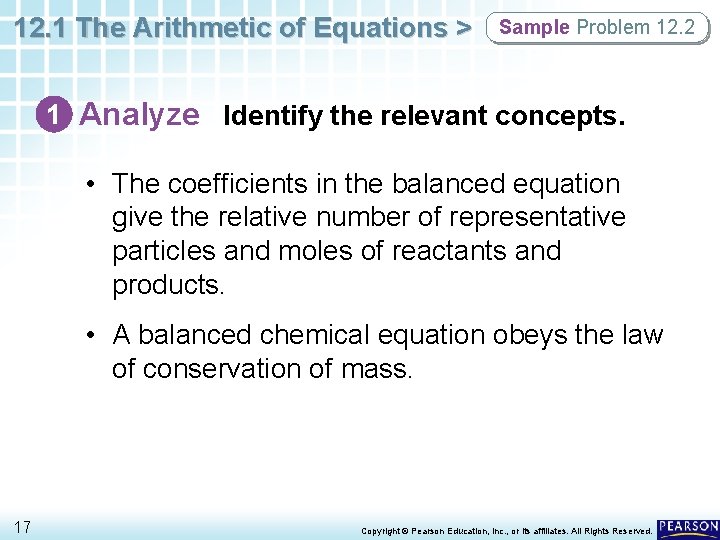
12. 1 The Arithmetic of Equations > Sample Problem 12. 2 1 Analyze Identify the relevant concepts. • The coefficients in the balanced equation give the relative number of representative particles and moles of reactants and products. • A balanced chemical equation obeys the law of conservation of mass. 17 Copyright © Pearson Education, Inc. , or its affiliates. All Rights Reserved.
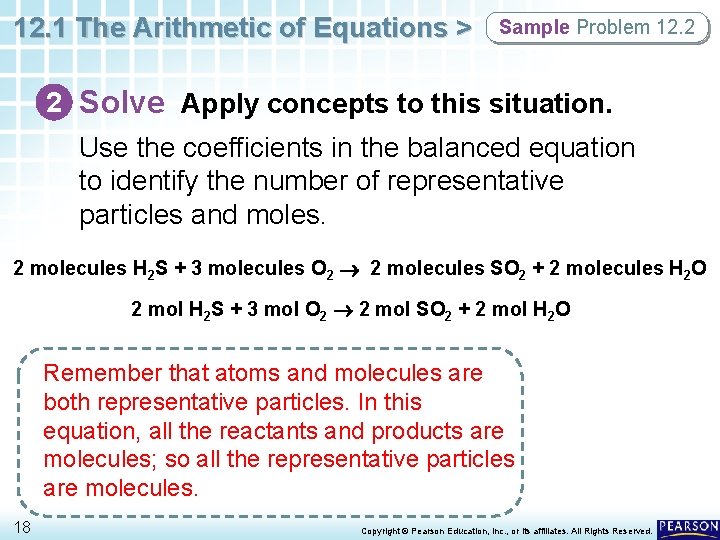
12. 1 The Arithmetic of Equations > Sample Problem 12. 2 2 Solve Apply concepts to this situation. Use the coefficients in the balanced equation to identify the number of representative particles and moles. 2 molecules H 2 S + 3 molecules O 2 2 molecules SO 2 + 2 molecules H 2 O 2 mol H 2 S + 3 mol O 2 2 mol SO 2 + 2 mol H 2 O Remember that atoms and molecules are both representative particles. In this equation, all the reactants and products are molecules; so all the representative particles are molecules. 18 Copyright © Pearson Education, Inc. , or its affiliates. All Rights Reserved.
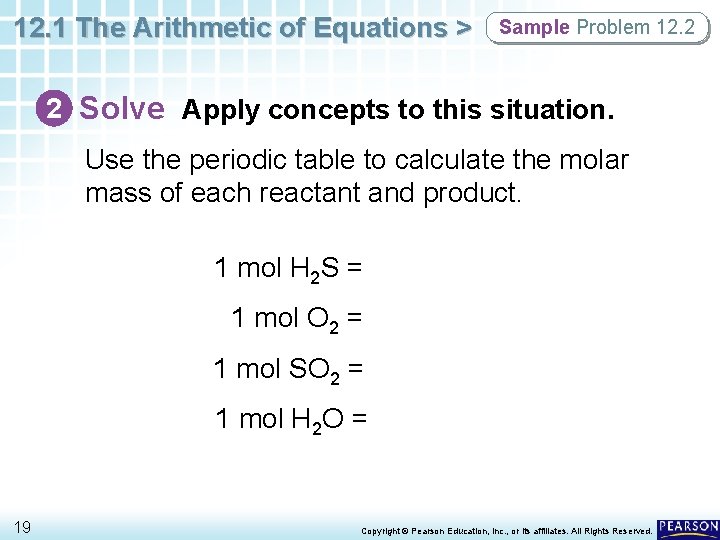
12. 1 The Arithmetic of Equations > Sample Problem 12. 2 2 Solve Apply concepts to this situation. Use the periodic table to calculate the molar mass of each reactant and product. 1 mol H 2 S = 34. 1 g H 2 S 1 mol O 2 = 32. 0 g O 2 1 mol SO 2 = 64. 1 g/mol SO 2 1 mol H 2 O = 18. 0 g/mol H 2 O 19 Copyright © Pearson Education, Inc. , or its affiliates. All Rights Reserved.
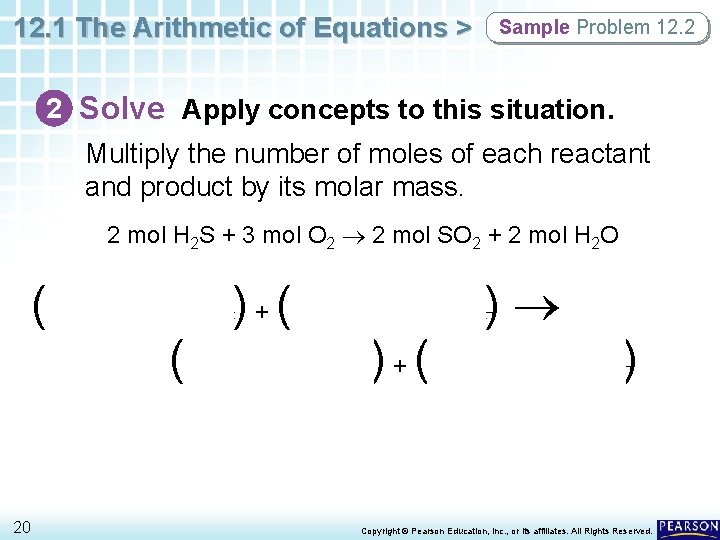
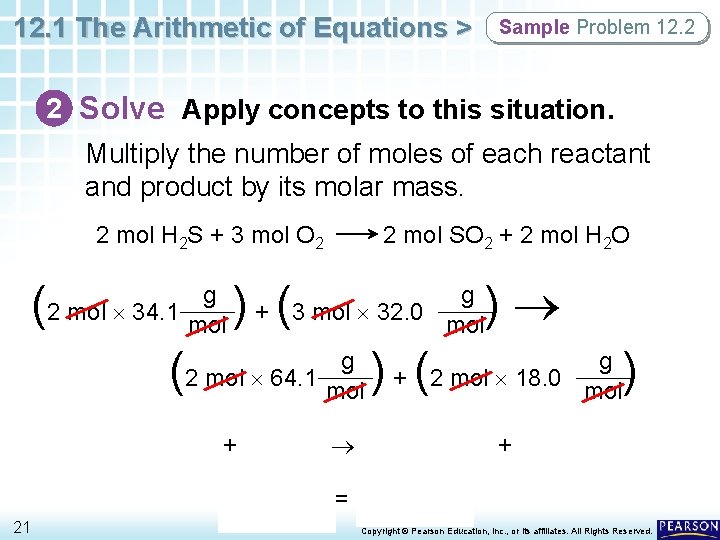
12. 1 The Arithmetic of Equations > Sample Problem 12. 2 2 Solve Apply concepts to this situation. Multiply the number of moles of each reactant and product by its molar mass. 2 mol H 2 S + 3 mol O 2 2 mol SO 2 + 2 mol H 2 O ( g 2 mol 34. 1 mol ( 20 ) ) ( g + 3 mol 32. 0 mol g g 2 mol 64. 1 + 2 mol 18. 0 mol ) ( ) Copyright © Pearson Education, Inc. , or its affiliates. All Rights Reserved.
12. 1 The Arithmetic of Equations > Sample Problem 12. 2 2 Solve Apply concepts to this situation. Multiply the number of moles of each reactant and product by its molar mass. 2 mol H 2 S + 3 mol O 2 ( g 2 mol 34. 1 mol ( 2 mol SO 2 + 2 mol H 2 O ) ) ( g + 3 mol 32. 0 mol g g 2 mol 64. 1 + 2 mol 18. 0 mol ) ( ) 68. 2 g H 2 S + 96. 0 O 2 128. 2 g SO 2 + 36. 0 g H 2 O 164. 2 g = 164. 2 g 21 Copyright © Pearson Education, Inc. , or its affiliates. All Rights Reserved.
12. 1 The Arithmetic of Equations > Chemical Equations The table below summarizes the information derived from the balanced chemical equation for the formation of ammonia. See page 389 N 2(g) + 2 H 2(g) 2 NH 3(g) + 1 2 atoms N + 6 atoms H 2 atoms N and 6 atoms H 1 molecule N 2 + 3 molecules H 2 2 molecules NH 3 10 molecules N 2 + 30 molecules H 2 20 molecules NH 3 ( 6. 02 1023 molecules N 2 ) 3 ( ) 2 ( 6. 02 1023 molecules NH 2 1 mol N 2 + 3 mol H 2 2 mol NH 3 23 g N 2 + 3 2 g H 2 2 17 g NH 3 34 g reactants 34 g products Assume STP 22. 4 L N 2 22 + 6. 02 1023 molecules H 2 + 22. 4 L 67. 2 L H 2 22. 4 L ) 22. 4 L 44. 8 L NH 3 Copyright © Pearson Education, Inc. , or its affiliates. All Rights Reserved.
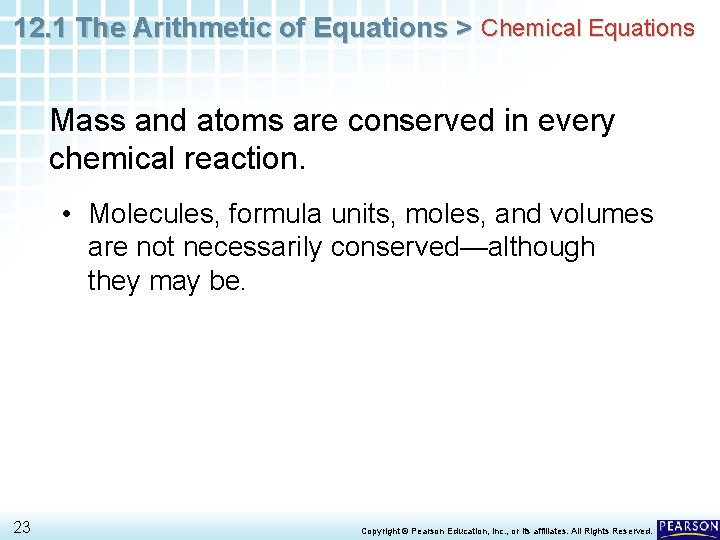
12. 1 The Arithmetic of Equations > Chemical Equations Mass and atoms are conserved in every chemical reaction. • Molecules, formula units, moles, and volumes are not necessarily conserved—although they may be. 23 Copyright © Pearson Education, Inc. , or its affiliates. All Rights Reserved.
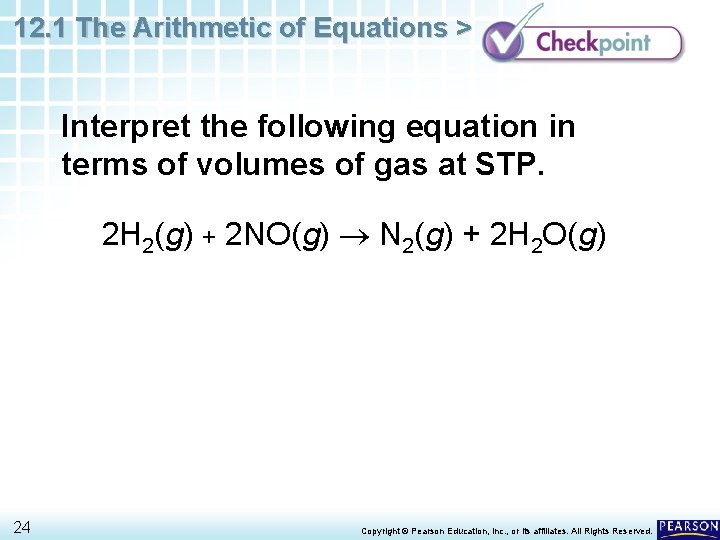
12. 1 The Arithmetic of Equations > Interpret the following equation in terms of volumes of gas at STP. 2 H 2(g) + 2 NO(g) N 2(g) + 2 H 2 O(g) 24 Copyright © Pearson Education, Inc. , or its affiliates. All Rights Reserved.
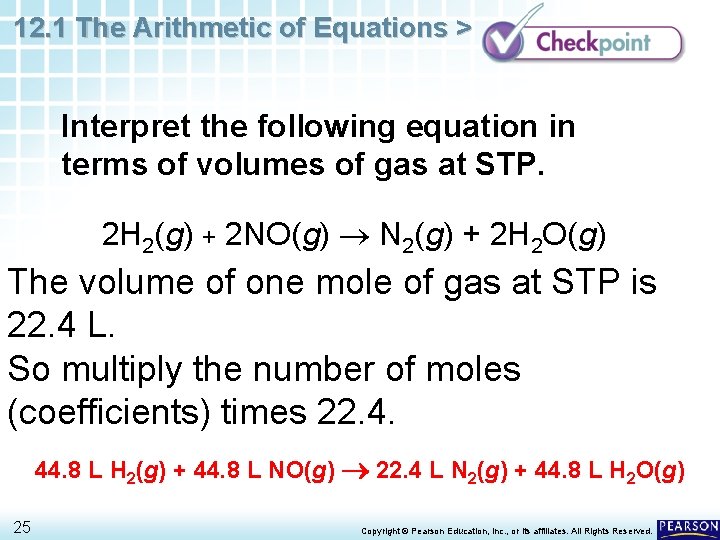
12. 1 The Arithmetic of Equations > Interpret the following equation in terms of volumes of gas at STP. 2 H 2(g) + 2 NO(g) N 2(g) + 2 H 2 O(g) The volume of one mole of gas at STP is 22. 4 L. So multiply the number of moles (coefficients) times 22. 4. 44. 8 L H 2(g) + 44. 8 L NO(g) 22. 4 L N 2(g) + 44. 8 L H 2 O(g) 25 Copyright © Pearson Education, Inc. , or its affiliates. All Rights Reserved.
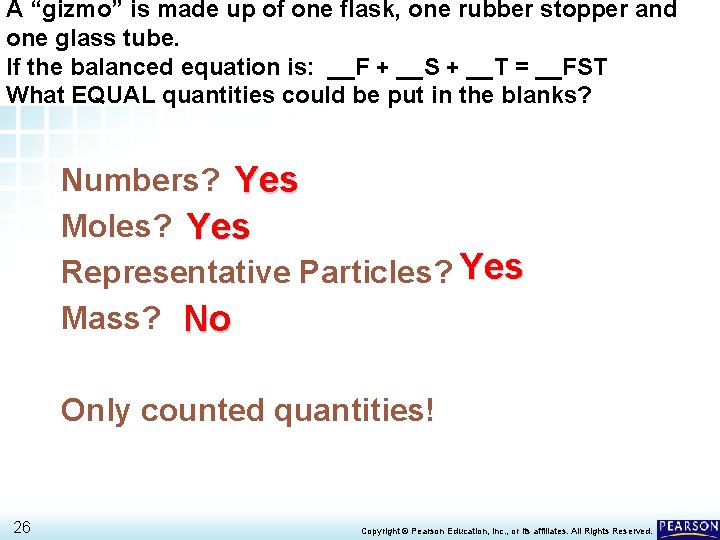
A “gizmo” is made up of one flask, one rubber stopper and 12. 1 glass Thetube. Arithmetic of Equations > one If the balanced equation is: __F + __S + __T = __FST What EQUAL quantities could be put in the blanks? Numbers? Yes Moles? Yes Representative Particles? Yes Mass? No Only counted quantities! 26 Copyright © Pearson Education, Inc. , or its affiliates. All Rights Reserved.
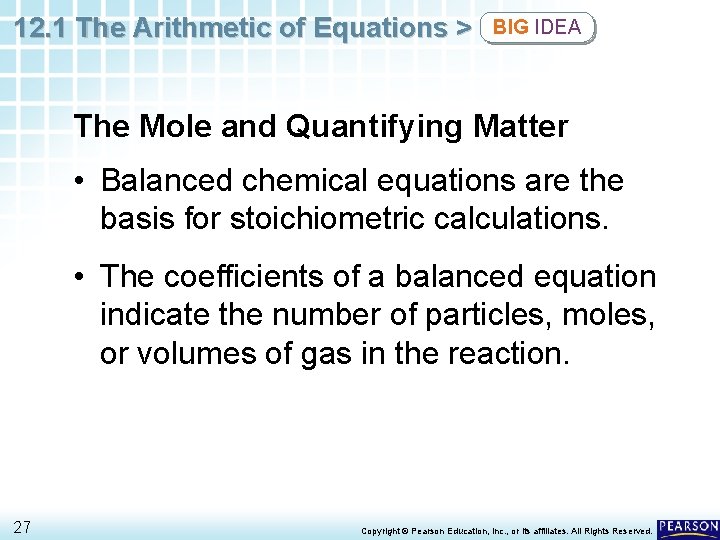
12. 1 The Arithmetic of Equations > BIG IDEA The Mole and Quantifying Matter • Balanced chemical equations are the basis for stoichiometric calculations. • The coefficients of a balanced equation indicate the number of particles, moles, or volumes of gas in the reaction. 27 Copyright © Pearson Education, Inc. , or its affiliates. All Rights Reserved.
12. 1 The Arithmetic of Equations > END OF 12. 1 28 Copyright © Pearson Education, Inc. , or its affiliates. All Rights Reserved.
12. 1 The Arithmetic of Equations > Key Concepts A balanced chemical equation provides the same kind of quantitative information that a recipe does. Chemists use balanced chemical equations as a basis to calculate how much reactant is needed or product is formed in a reaction. A balanced chemical equation can be interpreted in terms of different quantities, including numbers of atoms, molecules, or moles; mass; and volume. 29 Mass and atoms are conserved in every chemical reaction. Copyright © Pearson Education, Inc. , or its affiliates. All Rights Reserved.
12. 1 The Arithmetic of Equations > Glossary Terms stoichiometry: that portion of chemistry dealing with numerical relationships in chemical reactions; the calculation of quantities of substances involved in chemical equations 30 Copyright © Pearson Education, Inc. , or its affiliates. All Rights Reserved.