
The Arithmetic of Equations u OBJECTIVES Calculate the
The Arithmetic of Equations u OBJECTIVES: • Calculate the amount of reactants required, or product formed, in a non-chemical process.
The Arithmetic of Equations u OBJECTIVES: • Interpret balanced chemical equations in terms of interacting moles, representative particles, masses, and gas volume at STP.
Biscuits? u When baking biscuits, a recipe is usually used, telling the exact amount of each ingredient • If you need more, you can double or triple the amount u Thus, a recipe is much like a balanced equation
Stoichiometry u Greek for “measuring elements” u The calculations of quantities in chemical reactions based on a balanced equation. u We can interpret balanced chemical equations several ways.
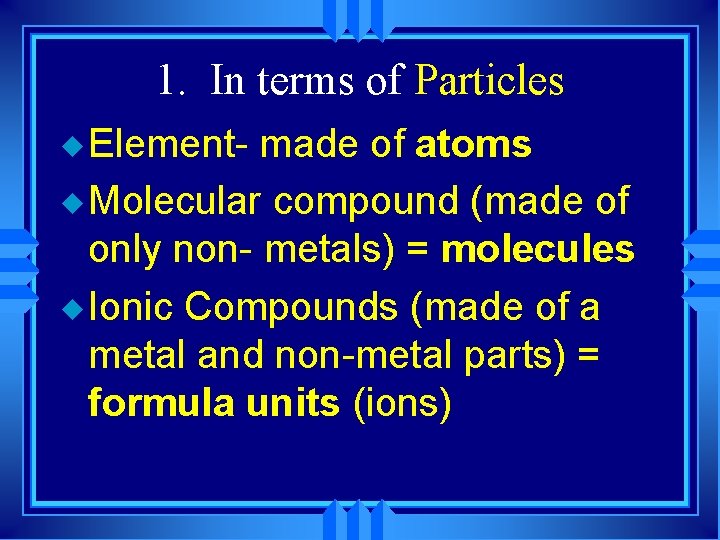
1. In terms of Particles u Element- made of atoms u Molecular compound (made of only non- metals) = molecules u Ionic Compounds (made of a metal and non-metal parts) = formula units (ions)
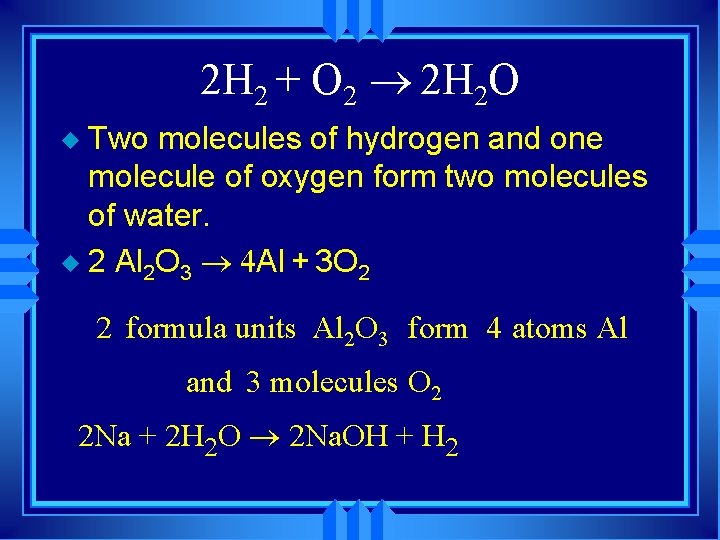
2 H 2 + O 2 ® 2 H 2 O Two molecules of hydrogen and one molecule of oxygen form two molecules of water. u 2 Al 2 O 3 ® 4 Al + 3 O 2 u 2 formula units Al 2 O 3 form 4 atoms Al and 3 molecules O 2 2 Na + 2 H 2 O ® 2 Na. OH + H 2
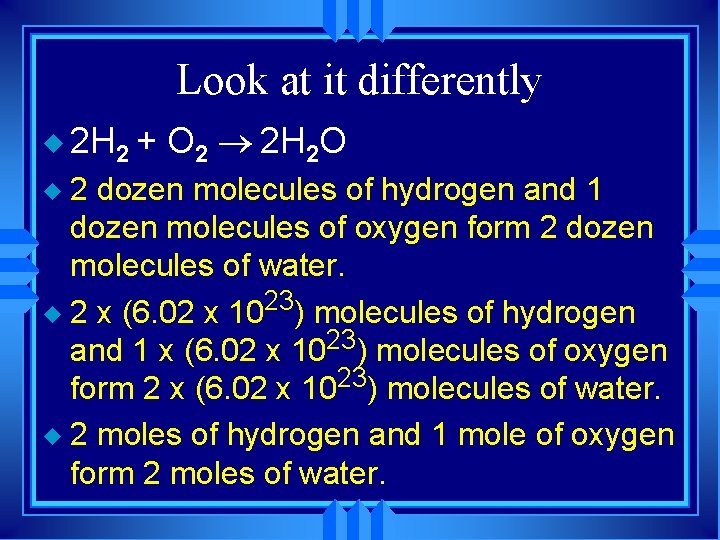
Look at it differently u 2 H 2 + O 2 ® 2 H 2 O 2 dozen molecules of hydrogen and 1 dozen molecules of oxygen form 2 dozen molecules of water. 23 u 2 x (6. 02 x 10 ) molecules of hydrogen and 1 x (6. 02 x 1023) molecules of oxygen form 2 x (6. 02 x 1023) molecules of water. u 2 moles of hydrogen and 1 mole of oxygen form 2 moles of water. u
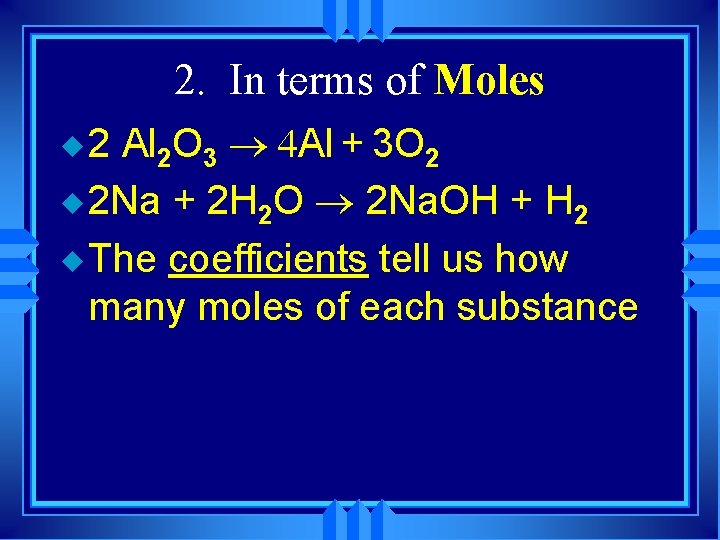
2. In terms of Moles Al 2 O 3 ® 4 Al + 3 O 2 u 2 Na + 2 H 2 O ® 2 Na. OH + H 2 u The coefficients tell us how many moles of each substance u 2
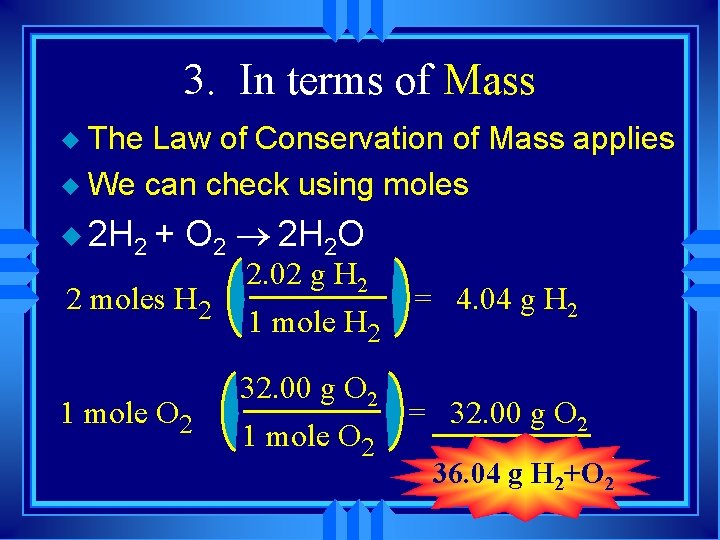
3. In terms of Mass The Law of Conservation of Mass applies u We can check using moles u u 2 H 2 + O 2 ® 2 H 2 O 2 moles H 2 2. 02 g H 2 1 mole O 2 32. 00 g O 2 = 32. 00 g O 2 1 mole O 2 = 4. 04 g H 2 36. 04 g g. HH +O 36. 04 +O 2 2 22
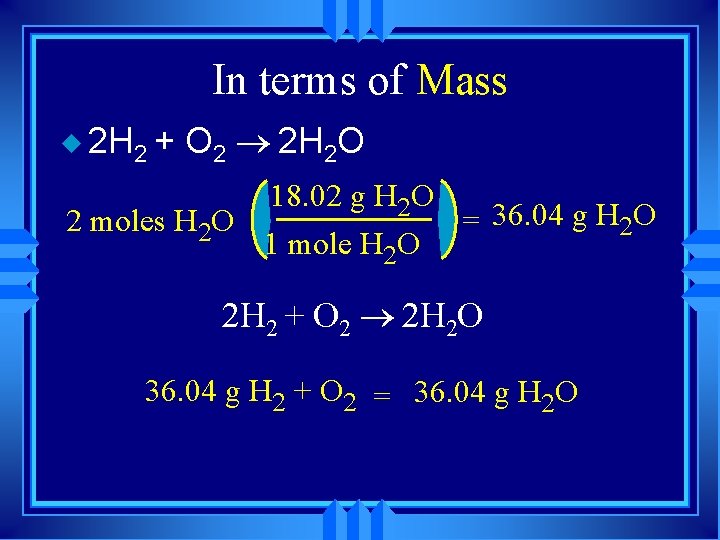
In terms of Mass u 2 H 2 + O 2 ® 2 H 2 O 18. 02 g H 2 O 2 moles H 2 O = 36. 04 g H 2 O 1 mole H 2 O 2 H 2 + O 2 ® 2 H 2 O 36. 04 g H 2 + O 2 = 36. 04 g H 2 O
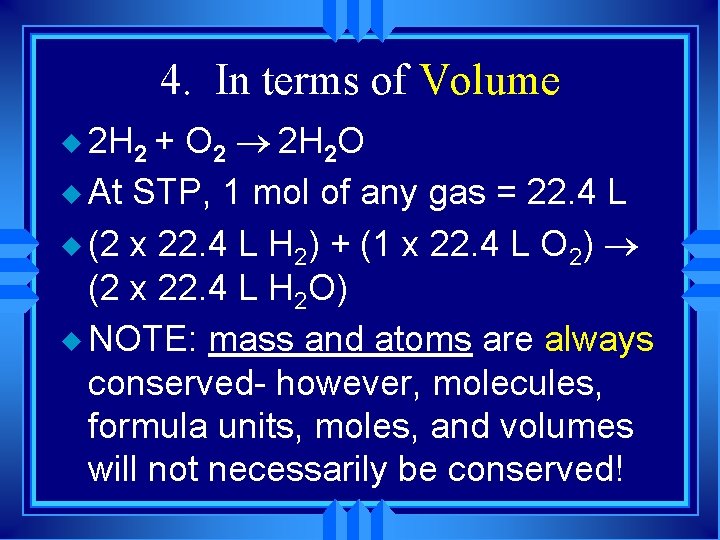
4. In terms of Volume O 2 ® 2 H 2 O u At STP, 1 mol of any gas = 22. 4 L u (2 x 22. 4 L H 2) + (1 x 22. 4 L O 2) ® (2 x 22. 4 L H 2 O) u NOTE: mass and atoms are always conserved- however, molecules, formula units, moles, and volumes will not necessarily be conserved! u 2 H 2 +
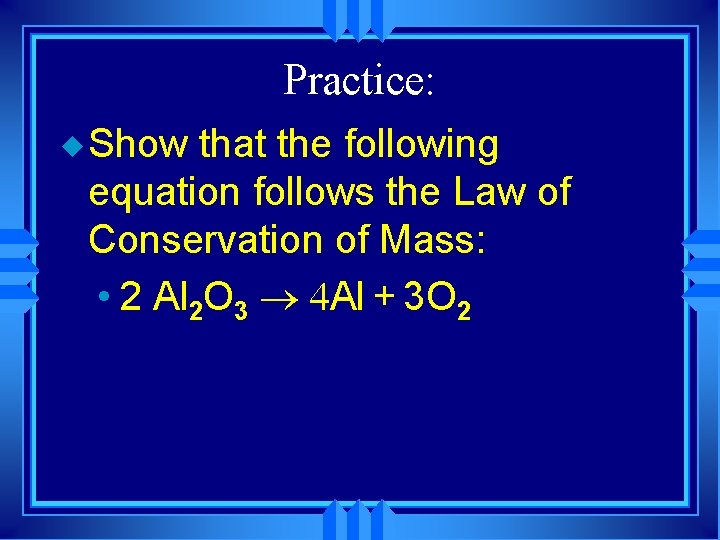
Practice: u Show that the following equation follows the Law of Conservation of Mass: • 2 Al 2 O 3 ® 4 Al + 3 O 2
Section 9. 2 Chemical Calculations u OBJECTIVES: • Construct mole ratios from balanced chemical equations, and apply these ratios in mole -mole stoichiometric calculations.
Section 9. 2 Chemical Calculations u OBJECTIVES: • Calculate stoichiometric quantities from balanced chemical equations using units of moles, mass, representative particles, and volumes of gases at STP.
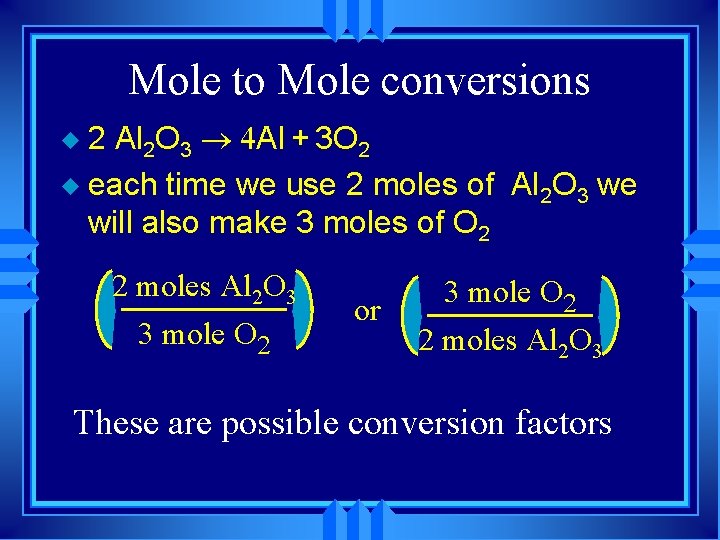
Mole to Mole conversions 2 Al 2 O 3 ® 4 Al + 3 O 2 u each time we use 2 moles of Al 2 O 3 we will also make 3 moles of O 2 u 2 moles Al 2 O 3 3 mole O 2 or 3 mole O 2 2 moles Al 2 O 3 These are possible conversion factors
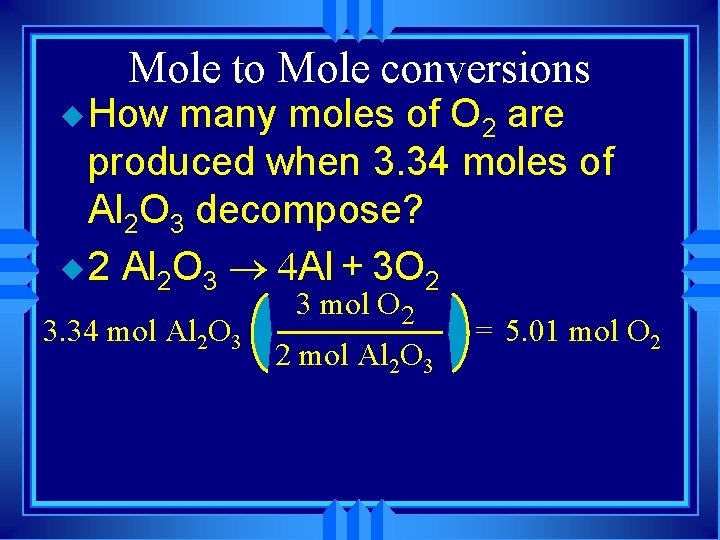
Mole to Mole conversions u How many moles of O 2 are produced when 3. 34 moles of Al 2 O 3 decompose? u 2 Al 2 O 3 ® 4 Al + 3 O 2 3. 34 mol Al 2 O 3 3 mol O 2 2 mol Al 2 O 3 = 5. 01 mol O 2
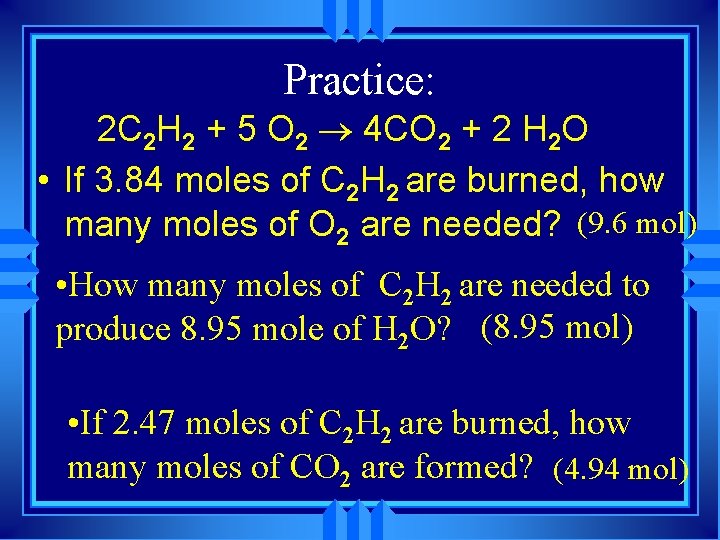
Practice: 2 C 2 H 2 + 5 O 2 ® 4 CO 2 + 2 H 2 O • If 3. 84 moles of C 2 H 2 are burned, how many moles of O 2 are needed? (9. 6 mol) • How many moles of C 2 H 2 are needed to produce 8. 95 mole of H 2 O? (8. 95 mol) • If 2. 47 moles of C 2 H 2 are burned, how many moles of CO 2 are formed? (4. 94 mol)

How do you get good at this?
Mass-Mass Calculations We do not measure moles directly, so what can we do? u We can convert grams to moles • Use the Periodic Table for mass values u Then do the math with the mole ratio • Balanced equation gives mole ratio! u Then turn the moles back to grams • Use Periodic table values u
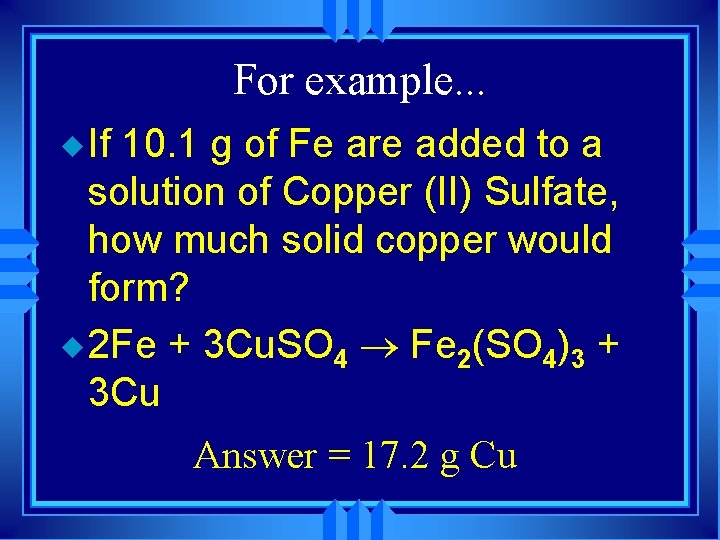
For example. . . u If 10. 1 g of Fe are added to a solution of Copper (II) Sulfate, how much solid copper would form? u 2 Fe + 3 Cu. SO 4 ® Fe 2(SO 4)3 + 3 Cu Answer = 17. 2 g Cu
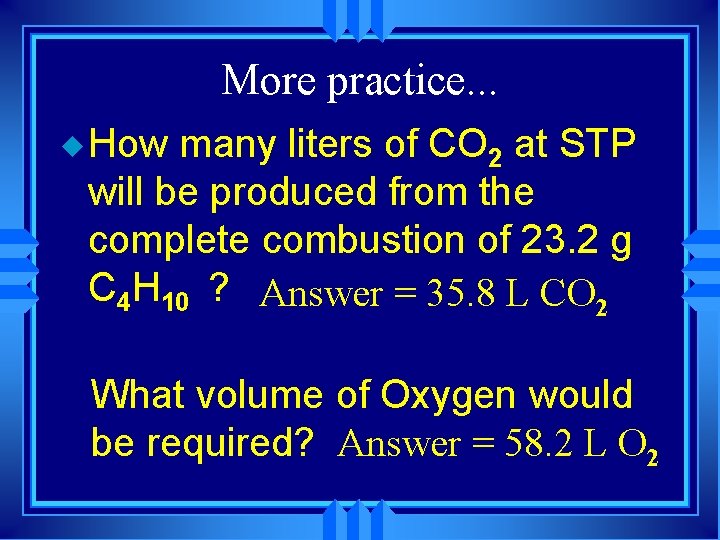
More practice. . . u How many liters of CO 2 at STP will be produced from the complete combustion of 23. 2 g C 4 H 10 ? Answer = 35. 8 L CO 2 What volume of Oxygen would be required? Answer = 58. 2 L O 2
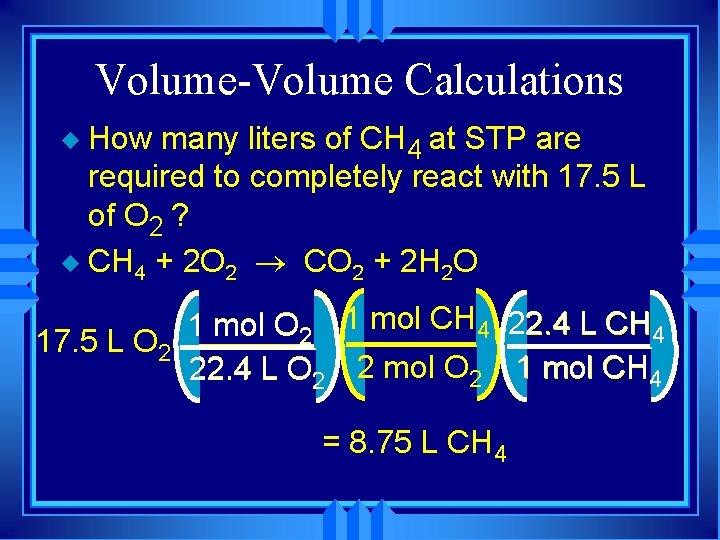
Volume-Volume Calculations How many liters of CH 4 at STP are required to completely react with 17. 5 L of O 2 ? u CH 4 + 2 O 2 ® CO 2 + 2 H 2 O u 1 mol O 2 1 mol CH 4 22. 4 L CH 4 17. 5 L O 2 22. 4 L O 2 2 mol O 2 1 mol CH 4 = 8. 75 L CH 4
Avogadro told us: u Equal volumes of gas, at the same temperature and pressure contain the same number of particles. u Moles are numbers of particles u You can treat reactions as if they happen liters at a time, as long as you keep the temperature and pressure the same.
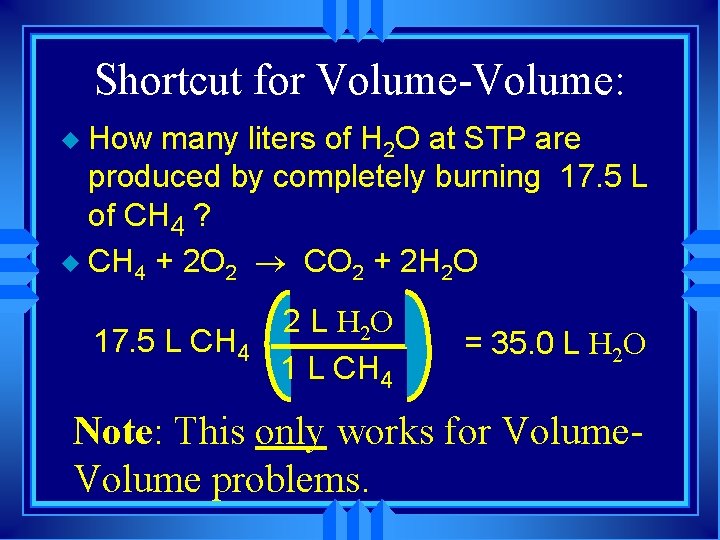
Shortcut for Volume-Volume: How many liters of H 2 O at STP are produced by completely burning 17. 5 L of CH 4 ? u CH 4 + 2 O 2 ® CO 2 + 2 H 2 O u 17. 5 L CH 4 2 L H 2 O 1 L CH 4 = 35. 0 L H 2 O Note: This only works for Volume problems.
Section 9. 3 Limiting Reagent & Percent Yield u OBJECTIVES: • Identify and use the limiting reagent in a reaction to calculate the maximum amount of product(s) produced, and the amount of excess reagent.
Section 9. 3 Limiting Reagent & Percent Yield u OBJECTIVES: • Calculate theoretical yield, actual yield, or percent yield, given appropriate information.
“Limiting” Reagent If you are given one dozen loaves of bread, a gallon of mustard, and three pieces of salami, how many salami sandwiches can you make? u The limiting reagent is the reactant you run out of first. u The excess reagent is the one you have left over. u The limiting reagent determines how much product you can make u
How do you find out? u Do two stoichiometry problems. u The one that makes the least product is the limiting reagent. u For example u Copper reacts with sulfur to form copper ( I ) sulfide. If 10. 6 g of copper reacts with 3. 83 g S how much product will be formed?
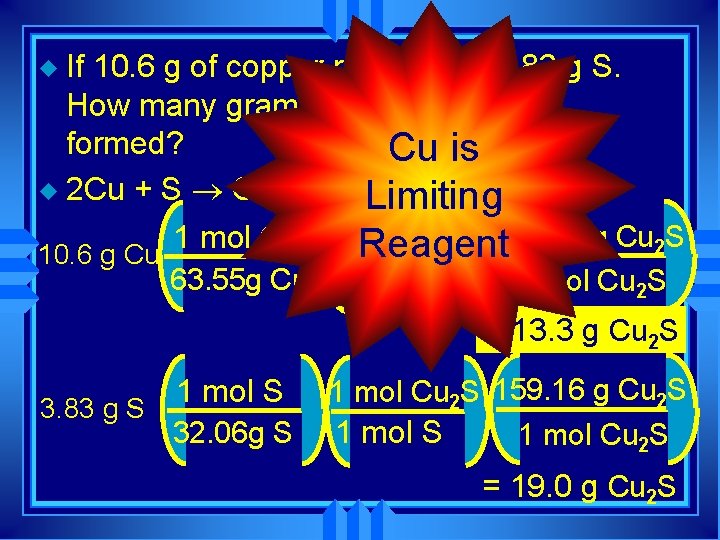
If 10. 6 g of copper reacts with 3. 83 g S. How many grams of product will be formed? Cu is u 2 Cu + S ® Cu 2 S Limiting u 1 mol Cu 2 S 159. 16 g Cu 2 S 1 mol Cu Reagent 10. 6 g Cu 63. 55 g Cu 2 mol Cu 1 mol Cu 2 S = 13. 3 g Cu 2 S 1 mol S 3. 83 g S 32. 06 g S 1 mol Cu 2 S 159. 16 g Cu 2 S 1 mol Cu 2 S = 19. 0 g Cu 2 S
Another example u If 10. 1 g of magnesium and 2. 87 L of HCl gas are reacted, how many liters of gas will be produced? u How many grams of solid? u How much excess reagent remains?
Still another example u If 10. 3 g of aluminum are reacted with 51. 7 g of Cu. SO 4 how much copper will be produced? u How much excess reagent will remain?
Yield The amount of product made in a chemical reaction. u There are three types: 1. Actual yield- what you get in the lab when the chemicals are mixed 2. Theoretical yield- what the balanced equation tells should be made 3. Percent yield = Actual X 100 Theoretical u
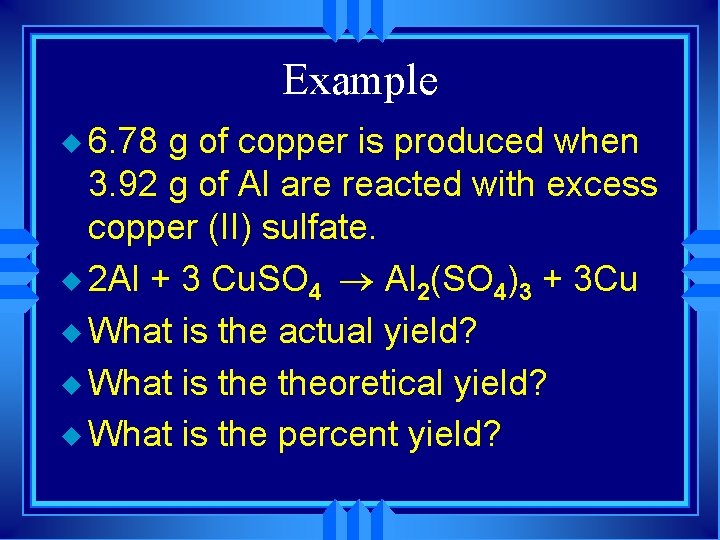
Example u 6. 78 g of copper is produced when 3. 92 g of Al are reacted with excess copper (II) sulfate. u 2 Al + 3 Cu. SO 4 ® Al 2(SO 4)3 + 3 Cu u What is the actual yield? u What is theoretical yield? u What is the percent yield?
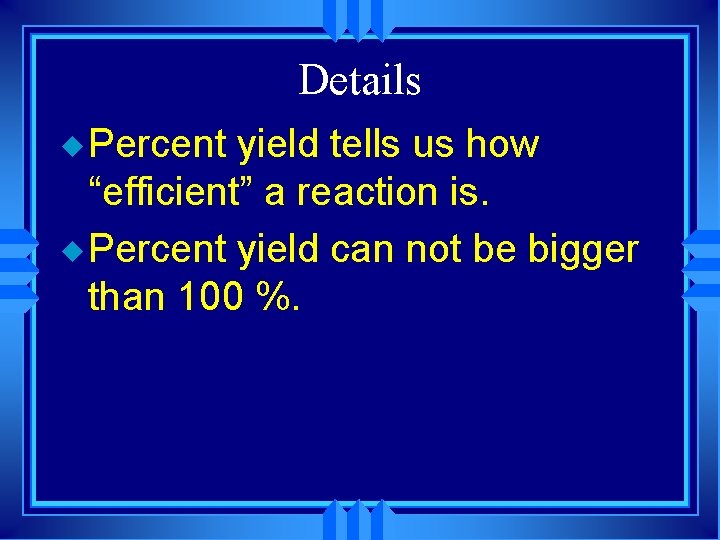
Details u Percent yield tells us how “efficient” a reaction is. u Percent yield can not be bigger than 100 %.
- Slides: 35