Wound Care E FAKHARIAN MD ASSISTANT PROFESSOR OF




- Slides: 58
Wound Care E. FAKHARIAN, MD. ASSISTANT PROFESSOR OF NEUROSURGERY KASHAN UNIVERSITY OF MEDICAL SCIENCES KASHAN-IRAN <efakharian@gmail. com>
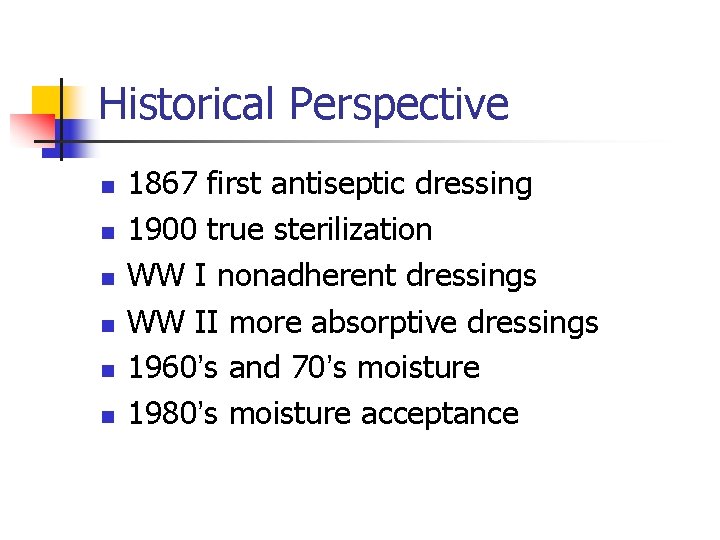
Historical Perspective n n n 1867 first antiseptic dressing 1900 true sterilization WW I nonadherent dressings WW II more absorptive dressings 1960’s and 70’s moisture 1980’s moisture acceptance
Goals of Wound Care n n n Minimizing infective risks Removing dead and devitalized tissue Allowing for wound drainage Promoting wound epithelialization and contraction Tissue perfusion Adequate nutrition
n Factors That Delay Wound Healing: Intrinsic Factors Extrinsic Factors
Factors That Delay Wound Healing: Intrinsic Wound infection - Bacterial count - Colonization VS infection - Assessment of infection n Foreign bodies Adequacy of blood supply
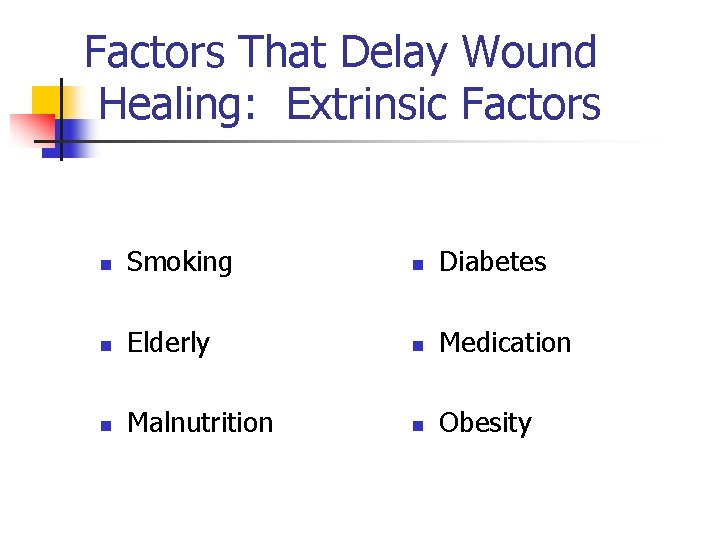
Factors That Delay Wound Healing: Extrinsic Factors n Smoking n Diabetes n Elderly n Medication n Malnutrition n Obesity
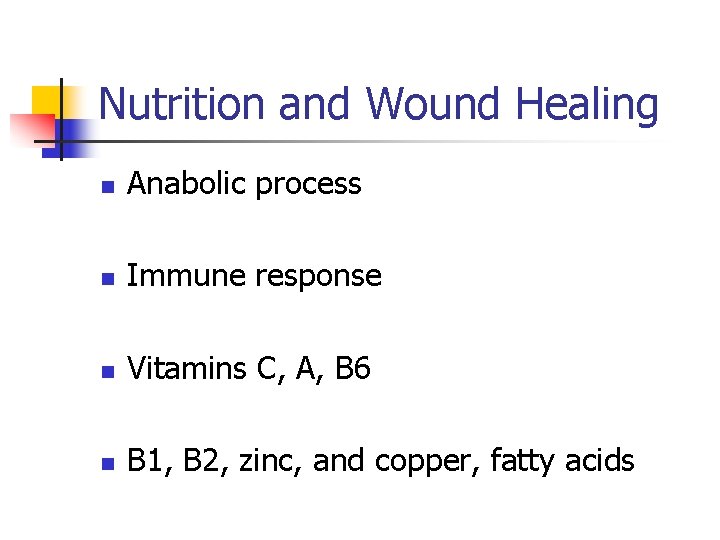
Nutrition and Wound Healing n Anabolic process n Immune response n Vitamins C, A, B 6 n B 1, B 2, zinc, and copper, fatty acids
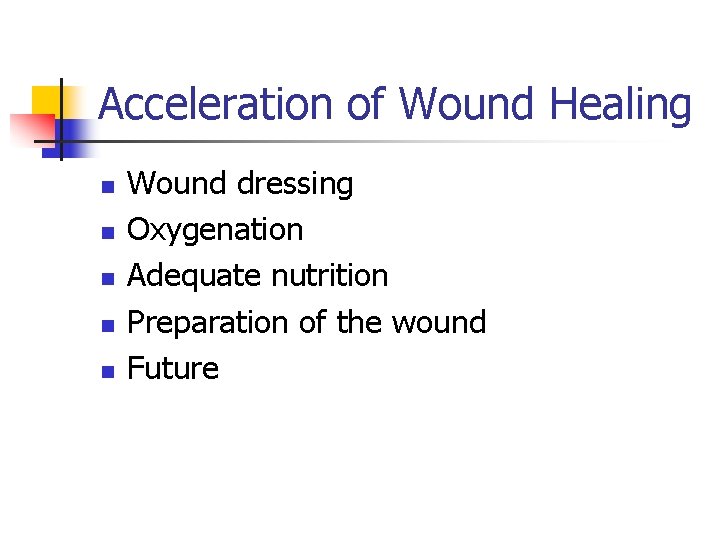
Acceleration of Wound Healing n n n Wound dressing Oxygenation Adequate nutrition Preparation of the wound Future
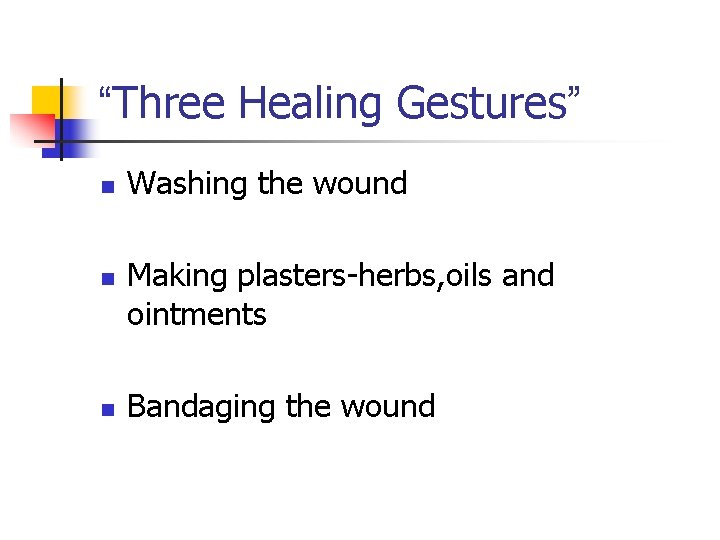
“Three Healing Gestures” n n n Washing the wound Making plasters-herbs, oils and ointments Bandaging the wound
Mechanism Shearing (perpendicular division of tissue) Tearing (<90 degree angle) Compressive (perpendicular with ragged edges)
Environment Household – generally “clean”, but not “sterile” Outdoor – contaminated in varying degrees (the barn, industrial machinery) Bites (human, animal) – highly contaminated
Modifying Factors Age of wound: Rule of Thumb +/ - 12 hr. Wound: Type (mechanism, sharp vs blunt object) Location and vascularity (face, scalp >12 hr. ? ) Contamination Comorbid factors
Co morbid Factors Age Medical hx. – anemia, nutrition, DM, PVD, ETOH, uremia, immunocompromised Medications – steroids, NSAIDS, anticoagulants, anti-neoplastics
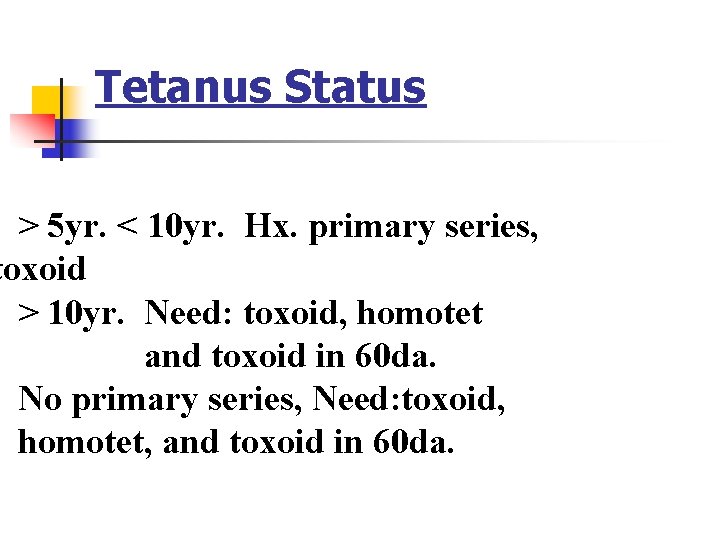
Tetanus Status > 5 yr. < 10 yr. Hx. primary series, toxoid > 10 yr. Need: toxoid, homotet and toxoid in 60 da. No primary series, Need: toxoid, homotet, and toxoid in 60 da.
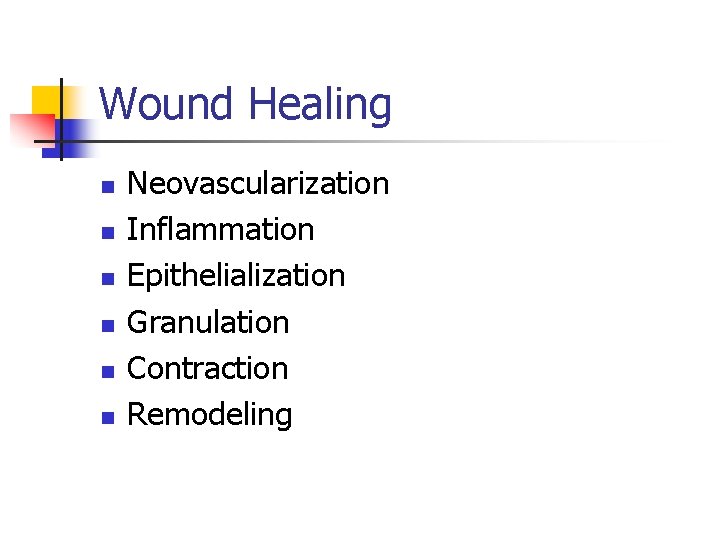
Wound Healing n n n Neovascularization Inflammation Epithelialization Granulation Contraction Remodeling
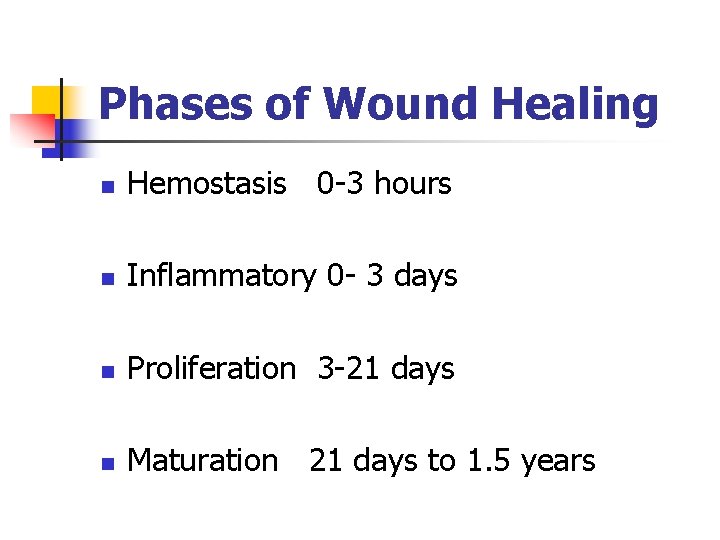
Phases of Wound Healing n Hemostasis 0 -3 hours n Inflammatory 0 - 3 days n Proliferation 3 -21 days n Maturation 21 days to 1. 5 years
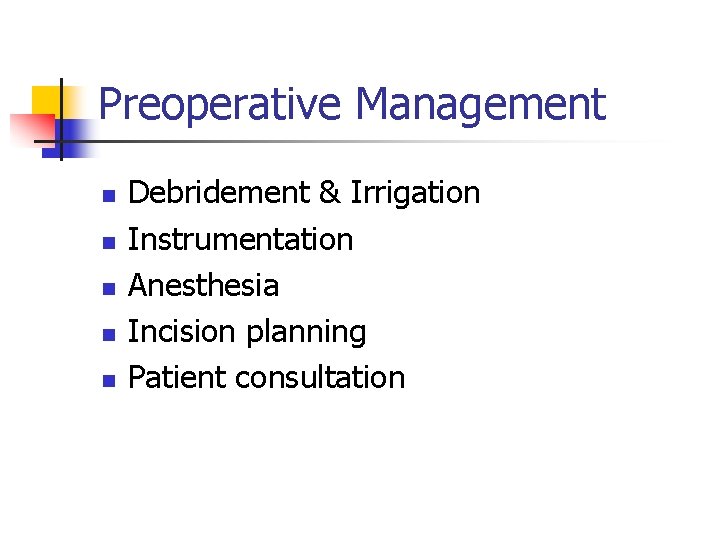
Preoperative Management n n n Debridement & Irrigation Instrumentation Anesthesia Incision planning Patient consultation
Intraoperative Precautions n n n n Incision placement Undermine where necessary Meticulous hemostasis Dead space obliteration **Dermal closure** Suture type & placement Anti-tension taping of wound
Postoperative wound care n n n Topical emollients for moisture Frequent cleaning with H 2 O 2 Early dermabrasion of irregular wounds Avoidance of sun, water Steroid creams, retinoids, etc.
Goals of scar revision n n Flat scar, level with surrounding skin Good color match with local tissue Narrow Parallel to the patient’s RSTL Absence of straight, unbroken lines
ASSESSMENT
Neurovascular Pulses, capillary refill, motor/sensory Musculoskeletal Muscle, bone, tendon, joint Foreign Body Visualize/x-ray (radiopaque materials)
PREPARATION ir Clip, not shave Shaving increases incidence of wound infection NEVER SHAVE EYEBROWS
Irrigation Volume 250 – 1000 + ml. NS 60 ml. Syringe and 16 – 18 ga. intracath
Irrigation üDo not scrub wounds or use full strength Betadine for irrigation (denatures protein, impairs wound healing) 10 : 1 solution for irrigation or temporary dressing
Repair n Sutures n n n Act as splints Should be Passive Aim to Return Tissues to n n Original Position New preplanned Position
Sutures n Immobilize Tissues to Allow n n n n Rapid healing Primary intention Less bleeding Reduced haematoma Reduced oedema Reduced discomfort Reduced risk of infection
Sutures n May Aid haemostasis n n n By direct vessel ligation By compression of vessel against bone edge By retaining a pack or dressing
Suture Needles n n n Eyed Swaged Straight/Curved Large/Micro Taper/Spatula Round Bodied/Cutting/Reverse Cutting
Sutures n Physical Properties n n n n Size Strength Elongation Elasticity Torsional Stiffness Flexibility Surface Capilliarity
Selection of Sutures n n How long is a suture to be responsible for wound strength? Is absolute fixation required? Is there a risk of infection? How does the choice of sutures affect the tissues?
Selection of Sutures n n How does the suture affect the healing process? What size of suture n n Is strong enough? Provides adequate fixation?
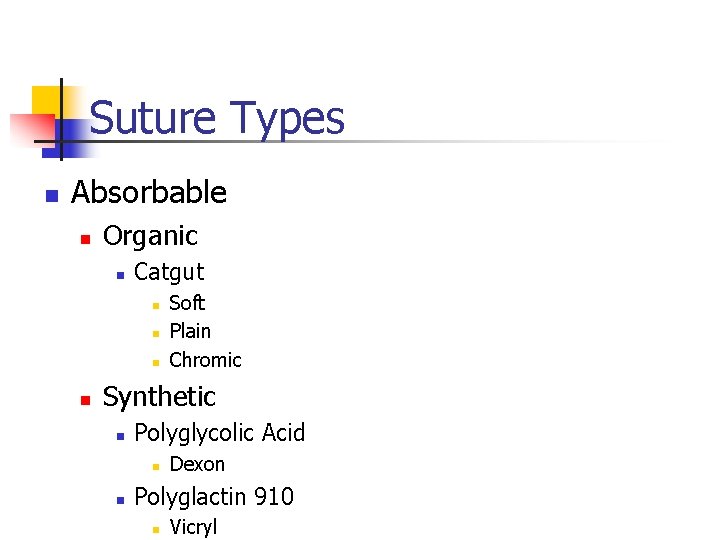
Suture Types n Absorbable n Organic n Catgut n n Soft Plain Chromic Synthetic n Polyglycolic Acid n n Dexon Polyglactin 910 n Vicryl
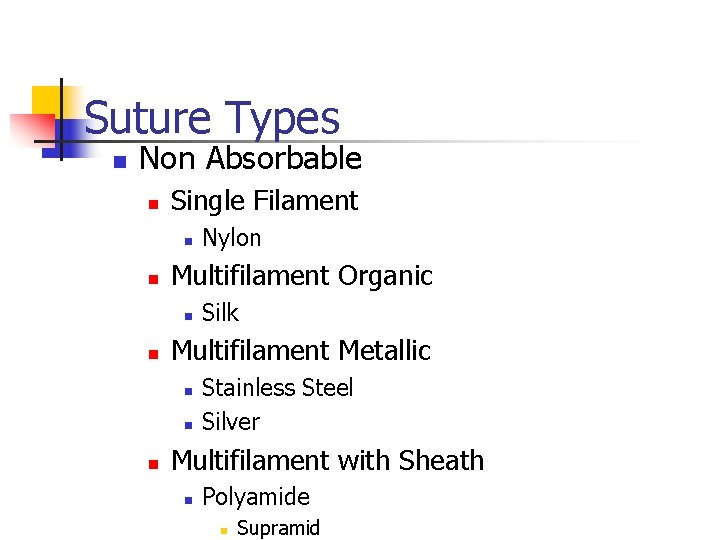
Suture Types n Non Absorbable n Single Filament n n Multifilament Organic n n Silk Multifilament Metallic n n n Nylon Stainless Steel Silver Multifilament with Sheath n Polyamide n Supramid
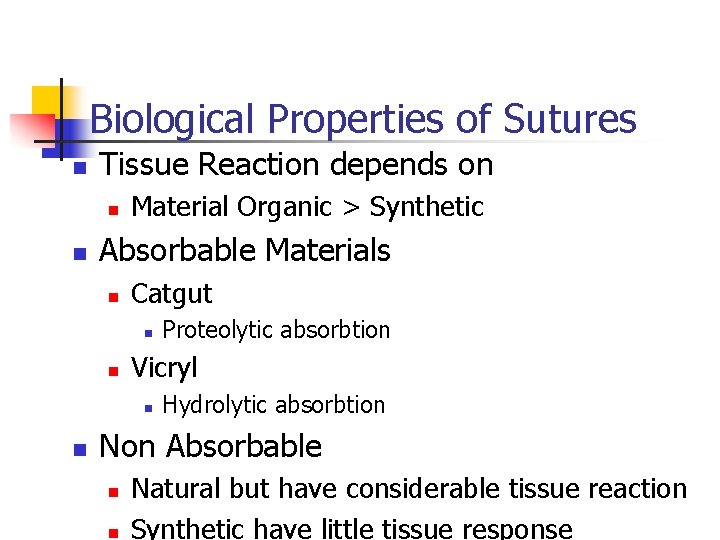
Biological Properties of Sutures n Tissue Reaction depends on n n Material Organic > Synthetic Absorbable Materials n Catgut n n Vicryl n n Proteolytic absorbtion Hydrolytic absorbtion Non Absorbable n n Natural but have considerable tissue reaction Synthetic have little tissue response
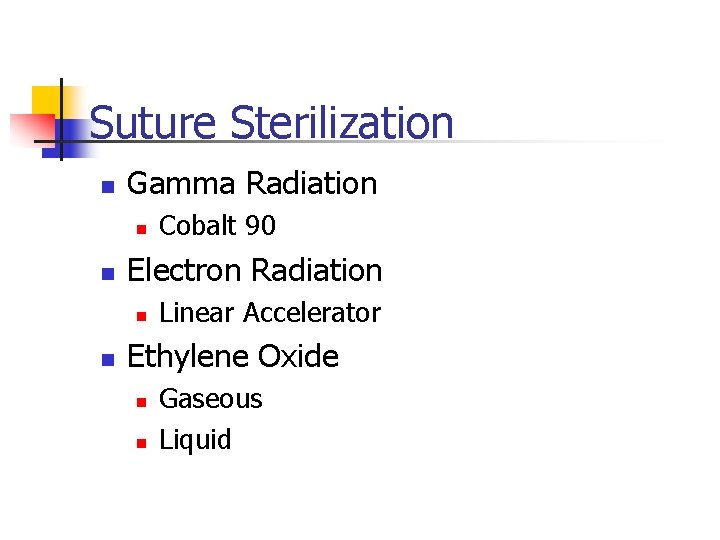
Suture Sterilization n Gamma Radiation n n Electron Radiation n n Cobalt 90 Linear Accelerator Ethylene Oxide n n Gaseous Liquid
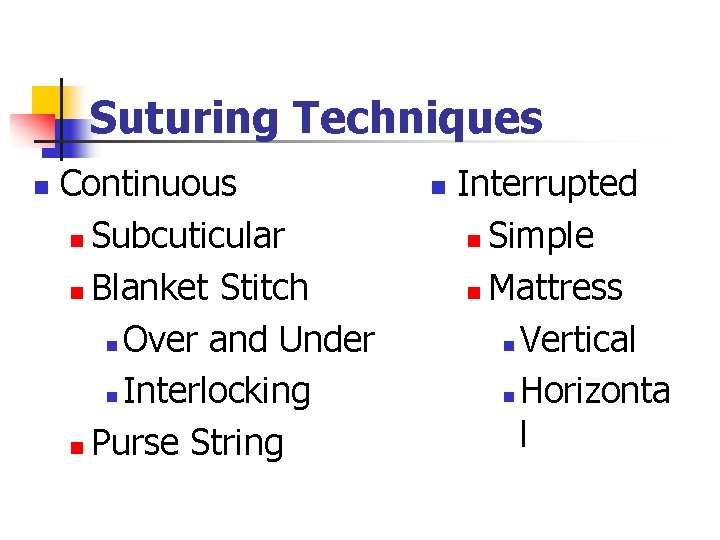
Suturing Techniques n Continuous n Subcuticular n Blanket Stitch n Over and Under n Interlocking n Purse String n Interrupted n Simple n Mattress n Vertical n Horizonta l
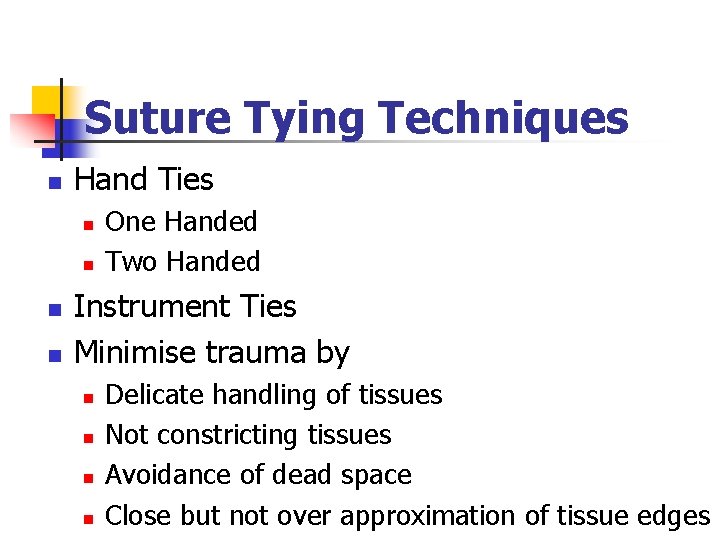
Suture Tying Techniques n Hand Ties n n One Handed Two Handed Instrument Ties Minimise trauma by n n Delicate handling of tissues Not constricting tissues Avoidance of dead space Close but not over approximation of tissue edges
Anesthesia Lidocaine Inject in sub-q tissue ( 21 – 25 ga. needle)
Anesthesia Lidocaine with epinephrine (if you must), but Never in digits, nose, ear, penis Skin Prep Betadine (not in wound) Always prep more area than you think you need
Primary – suture, staples, glue Secondary – granulation and reepitheliazation Delayed primary closure – closure after 48 – 72 hr. Interrupted sutures in ED
DRESSINGS
DRESSINGS Dry sterile dressing – avoid ointments(tend to macerate) id tape on skin if possible Paint skin with tincture of benzoin if you must use tape
DRESSINGS Encircling dressing ( ACE) Do not wrap tightly Immobilization Excessive motion impairs wound healing Splinting may be necessary
Characteristics of Dressings Protect wound from bacteria and foreign material n Absorb exudates n Prevent compression to minimize edema an obliterate dead space n
Dressings n n n Be nonadherent to limit wound disruption Create a warm, moist occluded environment to maximize epithelialization and minimize pain Be esthetically attractive
ANTIBIOTICS
Indications n Contaminated wound n Areas of marginal viability n Wounds involving joints, open fractures n All human bite wounds n Most animal bite wounds n Generally, wounds > 12 hr. old
SPECIAL WOUNDS
Bite Wounds High risk of infection with involvement of bones, joints, tendons, vessels, nerves Puncture wounds (difficult to irrigate and decontaminate)
Dog Bites 75% involve the extremities Most dog bites in children involve an extremity Severe facial lacerations involve the cheeks and lips as they try to "kiss the doggie”
Dog Bites Closure Dog bites – scalp, face, trunk, proximal extremities may be closed if superficial Human bites – “ never” close primarily (delay 48 – 72 hr. )
Puncture Wounds Never close Irrigate drain, if necessary Foot – shoe on or barefoot? Increased infection risk if shoe on
Abscesses n Incise, drain, irrigate, loosely pack with Iodoform gauze Return at 24 hrs. for irrigation fresh pack Return at 48 hrs. for pack removal and healing by granulation
Abscesses New onset DM may present with abcess Antibiotics may be indicated in addition to I&D
Nail / Nail Bed Injury Subungual hematoma, < 40 % nail area, nail bed injury unlikely, but distal phalanx fx. might be present Treatment: Battery cautery to make drainage hole in nail, irrigate with 25 ga. needle and 1% lidocaine Nail Bed - requires surgical repair
Foreign Bodies n Inert – (glass, metal), may leave unremoved if necessary Organic – (wood), must be removed