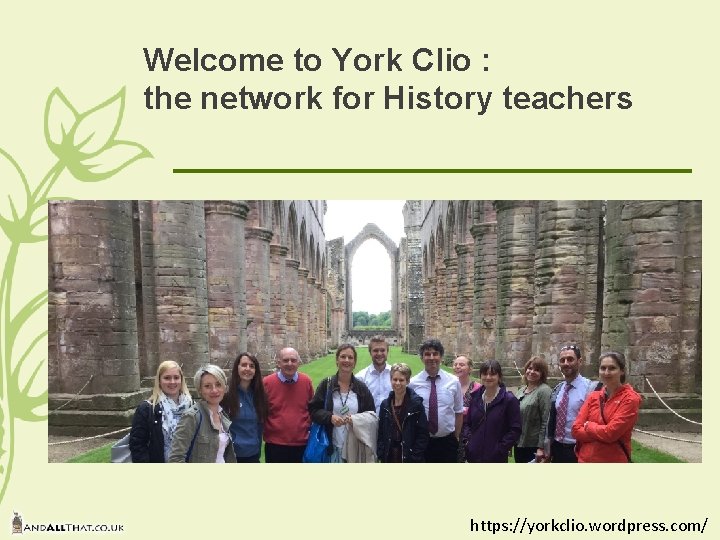
Welcome to York Clio the network for History


- Slides: 40
Welcome to York Clio : the network for History teachers https: //yorkclio. wordpress. com/
Dates for your Diary History nerds – please send me details of up to 5 keen Year 11 or 12 historians. Three meetings over one year. 1. Tues 9 th Oct: Dr John Jenkins discusses Why Becket is more than just a murder. 2. Wed 6 th Feb : Exploring the Borthwick Archives, York 3. Thurs 27 th June: Ian Dawson on Richard the III https: //yorkclio. wordpress. com/
Dates for your Diary HA Yorkshire History Forum, Wed 14 th November 2018, at Leeds Trinity University HA Tudor Day, 23 rd March 2019, Friends Meeting House York. Clio Meetings 28 th June : Using the archives at the Borthwick with students 21 st June: Richard Kerridge on teaching History to the less able
Ofsted, latest thoughts – https: //www. gov. uk/government/speeches/hmcicommentary-curriculum-and-the-new-education-inspection -framework “The research… showed that there was a dearth of understanding about the curriculum in some schools. Too many teachers and leaders have not been trained to think deeply about what they want their pupils to learn and how they are going to teach it. ” Amanda Spielman
What questions did Ofsted ask? – how do curriculum managers perceive knowledge within their curriculum? – what do curriculum managers do when designing, implementing and evaluating the curriculum? – how have curriculum managers developed the curriculum over time? – is there a common conceptual language employed by curriculum managers?
Alex Ford is lead tutor on the PGCE History course at Leeds Trinity University and SHP Regional Advisor for Yorkshire and the Humber. Prior to 2016, he was head of a large and successful history department in Leeds. He has eleven years teaching experience in a range of secondary settings. Alex speaks at a wide range of educational conferences and has delivered workshops on planning, assessment and progression for Teach First, the Historical Association and the Schools History Project. He has also worked with OCR on the development of the new GCSE SHP History specification. Alex is currently writing the "Making of America" textbook for Hodder Education's new GCSE series.
The first fruits… What have we learned about new GCSEs? … And what should we do now? Alex Ford - @apf 102 Leeds Trinity University
How were your GCSE ‘fruit’ this year? What questions do you have now?
Five things we learned from this year’s results…
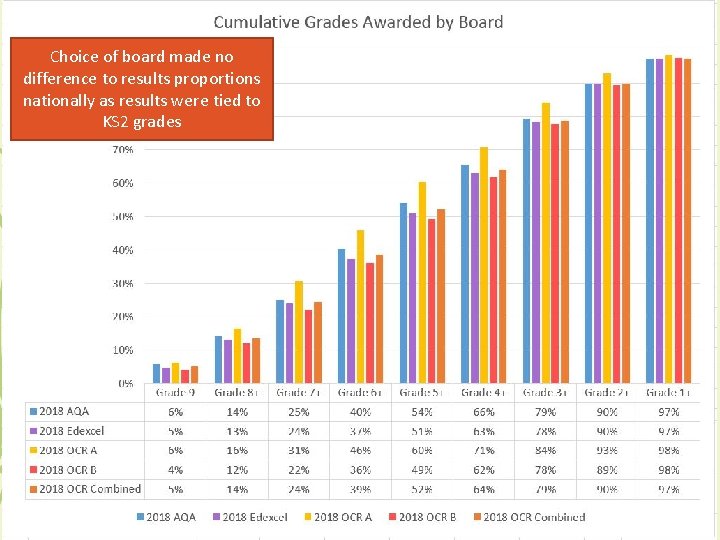
Choice of board made no difference to results proportions nationally as results were tied to KS 2 grades 1. The overall results were as expected
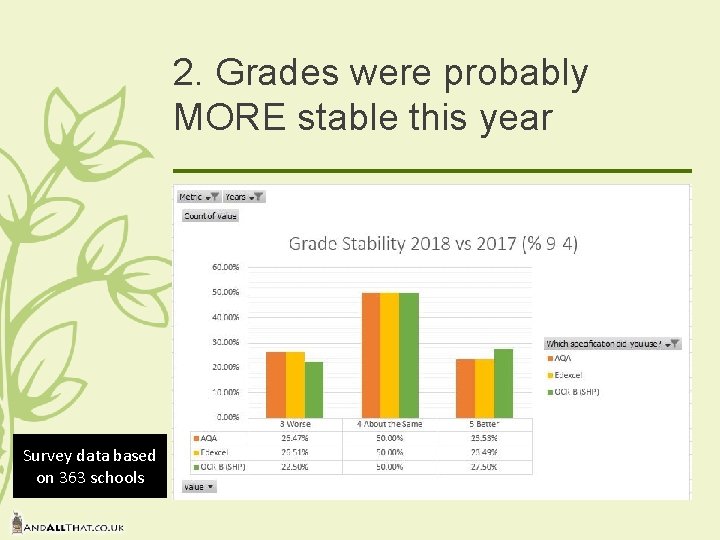
2. Grades were probably MORE stable this year Survey data based on 363 schools
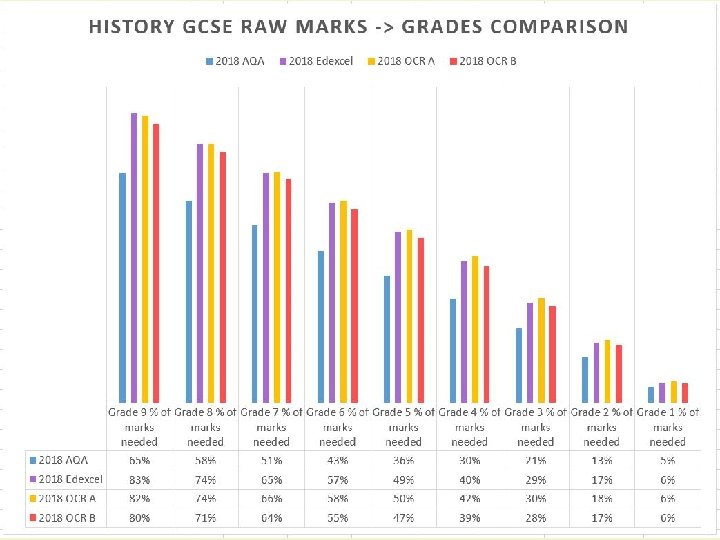
3. Pupils struggled much more with the new papers A pupil who gained a Grade 1 probably only got around 10 marks in total over three papers. Or in other words, they answered only 1 complete question correctly in 3 papers and over 4 hours of exams. By contrast a pupil in 2017 was getting around 36 marks across their papers, and therefore answering at least 3 whole questions correctly. Takeaway Your top end pupils are probably fine with all the changes, but your weaker students are going to struggle. Strategies to finish papers, or answer more questions will be key – confidence building and resilience work! It will also be key to boost core knowledge so that more questions are accessible.
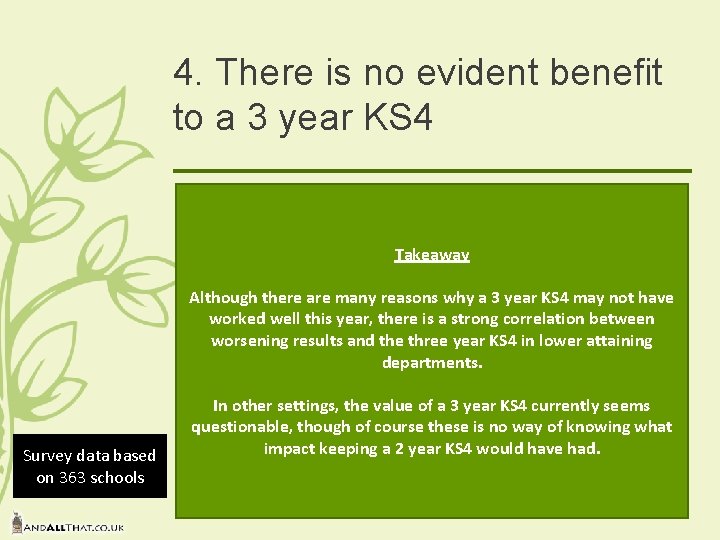
4. There is no evident benefit to a 3 year KS 4 100% 102% 2 yr vs 3 yr KS 4 Completion by School by Type Board 2 yr vs vs 3 yr KS 4 90%+ Completion by Board Takeaway 100% 90% 80% 98% 70% 96% Although there are many reasons why a 3 year KS 4 may not have 60% 94% 50% worked well this year, there is a strong correlation between 50% 92% worsening results and the three year KS 4 in lower attaining 40% 90% 30% 88% 20% 86% departments. 10% In other settings, the value of a 3 year KS 4 currently seems 84% Survey data based on 363 schools 82% 0% 0% questionable, though of course these is no way of knowing what Low AQA Ability Avg Edexcel Ability High OCR Ability B impact keeping a 2 year KS 4 would have had. 2 yr Same/Better 100%+ complete Results 3 yr 100%+ Same/Better complete Results
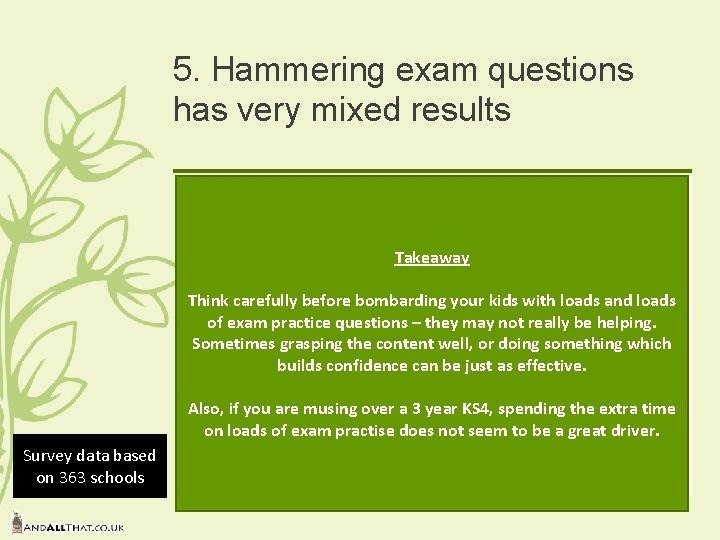
5. Hammering exam questions has very mixed results Takeaway Think carefully before bombarding your kids with loads and loads of exam practice questions – they may not really be helping. Sometimes grasping the content well, or doing something which builds confidence can be just as effective. Also, if you are musing over a 3 year KS 4, spending the extra time on loads of exam practise does not seem to be a great driver. Survey data based on 363 schools
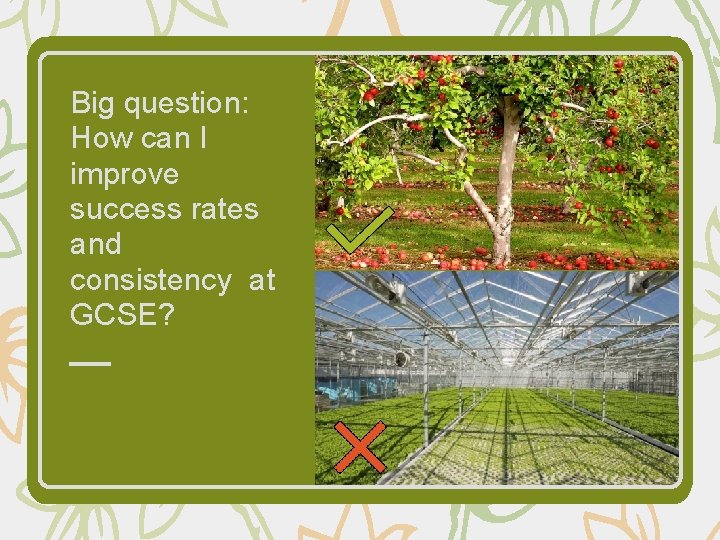
Big question: How can I improve success rates and consistency at GCSE?
Some thoughts from students (Burn & Todd, 2018) – Students believed GCSE was “harder now than it used to be” – an issue of reflected concern? – Students commented on course being rushed, repetitive and boring – an issue of curriculum – Students viewed the outcomes of history as “Remembering lots of information, lots of key facts. ” – a paucity of explanations of purpose: the “because we have to” approach
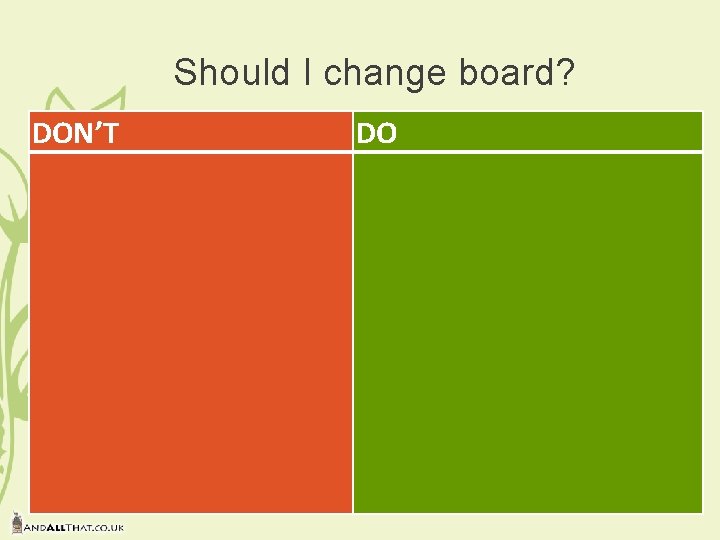
Should I change board? DON’T DO Don’t swap based on the number of Do look closely at which specifications have 7 s/4 s awarded. the most appropriate content for your pupils. Don’t swap to a board because it has Do consider the weight of content in each lower grade boundaries. specification and how this might turn into Don’t switch because you normally get questions. better results. You might just need to look carefully at support networks and understand the paper differently. the quality of published resources for each spec. Do look closely at which questions are the best history. All boards have some hoop jumping, but some have more hoops than others.
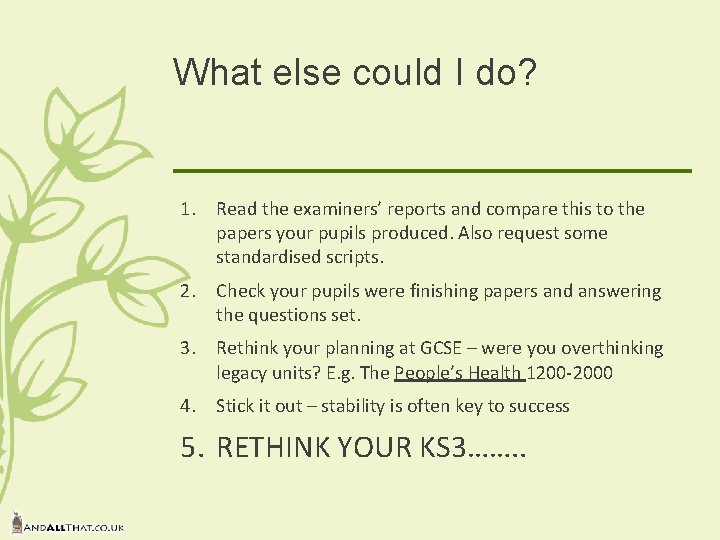
What else could I do? 1. Read the examiners’ reports and compare this to the papers your pupils produced. Also request some standardised scripts. 2. Check your pupils were finishing papers and answering the questions set. 3. Rethink your planning at GCSE – were you overthinking legacy units? E. g. The People’s Health 1200 -2000 4. Stick it out – stability is often key to success 5. RETHINK YOUR KS 3……. .
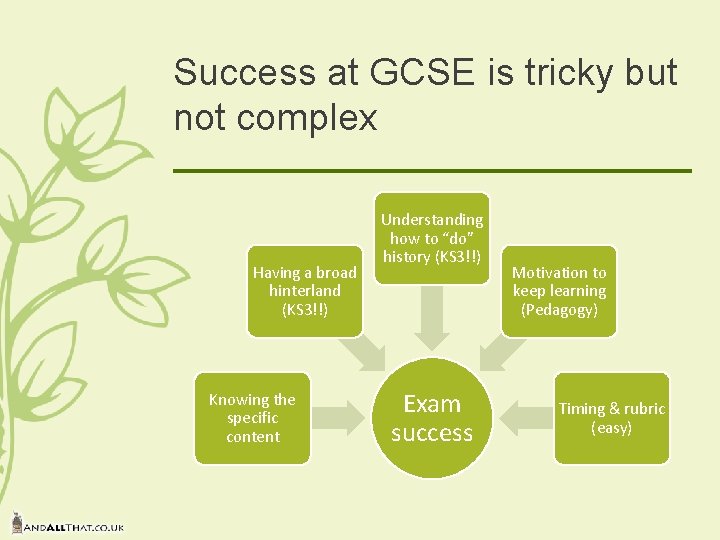
Success at GCSE is tricky but not complex Having a broad hinterland (KS 3!!) Knowing the specific content Understanding how to “do” history (KS 3!!) Exam success Motivation to keep learning (Pedagogy) Timing & rubric (easy)
Planting seeds “Society grows great when old men plant trees in whose shade they will not sit. ” Greek Proverb (allegedly) [N. B. I realise this is an Oak tree, but I like the picture]
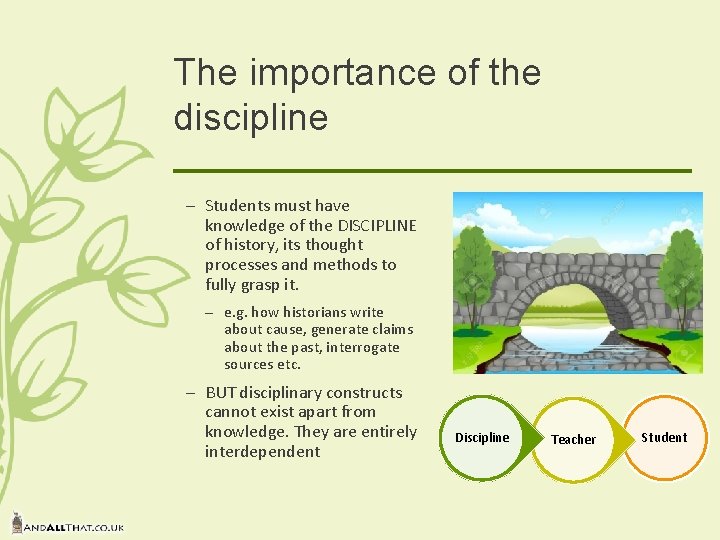
The importance of the discipline – Students must have knowledge of the DISCIPLINE of history, its thought processes and methods to fully grasp it. – e. g. how historians write about cause, generate claims about the past, interrogate sources etc. – BUT disciplinary constructs cannot exist apart from knowledge. They are entirely interdependent Discipline Teacher Student
Curriculum: deriving from the discipline… “The good historian is like the giant of the fairy tale. He knows that wherever he catches the scent of human flesh, there his quarry lies. ” p 22 “Conclusions which are founded upon a delicate imputation of motive fall upon a graduated scale from the infinitely probable to the barely credible. ” p 93 “…the knowledge of fragments, studied by turns, each for its own sake, will never produce the knowledge of the whole; it will not even produce that of the fragments themselves. ” p 128 “Human actions are essentially very delicate phenomena…properly to translate them into words, to fathom them rightly…great delicacy of language and precision shadings of verbal tone are necessary. ” p 22
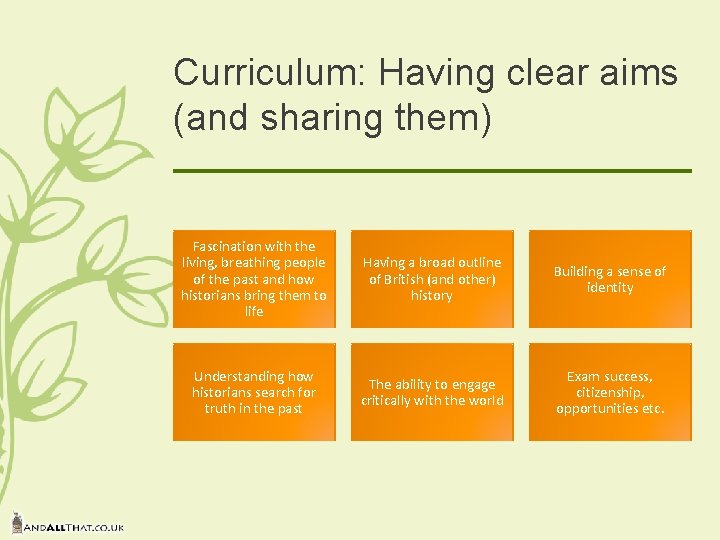
Curriculum: Having clear aims (and sharing them) Fascination with the living, breathing people of the past and how historians bring them to life Having a broad outline of British (and other) history Building a sense of identity Understanding how historians search for truth in the past The ability to engage critically with the world Exam success, citizenship, opportunities etc.
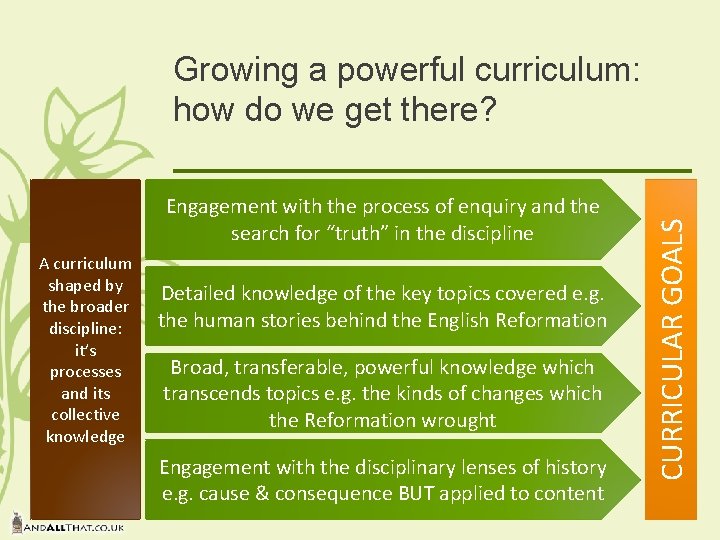
Engagement with the process of enquiry and the search for “truth” in the discipline A curriculum shaped by the broader discipline: it’s processes and its collective knowledge Detailed knowledge of the key topics covered e. g. the human stories behind the English Reformation Broad, transferable, powerful knowledge which transcends topics e. g. the kinds of changes which the Reformation wrought Engagement with the disciplinary lenses of history e. g. cause & consequence BUT applied to content CURRICULAR GOALS Growing a powerful curriculum: how do we get there?
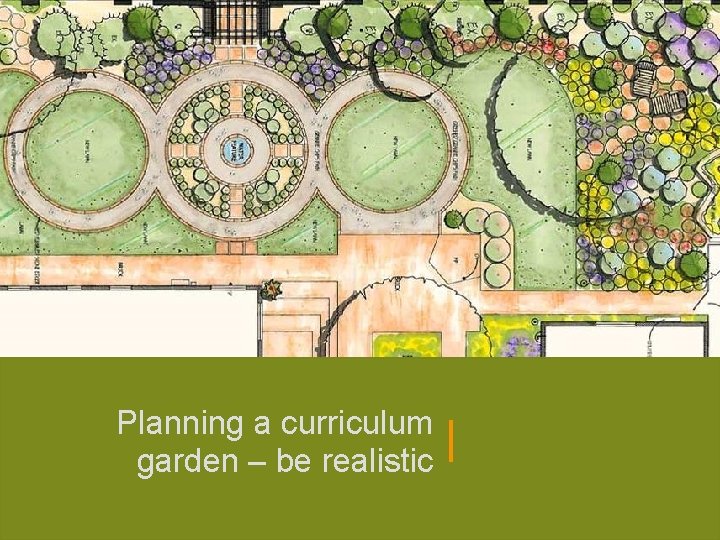
Planning a curriculum garden – be realistic
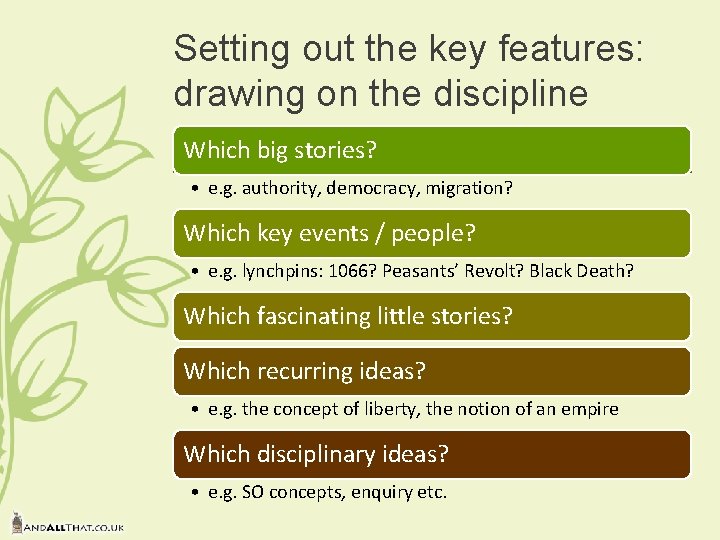
Setting out the key features: drawing on the discipline Which big stories? • e. g. authority, democracy, migration? Which key events / people? • e. g. lynchpins: 1066? Peasants’ Revolt? Black Death? Which fascinating little stories? Which recurring ideas? • e. g. the concept of liberty, the notion of an empire Which disciplinary ideas? • e. g. SO concepts, enquiry etc.
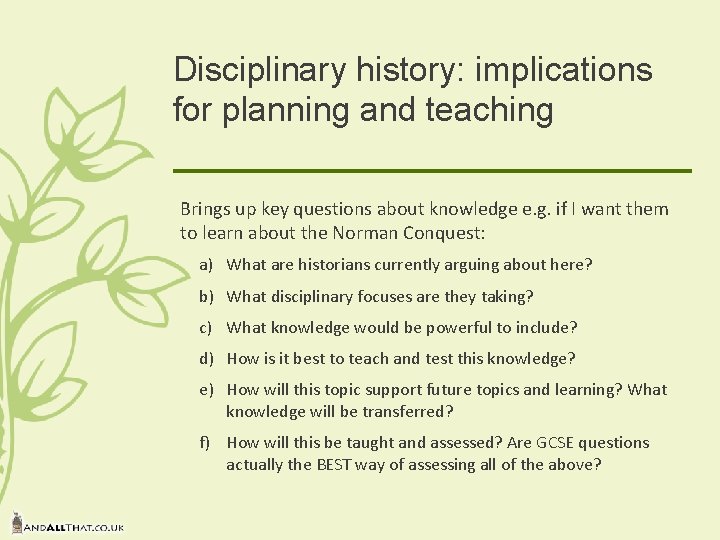
Disciplinary history: implications for planning and teaching Brings up key questions about knowledge e. g. if I want them to learn about the Norman Conquest: a) What are historians currently arguing about here? b) What disciplinary focuses are they taking? c) What knowledge would be powerful to include? d) How is it best to teach and test this knowledge? e) How will this topic support future topics and learning? What knowledge will be transferred? f) How will this be taught and assessed? Are GCSE questions actually the BEST way of assessing all of the above?
What kind of design is emerging?
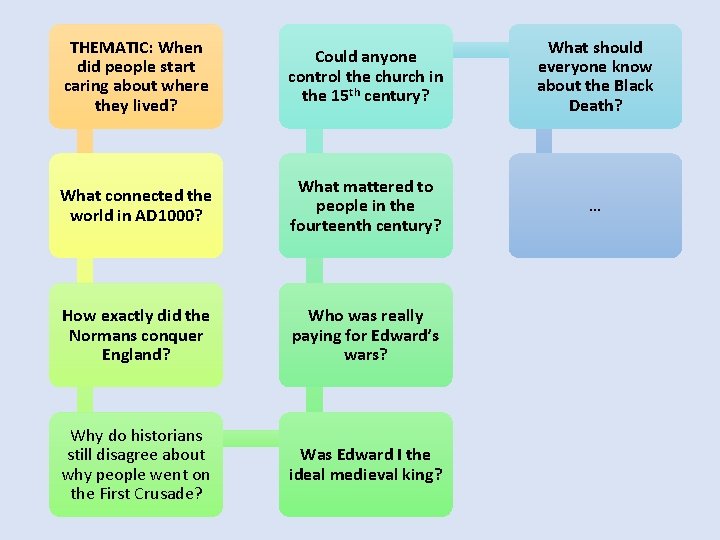
THEMATIC: When did people start caring about where they lived? Could anyone control the church in the 15 th century? What should everyone know about the Black Death? What connected the world in AD 1000? What mattered to people in the fourteenth century? … How exactly did the Normans conquer England? Who was really paying for Edward’s wars? Why do historians still disagree about why people went on the First Crusade? Was Edward I the ideal medieval king?
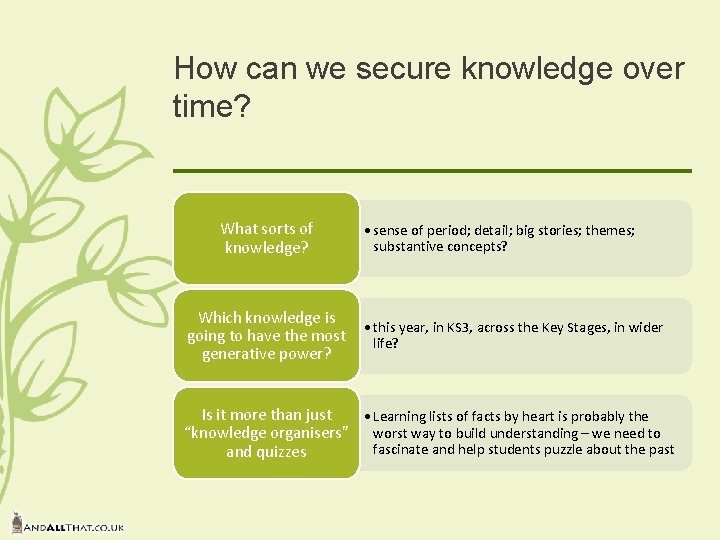
How can we secure knowledge over time? What sorts of knowledge? Which knowledge is going to have the most generative power? • sense of period; detail; big stories; themes; substantive concepts? • this year, in KS 3, across the Key Stages, in wider life? Is it more than just • Learning lists of facts by heart is probably the “knowledge organisers” worst way to build understanding – we need to fascinate and help students puzzle about the past and quizzes
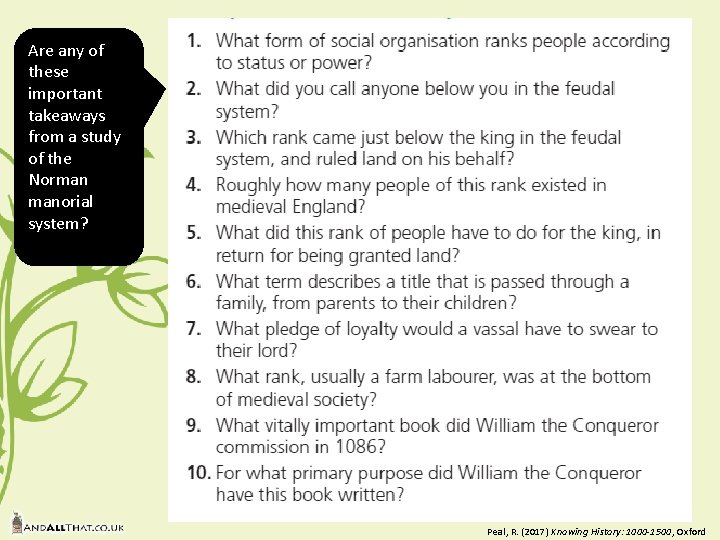
Are any of these important takeaways from a study of the Norman manorial system? Peal, R. (2017) Knowing History: 1000 -1500, Oxford
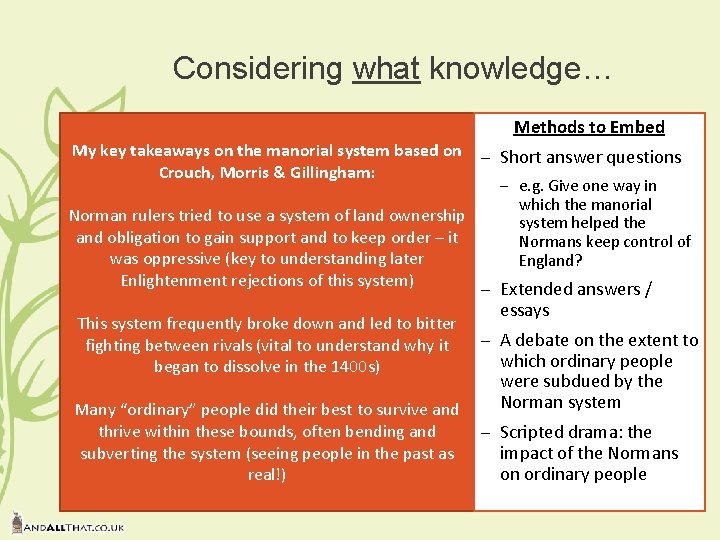
Considering what knowledge… Methods to Embed My key takeaways on the manorial system based on – Short answer questions Crouch, Morris & Gillingham: – e. g. Give one way in Norman rulers tried to use a system of land ownership and obligation to gain support and to keep order – it was oppressive (key to understanding later Enlightenment rejections of this system) This system frequently broke down and led to bitter fighting between rivals (vital to understand why it began to dissolve in the 1400 s) Many “ordinary” people did their best to survive and thrive within these bounds, often bending and subverting the system (seeing people in the past as real!) which the manorial system helped the Normans keep control of England? – Extended answers / essays – A debate on the extent to which ordinary people were subdued by the Norman system – Scripted drama: the impact of the Normans on ordinary people
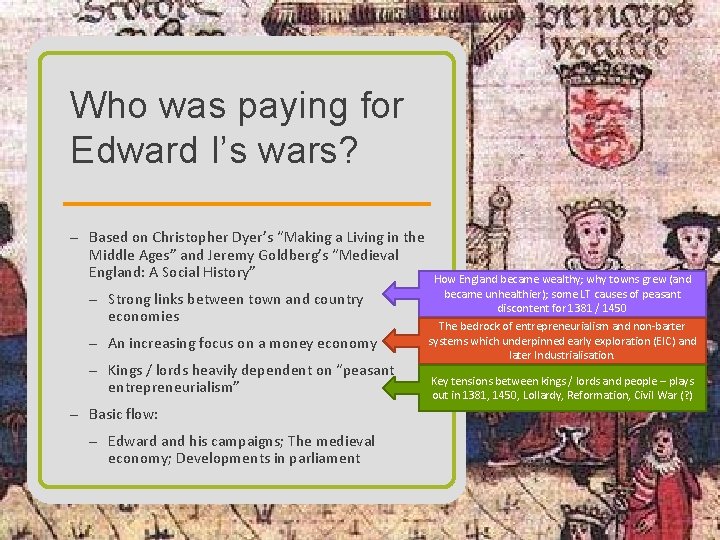
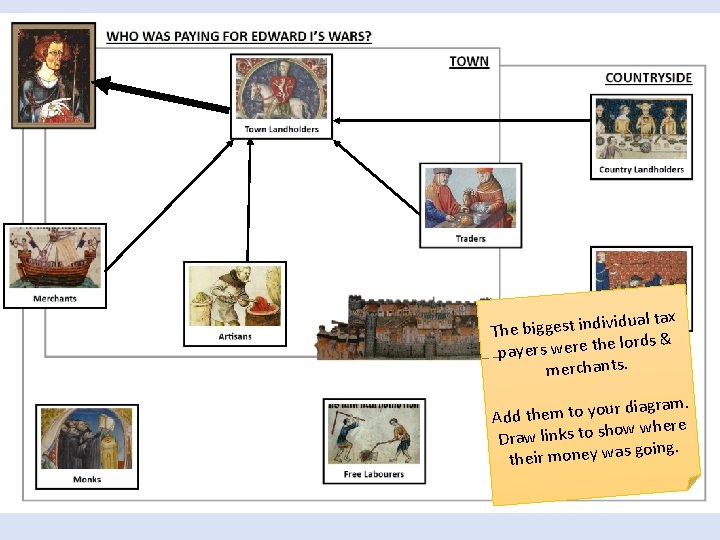
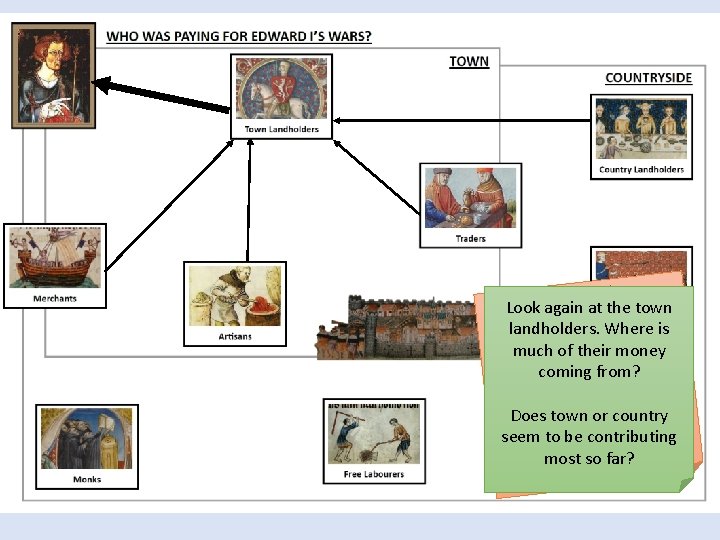
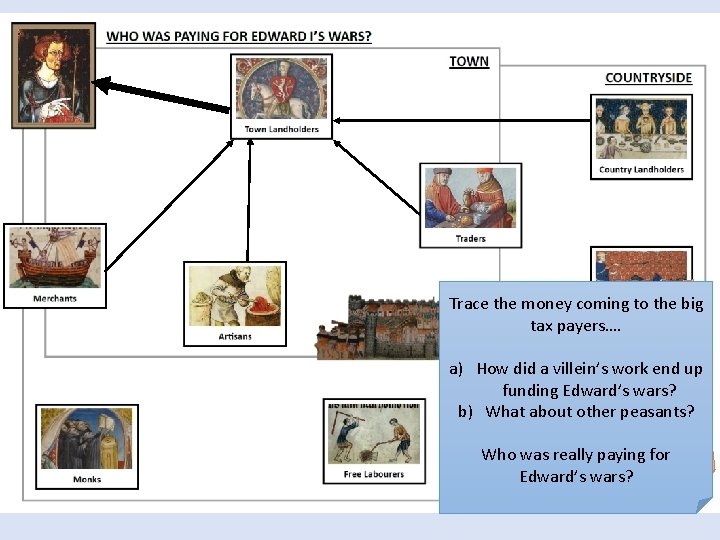
Who was paying for Edward I’s wars? – Based on Christopher Dyer’s “Making a Living in the Middle Ages” and Jeremy Goldberg’s “Medieval England: A Social History” – Strong links between town and country economies – An increasing focus on a money economy – Kings / lords heavily dependent on “peasant entrepreneurialism” – Basic flow: – Edward and his campaigns; The medieval economy; Developments in parliament How England became wealthy; why towns grew (and became unhealthier); some LT causes of peasant discontent for 1381 / 1450 The bedrock of entrepreneurialism and non-barter systems which underpinned early exploration (EIC) and later Industrialisation. Key tensions between kings / lords and people – plays out in 1381, 1450, Lollardy, Reformation, Civil War (? )
idual tax iv d in t s e g ig b e Th lords & payers were the merchants. gram. ia d r u o y to m e Add th ow where h s to s k n li w a r D oing. g s a w y e n o m ir the
ount Look again at the town am e g u h a w a ns s Towlandholders. createisd g. Where in e b h lt a e w ofmuch of their money coming from? ders and Add the tra ram. g ia d r u o y o st tisantown ar. Does or country w where o h s o t s k n raw lito be contributing D seem oing. g s a w y e n mo the most so far?
Trace the money coming to the big tax payers…. a) How did a villein’s work opleup he peend t n o d d a y Finall Edward’srywars? funding ide he count s t in b) What about other peasants? Who was really paying for Edward’s wars?
Securing concepts… 1. Big ideas: • • • The nature of freedom in the Middle Ages Who was really making England rich How town and countryside were connected Factors creating wealth in the Middle Ages The complexity of medieval society & of the economy The privileges of the gentry, and especially of monks!! 2. Smaller ideas/knowledge: • • • Differences between freemen, villeins, husbandmen and labourers The roles of merchants, artisans, traders etc. The notion of trade as being exchange of goods for cash. The notion of taxes, fees and fines Common goods being traded in the 13 th century
Have fun & don’t forget GQT andallthat. co. uk @apf 102
Useful reading on curriculum • Counsell, C. (2017) ‘The Fertility of Substantive Knowledge: In Search of Its Hidden Generative Power’. in Debates in History Teaching. Second Edition. ed. by Davies, I. London New York: Routledge, Taylor & Francis Group, 80– 99 • Gatto, J. T. (2010) Dumbing Us down: The Hidden Curriculum of Compulsory Schooling. Gabriola Island: New Society Publications • Hirsch, E. D. (2006) The Knowledge Deficit: Closing the Shocking Education Gap for American Children. Boston: Houghton Mifflin • Hirsch, E. D. (1999) The Schools We Need and Why We Don’t Have Them. 1. anchor book ed. Anchor books. New York: Doubleday • Kitson, A. (2017) How Helpful Is the Theory of Powerful Knowledge in the Context of History? • Young, M. (2014) ‘School Subjects as Powerful Knowledge: Lessons from History’. in Masterclass in History Education. ed. by Counsell, C. , Burn, K. , and Chapman, A. Masterclass in. . . Bloomsbury, 185– 194 • Young, M. (2007) ‘Curriculum Studies and the Problem of Knowledge. Updating the Enlightenment’. in Bringing Knowledge Back in: From Social Constructivism to Social Realism in the Sociology of Education. 81– 92 • Young, M. F. D. and Lambert, D. (2014) Knowledge and the Future School: Curriculum and Social Justice. New York: Bloomsbury Academic
Useful reading on the Middle Ages • Crouch, D. (2017) Medieval Britain, c. 1000 -1500, Cambridge University Press • Dawson, I. [Ed] (2018) Exploring and Teaching Medieval History, The Historical Association • Dyer, C. (2009) Making a Living in the Middle Ages: The People of Britain, 850 -1520, Yale University Press • Gillingham, J. (2014) Conquests, Catastrophe and Recovery: Britain and Ireland 1066– 1485, Vintage Books • Goldberg, J. (2004) Medieval England: A Social History 1250 -1550, Hodder Arnold