Universal Credit Universal Credit Statistics up to 12





- Slides: 75
Universal Credit
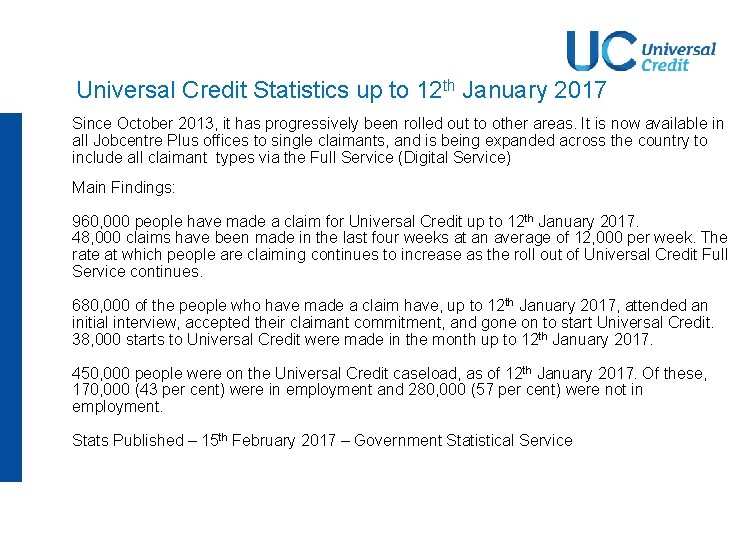
Universal Credit Statistics up to 12 th January 2017 Since October 2013, it has progressively been rolled out to other areas. It is now available in all Jobcentre Plus offices to single claimants, and is being expanded across the country to include all claimant types via the Full Service (Digital Service) Main Findings: 960, 000 people have made a claim for Universal Credit up to 12 th January 2017. 48, 000 claims have been made in the last four weeks at an average of 12, 000 per week. The rate at which people are claiming continues to increase as the roll out of Universal Credit Full Service continues. 680, 000 of the people who have made a claim have, up to 12 th January 2017, attended an initial interview, accepted their claimant commitment, and gone on to start Universal Credit. 38, 000 starts to Universal Credit were made in the month up to 12 th January 2017. 450, 000 people were on the Universal Credit caseload, as of 12 th January 2017. Of these, 170, 000 (43 per cent) were in employment and 280, 000 (57 per cent) were not in employment. Stats Published – 15 th February 2017 – Government Statistical Service
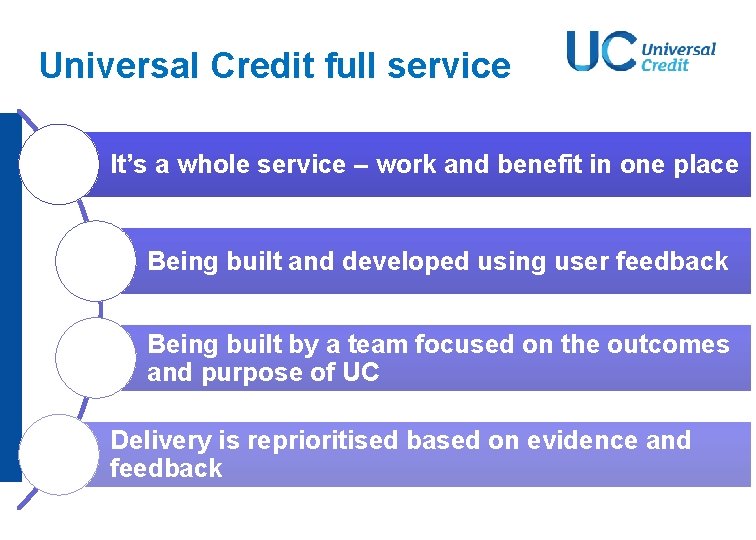
Universal Credit full service It’s a whole service – work and benefit in one place Being built and developed using user feedback Being built by a team focused on the outcomes and purpose of UC Delivery is reprioritised based on evidence and feedback
Universal Credit: Making Work Pay Universal Credit is the most significant change to the welfare state in many years: At the heart of Universal Credit is a desire to see more people move closer to work, into work and earning more: reducing their dependency on benefits. It will: increase labour market participation, reduce worklessness and increase in -work progression Support people moving into work by aligning their experience of UC to the world of work Modernise the delivery of welfare benefits by providing an easy to use simple service Reduce fraud and error, improve administrative efficiency and provide value for money to the taxpayer Provide an effective safety net that recognises the needs of claimants, reduces poverty and ensures fairness
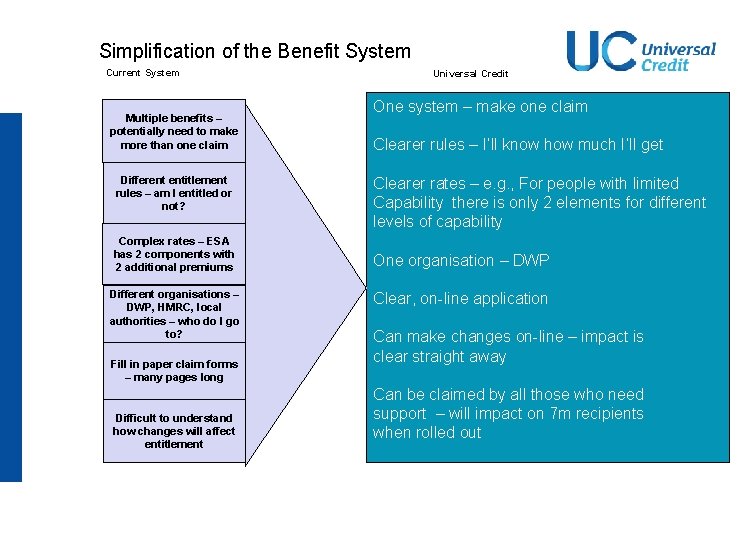
Simplification of the Benefit System Current System Multiple benefits – potentially need to make more than one claim Different entitlement rules – am I entitled or not? Complex rates – ESA has 2 components with 2 additional premiums Different organisations – DWP, HMRC, local authorities – who do I go to? Fill in paper claim forms – many pages long Difficult to understand how changes will affect entitlement Universal Credit One system – make one claim Clearer rules – I’ll know how much I’ll get Clearer rates – e. g. , For people with limited Capability there is only 2 elements for different levels of capability One organisation – DWP Clear, on-line application Can make changes on-line – impact is clear straight away Can be claimed by all those who need support – will impact on 7 m recipients when rolled out Reduces significantly the red tape/ regulations
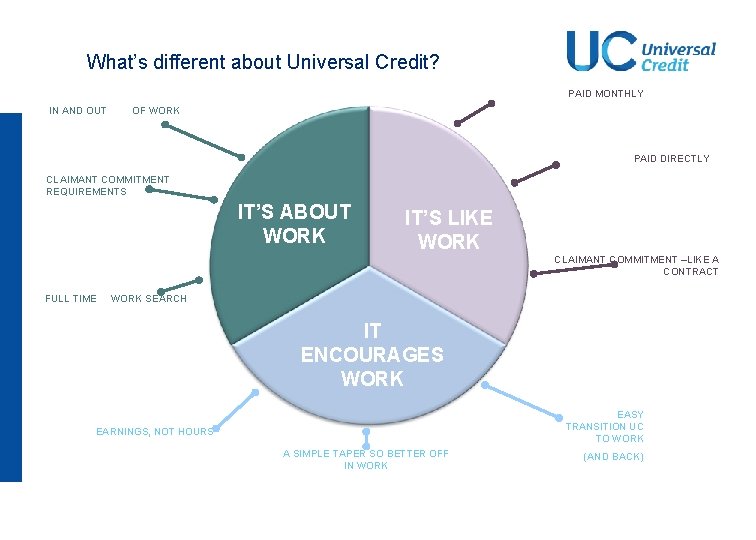
What’s different about Universal Credit? PAID MONTHLY IN AND OUT OF WORK PAID DIRECTLY CLAIMANT COMMITMENT REQUIREMENTS IT’S ABOUT WORK IT’S LIKE WORK CLAIMANT COMMITMENT –LIKE A CONTRACT FULL TIME WORK SEARCH IT ENCOURAGES WORK EASY TRANSITION UC TO WORK EARNINGS, NOT HOURS A SIMPLE TAPER SO BETTER OFF IN WORK (AND BACK)
Universal Credit - it’s all about work Universal Credit aims to reward work. No 16 hour rule and no limits on the number of hours someone can work. The Universal Credit payment only reduces gradually as their take home pay increases so claimants won’t lose all their benefits at once if they are on a low income Universal Credit will encourage a new type of relationship with claimants. Work Coaches will help claimants to become more independent by supporting them in their worksearch activities. They will help claimants plan and focus their jobsearch as well as set them actions that give them the best chance of finding work Universal Credit aims to support jobseekers through the Claimant Commitment to raise their expectations of what they can achieve, and to encourage responsibility. Those who are fit and ready for work will be expected to look for a job on a full time basis dependent on circumstances Universal Credit claimants are expected to use Universal Jobmatch, an intelligent job matching service that helps employers to get the best fit for the jobs that they have on offer
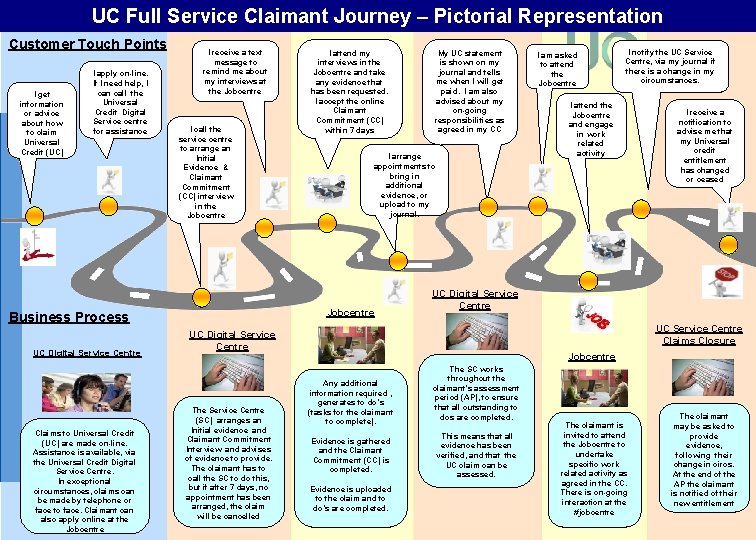
UC Full Service Claimant Journey – Pictorial Representation Customer Touch Points I get information or advice about how to claim Universal Credit (UC) I apply on-line. If I need help, I can call the Universal Credit Digital Service centre for assistance I receive a text message to remind me about my interviews at the Jobcentre I call the service centre to arrange an Initial Evidence & Claimant Commitment (CC) interview in the Jobcentre Claims to Universal Credit (UC) are made on-line. Assistance is available, via the Universal Credit Digital Service Centre. In exceptional circumstances, claims can be made by telephone or face to face. Claimant can also apply online at the Jobcentre My UC statement is shown on my journal and tells me when I will get paid. I am also advised about my on-going responsibilities as agreed in my CC I arrange appointments to bring in additional evidence, or upload to my journal. Jobcentre Business Process UC Digital Service Centre I attend my interviews in the Jobcentre and take any evidence that has been requested. I accept the online Claimant Commitment (CC) within 7 days I notify the UC Service Centre, via my journal if there is a change in my circumstances. I attend the Jobcentre and engage in work related activity I receive a notification to advise me that my Universal credit entitlement has changed or ceased UC Digital Service Centre UC Service Centre Claims Closure UC Digital Service Centre The Service Centre (SC) arranges an Initial evidence and Claimant Commitment Interview and advises of evidence to provide. The claimant has to call the SC to do this, but if after 7 days, no appointment has been arranged, the claim will be cancelled I am asked to attend the Jobcentre Any additional information required , generates to do’s (tasks for the claimant to complete). Evidence is gathered and the Claimant Commitment (CC) is completed. Evidence is uploaded to the claim and to do’s are completed. The SC works throughout the claimant’s assessment period (AP), to ensure that all outstanding to dos are completed. This means that all evidence has been verified, and that the UC claim can be assessed. The claimant is invited to attend the Jobcentre to undertake specific work related activity as agreed in the CC. There is on-going interaction at the #jobcentre The claimant may be asked to provide evidence, following their change in circs. At the end of the AP the claimant is notified of their new entitlement
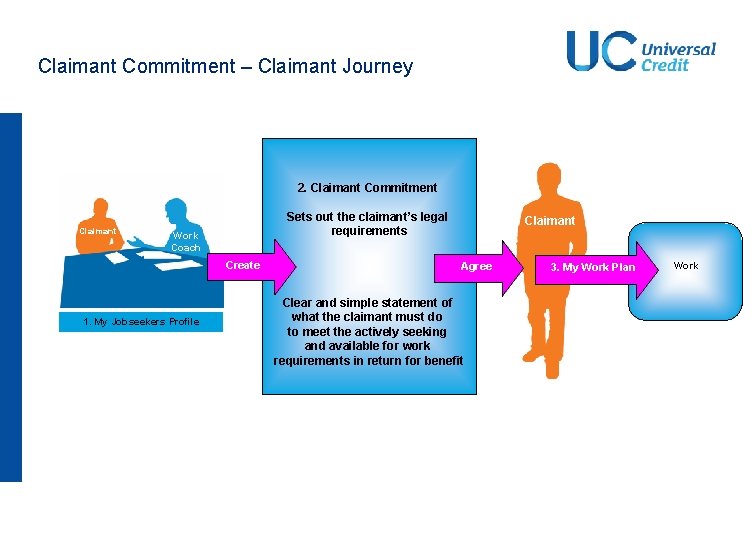
Claimant Commitment – Claimant Journey 2. Claimant Commitment Claimant Sets out the claimant’s legal requirements Work Coach Create 1. My Jobseekers Profile Claimant Agree Clear and simple statement of what the claimant must do to meet the actively seeking and available for work requirements in return for benefit 3. My Work Plan Work
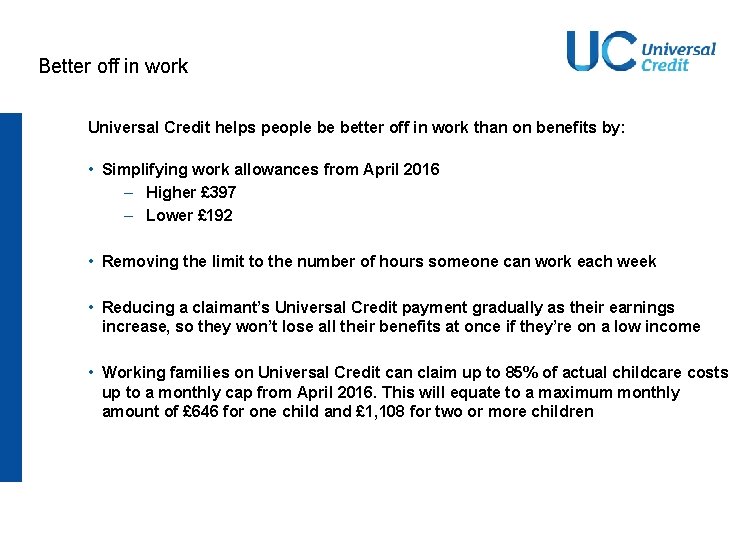
Better off in work Universal Credit helps people be better off in work than on benefits by: • Simplifying work allowances from April 2016 – Higher £ 397 – Lower £ 192 • Removing the limit to the number of hours someone can work each week • Reducing a claimant’s Universal Credit payment gradually as their earnings increase, so they won’t lose all their benefits at once if they’re on a low income • Working families on Universal Credit can claim up to 85% of actual childcare costs up to a monthly cap from April 2016. This will equate to a maximum monthly amount of £ 646 for one child and £ 1, 108 for two or more children
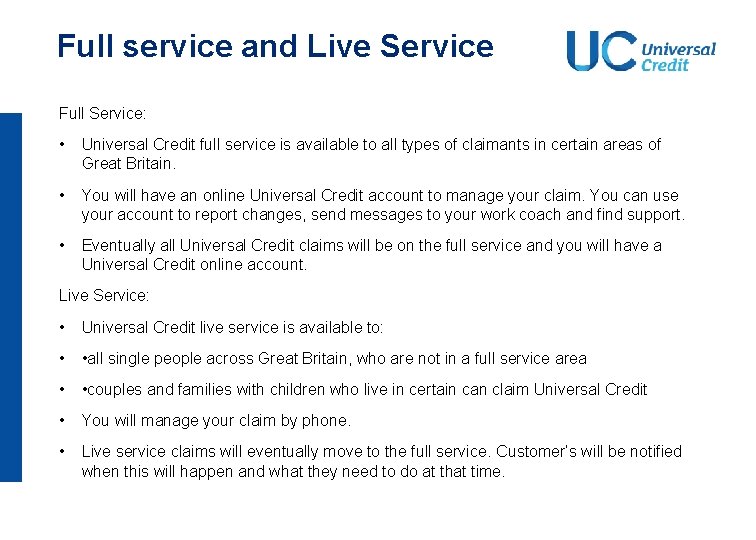
Full service and Live Service Full Service: • Universal Credit full service is available to all types of claimants in certain areas of Great Britain. • You will have an online Universal Credit account to manage your claim. You can use your account to report changes, send messages to your work coach and find support. • Eventually all Universal Credit claims will be on the full service and you will have a Universal Credit online account. Live Service: • Universal Credit live service is available to: • • all single people across Great Britain, who are not in a full service area • • couples and families with children who live in certain can claim Universal Credit • You will manage your claim by phone. • Live service claims will eventually move to the full service. Customer’s will be notified when this will happen and what they need to do at that time.
Live Service to full Service the claimant journey When you become a full service area all Universal Credit Live Service claimants will start to switch onto the Full Service. The switching process is managed by Universal Credit, the claimant does not have to do anything until they are asked. Claimants will be issued with an orientation letter explaining about the switching process prior to them having to switch their Universal Credit Claim. They will be notified when they have to take action to switch either by their work coach or by a letter issued to them if they don’t attend the Jobcentre on a regular basis. The action required from them is to complete their details on line via the full service, and then book and attend an identification interview in their jobcentre. This will ensure the most up-to -date evidence is held for the claimant. Jobcentre staff will take all opportunities to explain to existing Universal Credit claimants about switching to the Full Service and support will be offered for those who require it. If claimants do not comply with all the actions required to switch their Universal Credit Claim their payments will be suspended and subsequently their claim to Universal Credit terminated.
Claiming Universal Credit • When you make your claim you’ll be asked for your postcode and then be directed to the right service for you to complete your claim online. • In both services you will always have access to a work coach who can help you with things like: • • finding work • • increasing the hours you work • • getting more prepared for when you are able to work by learning new work skills or life skills • Helping you to improve your income is central to the Universal Credit service.
Contacting Universal Credit • How you report changes affecting your Universal Credit claim, such as changing address or adding a child to your claim, will depend on which service you use. Full service areas • Use your Universal Credit online account to report changes by answering the questions on screen. The online service will also explain how to report changes you cannot report online at the moment. Live service areas • Call the Universal Credit service centre to report changes: • Telephone: 0345 600 0723 • Textphone: 0345 600 0743 • Monday to Friday, 8 am to 6 pm If customers need further help, face to face and telephone support is available until the customer gets access to the internet. Jobcentres have online computers customers can use. They can also direct customers to local services, to help them get online and to open a bank accounts
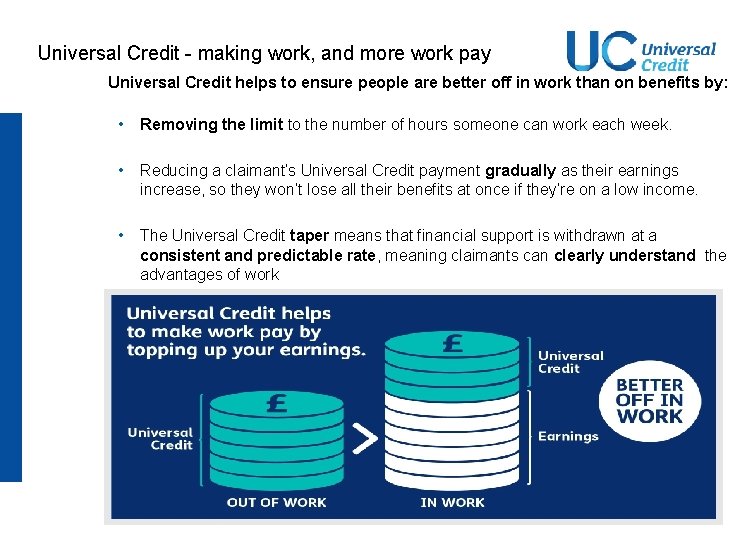
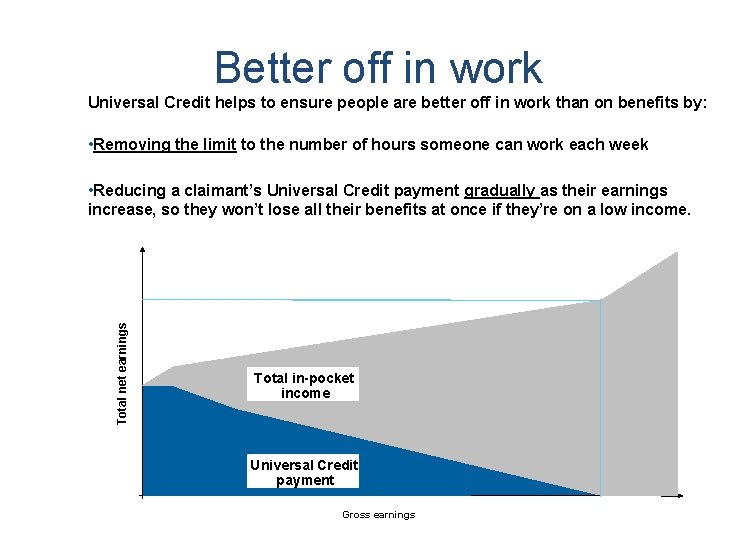
Universal Credit - making work, and more work pay Universal Credit helps to ensure people are better off in work than on benefits by: • Removing the limit to the number of hours someone can work each week. • Reducing a claimant’s Universal Credit payment gradually as their earnings increase, so they won’t lose all their benefits at once if they’re on a low income. • The Universal Credit taper means that financial support is withdrawn at a consistent and predictable rate, meaning claimants can clearly understand the advantages of work
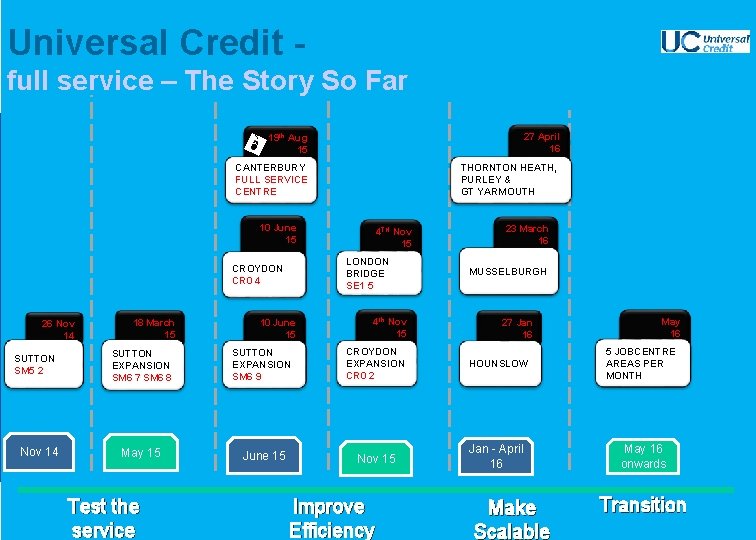
Universal Credit full service – The Story So Far 27 April 16 19 th Aug 15 CANTERBURY FULL SERVICE CENTRE THORNTON HEATH, PURLEY & GT YARMOUTH 10 June 15 CROYDON CR 0 4 26 Nov 14 SUTTON SM 5 2 Nov 14 18 March 15 10 June 15 4 TH Nov 15 LONDON BRIDGE SE 1 5 4 th Nov 15 23 March 16 MUSSELBURGH 27 Jan 16 May 16 SUTTON EXPANSION SM 6 7 SM 6 8 SUTTON EXPANSION SM 6 9 CROYDON EXPANSION CR 0 2 HOUNSLOW 5 JOBCENTRE AREAS PER MONTH May 15 June 15 Nov 15 Jan - April 16 May 16 onwards Test the service Improve Efficiency Make Scalable Transition
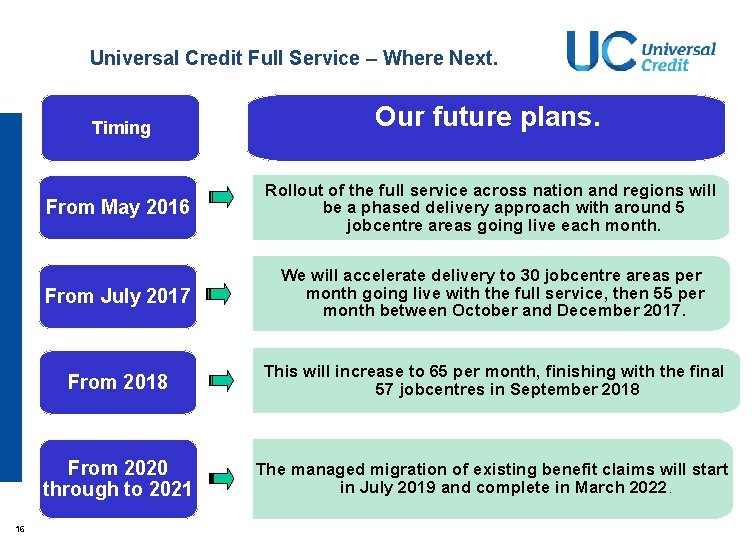
Universal Credit Full Service – Where Next. Timing 16 Our future plans. From May 2016 Rollout of the full service across nation and regions will be a phased delivery approach with around 5 jobcentre areas going live each month. From July 2017 We will accelerate delivery to 30 jobcentre areas per month going live with the full service, then 55 per month between October and December 2017. From 2018 This will increase to 65 per month, finishing with the final 57 jobcentres in September 2018 From 2020 through to 2021 The managed migration of existing benefit claims will start in July 2019 and complete in March 2022.
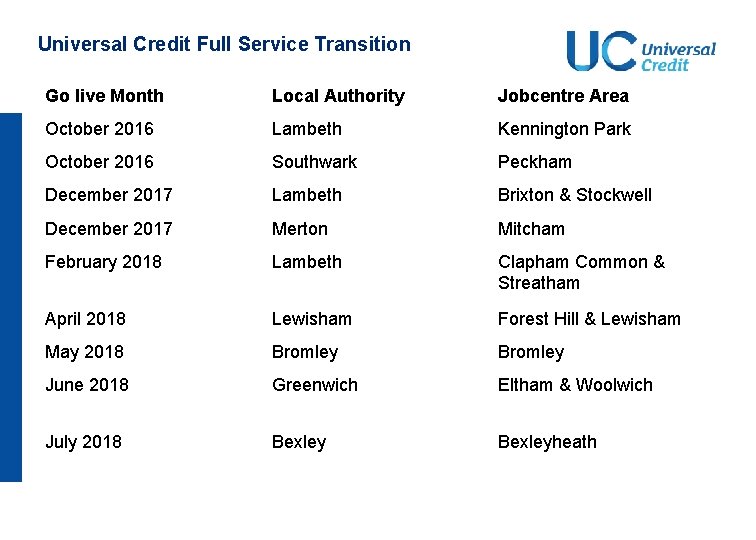
Universal Credit Full Service Transition Go live Month Local Authority Jobcentre Area October 2016 Lambeth Kennington Park October 2016 Southwark Peckham December 2017 Lambeth Brixton & Stockwell December 2017 Merton Mitcham February 2018 Lambeth Clapham Common & Streatham April 2018 Lewisham Forest Hill & Lewisham May 2018 Bromley June 2018 Greenwich Eltham & Woolwich July 2018 Bexleyheath
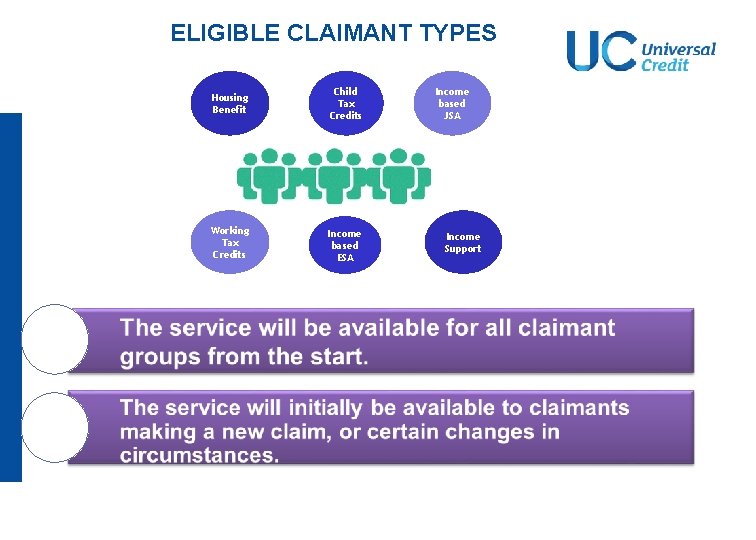
ELIGIBLE CLAIMANT TYPES Housing Benefit Child Tax Credits Working Tax Credits Income based ESA Income based JSA Income Support
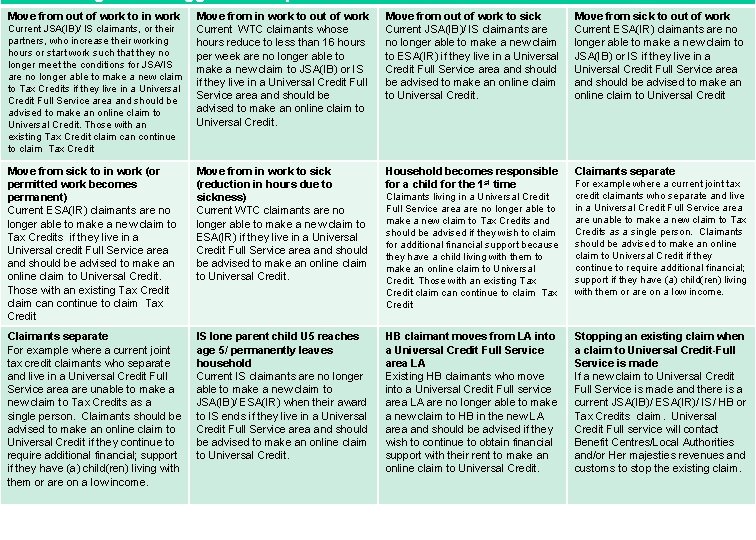
Move from out of work to in work Move from in work to out of work Current WTC claimants whose hours reduce to less than 16 hours per week are no longer able to make a new claim to JSA(IB) or IS if they live in a Universal Credit Full Service area and should be advised to make an online claim to Universal Credit. Move from out of work to sick Current JSA(IB)/ IS claimants are no longer able to make a new claim to ESA(IR) if they live in a Universal Credit Full Service area and should be advised to make an online claim to Universal Credit. Move from sick to out of work Current ESA(IR) claimants are no longer able to make a new claim to JSA(IB) or IS if they live in a Universal Credit Full Service area and should be advised to make an online claim to Universal Credit Move from sick to in work (or permitted work becomes permanent) Current ESA(IR) claimants are no longer able to make a new claim to Tax Credits if they live in a Universal credit Full Service area and should be advised to make an online claim to Universal Credit. Those with an existing Tax Credit claim can continue to claim Tax Credit Move from in work to sick (reduction in hours due to sickness) Current WTC claimants are no longer able to make a new claim to ESA(IR) if they live in a Universal Credit Full Service area and should be advised to make an online claim to Universal Credit. Household becomes responsible for a child for the 1 st time Claimants separate For example where a current joint tax credit claimants who separate and live in a Universal Credit Full Service area are unable to make a new claim to Tax Credits as a single person. Claimants should be advised to make an online claim to Universal Credit if they continue to require additional financial; support if they have (a) child(ren) living with them or are on a low income. IS lone parent child U 5 reaches age 5/ permanently leaves household Current IS claimants are no longer able to make a new claim to JSA(IB)/ ESA(IR) when their award to IS ends if they live in a Universal Credit Full Service area and should be advised to make an online claim to Universal Credit. HB claimant moves from LA into a Universal Credit Full Service area LA Existing HB claimants who move into a Universal Credit Full service area LA are no longer able to make a new claim to HB in the new LA area and should be advised if they wish to continue to obtain financial support with their rent to make an online claim to Universal Credit. Current JSA(IB)/ IS claimants, or their partners, who increase their working hours or start work such that they no longer meet the conditions for JSA/IS are no longer able to make a new claim to Tax Credits if they live in a Universal Credit Full Service area and should be advised to make an online claim to Universal Credit. Those with an existing Tax Credit claim can continue to claim Tax Credit Claimants living in a Universal Credit Full Service area are no longer able to make a new claim to Tax Credits and should be advised if they wish to claim for additional financial support because they have a child living with them to make an online claim to Universal Credit. Those with an existing Tax Credit claim can continue to claim Tax Credit For example where a current joint tax credit claimants who separate and live in a Universal Credit Full Service area are unable to make a new claim to Tax Credits as a single person. Claimants should be advised to make an online claim to Universal Credit if they continue to require additional financial; support if they have (a) child(ren) living with them or are on a low income. Stopping an existing claim when a claim to Universal Credit-Full Service is made If a new claim to Universal Credit Full Service is made and there is a current JSA(IB)/ ESA(IR)/ IS/ HB or Tax Credits claim. Universal Credit Full service will contact Benefit Centres/Local Authorities and/or Her majesties revenues and customs to stop the existing claim.
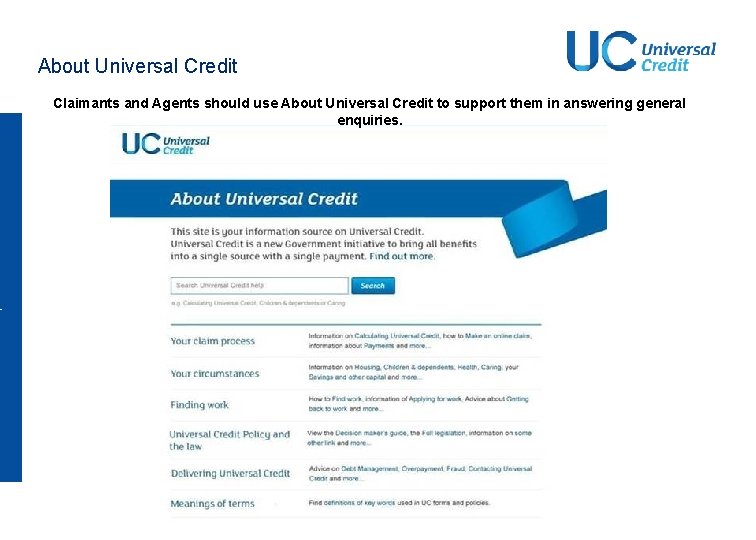
What is ‘About Universal Credit’? 'About Universal Credit‘ is the help section of the online claim 'About Universal Credit' was created to get the right information, to the right people, at the right time. It is designed so people can access information about Universal Credit in one place including policy and guidance. It is an internet-based system. 'About Universal Credit' will be similar to most internet web pages. It was created and will be maintained by one team within DWP called the Knowledge Management Team.
When will ‘About Universal Credit’ be used? ‘About Universal Credit' can be used to provide information on all aspects of Universal Credit. 'About Universal Credit' can be used by the claimant to help them make a claim online, and can be accessed by selecting the ‘About Universal Credit’ hyperlink at the bottom of the page. This is known as the Claimant Portal. DWP and Local Authority staff can also use it to help them answer the claimant’s queries on the telephone or face to face. 'About Universal Credit' contains all guidance on Universal Credit business processes. 'About Universal Credit' can be used by everyone involved in administering or claiming Universal Credit and is available to help at all times. Link attached here
How ‘About Universal Credit’ is different About Universal Credit' provides all users, DWP agents and claimants with the same information. 'About Universal Credit' is like a library of all the available information. Since everything is in one place this reduces error, misunderstanding and duplication. Previously, all the different sources of information had to be accessed and updated separately. Now 'About Universal Credit' can be updated once by just updating the master. This then automatically updates the sections of 'About Universal Credit' that feed into: the public Knowledge Base the internet the page and field level help on the Claimant and DWP Agent Portal This means that everyone using 'About Universal Credit' has access to the latest information.
About Universal Credit Claimants and Agents should use About Universal Credit to support them in answering general enquiries.
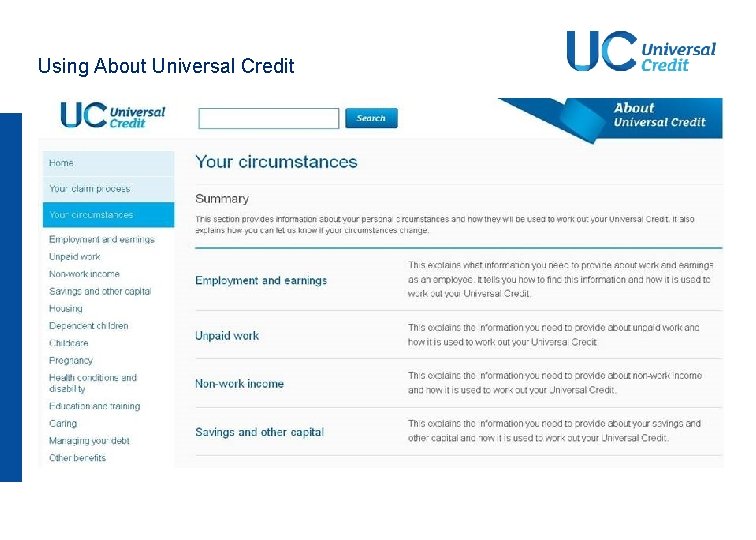
Using About Universal Credit
Universal Credit – full service https: //www. youtube. com/channel/UC 7 Km 4 IXf. VJB 1 n 8 S QUmk. JD 0 Q Creating a digital UC account.
Universal Credit Full Service Supporting information for landlords.
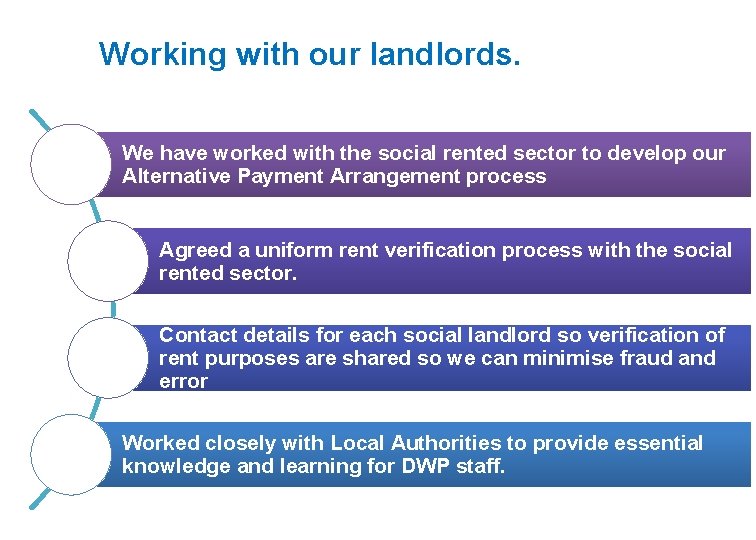
Working with our landlords. We have worked with the social rented sector to develop our Alternative Payment Arrangement process Agreed a uniform rent verification process with the social rented sector. Contact details for each social landlord so verification of rent purposes are shared so we can minimise fraud and error Worked closely with Local Authorities to provide essential knowledge and learning for DWP staff.
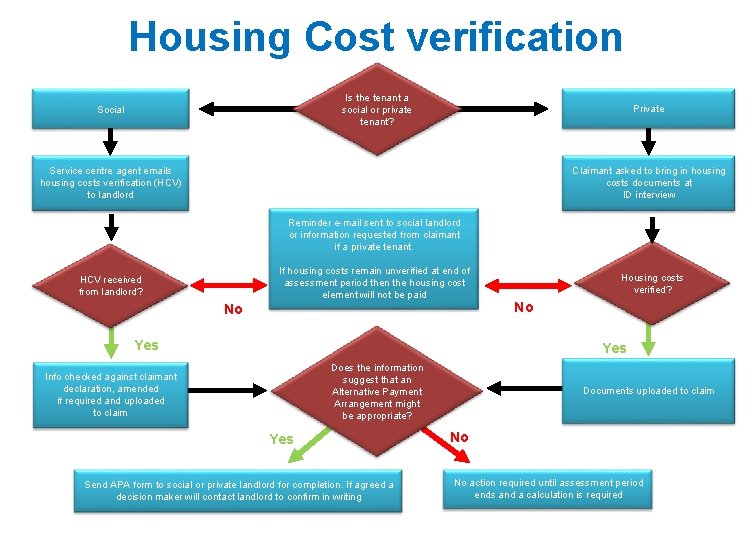
Housing Cost verification Is the tenant a social or private tenant? Social Private Service centre agent emails housing costs verification (HCV) to landlord Claimant asked to bring in housing costs documents at ID interview Reminder e-mail sent to social landlord or information requested from claimant if a private tenant. If housing costs remain unverified at end of assessment period then the housing cost element will not be paid HCV received from landlord? No Yes Housing costs verified? No Yes Does the information suggest that an Alternative Payment Arrangement might be appropriate? Info checked against claimant declaration, amended if required and uploaded to claim Yes Send APA form to social or private landlord for completion. If agreed a decision maker will contact landlord to confirm in writing Documents uploaded to claim No No action required until assessment period ends and a calculation is required
Universal Credit Child care costs.
Universal Credit Full Service. Child care costs. Universal Credit will help households meet the costs of childcare they pay out so they can work. This will help ensure that all households who can work do work. The childcare policy means people with average childcare costs should be able to work full time. Parents will understand how childcare support is calculated and they will understand how to report childcare costs.
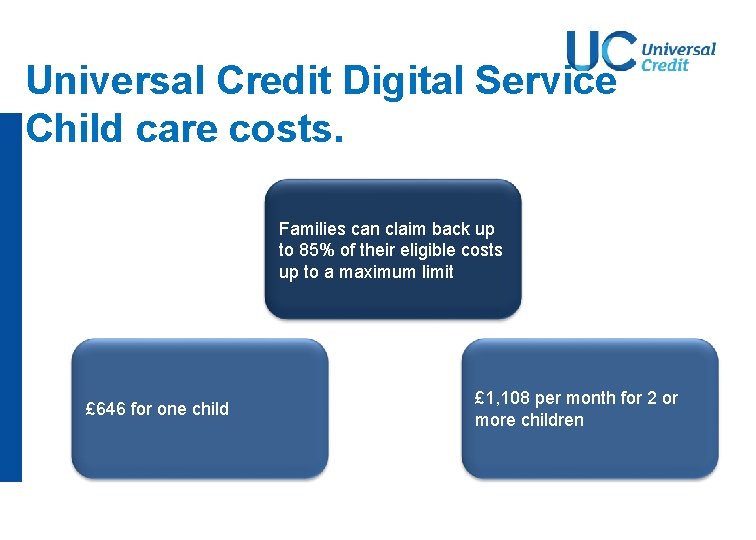
Universal Credit Digital Service Child care costs. Families can claim back up to 85% of their eligible costs up to a maximum limit £ 646 for one child £ 1, 108 per month for 2 or more children
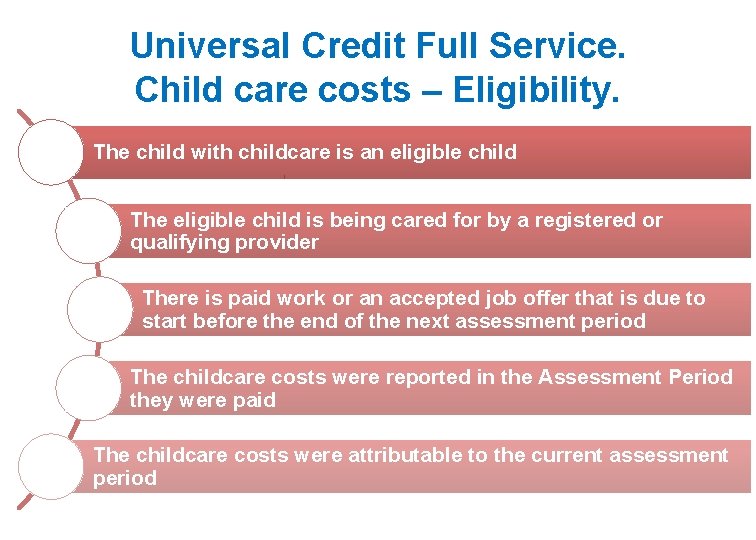
Universal Credit Full Service. Child care costs – Eligibility. The child with childcare is an eligible child The eligible child is being cared for by a registered or qualifying provider There is paid work or an accepted job offer that is due to start before the end of the next assessment period The childcare costs were reported in the Assessment Period they were paid The childcare costs were attributable to the current assessment period
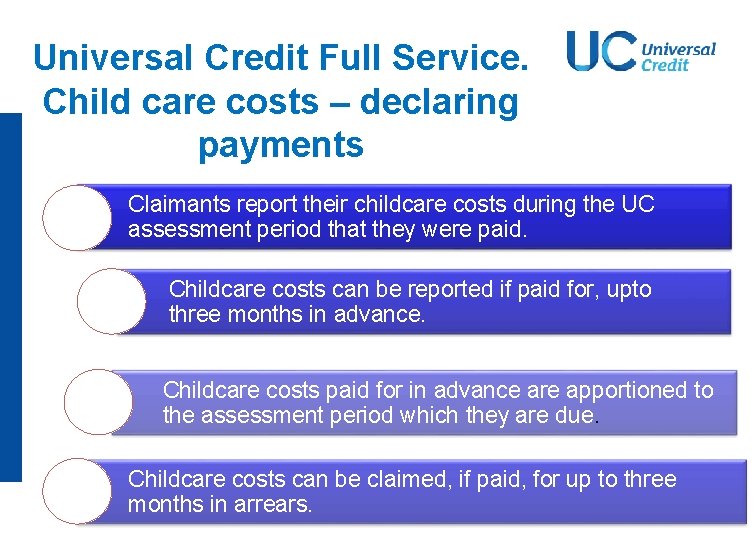
Universal Credit Full Service. Child care costs – declaring payments Claimants report their childcare costs during the UC assessment period that they were paid. Childcare costs can be reported if paid for, upto three months in advance. Childcare costs paid for in advance are apportioned to the assessment period which they are due. Childcare costs can be claimed, if paid, for up to three months in arrears.
Introduction to Universal Credit and families • Universal Credit will support families as they find work, increase their earnings and move towards financial independence • It will do this by making work pay, even if it’s just for a few hours a week, providing the right incentives and support to meet a parent’s needs and combining in and out of work benefits • Universal Credit payments will be made monthly to a household and can include: – A child element – A disabled child addition to the child element – this helps with the extra costs of bringing up a disabled child – A childcare costs element – this helps pay for registered childcare while someone is working • A claimant will also still be able to receive the following benefits whilst claiming Universal Credit: – Child Benefit – Child Maintenance – Free School Meals and milk (if eligible)
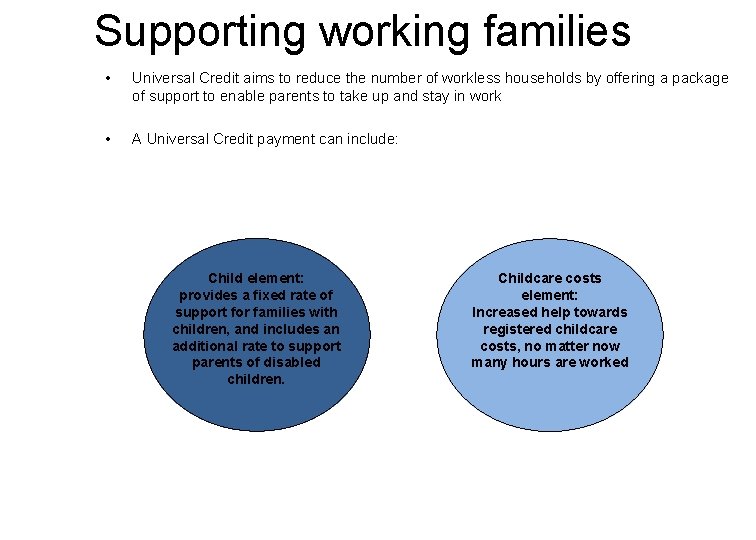
Supporting working families • Universal Credit aims to reduce the number of workless households by offering a package of support to enable parents to take up and stay in work • A Universal Credit payment can include: Child element: provides a fixed rate of support for families with children, and includes an additional rate to support parents of disabled children. Childcare costs element: Increased help towards registered childcare costs, no matter now many hours are worked
Universal Credit – family responsibilities at home • • Responsibilities at home will be taken into account when agreeing work activities in return for Universal Credit If the youngest child is in one of the following age brackets, then the parent or nominated carer in a couple may be expected to undertake actions in return for their Universal Credit • For a child aged: Under 1 year old not expected to do anything in return for UC, but must report a change of circumstance straight away 1 or 2 required to attend interviews to discuss plans for a future move into work 3 or 4 take active steps to prepare for work 5 to 12 look for work in line with caring responsibilities, for example during school hours 13 plus look for full-time work, depending on their circumstances
Help with childcare costs Childcare costs element: From April 2016 working families on Universal Credit can claim up to 85% of actual paid out childcare costs, up to a monthly cap. • If a claim is from a couple, both parties would normally need to be in work to receive help with childcare costs • The Childcare Provider must be registered with Ofsted or the Care Quality Commission i. e. providers usually found on school premises. • It is quick and easy to claim costs back, they will be added to the monthly Universal Credit payment.
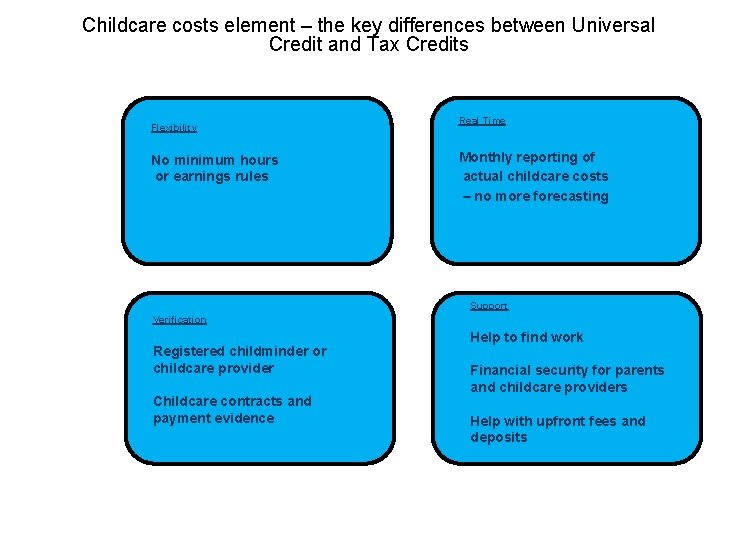
Childcare costs element – the key differences between Universal Credit and Tax Credits Flexibility Real Time No minimum hours or earnings rules Monthly reporting of actual childcare costs – no more forecasting Support Verification Registered childminder or childcare provider Childcare contracts and payment evidence Help to find work Financial security for parents and childcare providers Help with upfront fees and deposits
Universal Credit Digital Service Supporting claimant needs.
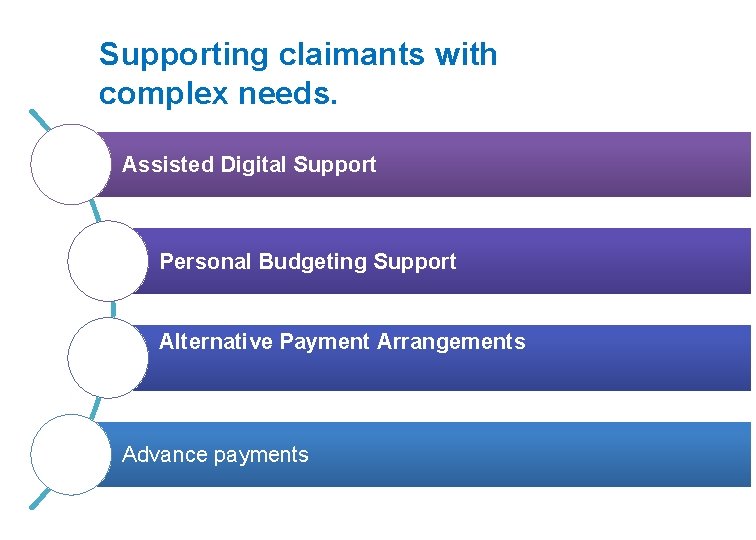
Supporting claimants with complex needs. Assisted Digital Support Personal Budgeting Support Alternative Payment Arrangements Advance payments
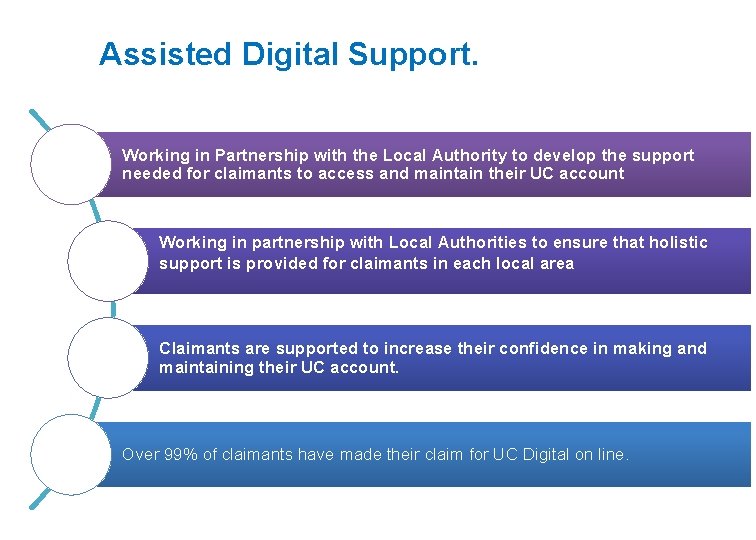
Assisted Digital Support. Working in Partnership with the Local Authority to develop the support needed for claimants to access and maintain their UC account Working in partnership with Local Authorities to ensure that holistic support is provided for claimants in each local area Claimants are supported to increase their confidence in making and maintaining their UC account. Over 99% of claimants have made their claim for UC Digital on line.
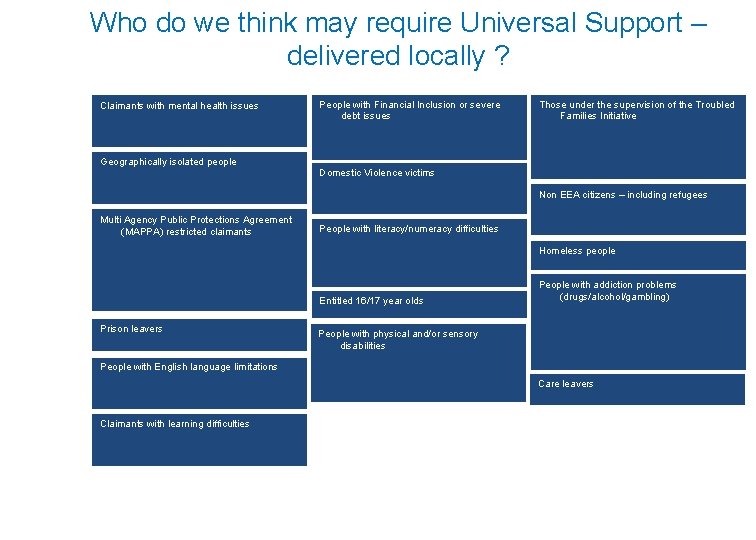
Who do we think may require Universal Support – delivered locally ? Claimants with mental health issues People with Financial Inclusion or severe debt issues Those under the supervision of the Troubled Families Initiative Geographically isolated people Domestic Violence victims Non EEA citizens – including refugees Multi Agency Public Protections Agreement (MAPPA) restricted claimants People with literacy/numeracy difficulties Homeless people Entitled 16/17 year olds Prison leavers People with addiction problems (drugs/alcohol/gambling) People with physical and/or sensory disabilities People with English language limitations Care leavers Claimants with learning difficulties
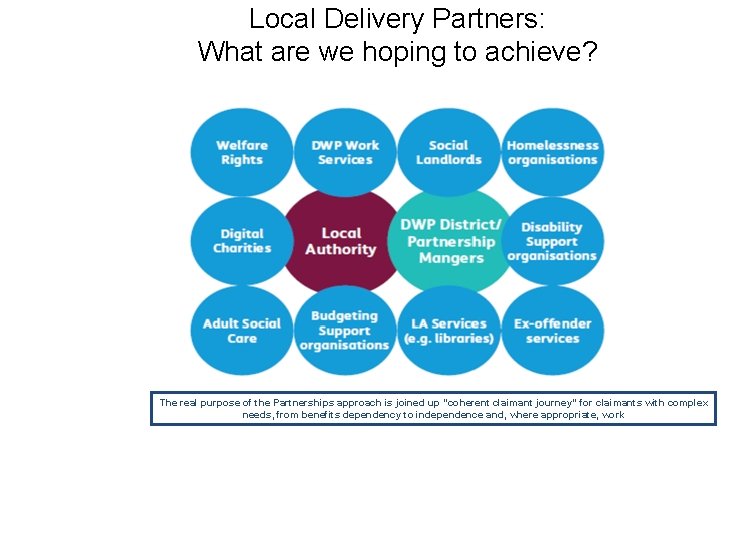
Local Delivery Partners: What are we hoping to achieve? The real purpose of the Partnerships approach is joined up “coherent claimant journey” for claimants with complex needs, from benefits dependency to independence and, where appropriate, work
What is happening with data sharing and landlords? • A data sharing consultation, which asked for views from Social Landlords on the draft regulations, which amend the Social Security (Information-sharing in relation to Welfare Services etc. ) Regulations 2012 was published on GOV. UK in September 2014. • These proposals allow the Secretary of State to share relevant information with social landlords in certain situations. The information shared by DWP will enable social landlords to assess and provide support to their tenants who have made UC claims or receive UC. • You can find out more about it here. • https: //www. gov. uk/government/consultations/universalcredit-data-sharing-with-social-landlords
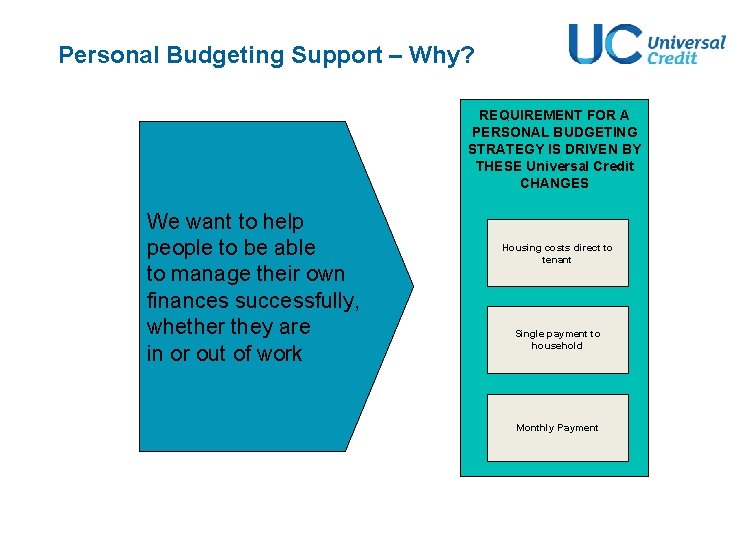
Personal Budgeting Support – Why? REQUIREMENT FOR A PERSONAL BUDGETING STRATEGY IS DRIVEN BY THESE Universal Credit CHANGES We want to help people to be able to manage their own finances successfully, whether they are in or out of work Housing costs direct to tenant Single payment to household Monthly Payment
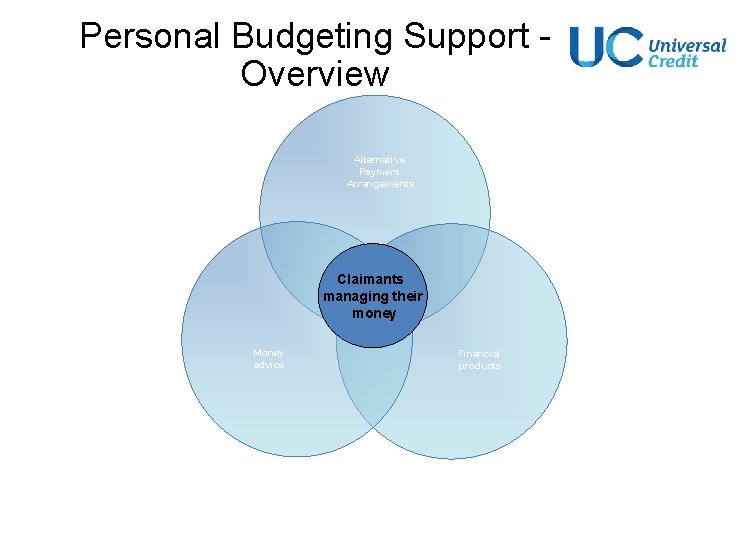
Personal Budgeting Support - Overview Alternative Payment Arrangements Claimants managing their money Money advice Financial products
Money Advice Money advice includes: • Offered to anyone claiming Universal Credit • Now part of the work coach role • Online budgeting tools for claimants who are able to self-help. We have worked closely with the Money Advice Service to produce a range of products. Information is also available on GOV. UK – https: //obs. moneyadviceservice. org. uk/ – Money Manager, a new online service to help claimants take charge of their finances and manage their move to Universal Credit • Money advice services using a mix of face to face and telephony support – currently delivered by LAs. • Longer term Universal Credit will be delivered via Universal Support through delivery partnership agreements • A Universal Credit Personal Planner is available on GOV. UK to help claimants understand the changes under Universal Credit and advice on what they might need to do to prepare: https: //secureonline. dwp. gov. uk/universal-credit-preparation
• Personal Budgeting Support – financial products A personal planner is available on GOV. UK to help claimants understand prepare • Up to 1. 3 million potential Universal Credit claimants currently do not use a transactional bank account (an account that allows bank customers to use direct debits to pay bills) to manage their benefit payments • We are looking at ways to make accounts with budgeting functionality, such as ‘jam jar’ accounts, more widely available. We are consulting with financial providers across the private, social and third sectors and considering the best ways to make these types of products more available • Universal Credit monthly payments can be paid into all types of Credit Union account • We have enabled the development of better basic bank accounts from all major banks which now offer users the ability to set up and pay by direct debit and pay bills.
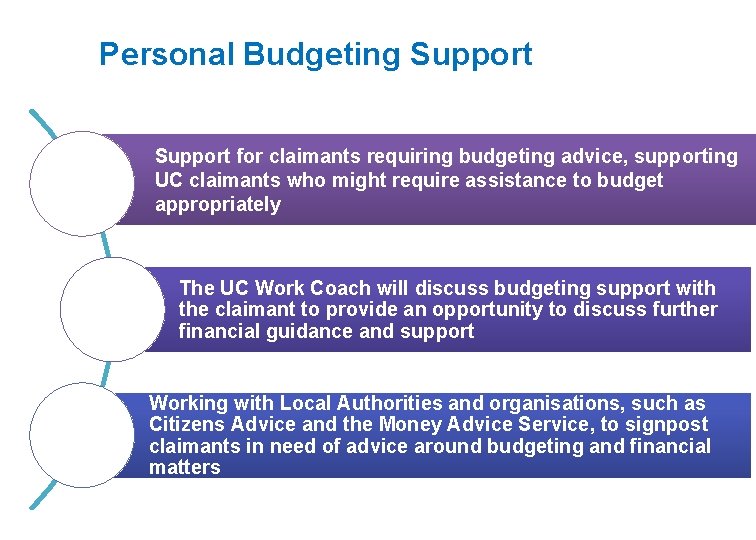
Personal Budgeting Support for claimants requiring budgeting advice, supporting UC claimants who might require assistance to budget appropriately The UC Work Coach will discuss budgeting support with the claimant to provide an opportunity to discuss further financial guidance and support Working with Local Authorities and organisations, such as Citizens Advice and the Money Advice Service, to signpost claimants in need of advice around budgeting and financial matters
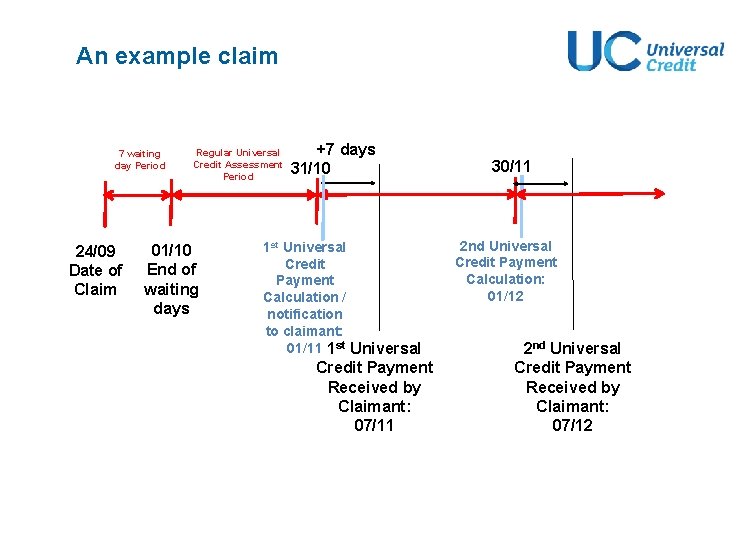
An example claim 7 waiting day Period 24/09 Date of Claim Regular Universal Credit Assessment Period 01/10 End of waiting days +7 days 31/10 1 st Universal Credit Payment Calculation / notification to claimant: 01/11 1 st Universal Credit Payment Received by Claimant: 07/11 30/11 2 nd Universal Credit Payment Calculation: 01/12 2 nd Universal Credit Payment Received by Claimant: 07/12
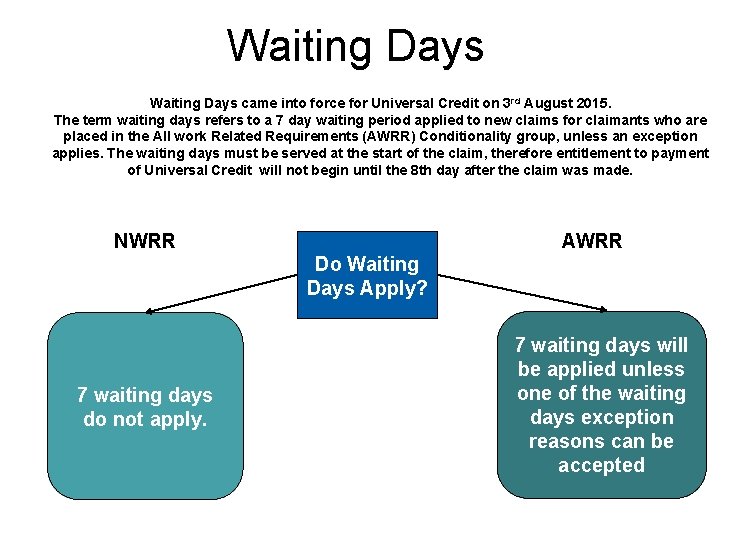
Waiting Days came into force for Universal Credit on 3 rd August 2015. The term waiting days refers to a 7 day waiting period applied to new claims for claimants who are placed in the All work Related Requirements (AWRR) Conditionality group, unless an exception applies. The waiting days must be served at the start of the claim, therefore entitlement to payment of Universal Credit will not begin until the 8 th day after the claim was made. AWRR NWRR Do Waiting Days Apply? 7 waiting days do not apply. 7 waiting days will be applied unless one of the waiting days exception reasons can be accepted
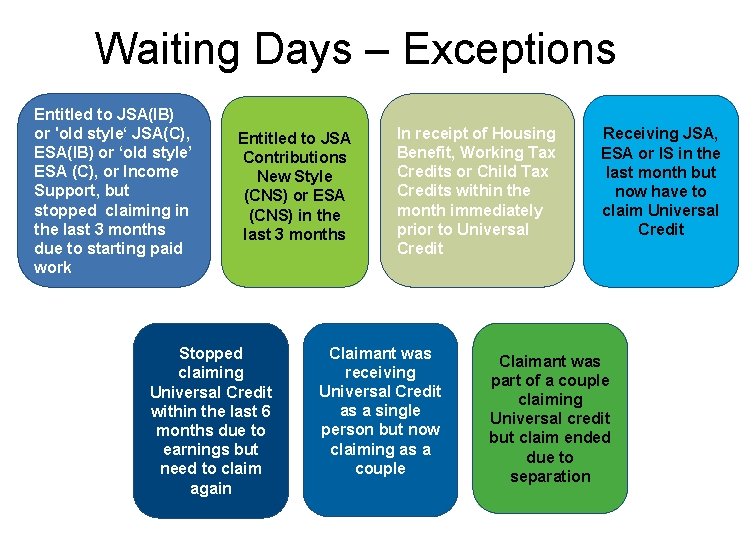
Waiting Days – Exceptions Entitled to JSA(IB) or 'old style‘ JSA(C), ESA(IB) or ‘old style’ ESA (C), or Income Support, but stopped claiming in the last 3 months due to starting paid work Entitled to JSA Contributions New Style (CNS) or ESA (CNS) in the last 3 months Stopped claiming Universal Credit within the last 6 months due to earnings but need to claim again In receipt of Housing Benefit, Working Tax Credits or Child Tax Credits within the month immediately prior to Universal Credit Claimant was receiving Universal Credit as a single person but now claiming as a couple Receiving JSA, ESA or IS in the last month but now have to claim Universal Credit Claimant was part of a couple claiming Universal credit but claim ended due to separation
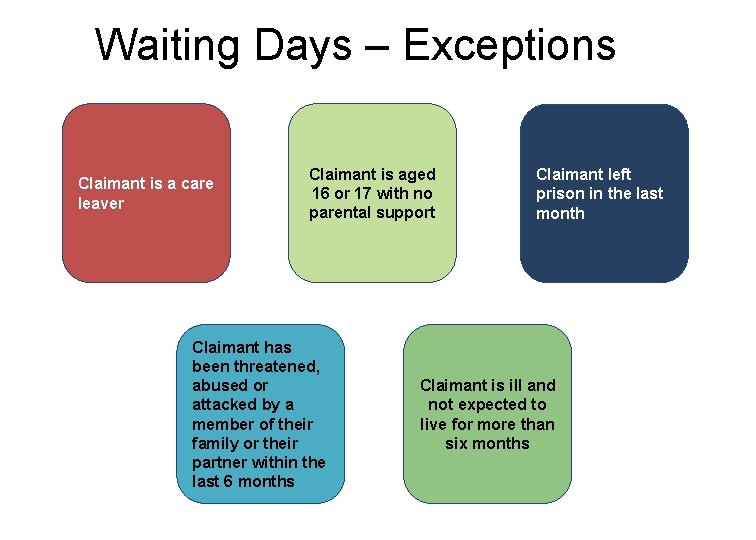
Waiting Days – Exceptions Claimant is a care leaver Claimant is aged 16 or 17 with no parental support Claimant has been threatened, abused or attacked by a member of their family or their partner within the last 6 months Claimant left prison in the last month Claimant is ill and not expected to live for more than six months
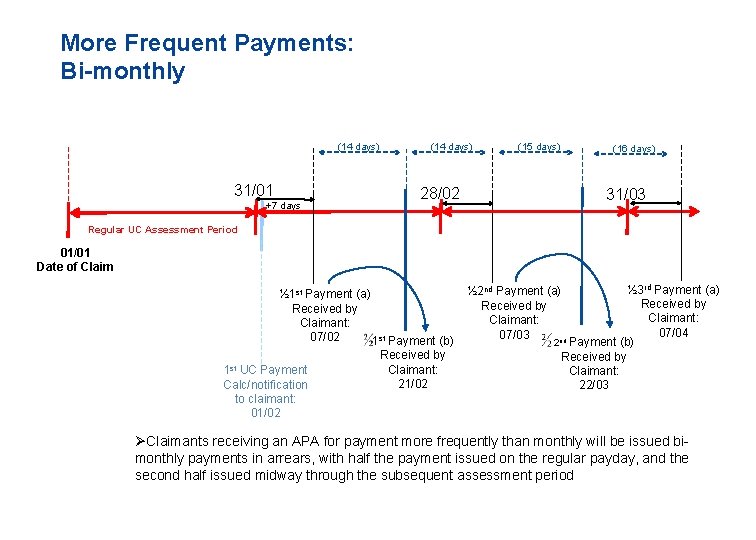
More Frequent Payments: Bi-monthly (14 days) 31/01 +7 days (14 days) (15 days) 28/02 (16 days) 31/03 Regular UC Assessment Period 01/01 Date of Claim ½ 1 st Payment (a) Received by Claimant: 07/02 1 st Payment (b) Received by st Claimant: 1 UC Payment 21/02 Calc/notification to claimant: 01/02 ½ 3 rd Payment (a) Received by Claimant: 07/04 2 Payment (b) Received by Claimant: 22/03 ½ 2 nd Payment (a) Received by Claimant: 07/03 nd ØClaimants receiving an APA for payment more frequently than monthly will be issued bimonthly payments in arrears, with half the payment issued on the regular payday, and the second half issued midway through the subsequent assessment period
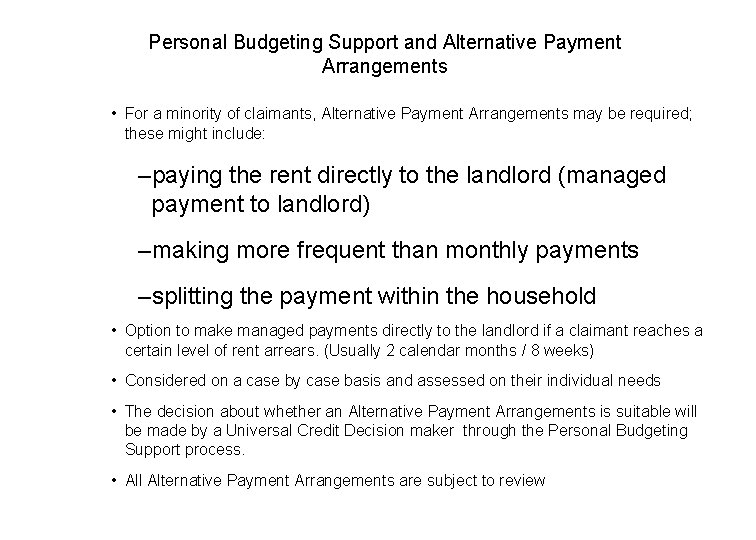
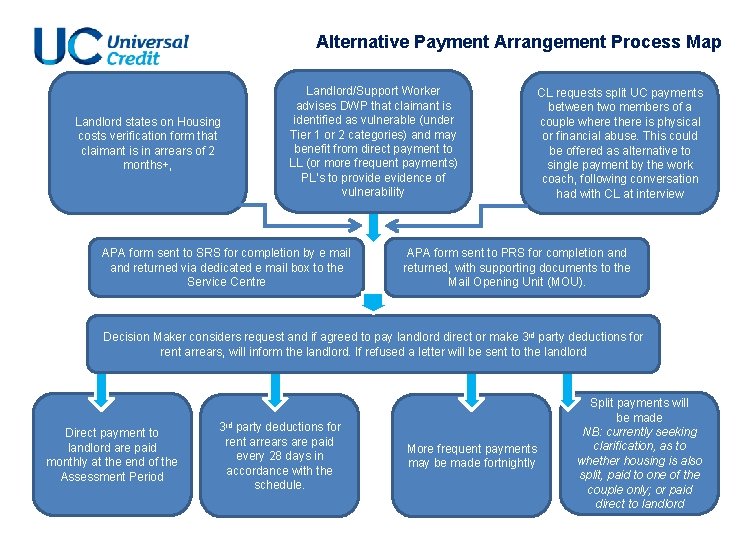
Personal Budgeting Support and Alternative Payment Arrangements • For a minority of claimants, Alternative Payment Arrangements may be required; these might include: –paying the rent directly to the landlord (managed payment to landlord) –making more frequent than monthly payments –splitting the payment within the household • Option to make managed payments directly to the landlord if a claimant reaches a certain level of rent arrears. (Usually 2 calendar months / 8 weeks) • Considered on a case by case basis and assessed on their individual needs • The decision about whether an Alternative Payment Arrangements is suitable will be made by a Universal Credit Decision maker through the Personal Budgeting Support process. • All Alternative Payment Arrangements are subject to review
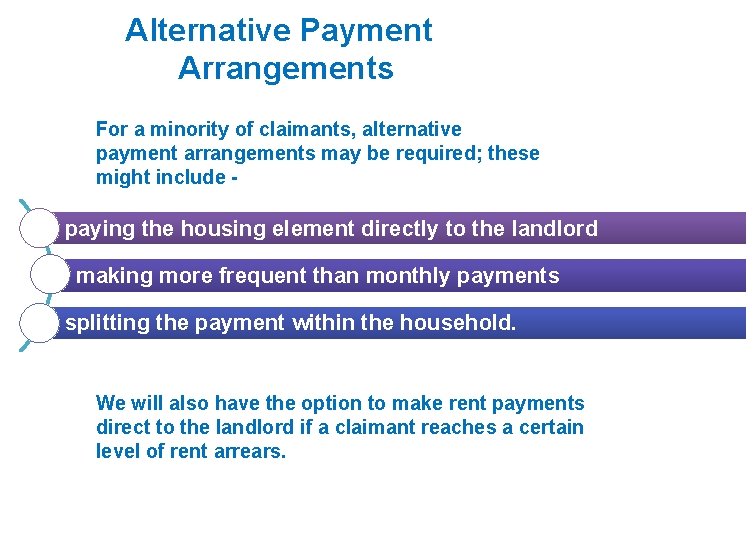
Alternative Payment Arrangements For a minority of claimants, alternative payment arrangements may be required; these might include - include: paying the housing element directly to the landlord making more frequent than monthly payments splitting the payment within the household. We will also have the option to make rent payments direct to the landlord if a claimant reaches a certain level of rent arrears.
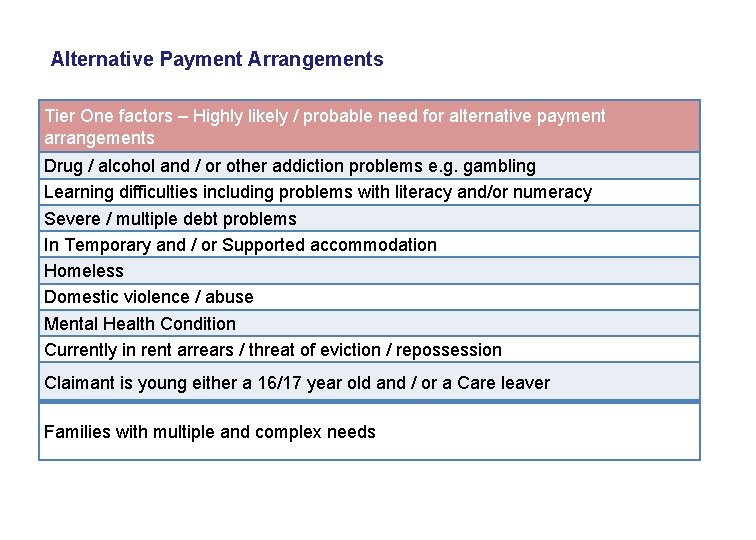
Alternative Payment Arrangements Tier One factors – Highly likely / probable need for alternative payment arrangements Drug / alcohol and / or other addiction problems e. g. gambling Learning difficulties including problems with literacy and/or numeracy Severe / multiple debt problems In Temporary and / or Supported accommodation Homeless Domestic violence / abuse Mental Health Condition Currently in rent arrears / threat of eviction / repossession Claimant is young either a 16/17 year old and / or a Care leaver Families with multiple and complex needs
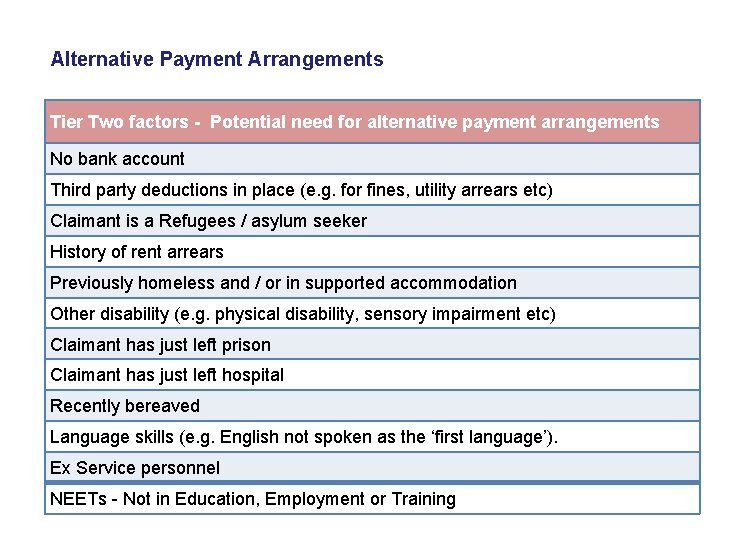
Alternative Payment Arrangements Tier Two factors - Potential need for alternative payment arrangements No bank account Third party deductions in place (e. g. for fines, utility arrears etc) Claimant is a Refugees / asylum seeker History of rent arrears Previously homeless and / or in supported accommodation Other disability (e. g. physical disability, sensory impairment etc) Claimant has just left prison Claimant has just left hospital Recently bereaved Language skills (e. g. English not spoken as the ‘first language’). Ex Service personnel NEETs - Not in Education, Employment or Training
Managed Payments to Landlords • Managed payments will be considered on a case-by-case basis and can be requested by landlords as well as claimants. They can be considered on request from: – The start of the claim; or – During the claim if the claimant has accumulated rent arrears which will put their tenancy at risk. • We do expect landlords to continue to follow their usual rent collection practices and procedures, making every effort to manage rent payments and recovery of any rent arrears. However, if the claimant is unable or unwilling to resolve payment issues with their landlord, Universal Credit can then intervene. • When a claimant has accumulated one month's rent arrears due to persistent underpayment, we will make an early intervention, reviewing the financial support they need and making managed payments to their landlord if appropriate. • If a claimant has accrued two month's rent arrears, we will pay the Universal Credit housing element direct to the landlord and if requested take steps to recover the rent arrears through deductions from their remaining Universal Credit payment.
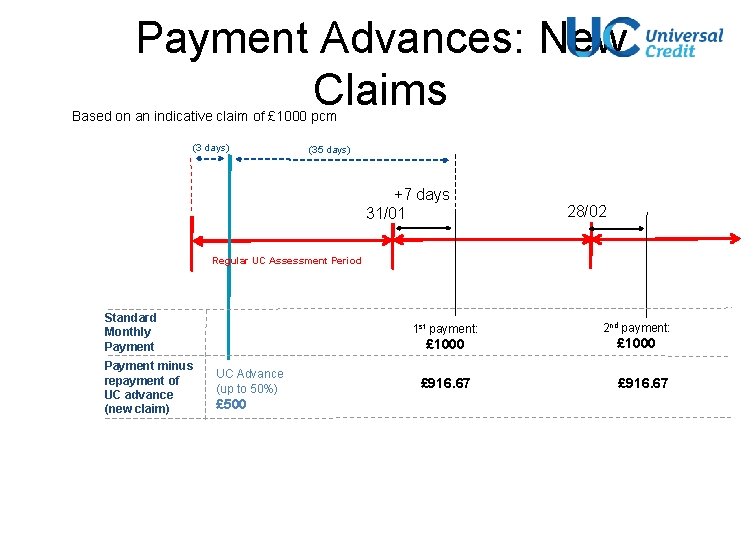
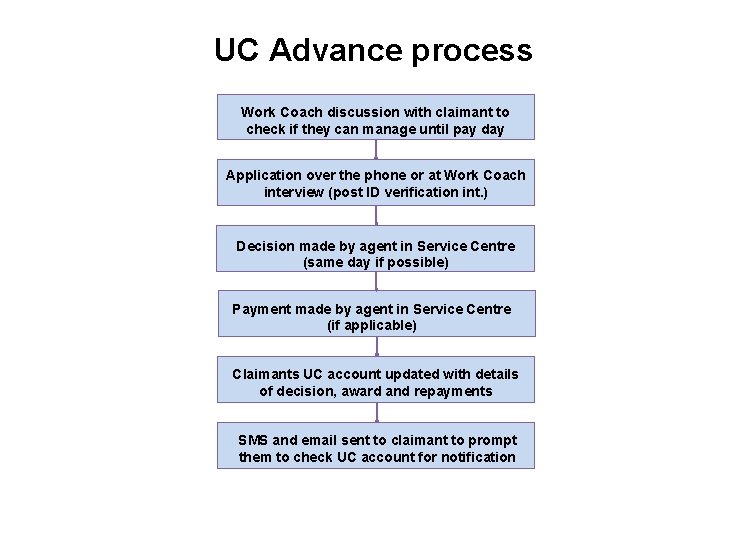
Payment Advances • Universal credit payments will be issued monthly through the BACS system. • The first payment will be made after the initial Universal Credit calculation period (one calendar month from the date of claim) + 7 days. • New claimants and those transitioning from legacy benefits may be eligible for an advance of their indicative award to help them manage during the first assessment period if they need it. • For a Universal Credit Advance (New Claim) the claimant will be advised at the non repudiation stage that if they can't manage they can claim an advance. They would have to have an underlying entitlement, be in financial need and able to repay the advance over the next 6 months.
Payment Advances (continued) • For a Universal Credit Advance (Transitional) the claimant will have to ask for the advance within one month of moving across to Universal Credit and have been in receipt of an existing benefit within one month of moving across to Universal Credit. The financial need eligibility criteria does not apply to a transitional advance • These Universal Credit advances will provide an interest-free lending facility for claimants who find it difficult to access mainstream credit, and could offer an alternative to high cost borrowing • A claimant can request an advance of up to 50% of their indicative Universal Credit award • More information about Universal Credit Advances can be found at GOV. UK
Payment Advances: New Claims Based on an indicative claim of £ 1000 pcm (3 days) (35 days) +7 days 31/01 28/02 Regular UC Assessment Period Standard Monthly Payment minus repayment of UC advance (new claim) UC Advance (up to 50%) £ 500 1 st payment: 2 nd payment: £ 1000 £ 916. 67
Alternative Payment Arrangement Process Map Landlord states on Housing costs verification form that claimant is in arrears of 2 months+, Landlord/Support Worker advises DWP that claimant is identified as vulnerable (under Tier 1 or 2 categories) and may benefit from direct payment to LL (or more frequent payments) PL’s to provide evidence of vulnerability APA form sent to SRS for completion by e mail and returned via dedicated e mail box to the Service Centre CL requests split UC payments between two members of a couple where there is physical or financial abuse. This could be offered as alternative to single payment by the work coach, following conversation had with CL at interview APA form sent to PRS for completion and returned, with supporting documents to the Mail Opening Unit (MOU). Decision Maker considers request and if agreed to pay landlord direct or make 3 rd party deductions for rent arrears, will inform the landlord. If refused a letter will be sent to the landlord Direct payment to landlord are paid monthly at the end of the Assessment Period 3 rd party deductions for rent arrears are paid every 28 days in accordance with the schedule. More frequent payments may be made fortnightly Split payments will be made NB: currently seeking clarification, as to whether housing is also split, paid to one of the couple only; or paid direct to landlord
UC Advance process Work Coach discussion with claimant to check if they can manage until pay day Application over the phone or at Work Coach interview (post ID verification int. ) Decision made by agent in Service Centre (same day if possible) Payment made by agent in Service Centre (if applicable) Claimants UC account updated with details of decision, award and repayments SMS and email sent to claimant to prompt them to check UC account for notification
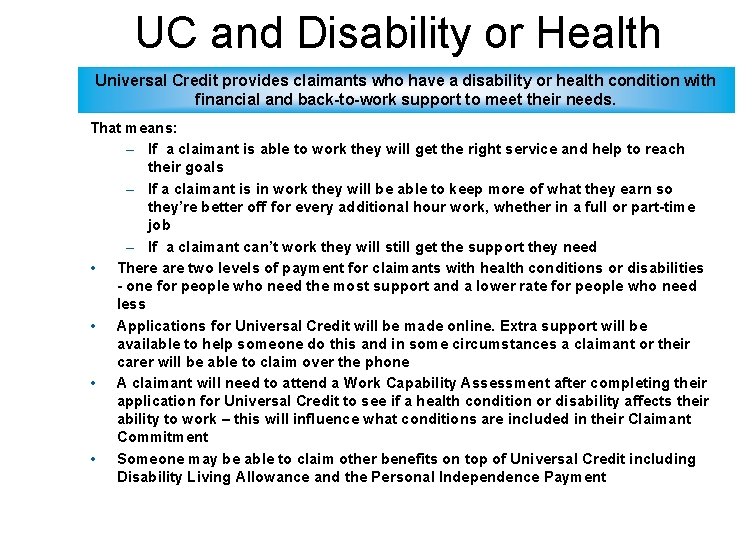
UC and Disability or Health Condition Universal Credit provides claimants who have a disability or health condition with financial and back-to-work support to meet their needs. That means: – If a claimant is able to work they will get the right service and help to reach their goals – If a claimant is in work they will be able to keep more of what they earn so they’re better off for every additional hour work, whether in a full or part-time job – If a claimant can’t work they will still get the support they need • There are two levels of payment for claimants with health conditions or disabilities - one for people who need the most support and a lower rate for people who need less • Applications for Universal Credit will be made online. Extra support will be available to help someone do this and in some circumstances a claimant or their carer will be able to claim over the phone • A claimant will need to attend a Work Capability Assessment after completing their application for Universal Credit to see if a health condition or disability affects their ability to work – this will influence what conditions are included in their Claimant Commitment • Someone may be able to claim other benefits on top of Universal Credit including Disability Living Allowance and the Personal Independence Payment
Better off in work Universal Credit helps to ensure people are better off in work than on benefits by: • Removing the limit to the number of hours someone can work each week Total net earnings • Reducing a claimant’s Universal Credit payment gradually as their earnings increase, so they won’t lose all their benefits at once if they’re on a low income. Total in-pocket income Universal Credit payment Gross earnings
UC and employers Universal Credit boosts business as employees can work any hours a business needs without losing their benefit if they are on a low income • Universal Credit provides employers with a more flexible workforce – removing the 16 hour rule makes it easier for claimant employees to move in and out of work and increase their hours, so employers will find it easier to fill temporary vacancies and access a wider pool of applicants • Universal Credit is an in and out of work benefit, so over time existing employees who have been claiming Tax Credits will move over to claim Universal Credit • Universal Credit payments are linked to how much an employed claimant has earned. This information is captured through the new Pay as You Earn (PAYE) reporting in real time to HMRC. This reduces employer administrative burdens and simplifies reporting for starters and leavers • Accurate reporting of employees’ PAYE information on time will be key to a smooth process for the employee so that the correct Universal Credit payment can be made on time too
Useful Links Jobcentre offices where eligible claimants can make a claim for Universal Credit https: //www. gov. uk/jobcentres-where-you-can-claim-universal-credit The Universal Credit Personal Planner - aimed at helping financial and digital preparation https: //secureonline. dwp. gov. uk/universal-credit-preparation/ Money Advice Service support for Universal Credit https: //www. moneyadviceservice. org. uk/en/categories/universal-credit-and-other-benefits A Money Advice Service Universal Credit video https: //www. moneyadviceservice. org. uk/en/videos/get-ready-universal-credit The Local Support Services Framework https: //www. gov. uk/government/uploads/system/uploads/attachment_data/file/181395/uc-local-service-supportframework. pdf The Universal Credit and Rented Housing Frequently Asked Questions https: //www. gov. uk/government/publications/universal-credit-and-rented-housing Operating Guidance for PBS & APAs https: //www. gov. uk/government/uploads/system/uploads/attachment_data/file/181399/personal-budgetingsupport-cover-note. pdf https: //www. gov. uk/government/uploads/system/uploads/attachment_data/file/181400/personal-budgetingsupport-guidance. pdf
Useful Links An introduction to Universal Credit video http: //youtu. be/E 7 GUu 7 Xa 7 Nw Universal Credit Managing Your Money video https: //www. youtube. com/watch? v=ZOj. Gm. DWf 6 l. U#t=41 Universal Credit pages on GOV. UK https: //www. gov. uk/universal-credit Jobcentre offices where eligible claimants can make a claim for Universal Credit https: //www. gov. uk/jobcentres-where-you-can-claim-universal-credit The Claimant Commitment https: //www. gov. uk/government/publications/universal-credit-and-your-claimant-commitment-quick-guide The Local Support Services Framework https: //www. gov. uk/government/uploads/system/uploads/attachment_data/file/181395/uc-local-service-supportframework. pdf UC Local Support Services Update and Trialling Plan published in December 2013 https: //www. gov. uk/government/publications/universal-credit-local-support-services-update-and-trialling-plan Operating Guidance for PBS & APAs https: //www. gov. uk/government/uploads/system/uploads/attachment_data/file/181399/personal-budgetingsupport-cover-note. pdf https: //www. gov. uk/government/uploads/system/uploads/attachment_data/file/181400/personal-budgetingsupport-guidance. pdf Budgeting help and support https: //www. gov. uk/government/publications/budgeting-your-universal-credit-quick-guide
The Universal Credit Personal Planner - aimed at helping financial and digital preparation https: //secureonline. dwp. gov. uk/universal-credit-preparation/ Landlord Preparation Strategy https: //www. gov. uk/government/news/universal-credit-support-boost-for-social-landlords Money Advice Service support for Universal Credit https: //www. moneyadviceservice. org. uk/en/categories/universal-credit Money Advice Service Universal Credit video https: //www. moneyadviceservice. org. uk/en/videos/get-ready-universal-credit The Universal Credit and Rented Housing Frequently Asked Questions https: //www. gov. uk/government/uploads/system/uploads/attachment_data/file/337964/universal-creditand-rented-housing. pdf Universal Credit Full Service You Tube Video https: //www. youtube. com/channel/UC 7 Km 4 IXf. VJB 1 n 8 SQUmk. JD 0 Q Universal Credit Toolkit for Partners https: //www. gov. uk/guidance/universal-credit-toolkit-for-partner-organisations
Getting ready for Universal Credit – support and information • Where is Universal Credit available: https: //www. gov. uk/jobcentres-where-you-can-claim-universal-credit • The ‘Universal Credit partner toolkit’ is available at the following url: https: //www. gov. uk/universal-credit-toolkit-for-partner-organisations • • The 'Universal Credit and families: questions and answers' is available at the following url: https: //www. gov. uk/government/publications/universal-credit-and-familiesquestions-and-answers. The publication 'Universal Credit and your family' is available at the following url: https: //www. gov. uk/government/publications/universal-credit-and-your-familyquick-guide. The publication 'Universal Credit: claimant journey for families' is available at the following url: https: //www. gov. uk/government/publications/universal-credit-claimant-journeyfor-families. The publication 'How Universal Credit supports families' is available at the following url: https: //www. gov. uk/government/publications/how-universal-credit-supportsfamilies.