
Statistics Statistical analysis is used to collect a
- Slides: 14
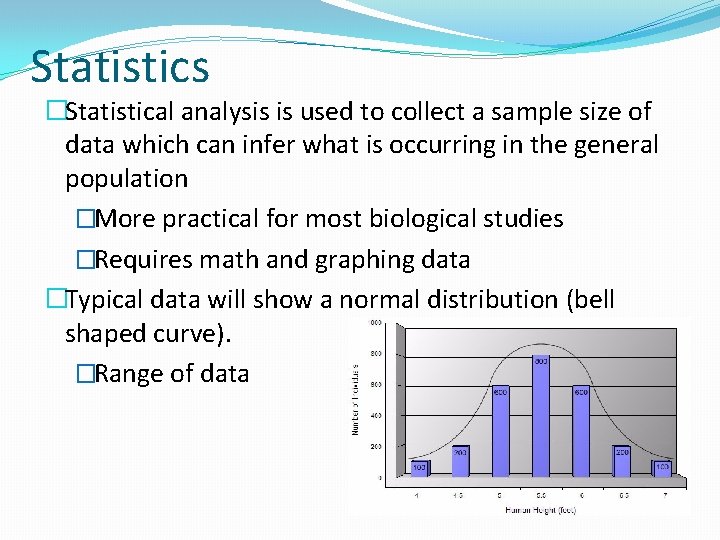
Statistics �Statistical analysis is used to collect a sample size of data which can infer what is occurring in the general population �More practical for most biological studies �Requires math and graphing data �Typical data will show a normal distribution (bell shaped curve). �Range of data
Measures of Central Tendencies �Mean �Average of data set �Median �Middle value of data set �Not sensitive to outlying data �Mode �Most common value of data set
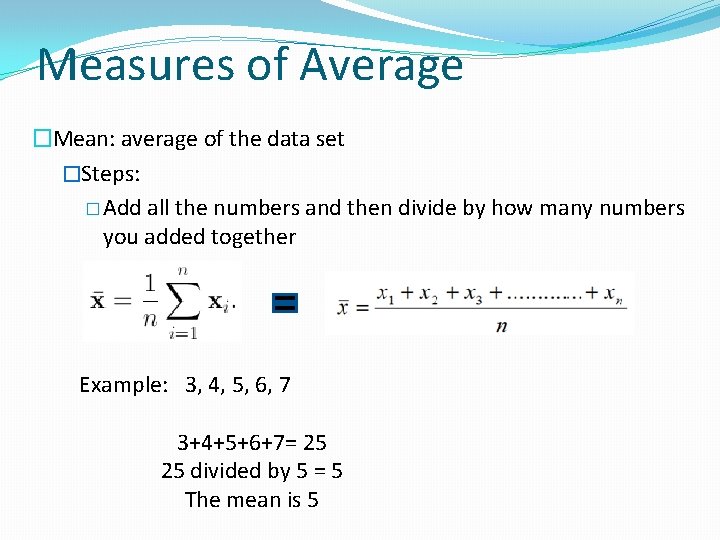
Measures of Average �Mean: average of the data set �Steps: � Add all the numbers and then divide by how many numbers you added together Example: 3, 4, 5, 6, 7 3+4+5+6+7= 25 25 divided by 5 = 5 The mean is 5
Measures of Average �Median: the middle number in a range of data points �Steps: � Arrange data points in numerical order. The middle number is the median � If there is an even number of data points, average the two middle numbers �Mode: value that appears most often Example: 1, 6, 4, 13, 9, 10, 6, 3, 19 1, 3, 4, 6, 6, 9, 10, 13, 19 Median = 6 Mode = 6
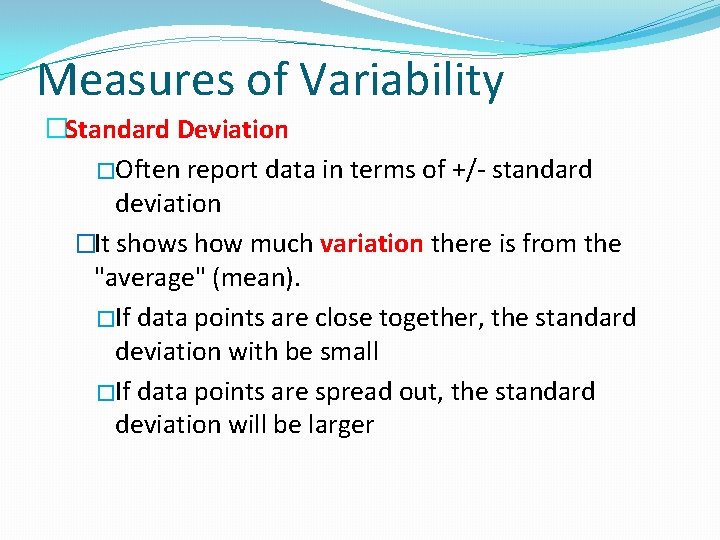
Measures of Variability �Standard Deviation �Often report data in terms of +/- standard deviation �It shows how much variation there is from the "average" (mean). �If data points are close together, the standard deviation with be small �If data points are spread out, the standard deviation will be larger
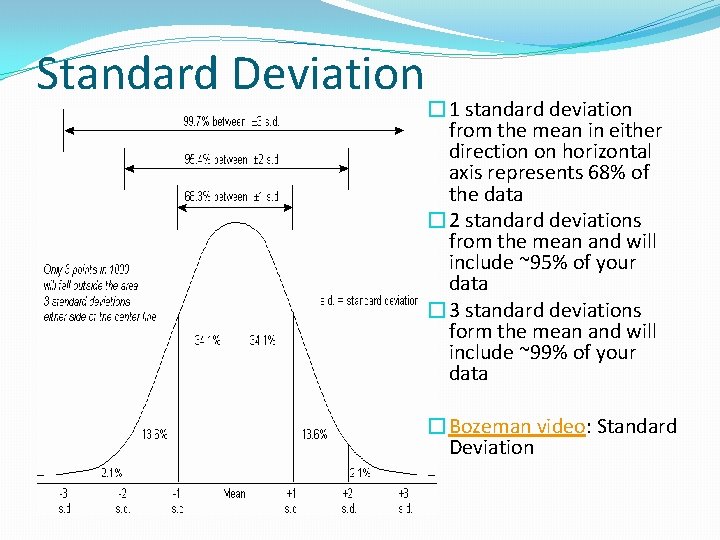
Standard Deviation � 1 standard deviation from the mean in either direction on horizontal axis represents 68% of the data � 2 standard deviations from the mean and will include ~95% of your data � 3 standard deviations form the mean and will include ~99% of your data �Bozeman video: Standard Deviation
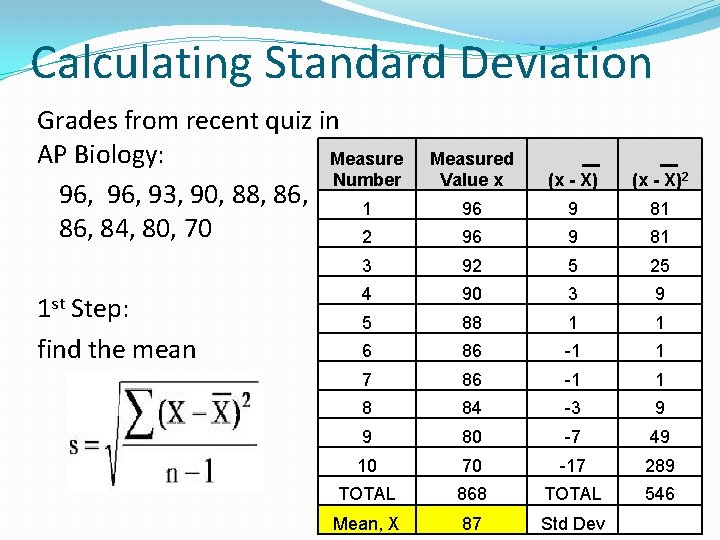
Calculating Standard Deviation Grades from recent quiz in AP Biology: Measure Number 96, 93, 90, 88, 86, 1 86, 84, 80, 70 2 1 st Step: find the mean Measured Value x (x - X)2 96 9 81 3 92 5 25 4 90 3 9 5 88 1 1 6 86 -1 1 7 86 -1 1 8 84 -3 9 9 80 -7 49 10 70 -17 289 TOTAL 868 TOTAL 546 Mean, X 87 Std Dev
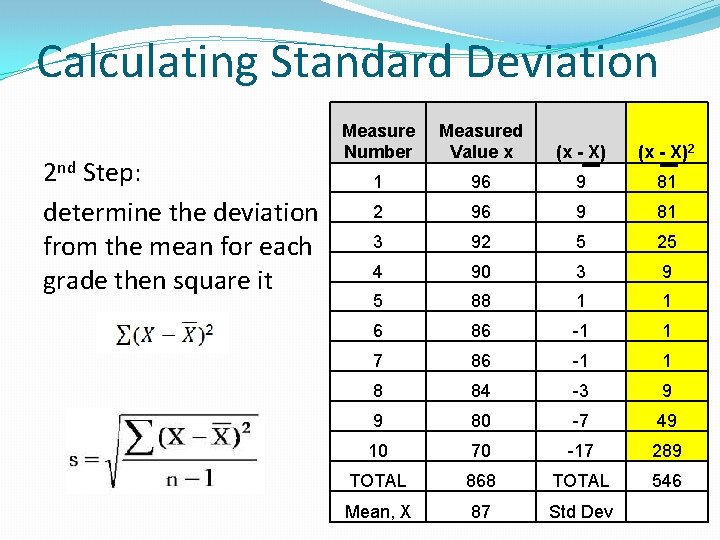
Calculating Standard Deviation 2 nd Step: determine the deviation from the mean for each grade then square it Measure Number Measured Value x (x - X)2 1 96 9 81 2 96 9 81 3 92 5 25 4 90 3 9 5 88 1 1 6 86 -1 1 7 86 -1 1 8 84 -3 9 9 80 -7 49 10 70 -17 289 TOTAL 868 TOTAL 546 Mean, X 87 Std Dev
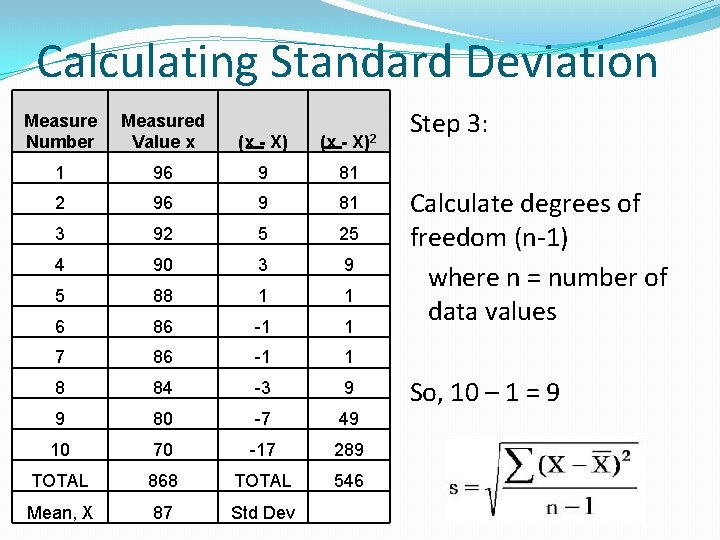
Calculating Standard Deviation Measure Number Measured Value x (x - X) 1 96 9 81 2 96 9 81 3 92 5 25 4 90 3 9 5 88 1 1 6 86 -1 1 7 86 -1 1 8 84 -3 9 9 80 -7 49 10 70 -17 289 TOTAL 868 TOTAL 546 Mean, X 87 Std Dev (x - X)2 Step 3: Calculate degrees of freedom (n-1) where n = number of data values So, 10 – 1 = 9
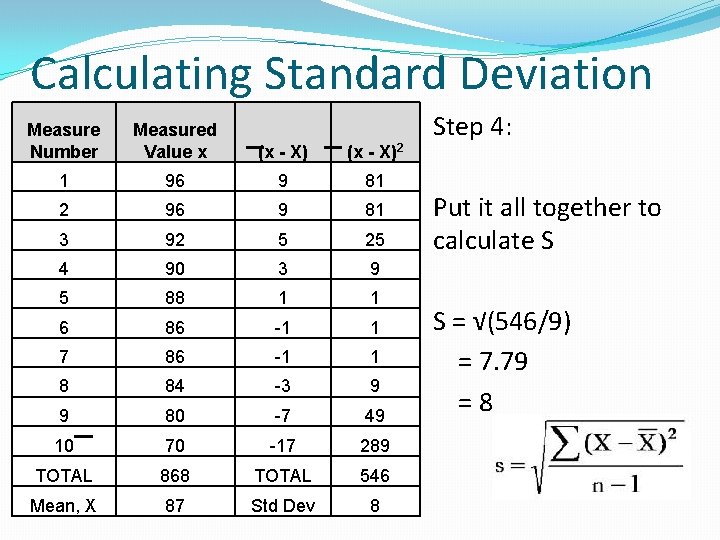
Calculating Standard Deviation Measure Number Measured Value x (x - X)2 1 96 9 81 2 96 9 81 3 92 5 25 4 90 3 9 5 88 1 1 6 86 -1 1 7 86 -1 1 8 84 -3 9 9 80 -7 49 10 70 -17 289 TOTAL 868 TOTAL 546 Mean, X 87 Std Dev 8 Step 4: Put it all together to calculate S S = √(546/9) = 7. 79 =8
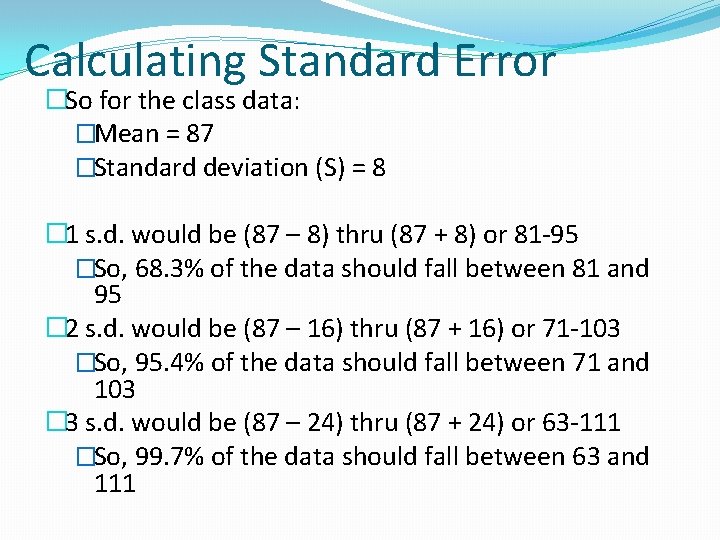
Calculating Standard Error �So for the class data: �Mean = 87 �Standard deviation (S) = 8 � 1 s. d. would be (87 – 8) thru (87 + 8) or 81 -95 �So, 68. 3% of the data should fall between 81 and 95 � 2 s. d. would be (87 – 16) thru (87 + 16) or 71 -103 �So, 95. 4% of the data should fall between 71 and 103 � 3 s. d. would be (87 – 24) thru (87 + 24) or 63 -111 �So, 99. 7% of the data should fall between 63 and 111
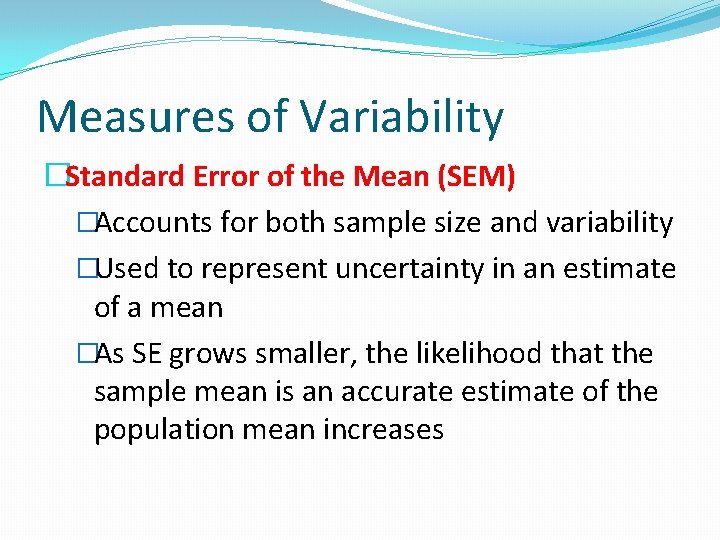
Measures of Variability �Standard Error of the Mean (SEM) �Accounts for both sample size and variability �Used to represent uncertainty in an estimate of a mean �As SE grows smaller, the likelihood that the sample mean is an accurate estimate of the population mean increases
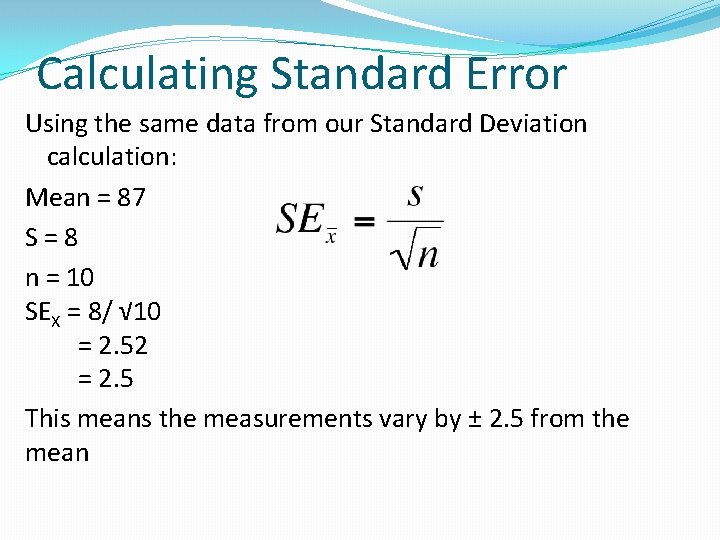
Calculating Standard Error Using the same data from our Standard Deviation calculation: Mean = 87 S=8 n = 10 SEX = 8/ √ 10 = 2. 52 = 2. 5 This means the measurements vary by ± 2. 5 from the mean
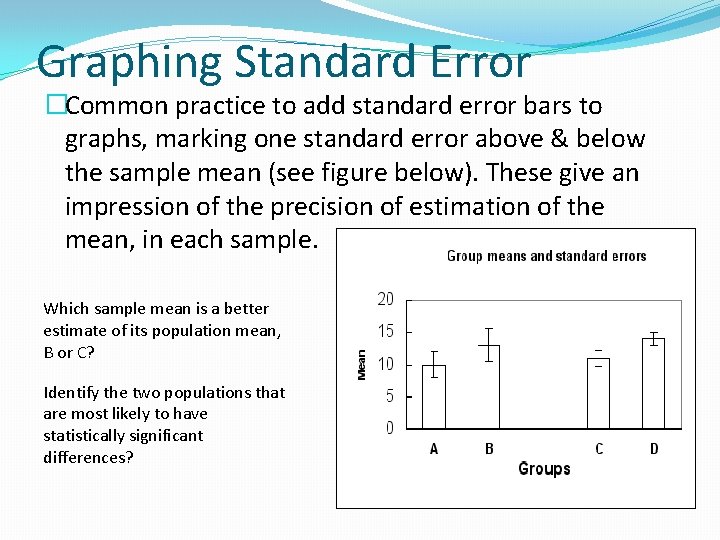
Graphing Standard Error �Common practice to add standard error bars to graphs, marking one standard error above & below the sample mean (see figure below). These give an impression of the precision of estimation of the mean, in each sample. Which sample mean is a better estimate of its population mean, B or C? Identify the two populations that are most likely to have statistically significant differences?