Unit 7 Communication and controlling Communication Meaning and


- Slides: 65
Unit 7 Communication and controlling
Communication Meaning and process of communication Types of communication – Formal and informal communication and Interpersonal and non-verbal communication Barriers to effective communication Techniques for improving communication
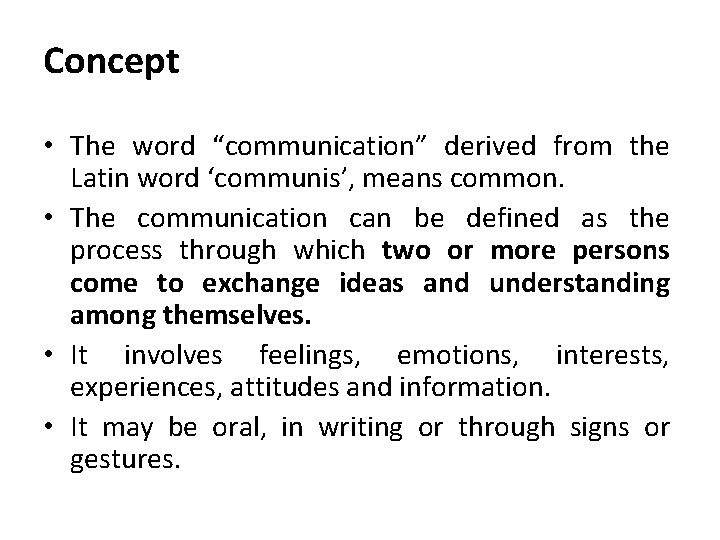
Concept • The word “communication” derived from the Latin word ‘communis’, means common. • The communication can be defined as the process through which two or more persons come to exchange ideas and understanding among themselves. • It involves feelings, emotions, interests, experiences, attitudes and information. • It may be oral, in writing or through signs or gestures.
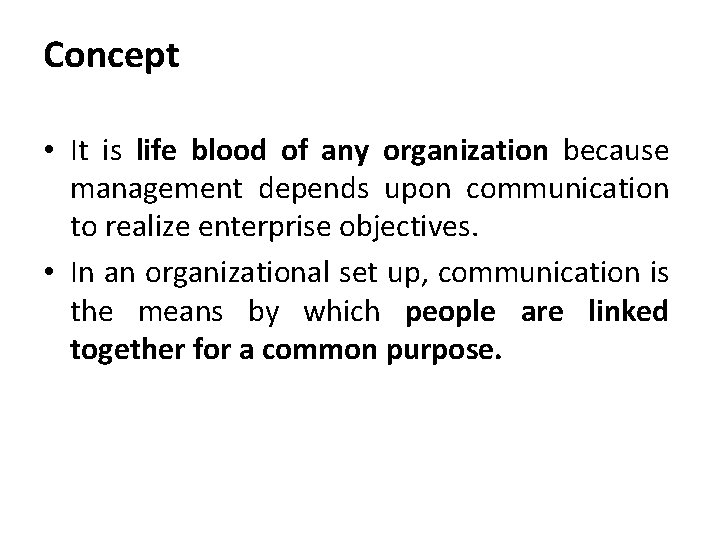
Concept • It is life blood of any organization because management depends upon communication to realize enterprise objectives. • In an organizational set up, communication is the means by which people are linked together for a common purpose.
Concept • “Communication is the process in which two or more parties exchange information and share meaning”. -Moorhead and Griffin • “Communication is the transfer of information and understanding from one person to another person”. –Newstrom and Davis • “Communication involves more than just linear information flows; it is a dynamic, interpersonal process that involves behavioral exchanges”. –Fred Luthans • “Communication is the transference and understanding of meaning”. - S. P. Robbins
Concept • Based on above definitions it can be concluded that communication is the – process of transmitting information, thoughts, opinions, messages, facts, ideas or emotions from one person, to another person in such a way that the meaning of the message received is understood by the receiver. – The message received should be as close in meaning as possible to the intended message.
COMMUNICATION PROCESS • Two way process. • Takes place between people. • Begins when the sender wants to transmit a fact, idea, opinion, or other information to the receiver. • Communication process completes only after feedback. • Message is the subject matter of communication. • It may be: – facts, figures or information. – When we speak, the speech is the message; – when we write, the writing is the message.
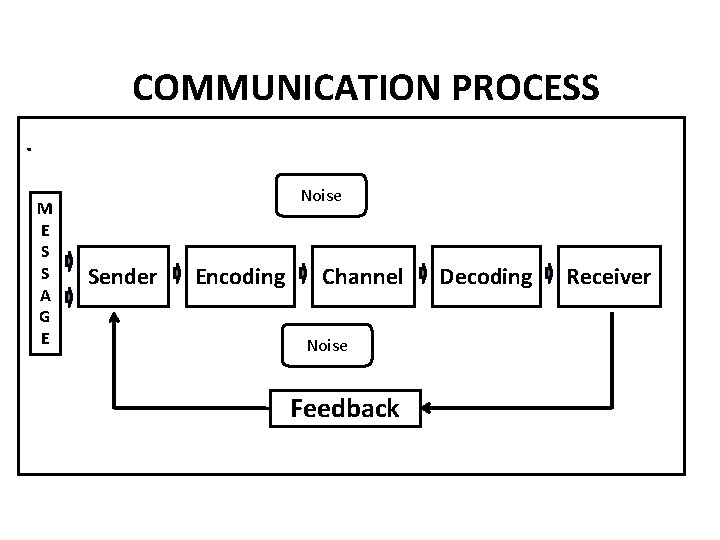
COMMUNICATION PROCESS. M E S S A G E Noise Sender Encoding Channel Noise Feedback Decoding Receiver
COMMUNICATION PROCESS • Sender: – It is the source of communication. – It is the individual, group or organization interested in communicating something to another party. • Encoding: – converting a message to symbolic form. – translating thought to message – It is the process by which the message is translated from an idea or thought into transmittable symbols. – The symbols can be word, sound, number, picture and gesture, etc.
COMMUNICATION PROCESS • Channel: – It is the media for message transmission. – It is selected by the source/sender – It can be : • • Audio-Visual (TV, Cinema etc), Print media (Newspaper, magazine, post mail, couriers) Mechanical (Telephone, mobile, fax, email, etc. ), and Personal (face to face contact).
COMMUNICATION PROCESS • Decoding: – It is the process by which the receiver of the message interprets the message’s meaning. – the receiver’s action in making sense of the message • Receiver: – It is the target audience of communication. – The receiver can accept or reject the message. – He can either use or not use the message.
COMMUNICATION PROCESS • Feedback: – It determines whether or not the understanding has been achieved. – It should be specific, useful, clear and timely. • Noise: – disturbance that reduces the accuracy of communication. – barrier to successful communication.
Types of communication It can be categorized under three major heads: A. Based on methods used a. Oral/Verbal communication b. Written c. Non-verbal (gesture) B. Based on direction used a. Vertical (Upward, Downward) b. Horizontal c. Diagonal C. Based on network (relationship): a. Formal network(Wheel, Chain, Circle, All channel network) b. Informal network -Grapevine(Cluster chain, Probability network, Gossip network, Single strand)
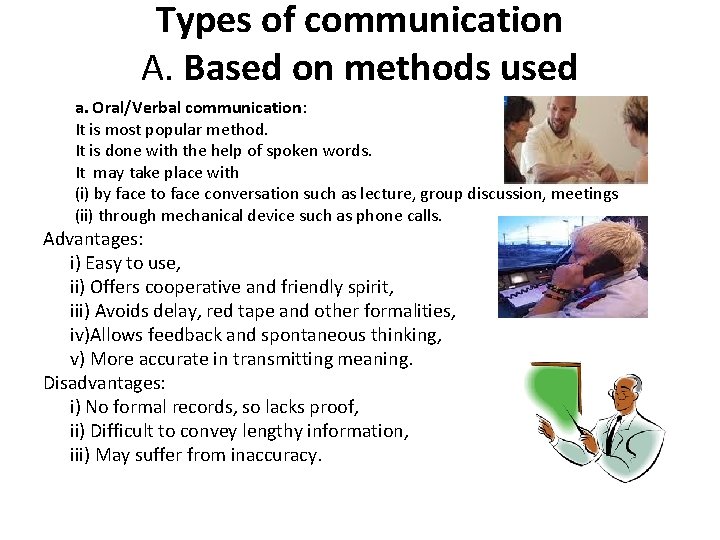
Types of communication A. Based on methods used a. Oral/Verbal communication: It is most popular method. It is done with the help of spoken words. It may take place with (i) by face to face conversation such as lecture, group discussion, meetings (ii) through mechanical device such as phone calls. Advantages: i) Easy to use, ii) Offers cooperative and friendly spirit, iii) Avoids delay, red tape and other formalities, iv)Allows feedback and spontaneous thinking, v) More accurate in transmitting meaning. Disadvantages: i) No formal records, so lacks proof, ii) Difficult to convey lengthy information, iii) May suffer from inaccuracy.
Types of communication A. Based on methods used b. Written: It is another most widely used method of communication. It is generally done in the form of instructions, memos, letters, formal reports, rules and regulations, policy handbooks, job description, information bulletins. It is used to give, receive and record information. It ensures that everyone has the same information. • Advantages: i) Formal, ii) Provides proof of evidence, iii) Permanent in nature so can be used for future reference, iv)Reduces the chances of misinterpretation and distortion of information. • Disadvantages: i) In general it is time consuming and expensive, ii) There is no certainty whether the receiver has understood or not, iii) It may give rise to excessive formality and rigidity in organizational operations
Types of communication A. Based on methods used c. Non-verbal (gesture): – Communication through sending and receiving wordless messages. – This method of communication includes all the elements associated with human communication except oral and written communication. – Most of us spend about 75 percent of our waking hours communicating our knowledge, thoughts, and ideas to others. – Non-verbal communication includes • facial expressions, eye contact, tone of voice, body posture and motions, and positioning within groups. • the way we wear our clothes or the silence we keep. • pictorial representations, signboards, even photographs, sketches and paintings. • Our facial expression can show frustration, fear, shyness, anger, and other characteristics which can be better communicated than voice or word.
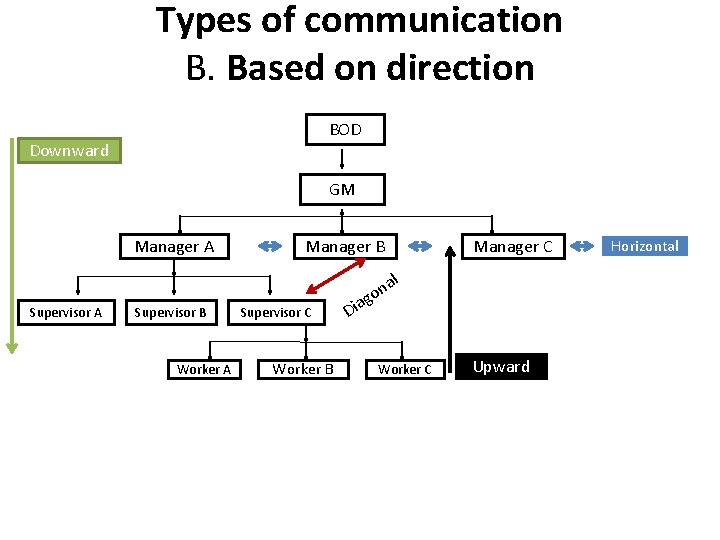
Types of communication B. Based on direction a. – – Vertical: Vertical communication consists of communication up and down the organization’s chain of command. Downward communication starts with top management and flows down through management levels to line workers and nonsupervisory personnel. The major purpose of downward communication is to advise, inform, direct, instruct, and evaluate employees and to provide organization members with information about organizational goals and policies. The main function of upward communication is to supply information to the upper levels about what is happening at the lower levels. This type of communication includes progress reports, suggestions, explanations, and requests for aid or decisions.
Types of communication B. Based on direction b. Horizontal : – It is interactive communication. – The flow of information is between people at the same level in the organization. – The basic idea of horizontal communication is to share information and bring higher degree of cooperation. – It refers to transmission of information among positions of the same level. c. Diagonal: – It is interactive communication. – In diagonal communication the flow of information is between people who are not at the same level in the organization.
Types of communication B. Based on direction BOD Downward GM Manager A Supervisor B Worker A Manager B Supervisor C Worker B Dia n go Manager C al Worker C Upward Horizontal
Types of communication C. Based on network (relationship): a. Formal networks: § Formal and official format. § Path of communications determined by the organization. § Official conferences, meetings and written memos and corporate letters are used for communication. § Can also occur between two strangers when they meet for the first time. § There can be many types of formal networks. Some of them are:
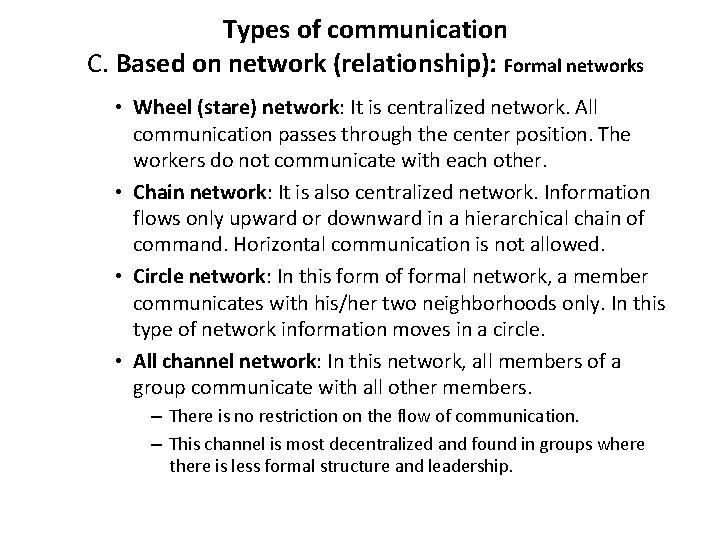
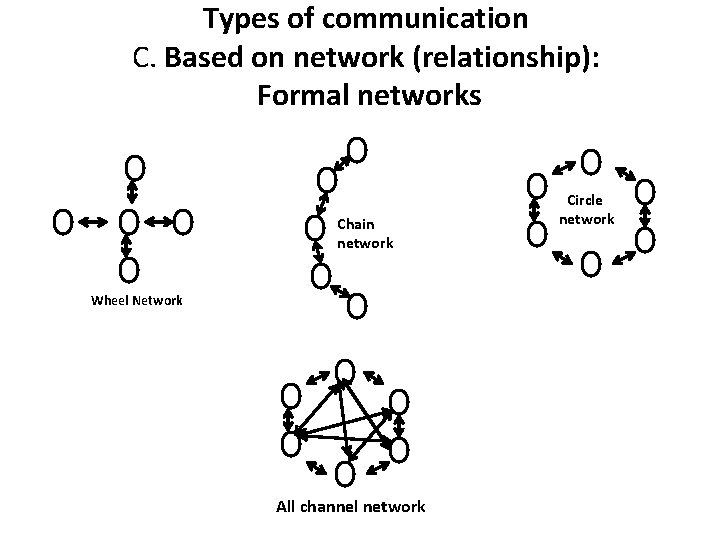
Types of communication C. Based on network (relationship): Formal networks • Wheel (stare) network: It is centralized network. All communication passes through the center position. The workers do not communicate with each other. • Chain network: It is also centralized network. Information flows only upward or downward in a hierarchical chain of command. Horizontal communication is not allowed. • Circle network: In this form of formal network, a member communicates with his/her two neighborhoods only. In this type of network information moves in a circle. • All channel network: In this network, all members of a group communicate with all other members. – There is no restriction on the flow of communication. – This channel is most decentralized and found in groups where there is less formal structure and leadership.
Types of communication C. Based on network (relationship): Formal networks Chain network Wheel Network All channel network Circle network
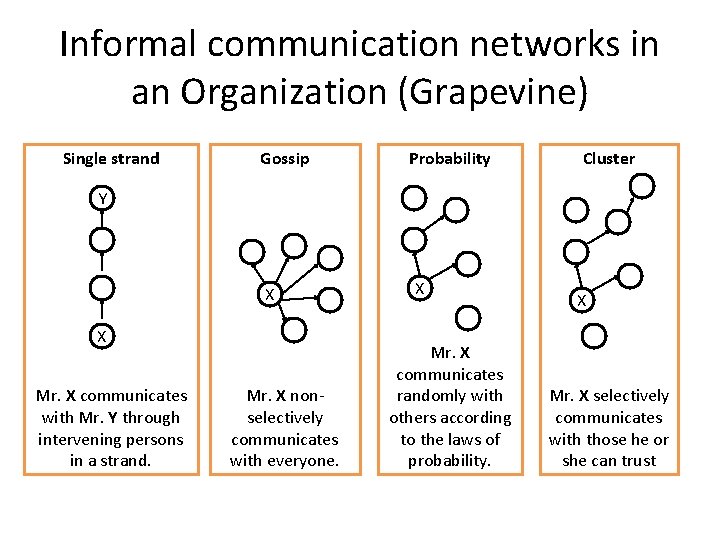
Types of communication C. Based on network (relationship): b. Informal network (Grapevine): In organization there is also an informal communication system which is called grapevine. – Grapevine is informal and unofficial communication network. – Informal communication does not have any rigid rules and guidelines. – Informal conversations need not necessarily have boundaries of time, place or even subjects for that matter. – Grapevine has three main characteristics • (i) it is not controlled by management • (ii) it is perceived by most employees as being more believable and reliable than formal information issued by top management. • (iii) it is largely used to serve the self interests of the people within it. • There can be four types of informal communication networks they are:
Types of communication C. Based on network (relationship): b. Informal network (Grapevine): There can be four types of informal communication networks they are: • Cluster chain: a member communicates with only those members whom he/she trust. • Probability network: In this type the member communicates randomly with other members. • Gossip network: In this type the member nonselectively communicates with everyone. • Single strand: In this type an individual communicates with other individual through linking persons.
Informal communication networks in an Organization (Grapevine) Single strand Gossip Probability Cluster Y X X Mr. X communicates with Mr. Y through intervening persons in a strand. Mr. X nonselectively communicates with everyone. X Mr. X communicates randomly with others according to the laws of probability. X Mr. X selectively communicates with those he or she can trust
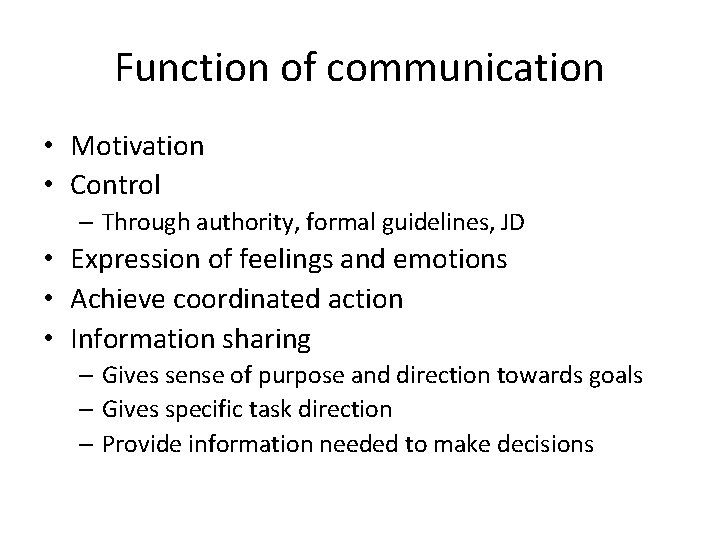
Function of communication • Motivation • Control – Through authority, formal guidelines, JD • Expression of feelings and emotions • Achieve coordinated action • Information sharing – Gives sense of purpose and direction towards goals – Gives specific task direction – Provide information needed to make decisions
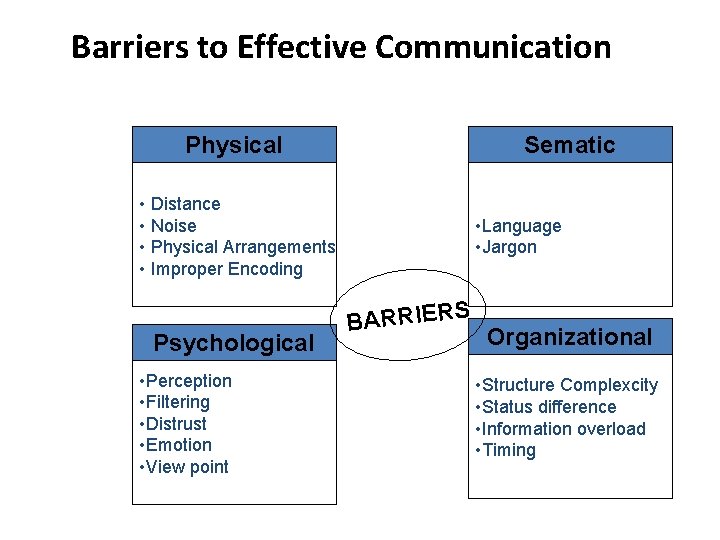
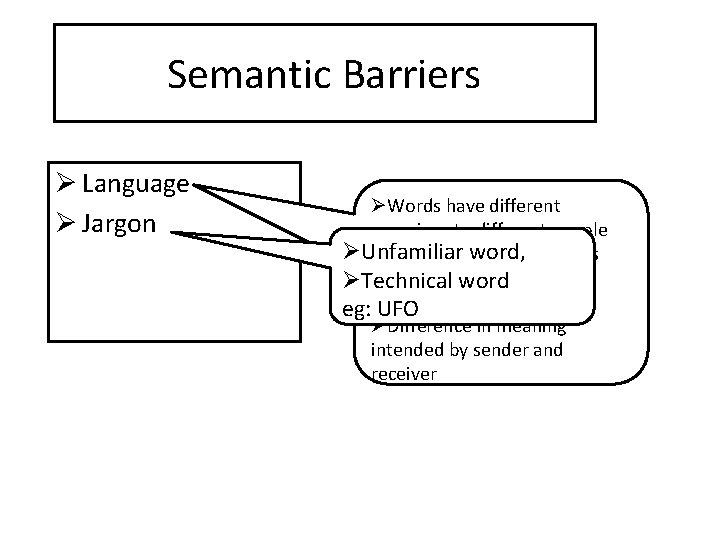
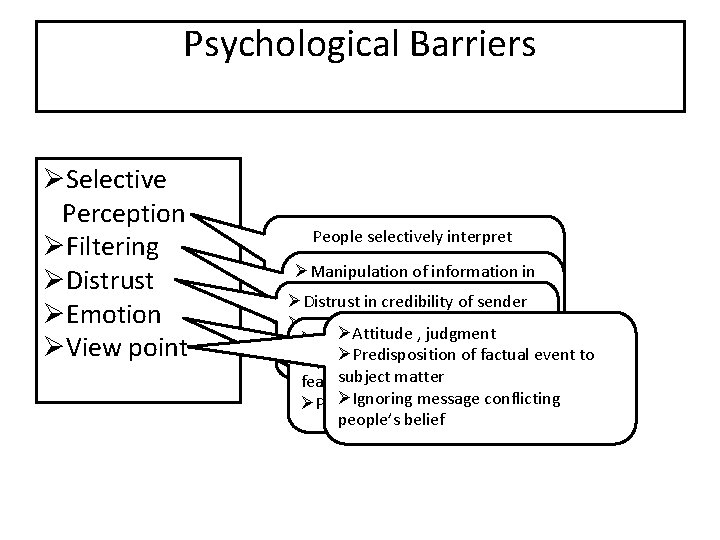
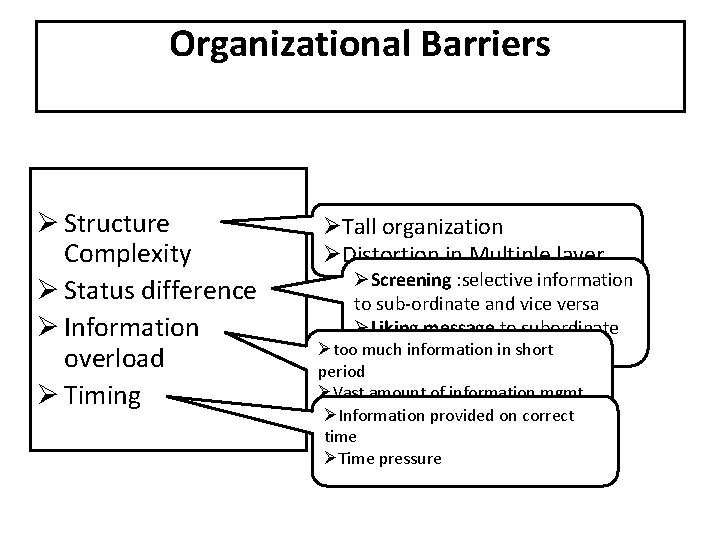
Barriers to Effective Communication Physical Sematic • Distance • Noise • Physical Arrangements • Improper Encoding • Language • Jargon S Psychological • Perception • Filtering • Distrust • Emotion • View point BARRIER Organizational • Structure Complexcity • Status difference • Information overload • Timing
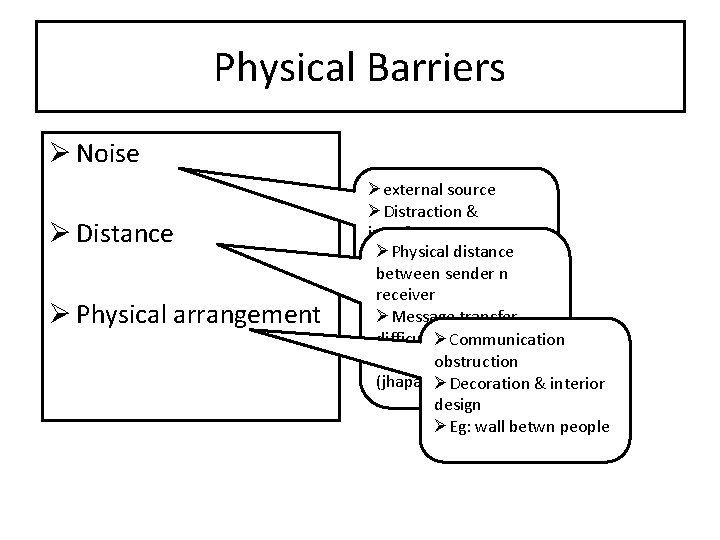
Physical Barriers Ø Noise Ø Distance Ø Physical arrangement Øexternal source ØDistraction & interference Physical ØØEg: clutter, distance between sender n information overload receiver ØMessage transfer difficult ØCommunication ØEg: communication obstruction (jhapa toØjumla) Decoration & interior design ØEg: wall betwn people
Semantic Barriers Ø Language Ø Jargon ØWords have different meanings to different people ØUnfamiliar word, ØDual meaning, ambiguous word ØTechnical word Long & complex sentence eg: ØUFO ØDifference in meaning intended by sender and receiver
Psychological Barriers ØSelective Perception ØFiltering ØDistrust ØEmotion ØView point People selectively interpret what they see on the basis of ØManipulation information in their interests, ofbackground, favor of receiver. experience, and attitudes ØDistrust in credibility of sender A sender’sor manipulation ØØConflicting inconsistentof ØAttitude , judgment information sofactor that it willas: be seen ØEmotional such message more favorably by the of receiver Ø Predisposition factual event to Ø(love, anger, mistrust, jealousy, fear) subject matter ØIgnoring ØPoor listening message skill , etc conflicting people’s belief
Organizational Barriers Ø Structure Complexity Ø Status difference Ø Information overload Ø Timing ØTall organization ØDistortion in Multiple layer ØScreening : selective information to sub-ordinate and vice versa ØLiking message to subordinate Øtoo much information in short period ØVast amount of information mgmt ØInformation provided on correct time ØTime pressure
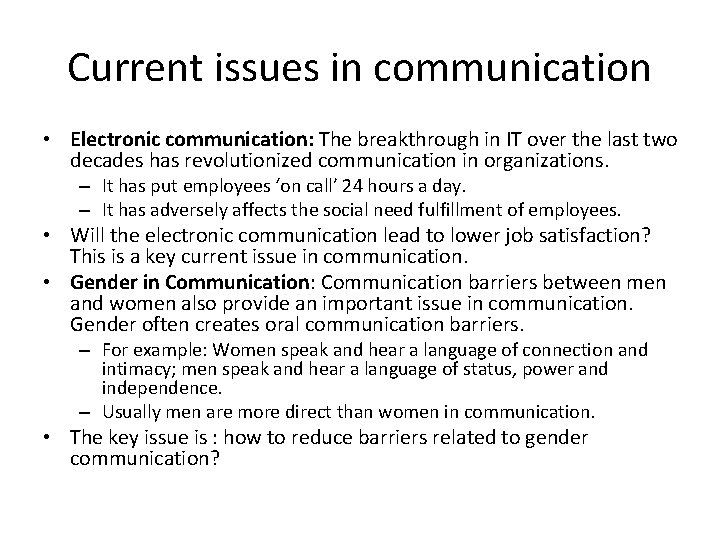
Current issues in communication • Electronic communication: The breakthrough in IT over the last two decades has revolutionized communication in organizations. – It has put employees ‘on call’ 24 hours a day. – It has adversely affects the social need fulfillment of employees. • Will the electronic communication lead to lower job satisfaction? This is a key current issue in communication. • Gender in Communication: Communication barriers between men and women also provide an important issue in communication. Gender often creates oral communication barriers. – For example: Women speak and hear a language of connection and intimacy; men speak and hear a language of status, power and independence. – Usually men are more direct than women in communication. • The key issue is : how to reduce barriers related to gender communication?
Current issues in communication • Politically Correct Communication: The key emerging issue is what is “politically correct” word for communication. – Words are the primary means of communication. They are being eliminated from usage because of political incorrectness. – Examples are Handicapped-Physically challenged, Blind. Visually impaired, Elderly-Senior citizen, Gay-Third gender, Bidhuwa-Ekal mahila, Bridha bhatta-Jestha Nagrik bhatta. • Elimination of words from vocabulary adversely affects accuracy of communication, especially the understanding of meaning. It also restricts the clarity of communication.
Current issues in communication • Cross Cultural Issues: Cross cultural factors create barriers to communication. Cultural barriers can be caused by: – Semantics: Words have different meanings to different people. – Word connotations: Words indicate different things in different languages. For example: - The Japanese word hai means “yes, ” but its connotations may be “yes, I’m listening, ” not “yes, I agree. ” – Tone differences: Tones change meaning according to context. – Perception difference: People who speak different languages view the word differently.
Techniques for improving communication (Enhancing Communication Effectiveness) 1. 2. 3. 4. 5. 6. 7. 8. Two way communication Clear language Effective listening Clear goals and target audience Climate of trust Avoid information overload Reduce psychological barriers Structural redesign
Controlling Meaning of controlling Types of control system - Pre-control; concurrent control and post-control. Characteristics of effective control system 7. 8 Introduction to MIS 7. 9 Quality concept – meaning of quality, QA/QC and TQM
Control • Control is a basic managerial function. • Measurement and correction of performance. • To ensure predetermined objectives are accomplished. • To ensure the resources are being effectively and efficiently used. • The process of management starts with planning and terminate at controlling.
Control • “Control consists in verifying whether everything occurs in conformity with the plans adopted, the instructions issued and the principles established. It has for its object to point out weaknesses and errors in order to rectify them and prevent recurrence” – Henri Fayol
Control • “The managerial function of controlling is the measurement and correction of the performance of activities of subordinates in order to make sure that enterprise objectives and the plans devised to attain them are being accomplished. ” – Koontz and O’Donnell
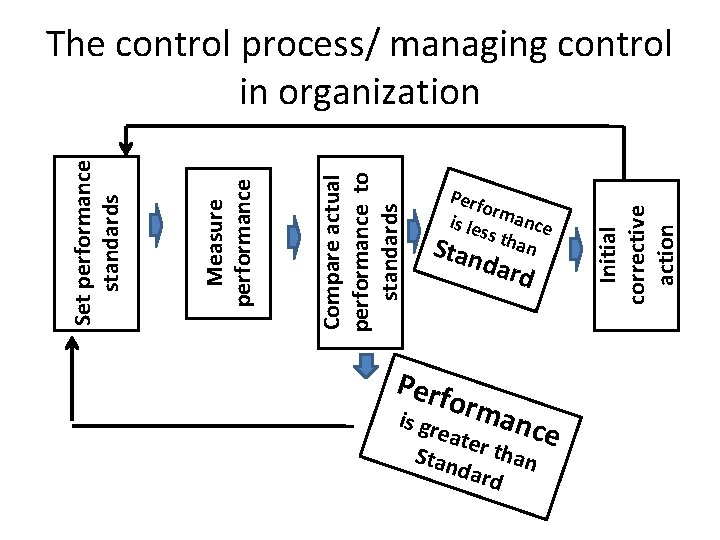
Control • Control is: – Measurement of actual performance, – Comparing actual performance with the standards, – Correction of deviations – Assure attainment of objectives according to plans. • Controlling is applicable to all activities of business.
Perf or is le mance ss th an Sta nda rd Perf orm eate ance Stan r than dard is gr Initial corrective action Compare actual performance to standards Measure performance Set performance standards The control process/ managing control in organization
Nature of Control • Basic function of management • Depends on and contributes to other function of management - Organizing, staffing, directing, planning • Related to People, things and Actions • Control is Pervasive function • Continuous process • Aims at taking corrective measure
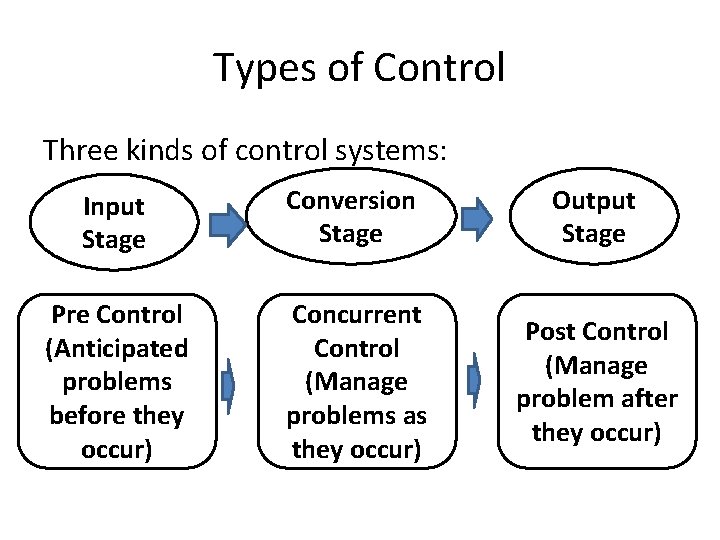
Types of Control Three kinds of control systems: Input Stage Conversion Stage Output Stage Pre Control (Anticipated problems before they occur) Concurrent Control (Manage problems as they occur) Post Control (Manage problem after they occur)
Types of Control 1. Pre-Control system: – Also known as Free forward or preventive control. – Takes place before the work is performed. – Problems are anticipated in advance and standards are set to regulate the management system. – Attempts to eliminate potential problems of • • • Concurrent Control system. Post Control system. Procurement department.
Types of Control 2. Concurrent Control system: – Also known as gatekeeper control or real time control. – Control as the work is being performed. – Managers and workers can spot errors and correct them. – Adjustments are made in the activities to ensure compliance with the standards. – Quality of product is checked while processing. – Frequent exam is taken. If problem found extra classes are taken.
Types of Control 3. Post Control system: – Also known as feedback control or post action control. – Takes place after the activities is over. – Management can take corrective action after analyzing deviation from the planned results. – Financial statement analysis, performance evaluation, quality control are examples – Provides corrective feedback.
Characteristics of effective control system • • • Integration with planning: should be linked with planning. Flexibility: should be flexible to accommodate change in environment. Accuracy: feedback should be accurate. Timely: control measure should be taken at the right time. Objectivity: control system should be objective. Economy: cost should be justify benefits. User friendly: should be understandable by users. Corrective actions: timely correction should be taken. Review: should be reviewed and changed timely.
Management information system (MIS) • Formal method of collecting information in summarized form. • It is network established within an organization to provide information to managers. • Provides systematic and analytical information necessary to all level of managers. • It helps managers to take right decision at the right time.
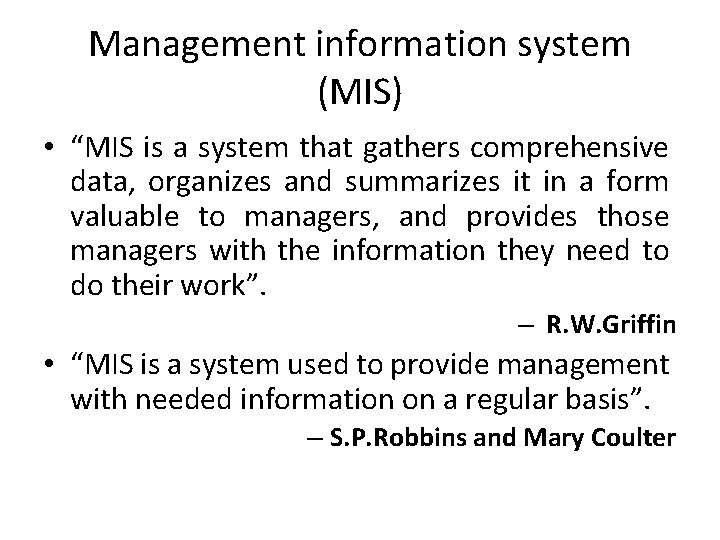
Management information system (MIS) • “MIS is a system that gathers comprehensive data, organizes and summarizes it in a form valuable to managers, and provides those managers with the information they need to do their work”. – R. W. Griffin • “MIS is a system used to provide management with needed information on a regular basis”. – S. P. Robbins and Mary Coulter
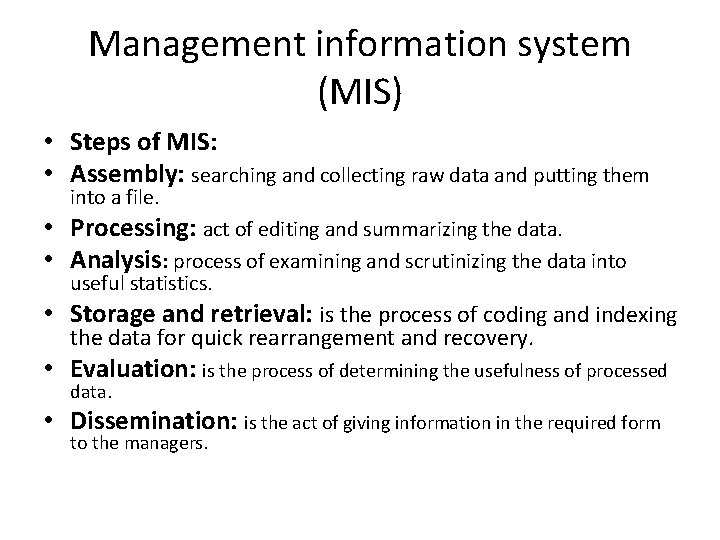
Management information system (MIS) • Steps of MIS: • Assembly: searching and collecting raw data and putting them into a file. • Processing: act of editing and summarizing the data. • Analysis: process of examining and scrutinizing the data into useful statistics. • Storage and retrieval: is the process of coding and indexing the data for quick rearrangement and recovery. • Evaluation: is the process of determining the usefulness of processed data. • Dissemination: is the act of giving information in the required form to the managers.
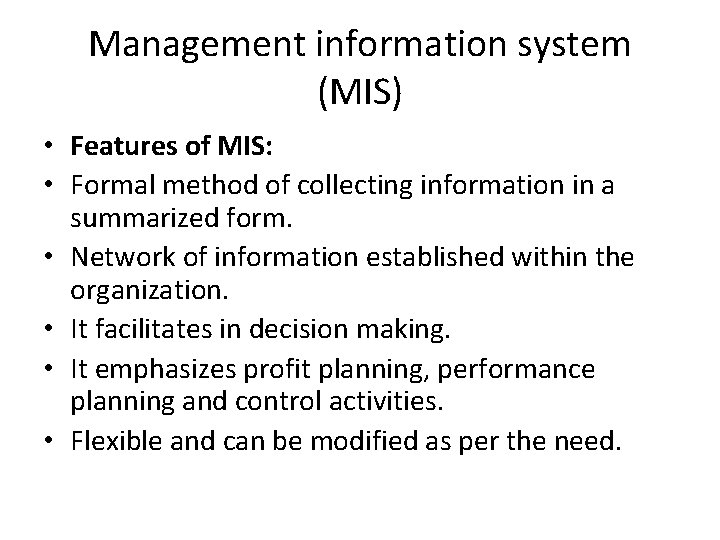
Management information system (MIS) • Features of MIS: • Formal method of collecting information in a summarized form. • Network of information established within the organization. • It facilitates in decision making. • It emphasizes profit planning, performance planning and control activities. • Flexible and can be modified as per the need.
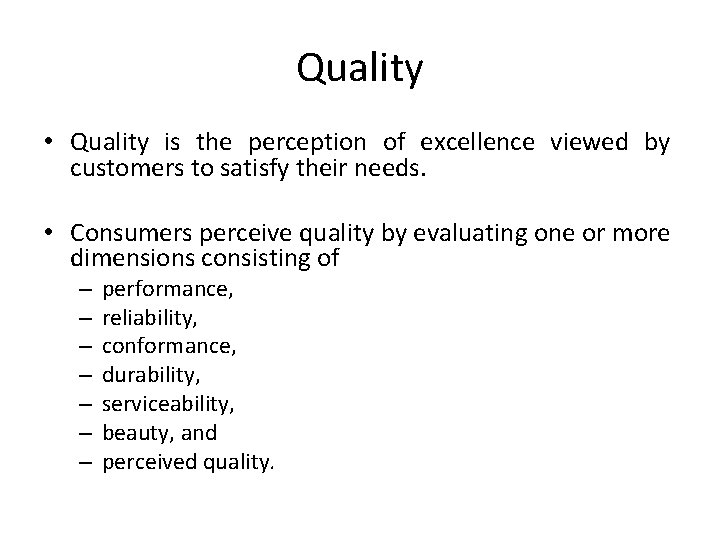
Quality • Quality is the perception of excellence viewed by customers to satisfy their needs. • Consumers perceive quality by evaluating one or more dimensions consisting of – – – – performance, reliability, conformance, durability, serviceability, beauty, and perceived quality.
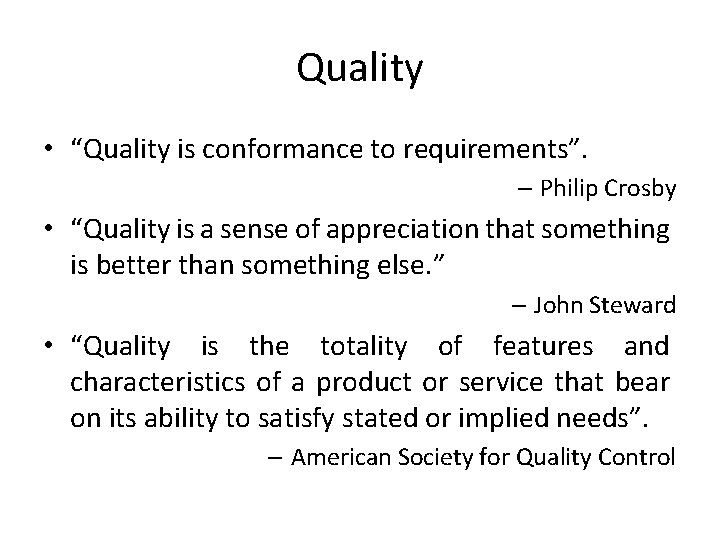
Quality • “Quality is conformance to requirements”. – Philip Crosby • “Quality is a sense of appreciation that something is better than something else. ” – John Steward • “Quality is the totality of features and characteristics of a product or service that bear on its ability to satisfy stated or implied needs”. – American Society for Quality Control
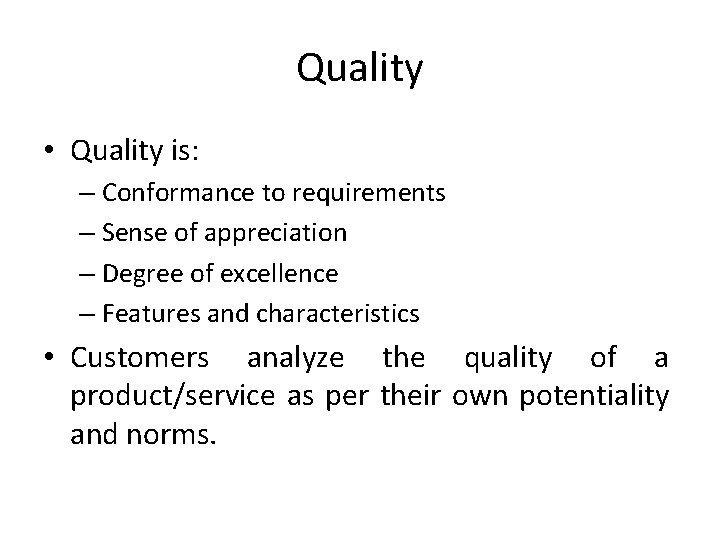
Quality • Quality is: – Conformance to requirements – Sense of appreciation – Degree of excellence – Features and characteristics • Customers analyze the quality of a product/service as per their own potentiality and norms.
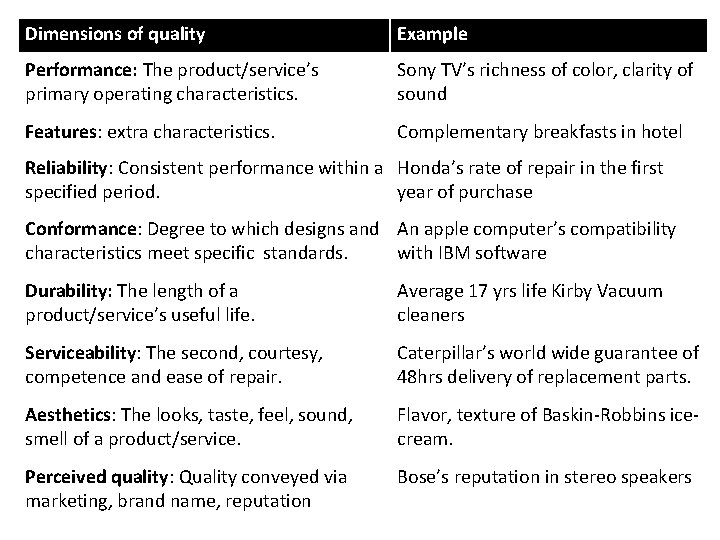
Dimensions of quality Example Performance: The product/service’s primary operating characteristics. Sony TV’s richness of color, clarity of sound Features: extra characteristics. Complementary breakfasts in hotel Reliability: Consistent performance within a Honda’s rate of repair in the first specified period. year of purchase Conformance: Degree to which designs and An apple computer’s compatibility characteristics meet specific standards. with IBM software Durability: The length of a product/service’s useful life. Average 17 yrs life Kirby Vacuum cleaners Serviceability: The second, courtesy, competence and ease of repair. Caterpillar’s world wide guarantee of 48 hrs delivery of replacement parts. Aesthetics: The looks, taste, feel, sound, smell of a product/service. Flavor, texture of Baskin-Robbins icecream. Perceived quality: Quality conveyed via marketing, brand name, reputation Bose’s reputation in stereo speakers
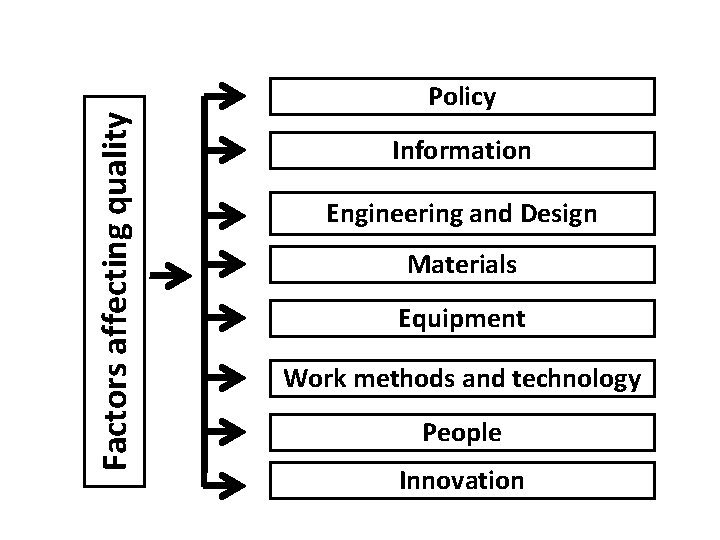
Factors affecting quality Policy Information Engineering and Design Materials Equipment Work methods and technology People Innovation
Quality Control • It is the function of ensuring that the product or service quality conforms to predetermined standards. • A quality control program involves determining minimum standards of acceptability. • Helps to minimize wastage. • Helps in finding defective products.
Quality Control • Quality control implies: • Determining tolerance: range within which deviations in actual quality from standards will be acceptable. • Conducting inspections: test of materials, processes, and products. • Isolating acceptable units: isolate which do not conform to quality standards. • Bringing causes of deviations: inform to concerned manager. • Suggesting ways and means of improvement to the concerned manager.
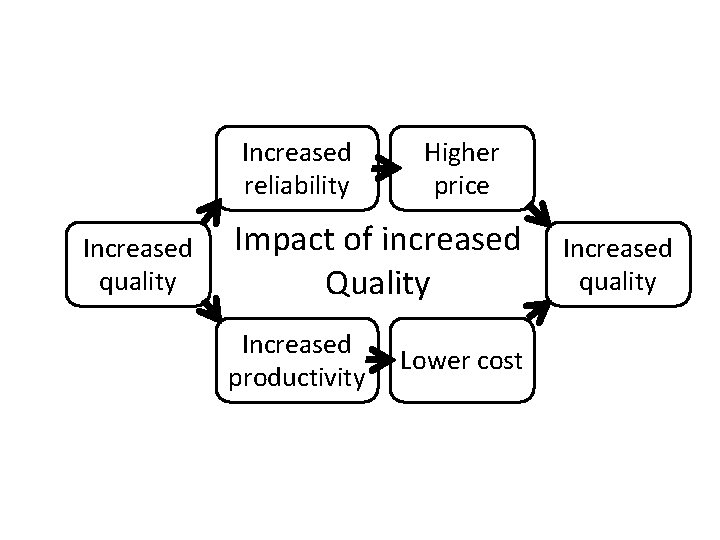
Increased reliability Increased quality Higher price Impact of increased Quality Increased productivity Lower cost Increased quality
Methods of Quality Control • There are main two technique of quality control. i. Inspection technique is traditional technique. • It involves complete or partial inspection of the units of work produced by each employee to determine whether or not the work reaches quality standards. • Inspection involves periodic checking and measuring before, during, and after the production process. • It aims to detect and isolate defective work and prevent it in future.
Methods of Quality Control ii. Statistical Quality Control: • It is the application of statistical techniques for the maintenance of quality standards. • It is based on theory of sampling and laws of probability. • It measures deviations from standard quality by recording sample tests on a chart, which immediately shows when work is being produced outside previously approved limits.
TQM – Listening with concentration to the consumers – Identifying exactly what they want – Analyzing logically and value or worth to it – Strive to meet their requirement – Quality not only to the final product but also to how the organization handles deliveries, how rapidly it responds to complaints, how politely the phones are answered, and the like.
Principles of TQM • • Do it Right the First Time Customer centered Make continuous improvement a way of life Build teamwork and empowerment
Tools for TQM • Benchmarking: – Compare your product with others. • Outsourcing: – Subcontract some of the job to others. • Speed: – the time that is defined to perform specific job of an organization. – Rethinking and redesigning whole process. • ISO 900: – international organization for standardization. • Statistical quality control: – statistical techniques applied to monitor quality.
• Thank you.