
Management Who Are Managers Manager Someone who works




- Slides: 32
Management
Who Are Managers? Manager Someone who works with and through other people by coordinating their work activities in order to accomplish organizational goals
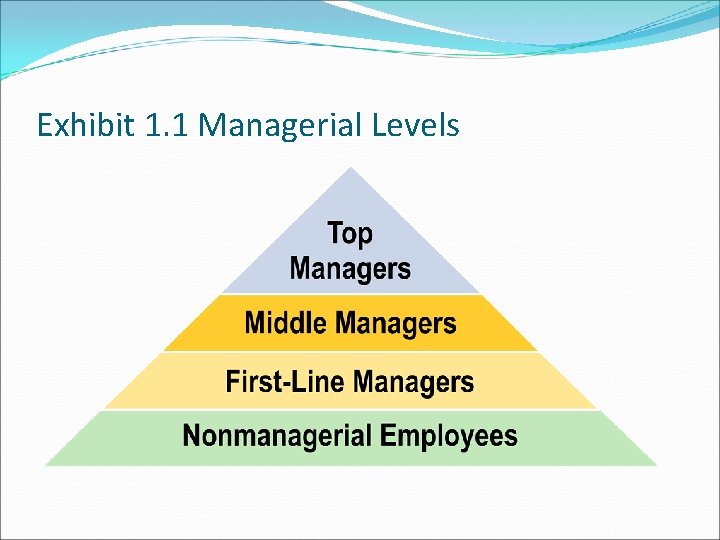
Types of Managers First-line Managers Are at the lowest level of management and manage the work of nonmanagerial employees Middle Managers Manage the work of first-line managers Top Managers Are responsible for making organization-wide decisions and establishing plans and goals that affect the entire organization
Exhibit 1. 1 Managerial Levels
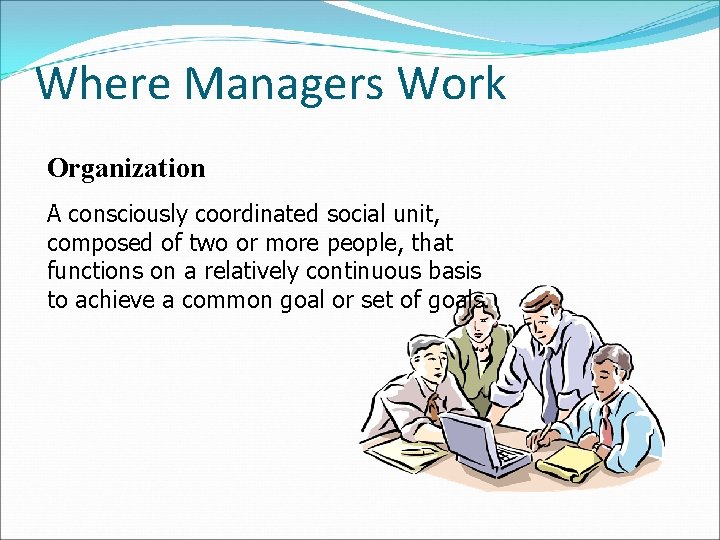
Where Managers Work Organization A consciously coordinated social unit, composed of two or more people, that functions on a relatively continuous basis to achieve a common goal or set of goals.
Definition of Management: Management is the process of designing and maintaining an environment in which individuals, working together in groups, efficiently accomplish selected aims
Definitions of Effectiveness and Efficiency Productivity implies effectiveness and efficiency in individual and organizational performance Effectiveness is the achievement of objectives Efficiency is the achievement of the ends with the least amount of resources (time, money, etc. )
Managerial Concerns Efficiency “Doing things right” Getting the most output for the least input Effectiveness “Doing the right things” Attaining organizational goals
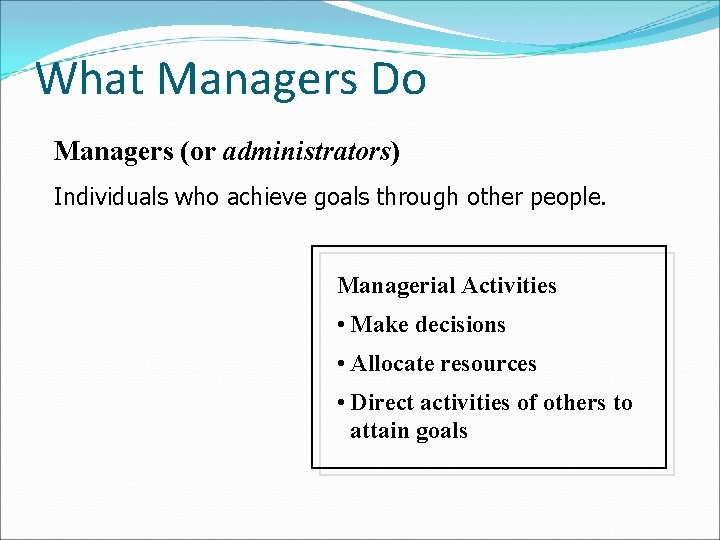
What Managers Do Managers (or administrators) Individuals who achieve goals through other people. Managerial Activities • Make decisions • Allocate resources • Direct activities of others to attain goals
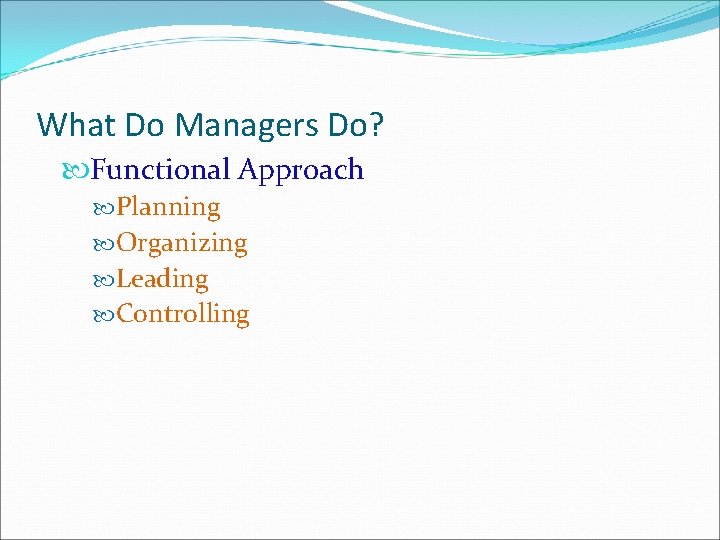
What Do Managers Do? Functional Approach Planning Organizing Leading Controlling
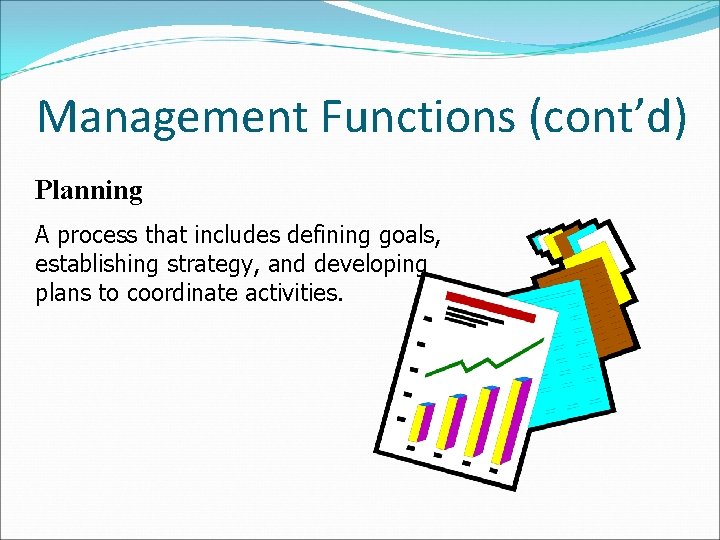
Management Functions (cont’d) Planning A process that includes defining goals, establishing strategy, and developing plans to coordinate activities.
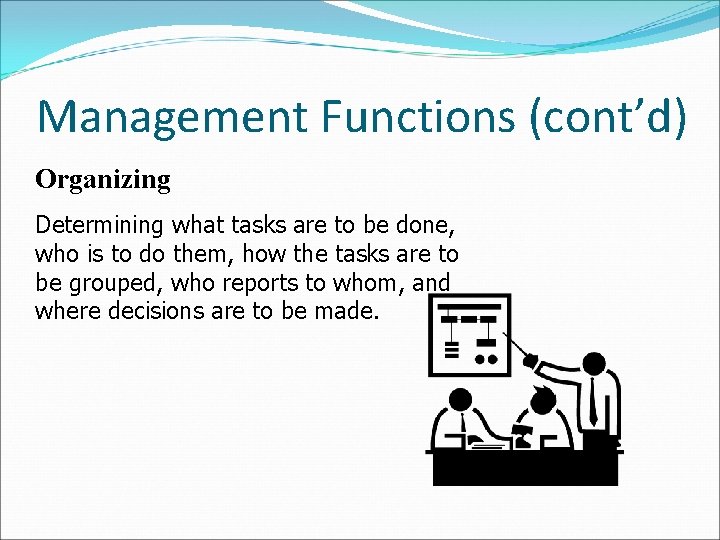
Management Functions (cont’d) Organizing Determining what tasks are to be done, who is to do them, how the tasks are to be grouped, who reports to whom, and where decisions are to be made.
Management Functions (cont’d) Leading A function that includes motivating employees, directing others, selecting the most effective communication channels, and resolving conflicts.
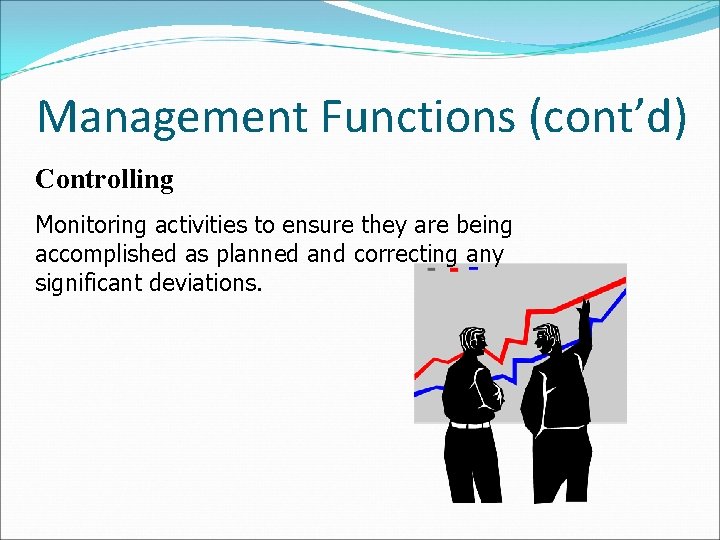
Management Functions (cont’d) Controlling Monitoring activities to ensure they are being accomplished as planned and correcting any significant deviations.
Management Functions Planning Organizing Leading Controlling Lead to Defining goals, establishing strategy, and developing subplans to coordinate activities Determining what needs to be done, how it will be done, and who is to do it Directing and motivating all involved parties and resolving conflicts Monitoring activities to ensure that they are accomplished as planned Achieving the organization ’s stated purpose
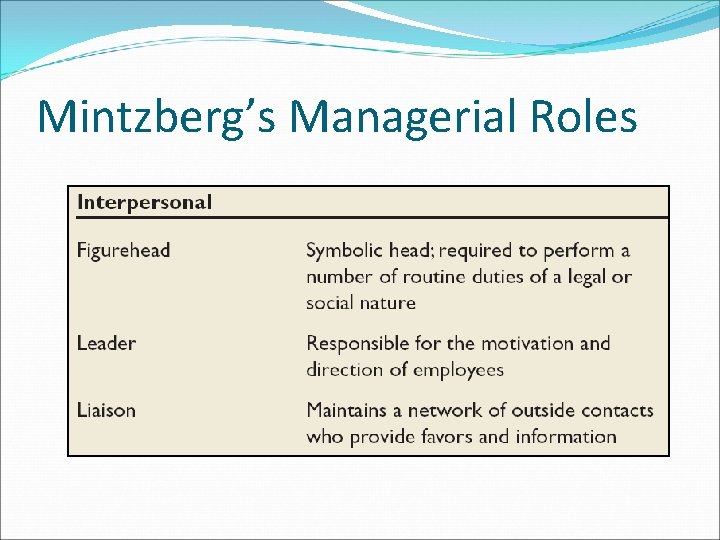
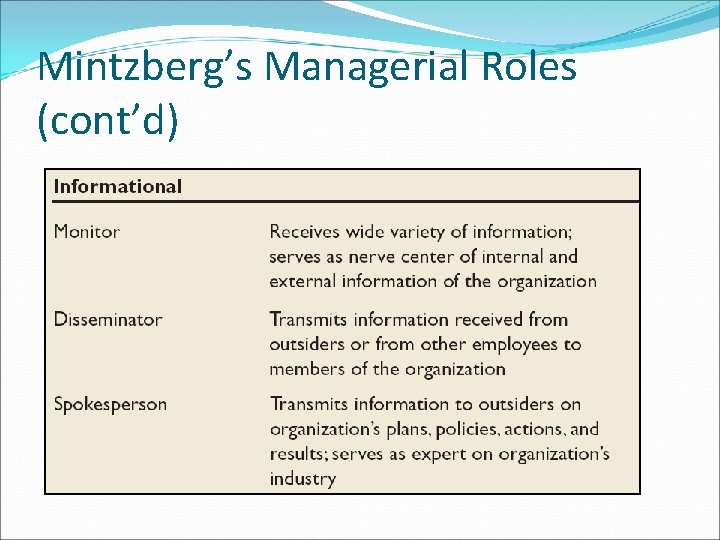
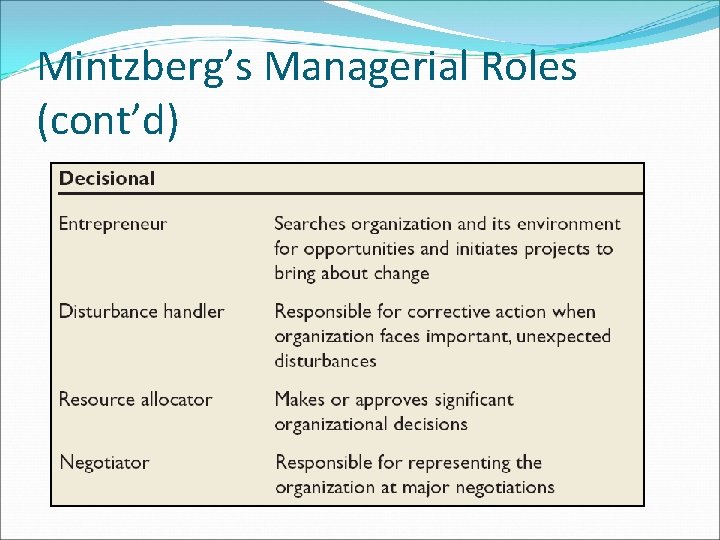
What Do Managers Do? (cont’d Mintzberg’s Management Roles Approach Interpersonal roles Figurehead, leader, liaison Informational roles Monitor, disseminator, spokesperson Decisional roles Entrepreneur, disturbance handler, resource allocator, negotiator
Mintzberg’s Managerial Roles
Mintzberg’s Managerial Roles (cont’d)
Mintzberg’s Managerial Roles (cont’d)
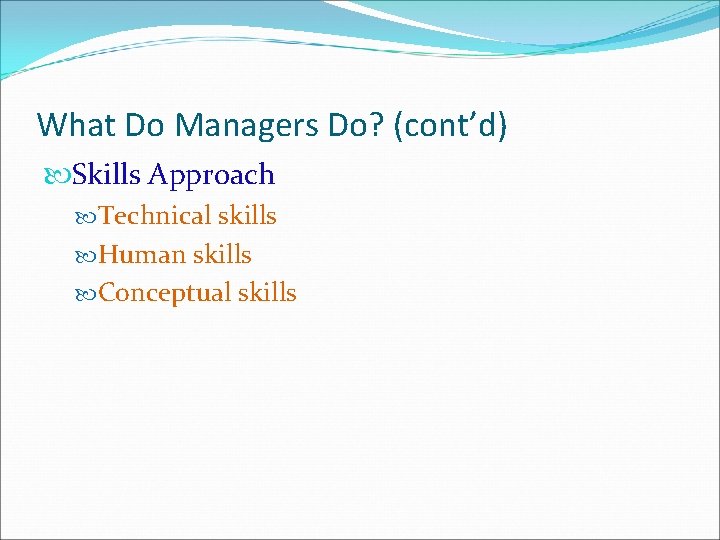
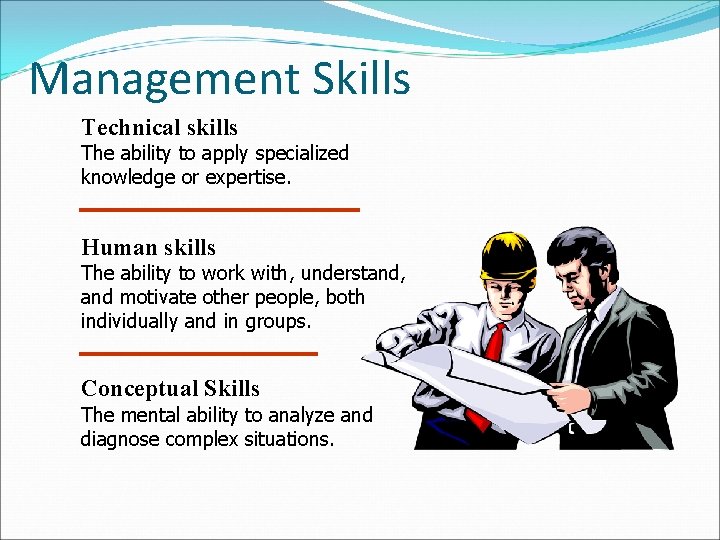
What Do Managers Do? (cont’d) Skills Approach Technical skills Human skills Conceptual skills
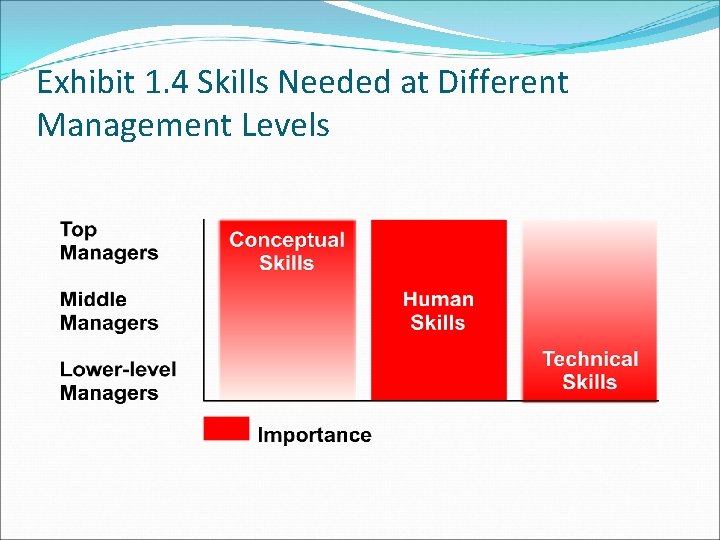
Management Skills Technical skills The ability to apply specialized knowledge or expertise. Human skills The ability to work with, understand, and motivate other people, both individually and in groups. Conceptual Skills The mental ability to analyze and diagnose complex situations.
Exhibit 1. 4 Skills Needed at Different Management Levels
What Is An Organization? An Organization Defined A deliberate arrangement of people to accomplish some specific purpose Common Characteristics of Organizations Have a distinct purpose (goal) Are composed of people Have a deliberate structure
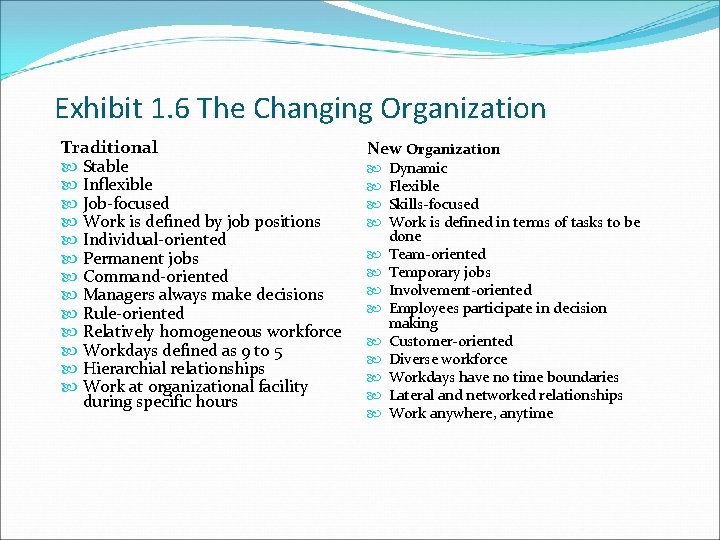
Exhibit 1. 6 The Changing Organization Traditional Stable Inflexible Job-focused Work is defined by job positions Individual-oriented Permanent jobs Command-oriented Managers always make decisions Rule-oriented Relatively homogeneous workforce Workdays defined as 9 to 5 Hierarchial relationships Work at organizational facility during specific hours New Organization Dynamic Flexible Skills-focused Work is defined in terms of tasks to be done Team-oriented Temporary jobs Involvement-oriented Employees participate in decision making Customer-oriented Diverse workforce Workdays have no time boundaries Lateral and networked relationships Work anywhere, anytime
Management: Definition Acc to Harold Koontz: Management is the art of getting things done through & with an formally organized group Acc to Henry Fayol: To manage is to forecast & plan, to organize, to compound, to co-ordinate and to control PODSCORB: - Planning, Organizing, Directing, Staffing, Controlling, Co-ordinating, Reporting & Budgeting
Features of Management Art as well as Science Management is an activity Management is a continuous process Management achieving pre-determined objectives Organized activities Management is a factor of production Management as a system Management is a discipline
Features of Management is a distinct entity Management aims at maximising profit Management is a purposeful activity Management is a profession Universal application Management is getting things done Management is needed at all levels
Importance of Management meet the challenge of change Accomplishment of group goals Effective utilization of resources Effective functioning of business Resource Development Sound organization Structure Management directs the organization Integrates various interests Stability
Importance of Management Innovation Co-ordination and team-spirit Tackling problems A tool for Personality Development
Henry Fayol (1841 -1925) Was a french industrialist Given : Elements of Management- Planning, Organizing, Commanding, Co-ordination & Control Qualities of Manager: Physical, Mental, Moral, General Education, Special Knowledge & Experience Principles of Management
Principles of Management Division of work Authority & responsibilty Discipline Unity of command Unity of direction Subordinate of individual interest to group interest Remuneration of personnel Centralization Scalar Chain
Principles of Management Order Equity Stability of tenure of personnel Initiative Espirit De Corps