
PART 5 CONTROLLING Quality and Performance Controlling Managers

- Slides: 20
PART 5: CONTROLLING : Quality and Performance
Controlling Managers use a variety of measures to monitor performance: – Controlling work processes – Regulating employee behavior – Systems for financial resources – Evaluating profitability 2
The Meaning of Control Organizational control is the systematic process through which managers regulate organizational activities to make them consistent with expectations established in plans, targets, and standards of performance 3
Choosing Standards and Measures • Common measures and controls: – Sales – Revenue – Profit • More focus on measuring intangibles – Customer service – Increased revenue 4
Steps of Feedback Control u Establish Standards of Performance v Measure Actual Performance w Compare Performance to Standards x Take Corrective Action 5
Application to Budgeting • Budgetary control – setting targets and monitoring expenditures • Budgets list planned and actual expenditures • Budgets are associated with a division or department – The unit of analysis for budgeting is the responsibility center 6
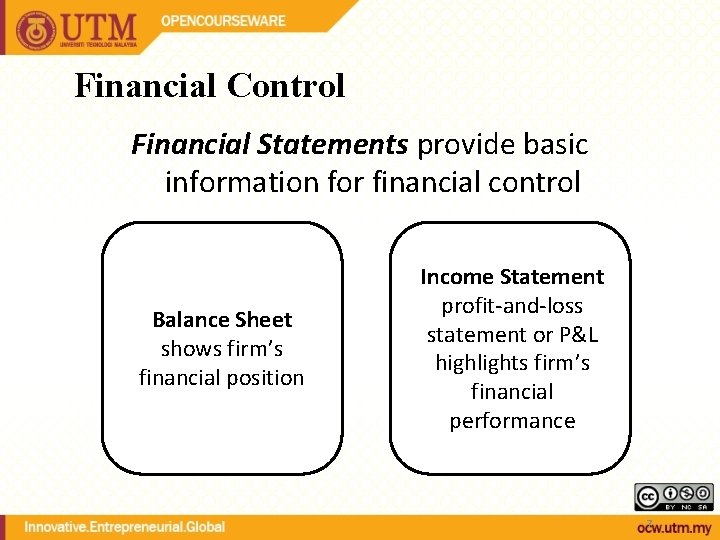
Financial Control Financial Statements provide basic information for financial control Balance Sheet shows firm’s financial position Income Statement profit-and-loss statement or P&L highlights firm’s financial performance 7
Hierarchical versus Decentralized Approaches • Hierarchical controls include the monitoring of behavior through rules, policies, reward systems, and written documentation • Decentralized controls based on values and assumptions; rules are only used when necessary – Culture is adaptive, uniting individuals and teams Managers’ approach to control is changing in many of today’s organizations 8
Open-Book Management ü Decentralized philosophy ü Get every employee thinking like an owner ü Information sharing and teamwork ü Allows employees to see the financial condition of company ü See how his/her job fits into organizational success 9
Total Quality Management (TQM) • Infuse quality into every aspect of the business, all day-to-day activities • Focuses on: – Teamwork – Collaboration – Identifying improvements 10
TQM • Total - made up of the whole • Quality - degree of excellence a product or service provides • Management - act, art or manner of planning, controlling, directing, …. Therefore, TQM is the art of managing the whole to achieve excellence Total Quality Management
What’s the goal of TQM? “Do the right things right the first time, every time. ” –zero defect
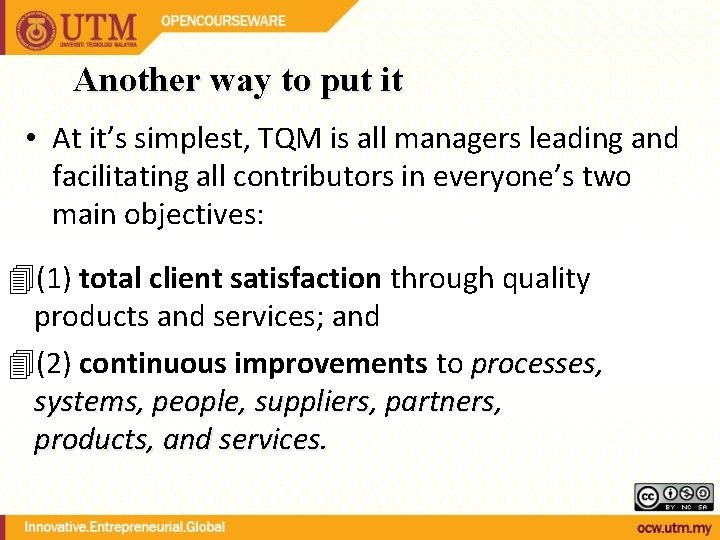
Another way to put it • At it’s simplest, TQM is all managers leading and facilitating all contributors in everyone’s two main objectives: 4(1) total client satisfaction through quality products and services; and 4(2) continuous improvements to processes, systems, people, suppliers, partners, products, and services.
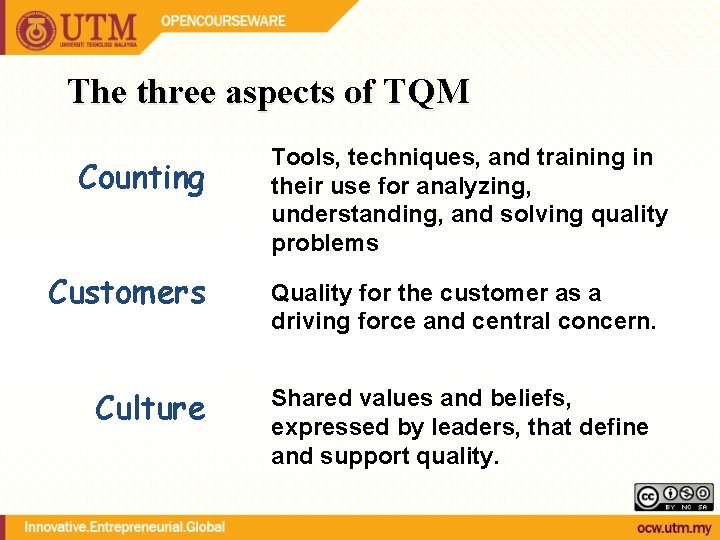
The three aspects of TQM Counting Customers Culture Tools, techniques, and training in their use for analyzing, understanding, and solving quality problems Quality for the customer as a driving force and central concern. Shared values and beliefs, expressed by leaders, that define and support quality.
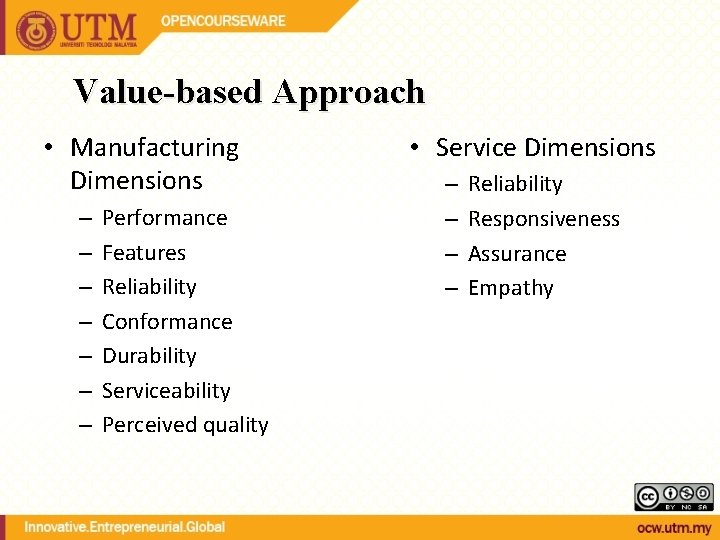
Value-based Approach • Manufacturing Dimensions – – – – Performance Features Reliability Conformance Durability Serviceability Perceived quality • Service Dimensions – – Reliability Responsiveness Assurance Empathy
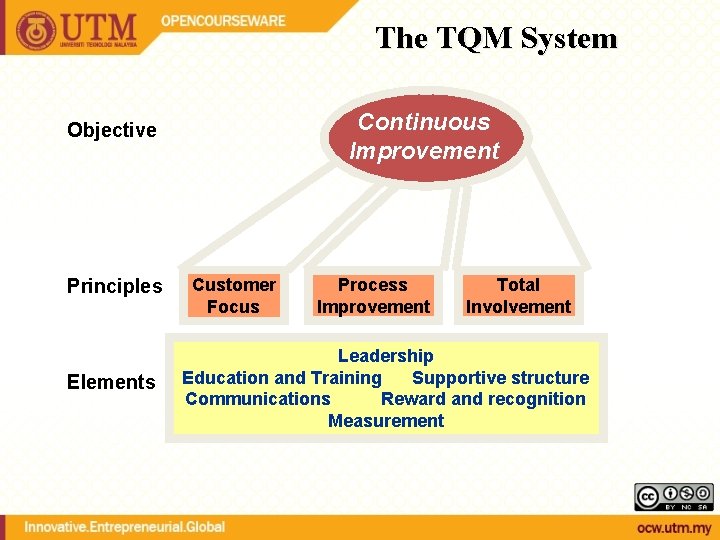
The TQM System Continuous Improvement Objective Principles Elements Customer Focus Process Improvement Total Involvement Leadership Education and Training Supportive structure Communications Reward and recognition Measurement
International Quality Standards • ISO 9000 standards – International Organization for Standardization – Organization certification – 157 Countries • Organizations demonstrate a commitment to quality • Europe leads in certifications but the United States had large increases 17
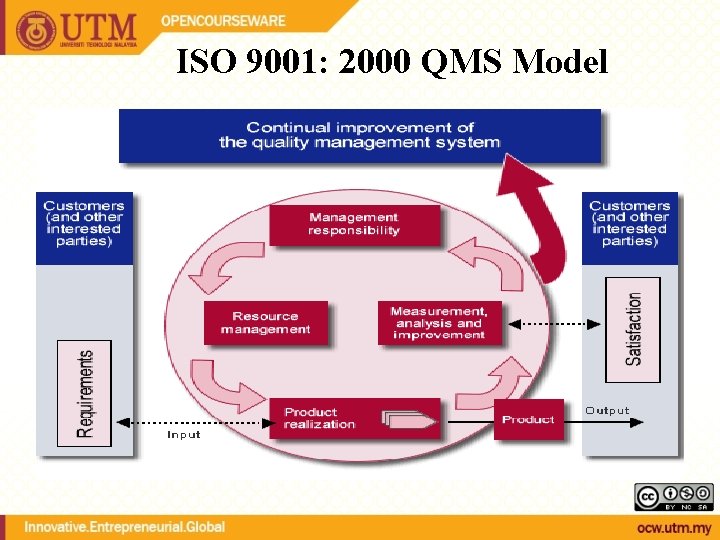
ISO 9001: 2000 QMS Model
Control of Human Behavior : A HRM revisit • • • Have rules & regulations Fair reward system Training Performance appraisal Disciplinary procedures
Thank you 20