U S History The PostWorld War II Cold
- Slides: 85
U. S. History The Post-World War II Cold War and Early Civil Rights Era 1945 -1960 Dr. Donnelly
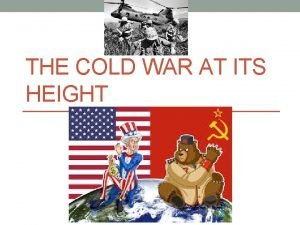
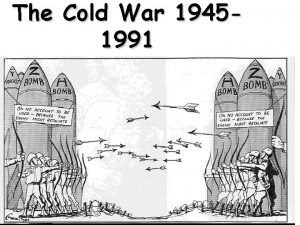
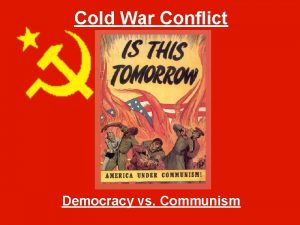
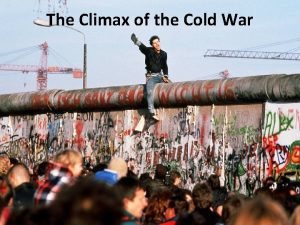
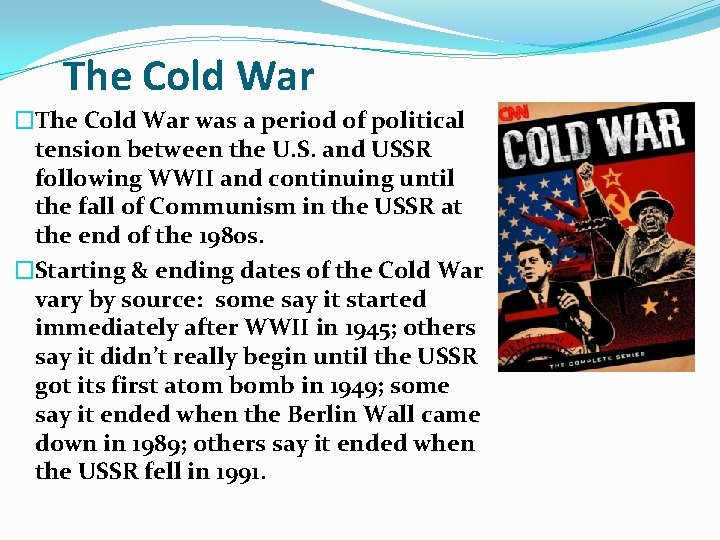
The Cold War �The Cold War was a period of political tension between the U. S. and USSR following WWII and continuing until the fall of Communism in the USSR at the end of the 1980 s. �Starting & ending dates of the Cold War vary by source: some say it started immediately after WWII in 1945; others say it didn’t really begin until the USSR got its first atom bomb in 1949; some say it ended when the Berlin Wall came down in 1989; others say it ended when the USSR fell in 1991.
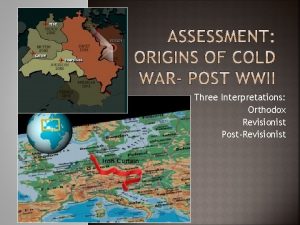
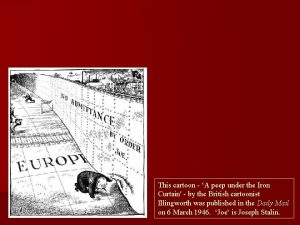
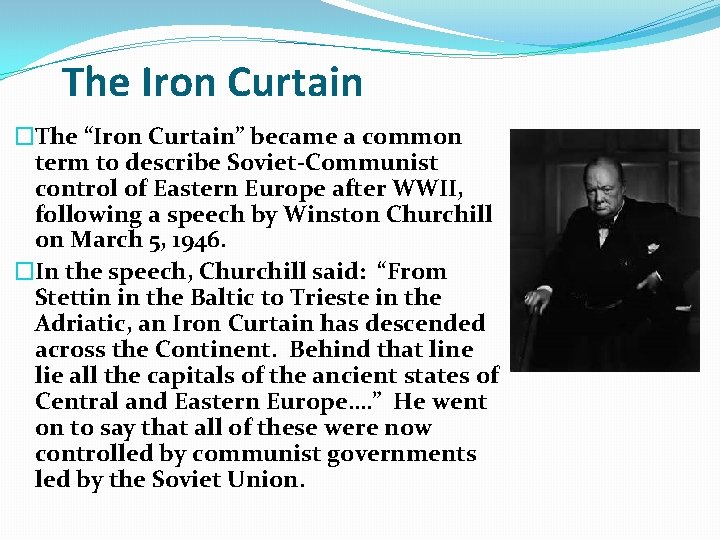
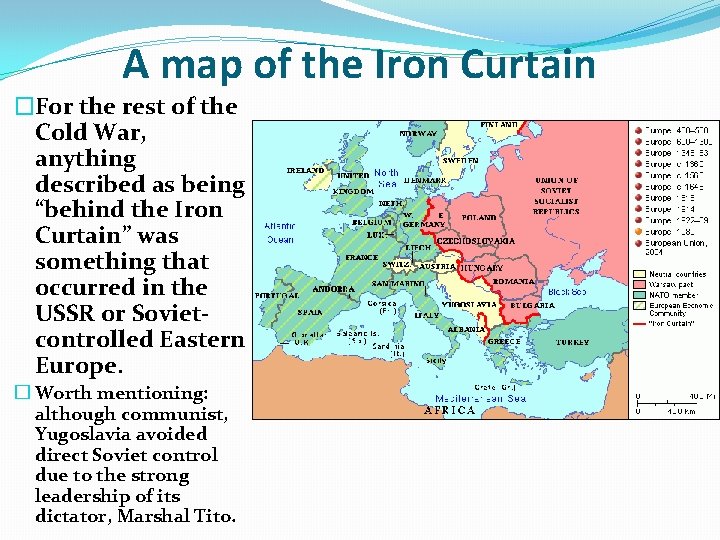
The Iron Curtain �The “Iron Curtain” became a common term to describe Soviet-Communist control of Eastern Europe after WWII, following a speech by Winston Churchill on March 5, 1946. �In the speech, Churchill said: “From Stettin in the Baltic to Trieste in the Adriatic, an Iron Curtain has descended across the Continent. Behind that line lie all the capitals of the ancient states of Central and Eastern Europe…. ” He went on to say that all of these were now controlled by communist governments led by the Soviet Union.
A map of the Iron Curtain �For the rest of the Cold War, anything described as being “behind the Iron Curtain” was something that occurred in the USSR or Sovietcontrolled Eastern Europe. � Worth mentioning: although communist, Yugoslavia avoided direct Soviet control due to the strong leadership of its dictator, Marshal Tito.
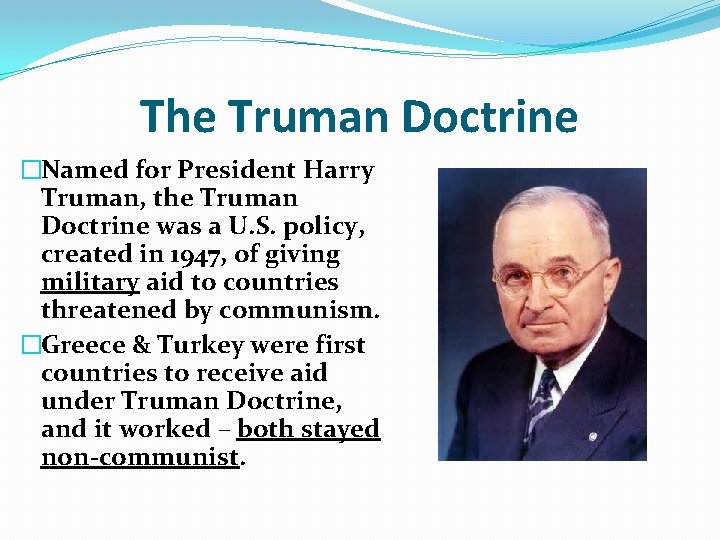
The Truman Doctrine �Named for President Harry Truman, the Truman Doctrine was a U. S. policy, created in 1947, of giving military aid to countries threatened by communism. �Greece & Turkey were first countries to receive aid under Truman Doctrine, and it worked – both stayed non-communist.
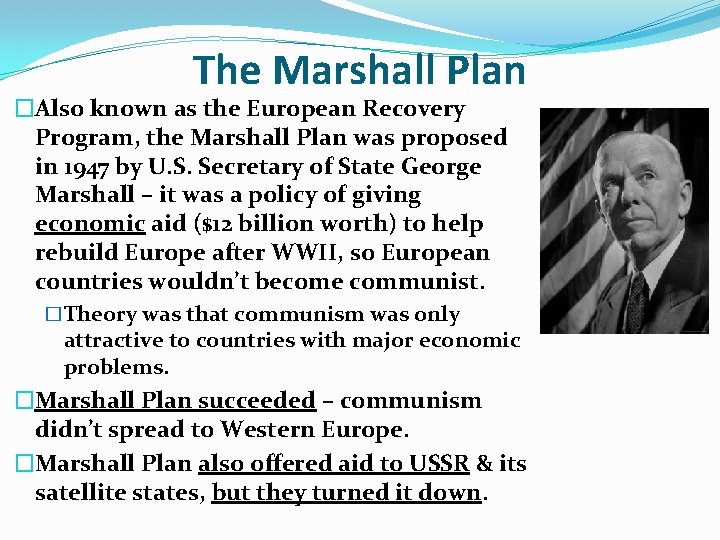
The Marshall Plan �Also known as the European Recovery Program, the Marshall Plan was proposed in 1947 by U. S. Secretary of State George Marshall – it was a policy of giving economic aid ($12 billion worth) to help rebuild Europe after WWII, so European countries wouldn’t become communist. �Theory was that communism was only attractive to countries with major economic problems. �Marshall Plan succeeded – communism didn’t spread to Western Europe. �Marshall Plan also offered aid to USSR & its satellite states, but they turned it down.
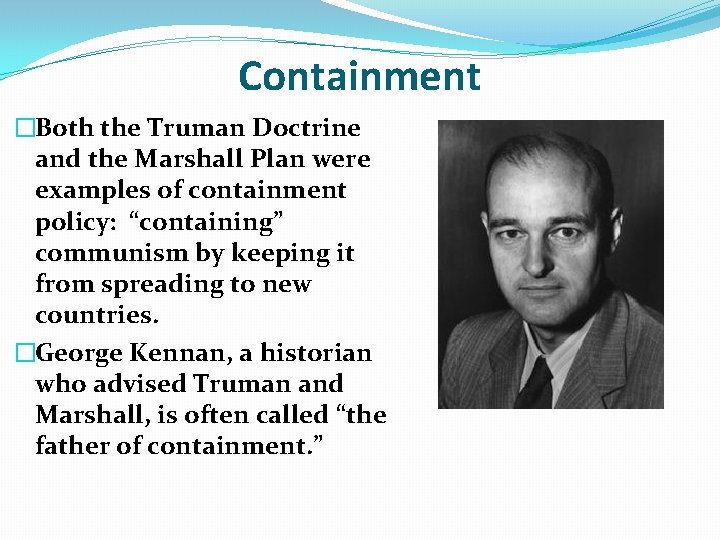
Containment �Both the Truman Doctrine and the Marshall Plan were examples of containment policy: “containing” communism by keeping it from spreading to new countries. �George Kennan, a historian who advised Truman and Marshall, is often called “the father of containment. ”
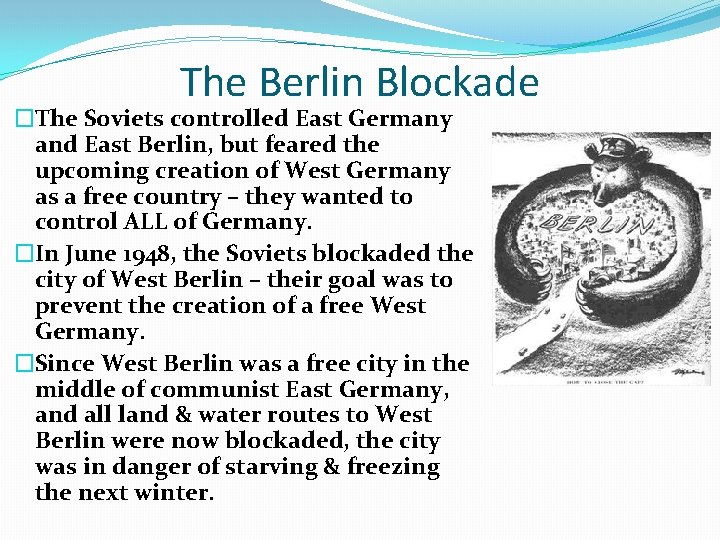
The Berlin Blockade �The Soviets controlled East Germany and East Berlin, but feared the upcoming creation of West Germany as a free country – they wanted to control ALL of Germany. �In June 1948, the Soviets blockaded the city of West Berlin – their goal was to prevent the creation of a free West Germany. �Since West Berlin was a free city in the middle of communist East Germany, and all land & water routes to West Berlin were now blockaded, the city was in danger of starving & freezing the next winter.
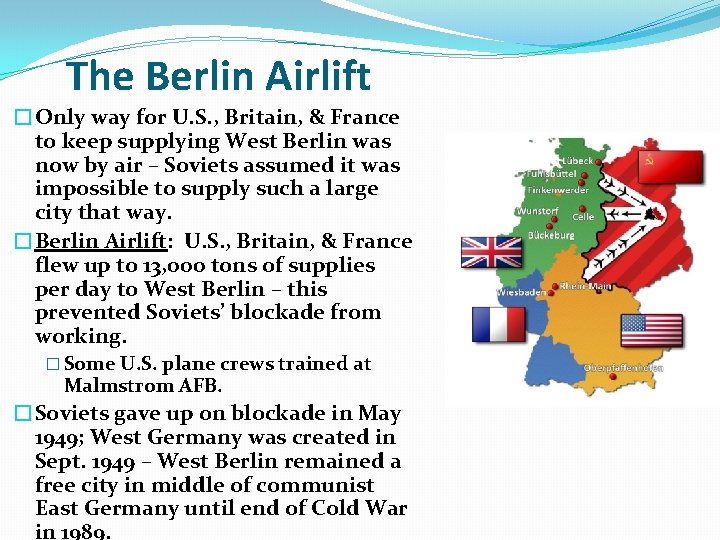
The Berlin Airlift �Only way for U. S. , Britain, & France to keep supplying West Berlin was now by air – Soviets assumed it was impossible to supply such a large city that way. �Berlin Airlift: U. S. , Britain, & France flew up to 13, 000 tons of supplies per day to West Berlin – this prevented Soviets’ blockade from working. � Some U. S. plane crews trained at Malmstrom AFB. �Soviets gave up on blockade in May 1949; West Germany was created in Sept. 1949 – West Berlin remained a free city in middle of communist East Germany until end of Cold War in 1989.
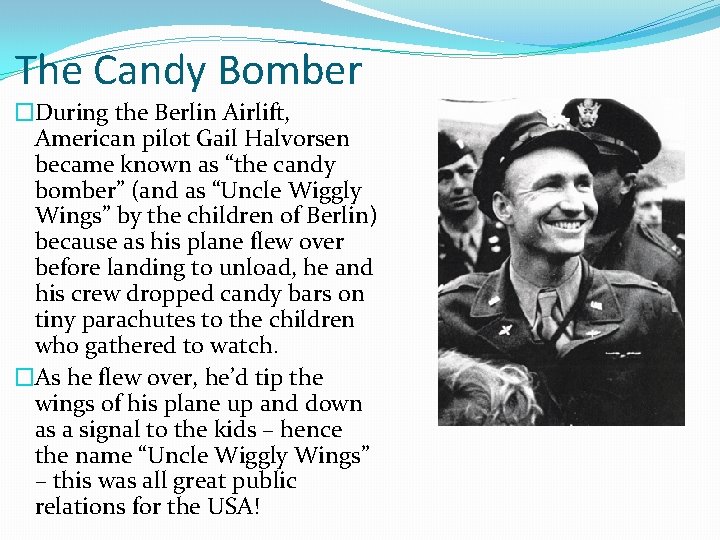
The Candy Bomber �During the Berlin Airlift, American pilot Gail Halvorsen became known as “the candy bomber” (and as “Uncle Wiggly Wings” by the children of Berlin) because as his plane flew over before landing to unload, he and his crew dropped candy bars on tiny parachutes to the children who gathered to watch. �As he flew over, he’d tip the wings of his plane up and down as a signal to the kids – hence the name “Uncle Wiggly Wings” – this was all great public relations for the USA!
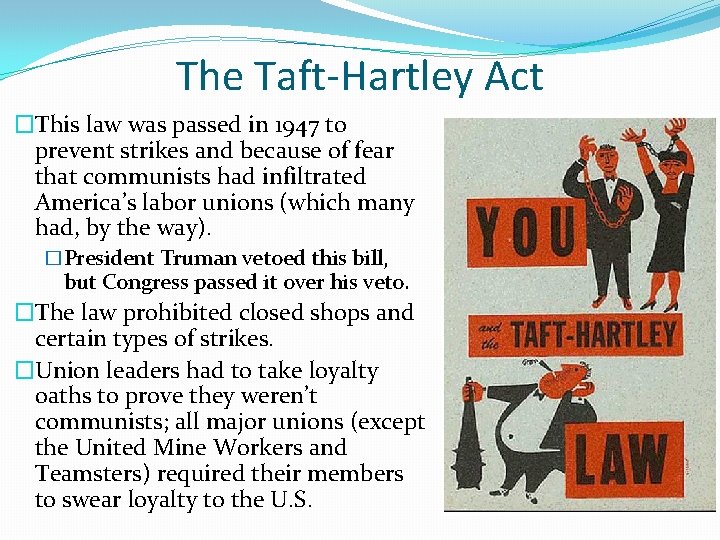
The Taft-Hartley Act �This law was passed in 1947 to prevent strikes and because of fear that communists had infiltrated America’s labor unions (which many had, by the way). �President Truman vetoed this bill, but Congress passed it over his veto. �The law prohibited closed shops and certain types of strikes. �Union leaders had to take loyalty oaths to prove they weren’t communists; all major unions (except the United Mine Workers and Teamsters) required their members to swear loyalty to the U. S.
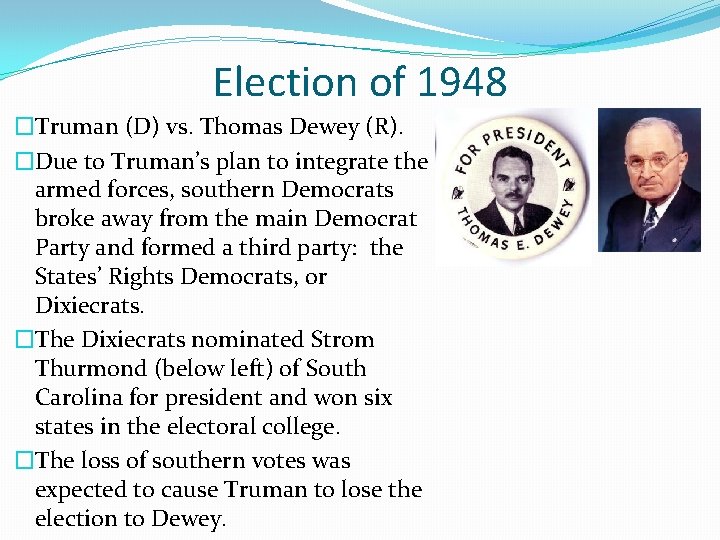
Election of 1948 �Truman (D) vs. Thomas Dewey (R). �Due to Truman’s plan to integrate the armed forces, southern Democrats broke away from the main Democrat Party and formed a third party: the States’ Rights Democrats, or Dixiecrats. �The Dixiecrats nominated Strom Thurmond (below left) of South Carolina for president and won six states in the electoral college. �The loss of southern votes was expected to cause Truman to lose the election to Dewey.
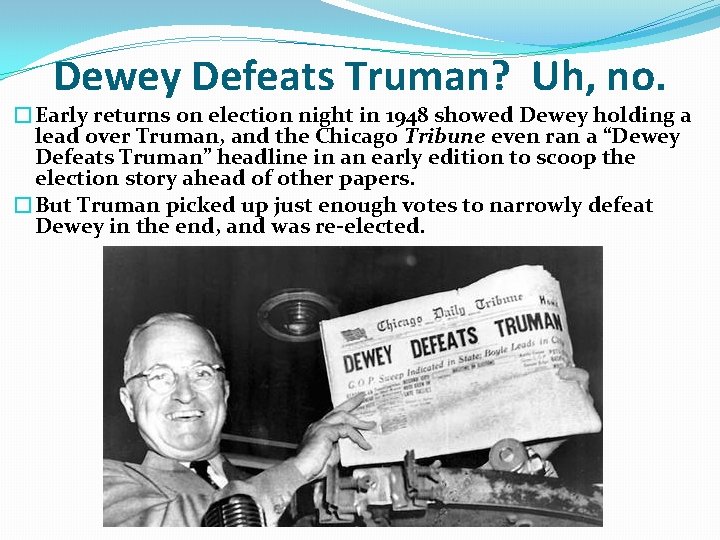
Dewey Defeats Truman? Uh, no. �Early returns on election night in 1948 showed Dewey holding a lead over Truman, and the Chicago Tribune even ran a “Dewey Defeats Truman” headline in an early edition to scoop the election story ahead of other papers. �But Truman picked up just enough votes to narrowly defeat Dewey in the end, and was re-elected.
The Cold War Red Scare �Communism had gained strength during the Great Depression – by 1939, there were over 50, 000 members of CPUSA (the American Communist Party). �Smith Act, 1940: made it illegal to belong to any group advocating overthrow of the U. S. government. �After WWII ended in 1945, fear of Soviet aggression and communist spies in U. S. was widespread.
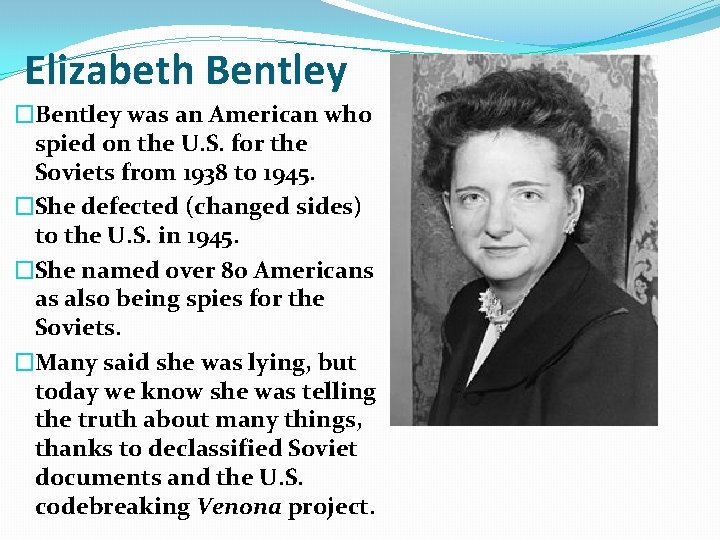
Elizabeth Bentley �Bentley was an American who spied on the U. S. for the Soviets from 1938 to 1945. �She defected (changed sides) to the U. S. in 1945. �She named over 80 Americans as also being spies for the Soviets. �Many said she was lying, but today we know she was telling the truth about many things, thanks to declassified Soviet documents and the U. S. codebreaking Venona project.
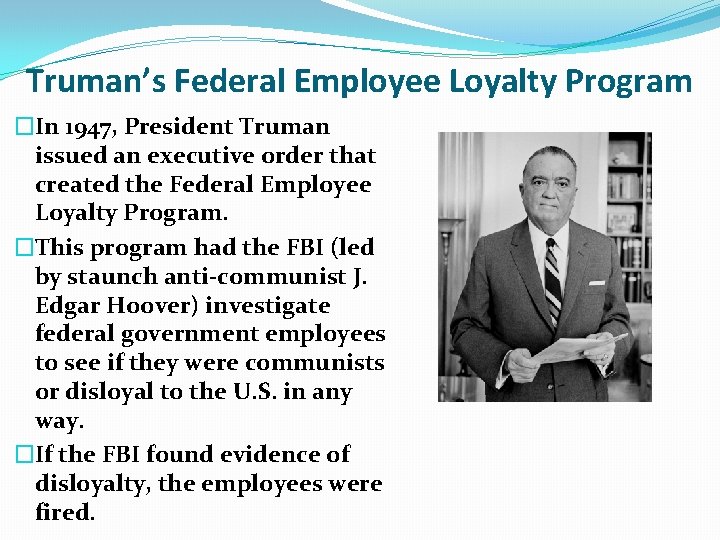
Truman’s Federal Employee Loyalty Program �In 1947, President Truman issued an executive order that created the Federal Employee Loyalty Program. �This program had the FBI (led by staunch anti-communist J. Edgar Hoover) investigate federal government employees to see if they were communists or disloyal to the U. S. in any way. �If the FBI found evidence of disloyalty, the employees were fired.
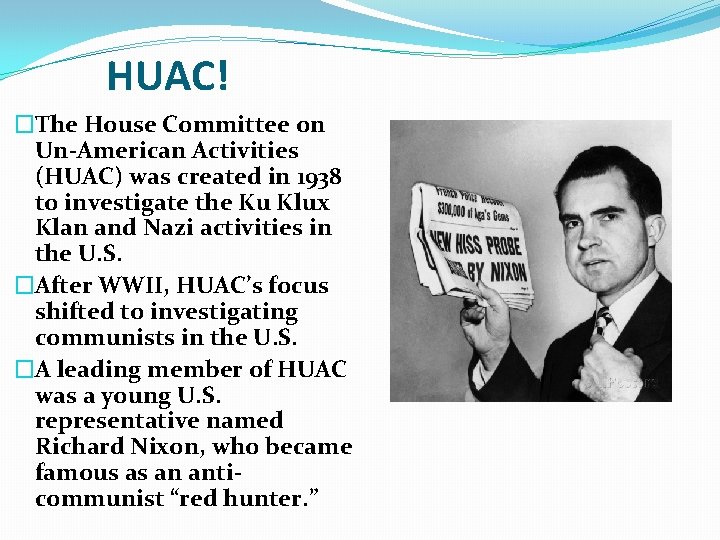
HUAC! �The House Committee on Un-American Activities (HUAC) was created in 1938 to investigate the Ku Klux Klan and Nazi activities in the U. S. �After WWII, HUAC’s focus shifted to investigating communists in the U. S. �A leading member of HUAC was a young U. S. representative named Richard Nixon, who became famous as an anticommunist “red hunter. ”
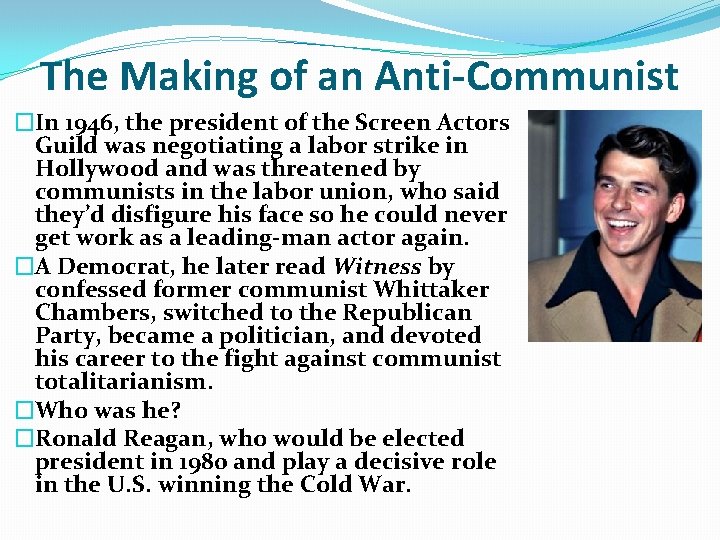
The Making of an Anti-Communist �In 1946, the president of the Screen Actors Guild was negotiating a labor strike in Hollywood and was threatened by communists in the labor union, who said they’d disfigure his face so he could never get work as a leading-man actor again. �A Democrat, he later read Witness by confessed former communist Whittaker Chambers, switched to the Republican Party, became a politician, and devoted his career to the fight against communist totalitarianism. �Who was he? �Ronald Reagan, who would be elected president in 1980 and play a decisive role in the U. S. winning the Cold War.
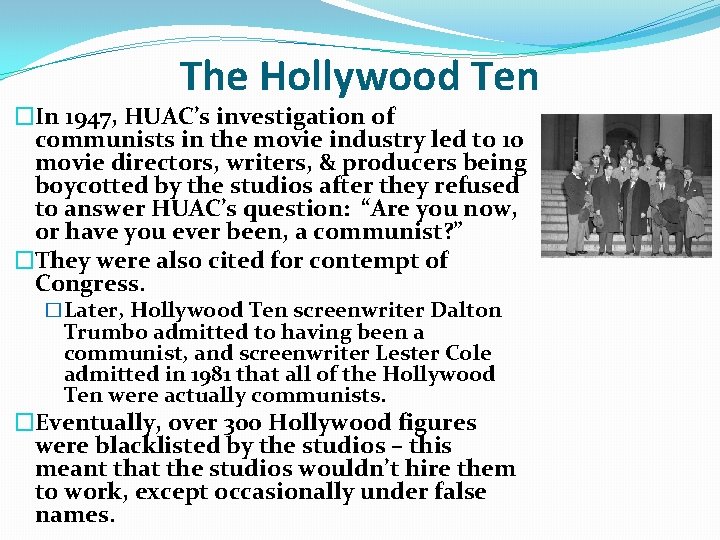
The Hollywood Ten �In 1947, HUAC’s investigation of communists in the movie industry led to 10 movie directors, writers, & producers being boycotted by the studios after they refused to answer HUAC’s question: “Are you now, or have you ever been, a communist? ” �They were also cited for contempt of Congress. �Later, Hollywood Ten screenwriter Dalton Trumbo admitted to having been a communist, and screenwriter Lester Cole admitted in 1981 that all of the Hollywood Ten were actually communists. �Eventually, over 300 Hollywood figures were blacklisted by the studios – this meant that the studios wouldn’t hire them to work, except occasionally under false names.
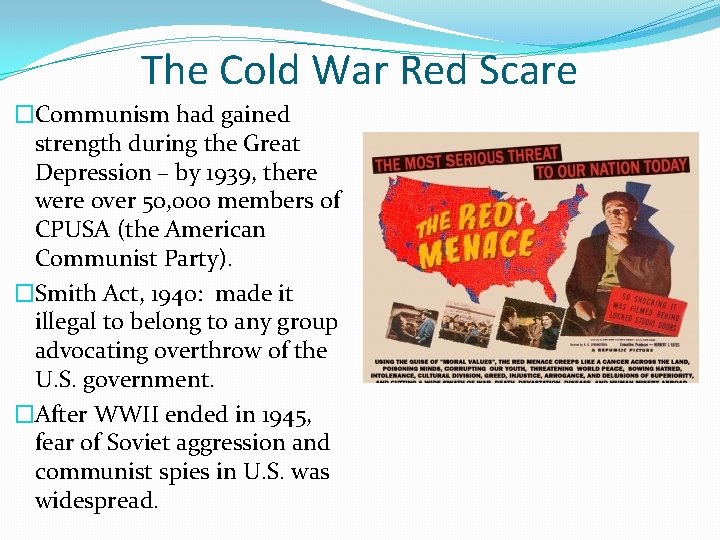
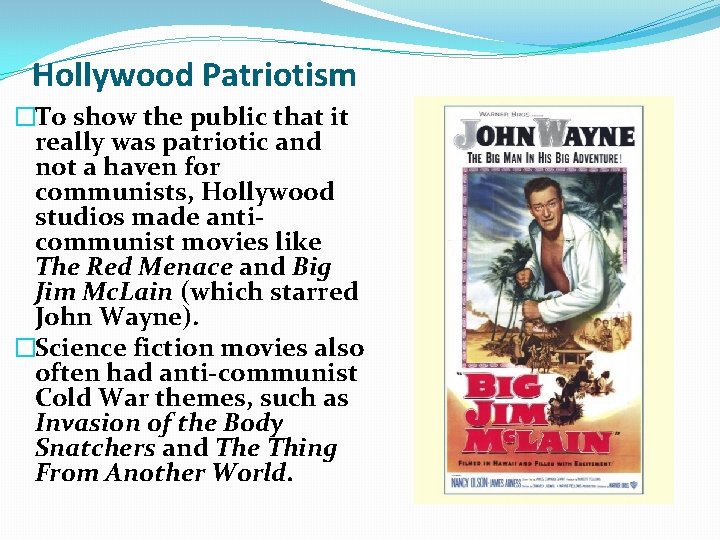
Hollywood Patriotism �To show the public that it really was patriotic and not a haven for communists, Hollywood studios made anticommunist movies like The Red Menace and Big Jim Mc. Lain (which starred John Wayne). �Science fiction movies also often had anti-communist Cold War themes, such as Invasion of the Body Snatchers and The Thing From Another World.
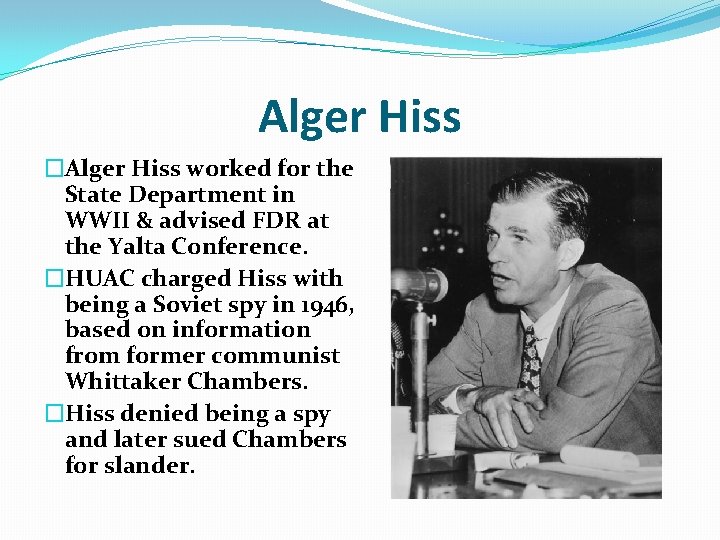
Alger Hiss �Alger Hiss worked for the State Department in WWII & advised FDR at the Yalta Conference. �HUAC charged Hiss with being a Soviet spy in 1946, based on information from former communist Whittaker Chambers. �Hiss denied being a spy and later sued Chambers for slander.
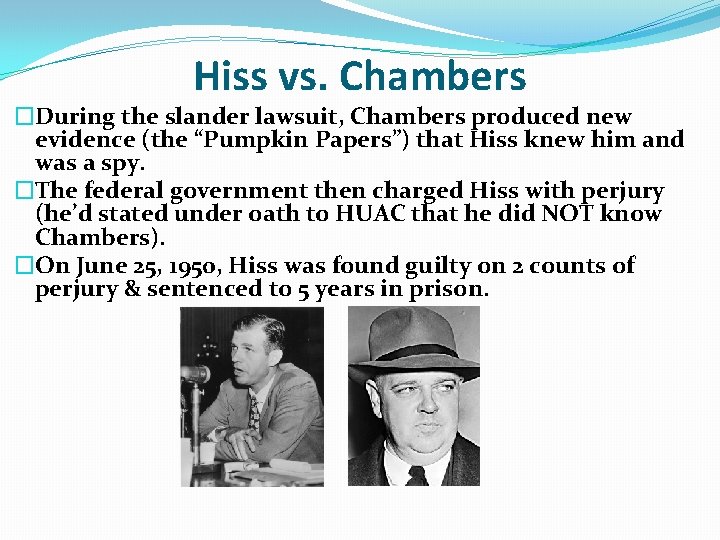
Hiss vs. Chambers �During the slander lawsuit, Chambers produced new evidence (the “Pumpkin Papers”) that Hiss knew him and was a spy. �The federal government then charged Hiss with perjury (he’d stated under oath to HUAC that he did NOT know Chambers). �On June 25, 1950, Hiss was found guilty on 2 counts of perjury & sentenced to 5 years in prison.
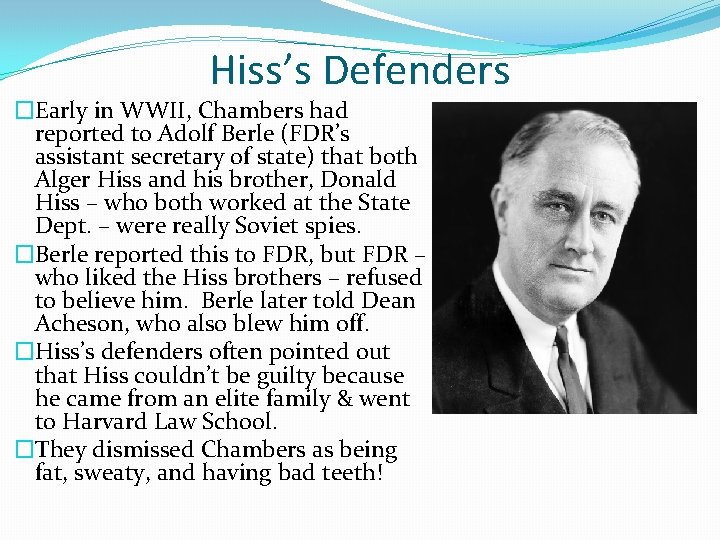
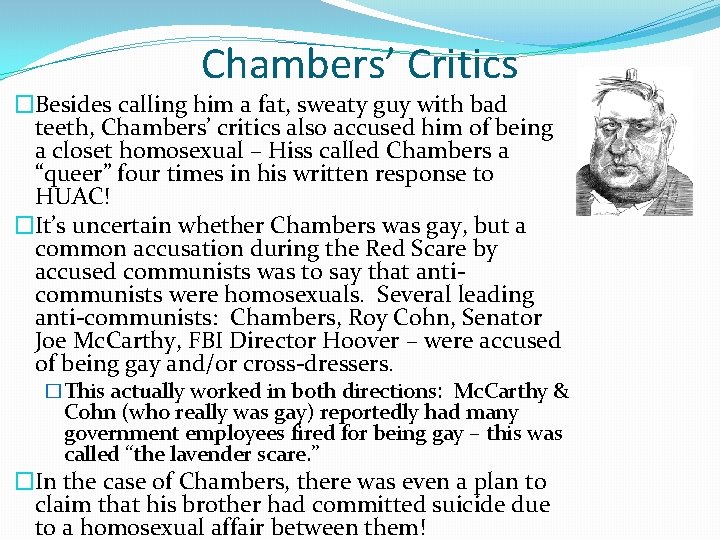
Hiss’s Defenders �Early in WWII, Chambers had reported to Adolf Berle (FDR’s assistant secretary of state) that both Alger Hiss and his brother, Donald Hiss – who both worked at the State Dept. – were really Soviet spies. �Berle reported this to FDR, but FDR – who liked the Hiss brothers – refused to believe him. Berle later told Dean Acheson, who also blew him off. �Hiss’s defenders often pointed out that Hiss couldn’t be guilty because he came from an elite family & went to Harvard Law School. �They dismissed Chambers as being fat, sweaty, and having bad teeth!
Chambers’ Critics �Besides calling him a fat, sweaty guy with bad teeth, Chambers’ critics also accused him of being a closet homosexual – Hiss called Chambers a “queer” four times in his written response to HUAC! �It’s uncertain whether Chambers was gay, but a common accusation during the Red Scare by accused communists was to say that anticommunists were homosexuals. Several leading anti-communists: Chambers, Roy Cohn, Senator Joe Mc. Carthy, FBI Director Hoover – were accused of being gay and/or cross-dressers. �This actually worked in both directions: Mc. Carthy & Cohn (who really was gay) reportedly had many government employees fired for being gay – this was called “the lavender scare. ” �In the case of Chambers, there was even a plan to claim that his brother had committed suicide due to a homosexual affair between them!
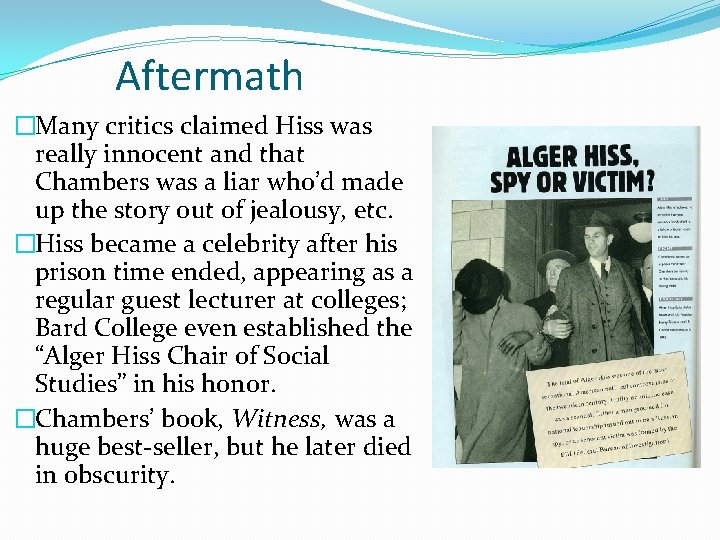
Aftermath �Many critics claimed Hiss was really innocent and that Chambers was a liar who’d made up the story out of jealousy, etc. �Hiss became a celebrity after his prison time ended, appearing as a regular guest lecturer at colleges; Bard College even established the “Alger Hiss Chair of Social Studies” in his honor. �Chambers’ book, Witness, was a huge best-seller, but he later died in obscurity.
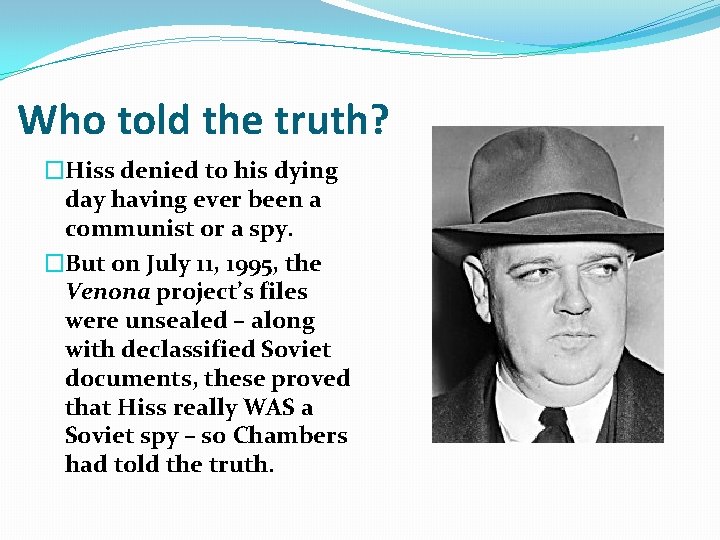
Who told the truth? �Hiss denied to his dying day having ever been a communist or a spy. �But on July 11, 1995, the Venona project’s files were unsealed – along with declassified Soviet documents, these proved that Hiss really WAS a Soviet spy – so Chambers had told the truth.
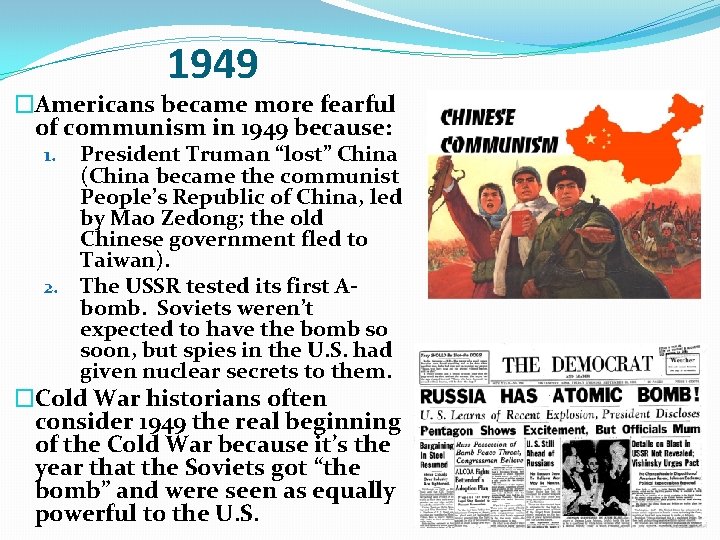
1949 �Americans became more fearful of communism in 1949 because: President Truman “lost” China (China became the communist People’s Republic of China, led by Mao Zedong; the old Chinese government fled to Taiwan). 2. The USSR tested its first Abomb. Soviets weren’t expected to have the bomb so soon, but spies in the U. S. had given nuclear secrets to them. 1. �Cold War historians often consider 1949 the real beginning of the Cold War because it’s the year that the Soviets got “the bomb” and were seen as equally powerful to the U. S.
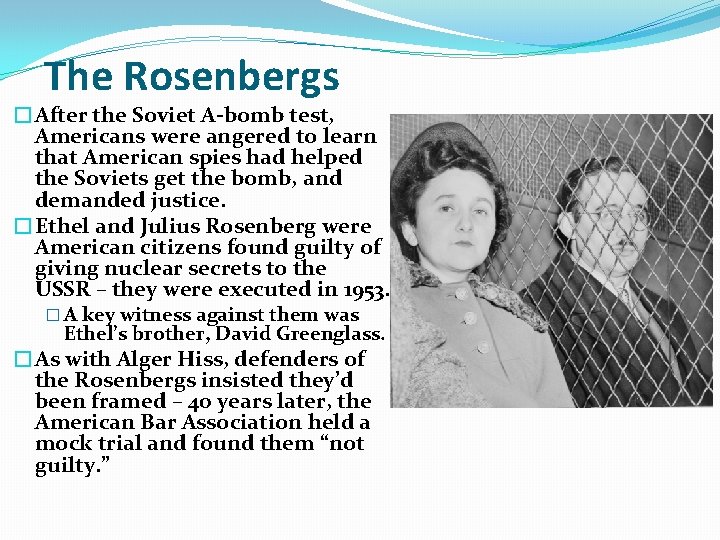
The Rosenbergs �After the Soviet A-bomb test, Americans were angered to learn that American spies had helped the Soviets get the bomb, and demanded justice. �Ethel and Julius Rosenberg were American citizens found guilty of giving nuclear secrets to the USSR – they were executed in 1953. � A key witness against them was Ethel’s brother, David Greenglass. �As with Alger Hiss, defenders of the Rosenbergs insisted they’d been framed – 40 years later, the American Bar Association held a mock trial and found them “not guilty. ”
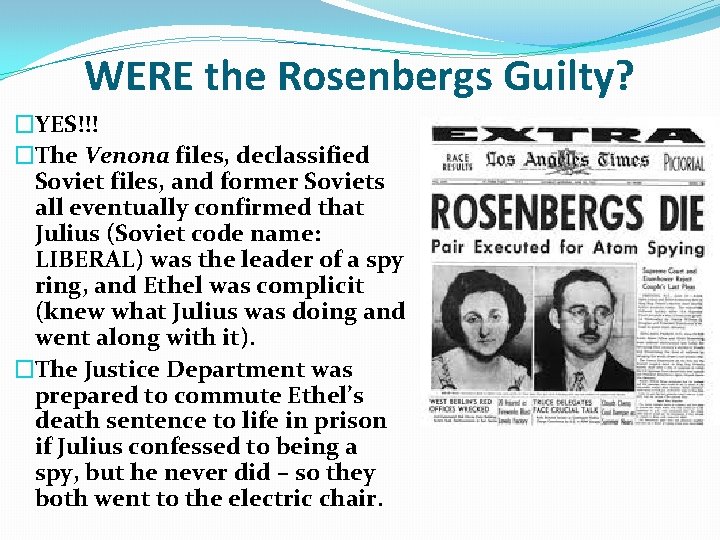
WERE the Rosenbergs Guilty? �YES!!! �The Venona files, declassified Soviet files, and former Soviets all eventually confirmed that Julius (Soviet code name: LIBERAL) was the leader of a spy ring, and Ethel was complicit (knew what Julius was doing and went along with it). �The Justice Department was prepared to commute Ethel’s death sentence to life in prison if Julius confessed to being a spy, but he never did – so they both went to the electric chair.
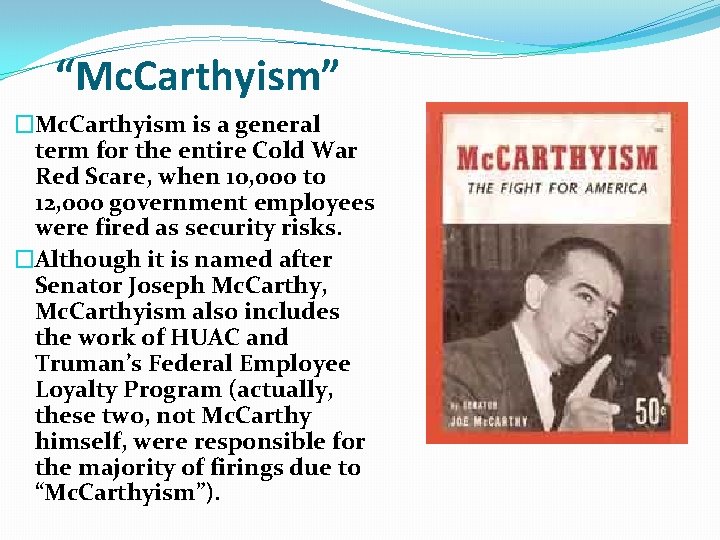
“Mc. Carthyism” �Mc. Carthyism is a general term for the entire Cold War Red Scare, when 10, 000 to 12, 000 government employees were fired as security risks. �Although it is named after Senator Joseph Mc. Carthy, Mc. Carthyism also includes the work of HUAC and Truman’s Federal Employee Loyalty Program (actually, these two, not Mc. Carthy himself, were responsible for the majority of firings due to “Mc. Carthyism”).
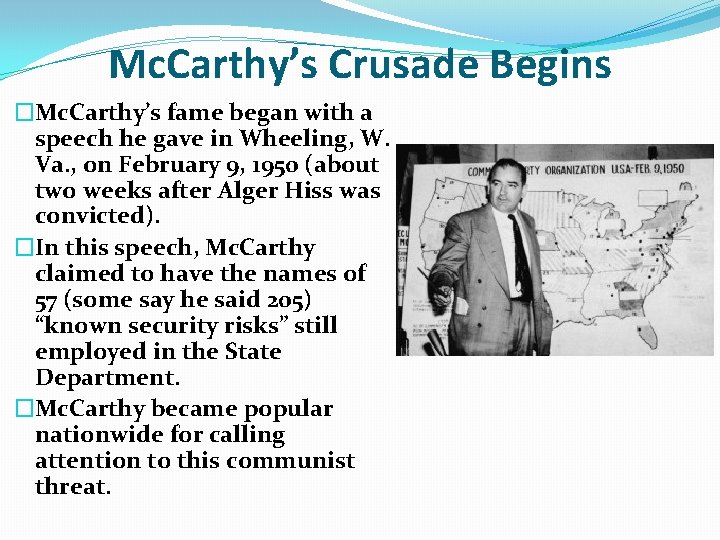
Mc. Carthy’s Crusade Begins �Mc. Carthy’s fame began with a speech he gave in Wheeling, W. Va. , on February 9, 1950 (about two weeks after Alger Hiss was convicted). �In this speech, Mc. Carthy claimed to have the names of 57 (some say he said 205) “known security risks” still employed in the State Department. �Mc. Carthy became popular nationwide for calling attention to this communist threat.
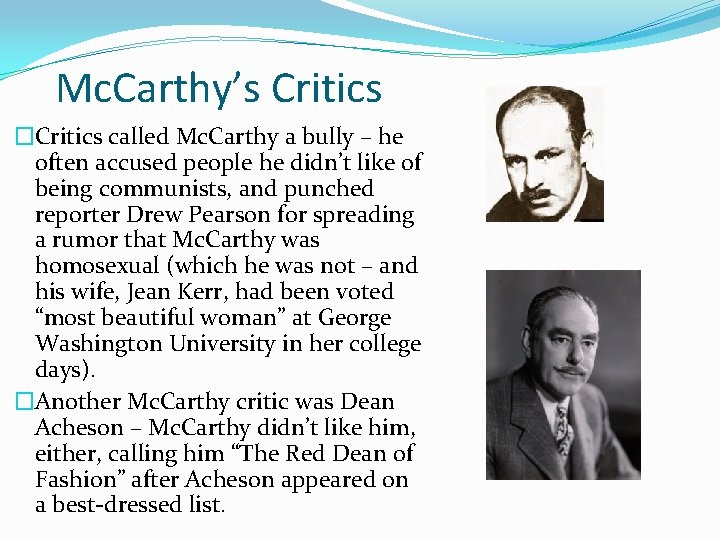
Mc. Carthy’s Critics �Critics called Mc. Carthy a bully – he often accused people he didn’t like of being communists, and punched reporter Drew Pearson for spreading a rumor that Mc. Carthy was homosexual (which he was not – and his wife, Jean Kerr, had been voted “most beautiful woman” at George Washington University in her college days). �Another Mc. Carthy critic was Dean Acheson – Mc. Carthy didn’t like him, either, calling him “The Red Dean of Fashion” after Acheson appeared on a best-dressed list.
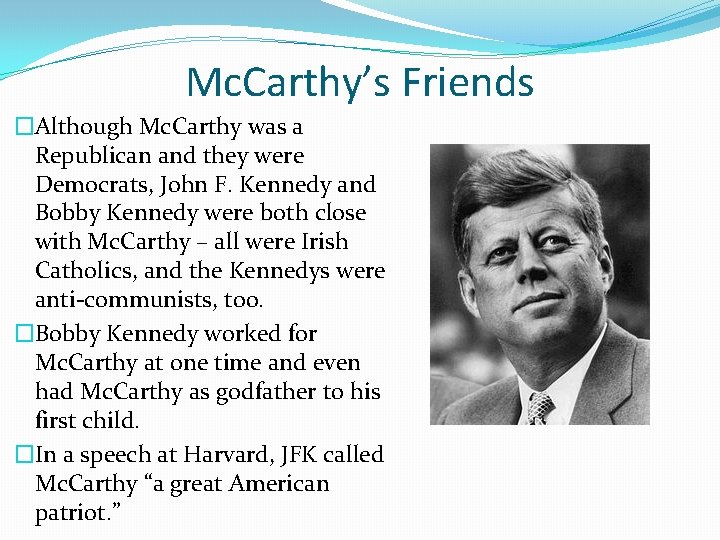
Mc. Carthy’s Friends �Although Mc. Carthy was a Republican and they were Democrats, John F. Kennedy and Bobby Kennedy were both close with Mc. Carthy – all were Irish Catholics, and the Kennedys were anti-communists, too. �Bobby Kennedy worked for Mc. Carthy at one time and even had Mc. Carthy as godfather to his first child. �In a speech at Harvard, JFK called Mc. Carthy “a great American patriot. ”
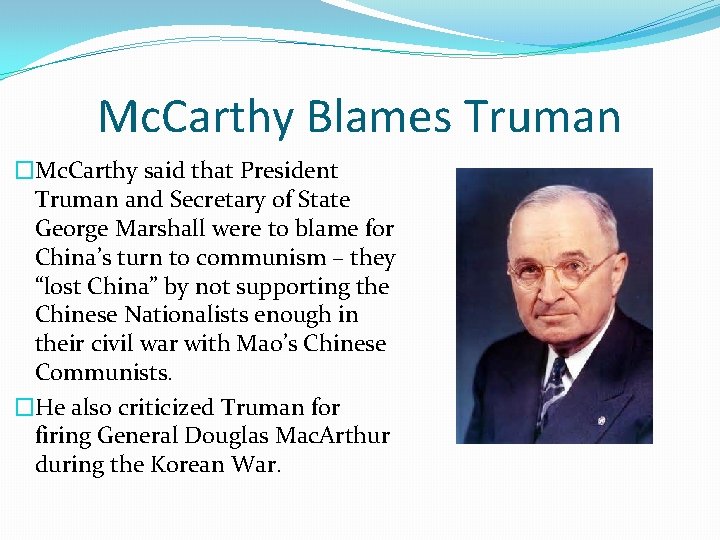
Mc. Carthy Blames Truman �Mc. Carthy said that President Truman and Secretary of State George Marshall were to blame for China’s turn to communism – they “lost China” by not supporting the Chinese Nationalists enough in their civil war with Mao’s Chinese Communists. �He also criticized Truman for firing General Douglas Mac. Arthur during the Korean War.
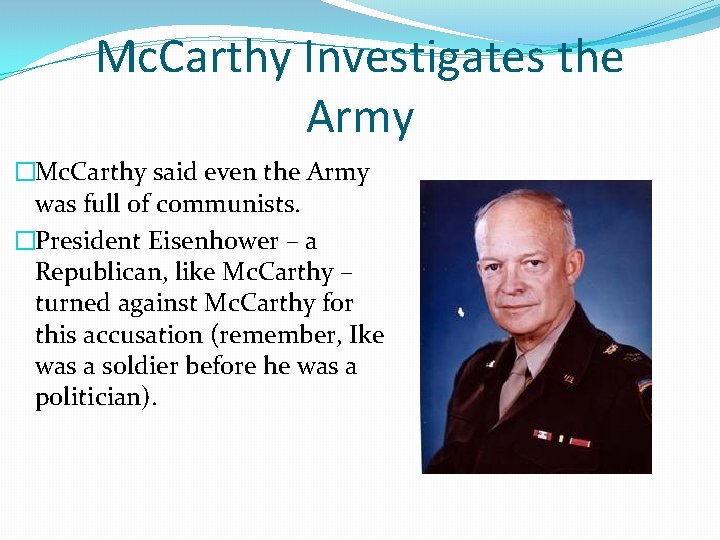
Mc. Carthy Investigates the Army �Mc. Carthy said even the Army was full of communists. �President Eisenhower – a Republican, like Mc. Carthy – turned against Mc. Carthy for this accusation (remember, Ike was a soldier before he was a politician).
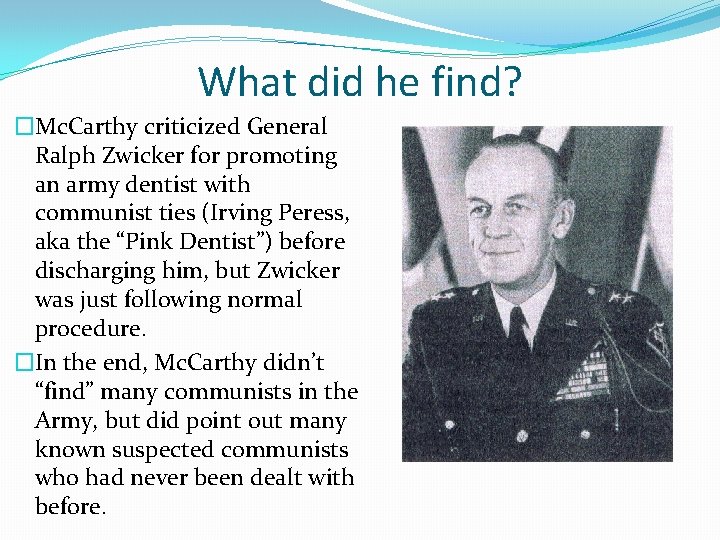
What did he find? �Mc. Carthy criticized General Ralph Zwicker for promoting an army dentist with communist ties (Irving Peress, aka the “Pink Dentist”) before discharging him, but Zwicker was just following normal procedure. �In the end, Mc. Carthy didn’t “find” many communists in the Army, but did point out many known suspected communists who had never been dealt with before.
The Army-Mc. Carthy Hearings �In 1954, the Army charged Mc. Carthy and Roy Cohn (a lawyer who worked for Mc. Carthy) with demanding preferential treatment former Mc. Carthy employee David Schine (who’d been drafted). �Hearings were televised live for 36 days, averaging 20 million viewers. �Mc. Carthy came across as bullying & arrogant – even he admitted this later.
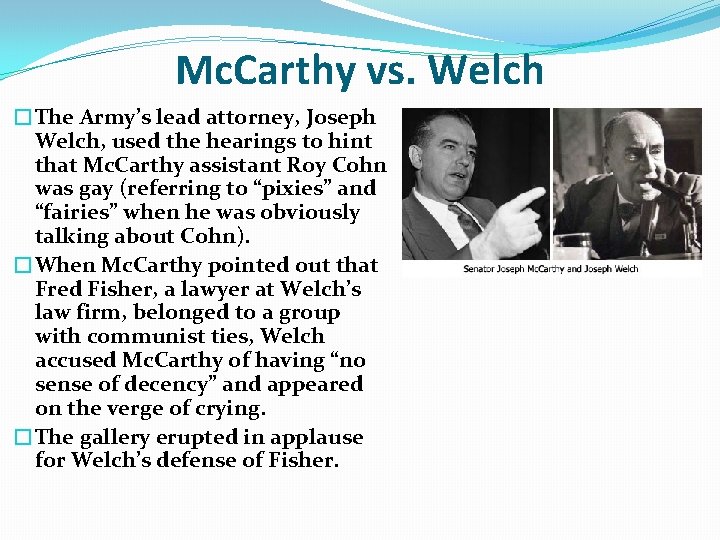
Mc. Carthy vs. Welch �The Army’s lead attorney, Joseph Welch, used the hearings to hint that Mc. Carthy assistant Roy Cohn was gay (referring to “pixies” and “fairies” when he was obviously talking about Cohn). �When Mc. Carthy pointed out that Fred Fisher, a lawyer at Welch’s law firm, belonged to a group with communist ties, Welch accused Mc. Carthy of having “no sense of decency” and appeared on the verge of crying. �The gallery erupted in applause for Welch’s defense of Fisher.
Mc. Carthy’s Downfall �Reporters disliked Mc. Carthy & harshly criticized him during the hearings (also, taped broadcasts of the hearing were edited to make Mc. Carthy look worse). �Famous reporters like Edward R. Murrow and I. F. Stone were key in turning public opinion against Mc. Carthy (after his death, it was learned that Stone was actually a communist spy!). �The Senate later censured Mc. Carthy – his career ruined, he died in 1957 at the age of 48.
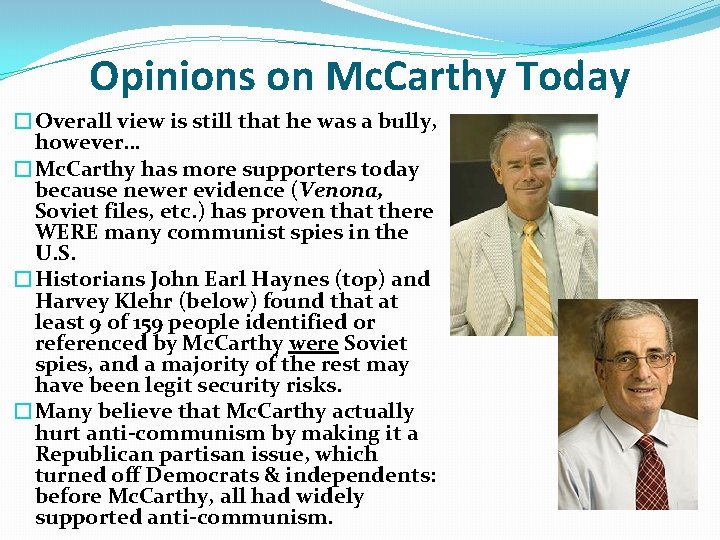
Opinions on Mc. Carthy Today �Overall view is still that he was a bully, however… �Mc. Carthy has more supporters today because newer evidence (Venona, Soviet files, etc. ) has proven that there WERE many communist spies in the U. S. �Historians John Earl Haynes (top) and Harvey Klehr (below) found that at least 9 of 159 people identified or referenced by Mc. Carthy were Soviet spies, and a majority of the rest may have been legit security risks. �Many believe that Mc. Carthy actually hurt anti-communism by making it a Republican partisan issue, which turned off Democrats & independents: before Mc. Carthy, all had widely supported anti-communism.
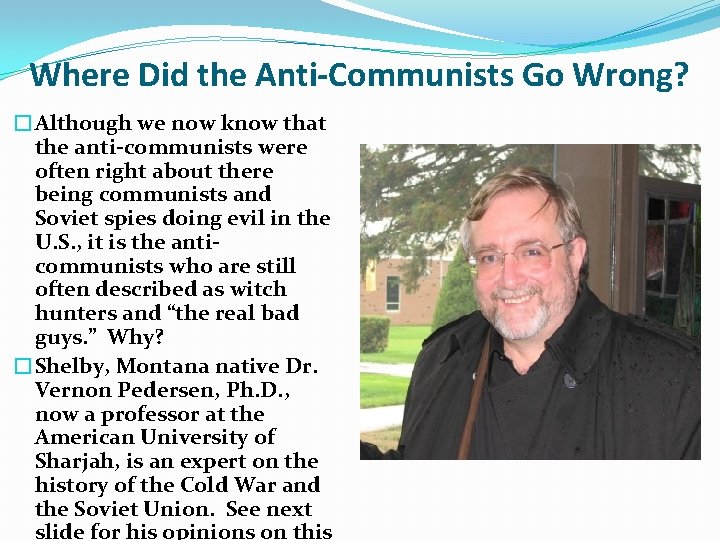
Where Did the Anti-Communists Go Wrong? �Although we now know that the anti-communists were often right about there being communists and Soviet spies doing evil in the U. S. , it is the anticommunists who are still often described as witch hunters and “the real bad guys. ” Why? �Shelby, Montana native Dr. Vernon Pedersen, Ph. D. , now a professor at the American University of Sharjah, is an expert on the history of the Cold War and the Soviet Union. See next slide for his opinions on this
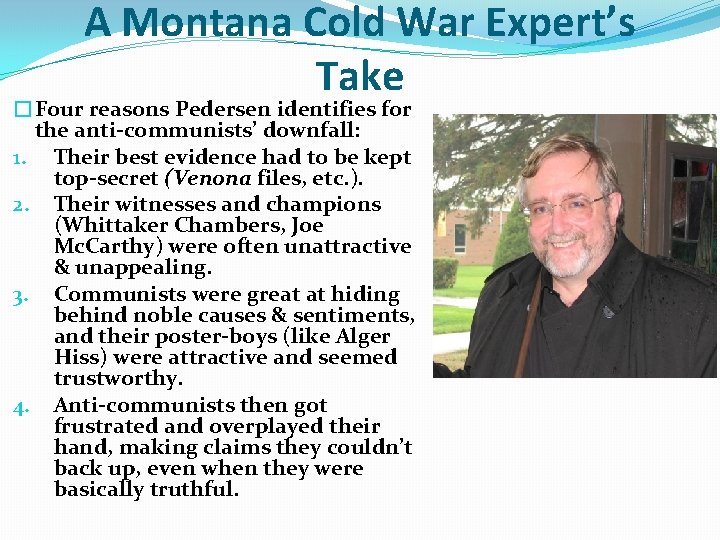
A Montana Cold War Expert’s Take �Four reasons Pedersen identifies for the anti-communists’ downfall: 1. Their best evidence had to be kept top-secret (Venona files, etc. ). 2. Their witnesses and champions (Whittaker Chambers, Joe Mc. Carthy) were often unattractive & unappealing. 3. Communists were great at hiding behind noble causes & sentiments, and their poster-boys (like Alger Hiss) were attractive and seemed trustworthy. 4. Anti-communists then got frustrated and overplayed their hand, making claims they couldn’t back up, even when they were basically truthful.
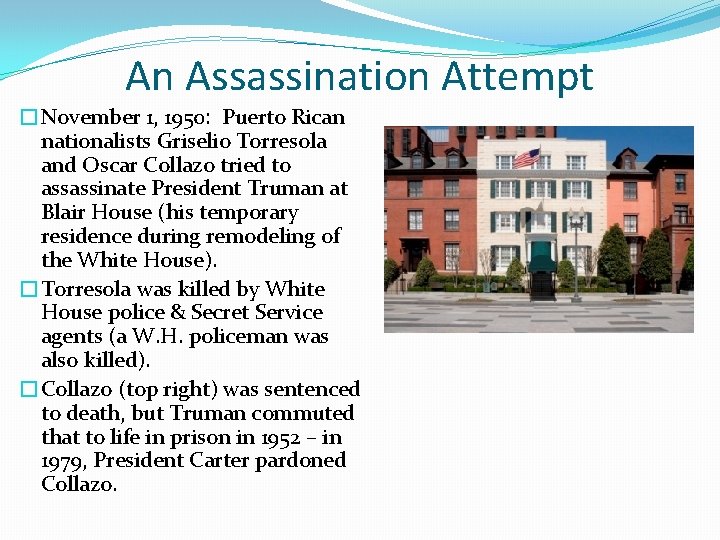
An Assassination Attempt �November 1, 1950: Puerto Rican nationalists Griselio Torresola and Oscar Collazo tried to assassinate President Truman at Blair House (his temporary residence during remodeling of the White House). �Torresola was killed by White House police & Secret Service agents (a W. H. policeman was also killed). �Collazo (top right) was sentenced to death, but Truman commuted that to life in prison in 1952 – in 1979, President Carter pardoned Collazo.
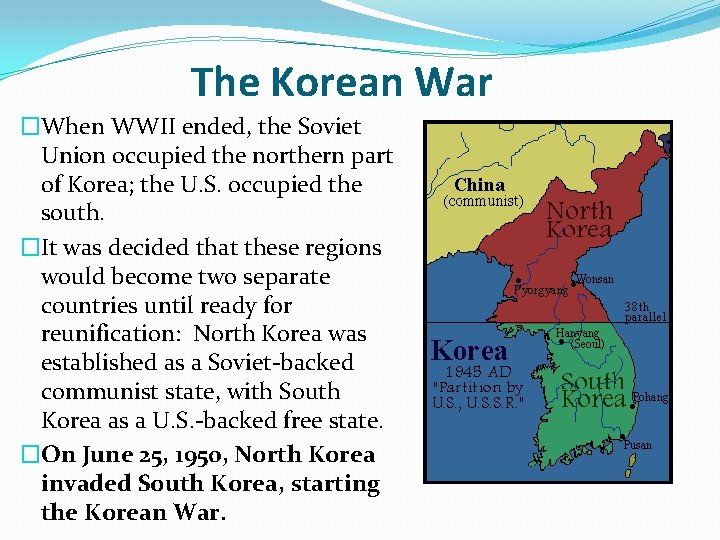
The Korean War �When WWII ended, the Soviet Union occupied the northern part of Korea; the U. S. occupied the south. �It was decided that these regions would become two separate countries until ready for reunification: North Korea was established as a Soviet-backed communist state, with South Korea as a U. S. -backed free state. �On June 25, 1950, North Korea invaded South Korea, starting the Korean War.
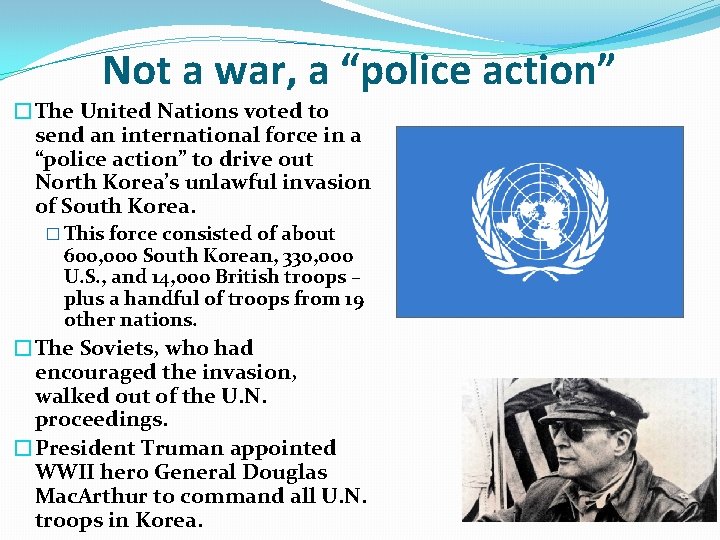
Not a war, a “police action” �The United Nations voted to send an international force in a “police action” to drive out North Korea’s unlawful invasion of South Korea. � This force consisted of about 600, 000 South Korean, 330, 000 U. S. , and 14, 000 British troops – plus a handful of troops from 19 other nations. �The Soviets, who had encouraged the invasion, walked out of the U. N. proceedings. �President Truman appointed WWII hero General Douglas Mac. Arthur to command all U. N. troops in Korea.
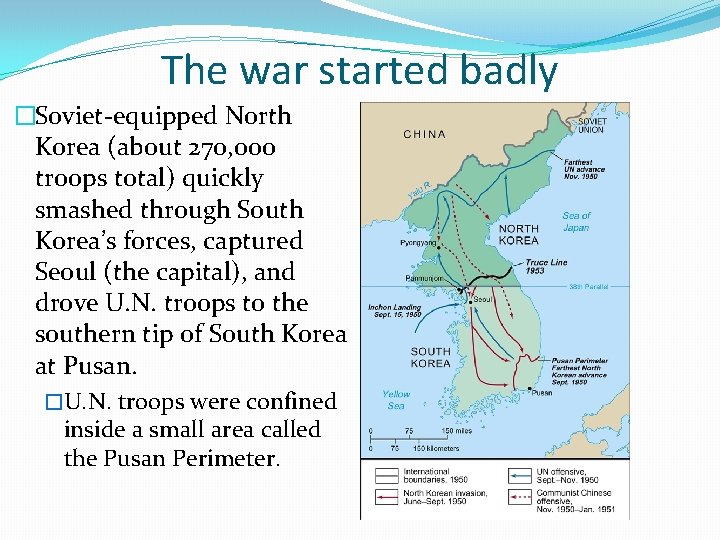
The war started badly �Soviet-equipped North Korea (about 270, 000 troops total) quickly smashed through South Korea’s forces, captured Seoul (the capital), and drove U. N. troops to the southern tip of South Korea at Pusan. �U. N. troops were confined inside a small area called the Pusan Perimeter.
The Inchon Landing �Mac. Arthur surprised the North Koreans with a massive troop landing at Inchon, near the North-South Korea border. �At the same time, U. N. forces launched a strong counterattack out of Pusan to drive the North Koreans out of South Korea. �By November 1950, Seoul was liberated, and the North Korean army was driven all the way back to northern North Korea – almost to the Chinese border.
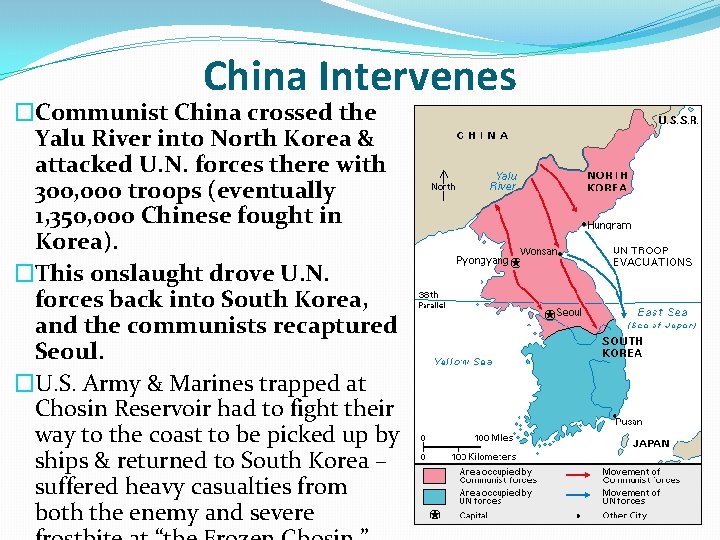
China Intervenes �Communist China crossed the Yalu River into North Korea & attacked U. N. forces there with 300, 000 troops (eventually 1, 350, 000 Chinese fought in Korea). �This onslaught drove U. N. forces back into South Korea, and the communists recaptured Seoul. �U. S. Army & Marines trapped at Chosin Reservoir had to fight their way to the coast to be picked up by ships & returned to South Korea – suffered heavy casualties from both the enemy and severe
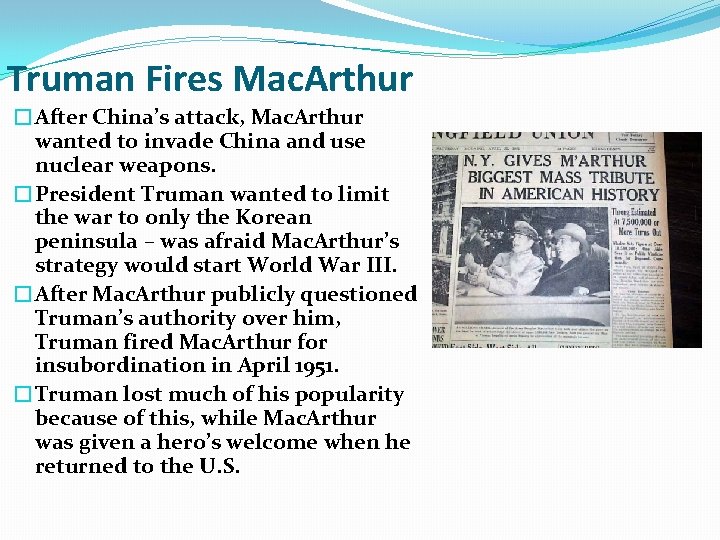
Truman Fires Mac. Arthur �After China’s attack, Mac. Arthur wanted to invade China and use nuclear weapons. �President Truman wanted to limit the war to only the Korean peninsula – was afraid Mac. Arthur’s strategy would start World War III. �After Mac. Arthur publicly questioned Truman’s authority over him, Truman fired Mac. Arthur for insubordination in April 1951. �Truman lost much of his popularity because of this, while Mac. Arthur was given a hero’s welcome when he returned to the U. S.
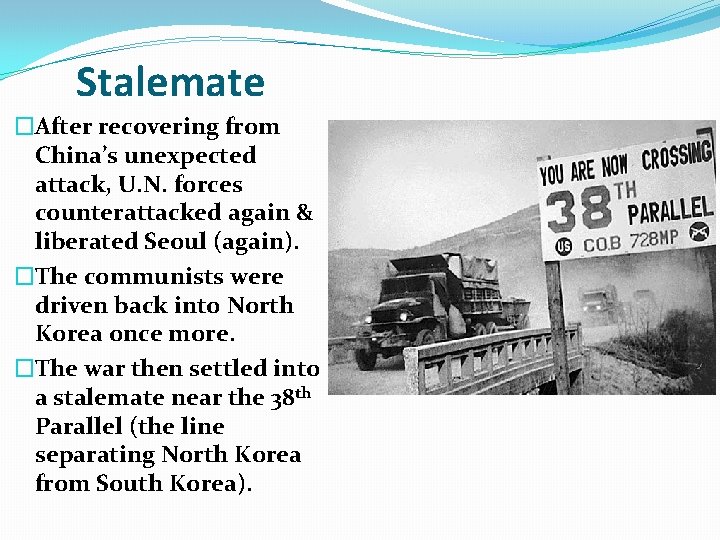
Stalemate �After recovering from China’s unexpected attack, U. N. forces counterattacked again & liberated Seoul (again). �The communists were driven back into North Korea once more. �The war then settled into a stalemate near the 38 th Parallel (the line separating North Korea from South Korea).
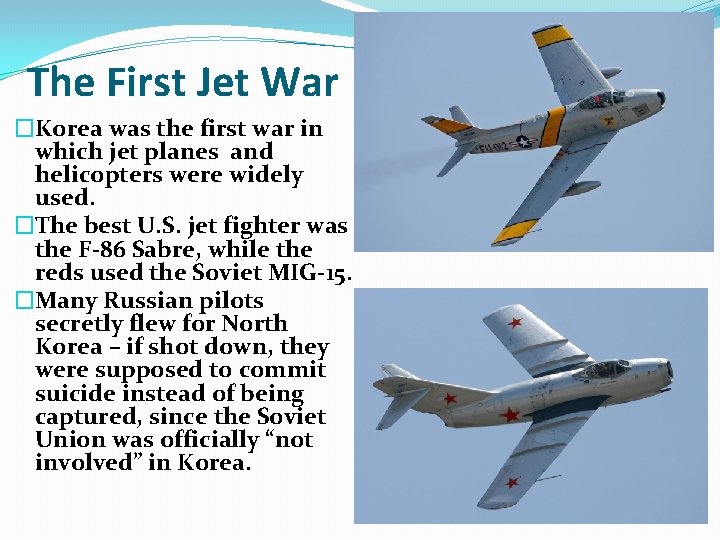
The First Jet War �Korea was the first war in which jet planes and helicopters were widely used. �The best U. S. jet fighter was the F-86 Sabre, while the reds used the Soviet MIG-15. �Many Russian pilots secretly flew for North Korea – if shot down, they were supposed to commit suicide instead of being captured, since the Soviet Union was officially “not involved” in Korea.
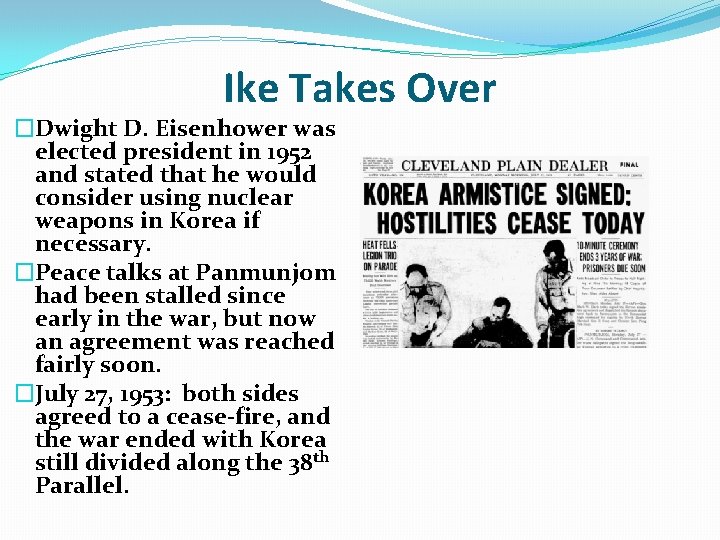
Ike Takes Over �Dwight D. Eisenhower was elected president in 1952 and stated that he would consider using nuclear weapons in Korea if necessary. �Peace talks at Panmunjom had been stalled since early in the war, but now an agreement was reached fairly soon. �July 27, 1953: both sides agreed to a cease-fire, and the war ended with Korea still divided along the 38 th Parallel.
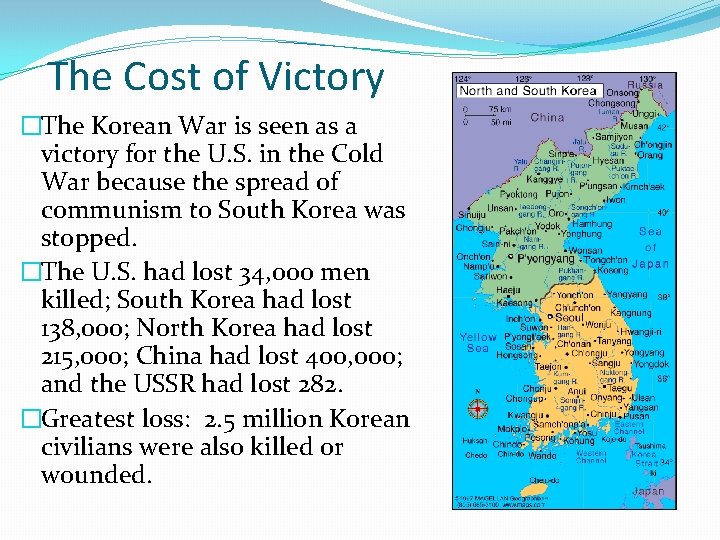
The Cost of Victory �The Korean War is seen as a victory for the U. S. in the Cold War because the spread of communism to South Korea was stopped. �The U. S. had lost 34, 000 men killed; South Korea had lost 138, 000; North Korea had lost 215, 000; China had lost 400, 000; and the USSR had lost 282. �Greatest loss: 2. 5 million Korean civilians were also killed or wounded.
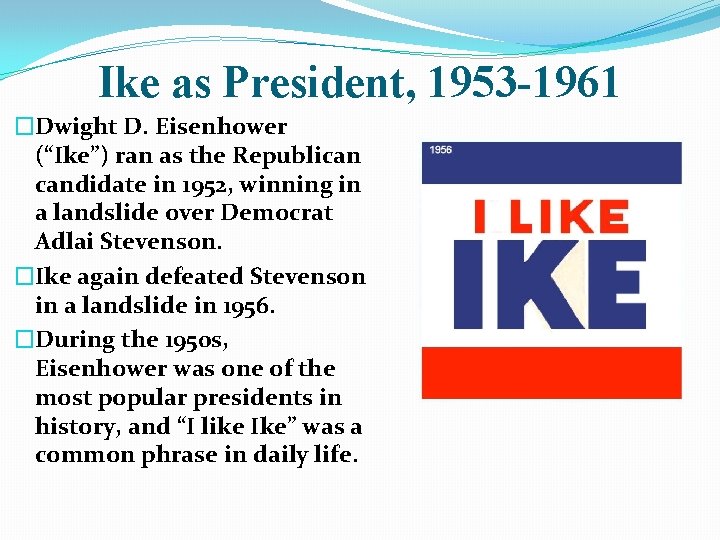
Ike as President, 1953 -1961 �Dwight D. Eisenhower (“Ike”) ran as the Republican candidate in 1952, winning in a landslide over Democrat Adlai Stevenson. �Ike again defeated Stevenson in a landslide in 1956. �During the 1950 s, Eisenhower was one of the most popular presidents in history, and “I like Ike” was a common phrase in daily life.
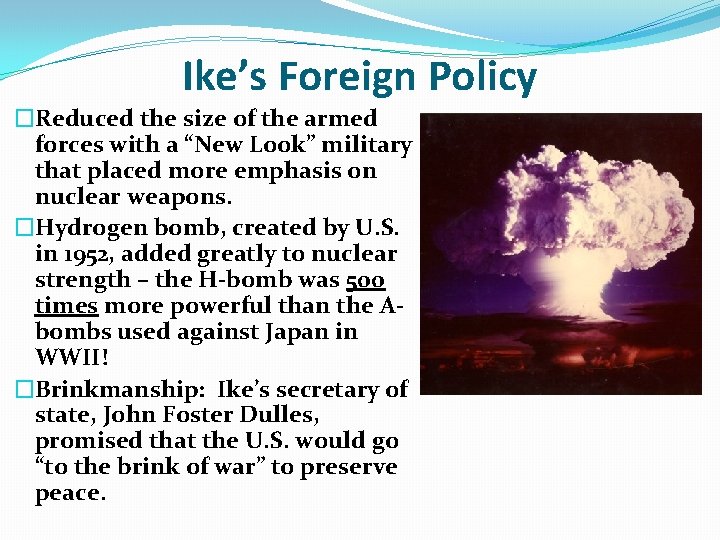
Ike’s Foreign Policy �Reduced the size of the armed forces with a “New Look” military that placed more emphasis on nuclear weapons. �Hydrogen bomb, created by U. S. in 1952, added greatly to nuclear strength – the H-bomb was 500 times more powerful than the Abombs used against Japan in WWII! �Brinkmanship: Ike’s secretary of state, John Foster Dulles, promised that the U. S. would go “to the brink of war” to preserve peace.
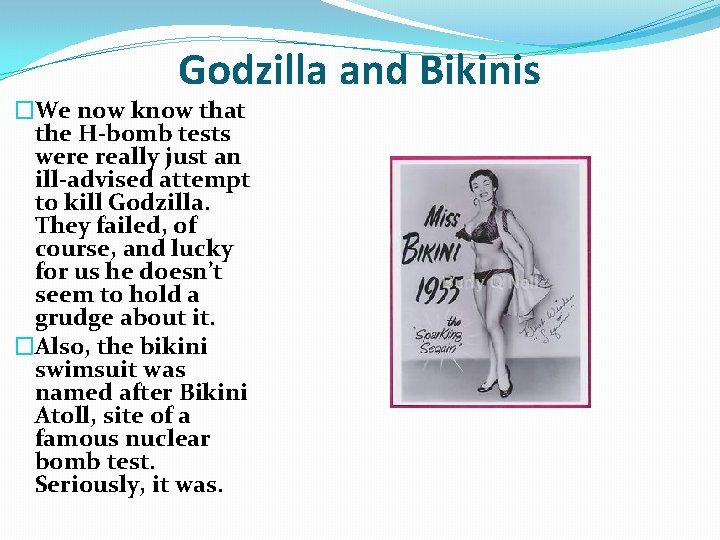
Godzilla and Bikinis �We now know that the H-bomb tests were really just an ill-advised attempt to kill Godzilla. They failed, of course, and lucky for us he doesn’t seem to hold a grudge about it. �Also, the bikini swimsuit was named after Bikini Atoll, site of a famous nuclear bomb test. Seriously, it was.
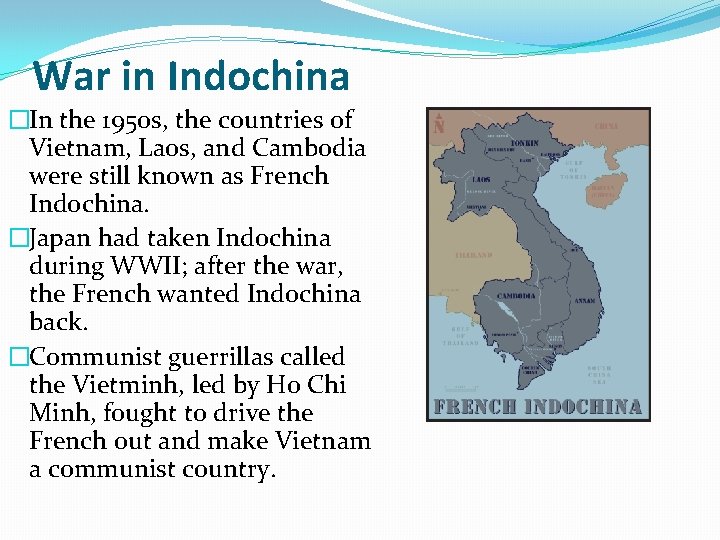
War in Indochina �In the 1950 s, the countries of Vietnam, Laos, and Cambodia were still known as French Indochina. �Japan had taken Indochina during WWII; after the war, the French wanted Indochina back. �Communist guerrillas called the Vietminh, led by Ho Chi Minh, fought to drive the French out and make Vietnam a communist country.
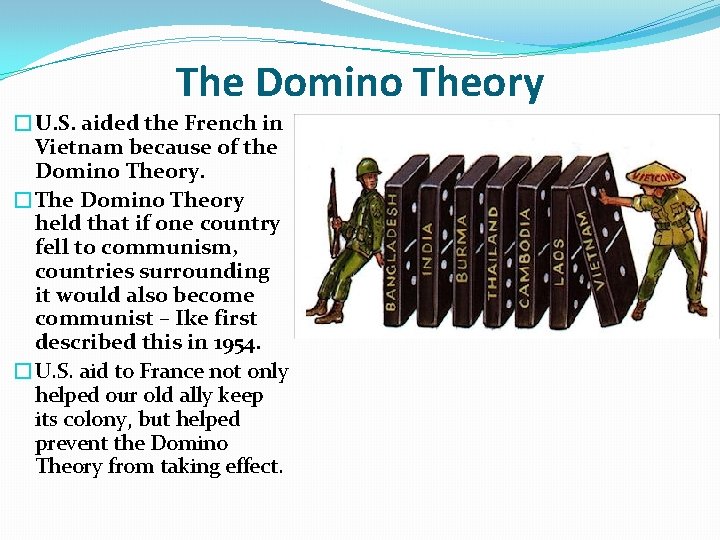
The Domino Theory �U. S. aided the French in Vietnam because of the Domino Theory. �The Domino Theory held that if one country fell to communism, countries surrounding it would also become communist – Ike first described this in 1954. �U. S. aid to France not only helped our old ally keep its colony, but helped prevent the Domino Theory from taking effect.
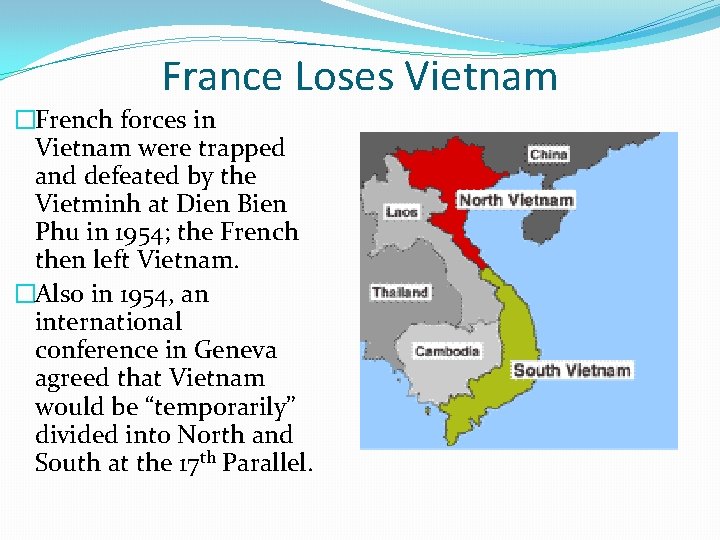
France Loses Vietnam �French forces in Vietnam were trapped and defeated by the Vietminh at Dien Bien Phu in 1954; the French then left Vietnam. �Also in 1954, an international conference in Geneva agreed that Vietnam would be “temporarily” divided into North and South at the 17 th Parallel.
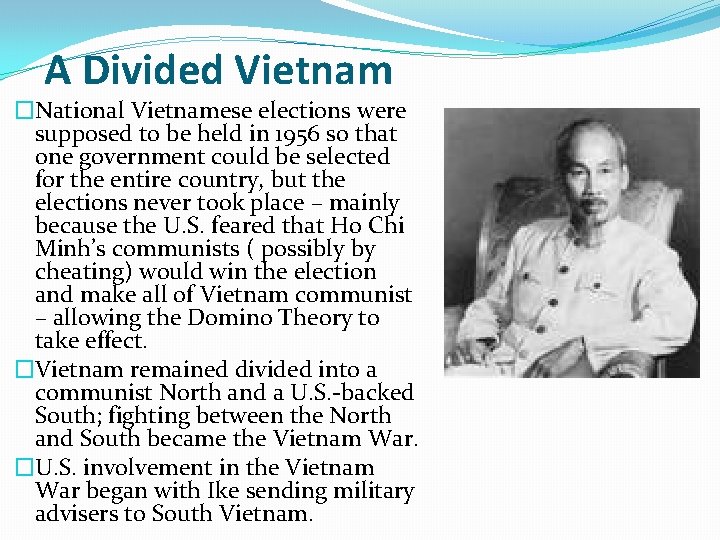
A Divided Vietnam �National Vietnamese elections were supposed to be held in 1956 so that one government could be selected for the entire country, but the elections never took place – mainly because the U. S. feared that Ho Chi Minh’s communists ( possibly by cheating) would win the election and make all of Vietnam communist – allowing the Domino Theory to take effect. �Vietnam remained divided into a communist North and a U. S. -backed South; fighting between the North and South became the Vietnam War. �U. S. involvement in the Vietnam War began with Ike sending military advisers to South Vietnam.
“Pactomania” �Eisenhower & Dulles’ critics referred to Dulles’ strategy of using treaties to surround communist countries with U. S. -backed countries “pactomania” (as if it were a psychological disorder of Dulles’). �There WERE several U. S. -backed treaty organizations to resist communism: NATO, SEATO, and METO. �While John Foster Dulles was Ike’s secretary of state, his brother Allen Dulles was CIA director for Ike and (briefly) JFK.
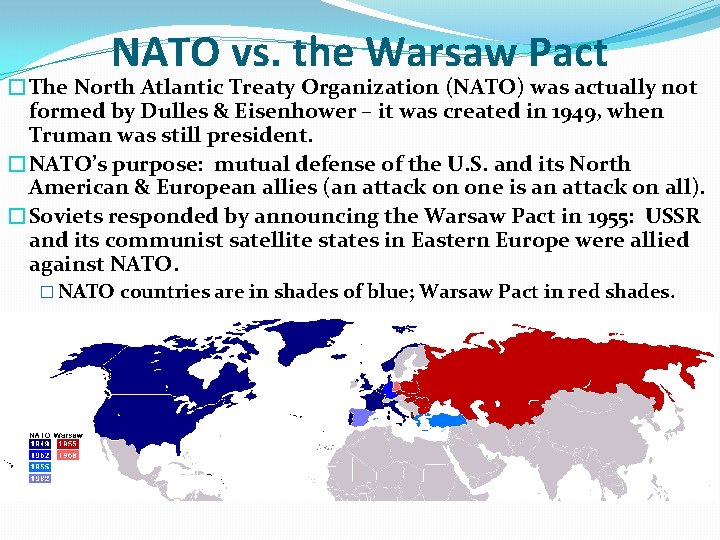
NATO vs. the Warsaw Pact �The North Atlantic Treaty Organization (NATO) was actually not formed by Dulles & Eisenhower – it was created in 1949, when Truman was still president. �NATO’s purpose: mutual defense of the U. S. and its North American & European allies (an attack on one is an attack on all). �Soviets responded by announcing the Warsaw Pact in 1955: USSR and its communist satellite states in Eastern Europe were allied against NATO. � NATO countries are in shades of blue; Warsaw Pact in red shades.
SEATO and METO �In the 1950 s, Dulles got anti-communist governments in Asia and the Pacific to join the U. S. to form SEATO (Southeast Asia Treaty Organization). �The U. S. also promoted (but didn’t join) METO (Middle East Treaty Organization). �Purpose of both groups was to resist Soviet/communist aggression in those parts of the world.
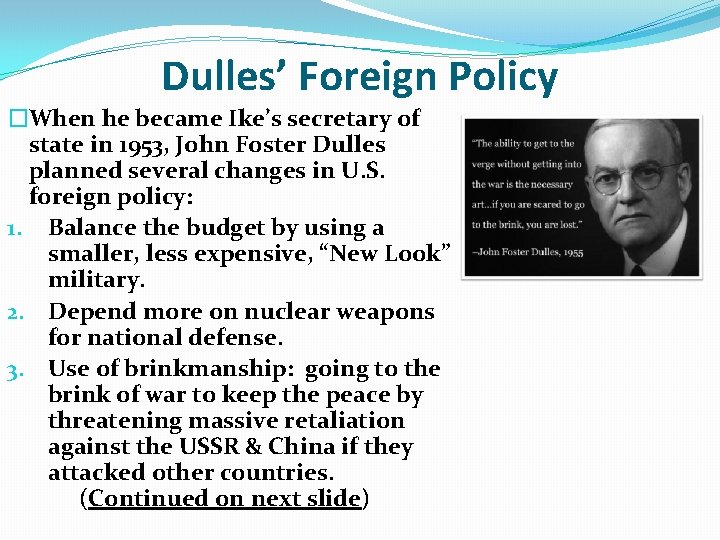
Dulles’ Foreign Policy �When he became Ike’s secretary of state in 1953, John Foster Dulles planned several changes in U. S. foreign policy: 1. Balance the budget by using a smaller, less expensive, “New Look” military. 2. Depend more on nuclear weapons for national defense. 3. Use of brinkmanship: going to the brink of war to keep the peace by threatening massive retaliation against the USSR & China if they attacked other countries. (Continued on next slide)
Dulles’ Foreign Policy, continued 4. Instead of just containing the spread of communism (as Truman had done), the U. S. would now “roll back the tide” of communism by going in to free “captive peoples” in communist countries. This was never really put into effect. 5. After 1954, Dulles and Ike dropped their idea of rolling back communism and settled for more containment by surrounding communist nations via treaty organizations: NATO, SEATO, and METO. Critics called this “pactomania. ”
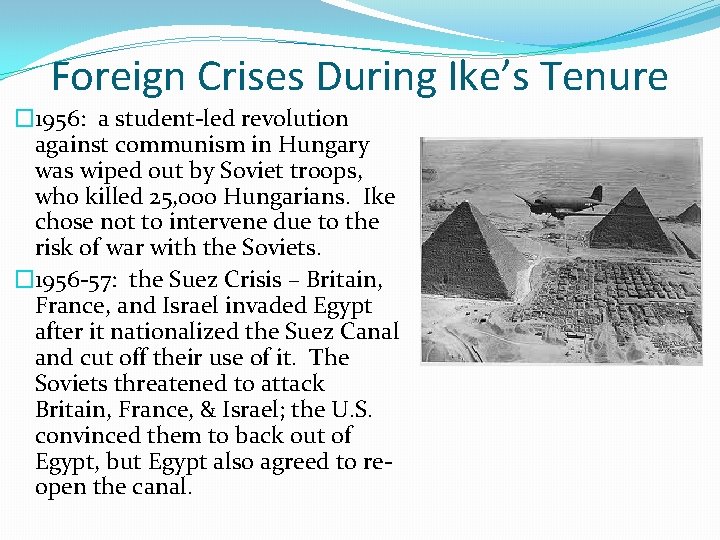
Foreign Crises During Ike’s Tenure � 1956: a student-led revolution against communism in Hungary was wiped out by Soviet troops, who killed 25, 000 Hungarians. Ike chose not to intervene due to the risk of war with the Soviets. � 1956 -57: the Suez Crisis – Britain, France, and Israel invaded Egypt after it nationalized the Suez Canal and cut off their use of it. The Soviets threatened to attack Britain, France, & Israel; the U. S. convinced them to back out of Egypt, but Egypt also agreed to reopen the canal.
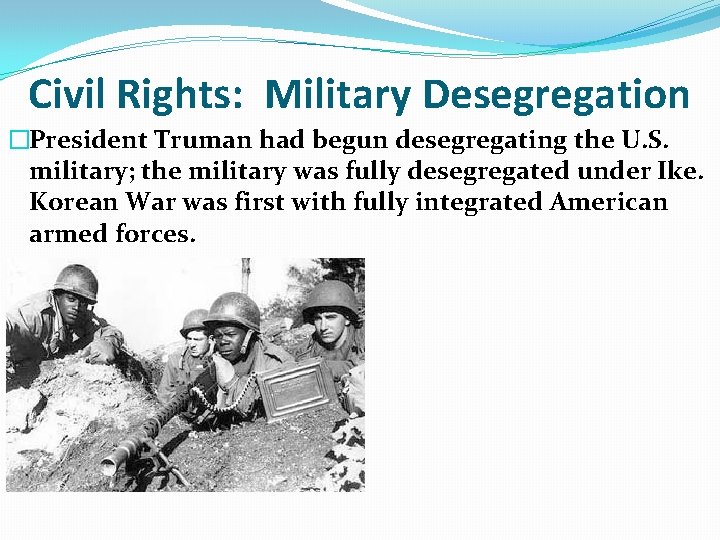
Civil Rights: Military Desegregation �President Truman had begun desegregating the U. S. military; the military was fully desegregated under Ike. Korean War was first with fully integrated American armed forces.
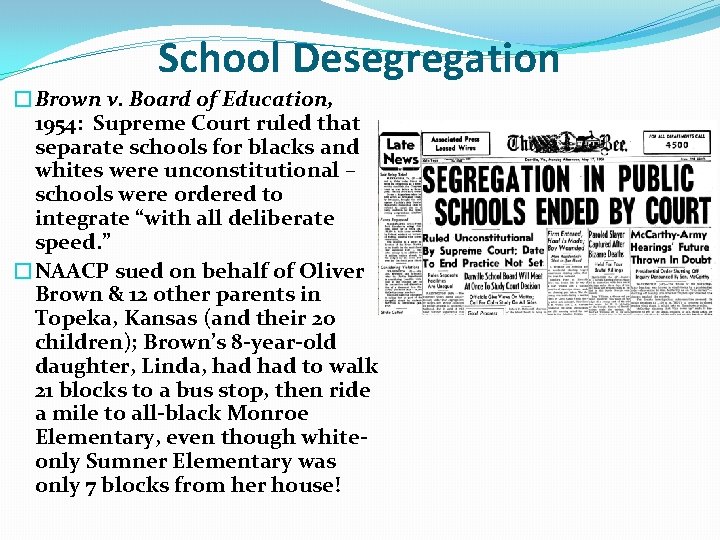
School Desegregation �Brown v. Board of Education, 1954: Supreme Court ruled that separate schools for blacks and whites were unconstitutional – schools were ordered to integrate “with all deliberate speed. ” �NAACP sued on behalf of Oliver Brown & 12 other parents in Topeka, Kansas (and their 20 children); Brown’s 8 -year-old daughter, Linda, had to walk 21 blocks to a bus stop, then ride a mile to all-black Monroe Elementary, even though whiteonly Sumner Elementary was only 7 blocks from her house!
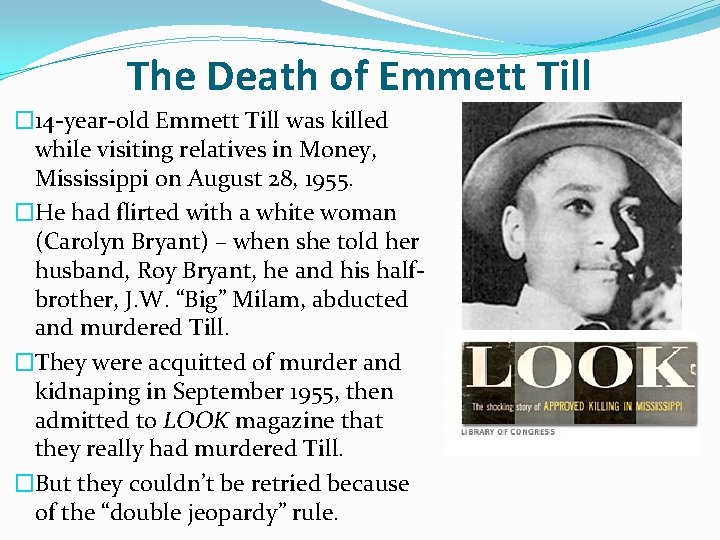
The Death of Emmett Till � 14 -year-old Emmett Till was killed while visiting relatives in Money, Mississippi on August 28, 1955. �He had flirted with a white woman (Carolyn Bryant) – when she told her husband, Roy Bryant, he and his halfbrother, J. W. “Big” Milam, abducted and murdered Till. �They were acquitted of murder and kidnaping in September 1955, then admitted to LOOK magazine that they really had murdered Till. �But they couldn’t be retried because of the “double jeopardy” rule.
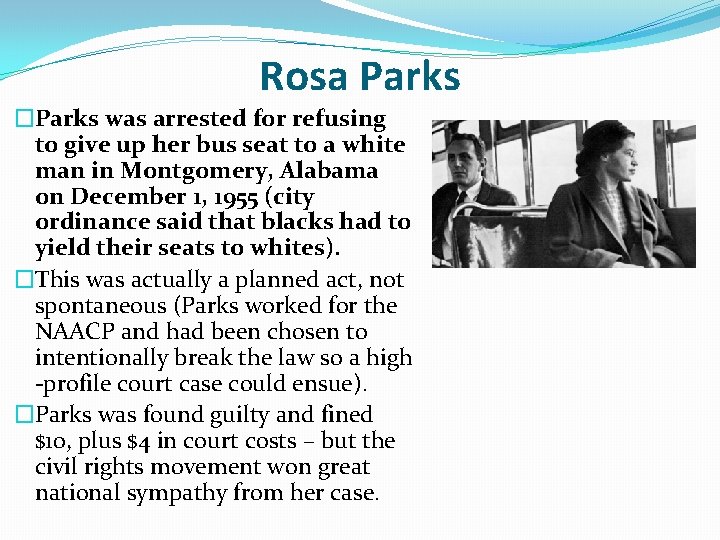
Rosa Parks �Parks was arrested for refusing to give up her bus seat to a white man in Montgomery, Alabama on December 1, 1955 (city ordinance said that blacks had to yield their seats to whites). �This was actually a planned act, not spontaneous (Parks worked for the NAACP and had been chosen to intentionally break the law so a high -profile court case could ensue). �Parks was found guilty and fined $10, plus $4 in court costs – but the civil rights movement won great national sympathy from her case.
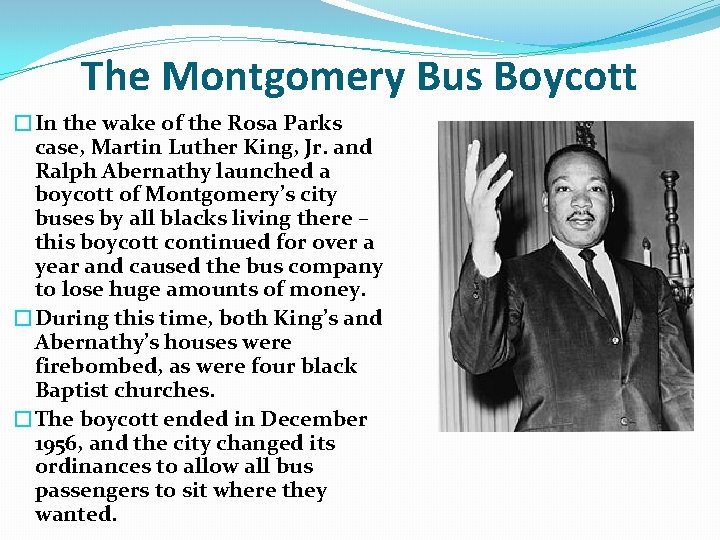
The Montgomery Bus Boycott �In the wake of the Rosa Parks case, Martin Luther King, Jr. and Ralph Abernathy launched a boycott of Montgomery’s city buses by all blacks living there – this boycott continued for over a year and caused the bus company to lose huge amounts of money. �During this time, both King’s and Abernathy’s houses were firebombed, as were four black Baptist churches. �The boycott ended in December 1956, and the city changed its ordinances to allow all bus passengers to sit where they wanted.
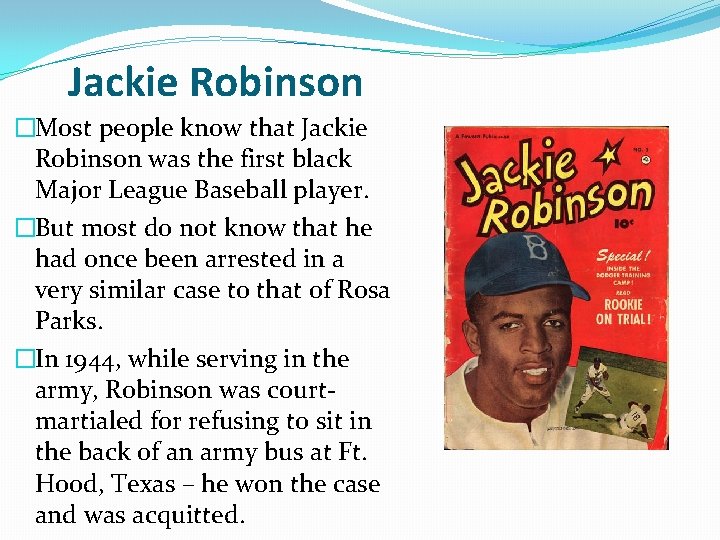
Jackie Robinson �Most people know that Jackie Robinson was the first black Major League Baseball player. �But most do not know that he had once been arrested in a very similar case to that of Rosa Parks. �In 1944, while serving in the army, Robinson was courtmartialed for refusing to sit in the back of an army bus at Ft. Hood, Texas – he won the case and was acquitted.
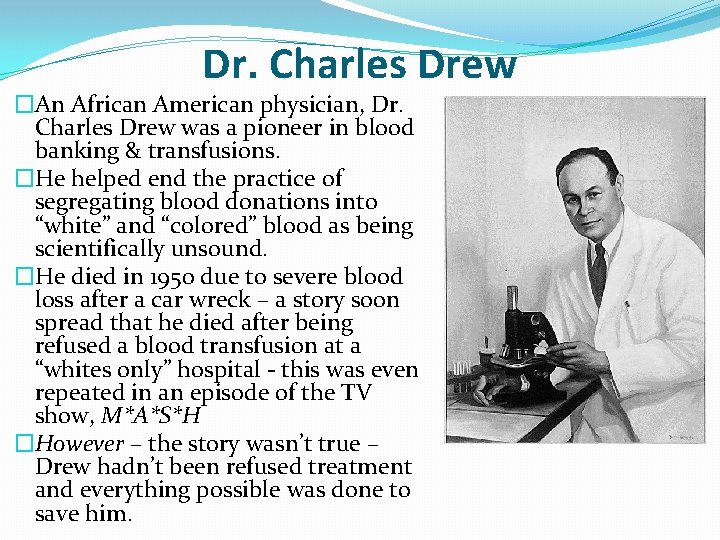
Dr. Charles Drew �An African American physician, Dr. Charles Drew was a pioneer in blood banking & transfusions. �He helped end the practice of segregating blood donations into “white” and “colored” blood as being scientifically unsound. �He died in 1950 due to severe blood loss after a car wreck – a story soon spread that he died after being refused a blood transfusion at a “whites only” hospital - this was even repeated in an episode of the TV show, M*A*S*H �However – the story wasn’t true – Drew hadn’t been refused treatment and everything possible was done to save him.
The Southern Manifesto �In reaction to the Brown v. Board of Education ruling, Southerners in Congress signed a statement called “the Southern Manifesto, ” pledging to fight integration and keep segregation. �Total of 99 southern senators & representatives (97 Democrats, 2 Republicans) signed the Southern Manifesto in 1956.
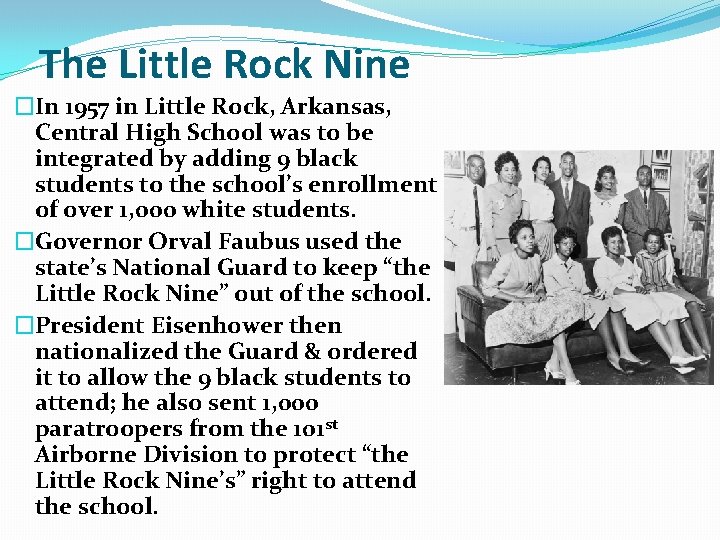
The Little Rock Nine �In 1957 in Little Rock, Arkansas, Central High School was to be integrated by adding 9 black students to the school’s enrollment of over 1, 000 white students. �Governor Orval Faubus used the state’s National Guard to keep “the Little Rock Nine” out of the school. �President Eisenhower then nationalized the Guard & ordered it to allow the 9 black students to attend; he also sent 1, 000 paratroopers from the 101 st Airborne Division to protect “the Little Rock Nine’s” right to attend the school.
More of the Little Rock Story �The nine black students were not welcomed by most white students and had to be protected all day, every day. �Even so, violence sometimes occurred – student Melba Patillo had acid thrown in her eyes by a white student. �The next year (1958 -59), Governor Faubus closed all three of Little Rock’s public high schools, rather than allow integration – the schools reopened (integrated now) in 1959 -60.
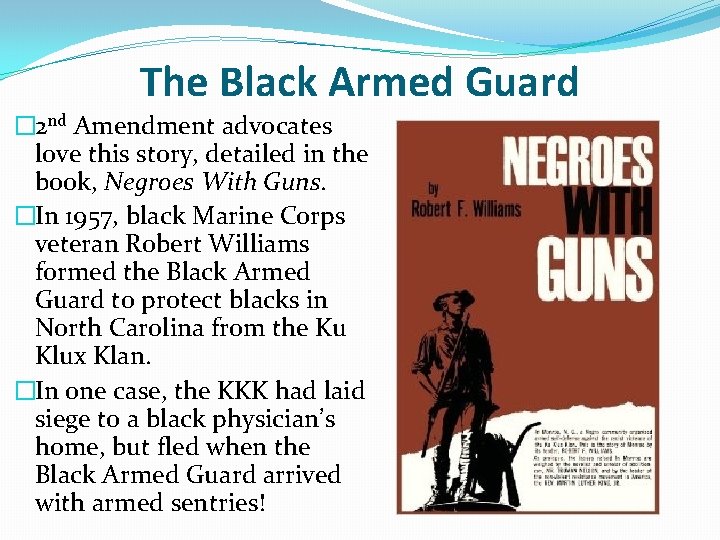
The Black Armed Guard � 2 nd Amendment advocates love this story, detailed in the book, Negroes With Guns. �In 1957, black Marine Corps veteran Robert Williams formed the Black Armed Guard to protect blacks in North Carolina from the Ku Klux Klan. �In one case, the KKK had laid siege to a black physician’s home, but fled when the Black Armed Guard arrived with armed sentries!
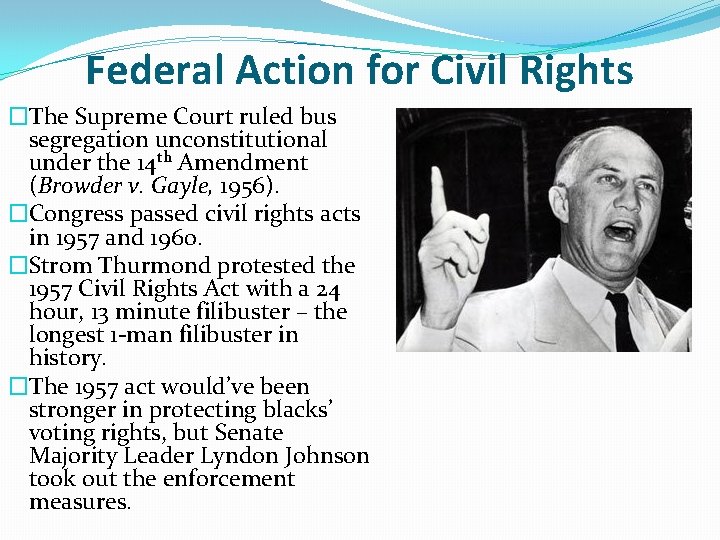
Federal Action for Civil Rights �The Supreme Court ruled bus segregation unconstitutional under the 14 th Amendment (Browder v. Gayle, 1956). �Congress passed civil rights acts in 1957 and 1960. �Strom Thurmond protested the 1957 Civil Rights Act with a 24 hour, 13 minute filibuster – the longest 1 -man filibuster in history. �The 1957 act would’ve been stronger in protecting blacks’ voting rights, but Senate Majority Leader Lyndon Johnson took out the enforcement measures.
Montana Senators’ Strange Vote �In the Senate, all 43 Republicans and a majority of Democrats voted for the 1957 civil rights bill (which mostly protected voting rights for blacks). �Most Democrats who voted against the bill were from the South – but Montana’s senators (Mike Mansfield & Jim Murray) also voted against it. Why? �Mainly, so that southern Democrat senators would return the favor by voting for federal funding to help pay for a dam back in Montana.
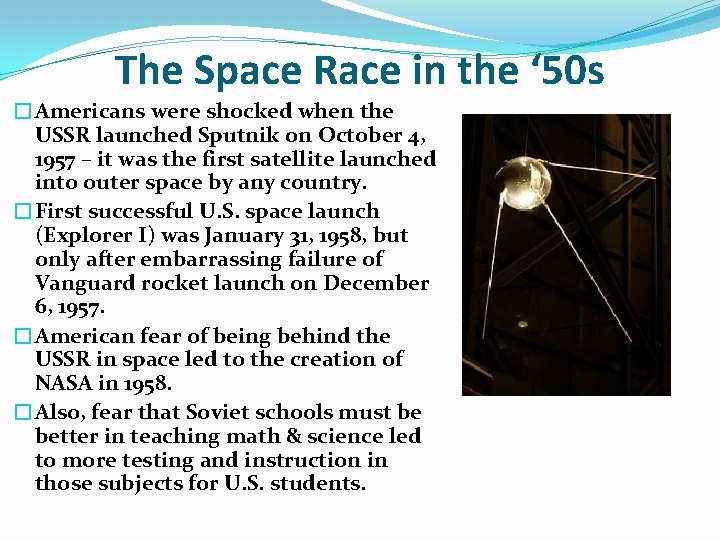
The Space Race in the ‘ 50 s �Americans were shocked when the USSR launched Sputnik on October 4, 1957 – it was the first satellite launched into outer space by any country. �First successful U. S. space launch (Explorer I) was January 31, 1958, but only after embarrassing failure of Vanguard rocket launch on December 6, 1957. �American fear of being behind the USSR in space led to the creation of NASA in 1958. �Also, fear that Soviet schools must be better in teaching math & science led to more testing and instruction in those subjects for U. S. students.
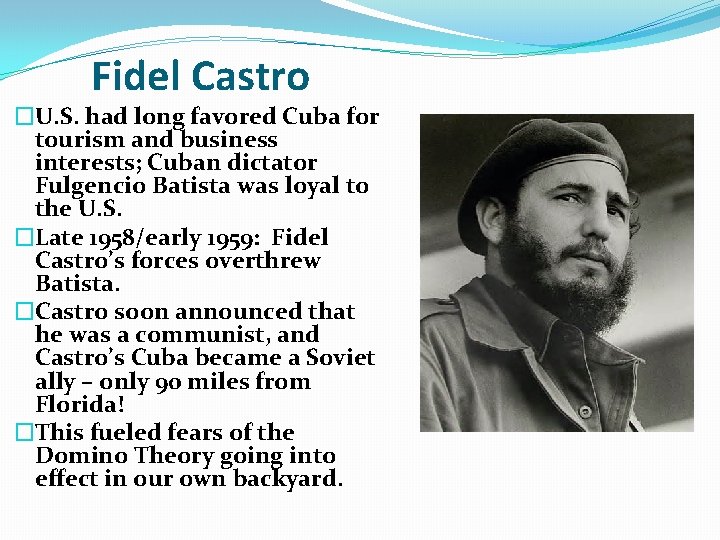
Fidel Castro �U. S. had long favored Cuba for tourism and business interests; Cuban dictator Fulgencio Batista was loyal to the U. S. �Late 1958/early 1959: Fidel Castro’s forces overthrew Batista. �Castro soon announced that he was a communist, and Castro’s Cuba became a Soviet ally – only 90 miles from Florida! �This fueled fears of the Domino Theory going into effect in our own backyard.
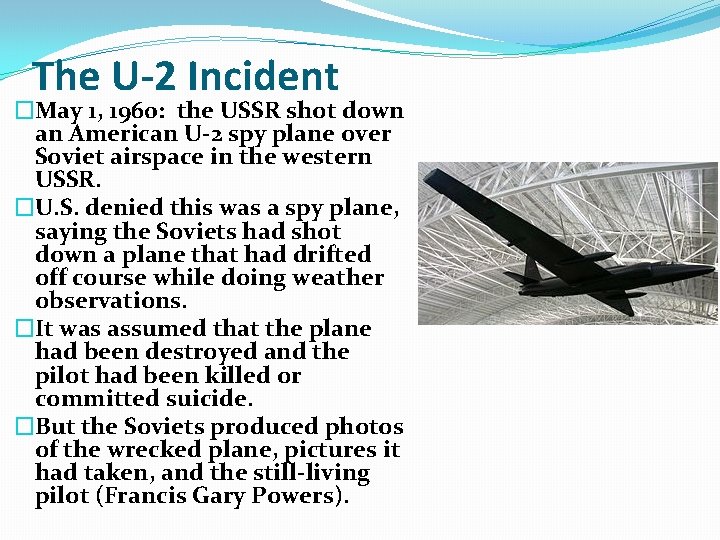
The U-2 Incident �May 1, 1960: the USSR shot down an American U-2 spy plane over Soviet airspace in the western USSR. �U. S. denied this was a spy plane, saying the Soviets had shot down a plane that had drifted off course while doing weather observations. �It was assumed that the plane had been destroyed and the pilot had been killed or committed suicide. �But the Soviets produced photos of the wrecked plane, pictures it had taken, and the still-living pilot (Francis Gary Powers).
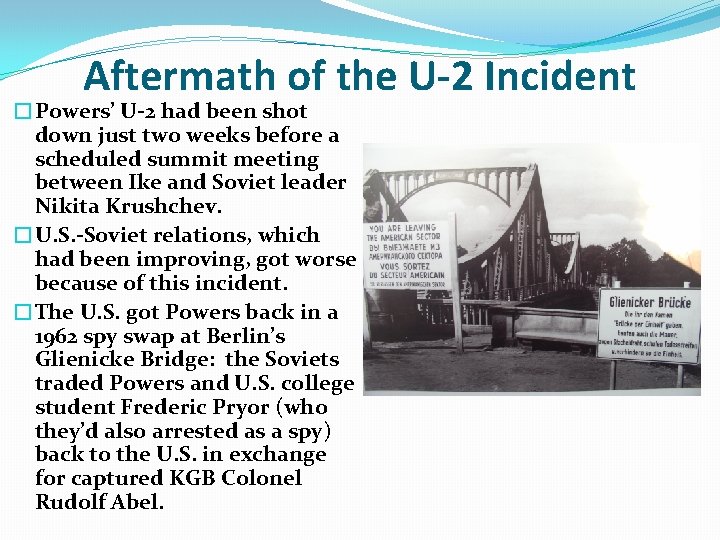
Aftermath of the U-2 Incident �Powers’ U-2 had been shot down just two weeks before a scheduled summit meeting between Ike and Soviet leader Nikita Krushchev. �U. S. -Soviet relations, which had been improving, got worse because of this incident. �The U. S. got Powers back in a 1962 spy swap at Berlin’s Glienicke Bridge: the Soviets traded Powers and U. S. college student Frederic Pryor (who they’d also arrested as a spy) back to the U. S. in exchange for captured KGB Colonel Rudolf Abel.
Ike’s Warning �Before he left office in 1961, Ike warned Americans of the growing power of the “military-industrial complex. ” �He said that weapons manufacturers had too close of a relationship with the U. S. government, leading the industrial weaponmakers to have influence over government decisions involving use of the military.
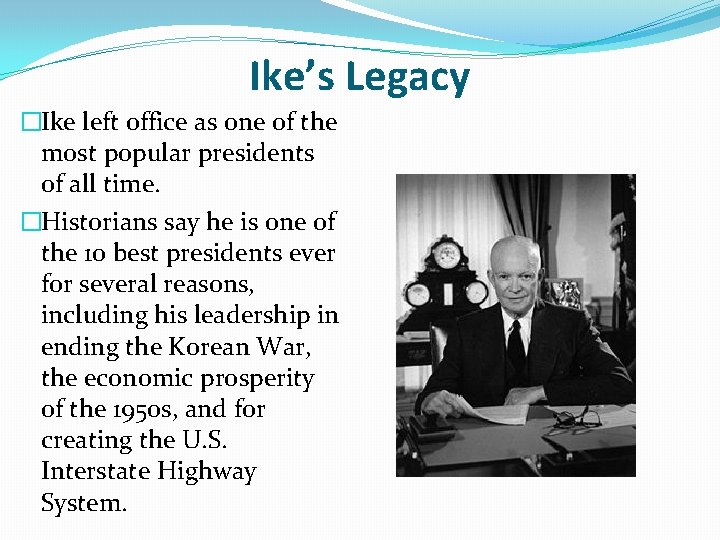
Ike’s Legacy �Ike left office as one of the most popular presidents of all time. �Historians say he is one of the 10 best presidents ever for several reasons, including his leadership in ending the Korean War, the economic prosperity of the 1950 s, and for creating the U. S. Interstate Highway System.