
Truman and the Cold War Chapter 26 1945

- Slides: 19
Truman and the Cold War Chapter 26 1945 -1952
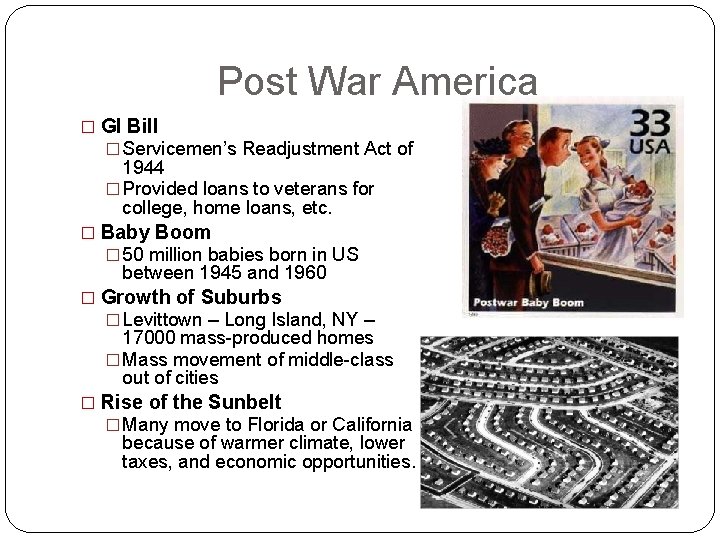
Post War America � GI Bill � Servicemen’s Readjustment Act of 1944 � Provided loans to veterans for college, home loans, etc. � Baby Boom � 50 million babies born in US between 1945 and 1960 � Growth of Suburbs � Levittown – Long Island, NY – 17000 mass-produced homes � Mass movement of middle-class out of cities � Rise of the Sunbelt � Many move to Florida or California because of warmer climate, lower taxes, and economic opportunities.
Republican Congress � 22 nd Amendment (1951) �Limits a president to a maximum of two full terms in office �Taft-Hartley Act (1947) �Purpose was the check to growing power of labor unions �Outlawed the “closed shop” �Permitted states to pass “right to work” laws �Gave the President the power to invoke an 80 -day cooling off period before a strike
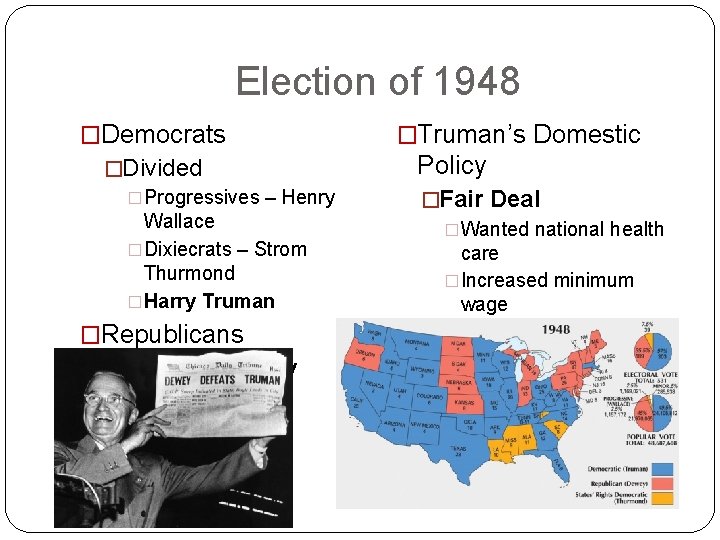
Election of 1948 �Democrats �Divided �Progressives – Henry Wallace �Dixiecrats – Strom Thurmond �Harry Truman �Republicans �Thomas Dewey �Truman’s Domestic Policy �Fair Deal �Wanted national health care �Increased minimum wage �Inclusion of more workers under Social Security
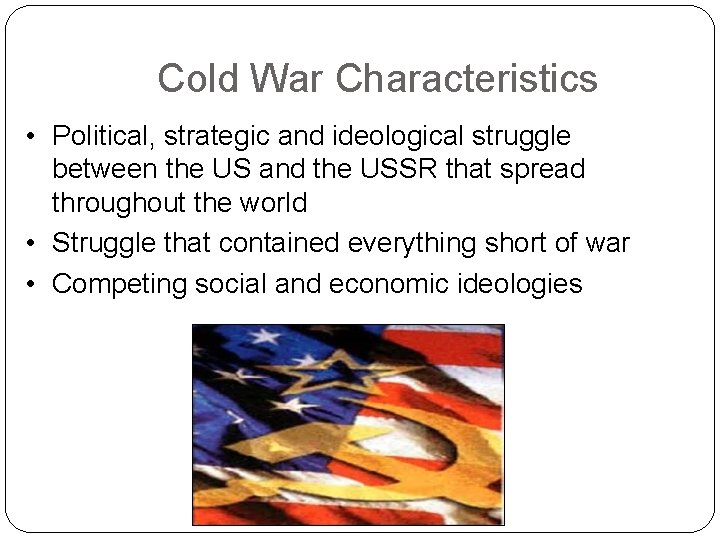
Cold War Characteristics • Political, strategic and ideological struggle between the US and the USSR that spread throughout the world • Struggle that contained everything short of war • Competing social and economic ideologies 5
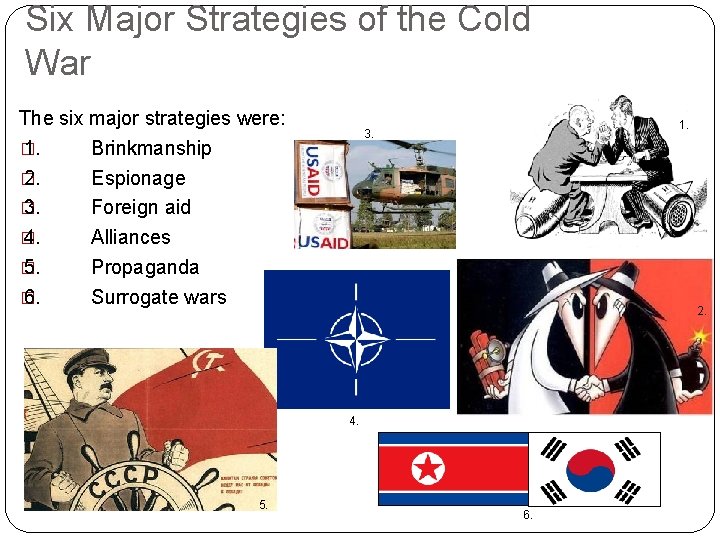
Six Major Strategies of the Cold War The six major strategies were: � 1. Brinkmanship � 2. Espionage � 3. Foreign aid � 4. Alliances � 5. Propaganda � 6. Surrogate wars 1. 3. 2. 4. 6 5. 6.
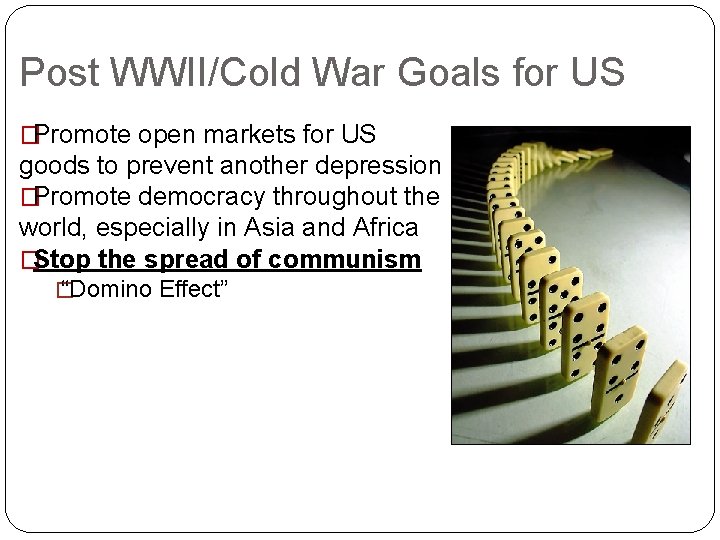
Post WWII/Cold War Goals for US �Promote open markets for US goods to prevent another depression �Promote democracy throughout the world, especially in Asia and Africa �Stop the spread of communism � “Domino Effect” 7
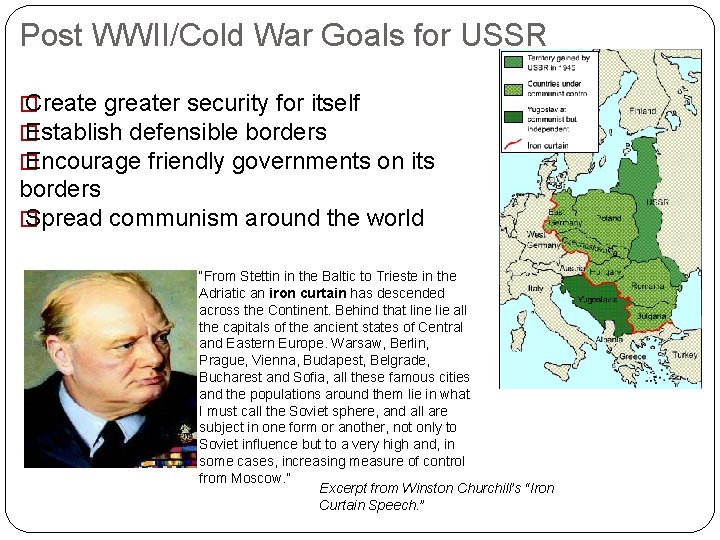
Post WWII/Cold War Goals for USSR � Create greater security for itself � Establish defensible borders � Encourage friendly governments on its borders � Spread communism around the world 8 “From Stettin in the Baltic to Trieste in the Adriatic an iron curtain has descended across the Continent. Behind that line lie all the capitals of the ancient states of Central and Eastern Europe. Warsaw, Berlin, Prague, Vienna, Budapest, Belgrade, Bucharest and Sofia, all these famous cities and the populations around them lie in what I must call the Soviet sphere, and all are subject in one form or another, not only to Soviet influence but to a very high and, in some cases, increasing measure of control from Moscow. ” Excerpt from Winston Churchill’s “Iron Curtain Speech. ”
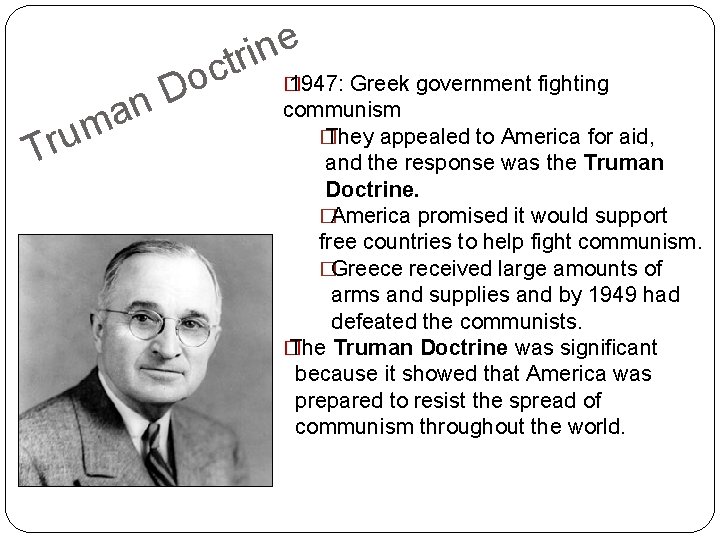
n a rum T 9 e n i r � 1947: Greek government fighting t c Do communism � They appealed to America for aid, and the response was the Truman Doctrine. �America promised it would support free countries to help fight communism. �Greece received large amounts of arms and supplies and by 1949 had defeated the communists. � The Truman Doctrine was significant because it showed that America was prepared to resist the spread of communism throughout the world.
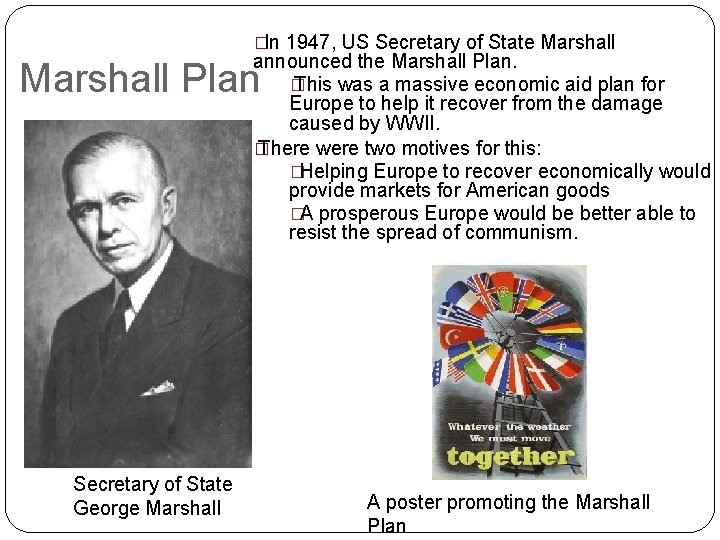
�In 1947, US Secretary of State Marshall announced the Marshall Plan. � This was a massive economic aid plan for Europe to help it recover from the damage caused by WWII. � There were two motives for this: �Helping Europe to recover economically would provide markets for American goods �A prosperous Europe would be better able to resist the spread of communism. Marshall Plan 10 Secretary of State George Marshall A poster promoting the Marshall Plan
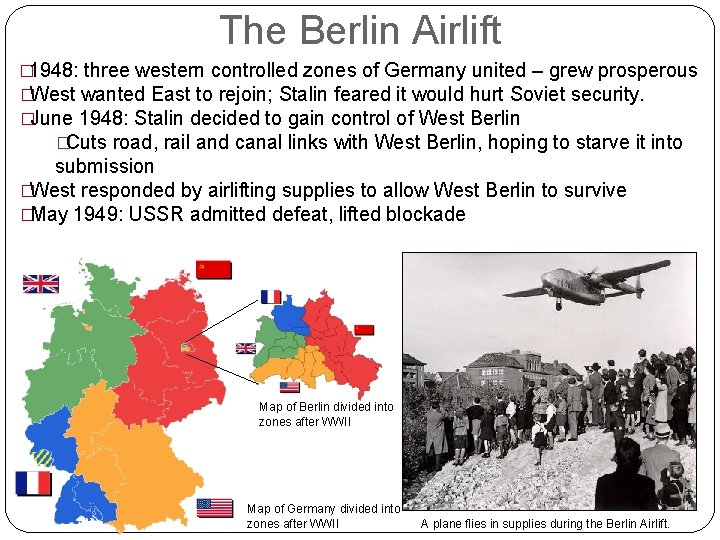
The Berlin Airlift � 1948: three western controlled zones of Germany united – grew prosperous �West wanted East to rejoin; Stalin feared it would hurt Soviet security. �June 1948: Stalin decided to gain control of West Berlin �Cuts road, rail and canal links with West Berlin, hoping to starve it into submission �West responded by airlifting supplies to allow West Berlin to survive �May 1949: USSR admitted defeat, lifted blockade Map of Berlin divided into zones after WWII 11 Map of Germany divided into zones after WWII A plane flies in supplies during the Berlin Airlift.
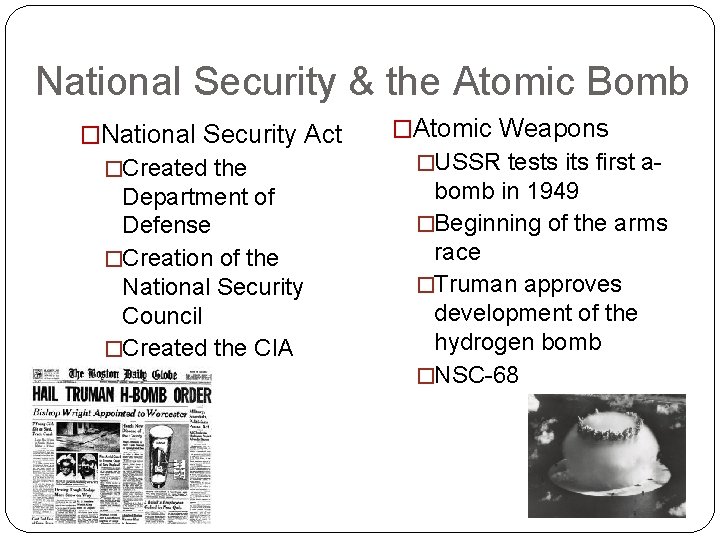
National Security & the Atomic Bomb �National Security Act �Created the Department of Defense �Creation of the National Security Council �Created the CIA �Atomic Weapons �USSR tests its first a- bomb in 1949 �Beginning of the arms race �Truman approves development of the hydrogen bomb �NSC-68
NATO: North Atlantic Treaty Organization �In 1949 the western nations formed the North NATO flag 13 Atlantic Treaty Organization to coordinate their defense against USSR. � It originally consisted of: � United States of America � Belgium � Britain � Canada � Denmark � France � Holland � Italy � Luxembourg � Norway � Portugal �Since the fall of the Soviet Union in 1991, some former Soviet republics have applied for membership to NATO.
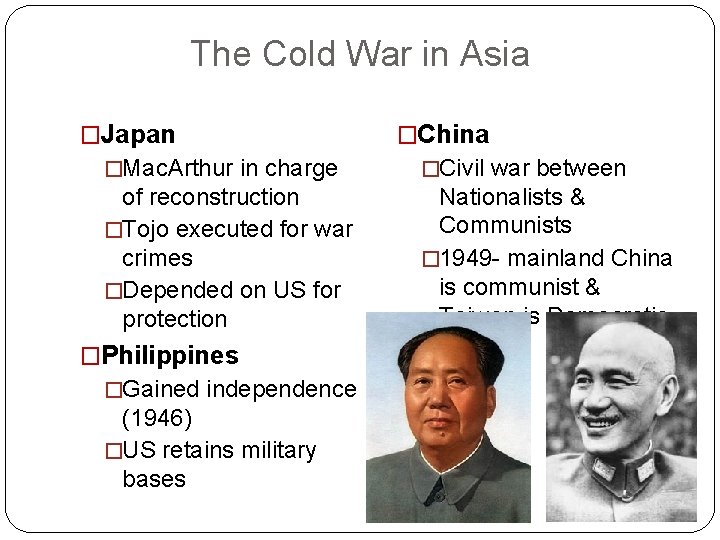
The Cold War in Asia �Japan �China �Mac. Arthur in charge �Civil war between of reconstruction �Tojo executed for war crimes �Depended on US for protection Nationalists & Communists � 1949 - mainland China is communist & Taiwan is Democratic �Philippines �Gained independence (1946) �US retains military bases
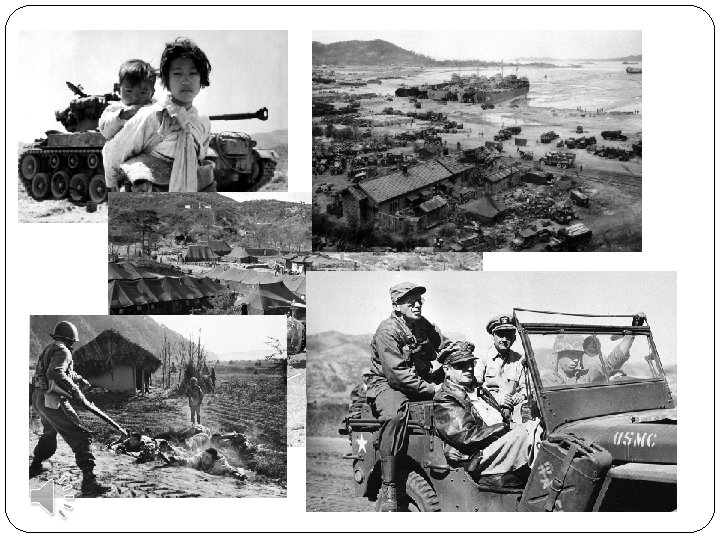
The Korean War � Korea divided at 38 th Parallel �Soviet influence in North � Kim Il Sung �US influence in South � Syngman Rhee � June 25, 1950 – N. Korea invades S. Korea � UN authorizes forces to defend S. Korea � Commanded by Mac. Arthur � Characterized as a “police action” � November 1950 – China sends aide to N. Korea, overwhelmed UN forces � Mac. Arthur wants to wage war with China– Truman forces him to resign � 1951 - war is stalemated at 38 th parallel � Armistice signed in 1953 � America loses 54, 000 soldiers
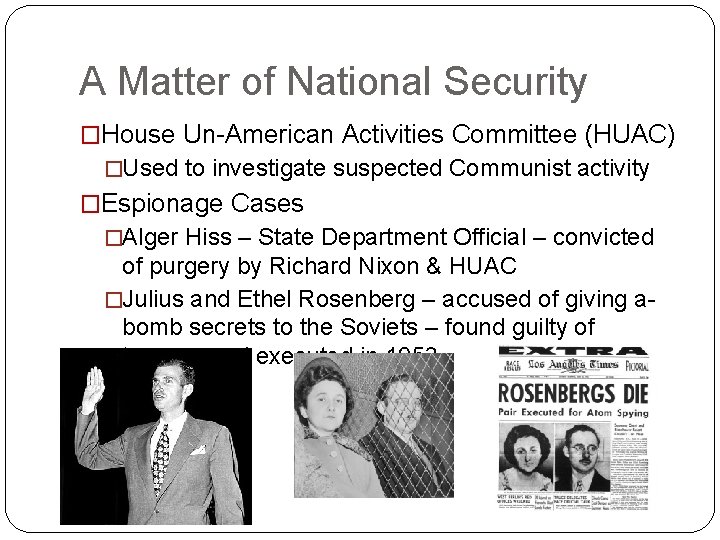
A Matter of National Security �House Un-American Activities Committee (HUAC) �Used to investigate suspected Communist activity �Espionage Cases �Alger Hiss – State Department Official – convicted of purgery by Richard Nixon & HUAC �Julius and Ethel Rosenberg – accused of giving abomb secrets to the Soviets – found guilty of treason and executed in 1953.
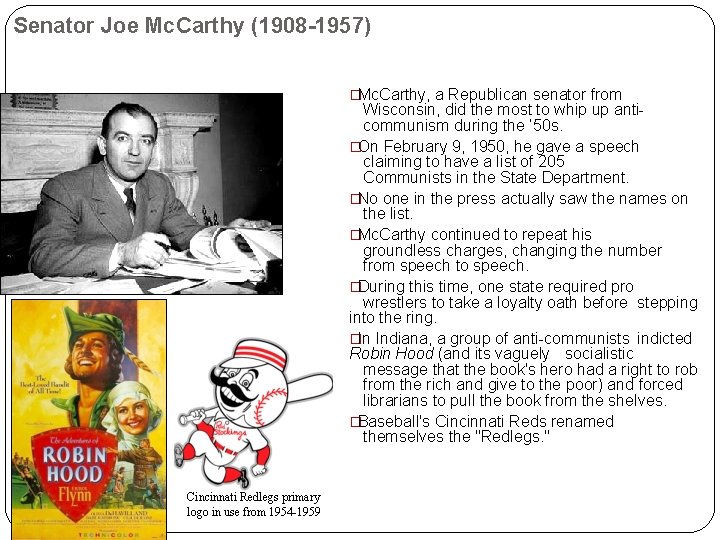
Senator Joe Mc. Carthy (1908 -1957) �Mc. Carthy, a Republican senator from Wisconsin, did the most to whip up anticommunism during the ‘ 50 s. �On February 9, 1950, he gave a speech claiming to have a list of 205 Communists in the State Department. �No one in the press actually saw the names on the list. �Mc. Carthy continued to repeat his groundless charges, changing the number from speech to speech. �During this time, one state required pro wrestlers to take a loyalty oath before stepping into the ring. �In Indiana, a group of anti-communists indicted Robin Hood (and its vaguely socialistic message that the book's hero had a right to rob from the rich and give to the poor) and forced librarians to pull the book from the shelves. �Baseball's Cincinnati Reds renamed themselves the "Redlegs. " 18 Cincinnati Redlegs primary logo in use from 1954 -1959
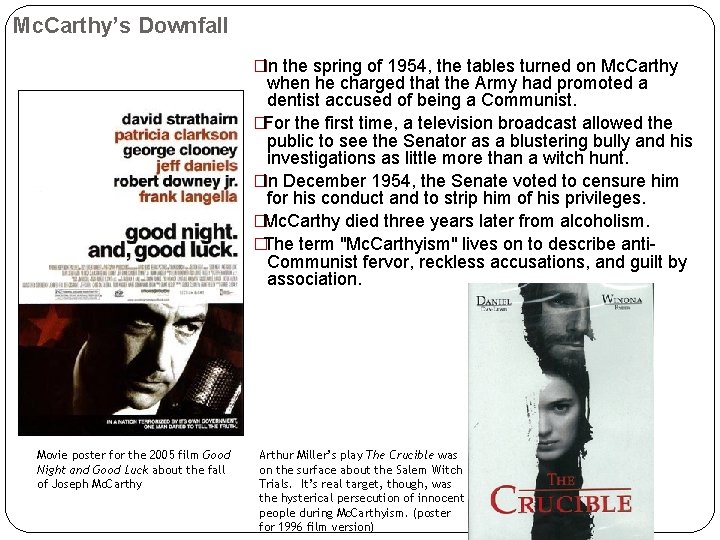
Mc. Carthy’s Downfall �In the spring of 1954, the tables turned on Mc. Carthy when he charged that the Army had promoted a dentist accused of being a Communist. �For the first time, a television broadcast allowed the public to see the Senator as a blustering bully and his investigations as little more than a witch hunt. �In December 1954, the Senate voted to censure him for his conduct and to strip him of his privileges. �Mc. Carthy died three years later from alcoholism. �The term "Mc. Carthyism" lives on to describe anti. Communist fervor, reckless accusations, and guilt by association. Movie poster for the 2005 film Good Night and Good Luck about the fall of Joseph Mc. Carthy Arthur Miller’s play The Crucible was on the surface about the Salem Witch Trials. It’s real target, though, was the hysterical persecution of innocent people during Mc. Carthyism. (poster for 1996 film version)