
Unit 14 The Cold War Vocabulary superpower a
Unit 14: The Cold War

Vocabulary • superpower – a nation stronger than other powerful nations • containment – the U. S. strategy of keeping communism within its existing borders • suburbanization – the movement to built-up areas outside of central cities • demilitarized zone – dividing line between North and South Korea • guerrilla – a soldier in a loosely organized force making surprise raids • glasnost – Soviet policy of greater freedom of expression • perestroika – Soviet policy of democratic and free-market reforms

The Cold War • After World War II, the United States and the Soviet Union emerged as the world’s leading superpowers. • Conflicting ideologies and mutual trust between the two nations soon led to the conflict known as the Cold War. • The Cold War was a period of tension and hostility between the U. S. and U. S. S. R. that did not involve armed conflict.

Communism in Eastern Europe • As the Red Army had pushed German forces out of Eastern Europe, it had left behind occupying forces. • Stalin hoped to spread communism there, and he also wanted to create a buffer between Germany and the Soviet Union. • By 1948, pro-Soviet communist governments were in place throughout Eastern Europe.

The Truman Doctrine • In 1947, Truman promised to aid nations (like Greece and Turkey) that were struggling against communism. • This became known as the Truman Doctrine. • The Truman Doctrine set the U. S. on a course of containment, in an effort to limit communism to the areas where it already existed.
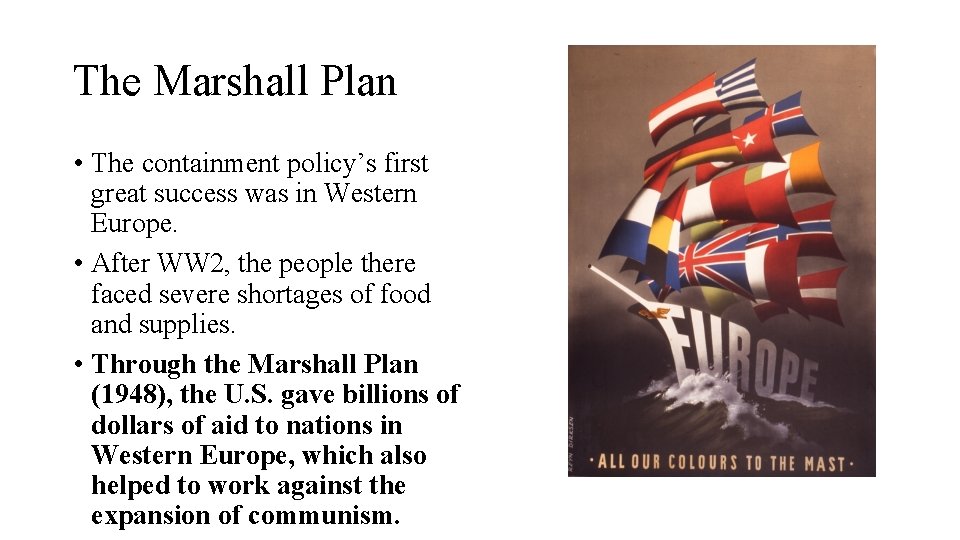
The Marshall Plan • The containment policy’s first great success was in Western Europe. • After WW 2, the people there faced severe shortages of food and supplies. • Through the Marshall Plan (1948), the U. S. gave billions of dollars of aid to nations in Western Europe, which also helped to work against the expansion of communism.

East and West Germany • Following WW 2, Germany was split into two separate countries: democratic West Germany and communist East Germany. • Berlin, a city tucked deep inside East Germany, was also split. • West Berlin belonged to West Germany, while East Berlin belonged to East Germany.
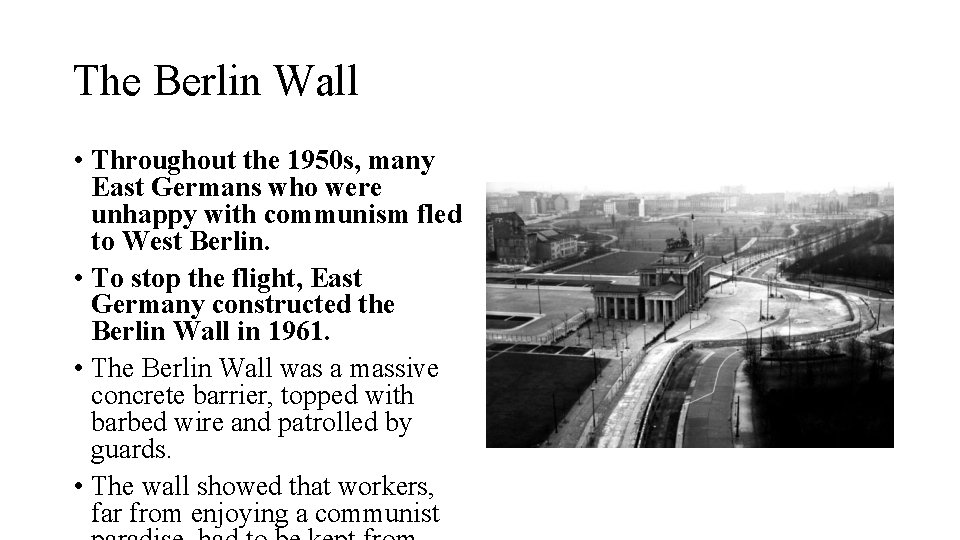
The Berlin Wall • Throughout the 1950 s, many East Germans who were unhappy with communism fled to West Berlin. • To stop the flight, East Germany constructed the Berlin Wall in 1961. • The Berlin Wall was a massive concrete barrier, topped with barbed wire and patrolled by guards. • The wall showed that workers, far from enjoying a communist

The Iron Curtain • In 1949, the U. S. , Canada, and the nations of Western Europe formed a military alliance known as the North Atlantic Treaty Organization (NATO). • In response, the Soviet Union and its satellite states formed a rival alliance, called the Warsaw Pact. • The line between the democratic West and communist East became known as the Iron Curtain.

The Hungarian Revolution and Prague Spring • Two notable challenges to Soviet authority occurred in Hungary and Czechoslovakia. • In 1956, an anti-Soviet revolt broke out in Hungary. • In 1968, democratic reforms were introduced in Czechoslovakia. • In both instances, the USSR sent in troops to crush all opposition and enforce Soviet domination.
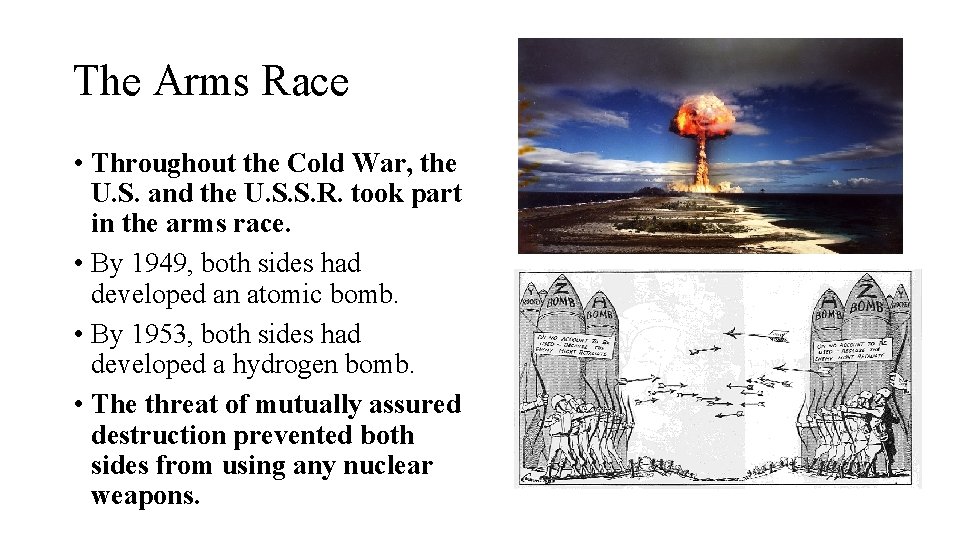
The Arms Race • Throughout the Cold War, the U. S. and the U. S. S. R. took part in the arms race. • By 1949, both sides had developed an atomic bomb. • By 1953, both sides had developed a hydrogen bomb. • The threat of mutually assured destruction prevented both sides from using any nuclear weapons.

Cuban Revolution • In the Western Hemisphere, the most serious Cold War conflict involved the island nation of Cuba. • In 1959, Fidel Castro came to power in Cuba and allied with the USSR. • Castro also severely restricted Cubans’ freedoms, and critics were jailed or silenced. • As a result, hundreds of thousands of Cubans fled to

Bay of Pigs Invasion • Hoping to topple Castro’s communist regime, a CIAtrained force of Cuban exiles led an invasion of Cuba in 1961. • The Bay of Pigs Invasion quickly ended in failure when Castro’s forces captured the invaders. • In response, the United States imposed a trade embargo on Cuba that remains in effect to this day.
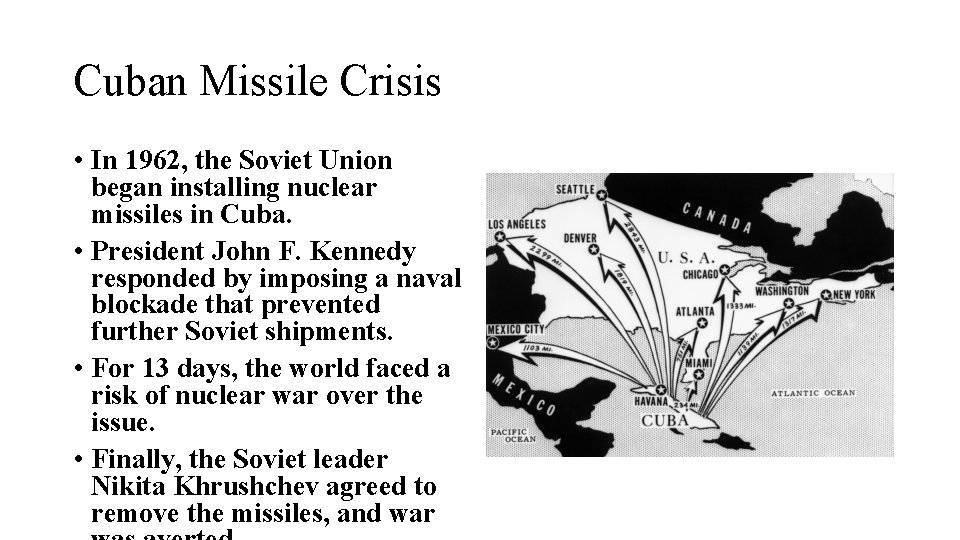
Cuban Missile Crisis • In 1962, the Soviet Union began installing nuclear missiles in Cuba. • President John F. Kennedy responded by imposing a naval blockade that prevented further Soviet shipments. • For 13 days, the world faced a risk of nuclear war over the issue. • Finally, the Soviet leader Nikita Khrushchev agreed to remove the missiles, and war
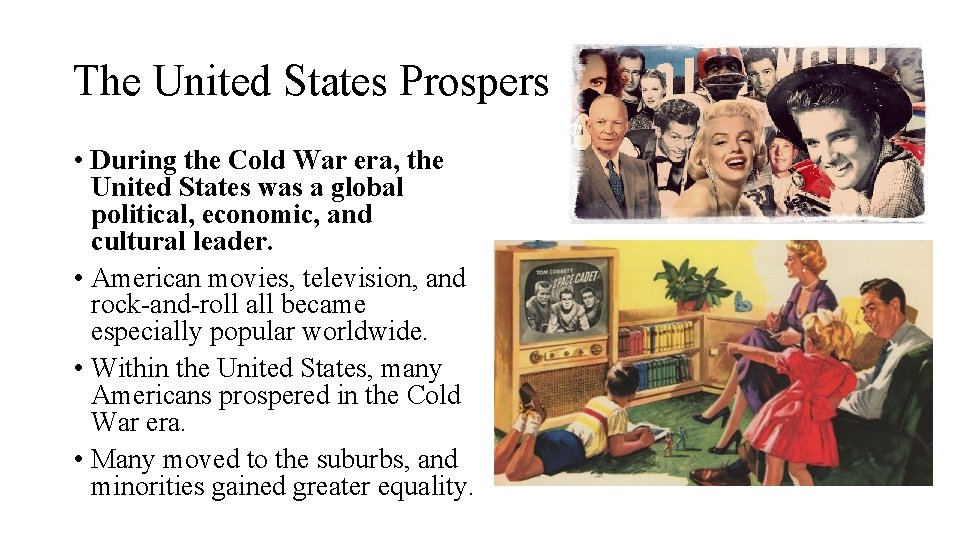
The United States Prospers • During the Cold War era, the United States was a global political, economic, and cultural leader. • American movies, television, and rock-and-roll all became especially popular worldwide. • Within the United States, many Americans prospered in the Cold War era. • Many moved to the suburbs, and minorities gained greater equality.

European Economic Community • In Western Europe, recovery from the devastation of WW 2 was aided by the Marshall Plan. • In 1957, six European nations formed the European Economic Community. • The EEC established free trade among member nations. • In time, more nations joined.
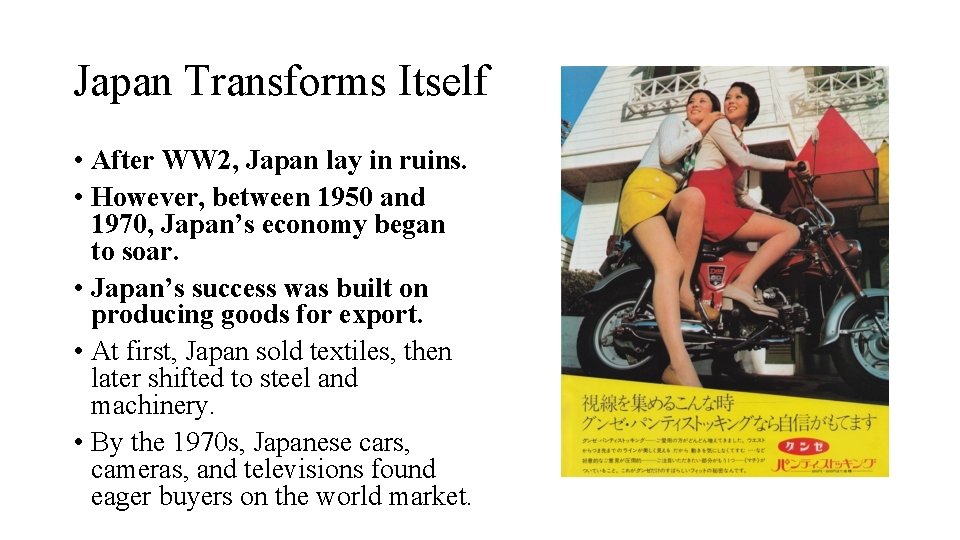
Japan Transforms Itself • After WW 2, Japan lay in ruins. • However, between 1950 and 1970, Japan’s economy began to soar. • Japan’s success was built on producing goods for export. • At first, Japan sold textiles, then later shifted to steel and machinery. • By the 1970 s, Japanese cars, cameras, and televisions found eager buyers on the world market.
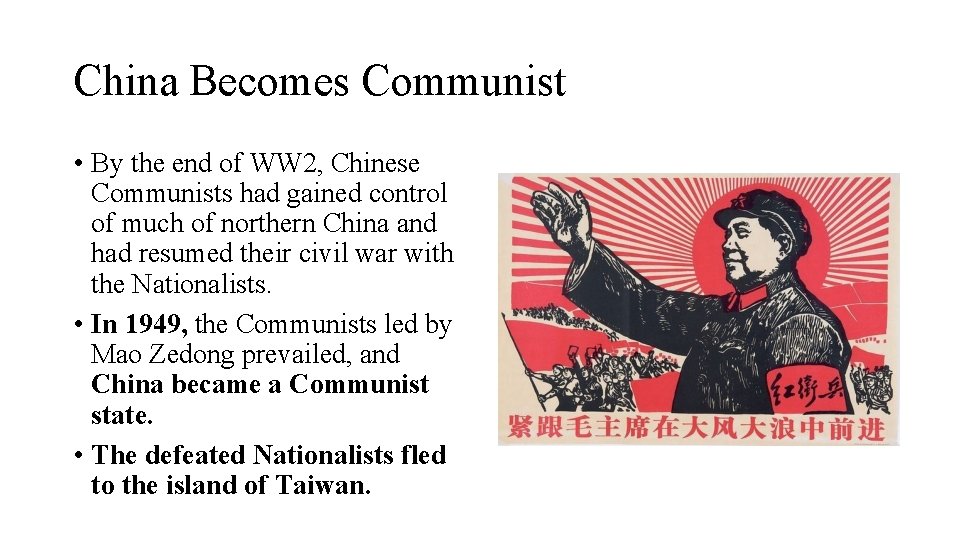
China Becomes Communist • By the end of WW 2, Chinese Communists had gained control of much of northern China and had resumed their civil war with the Nationalists. • In 1949, the Communists led by Mao Zedong prevailed, and China became a Communist state. • The defeated Nationalists fled to the island of Taiwan.
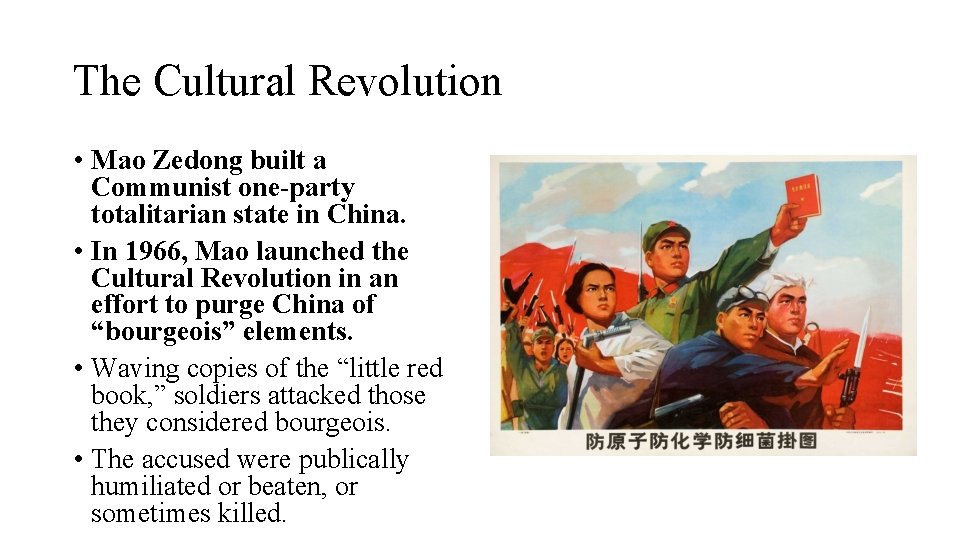
The Cultural Revolution • Mao Zedong built a Communist one-party totalitarian state in China. • In 1966, Mao launched the Cultural Revolution in an effort to purge China of “bourgeois” elements. • Waving copies of the “little red book, ” soldiers attacked those they considered bourgeois. • The accused were publically humiliated or beaten, or sometimes killed.
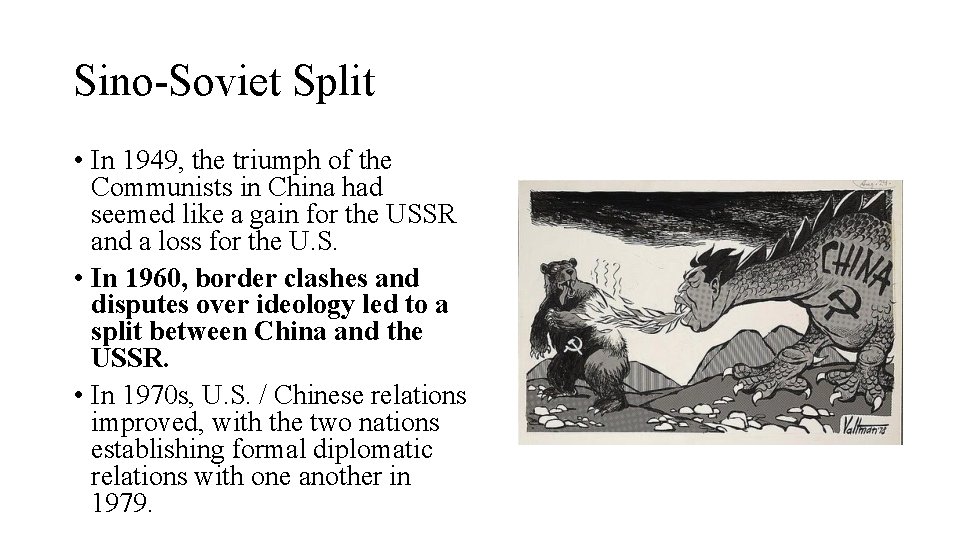
Sino-Soviet Split • In 1949, the triumph of the Communists in China had seemed like a gain for the USSR and a loss for the U. S. • In 1960, border clashes and disputes over ideology led to a split between China and the USSR. • In 1970 s, U. S. / Chinese relations improved, with the two nations establishing formal diplomatic relations with one another in 1979.
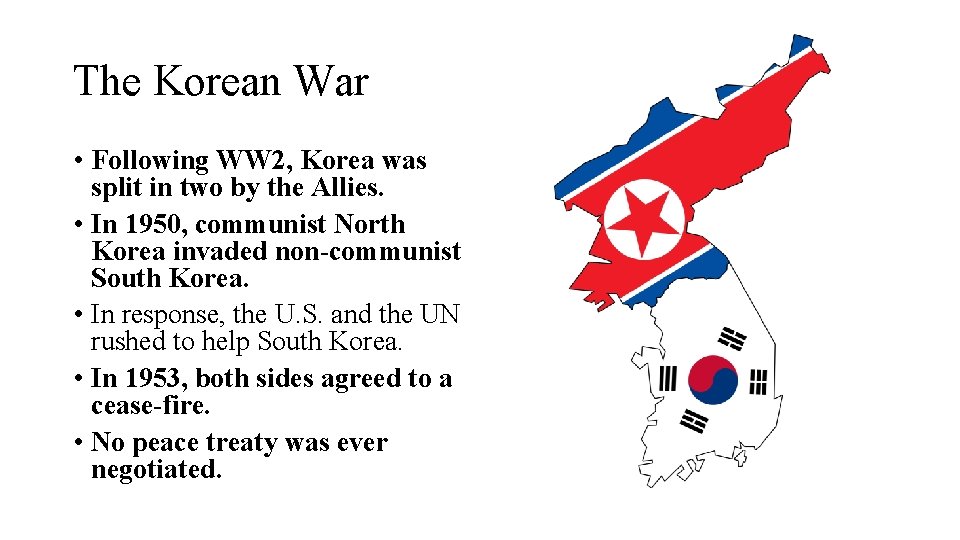
The Korean War • Following WW 2, Korea was split in two by the Allies. • In 1950, communist North Korea invaded non-communist South Korea. • In response, the U. S. and the UN rushed to help South Korea. • In 1953, both sides agreed to a cease-fire. • No peace treaty was ever negotiated.
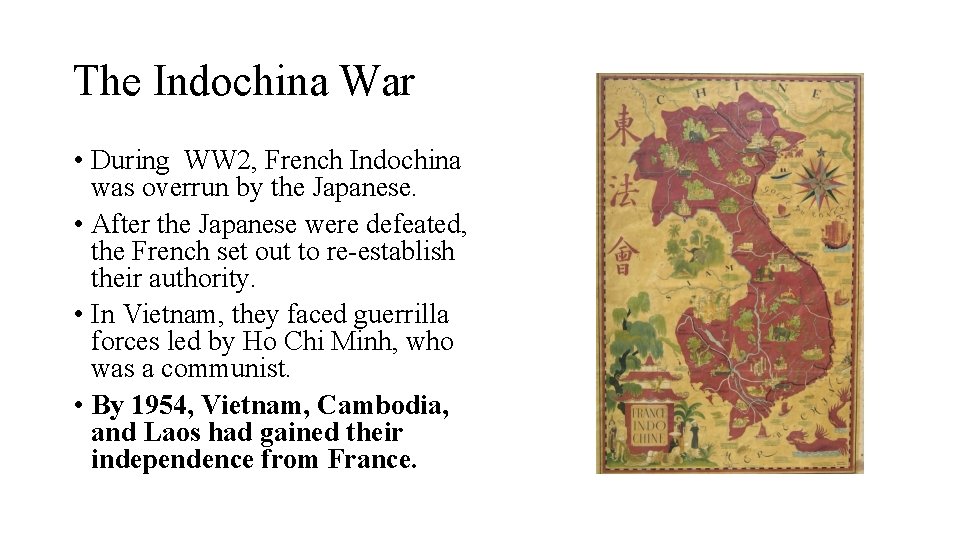
The Indochina War • During WW 2, French Indochina was overrun by the Japanese. • After the Japanese were defeated, the French set out to re-establish their authority. • In Vietnam, they faced guerrilla forces led by Ho Chi Minh, who was a communist. • By 1954, Vietnam, Cambodia, and Laos had gained their independence from France.
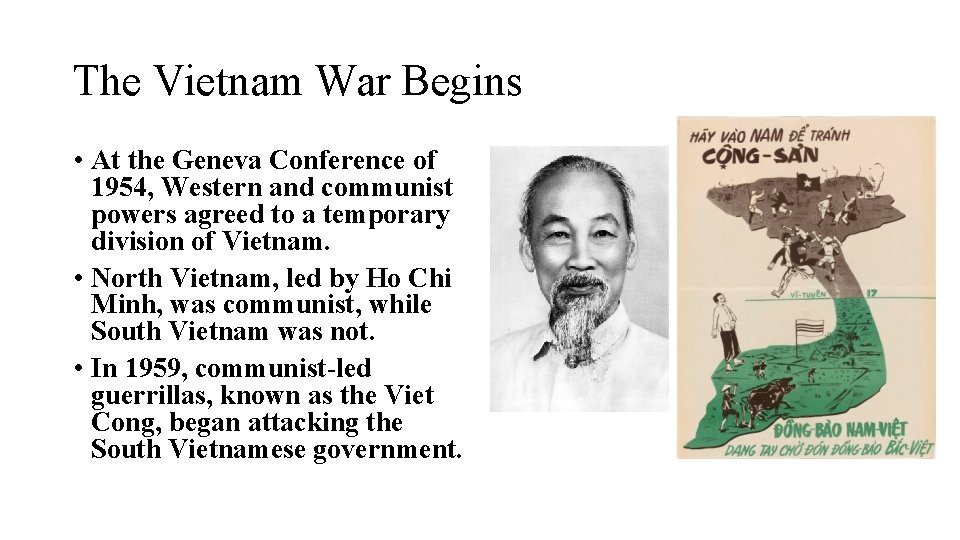
The Vietnam War Begins • At the Geneva Conference of 1954, Western and communist powers agreed to a temporary division of Vietnam. • North Vietnam, led by Ho Chi Minh, was communist, while South Vietnam was not. • In 1959, communist-led guerrillas, known as the Viet Cong, began attacking the South Vietnamese government.
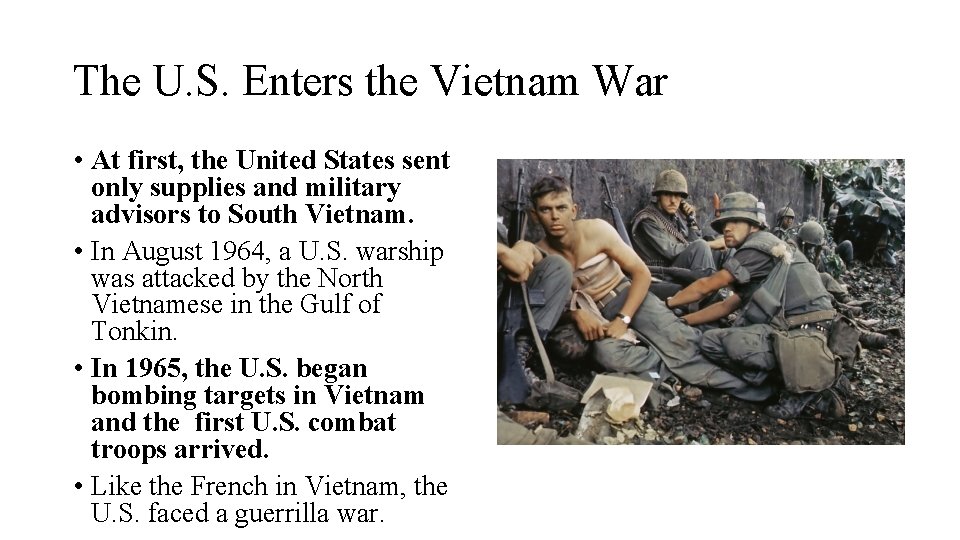
The U. S. Enters the Vietnam War • At first, the United States sent only supplies and military advisors to South Vietnam. • In August 1964, a U. S. warship was attacked by the North Vietnamese in the Gulf of Tonkin. • In 1965, the U. S. began bombing targets in Vietnam and the first U. S. combat troops arrived. • Like the French in Vietnam, the U. S. faced a guerrilla war.
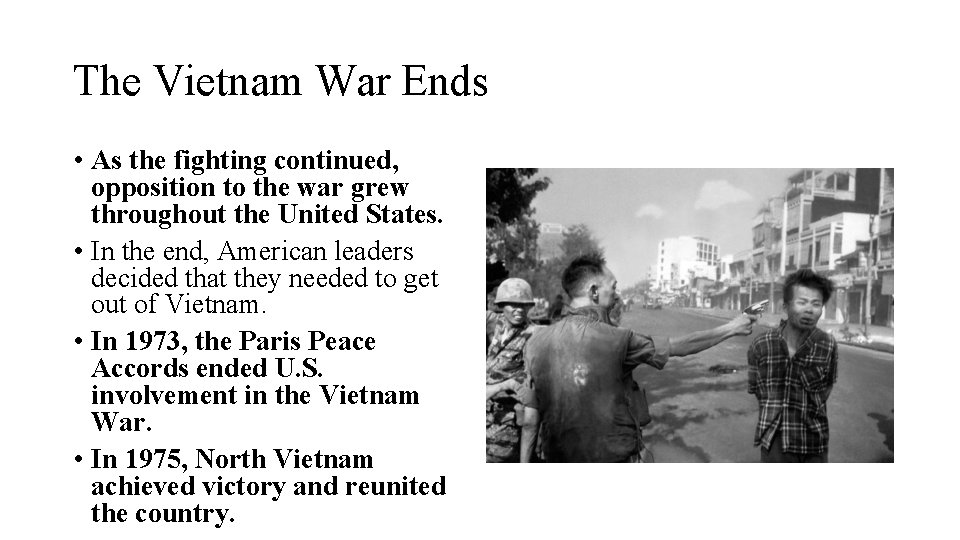
The Vietnam War Ends • As the fighting continued, opposition to the war grew throughout the United States. • In the end, American leaders decided that they needed to get out of Vietnam. • In 1973, the Paris Peace Accords ended U. S. involvement in the Vietnam War. • In 1975, North Vietnam achieved victory and reunited the country.
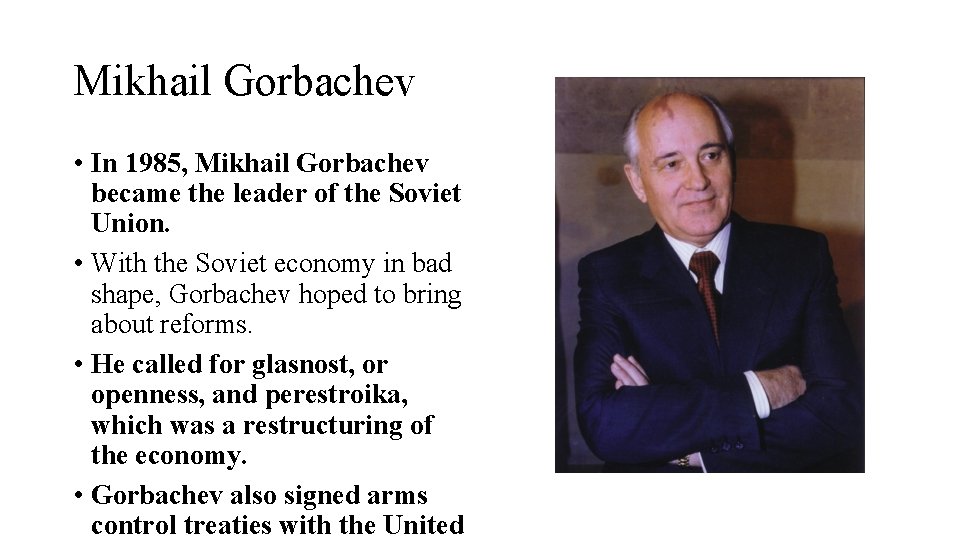
Mikhail Gorbachev • In 1985, Mikhail Gorbachev became the leader of the Soviet Union. • With the Soviet economy in bad shape, Gorbachev hoped to bring about reforms. • He called for glasnost, or openness, and perestroika, which was a restructuring of the economy. • Gorbachev also signed arms control treaties with the United
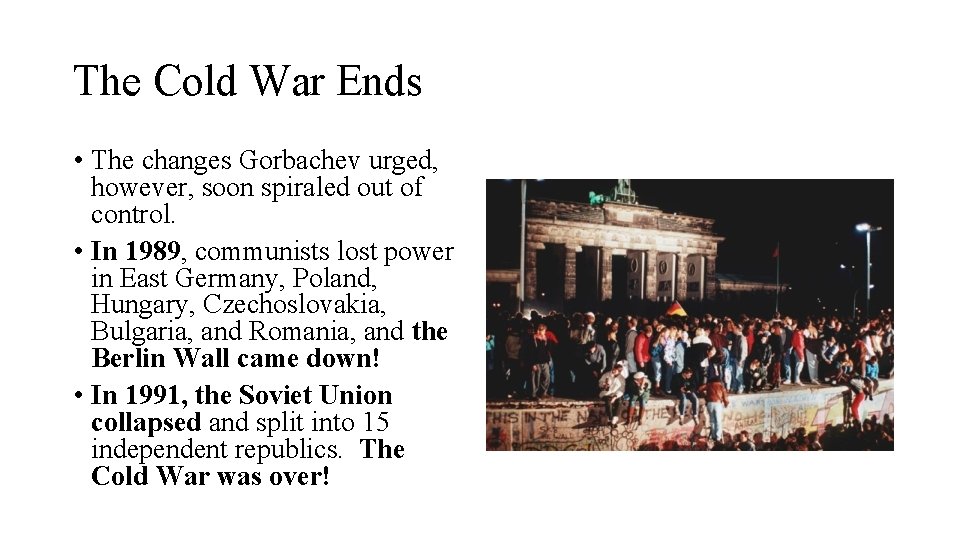
The Cold War Ends • The changes Gorbachev urged, however, soon spiraled out of control. • In 1989, communists lost power in East Germany, Poland, Hungary, Czechoslovakia, Bulgaria, and Romania, and the Berlin Wall came down! • In 1991, the Soviet Union collapsed and split into 15 independent republics. The Cold War was over!
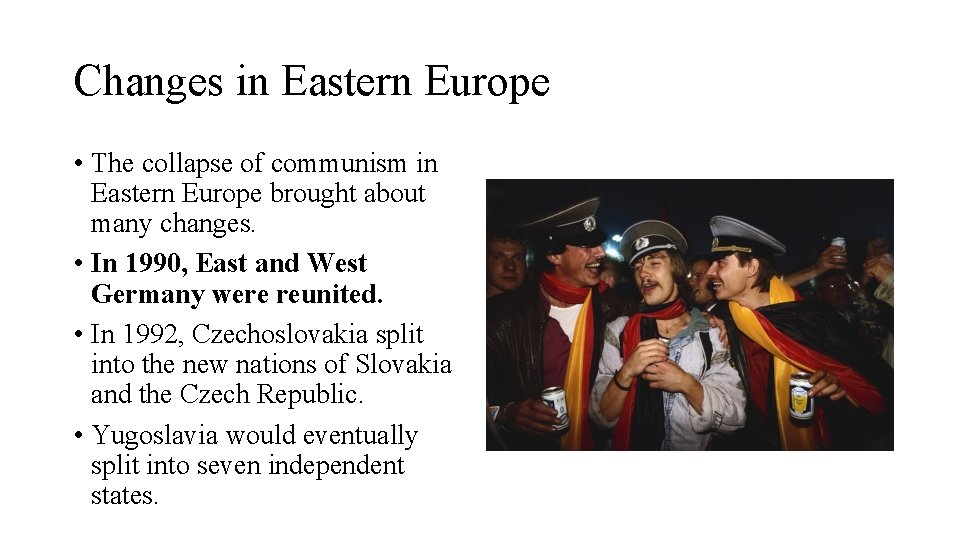
Changes in Eastern Europe • The collapse of communism in Eastern Europe brought about many changes. • In 1990, East and West Germany were reunited. • In 1992, Czechoslovakia split into the new nations of Slovakia and the Czech Republic. • Yugoslavia would eventually split into seven independent states.
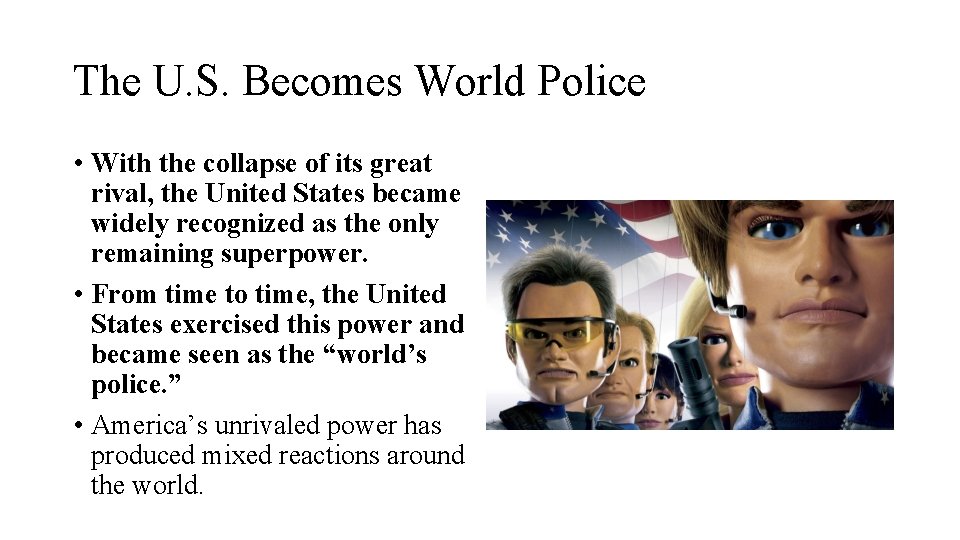
The U. S. Becomes World Police • With the collapse of its great rival, the United States became widely recognized as the only remaining superpower. • From time to time, the United States exercised this power and became seen as the “world’s police. ” • America’s unrivaled power has produced mixed reactions around the world.
- Slides: 29