Transport Layer CS 3516 Computer Networks Chapter 3
- Slides: 106
Transport Layer CS 3516 – Computer Networks
Chapter 3: Transport Layer Goals: • Understand principles behind transport layer services: – Multiplexing / demultiplexing – Reliable data transfer – Flow control – Congestion control • Learn about transport layer protocols in the Internet: – UDP: connectionless transport – TCP: connection-oriented transport – TCP congestion control
Chapter 3 outline • • 3. 1 Transport-layer services 3. 2 Multiplexing and demultiplexing 3. 3 Connectionless transport: UDP 3. 4 Principles of reliable data transfer • • • 3. 5 Connection-oriented transport: TCP – – segment structure reliable data transfer flow control connection management 3. 6 Principles of congestion control 3. 7 TCP congestion control
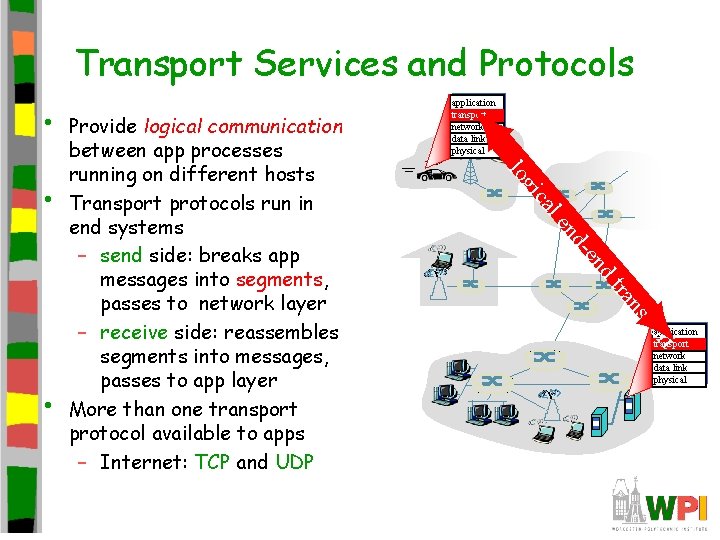
Transport Services and Protocols • or sp n ra t nd -e nd le ica application transport network data link physical t • g lo • Provide logical communication between app processes running on different hosts Transport protocols run in end systems – send side: breaks app messages into segments, passes to network layer – receive side: reassembles segments into messages, passes to app layer More than one transport protocol available to apps – Internet: TCP and UDP application transport network data link physical
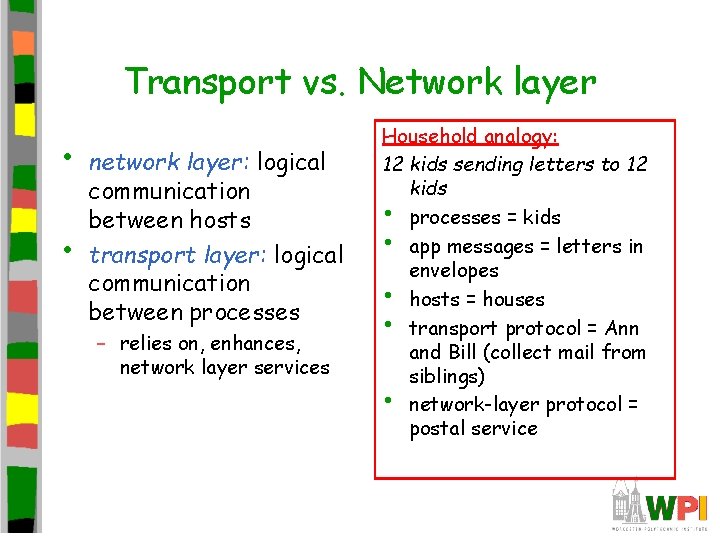
Transport vs. Network layer • • network layer: logical communication between hosts transport layer: logical communication between processes – relies on, enhances, network layer services Household analogy: 12 kids sending letters to 12 kids • processes = kids • app messages = letters in envelopes • hosts = houses • transport protocol = Ann and Bill (collect mail from siblings) • network-layer protocol = postal service
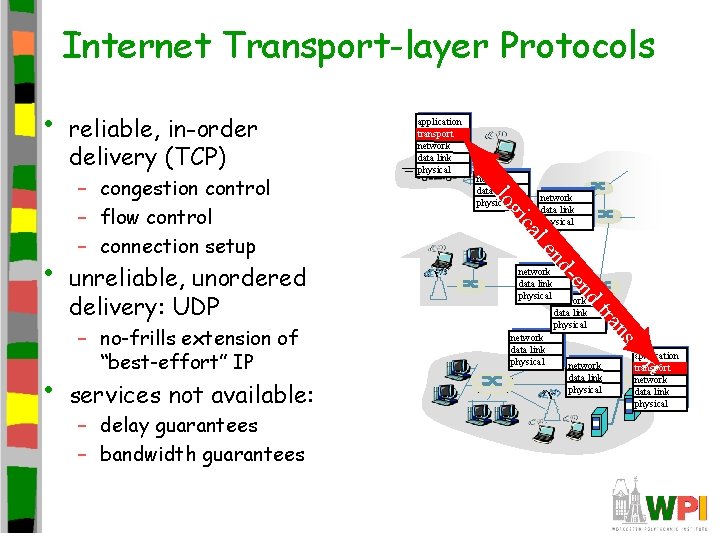
Internet Transport-layer Protocols • network data link physical application transport network data link physical or sp – delay guarantees – bandwidth guarantees data link physical n ra services not available: network data link physical network t nd – no-frills extension of “best-effort” IP network data link physical -e nd unreliable, unordered delivery: UDP network data link physical le ica • – congestion control – flow control – connection setup application transport network data link physical g lo • reliable, in-order delivery (TCP)
Chapter 3 outline • • 3. 1 Transport-layer services 3. 2 Multiplexing and demultiplexing 3. 3 Connectionless transport: UDP 3. 4 Principles of reliable data transfer • • • 3. 5 Connection-oriented transport: TCP – – segment structure reliable data transfer flow control connection management 3. 6 Principles of congestion control 3. 7 TCP congestion control
Chapter 3 outline • • 3. 1 Transport-layer services 3. 2 Multiplexing and demultiplexing 3. 3 Connectionless transport: UDP 3. 4 Principles of reliable data transfer • • • 3. 5 Connection-oriented transport: TCP – – segment structure reliable data transfer flow control connection management 3. 6 Principles of congestion control 3. 7 TCP congestion control
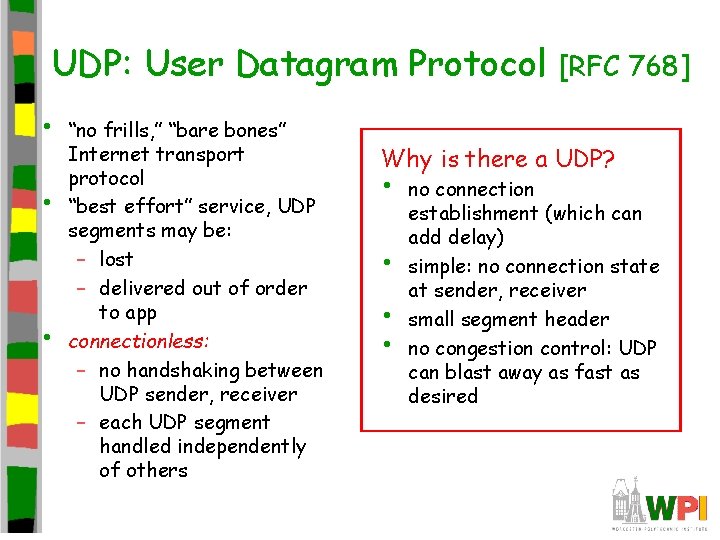
UDP: User Datagram Protocol • • • “no frills, ” “bare bones” Internet transport protocol “best effort” service, UDP segments may be: – lost – delivered out of order to app connectionless: – no handshaking between UDP sender, receiver – each UDP segment handled independently of others [RFC 768] Why is there a UDP? • • no connection establishment (which can add delay) simple: no connection state at sender, receiver small segment header no congestion control: UDP can blast away as fast as desired
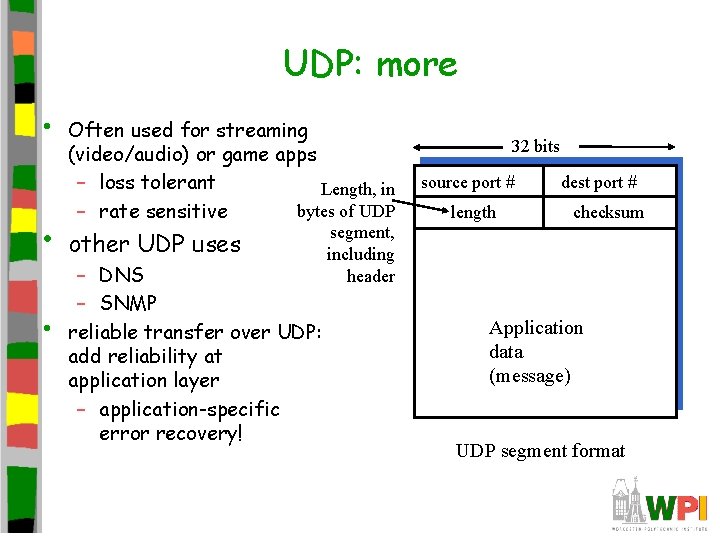
UDP: more • • • Often used for streaming (video/audio) or game apps – loss tolerant Length, in bytes of UDP – rate sensitive other UDP uses – DNS – SNMP reliable transfer over UDP: add reliability at application layer – application-specific error recovery! 32 bits source port # length dest port # checksum segment, including header Application data (message) UDP segment format
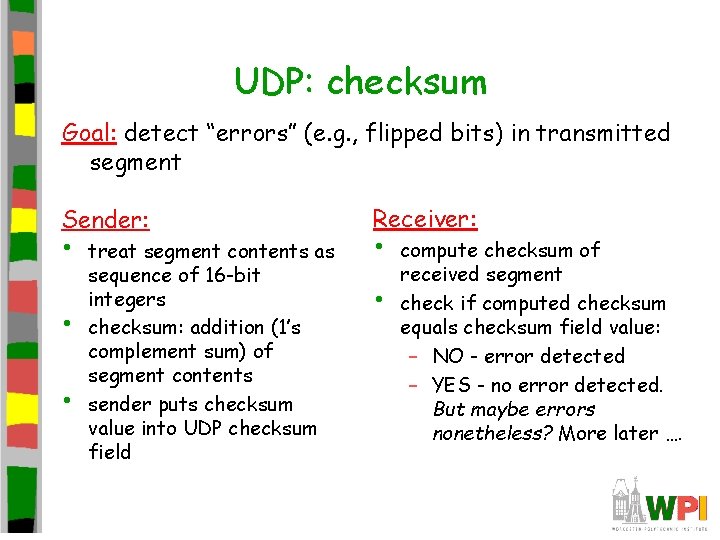
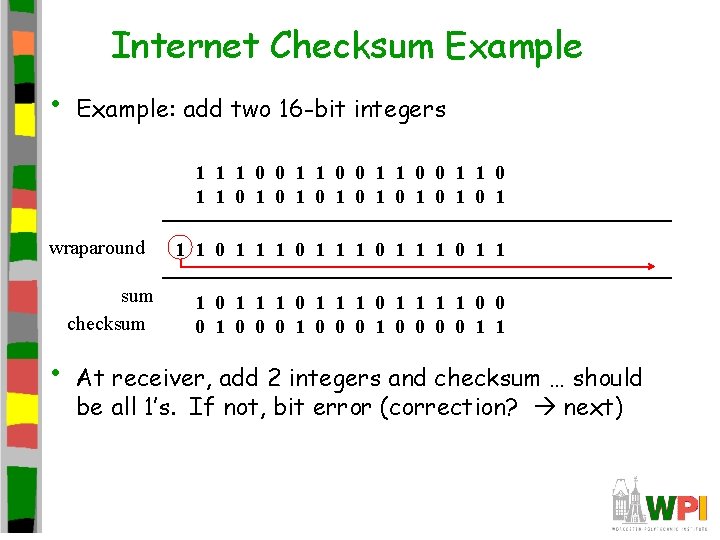
UDP: checksum Goal: detect “errors” (e. g. , flipped bits) in transmitted segment Sender: • • • treat segment contents as sequence of 16 -bit integers checksum: addition (1’s complement sum) of segment contents sender puts checksum value into UDP checksum field Receiver: • • compute checksum of received segment check if computed checksum equals checksum field value: – NO - error detected – YES - no error detected. But maybe errors nonetheless? More later ….
Internet Checksum Example • Example: add two 16 -bit integers 1 1 0 0 1 1 1 0 1 0 1 wraparound sum checksum • 1 1 0 1 1 1 0 1 1 0 0 1 0 0 1 1 At receiver, add 2 integers and checksum … should be all 1’s. If not, bit error (correction? next)
Chapter 3 outline • • 3. 1 Transport-layer services 3. 2 Multiplexing and demultiplexing 3. 3 Connectionless transport: UDP 3. 4 Principles of reliable data transfer • • • 3. 5 Connection-oriented transport: TCP – – segment structure reliable data transfer flow control connection management 3. 6 Principles of congestion control 3. 7 TCP congestion control
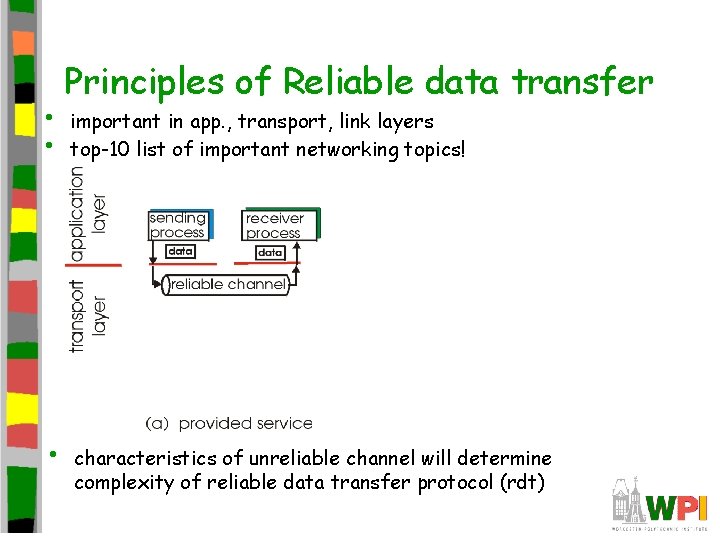
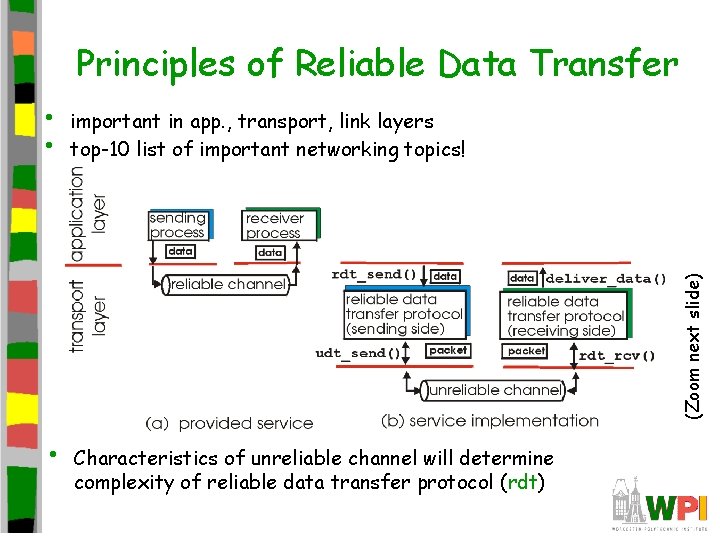
• • • Principles of Reliable data transfer important in app. , transport, link layers top-10 list of important networking topics! characteristics of unreliable channel will determine complexity of reliable data transfer protocol (rdt)
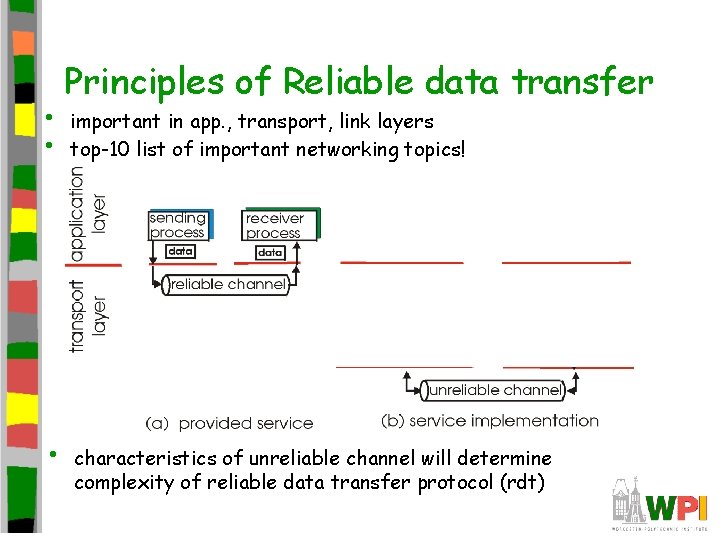
• • • Principles of Reliable data transfer important in app. , transport, link layers top-10 list of important networking topics! characteristics of unreliable channel will determine complexity of reliable data transfer protocol (rdt)
Principles of Reliable Data Transfer important in app. , transport, link layers top-10 list of important networking topics! (Zoom next slide) • • • Characteristics of unreliable channel will determine complexity of reliable data transfer protocol (rdt)
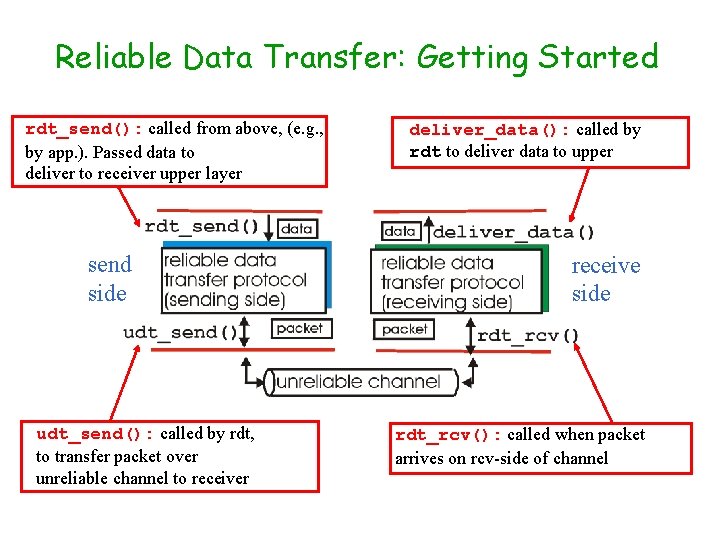
Reliable Data Transfer: Getting Started rdt_send(): called from above, (e. g. , by app. ). Passed data to deliver to receiver upper layer send side udt_send(): called by rdt, to transfer packet over unreliable channel to receiver deliver_data(): called by rdt to deliver data to upper receive side rdt_rcv(): called when packet arrives on rcv-side of channel
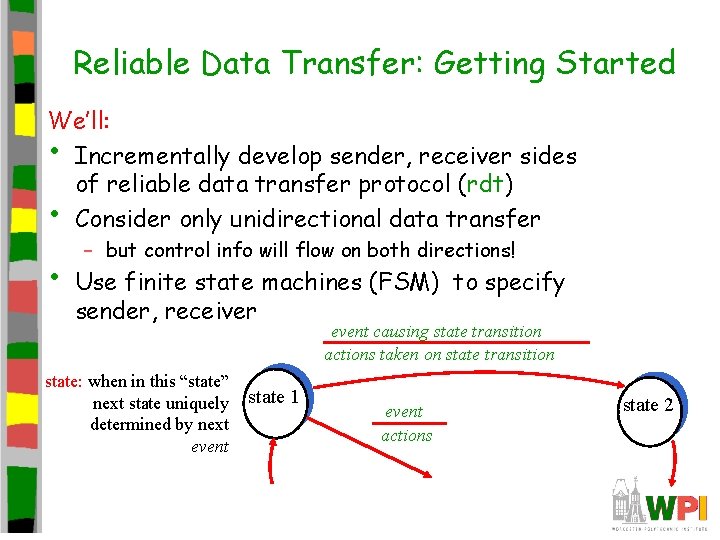
Reliable Data Transfer: Getting Started We’ll: • Incrementally develop sender, receiver sides of reliable data transfer protocol (rdt) • Consider only unidirectional data transfer • – but control info will flow on both directions! Use finite state machines (FSM) to specify sender, receiver event causing state transition actions taken on state transition state: when in this “state” next state uniquely determined by next event state 1 event actions state 2
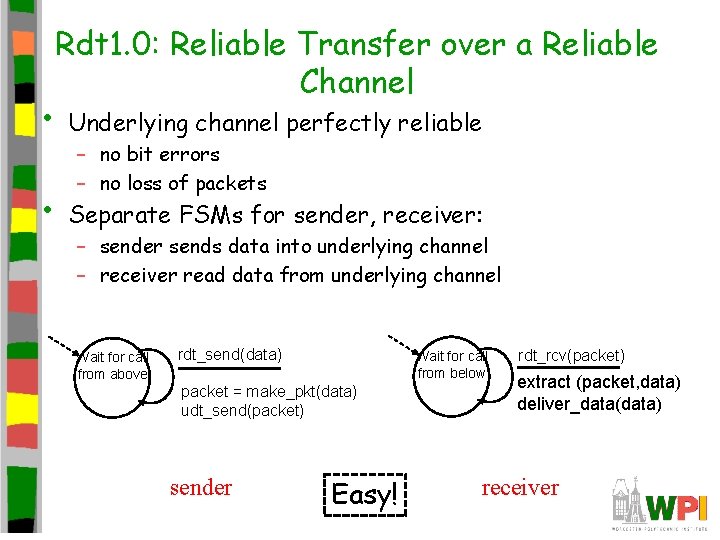
Rdt 1. 0: Reliable Transfer over a Reliable Channel • Underlying channel perfectly reliable • Separate FSMs for sender, receiver: – no bit errors – no loss of packets – sender sends data into underlying channel – receiver read data from underlying channel Wait for call from above rdt_send(data) Wait for call from below packet = make_pkt(data) udt_send(packet) sender Easy! rdt_rcv(packet) extract (packet, data) deliver_data(data) receiver
What if Taking a Message over Phone? • Message is clear? • Message is garbled?
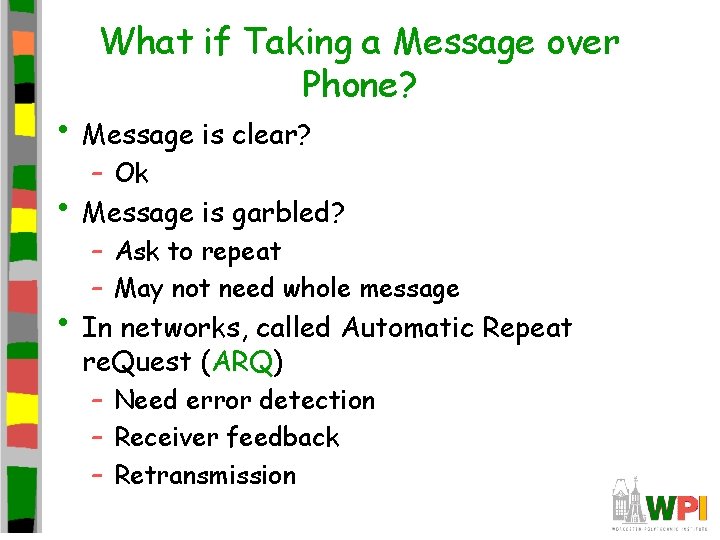
What if Taking a Message over Phone? • Message is clear? – Ok • Message is garbled? – Ask to repeat – May not need whole message • In networks, called Automatic Repeat re. Quest (ARQ) – Need error detection – Receiver feedback – Retransmission
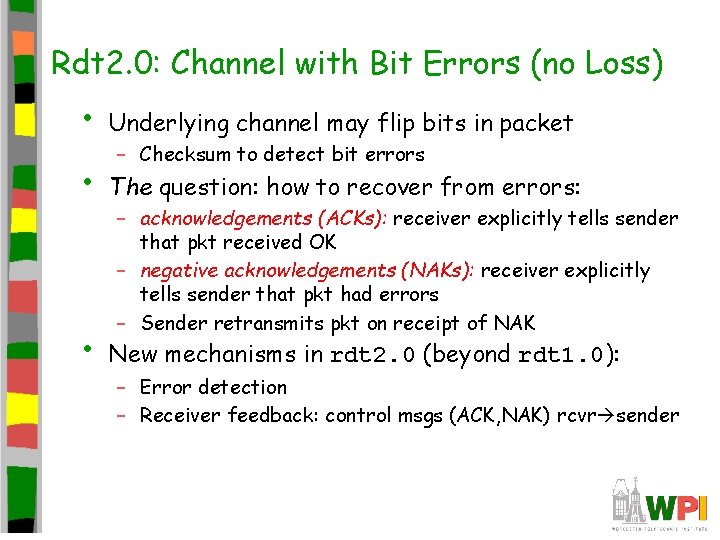
Rdt 2. 0: Channel with Bit Errors (no Loss) • Underlying channel may flip bits in packet • The question: how to recover from errors: • New mechanisms in rdt 2. 0 (beyond rdt 1. 0): – Checksum to detect bit errors – acknowledgements (ACKs): receiver explicitly tells sender that pkt received OK – negative acknowledgements (NAKs): receiver explicitly tells sender that pkt had errors – Sender retransmits pkt on receipt of NAK – Error detection – Receiver feedback: control msgs (ACK, NAK) rcvr sender
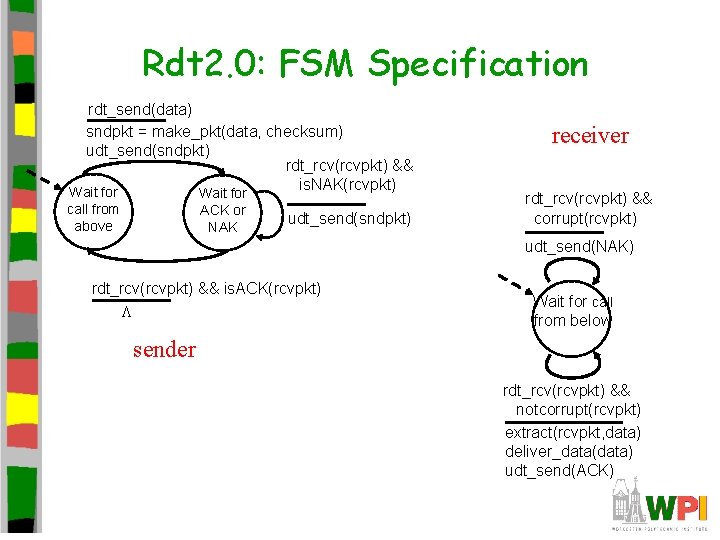
Rdt 2. 0: FSM Specification rdt_send(data) sndpkt = make_pkt(data, checksum) udt_send(sndpkt) rdt_rcv(rcvpkt) && is. NAK(rcvpkt) Wait for ACK or NAK call from above udt_send(sndpkt) receiver rdt_rcv(rcvpkt) && corrupt(rcvpkt) udt_send(NAK) rdt_rcv(rcvpkt) && is. ACK(rcvpkt) L Wait for call from below sender rdt_rcv(rcvpkt) && notcorrupt(rcvpkt) extract(rcvpkt, data) deliver_data(data) udt_send(ACK)
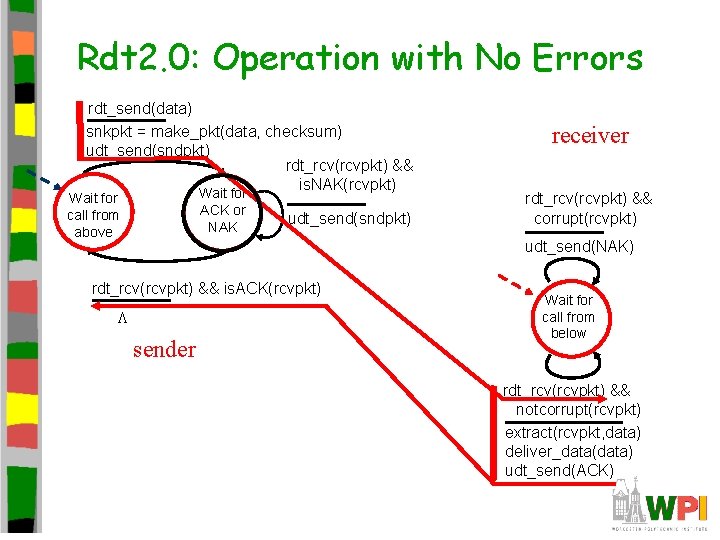
Rdt 2. 0: Operation with No Errors rdt_send(data) snkpkt = make_pkt(data, checksum) udt_send(sndpkt) rdt_rcv(rcvpkt) && is. NAK(rcvpkt) Wait for ACK or NAK Wait for call from above udt_send(sndpkt) receiver rdt_rcv(rcvpkt) && corrupt(rcvpkt) udt_send(NAK) rdt_rcv(rcvpkt) && is. ACK(rcvpkt) L sender Wait for call from below rdt_rcv(rcvpkt) && notcorrupt(rcvpkt) extract(rcvpkt, data) deliver_data(data) udt_send(ACK)
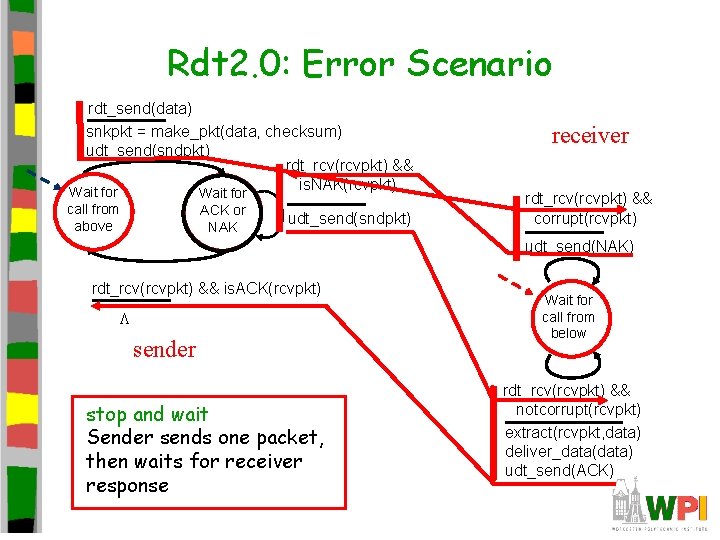
Rdt 2. 0: Error Scenario rdt_send(data) snkpkt = make_pkt(data, checksum) udt_send(sndpkt) rdt_rcv(rcvpkt) && is. NAK(rcvpkt) Wait for ACK or NAK call from above udt_send(sndpkt) receiver rdt_rcv(rcvpkt) && corrupt(rcvpkt) udt_send(NAK) rdt_rcv(rcvpkt) && is. ACK(rcvpkt) L sender stop and wait Sender sends one packet, then waits for receiver response Wait for call from below rdt_rcv(rcvpkt) && notcorrupt(rcvpkt) extract(rcvpkt, data) deliver_data(data) udt_send(ACK)
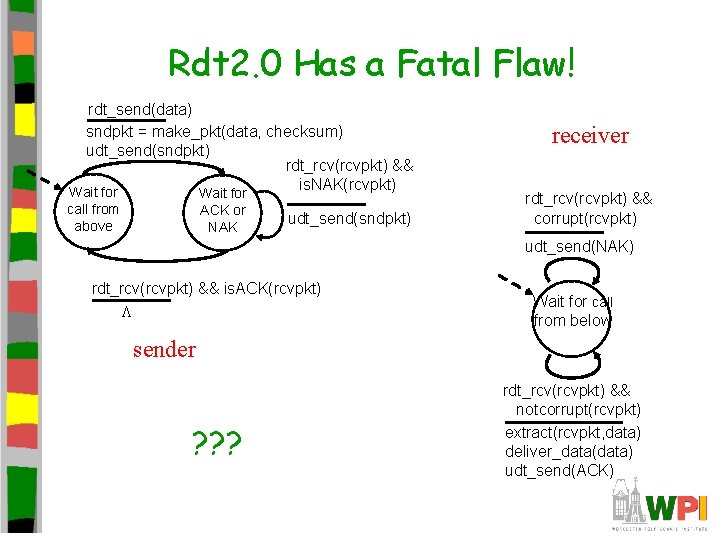
Rdt 2. 0 Has a Fatal Flaw! rdt_send(data) sndpkt = make_pkt(data, checksum) udt_send(sndpkt) rdt_rcv(rcvpkt) && is. NAK(rcvpkt) Wait for ACK or NAK call from above udt_send(sndpkt) receiver rdt_rcv(rcvpkt) && corrupt(rcvpkt) udt_send(NAK) rdt_rcv(rcvpkt) && is. ACK(rcvpkt) L Wait for call from below sender ? ? ? rdt_rcv(rcvpkt) && notcorrupt(rcvpkt) extract(rcvpkt, data) deliver_data(data) udt_send(ACK)
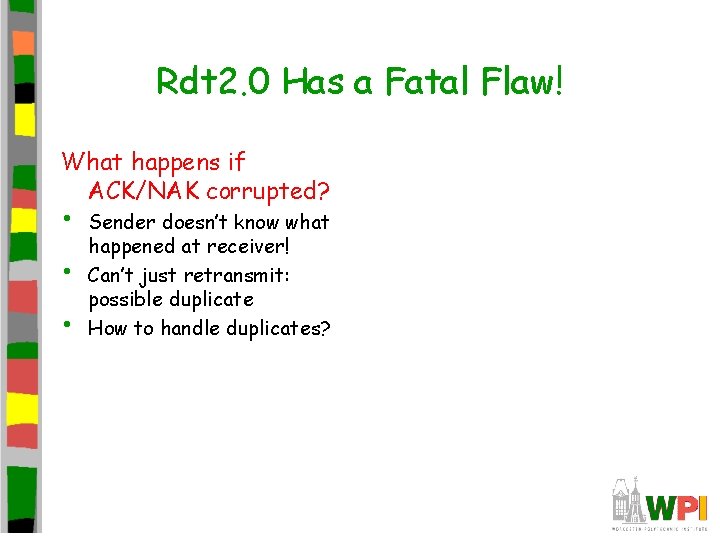
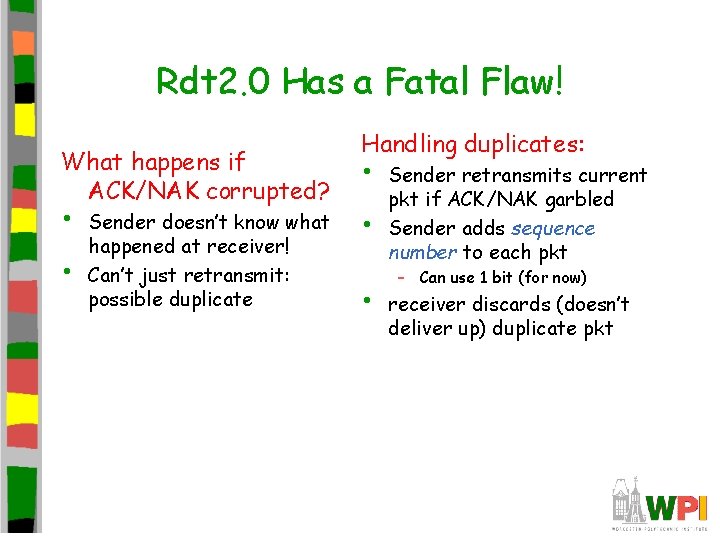
Rdt 2. 0 Has a Fatal Flaw! What happens if ACK/NAK corrupted? • • • Sender doesn’t know what happened at receiver! Can’t just retransmit: possible duplicate How to handle duplicates?
Rdt 2. 0 Has a Fatal Flaw! What happens if ACK/NAK corrupted? • • Sender doesn’t know what happened at receiver! Can’t just retransmit: possible duplicate Handling duplicates: • • • Sender retransmits current pkt if ACK/NAK garbled Sender adds sequence number to each pkt – Can use 1 bit (for now) receiver discards (doesn’t deliver up) duplicate pkt
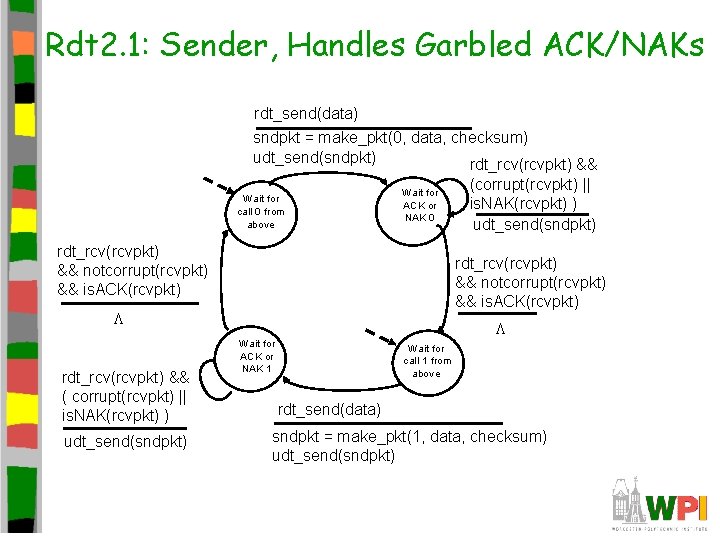
Rdt 2. 1: Sender, Handles Garbled ACK/NAKs rdt_send(data) sndpkt = make_pkt(0, data, checksum) udt_send(sndpkt) rdt_rcv(rcvpkt) && Wait for call 0 from above Wait for ACK or NAK 0 rdt_rcv(rcvpkt) && notcorrupt(rcvpkt) && is. ACK(rcvpkt) L rdt_rcv(rcvpkt) && ( corrupt(rcvpkt) || is. NAK(rcvpkt) ) udt_send(sndpkt) (corrupt(rcvpkt) || is. NAK(rcvpkt) ) udt_send(sndpkt) L Wait for ACK or NAK 1 Wait for call 1 from above rdt_send(data) sndpkt = make_pkt(1, data, checksum) udt_send(sndpkt)
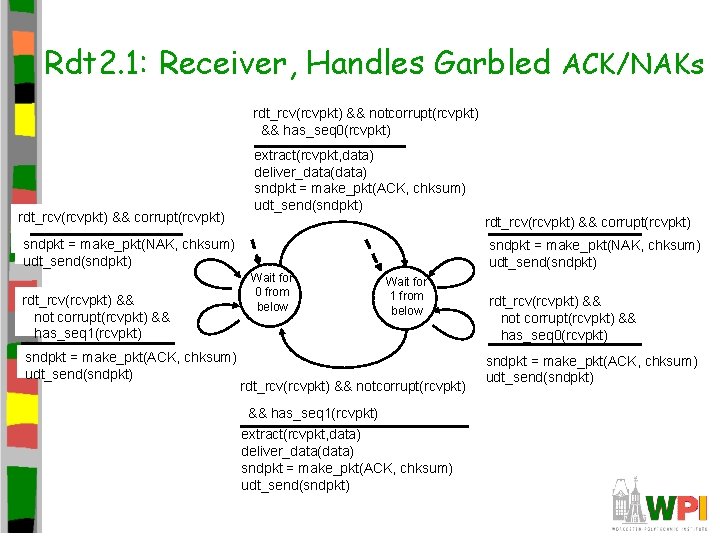
Rdt 2. 1: Receiver, Handles Garbled ACK/NAKs rdt_rcv(rcvpkt) && notcorrupt(rcvpkt) && has_seq 0(rcvpkt) rdt_rcv(rcvpkt) && corrupt(rcvpkt) extract(rcvpkt, data) deliver_data(data) sndpkt = make_pkt(ACK, chksum) udt_send(sndpkt) rdt_rcv(rcvpkt) && corrupt(rcvpkt) sndpkt = make_pkt(NAK, chksum) udt_send(sndpkt) rdt_rcv(rcvpkt) && not corrupt(rcvpkt) && has_seq 1(rcvpkt) sndpkt = make_pkt(ACK, chksum) udt_send(sndpkt) sndpkt = make_pkt(NAK, chksum) udt_send(sndpkt) Wait for 0 from below Wait for 1 from below rdt_rcv(rcvpkt) && notcorrupt(rcvpkt) && has_seq 1(rcvpkt) extract(rcvpkt, data) deliver_data(data) sndpkt = make_pkt(ACK, chksum) udt_send(sndpkt) rdt_rcv(rcvpkt) && not corrupt(rcvpkt) && has_seq 0(rcvpkt) sndpkt = make_pkt(ACK, chksum) udt_send(sndpkt)
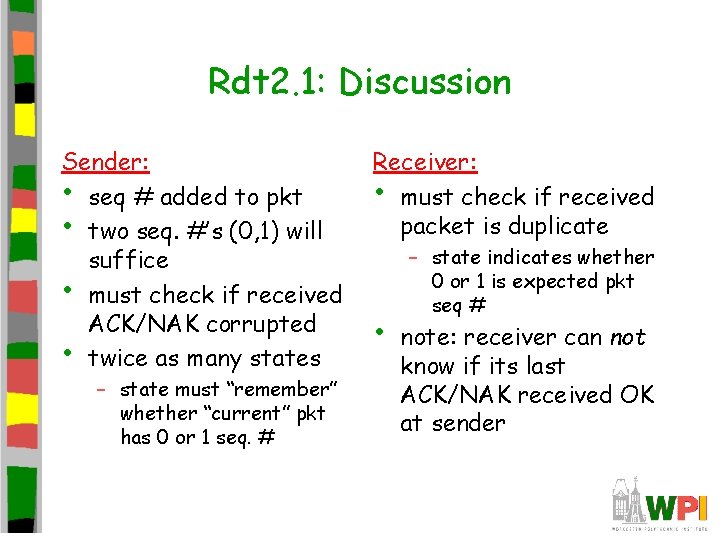
Rdt 2. 1: Discussion Sender: • seq # added to pkt • two seq. #’s (0, 1) will suffice • must check if received ACK/NAK corrupted • twice as many states – state must “remember” whether “current” pkt has 0 or 1 seq. # Receiver: • must check if received packet is duplicate • – state indicates whether 0 or 1 is expected pkt seq # note: receiver can not know if its last ACK/NAK received OK at sender
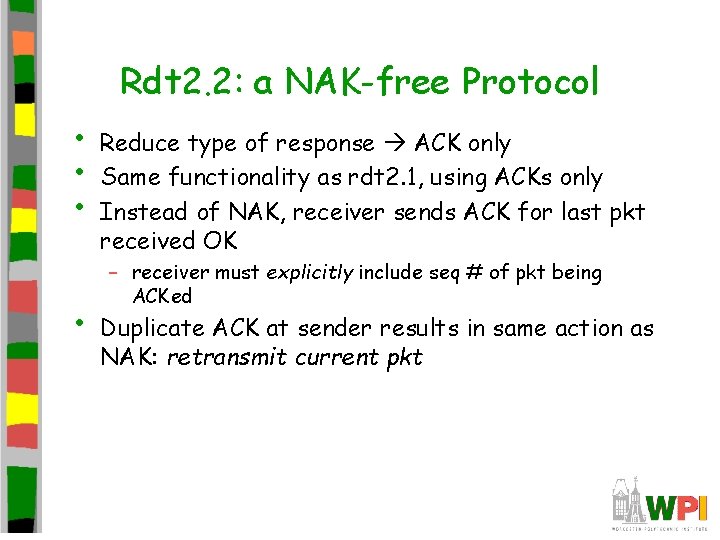
Rdt 2. 2: a NAK-free Protocol • • Reduce type of response ACK only Same functionality as rdt 2. 1, using ACKs only Instead of NAK, receiver sends ACK for last pkt received OK – receiver must explicitly include seq # of pkt being ACKed Duplicate ACK at sender results in same action as NAK: retransmit current pkt
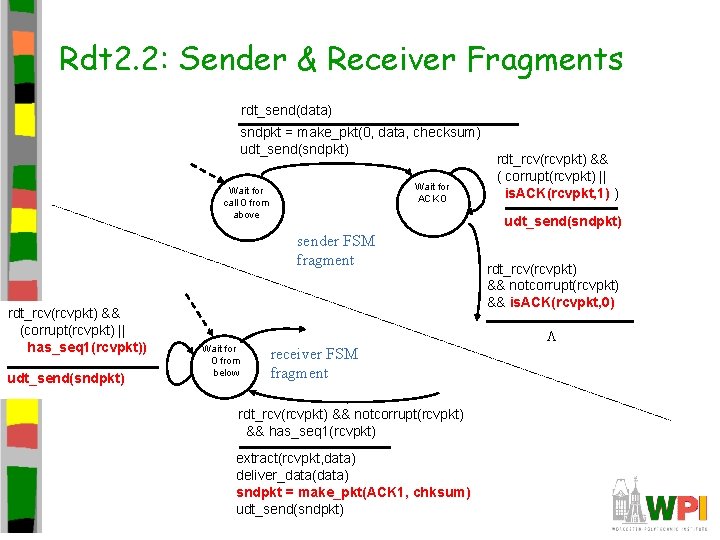
Rdt 2. 2: Sender & Receiver Fragments rdt_send(data) sndpkt = make_pkt(0, data, checksum) udt_send(sndpkt) Wait for ACK 0 Wait for call 0 from above udt_send(sndpkt) sender FSM fragment rdt_rcv(rcvpkt) && (corrupt(rcvpkt) || has_seq 1(rcvpkt)) udt_send(sndpkt) Wait for 0 from below rdt_rcv(rcvpkt) && ( corrupt(rcvpkt) || is. ACK(rcvpkt, 1) ) rdt_rcv(rcvpkt) && notcorrupt(rcvpkt) && is. ACK(rcvpkt, 0) L receiver FSM fragment rdt_rcv(rcvpkt) && notcorrupt(rcvpkt) && has_seq 1(rcvpkt) extract(rcvpkt, data) deliver_data(data) sndpkt = make_pkt(ACK 1, chksum) udt_send(sndpkt)
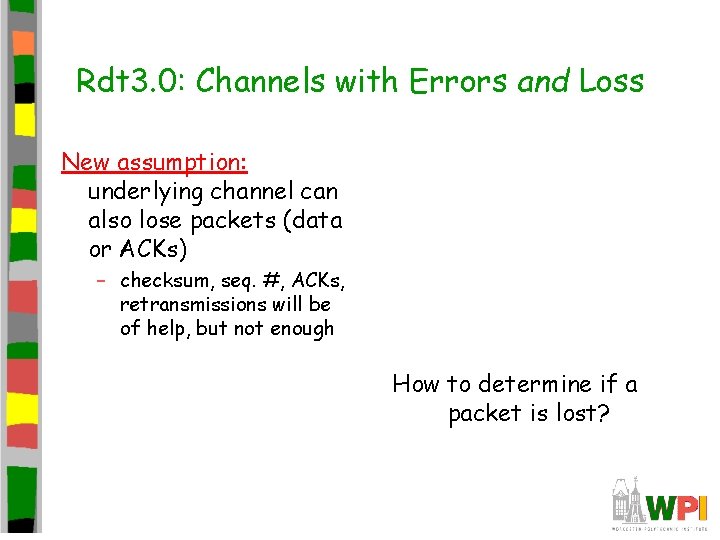
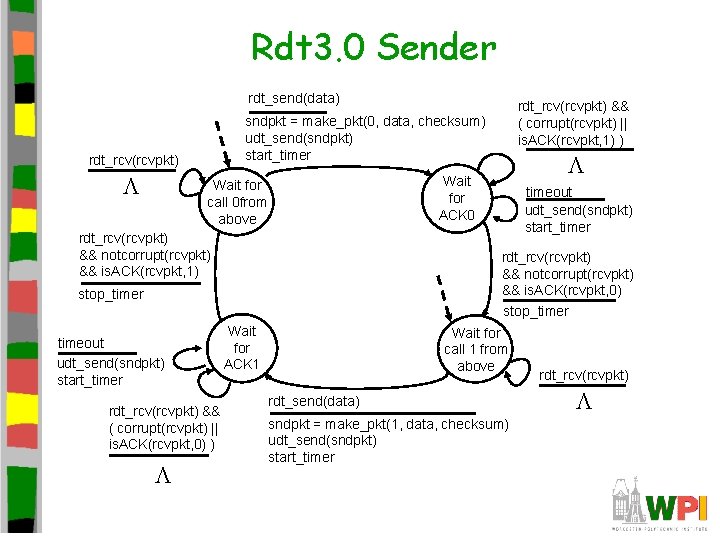
Rdt 3. 0: Channels with Errors and Loss New assumption: underlying channel can also lose packets (data or ACKs) – checksum, seq. #, ACKs, retransmissions will be of help, but not enough How to determine if a packet is lost?
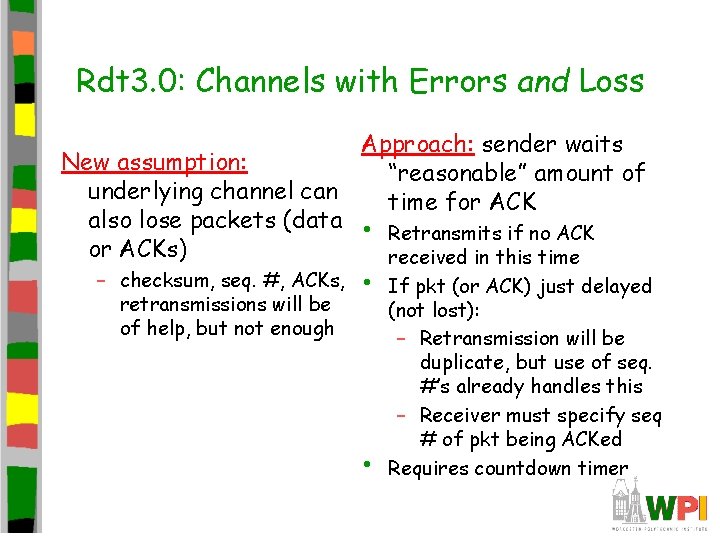
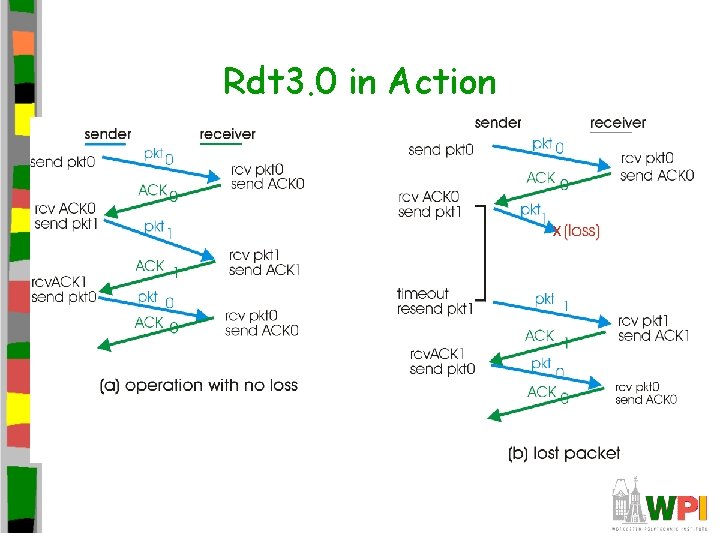
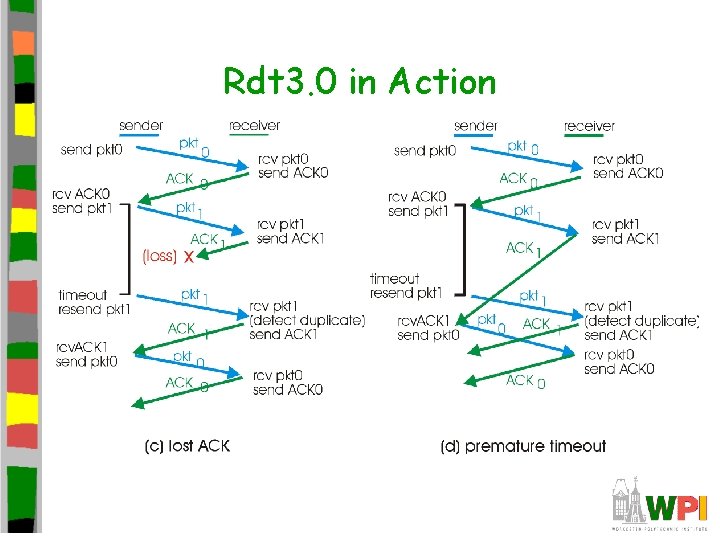
Rdt 3. 0: Channels with Errors and Loss Approach: sender waits New assumption: “reasonable” amount of underlying channel can time for ACK also lose packets (data • Retransmits if no ACK or ACKs) received in this time – checksum, seq. #, ACKs, retransmissions will be of help, but not enough • • If pkt (or ACK) just delayed (not lost): – Retransmission will be duplicate, but use of seq. #’s already handles this – Receiver must specify seq # of pkt being ACKed Requires countdown timer
Rdt 3. 0 Sender rdt_send(data) sndpkt = make_pkt(0, data, checksum) udt_send(sndpkt) start_timer rdt_rcv(rcvpkt) L rdt_rcv(rcvpkt) && notcorrupt(rcvpkt) && is. ACK(rcvpkt, 1) rdt_rcv(rcvpkt) && ( corrupt(rcvpkt) || is. ACK(rcvpkt, 0) ) timeout udt_send(sndpkt) start_timer rdt_rcv(rcvpkt) && notcorrupt(rcvpkt) && is. ACK(rcvpkt, 0) stop_timer timeout udt_send(sndpkt) start_timer L Wait for ACK 0 Wait for call 0 from above L rdt_rcv(rcvpkt) && ( corrupt(rcvpkt) || is. ACK(rcvpkt, 1) ) Wait for ACK 1 Wait for call 1 from above rdt_send(data) sndpkt = make_pkt(1, data, checksum) udt_send(sndpkt) start_timer rdt_rcv(rcvpkt) L
Rdt 3. 0 in Action
Rdt 3. 0 in Action
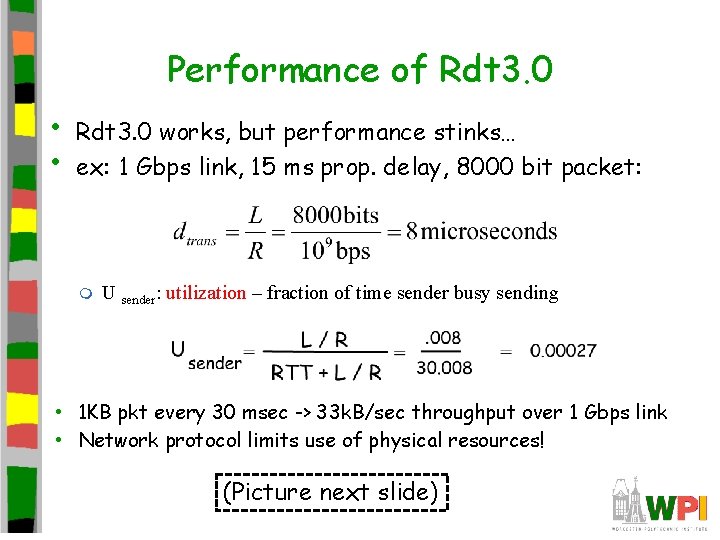
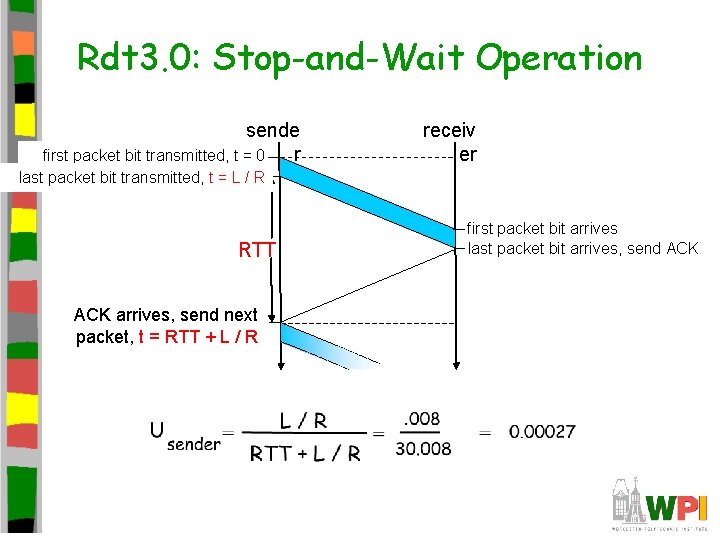
Performance of Rdt 3. 0 • • Rdt 3. 0 works, but performance stinks… ex: 1 Gbps link, 15 ms prop. delay, 8000 bit packet: m U sender: utilization – fraction of time sender busy sending • 1 KB pkt every 30 msec -> 33 k. B/sec throughput over 1 Gbps link • Network protocol limits use of physical resources! (Picture next slide)
Rdt 3. 0: Stop-and-Wait Operation sende first packet bit transmitted, t = 0 r receiv er last packet bit transmitted, t = L / R RTT ACK arrives, send next packet, t = RTT + L / R first packet bit arrives last packet bit arrives, send ACK
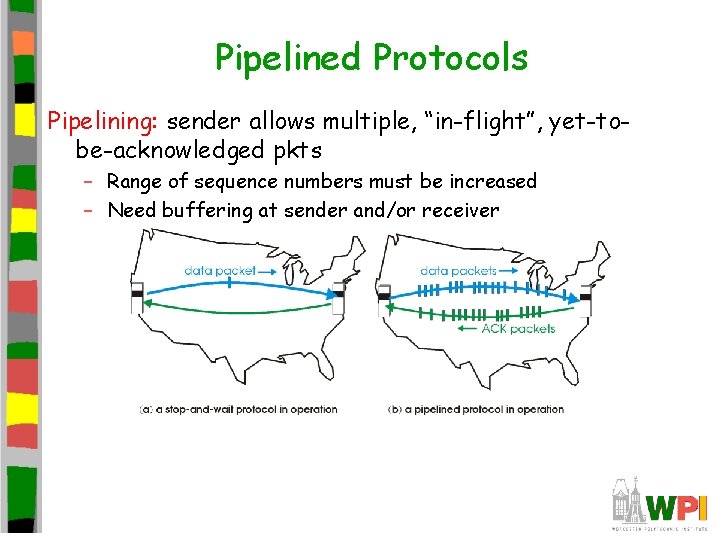
Pipelined Protocols Pipelining: sender allows multiple, “in-flight”, yet-tobe-acknowledged pkts – Range of sequence numbers must be increased – Need buffering at sender and/or receiver
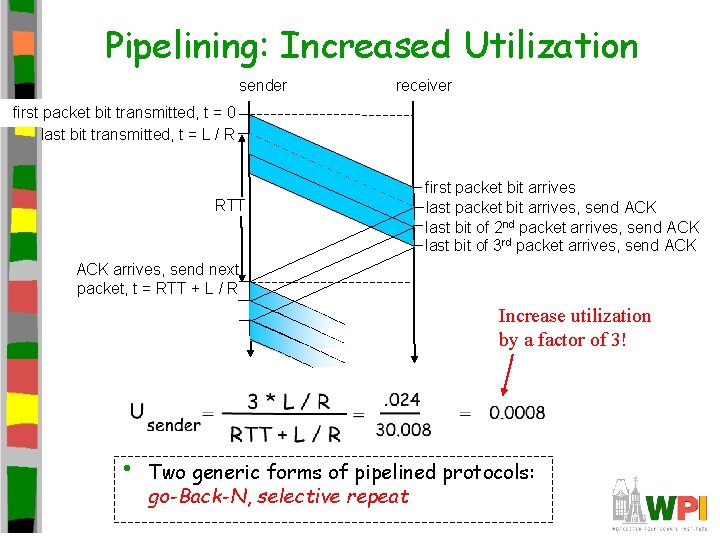
Pipelining: Increased Utilization sender receiver first packet bit transmitted, t = 0 last bit transmitted, t = L / R RTT first packet bit arrives last packet bit arrives, send ACK last bit of 2 nd packet arrives, send ACK last bit of 3 rd packet arrives, send ACK arrives, send next packet, t = RTT + L / R Increase utilization by a factor of 3! • Two generic forms of pipelined protocols: go-Back-N, selective repeat
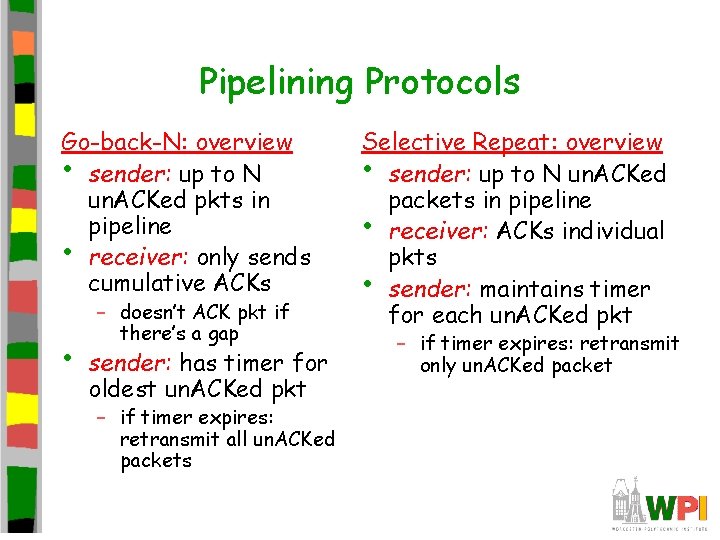
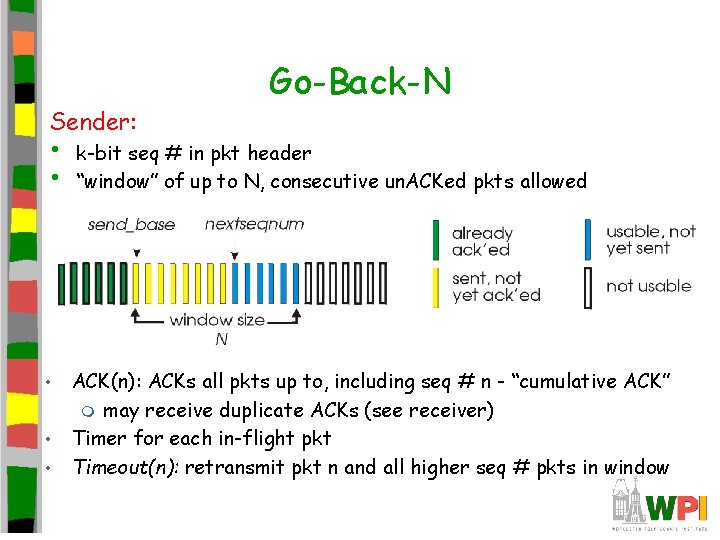
Pipelining Protocols Go-back-N: overview • sender: up to N un. ACKed pkts in pipeline • receiver: only sends cumulative ACKs • – doesn’t ACK pkt if there’s a gap sender: has timer for oldest un. ACKed pkt – if timer expires: retransmit all un. ACKed packets Selective Repeat: overview • sender: up to N un. ACKed packets in pipeline • receiver: ACKs individual pkts • sender: maintains timer for each un. ACKed pkt – if timer expires: retransmit only un. ACKed packet
Sender: • • • Go-Back-N k-bit seq # in pkt header “window” of up to N, consecutive un. ACKed pkts allowed ACK(n): ACKs all pkts up to, including seq # n - “cumulative ACK” m may receive duplicate ACKs (see receiver) Timer for each in-flight pkt Timeout(n): retransmit pkt n and all higher seq # pkts in window
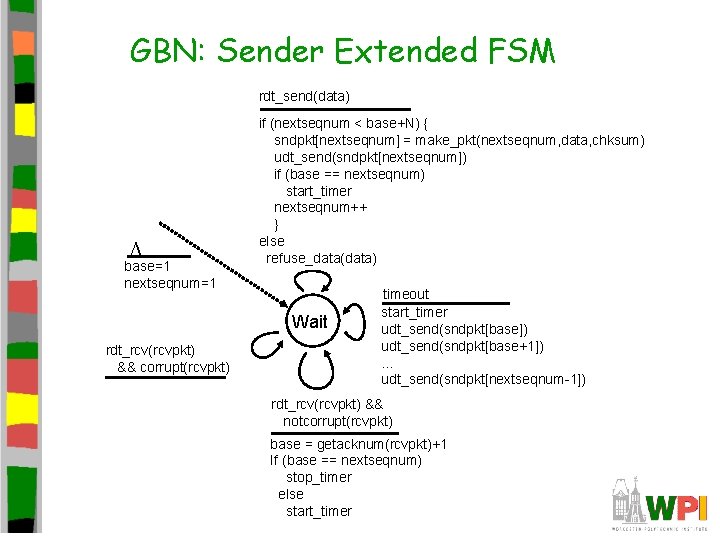
GBN: Sender Extended FSM rdt_send(data) L base=1 nextseqnum=1 if (nextseqnum < base+N) { sndpkt[nextseqnum] = make_pkt(nextseqnum, data, chksum) udt_send(sndpkt[nextseqnum]) if (base == nextseqnum) start_timer nextseqnum++ } else refuse_data(data) Wait rdt_rcv(rcvpkt) && corrupt(rcvpkt) timeout start_timer udt_send(sndpkt[base]) udt_send(sndpkt[base+1]) … udt_send(sndpkt[nextseqnum-1]) rdt_rcv(rcvpkt) && notcorrupt(rcvpkt) base = getacknum(rcvpkt)+1 If (base == nextseqnum) stop_timer else start_timer
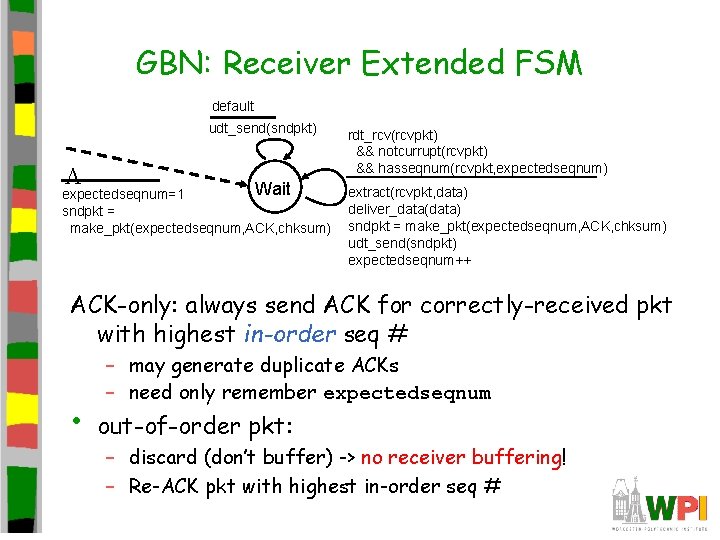
GBN: Receiver Extended FSM default udt_send(sndpkt) L Wait expectedseqnum=1 sndpkt = make_pkt(expectedseqnum, ACK, chksum) rdt_rcv(rcvpkt) && notcurrupt(rcvpkt) && hasseqnum(rcvpkt, expectedseqnum) extract(rcvpkt, data) deliver_data(data) sndpkt = make_pkt(expectedseqnum, ACK, chksum) udt_send(sndpkt) expectedseqnum++ ACK-only: always send ACK for correctly-received pkt with highest in-order seq # • – may generate duplicate ACKs – need only remember expectedseqnum out-of-order pkt: – discard (don’t buffer) -> no receiver buffering! – Re-ACK pkt with highest in-order seq #
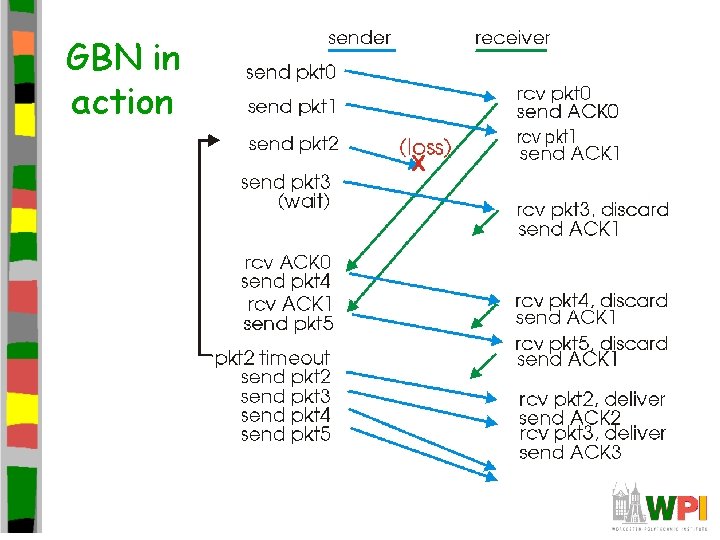
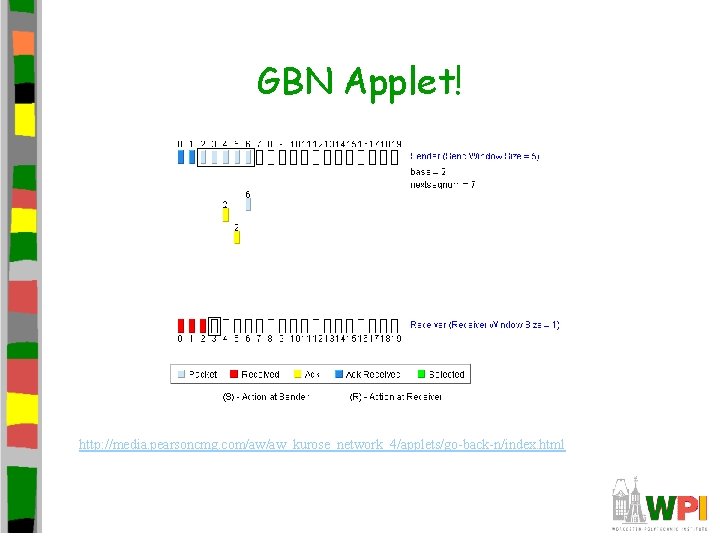
GBN in action
GBN Applet! http: //media. pearsoncmg. com/aw/aw_kurose_network_4/applets/go-back-n/index. html
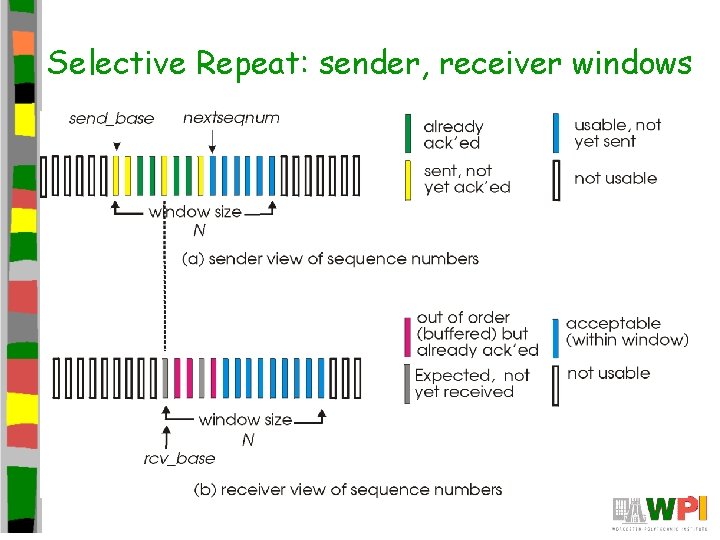
• • • Selective Repeat Receiver individually acknowledges all correctly received pkts – Buffers pkts, as needed, for eventual in-order delivery to upper layer Sender only resends pkts for which ACK not received – Sender timer for each un. ACKed pkt Sender window – N consecutive seq #’s – Again limits seq #s of sent, un. ACKed pkts
Selective Repeat: sender, receiver windows
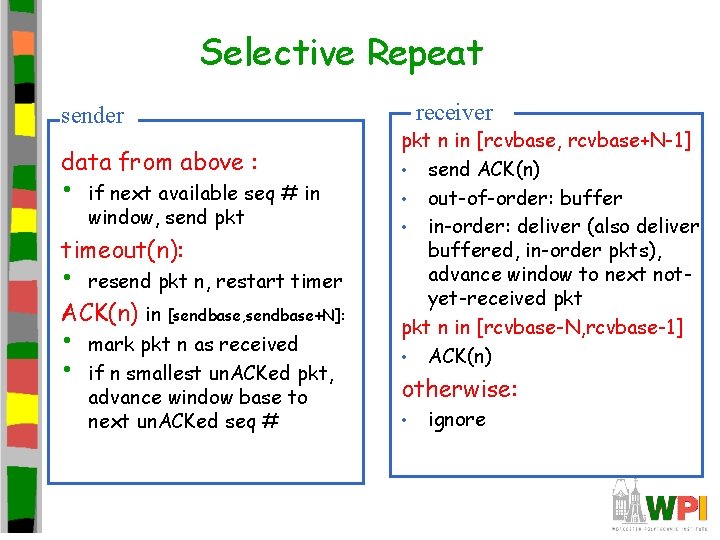
Selective Repeat sender data from above : • if next available seq # in window, send pkt timeout(n): • resend pkt n, restart timer ACK(n) in [sendbase, sendbase+N]: • • mark pkt n as received if n smallest un. ACKed pkt, advance window base to next un. ACKed seq # receiver pkt n in [rcvbase, rcvbase+N-1] • send ACK(n) • out-of-order: buffer • in-order: deliver (also deliver buffered, in-order pkts), advance window to next notyet-received pkt n in [rcvbase-N, rcvbase-1] • ACK(n) otherwise: • ignore
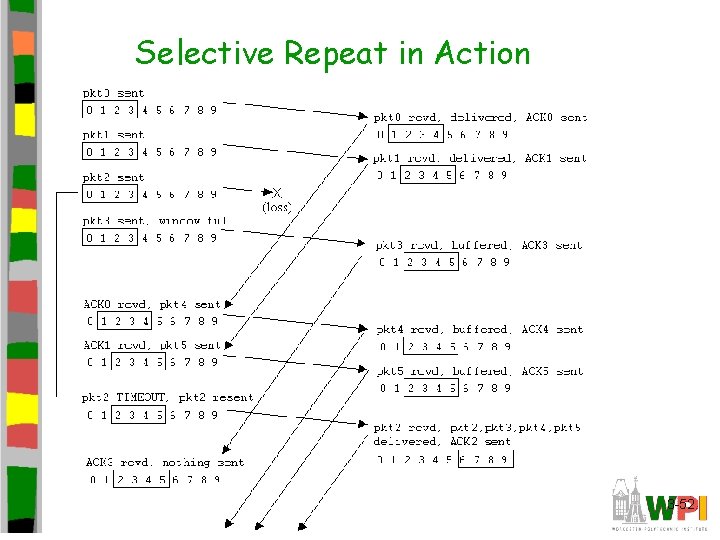
Selective Repeat in Action Transport Layer 3 -52
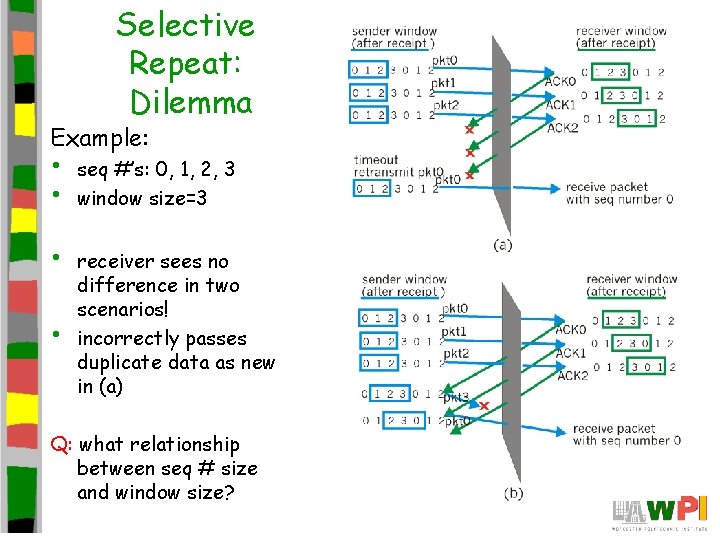
Selective Repeat: Dilemma Example: • • seq #’s: 0, 1, 2, 3 window size=3 receiver sees no difference in two scenarios! incorrectly passes duplicate data as new in (a) Q: what relationship between seq # size and window size?
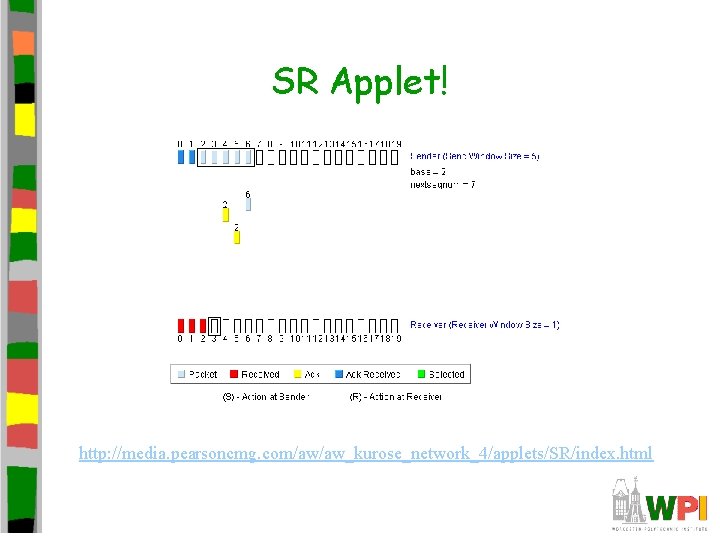
SR Applet! http: //media. pearsoncmg. com/aw/aw_kurose_network_4/applets/SR/index. html
Chapter 3 outline • • 3. 1 Transport-layer services 3. 2 Multiplexing and demultiplexing 3. 3 Connectionless transport: UDP 3. 4 Principles of reliable data transfer • • • 3. 5 Connection-oriented transport: TCP – – segment structure reliable data transfer flow control connection management 3. 6 Principles of congestion control 3. 7 TCP congestion control
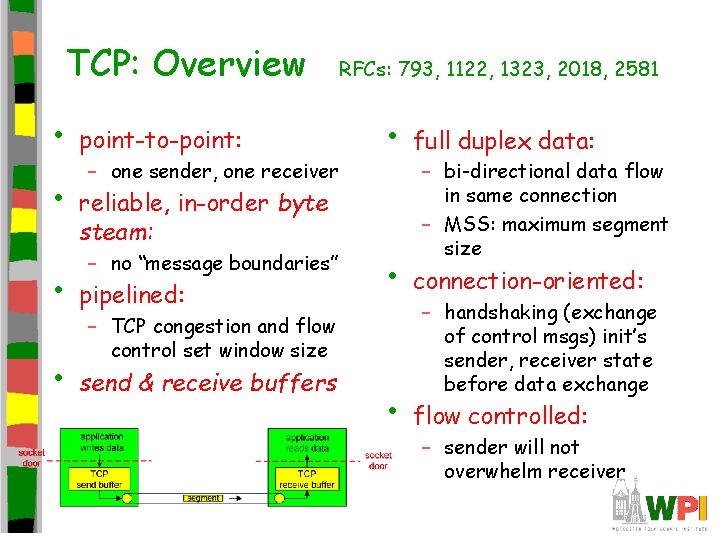
TCP: Overview • • point-to-point: – one sender, one receiver RFCs: 793, 1122, 1323, 2018, 2581 • full duplex data: • connection-oriented: • flow controlled: reliable, in-order byte steam: – no “message boundaries” • pipelined: • send & receive buffers – TCP congestion and flow control set window size – bi-directional data flow in same connection – MSS: maximum segment size – handshaking (exchange of control msgs) init’s sender, receiver state before data exchange – sender will not overwhelm receiver
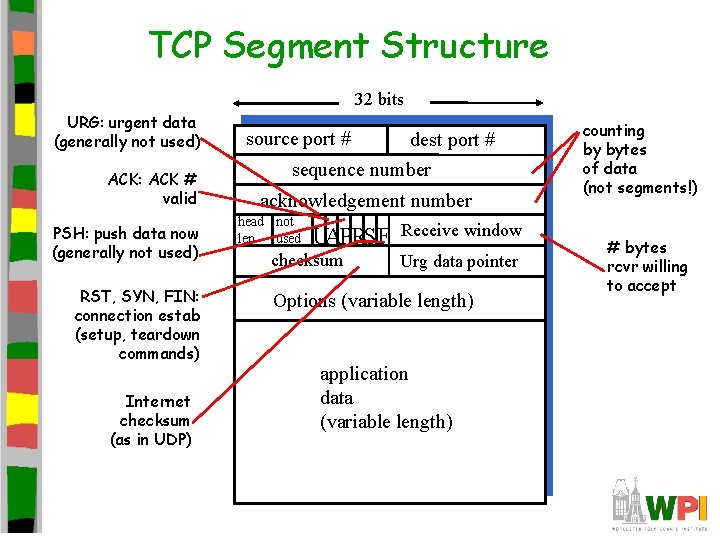
TCP Segment Structure 32 bits URG: urgent data (generally not used) ACK: ACK # valid PSH: push data now (generally not used) RST, SYN, FIN: connection estab (setup, teardown commands) Internet checksum (as in UDP) source port # dest port # sequence number acknowledgement number head not len used UAPRSF checksum Receive window Urg data pointer Options (variable length) application data (variable length) counting by bytes of data (not segments!) # bytes rcvr willing to accept
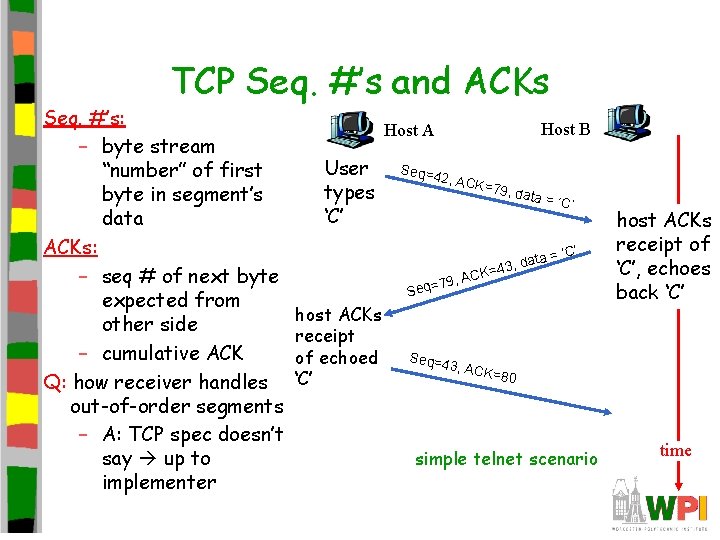
TCP Seq. #’s and ACKs Seq. #’s: – byte stream “number” of first byte in segment’s data ACKs: – seq # of next byte expected from other side – cumulative ACK Q: how receiver handles out-of-order segments – A: TCP spec doesn’t say up to implementer Host B Host A User types ‘C’ Seq=4 2, AC K=79, data = ‘C’ ta = 3, da ‘C’ CK=4 A , 9 eq=7 S host ACKs receipt of echoed ‘C’ Seq=4 host ACKs receipt of ‘C’, echoes back ‘C’ 3, ACK =80 simple telnet scenario time
TCP Round Trip Time and Timeout Q: how to set TCP timeout value?
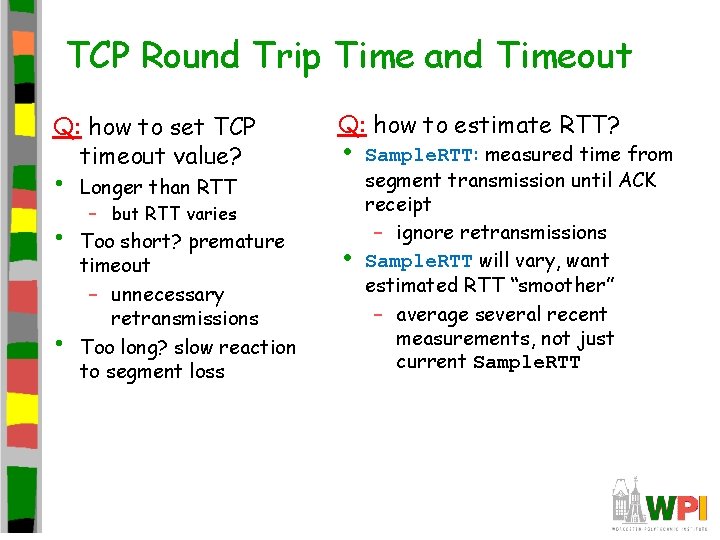
TCP Round Trip Time and Timeout Q: how to set TCP timeout value? • • • Longer than RTT – but RTT varies Too short? premature timeout – unnecessary retransmissions Too long? slow reaction to segment loss Q: how to estimate RTT?
TCP Round Trip Time and Timeout Q: how to set TCP timeout value? • • • Q: how to estimate RTT? • Sample. RTT: measured time from Longer than RTT – but RTT varies Too short? premature timeout – unnecessary retransmissions Too long? slow reaction to segment loss • segment transmission until ACK receipt – ignore retransmissions Sample. RTT will vary, want estimated RTT “smoother” – average several recent measurements, not just current Sample. RTT
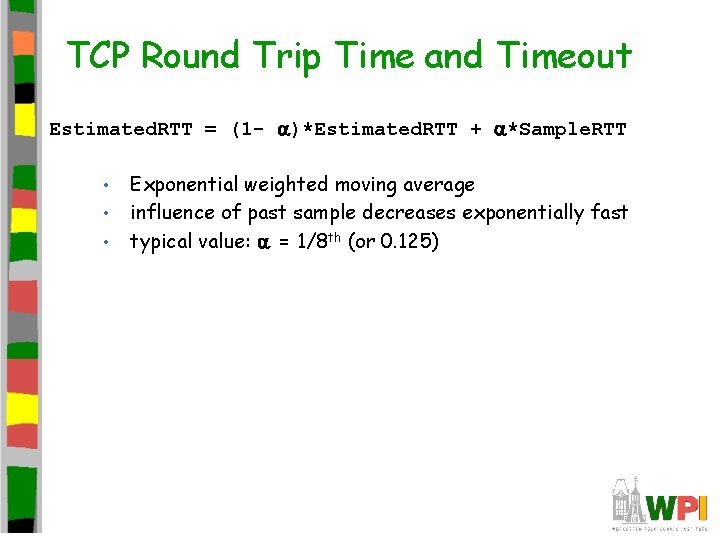
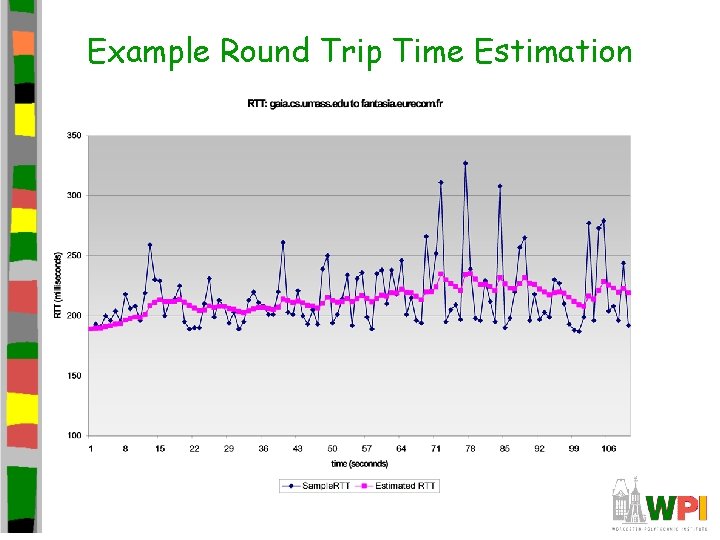
TCP Round Trip Time and Timeout Estimated. RTT = (1 - )*Estimated. RTT + *Sample. RTT • • • Exponential weighted moving average influence of past sample decreases exponentially fast typical value: = 1/8 th (or 0. 125)
Example Round Trip Time Estimation
TCP Round Trip Time and Timeout Setting the timeout • Estimted. RTT plus “safety margin” • – large variation in Estimated. RTT -> larger safety margin First estimate of how much Sample. RTT deviates from Estimated. RTT: Dev. RTT = (1 - )*Dev. RTT + *|Sample. RTT-Estimated. RTT| (typically, = 0. 25) Then set timeout interval: Timeout. Interval = Estimated. RTT + 4*Dev. RTT
Chapter 3 outline • • 3. 1 Transport-layer services 3. 2 Multiplexing and demultiplexing 3. 3 Connectionless transport: UDP 3. 4 Principles of reliable data transfer • • • 3. 5 Connection-oriented transport: TCP – – segment structure reliable data transfer flow control connection management 3. 6 Principles of congestion control 3. 7 TCP congestion control
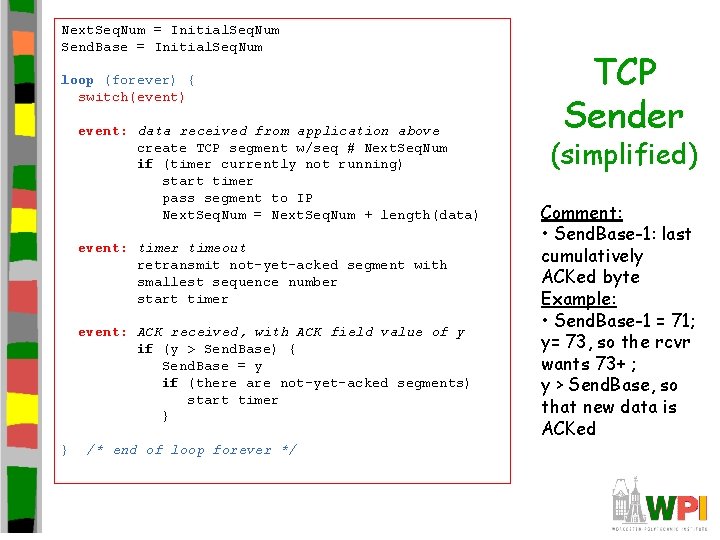
TCP reliable data transfer • • TCP creates rdt service on top of IP’s unreliable service Pipelined segments Cumulative ACKs TCP uses single retransmission timer • • Retransmissions are triggered by: – Timeout events – Duplicate ACKs Initially consider simplified TCP sender: – Ignore duplicate ACKs – Ignore flow control, congestion control
TCP Sender Events: Data rcvd from app: • Create segment with seq # • seq # is byte-stream number of first data byte in segment • Start timer if not already running (think of timer as for oldest un. ACKed segment) • Expiration interval: Time. Out. Interval Timeout: • retransmit segment that caused timeout • restart timer ACK rcvd: • If acknowledges previously un. ACKed segments – update what is known to be ACKed – start timer if there are outstanding segments
Next. Seq. Num = Initial. Seq. Num Send. Base = Initial. Seq. Num loop (forever) { switch(event) event: data received from application above create TCP segment w/seq # Next. Seq. Num if (timer currently not running) start timer pass segment to IP Next. Seq. Num = Next. Seq. Num + length(data) event: timer timeout retransmit not-yet-acked segment with smallest sequence number start timer event: ACK received, with ACK field value of y if (y > Send. Base) { Send. Base = y if (there are not-yet-acked segments) start timer } } /* end of loop forever */ TCP Sender (simplified) Comment: • Send. Base-1: last cumulatively ACKed byte Example: • Send. Base-1 = 71; y= 73, so the rcvr wants 73+ ; y > Send. Base, so that new data is ACKed
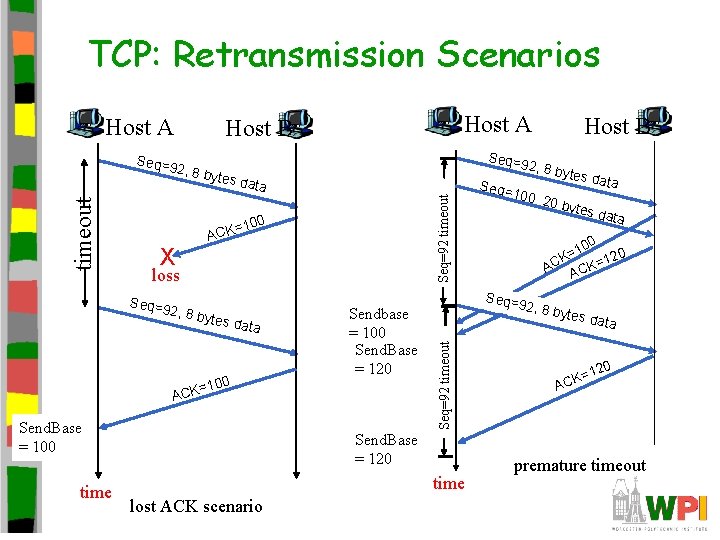
TCP: Retransmission Scenarios Host A Seq=9 2, 8 b ytes d Seq=92 timeout ata =100 ACK X loss Seq=9 2, 8 b ytes d ata 100 Sendbase = 100 Send. Base = 120 = ACK Send. Base = 100 time Host B Seq=9 Send. Base = 120 time lost ACK scenario 2, 8 b Seq= 100, ytes d a ta 20 by t es da t a 0 10 = K 120 = C K A AC Seq=92 timeout Host A Host B 2, 8 b ytes d ata 0 AC 2 K=1 premature timeout
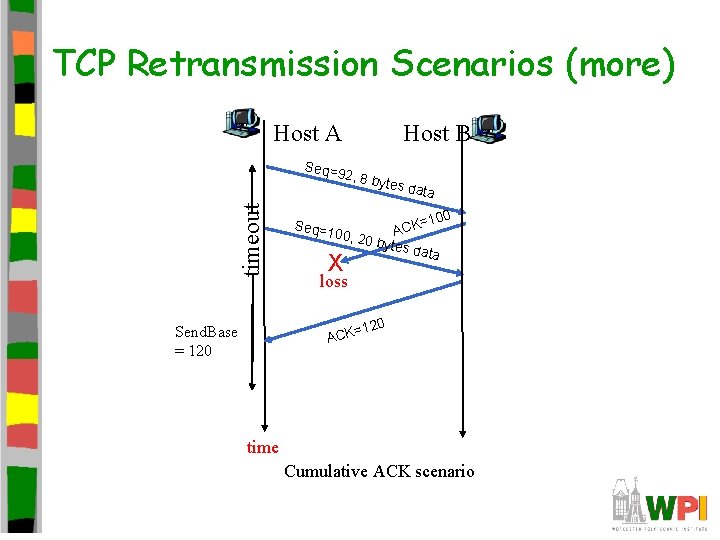
TCP Retransmission Scenarios (more) Host A Host B Seq=9 timeout 2, 8 b yt es dat a 00 K=1 C A 00, 20 bytes data Seq=1 X loss =120 Send. Base = 120 ACK time Cumulative ACK scenario
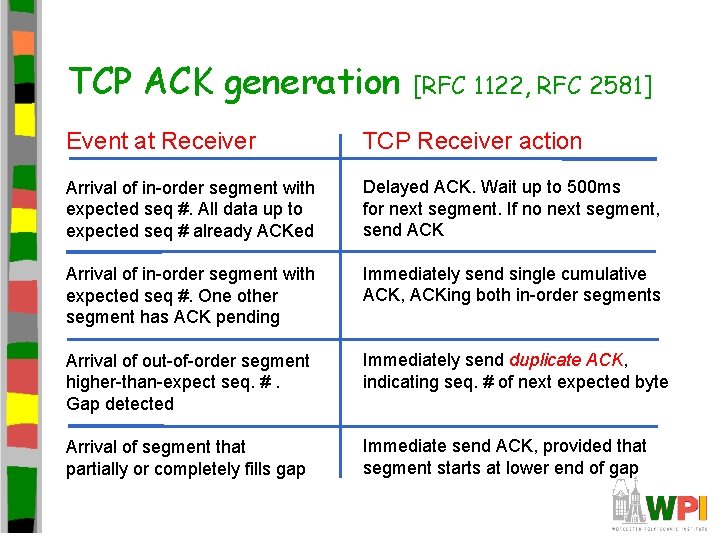
TCP ACK generation [RFC 1122, RFC 2581] Event at Receiver TCP Receiver action Arrival of in-order segment with expected seq #. All data up to expected seq # already ACKed Delayed ACK. Wait up to 500 ms for next segment. If no next segment, send ACK Arrival of in-order segment with expected seq #. One other segment has ACK pending Immediately send single cumulative ACK, ACKing both in-order segments Arrival of out-of-order segment higher-than-expect seq. #. Gap detected Immediately send duplicate ACK, indicating seq. # of next expected byte Arrival of segment that partially or completely fills gap Immediate send ACK, provided that segment starts at lower end of gap
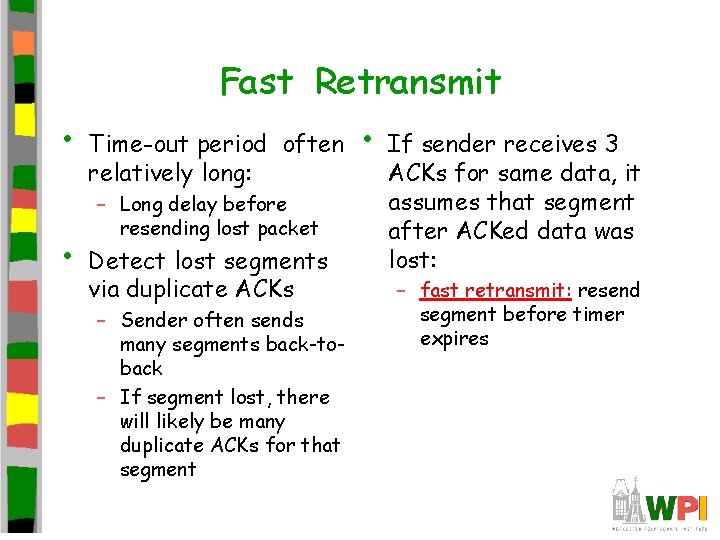
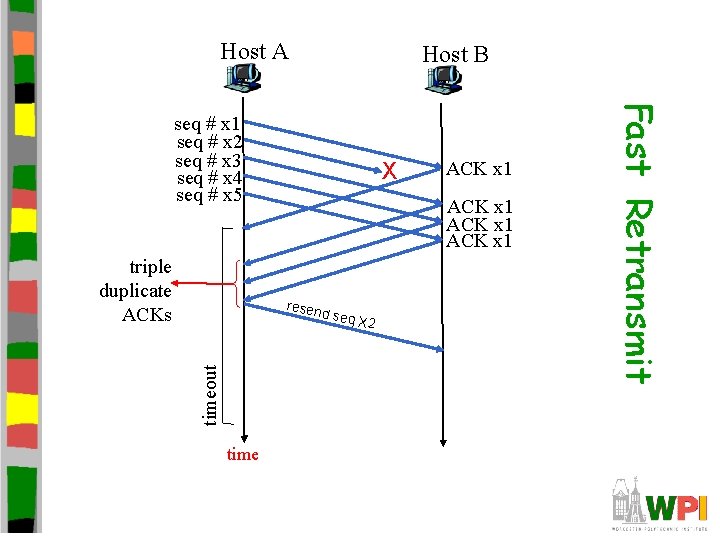
Fast Retransmit • • Time-out period often relatively long: – Long delay before resending lost packet Detect lost segments via duplicate ACKs – Sender often sends many segments back-toback – If segment lost, there will likely be many duplicate ACKs for that segment • If sender receives 3 ACKs for same data, it assumes that segment after ACKed data was lost: – fast retransmit: resend segment before timer expires
Host A Host B triple duplicate ACKs X ACK x 1 resen timeout d seq time ACK x 1 X 2 Fast Retransmit seq # x 1 seq # x 2 seq # x 3 seq # x 4 seq # x 5
Chapter 3 outline • • 3. 1 Transport-layer services 3. 2 Multiplexing and demultiplexing 3. 3 Connectionless transport: UDP 3. 4 Principles of reliable data transfer • • • 3. 5 Connection-oriented transport: TCP – – segment structure reliable data transfer flow control connection management 3. 6 Principles of congestion control 3. 7 TCP congestion control
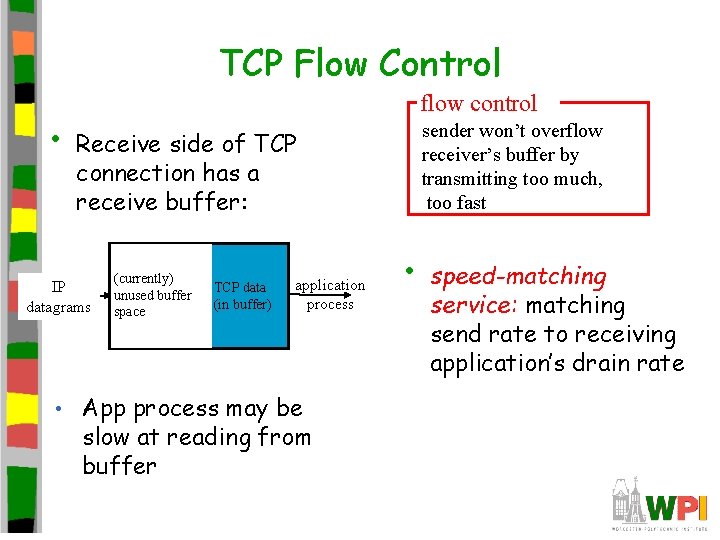
TCP Flow Control • flow control sender won’t overflow receiver’s buffer by transmitting too much, too fast Receive side of TCP connection has a receive buffer: IP datagrams (currently) unused buffer space TCP data (in buffer) application process • App process may be slow at reading from buffer • speed-matching service: matching send rate to receiving application’s drain rate
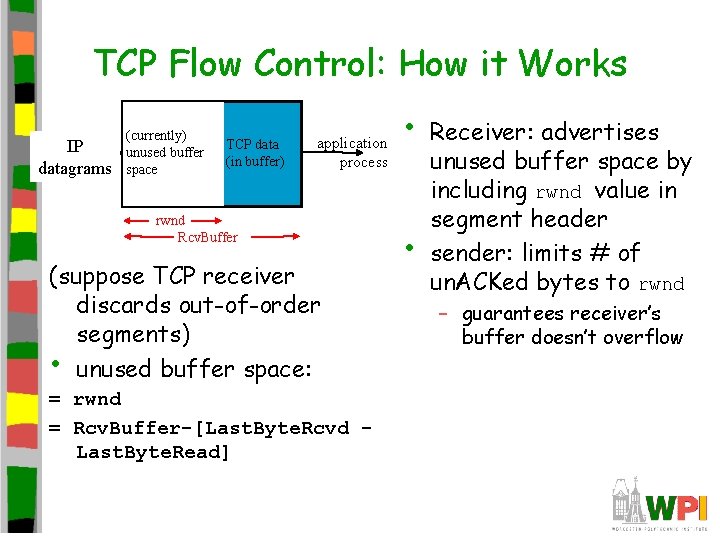
TCP Flow Control: How it Works IP datagrams (currently) unused buffer space TCP data (in buffer) application process rwnd Rcv. Buffer (suppose TCP receiver discards out-of-order segments) • unused buffer space: = rwnd = Rcv. Buffer-[Last. Byte. Rcvd Last. Byte. Read] • • Receiver: advertises unused buffer space by including rwnd value in segment header sender: limits # of un. ACKed bytes to rwnd – guarantees receiver’s buffer doesn’t overflow
Chapter 3 outline • • 3. 1 Transport-layer services 3. 2 Multiplexing and demultiplexing 3. 3 Connectionless transport: UDP 3. 4 Principles of reliable data transfer • • • 3. 5 Connection-oriented transport: TCP – – segment structure reliable data transfer flow control connection management 3. 6 Principles of congestion control 3. 7 TCP congestion control
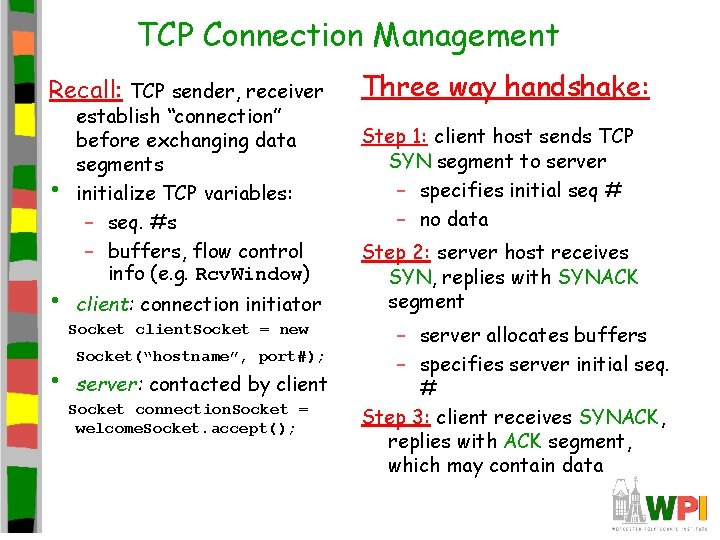
TCP Connection Management Recall: TCP sender, receiver • • establish “connection” before exchanging data segments initialize TCP variables: – seq. #s – buffers, flow control info (e. g. Rcv. Window) client: connection initiator Socket client. Socket = new • Socket(“hostname”, port#); server: contacted by client Socket connection. Socket = welcome. Socket. accept(); Three way handshake: Step 1: client host sends TCP SYN segment to server – specifies initial seq # – no data Step 2: server host receives SYN, replies with SYNACK segment – server allocates buffers – specifies server initial seq. # Step 3: client receives SYNACK, replies with ACK segment, which may contain data
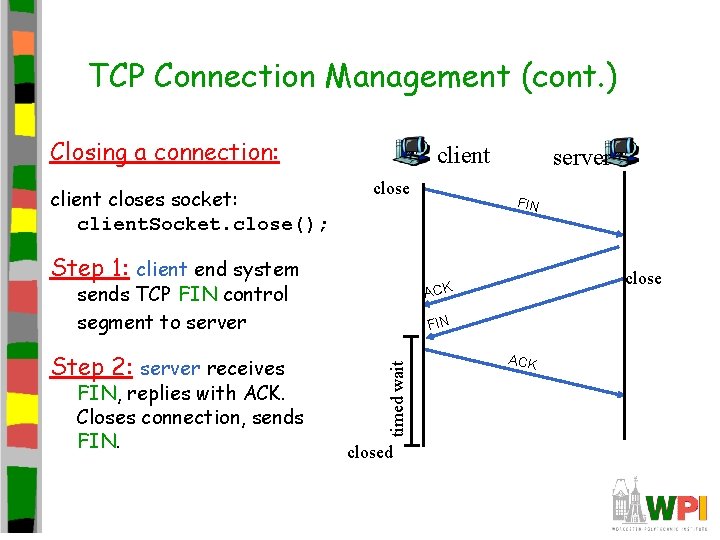
TCP Connection Management (cont. ) Closing a connection: client closes socket: client. Socket. close(); client close Step 1: client end system sends TCP FIN control segment to server FIN, replies with ACK. Closes connection, sends FIN close ACK FIN timed wait Step 2: server receives server closed ACK
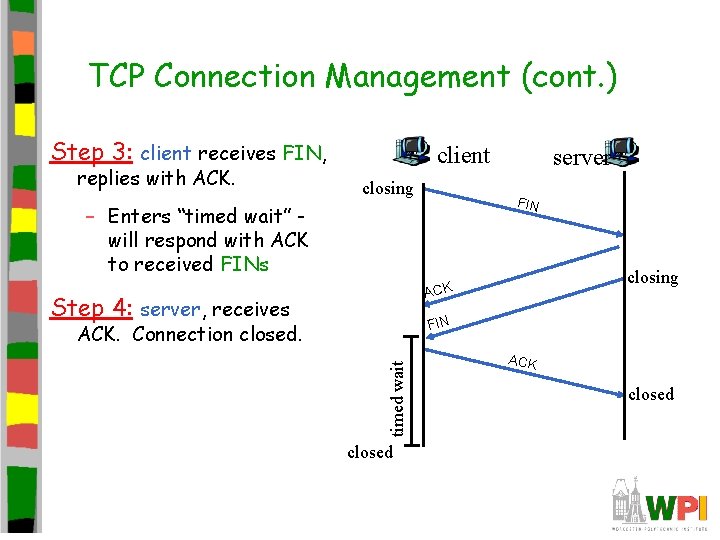
TCP Connection Management (cont. ) Step 3: client receives FIN, replies with ACK. client closing server FIN – Enters “timed wait” will respond with ACK to received FINs closing ACK Step 4: server, receives FIN timed wait ACK. Connection closed ACK closed
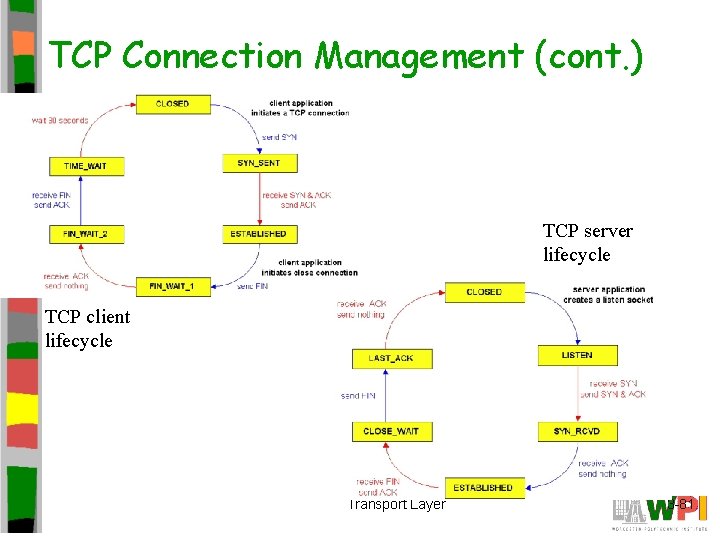
TCP Connection Management (cont. ) TCP server lifecycle TCP client lifecycle Transport Layer 3 -81
Chapter 3 outline • • 3. 1 Transport-layer services 3. 2 Multiplexing and demultiplexing 3. 3 Connectionless transport: UDP 3. 4 Principles of reliable data transfer • • • 3. 5 Connection-oriented transport: TCP – – segment structure reliable data transfer flow control connection management 3. 6 Principles of congestion control 3. 7 TCP congestion control
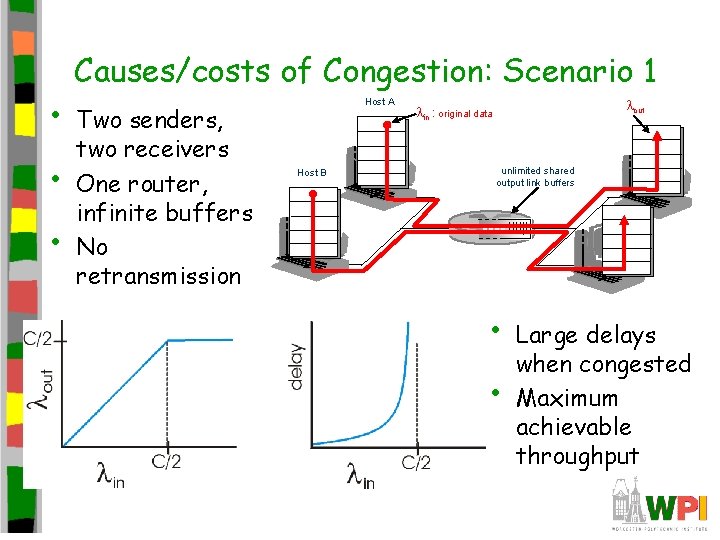
Principles of Congestion Control Congestion: • • Informally: “too many sources sending too much data too fast for network to handle” Different from flow control! Manifestations: – Lost packets (buffer overflow at routers) – Long delays (queueing in router buffers) A “top-10” problem!
• • • Causes/costs of Congestion: Scenario 1 Two senders, two receivers One router, infinite buffers No retransmission Host A Host B lout lin : original data unlimited shared output link buffers • • Large delays when congested Maximum achievable throughput
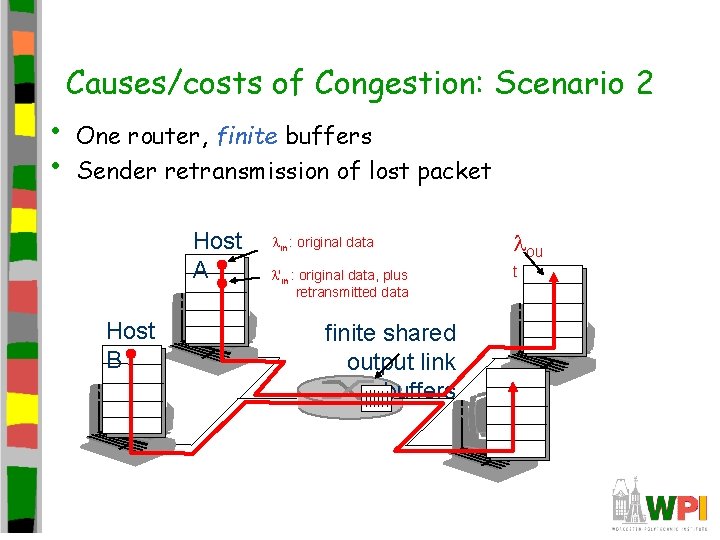
Causes/costs of Congestion: Scenario 2 • • One router, finite buffers Sender retransmission of lost packet Host A Host B lin : original data lou l'in : original data, plus retransmitted data t finite shared output link buffers
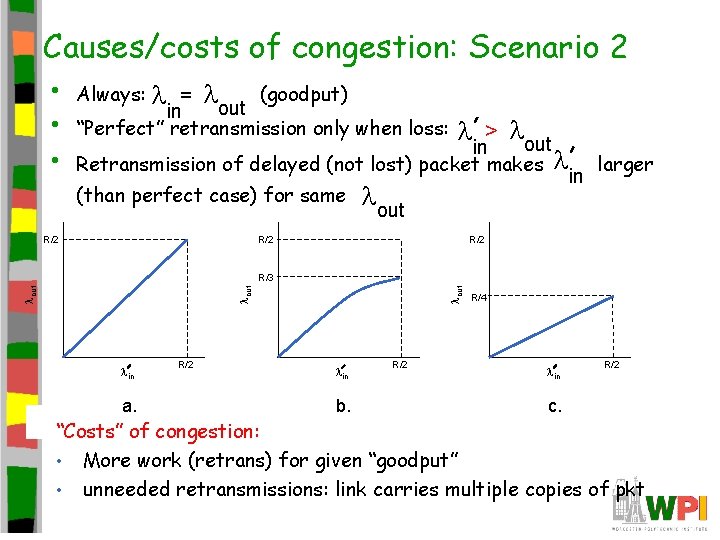
Causes/costs of congestion: Scenario 2 • Always: l = lout (goodput) in • “Perfect” retransmission only when loss: l > l out in • Retransmission of delayed (not lost) packet makes lin larger (than perfect case) for same R/2 lout R/2 lin a. R/2 lout R/3 lin b. R/2 R/4 lin R/2 c. “Costs” of congestion: • More work (retrans) for given “goodput” • unneeded retransmissions: link carries multiple copies of pkt
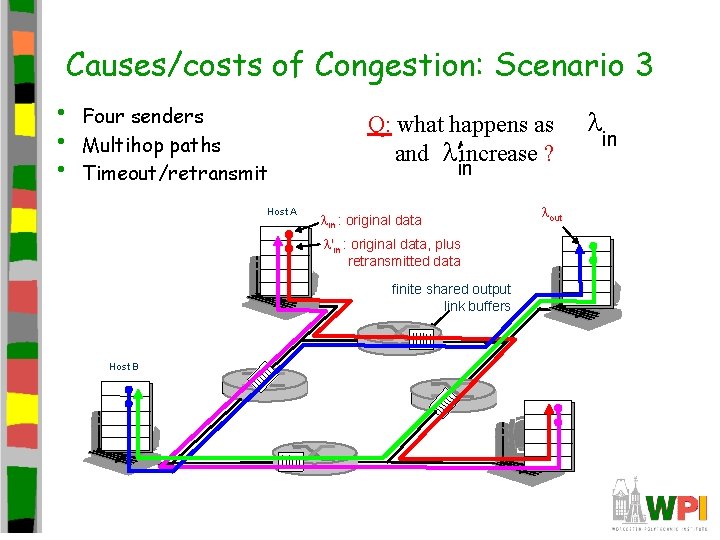
Causes/costs of Congestion: Scenario 3 • Four senders Q: what happens as l in • Multihop paths and l increase ? in • Timeout/retransmit Host A lin : original data l'in : original data, plus retransmitted data finite shared output link buffers Host B lout
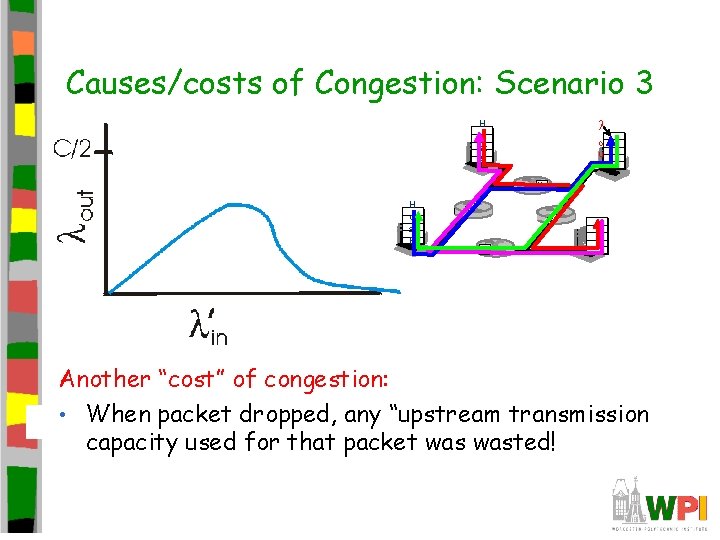
Causes/costs of Congestion: Scenario 3 H o st A l o u t H o st B Another “cost” of congestion: • When packet dropped, any “upstream transmission capacity used for that packet wasted!
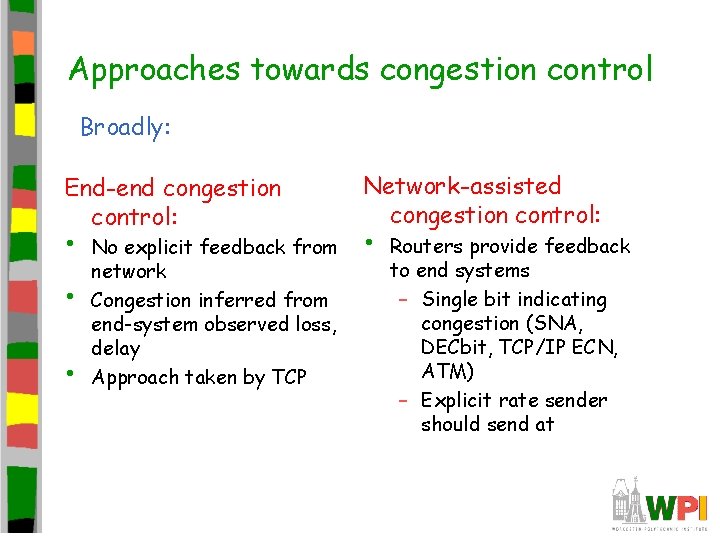
Approaches towards congestion control Broadly: End-end congestion control: • • • No explicit feedback from network Congestion inferred from end-system observed loss, delay Approach taken by TCP Network-assisted congestion control: • Routers provide feedback to end systems – Single bit indicating congestion (SNA, DECbit, TCP/IP ECN, ATM) – Explicit rate sender should send at
Chapter 3 outline • • 3. 1 Transport-layer services 3. 2 Multiplexing and demultiplexing 3. 3 Connectionless transport: UDP 3. 4 Principles of reliable data transfer • • • 3. 5 Connection-oriented transport: TCP – – segment structure reliable data transfer flow control connection management 3. 6 Principles of congestion control 3. 7 TCP congestion control
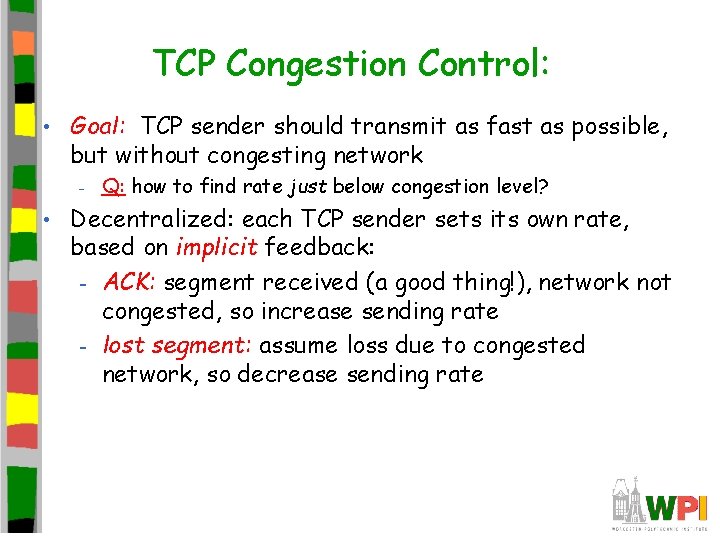
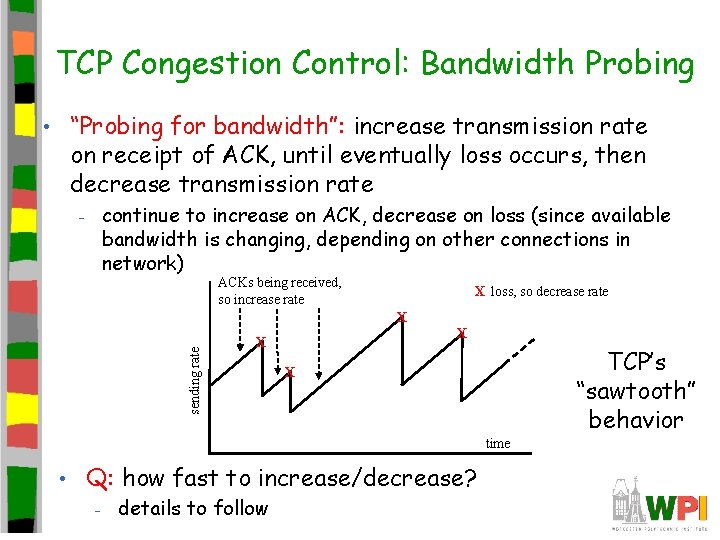
TCP Congestion Control: • Goal: TCP sender should transmit as fast as possible, but without congesting network - Q: how to find rate just below congestion level? • Decentralized: each TCP sender sets its own rate, based on implicit feedback: - ACK: segment received (a good thing!), network not congested, so increase sending rate - lost segment: assume loss due to congested network, so decrease sending rate
TCP Congestion Control: Bandwidth Probing • “Probing for bandwidth”: increase transmission rate on receipt of ACK, until eventually loss occurs, then decrease transmission rate - continue to increase on ACK, decrease on loss (since available bandwidth is changing, depending on other connections in network) ACKs being received, so increase rate X loss, so decrease rate sending rate X X X TCP’s “sawtooth” behavior X time • Q: how fast to increase/decrease? - details to follow
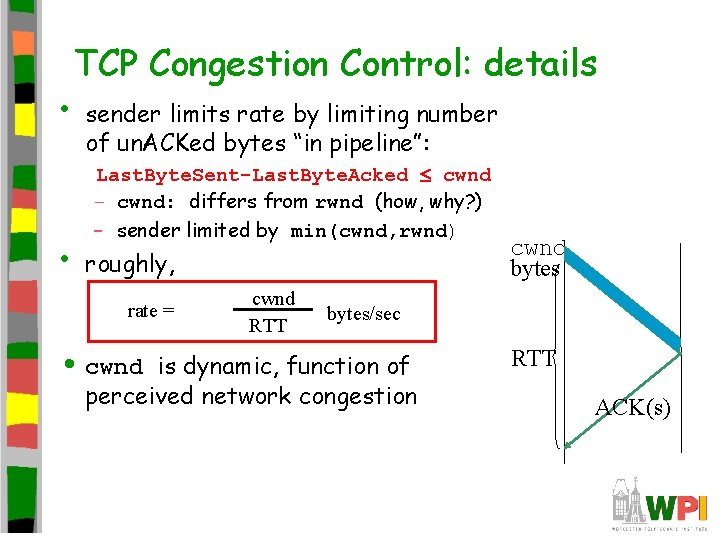
• • TCP Congestion Control: details sender limits rate by limiting number of un. ACKed bytes “in pipeline”: Last. Byte. Sent-Last. Byte. Acked cwnd – cwnd: differs from rwnd (how, why? ) – sender limited by min(cwnd, rwnd) roughly, rate = • cwnd RTT cwnd bytes/sec is dynamic, function of perceived network congestion RTT ACK(s)
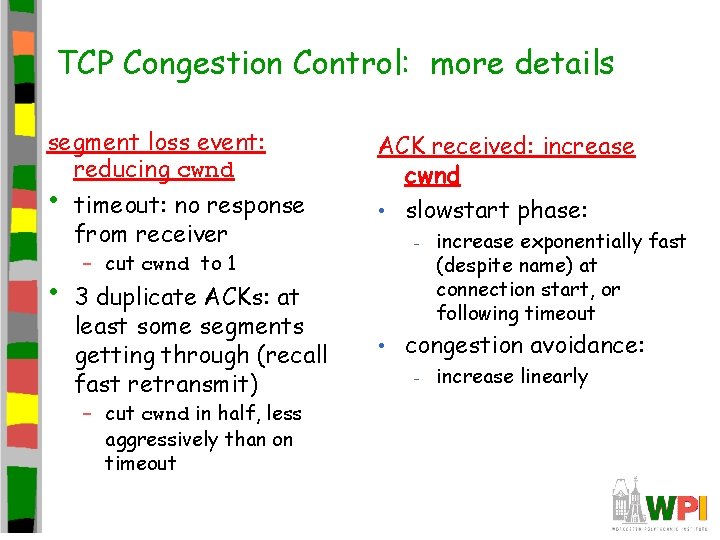
TCP Congestion Control: more details segment loss event: reducing cwnd • • timeout: no response from receiver – cut cwnd to 1 3 duplicate ACKs: at least some segments getting through (recall fast retransmit) – cut cwnd in half, less aggressively than on timeout ACK received: increase cwnd • slowstart phase: - increase exponentially fast (despite name) at connection start, or following timeout • congestion avoidance: - increase linearly
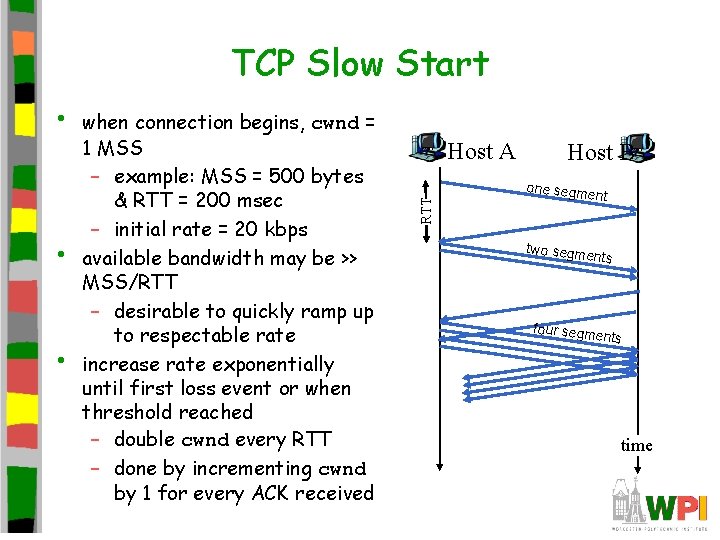
TCP Slow Start • • when connection begins, cwnd = 1 MSS – example: MSS = 500 bytes & RTT = 200 msec – initial rate = 20 kbps available bandwidth may be >> MSS/RTT – desirable to quickly ramp up to respectable rate increase rate exponentially until first loss event or when threshold reached – double cwnd every RTT – done by incrementing cwnd by 1 for every ACK received Host A RTT • Host B one segm ent two segm ents four segm ents time
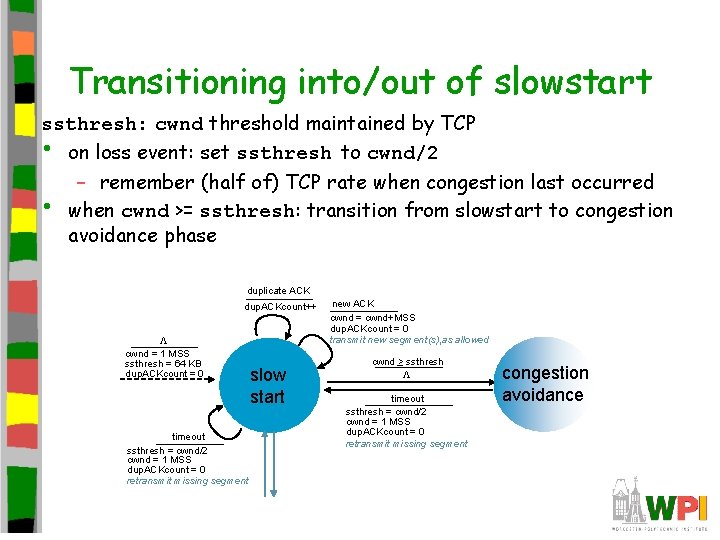
Transitioning into/out of slowstart ssthresh: cwnd threshold maintained by TCP • on loss event: set ssthresh to cwnd/2 – remember (half of) TCP rate when congestion last occurred • when cwnd >= ssthresh: transition from slowstart to congestion avoidance phase duplicate ACK dup. ACKcount++ L cwnd = 1 MSS ssthresh = 64 KB dup. ACKcount = 0 timeout ssthresh = cwnd/2 cwnd = 1 MSS dup. ACKcount = 0 retransmit missing segment slow start new ACK cwnd = cwnd+MSS dup. ACKcount = 0 transmit new segment(s), as allowed cwnd > ssthresh L timeout ssthresh = cwnd/2 cwnd = 1 MSS dup. ACKcount = 0 retransmit missing segment congestion avoidance
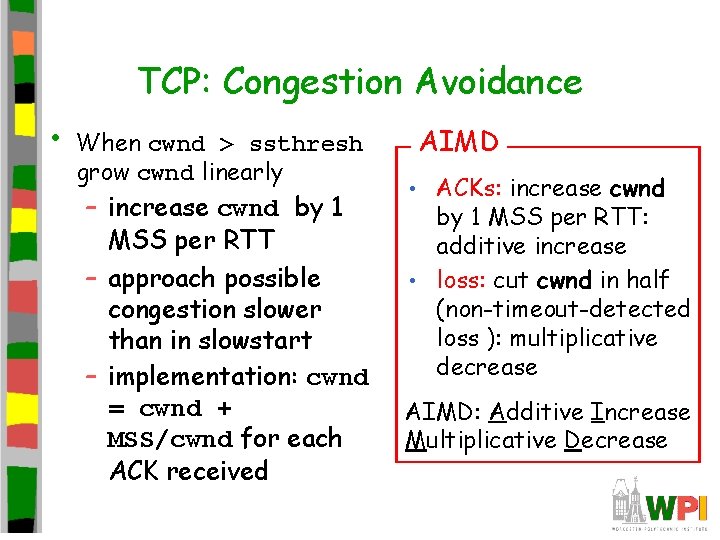
TCP: Congestion Avoidance • When cwnd > ssthresh grow cwnd linearly – increase cwnd by 1 MSS per RTT – approach possible congestion slower than in slowstart – implementation: cwnd = cwnd + MSS/cwnd for each ACK received AIMD • ACKs: increase cwnd by 1 MSS per RTT: additive increase • loss: cut cwnd in half (non-timeout-detected loss ): multiplicative decrease AIMD: Additive Increase Multiplicative Decrease
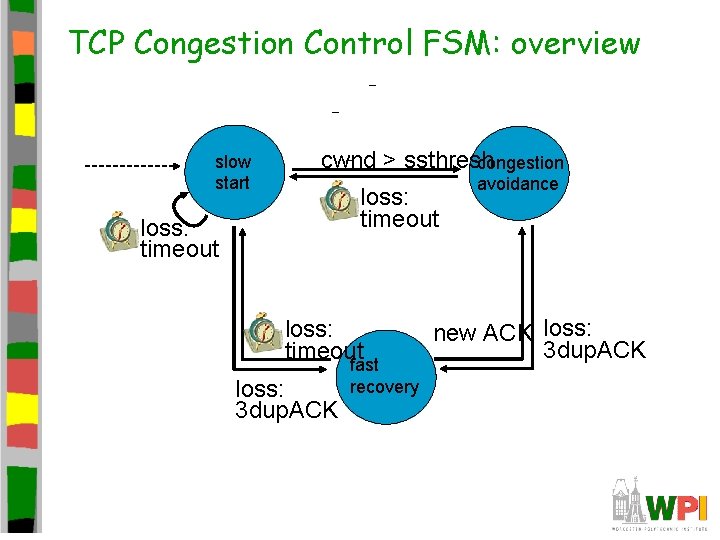
TCP Congestion Control FSM: overview slow start cwnd > ssthresh congestion loss: timeout loss: 3 dup. ACK fast recovery avoidance new ACK loss: 3 dup. ACK
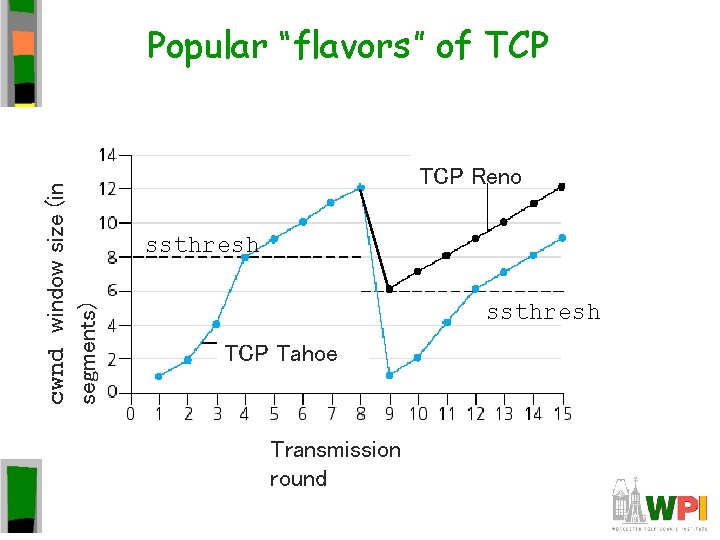
cwnd window size (in segments) Popular “flavors” of TCP Reno ssthresh TCP Tahoe Transmission round
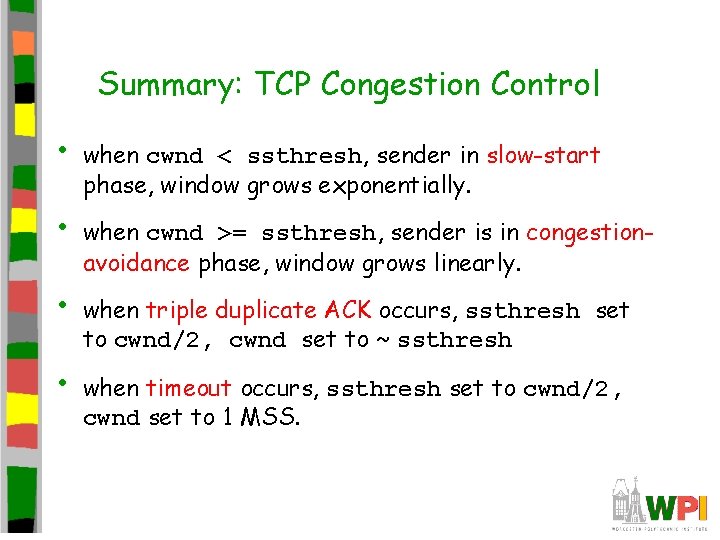
Summary: TCP Congestion Control • • when cwnd < ssthresh, sender in slow-start phase, window grows exponentially. when cwnd >= ssthresh, sender is in congestionavoidance phase, window grows linearly. when triple duplicate ACK occurs, ssthresh set to cwnd/2, cwnd set to ~ ssthresh when timeout occurs, ssthresh set to cwnd/2, cwnd set to 1 MSS.
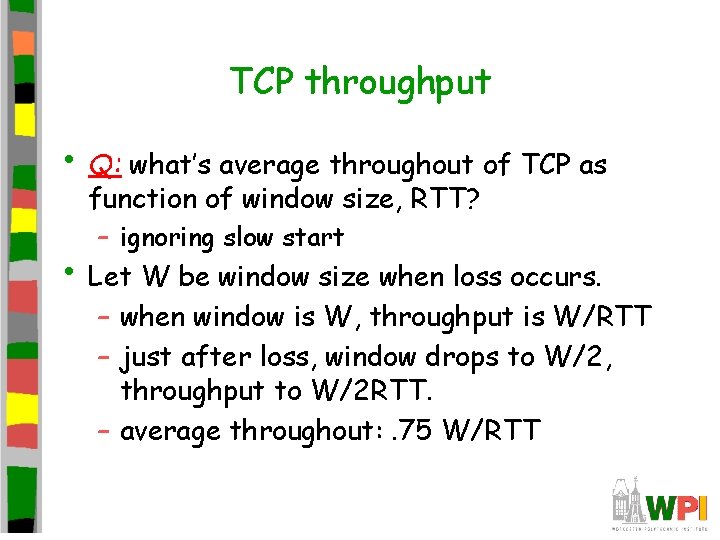
TCP throughput • Q: what’s average throughout of TCP as function of window size, RTT? – ignoring slow start • Let W be window size when loss occurs. – when window is W, throughput is W/RTT – just after loss, window drops to W/2, throughput to W/2 RTT. – average throughout: . 75 W/RTT
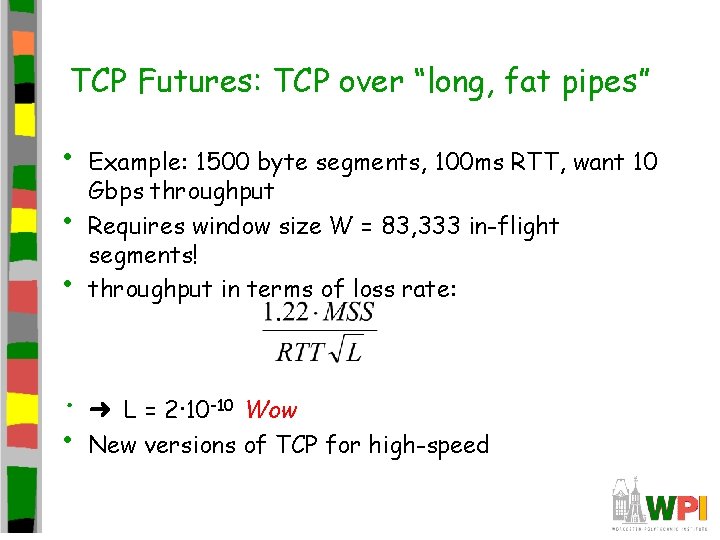
TCP Futures: TCP over “long, fat pipes” • • • Example: 1500 byte segments, 100 ms RTT, want 10 Gbps throughput Requires window size W = 83, 333 in-flight segments! throughput in terms of loss rate: • ➜ L = 2·10 -10 Wow • New versions of TCP for high-speed
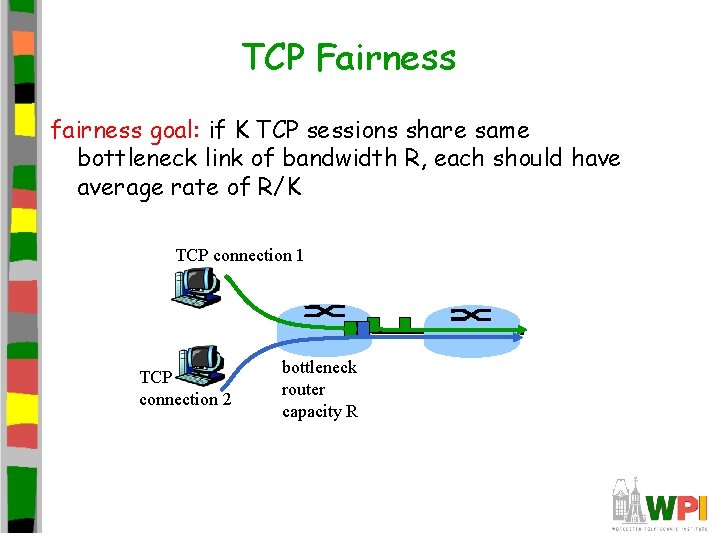
TCP Fairness fairness goal: if K TCP sessions share same bottleneck link of bandwidth R, each should have average rate of R/K TCP connection 1 TCP connection 2 bottleneck router capacity R
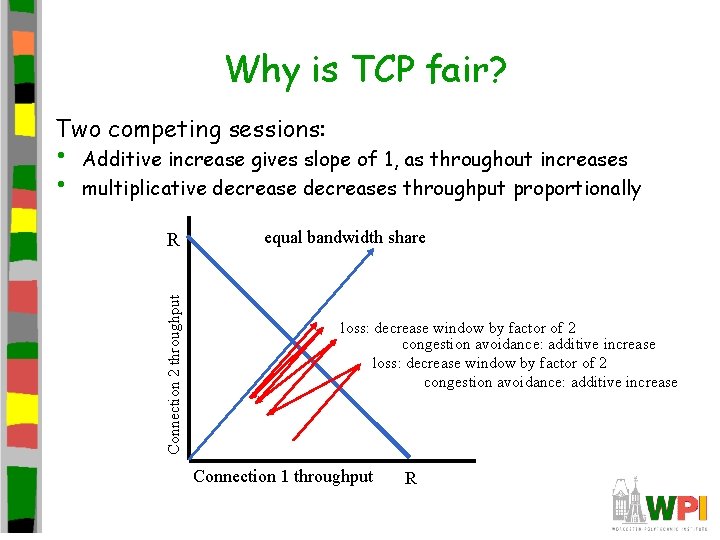
Why is TCP fair? Two competing sessions: Additive increase gives slope of 1, as throughout increases multiplicative decreases throughput proportionally R Connection 2 throughput • • equal bandwidth share loss: decrease window by factor of 2 congestion avoidance: additive increase Connection 1 throughput R
Fairness (more) Fairness and UDP • Multimedia apps often do not use TCP • – do not want rate throttled by congestion control Instead use UDP: – pump audio/video at constant rate, tolerate packet loss Fairness and Parallel TCP Connections • Nothing prevents app from opening parallel connections between 2 hosts. • Web browsers do this • Example: link of rate R supporting 9 connections; – new app asks for 1 TCP, gets rate R/10 – new app asks for 11 TCPs, gets R/2 !
Chapter 3: Summary • • Principles behind transport layer services: – multiplexing, demultiplexing – reliable data transfer – flow control – congestion control Instantiation and implementation in the Internet – UDP – TCP Next: • leaving the network “edge” (application, transport layers) • into the network “core”