
Transport Layer Transportlayer services Multiplexing and demultiplexing COMPSCI


- Slides: 16
Transport Layer § Transport-layer services § Multiplexing and demultiplexing COMPSCI 453 Computer Networks Professor Jim Kurose College of Information and Computer Sciences University of Massachusetts § Connectionless transport: UDP § § § Principles of reliable data transfer Connection-oriented transport: TCP Principles of congestion control TCP congestion control Evolution of transport-layer functionality Class textbook: Computer Networking: A Top. Down Approach (8 th ed. ) J. F. Kurose, K. W. Ross Pearson, 2020 http: //gaia. cs. umass. edu/kurose_ross
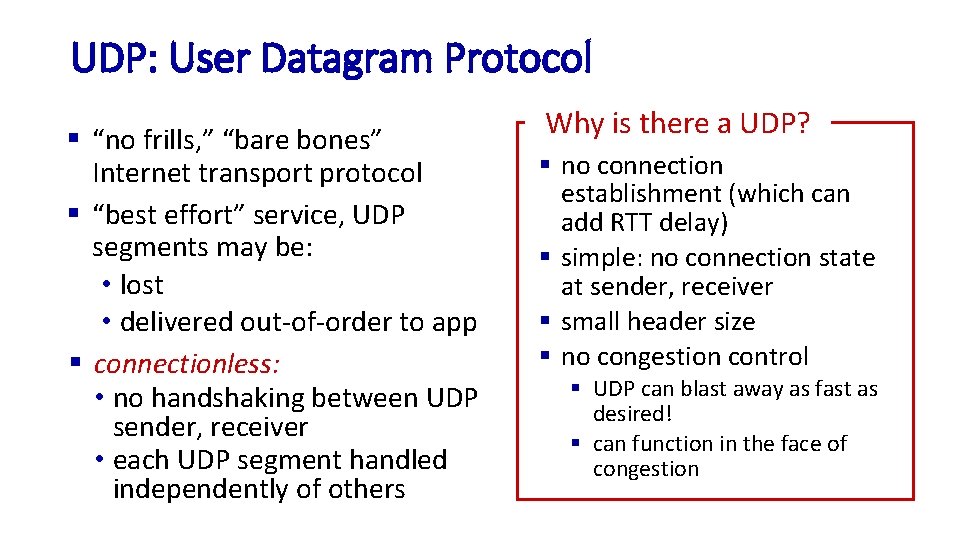
UDP: User Datagram Protocol § “no frills, ” “bare bones” Internet transport protocol § “best effort” service, UDP segments may be: • lost • delivered out-of-order to app § connectionless: • no handshaking between UDP sender, receiver • each UDP segment handled independently of others Why is there a UDP? § no connection establishment (which can add RTT delay) § simple: no connection state at sender, receiver § small header size § no congestion control § UDP can blast away as fast as desired! § can function in the face of congestion
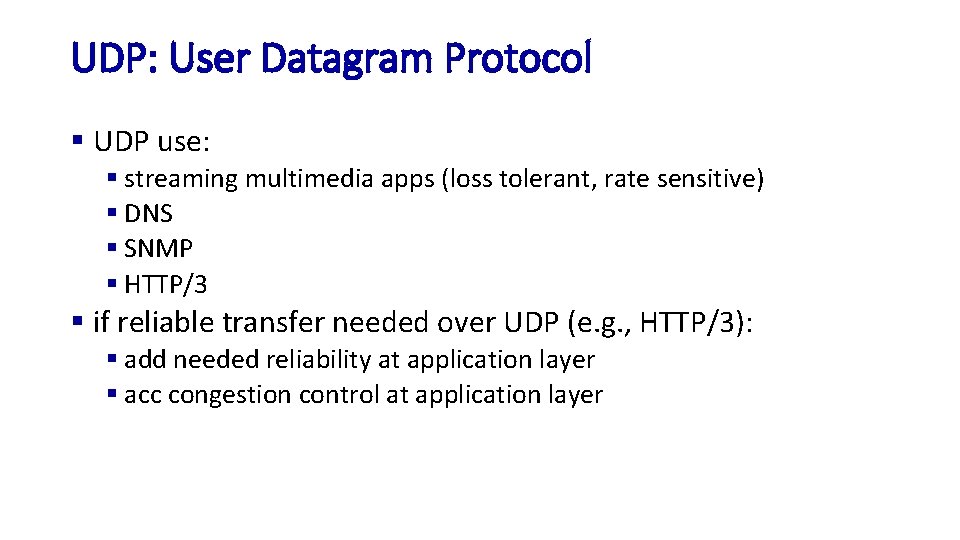
UDP: User Datagram Protocol § UDP use: § streaming multimedia apps (loss tolerant, rate sensitive) § DNS § SNMP § HTTP/3 § if reliable transfer needed over UDP (e. g. , HTTP/3): § add needed reliability at application layer § acc congestion control at application layer
UDP: User Datagram Protocol [RFC 768]
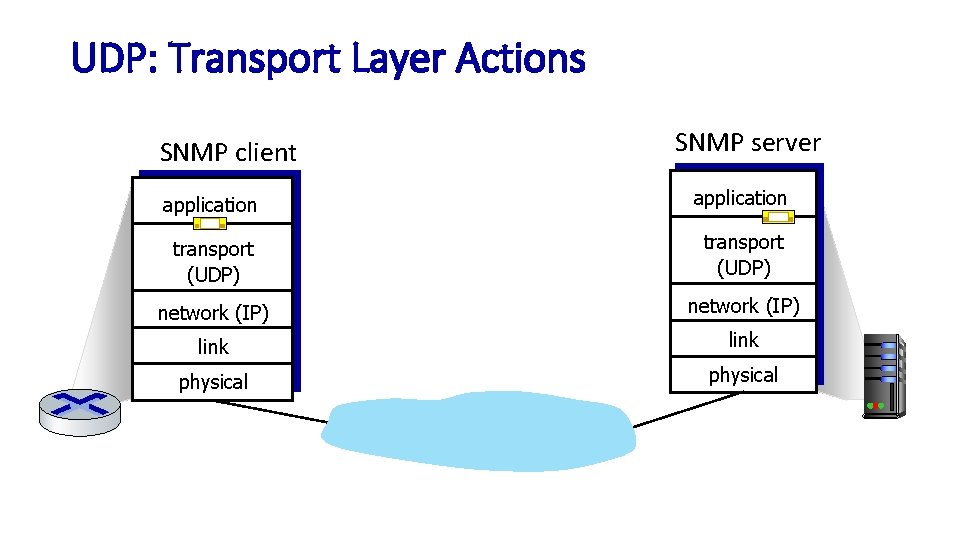
UDP: Transport Layer Actions SNMP client SNMP server application transport (UDP) network (IP) link physical
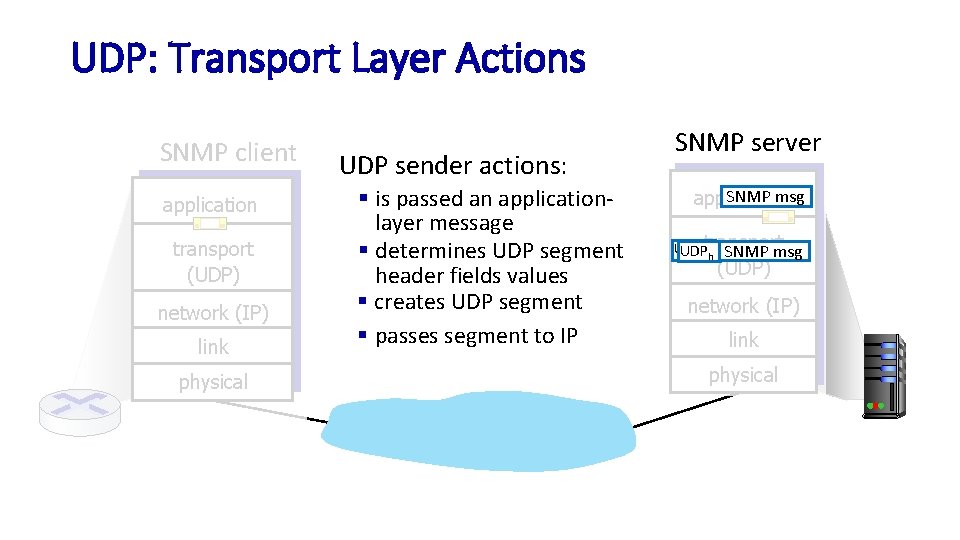
UDP: Transport Layer Actions SNMP client application transport (UDP) network (IP) link physical UDP sender actions: § is passed an applicationlayer message § determines UDP segment header fields values § creates UDP segment § passes segment to IP SNMP server SNMP msg application UDPhtransport h SNMP msg (UDP) network (IP) link physical
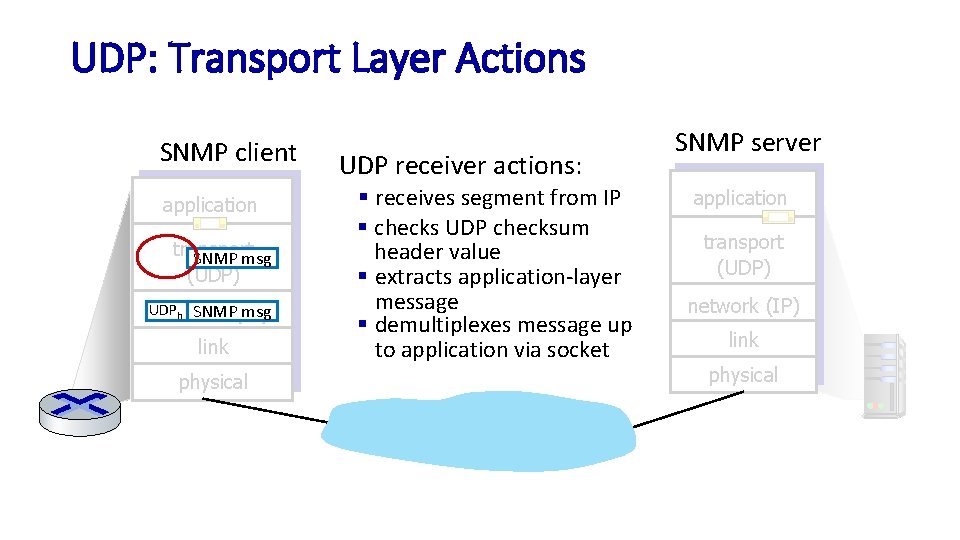
UDP: Transport Layer Actions SNMP client application transport SNMP msg (UDP) UDP msg h SNMP(IP) network link physical UDP receiver actions: § receives segment from IP § checks UDP checksum header value § extracts application-layer message § demultiplexes message up to application via socket SNMP server application transport (UDP) network (IP) link physical
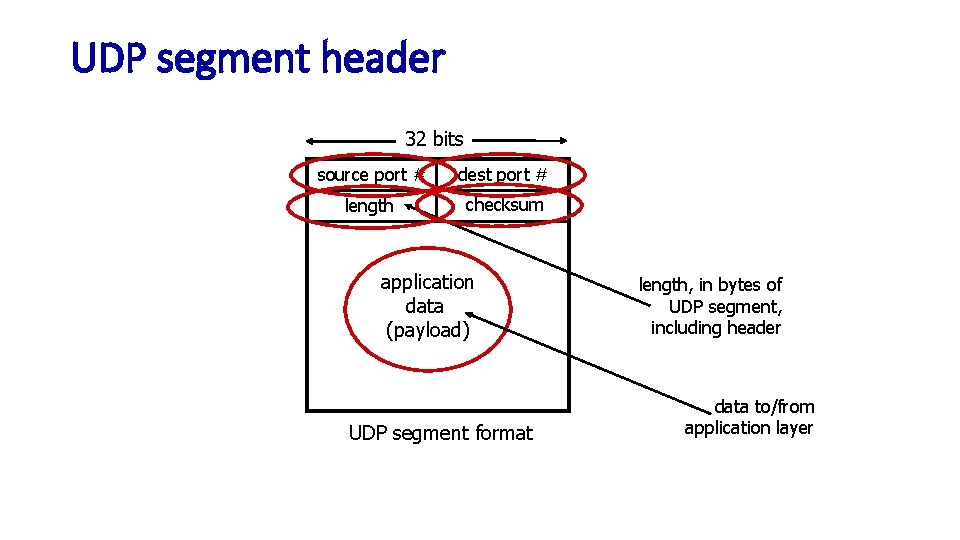
UDP segment header 32 bits source port # dest port # length checksum application data (payload) UDP segment format length, in bytes of UDP segment, including header data to/from application layer
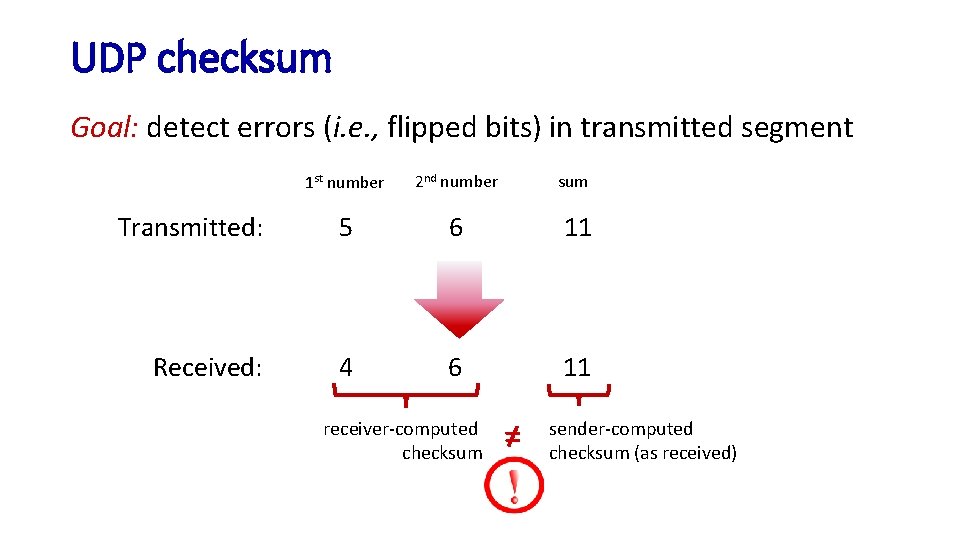
UDP checksum Goal: detect errors (i. e. , flipped bits) in transmitted segment 1 st number 2 nd number sum Transmitted: 5 6 11 Received: 4 6 11 receiver-computed checksum = sender-computed checksum (as received)
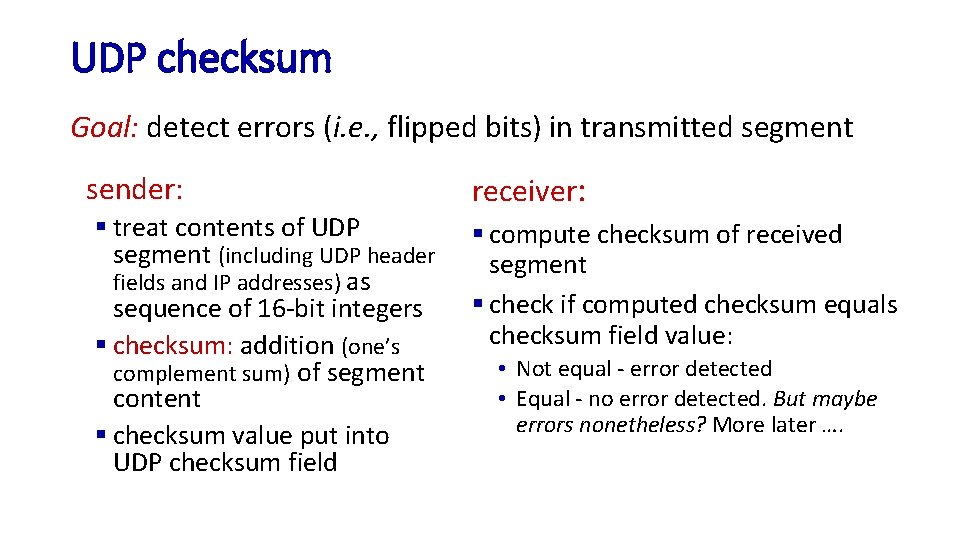
UDP checksum Goal: detect errors (i. e. , flipped bits) in transmitted segment sender: § treat contents of UDP segment (including UDP header fields and IP addresses) as sequence of 16 -bit integers § checksum: addition (one’s complement sum) of segment content § checksum value put into UDP checksum field receiver: § compute checksum of received segment § check if computed checksum equals checksum field value: • Not equal - error detected • Equal - no error detected. But maybe errors nonetheless? More later ….
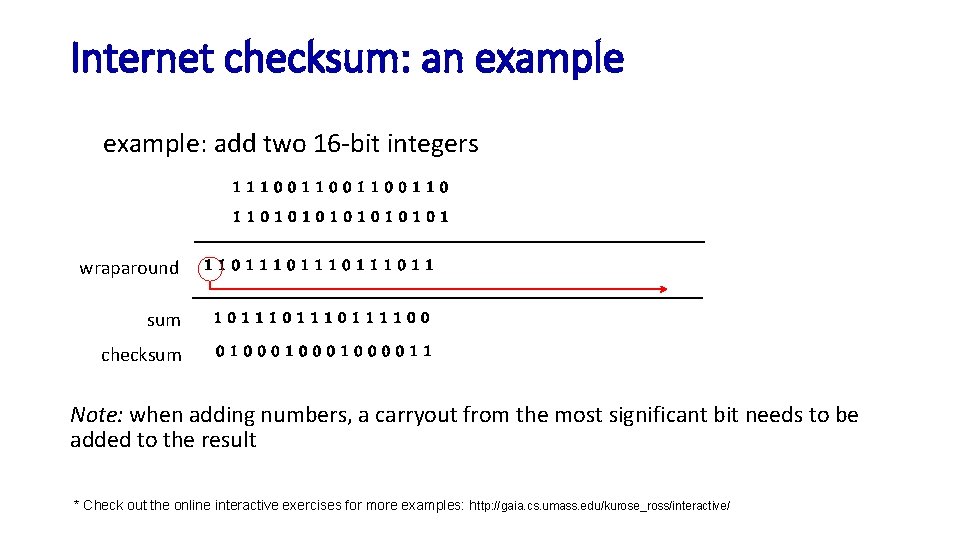
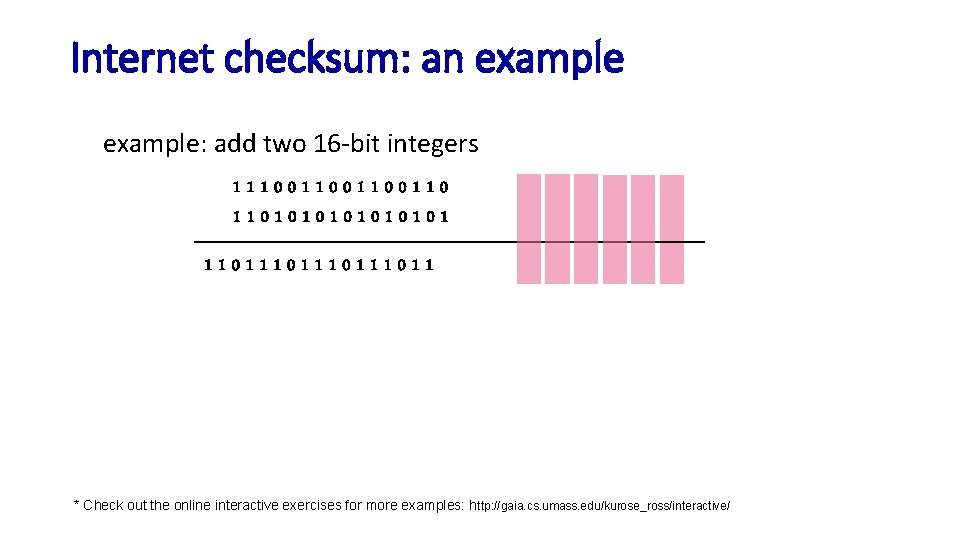
Internet checksum: an example: add two 16 -bit integers 111001100110 1101010101 wraparound 110111011 sum 101110111100 010001000011 checksum Note: when adding numbers, a carryout from the most significant bit needs to be added to the result * Check out the online interactive exercises for more examples: http: //gaia. cs. umass. edu/kurose_ross/interactive/
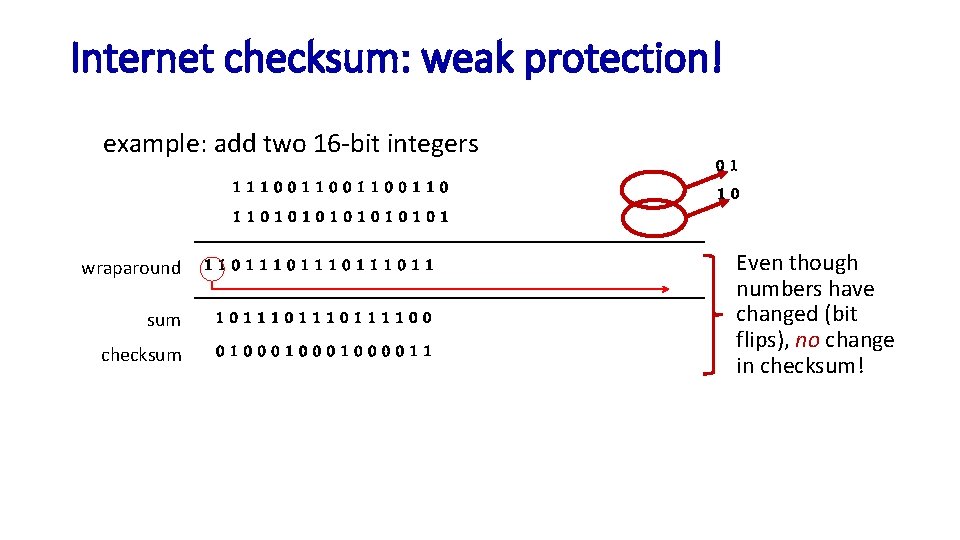
Internet checksum: weak protection! example: add two 16 -bit integers 111001100110 1101010101 wraparound 110111011 sum 101110111100 010001000011 checksum 01 10 Even though numbers have changed (bit flips), no change in checksum!
Summary: UDP § “no frills” protocol: • segments may be lost, delivered out of order • best effort service: “send and hope for the best” § UDP has its plusses: • no setup/handshaking needed (no RTT incurred) • can function when network service is compromised • helps with reliability (checksum) § build additional functionality on top of UDP in application layer (e. g. , HTTP/3)
Transport Layer § Transport-layer services § Multiplexing and demultiplexing COMPSCI 453 Computer Networks Professor Jim Kurose College of Information and Computer Sciences University of Massachusetts § Connectionless transport: UDP § § § Principles of reliable data transfer Connection-oriented transport: TCP Principles of congestion control TCP congestion control Evolution of transport-layer functionality Video: 2020, J. F. Kurose, All Rights Reserved Powerpoint: 1996 -2020, J. F. Kurose, K. W. Ross, All Rights Reserved Class textbook: Computer Networking: A Top. Down Approach (8 th ed. ) J. F. Kurose, K. W. Ross Pearson, 2020 http: //gaia. cs. umass. edu/kurose_ross
Internet checksum: an example: add two 16 -bit integers 111001100110 1101010101 110111011 * Check out the online interactive exercises for more examples: http: //gaia. cs. umass. edu/kurose_ross/interactive/
UDP: User Datagram Protocol § UDP sender/receiver actions § UDP segment format § Internet checksum