The Knowledge Management Infrastructure Prof E Vandijck If


- Slides: 44
The Knowledge Management Infrastructure Prof. E. Vandijck
“ If we only knew what we know at TI “ Jerry Junkins Former chairman , President and CEO of TI
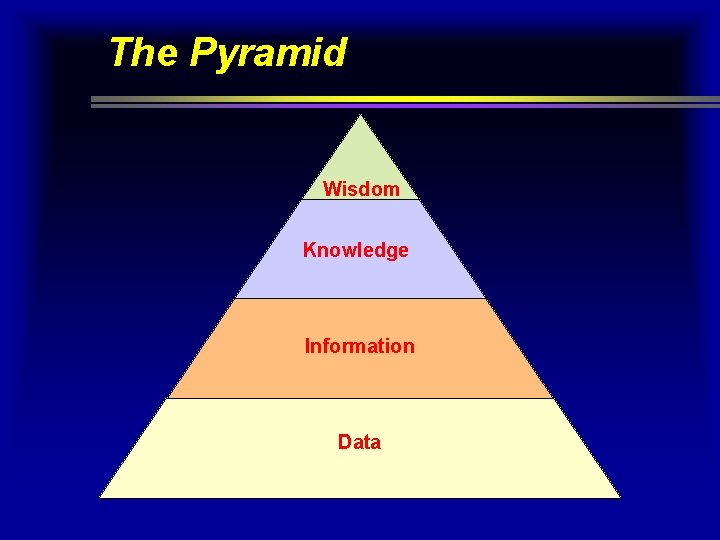
Knowledge § § Knowledge is a broader and more difficult to define concept than information. We obtain knowledge when the information is also interpreted and therefore made usable. We get knowledge by creating associations and by earning insight.
The Pyramid Wisdom Knowledge Information Data
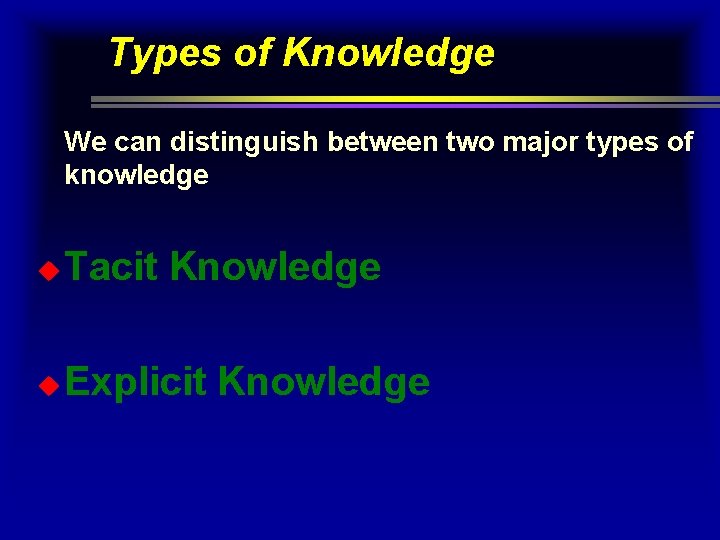
Types of Knowledge We can distinguish between two major types of knowledge u Tacit Knowledge u Explicit Knowledge
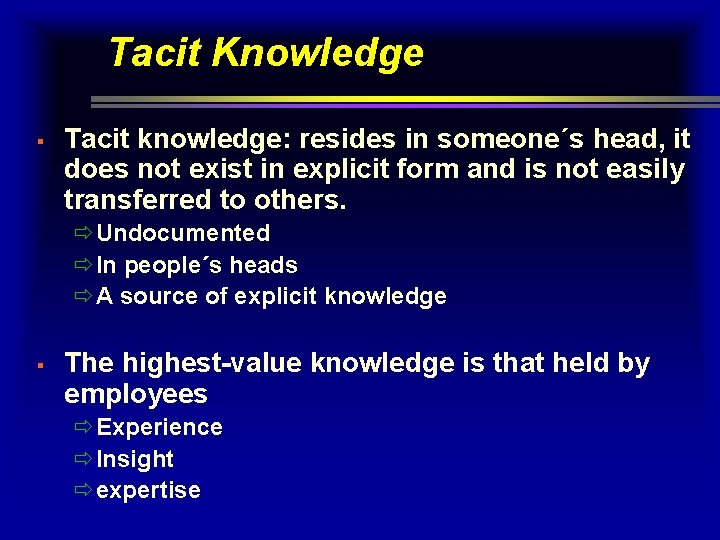
Tacit Knowledge § Tacit knowledge: resides in someone´s head, it does not exist in explicit form and is not easily transferred to others. ðUndocumented ðIn people´s heads ðA source of explicit knowledge § The highest-value knowledge is that held by employees ðExperience ðInsight ðexpertise
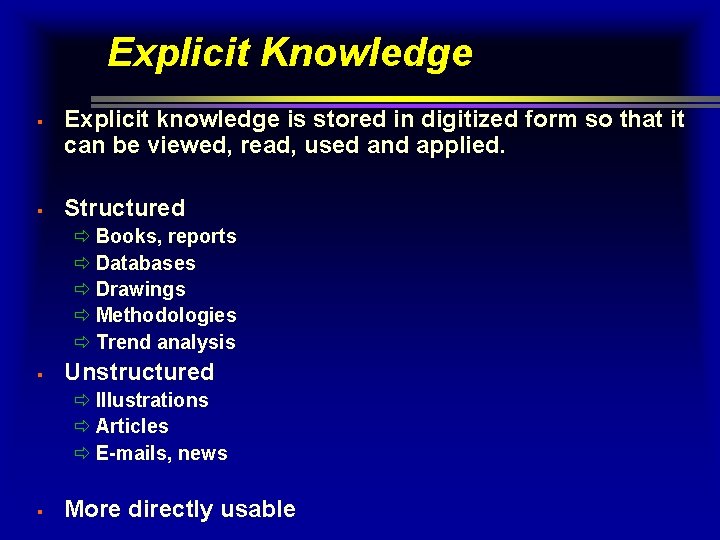
Explicit Knowledge § § Explicit knowledge is stored in digitized form so that it can be viewed, read, used and applied. Structured ð Books, reports ð Databases ð Drawings ð Methodologies ð Trend analysis § Unstructured ð Illustrations ð Articles ð E-mails, news § More directly usable
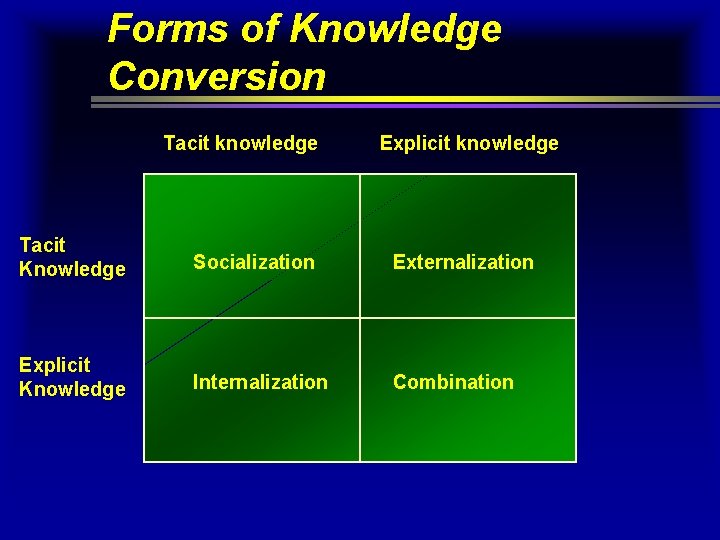
Forms of Knowledge Conversion Tacit knowledge Explicit knowledge Tacit Knowledge Socialization Externalization Explicit Knowledge Internalization Combination
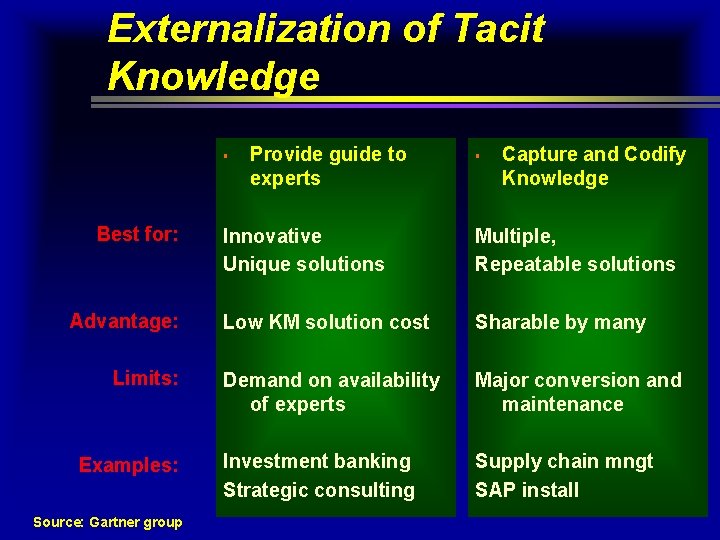
Externalization of Tacit Knowledge § Best for: Advantage: Limits: Examples: Source: Gartner group Provide guide to experts § Capture and Codify Knowledge Innovative Unique solutions Multiple, Repeatable solutions Low KM solution cost Sharable by many Demand on availability of experts Major conversion and maintenance Investment banking Strategic consulting Supply chain mngt SAP install
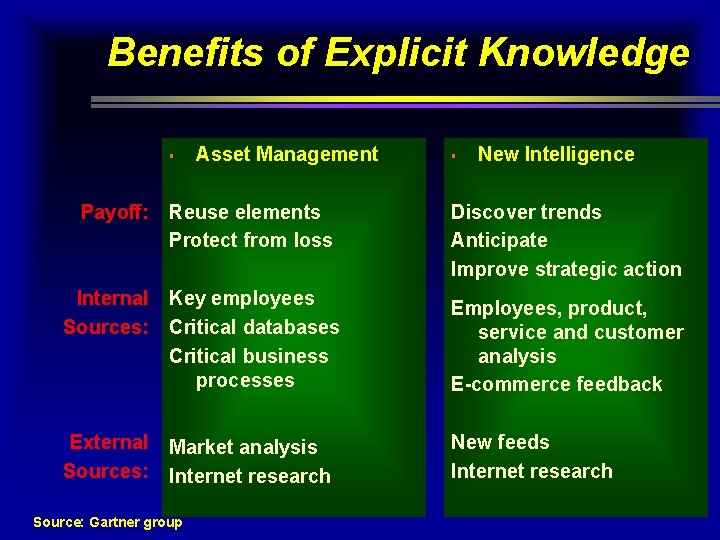
Benefits of Explicit Knowledge § Payoff: Asset Management Reuse elements Protect from loss § New Intelligence Discover trends Anticipate Improve strategic action Internal Key employees Sources: Critical databases Critical business processes Employees, product, service and customer analysis E-commerce feedback External Sources: New feeds Internet research Market analysis Internet research Source: Gartner group
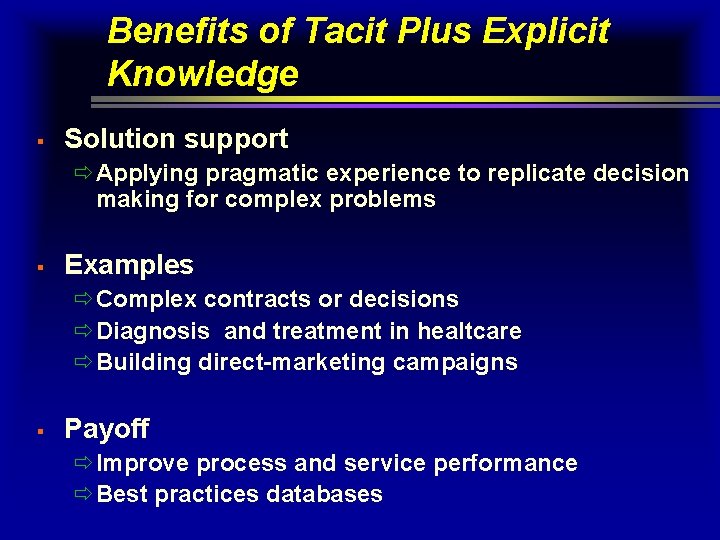
Benefits of Tacit Plus Explicit Knowledge § Solution support ðApplying pragmatic experience to replicate decision making for complex problems § Examples ðComplex contracts or decisions ðDiagnosis and treatment in healtcare ðBuilding direct-marketing campaigns § Payoff ðImprove process and service performance ðBest practices databases
Knowledge Management
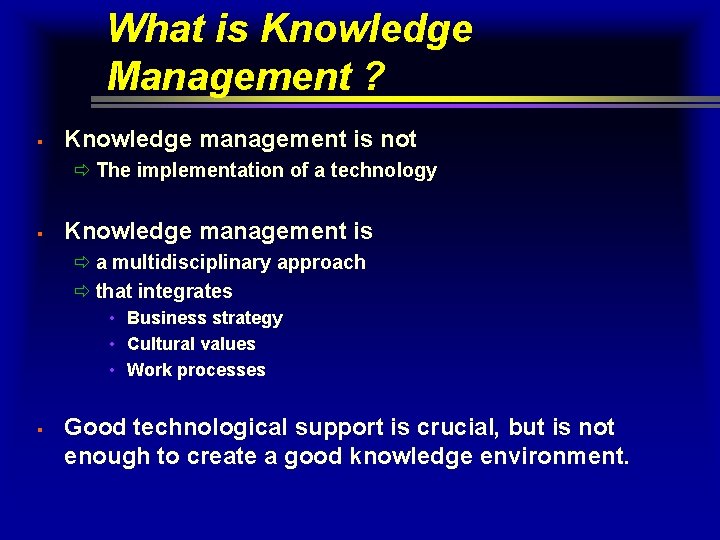
What is Knowledge Management ? § Knowledge management is not ð The implementation of a technology § Knowledge management is ð a multidisciplinary approach ð that integrates • Business strategy • Cultural values • Work processes § Good technological support is crucial, but is not enough to create a good knowledge environment.
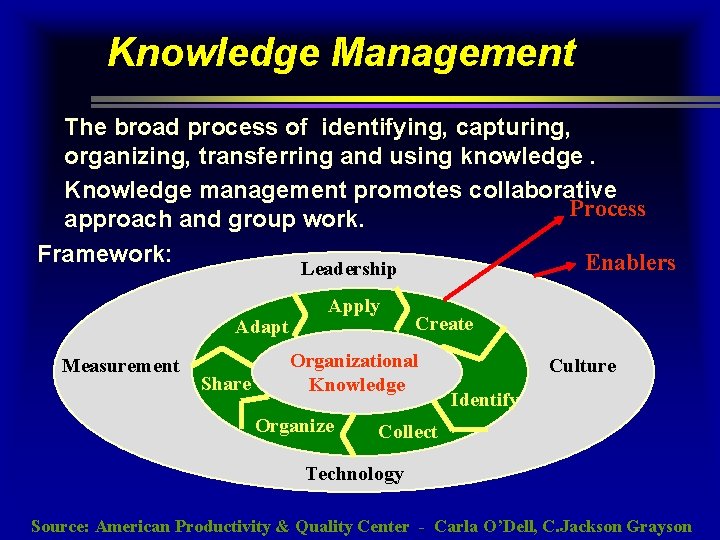
Knowledge Management The broad process of identifying, capturing, organizing, transferring and using knowledge. Knowledge management promotes collaborative Process approach and group work. Framework: Enablers Leadership Adapt Measurement Share Apply Create Organizational Leadership Knowledge Organize Culture Identify Collect Technology Source: American Productivity & Quality Center - Carla O’Dell, C. Jackson Grayson
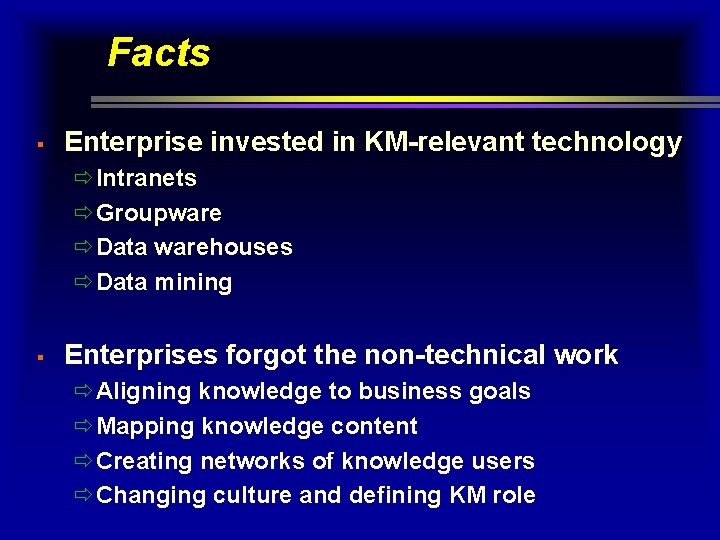
Facts § Enterprise invested in KM-relevant technology ðIntranets ðGroupware ðData warehouses ðData mining § Enterprises forgot the non-technical work ðAligning knowledge to business goals ðMapping knowledge content ðCreating networks of knowledge users ðChanging culture and defining KM role
Business Benefits of KM § KM generates economic and business benifits by: ð Providing broad and easy access to enterprise knowledge ð Leveraging knowledge trough improved collaboration processes and technologies ð Integrating KM into work tasks and processes of employees ð Stimulating innovation and the creation of new knowledge § Gartner group study showed that 60% of knowledge management programs resulted in success
Aspects of Knowledge Management § Knowledge discovery ð Generating knowledge from data § Knowledge representation ð Human-readable knowledge ð Machine-readable knowledge ð Ontologies (study of being, general properties) § § Knowledge filtering Knowledge searching ð Search engines ð Intelligent agents ð Visualization models
Within the Company § § Companies try to manage and use this knowledge in a more systematic way. Required actions. ð define which knowledge is required in order to define and execute the strategic business plan; ð organizations must implement a system that assures a continuous flow from the members of the organization, the knowledge workers, towards the infrastructure that supports the knowledge management; ð there has to be an integration of the strategy, the processes, the cultural and technical aspects of knowledge management. ð Setup of an Enterprise Knowledge Architecture.
KM Success Is Focused on the Business § Do first ð Determine role of knowledge in achieving company goals ð Select mission-critical business areas for high KM impact ð Knowledge-enable key processes and decision making ð Try to make the link between improved knowledge and business results ð Start small projects within the business culture § Do then ð Encyclopedia of R&D or operations knowledge ð Know-how of departing experts ð Capture tacit knowledge in explicit form
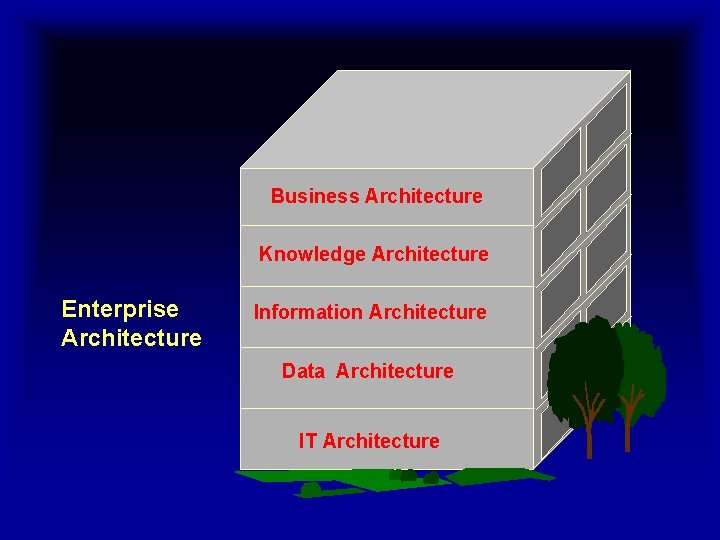
Business Architecture Knowledge Architecture Enterprise Architecture Information Architecture Data Architecture IT Architecture
The Enterprise Architecture § The IT architecture: basis for the other components. ðHardware. ðNetwork and communication environment. ðThe system management tools. ðThe middleware and the basic software. § The data architecture. ðHow data will be collected, stored and distributed. ðThose data are raw data in an updateable form, needed for later interpretation and usage. ðImportant aspects here are reliability, integrity and security.
The Enterprise Architecture § In the information architecture: basis and the guideline for the ICT-management. ð The ICT-strategy of the enterprise is captured. ð It is the translation of the enterprise business strategy into high-level information needs. ð A set of applications that are build to fulfil business needs. § The knowledge architecture. ð How and where the organization creates and distributes knowledge in all the forms. § The business architecture. ð The way the enterprise planned to achieve its business strategy. ð This strategy includes goals and objectives, seen in the context of the environment of stakeholders, employees, competitors and other internal and external factors.
§ Gathering. ð Document management. ð Office systems. ð Data entry. § Dissemination. ð ð § Email, voice mail, … Web. Inquiry systems. Data warehouse, data mart. Networks. ð Lan, wan, ð Internet, intranet, extranet. § Storage. Knowledge Management Infrastructure • extract • combine • transform • derive • analyze • present ð Databases, files, . . . ð Meta data, dictionaries, … § Groupware. ð Collaboration tools. ð Conferencing tools. § Analysis. ð Data mining. ð OLAP. Knowledge Architecture
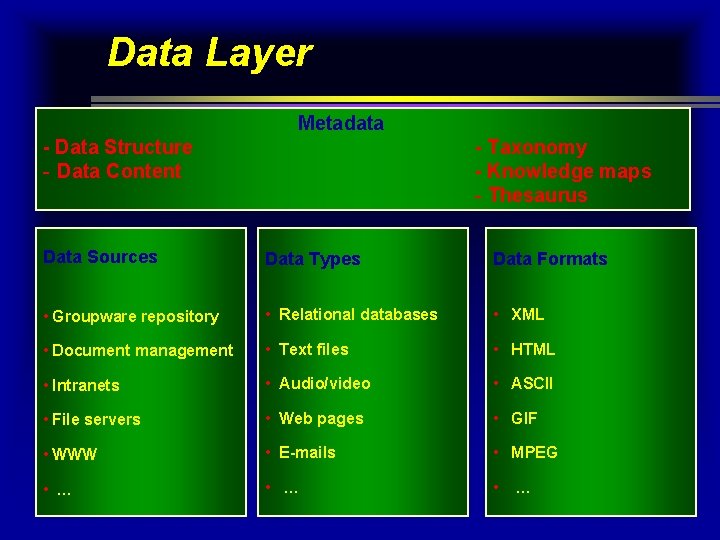
Data Layer Metadata - Data Structure - Data Content - Taxonomy - Knowledge maps - Thesaurus Data Sources Data Types Data Formats • Groupware repository • Relational databases • XML • Document management • Text files • HTML • Intranets • Audio/video • ASCII • File servers • Web pages • GIF • WWW • E-mails • MPEG • …
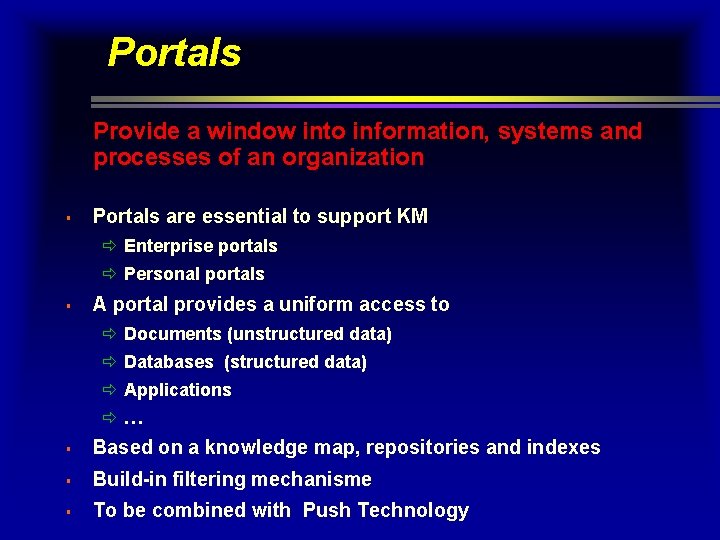
Portals Provide a window into information, systems and processes of an organization § Portals are essential to support KM ð Enterprise portals ð Personal portals § A portal provides a uniform access to ð Documents (unstructured data) ð Databases (structured data) ð Applications ð… § Based on a knowledge map, repositories and indexes § Build-in filtering mechanisme § To be combined with Push Technology
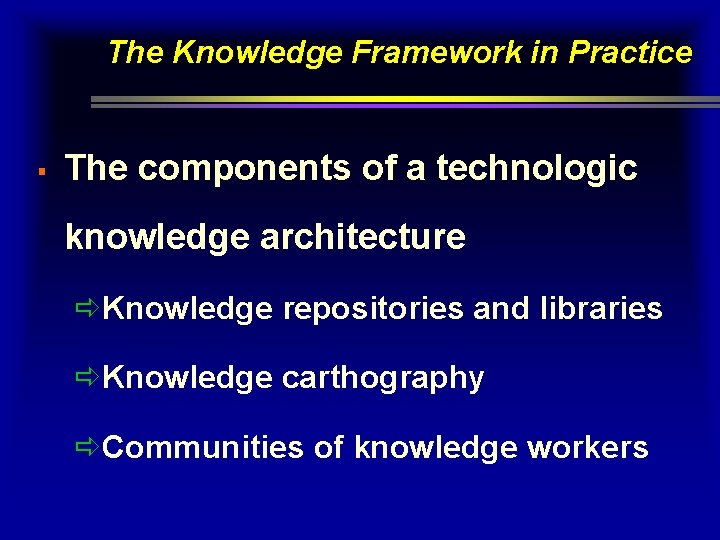
The Knowledge Framework in Practice § The components of a technologic knowledge architecture ðKnowledge repositories and libraries ðKnowledge carthography ðCommunities of knowledge workers
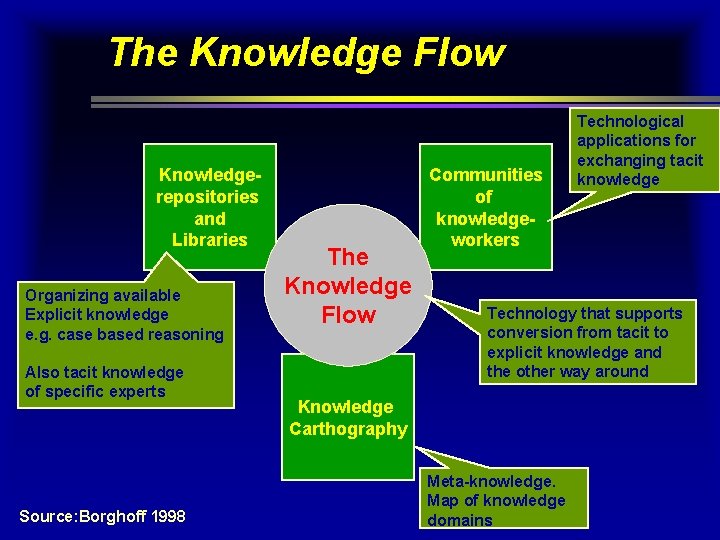
The Knowledge Flow Knowledgerepositories and Libraries Organizing available Explicit knowledge e. g. case based reasoning Also tacit knowledge of specific experts Source: Borghoff 1998 The Knowledge Flow Communities of knowledgeworkers Technological applications for exchanging tacit knowledge Technology that supports conversion from tacit to explicit knowledge and the other way around Knowledge Carthography Meta-knowledge. Map of knowledge domains
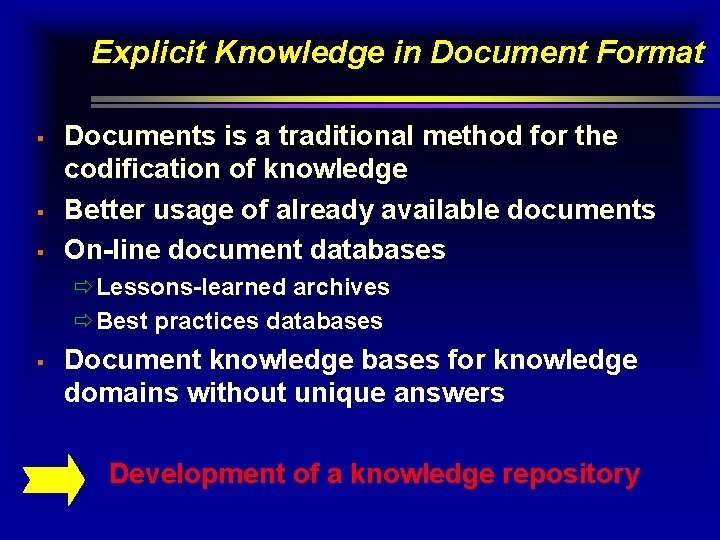
Explicit Knowledge in Document Format § § § Documents is a traditional method for the codification of knowledge Better usage of already available documents On-line document databases ðLessons-learned archives ðBest practices databases § Document knowledge bases for knowledge domains without unique answers Development of a knowledge repository
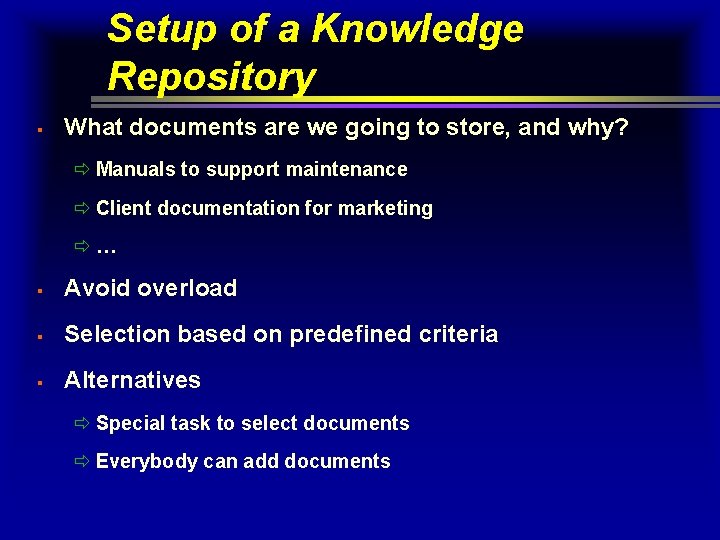
Setup of a Knowledge Repository § What documents are we going to store, and why? ð Manuals to support maintenance ð Client documentation for marketing ð… § Avoid overload § Selection based on predefined criteria § Alternatives ð Special task to select documents ð Everybody can add documents
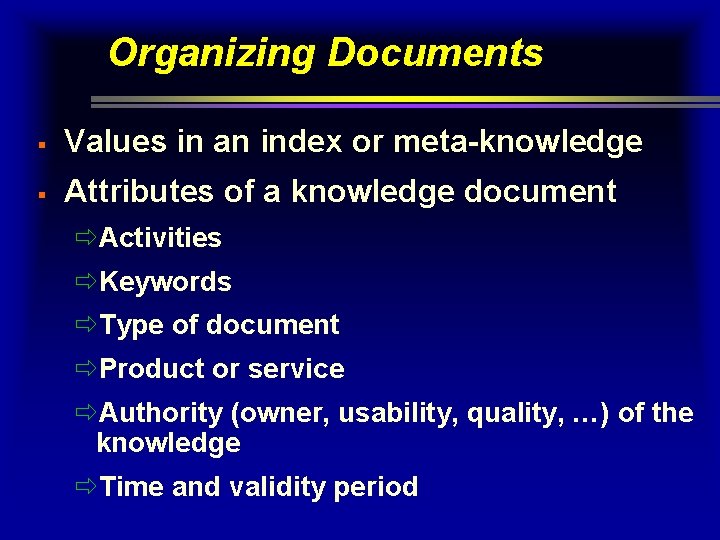
Organizing Documents § Values in an index or meta-knowledge § Attributes of a knowledge document ðActivities ðKeywords ðType of document ðProduct or service ðAuthority (owner, usability, quality, …) of the knowledge ðTime and validity period
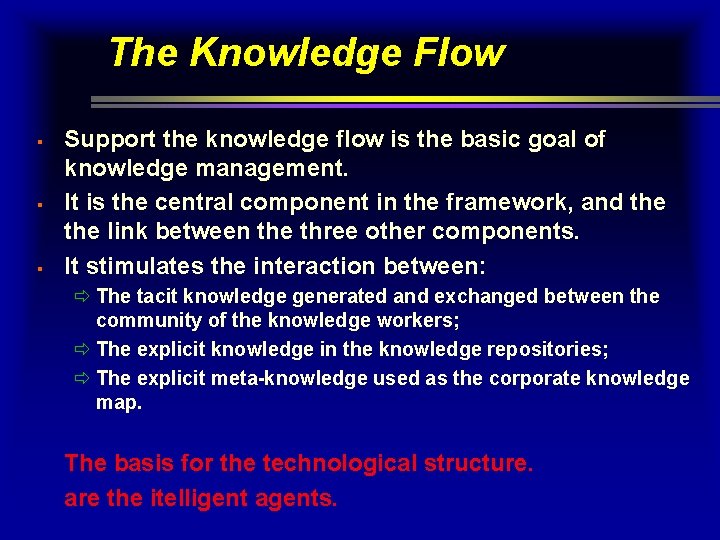
The Knowledge Flow § § § Support the knowledge flow is the basic goal of knowledge management. It is the central component in the framework, and the link between the three other components. It stimulates the interaction between: ð The tacit knowledge generated and exchanged between the community of the knowledge workers; ð The explicit knowledge in the knowledge repositories; ð The explicit meta-knowledge used as the corporate knowledge map. The basis for the technological structure. are the itelligent agents.
Intelligent Agents § Intelligent agents: ð perform tasks on behalf of something else like e. g. a person, a system or a business proces; . ð it is a small computerprogram that can perform tasks on his own, including take some decissions; ð an agent can react on events; ð it can contain simple rules or it can be based on more complex techniques like neural networks; ð they run in background, often without being seen by the users. § Useful in two of the components of the framework: ð in knowledge repositories; ð in knowledge carthography.
Intelligent Agents in Knowledge Repositories § Personal agents ðTo master information overload; ðTo switch from pull to push mode; ðPersonalized content filtering; ðUser profile, based on a personal thesaurus and intelligent search algorithms; § Technical agents ðAutomatic document indexing; ðImportant in case-based reasoning systems;
Intelligent Agents in Communities of Knowledge Workers § Personal agents ð Responsible for activity planning (workflow environments); ð Interaction with actor agents that define the role of the worker in the business process; § A workflow agent ð tries to find a personal agent that can perform a certain task; ð Asks the personal agent whether this task fits in planning of the specific knowledge worker; § A deliberation agent ð will check the requests against the availability of the personal agents; ð An instance of the actor, containing the goals and activities of the task, is added to the personal agents.
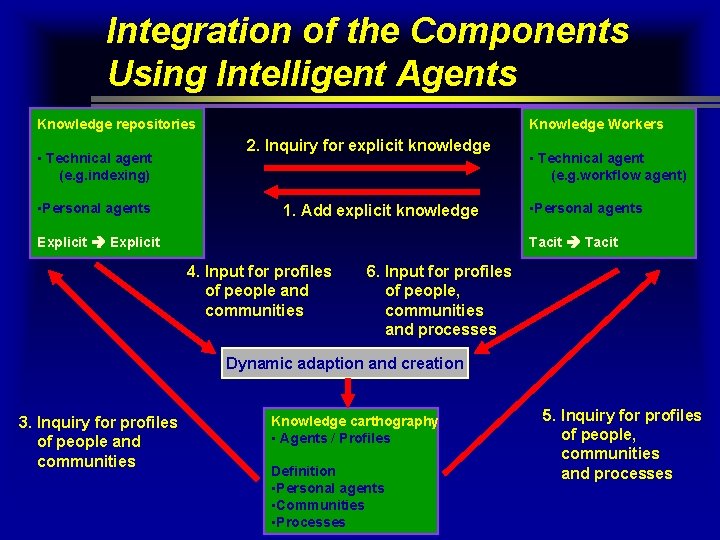
Integration of the Components Using Intelligent Agents Knowledge repositories • Technical agent (e. g. indexing) • Personal agents Knowledge Workers 2. Inquiry for explicit knowledge 1. Add explicit knowledge Explicit • Technical agent (e. g. workflow agent) • Personal agents Tacit 4. Input for profiles of people and communities 6. Input for profiles of people, communities and processes Dynamic adaption and creation 3. Inquiry for profiles of people and communities Knowledge carthography • Agents / Profiles Definition • Personal agents • Communities • Processes 5. Inquiry for profiles of people, communities and processes
Building the Environment
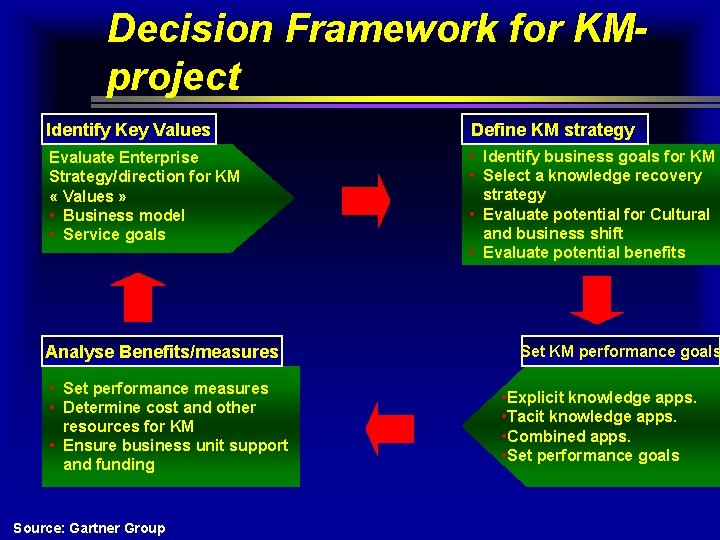
Decision Framework for KMproject Identify Key Values Define KM strategy Evaluate Enterprise Strategy/direction for KM « Values » • Business model • Service goals • • • Analyse Benefits/measures • Set performance measures • Determine cost and other resources for KM • Ensure business unit support and funding Source: Gartner Group Identify business goals for KM Select a knowledge recovery strategy Evaluate potential for Cultural and business shift • Evaluate potential benefits Set KM performance goals • Explicit knowledge apps. • Tacit knowledge apps. • Combined apps. • Set performance goals
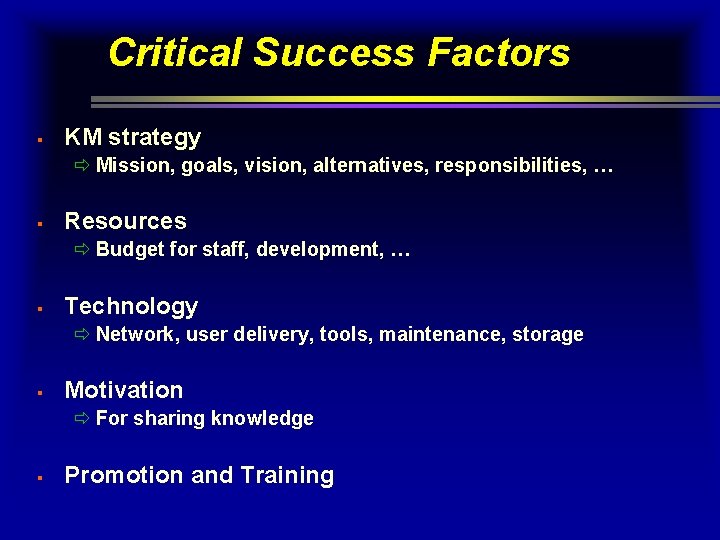
Critical Success Factors § KM strategy ð Mission, goals, vision, alternatives, responsibilities, … § Resources ð Budget for staff, development, … § Technology ð Network, user delivery, tools, maintenance, storage § Motivation ð For sharing knowledge § Promotion and Training
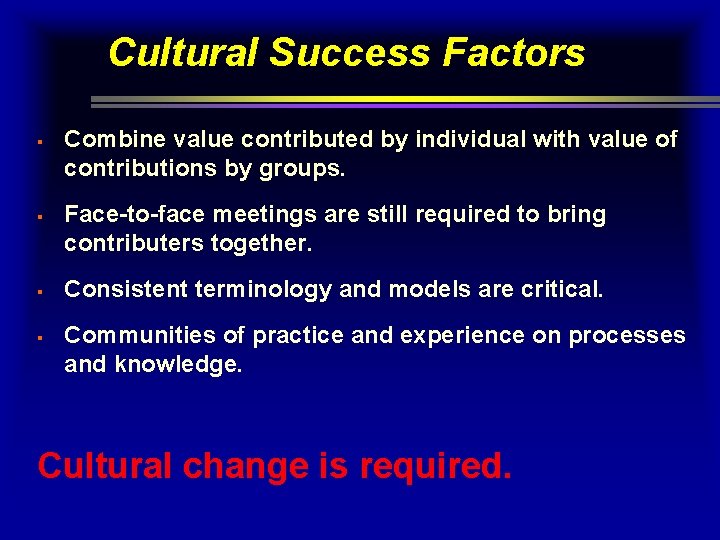
Cultural Success Factors § § Combine value contributed by individual with value of contributions by groups. Face-to-face meetings are still required to bring contributers together. Consistent terminology and models are critical. Communities of practice and experience on processes and knowledge. Cultural change is required.
Citation There is nothing more difficult to plan , more doubtful of success, nor more dangerous to manage than the creation of a new system. For the initiator has the enmity of all who would profit by the preservation of the old system and merely lukewarm defenders in those who would gain by the new one. Machiavelli, 1513
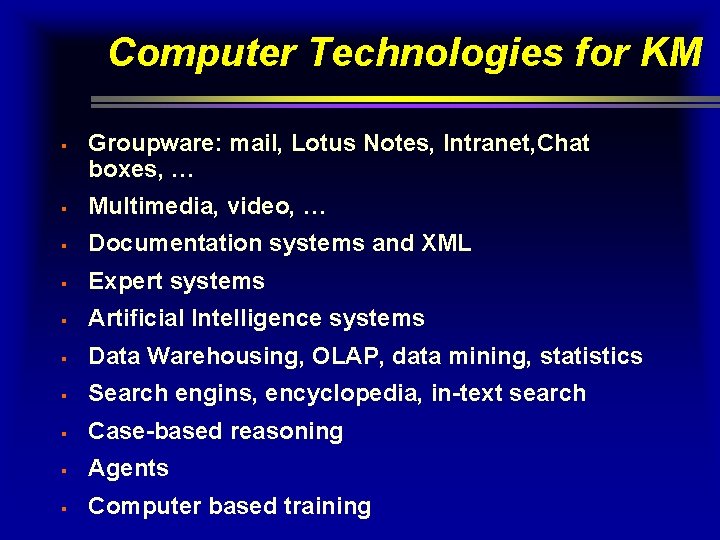
Computer Technologies for KM § Groupware: mail, Lotus Notes, Intranet, Chat boxes, … § Multimedia, video, … § Documentation systems and XML § Expert systems § Artificial Intelligence systems § Data Warehousing, OLAP, data mining, statistics § Search engins, encyclopedia, in-text search § Case-based reasoning § Agents § Computer based training
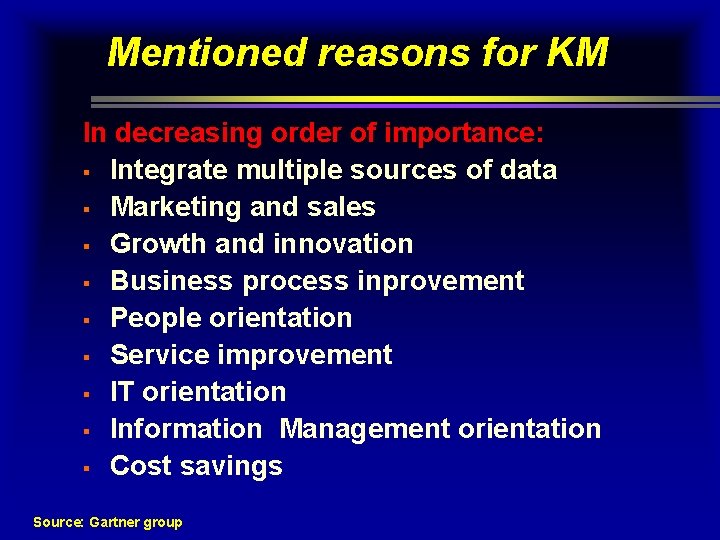
Mentioned reasons for KM In decreasing order of importance: § Integrate multiple sources of data § Marketing and sales § Growth and innovation § Business process inprovement § People orientation § Service improvement § IT orientation § Information Management orientation § Cost savings Source: Gartner group
Think about this ! Knowledge management technology does not equal Knowledge management for the same reason that an exercise machine does not equal exercise