SVVRL IM NTU Hashing YihKuen Tsay Dept of

- Slides: 67
SVVRL @ IM. NTU Hashing Yih-Kuen Tsay Dept. of Information Management National Taiwan University Based on [Carrano and Henry 2013] 1 / 67
SVVRL @ IM. NTU Prelude n n We will first study the ADT Dictionary, for problems that must manage data by value. The main goal is to evaluate several possible implementations using value-oriented data structures. In particular, we shall analyze how efficiently the implementations support the various dictionary operations. This motives the use of more sophisticated data structures to achieve better efficiency. Yih-Kuen Tsay DS 2016: Hashing 2 / 67
SVVRL @ IM. NTU Outline n n The ADT Dictionary Possible Implementations Selecting an Implementation Hashing q q Basic idea Resolving collisions Efficiency of hashing Hashing for the ADT Dictionary Note: balanced search trees are covered in a separate lecture. Yih-Kuen Tsay DS 2016: Hashing 3 / 67
The ADT Dictionary (1/2) n n SVVRL @ IM. NTU When sorting a collection of data, the criterion you use is called the sort key. When searching a collection of data for specific information, it is called the search key. Sorting or searching involves values instead of positions. Applications that require such value-oriented operations are prevalent, e. g. , q q Find the phone number of a person, or Delete all information about the employ with a particular ID. Yih-Kuen Tsay DS 2016: Hashing 4 / 67
The ADT Dictionary (2/2) n Value-oriented ADTs studied so far: q q n n SVVRL @ IM. NTU Sorted list Binary search tree The dictionary is another value-oriented ADT, allowing you to look up information easily. It is also called map or table. A dictionary stores items (objects) that contain several pieces of data. The retrieval of an item is facilitated by search on a specified search key. Yih-Kuen Tsay DS 2016: Hashing 5 / 67
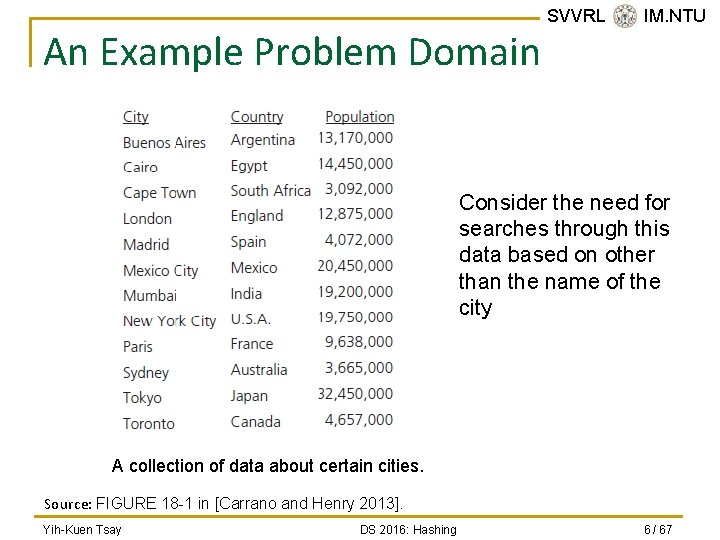
An Example Problem Domain SVVRL @ IM. NTU Consider the need for searches through this data based on other than the name of the city A collection of data about certain cities. Source: FIGURE 18 -1 in [Carrano and Henry 2013]. Yih-Kuen Tsay DS 2016: Hashing 6 / 67
SVVRL @ IM. NTU ADT Dictionary Operations (1/3) n n n Test whether a dictionary is empty. Get the number of items in a dictionary. Insert a new item into a dictionary. Remove an item with a given search key from a dictionary. Remove all items from a dictionary. Note: we will assume all search keys are distinct. Yih-Kuen Tsay DS 2016: Hashing 7 / 67
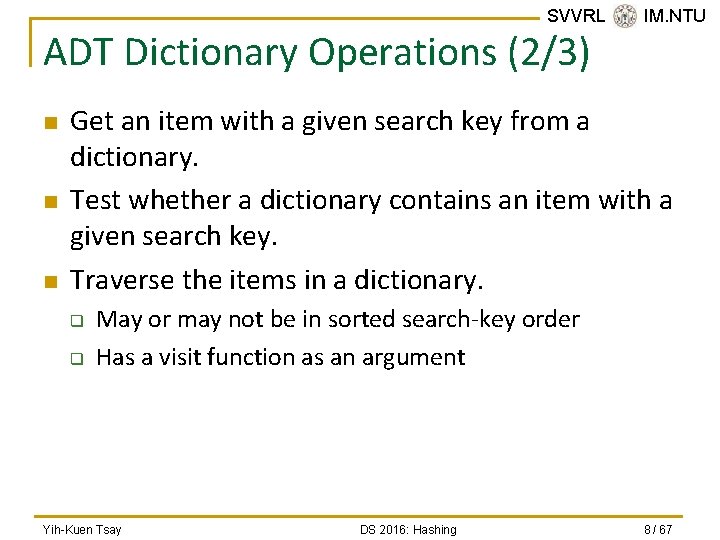
SVVRL @ IM. NTU ADT Dictionary Operations (2/3) n n n Get an item with a given search key from a dictionary. Test whether a dictionary contains an item with a given search key. Traverse the items in a dictionary. q q May or may not be in sorted search-key order Has a visit function as an argument Yih-Kuen Tsay DS 2016: Hashing 8 / 67
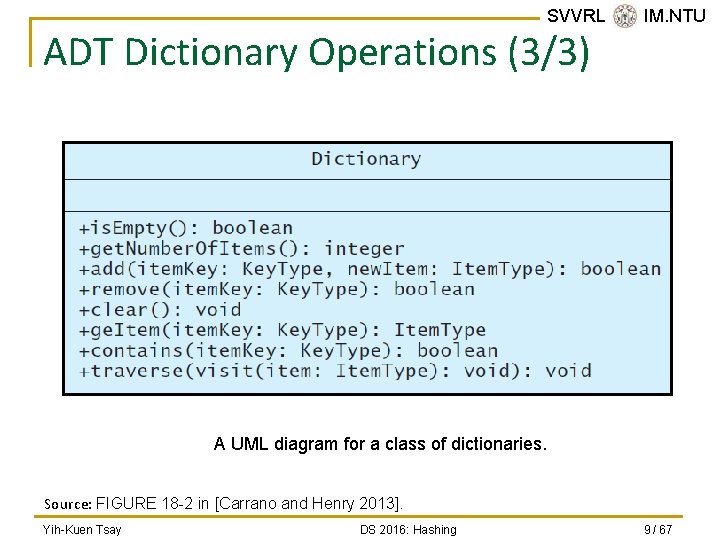
SVVRL @ IM. NTU ADT Dictionary Operations (3/3) A UML diagram for a class of dictionaries. Source: FIGURE 18 -2 in [Carrano and Henry 2013]. Yih-Kuen Tsay DS 2016: Hashing 9 / 67
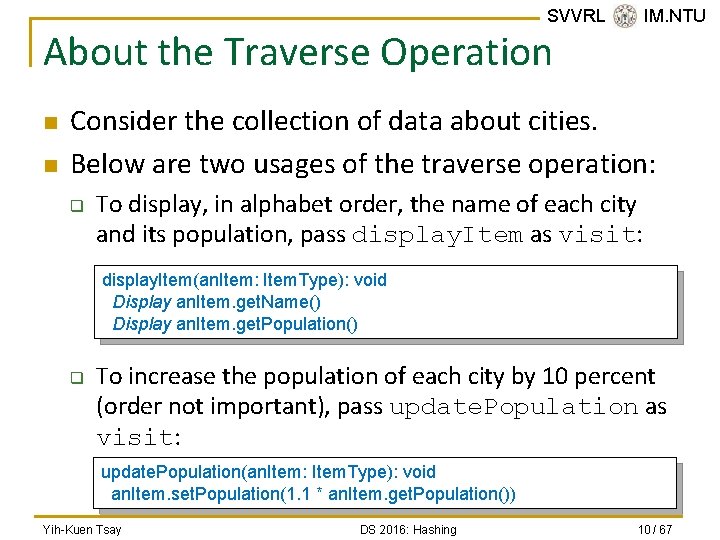
SVVRL @ IM. NTU About the Traverse Operation n n Consider the collection of data about cities. Below are two usages of the traverse operation: q To display, in alphabet order, the name of each city and its population, pass display. Item as visit: display. Item(an. Item: Item. Type): void Display an. Item. get. Name() Display an. Item. get. Population() q To increase the population of each city by 10 percent (order not important), pass update. Population as visit: update. Population(an. Item: Item. Type): void an. Item. set. Population(1. 1 * an. Item. get. Population()) Yih-Kuen Tsay DS 2016: Hashing 10 / 67
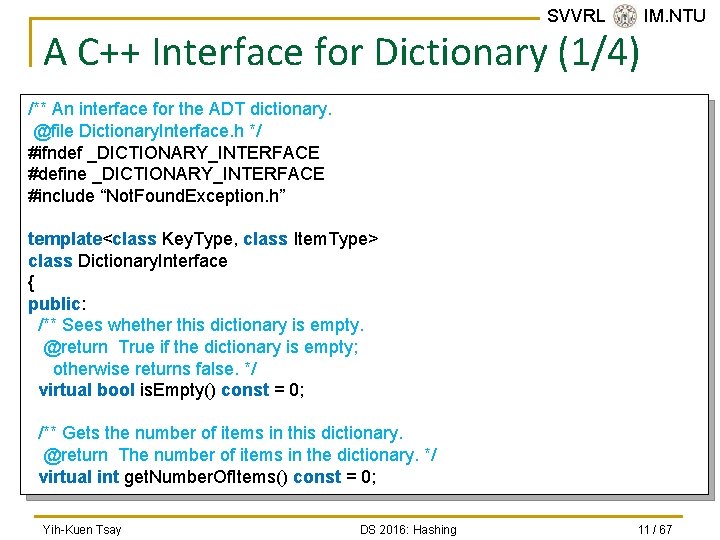
SVVRL @ IM. NTU A C++ Interface for Dictionary (1/4) /** An interface for the ADT dictionary. @file Dictionary. Interface. h */ #ifndef _DICTIONARY_INTERFACE #define _DICTIONARY_INTERFACE #include “Not. Found. Exception. h” template<class Key. Type, class Item. Type> class Dictionary. Interface { public: /** Sees whether this dictionary is empty. @return True if the dictionary is empty; otherwise returns false. */ virtual bool is. Empty() const = 0; /** Gets the number of items in this dictionary. @return The number of items in the dictionary. */ virtual int get. Number. Of. Items() const = 0; Yih-Kuen Tsay DS 2016: Hashing 11 / 67
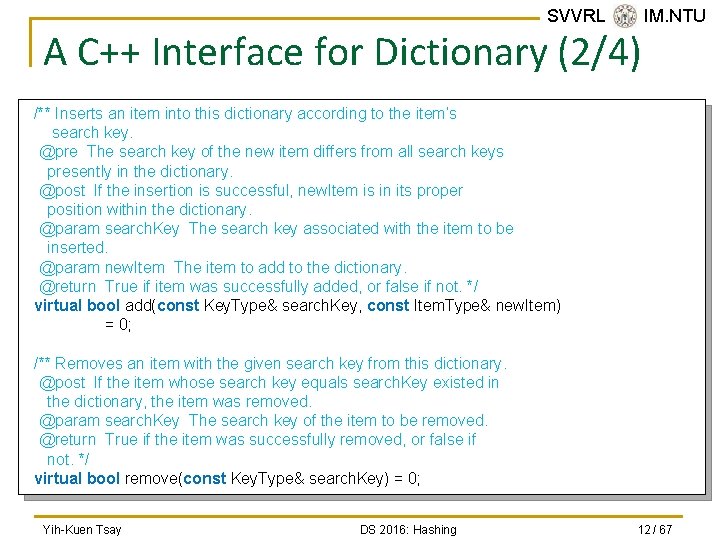
SVVRL @ IM. NTU A C++ Interface for Dictionary (2/4) /** Inserts an item into this dictionary according to the item’s search key. @pre The search key of the new item differs from all search keys presently in the dictionary. @post If the insertion is successful, new. Item is in its proper position within the dictionary. @param search. Key The search key associated with the item to be inserted. @param new. Item The item to add to the dictionary. @return True if item was successfully added, or false if not. */ virtual bool add(const Key. Type& search. Key, const Item. Type& new. Item) = 0; /** Removes an item with the given search key from this dictionary. @post If the item whose search key equals search. Key existed in the dictionary, the item was removed. @param search. Key The search key of the item to be removed. @return True if the item was successfully removed, or false if not. */ virtual bool remove(const Key. Type& search. Key) = 0; Yih-Kuen Tsay DS 2016: Hashing 12 / 67
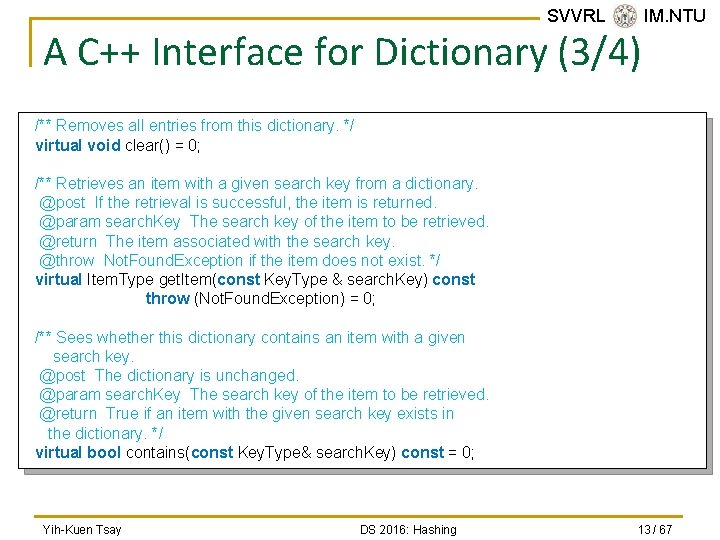
SVVRL @ IM. NTU A C++ Interface for Dictionary (3/4) /** Removes all entries from this dictionary. */ virtual void clear() = 0; /** Retrieves an item with a given search key from a dictionary. @post If the retrieval is successful, the item is returned. @param search. Key The search key of the item to be retrieved. @return The item associated with the search key. @throw Not. Found. Exception if the item does not exist. */ virtual Item. Type get. Item(const Key. Type & search. Key) const throw (Not. Found. Exception) = 0; /** Sees whether this dictionary contains an item with a given search key. @post The dictionary is unchanged. @param search. Key The search key of the item to be retrieved. @return True if an item with the given search key exists in the dictionary. */ virtual bool contains(const Key. Type& search. Key) const = 0; Yih-Kuen Tsay DS 2016: Hashing 13 / 67
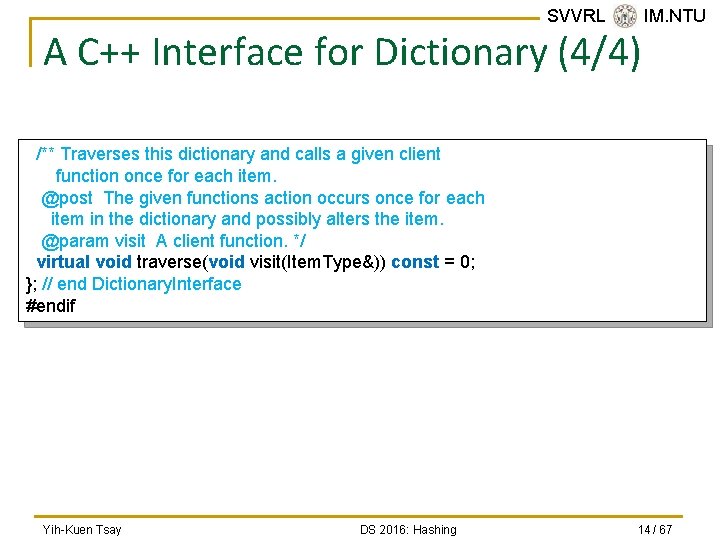
SVVRL @ IM. NTU A C++ Interface for Dictionary (4/4) /** Traverses this dictionary and calls a given client function once for each item. @post The given functions action occurs once for each item in the dictionary and possibly alters the item. @param visit A client function. */ virtual void traverse(void visit(Item. Type&)) const = 0; }; // end Dictionary. Interface #endif Yih-Kuen Tsay DS 2016: Hashing 14 / 67
SVVRL @ IM. NTU Possible Implementations (1/5) n n n We will investigate both linear and nonlinear implementations. Arrays and lists of linked nodes are considered linear, as they store data items one after another. Possible linear implementations of Dictionary: q q Sorted (by search key), array-based Sorted (by search key), link-based Unsorted, array-based Unsorted, link-based Yih-Kuen Tsay DS 2016: Hashing 15 / 67
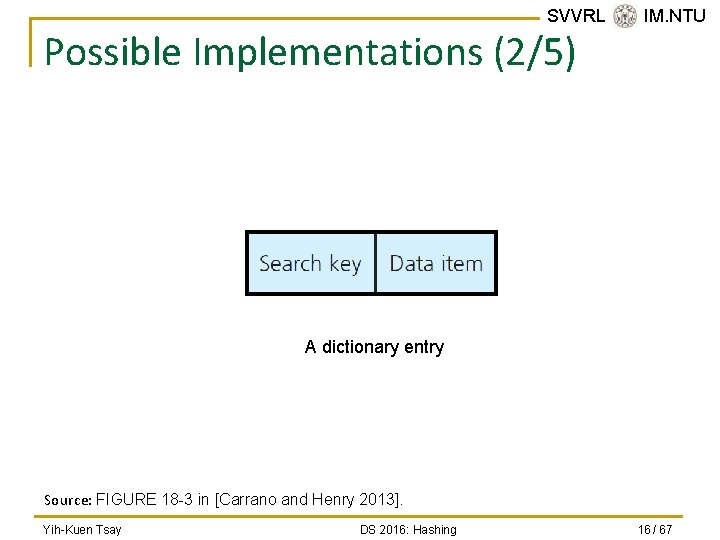
SVVRL @ IM. NTU Possible Implementations (2/5) A dictionary entry Source: FIGURE 18 -3 in [Carrano and Henry 2013]. Yih-Kuen Tsay DS 2016: Hashing 16 / 67
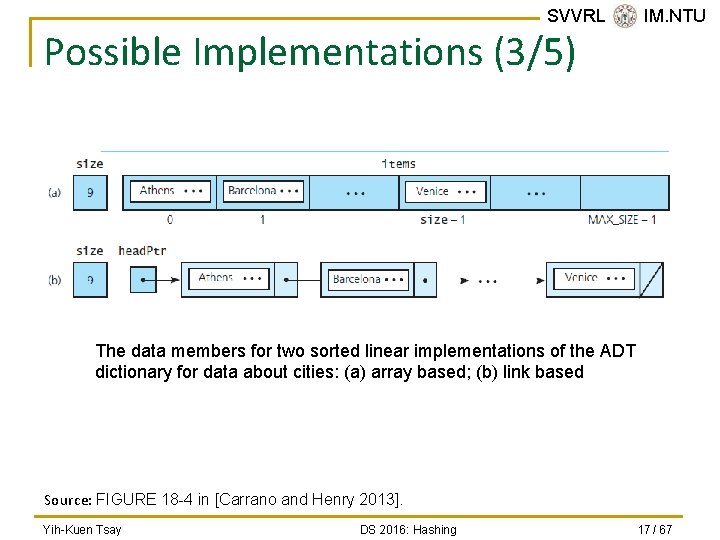
SVVRL @ IM. NTU Possible Implementations (3/5) The data members for two sorted linear implementations of the ADT dictionary for data about cities: (a) array based; (b) link based Source: FIGURE 18 -4 in [Carrano and Henry 2013]. Yih-Kuen Tsay DS 2016: Hashing 17 / 67
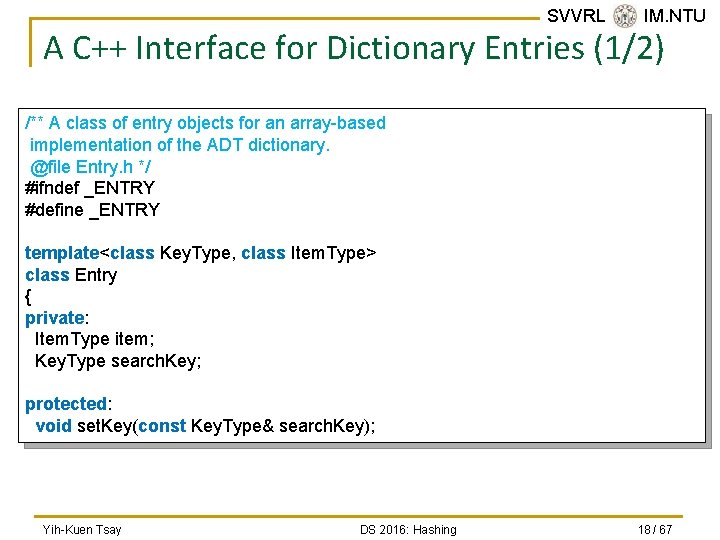
SVVRL @ IM. NTU A C++ Interface for Dictionary Entries (1/2) /** A class of entry objects for an array-based implementation of the ADT dictionary. @file Entry. h */ #ifndef _ENTRY #define _ENTRY template<class Key. Type, class Item. Type> class Entry { private: Item. Type item; Key. Type search. Key; protected: void set. Key(const Key. Type& search. Key); Yih-Kuen Tsay DS 2016: Hashing 18 / 67
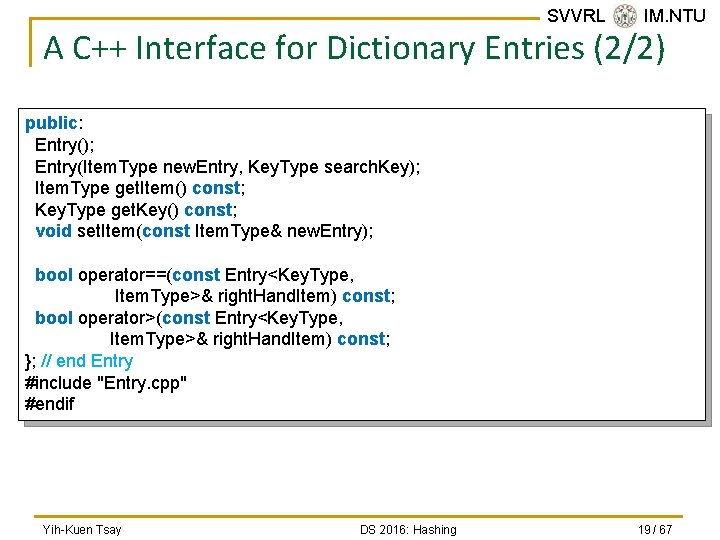
SVVRL @ IM. NTU A C++ Interface for Dictionary Entries (2/2) public: Entry(); Entry(Item. Type new. Entry, Key. Type search. Key); Item. Type get. Item() const; Key. Type get. Key() const; void set. Item(const Item. Type& new. Entry); bool operator==(const Entry<Key. Type, Item. Type>& right. Hand. Item) const; bool operator>(const Entry<Key. Type, Item. Type>& right. Hand. Item) const; }; // end Entry #include "Entry. cpp" #endif Yih-Kuen Tsay DS 2016: Hashing 19 / 67
SVVRL @ IM. NTU Possible Implementations (4/5) n There are other choices than linear implementations: q q q Binary search tree Hash table (main topic of this lecture) Balanced search tree (covered in a separate lecture) Yih-Kuen Tsay DS 2016: Hashing 20 / 67
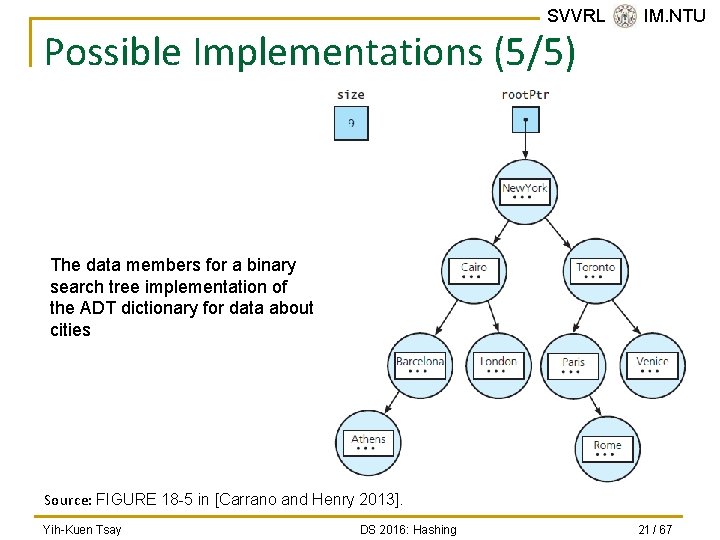
SVVRL @ IM. NTU Possible Implementations (5/5) The data members for a binary search tree implementation of the ADT dictionary for data about cities Source: FIGURE 18 -5 in [Carrano and Henry 2013]. Yih-Kuen Tsay DS 2016: Hashing 21 / 67
SVVRL @ IM. NTU Sorted Array-Based Implementation (1/5) n Data members similar to those for other ADTs q An array items of data items n q q n n An item contains both a search key and some other data A count item. Count of the items A maximum number max. Items of items For a sorted dictionary, method traverse should visit the data in such a way that their search keys are in sorted order. Method add bears the responsibility for keeping the array items sorted Yih-Kuen Tsay DS 2016: Hashing 22 / 67
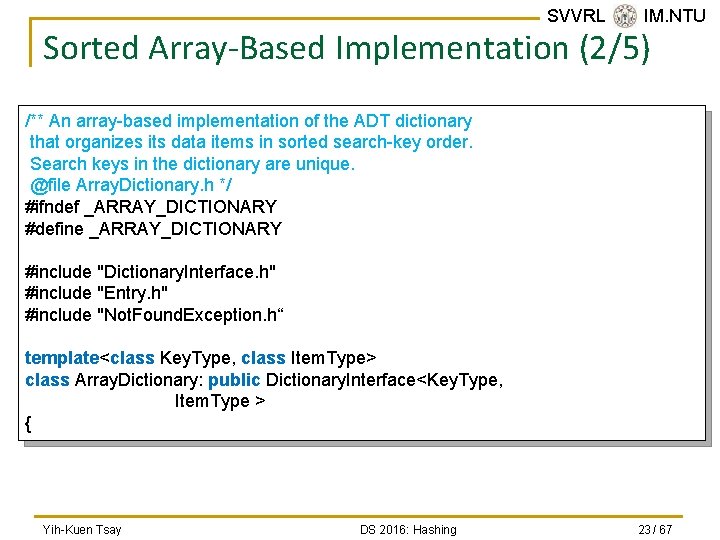
SVVRL @ IM. NTU Sorted Array-Based Implementation (2/5) /** An array-based implementation of the ADT dictionary that organizes its data items in sorted search-key order. Search keys in the dictionary are unique. @file Array. Dictionary. h */ #ifndef _ARRAY_DICTIONARY #define _ARRAY_DICTIONARY #include "Dictionary. Interface. h" #include "Entry. h" #include "Not. Found. Exception. h“ template<class Key. Type, class Item. Type> class Array. Dictionary: public Dictionary. Interface<Key. Type, Item. Type > { Yih-Kuen Tsay DS 2016: Hashing 23 / 67
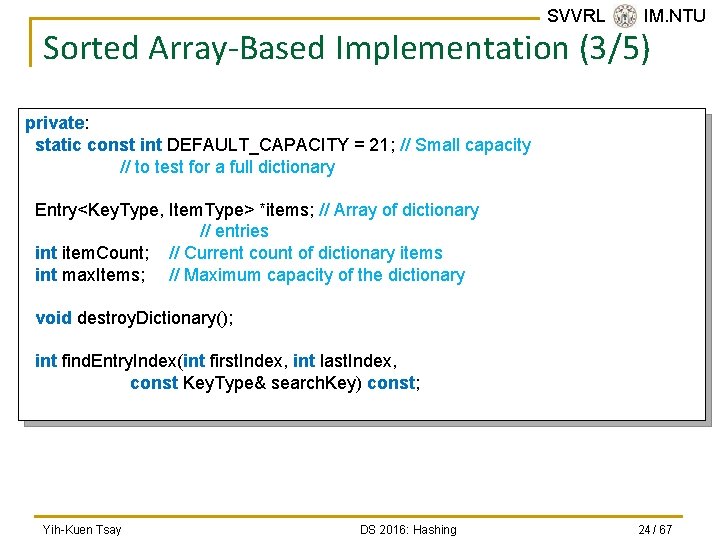
SVVRL @ IM. NTU Sorted Array-Based Implementation (3/5) private: static const int DEFAULT_CAPACITY = 21; // Small capacity // to test for a full dictionary Entry<Key. Type, Item. Type> *items; // Array of dictionary // entries int item. Count; // Current count of dictionary items int max. Items; // Maximum capacity of the dictionary void destroy. Dictionary(); int find. Entry. Index(int first. Index, int last. Index, const Key. Type& search. Key) const; Yih-Kuen Tsay DS 2016: Hashing 24 / 67
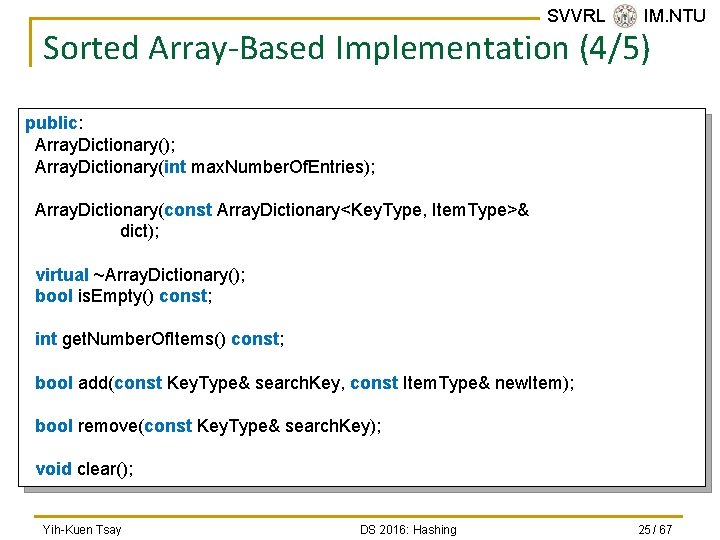
SVVRL @ IM. NTU Sorted Array-Based Implementation (4/5) public: Array. Dictionary(); Array. Dictionary(int max. Number. Of. Entries); Array. Dictionary(const Array. Dictionary<Key. Type, Item. Type>& dict); virtual ~Array. Dictionary(); bool is. Empty() const; int get. Number. Of. Items() const; bool add(const Key. Type& search. Key, const Item. Type& new. Item); bool remove(const Key. Type& search. Key); void clear(); Yih-Kuen Tsay DS 2016: Hashing 25 / 67
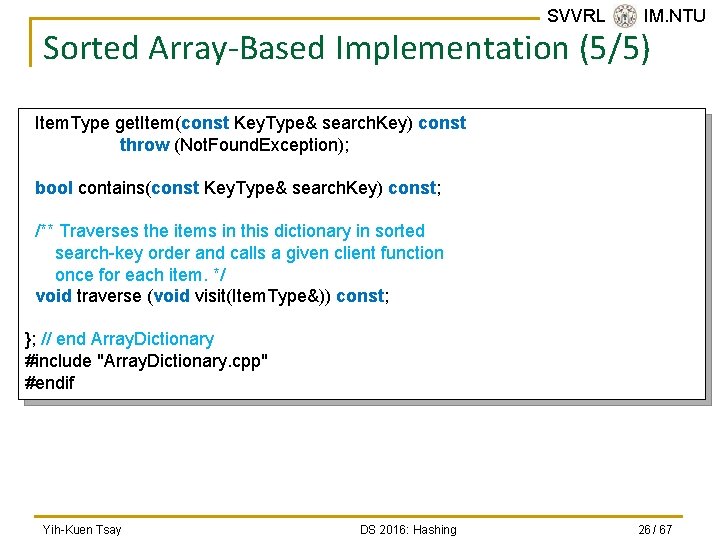
SVVRL @ IM. NTU Sorted Array-Based Implementation (5/5) Item. Type get. Item(const Key. Type& search. Key) const throw (Not. Found. Exception); bool contains(const Key. Type& search. Key) const; /** Traverses the items in this dictionary in sorted search-key order and calls a given client function once for each item. */ void traverse (void visit(Item. Type&)) const; }; // end Array. Dictionary #include "Array. Dictionary. cpp" #endif Yih-Kuen Tsay DS 2016: Hashing 26 / 67
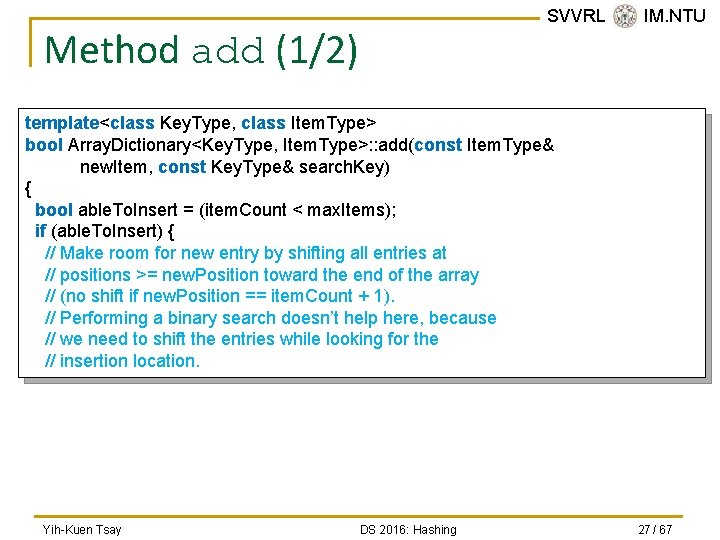
SVVRL @ IM. NTU Method add (1/2) template<class Key. Type, class Item. Type> bool Array. Dictionary<Key. Type, Item. Type>: : add(const Item. Type& new. Item, const Key. Type& search. Key) { bool able. To. Insert = (item. Count < max. Items); if (able. To. Insert) { // Make room for new entry by shifting all entries at // positions >= new. Position toward the end of the array // (no shift if new. Position == item. Count + 1). // Performing a binary search doesn’t help here, because // we need to shift the entries while looking for the // insertion location. Yih-Kuen Tsay DS 2016: Hashing 27 / 67
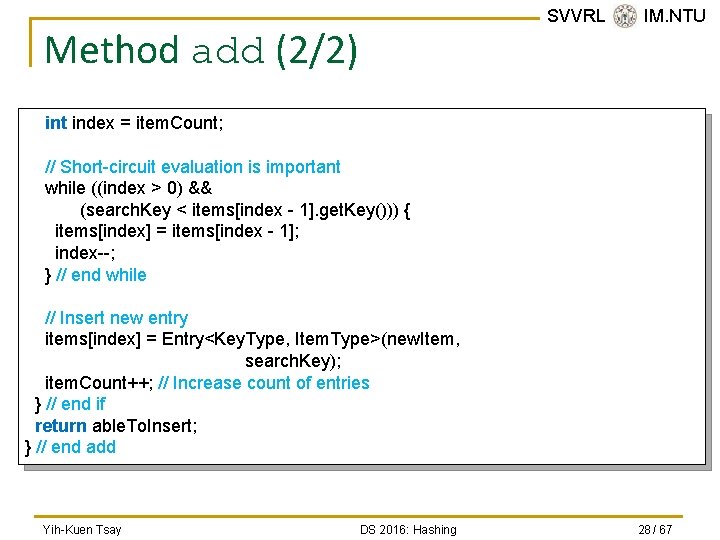
SVVRL @ IM. NTU Method add (2/2) int index = item. Count; // Short-circuit evaluation is important while ((index > 0) && (search. Key < items[index - 1]. get. Key())) { items[index] = items[index - 1]; index--; } // end while // Insert new entry items[index] = Entry<Key. Type, Item. Type>(new. Item, search. Key); item. Count++; // Increase count of entries } // end if return able. To. Insert; } // end add Yih-Kuen Tsay DS 2016: Hashing 28 / 67
SVVRL @ IM. NTU Binary Search Tree Implementation (1/6) n n n Linear implementations may be fine for specific cases, but they are not general enough. We now consider a nonlinear implementation using binary search trees. The dictionary class will use composition q q A binary search tree as one of its data members Reuse of the class Binary. Search. Tree discussed earlier Yih-Kuen Tsay DS 2016: Hashing 29 / 67
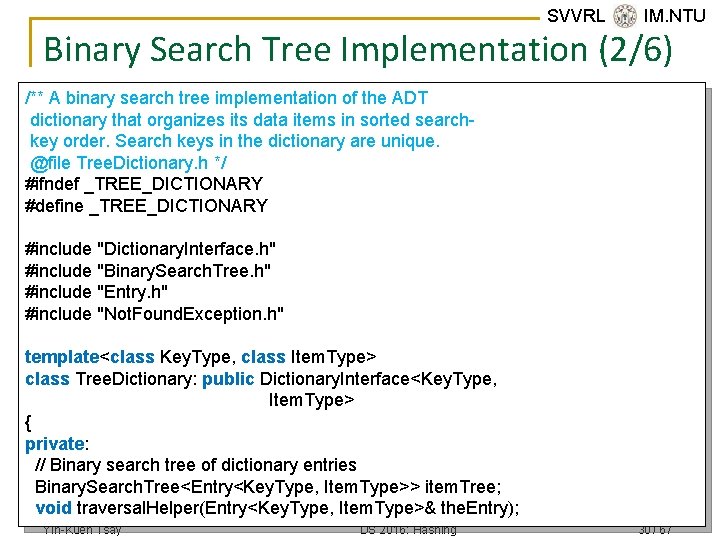
SVVRL @ IM. NTU Binary Search Tree Implementation (2/6) /** A binary search tree implementation of the ADT dictionary that organizes its data items in sorted search key order. Search keys in the dictionary are unique. @file Tree. Dictionary. h */ #ifndef _TREE_DICTIONARY #define _TREE_DICTIONARY #include "Dictionary. Interface. h" #include "Binary. Search. Tree. h" #include "Entry. h" #include "Not. Found. Exception. h" template<class Key. Type, class Item. Type> class Tree. Dictionary: public Dictionary. Interface<Key. Type, Item. Type> { private: // Binary search tree of dictionary entries Binary. Search. Tree<Entry<Key. Type, Item. Type>> item. Tree; void traversal. Helper(Entry<Key. Type, Item. Type>& the. Entry); Yih-Kuen Tsay DS 2016: Hashing 30 / 67
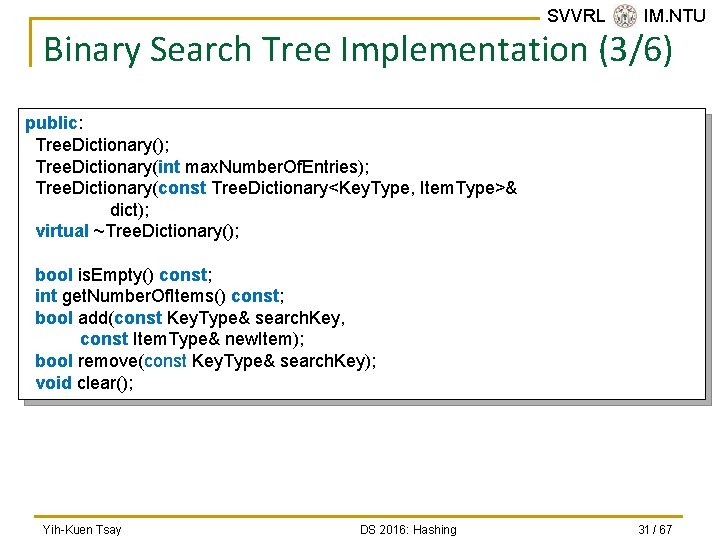
SVVRL @ IM. NTU Binary Search Tree Implementation (3/6) public: Tree. Dictionary(); Tree. Dictionary(int max. Number. Of. Entries); Tree. Dictionary(const Tree. Dictionary<Key. Type, Item. Type>& dict); virtual ~Tree. Dictionary(); bool is. Empty() const; int get. Number. Of. Items() const; bool add(const Key. Type& search. Key, const Item. Type& new. Item); bool remove(const Key. Type& search. Key); void clear(); Yih-Kuen Tsay DS 2016: Hashing 31 / 67
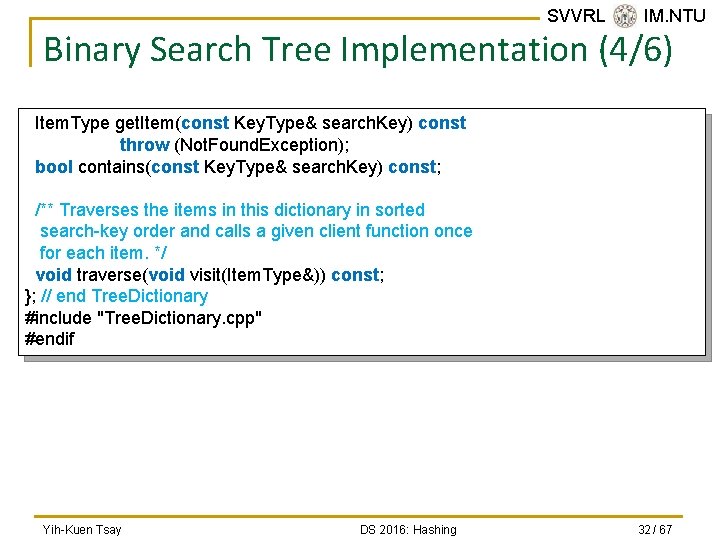
SVVRL @ IM. NTU Binary Search Tree Implementation (4/6) Item. Type get. Item(const Key. Type& search. Key) const throw (Not. Found. Exception); bool contains(const Key. Type& search. Key) const; /** Traverses the items in this dictionary in sorted search-key order and calls a given client function once for each item. */ void traverse(void visit(Item. Type&)) const; }; // end Tree. Dictionary #include "Tree. Dictionary. cpp" #endif Yih-Kuen Tsay DS 2016: Hashing 32 / 67
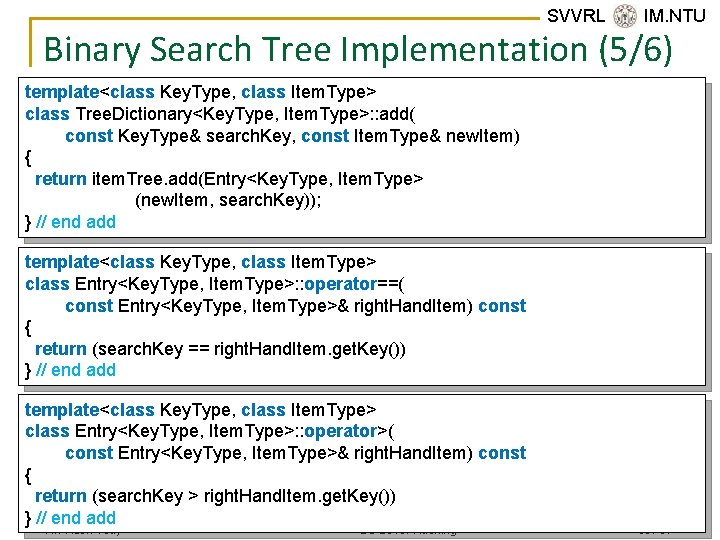
SVVRL @ IM. NTU Binary Search Tree Implementation (5/6) template<class Key. Type, class Item. Type> class Tree. Dictionary<Key. Type, Item. Type>: : add( const Key. Type& search. Key, const Item. Type& new. Item) { return item. Tree. add(Entry<Key. Type, Item. Type> (new. Item, search. Key)); } // end add template<class Key. Type, class Item. Type> class Entry<Key. Type, Item. Type>: : operator==( const Entry<Key. Type, Item. Type>& right. Hand. Item) const { return (search. Key == right. Hand. Item. get. Key()) } // end add template<class Key. Type, class Item. Type> class Entry<Key. Type, Item. Type>: : operator>( const Entry<Key. Type, Item. Type>& right. Hand. Item) const { return (search. Key > right. Hand. Item. get. Key()) } // end add Yih-Kuen Tsay DS 2016: Hashing 33 / 67
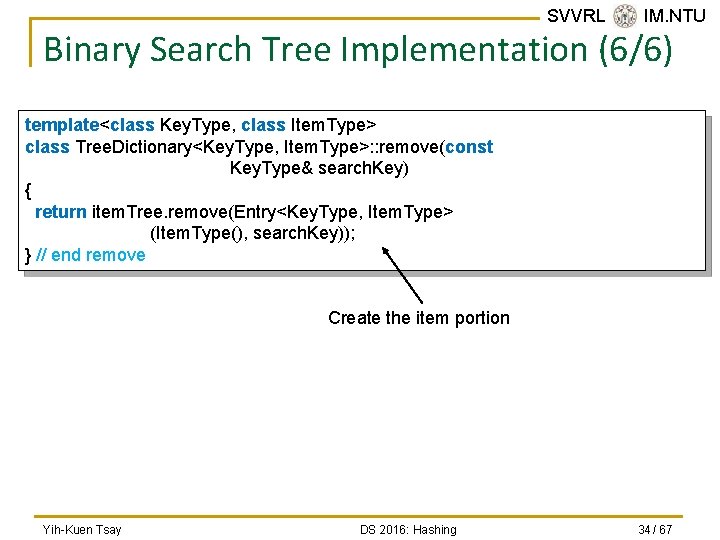
SVVRL @ IM. NTU Binary Search Tree Implementation (6/6) template<class Key. Type, class Item. Type> class Tree. Dictionary<Key. Type, Item. Type>: : remove(const Key. Type& search. Key) { return item. Tree. remove(Entry<Key. Type, Item. Type> (Item. Type(), search. Key)); } // end remove Create the item portion Yih-Kuen Tsay DS 2016: Hashing 34 / 67
SVVRL @ IM. NTU Selecting an Implementation (1/5) n Reasons for considering linear implementations (though they are not general enough) q n n Perspective, Efficiency, and Motivation One implementation may support some (but not all) of the operations more efficiently than another. Questions to ask q q What operations are needed? How often is each operation required? Yih-Kuen Tsay DS 2016: Hashing 35 / 67
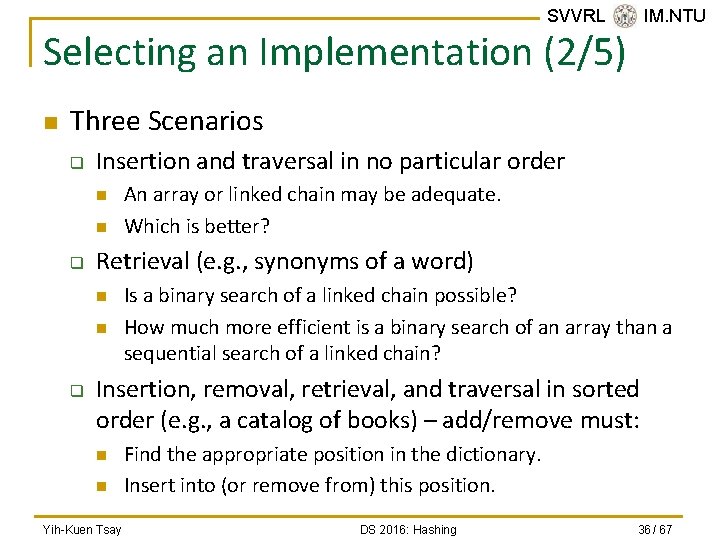
SVVRL @ IM. NTU Selecting an Implementation (2/5) n Three Scenarios q Insertion and traversal in no particular order n n q Retrieval (e. g. , synonyms of a word) n n q An array or linked chain may be adequate. Which is better? Is a binary search of a linked chain possible? How much more efficient is a binary search of an array than a sequential search of a linked chain? Insertion, removal, retrieval, and traversal in sorted order (e. g. , a catalog of books) – add/remove must: n n Yih-Kuen Tsay Find the appropriate position in the dictionary. Insert into (or remove from) this position. DS 2016: Hashing 36 / 67
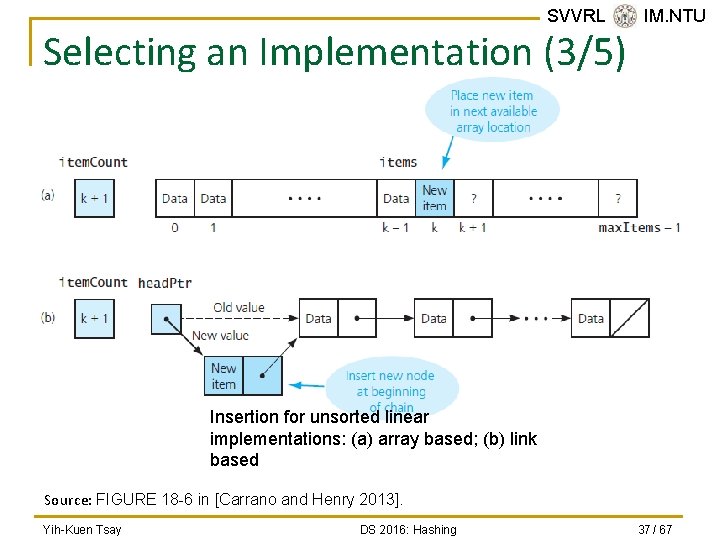
SVVRL @ IM. NTU Selecting an Implementation (3/5) Insertion for unsorted linear implementations: (a) array based; (b) link based Source: FIGURE 18 -6 in [Carrano and Henry 2013]. Yih-Kuen Tsay DS 2016: Hashing 37 / 67
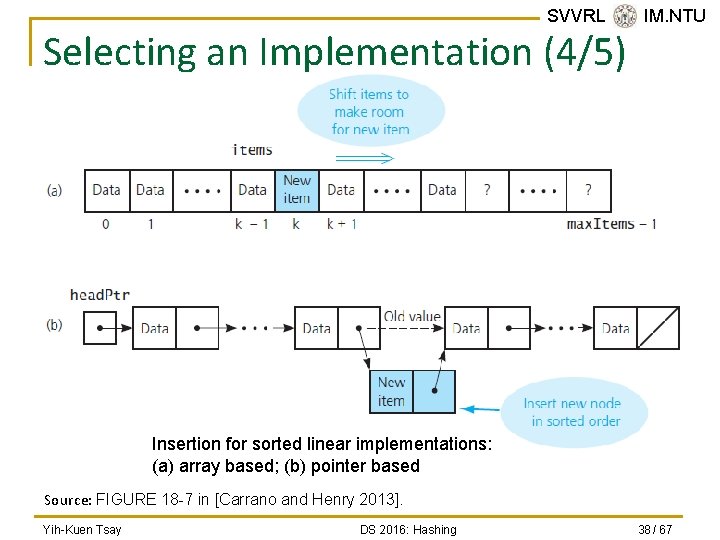
SVVRL @ IM. NTU Selecting an Implementation (4/5) Insertion for sorted linear implementations: (a) array based; (b) pointer based Source: FIGURE 18 -7 in [Carrano and Henry 2013]. Yih-Kuen Tsay DS 2016: Hashing 38 / 67
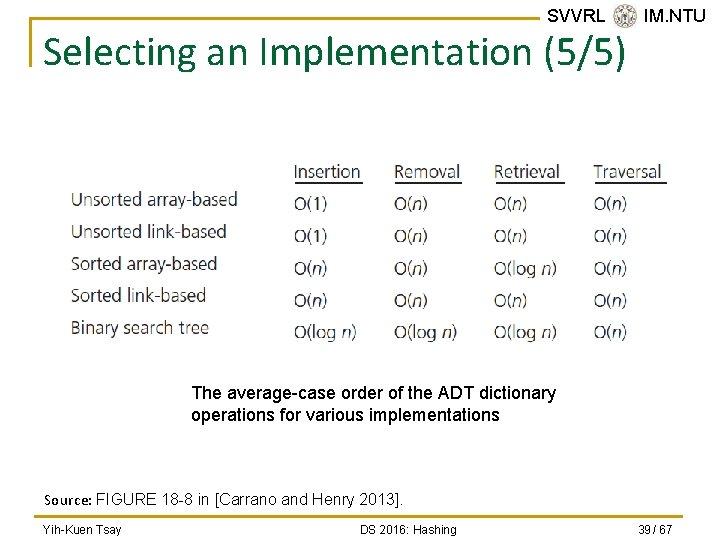
SVVRL @ IM. NTU Selecting an Implementation (5/5) The average-case order of the ADT dictionary operations for various implementations Source: FIGURE 18 -8 in [Carrano and Henry 2013]. Yih-Kuen Tsay DS 2016: Hashing 39 / 67
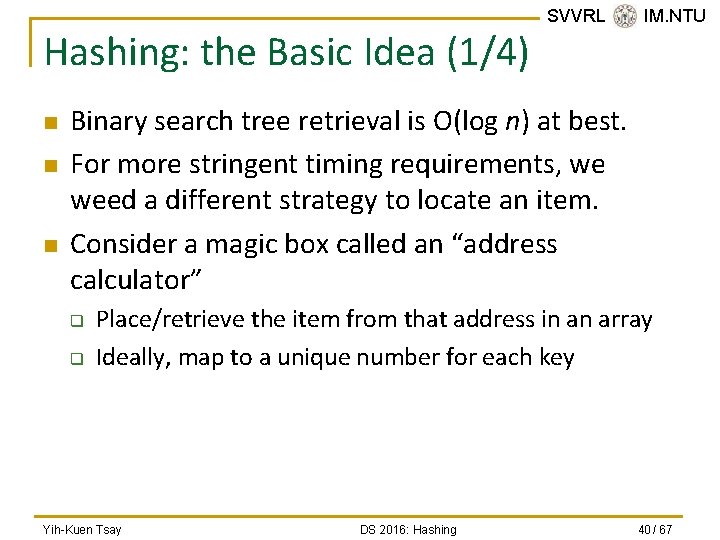
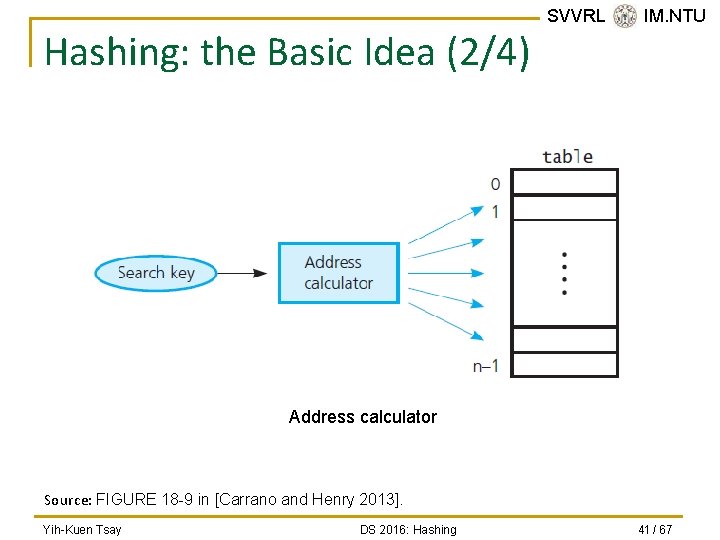
Hashing: the Basic Idea (1/4) n n n SVVRL @ IM. NTU Binary search tree retrieval is O(log n) at best. For more stringent timing requirements, we weed a different strategy to locate an item. Consider a magic box called an “address calculator” q q Place/retrieve the item from that address in an array Ideally, map to a unique number for each key Yih-Kuen Tsay DS 2016: Hashing 40 / 67
Hashing: the Basic Idea (2/4) SVVRL @ IM. NTU Address calculator Source: FIGURE 18 -9 in [Carrano and Henry 2013]. Yih-Kuen Tsay DS 2016: Hashing 41 / 67
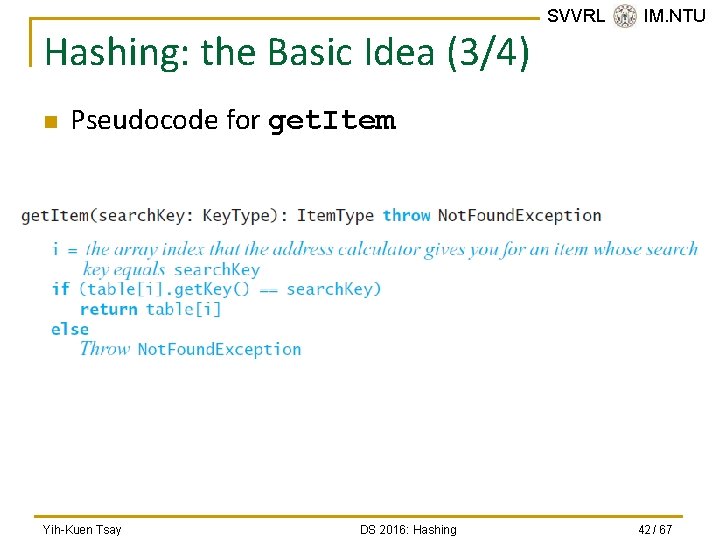
Hashing: the Basic Idea (3/4) n SVVRL @ IM. NTU Pseudocode for get. Item Yih-Kuen Tsay DS 2016: Hashing 42 / 67
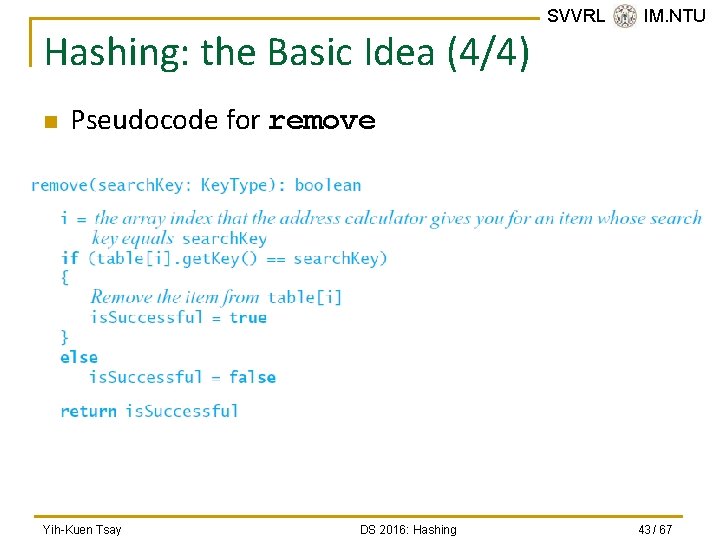
Hashing: the Basic Idea (4/4) n SVVRL @ IM. NTU Pseudocode for remove Yih-Kuen Tsay DS 2016: Hashing 43 / 67
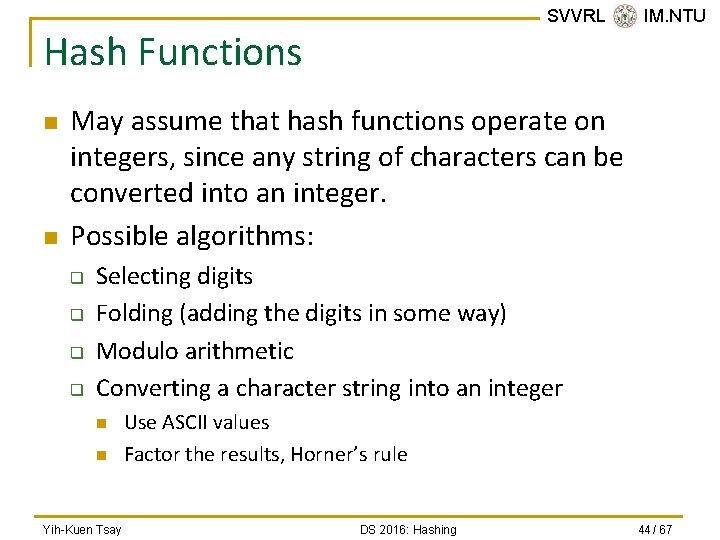
SVVRL @ IM. NTU Hash Functions n n May assume that hash functions operate on integers, since any string of characters can be converted into an integer. Possible algorithms: q q Selecting digits Folding (adding the digits in some way) Modulo arithmetic Converting a character string into an integer n n Yih-Kuen Tsay Use ASCII values Factor the results, Horner’s rule DS 2016: Hashing 44 / 67
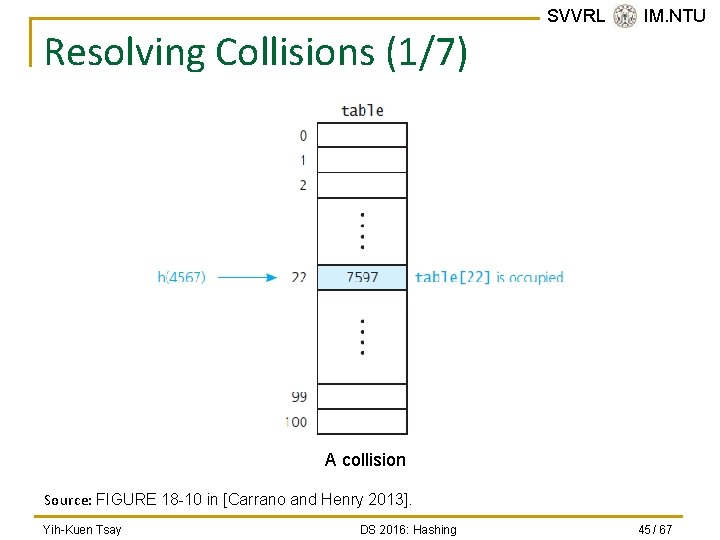
Resolving Collisions (1/7) SVVRL @ IM. NTU A collision Source: FIGURE 18 -10 in [Carrano and Henry 2013]. Yih-Kuen Tsay DS 2016: Hashing 45 / 67
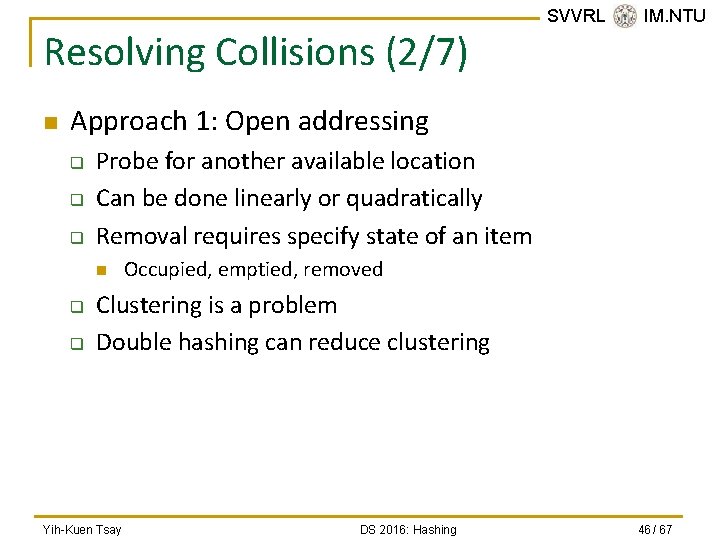
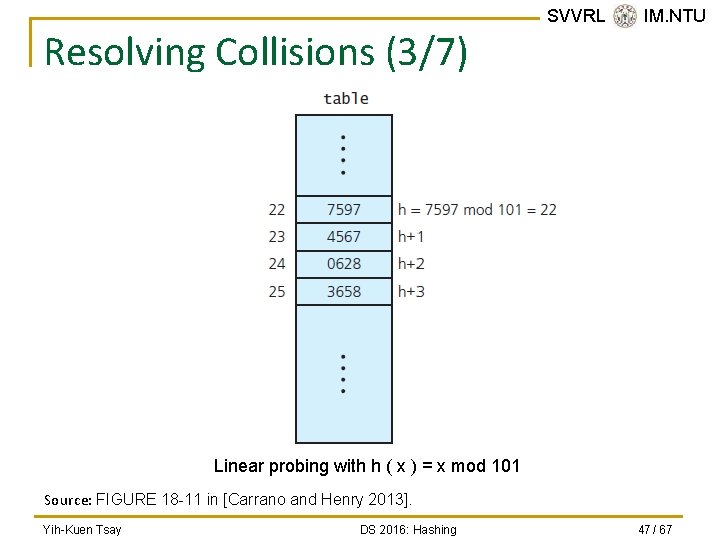
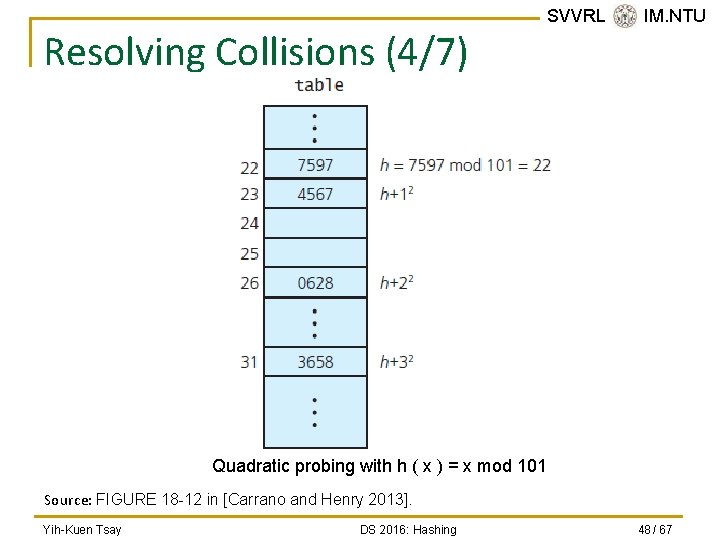
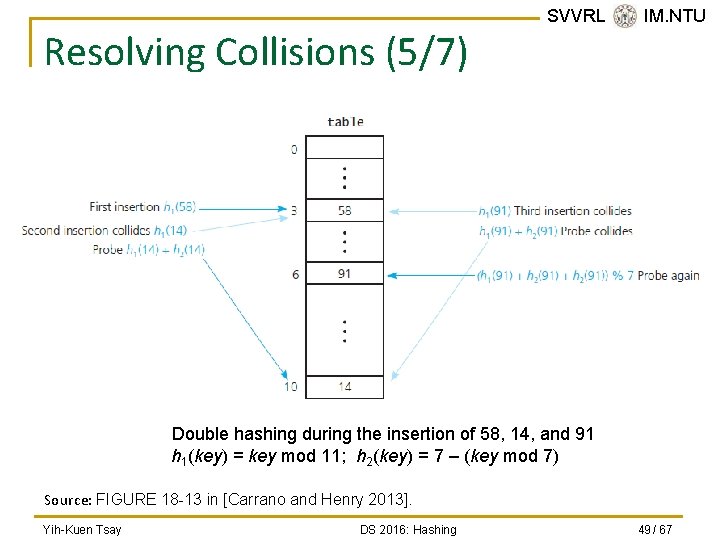
Resolving Collisions (2/7) n SVVRL @ IM. NTU Approach 1: Open addressing q q q Probe for another available location Can be done linearly or quadratically Removal requires specify state of an item n q q Occupied, emptied, removed Clustering is a problem Double hashing can reduce clustering Yih-Kuen Tsay DS 2016: Hashing 46 / 67
Resolving Collisions (3/7) SVVRL @ IM. NTU Linear probing with h ( x ) = x mod 101 Source: FIGURE 18 -11 in [Carrano and Henry 2013]. Yih-Kuen Tsay DS 2016: Hashing 47 / 67
Resolving Collisions (4/7) SVVRL @ IM. NTU Quadratic probing with h ( x ) = x mod 101 Source: FIGURE 18 -12 in [Carrano and Henry 2013]. Yih-Kuen Tsay DS 2016: Hashing 48 / 67
Resolving Collisions (5/7) SVVRL @ IM. NTU Double hashing during the insertion of 58, 14, and 91 h 1(key) = key mod 11; h 2(key) = 7 – (key mod 7) Source: FIGURE 18 -13 in [Carrano and Henry 2013]. Yih-Kuen Tsay DS 2016: Hashing 49 / 67
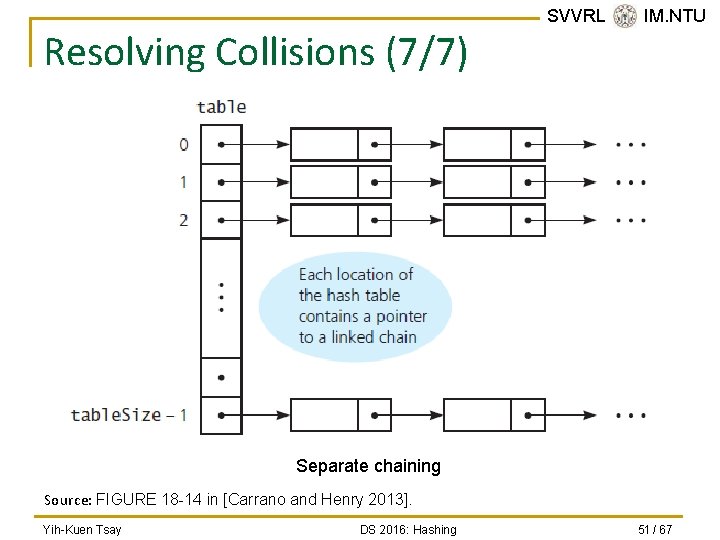
Resolving Collisions (6/7) n SVVRL @ IM. NTU Approach 2: Restructuring the hash table q q q Each hash location can accommodate more than one item Each location is a “bucket” or an array itself Alternatively, design the hash table as an array of linked chains – called “separate chaining” Yih-Kuen Tsay DS 2016: Hashing 50 / 67
Resolving Collisions (7/7) SVVRL @ IM. NTU Separate chaining Source: FIGURE 18 -14 in [Carrano and Henry 2013]. Yih-Kuen Tsay DS 2016: Hashing 51 / 67
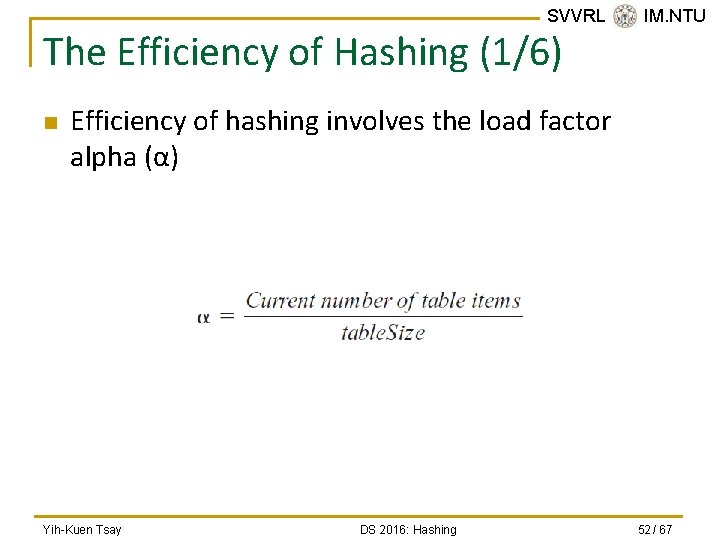
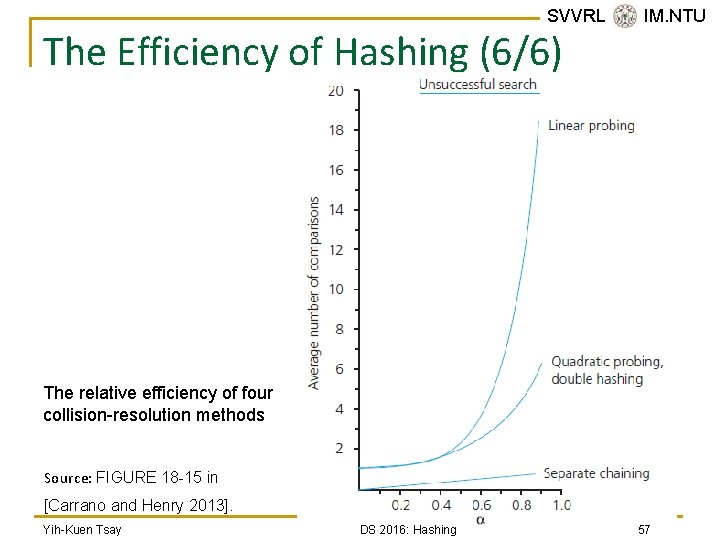
SVVRL @ IM. NTU The Efficiency of Hashing (1/6) n Efficiency of hashing involves the load factor alpha (α) Yih-Kuen Tsay DS 2016: Hashing 52 / 67
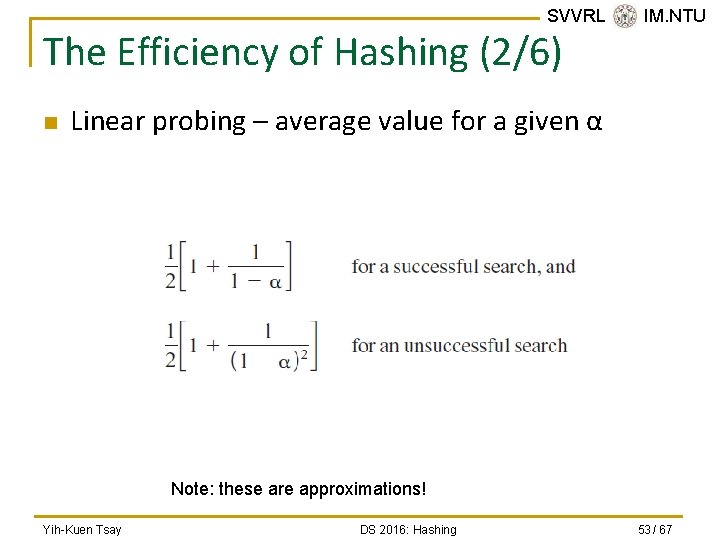
SVVRL @ IM. NTU The Efficiency of Hashing (2/6) n Linear probing – average value for a given α Note: these are approximations! Yih-Kuen Tsay DS 2016: Hashing 53 / 67
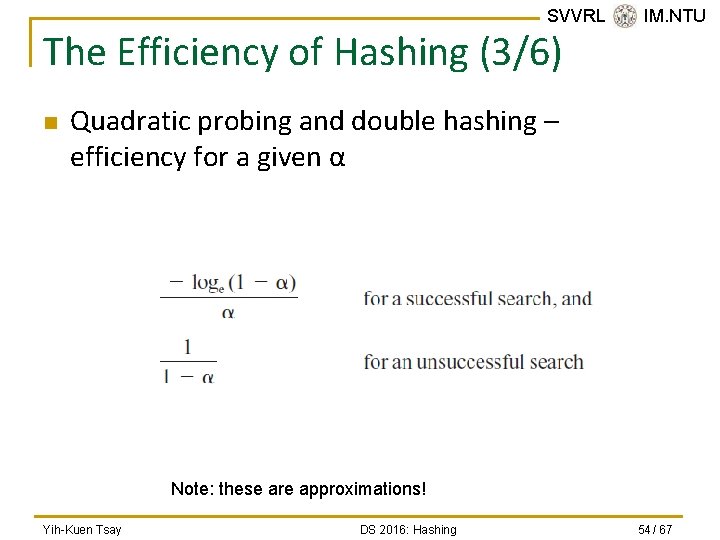
SVVRL @ IM. NTU The Efficiency of Hashing (3/6) n Quadratic probing and double hashing – efficiency for a given α Note: these are approximations! Yih-Kuen Tsay DS 2016: Hashing 54 / 67
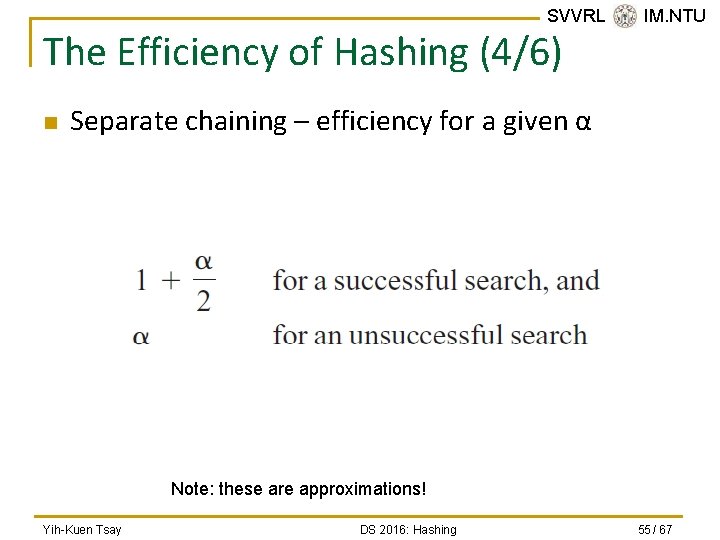
SVVRL @ IM. NTU The Efficiency of Hashing (4/6) n Separate chaining – efficiency for a given α Note: these are approximations! Yih-Kuen Tsay DS 2016: Hashing 55 / 67
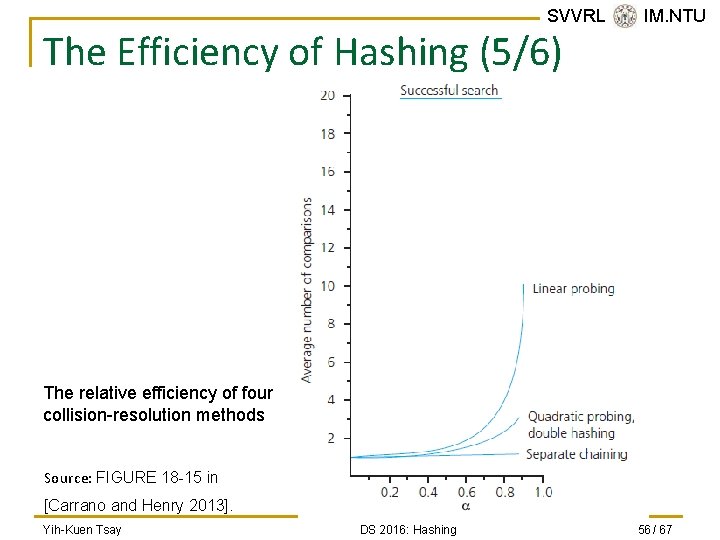
SVVRL @ IM. NTU The Efficiency of Hashing (5/6) The relative efficiency of four collision-resolution methods Source: FIGURE 18 -15 in [Carrano and Henry 2013]. Yih-Kuen Tsay DS 2016: Hashing 56 / 67
SVVRL @ IM. NTU The Efficiency of Hashing (6/6) The relative efficiency of four collision-resolution methods Source: FIGURE 18 -15 in [Carrano and Henry 2013]. Yih-Kuen Tsay DS 2016: Hashing 57 / 67
SVVRL @ IM. NTU Maintaining Hashing Performance n n Collisions and their resolution typically cause the load factor α to increase To maintain efficiency, restrict the size of α q q n α 0. 5 for open addressing α 1. 0 for separate chaining If the load factor exceeds these limits q q Increase the size of the hash table Rehash with a new hashing function Yih-Kuen Tsay DS 2016: Hashing 58 / 67
SVVRL @ IM. NTU What Constitutes a Good Hash Function? n n Easy and fast to compute? Scatter data evenly throughout the hash table? How well does it scatter random data? How well does it scatter non-random data? Note: traversal in sorted order is inefficient when using hashing Yih-Kuen Tsay DS 2016: Hashing 59 / 67
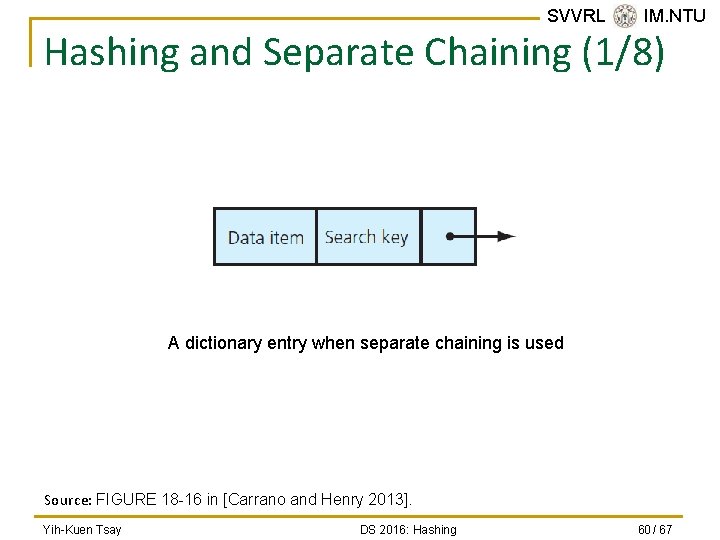
SVVRL @ IM. NTU Hashing and Separate Chaining (1/8) A dictionary entry when separate chaining is used Source: FIGURE 18 -16 in [Carrano and Henry 2013]. Yih-Kuen Tsay DS 2016: Hashing 60 / 67
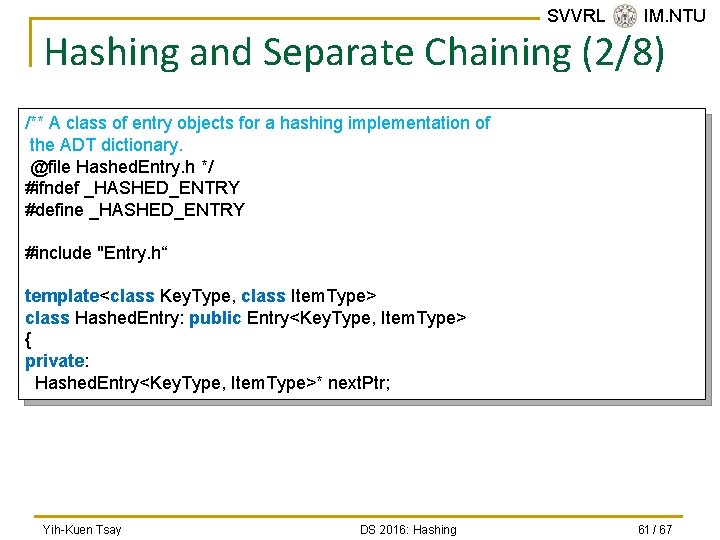
SVVRL @ IM. NTU Hashing and Separate Chaining (2/8) /** A class of entry objects for a hashing implementation of the ADT dictionary. @file Hashed. Entry. h */ #ifndef _HASHED_ENTRY #define _HASHED_ENTRY #include "Entry. h“ template<class Key. Type, class Item. Type> class Hashed. Entry: public Entry<Key. Type, Item. Type> { private: Hashed. Entry<Key. Type, Item. Type>* next. Ptr; Yih-Kuen Tsay DS 2016: Hashing 61 / 67
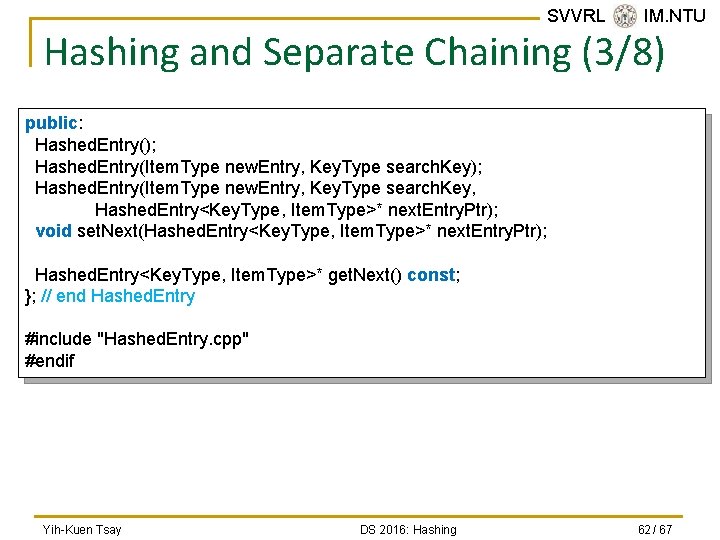
SVVRL @ IM. NTU Hashing and Separate Chaining (3/8) public: Hashed. Entry(); Hashed. Entry(Item. Type new. Entry, Key. Type search. Key, Hashed. Entry<Key. Type, Item. Type>* next. Entry. Ptr); void set. Next(Hashed. Entry<Key. Type, Item. Type>* next. Entry. Ptr); Hashed. Entry<Key. Type, Item. Type>* get. Next() const; }; // end Hashed. Entry #include "Hashed. Entry. cpp" #endif Yih-Kuen Tsay DS 2016: Hashing 62 / 67
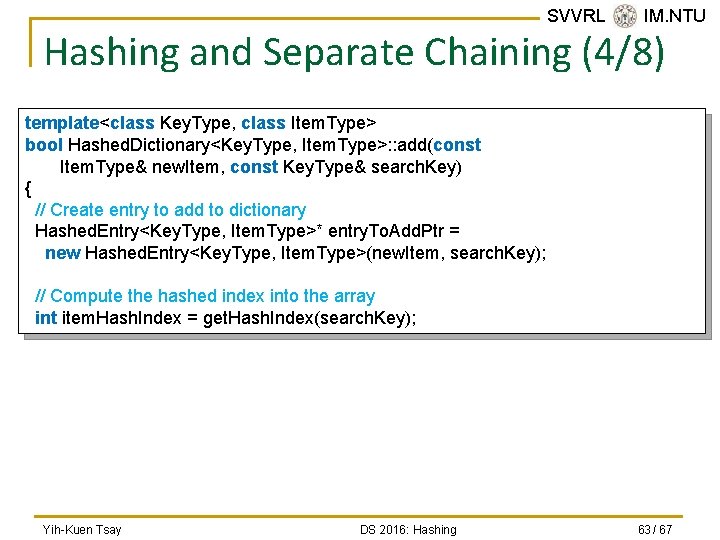
SVVRL @ IM. NTU Hashing and Separate Chaining (4/8) template<class Key. Type, class Item. Type> bool Hashed. Dictionary<Key. Type, Item. Type>: : add(const Item. Type& new. Item, const Key. Type& search. Key) { // Create entry to add to dictionary Hashed. Entry<Key. Type, Item. Type>* entry. To. Add. Ptr = new Hashed. Entry<Key. Type, Item. Type>(new. Item, search. Key); // Compute the hashed index into the array int item. Hash. Index = get. Hash. Index(search. Key); Yih-Kuen Tsay DS 2016: Hashing 63 / 67
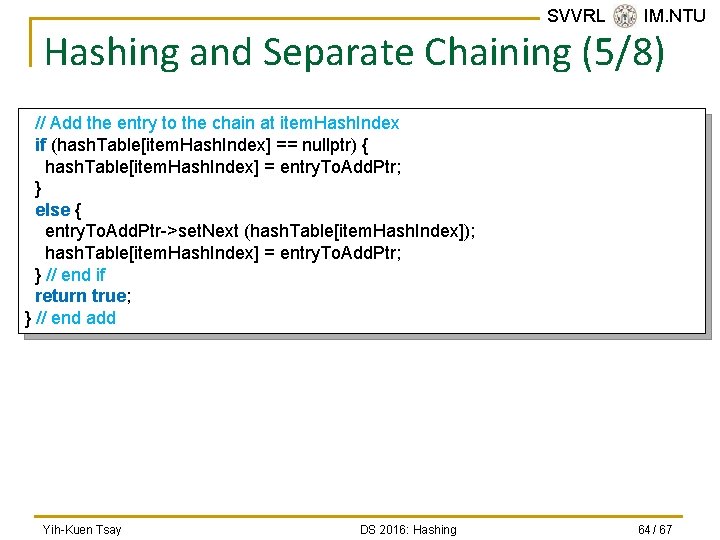
SVVRL @ IM. NTU Hashing and Separate Chaining (5/8) // Add the entry to the chain at item. Hash. Index if (hash. Table[item. Hash. Index] == nullptr) { hash. Table[item. Hash. Index] = entry. To. Add. Ptr; } else { entry. To. Add. Ptr->set. Next (hash. Table[item. Hash. Index]); hash. Table[item. Hash. Index] = entry. To. Add. Ptr; } // end if return true; } // end add Yih-Kuen Tsay DS 2016: Hashing 64 / 67
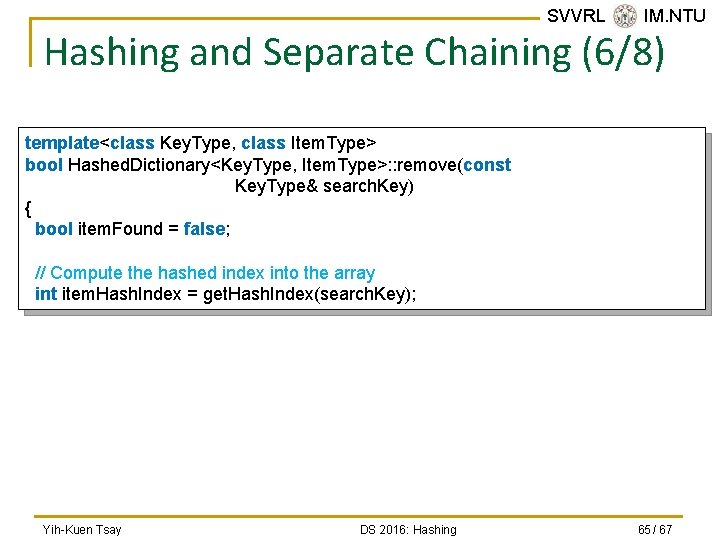
SVVRL @ IM. NTU Hashing and Separate Chaining (6/8) template<class Key. Type, class Item. Type> bool Hashed. Dictionary<Key. Type, Item. Type>: : remove(const Key. Type& search. Key) { bool item. Found = false; // Compute the hashed index into the array int item. Hash. Index = get. Hash. Index(search. Key); Yih-Kuen Tsay DS 2016: Hashing 65 / 67
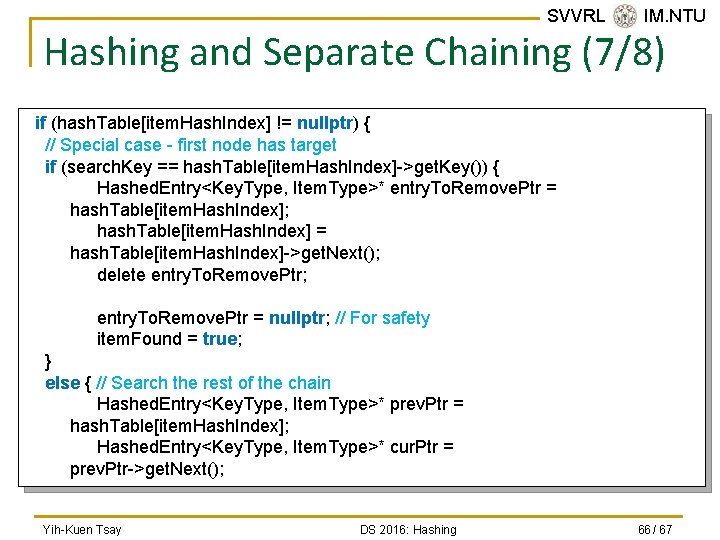
SVVRL @ IM. NTU Hashing and Separate Chaining (7/8) if (hash. Table[item. Hash. Index] != nullptr) { // Special case - first node has target if (search. Key == hash. Table[item. Hash. Index]->get. Key()) { Hashed. Entry<Key. Type, Item. Type>* entry. To. Remove. Ptr = hash. Table[item. Hash. Index]; hash. Table[item. Hash. Index] = hash. Table[item. Hash. Index]->get. Next(); delete entry. To. Remove. Ptr; entry. To. Remove. Ptr = nullptr; // For safety item. Found = true; } else { // Search the rest of the chain Hashed. Entry<Key. Type, Item. Type>* prev. Ptr = hash. Table[item. Hash. Index]; Hashed. Entry<Key. Type, Item. Type>* cur. Ptr = prev. Ptr->get. Next(); Yih-Kuen Tsay DS 2016: Hashing 66 / 67
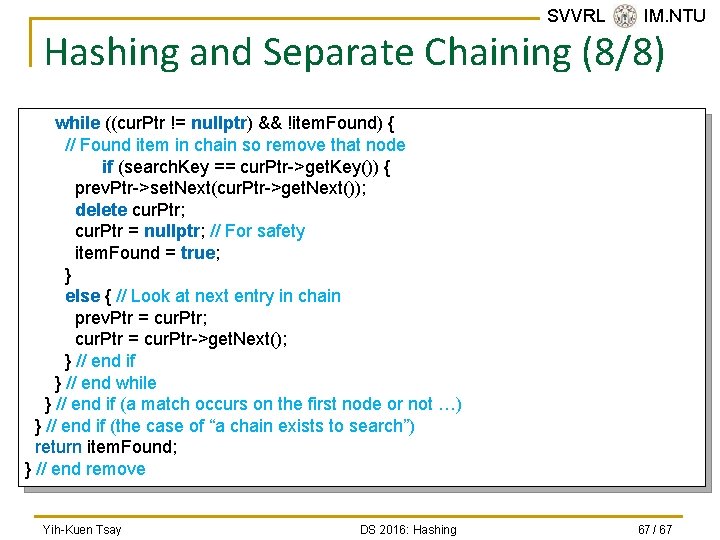
SVVRL @ IM. NTU Hashing and Separate Chaining (8/8) while ((cur. Ptr != nullptr) && !item. Found) { // Found item in chain so remove that node if (search. Key == cur. Ptr->get. Key()) { prev. Ptr->set. Next(cur. Ptr->get. Next()); delete cur. Ptr; cur. Ptr = nullptr; // For safety item. Found = true; } else { // Look at next entry in chain prev. Ptr = cur. Ptr; cur. Ptr = cur. Ptr->get. Next(); } // end if } // end while } // end if (a match occurs on the first node or not …) } // end if (the case of “a chain exists to search”) return item. Found; } // end remove Yih-Kuen Tsay DS 2016: Hashing 67 / 67