
Research Student Orientation presented by Assoc Professor Dion
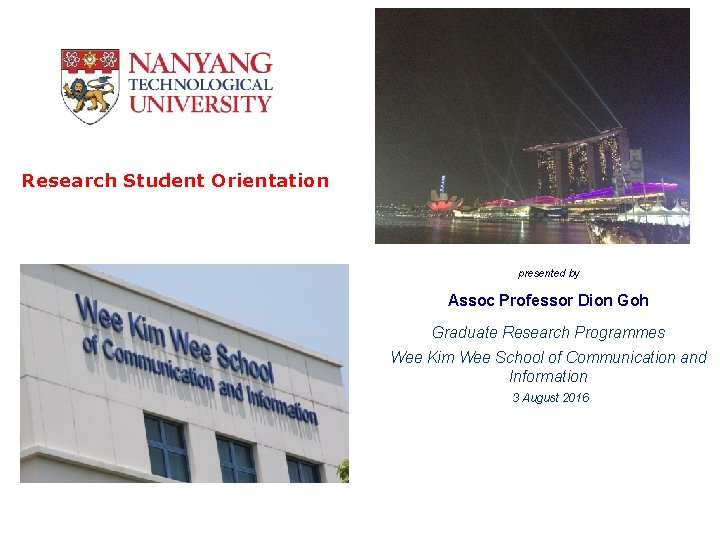
Research Student Orientation presented by Assoc Professor Dion Goh Graduate Research Programmes Wee Kim Wee School of Communication and Information 3 August 2016
Agenda 5. 30 pm Welcome and Introduction Assoc Prof. Dion Goh, Research Programme Committee 5. 45 pm Overview of Graduate Research Programmes, Expectations, Requirements, Committees and Examinations 6. 15 pm Q&A 6. 30 pm Graduates Orientation Ceremony @ LF-LT (Level 1) 8. 05 pm Dinner Reception
Contact Persons Dr. Mark CENITE Associate Chair (Academic) Email: Tmark@ntu. edu. sg Assoc Prof. Brendan LUYT Programme Director, Graduate Research Programmes (Ph. D and MARes)* Email: jwalther@ntu. edu. sg Ms. Joanne QUEK Manager, Graduate Studies Email: joanne_quek@ntu. edu. sg Ms. TAN Siyun Senior Assistant Manager, Graduate Studies Email: tgbchua@ntu. edu. sg Ms. WEE Kia Hui Executive, Graduate Studies Email: khwee@ntu. edu. sg *Other Graduate Research Programmes Committee Members: • Assoc Prof. Dion Goh • Asst Prof. Nuri Kim • Asst Prof. Edson
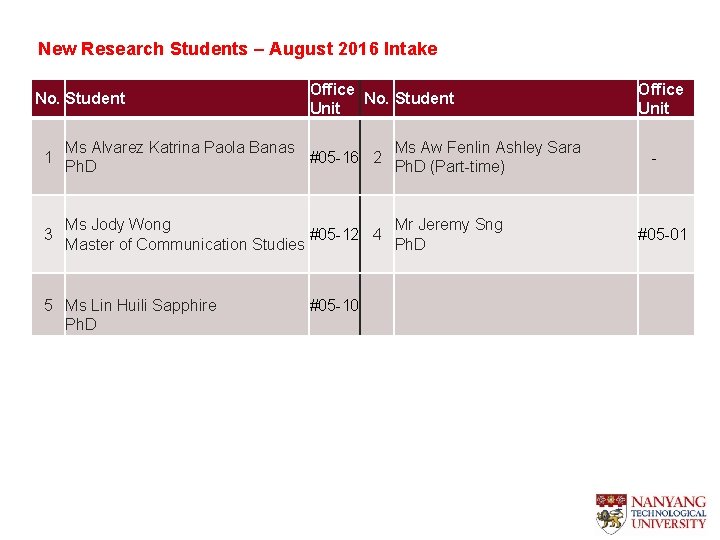
New Research Students – August 2016 Intake No. Student Office No. Student Unit Office Unit 1 Ms Aw Fenlin Ashley Sara Ms Alvarez Katrina Paola Banas #05 -16 2 Ph. D (Part-time) - 3 Mr Jeremy Sng Ms Jody Wong #05 -12 4 Master of Communication Studies Ph. D #05 -01 5 Ms Lin Huili Sapphire Ph. D #05 -10
Graduate Research Programmes at WKWSCI: GOALS Holistic Leaning Experience § More than learning to solve a problem; contribute to knowledge about human nature § Foster independence and initiative § Foster collaboration with faculty and other students § Learn about inter-related fields through seminar presentations § Hone communication skills in writing and presentations Characteristics § Global outlook with an Asian perspective § Potential integration of IS and CS perspectives § Resources for graduate research students
Graduate Research Programmes at WKWSCI: GOALS Upon successful completion of the WKWSCI programme, you will be able to: • Make significant intellectual contributions to the body of knowledge in your chosen field. • Conduct empirical research and think analytically. • Be confident to lead a research team and think strategically. • Apply critical thinking to various fields besides your chosen one. • Communicate effectively - both orally and in written form.

Graduate Research Programmes at WKWSCI: GOALS • Masters: Successfully enter and excel in a top-ranked Ph. D programme anywhere in the world. • Ph. D: Become a successful faculty member with a foundation of strong teaching skills, valuable ongoing publications and a developing research agenda, with a trajectory to be an eventual leader in the field.
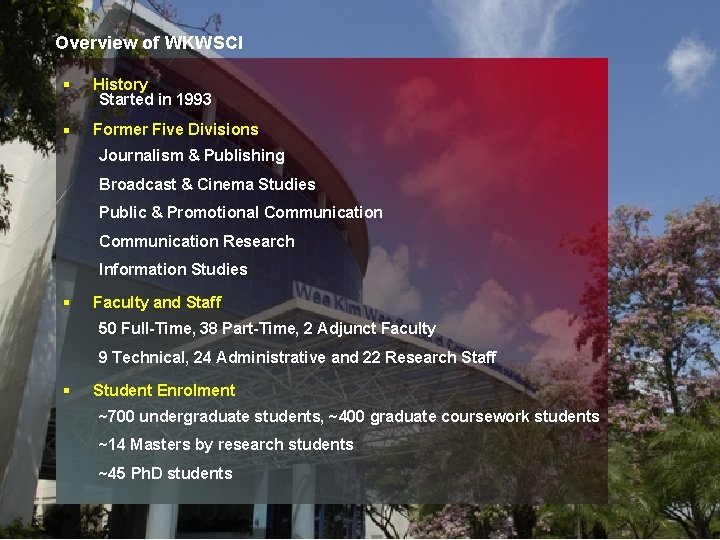
Overview of WKWSCI § History Started in 1993 § Former Five Divisions Journalism & Publishing Broadcast & Cinema Studies Public & Promotional Communication Research Information Studies § Faculty and Staff 50 Full-Time, 38 Part-Time, 2 Adjunct Faculty 9 Technical, 24 Administrative and 22 Research Staff § Student Enrolment ~700 undergraduate students, ~400 graduate coursework students ~14 Masters by research students ~45 Ph. D students
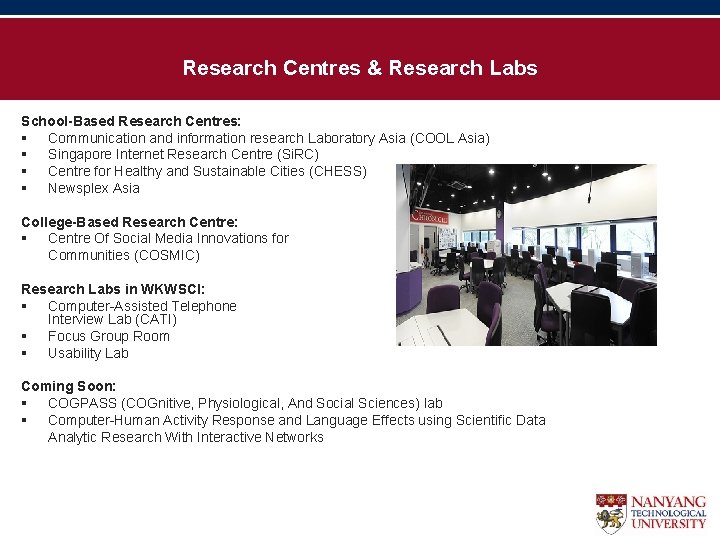
Research Centres & Research Labs School-Based Research Centres: § Communication and information research Laboratory Asia (COOL Asia) § Singapore Internet Research Centre (Si. RC) § Centre for Healthy and Sustainable Cities (CHESS) § Newsplex Asia College-Based Research Centre: § Centre Of Social Media Innovations for Communities (COSMIC) Research Labs in WKWSCI: § Computer-Assisted Telephone Interview Lab (CATI) § Focus Group Room § Usability Lab Coming Soon: § COGPASS (COGnitive, Physiological, And Social Sciences) lab § Computer-Human Activity Response and Language Effects using Scientific Data Analytic Research With Interactive Networks
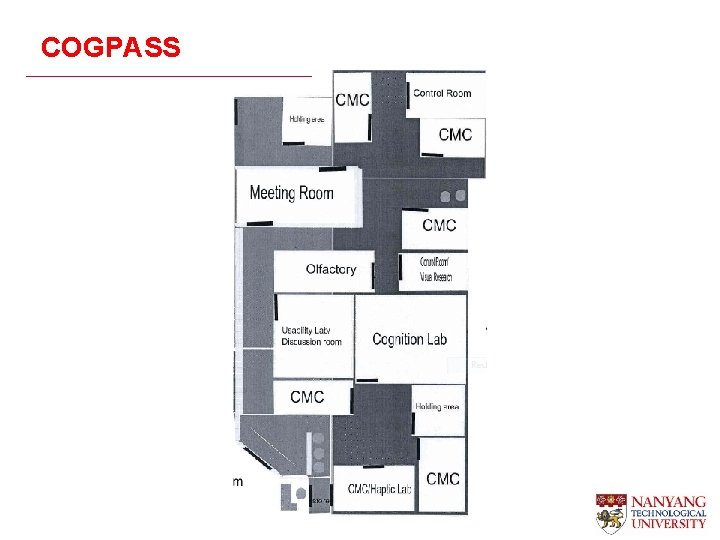
COGPASS
Program Overview • • Research and Coursework – The European and American traditions; the WKWSCI Approach Coursework – Courses – Standards – Registration Teaching Assistantships Research Confirmation Thesis and Defense Committees – Thesis Advisory Committee (TAC) – Examination committees
Research and Coursework Scheme • The European and American traditions • The WKWSCI Approach
Research Expectations • The primary focus of graduate study; why you’re here – Build experience and insight of how to ask and answer questions – Gain strategic know-how and develop sensibilities – Generate and disseminate knowledge through publication • High-quality research is paramount – What you are enabled to do now will be your best opportunity ever Opportunities: Seek them – Work with your supervisor (or his/her designee) frequently & consistently at least 6 hours per week on average • Aside from thesis • Aside from TA work – Work with other students – Work with other Profs • You will be evaluated on research quality and quantity
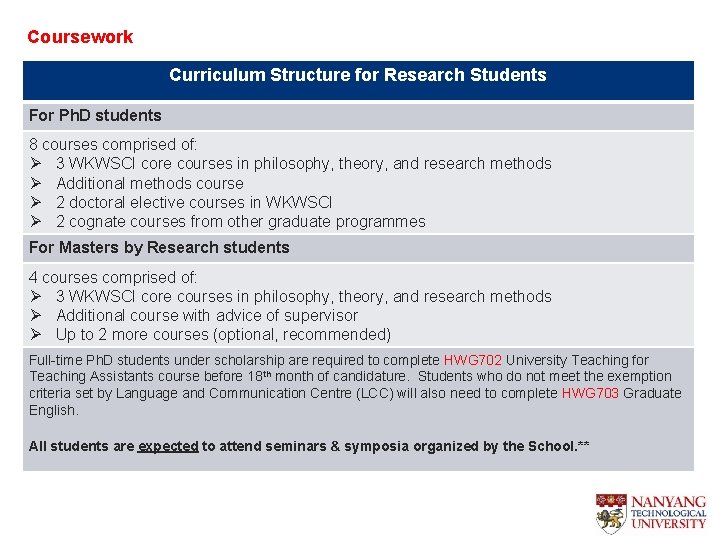
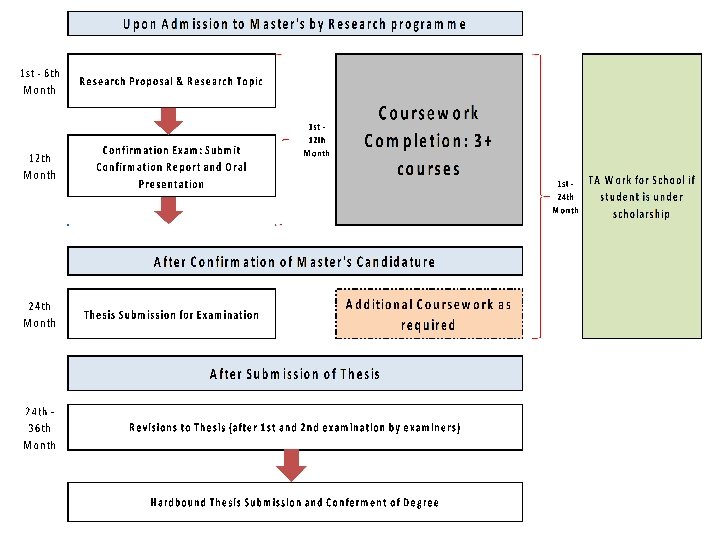
Coursework Curriculum Structure for Research Students For Ph. D students 8 courses comprised of: Ø 3 WKWSCI core courses in philosophy, theory, and research methods Ø Additional methods course Ø 2 doctoral elective courses in WKWSCI Ø 2 cognate courses from other graduate programmes For Masters by Research students 4 courses comprised of: Ø 3 WKWSCI core courses in philosophy, theory, and research methods Ø Additional course with advice of supervisor Ø Up to 2 more courses (optional, recommended) Full-time Ph. D students under scholarship are required to complete HWG 702 University Teaching for Teaching Assistants course before 18 th month of candidature. Students who do not meet the exemption criteria set by Language and Communication Centre (LCC) will also need to complete HWG 703 Graduate English. All students are expected to attend seminars & symposia organized by the School. **
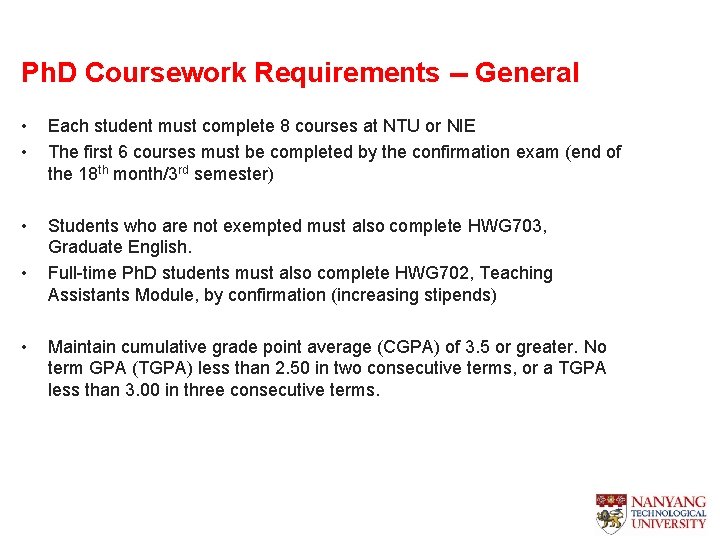
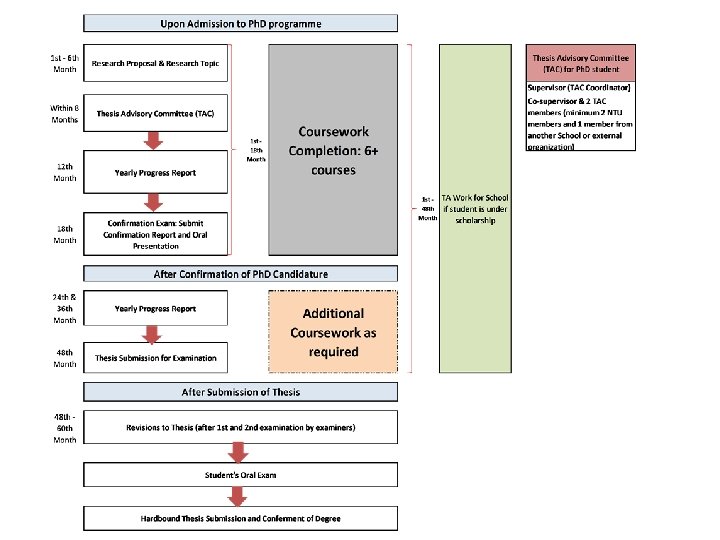
Ph. D Coursework Requirements -- General • • Each student must complete 8 courses at NTU or NIE The first 6 courses must be completed by the confirmation exam (end of the 18 th month/3 rd semester) • Students who are not exempted must also complete HWG 703, Graduate English. Full-time Ph. D students must also complete HWG 702, Teaching Assistants Module, by confirmation (increasing stipends) • • Maintain cumulative grade point average (CGPA) of 3. 5 or greater. No term GPA (TGPA) less than 2. 50 in two consecutive terms, or a TGPA less than 3. 00 in three consecutive terms.
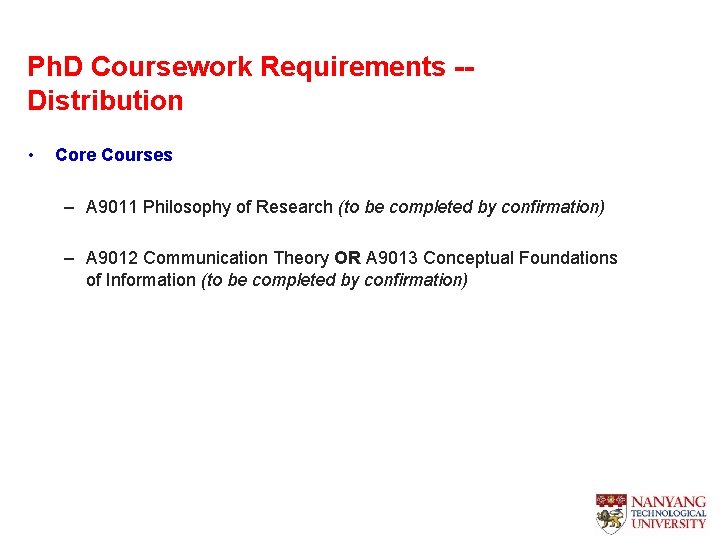
Ph. D Coursework Requirements -Distribution • Core Courses – A 9011 Philosophy of Research (to be completed by confirmation) – A 9012 Communication Theory OR A 9013 Conceptual Foundations of Information (to be completed by confirmation)
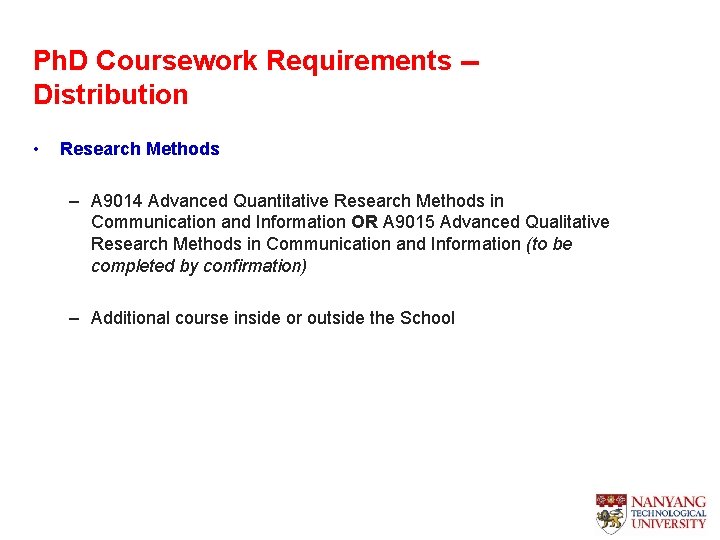
Ph. D Coursework Requirements -Distribution • Research Methods – A 9014 Advanced Quantitative Research Methods in Communication and Information OR A 9015 Advanced Qualitative Research Methods in Communication and Information (to be completed by confirmation) – Additional course inside or outside the School
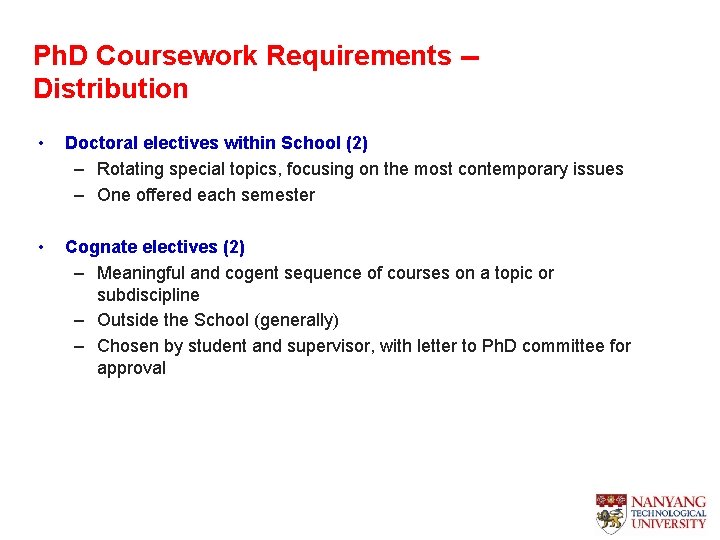
Ph. D Coursework Requirements -Distribution • Doctoral electives within School (2) – Rotating special topics, focusing on the most contemporary issues – One offered each semester • Cognate electives (2) – Meaningful and cogent sequence of courses on a topic or subdiscipline – Outside the School (generally) – Chosen by student and supervisor, with letter to Ph. D committee for approval
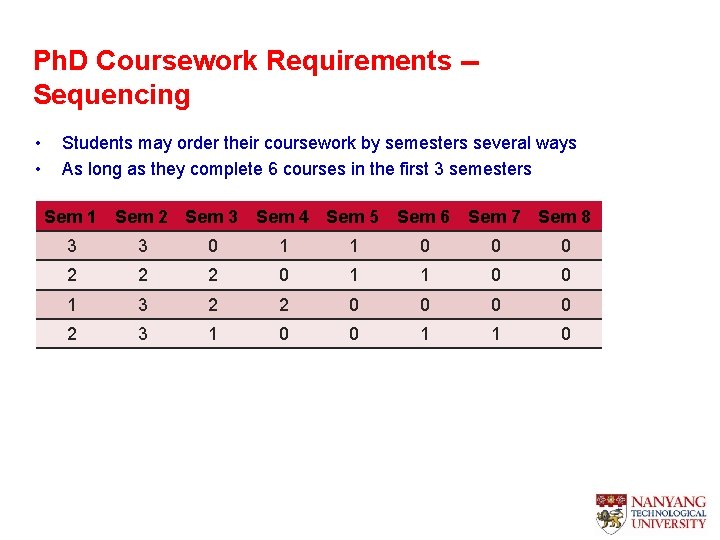
Ph. D Coursework Requirements -Sequencing • • Students may order their coursework by semesters several ways As long as they complete 6 courses in the first 3 semesters Sem 1 Sem 2 Sem 3 Sem 4 Sem 5 Sem 6 Sem 7 Sem 8 3 3 0 1 1 0 0 0 2 2 2 0 1 1 0 0 1 3 2 2 0 0 2 3 1 0 0 1 1 0
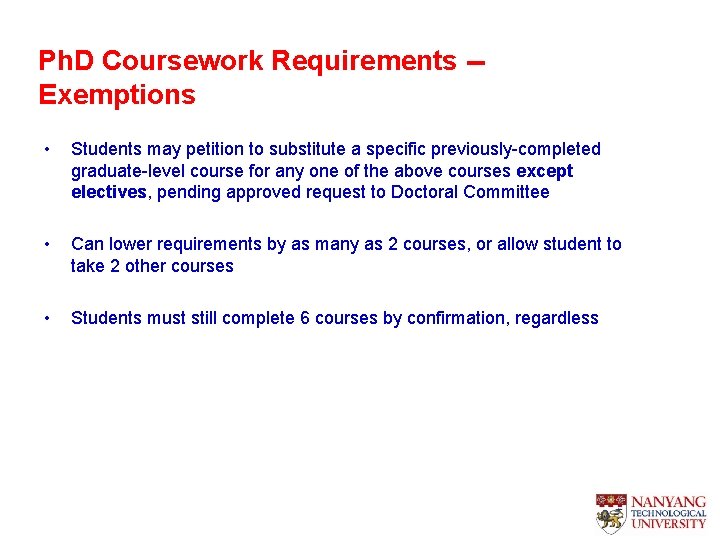
Ph. D Coursework Requirements -Exemptions • Students may petition to substitute a specific previously-completed graduate-level course for any one of the above courses except electives, pending approved request to Doctoral Committee • Can lower requirements by as many as 2 courses, or allow student to take 2 other courses • Students must still complete 6 courses by confirmation, regardless
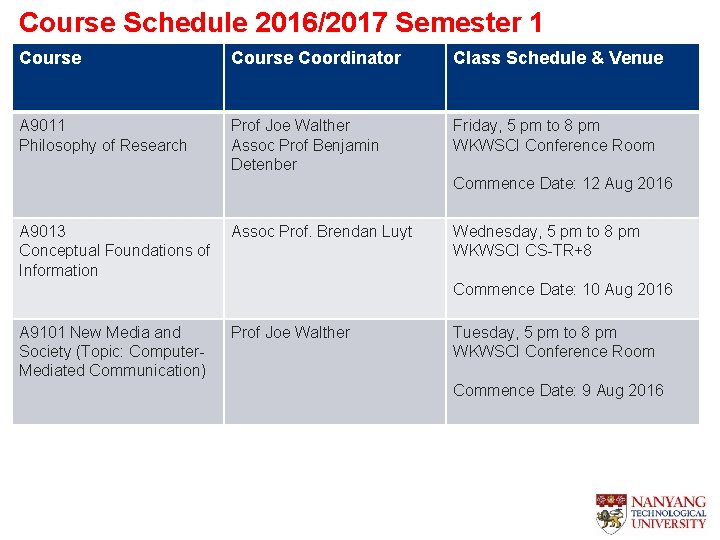
Course Schedule 2016/2017 Semester 1 Course Coordinator Class Schedule & Venue A 9011 Philosophy of Research Prof Joe Walther Assoc Prof Benjamin Detenber Friday, 5 pm to 8 pm WKWSCI Conference Room Commence Date: 12 Aug 2016 A 9013 Conceptual Foundations of Information Assoc Prof. Brendan Luyt Wednesday, 5 pm to 8 pm WKWSCI CS-TR+8 Commence Date: 10 Aug 2016 A 9101 New Media and Society (Topic: Computer. Mediated Communication) Prof Joe Walther Tuesday, 5 pm to 8 pm WKWSCI Conference Room Commence Date: 9 Aug 2016
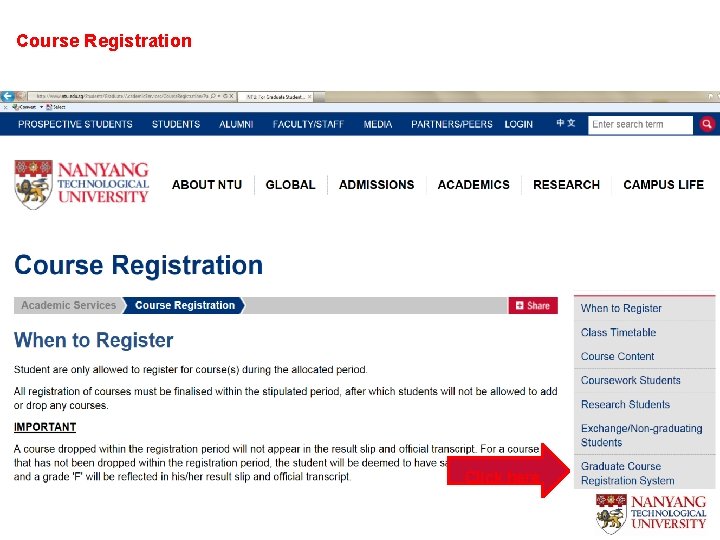
Course Registration Click here
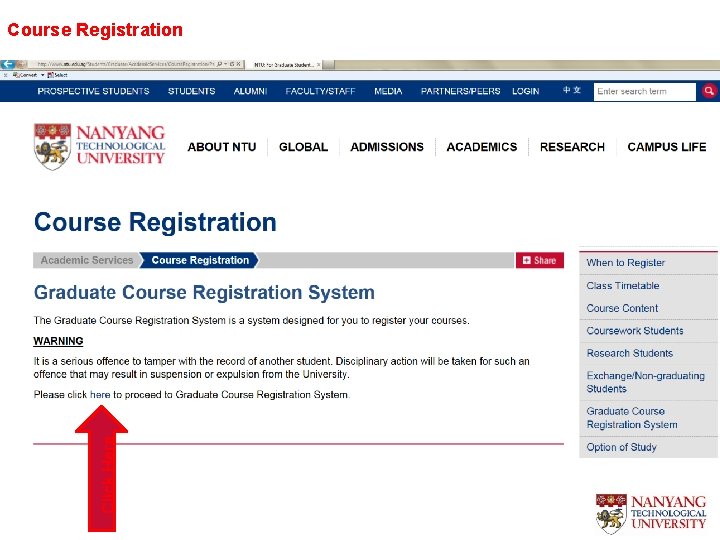
Click Here Course Registration
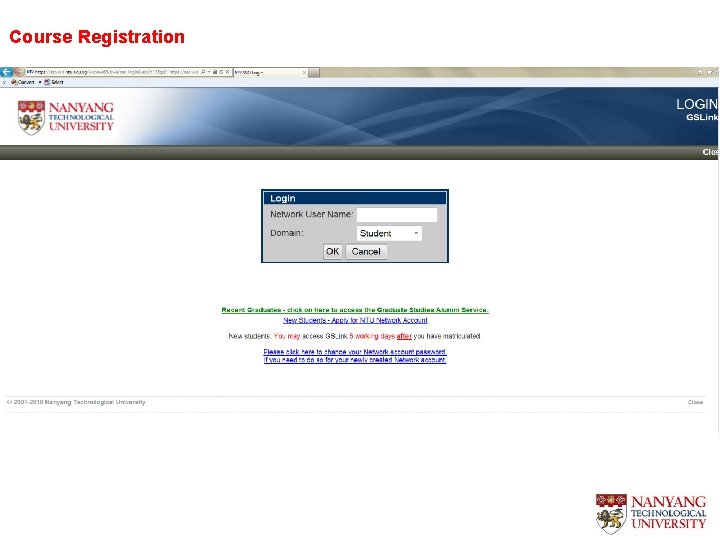
Course Registration
TA (teaching assistant) Requirements § All students on research scholarship are required to perform TA duties. § Direct and indirect teaching § Admin § Research support § § Six to ten hours a week (NPGS awardees have a greater hours) Assessed as part of yearly progress report § Make yourself easy to find § Communicate with supervisors about difficulties and conflicting demands in advance
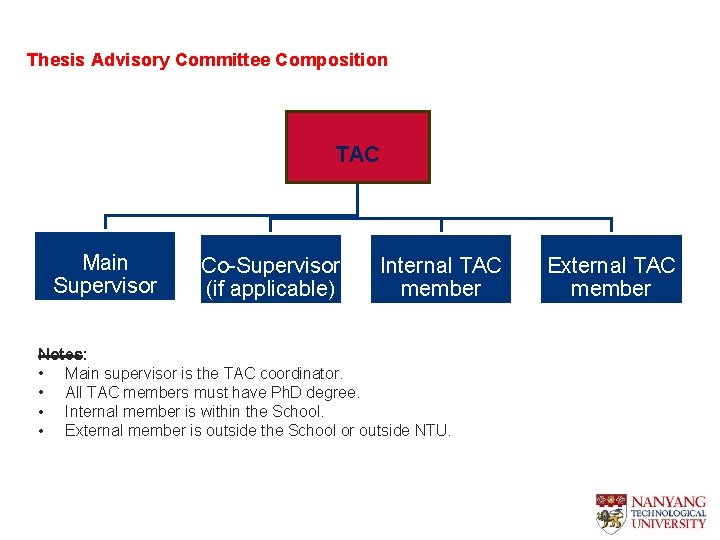
Thesis Advisory Committee Composition TAC Main Supervisor Co-Supervisor (if applicable) Internal TAC member Notes: • Main supervisor is the TAC coordinator. • All TAC members must have Ph. D degree. • Internal member is within the School. • External member is outside the School or outside NTU. External TAC member
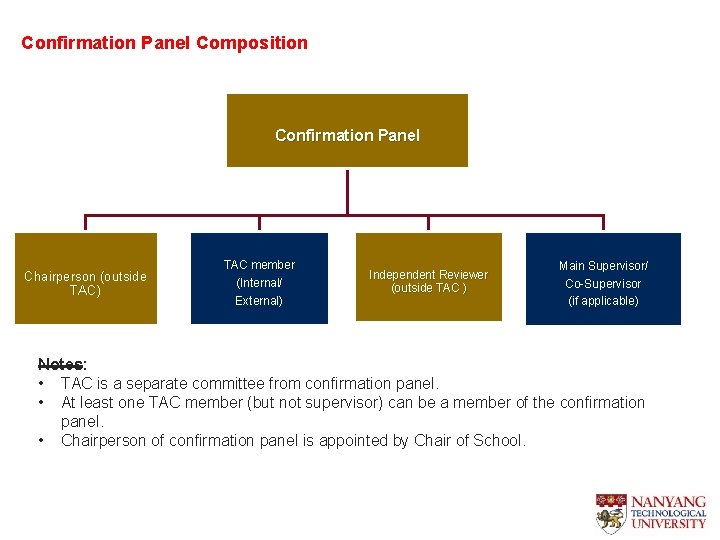
Confirmation Panel Composition Confirmation Panel Chairperson (outside TAC) TAC member (Internal/ External) Independent Reviewer (outside TAC ) Main Supervisor/ Co-Supervisor (if applicable) Notes: • TAC is a separate committee from confirmation panel. • At least one TAC member (but not supervisor) can be a member of the confirmation panel. • Chairperson of confirmation panel is appointed by Chair of School.
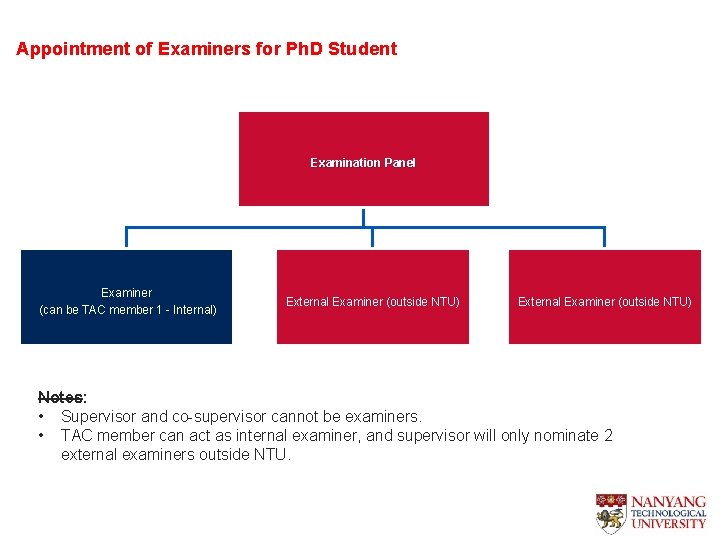
Appointment of Examiners for Ph. D Student Examination Panel Examiner (can be TAC member 1 - Internal) External Examiner (outside NTU) Notes: • Supervisor and co-supervisor cannot be examiners. • TAC member can act as internal examiner, and supervisor will only nominate 2 external examiners outside NTU.
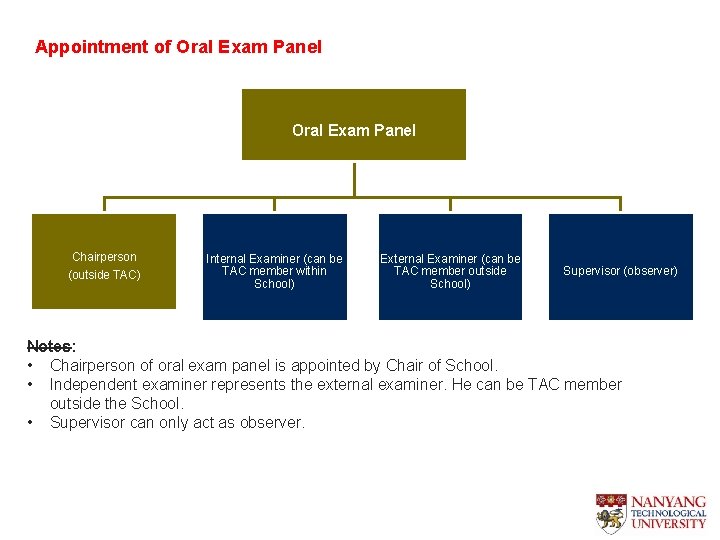
Appointment of Oral Exam Panel Chairperson (outside TAC) Internal Examiner (can be TAC member within School) External Examiner (can be TAC member outside School) Supervisor (observer) Notes: • Chairperson of oral exam panel is appointed by Chair of School. • Independent examiner represents the external examiner. He can be TAC member outside the School. • Supervisor can only act as observer.
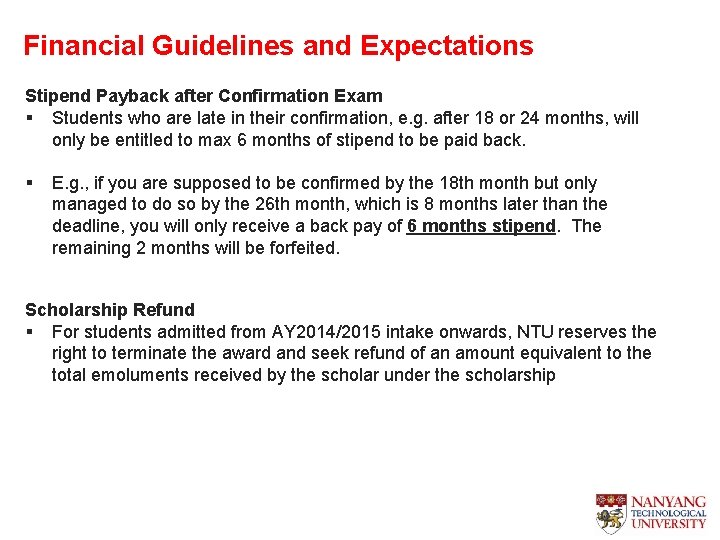
Financial Guidelines and Expectations Stipend Payback after Confirmation Exam § Students who are late in their confirmation, e. g. after 18 or 24 months, will only be entitled to max 6 months of stipend to be paid back. § E. g. , if you are supposed to be confirmed by the 18 th month but only managed to do so by the 26 th month, which is 8 months later than the deadline, you will only receive a back pay of 6 months stipend. The remaining 2 months will be forfeited. Scholarship Refund § For students admitted from AY 2014/2015 intake onwards, NTU reserves the right to terminate the award and seek refund of an amount equivalent to the total emoluments received by the scholar under the scholarship
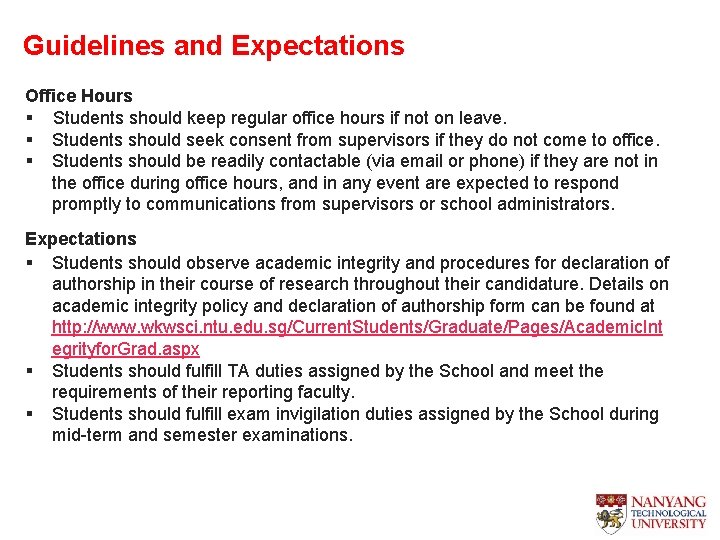
Guidelines and Expectations Office Hours § Students should keep regular office hours if not on leave. § Students should seek consent from supervisors if they do not come to office. § Students should be readily contactable (via email or phone) if they are not in the office during office hours, and in any event are expected to respond promptly to communications from supervisors or school administrators. Expectations § Students should observe academic integrity and procedures for declaration of authorship in their course of research throughout their candidature. Details on academic integrity policy and declaration of authorship form can be found at http: //www. wkwsci. ntu. edu. sg/Current. Students/Graduate/Pages/Academic. Int egrityfor. Grad. aspx § Students should fulfill TA duties assigned by the School and meet the requirements of their reporting faculty. § Students should fulfill exam invigilation duties assigned by the School during mid-term and semester examinations.
Guidelines and Expectations Vacation Leave Guidelines § Students are not allowed to take leave during semester time, and must ensure that they fulfill TA duties for supervisors/faculty. § 21 days of vacation leave per year given to students. Rollover of unconsumed leave to the following year is not allowed. § Special provision of up to 2 days can be allowed during semester time for students who need to take leave for urgent reasons. Conference Funding Guidelines § Full-time Ph. D students are eligible to apply for 2 trips during their candidature. § Conference funding is based on School’s guidelines for airfare and subsistence allowance. Research Grant Guidelines § Research students may apply for research grant amounting to $3, 000 per candidature. § Students are required to submit grant proposal and application during School’s grant call period to apply for funding.
Student Activities Summer Programme Possibilities § Quantitative Methods of Social Sciences, Social Science and Data Analysis § University of Michigan, University of Essex § Sponsorship from school, competitive basis Annual Ph. D Symposium § November 2016 § Deadline for submission of papers (exact date to be confirmed by host university) § Competitive selection Student Activities • Activities organised by students and/or graduate programme office • Previous: moon cake festival, mid-semester dialogue, research open house and other publicity roadshows/events, end of semester gathering, midsemester gathering • Take initiative to organise for all Ph. D students • Possible funding from the programme
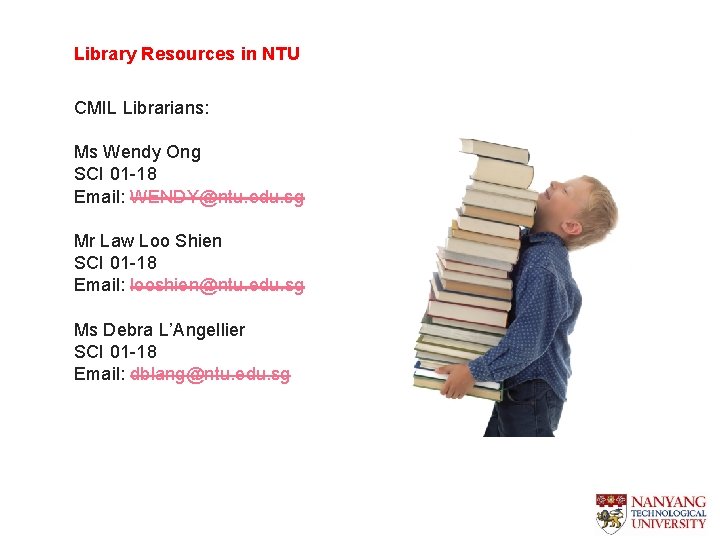
Library Resources in NTU CMIL Librarians: Ms Wendy Ong SCI 01 -18 Email: WENDY@ntu. edu. sg Mr Law Loo Shien SCI 01 -18 Email: looshien@ntu. edu. sg Ms Debra L’Angellier SCI 01 -18 Email: dblang@ntu. edu. sg
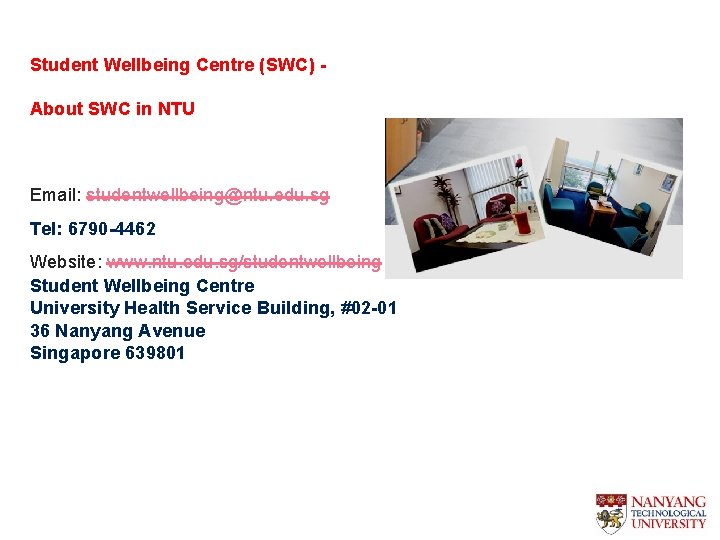
Student Wellbeing Centre (SWC) About SWC in NTU Email: studentwellbeing@ntu. edu. sg Tel: 6790 -4462 Website: www. ntu. edu. sg/studentwellbeing Student Wellbeing Centre University Health Service Building, #02 -01 36 Nanyang Avenue Singapore 639801


- Slides: 39