
Graduate Institute of Electronics Engineering NTU Fixedpoint Analysis



- Slides: 15
Graduate Institute of Electronics Engineering, NTU Fixed-point Analysis of Digital Filters VLSI Signal Processing 台灣大學電機系 吳安宇 ACCESS IC LAB
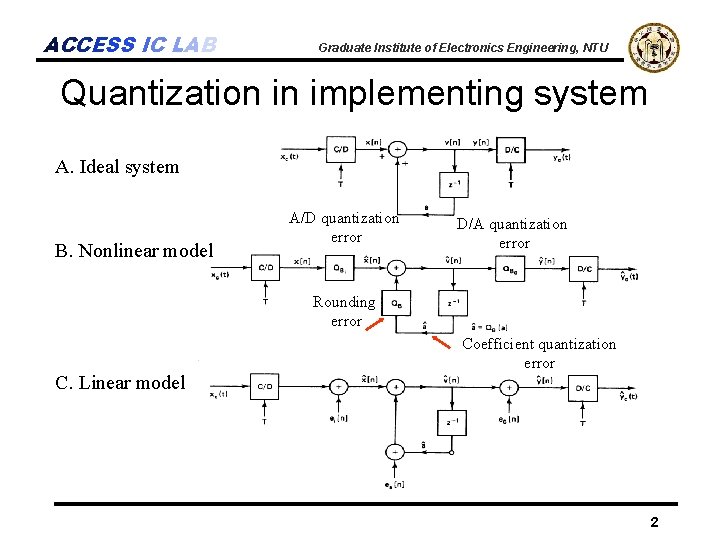
ACCESS IC LAB Graduate Institute of Electronics Engineering, NTU Quantization in implementing system A. Ideal system B. Nonlinear model A/D quantization error D/A quantization error Rounding error C. Linear model Coefficient quantization error 2
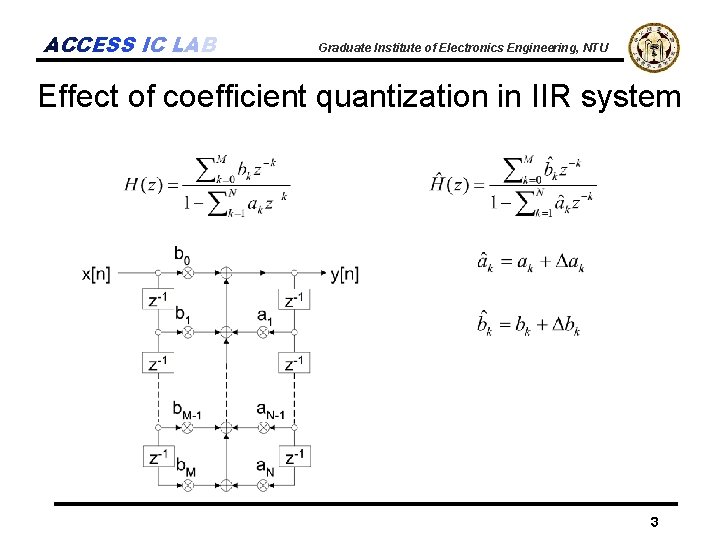
ACCESS IC LAB Graduate Institute of Electronics Engineering, NTU Effect of coefficient quantization in IIR system 3
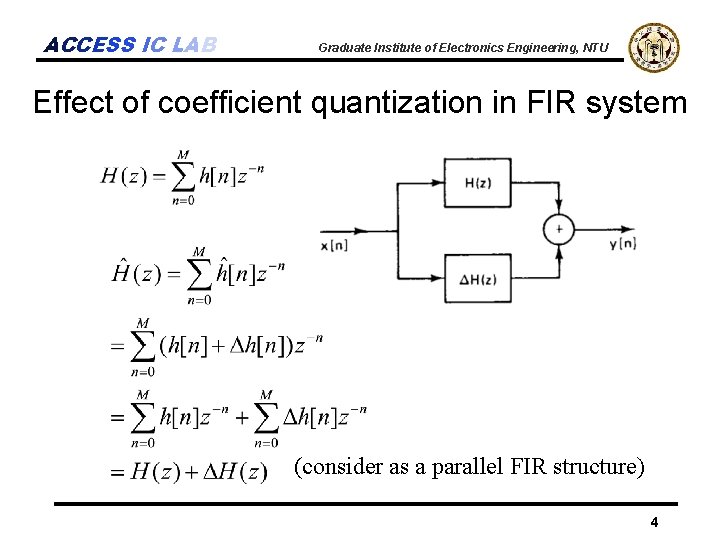
ACCESS IC LAB Graduate Institute of Electronics Engineering, NTU Effect of coefficient quantization in FIR system (consider as a parallel FIR structure) 4
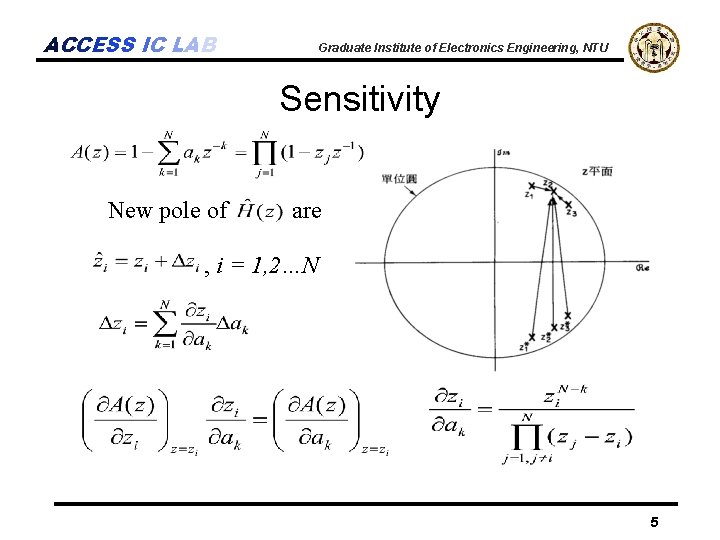
ACCESS IC LAB Graduate Institute of Electronics Engineering, NTU Sensitivity New pole of are , i = 1, 2…N 5
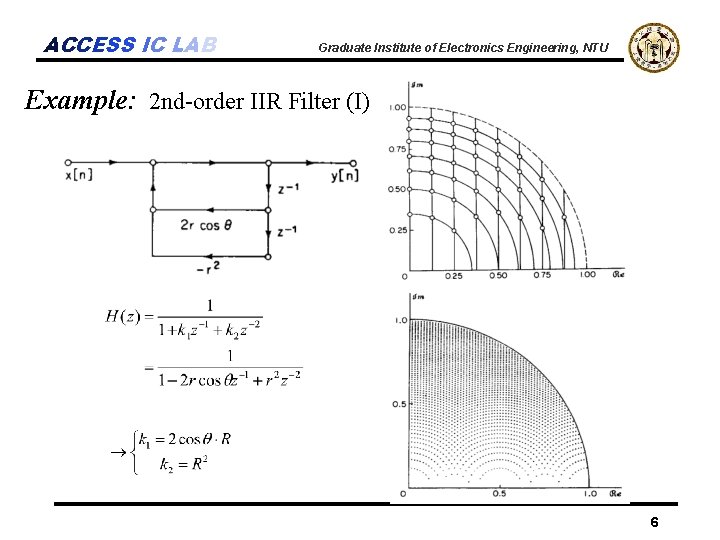
ACCESS IC LAB Graduate Institute of Electronics Engineering, NTU Example: 2 nd-order IIR Filter (I) 6
ACCESS IC LAB Graduate Institute of Electronics Engineering, NTU Example: 2 nd-order IIR Filter (II) 7
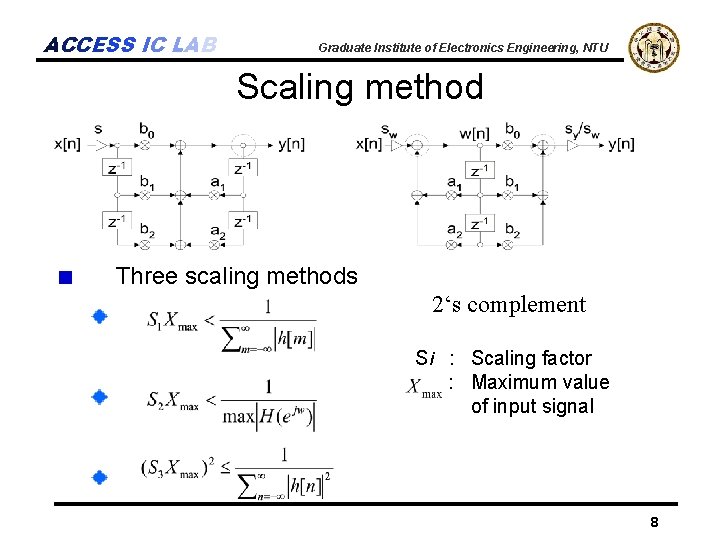
ACCESS IC LAB Graduate Institute of Electronics Engineering, NTU Scaling method Three scaling methods 2‘s complement Si : Scaling factor : Maximum value of input signal 8
ACCESS IC LAB Graduate Institute of Electronics Engineering, NTU Scaling method I x + y a 9
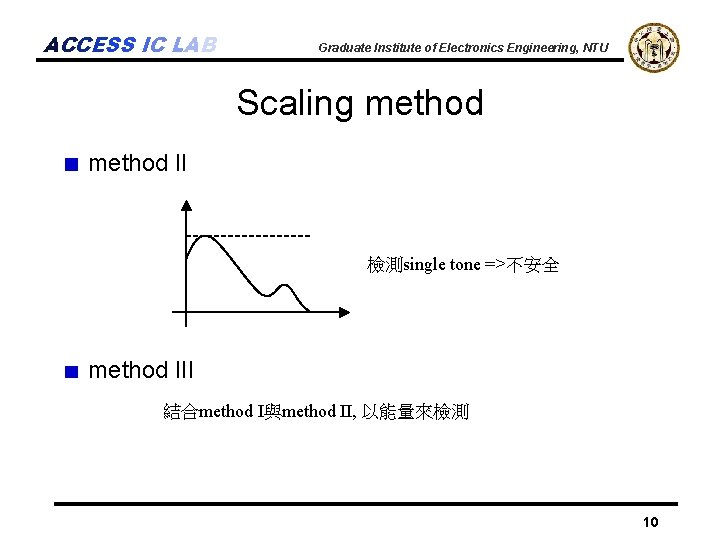
ACCESS IC LAB Graduate Institute of Electronics Engineering, NTU Scaling method II 檢測single tone =>不安全 method III 結合method I與method II, 以能量來檢測 10
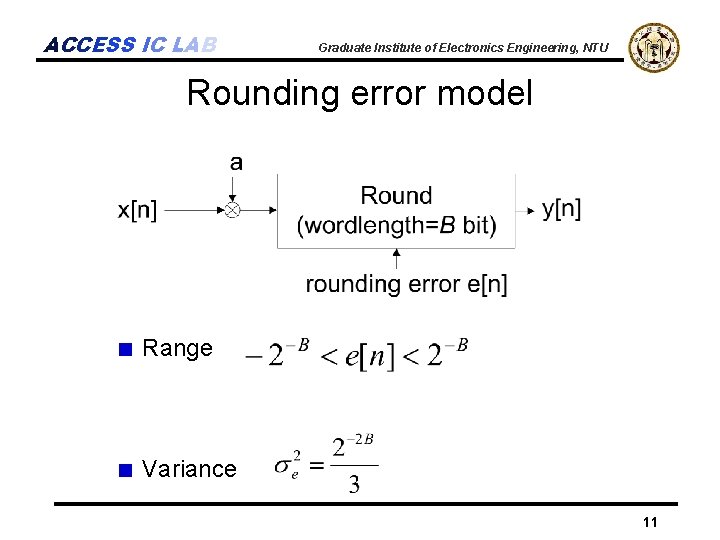
ACCESS IC LAB Graduate Institute of Electronics Engineering, NTU Rounding error model Range Variance 11
ACCESS IC LAB Graduate Institute of Electronics Engineering, NTU Direct form I Assume x[n] is uniform in [-1, 1] Variance of output signal Variance of rounding output error A(z) : denominator part of H(z) 12
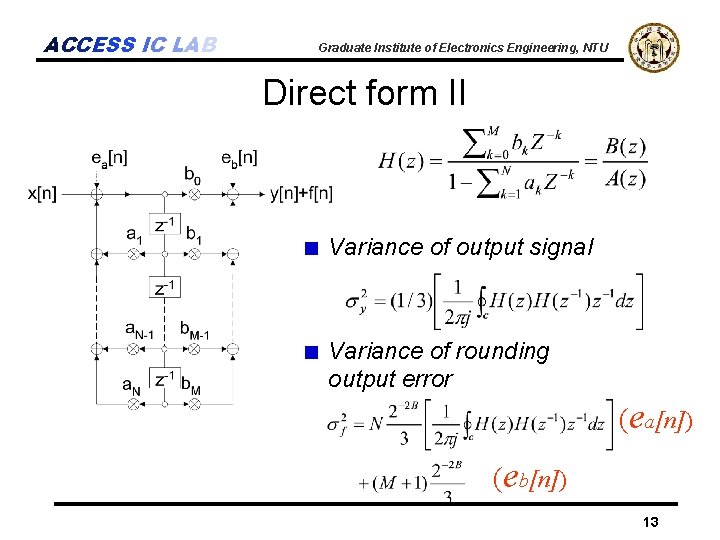
ACCESS IC LAB Graduate Institute of Electronics Engineering, NTU Direct form II Variance of output signal Variance of rounding output error (ea[n]) (eb[n]) 13
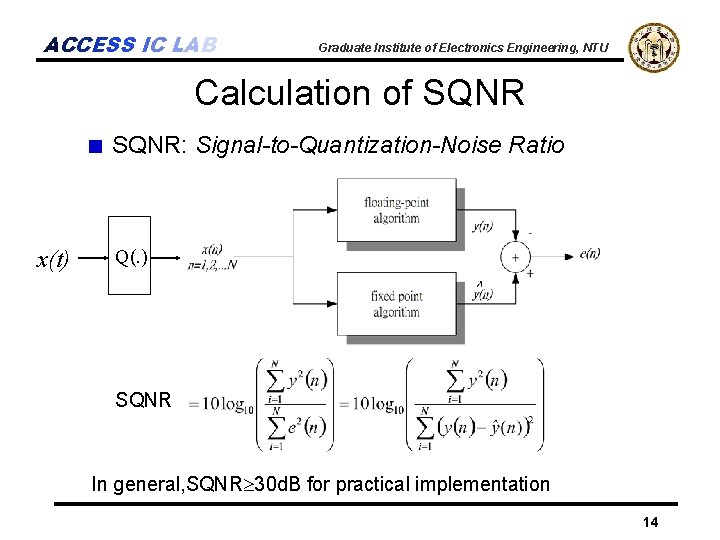
ACCESS IC LAB Graduate Institute of Electronics Engineering, NTU Calculation of SQNR: Signal-to-Quantization-Noise Ratio x(t) Q(. ) SQNR In general, SQNR 30 d. B for practical implementation 14
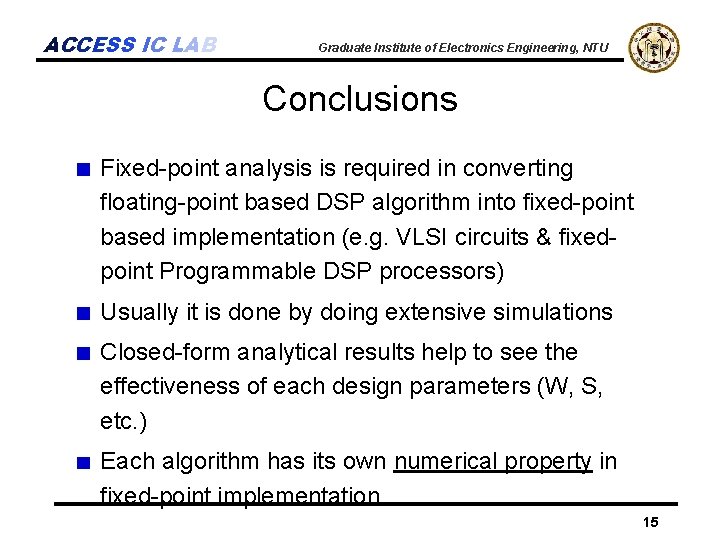
ACCESS IC LAB Graduate Institute of Electronics Engineering, NTU Conclusions Fixed-point analysis is required in converting floating-point based DSP algorithm into fixed-point based implementation (e. g. VLSI circuits & fixedpoint Programmable DSP processors) Usually it is done by doing extensive simulations Closed-form analytical results help to see the effectiveness of each design parameters (W, S, etc. ) Each algorithm has its own numerical property in fixed-point implementation 15