Supervisors Leadership 24 hrs TCOLE Course 3737 AND


- Slides: 64
Supervisors Leadership (24 hrs) TCOLE Course # 3737 AND BCCO PCT #4 Power. Point UNIT THREE
Learning Objectives Learning Objective : Learning Objective :
3. 0 VALUES, ETHICS and PRINCIPALS
QUESTION FOR CLASS What is your definition of INTEGRITY? INTEGRITY
3. 1. A. DEFINITIONS 1. Terms a. Values: those fundamental Values beliefs upon which decisions and conduct are based
3. 1. A. DEFINITIONS – Cont’d 1. Terms – Cont’d b. Ethics: accepted rules of Ethics conduct governing an individual or group or a code of values which guides our choices and actions and determines the purpose and course of our lives.
3. 1. A. DEFINITIONS – Cont’d 1. Terms – Cont’d c. Principles: ethical Principles standards relied upon for guidance in decision-making
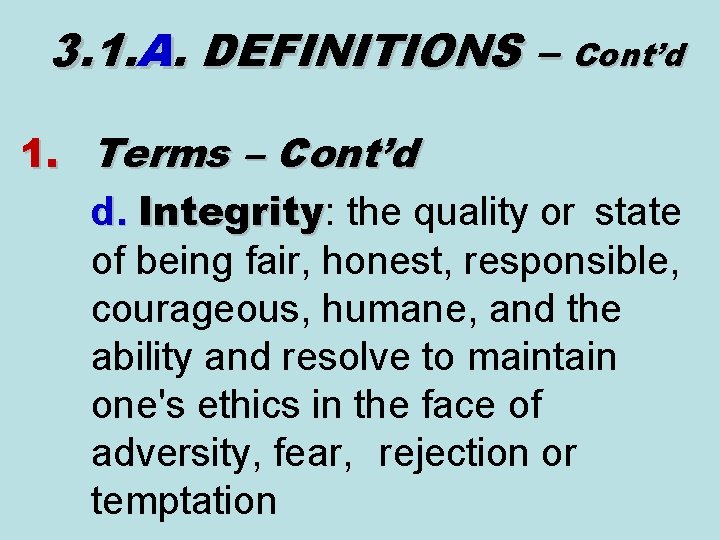
3. 1. A. DEFINITIONS – Cont’d 1. Terms – Cont’d d. Integrity: the quality or state Integrity of being fair, honest, responsible, courageous, humane, and the ability and resolve to maintain one's ethics in the face of adversity, fear, rejection or temptation
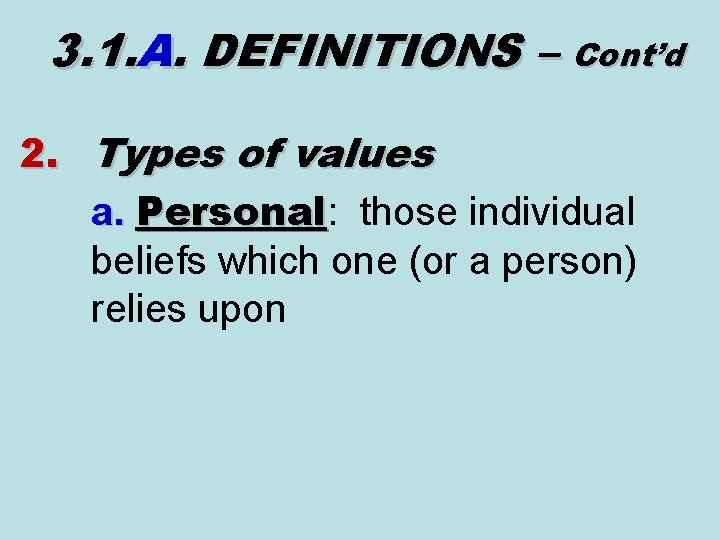
3. 1. A. DEFINITIONS – Cont’d 2. Types of values a. Personal: those individual Personal beliefs which one (or a person) relies upon
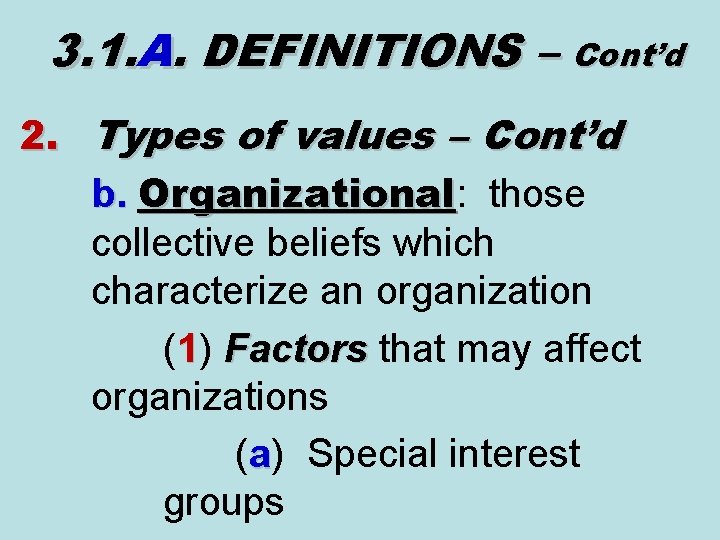
3. 1. A. DEFINITIONS – Cont’d 2. Types of values – Cont’d b. Organizational: those Organizational collective beliefs which characterize an organization (1) Factors that may affect Factors organizations (a) Special interest groups
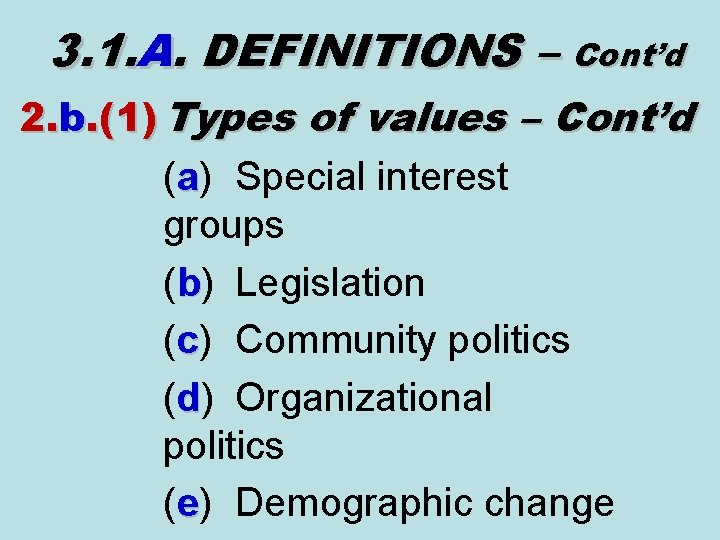
3. 1. A. DEFINITIONS – Cont’d 2. b. (1) Types of values – Cont’d (a) Special interest groups (b) Legislation (c) Community politics (d) Organizational politics (e) Demographic change
3. 1. A. DEFINITIONS – Cont’d 2. Types of values – Cont’d c. Professional: those Professional beliefs which are fundamental to and characterize a specific vocational group or discipline d. Societal: those beliefs Societal reflected by all aspects of the community
3. 1. B. Ethical Issues in Law Enforcement (Values) B. How Values Develop and Change 1. Personal a. Collection of individual experiences (family, school) b. Change slower/less frequently
3. 1. B. Ethical Issues in Law Enforcement (Values) B. How Values Develop and Change 1. Personal – Cont’d c. More controllable d. Subject to change at times of significant events
3. 1. B. Ethical Issues in Law Enforcement (Values) B. How Values Develop and Change 2. Societal a. Within work place b. Emerging community groups
3. 1. B. Ethical Issues in Law Enforcement (Values) B. How Values Develop and Change 3. Organizational Professional a. Represents the collective values of the members and are particularly influenced by leaders and relevant environments
3. 1. B. Ethical Issues in Law Enforcement (Values) B. How Values Develop and Change 3. Organizational Professional – Cont’d b. Subject to change more frequently c. Sensitive to external influences
3. 1. B. Ethical Issues in Law Enforcement (Values) B. How Values Develop and Change 3. Organizational Professional – Cont’d d. Strongly influenced by internal leadership e. Typically are documented in organizational values statements.
3. 1. B. Ethical Issues in Law Enforcement (Values) B. How Values Develop and Change 3. Organizational Professional – Cont’d f. Supervisor must be a role model for positive values.
3. 1. B. Ethical Issues in Law Enforcement (Values) B. How Values Develop and Change 4. Factors that may affect individual or collective behavior a. Agency policies - SOP b. Peer group influences
3. 1. B. Ethical Issues in Law Enforcement (Values) B. How Values Develop and Change 4. Factors that may affect individual or collective behavior c. Media d. Dilemma of the ethics taught vs. the ethics observed
3. 1. B. Ethical Issues in Law Enforcement (Values) B. How Values Develop and Change 4. Factors that may affect individual or collective behavior e. External influences (1) Religious (2) Political
3. 1. B. Ethical Issues in Law Enforcement (Values) B. How Values Develop and Change 4. Factors that may affect individual or collective behavior e. External influences (3) Family (4) Cultural
3. 1. B. Ethical Issues in Law Enforcement (Values) B. How Values Develop and Change 4. Factors that may affect individual or collective behavior f. Personal prejudices and biases
3. 1. C. What Subordinates are taught (Values) C. What Subordinates Are Taught 1. Law Enforcement Code of 1. Ethics 2. Code of Professional Conduct 2. and Responsibilities for Peace Officers
3. 1. C. What Subordinates are taught (Values) C. What Subordinates Are Taught 3. Agency specific ethics 3. awareness efforts
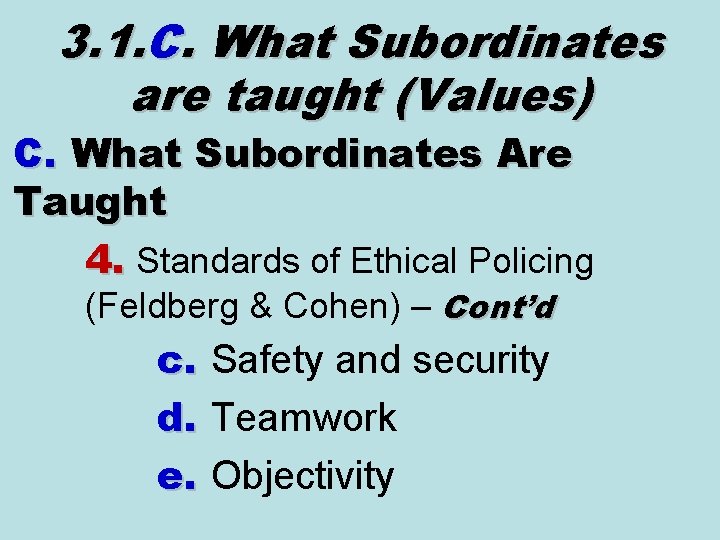
3. 1. C. What Subordinates are taught (Values) C. What Subordinates Are Taught 4. Standards of Ethical Policing 4. (Feldberg & Cohen) a. Fair access b. Public trust
3. 1. C. What Subordinates are taught (Values) C. What Subordinates Are Taught 4. Standards of Ethical Policing (Feldberg & Cohen) – Cont’d c. Safety and security d. Teamwork e. Objectivity
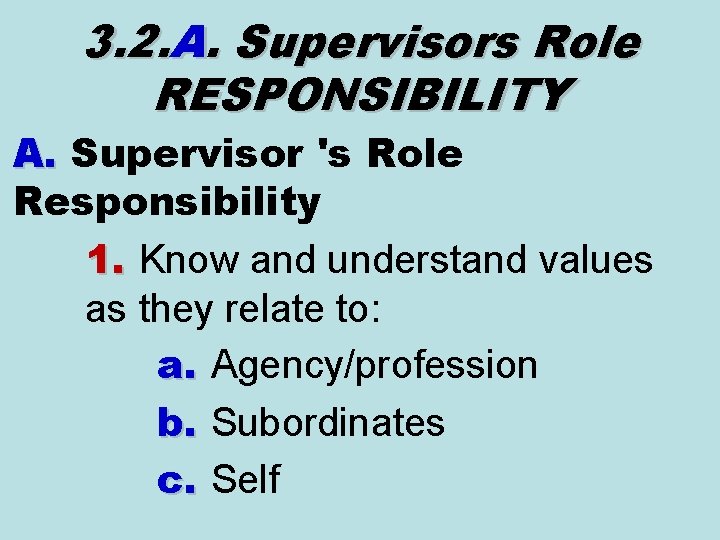
3. 2. A. Supervisors Role RESPONSIBILITY A. Supervisor 's Role Responsibility 1. Know and understand values as they relate to: a. Agency/profession b. Subordinates c. Self
3. 2. A. Supervisors Role RESPONSIBILITY A. Supervisor 's Role Responsibility 2. Supervisors accountability for subordinate conduct and welfare
3. 2. A. Supervisors Role RESPONSIBILITY QUESTION: What is agency QUESTION: supervisor's power to influence subordinate behavior? QUESTION: What is most QUESTION: powerful rank in our agency?
3. 2. A. Supervisors Role RESPONSIBILITY A. Supervisor 's Role Responsibility 3. Demonstrate integrity by: a. Setting the example b. Instructing
3. 2. A. Supervisors Role RESPONSIBILITY A. Supervisor 's Role Responsibility – Cont’d 3. Demonstrate integrity by: c. Monitoring d. Correcting/reinforcing
3. 2. A. Supervisors Role RESPONSIBILITY A. Supervisor 's Role Responsibility – Cont’d 3. Demonstrate integrity by: c. Monitoring d. Correcting/reinforcing
3. 2. B. ETHICS & INTEGRITY Decision-Making B. Applying ethics and integrity to supervisory decision-making 1. Communicate organizational values and your expectations
3. 2. B. ETHICS & INTEGRITY Decision-Making B. Applying ethics and integrity to supervisory decision-making – Cont’d 2. Acceptable subordinate behavior a. Reinforce a. b. Reward b.
3. 2. B. ETHICS & INTEGRITY Decision-Making B. Applying ethics and integrity to supervisory decision-making – Cont’d 3. Unacceptable subordinate behavior a. Intervene a. b. Correct b. c. Follow-up and reinforce c. corrected behavior
3. 2. B. ETHICS & INTEGRITY Decision-Making B. Applying ethics and integrity to supervisory decision-making – Cont’d 4. Supervisor's personal conduct a. Unequal enforcement a. double standard b. Insensitivity to subordinate concerns
3. 2. B. ETHICS & INTEGRITY Decision-Making B. Applying ethics and integrity to supervisory decision-making – Cont’d 4. Supervisor's personal conduct c. Polarization of c. employees within the work unit
3. 2. B. ETHICS & INTEGRITY Decision-Making B. Applying ethics and integrity to supervisory decision-making – Cont’d 5. Resources for decisions a. Code of Ethics a. b. Prior training b. c. Departmental policies c. and procedures
3. 2. B. ETHICS & INTEGRITY Decision-Making B. Applying ethics and integrity to supervisory decision-making – Cont’d 5. Resources for decisions d. Laws d. e. Code of Professional Conduct
3. 2. B. ETHICS & INTEGRITY Decision-Making B. Applying ethics and integrity to supervisory decision-making – Cont’d 5. Resources for decisions f. Values statements f. g. Peers and supervisors g.
3. 2. B. ETHICS & INTEGRITY Decision-Making B. Applying ethics and integrity to supervisory decision-making – Cont’d 6. Pitfalls in supervisory decision-making a. Rationalization (superiors, peers misconduct is no excuse) b. Popularity vs. integrity b.
3. 2. C. ETHICS & INTEGRITY Decision-Making C. Commitment to Ethics, Values and Principles 1. Benefits a. Maintain integrity of the a. profession b. Maintain personal b. integrity
3. 2. C. ETHICS & INTEGRITY Decision-Making C. Commitment to Ethics, Values and Principles – Cont’d 1. Benefits c. Command respect for c. the supervisor and the profession
3. 2. C. ETHICS & INTEGRITY Decision-Making C. Commitment to Ethics, Values and Principles – Cont’d 2. Risks of Lack of Commitment To Ethics a. Personal integrity suffers a. b. Impaired processional b. image
3. 2. C. ETHICS & INTEGRITY Decision-Making C. Commitment to Ethics, Values and Principles – Cont’d 2. Risks of Lack of Commitment To Ethics c. Lose respect of: c. (1) peers (2) subordinates
3. 2. C. ETHICS & INTEGRITY Decision-Making C. Commitment to Ethics, Values and Principles – Cont’d 2. Risks of Lack of Commitment To Ethics c. Lose respect of: c. (3) community (4) superiors
3. 2. C. ETHICS & INTEGRITY Decision-Making C. Commitment to Ethics, Values and Principles – Cont’d 2. Risks of Lack of Commitment To Ethics d. Political ramifications d. e. Civil and criminal e. penalties
3. 2. C. ETHICS & INTEGRITY Decision-Making C. Commitment to Ethics, Values and Principles – Cont’d 3. Professional Contract Commitment Statement a. Individual personal a. written commitment to integrity as a supervisor
3. 2. C. ETHICS & INTEGRITY Decision-Making C. Commitment to Ethics, Values and Principles – Cont’d 3. Professional Contract Commitment Statement b. Define and describe traits, behaviors and values of a ethical supervisor
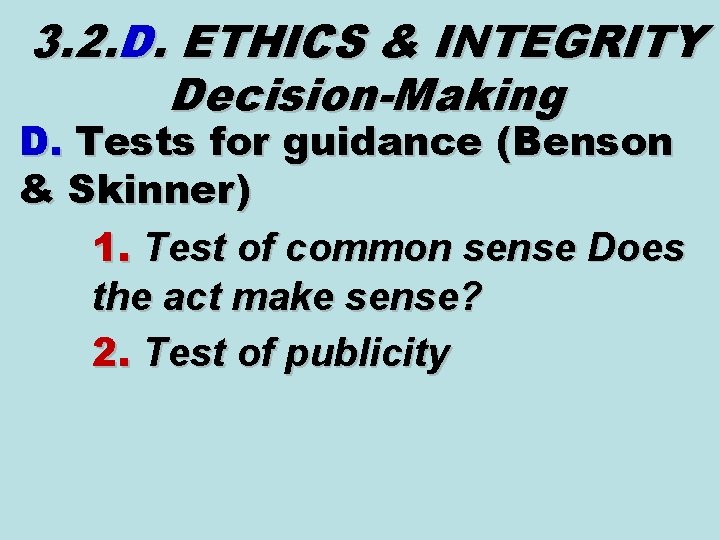
3. 2. D. ETHICS & INTEGRITY Decision-Making D. Tests for guidance (Benson & Skinner) 1. Test of common sense Does the act make sense? 2. Test of publicity
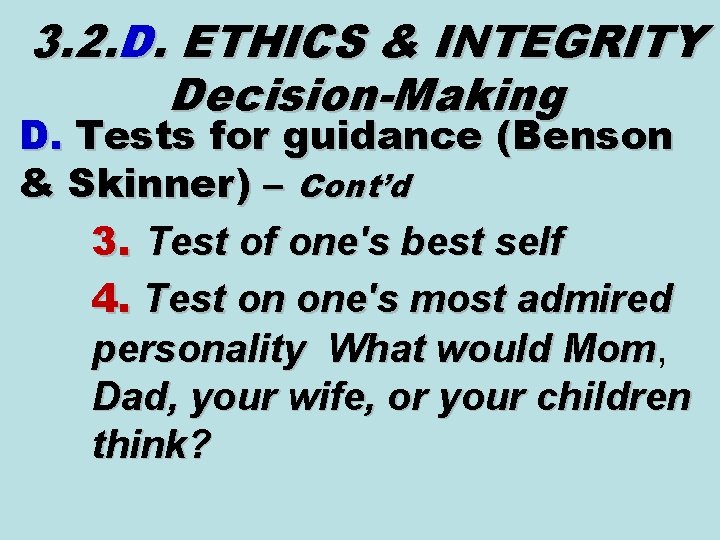
3. 2. D. ETHICS & INTEGRITY Decision-Making D. Tests for guidance (Benson & Skinner) – Cont’d 3. Test of one's best self 4. Test on one's most admired personality What would Mom, Mom Dad, your wife, or your children think?
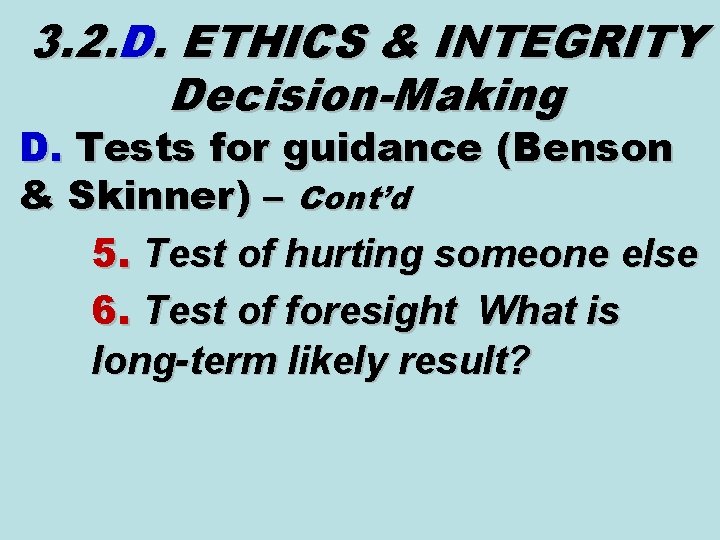
3. 2. D. ETHICS & INTEGRITY Decision-Making D. Tests for guidance (Benson & Skinner) – Cont’d 5. Test of hurting someone else 6. Test of foresight What is long-term likely result?
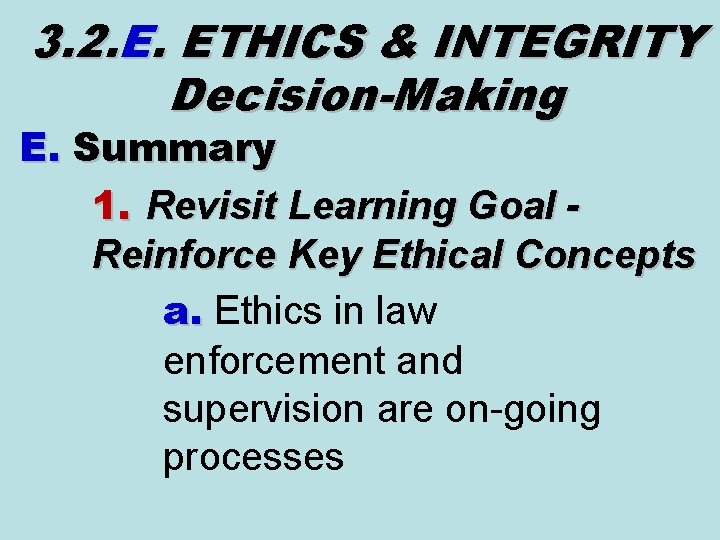
3. 2. E. ETHICS & INTEGRITY Decision-Making E. Summary 1. Revisit Learning Goal Reinforce Key Ethical Concepts a. Ethics in law a. enforcement and supervision are on-going processes
3. 2. E. ETHICS & INTEGRITY Decision-Making E. Summary – Cont’d 1. Revisit Learning Goal Reinforce Key Ethical Concepts b. Ethical decisions are not b. always easy to identify or solve
3. 2. E. ETHICS & INTEGRITY Decision-Making E. Summary – Cont’d 1. Revisit Learning Goal Ethical Concepts Reinforce Key c. Is very important for supervisors c. to discuss ethical dilemmas and issues related to personal and organizational values with peers, subordinates and superiors before they become a problem.
3. 2. E. ETHICS & INTEGRITY Decision-Making E. Summary – Cont’d 2. Challenge to Participants are law a. enforcement leaders - they have tremendous influence within their organizations. Use influence ethically and wisely.
3. 2. E. ETHICS & INTEGRITY Decision-Making E. Summary – Cont’d 2. Challenge to Participants b. Ethics is not about "what b. is" - Ethics is about "what should be. " Work for a more ethical future.
Questions?
DEFINE & PROCESS Define 3. 0 the key Process: 61
SOURCES All Course Sources and/or Resources are listed in your Participant Handout First-Line Supervisor LEADERSHIP TCOLE Course # 3737 Bexar County Constable Office PCT#4
“Knowledge is “POWER” Stay informed, stay SAFE, stay Vigilant & stay Alive”
TAKE A 10 -MINUTE BREAK