
MISSING Exploited Children Basic Overview TCOLE Course 3275

MISSING & Exploited Children (Basic Overview) TCOLE Course # 3275 AND BCCO PCT #4 Power. Point UNIT TWO
Learning Objectives Learning Objective 2. 1: The participant will be able to differentiate when reporting youth runaway cases is legally required as well as correlate youth runaway populations and risks for potential harm or exploitation. Learning Objective 2. 2: The participant will be able to articulate conditions that may lead children to go missing from care as well as the manners in which offenders specifically target this population.
Learning Objectives Learning Objective 2. 3: The participant will be able to organize an appropriate response to the scene of a missing child with special needs based on best practices for recovery and available resources.
UNIT TWO Section 2: High Risk Populations 2. 1 2. 2 2. 3 Runaways Missing from Care Missing with Special Needs
Assume the following is true: Activity • You have no identification. You can’t legally get a job. • You are at your residence. Leaving your home after dark is dangerous. You might get jumped, or even sexually assaulted. People have told you that you shouldn’t walk alone in your neighborhood. • You have less than $10 in your pocket. You have no food or water supplies. No vehicle or valuable assets. You don’t have any friends or family who could help you. In 5 minutes or less, list as many situations as you can think of that would cause you to leave your residence without any plan to return despite all of the above.
Thrown-away • Parent or Caretaker: Ø Asks the child to leave home; home Ø Prevents child from returning home; Ø Makes no effort to recover runaway child; and/or
Thrown away – Cont’d • Parent or Caretaker: Caretaker Ø Abandons or Abandons deserts child (no deserts adequate care or alternatives arranged for child). See http: //www. missingkids. com/en_US/documents/911 standards. pdf
Risks Faced by Runaways • May resort to illegal and illegal risky activities • Substance abuse • May become a victim of ØViolent acts; and/or ØSexual exploitation. See http: //www. missingkids. com/en_US/publications/NC 74. pdf
Risks Faced by Runaways Continued • Become disconnected from ØEducational system; ØHealthcare; ØHousing; and/or ØPositive ØSocial Connections. See http: //www. missingkids. com/en_US/publications/NC 74. pdf
How Many Runaways are Involved in Trafficking? It is difficult to accurately quantify the number of children currently involved in child sex trafficking. But, for the year 2013, the National Center for Missing & Exploited Children found that, 1 in 7 endangered runaways were likely child sex trafficking victims. http: //www. missingkids. com/CSTT
Law Enforcement Requirements Code of Criminal Procedure Art. 63. 009 (a) Local law enforcement agencies, on receiving a report of a missing child or a missing person, shall: (1) if the subject of the report is a child and the well-being of the child is in danger or if the subject danger
Code of Criminal Procedure Art. 63. 009 (a) – Cont’d: of the report is a person who is known by the agency to have or is reported to have chronic dementia, including Alzheimer's dementia, whether caused by illness, brain defect, or brain injury, immediately start an investigation in order to determine the present location of the child or person;
Code of Criminal Procedure Art. 63. 009 (a) – Cont’d: (2) if the subject of the report is a child or person other than a child or person described by Subdivision (1), start an investigation with due diligence in order to determine the present location of the child or person;
Law Enforcement Requirements – Cont’d Code of Criminal Procedure Art. 63. 009 (a) Local law enforcement agencies, on receiving a report of a missing child or a missing person, shall: (3) immediately, but not later than two hours after receiving the report, enter the name of the child or person into the clearinghouse, clearinghouse the national crime information center [NCIC] missing person file if the child or person meets the center's criteria, and the Alzheimer's Association Safe Return crisis number, if applicable, with all available identifying features such as dental records, fingerprints, other physical characteristics, and a description of the clothing worn when last seen, and all available information describing any person reasonably believed to have taken or retained the missing child or missing person; and
Law Enforcement Requirements – Cont’d Code of Criminal Procedure Art. 63. 009 (a) Local law enforcement agencies, on receiving a report of a missing child or a missing person, shall: (4) inform the person who filed the report of the missing child or missing person that the information will be entered into the clearinghouse, the national crime information center missing person file, and the Alzheimer's Association Safe Return crisis number, if applicable.
High Risk Factor Missing Juvenile - High Risk Factor [Senate Bill 742] also enacted 742 changes to TCIC [Texas Crime Information Center] reports of certain missing persons, specifically missing juveniles. Article 63. 0091 (CCP) requires DPS to adopt rules regarding procedures for local law enforcement agencies on receiving a report of a missing child who Information provided by Texas Department of Public Safety
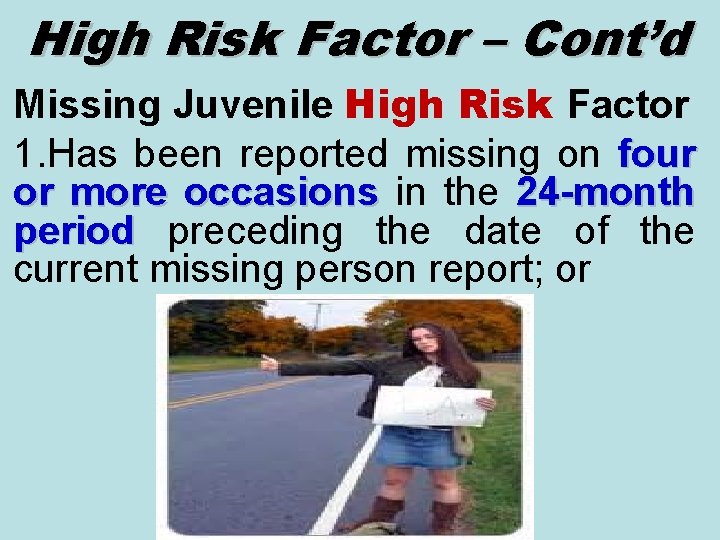
High Risk Factor – Cont’d Missing Juvenile High Risk Factor 1. Has been reported missing on four or more occasions in the 24 -month period preceding the date of the current missing person report; or
High Risk Factor – Cont’d Missing Juvenile - High Risk Factor – Cont’d: 2. Is in foster care or in the conservatorship of the Department of Family and Protective Services (DFPS) and had been DFPS reported missing on two or more occasions in the 24 -month period preceding the current missing person report.

High Risk Factor – Cont’d There may be instances when the entering agency is unaware of whether or not the missing person meets the requirements above, due to the two hour requirement for entry of missing persons. The original entry should be modified as soon as this information becomes available to the agency. Compliance with this policy will be assessed at the time of the agency’s TCIC audit. Information provided by Texas Department of Public Safety
High Risk Factor – Cont’d Acceptable documentation for Category 1 consists of copies of prior missing person reports and/or written statements from parents, legal guardians, family members or other sources confirming prior incidents. Information provided by Texas Department of Public Safety
High Risk Factor – Cont’d Acceptable documentation for Category 2 consists of copies of prior missing person reports from law enforcement and/or written statements from parent, legal guardian, family member or other sources confirming prior incidents, in addition to a written statement from parent, legal guardian, family member, the Department of Family and Protective Services or other source confirming the missing individual is in foster care or in conservatorship.

High Risk Factor – Cont’d To facilitate this entry, TCIC has added a new field to the missing person screens. The High Risk Indicator (HRF) values will be 1 and 2 respectively with a default value of blank. Information provided by Texas Department of Public Safety
High Risk Factor – Cont’d Entry into this field will require specific text to be included in the MIS field: • HRF/1 will require “High Risk” and • HRF/2 will require “High Risk Foster Care”. It is important to note that this new field is a TCIC only field and will not be sent to NCIC. Message keys effected: EMJ, EMJC, MM

If it’s so dangerous, why do kids run?
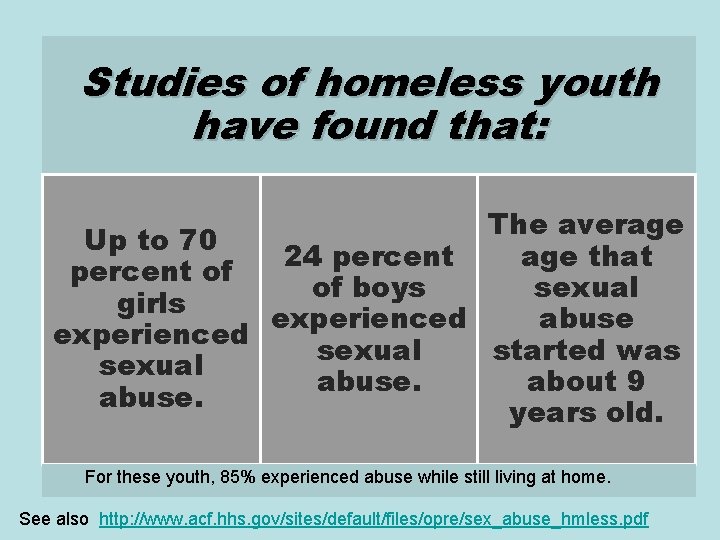
Studies of homeless youth have found that: The average Up to 70 age that 24 percent of sexual of boys girls abuse experienced started was sexual abuse. about 9 abuse. years old. For these youth, 85% experienced abuse while still living at home. See also http: //www. acf. hhs. gov/sites/default/files/opre/sex_abuse_hmless. pdf
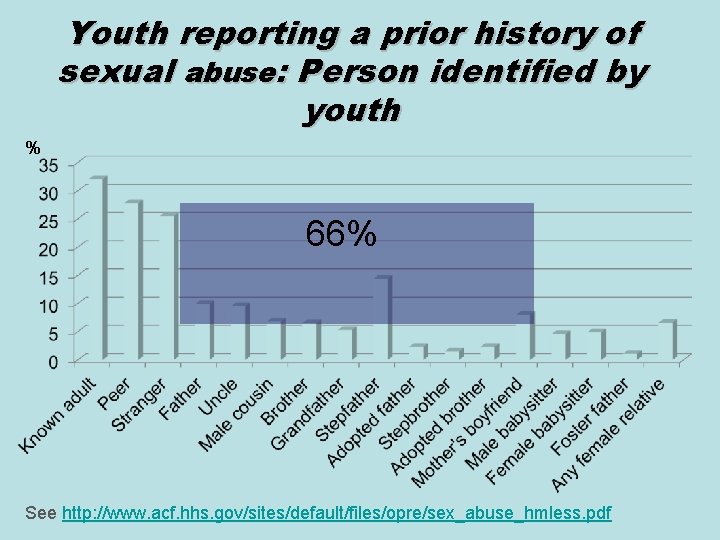
Youth reporting a prior history of sexual abuse: Person identified by youth % 66% See http: //www. acf. hhs. gov/sites/default/files/opre/sex_abuse_hmless. pdf
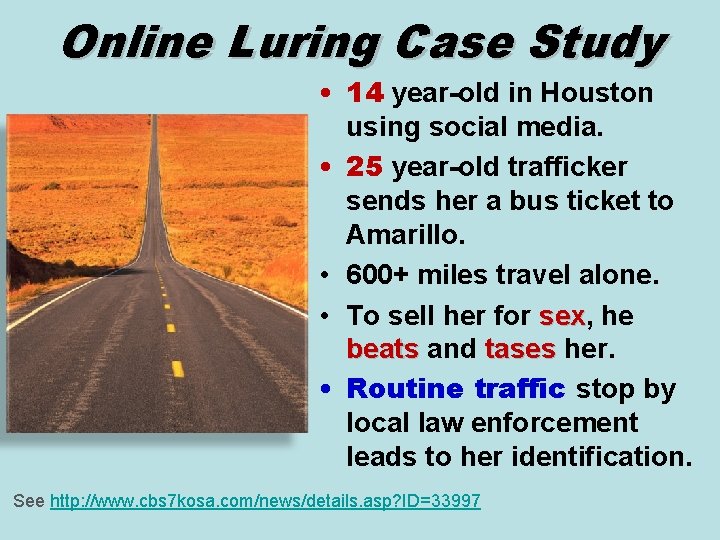
Online Luring Case Study • 14 year-old in Houston using social media. • 25 year-old trafficker sends her a bus ticket to Amarillo. • 600+ miles travel alone. • To sell her for sex, sex he beats and tases her. • Routine traffic stop by local law enforcement leads to her identification. See http: //www. cbs 7 kosa. com/news/details. asp? ID=33997
Activity Imagine yourself at home in the evening on a regular weekday night. You have just had dinner when an official arrives at your door and knocks loudly. The official informs you that you are being evacuated and will have to come with him immediately. Assume that his authority and identification checks out, you have no choice but to follow his commands He hands you a plastic garbage bag and tells you that you have 5 minutes to grab your essentials. You can only fill the bag; that is all there is room for in his vehicle. He will not tell you where you are going.
Activity – Cont’d You have 5 minutes to identify all of the things you would pack. What are your other concerns while you are packing your bag? List the items you would grab. Also list the primary concerns that are going through your mind while you pack.
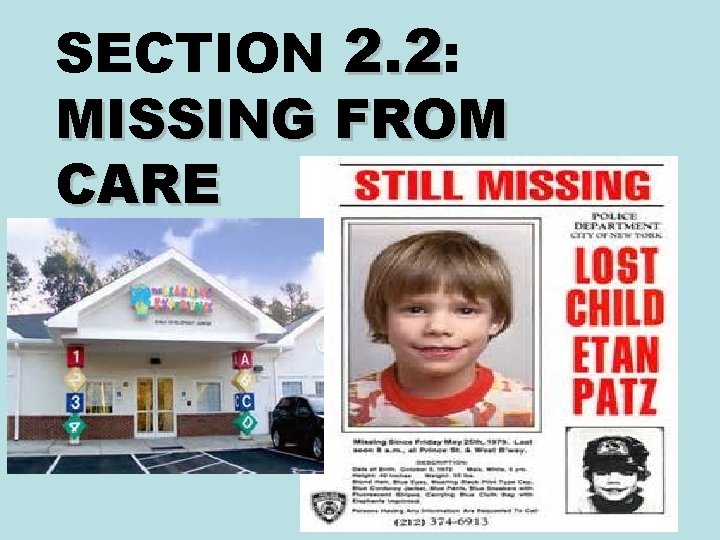
SECTION 2. 2: MISSING FROM CARE
Missing from Care “A child is considered missing from care if he or she is not in the physical custody of the childwelfare agency or person or institution with whom the child has been placed. ” See http: //www. missingkids. com/en_US/publications/NC 162. pdf
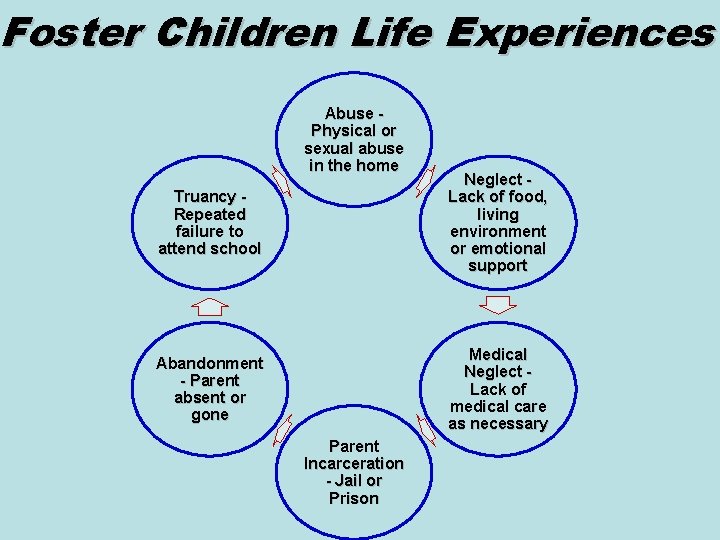
Foster Children Life Experiences Abuse Physical or sexual abuse in the home Truancy Repeated failure to attend school Neglect Lack of food, living environment or emotional support Abandonment - Parent absent or gone Medical Neglect Lack of medical care as necessary Parent Incarceration - Jail or Prison
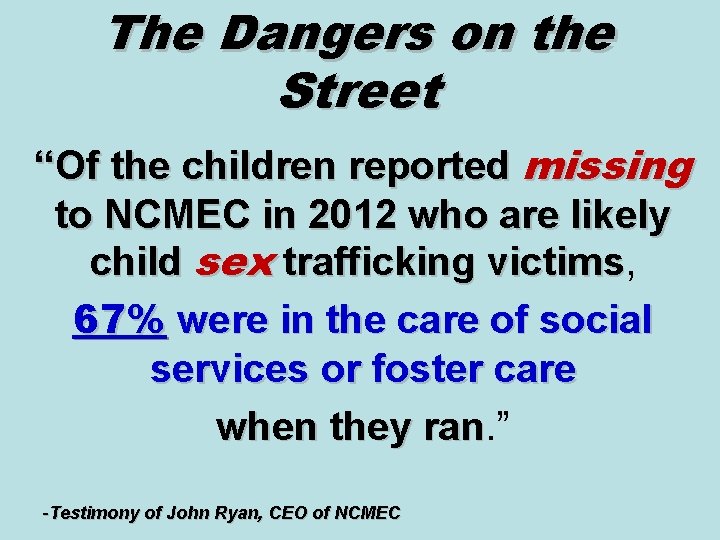
The Dangers on the Street “Of the children reported missing to NCMEC in 2012 who are likely child sex trafficking victims, victims 67% were in the care of social services or foster care when they ran. ” ran -Testimony of John Ryan, CEO of NCMEC
Similar findings from LA County • “The majority of young people arrested on prostitution charges in LA County come from the county's own foster care system, system according to county officials. ” http: //www. huffingtonpost. com/2012/11/28/la-teen-prostitutes-foster-homes-county-video_n_2207778. html
Similar findings from LA County Continued • Nearly two-thirds had prior social two-thirds services involvement. • Driving force behind local task force creation. • Learning point: Smaller communities can also form multi-disciplinary task forces.
Individual Reasons for Running from Care • To spend time with friends or family. • Unhappy about placement. • Drawn to apparent attractions of street life See http: //www. missingkids. com/en_US/publications/NC 162. pdf
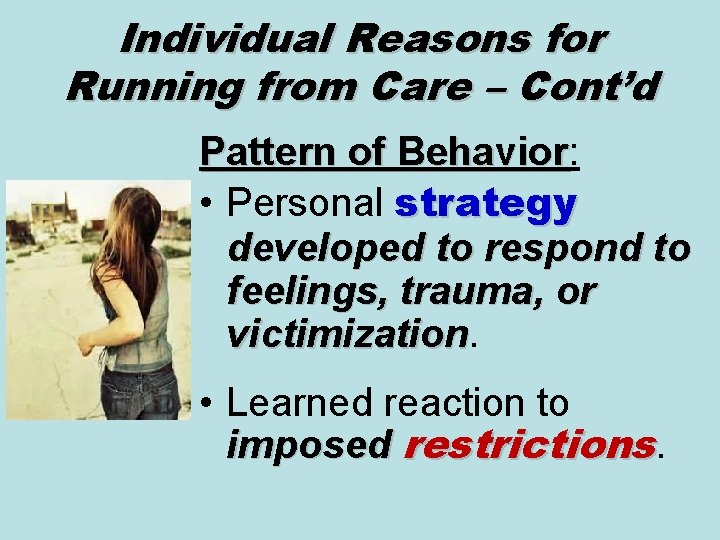
Individual Reasons for Running from Care – Cont’d Pattern of Behavior: Behavior • Personal strategy developed to respond to feelings, trauma, or victimization • Learned reaction to imposed restrictions.
System-Based Reasons for Running from Care Resources: Resources • Inadequate monitoring of monitoring placements or inadequate training • Inadequate staffing or frequent staffing turnover. See https: //www. childwelfare. gov/pubs/factsheets/foster. cfm
System-Based Reasons for Running from Care Resources – Cont’d: Resources • Lack of placement resources. • Just under 400, 000 children in the U. S. in foster care on September 30, 2012.
Prevention • Prepare child for new placements & provide mutually acceptable solutions wherever possible. • Assist children in developing problem-solving and coping skills See http: //www. missingkids. com/en_US/publications/NC 162. pdf
Prevention…Cont’d • Encourage children to have a strong connection with at least one adult outside the foster home (teacher, counselor, mentor, but must be someone with supervision and a background check).
Prevention…Cont’d • Prevention can happen anywhere: at a formal training or school event, during extracurricular activities, or on the street interacting with youth. • Encourage checking in on a regular basis. See http: //www. missingkids. com/en_US/publications/NC 162. pdf
Prevention…Cont’d • Inform children of risks & alternatives to running away. • Especially challenge street myths pushed by recruiters, gangs or adult “boyfriends. ” FACT……Vs…. . MYTH
Texas Foster Care Case Study • 13 year-old girl runs from foster care. • Goes to a vacant apartment to live with friend. • Boys at a party wants to have her perform oral sex. Johnson v. State, 2011 Tex. App. LEXIS 954 (Tex. App. Houston 1 st Dist. Feb. 10, 2011) (appeal denied).
Texas Foster Care Case Study Continued • She refuses, so they beat her. • She leaves the party alone & injured. • She meets a 35 year-old man nicknamed “Golden” on the street • Golden takes her home, treats her wounds and has oral sex with her (no legal consent possible).
Texas Foster Care Case Study Continued • He asks her to prostitute for him. • She is picked up by undercover officer who uses her to set up “Golden”. • He receives a 20 year sentence for compelling prostitution Johnson v. State, 2011 Tex. App. LEXIS 954 (Tex. App. Houston 1 st Dist. Feb. 10, 2011) (appeal denied).
Learning from the Case Study: Suppose you encountered the victim on the street after she met “Golden”: • What basic information will you try to collect from the child? • What additional leads might you follow to identify the victim in this case?
Suppose you encountered the victim on the street after she met “Golden”: • What agencies can you contact to try to verify child’s name, age and history? • If you determine the child is in an unsafe situation, what steps do situation you follow? • What are important physical details and evidence to evidence document and/or collect? • Who are potential witnesses who will need to be interviewed?
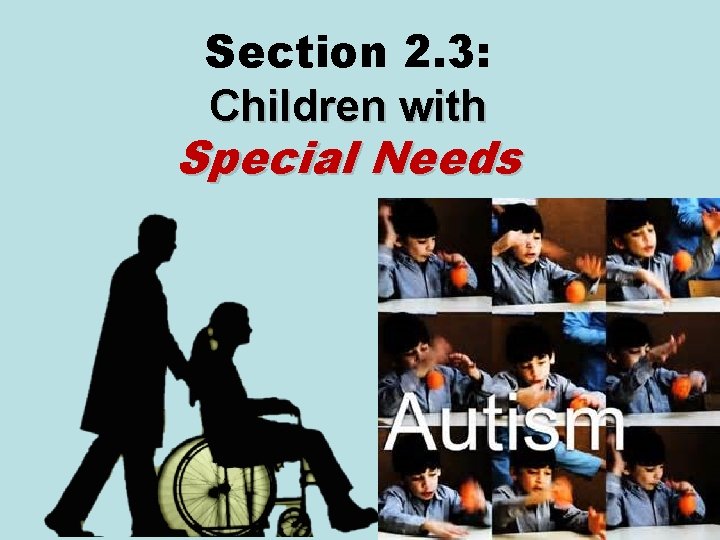
Section 2. 3: Children with Special Needs
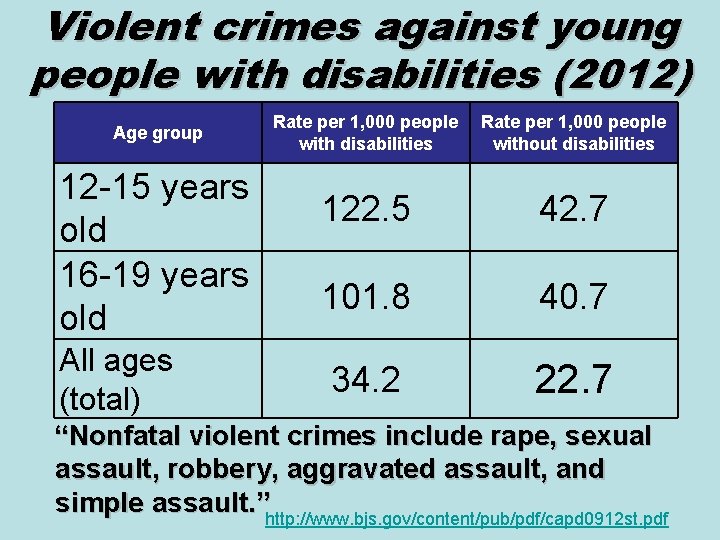
Violent crimes against young people with disabilities (2012) Age group 12 -15 years old 16 -19 years old All ages (total) Rate per 1, 000 people with disabilities Rate per 1, 000 people without disabilities 122. 5 42. 7 101. 8 40. 7 34. 2 22. 7 “Nonfatal violent crimes include rape, sexual assault, robbery, aggravated assault, and simple assault. ”http: //www. bjs. gov/content/pub/pdf/capd 0912 st. pdf
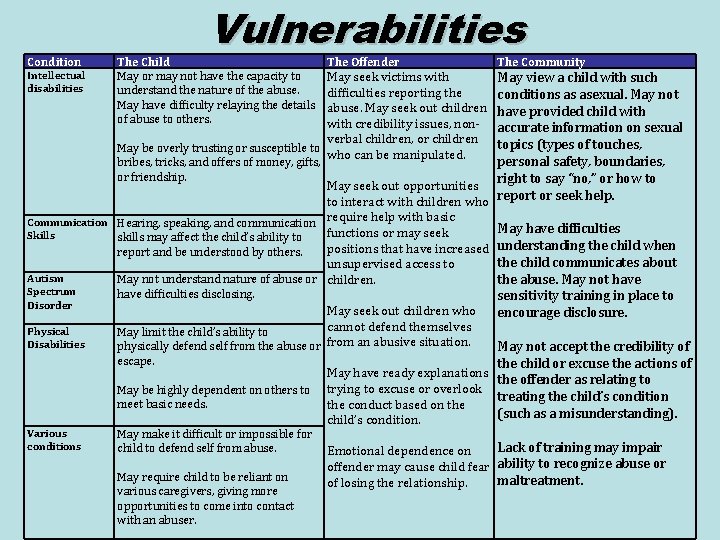
Condition Intellectual disabilities Vulnerabilities The Child May or may not have the capacity to understand the nature of the abuse. May have difficulty relaying the details of abuse to others. May be overly trusting or susceptible to bribes, tricks, and offers of money, gifts, or friendship. The Offender May seek victims with difficulties reporting the abuse. May seek out children with credibility issues, nonverbal children, or children who can be manipulated. May seek out opportunities to interact with children who Communication Hearing, speaking, and communication require help with basic functions or may seek Skills skills may affect the child’s ability to positions that have increased report and be understood by others. unsupervised access to Autism May not understand nature of abuse or children. Spectrum have difficulties disclosing. Disorder May seek out children who cannot defend themselves Physical May limit the child’s ability to Disabilities physically defend self from the abuse or from an abusive situation. escape. May have ready explanations May be highly dependent on others to trying to excuse or overlook meet basic needs. the conduct based on the child’s condition. Various May make it difficult or impossible for conditions child to defend self from abuse. Emotional dependence on offender may cause child fear May require child to be reliant on of losing the relationship. various caregivers, giving more opportunities to come into contact with an abuser. The Community May view a child with such conditions as asexual. May not have provided child with accurate information on sexual topics (types of touches, personal safety, boundaries, right to say “no, ” or how to report or seek help. May have difficulties understanding the child when the child communicates about the abuse. May not have sensitivity training in place to encourage disclosure. May not accept the credibility of the child or excuse the actions of the offender as relating to treating the child’s condition (such as a misunderstanding). Lack of training may impair ability to recognize abuse or maltreatment.
Focus on Autism Spectrum Disorder (ASD) • 48% of children with an ASD attempt to elope from a safe environment, a rate nearly four times higher than their unaffected siblings. • In 2009, 2010, and 2011, accidental drowning accounted for 91% total U. S. deaths reported in children with an ASD ages 14 and younger subsequent to wandering/elopement.
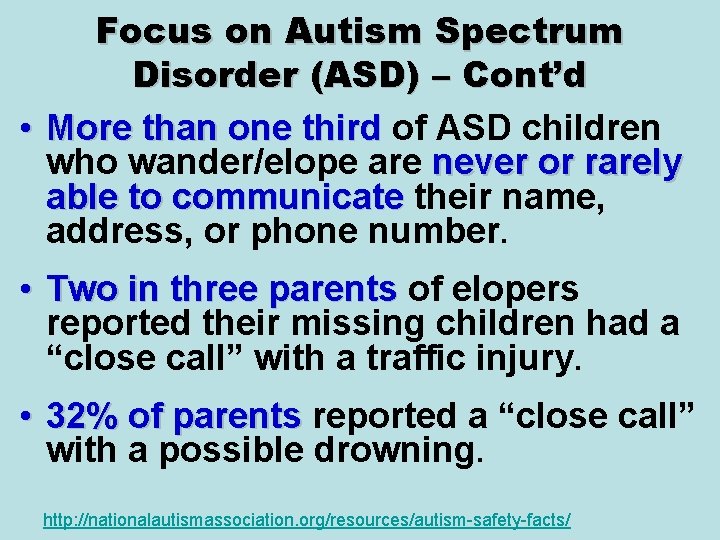
Focus on Autism Spectrum Disorder (ASD) – Cont’d • More than one third of ASD children who wander/elope are never or rarely able to communicate their name, address, or phone number. • Two in three parents of elopers reported their missing children had a “close call” with a traffic injury. • 32% of parents reported a “close call” with a possible drowning. http: //nationalautismassociation. org/resources/autism-safety-facts/
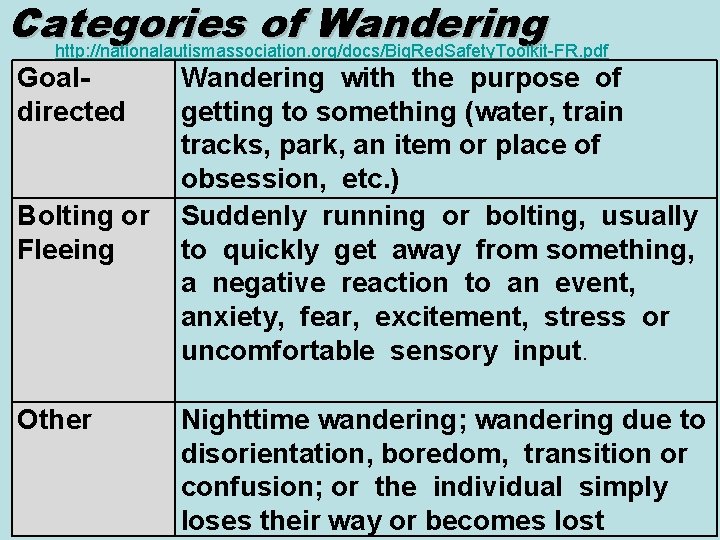
Categories of Wandering http: //nationalautismassociation. org/docs/Big. Red. Safety. Toolkit-FR. pdf Goaldirected Bolting or Fleeing Other Wandering with the purpose of getting to something (water, train tracks, park, an item or place of obsession, etc. ) Suddenly running or bolting, usually to quickly get away from something, a negative reaction to an event, anxiety, fear, excitement, stress or uncomfortable sensory input. Nighttime wandering; wandering due to disorientation, boredom, transition or confusion; or the individual simply loses their way or becomes lost
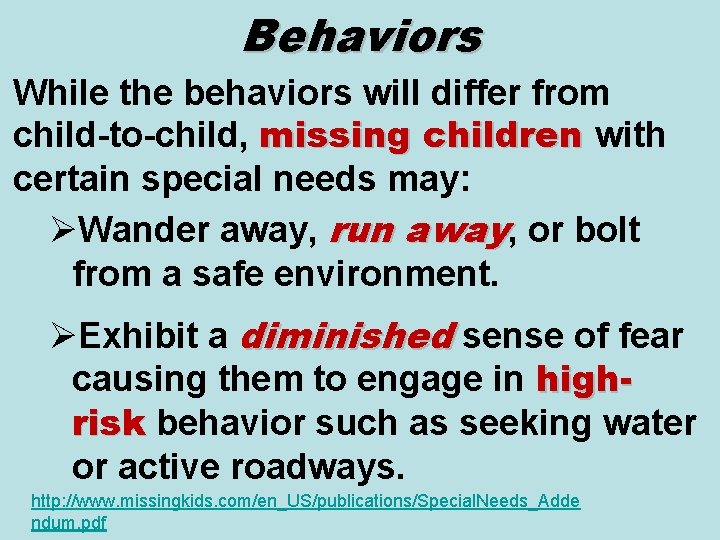
Behaviors While the behaviors will differ from child-to-child, missing children with certain special needs may: ØWander away, run away, or bolt from a safe environment. ØExhibit a diminished sense of fear causing them to engage in highrisk behavior such as seeking water or active roadways. http: //www. missingkids. com/en_US/publications/Special. Needs_Adde ndum. pdf
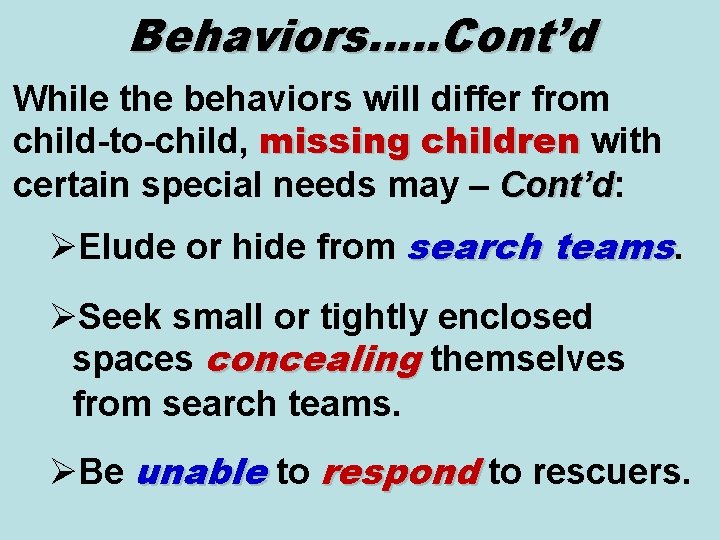
Behaviors…. . Cont’d While the behaviors will differ from child-to-child, missing children with certain special needs may – Cont’d: Cont’d ØElude or hide from search teams. ØSeek small or tightly enclosed spaces concealing themselves from search teams. ØBe unable to respond to rescuers.
Call Intake First obtain a full description of the child including height, weight, child hair color, and clothing worn. Then ask: • Is the child wearing or carrying any tracking technology device? If so, which one and how is location information accessed? • Is the child attracted to water? water If so, can the child swim?
Then ask – Cont’d: Cont’d • Is the child attracted to active roadways/highways? ays • Does the child have a fascination with vehicles such as trains, trains heavy equipment, airplanes, or fire trucks? • Has the child wandered away before? If so, where was he or she before found?
Then ask – Cont’d: • Does the child have a sibling with special needs? If so, has that sibling wandered away before? • If so, where was the sibling found? • Where does the child like to go? Does the child have a favorite place?
Call Intake…. Continued: • Is the child nonverbal? How will nonverbal the child likely react to his or her name being called? • Will the child respond to a particular voice such as that of his or her mother, father, other relative, caregiver, or family friend?
Call Intake…. Continued: • Does the child have a favorite song, toy, or character? If so, what or who is it? • Does the verbal child know his or her parents’ names, home address, and phone number?
Call Intake…. Continued: • Does the child have any specific dislikes, fears, or behavioral triggers? • How might the child react to sirens, helicopters, airplanes, search dogs, people in uniform, or those participating in a search team? http: //www. missingkids. com/en_US/publications/Special. Needs_Adde ndum. pdf
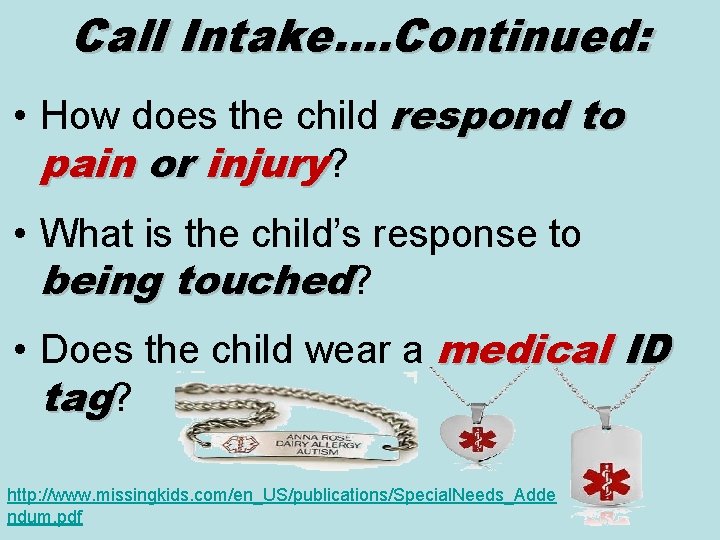
Call Intake…. Continued: • How does the child respond to pain or injury? • What is the child’s response to being touched? • Does the child wear a medical ID tag? http: //www. missingkids. com/en_US/publications/Special. Needs_Adde ndum. pdf
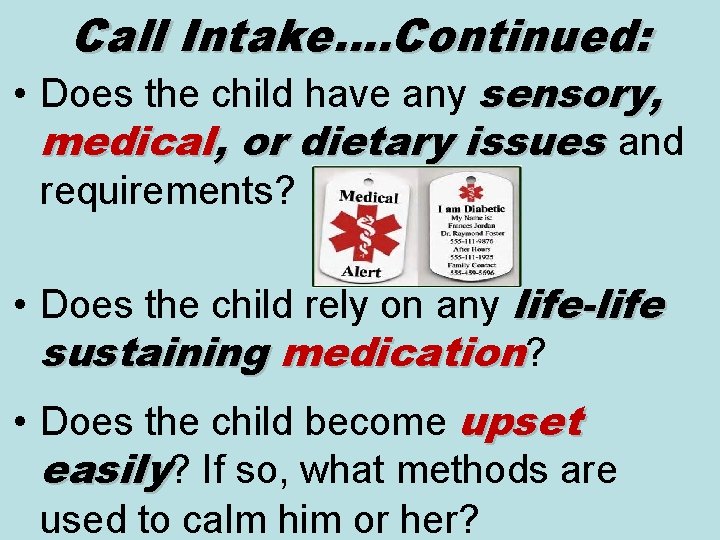
Call Intake…. Continued: • Does the child have any sensory, medical, or dietary issues and requirements? • Does the child rely on any life-life sustaining medication? • Does the child become upset easily? If so, what methods are used to calm him or her?

TAKE A 10 -MINUTE BREAK
Initial Response • Identify hazards in the area where the child was last seen and dispatch personnel to those locations to search for the child, paying special attention to any bodies of water and specific locations of interest to the child such as his or her favorite places
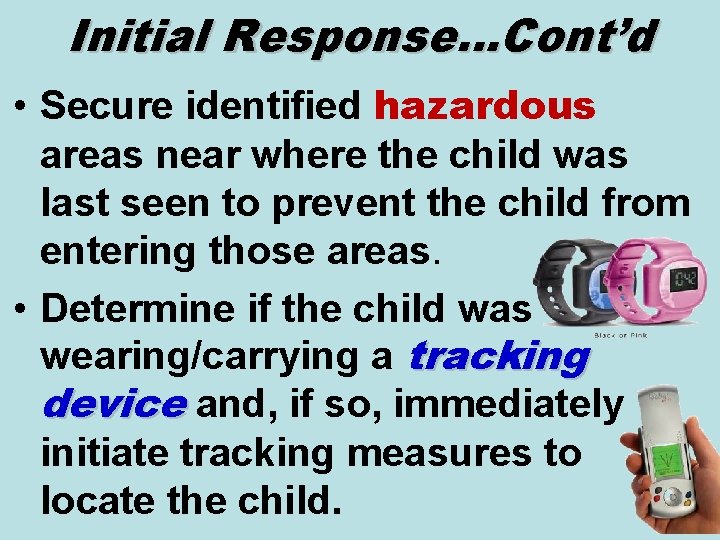
Initial Response…Cont’d • Secure identified hazardous areas near where the child was last seen to prevent the child from entering those areas. • Determine if the child was wearing/carrying a tracking device and, if so, immediately initiate tracking measures to locate the child.
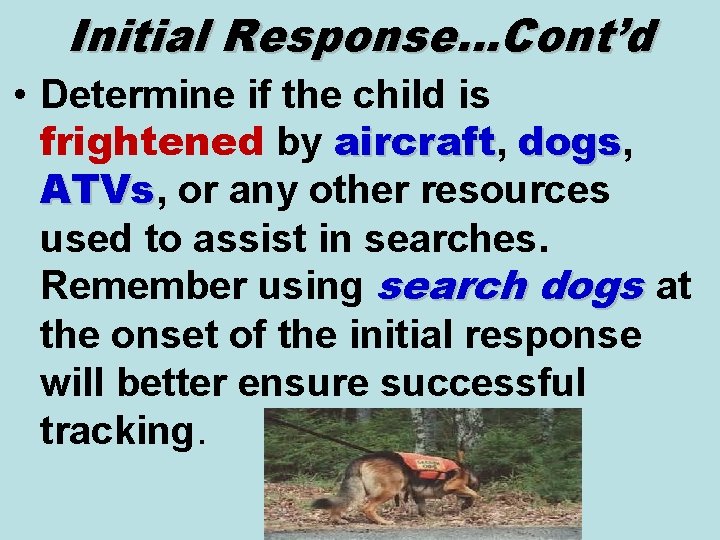
Initial Response…Cont’d • Determine if the child is frightened by aircraft, aircraft dogs, dogs ATVs, ATVs or any other resources used to assist in searches. Remember using search dogs at the onset of the initial response will better ensure successful tracking.
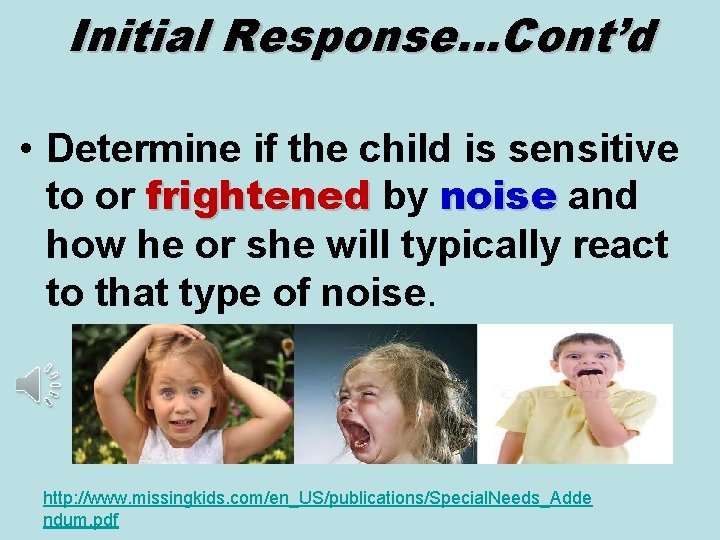
Initial Response…Cont’d • Determine if the child is sensitive to or frightened by noise and how he or she will typically react to that type of noise. http: //www. missingkids. com/en_US/publications/Special. Needs_Adde ndum. pdf
Initial Response…Cont’d • Establish containment measures of the child’s known routes to prevent him or her from wandering further away from the place last seen using all appropriate means such as road, bike, and air patrol. http: //www. missingkids. com/en_US/publications/Special. Needs_Adde ndum. pdf
Initial Response…Cont’d • Contact the National Center for Missing & Exploited Children without delay to request assistance from their search-andrescue and search-management experts.
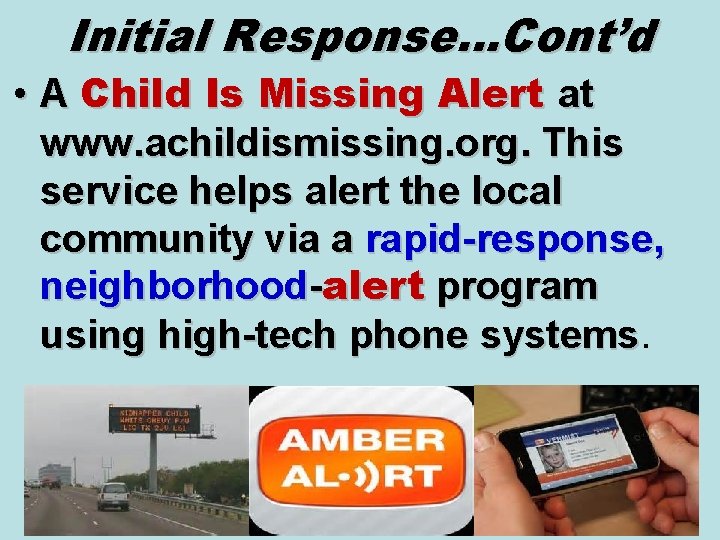
Initial Response…Cont’d • A Child Is Missing Alert at www. achildismissing. org. This service helps alert the local community via a rapid-response, neighborhood-alert program using high-tech phone systems
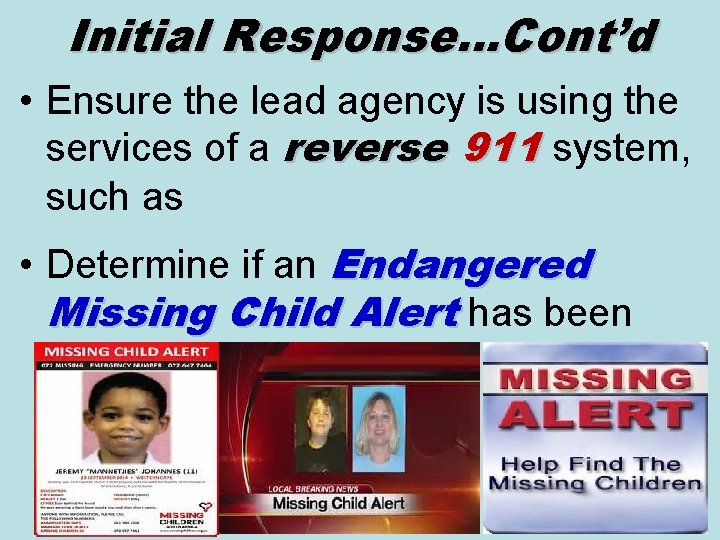
Initial Response…Cont’d • Ensure the lead agency is using the services of a reverse 911 system, such as • Determine if an Endangered Missing Child Alert has been issued.
Investigators • Contact the child’s parent or guardian to further assess the child’s special needs condition. • Determine if the child has any history of wandering or eloping and, if so, where and what physical features associated with those episodes may have attracted the child.
Investigators…Cont’d • Identify additional physical features the child may be attracted to such as roadways/highways, trains, heavy equipment, fire trucks, park swings, and road signs. • Determine if the child has any favorite places. • Determine if the child has a favorite song, toy, or character.
Investigators…Cont’d • Determine if the child has any dislikes, fears, or behavioral triggers and, if so, how he or she will typically react to negative stimuli.
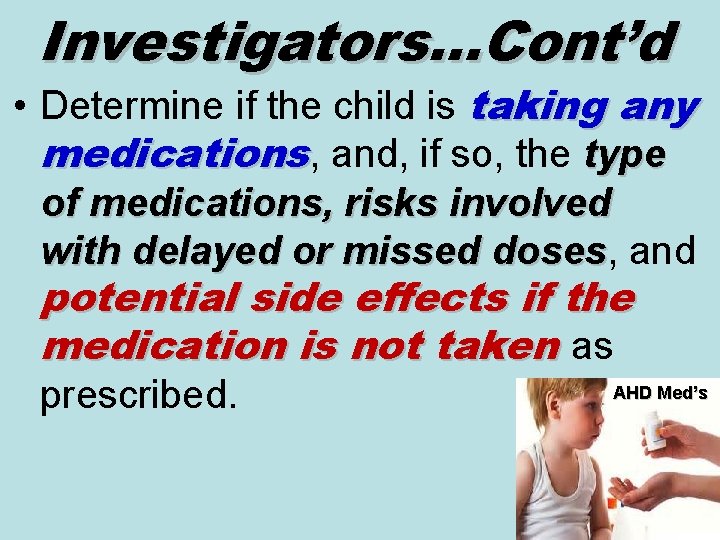
Investigators…Cont’d • Determine if the child is taking any medications, and, if so, the type of medications, risks involved with delayed or missed doses, and doses potential side effects if the medication is not taken as AHD Med’s prescribed.
Investigators…Cont’d • Determine if the child wears a medical identification bracelet or tag. • Determine how the child responds to pain or injury. • Determine the child’s response to being touched. • Determine what methods are used to calm the child.
Investigators…Cont’d • Determine how the child reacts to sirens, dogs, vehicles used in searches, and people of authority/in uniform. Children with autism will sometimes avoid autism search teams or teams attempt to hide in small places http: //www. missingkids. com/en_US/publications/Special. Needs_Adde ndum. pdf
Investigators…Cont’d • Determine the communication abilities of the child regarding verbal versus nonverbal skills. • Determine if the child will respond to his or her name when being called. • Determine if the child knows his or her parents’ names, home names address, and phone numbers.
Investigators…Cont’d • Determine if the child has any other mental or physical conditions • Determine if the child has any dietary issues or requirements.
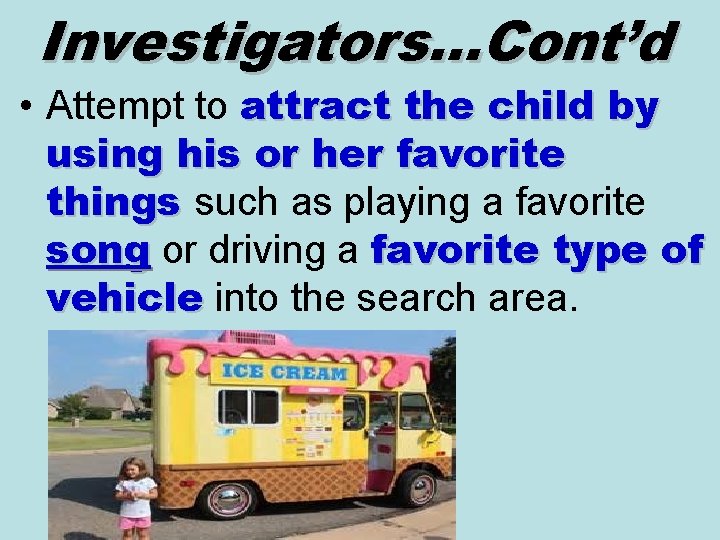
Investigators…Cont’d • Attempt to attract the child by using his or her favorite things such as playing a favorite song or driving a favorite type of song vehicle into the search area. vehicle
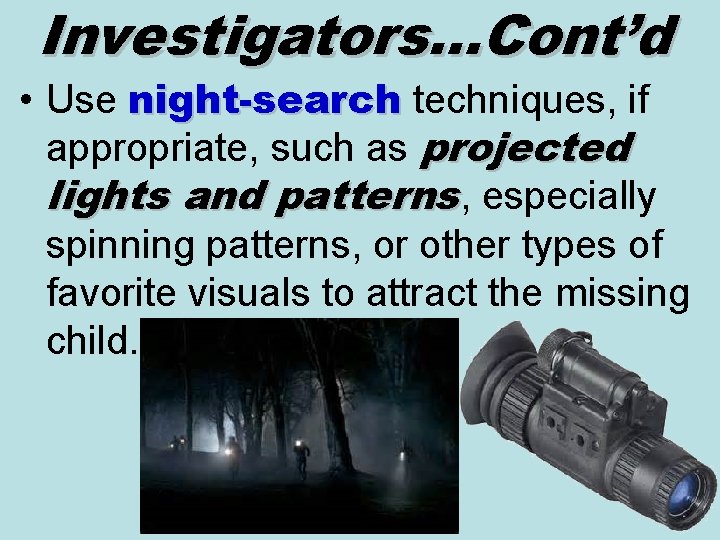
Investigators…Cont’d • Use night-search techniques, if night-search appropriate, such as projected lights and patterns, especially spinning patterns, or other types of favorite visuals to attract the missing child.
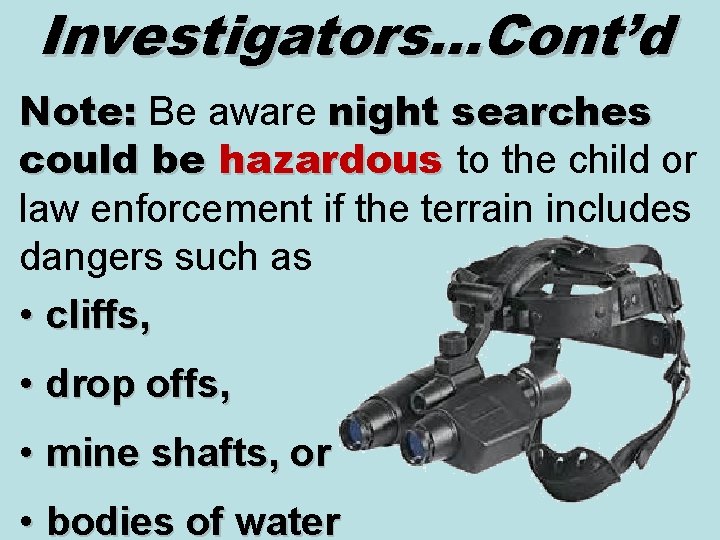
Investigators…Cont’d Note: Be aware night searches Note: could be hazardous to the child or law enforcement if the terrain includes dangers such as • cliffs, • drop offs, • mine shafts, or • bodies of water
Investigators…Cont’d • Extend search duration because the unique behaviors of some children with special needs may have a protective effect allowing the child to survive longer than what is considered to be a normal survival rate for a child. http: //www. missingkids. com/en_US/publications/Special. Needs_Adde ndum. pdf
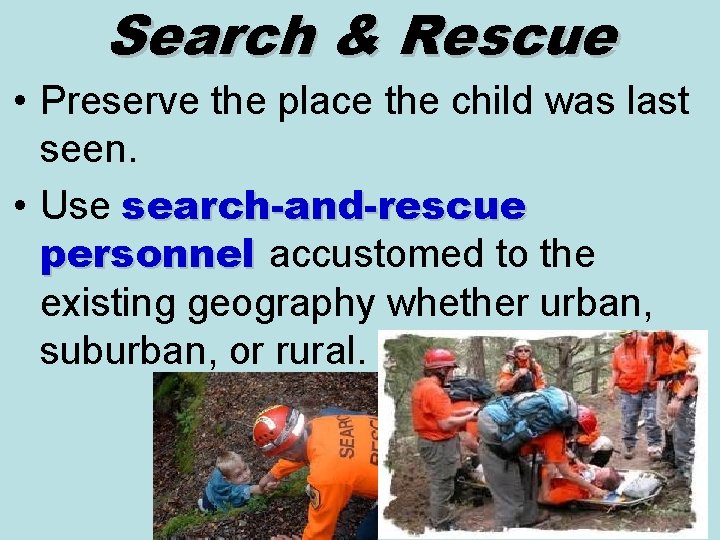
Search & Rescue • Preserve the place the child was last seen. • Use search-and-rescue personnel accustomed to the existing geography whether urban, suburban, or rural.
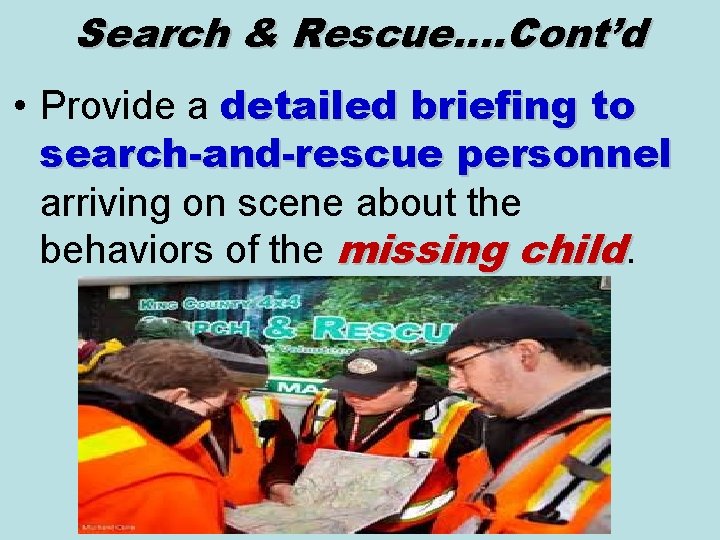
Search & Rescue…. Cont’d • Provide a detailed briefing to search-and-rescue personnel arriving on scene about the behaviors of the missing child.
Search & Rescue…. Cont’d • Consider using the National Center for Missing & Exploited Children’s • Missing Children With Special Needs Lost-Person Questionnaire
Search & Rescue…. Cont’d • Initiate search-and-rescue efforts with an emphasis on bodies of water, high-hazard areas, travel corridors, routes to favorite places, previous locations visited, and any other areas of interest suggested by those who know the child http: //www. missingkids. com/en_US/publications/Special. Needs_Adde ndum. pdf
Prolonged Searches • Evaluate the overall effectiveness Evaluate of the search operations and adjust as necessary for the next operational phase. • Estimate immediate and long-range resources and logistical requirements for deployment of those resources. • Assign new or additional personnel for the prolonged search operation.
Prolonged Searches…. . Cont’d • Consider expanding the search area, taking into account the distance the child could have walked during the time frame he or she has been missing and his or her resiliency. Children with autism have been known to walk several miles, often exceeding the miles initial containment areas.
Prolonged Searches…. . Cont’d • Determine if there any gaps in the original search area and make arrangements to search those areas again. • Consider using trained searchand-rescue personnel with volunteer searchers to enhance the search capabilities. http: //www. missingkids. com/en_US/publications/Spec ial. Needs_Addendum. pdf
Recovering the Child The considerations noted below are recommended to deescalate and/or minimize any heightened emotions or anxieties the child may experience at the time of recovery. • Maintain a calm and relaxed environment
Recovering the Child…Cont’d • Contain the child in a passive way to keep him or her from running or bolting and avoid use of restraints. bolting • Bring a parent or guardian immediately to the recovery site, whenever possible, and tell the site child that person is on the way.
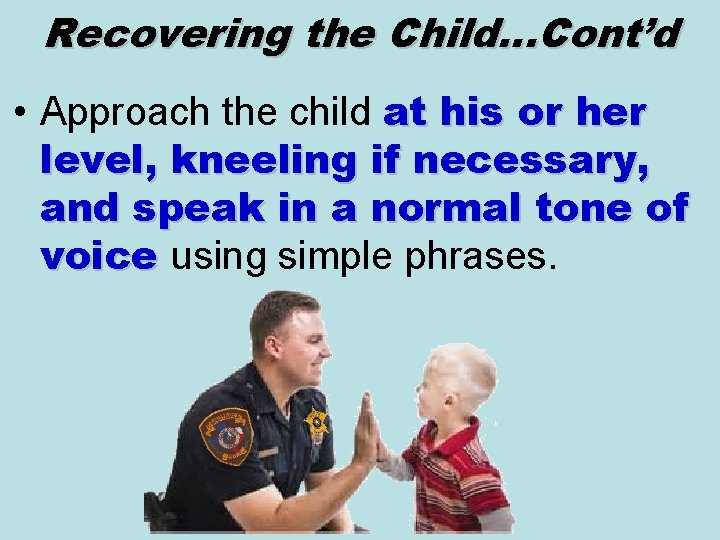
Recovering the Child…Cont’d • Approach the child at his or her level, kneeling if necessary, and speak in a normal tone of voice using simple phrases.
Recovering the Child…Cont’d • Use a task-and-reward process to ease anxiety and enhance compliance using phrases such as, “First we are going to stay here, and then your father is going to come here. ” here
Recovering the Child…Cont’d • Avoid assuming the child understands everything being said and done at the recovery scene. • Use communication aids, written aids instructions, drawings, or prompts if possible.
Recovering the Child…Cont’d • Use humor and familiar topics when possible. For instance if the child is wearing a shirt with a cartoon character on it, talk to the child about the character to help lessen any anxiety the child may be feeling and calm the child if upset. • Check for any identification such as a medical bracelet or tracking bracelet device.
Activity • A child with special needs is reported missing from a playground in a small town. • The aerial map of the area where the child was last seen is provided on the following slides. • Identify the potential hazards in the area based on the aerial map. • Identify steps you would take upon steps arriving at the scene.
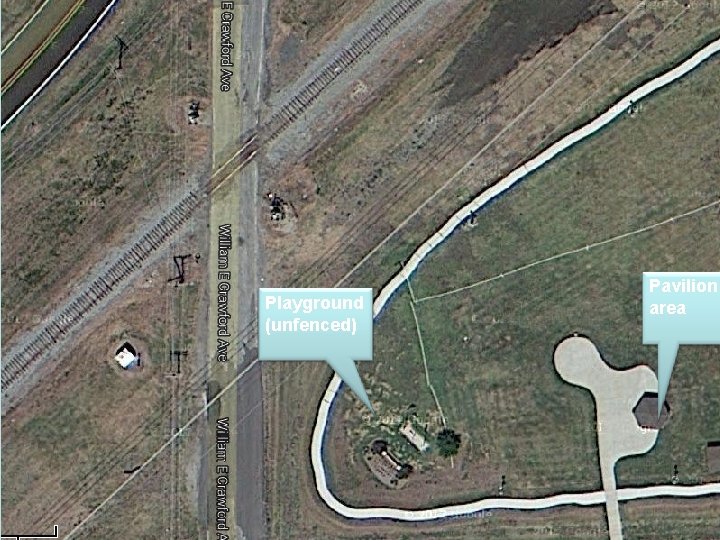
Playground (unfenced) Pavilion area
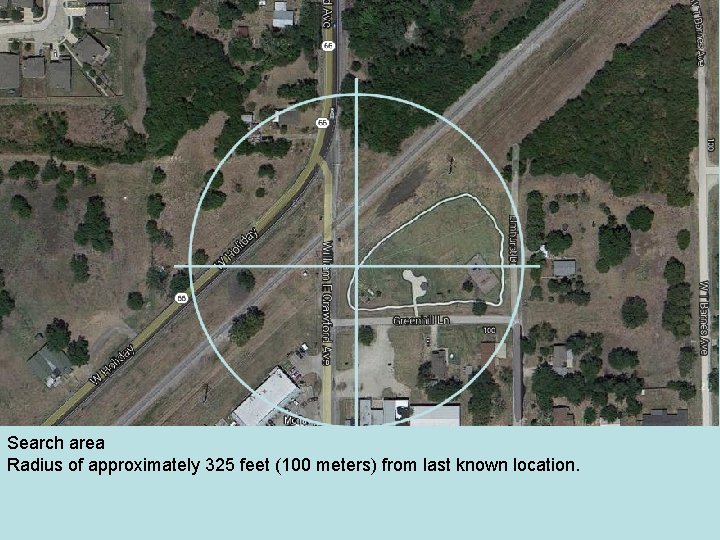
Search area Radius of approximately 325 feet (100 meters) from last known location.
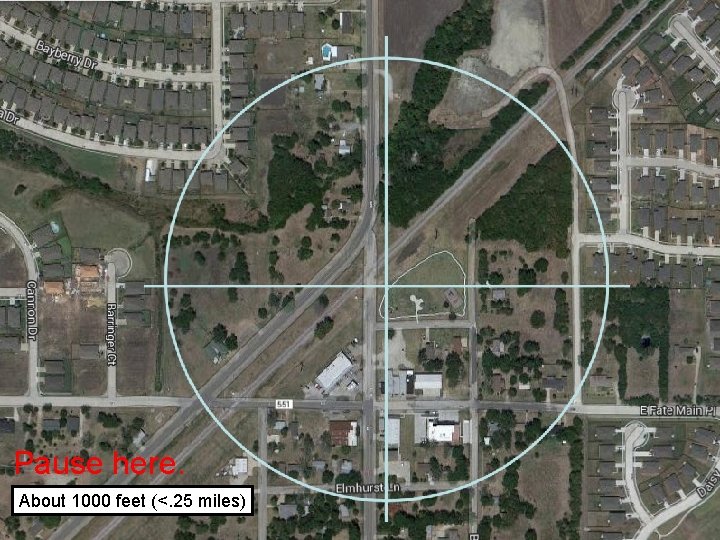
Pause here. About 1000 feet (<. 25 miles)
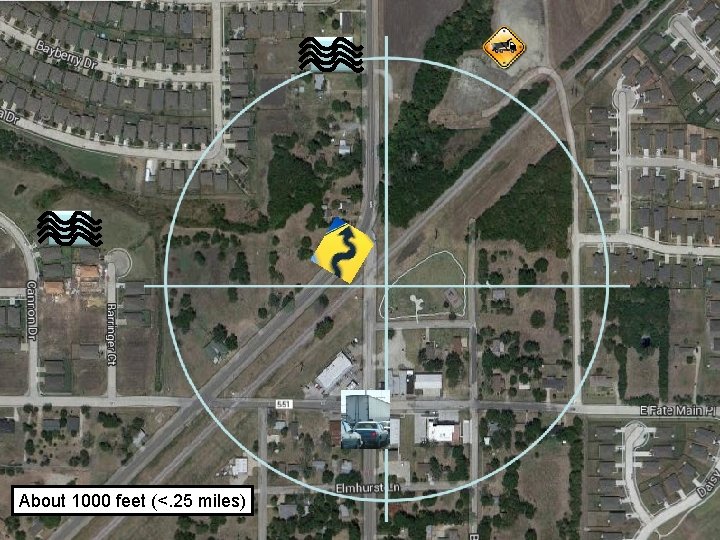
About 1000 feet (<. 25 miles)
Resources on Recovery Contact the National Autism Association for further reunification assistance at 1 -877 -622 -2884. For more information about children with autism and resources for families, such as the Big Red Safety Box, visit www. nationalautismassociation. org. Visit the National Autism Association’s websites at www. autismsafety. org and www. nationalautismassociation. org and the AWAARE Collaboration at www. awaare. org for additional information about children with autism. Consult Robert Koester’s Lost Person Behavior: A search and rescue guide on where to look - for land, air and water (2008) for additional general information. http: //www. missingkids. com/en_US/publications/Special. Needs_Adde ndum. pdf
Resources • Autism Speaks – http: //www. autismspeaks. org/wandering-resources • National Autism Association – AWAARE and the Big Red Safety Toolkit for First Responders- http: //awaare. nationalautismassociation. org/ – http: //nationalautismassociation. org/resources/autismsafety-facts/ • Center for Disease Control – Safety and Children with Disabilities – http: //www. cdc. gov/ncbddd/disabilityandsafety/wandering. html • Texas Tech University – Burkhart Center for Autism Education & Research – http: //www. depts. ttu. edu/burkhartcenter/

Questions?

SOURCES All Course Sources and/or Resources are listed in your Participant Handout EXPLOITED & MISSING CHILDREN TCOLE Course # 3275 Bexar County Constable Office PCT#4

“Knowledge is “POWER” Stay informed, stay SAFE, stay Vigilant & stay Alive”

TAKE A 10 -MINUTE BREAK
- Slides: 109