
Sexual Health Relationships Starting conversations with AYA families


- Slides: 19
Sexual Health & Relationships: Starting conversations with AYA families Presented by: Beth Boatman LMFT-Associate, CSE
Presentation Outline 1. Introduction and objectives (5 min) 2. Recent literature (from 2010 forward) (10 m) a. Significant issues b. Barriers to talking c. When and whose responsibility? 3. Helpful resources (10 m) a. Continued education b. In-hand helpers c. Outside help: social support, specialized care, etc 4. Talking about sexual health: Exercise (15 m) 5. Questions (5 m)
Beth Boatman LMFTAssociate, CSE Beth@yoursensualhealth. com www. yoursensualhealth. com @txsensualhealth @bethboatmanlmfta The presenter has no conflict or competing interest to declare.
Objectives 45 minute Presentation (3: 15 -4 p): 1. Describe at least 2 reasons why discussing sexual and relationship health is important to AYA health outcomes. 2. Identify at least 2 reputable resources to assist in continued sexual health and relationship conversation support for AYA providers. p 3. Practice starting the conversation with AYAs and their families at least once. iders by the end of the presentation.
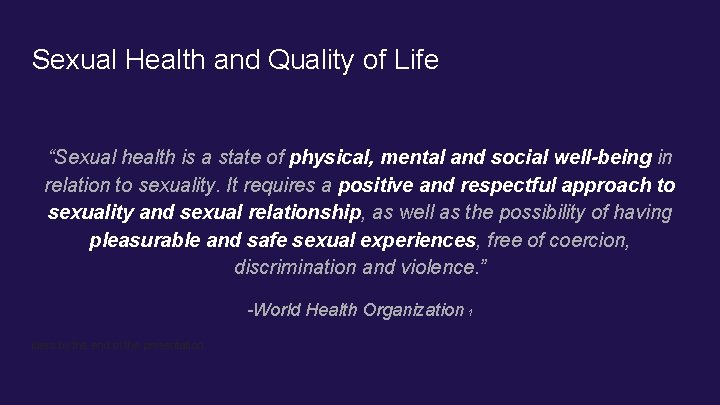
Sexual Health and Quality of Life “Sexual health is a state of physical, mental and social well-being in relation to sexuality. It requires a positive and respectful approach to sexuality and sexual relationship, as well as the possibility of having pleasurable and safe sexual experiences, free of coercion, discrimination and violence. ” -World Health Organization 1 iders by the end of the presentation.
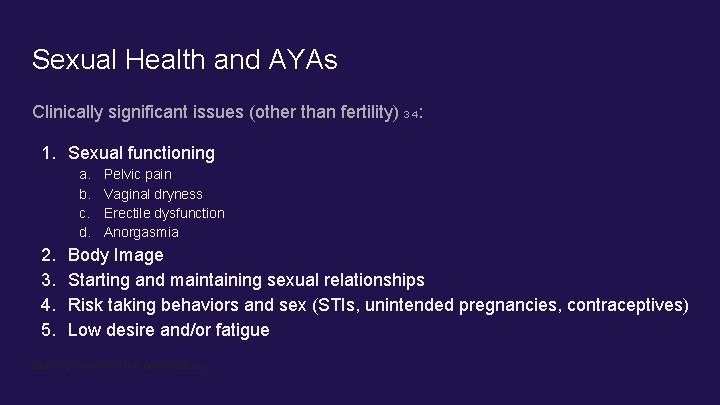
Sexual Health and AYAs Clinically significant issues (other than fertility) 3 4: 1. Sexual functioning a. b. c. d. 2. 3. 4. 5. Pelvic pain Vaginal dryness Erectile dysfunction Anorgasmia Body Image Starting and maintaining sexual relationships Risk taking behaviors and sex (STIs, unintended pregnancies, contraceptives) Low desire and/or fatigue iders by the end of the presentation.
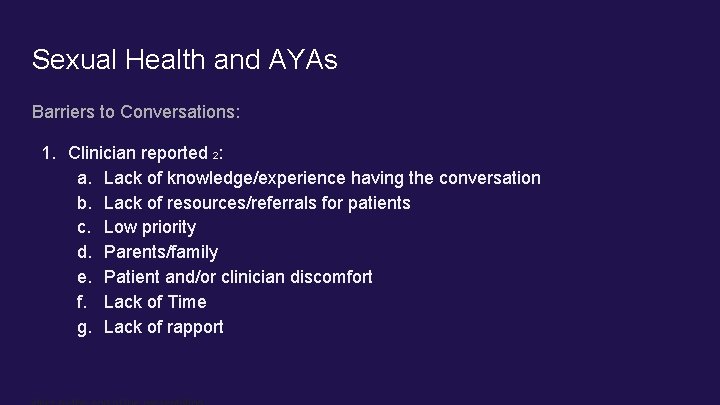
Sexual Health and AYAs Barriers to Conversations: 1. Clinician reported 2: a. Lack of knowledge/experience having the conversation b. Lack of resources/referrals for patients c. Low priority d. Parents/family e. Patient and/or clinician discomfort f. Lack of Time g. Lack of rapport
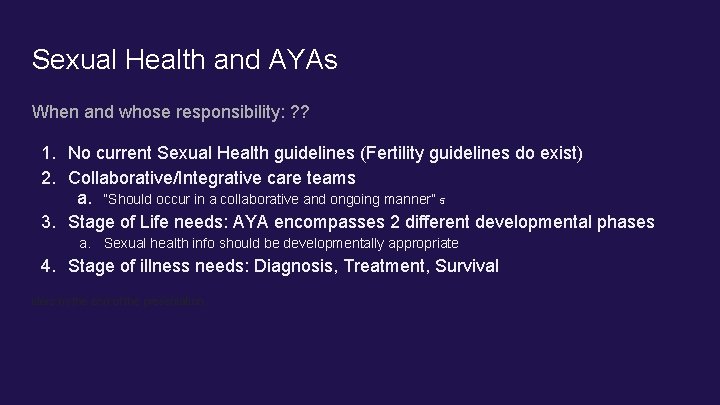
Sexual Health and AYAs When and whose responsibility: ? ? 1. No current Sexual Health guidelines (Fertility guidelines do exist) 2. Collaborative/Integrative care teams a. “Should occur in a collaborative and ongoing manner” 5 3. Stage of Life needs: AYA encompasses 2 different developmental phases a. Sexual health info should be developmentally appropriate 4. Stage of illness needs: Diagnosis, Treatment, Survival iders by the end of the presentation.
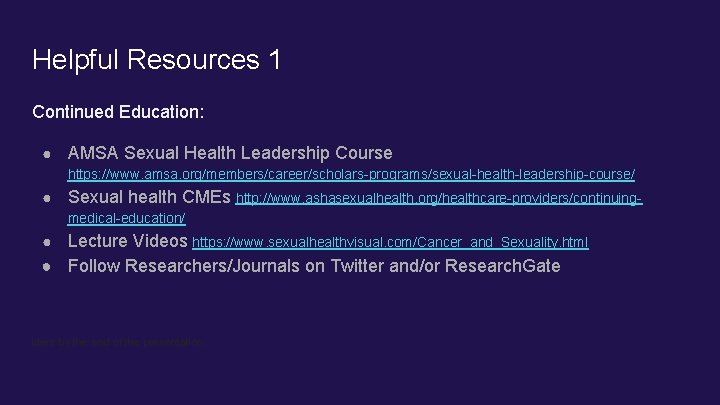
Helpful Resources 1 Continued Education: ● AMSA Sexual Health Leadership Course https: //www. amsa. org/members/career/scholars-programs/sexual-health-leadership-course/ ● Sexual health CMEs http: //www. ashasexualhealth. org/healthcare-providers/continuingmedical-education/ Lecture Videos https: //www. sexualhealthvisual. com/Cancer_and_Sexuality. html ● Follow Researchers/Journals on Twitter and/or Research. Gate ● iders by the end of the presentation.
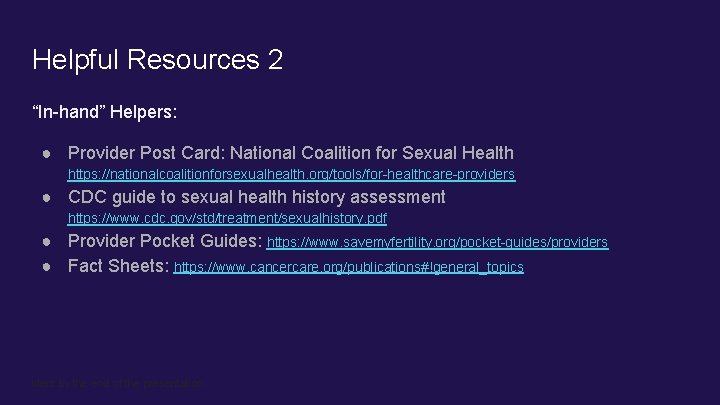
Helpful Resources 2 “In-hand” Helpers: ● Provider Post Card: National Coalition for Sexual Health https: //nationalcoalitionforsexualhealth. org/tools/for-healthcare-providers ● CDC guide to sexual health history assessment https: //www. cdc. gov/std/treatment/sexualhistory. pdf ● Provider Pocket Guides: https: //www. savemyfertility. org/pocket-guides/providers ● Fact Sheets: https: //www. cancercare. org/publications#!general_topics iders by the end of the presentation.
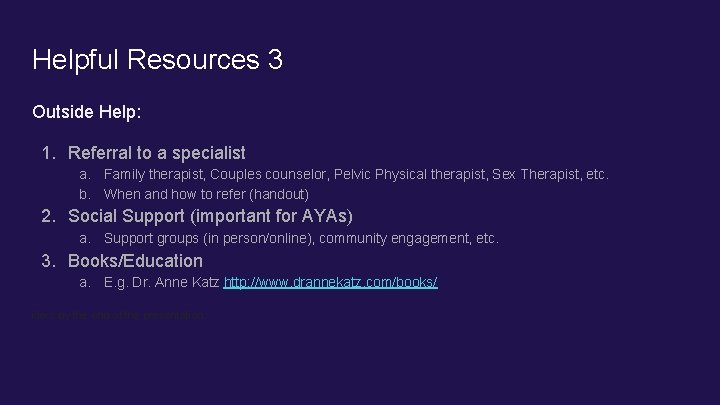
Helpful Resources 3 Outside Help: 1. Referral to a specialist a. Family therapist, Couples counselor, Pelvic Physical therapist, Sex Therapist, etc. b. When and how to refer (handout) 2. Social Support (important for AYAs) a. Support groups (in person/online), community engagement, etc. 3. Books/Education a. E. g. Dr. Anne Katz http: //www. drannekatz. com/books/ iders by the end of the presentation.
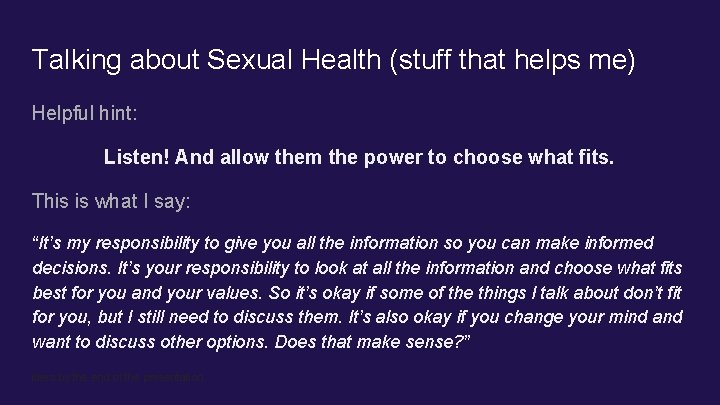
Talking about Sexual Health (stuff that helps me) Helpful hint: Listen! And allow them the power to choose what fits. This is what I say: “It’s my responsibility to give you all the information so you can make informed decisions. It’s your responsibility to look at all the information and choose what fits best for you and your values. So it’s okay if some of the things I talk about don’t fit for you, but I still need to discuss them. It’s also okay if you change your mind and want to discuss other options. Does that make sense? ” iders by the end of the presentation.
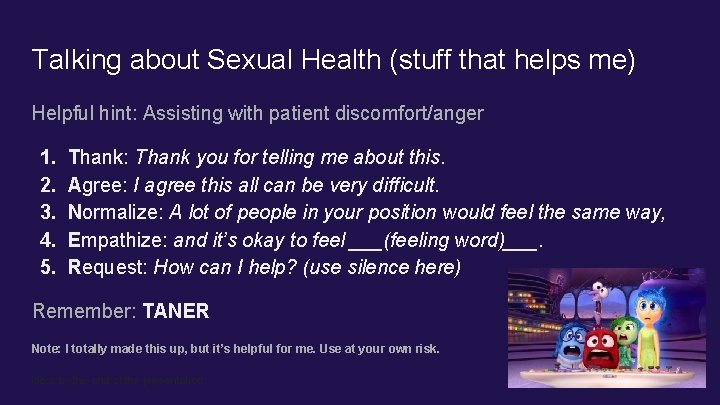
Talking about Sexual Health (stuff that helps me) Helpful hint: Assisting with patient discomfort/anger 1. 2. 3. 4. 5. Thank: Thank you for telling me about this. Agree: I agree this all can be very difficult. Normalize: A lot of people in your position would feel the same way, Empathize: and it’s okay to feel ___(feeling word)___. Request: How can I help? (use silence here) Remember: TANER Note: I totally made this up, but it’s helpful for me. Use at your own risk. iders by the end of the presentation.
Talking about Sexual Health Exercise: 1. 2. 3. 4. Get into groups of 2 Designate an AYA and a provider Practice starting the conversation based upon vignette Use tools provided if needed iders by the end of the presentation.
Vignette #1 Exercise: iders by the end of the presentation.
Vignette #2 Exercise: iders by the end of the presentation.
Summary 1. Recent literature a. Significant issues in Sexual health impact Quality of LIfe b. Barriers to talking c. Working in collaborative care teams and using resources? 2. Helpful resources (10 m) a. Continued education b. In-hand helpers c. Outside help: social support, specialized care, etc iders by the end of the presentation.
Questions?
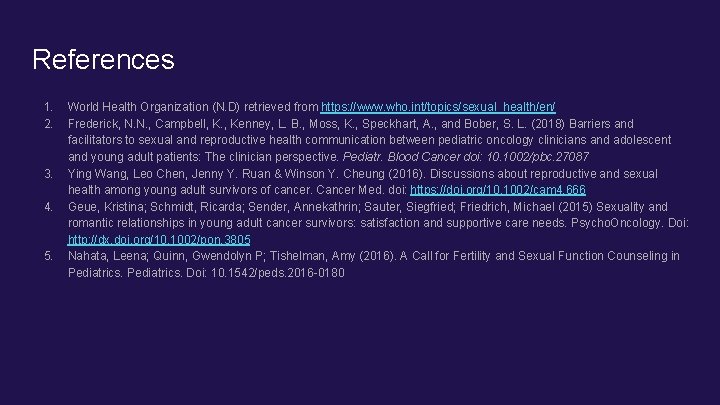
References 1. 2. 3. 4. 5. World Health Organization (N. D) retrieved from https: //www. who. int/topics/sexual_health/en/ Frederick, N. N. , Campbell, K. , Kenney, L. B. , Moss, K. , Speckhart, A. , and Bober, S. L. (2018) Barriers and facilitators to sexual and reproductive health communication between pediatric oncology clinicians and adolescent and young adult patients: The clinician perspective. Pediatr. Blood Cancer doi: 10. 1002/pbc. 27087 Ying Wang, Leo Chen, Jenny Y. Ruan & Winson Y. Cheung (2016). Discussions about reproductive and sexual health among young adult survivors of cancer. Cancer Med. doi: https: //doi. org/10. 1002/cam 4. 666 Geue, Kristina; Schmidt, Ricarda; Sender, Annekathrin; Sauter, Siegfried; Friedrich, Michael (2015) Sexuality and romantic relationships in young adult cancer survivors: satisfaction and supportive care needs. Psycho. Oncology. Doi: http: //dx. doi. org/10. 1002/pon. 3805 Nahata, Leena; Quinn, Gwendolyn P; Tishelman, Amy (2016). A Call for Fertility and Sexual Function Counseling in Pediatrics. Doi: 10. 1542/peds. 2016 -0180