ROCC CommunicationsReporting Reconnaissance and Surveillance Leader Course Agenda





- Slides: 61
ROCC Communications/Reporting Reconnaissance and Surveillance Leader Course
Agenda • Base Radio Station Concept • Message Traffic • LRS Communications Systems • Digital Capabilities • Communications Limitations/Constraints Reconnaissance and Surveillance Leader Course
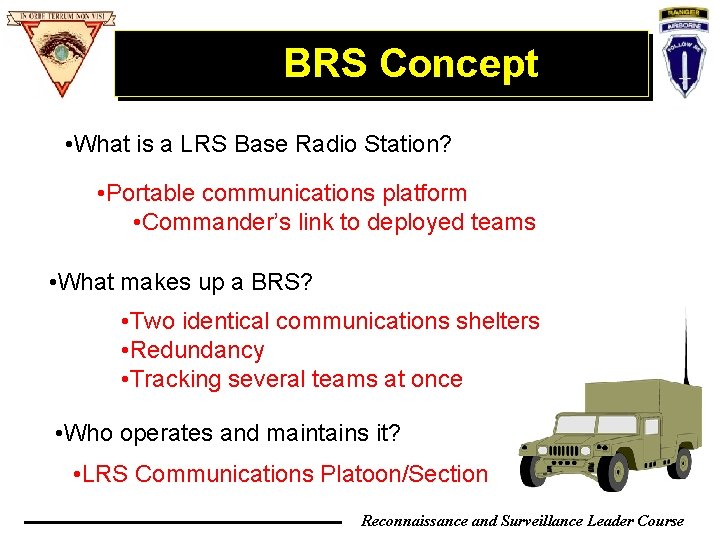
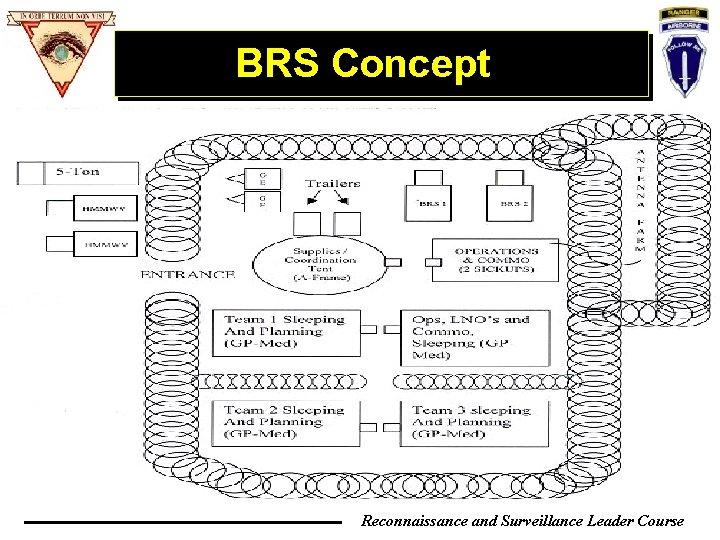
BRS Concept • What is a LRS Base Radio Station? • Portable communications platform • Commander’s link to deployed teams • What makes up a BRS? • Two identical communications shelters • Redundancy • Tracking several teams at once • Who operates and maintains it? • LRS Communications Platoon/Section Reconnaissance and Surveillance Leader Course
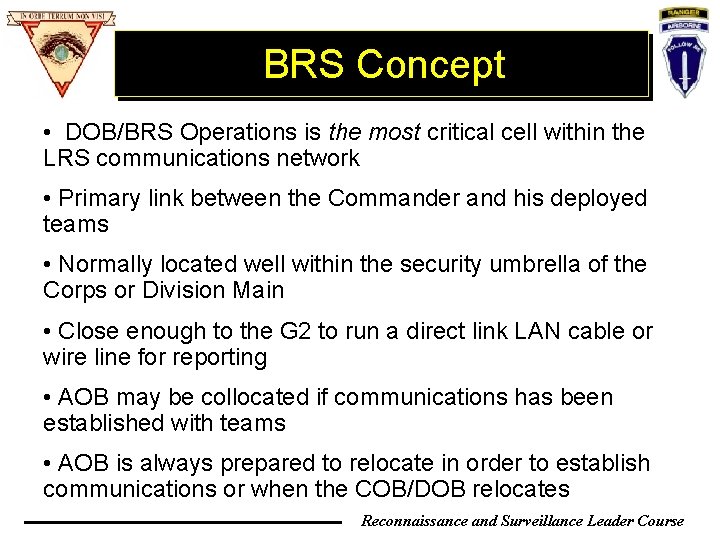
BRS Concept • DOB/BRS Operations is the most critical cell within the LRS communications network • Primary link between the Commander and his deployed teams • Normally located well within the security umbrella of the Corps or Division Main • Close enough to the G 2 to run a direct link LAN cable or wire line for reporting • AOB may be collocated if communications has been established with teams • AOB is always prepared to relocate in order to establish communications or when the COB/DOB relocates Reconnaissance and Surveillance Leader Course
AOB BRS Concept DOB/COB TACSAT HF Tactical Switch HF LRS Team VHF/FM AOB BRS Reconnaissance and Surveillance Leader Course
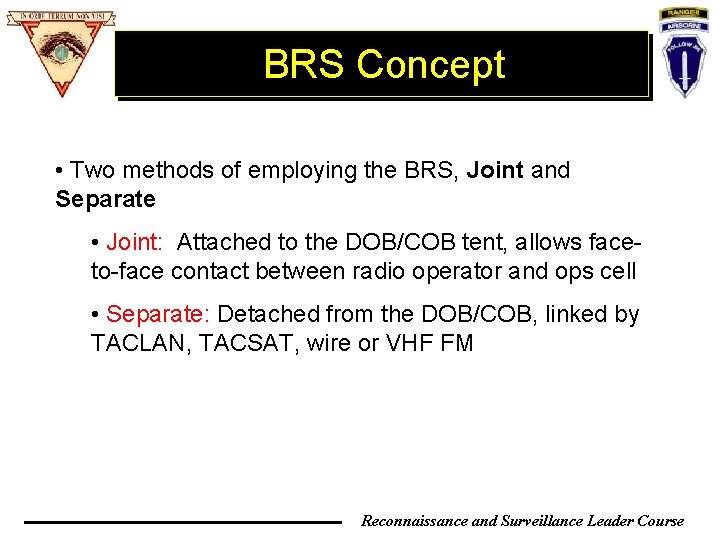
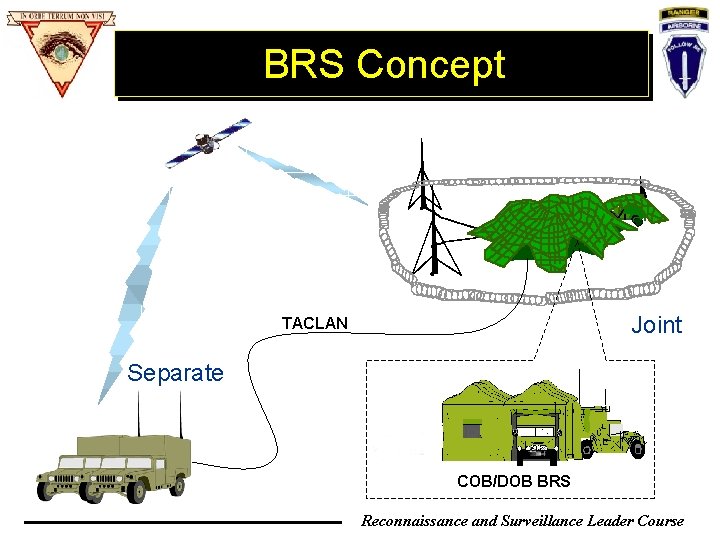
BRS Concept • Two methods of employing the BRS, Joint and Separate • Joint: Attached to the DOB/COB tent, allows faceto-face contact between radio operator and ops cell • Separate: Detached from the DOB/COB, linked by TACLAN, TACSAT, wire or VHF FM Reconnaissance and Surveillance Leader Course
BRS Concept Joint TACLAN Separate COB/DOB BRS Reconnaissance and Surveillance Leader Course
BRS Concept Reconnaissance and Surveillance Leader Course
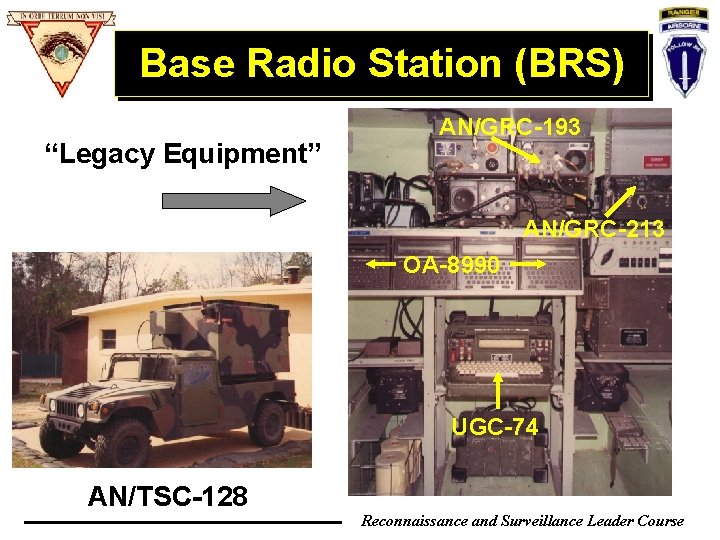
Base Radio Station (BRS) “Legacy Equipment” AN/GRC-193 AN/GRC-213 OA-8990 UGC-74 AN/TSC-128 Reconnaissance and Surveillance Leader Course
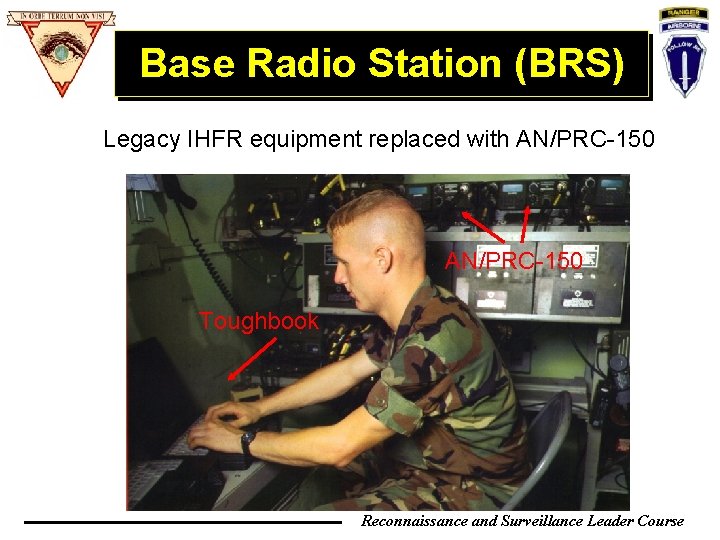
Base Radio Station (BRS) Legacy IHFR equipment replaced with AN/PRC-150 Toughbook Reconnaissance and Surveillance Leader Course
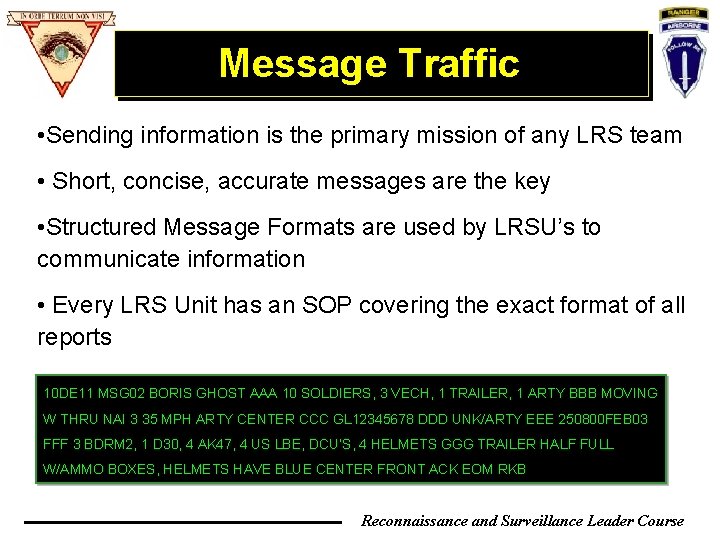
Message Traffic • Sending information is the primary mission of any LRS team • Short, concise, accurate messages are the key • Structured Message Formats are used by LRSU’s to communicate information • Every LRS Unit has an SOP covering the exact format of all reports 10 DE 11 MSG 02 BORIS GHOST AAA 10 SOLDIERS, 3 VECH, 1 TRAILER, 1 ARTY BBB MOVING W THRU NAI 3 35 MPH ARTY CENTER CCC GL 12345678 DDD UNK/ARTY EEE 250800 FEB 03 FFF 3 BDRM 2, 1 D 30, 4 AK 47, 4 US LBE, DCU’S, 4 HELMETS GGG TRAILER HALF FULL W/AMMO BOXES, HELMETS HAVE BLUE CENTER FRONT ACK EOM RKB Reconnaissance and Surveillance Leader Course
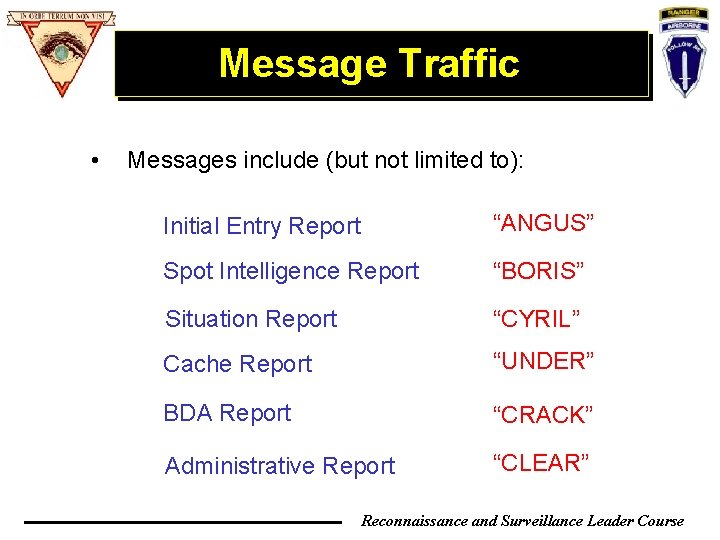
Message Traffic • Messages include (but not limited to): Initial Entry Report “ANGUS” Spot Intelligence Report “BORIS” Situation Report “CYRIL” Cache Report “UNDER” BDA Report “CRACK” Administrative Report “CLEAR” Reconnaissance and Surveillance Leader Course
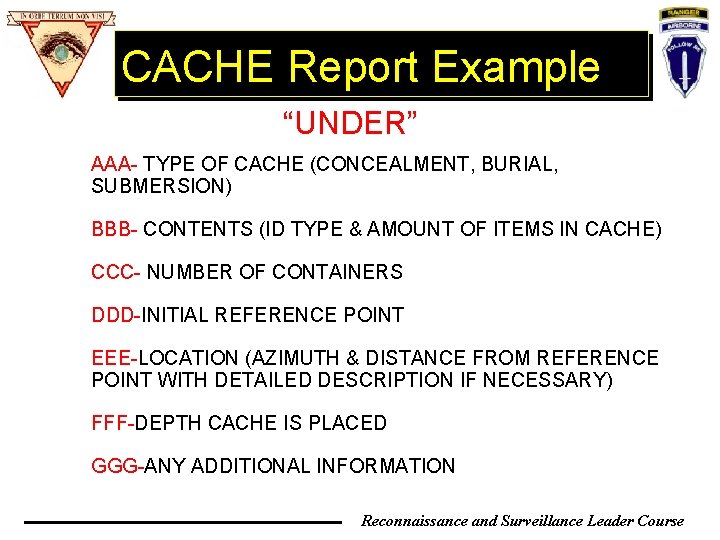
CACHE Report Example “UNDER” AAA- TYPE OF CACHE (CONCEALMENT, BURIAL, SUBMERSION) BBB- CONTENTS (ID TYPE & AMOUNT OF ITEMS IN CACHE) CCC- NUMBER OF CONTAINERS DDD-INITIAL REFERENCE POINT EEE-LOCATION (AZIMUTH & DISTANCE FROM REFERENCE POINT WITH DETAILED DESCRIPTION IF NECESSARY) FFF-DEPTH CACHE IS PLACED GGG-ANY ADDITIONAL INFORMATION Reconnaissance and Surveillance Leader Course
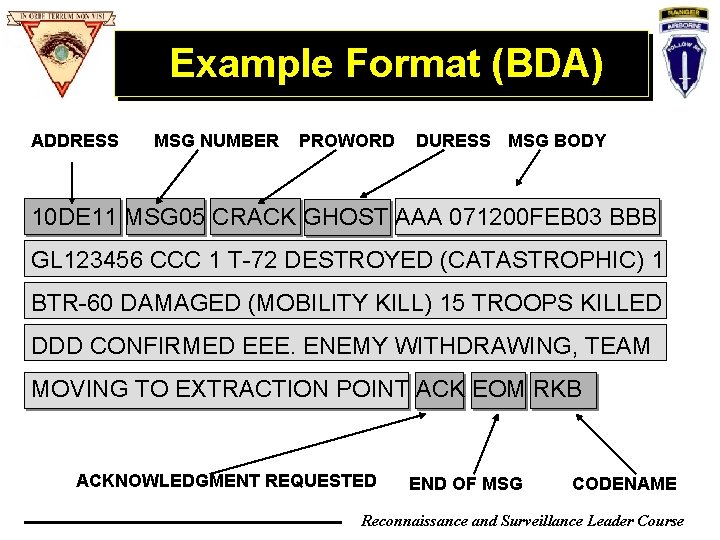
Example Format (BDA) ADDRESS MSG NUMBER PROWORD DURESS MSG BODY 10 DE 11 MSG 05 CRACK GHOST AAA 071200 FEB 03 BBB GL 123456 CCC 1 T-72 DESTROYED (CATASTROPHIC) 1 BTR-60 DAMAGED (MOBILITY KILL) 15 TROOPS KILLED DDD CONFIRMED EEE. ENEMY WITHDRAWING, TEAM MOVING TO EXTRACTION POINT ACK EOM RKB ACKNOWLEDGMENT REQUESTED END OF MSG CODENAME Reconnaissance and Surveillance Leader Course
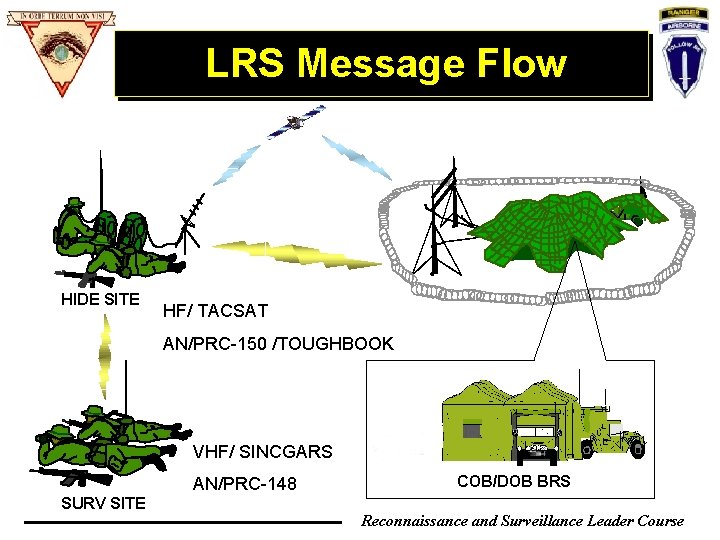
LRS Message Flow HIDE SITE HF/ TACSAT AN/PRC-150 /TOUGHBOOK VHF/ SINCGARS AN/PRC-148 SURV SITE COB/DOB BRS Reconnaissance and Surveillance Leader Course
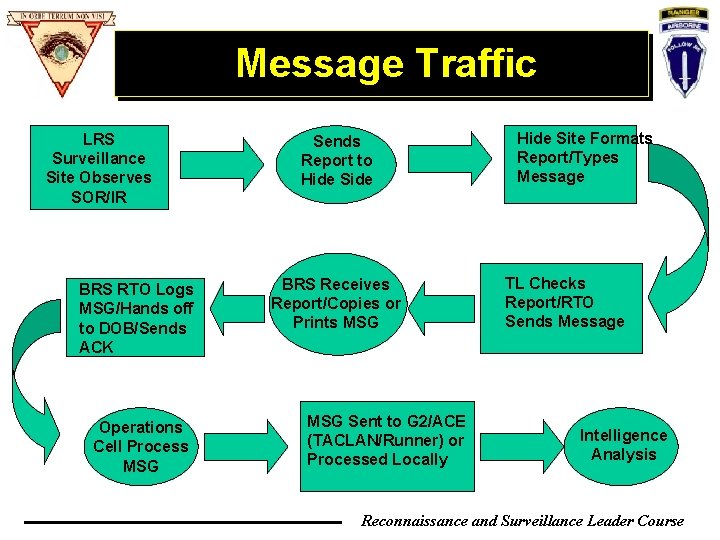
Message Traffic LRS Surveillance Site Observes SOR/IR BRS RTO Logs MSG/Hands off to DOB/Sends ACK Operations Cell Process MSG Sends Report to Hide Side BRS Receives Report/Copies or Prints MSG Sent to G 2/ACE (TACLAN/Runner) or Processed Locally Hide Site Formats Report/Types Message TL Checks Report/RTO Sends Message Intelligence Analysis Reconnaissance and Surveillance Leader Course
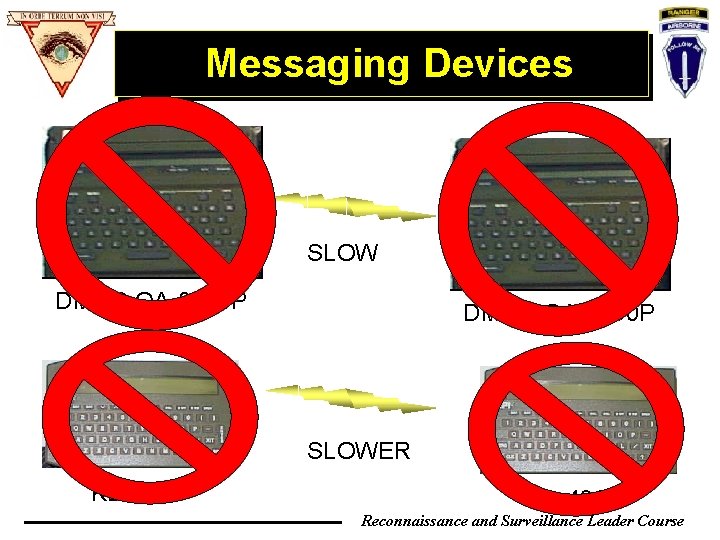
Messaging Devices SLOW DMDG OA-8990 P SLOWER KL-43 C Reconnaissance and Surveillance Leader Course
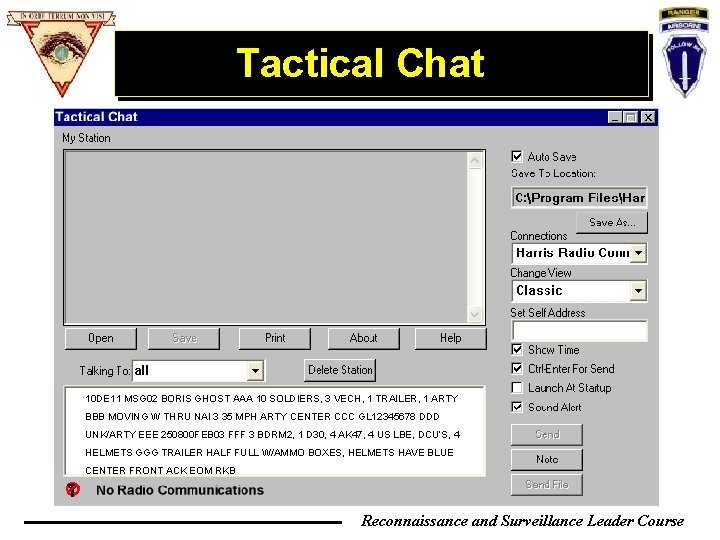
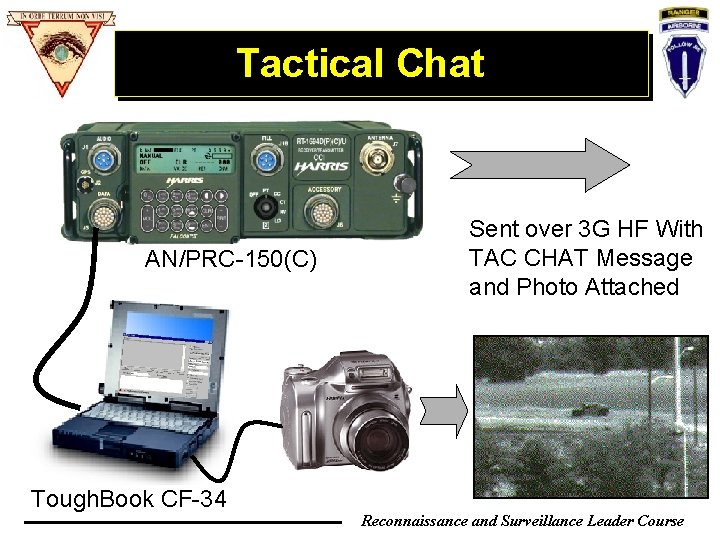
Tactical Chat 10 DE 11 MSG 02 BORIS GHOST AAA 10 SOLDIERS, 3 VECH, 1 TRAILER, 1 ARTY BBB MOVING W THRU NAI 3 35 MPH ARTY CENTER CCC GL 12345678 DDD UNK/ARTY EEE 250800 FEB 03 FFF 3 BDRM 2, 1 D 30, 4 AK 47, 4 US LBE, DCU’S, 4 HELMETS GGG TRAILER HALF FULL W/AMMO BOXES, HELMETS HAVE BLUE CENTER FRONT ACK EOM RKB Reconnaissance and Surveillance Leader Course
Tactical Chat AN/PRC-150(C) Tough. Book CF-34 Sent over 3 G HF With TAC CHAT Message and Photo Attached Reconnaissance and Surveillance Leader Course
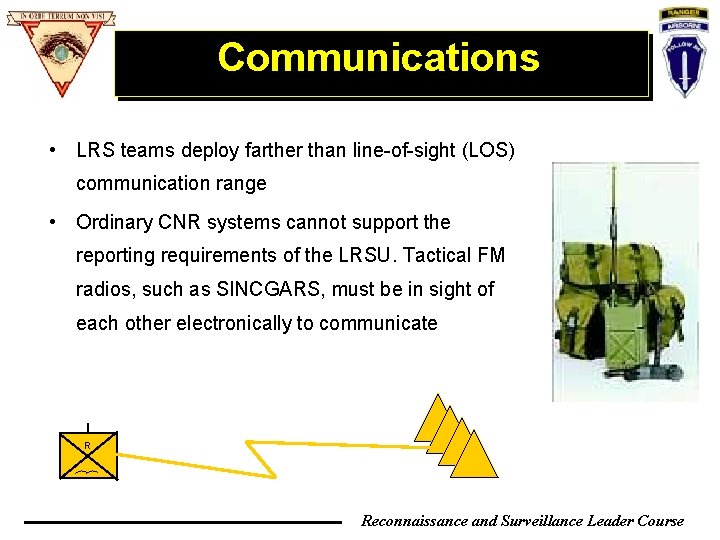
Communications • LRS teams deploy farther than line-of-sight (LOS) communication range • Ordinary CNR systems cannot support the reporting requirements of the LRSU. Tactical FM radios, such as SINCGARS, must be in sight of each other electronically to communicate R Reconnaissance and Surveillance Leader Course
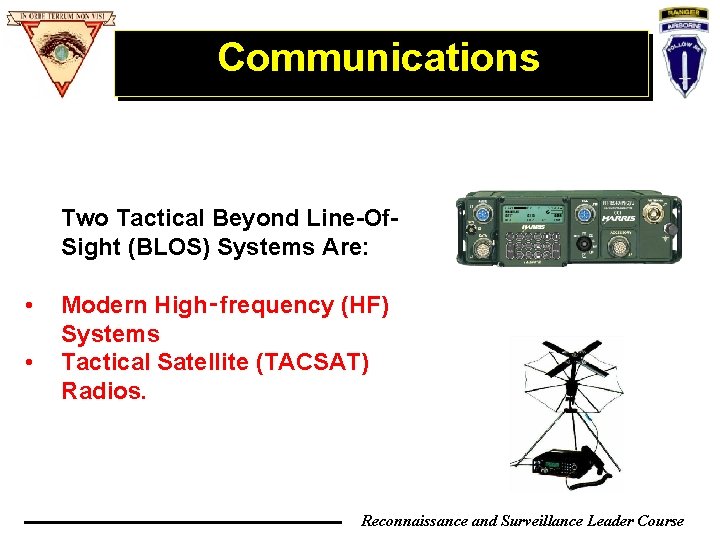
Communications Two Tactical Beyond Line-Of. Sight (BLOS) Systems Are: • • Modern High‑frequency (HF) Systems Tactical Satellite (TACSAT) Radios. Reconnaissance and Surveillance Leader Course
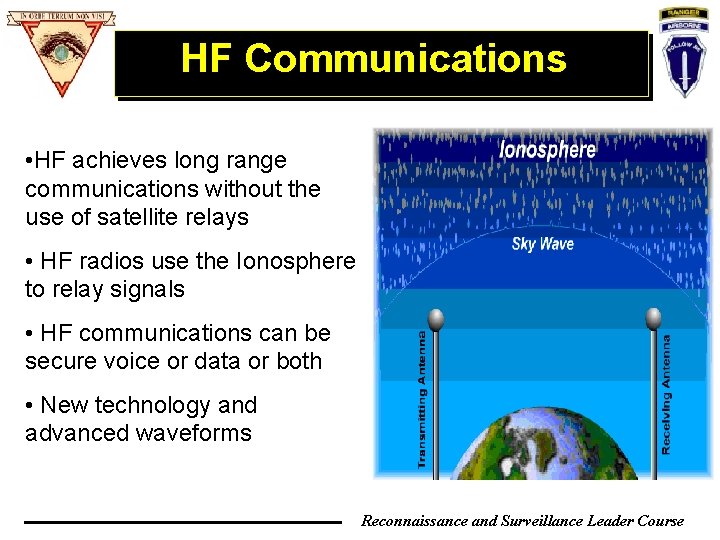
HF Communications • HF achieves long range communications without the use of satellite relays • HF radios use the Ionosphere to relay signals • HF communications can be secure voice or data or both • New technology and advanced waveforms Reconnaissance and Surveillance Leader Course
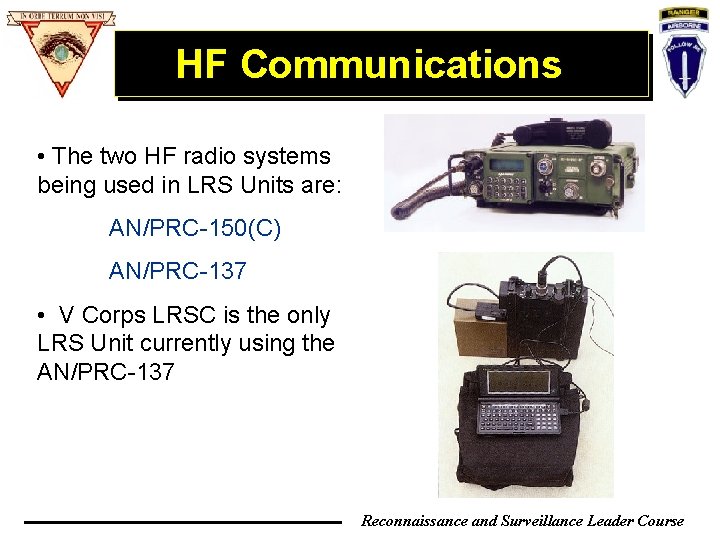
HF Communications • The two HF radio systems being used in LRS Units are: AN/PRC-150(C) AN/PRC-137 • V Corps LRSC is the only LRS Unit currently using the AN/PRC-137 Reconnaissance and Surveillance Leader Course
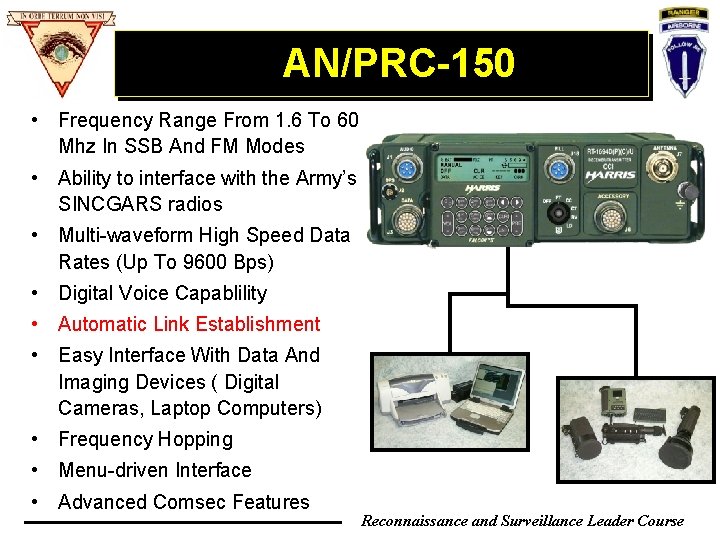
AN/PRC-150 • Frequency Range From 1. 6 To 60 Mhz In SSB And FM Modes • Ability to interface with the Army’s SINCGARS radios • Multi-waveform High Speed Data Rates (Up To 9600 Bps) • Digital Voice Capablility • Automatic Link Establishment • Easy Interface With Data And Imaging Devices ( Digital Cameras, Laptop Computers) • Frequency Hopping • Menu-driven Interface • Advanced Comsec Features Reconnaissance and Surveillance Leader Course
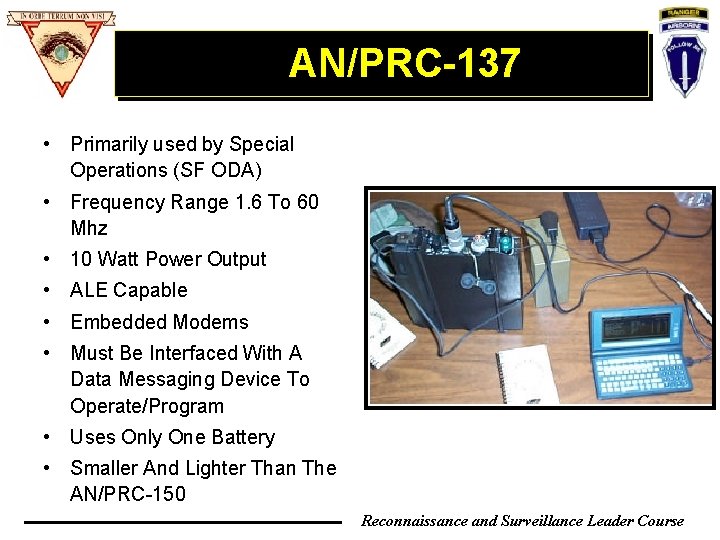
AN/PRC-137 • Primarily used by Special Operations (SF ODA) • Frequency Range 1. 6 To 60 Mhz • 10 Watt Power Output • ALE Capable • Embedded Modems • Must Be Interfaced With A Data Messaging Device To Operate/Program • Uses Only One Battery • Smaller And Lighter Than The AN/PRC-150 Reconnaissance and Surveillance Leader Course
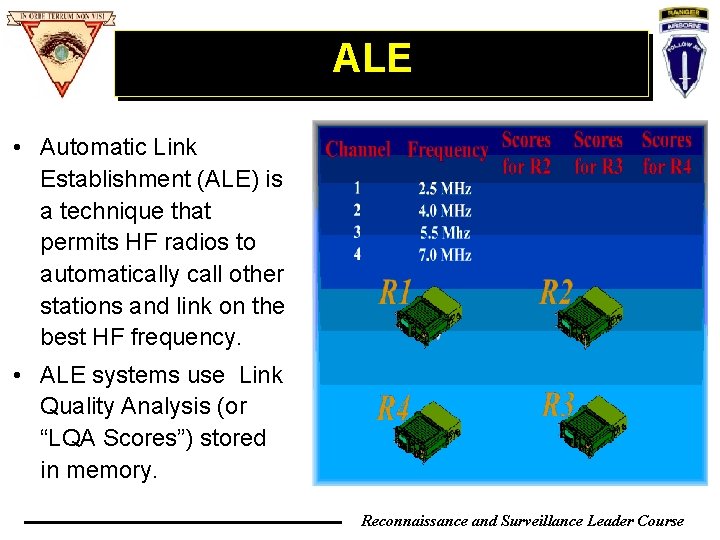
ALE • Automatic Link Establishment (ALE) is a technique that permits HF radios to automatically call other stations and link on the best HF frequency. • ALE systems use Link Quality Analysis (or “LQA Scores”) stored in memory. Reconnaissance and Surveillance Leader Course
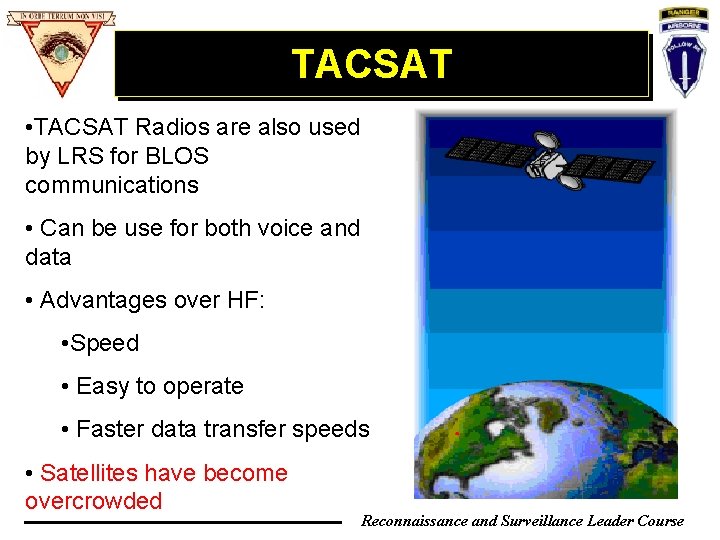
TACSAT • TACSAT Radios are also used by LRS for BLOS communications • Can be use for both voice and data • Advantages over HF: • Speed • Easy to operate • Faster data transfer speeds • Satellites have become overcrowded Reconnaissance and Surveillance Leader Course
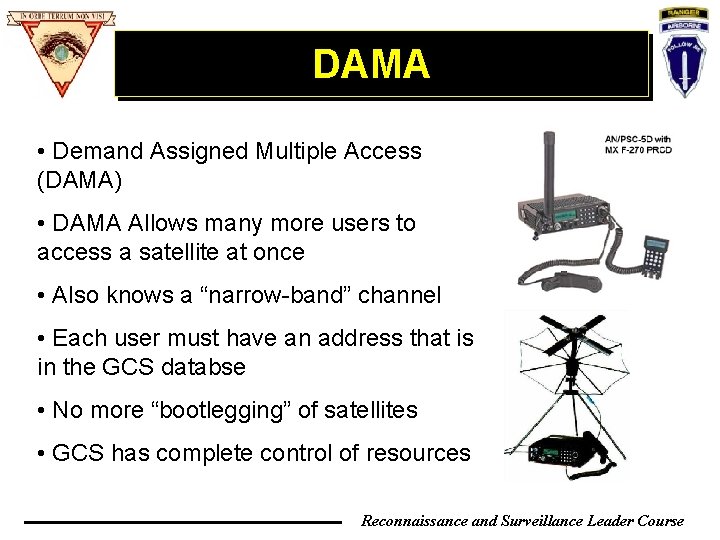
DAMA • Demand Assigned Multiple Access (DAMA) • DAMA Allows many more users to access a satellite at once • Also knows a “narrow-band” channel • Each user must have an address that is in the GCS databse • No more “bootlegging” of satellites • GCS has complete control of resources Reconnaissance and Surveillance Leader Course
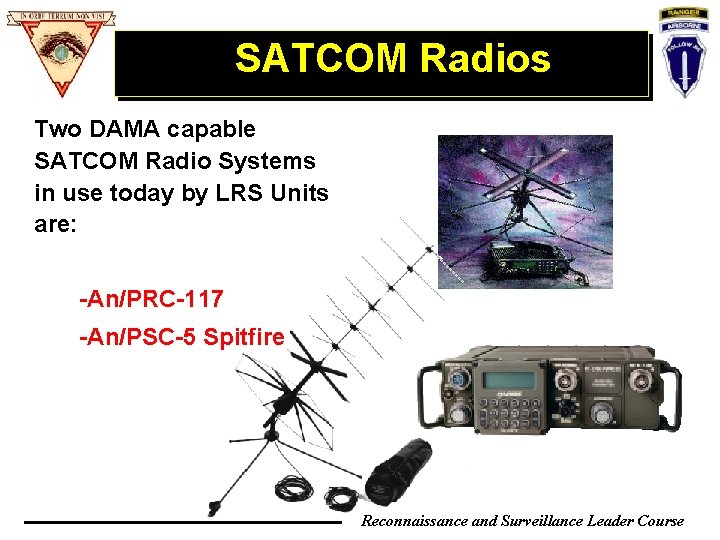
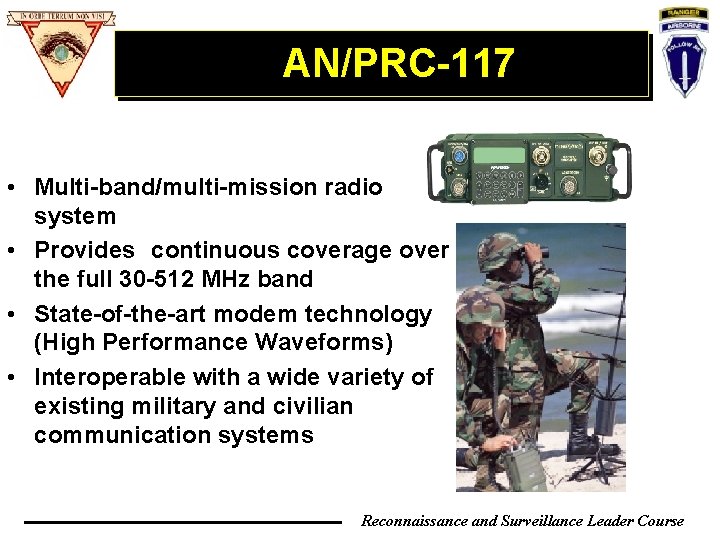
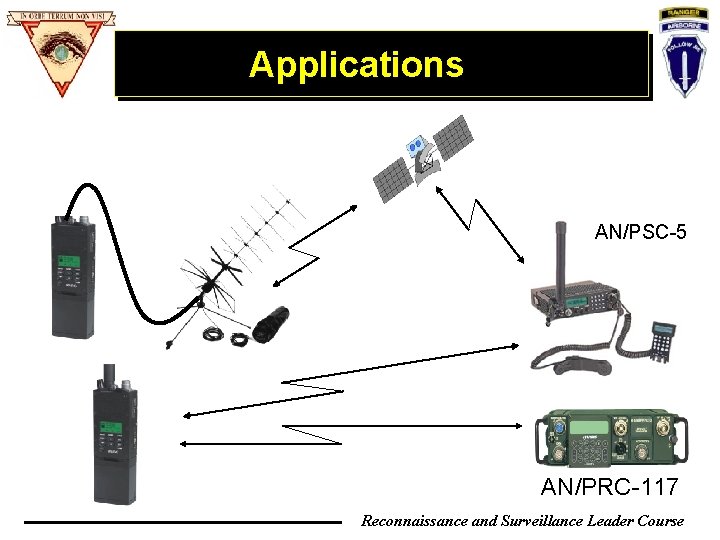
SATCOM Radios Two DAMA capable SATCOM Radio Systems in use today by LRS Units are: -An/PRC-117 -An/PSC-5 Spitfire Reconnaissance and Surveillance Leader Course
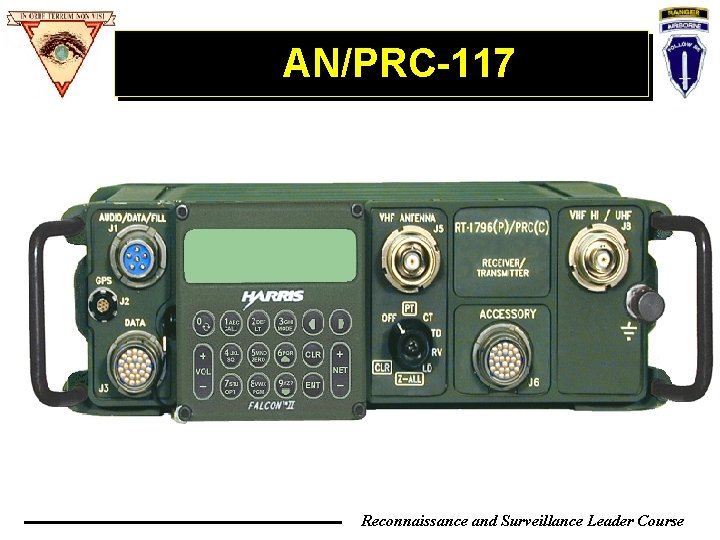
AN/PRC-117 Reconnaissance and Surveillance Leader Course
AN/PRC-117 • Multi-band/multi-mission radio system • Provides continuous coverage over the full 30 -512 MHz band • State-of-the-art modem technology (High Performance Waveforms) • Interoperable with a wide variety of existing military and civilian communication systems Reconnaissance and Surveillance Leader Course
Advantages of AN/PRC-117 • Designed to provide the most advanced tactical communications technology available in one single package. • Microprocessor-based • Software-controlled (vs hardware) • Radio can be tailored to fit any unconventional, conventional or data/automation mission requirement • More user-friendly and cost-effective when compared to current "standard" equipment Reconnaissance and Surveillance Leader Course
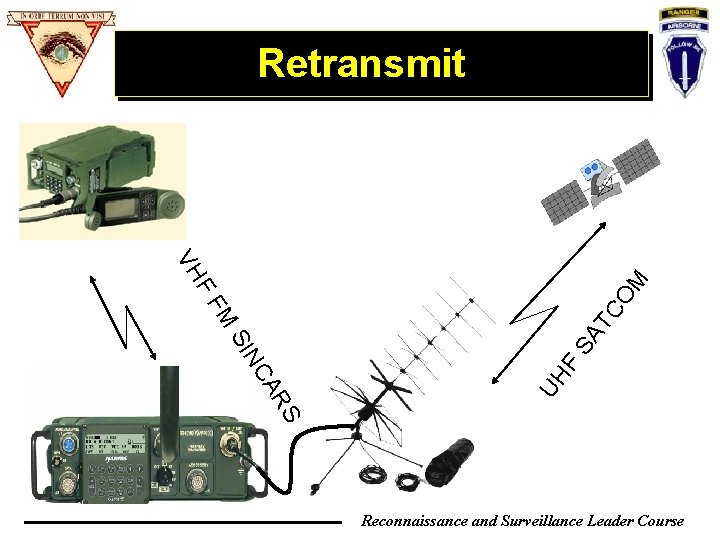
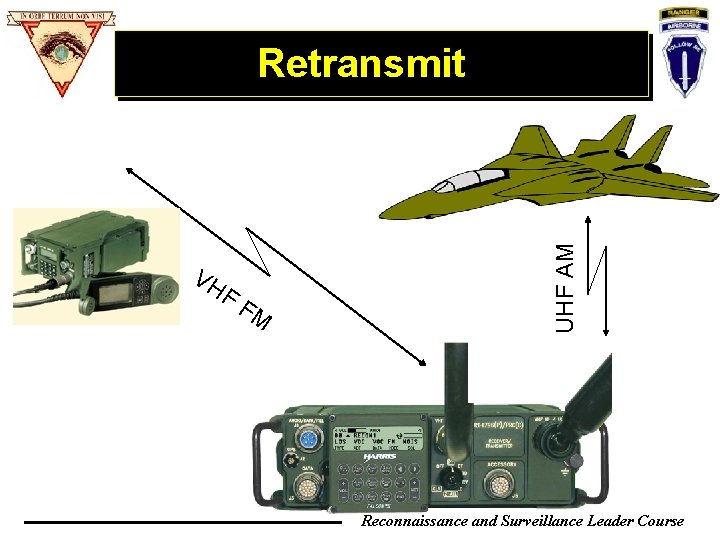
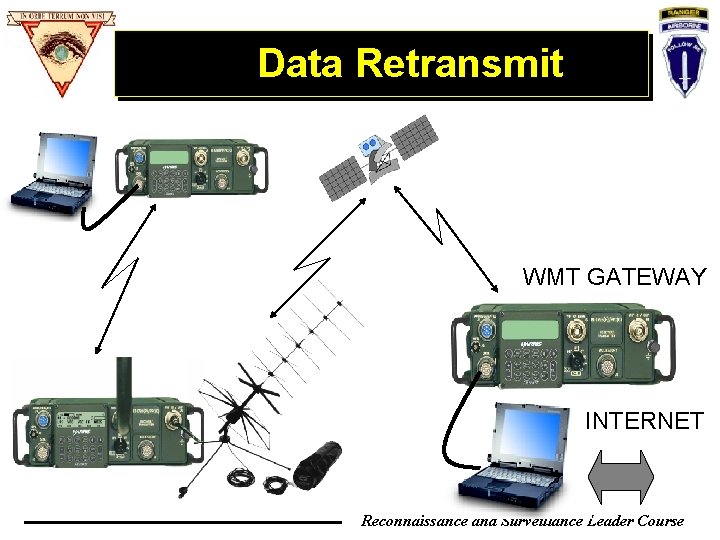
Advantages of AN/PRC-117 • Can be used as a bridge between two different communications systems (SINCGARS to SATCOM, SABRE to SINCGARS) • Easy interface with standard laptops or Toughbooks through Data Port • Uses Wireless Messaging Terminal (Outlook Email) • Can be used as a Gateway to WWW (Standard E-mail to WMT) • Retransmit capabilities (example UHF AM to VHF FM) Reconnaissance and Surveillance Leader Course
AN/PRC-117 F • Manpack, vehicular, marine and base-station configurations • Built-in ECCM and COMSEC capability • Voice/data retransmission across traditional frequency bands and waveforms • Data rates up to 64 kbs with built-in interfaces • Full remote-control capability (all functions) • Longer battery life due to low voltage logic design • Multiband scanning • 100 -channel presets for fixed frequency Reconnaissance and Surveillance Leader Course
AN/PRC-117 F • Optional Global Positioning System interface for navigation and time signals • Software-reprogrammable to accommodate evolving waveforms, ECCM, COMSEC, signal processing and modulation techniques • Dual antennas for optimal performance (30 -512 m. Hz). Reconnaissance and Surveillance Leader Course
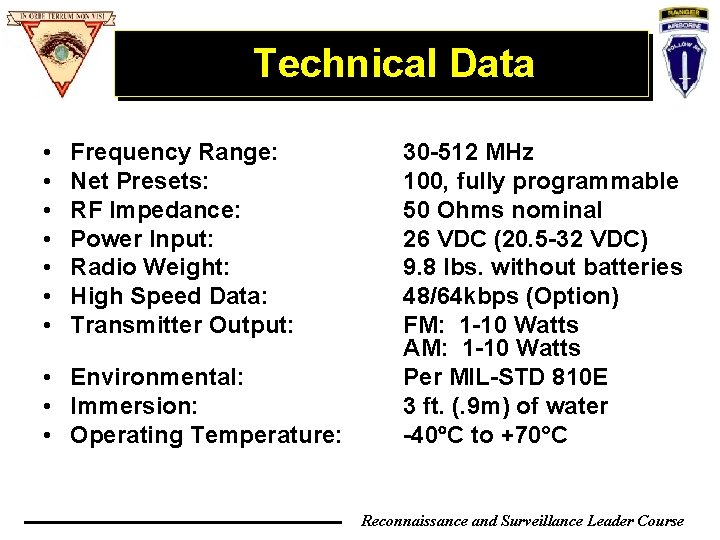
Technical Data • • Frequency Range: Net Presets: RF Impedance: Power Input: Radio Weight: High Speed Data: Transmitter Output: • Environmental: • Immersion: • Operating Temperature: 30 -512 MHz 100, fully programmable 50 Ohms nominal 26 VDC (20. 5 -32 VDC) 9. 8 lbs. without batteries 48/64 kbps (Option) FM: 1 -10 Watts AM: 1 -10 Watts Per MIL-STD 810 E 3 ft. (. 9 m) of water -40 C to +70 C Reconnaissance and Surveillance Leader Course
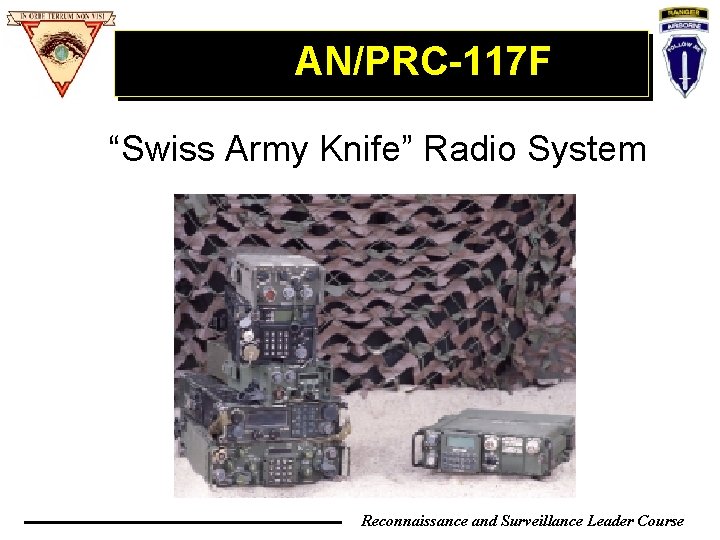
AN/PRC-117 F “Swiss Army Knife” Radio System Reconnaissance and Surveillance Leader Course
Wireless Messaging Terminal (E-mail) Se nt Via HP W Up lin k to SA T Applications Image Sent to Toughbook Reconnaissance and Surveillance Leader Course
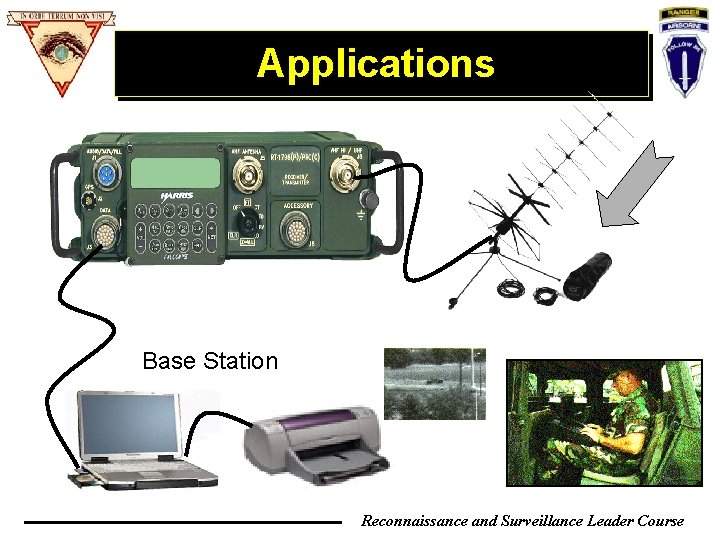
Applications Base Station Reconnaissance and Surveillance Leader Course
Retransmit F UH S AR NC SI SA TC FM OM F VH Reconnaissance and Surveillance Leader Course
VH F FM UHF AM Retransmit Reconnaissance and Surveillance Leader Course
Data Retransmit WMT GATEWAY INTERNET Reconnaissance and Surveillance Leader Course
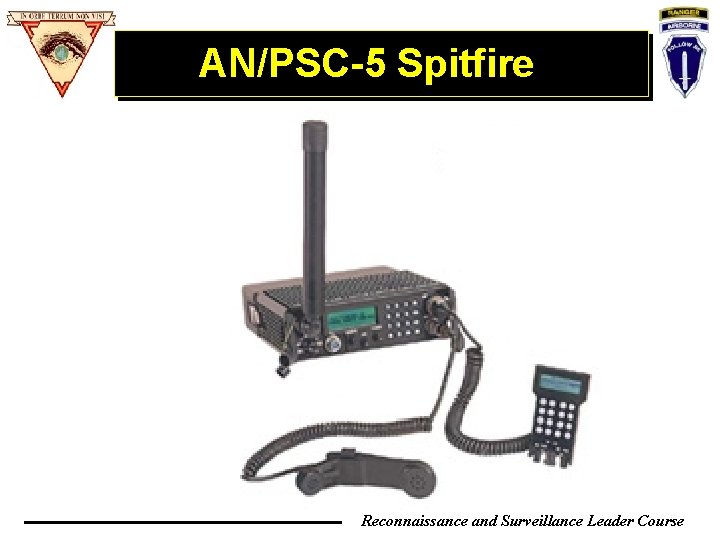
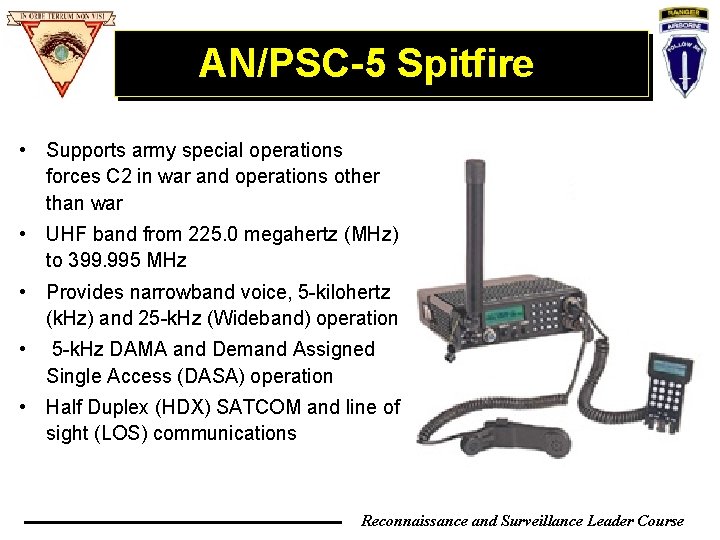
AN/PSC-5 Spitfire Reconnaissance and Surveillance Leader Course
AN/PSC-5 Spitfire • Supports army special operations forces C 2 in war and operations other than war • UHF band from 225. 0 megahertz (MHz) to 399. 995 MHz • Provides narrowband voice, 5 -kilohertz (k. Hz) and 25 -k. Hz (Wideband) operation • 5 -k. Hz DAMA and Demand Assigned Single Access (DASA) operation • Half Duplex (HDX) SATCOM and line of sight (LOS) communications Reconnaissance and Surveillance Leader Course
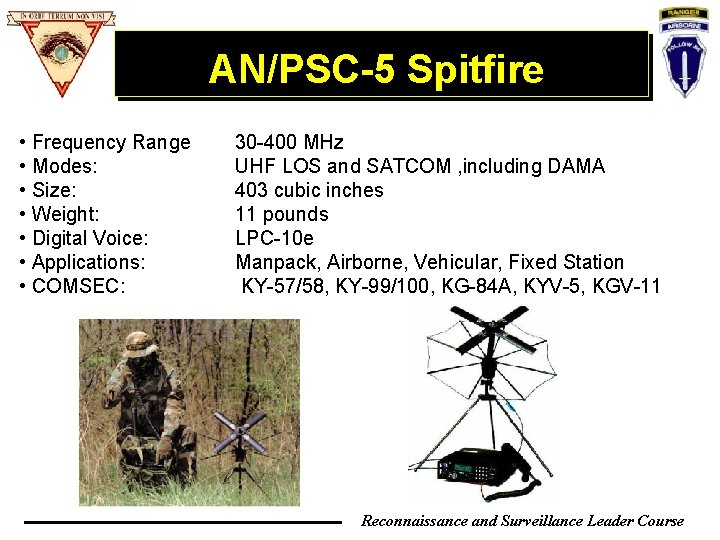
AN/PSC-5 Spitfire • Frequency Range • Modes: • Size: • Weight: • Digital Voice: • Applications: • COMSEC: 30 -400 MHz UHF LOS and SATCOM , including DAMA 403 cubic inches 11 pounds LPC-10 e Manpack, Airborne, Vehicular, Fixed Station KY-57/58, KY-99/100, KG-84 A, KYV-5, KGV-11 Reconnaissance and Surveillance Leader Course
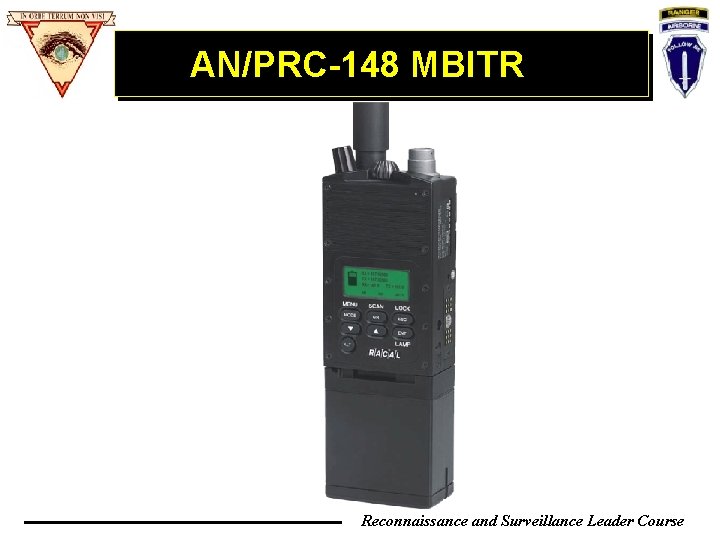
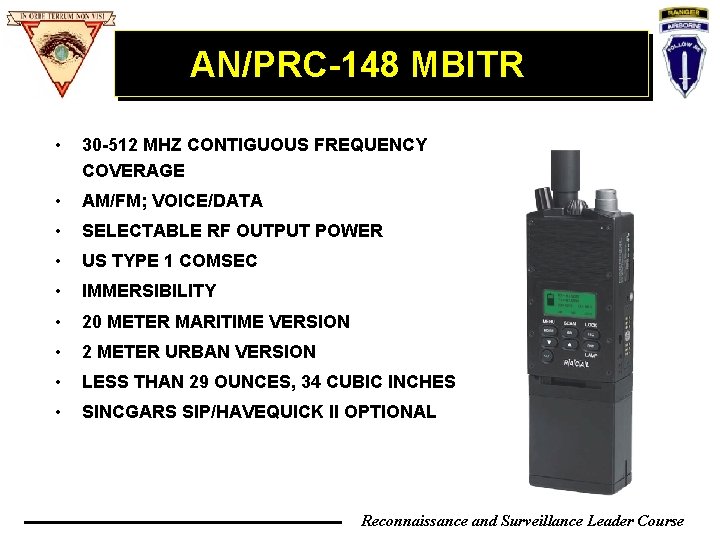
AN/PRC-148 MBITR Reconnaissance and Surveillance Leader Course
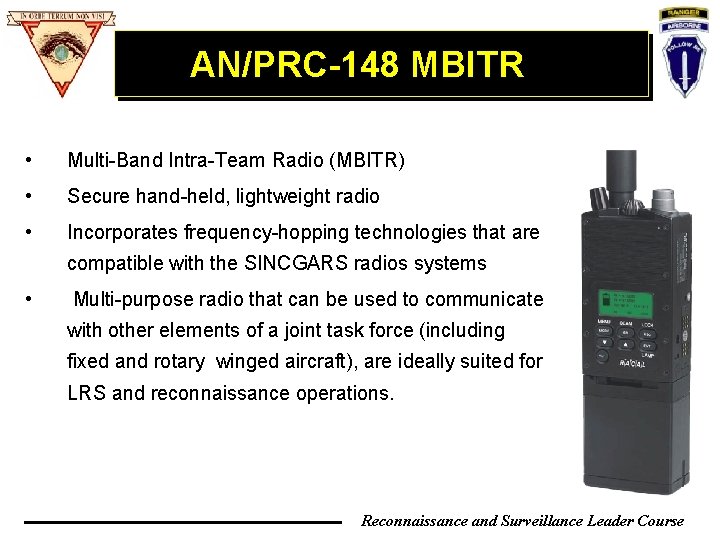
AN/PRC-148 MBITR • Multi-Band Intra-Team Radio (MBITR) • Secure hand-held, lightweight radio • Incorporates frequency-hopping technologies that are compatible with the SINCGARS radios systems • Multi-purpose radio that can be used to communicate with other elements of a joint task force (including fixed and rotary winged aircraft), are ideally suited for LRS and reconnaissance operations. Reconnaissance and Surveillance Leader Course
AN/PRC-148 MBITR • 30 -512 MHZ CONTIGUOUS FREQUENCY COVERAGE • AM/FM; VOICE/DATA • SELECTABLE RF OUTPUT POWER • US TYPE 1 COMSEC • IMMERSIBILITY • 20 METER MARITIME VERSION • 2 METER URBAN VERSION • LESS THAN 29 OUNCES, 34 CUBIC INCHES • SINCGARS SIP/HAVEQUICK II OPTIONAL Reconnaissance and Surveillance Leader Course
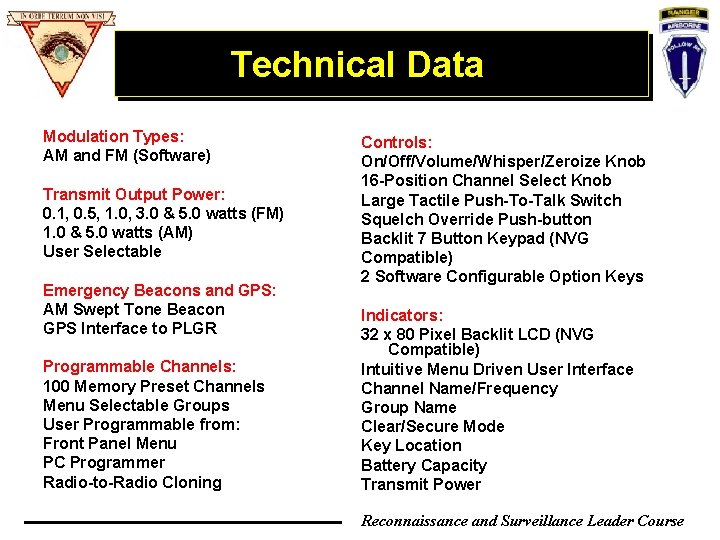
Technical Data Modulation Types: AM and FM (Software) Transmit Output Power: 0. 1, 0. 5, 1. 0, 3. 0 & 5. 0 watts (FM) 1. 0 & 5. 0 watts (AM) User Selectable Emergency Beacons and GPS: AM Swept Tone Beacon GPS Interface to PLGR Programmable Channels: 100 Memory Preset Channels Menu Selectable Groups User Programmable from: Front Panel Menu PC Programmer Radio-to-Radio Cloning Controls: On/Off/Volume/Whisper/Zeroize Knob 16 -Position Channel Select Knob Large Tactile Push-To-Talk Switch Squelch Override Push-button Backlit 7 Button Keypad (NVG Compatible) 2 Software Configurable Option Keys Indicators: 32 x 80 Pixel Backlit LCD (NVG Compatible) Intuitive Menu Driven User Interface Channel Name/Frequency Group Name Clear/Secure Mode Key Location Battery Capacity Transmit Power Reconnaissance and Surveillance Leader Course
Technical Data Connectors: 50 Ohm TNC Antenna 10 Pin Multi-function Immersion Sealed Top Connector (20 M) 6 -Pin Multi-function Top Connector (2 M) 18 -Pin Side Connector for Extended Capabilities and Upgrades Physical Parameters (with battery): Length: 8. 44 inches (21. 44 cm) Width: 2. 63 inches (6. 68 cm) Depth: 1. 52 inches (3. 86 cm) Volume: 33. 74 cu. inches (552. 8 cubic cm) Weight: 30. 6 ounces (867. 5 gm) COMSEC: US Type 1 VINSON & FED-STD-1023 Selective Key Zeroization Panic Radio Zeroization with Mechanical Interlock Protection Receive OTAR Compatible 6 Key Locations Environmental Specifications: Temperature: Operating: -31° to +60° C Storage: -33° to +71° C Humidity: 95% non-condensing Shock: EIA-603 -1992 Vibration: EIA-603 -1992 Altitude: 30, 000 Feet Reconnaissance and Surveillance Leader Course
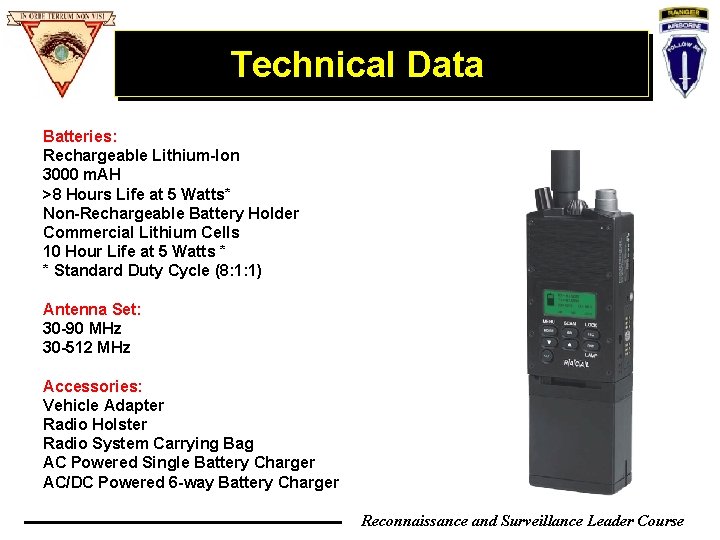
Technical Data Batteries: Rechargeable Lithium-Ion 3000 m. AH >8 Hours Life at 5 Watts* Non-Rechargeable Battery Holder Commercial Lithium Cells 10 Hour Life at 5 Watts * * Standard Duty Cycle (8: 1: 1) Antenna Set: 30 -90 MHz 30 -512 MHz Accessories: Vehicle Adapter Radio Holster Radio System Carrying Bag AC Powered Single Battery Charger AC/DC Powered 6 -way Battery Charger Reconnaissance and Surveillance Leader Course
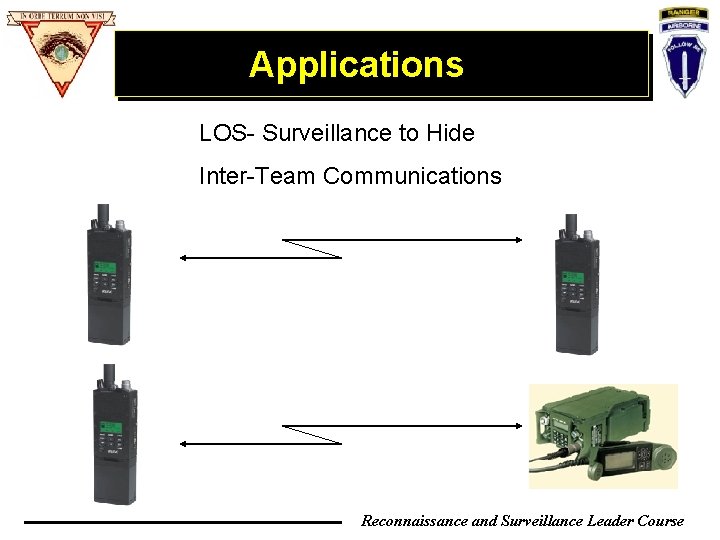
Applications LOS- Surveillance to Hide Inter-Team Communications Reconnaissance and Surveillance Leader Course
Applications AN/PSC-5 AN/PRC-117 Reconnaissance and Surveillance Leader Course
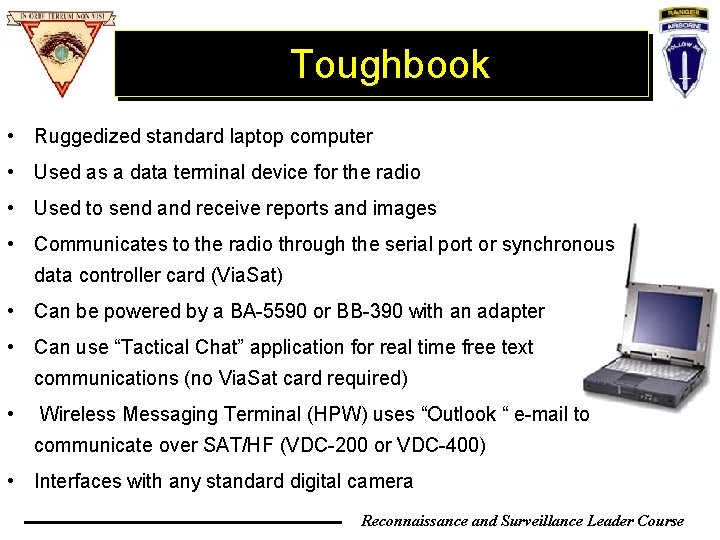
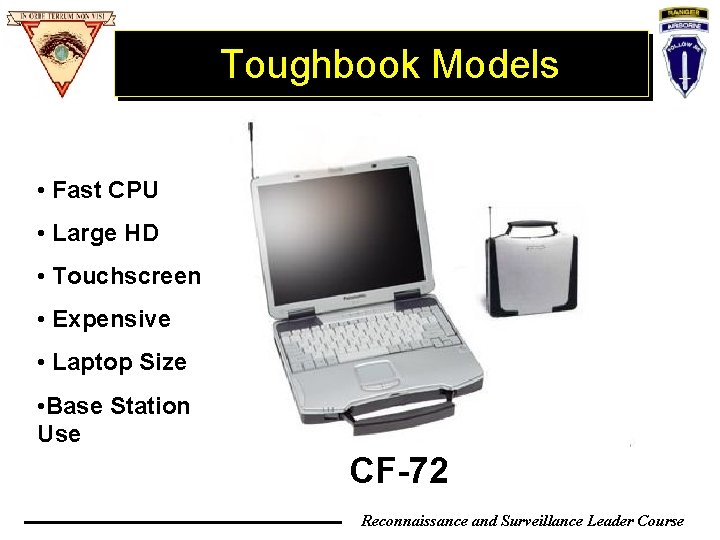
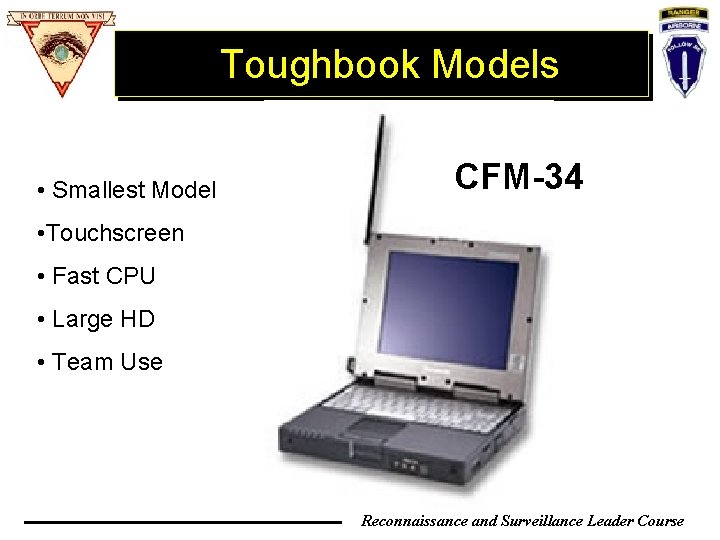
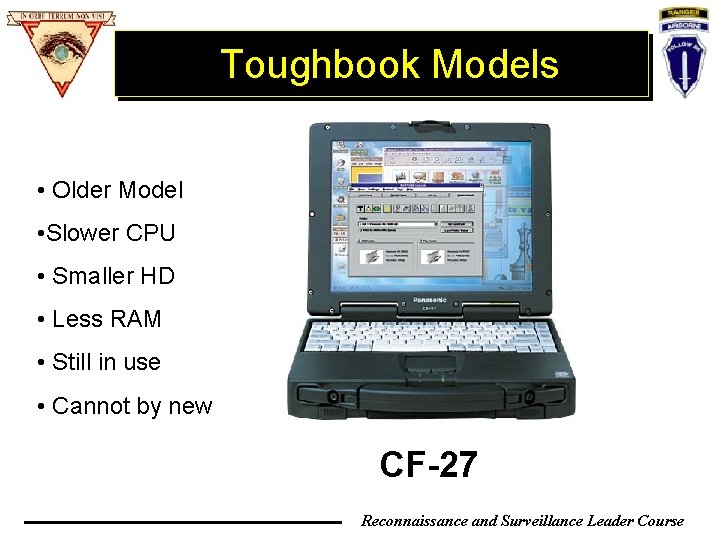
Toughbook • Ruggedized standard laptop computer • Used as a data terminal device for the radio • Used to send and receive reports and images • Communicates to the radio through the serial port or synchronous data controller card (Via. Sat) • Can be powered by a BA-5590 or BB-390 with an adapter • Can use “Tactical Chat” application for real time free text communications (no Via. Sat card required) • Wireless Messaging Terminal (HPW) uses “Outlook “ e-mail to communicate over SAT/HF (VDC-200 or VDC-400) • Interfaces with any standard digital camera Reconnaissance and Surveillance Leader Course
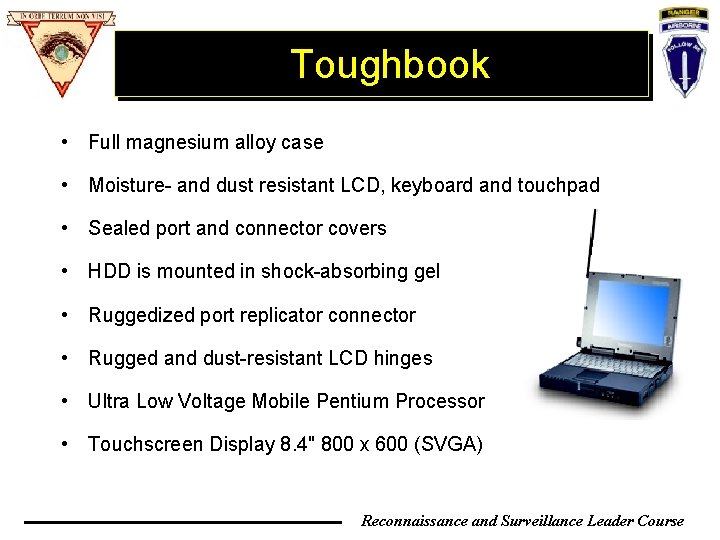
Toughbook • Full magnesium alloy case • Moisture- and dust resistant LCD, keyboard and touchpad • Sealed port and connector covers • HDD is mounted in shock-absorbing gel • Ruggedized port replicator connector • Rugged and dust-resistant LCD hinges • Ultra Low Voltage Mobile Pentium Processor • Touchscreen Display 8. 4" 800 x 600 (SVGA) Reconnaissance and Surveillance Leader Course
Toughbook Models • Fast CPU • Large HD • Touchscreen • Expensive • Laptop Size • Base Station Use CF-72 Reconnaissance and Surveillance Leader Course
Toughbook Models • Smallest Model CFM-34 • Touchscreen • Fast CPU • Large HD • Team Use Reconnaissance and Surveillance Leader Course
Toughbook Models • Older Model • Slower CPU • Smaller HD • Less RAM • Still in use • Cannot by new CF-27 Reconnaissance and Surveillance Leader Course
Limitations/Constraints High Frequency Radio Limitations and Constraints -Planning Considerations -Planning Ranges -Operations in Unusual Conditions -ALE Network Profiles (RPA) Development -Frequency Management -Training (operators/communications personnel) -Enforcing HF ALE as primary means of communications -Equipment (MTO&E vs. the right equipment) Reconnaissance and Surveillance Leader Course
Limitations/Constraints TACSAT Radio Limitations and Constraints -Planning Considerations -DAMA Terminal Address Assignment -DAMA Order-wire Key -Getting through on a DAMA channel -Training (operators/communications personnel) -Equipment (MTO&E vs. the right equipment) -Relying on SATCOM and loosing HF skills Reconnaissance and Surveillance Leader Course