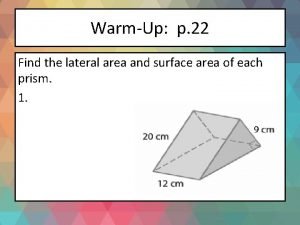
Standards CCSS 6 G 1 Find the area


- Slides: 33
Standards: CCSS. 6. G. 1: Find the area of right triangles, and special quadrilaterals by composing into rectangles or decomposing into triangles and other shapes. Essential Question: How is the formula for the area of a triangle related to the formula for the area of a parallelogram? Materials: Journal, a pencil, and a metric ruler. copyright©amberpasillas 2010
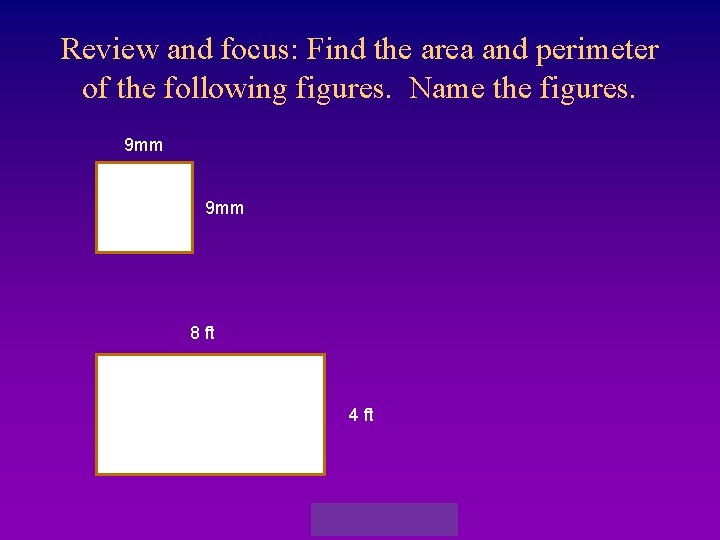
Review and focus: Find the area and perimeter of the following figures. Name the figures. 9 mm 8 ft 4 ft copyright©amberpasillas 2010
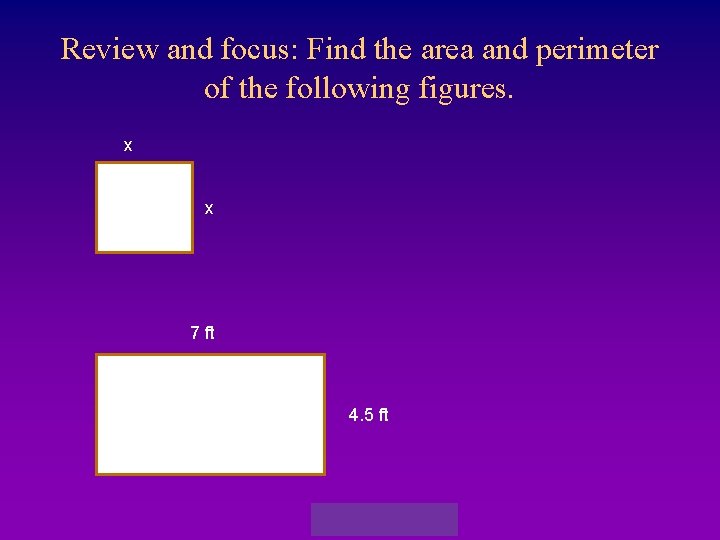
Review and focus: Find the area and perimeter of the following figures. x x 7 ft 4. 5 ft copyright©amberpasillas 2010
copyright©amberpasillas 2010
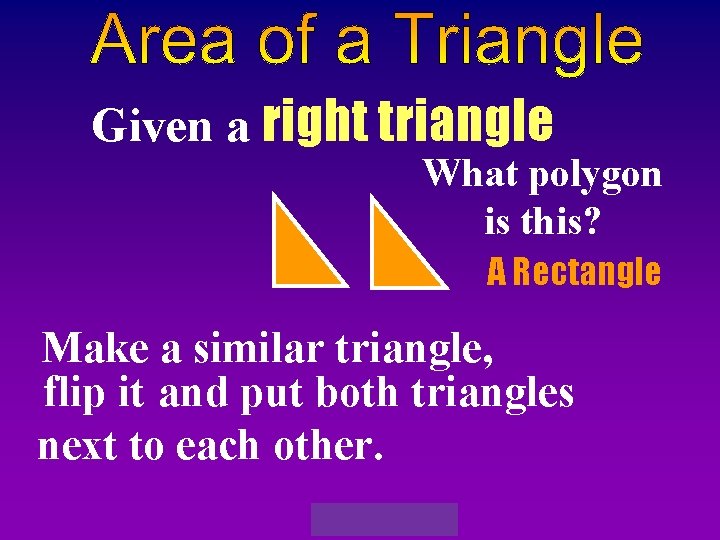
Given a right triangle What polygon is this? A Rectangle Make a similar triangle, flip it and put both triangles next to each other. copyright©amberpasillas 2010
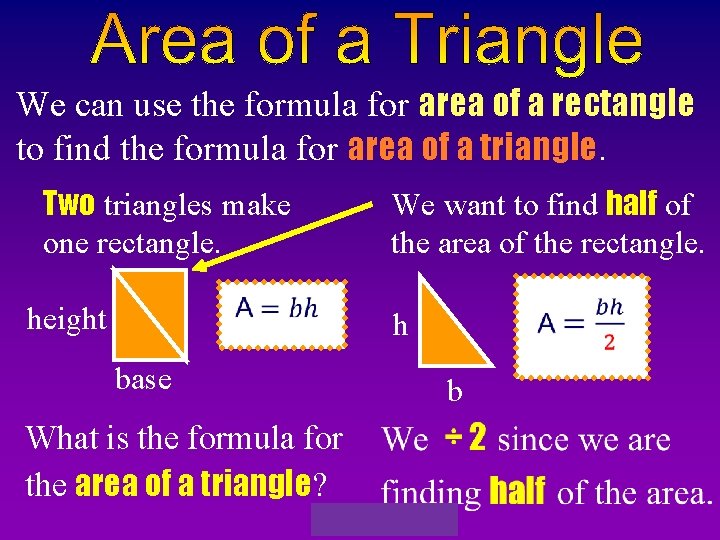
We can use the formula for area of a rectangle to find the formula for area of a triangle. Two triangles make We want to find half of one rectangle. the area of the rectangle. height AAA h base b What is the formula for the area of a triangle? copyright©amberpasillas 2010
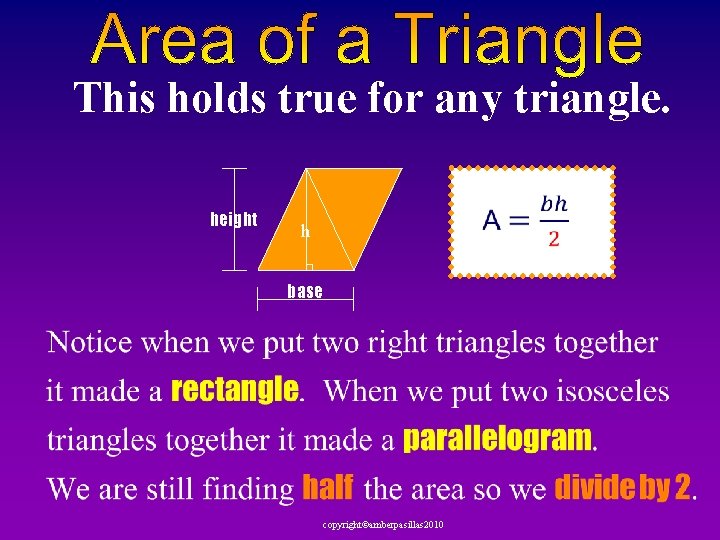
This holds true for any triangle. height h base copyright©amberpasillas 2010
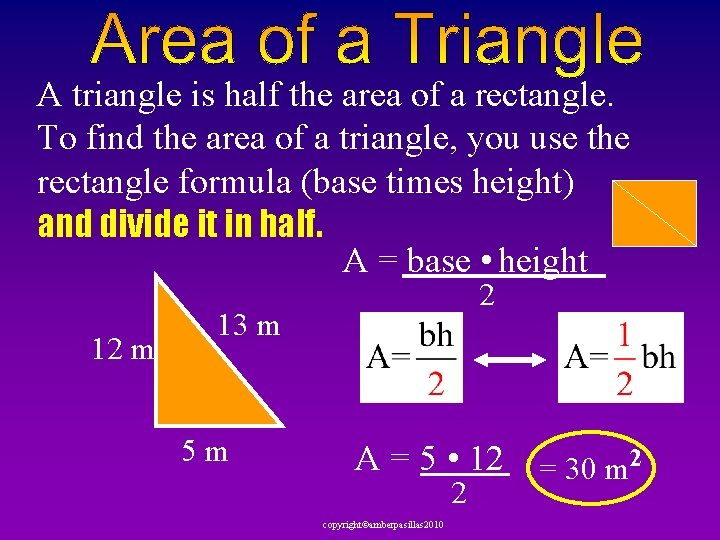
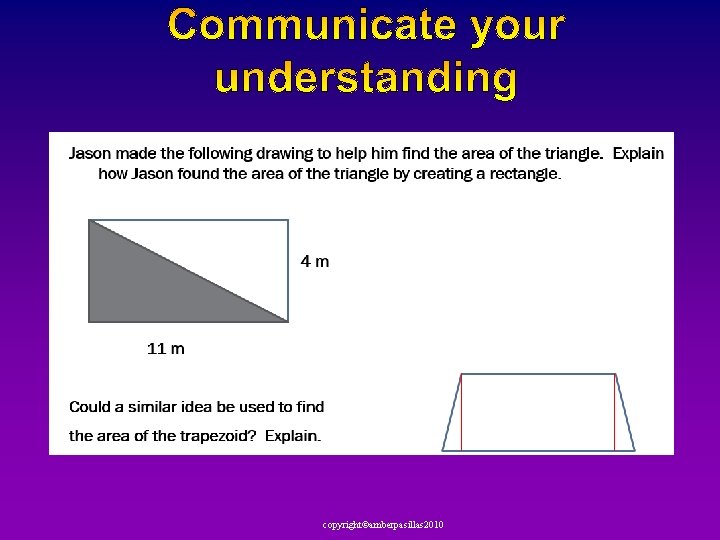
A triangle is half the area of a rectangle. To find the area of a triangle, you use the rectangle formula (base times height) and divide it in half. A = base • height 12 m 2 13 m 5 m A = 5 • 12 = 30 m 2 2 copyright©amberpasillas 2010
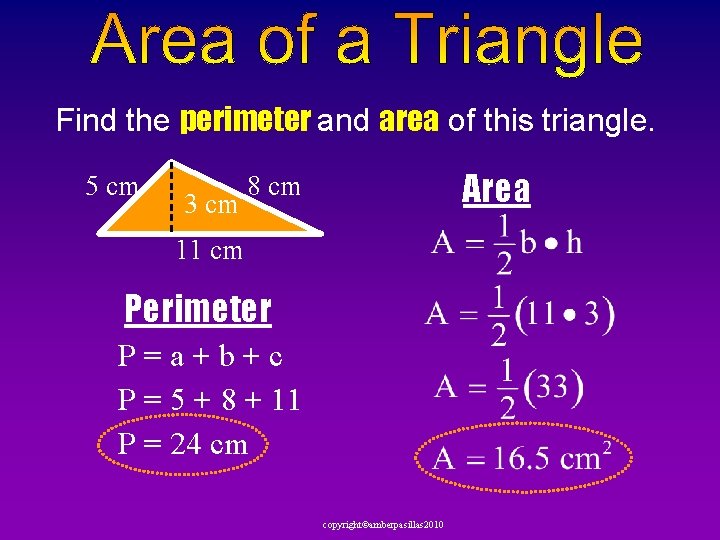
Find the perimeter and area of this triangle. 5 cm 3 cm Area 8 cm 11 cm Perimeter P = a + b + c P = 5 + 8 + 11 P = 24 cm copyright©amberpasillas 2010
Standards: CCSS. 6. G. 1: Find the area of right triangles, and special quadrilaterals by composing into rectangles or decomposing into triangles and other shapes. Essential Question: How is the formula for the area of a triangle related to the formula for the area of a parallelogram? You need your Journal open to homework, a pencil, glue, and a metric ruler. copyright©amberpasillas 2010
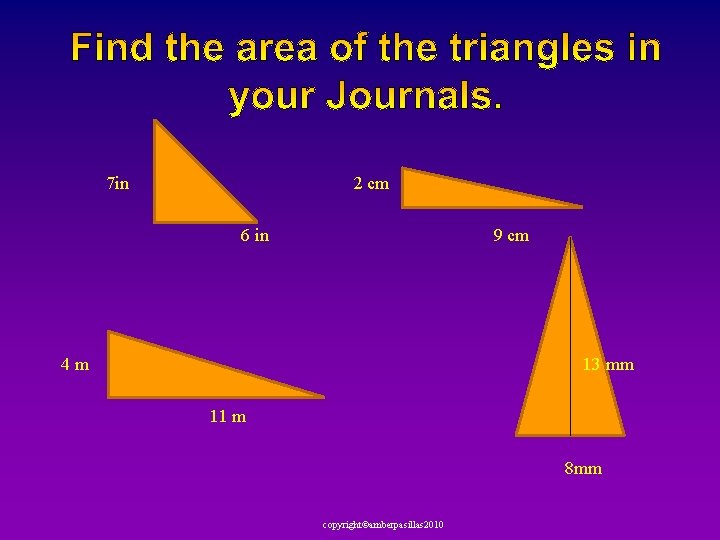
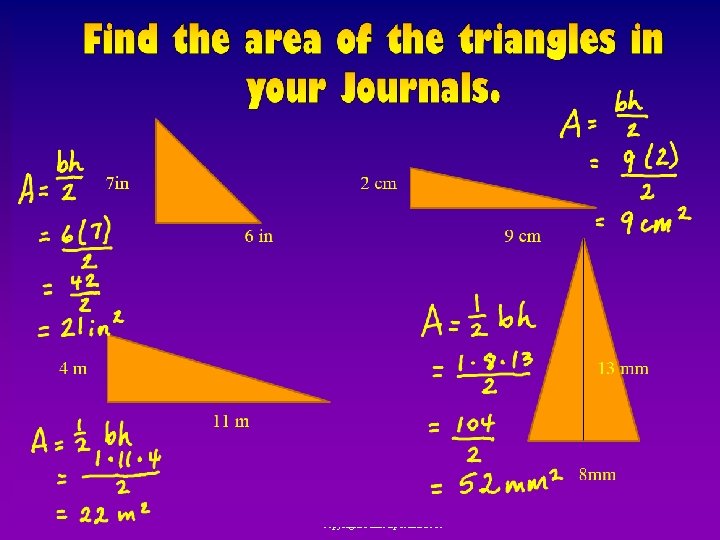
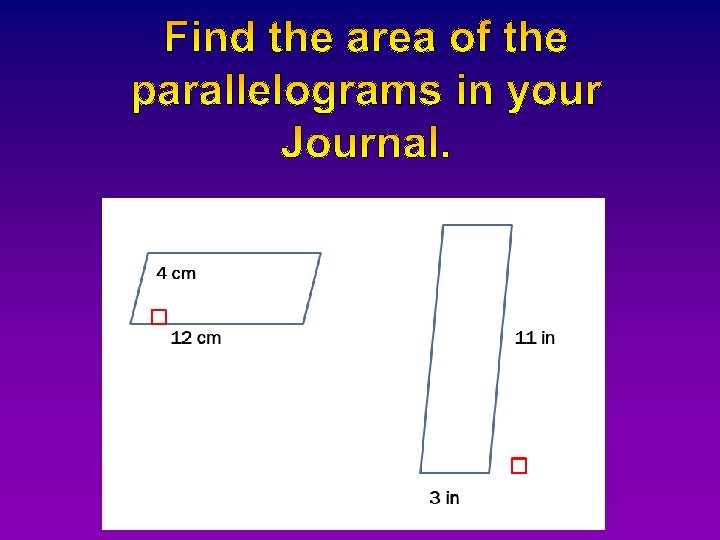
7 in 2 cm 6 in 9 cm 4 m 13 mm 11 m copyright©amberpasillas 2010 8 mm
copyright©amberpasillas 2010
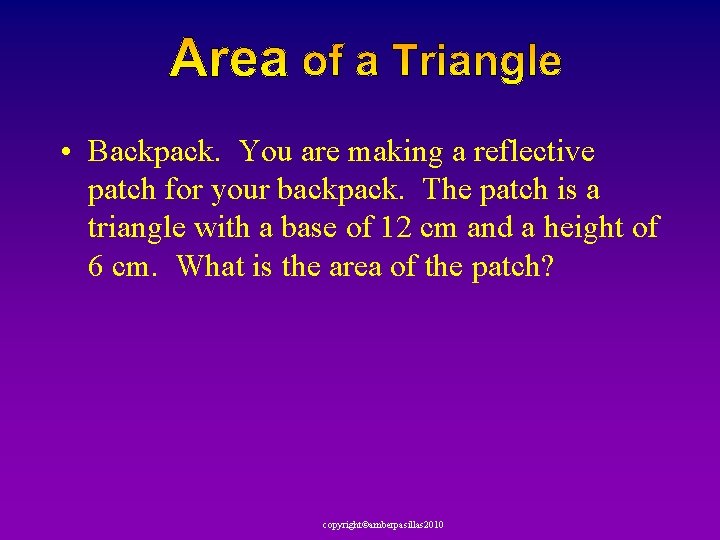
• Backpack. You are making a reflective patch for your backpack. The patch is a triangle with a base of 12 cm and a height of 6 cm. What is the area of the patch? copyright©amberpasillas 2010
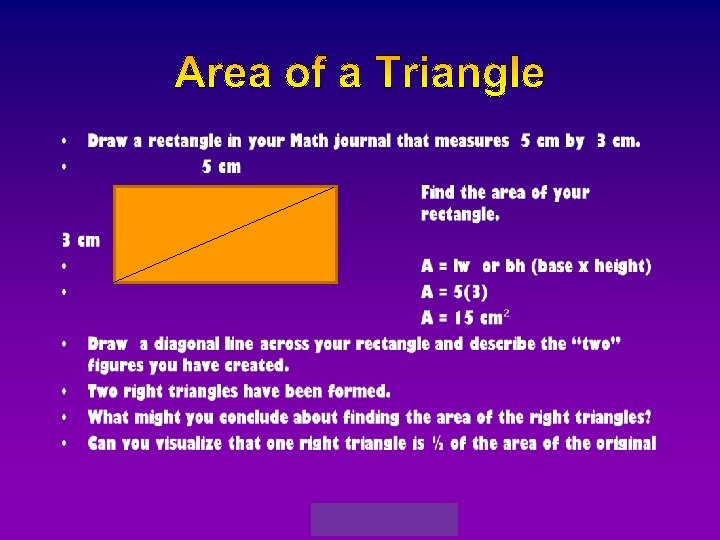
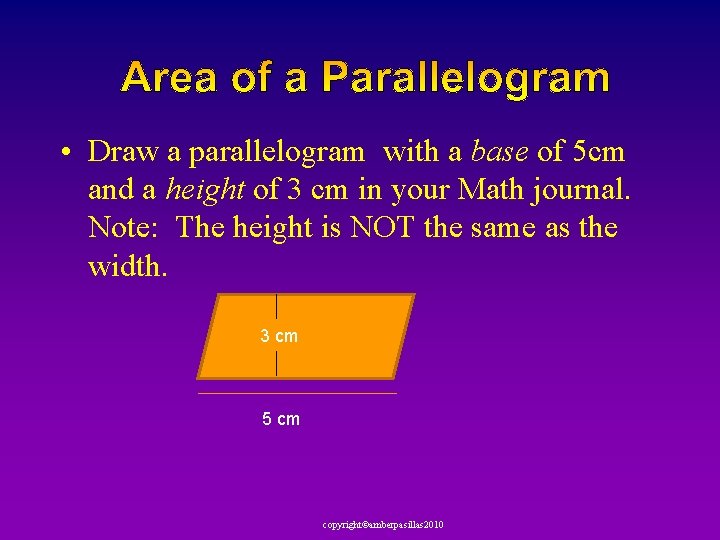
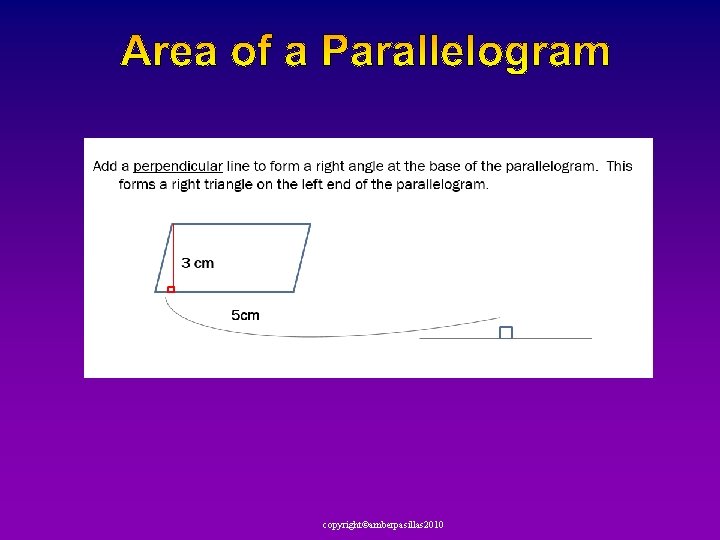
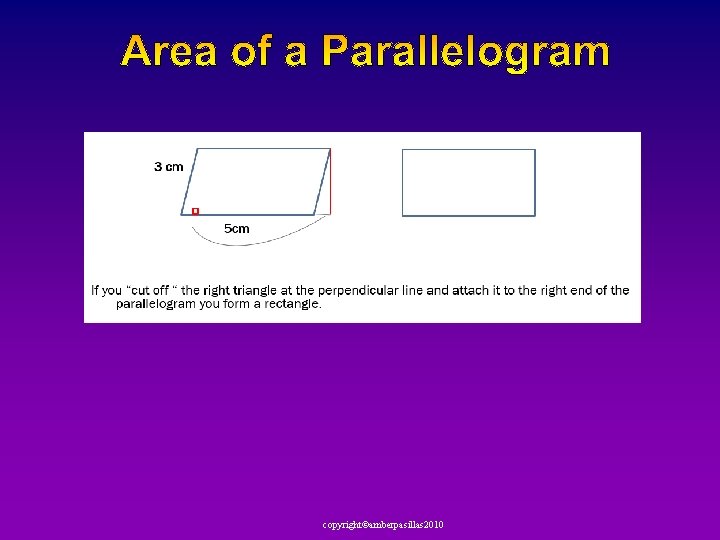
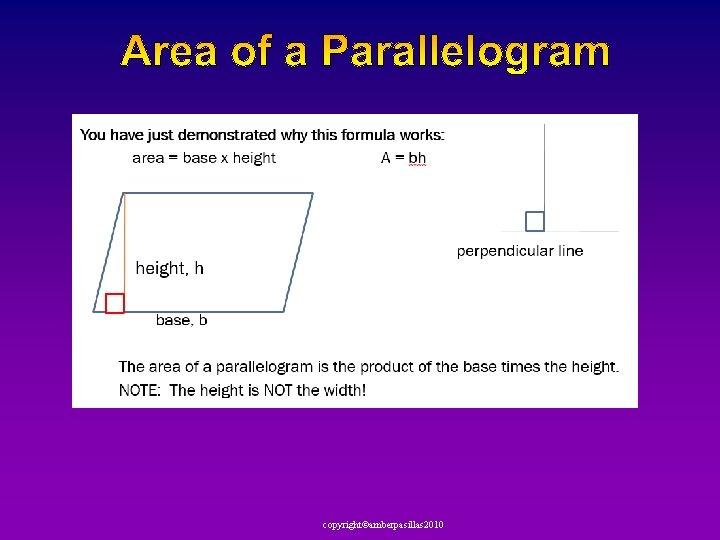
• Draw a parallelogram with a base of 5 cm and a height of 3 cm in your Math journal. Note: The height is NOT the same as the width. 3 cm 5 cm copyright©amberpasillas 2010
copyright©amberpasillas 2010
copyright©amberpasillas 2010
copyright©amberpasillas 2010
copyright©amberpasillas 2010
copyright©amberpasillas 2010
Given the formula for area of a triangle and the formula for area of a parallelogram we are going to use that information to discover the formula for the area of a trapezoid Watch carefully not to miss it! copyright©amberpasillas 2010
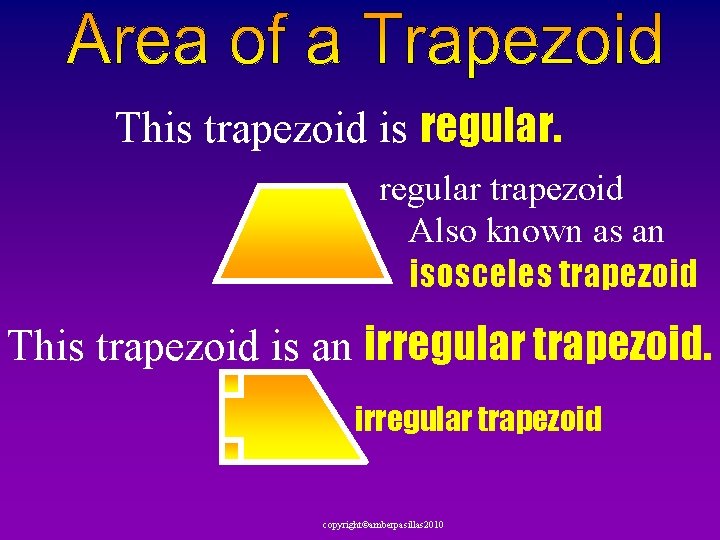
This trapezoid is regular trapezoid Also known as an isosceles trapezoid This trapezoid is an irregular trapezoid copyright©amberpasillas 2010
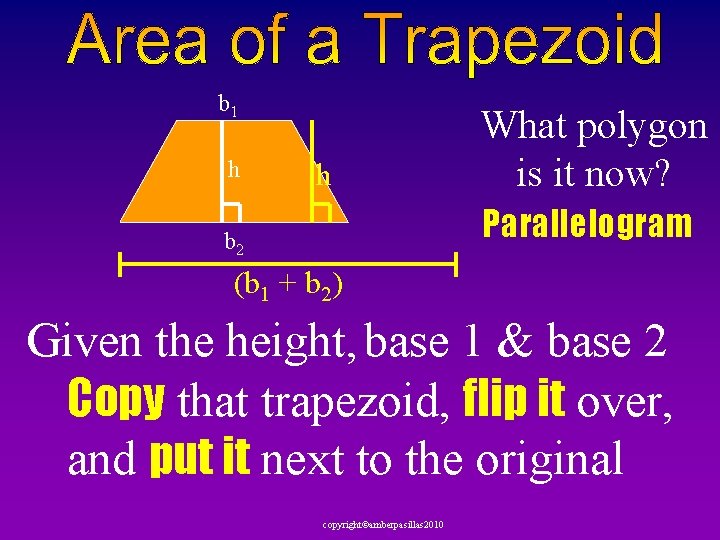
b 1 h h What polygon is it now? Parallelogram b 2 (b 1 + b 2) Given the height, base 1 & base 2 Copy that trapezoid, flip it over, and put it next to the original copyright©amberpasillas 2010
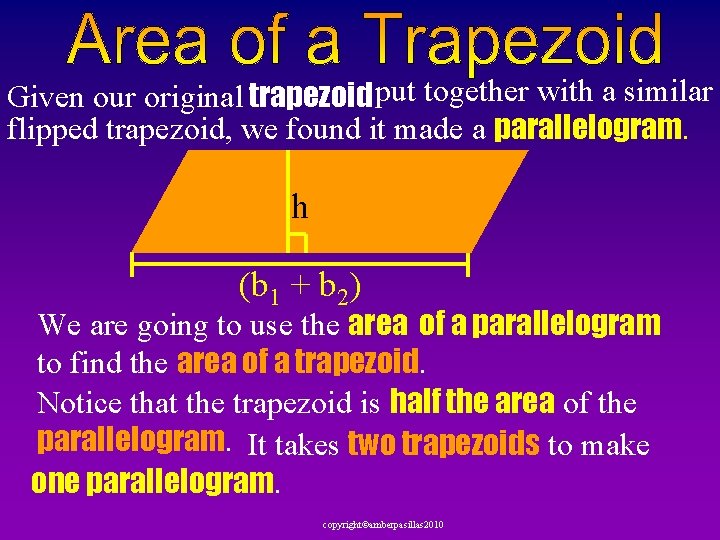
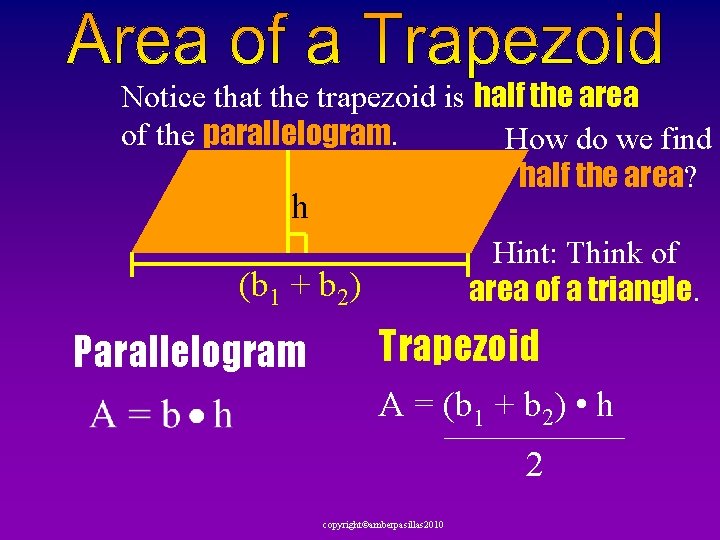
put together with a similar Given our original trapezoid flipped trapezoid, we found it made a parallelogram. h (b 1 + b 2) We are going to use the area of a parallelogram to find the area of a trapezoid. Notice that the trapezoid is half the area of the parallelogram. It takes two trapezoids to make one parallelogram. copyright©amberpasillas 2010
Notice that the trapezoid is half the area of the parallelogram. How do we find half the area? h Hint: Think of area of a triangle. (b 1 + b 2) Parallelogram Trapezoid A = (b 1 + b 2) • h 2 copyright©amberpasillas 2010
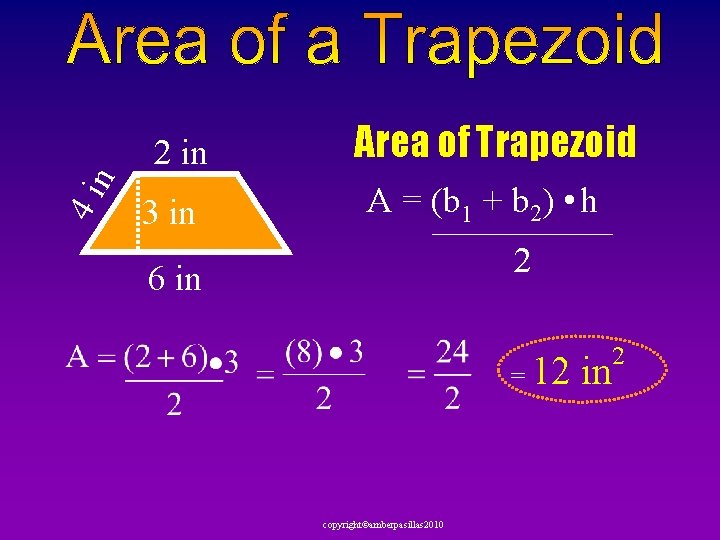
4 in 2 in 3 in Area of Trapezoid A = (b 1 + b 2) • h 2 6 in = copyright©amberpasillas 2010 12 in 2
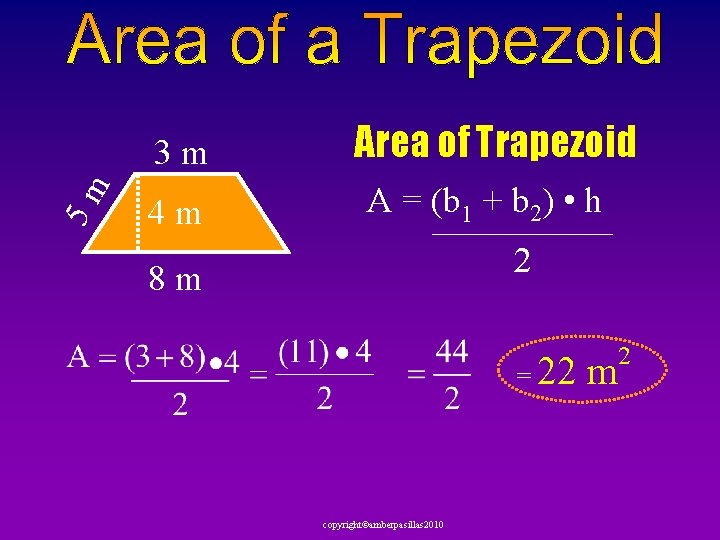
5 m 3 m 4 m Area of Trapezoid A = (b 1 + b 2) • h 2 8 m = copyright©amberpasillas 2010 22 m 2
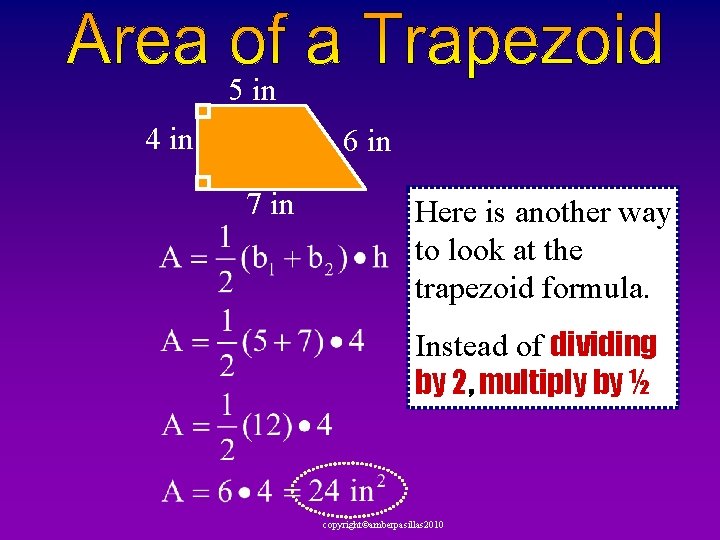
5 in 4 in 6 in 7 in Here is another way to look at the trapezoid formula. Instead of dividing by 2, multiply by ½ copyright©amberpasillas 2010
The End! Have a great weekend!! copyright©amberpasillas 2010
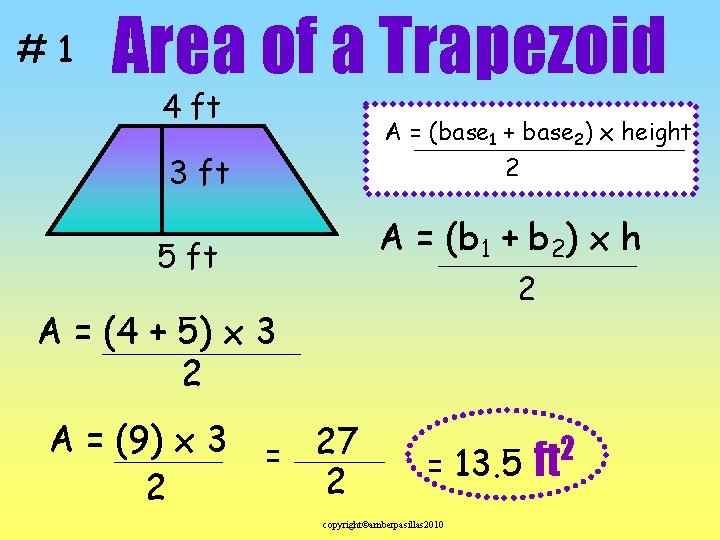
#1 Area of a Trapezoid 4 ft A = (base 1 + base 2) x height 3 ft 2 A = (b 1 + b 2) x h 5 ft 2 A = (4 + 5) x 3 2 A = (9) x 3 2 = 27 2 = 13. 5 copyright©amberpasillas 2010 ft 2
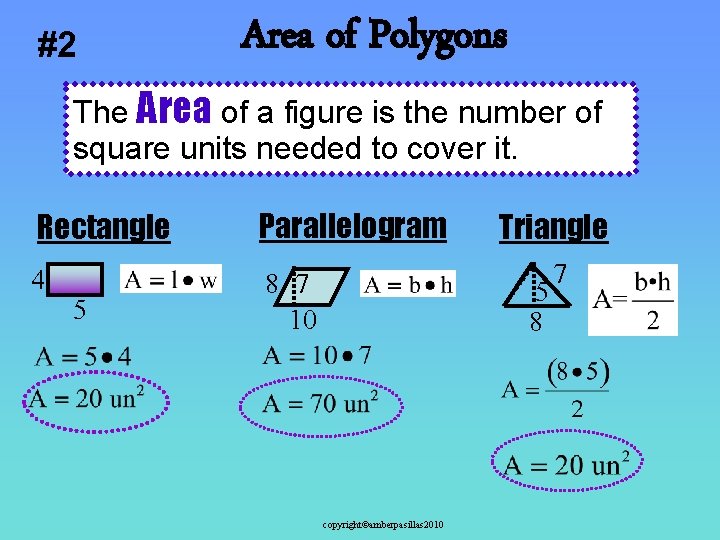
#2 Area of Polygons The Area of a figure is the number of square units needed to cover it. Rectangle Parallelogram 4 8 7 10 5 Triangle 5 8 copyright©amberpasillas 2010 7
Practice • Complete the practice worksheet. Work in your groups. copyright©amberpasillas 2010
If you have trouble viewing you need Math. Type software: To see all math formulas correctly you need to install Math. Type software, similar to equation editor and is available for free at Design Science website. http: //www. mathslideshows. com
For more information on Math Slideshows visit: http: //www. mathslideshows. com/ http: //www. mathslideshows. com