
Curriculum and Instruction that Supports High Quality Student


- Slides: 35
Curriculum and Instruction that Supports High Quality Student Learning Summer 2014
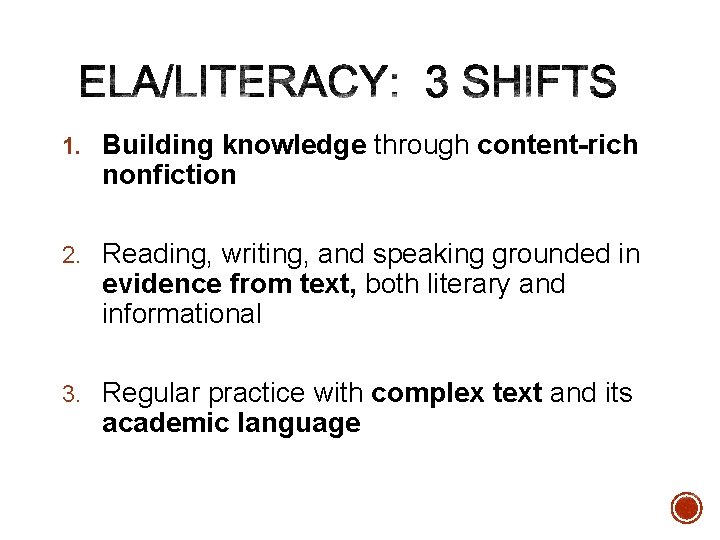
1. Building knowledge through content-rich nonfiction 2. Reading, writing, and speaking grounded in evidence from text, both literary and informational 3. Regular practice with complex text and its academic language
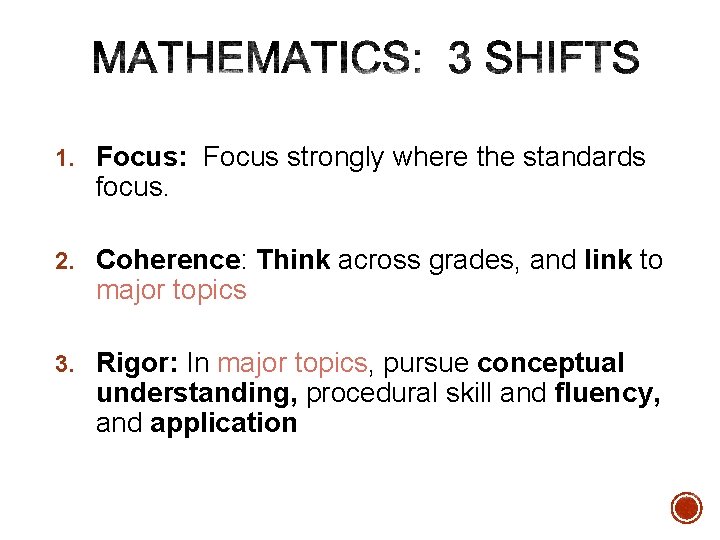
1. Focus: Focus strongly where the standards focus. 2. Coherence: Think across grades, and link to major topics 3. Rigor: In major topics, pursue conceptual understanding, procedural skill and fluency, and application
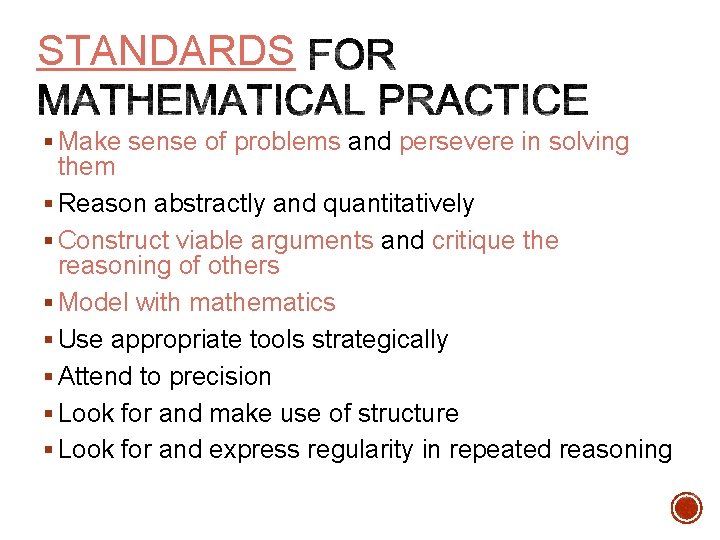
STANDARDS § Make sense of problems and persevere in solving them § Reason abstractly and quantitatively § Construct viable arguments and critique the reasoning of others § Model with mathematics § Use appropriate tools strategically § Attend to precision § Look for and make use of structure § Look for and express regularity in repeated reasoning
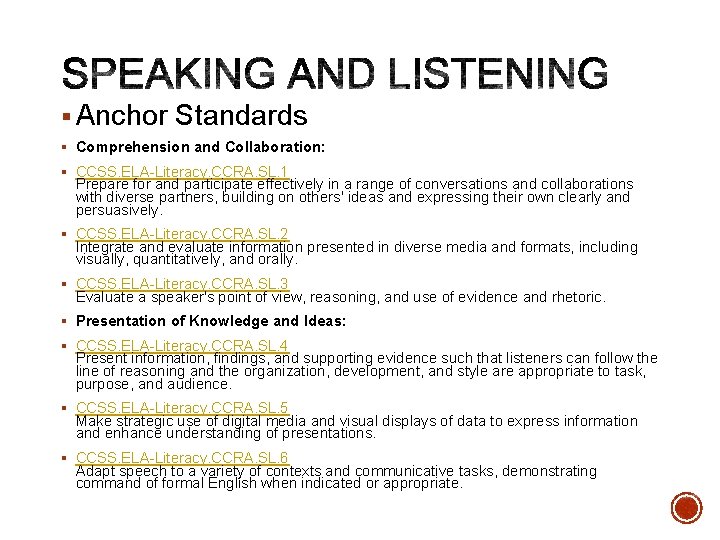
§ Anchor Standards § Comprehension and Collaboration: § CCSS. ELA-Literacy. CCRA. SL. 1 Prepare for and participate effectively in a range of conversations and collaborations with diverse partners, building on others' ideas and expressing their own clearly and persuasively. § CCSS. ELA-Literacy. CCRA. SL. 2 Integrate and evaluate information presented in diverse media and formats, including visually, quantitatively, and orally. § CCSS. ELA-Literacy. CCRA. SL. 3 Evaluate a speaker's point of view, reasoning, and use of evidence and rhetoric. § Presentation of Knowledge and Ideas: § CCSS. ELA-Literacy. CCRA. SL. 4 Present information, findings, and supporting evidence such that listeners can follow the line of reasoning and the organization, development, and style are appropriate to task, purpose, and audience. § CCSS. ELA-Literacy. CCRA. SL. 5 Make strategic use of digital media and visual displays of data to express information and enhance understanding of presentations. § CCSS. ELA-Literacy. CCRA. SL. 6 Adapt speech to a variety of contexts and communicative tasks, demonstrating command of formal English when indicated or appropriate.
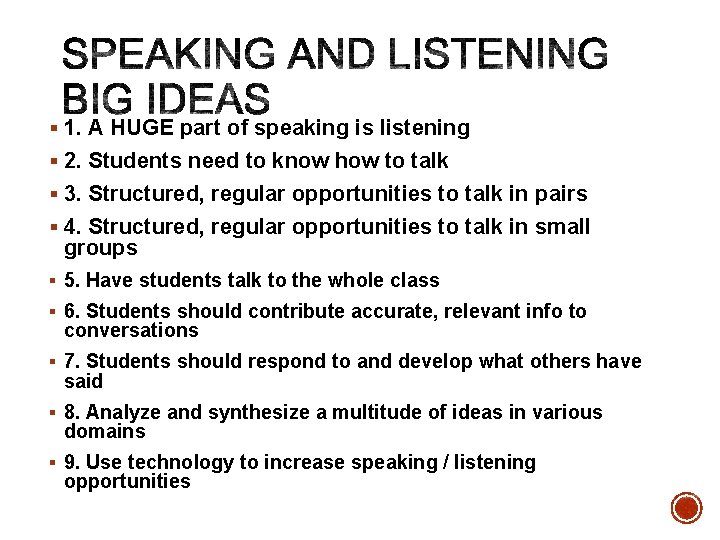
§ 1. A HUGE part of speaking is listening § 2. Students need to know how to talk § 3. Structured, regular opportunities to talk in pairs § 4. Structured, regular opportunities to talk in small groups § 5. Have students talk to the whole class § 6. Students should contribute accurate, relevant info to conversations § 7. Students should respond to and develop what others have said § 8. Analyze and synthesize a multitude of ideas in various domains § 9. Use technology to increase speaking / listening opportunities
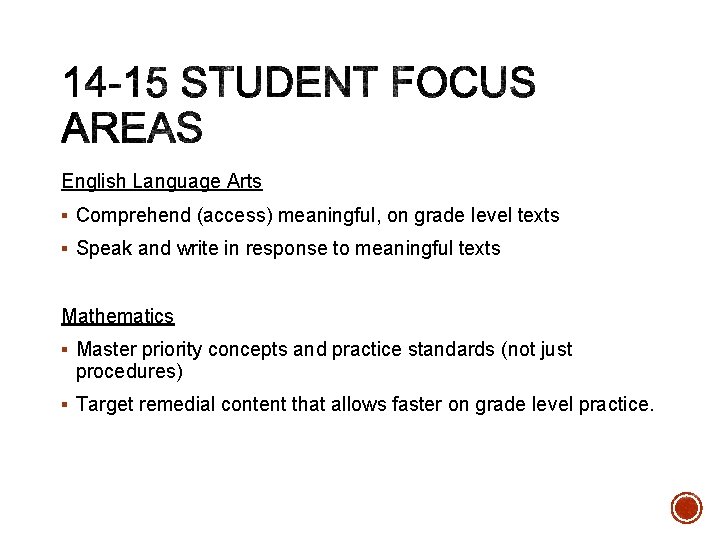
English Language Arts § Comprehend (access) meaningful, on grade level texts § Speak and write in response to meaningful texts Mathematics § Master priority concepts and practice standards (not just procedures) § Target remedial content that allows faster on grade level practice.
§ Planning, instruction, & assessing using… § In ELA: § On grade level texts daily with ALL students § Increasingly challenging questions that help students comprehend text § Increasingly complex tasks that require students write and speak about text § In Mathematics: § Tasks that building conceptual understanding of priority standards § Tasks that require fluency and use of math practices to master concepts § Just enough remediation to help students practice on grade level content as quickly as possible.
§ Deeper order thinking should be on show. With CCSS, it’s not § § enough for students to just memorize how to do something, in many cases they’re expected to know why. Teachers should be challenging students to explain their thinking and to provide proof. The classroom should be language-rich. It doesn’t matter what you teach anymore language skills are expected to be involved. Reading, writing, and speaking skills should be practiced across the board and every classroom from elementary to high school, from selfcontained to subject specific should be reflecting that. Class time should be maximized. Not that teachers were doing this before, but with CCSS, even more than before, teachers need to be planning for “bell to bell” instruction, which is absolutely necessary to teach the more complex thinking skills associated with Common Core. The atmosphere should be one of “create and learn, ” not “sit and get. ” In order to push the thinking skills associated with CCSS, students will need to be engaged in their lessons. If all a student ever does is sit and take notes, they won’t be able to learn how to think. Technology should be a part of learning. The CCSS specifically call for students to learn how to communicate and collaborate with others using technology. Expect to see a greater push toward blogging, Twitter, and services like Google docs.
§ DSC – pre-K and K § Dibels/SRI – K-3 § PARCC – grades 3 – 8 ELA and Math § Leap/i. LEAP – grades 3 – 8 Science and Social Studies § Explore – grades 8 & 9 § Plan – Grade 10 § ACT – Grade 11 § EOC – Algebra I, Geometry, English III, Biology, and American History
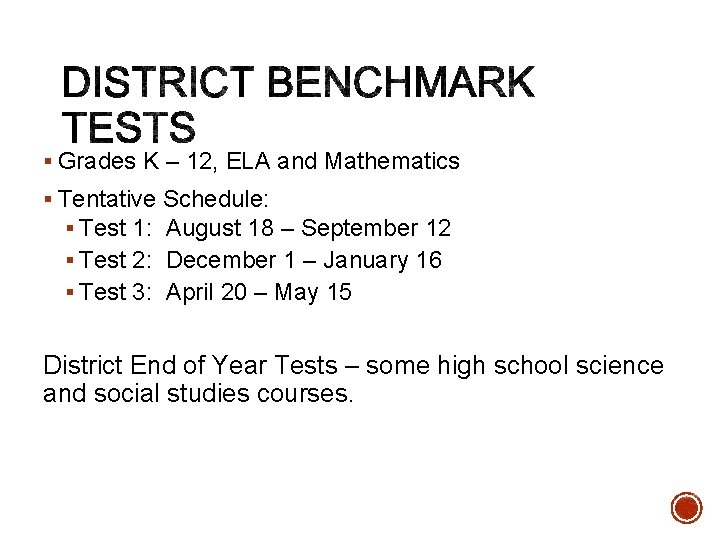
§ Grades K – 12, ELA and Mathematics § Tentative Schedule: § Test 1: August 18 – September 12 § Test 2: December 1 – January 16 § Test 3: April 20 – May 15 District End of Year Tests – some high school science and social studies courses.
§ Teacher and schools are strongly encouraged to use LDOE provided assessment resources including EAGLE. § EAGLE training should be after school starts.
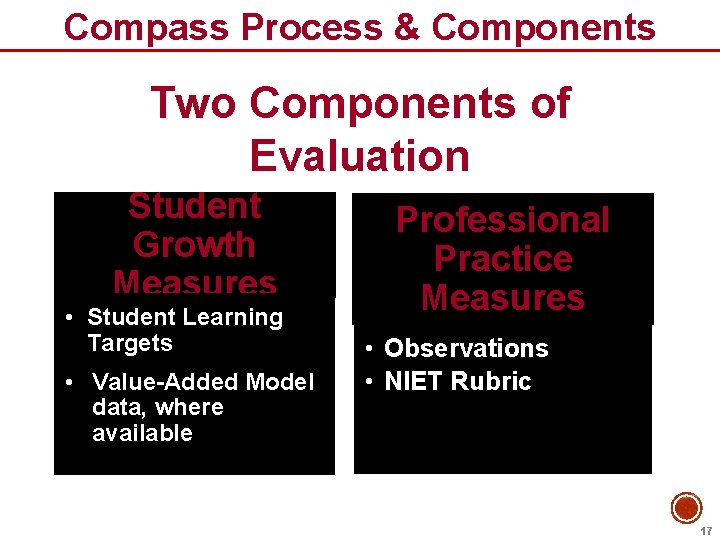
Compass Process & Components Two Components of Evaluation Student Growth Measures • Student Learning Targets • Value-Added Model data, where available Professional Practice Measures • Observations • NIET Rubric 17
DISTRICT SLT RESOURCE PAGE http: //www. tangischools. net/ciweb/common%20 core/slt. htm 18
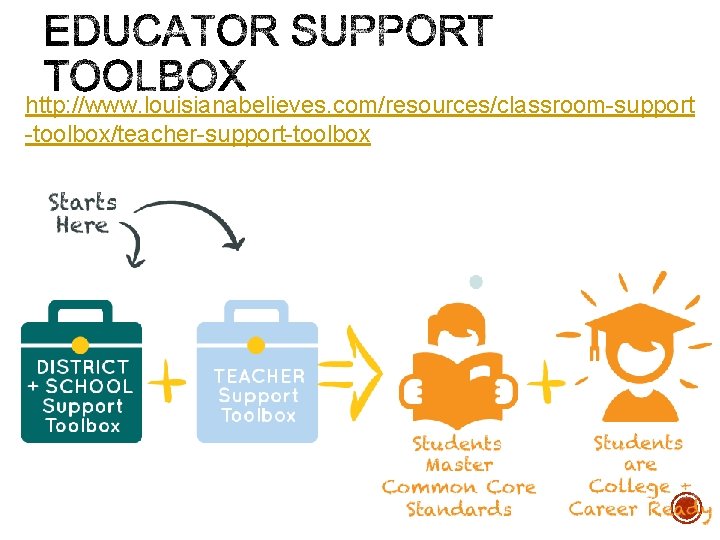
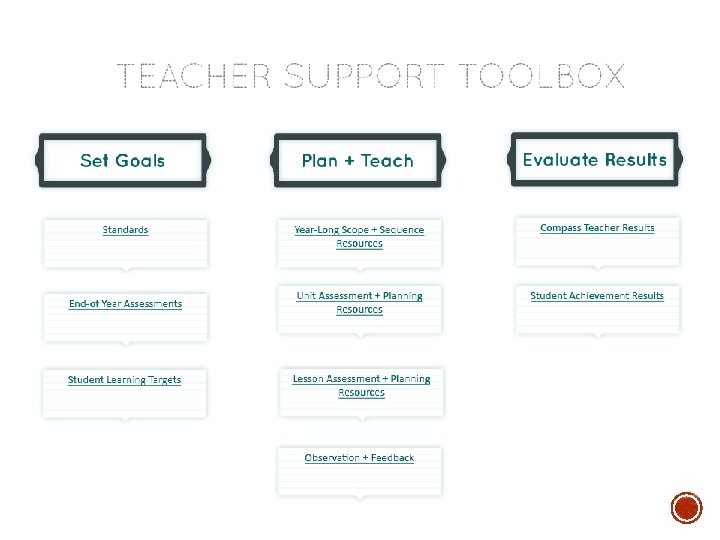
http: //www. louisianabelieves. com/resources/classroom-support -toolbox/teacher-support-toolbox
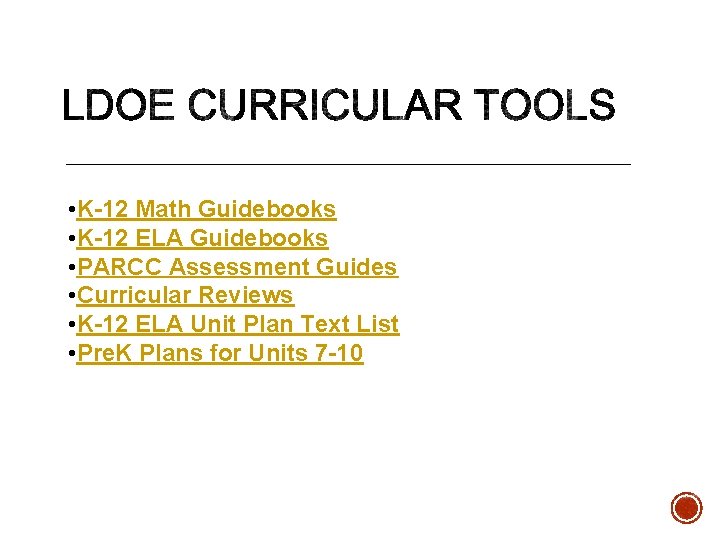
• K-12 Math Guidebooks • K-12 ELA Guidebooks • PARCC Assessment Guides • Curricular Reviews • K-12 ELA Unit Plan Text List • Pre. K Plans for Units 7 -10
What do I teach?
§ Continue with Storytown as the foundation § New Unit assessments § Align units to mirror units in DOE guidebooks § Develop text dependent questions (Basal Alignment Project)and Common Formative Assessments (tasks) § Utilize Storytown in combination with 2 of the units from the ELA guidebooks. § Develop a pacing guide that includes the 2 LDOE units. § Schools may substitute anchor texts used for Storytown units. § New unit assessments § For Storytown units develop text dependent questions (Basal Alignment Project)and Common Formative Assessments (tasks)
§ Utilize current texts and at least 2 LDOE units § Alignment of units and textbooks § Create a pacing chart
§ Continue to implement Envision Math Textbook § Incorporate Eureka math lessons when appropriate. § Utilize curriculum and intervention support: Fastt. Math and Fraction Nation
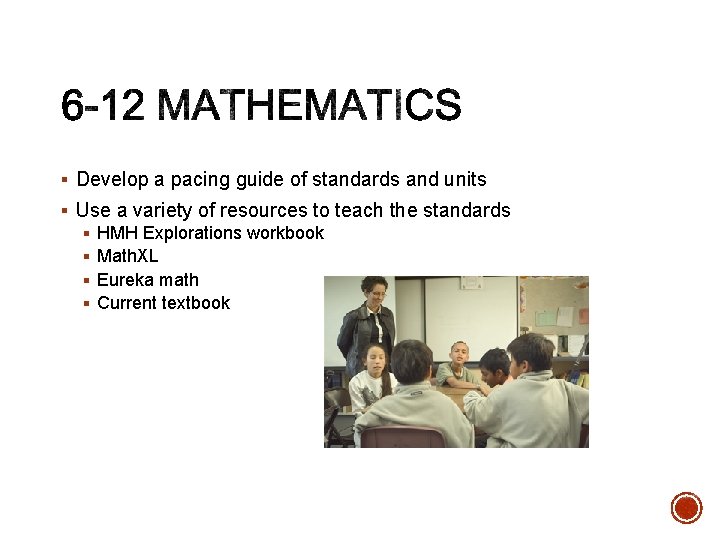
§ Develop a pacing guide of standards and units § Use a variety of resources to teach the standards § HMH Explorations workbook § Math. XL § Eureka math § Current textbook
§ District adopted textbooks § State Standards § http: //www. louisianabelieves. com/resources/library/academic- standards § National Standards (in the absence of state standards)
§ JPAMS - JGRADEBOOK § Grade book Policy § Grading Procedures § On. Course § Lesson plan policy § Lesson plan templates (CCSS Lesson Plan Template and Guide) Curriculum and Instruction Policies and Procedures
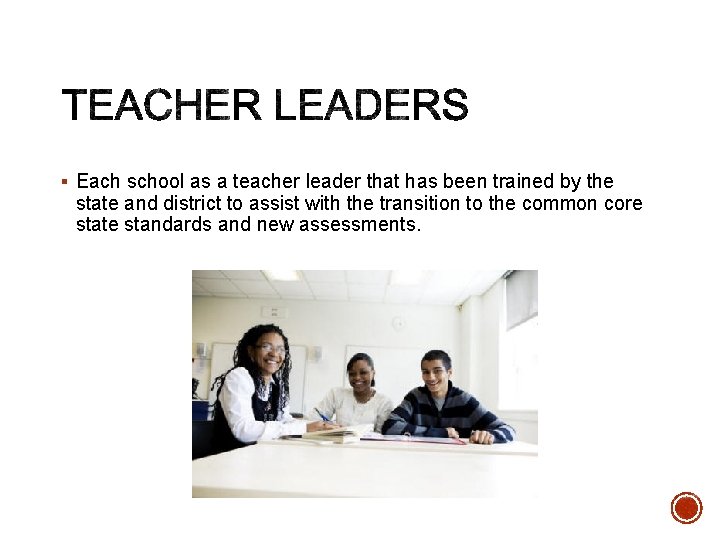
§ Each school as a teacher leader that has been trained by the state and district to assist with the transition to the common core state standards and new assessments.
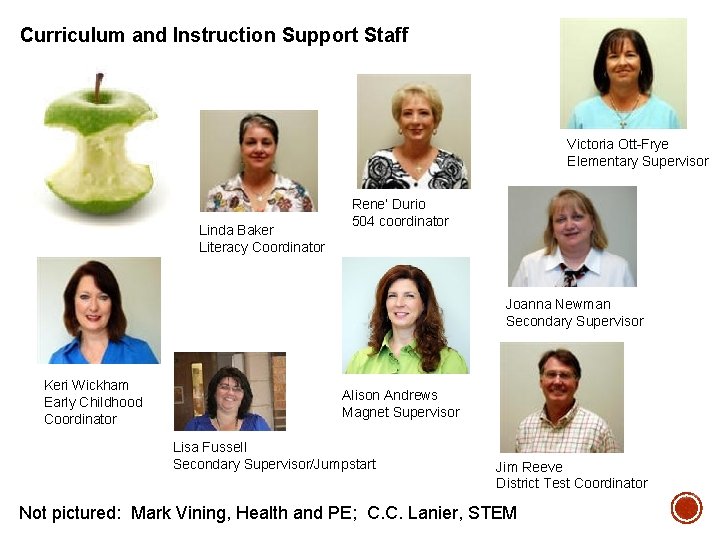
Curriculum and Instruction Support Staff Victoria Ott-Frye Elementary Supervisor Linda Baker Literacy Coordinator Rene’ Durio 504 coordinator Joanna Newman Secondary Supervisor Keri Wickham Early Childhood Coordinator Alison Andrews Magnet Supervisor Lisa Fussell Secondary Supervisor/Jumpstart Jim Reeve District Test Coordinator Not pictured: Mark Vining, Health and PE; C. C. Lanier, STEM
§ TPSS Common Core Portal § TPSS Curriculum and Instruction Page § TPSS Blackboard – TPSS Resources § Video Resources § Teaching Channel § Inside Mathematics § PD 360 § danny. williams@tangischools. org