SAMPOL 204 Varieties of Political Regimes in Latin



- Slides: 118
SAMPOL 204: Varieties of Political Regimes in Latin America Section 3: Varieties of Nondemocratic Regimes in Latin America. Sultanistic Regimes in Latin America. Wednesday 22 February 2017, 10. 1512. 00, Carl L. Godskes hus, auditorium 307 Einar Berntzen
Sultanistic regimes in Latin America • Trujillo (1930 -61) The Dominican Republic • The Somozas (1936 -79) Nicaragua • Batista (1952 -59) Cuba • Baby Doc Duvalier (1971 -86) Haiti • Noriega (1983 -89) Panama • Borderline cases: Papa Doc Duvalier (195771) Haiti; Stroessner (1954 -89) Paraguay
Characteristics of Sultanistic Regimes • • • 1. Blurred line between regime and state 2. Personalism 3. Constitutional hypocrisy 4. Narrow social bases 5. Distorted capitalism
The DOMINICAN REPUBLIC • • 1821 -22: Independence 1822 -44: occupied by Haiti 1844 -61: Independence 1861 -65: reannexed by Spain 1865 -: Independence Ulises Heureaux (1882 -99) US marines occupation (1916 -24)
THE DOMINICAN REPUBLIC • Horacio Vásquez (1924 -30) • Rafael Trujillo was the key military figure behind the coup that overthrew Horacio Vásquez on 23 February 1930. After questionable elections Rafael Trujillo became president on 16 August 1930. What appeared to be just another era of caudillo rule turned into the prototype of sultanism
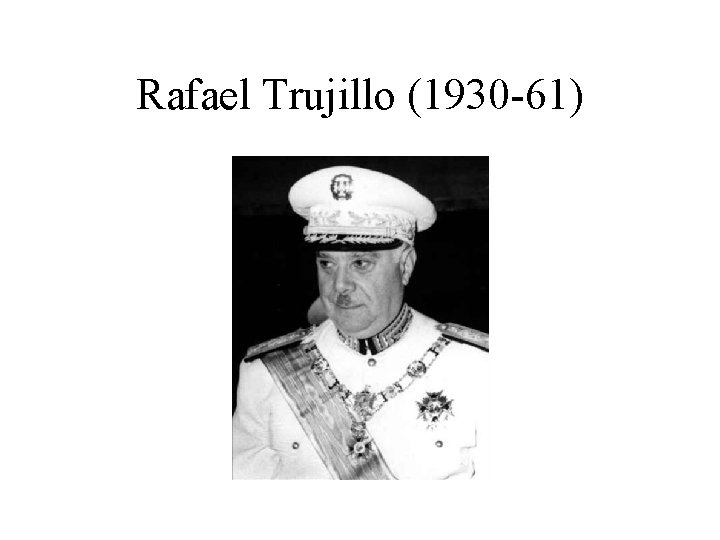
Rafael Trujillo (1930 -61)
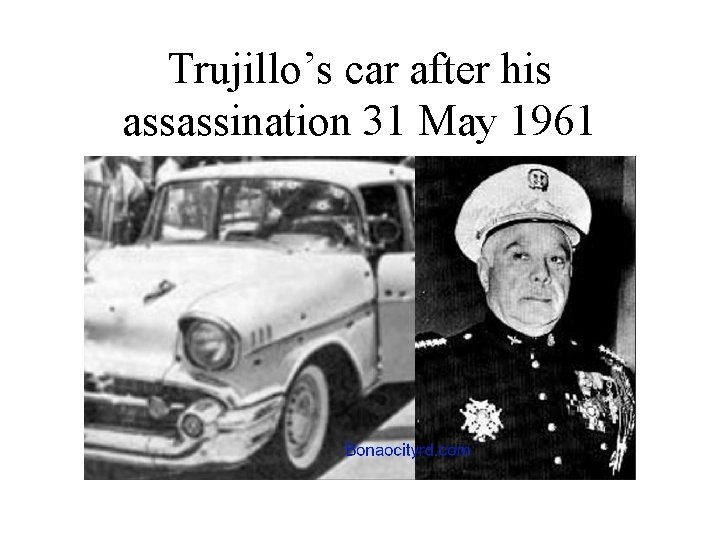
Trujillo’s car after his assassination 31 May 1961
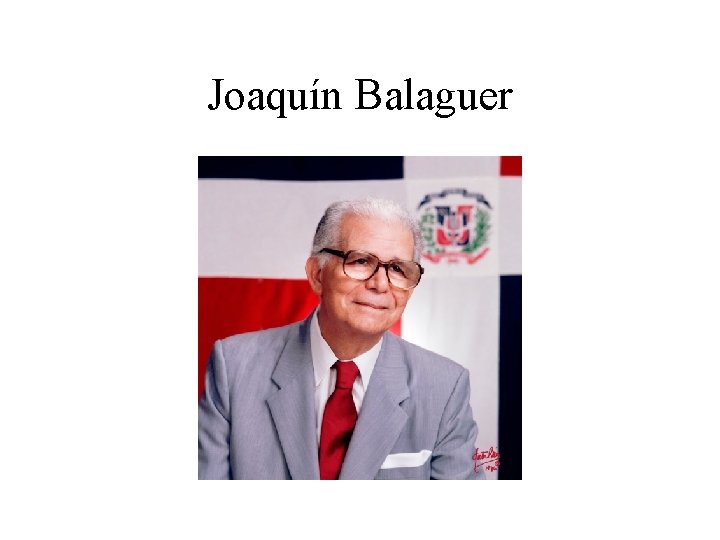
Joaquín Balaguer
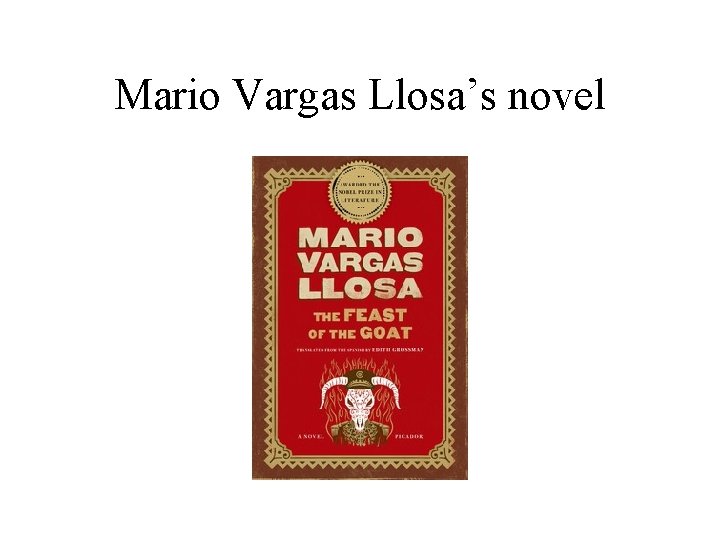
Mario Vargas Llosa’s novel
THE DOMINICAN REPUBLIC • US marines occupation (1916 -24) • Leonidas Trujillo (1930 -61) assassinated 31 May 1961 • Democratic elections: Juan Bosch (1962 -63), toppled by military junta (1963 -65) • US military invasion April 1965 to prevent an attempt to reinstate Bosch in the presidency • 1966 -78: Joaquín Balaguer (neo-patrimonial regime) • Transition to democracy (1978): Carter intervened to prevent Balaguer from ”winning” by electoral fraud. Opposition (PRD) allowed to assume power.
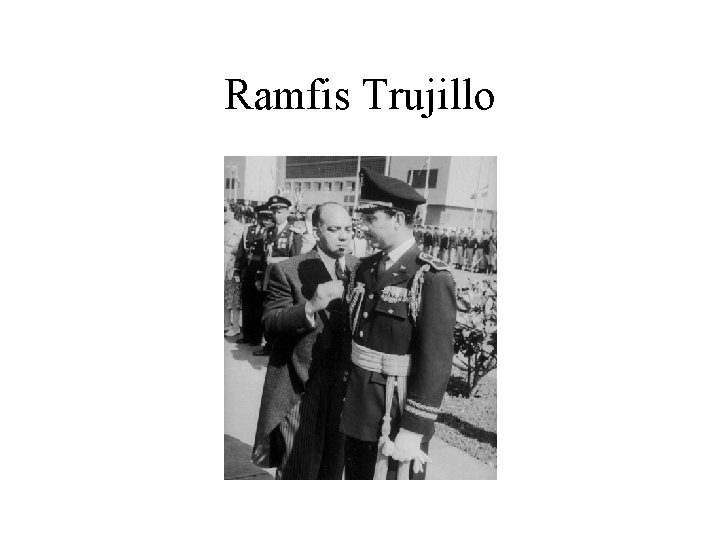
1. Blurred line between regime and state • Trujillo created the Dominican Party (PD) in 1931, other parties were forced to disband • The army was Trujillo’s personal instrument, controlled by his brothers and his son, Ramfis (who was made a full colonel in the army at the age of 4 and a brigadier general at the age of 9!)
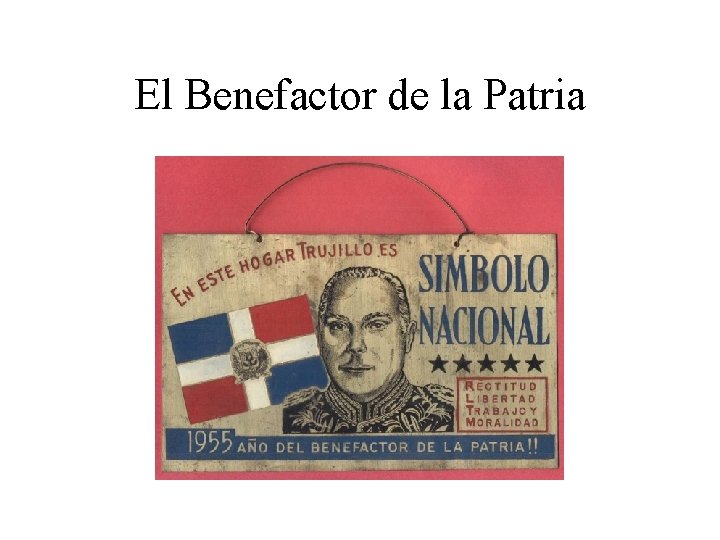
2. Personalism • Cult of personality: «Generalísimo» ; «Benefactor de la patria» . Pico Trujillo (Pico Duarte), Ciudad Trujillo (Santo Domingo) • Invented ideology: Anti-Haitianism (the Haitian massacre of October 1937) • Dynasticism: Rafael’s son Ramfis
El Benefactor de la Patria
Ramfis Trujillo
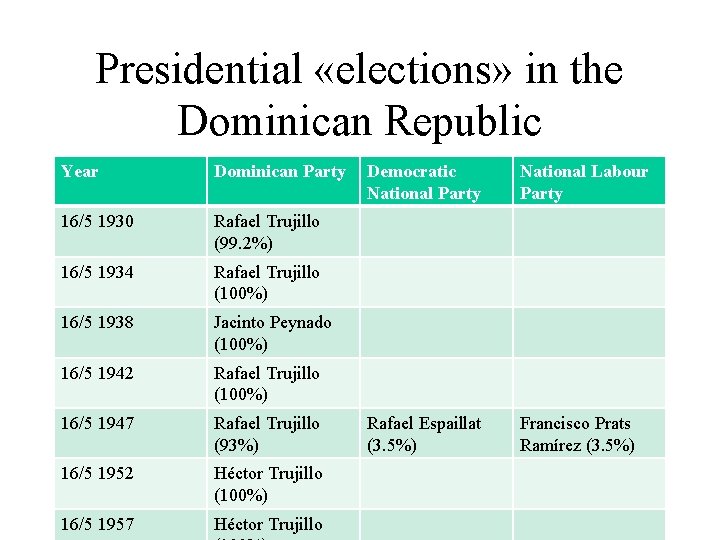
3. Constitutional hypocrisy • Elections: Trujillo «reelected» in 1934. His vice-president Peynado «elected» president in 1938. When Peynado died in office in 1940, his term was completed by the vicepresident, Manuel de Jesús Troncoso de la Concha (1940 -42). Trujillo «elected» to a 3 rd (5 -year) term in 1942, 4 th in 1947. His brother Héctor «elected» in 1952 and 1957.
Presidential «elections» in the Dominican Republic Year Dominican Party 16/5 1930 Rafael Trujillo (99. 2%) 16/5 1934 Rafael Trujillo (100%) 16/5 1938 Jacinto Peynado (100%) 16/5 1942 Rafael Trujillo (100%) 16/5 1947 Rafael Trujillo (93%) 16/5 1952 Héctor Trujillo (100%) 16/5 1957 Héctor Trujillo Democratic National Party National Labour Party Rafael Espaillat (3. 5%) Francisco Prats Ramírez (3. 5%)
Presidents of the Dominican Republic (1930 -62) • Rafael Trujillo (1930 -38) • Jacito Peynado (1938 -40) • Manuel de Jesús Troncoso de la Concha (1940 -42) • Rafael Trujillo (1942 -52) • Héctor Trujillo (1952 -60) • Joaquín Balaguer (1960 -62)
4. Narrow social bases of sultanism • Trujillo’s regime based on total control of the state’s repressive apparatus • US support. Trujillo’s fall was due to a shift in attitude of the US of A, in turn due to the impact of the Cuban Revolution
5. Distorted capitalism • Trujillo created state and commercial monopolies, which made him the country’s richest man. In addition, he collected hefty commissions on all public works contracts. His largest investments were in sugar. By 1956, 12 of the 16 sugar mills in the country belonged to the Trujillo family.
The Dominican Republic after sultanism • Juan Bosch (1962 -63) • Military junta (1963 -65) • Civil-military conspiracy to try to bring Bosch back led to US military intervention in April 1965 • Neopatrimonial regime under Joaquín Balaguer (1966 -78)
Dominican presidents since 1978 • • • S. Antonio Guzmán (PRD) (1978 -82) Salvador Jorge Blanco (PRD) (1982 -86) Joaquín Balaguer (PRSC) (1986 -90) Joaquín Balaguer (PRSC) (1990 -94) Joaquín Balaguer (PRSC) (1994 -96) Leonel Fernández (PLD) (1996 -2000) Hipólito Mejía (PRD) (2000 -04) Leonel Fernández (PLD) (2004 -08) Leonel Fernández (PLD) (2008 -12) Danilo Medina (PLD) (2012 -16) Danilo Medina (PLD) (2016 -20)
NICARAGUA • 1821 -38: part of the Federal Republic of Central America • William Walker (1856 -57) filibuster • 1857 -93: Conservative presidents • José Santos Zelaya (1903 -1909) Liberal, incurred the anger of the US by negotiating with Germany and Japan to resurrect the proposed Nicaragua Canal.
NICARAGUA • US backed Conservative revolt against Zelaya in 1909. • Adolfo Díaz (1911 -17), Conservative. A Liberal revolt in 1912 was put down by the US marines, which remained until 1925. • Emiliano Chamorro (1917 -21), Diego Chamorro (1921 -23), Bartolomé Martínez (1923 -25)
NICARAGUA • Carlos José Solórzano, a moderate Conservative, was elected president in 1925 with the Liberal Juan Bautista Sacasa as his vice-president. Believing the Nicaraguan government was now stable, the US Marines withdrew in August 1925. However, Solórzano was forced out of power by a conservative group who…
NICARAGUA • proclaimed general Emiliano Chamorro as president in January 1926. Sacasa fled to Mexico. The US of A refused to accept Chamorro as president and sent the Marines back to Nicaragua in May 1926. Chamorro resigned and former president Adolfo Díaz (1911 -17) was elected president by the Nicaraguan Congress.
NICARAGUA • However, new violent conflict when Sacasa returned to Nicaragua to claim his right to the presidency. The US of A sent Henry L. Stimson to help resolve the conflict: a power-sharing agreement: the Pact of Espino Negro (1927) between the leader of the liberal rebels, General José María Moncada and president Díaz.
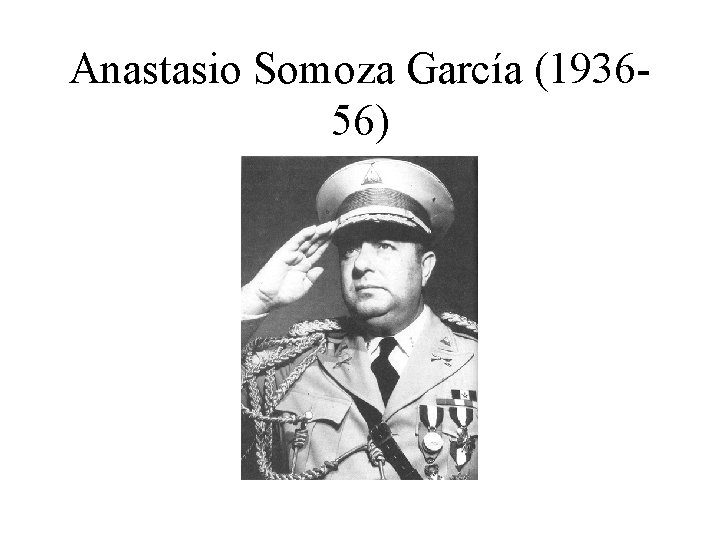
The Pact of Espino Negro • President Díaz would finish his term • The US Marines would remain in Nicaragua to supervise the 1928 elections • Both the Liberal rebels and the government agreed to disarm while the US of A organized a non-partisan police force: the National Guard. One Liberal commander, Augusto Sandino, rejected the agreement.
NICARAGUA • José María Moncada (1928 -32) • Juan Bautista Sacasa (1932 -36) • The US Marines withdrew from Nicaragua 1933. Anastasio Somoza García is appointed director of the National Guard. Sandino agrees to end the war. Murdered in an ambush by Somoza García in February 1934.
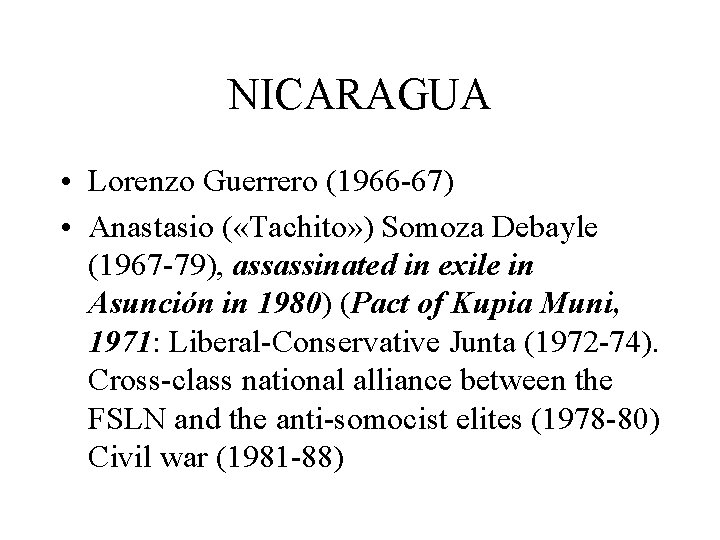
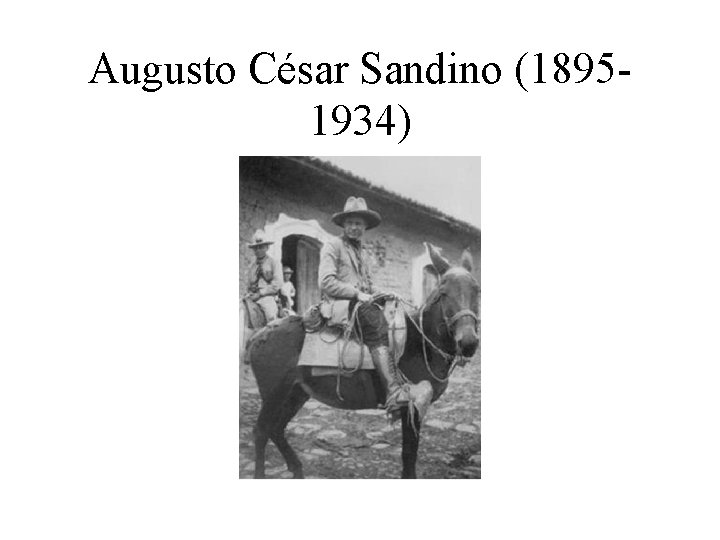
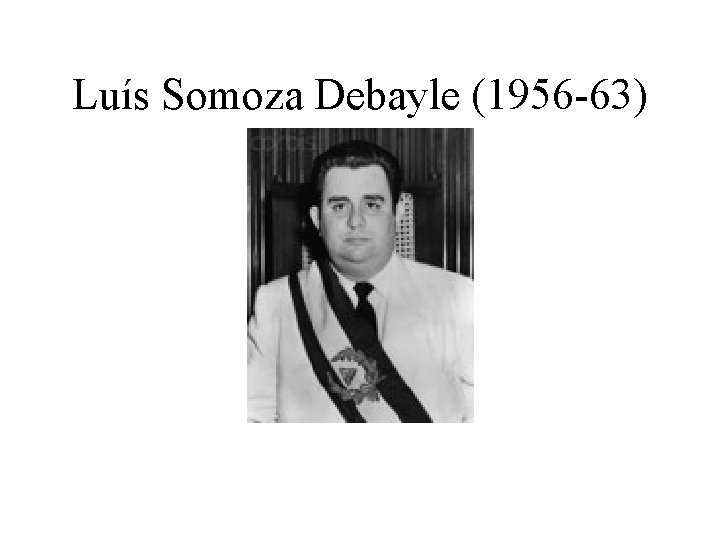
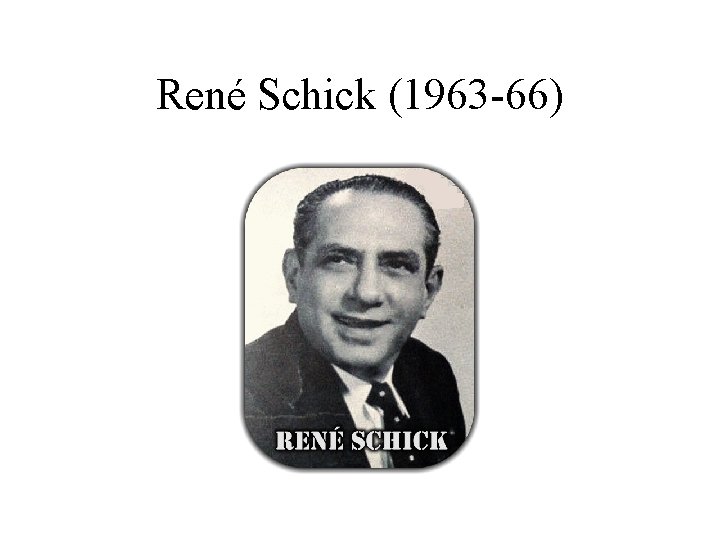
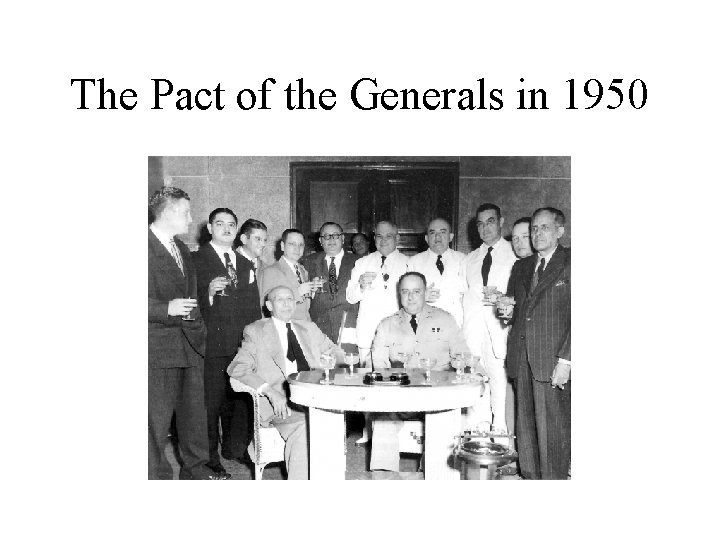
NICARAGUA • US marines (1909 -25; 1926 -33) • Anastasio ( «Tacho» ) Somoza García (193656, assassinated) sham elections (the Pact of the Generals between Somoza and Chamorro, 1950) • Luís Somoza Debayle (1956 -63, died from a heart attack in 1967) • René Schick (1963 -66, died in office)
NICARAGUA • Lorenzo Guerrero (1966 -67) • Anastasio ( «Tachito» ) Somoza Debayle (1967 -79), assassinated in exile in Asunción in 1980) (Pact of Kupia Muni, 1971: Liberal-Conservative Junta (1972 -74). Cross-class national alliance between the FSLN and the anti-somocist elites (1978 -80) Civil war (1981 -88)
Anastasio Somoza García (193656)
Augusto César Sandino (18951934)
Luís Somoza Debayle (1956 -63)
René Schick (1963 -66)
Anastasio Somoza Debayle (1967 -79)
The death of Somoza Debayle 1980
1. Blurred line between regime and state • The Guardia Nacional was loyal to Somoza and fought well in the civil war. • Somoza did not create a single party, but shanghaied the Liberal party, rebaptised National Liberal Party (PLN)
2. Personalism • Cult of personality: Puerto Somoza (Puerto Cabezas) • Dynasticism and nepotism: the sons (Luís and Anastasio). Anastasio Somoza Portocarrero, son of Anastasio Somoza Debayle, heir apparent.
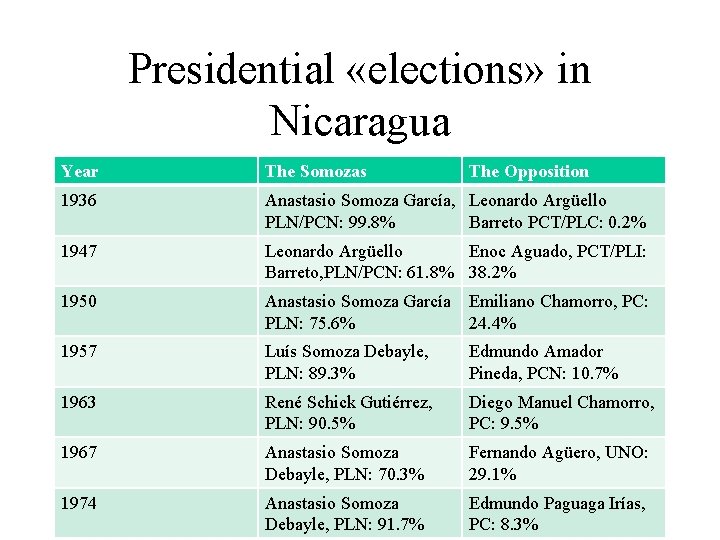
3. Constitutional hypocrisy • The constitution was frequently altered by a compliant legislature dominated by PLN loyalists. The Somoza’s sham constitutionalism, holding elections (always fraudulently manipulated) and extolling of democracy were helpful in keeping the external support of the US of A.
Presidential «elections» in Nicaragua Year The Somozas The Opposition 1936 Anastasio Somoza García, Leonardo Argüello PLN/PCN: 99. 8% Barreto PCT/PLC: 0. 2% 1947 Leonardo Argüello Enoc Aguado, PCT/PLI: Barreto, PLN/PCN: 61. 8% 38. 2% 1950 Anastasio Somoza García PLN: 75. 6% Emiliano Chamorro, PC: 24. 4% 1957 Luís Somoza Debayle, PLN: 89. 3% Edmundo Amador Pineda, PCN: 10. 7% 1963 René Schick Gutiérrez, PLN: 90. 5% Diego Manuel Chamorro, PC: 9. 5% 1967 Anastasio Somoza Debayle, PLN: 70. 3% Fernando Agüero, UNO: 29. 1% 1974 Anastasio Somoza Debayle, PLN: 91. 7% Edmundo Paguaga Irías, PC: 8. 3%
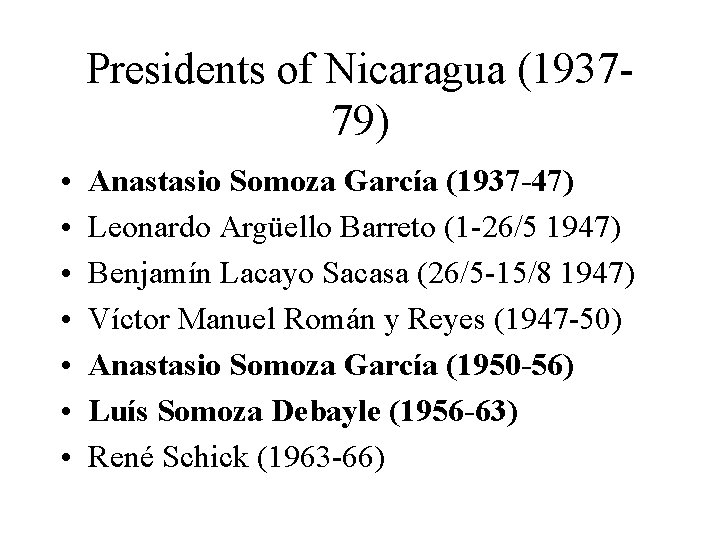
Presidents of Nicaragua (193779) • • Anastasio Somoza García (1937 -47) Leonardo Argüello Barreto (1 -26/5 1947) Benjamín Lacayo Sacasa (26/5 -15/8 1947) Víctor Manuel Román y Reyes (1947 -50) Anastasio Somoza García (1950 -56) Luís Somoza Debayle (1956 -63) René Schick (1963 -66)
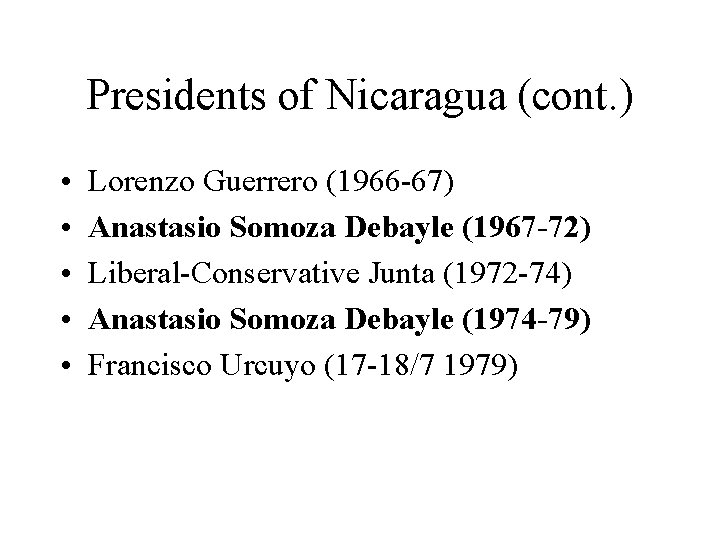
Presidents of Nicaragua (cont. ) • • • Lorenzo Guerrero (1966 -67) Anastasio Somoza Debayle (1967 -72) Liberal-Conservative Junta (1972 -74) Anastasio Somoza Debayle (1974 -79) Francisco Urcuyo (17 -18/7 1979)
The Pact of the Generals in 1950
4. Narrow social bases of sultanism • At the outset: a base among Liberals (PLN). Under Anastasio Somoza Debayle many former allies turned against him and joined the opposition. • US support ( «Ah, that Tacho! He was a great party guy!» ) Somoza-lobby in the US. The US ambassador Turner Shelton
5. Distorted capitalism • «Loaded dice group» : The Somozas received substantial bribes masquerading as consulting and advisory fees from both domestic and foreign firms.
Nicaragua after sultanism • Junta of National Reconstruction (1979 -84) • Sandinista coporatist regime: Consejo de Estado (1979 -84) • Civil War (1981 -88) US-backed Contras • Elections (boycotted by the opposition) in 1984 • Elections in 1990 with opposition participation
Nicaragua after sultanism: presidents since 1984 • Daniel Ortega (FSLN) (1984 -90) • Violeta Barrios de Chamorro (UNO) (199096) • Arnoldo Alemán (PLC) (1996 -2001) • Enrique Bolaños (PLC) (2001 -06) • Daniel Ortega (FSLN) (2006 -11) • Daniel Ortega (FSLN) (2011 -16) • Daniel Ortega (FSLN) (2016 -21)
CUBA • • • US military occupation (1898 -1902) US protectorate (1902 -34) ”Platt Amendment” to the Cuban Constitution entitled the US of A to intervene in Cuba’s domestic politics at will (1906 -09, 1912, and 1917 -20) Gerardo Machado (1925 -33) The ”Seargents’ revolt”: Fulgencio Batista Ramón Grau San Martín (1933 -34) Fulgencio Batista (1940 -44) democratically elected Ramón Grau San Martín (1944 -48) Carlos Prío Socorrás (1948 -52) Fulgencio Batista (1952 -59, seized power by coup, died in exile in Spain in 1973) The Cuban Revolution 1959 Oswaldo Dórticos Torrado president (1959 -76) Fidel Castro president (1976 -2008) Raúl Castro acting president (31/7 2006 -24/2 2008), president (24/2 2008 -
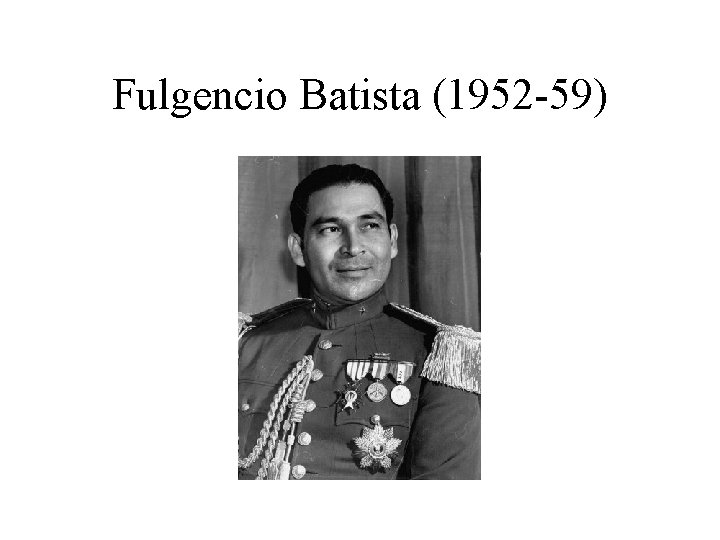
Fulgencio Batista (1952 -59)
1. Blurred line between regime and state • Batista discharged hundreds of officers, and recalled the officers personally loyal to him who had been purged in 1944 -45 and entrusted them the top commands of the armed forces. It was these unprofessional officers who faced Fidel Castro’s insurgency and lost.
2. Personalism • The Batista regime lacked an ideology. No dynasty
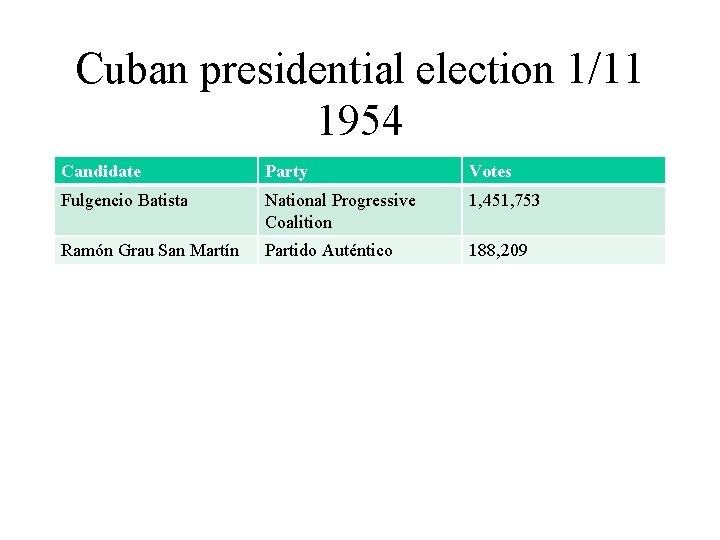
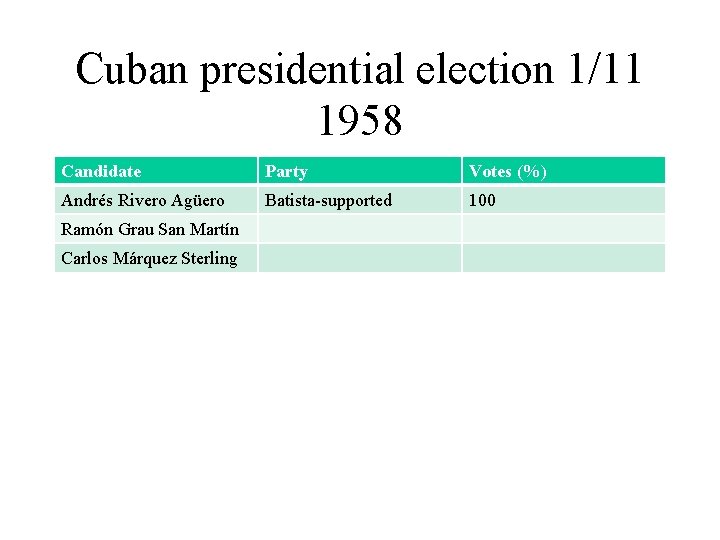
3. Constitutional hypocrisy • Batista held presidential elections in 1954 (Batista vs. Grau). Batista even formally «resigned» as president (installing his longstanding associate, Andrés Domingo y Morales de Castillo as president for a few weeks). 1958 (Batista’s prime minister Andrés Rivero Agüero vs. Grau vs. Carlos Márquez Sterling)
Cuban presidential election 1/11 1954 Candidate Party Votes Fulgencio Batista National Progressive Coalition 1, 451, 753 Ramón Grau San Martín Partido Auténtico 188, 209
Cuban presidential election 1/11 1958 Candidate Party Votes (%) Andrés Rivero Agüero Batista-supported 100 Ramón Grau San Martín Carlos Márquez Sterling
4. Narrow social bases of sultanism • Batista’s old conservative partners (Liberals, Democrats), Rolando Masferrer’s Radical Union Party, the Cuban Confederation of Labor (Eusebio Mujal). US ambassador Arthur Gardner became Batista’s personal friend.
5. Distorted capitalism • Batista permitted the growth of illegal gambling with the proceeds going to the presidential palace. Batista removed the national lottery from the national budget so none of its funds would enter the national treasury enabled Batista to distribute large sums of money to reward his friends and supporters entirely at his own discretion.
Distorted capitalism (cont. ) • Payments of commissions (typically 30% of the cost) for government contracts. It explains Batista’s devotion to public works: they created jobs and generated kickbacks. • The sugar industry was left untouched. The Sugar Stabilization Institute protected property owners.
Cuba after sultanism • A communist totalitarian regime, institutionalized by the 1976 Constitution, approved in a constitutional referendum 15/2 1976: Yes (99. 02%)
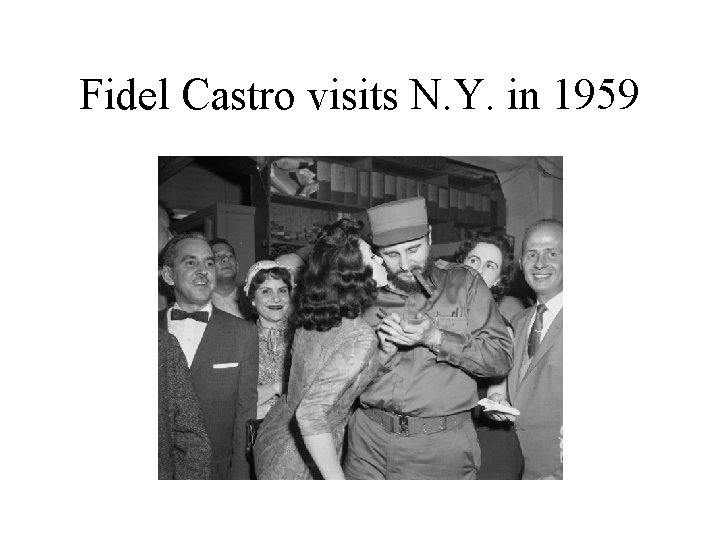
Fidel Castro visits N. Y. in 1959
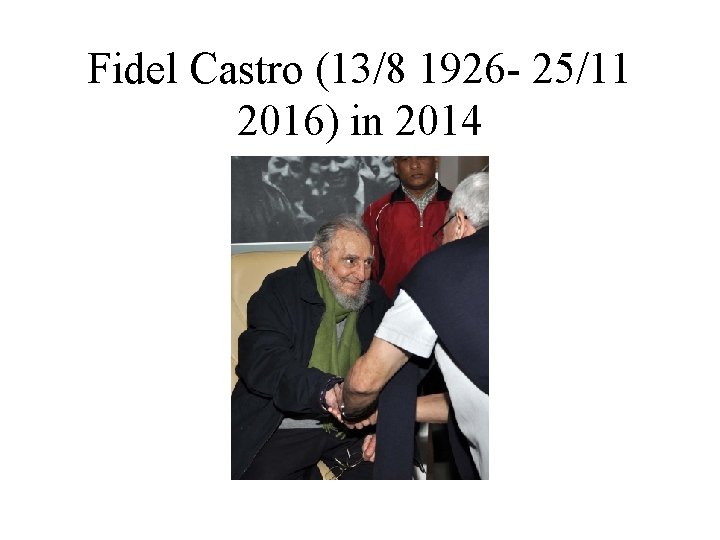
Fidel Castro (13/8 1926 - 25/11 2016) in 2014
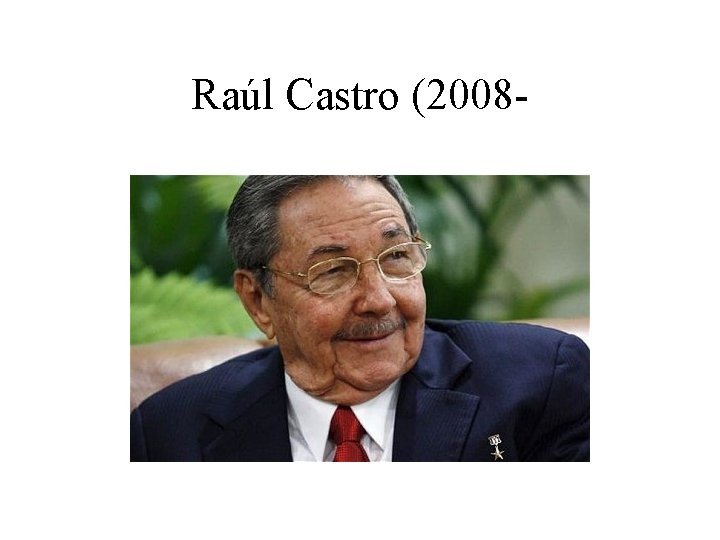
Raúl Castro (2008 -
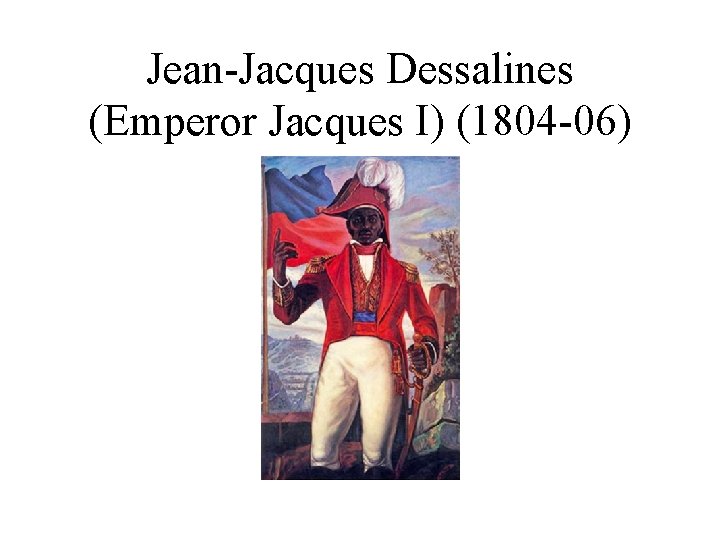
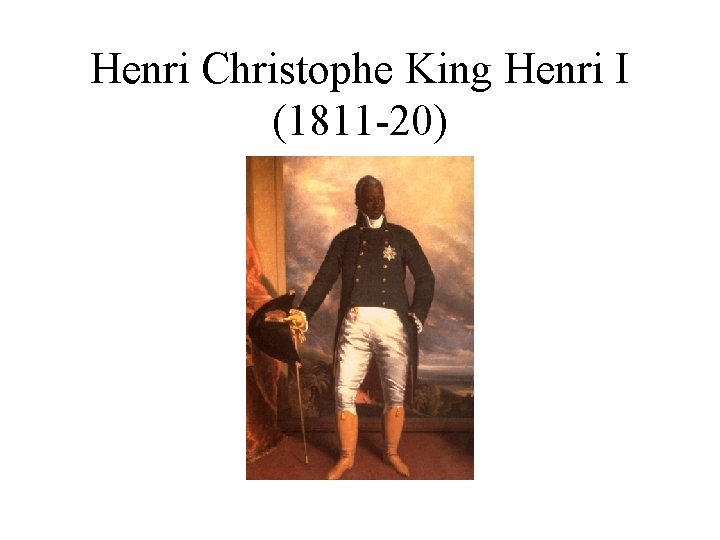
HAITI • Toussaint Louverture, leader of the Haitian Revolution (1791 -1802), declared full independence of Haiti in 1804 • Jean-Jacques Dessalines (Jacque I) Emperor of Haiti (1804 -06) • Henri Christophe President 1807 -11; King (Henri I, 1811 -20) • Alexandre Pétion President of (southern) Haiti (1806 -18)
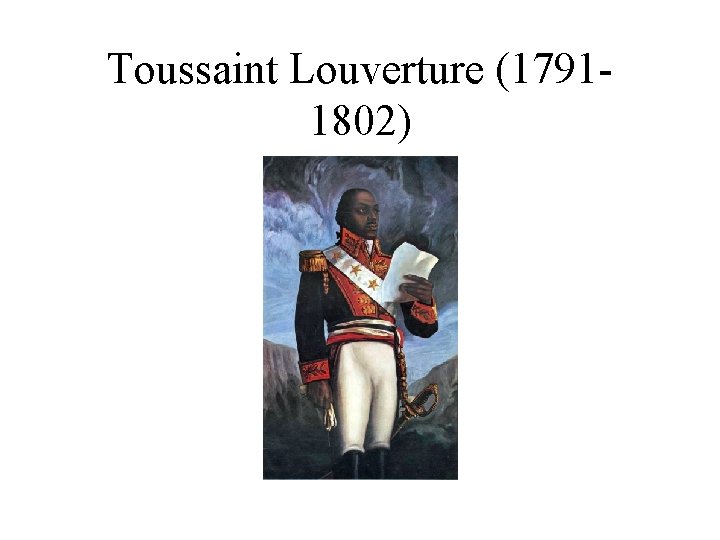
Toussaint Louverture (17911802)
Jean-Jacques Dessalines (Emperor Jacques I) (1804 -06)
Henri Christophe King Henri I (1811 -20)
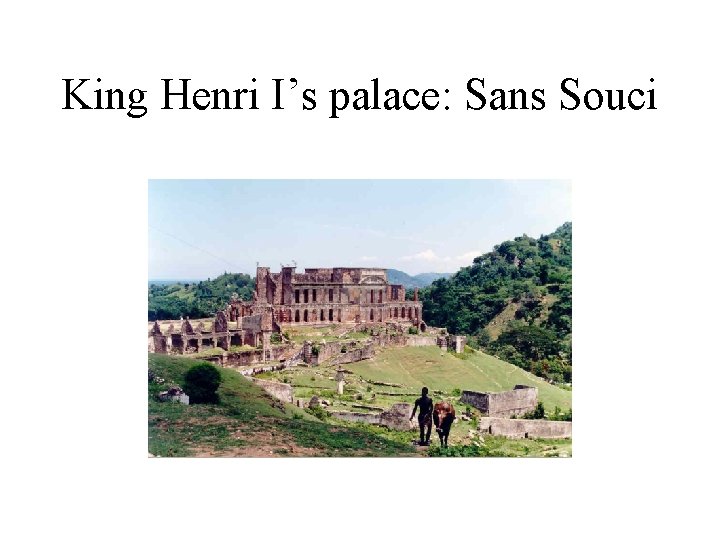
King Henri I’s palace: Sans Souci
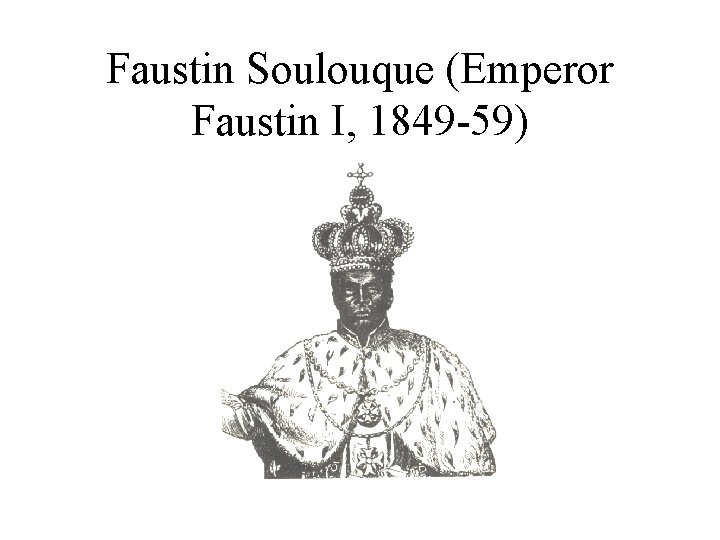
HAITI (cont. ) • Jean Pierre Boyer (1818 -43) invaded the Dominican Republic in 1822 • 4 presidents (1843 -47) • Faustin Soulouque (Faustin I) president (1847 -49), Emperor (1849 -59) • Fabre Geffrard (1859 -67) • 22 presidents (1867 -1915)
Faustin Soulouque (Emperor Faustin I, 1849 -59)
HAITI (cont. ) • • • US marines occupation (1915 -34) Sténio Vincent (1930 -41) Elie Lescot (1941 -46) Dumarsais Estimé (1946 -50) Paul Magloire (1950 -56) Francois Duvalier (1957 -71)
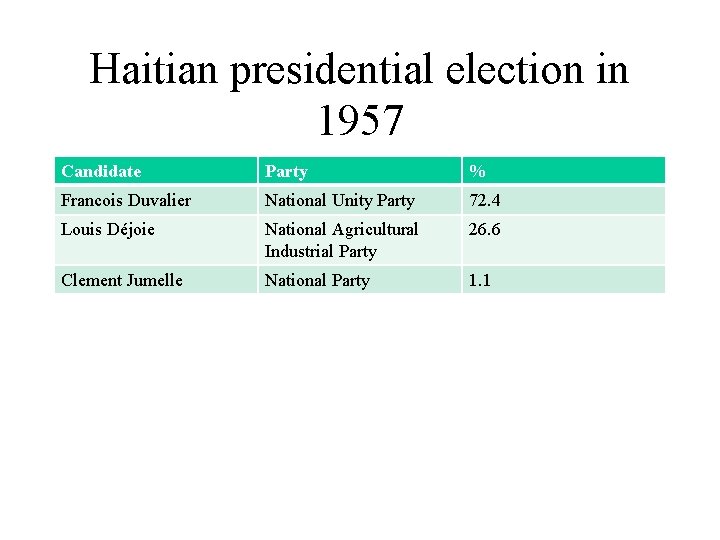
Haitian presidential election in 1957 Candidate Party % Francois Duvalier National Unity Party 72. 4 Louis Déjoie National Agricultural Industrial Party 26. 6 Clement Jumelle National Party 1. 1
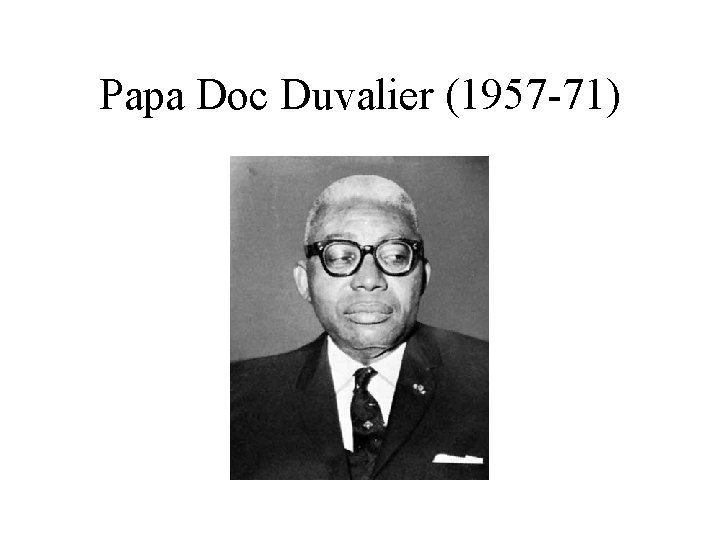
Haiti under Papa Doc Duvalier: a borderline case • The Haitian regime under Francois Duvalier (1957 -71) does not fit the pure type of sultanistic regime. Papa Doc based his rule on the black middle classes in opposition to Haiti’s mulatto elite.
Papa Doc Duvalier (1957 -71)
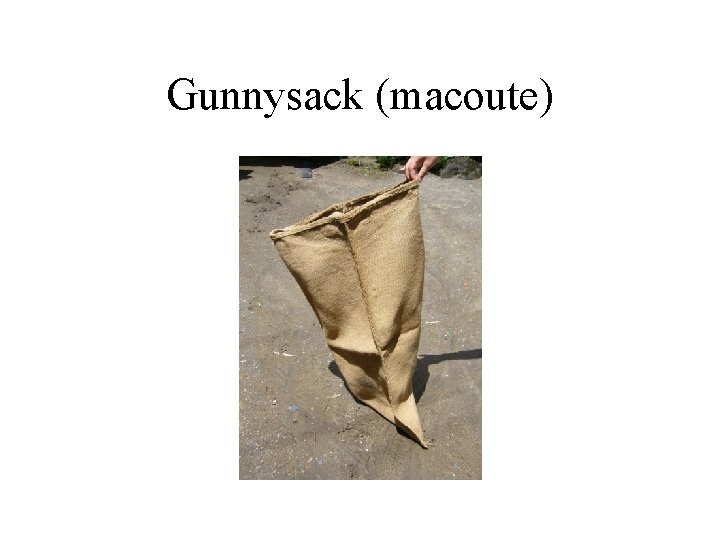
1. Blurred line between regime and state • Papa Doc created a private militia in 1959 to sustain control: the Tontons Macoutes According to Haitian Creole mythology, a Tonton Macoute (Uncle Gunnysack) is a bogeyman who kidnaps and punishes unruly children by snaring them in a gunny sack (macoute) and carrying them off to be consumed at breakfast.
Gunnysack (macoute)
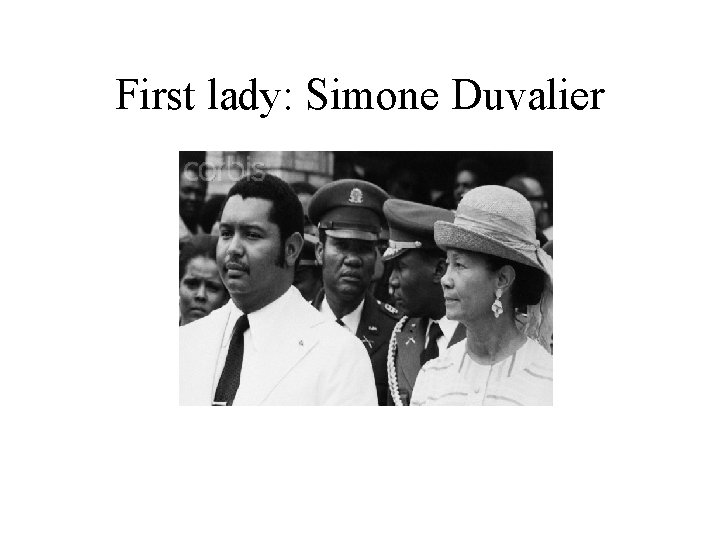
2. Personalism • Cult of personality: Duvalierville (Cabaret) • Invented ideology: noirisme • Dynasticism: Papa and Baby Doc (Son) Wife, Simone Ovide Duvalier, wielded considerable influence and was involved in corruption
First lady: Simone Duvalier
3. Constitutional hypocrisy • Presidential referendum in 1961 to determine whether to let president Francois Duvalier remain in office for a further 6 years: Yes (100%)! • Constitutional referendum 14/6 1964 which made Francois Duvalier President for Life with absolute power and the right to name his successor: Yes (99. 9%)
Constitutional hypocrisy (cont. ) • Constitutional referendum 30/11971 on Francois Duvalier’s choice of his son to succeed him as President for Life. Before the referendum the Haitian parliament had lowered the age limit for becoming president from 40 to 20, as well as confirming Jean-Claude Duvalier as 21 years of age, which would allow him to succeed his father.
4. Narrow social bases of sultanism • Papa Doc based himself on a broader social base: the black middle classes. He enjoyed support from an important black middle class in the cities and of middlelevel peasants in the countryside.
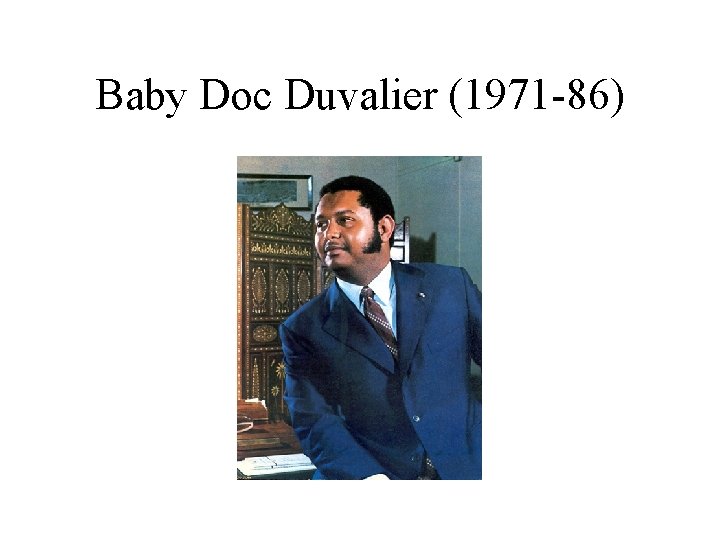
Baby Doc Duvalier (1971 -86)
1. Blurred line between regime and state • Jean-Claude Duvalier created a single party: Comité National d’Action Jean-Claudiste. • Civilian control over the army (7, 000 men). After the popular antigovernment demonstrations of December 1985, it took weeks before the army moved to take over the country, which they did, at the behest of Duvalier and the US embassy on 7/2 1986.
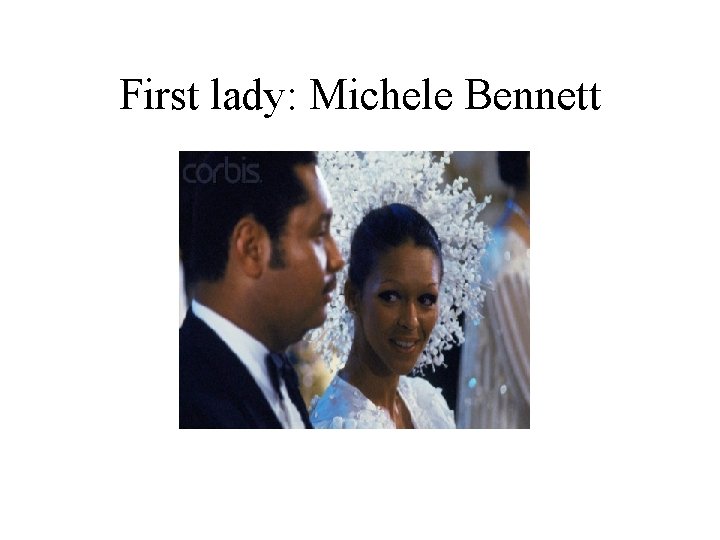
2. Personalism • «Jean-Claudism» became official state ideology in 1978 • Dynasticism: Jean-Claude’s wife, Michele Bennett, wielded considerable influence and was involved in corruption
First lady: Michele Bennett
3. Constitutional hypocrisy • Constitutional referendum 22/7 1985. The amendments to the new constitution would restore multi-party politics, on the condition that all parties swore allegiance to President Jean-Claude Duvalier; confirmed Duvalier as President for Life; allowed him to singlehandedly appoint the Prime Minister and his successor. Yes: 99. 98%!
4. Narrow Social Bases of Sultanism • Married a mulatto: Michele Bennett in 1980, alienated the black middle classes • Foreign aid: a principal source of corruption throughout the regime of Baby Doc
Haiti after sultanism • US marines occupation (1915 -34) • Papa Doc Duvalier (1957 -71, President for Life in 1964, died in office). Neo-patrimonial regime • Baby Doc Duvalier (1971 -86) forced into exile (France) by a military coup, returned to Haiti 16/1 2011; died from a cardiac arrest 4/10 2014) Sultanistic regime • Henri Namphy (7/2 1986 -7/2 1988) • Leslie Manigat (7/2 -20/6 1988) military coup • Henri Namphy (20/6 -17/9 1988) military coup • Prosper Avril (17/9 1988 -10/3 1990) • Ertha Pascal-Trouillot (13/3 1990 -7/2 1991)
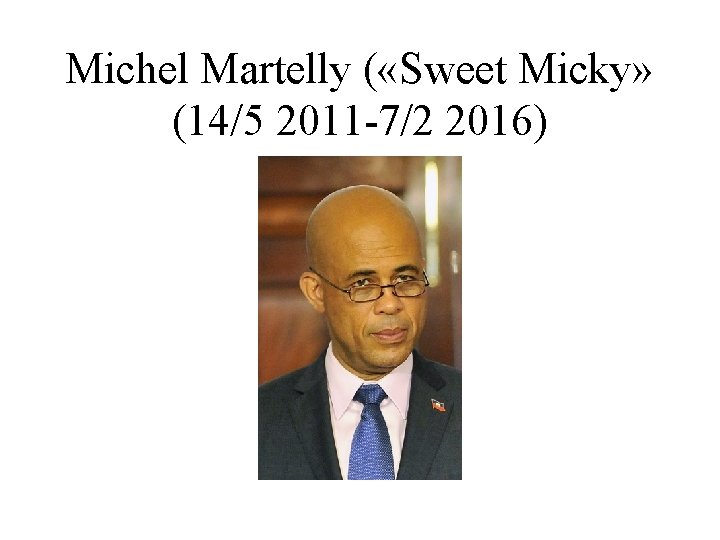
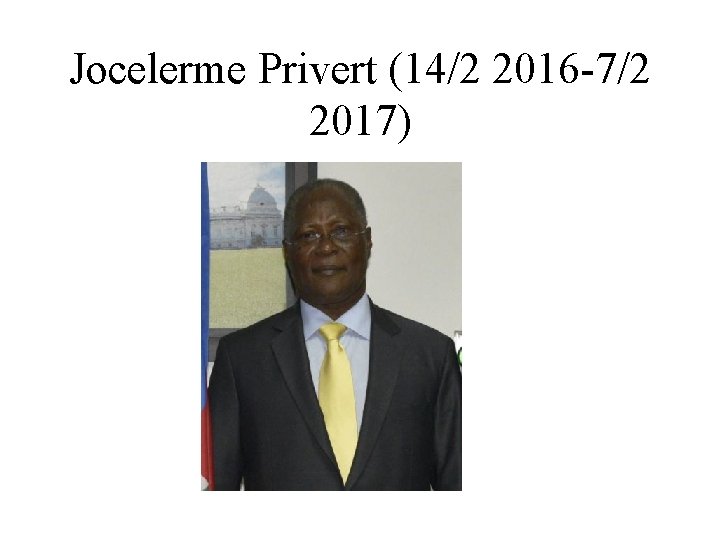
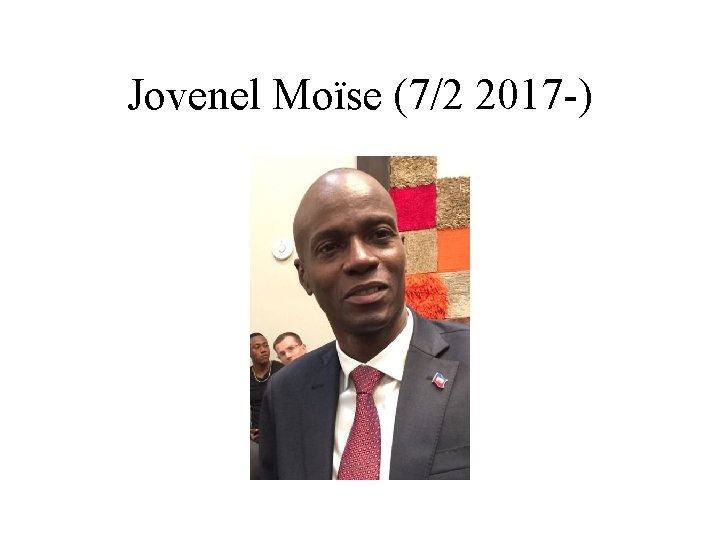
Haiti after sultanism (cont. ) • Jean-Bertrand Aristide (7/2 -30/9 1991) military coup • Raoul Cédras (30/9 1991 -18/10 1994) US led invasion (OAS Resolution 1080) • Jean-Bertrand Aristide (18/10 1994 -7/2 1996) • René Préval (7/2 1996 -7/2 2001) • Jean-Bertrand Aristide (7/2 2001 -29/2 2004, in exile in South Africa and returned to Haiti 18/3 2011) rebellion by ex-militaries • Boniface Alexandre (29/2 2004 -14/5 2006) • René Préval (14/5 2006 -14/5 2011) • Michel Martelly (14/5 2011 -7/2 2016) • Jocelerme Privert (14/2 2016 -7/2 2017) • Jovenel Moïse (7/2 2017 -)
Michel Martelly ( «Sweet Micky» (14/5 2011 -7/2 2016)
Jocelerme Privert (14/2 2016 -7/2 2017)
Jovenel Moïse (7/2 2017 -)
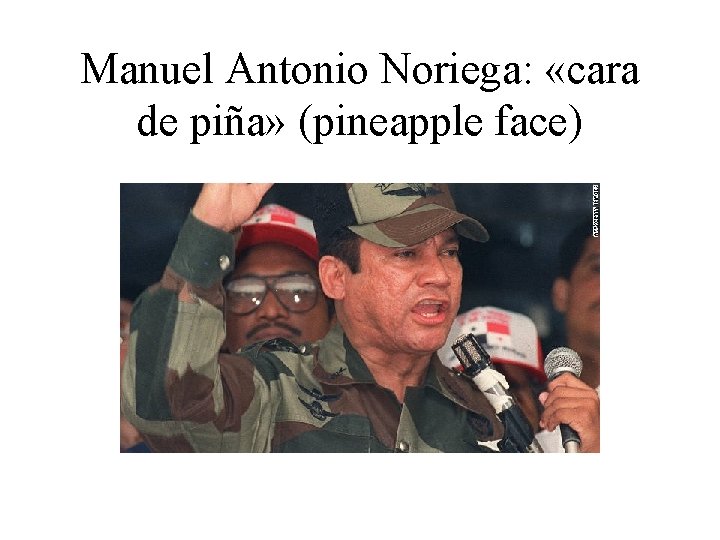
PANAMA • 1903 -31: Liberal party hegemony, coup 2/1 1931. Harmodio (Arnulfo’s brother) Arias won the election in 1932 • 1931 -68: Arnulfo Arias dominated: ran for president 4 times (1948, 1964, 1968 and 1984), but 3 times (1948, 1964 and 1984) he was denied electoral victory, and twice (1951 and 1968) he was ousted by military coups • Reformist dictatorship under Omar Torrijos (1968 -81) who died in a plane crash 30/7 1981 • Manuel Noriega’s sultanistic regime (1983 -89)
Manuel Antonio Noriega: «cara de piña» (pineapple face)
1. Blurred line between regime and state • Noriega used the regime’s political party, the Democratic Revolutionary Party (PRD), as a vehicle of control • Noriega controlled the creation of the new Panamanian Defence Forces
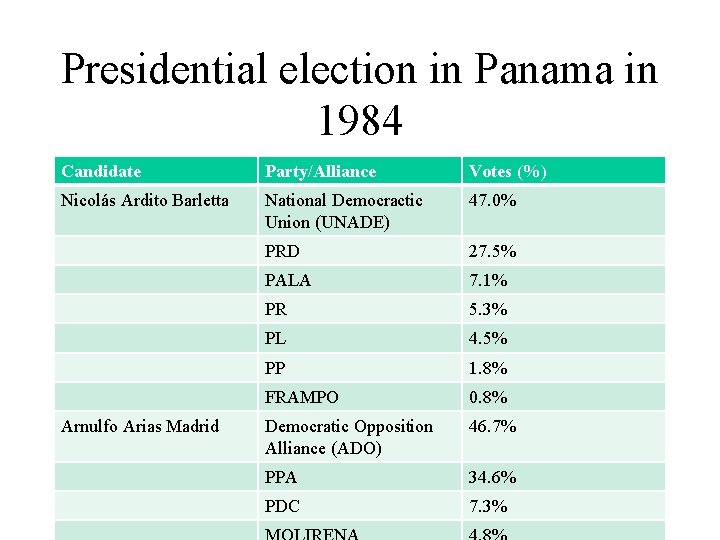
Constitutional hypocrisy • «Elections» 1984, 1989
Presidential election in Panama in 1984 Candidate Party/Alliance Votes (%) Nicolás Ardito Barletta National Democractic Union (UNADE) 47. 0% PRD 27. 5% PALA 7. 1% PR 5. 3% PL 4. 5% PP 1. 8% FRAMPO 0. 8% Democratic Opposition Alliance (ADO) 46. 7% PPA 34. 6% PDC 7. 3% Arnulfo Arias Madrid
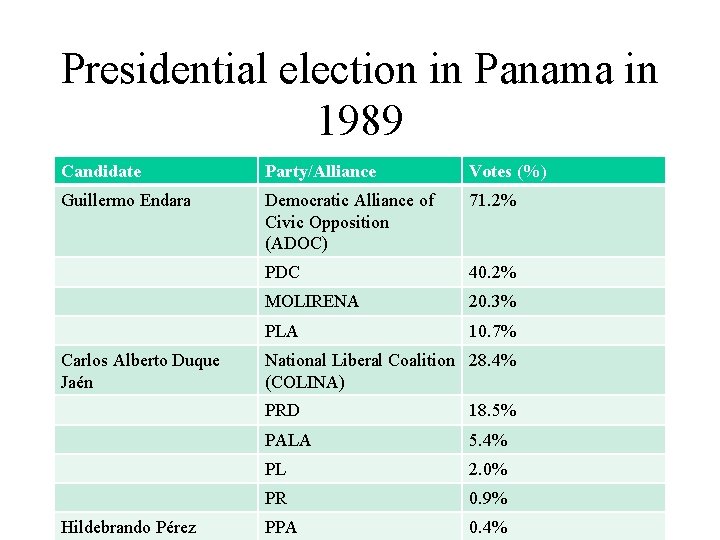
Presidential election in Panama in 1989 Candidate Party/Alliance Votes (%) Guillermo Endara Democratic Alliance of Civic Opposition (ADOC) 71. 2% PDC 40. 2% MOLIRENA 20. 3% PLA 10. 7% Carlos Alberto Duque Jaén Hildebrando Pérez National Liberal Coalition 28. 4% (COLINA) PRD 18. 5% PALA 5. 4% PL 2. 0% PR 0. 9% PPA 0. 4%
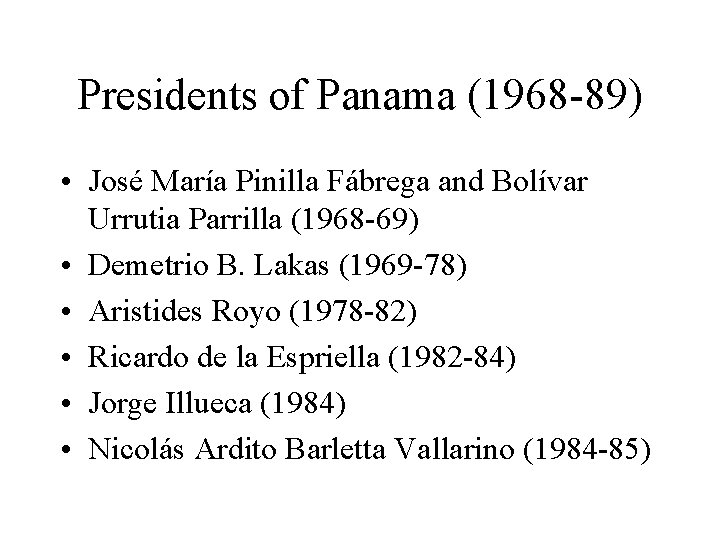
Presidents of Panama (1968 -89) • José María Pinilla Fábrega and Bolívar Urrutia Parrilla (1968 -69) • Demetrio B. Lakas (1969 -78) • Aristides Royo (1978 -82) • Ricardo de la Espriella (1982 -84) • Jorge Illueca (1984) • Nicolás Ardito Barletta Vallarino (1984 -85)
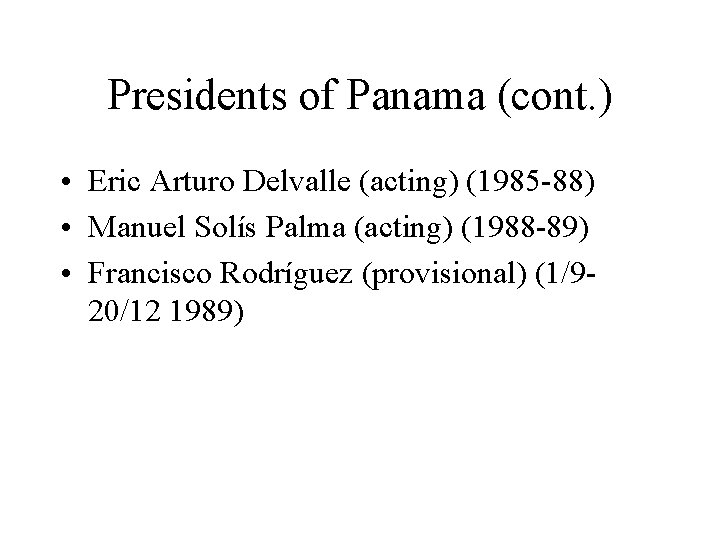
Presidents of Panama (cont. ) • Eric Arturo Delvalle (acting) (1985 -88) • Manuel Solís Palma (acting) (1988 -89) • Francisco Rodríguez (provisional) (1/920/12 1989)
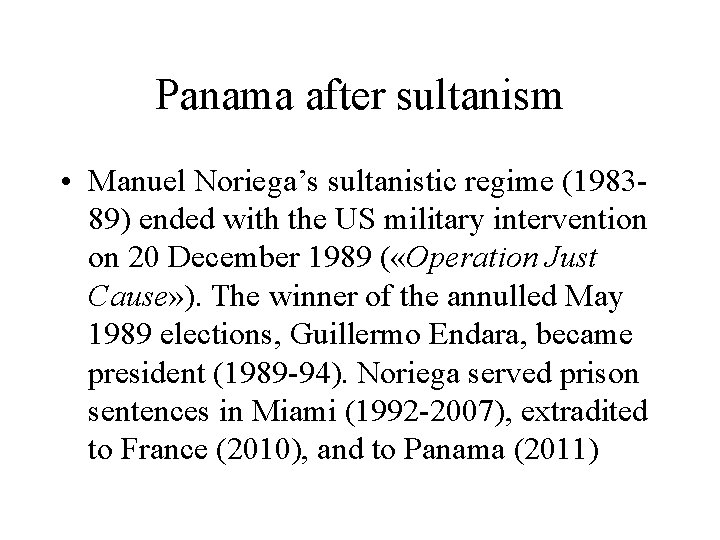
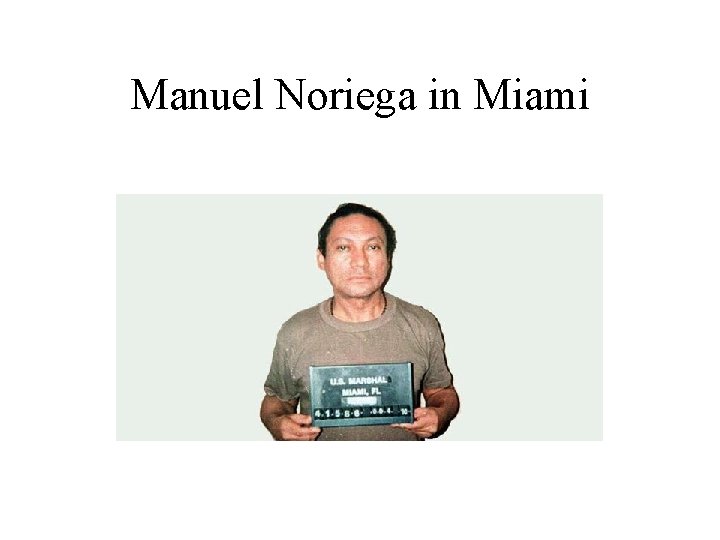
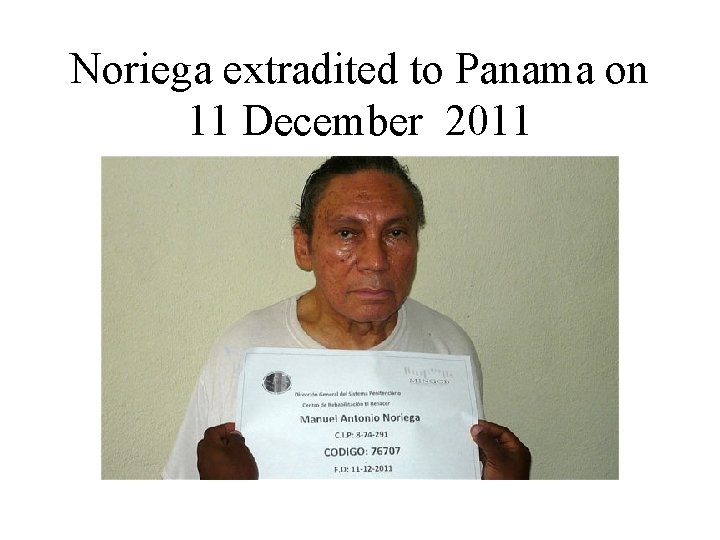
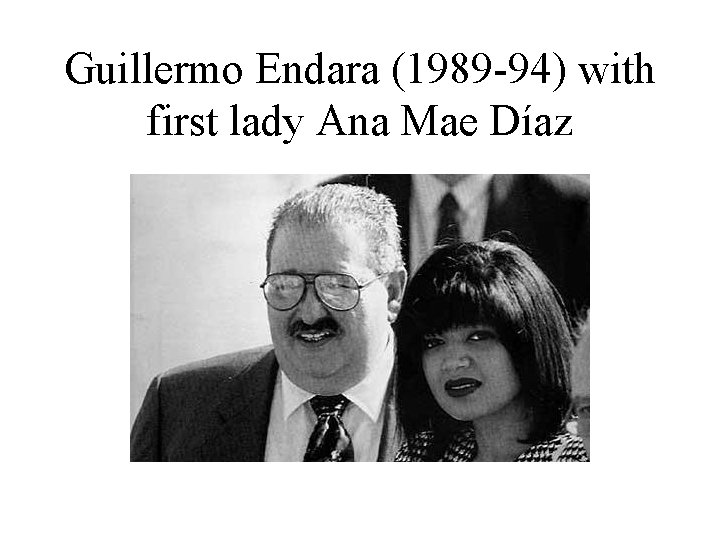
Panama after sultanism • Manuel Noriega’s sultanistic regime (198389) ended with the US military intervention on 20 December 1989 ( «Operation Just Cause» ). The winner of the annulled May 1989 elections, Guillermo Endara, became president (1989 -94). Noriega served prison sentences in Miami (1992 -2007), extradited to France (2010), and to Panama (2011)
Manuel Noriega in Miami
Noriega extradited to Panama on 11 December 2011
Panama after sultanism: presidents since 1989 • • • Guillermo Endara (PA) (1989 -94) Ernesto Pérez Balladares (PRD) (1994 -99) Mireya Moscoso de Arias (PA) (1999 -2004) Martín Torrijos (PRD) (2004 -09) Ricardo Martinelli (CD) (2009 -14) Juan Carlos Varela (PA) (2014 -19)
Guillermo Endara (1989 -94) with first lady Ana Mae Díaz
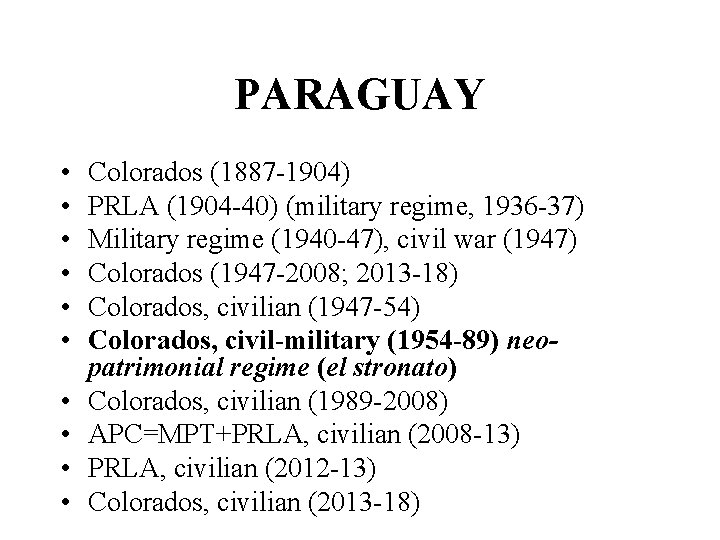
PARAGUAY • • • Colorados (1887 -1904) PRLA (1904 -40) (military regime, 1936 -37) Military regime (1940 -47), civil war (1947) Colorados (1947 -2008; 2013 -18) Colorados, civilian (1947 -54) Colorados, civil-military (1954 -89) neopatrimonial regime (el stronato) Colorados, civilian (1989 -2008) APC=MPT+PRLA, civilian (2008 -13) PRLA, civilian (2012 -13) Colorados, civilian (2013 -18)
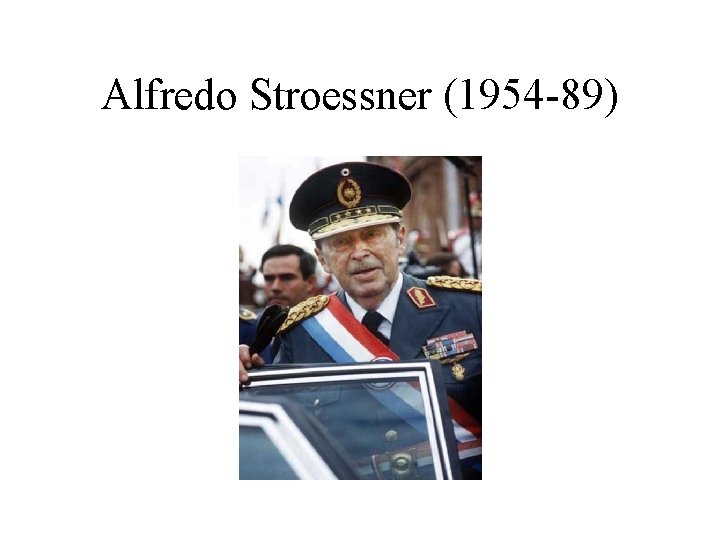
Alfredo Stroessner (1954 -89)
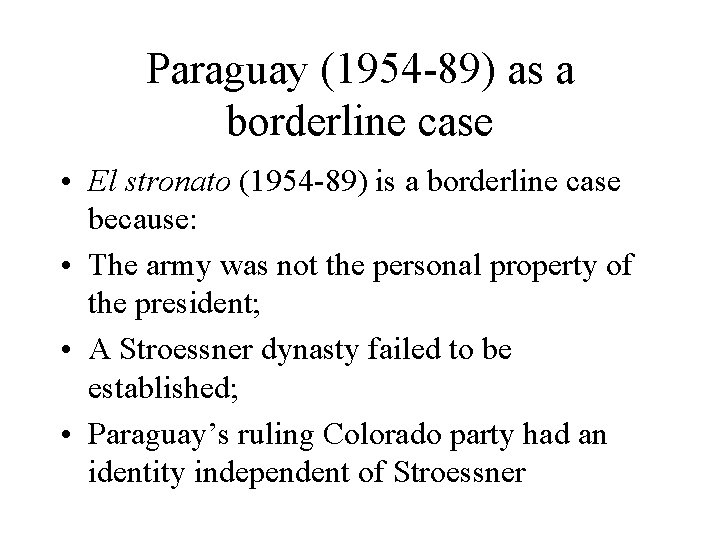
Paraguay (1954 -89) as a borderline case • El stronato (1954 -89) is a borderline case because: • The army was not the personal property of the president; • A Stroessner dynasty failed to be established; • Paraguay’s ruling Colorado party had an identity independent of Stroessner
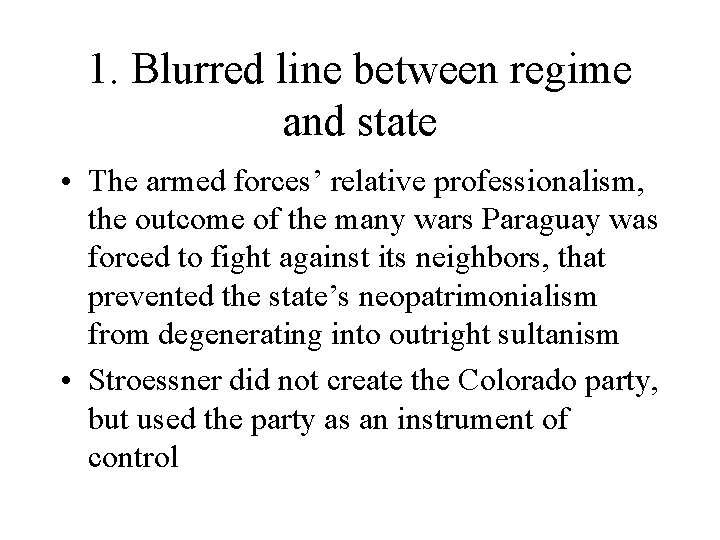
1. Blurred line between regime and state • The armed forces’ relative professionalism, the outcome of the many wars Paraguay was forced to fight against its neighbors, that prevented the state’s neopatrimonialism from degenerating into outright sultanism • Stroessner did not create the Colorado party, but used the party as an instrument of control
2. Personalism • Personalism relatively less pronounced • Dynasticism: Alfredo Stroessner failed to have his eldest son, Gustavo Stroessner, succeed him
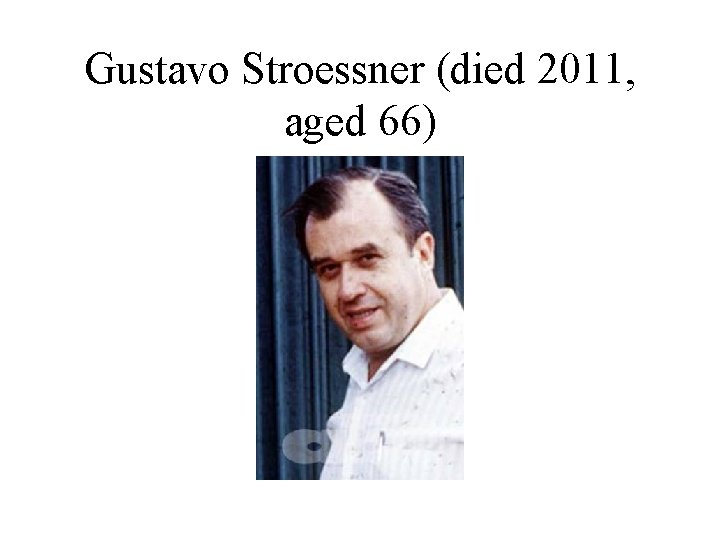
Gustavo Stroessner (died 2011, aged 66)
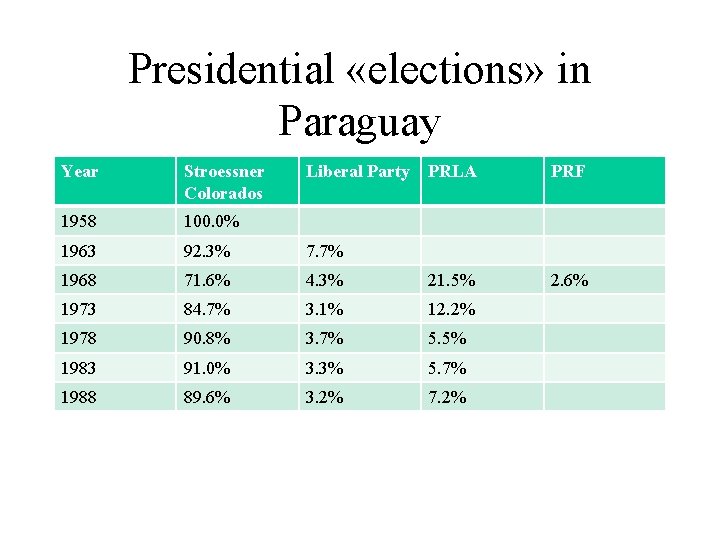
3. Constitutional hypocrisy • Regular «elections» from 1954 to 1988
Presidential «elections» in Paraguay Year Stroessner Colorados Liberal Party PRLA PRF 1958 100. 0% 1963 92. 3% 7. 7% 1968 71. 6% 4. 3% 21. 5% 2. 6% 1973 84. 7% 3. 1% 12. 2% 1978 90. 8% 3. 7% 5. 5% 1983 91. 0% 3. 3% 5. 7% 1988 89. 6% 3. 2% 7. 2%
4. Narrow social bases of sultanism • Stroessner had a broader social base, among the peasantry, encapsulated through the Colorado party
5. Distorted capitalism • Smuggling economy, corruption and cronyism
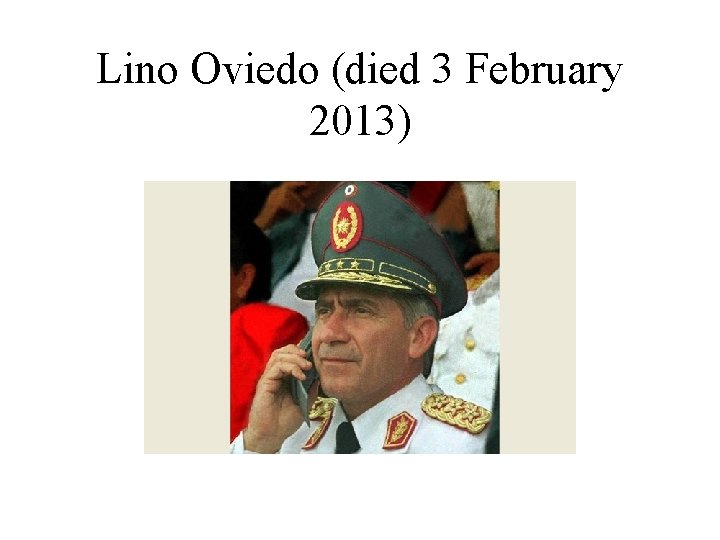
Democratic transition from a neopatrimonial regime • Rodríguez’s palace coup against Stroessner 2 February 1989, elections 1 May won by Rodríguez • Constituent assembly elections Dec. 1991: Constitution of 1992 • Fraudulent internal Colorado primary Dec. 1992: Juan Carlos Wasmosy (1993 -98); April 1996: Gral. Oviedo’s coup attempt • Colorado primary Sept. 1997; Raúl Cubas (Oviedo’s vice-presidential partner) replaces Oviedo as presidential candidate with Argaña as vicepresidential candidate. Cuba (1998 -99) releases Oviedo from prison, and the Supreme Court orders the return of Oviedo to prison. Cubas refuses and Congress initiates impeachment proceedings. • El marzo paraguayo: Argaña assassinated 23 March 1999. Cubas impeached, resigned 28 March. Luís González Macchi (1999 -2003).
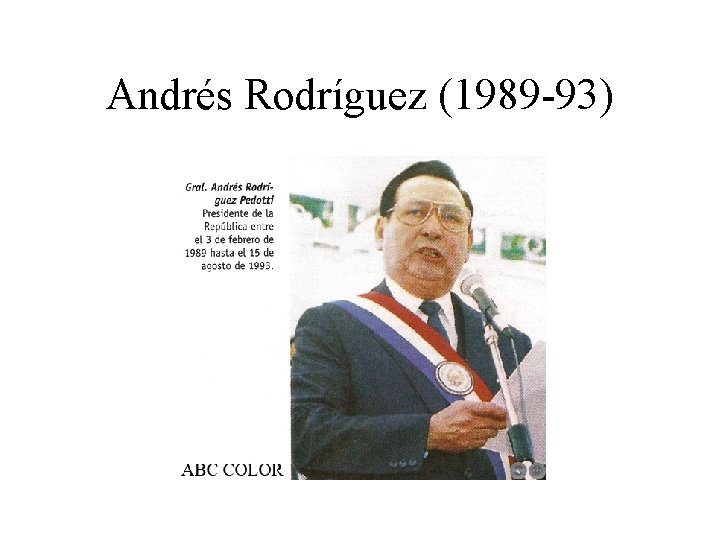
Andrés Rodríguez (1989 -93)
Lino Oviedo (died 3 February 2013)
Paraguayan presidents since 1989 • Andrés Rodríguez (Colorado) (1989 -93) • Juan Carlos Wasmosy (Colorado) (1993 -98), failed coup attempt by Lino Oviedo in 1996 • Raúl Cubas (Colorado) (1998 -99) impeached, resigned • Luís Angel González Macchi (Colorado) (1999 -2003) impeached, acquitted • Nicanor Duarte Frutos (Colorado) (2003 -08) • Fernando Lugo (APC=MPT+PRLA) (2008 -12) impeached • Federico Franco (PRLA) (2012 -13) • Horacio Cartes (Colorado) (2013 -18)
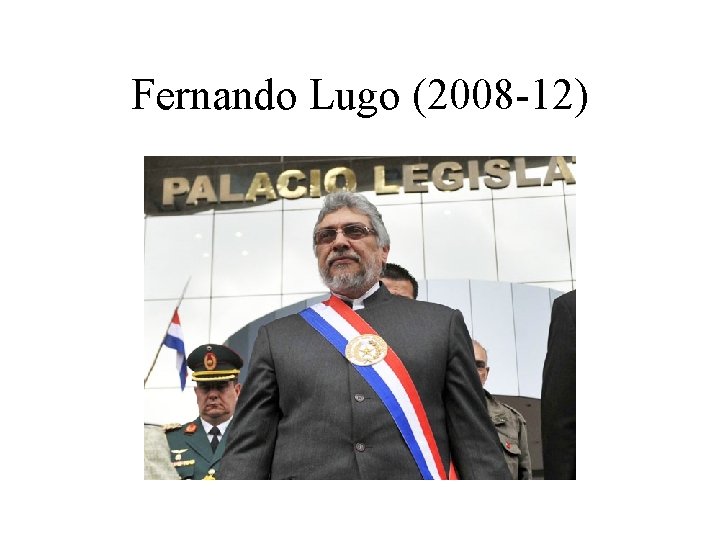
Fernando Lugo (2008 -12)