
GENETIC VARIABILITY FOR QUANTITATIVE TRAITS IN CHINA ASTER
GENETIC VARIABILITY FOR QUANTITATIVE TRAITS IN CHINA ASTER [Callistephus chinensis (L. ) NEES] Rajiv Kumar, Gayatri Khangjarakpam, T. Manjunatha Rao and M. V. Dhananjaya Division of Ornamental Crops ICAR-Indian Institute of Horticultural Research Hessaraghatta Lake Post, Bangalore 560 089 1
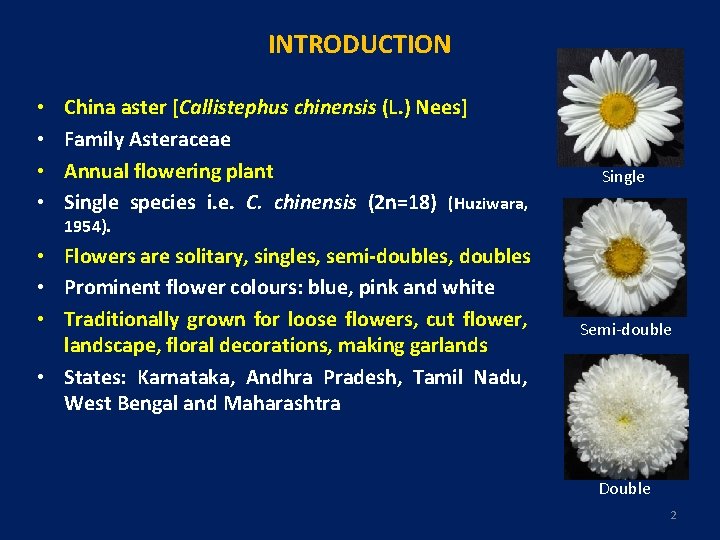
INTRODUCTION • • China aster [Callistephus chinensis (L. ) Nees] Family Asteraceae Annual flowering plant Single species i. e. C. chinensis (2 n=18) (Huziwara, Single 1954). • Flowers are solitary, singles, semi-doubles, doubles • Prominent flower colours: blue, pink and white • Traditionally grown for loose flowers, cut flower, landscape, floral decorations, making garlands • States: Karnataka, Andhra Pradesh, Tamil Nadu, West Bengal and Maharashtra Semi-double Double 2
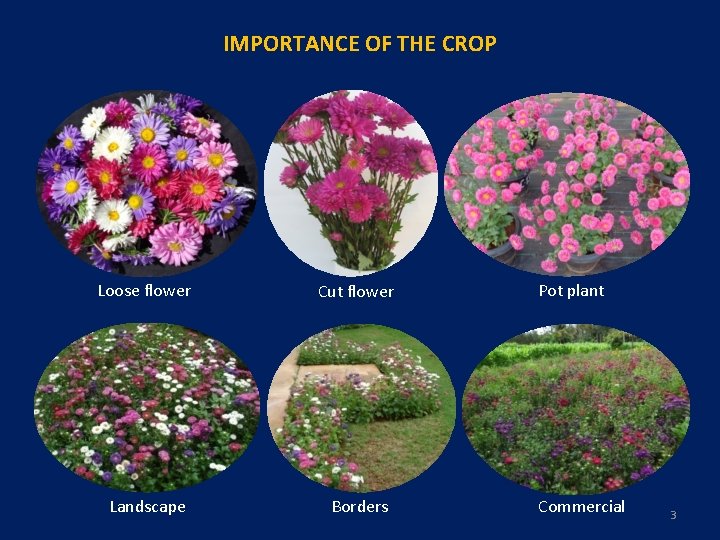
IMPORTANCE OF THE CROP Loose flower Cut flower Landscape Borders Pot plant Commercial 3
OBJECTIVES • To estimate the genetic variability, heritability and genetic advance in twenty genotypes of China aster. • To workout the relationships among different characteristics through correlation co-efficient and to assess direct and indirect effects of characters on flower yield through path analysis. 4
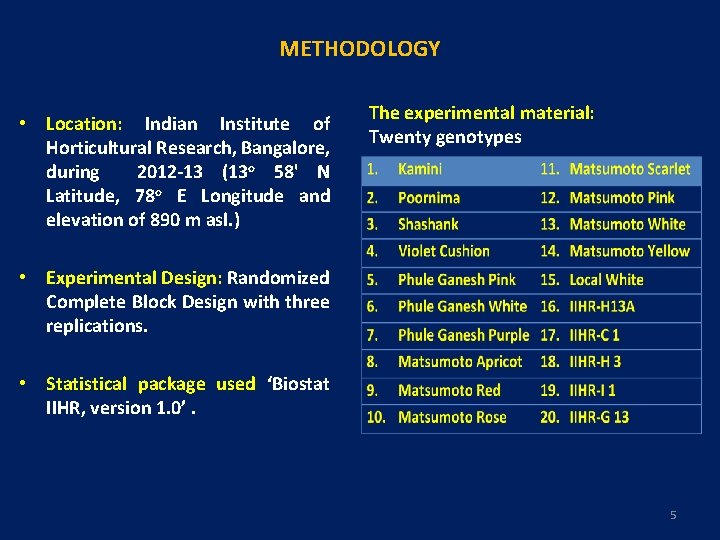
METHODOLOGY • Location: Indian Institute of Horticultural Research, Bangalore, during 2012 -13 (13 o 58' N Latitude, 78 o E Longitude and elevation of 890 m asl. ) The experimental material: Twenty genotypes • Experimental Design: Randomized Complete Block Design with three replications. • Statistical package used ‘Biostat IIHR, version 1. 0’. 5
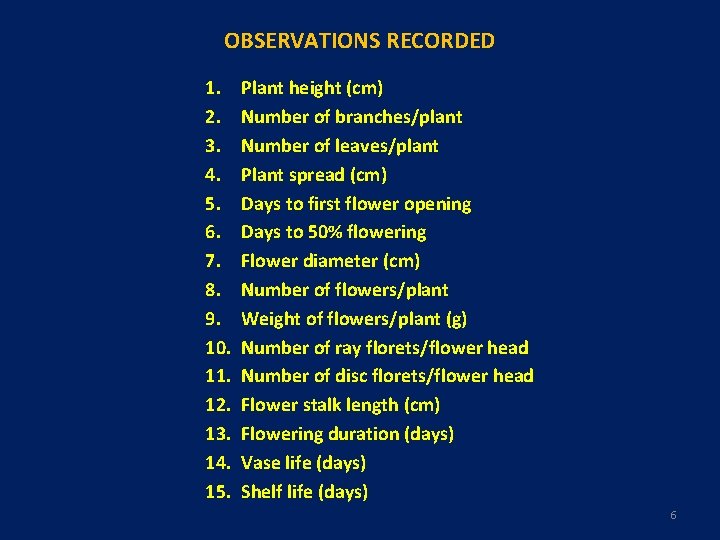
OBSERVATIONS RECORDED 1. 2. 3. 4. 5. 6. 7. 8. 9. 10. 11. 12. 13. 14. 15. Plant height (cm) Number of branches/plant Number of leaves/plant Plant spread (cm) Days to first flower opening Days to 50% flowering Flower diameter (cm) Number of flowers/plant Weight of flowers/plant (g) Number of ray florets/flower head Number of disc florets/flower head Flower stalk length (cm) Flowering duration (days) Vase life (days) Shelf life (days) 6
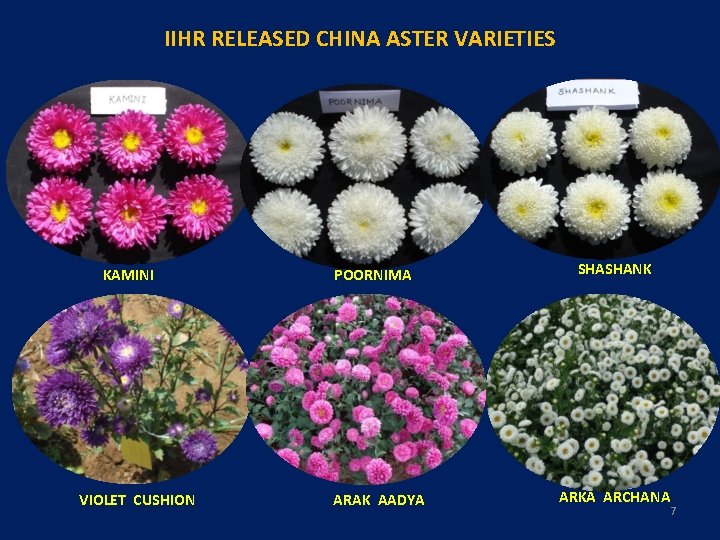
IIHR RELEASED CHINA ASTER VARIETIES KAMINI VIOLET CUSHION POORNIMA ARAK AADYA SHASHANK ARKA ARCHANA 7
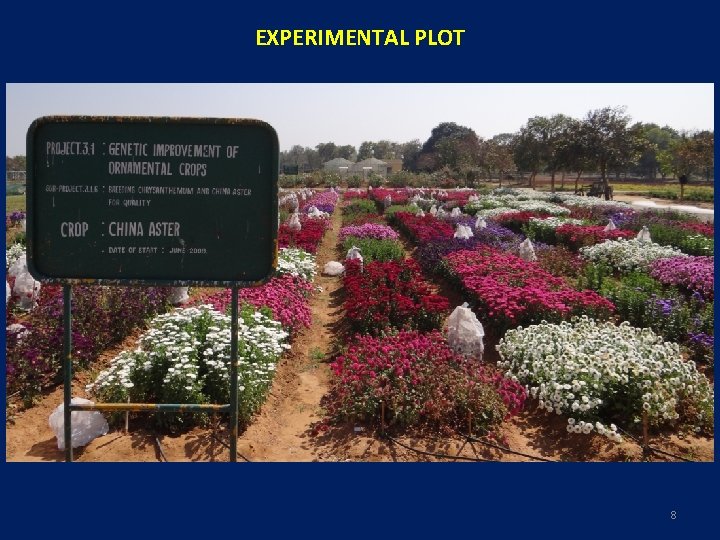
EXPERIMENTAL PLOT 8

RESULTS 9
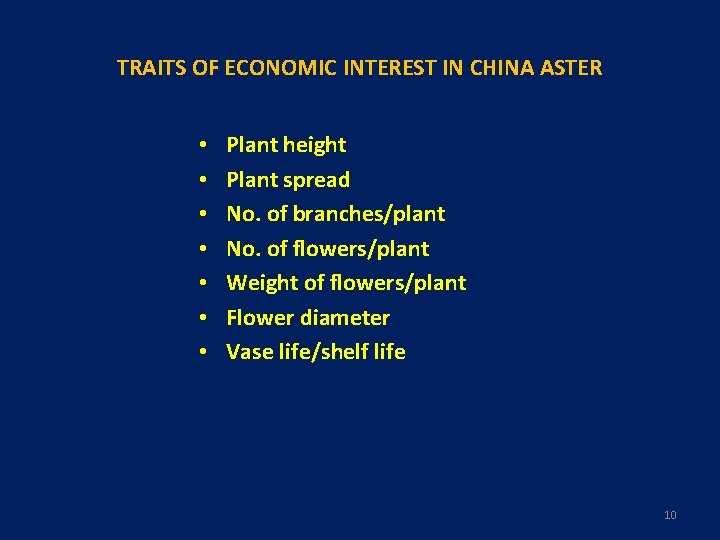
TRAITS OF ECONOMIC INTEREST IN CHINA ASTER • • Plant height Plant spread No. of branches/plant No. of flowers/plant Weight of flowers/plant Flower diameter Vase life/shelf life 10
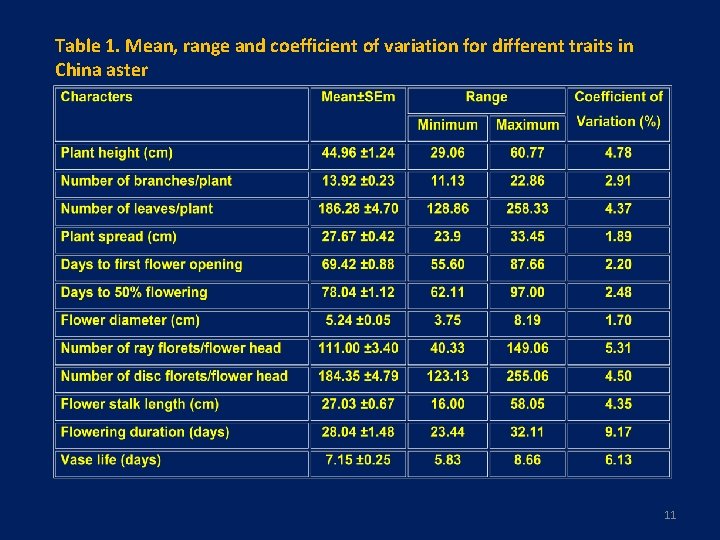
Table 1. Mean, range and coefficient of variation for different traits in China aster 11
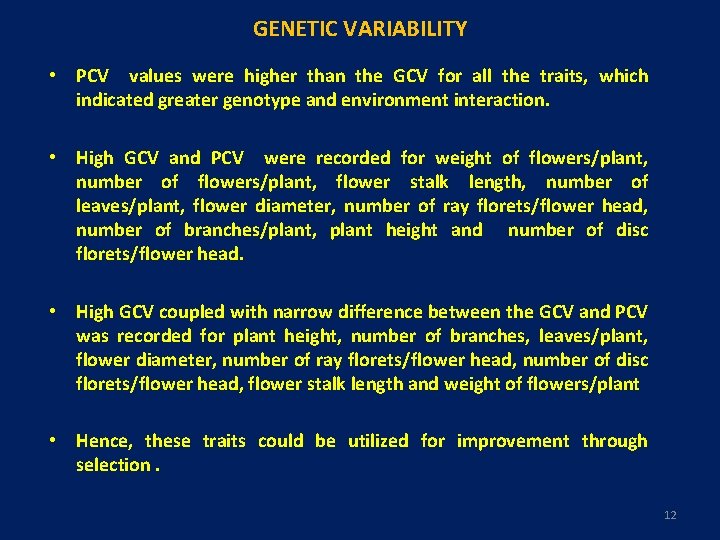
GENETIC VARIABILITY • PCV values were higher than the GCV for all the traits, which indicated greater genotype and environment interaction. • High GCV and PCV were recorded for weight of flowers/plant, number of flowers/plant, flower stalk length, number of leaves/plant, flower diameter, number of ray florets/flower head, number of branches/plant, plant height and number of disc florets/flower head. • High GCV coupled with narrow difference between the GCV and PCV was recorded for plant height, number of branches, leaves/plant, flower diameter, number of ray florets/flower head, number of disc florets/flower head, flower stalk length and weight of flowers/plant • Hence, these traits could be utilized for improvement through selection. 12
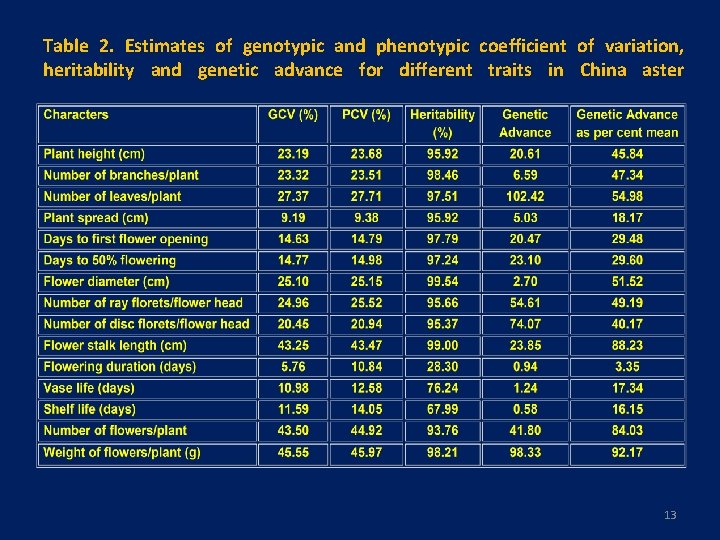
Table 2. Estimates of genotypic and phenotypic coefficient of variation, heritability and genetic advance for different traits in China aster 13
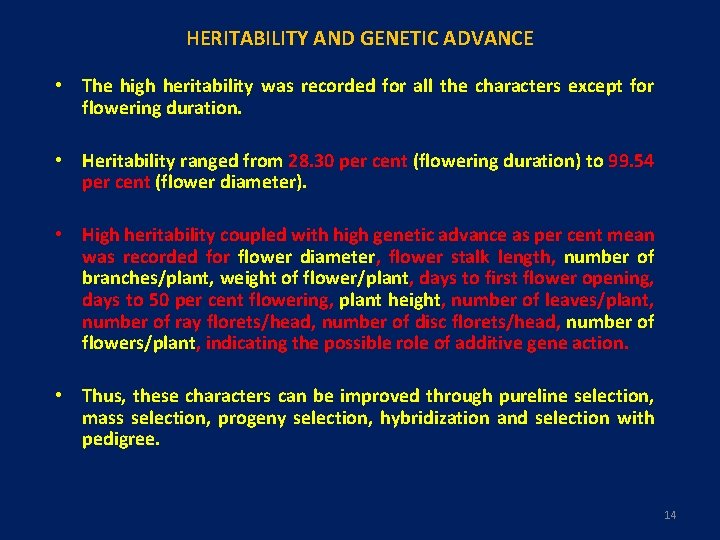
HERITABILITY AND GENETIC ADVANCE • The high heritability was recorded for all the characters except for flowering duration. • Heritability ranged from 28. 30 per cent (flowering duration) to 99. 54 per cent (flower diameter). • High heritability coupled with high genetic advance as per cent mean was recorded for flower diameter, flower stalk length, number of branches/plant, weight of flower/plant, days to first flower opening, days to 50 per cent flowering, plant height, number of leaves/plant, number of ray florets/head, number of disc florets/head, number of flowers/plant, indicating the possible role of additive gene action. • Thus, these characters can be improved through pureline selection, mass selection, progeny selection, hybridization and selection with pedigree. 14
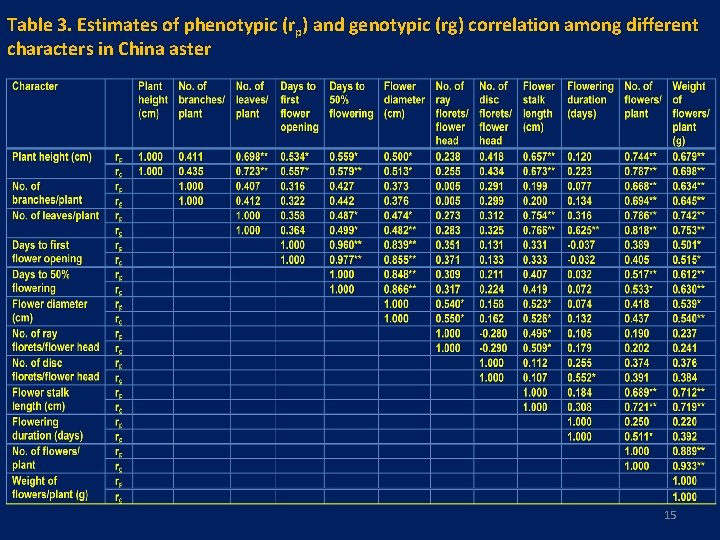
Table 3. Estimates of phenotypic (rp) and genotypic (rg) correlation among different characters in China aster 15
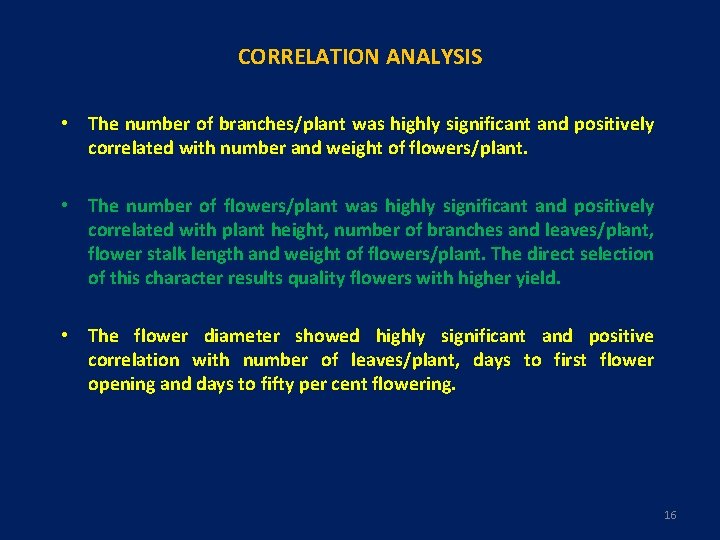
CORRELATION ANALYSIS • The number of branches/plant was highly significant and positively correlated with number and weight of flowers/plant. • The number of flowers/plant was highly significant and positively correlated with plant height, number of branches and leaves/plant, flower stalk length and weight of flowers/plant. The direct selection of this character results quality flowers with higher yield. • The flower diameter showed highly significant and positive correlation with number of leaves/plant, days to first flower opening and days to fifty per cent flowering. 16
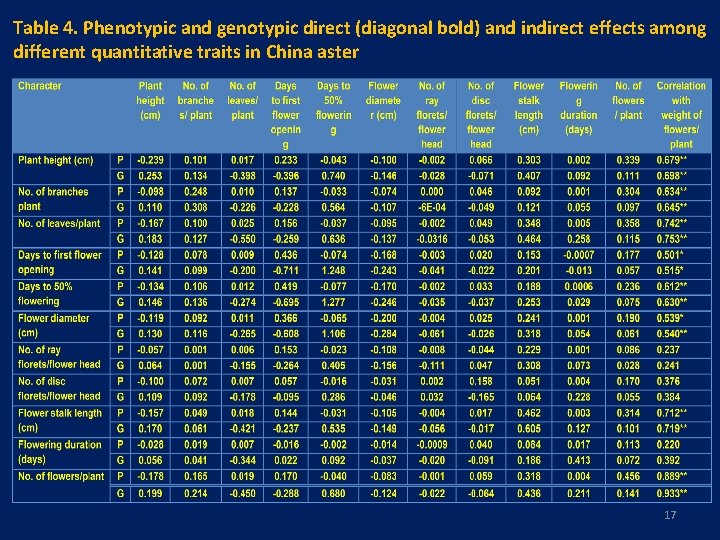
Table 4. Phenotypic and genotypic direct (diagonal bold) and indirect effects among different quantitative traits in China aster 17
PATH CO-EFFICIENT ANALYSIS • Plant height had positive direct effect on weight of flowers per plant, however, its correlation with weight of flowers per plant was positive and highly significant. • This character indirectly contributed to weight of flower plant via number of branches per plant, flower stalk length, flowering duration and number of flowers per plant. • Number of branches per plant had positive direct effect and highly significant correlation with weight of flower plant. 18
CONCLUSION • Observations recorded on 15 potential traits indicated highly significant genotypic differences for all the characters. • Traits viz. , plant height, flower diameter, number of ray and disc florets/flower head, flower stalk length, number and weight of flowers/plant showed high GCV, heritability and genetic advance. These characters can be useful in breeding programme of China aster. • Characters contributing in improvement in yield of flowers are number and weight of flowers/plant, plant height, number of branches/plant and flower stalk length. 19
Thank You 20
- Slides: 20