
Cultural Anthropology Chapter Eleven Political Organization and the
- Slides: 20
Cultural Anthropology Chapter Eleven: Political Organization and the Maintenance of Order Copyright © 2009 by Nelson Education Ltd.
Chapter Preview What Is Political Organization? How Is Order Maintained Within a Culture? How is Order Maintained Between Cultures? How Do Political Systems Obtain People’s Allegiance? Copyright © 2009 by Nelson Education Ltd.
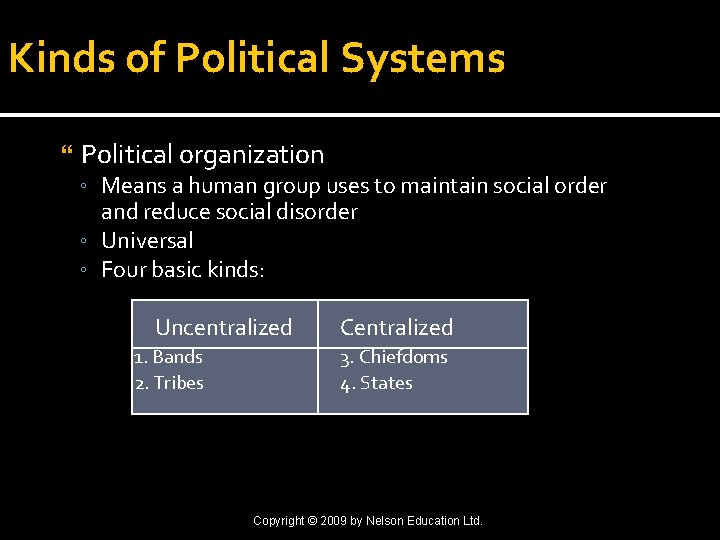
Kinds of Political Systems Political organization ◦ Means a human group uses to maintain social order and reduce social disorder ◦ Universal ◦ Four basic kinds: Uncentralized 1. Bands 2. Tribes Centralized 3. Chiefdoms 4. States Copyright © 2009 by Nelson Education Ltd.
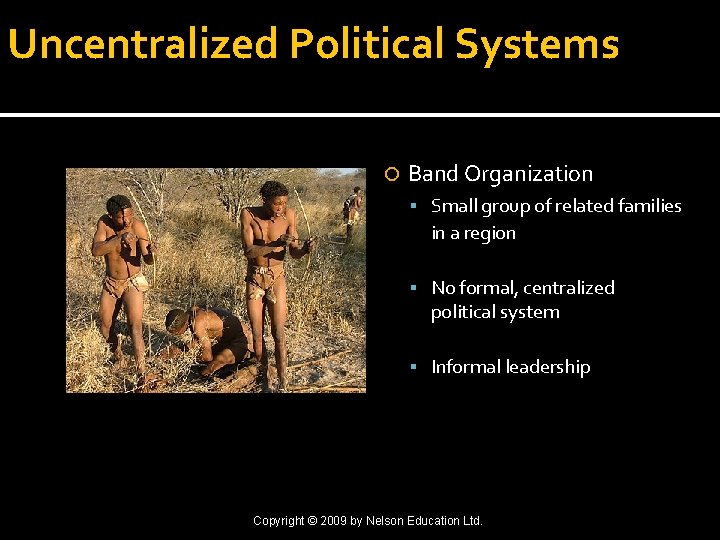
Uncentralized Political Systems Band Organization Small group of related families in a region No formal, centralized political system Informal leadership Copyright © 2009 by Nelson Education Ltd.
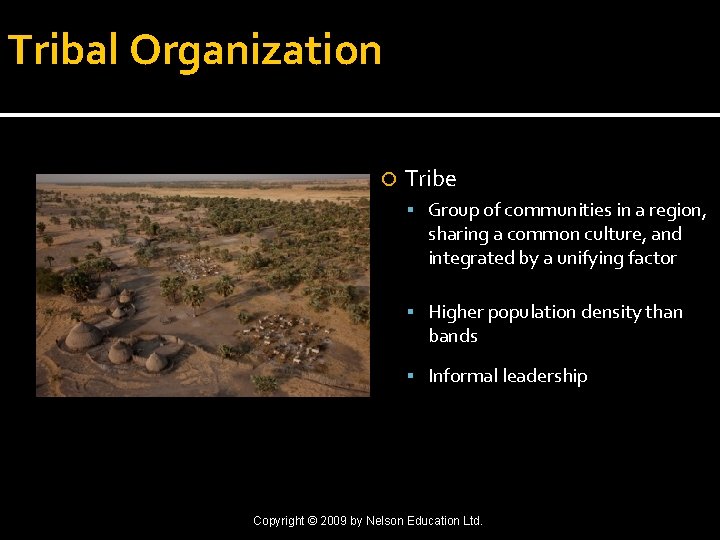
Tribal Organization Tribe Group of communities in a region, sharing a common culture, and integrated by a unifying factor Higher population density than bands Informal leadership Copyright © 2009 by Nelson Education Ltd.
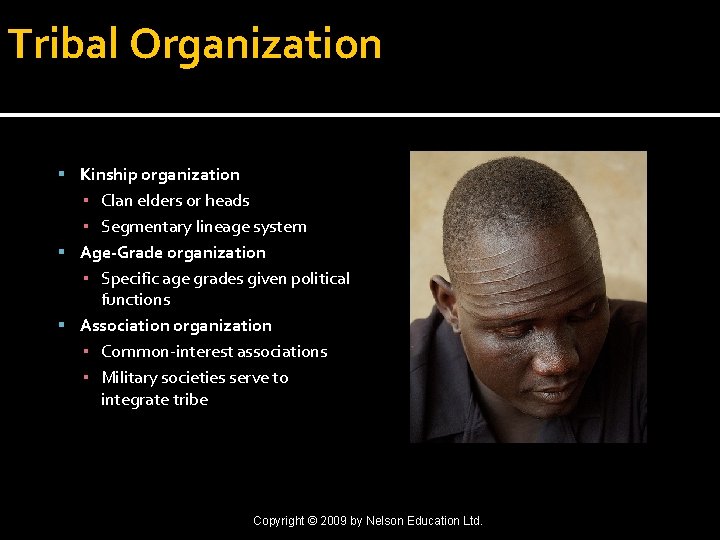
Tribal Organization Kinship organization ▪ Clan elders or heads ▪ Segmentary lineage system Age-Grade organization ▪ Specific age grades given political functions Association organization ▪ Common-interest associations ▪ Military societies serve to integrate tribe Copyright © 2009 by Nelson Education Ltd.
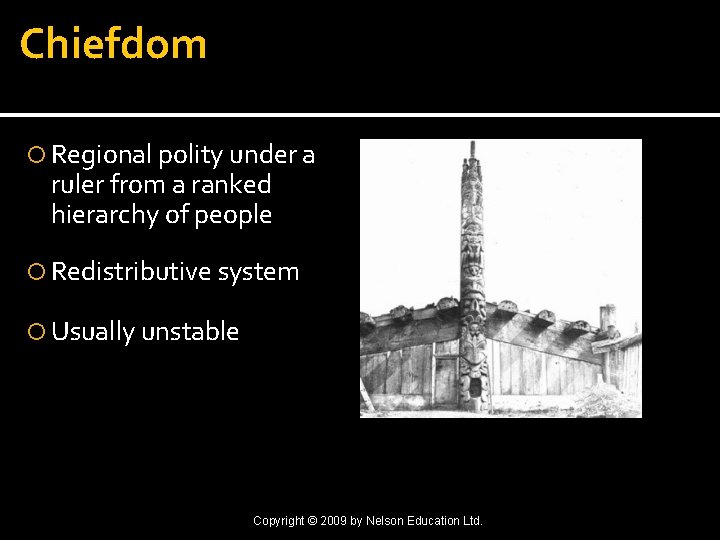
Chiefdom Regional polity under a ruler from a ranked hierarchy of people Redistributive system Usually unstable Copyright © 2009 by Nelson Education Ltd.
State System Power centralized in a government Legalized use of force Tendency toward instability and transience Usually multinational Difference between nation and state Nation: communities of people who see themselves as “one people” Today, 181 states and 5000 nations Copyright © 2009 by Nelson Education Ltd.
Political Leadership and Gender Women rarely in top political positions. There are presently exceptions to this. Women have power in a number of societies Bands Iroquois Igbo Copyright © 2009 by Nelson Education Ltd.
Political Organization and the Maintenance of Order Chiefdoms and states Authority with power to regulate peoples’ actions Bands and tribes No centralized authority Depend upon gossip, criticism, and fear of supernatural forces Copyright © 2009 by Nelson Education Ltd.
Internalized Controls Cultural control Control due to internalized beliefs and values Effective deterrents to antisocial behaviour ▪ Disgust of incest ▪ Fear of deformity, disease, or death ▪ Fear of ghosts or hell Copyright © 2009 by Nelson Education Ltd.
Externalized Controls Social control Open coercion Sanctions Conformity to social norms Formal (Organized) ▪ Positive ▪ Negative Informal (Diffuse) ▪ Positive ▪ Negative Copyright © 2009 by Nelson Education Ltd.
Original Study Limits on Power in Bedouin Society Power depends upon respect To win respect a person must follow ideals Alienating a dependent can lose respect for person in power ▪ Dependent can leave ▪ Kin of dependent can scold superior ▪ Supernatural retribution is feared Copyright © 2009 by Nelson Education Ltd.
Social Control Through Law Definition of law under contention Malinowski and Hoebel Use of overt coercion Need to consider each case in its cultural context Laws are formal negative sanctions Copyright © 2009 by Nelson Education Ltd.
Functions of Law - Defines relationships among society members - Allocates the authority to employ coercion in the enforcement of sanctions - Redefines social relations and ensures social flexibility Copyright © 2009 by Nelson Education Ltd.
Crime Distinction between crime and tort The former is a breach and violation of the public right, latter is an infringement or privation of the civil rights of an individual Settlement of disputes ◦ Negotiation ◦ Mediation ◦ Adjudication Copyright © 2009 by Nelson Education Ltd.
Political Organization and External Affairs War Not a universal phenomenon Situation specific Levels differ dramatically Dramatic increase in scale with states Crisis today Modern weaponry Civilian casualties Worldview a major factor Copyright © 2009 by Nelson Education Ltd.
Canada and International Peacekeeping External affairs more than warfare Diplomatic offices, trade relations and international aid Canadian soldiers involved in many military peacekeeping missions Copyright © 2009 by Nelson Education Ltd.
Political Systems and the Question of Legitimacy Allegiance necessary for society to work Uncentralized systems have it freely given Centralized systems rely upon coercion Legitimacy is the right of leaders to rule Based on social values Grants the rights of power May be withdrawn Copyright © 2009 by Nelson Education Ltd.
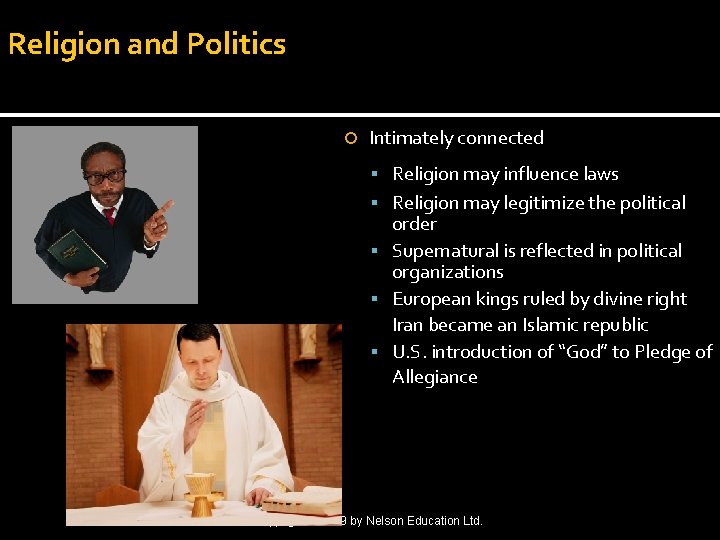
Religion and Politics Intimately connected Religion may influence laws Religion may legitimize the political order Supernatural is reflected in political organizations European kings ruled by divine right Iran became an Islamic republic U. S. introduction of “God” to Pledge of Allegiance Copyright © 2009 by Nelson Education Ltd.