Role of Fusion Energy in the 21 st




- Slides: 41
Role of Fusion Energy in the 21 st Century Farrokh Najmabadi Prof. of Electrical Engineering Director of Center for Energy Research UC San Diego NPSS Albuquerque Chapter August 30, 2007 With Thanks to Dr. Steve Koonin, BP for energy charts
The Energy Challenge Facts and Fiction
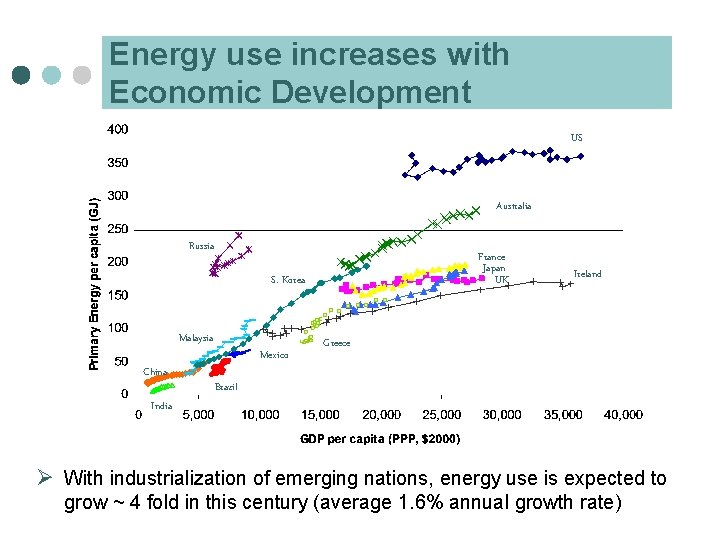
Energy use increases with Economic Development US Australia Russia France Japan UK S. Korea Malaysia China India Mexico Ireland Greece Brazil Ø With industrialization of emerging nations, energy use is expected to grow ~ 4 fold in this century (average 1. 6% annual growth rate)
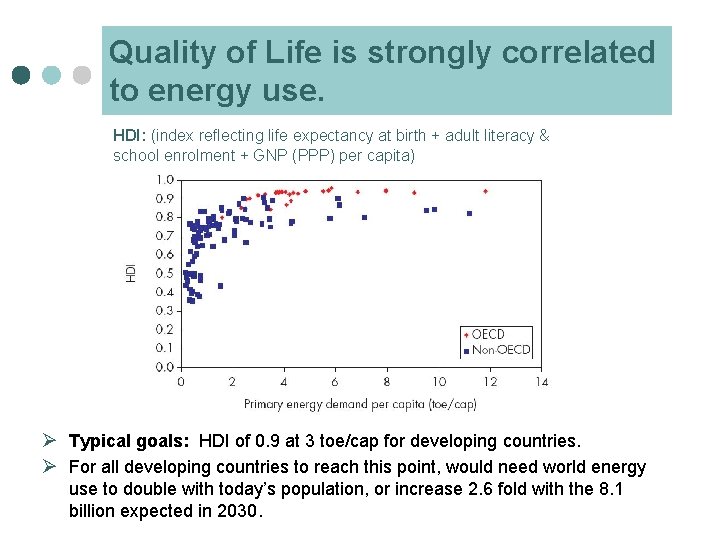
Quality of Life is strongly correlated to energy use. HDI: (index reflecting life expectancy at birth + adult literacy & school enrolment + GNP (PPP) per capita) Ø Typical goals: HDI of 0. 9 at 3 toe/cap for developing countries. Ø For all developing countries to reach this point, would need world energy use to double with today’s population, or increase 2. 6 fold with the 8. 1 billion expected in 2030.
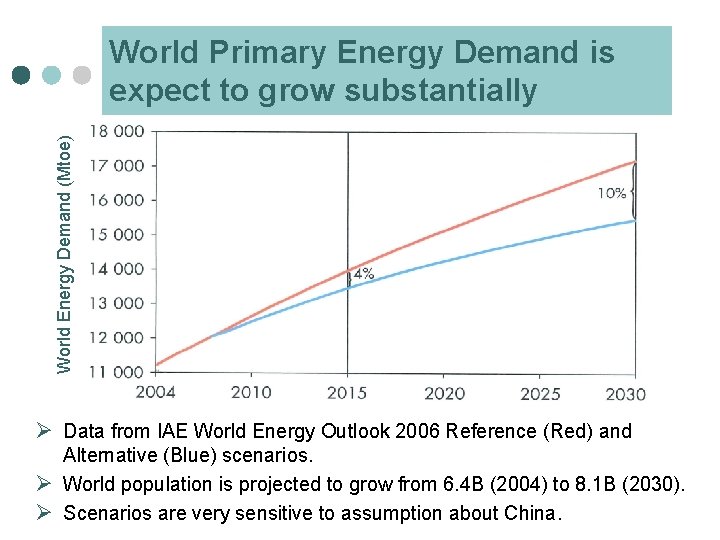
World Energy Demand (Mtoe) World Primary Energy Demand is expect to grow substantially Ø Data from IAE World Energy Outlook 2006 Reference (Red) and Alternative (Blue) scenarios. Ø World population is projected to grow from 6. 4 B (2004) to 8. 1 B (2030). Ø Scenarios are very sensitive to assumption about China.
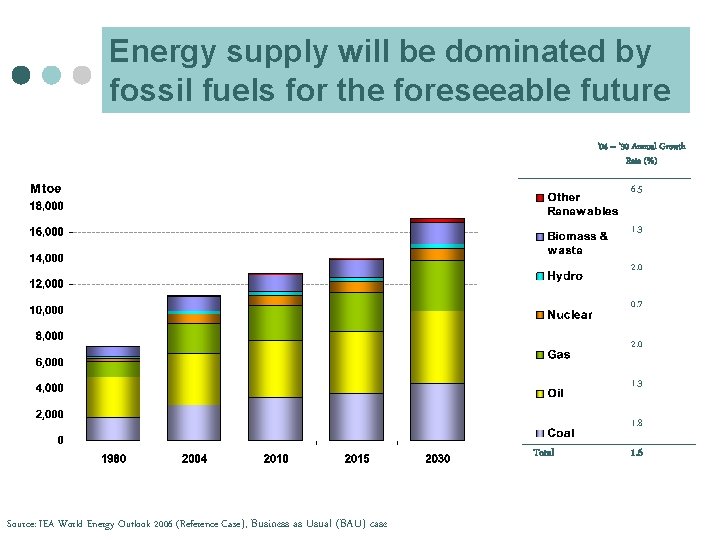
Energy supply will be dominated by fossil fuels for the foreseeable future ’ 04 – ’ 30 Annual Growth Rate (%) 6. 5 1. 3 2. 0 0. 7 2. 0 1. 3 1. 8 Total Source: IEA World Energy Outlook 2006 (Reference Case), Business as Usual (BAU) case 1. 6
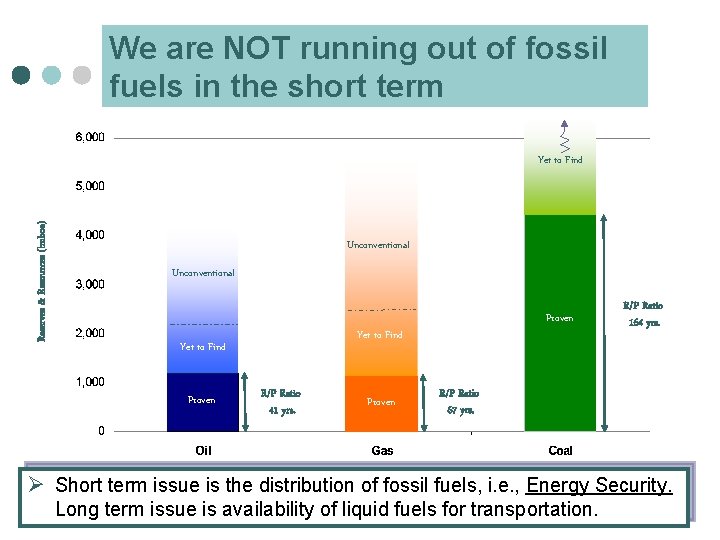
We are NOT running out of fossil fuels in the short term Reserves & Resources (bnboe) Yet to Find Unconventional Yet to Find Proven R/P Ratio 41 yrs. Proven R/P Ratio 164 yrs. R/P Ratio 67 yrs. Ø Short term issue is the distribution of fossil fuels, i. e. , Energy Security. Long term issue is availability of liquid fuels for transportation.
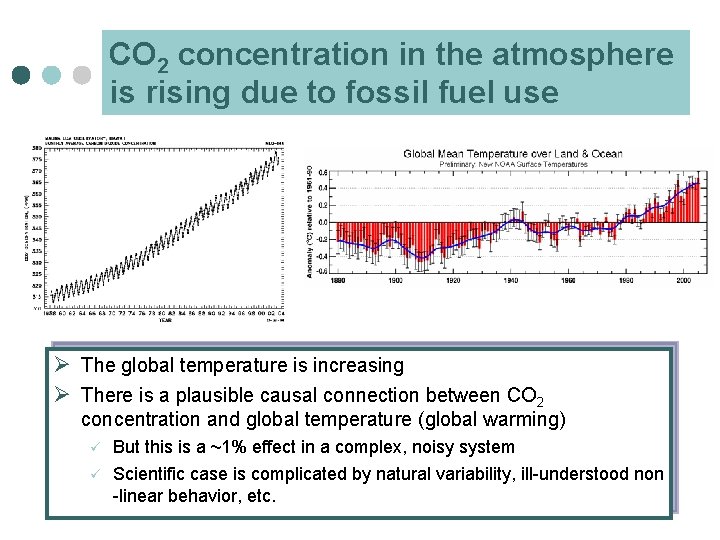
CO 2 concentration in the atmosphere is rising due to fossil fuel use Ø The global temperature is increasing Ø There is a plausible causal connection between CO 2 concentration and global temperature (global warming) ü But this is a ~1% effect in a complex, noisy system ü Scientific case is complicated by natural variability, ill-understood non -linear behavior, etc.
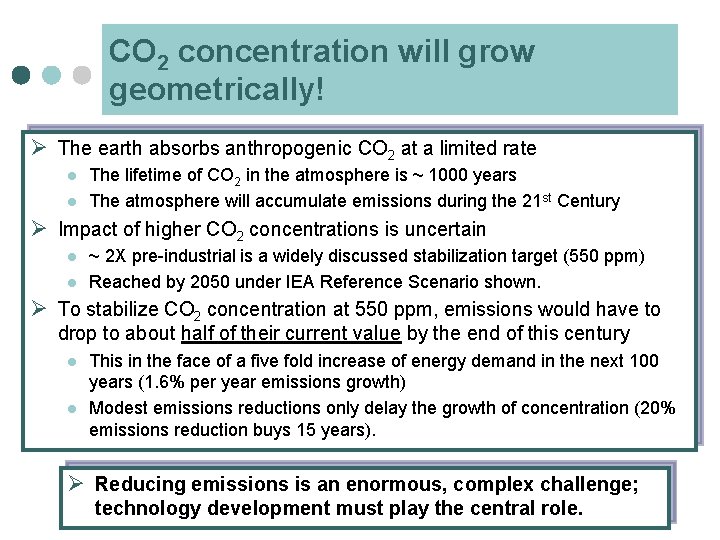
CO 2 concentration will grow geometrically! Ø The earth absorbs anthropogenic CO 2 at a limited rate l l The lifetime of CO 2 in the atmosphere is ~ 1000 years The atmosphere will accumulate emissions during the 21 st Century Ø Impact of higher CO 2 concentrations is uncertain l l ~ 2 X pre-industrial is a widely discussed stabilization target (550 ppm) Reached by 2050 under IEA Reference Scenario shown. Ø To stabilize CO 2 concentration at 550 ppm, emissions would have to drop to about half of their current value by the end of this century l l This in the face of a five fold increase of energy demand in the next 100 years (1. 6% per year emissions growth) Modest emissions reductions only delay the growth of concentration (20% emissions reduction buys 15 years). Ø Reducing emissions is an enormous, complex challenge; technology development must play the central role.
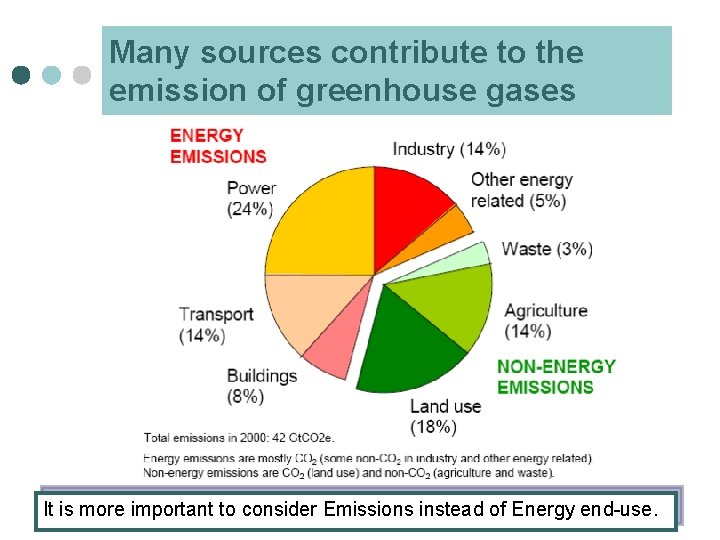
Many sources contribute to the emission of greenhouse gases It is more important to consider Emissions instead of Energy end-use.
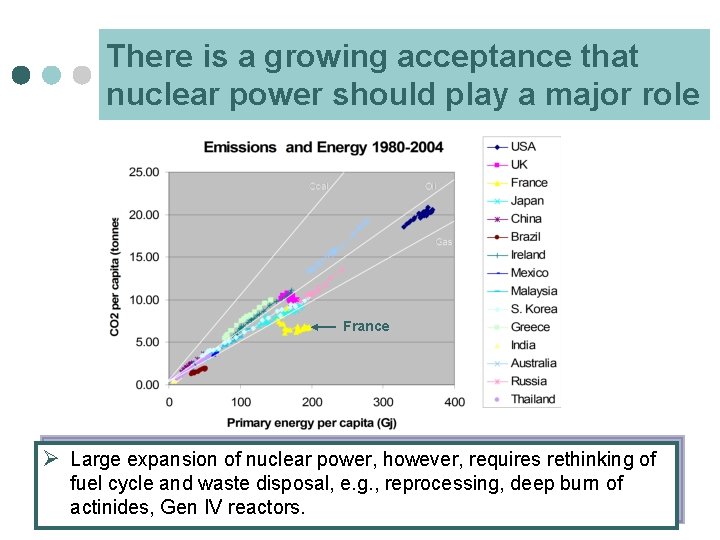
There is a growing acceptance that nuclear power should play a major role France Ø Large expansion of nuclear power, however, requires rethinking of fuel cycle and waste disposal, e. g. , reprocessing, deep burn of actinides, Gen IV reactors.
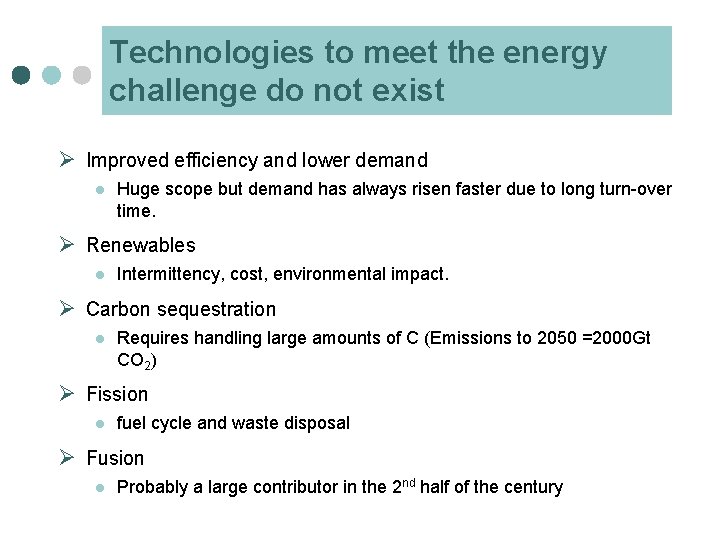
Technologies to meet the energy challenge do not exist Ø Improved efficiency and lower demand l Huge scope but demand has always risen faster due to long turn-over time. Ø Renewables l Intermittency, cost, environmental impact. Ø Carbon sequestration l Requires handling large amounts of C (Emissions to 2050 =2000 Gt CO 2) Ø Fission l fuel cycle and waste disposal Ø Fusion l Probably a large contributor in the 2 nd half of the century
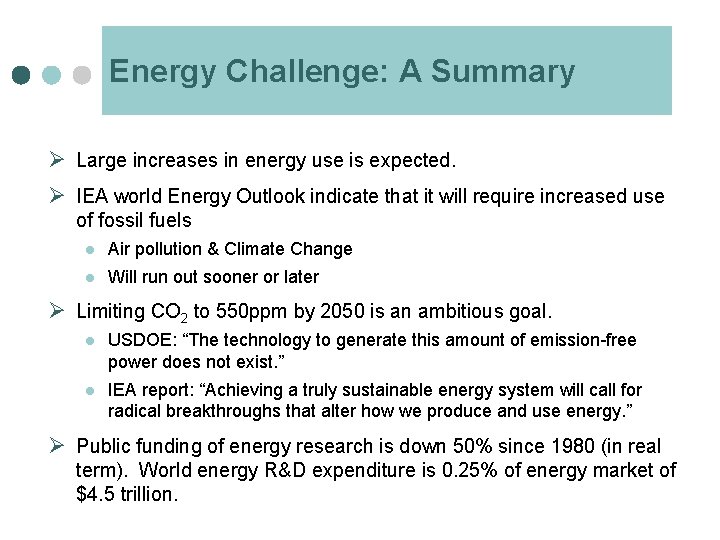
Energy Challenge: A Summary Ø Large increases in energy use is expected. Ø IEA world Energy Outlook indicate that it will require increased use of fossil fuels l Air pollution & Climate Change l Will run out sooner or later Ø Limiting CO 2 to 550 ppm by 2050 is an ambitious goal. l USDOE: “The technology to generate this amount of emission-free power does not exist. ” l IEA report: “Achieving a truly sustainable energy system will call for radical breakthroughs that alter how we produce and use energy. ” Ø Public funding of energy research is down 50% since 1980 (in real term). World energy R&D expenditure is 0. 25% of energy market of $4. 5 trillion.
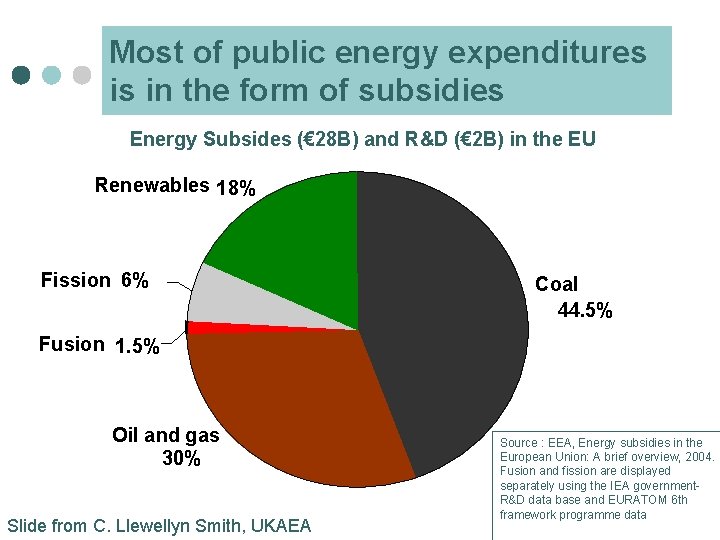
Most of public energy expenditures is in the form of subsidies Energy Subsides (€ 28 B) and R&D (€ 2 B) in the EU Renewables 18% Fission 6% Coal 44. 5% Fusion 1. 5% Oil and gas 30% Slide from C. Llewellyn Smith, UKAEA Source : EEA, Energy subsidies in the European Union: A brief overview, 2004. Fusion and fission are displayed separately using the IEA government. R&D data base and EURATOM 6 th framework programme data
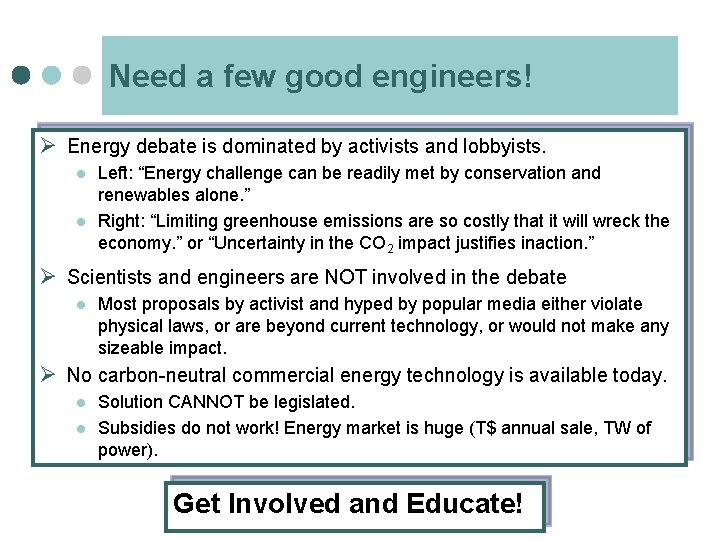
Need a few good engineers! Ø Energy debate is dominated by activists and lobbyists. l l Left: “Energy challenge can be readily met by conservation and renewables alone. ” Right: “Limiting greenhouse emissions are so costly that it will wreck the economy. ” or “Uncertainty in the CO 2 impact justifies inaction. ” Ø Scientists and engineers are NOT involved in the debate l Most proposals by activist and hyped by popular media either violate physical laws, or are beyond current technology, or would not make any sizeable impact. Ø No carbon-neutral commercial energy technology is available today. l l Solution CANNOT be legislated. Subsidies do not work! Energy market is huge (T$ annual sale, TW of power). Get Involved and Educate!
Status of Fusion Research
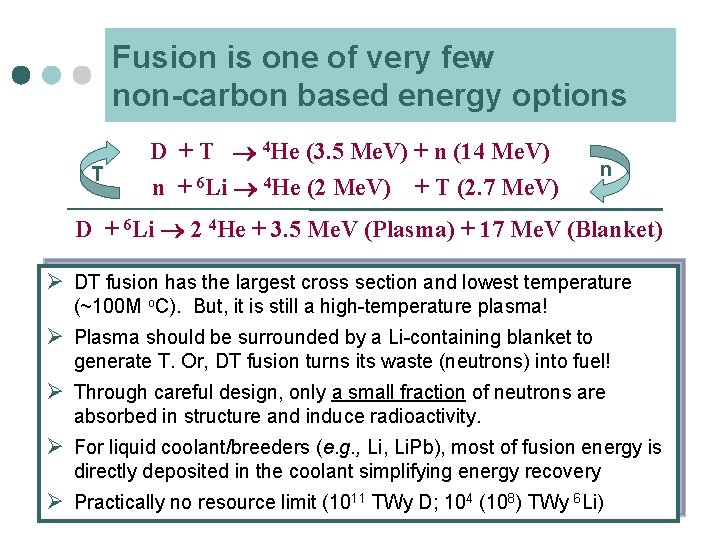
Fusion is one of very few non-carbon based energy options T D + T 4 He (3. 5 Me. V) + n (14 Me. V) n + 6 Li 4 He (2 Me. V) + T (2. 7 Me. V) n D + 6 Li 2 4 He + 3. 5 Me. V (Plasma) + 17 Me. V (Blanket) Ø DT fusion has the largest cross section and lowest temperature (~100 M o. C). But, it is still a high-temperature plasma! Ø Plasma should be surrounded by a Li-containing blanket to generate T. Or, DT fusion turns its waste (neutrons) into fuel! Ø Through careful design, only a small fraction of neutrons are absorbed in structure and induce radioactivity. Ø For liquid coolant/breeders (e. g. , Li. Pb), most of fusion energy is directly deposited in the coolant simplifying energy recovery Ø Practically no resource limit (1011 TWy D; 104 (108) TWy 6 Li)
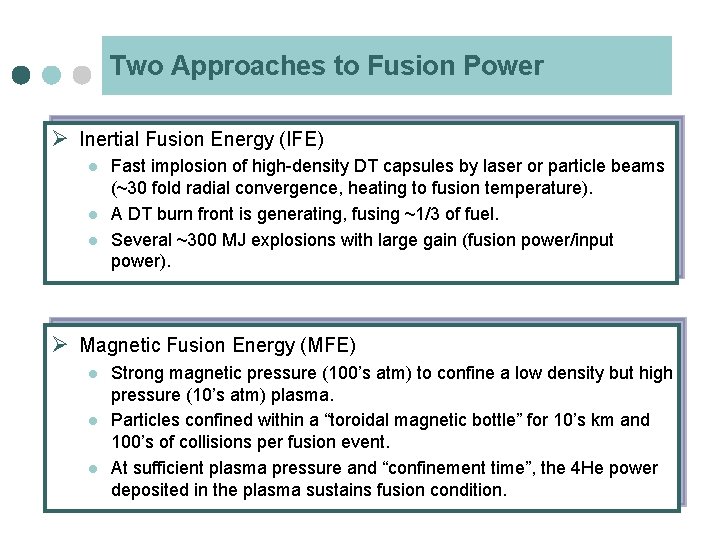
Two Approaches to Fusion Power Ø Inertial Fusion Energy (IFE) l l l Fast implosion of high-density DT capsules by laser or particle beams (~30 fold radial convergence, heating to fusion temperature). A DT burn front is generating, fusing ~1/3 of fuel. Several ~300 MJ explosions with large gain (fusion power/input power). Ø Magnetic Fusion Energy (MFE) l l l Strong magnetic pressure (100’s atm) to confine a low density but high pressure (10’s atm) plasma. Particles confined within a “toroidal magnetic bottle” for 10’s km and 100’s of collisions per fusion event. At sufficient plasma pressure and “confinement time”, the 4 He power deposited in the plasma sustains fusion condition.
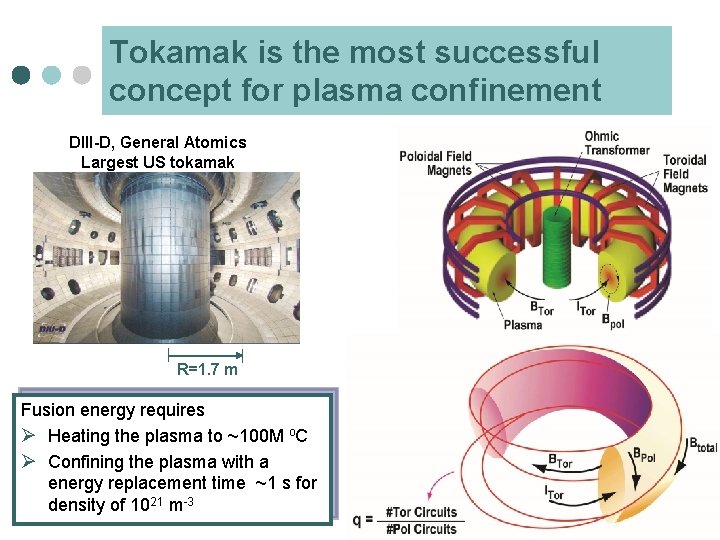
Tokamak is the most successful concept for plasma confinement DIII-D, General Atomics Largest US tokamak R=1. 7 m JET 3 m requires Fusion energy Ø Heating the plasma to ~100 M o. C Ø Confining the plasma with a energy replacement time ~1 s for density of 1021 m-3
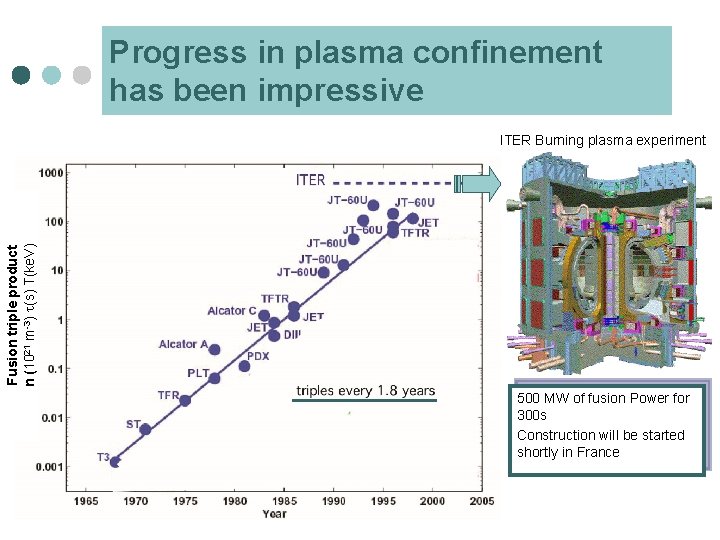
Progress in plasma confinement has been impressive Fusion triple product n (1021 m-3) t(s) T(ke. V) ITER Burning plasma experiment 500 MW of fusion Power for 300 s Construction will be started shortly in France
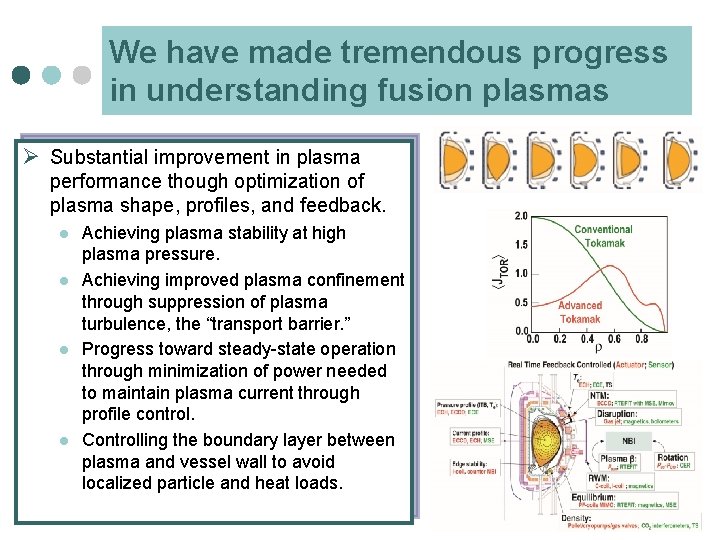
We have made tremendous progress in understanding fusion plasmas Ø Substantial improvement in plasma performance though optimization of plasma shape, profiles, and feedback. l l Achieving plasma stability at high plasma pressure. Achieving improved plasma confinement through suppression of plasma turbulence, the “transport barrier. ” Progress toward steady-state operation through minimization of power needed to maintain plasma current through profile control. Controlling the boundary layer between plasma and vessel wall to avoid localized particle and heat loads.
Fusion: Looking into the future
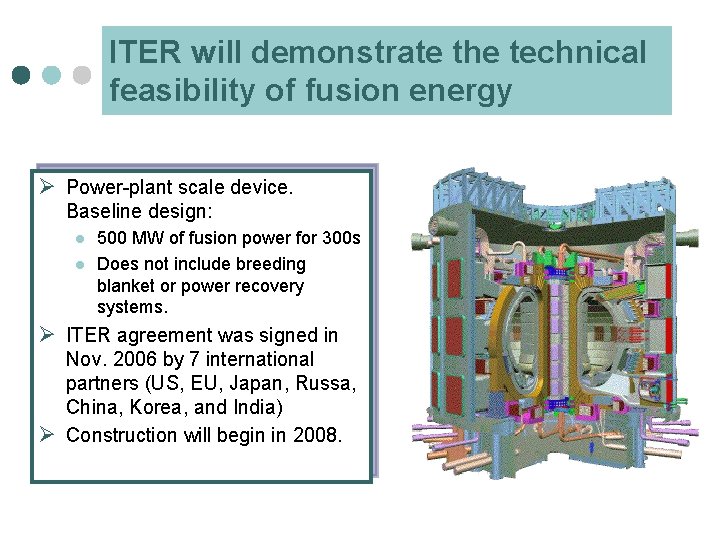
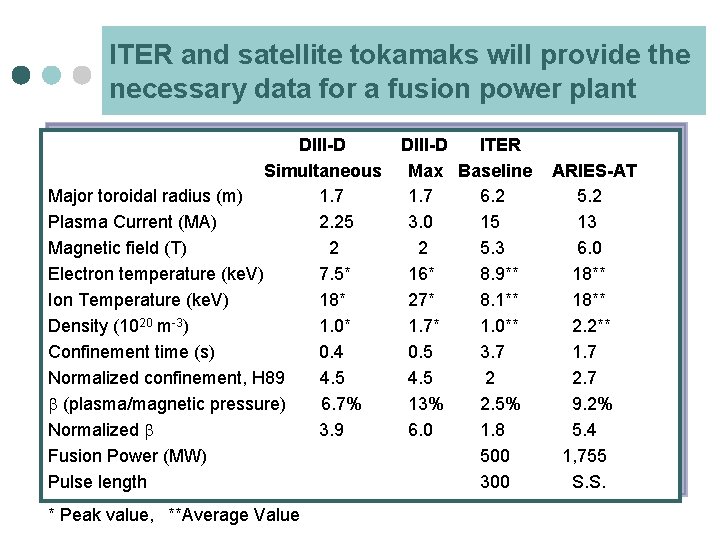
ITER will demonstrate the technical feasibility of fusion energy Ø Power-plant scale device. Baseline design: l l 500 MW of fusion power for 300 s Does not include breeding blanket or power recovery systems. Ø ITER agreement was signed in Nov. 2006 by 7 international partners (US, EU, Japan, Russa, China, Korea, and India) Ø Construction will begin in 2008.
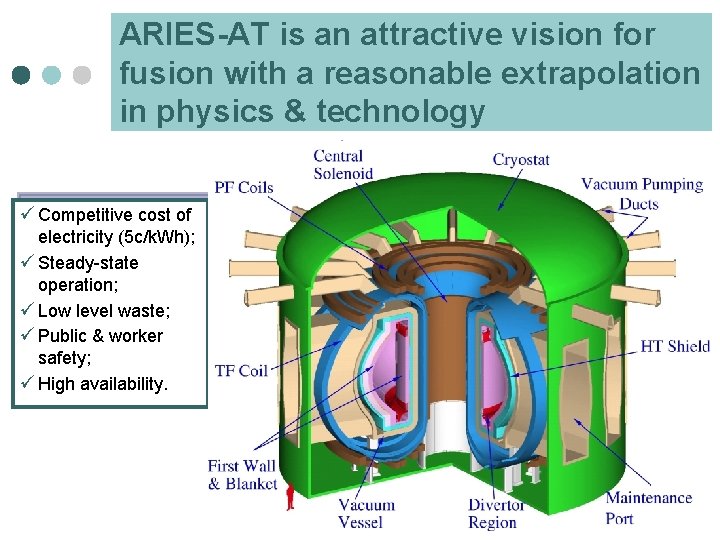
ARIES-AT is an attractive vision for fusion with a reasonable extrapolation in physics & technology ü Competitive cost of electricity (5 c/k. Wh); ü Steady-state operation; ü Low level waste; ü Public & worker safety; ü High availability.
ITER and satellite tokamaks will provide the necessary data for a fusion power plant DIII-D Simultaneous Major toroidal radius (m) 1. 7 Plasma Current (MA) 2. 25 Magnetic field (T) 2 Electron temperature (ke. V) 7. 5* Ion Temperature (ke. V) 18* Density (1020 m-3) 1. 0* Confinement time (s) 0. 4 Normalized confinement, H 89 4. 5 b (plasma/magnetic pressure) 6. 7% Normalized b 3. 9 Fusion Power (MW) Pulse length * Peak value, **Average Value DIII-D ITER Max Baseline 1. 7 6. 2 3. 0 15 2 5. 3 16* 8. 9** 27* 8. 1** 1. 7* 1. 0** 0. 5 3. 7 4. 5 2 13% 2. 5% 6. 0 1. 8 500 300 ARIES-AT 5. 2 13 6. 0 18** 2. 2** 1. 7 2. 7 9. 2% 5. 4 1, 755 S. S.
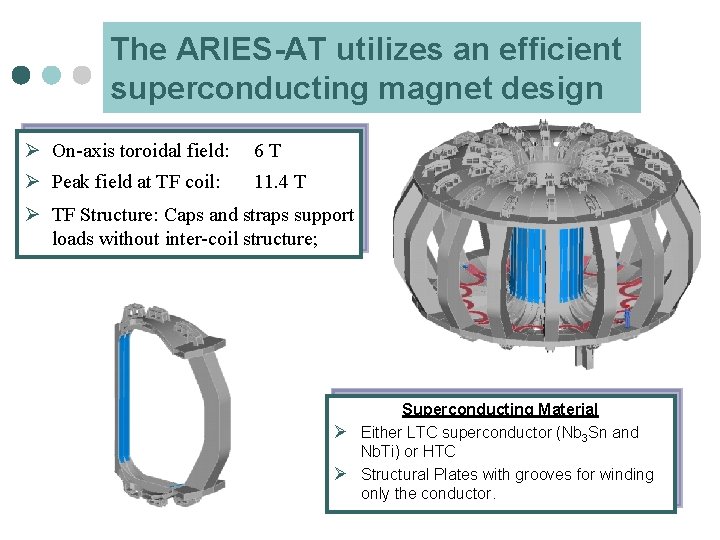
The ARIES-AT utilizes an efficient superconducting magnet design Ø On-axis toroidal field: 6 T Ø Peak field at TF coil: 11. 4 T Ø TF Structure: Caps and straps support loads without inter-coil structure; Superconducting Material Ø Either LTC superconductor (Nb 3 Sn and Nb. Ti) or HTC Ø Structural Plates with grooves for winding only the conductor.
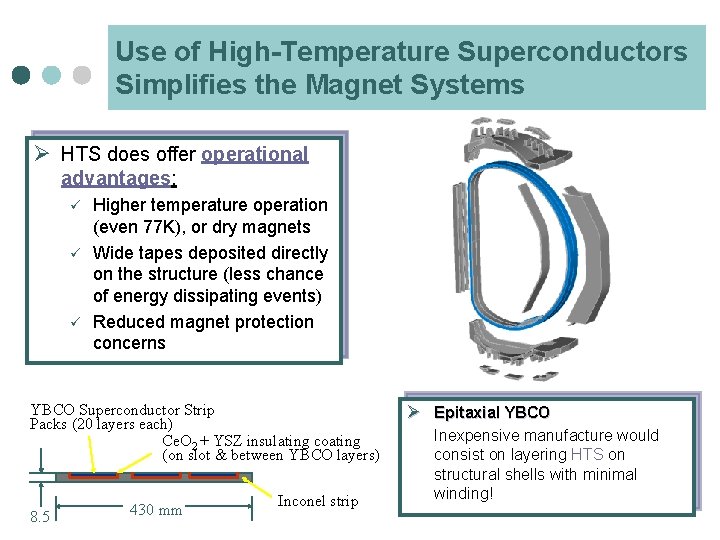
Use of High-Temperature Superconductors Simplifies the Magnet Systems Ø HTS does offer operational advantages: ü ü ü Higher temperature operation (even 77 K), or dry magnets Wide tapes deposited directly on the structure (less chance of energy dissipating events) Reduced magnet protection concerns YBCO Superconductor Strip Packs (20 layers each) Ce. O 2 + YSZ insulating coating (on slot & between YBCO layers) 8. 5 430 mm Inconel strip Ø Epitaxial YBCO Inexpensive manufacture would consist on layering HTS on structural shells with minimal winding!
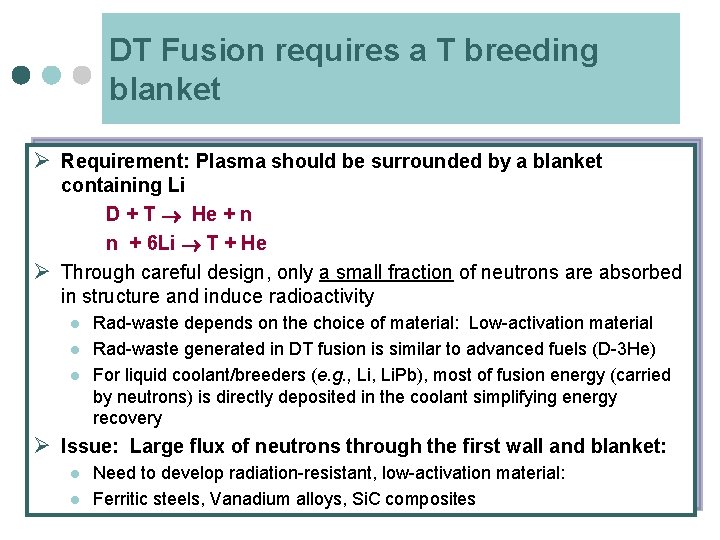
DT Fusion requires a T breeding blanket Ø Requirement: Plasma should be surrounded by a blanket containing Li D + T He + n n + 6 Li T + He Ø Through careful design, only a small fraction of neutrons are absorbed in structure and induce radioactivity l l l Rad-waste depends on the choice of material: Low-activation material Rad-waste generated in DT fusion is similar to advanced fuels (D-3 He) For liquid coolant/breeders (e. g. , Li. Pb), most of fusion energy (carried by neutrons) is directly deposited in the coolant simplifying energy recovery Ø Issue: Large flux of neutrons through the first wall and blanket: l l Need to develop radiation-resistant, low-activation material: Ferritic steels, Vanadium alloys, Si. C composites
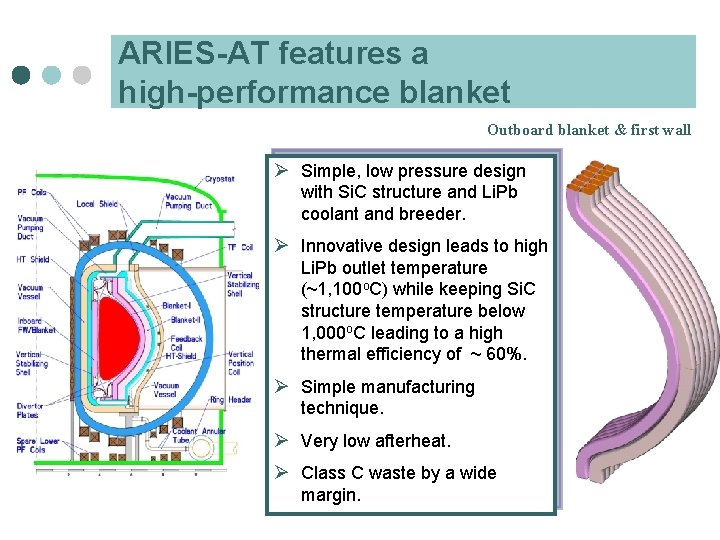
ARIES-AT features a high-performance blanket Outboard blanket & first wall Ø Simple, low pressure design with Si. C structure and Li. Pb coolant and breeder. Ø Innovative design leads to high Li. Pb outlet temperature (~1, 100 o. C) while keeping Si. C structure temperature below 1, 000 o. C leading to a high thermal efficiency of ~ 60%. Ø Simple manufacturing technique. Ø Very low afterheat. Ø Class C waste by a wide margin.
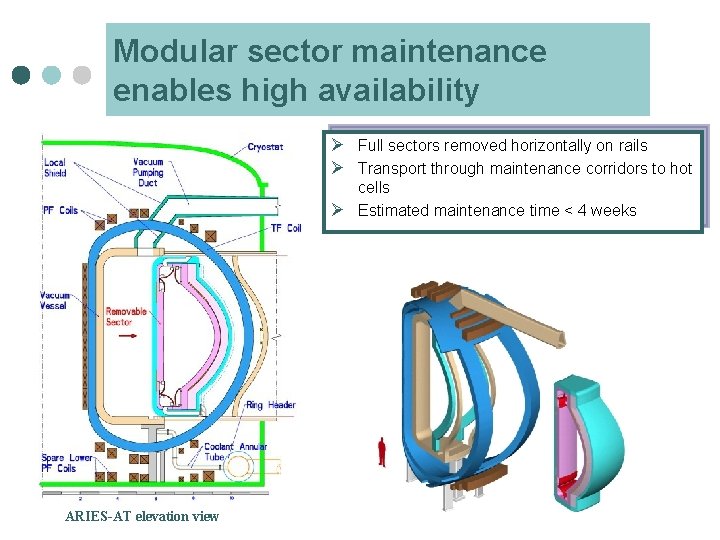
Modular sector maintenance enables high availability Ø Full sectors removed horizontally on rails Ø Transport through maintenance corridors to hot cells Ø Estimated maintenance time < 4 weeks ARIES-AT elevation view
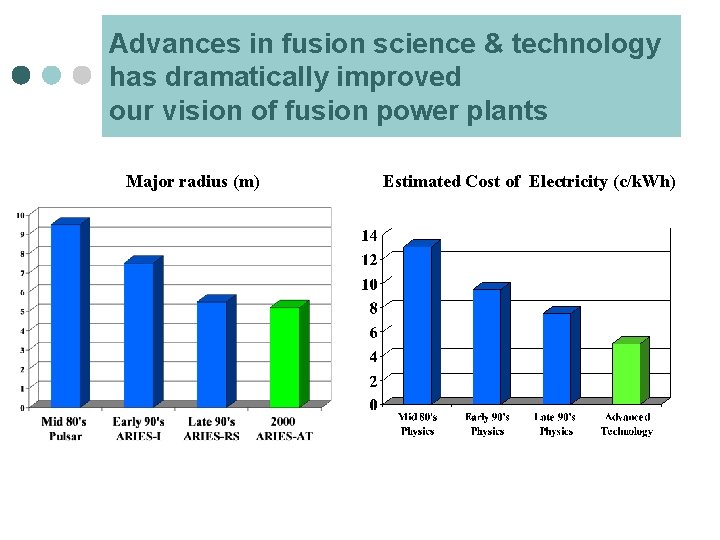
Advances in fusion science & technology has dramatically improved our vision of fusion power plants Major radius (m) Estimated Cost of Electricity (c/k. Wh)
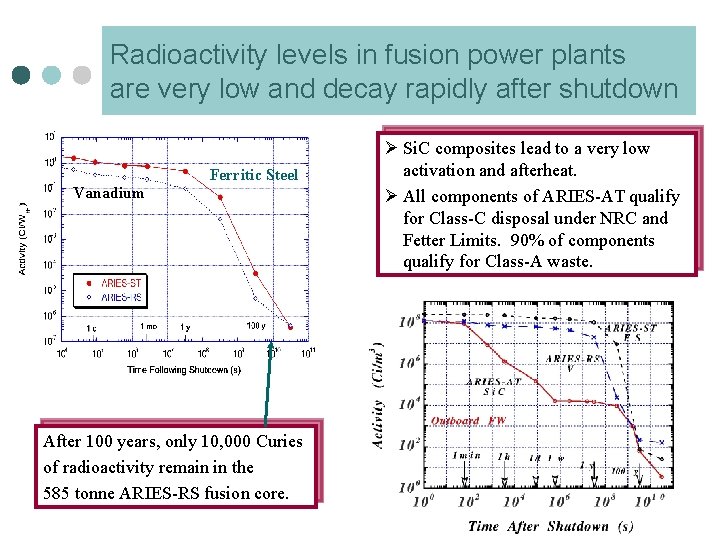
Radioactivity levels in fusion power plants are very low and decay rapidly after shutdown Ferritic Steel Vanadium After 100 years, only 10, 000 Curies of radioactivity remain in the 585 tonne ARIES-RS fusion core. Ø Si. C composites lead to a very low activation and afterheat. Ø All components of ARIES-AT qualify for Class-C disposal under NRC and Fetter Limits. 90% of components qualify for Class-A waste.
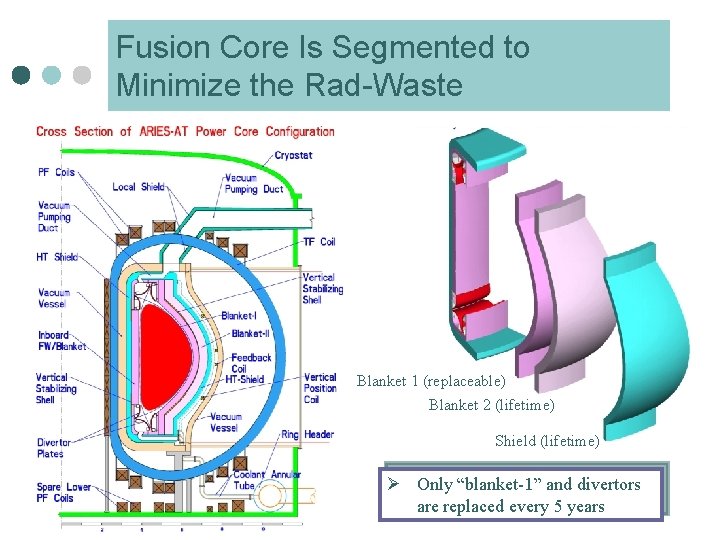
Fusion Core Is Segmented to Minimize the Rad-Waste Blanket 1 (replaceable) Blanket 2 (lifetime) Shield (lifetime) Ø Only “blanket-1” and divertors are replaced every 5 years
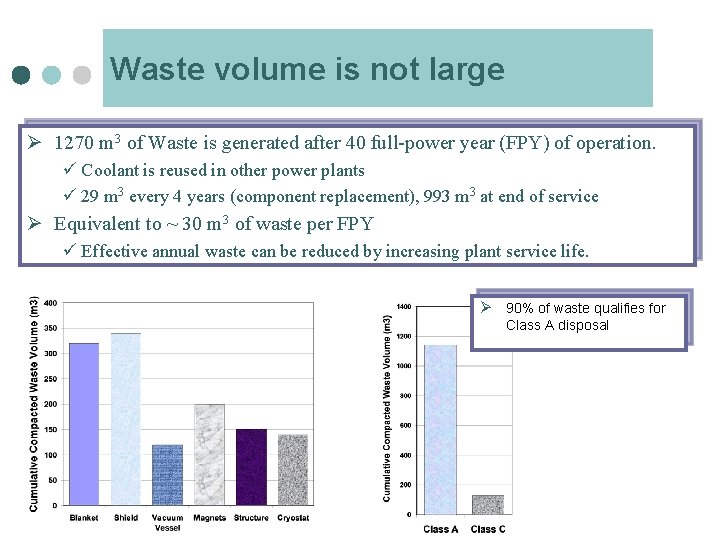
Waste volume is not large Ø 1270 m 3 of Waste is generated after 40 full-power year (FPY) of operation. ü Coolant is reused in other power plants ü 29 m 3 every 4 years (component replacement), 993 m 3 at end of service Ø Equivalent to ~ 30 m 3 of waste per FPY ü Effective annual waste can be reduced by increasing plant service life. Ø 90% of waste qualifies for Class A disposal
Fusion: Why is taking so long?
There has been no urgency in developing new sources of energy Ø Proposed fusion development plan in 1976 aimed at fielding a fusion Demo by 2000. Ø Recent DOE Fusion Development Plan (2003) aimed at fielding a fusion Demo by 2030. Ø The required funding to implement the plans were not approved. Ø Proposals for fielding a burning plasma experiments since mid 1980 s. Ø Fusion program was restructured in mid 1990 s, focusing on developing fusion sciences (with 1/3 reduction in US funding). l Fielding a fusion Demo is NOT the official goal of DOE at present Ø Large interest and R&D investment in Europe and Japan (and China, India, Korea)
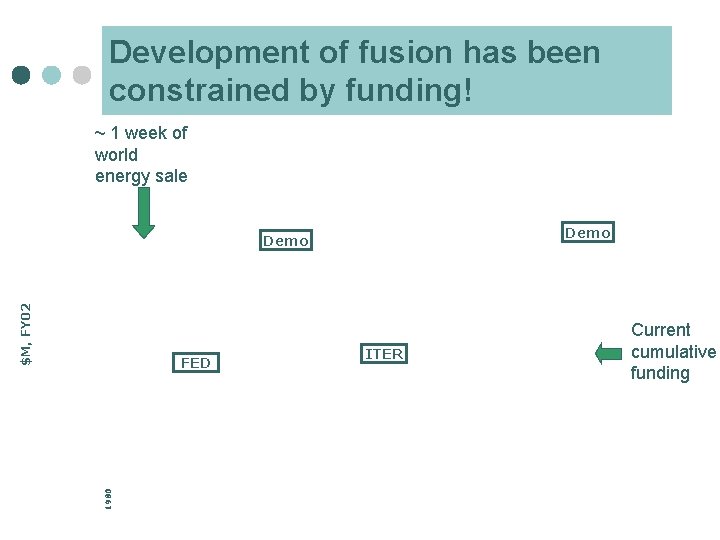
Development of fusion has been constrained by funding! ~ 1 week of world energy sale Demo $M, FY 02 Demo 1980 FED ITER Current cumulative funding
In Summary, …
In a CO 2 constrained world uncertainty abounds Ø No carbon-neutral commercial energy technology is available today. Carbon sequestration is the determining factor fossil fuel electric generation. l A large investment in energy R&D is needed. l A shift to a hydrogen economy or carbon-neutral syn-fuels is also needed to allow continued use of liquid fuels for transportation. Ø Problem cannot be solved by legislation or subsidy. We need technical solutions. l l Technical Communities should be involved or considerable public resources would be wasted Ø The size of energy market ($1 T annual sale, TW of power) is huge. Solutions should fit this size market l l 100 Nuclear plants = 20% of electricity production $50 B annual R&D represents 5% of energy sale
Status of fusion power Ø Over 15 MW of fusion power is generated (JET, 1997) establishing “scientific feasibility” of fusion power l Although fusion power < input power. Ø ITER will demonstrate “technical feasibility” of fusion power by generating copious amount of fusion power (500 MW for 300 s) with fusion power > 10 input power. Ø Tremendous progress in understanding plasmas helped optimize plasma performance considerably. Vision of attractive fusion power plants exists. Ø Transformation of fusion into a power plant requires considerable R&D in material and fusion nuclear technologies (largely ignored or under-funded to date). l This step, however, can be done in parallel with ITER Ø Large synergy between fusion nuclear technology R&D and Gen-IV.
Thank you! Any Questions?