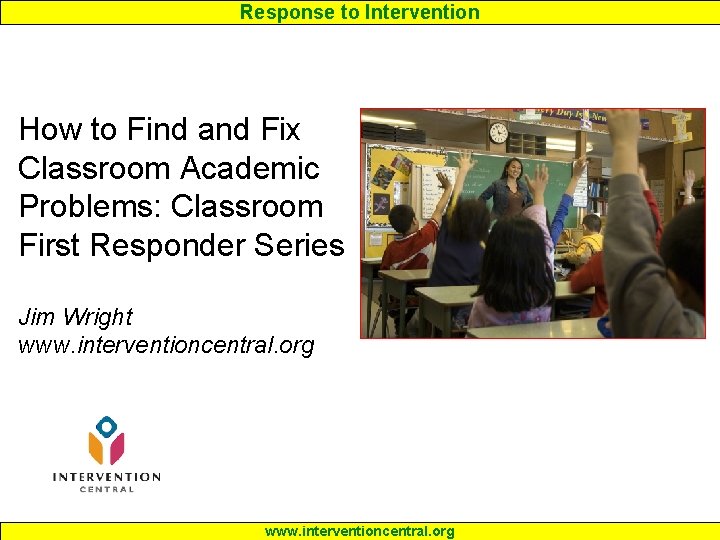
Response to Intervention How to Find and Fix
- Slides: 113
Response to Intervention How to Find and Fix Classroom Academic Problems: Classroom First Responder Series Jim Wright www. interventioncentral. org
Response to Intervention www. interventioncentral. org
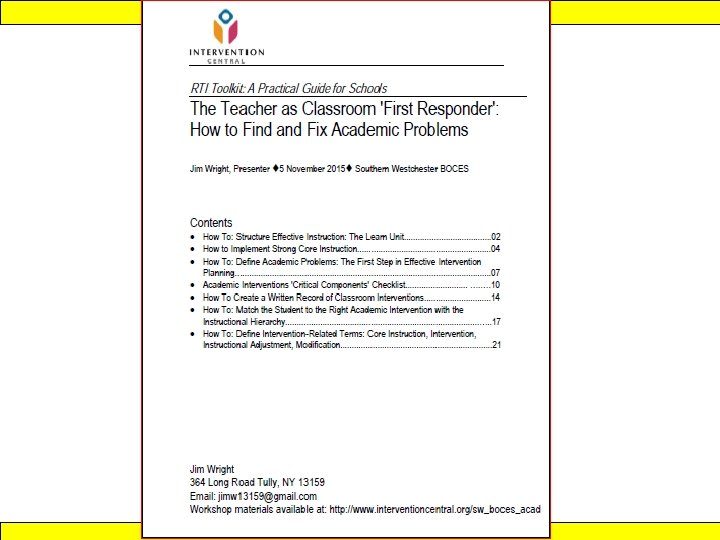
Response to Intervention Workshop Materials will be posted at: available at: http: //www. interventioncentral. org/sw_boce s_acad www. interventioncentral. org 3
Response to Intervention ‘First Responder’ Toolkit Instruction. What elements make up highquality core instruction? Intervention. How can one define the student’s academic need(s) and match to research-based intervention ideas? Student Self-Management. What are ideas for helping the student to manage their own learning? Problem-Solving Process. What forms & meeting process can help to create strong classroom intervention plans? Resources. Where can teachers find online resources to support classroom interventions? www. interventioncentral. org
Response to Intervention Big Ideas in Academic Interventions. Academic interventions are strengthened when they align with these 7 important ‘quality indicators’. ` www. interventioncentral. org 5
Response to Intervention Academic Interventions: 7 ‘Big Ideas’ • Academic problems should be clearly defined. Before a teacher can select interventions to address a student academic problem, the instructor must be able to describe in clear and specific terms just what the student problem is. In fact, the most important step in the entire process of developing an intervention is to be able to describe correctly and specifically the problem that must be fixed (Bergan, 1995). www. interventioncentral. org 1 6
Response to Intervention Academic Interventions: 7 ‘Big Ideas’ • Academic problems should be linked to their probable cause. Once an academic problem has been defined, the teacher will want to develop a hypothesis ('educated guess') about what issue is causing that problem. For example, a student may do poorly on a reading comprehension task because she lacks the necessary comprehension skills, is accurate but not yet fluent in those skills, had once learned those skills but failed to retain them, can perform the skills but has limited endurance, or possesses the skills but doeswww. interventioncentral. org not recognize situations when 2 7
Response to Intervention Academic Interventions: 7 ‘Big Ideas’ • Intervention strategies should be research-based. When possible, the teacher should include in an intervention plan only those ideas supported by research. At present, there is no consensus on how to define 'research-based' interventions (Odom et al. , 2005). However, a sensible rule of thumb to follow is that an intervention idea should be shown as effective in at least one study published in a reputable peer-reviewed research journal before it is used in school intervention plans. www. interventioncentral. org 3 8
Response to Intervention Academic Interventions: 7 ‘Big Ideas’ • Intervention plans should help students to access instruction--but not 'dumb down' instruction. When putting together classroom intervention plans, instructors can choose from among a wide array of strategies to help the student to achieve academic success. But general-education teachers should take care not cross the line and modify core instruction for struggling general-education students; that is, they should not hold underperforming students to a lesser academic standard than their classmates (Tindal & Fuchs, 1999). www. interventioncentral. org 4 9
Response to Intervention Academic Interventions: 7 ‘Big Ideas’ • Interventions should be documented in writing. When a teacher commits to develop an academic intervention to support a student, that instructor should always create a written plan to document the intervention prior to implementing it (Burns & Gibbons, 2008). Writing out intervention plans help teachers to carry them out more consistently and be able to produce the plans when needed as proof that they are providing at-risk students with ongoing assistance. www. interventioncentral. org 5 10
Response to Intervention Academic Interventions: 7 ‘Big Ideas’ • Interventions should be carried out with integrity. The teacher should monitor the integrity of any classroom intervention closely, ensuring that the actual intervention conforms as closely as possible to the guidelines contained in the written intervention plan (Gansle & Noell, 2007) and taking steps when needed to bring the intervention back into alignment with good practices. www. interventioncentral. org 6 11
Response to Intervention Academic Interventions: 7 ‘Big Ideas’ • Goal-setting and progress-monitoring should be a part of all academic interventions. At their core, academic interventions are intended to improve student performance (Duhon, Mesmer, Atkins, Greguson, & Olinger, 2009). But teachers cannot know with certainty whether a student is actually benefiting from an intervention unless they set specific outcome goals up front and then collect data periodically throughout the intervention to verify that these goals are met (Wright 2007). www. interventioncentral. org 7 12
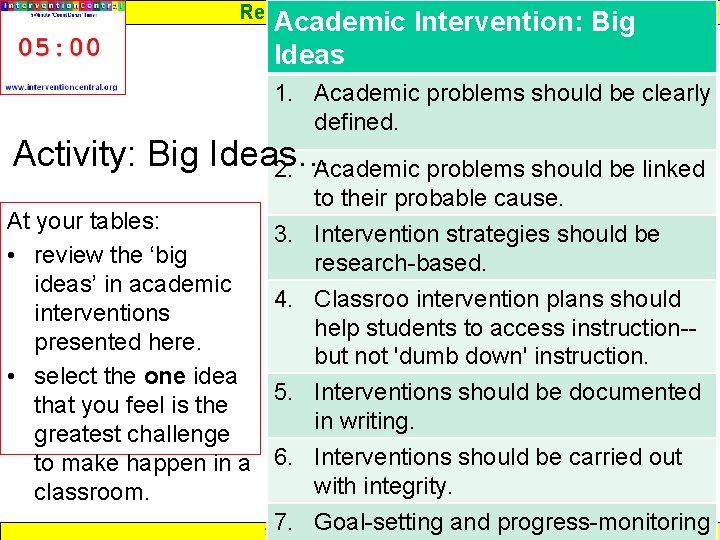
Response to Intervention Academic Intervention: Big Ideas 1. Academic problems should be clearly defined. Activity: Big Ideas… 2. Academic problems should be linked to their probable cause. 3. Intervention strategies should be research-based. At your tables: • review the ‘big ideas’ in academic 4. Classroo intervention plans should interventions help students to access instruction-presented here. but not 'dumb down' instruction. • select the one idea 5. Interventions should be documented that you feel is the in writing. greatest challenge to make happen in a 6. Interventions should be carried out with integrity. classroom. 7. Goal-setting and progress-monitoring www. interventioncentral. org
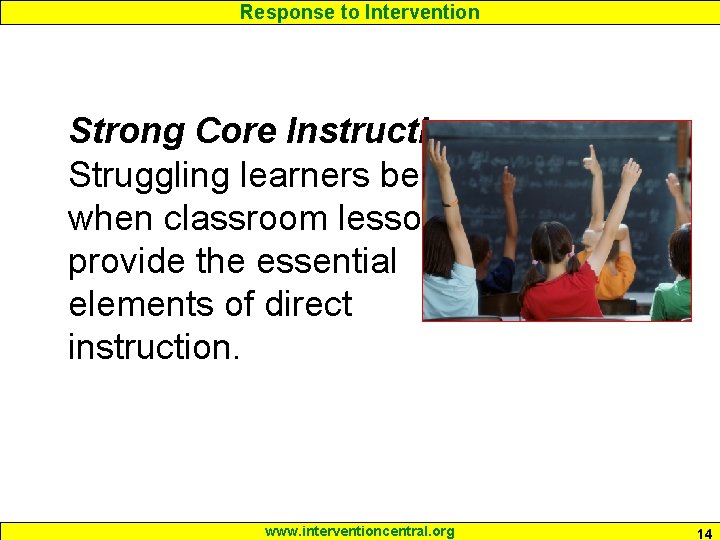
Response to Intervention Strong Core Instruction: Struggling learners benefit when classroom lessons provide the essential elements of direct instruction. www. interventioncentral. org 14
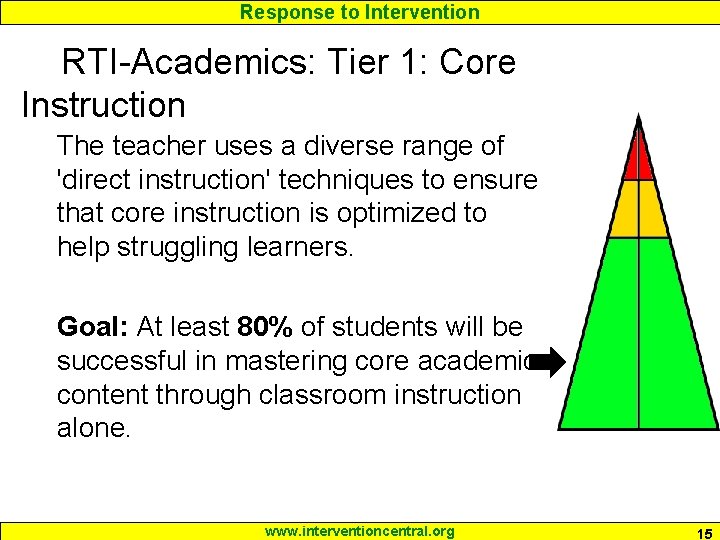
Response to Intervention RTI-Academics: Tier 1: Core Instruction The teacher uses a diverse range of 'direct instruction' techniques to ensure that core instruction is optimized to help struggling learners. Goal: At least 80% of students will be successful in mastering core academic content through classroom instruction alone. www. interventioncentral. org 15
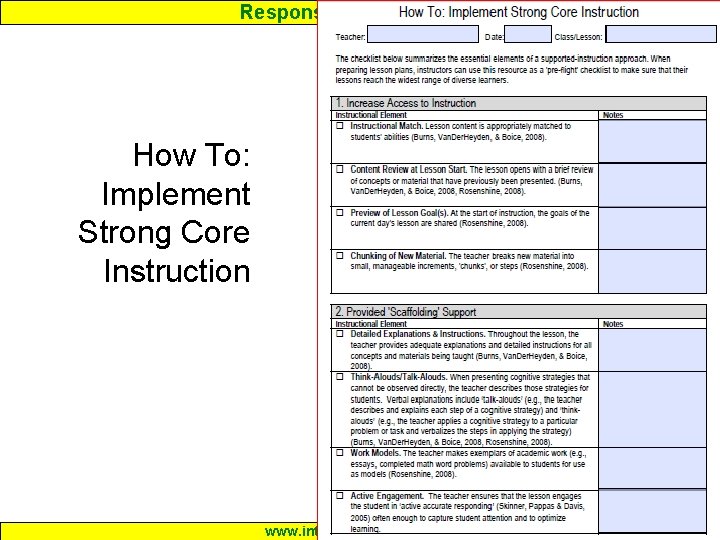
Response to Intervention How To: Implement Strong Core Instruction www. interventioncentral. org 16
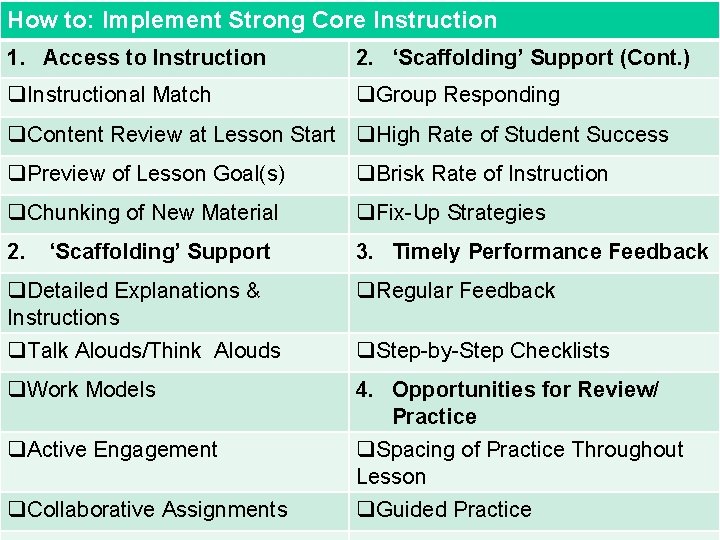
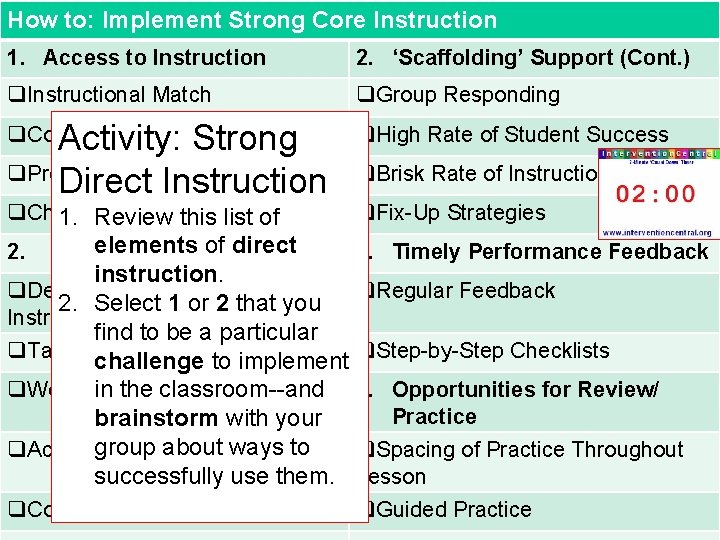
Response to Intervention How to: Implement Strong Core Instruction 1. Access to Instruction 2. ‘Scaffolding’ Support (Cont. ) q. Instructional Match q. Group Responding q. Content Review at Lesson Start q. High Rate of Student Success q. Preview of Lesson Goal(s) q. Brisk Rate of Instruction q. Chunking of New Material q. Fix-Up Strategies 2. 3. Timely Performance Feedback ‘Scaffolding’ Support q. Detailed Explanations & Instructions q. Talk Alouds/Think Alouds q. Regular Feedback q. Work Models 4. Opportunities for Review/ Practice q. Spacing of Practice Throughout Lesson q. Guided Practice q. Active Engagement q. Collaborative Assignments q. Step-by-Step Checklists www. interventioncentral. org
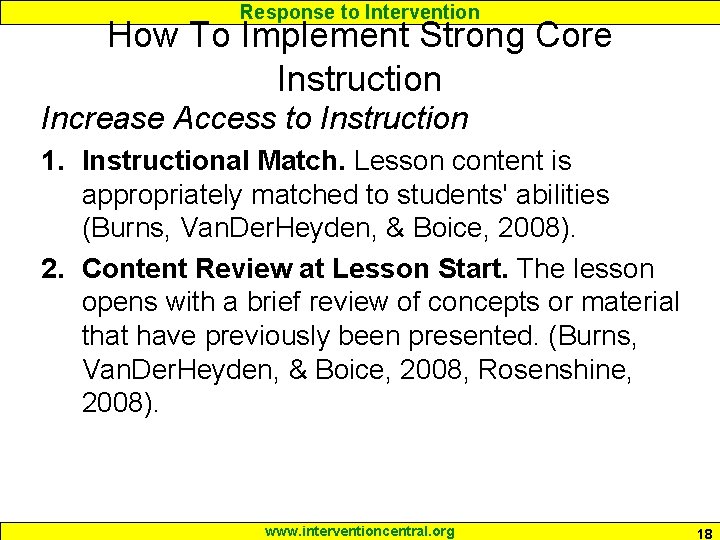
Response to Intervention How To Implement Strong Core Instruction Increase Access to Instruction 1. Instructional Match. Lesson content is appropriately matched to students' abilities (Burns, Van. Der. Heyden, & Boice, 2008). 2. Content Review at Lesson Start. The lesson opens with a brief review of concepts or material that have previously been presented. (Burns, Van. Der. Heyden, & Boice, 2008, Rosenshine, 2008). www. interventioncentral. org 18
Response to Intervention How To Implement Strong Core Instruction Increase Access to Instruction 3. Preview of Lesson Goal(s). At the start of instruction, the goals of the current day's lesson are shared (Rosenshine, 2008). 4. Chunking of New Material. The teacher breaks new material into small, manageable increments, 'chunks', or steps (Rosenshine, 2008). www. interventioncentral. org 19
Response to Intervention How To Implement Strong Core Instruction Provide ‘Scaffolding’ Support 1. Detailed Explanations & Instructions. Throughout the lesson, the teacher provides adequate explanations and detailed instructions for all concepts and materials being taught (Burns, Van. Der. Heyden, & Boice, 2008). 2. Talk-Alouds/Think-Alouds. Verbal explanations are given to explain cognitive strategies: ‘talk-alouds’ (e. g. , the teacher describes and explains each step of a cognitive strategy) and ‘think-alouds’ (e. g. , the teacher applies a cognitive strategy to a particular www. interventioncentral. org 20
Response to Intervention How To Implement Strong Core Instruction Provide ‘Scaffolding’ Support 3. Work Models. The teacher makes exemplars of academic work (e. g. , essays, completed math word problems) available to students for use as models (Rosenshine, 2008). 4. Active Engagement. The teacher ensures that the lesson engages the student in ‘active accurate responding’ (Skinner, Pappas & Davis, 2005) often enough to capture student attention and to optimize learning. www. interventioncentral. org 21
Response to Intervention How To Implement Strong Core Instruction Provide ‘Scaffolding’ Support 5. Collaborative Assignments. Students have frequent opportunities to work collaboratively--in pairs or groups. (Baker, Gersten, & Lee, 2002; Gettinger & Seibert, 2002). 6. Checks for Understanding. The instructor regularly checks for student understanding by posing frequent questions to the group (Rosenshine, 2008). www. interventioncentral. org 22
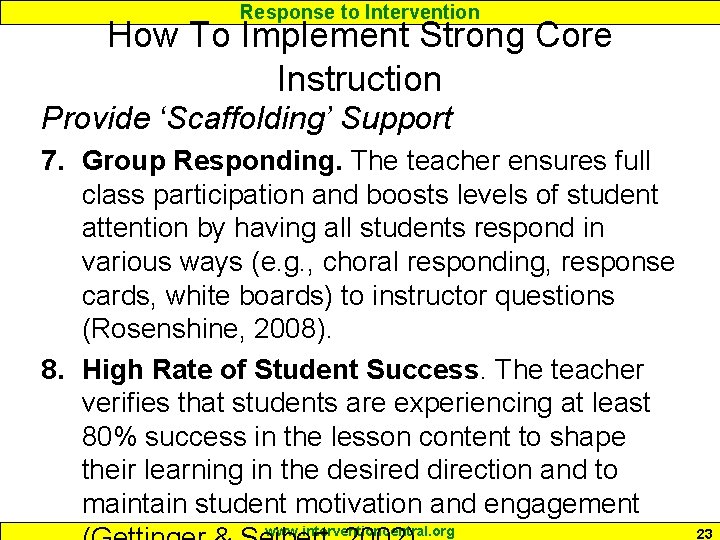
Response to Intervention How To Implement Strong Core Instruction Provide ‘Scaffolding’ Support 7. Group Responding. The teacher ensures full class participation and boosts levels of student attention by having all students respond in various ways (e. g. , choral responding, response cards, white boards) to instructor questions (Rosenshine, 2008). 8. High Rate of Student Success. The teacher verifies that students are experiencing at least 80% success in the lesson content to shape their learning in the desired direction and to maintain student motivation and engagement www. interventioncentral. org 23
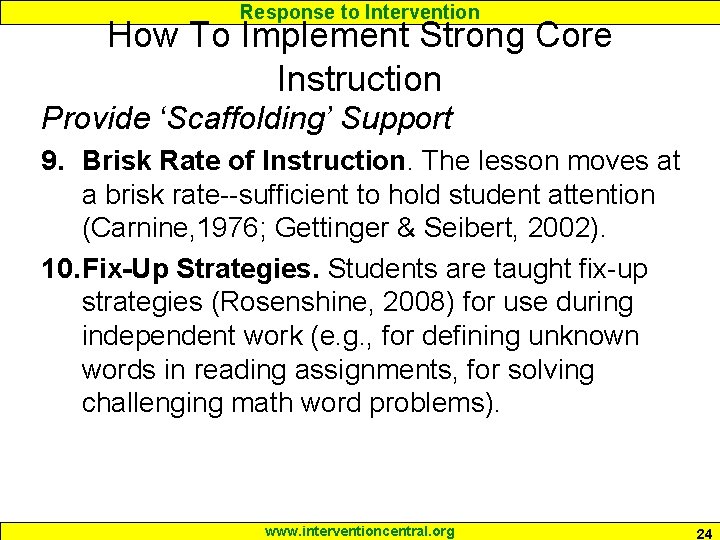
Response to Intervention How To Implement Strong Core Instruction Provide ‘Scaffolding’ Support 9. Brisk Rate of Instruction. The lesson moves at a brisk rate--sufficient to hold student attention (Carnine, 1976; Gettinger & Seibert, 2002). 10. Fix-Up Strategies. Students are taught fix-up strategies (Rosenshine, 2008) for use during independent work (e. g. , for defining unknown words in reading assignments, for solving challenging math word problems). www. interventioncentral. org 24
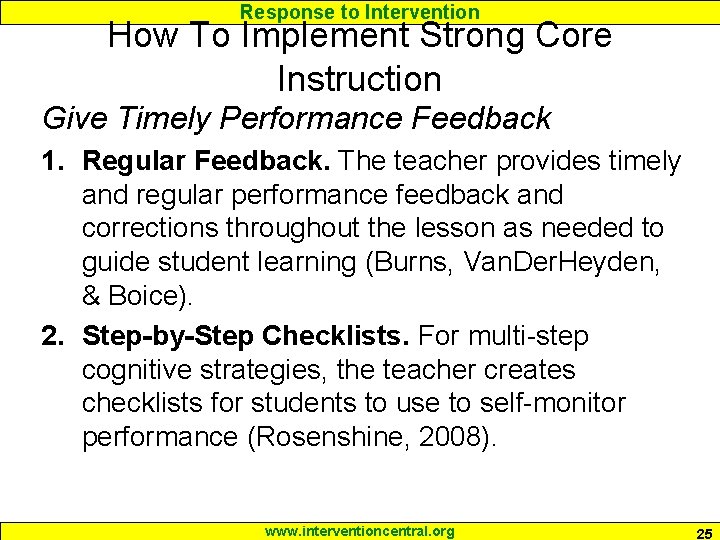
Response to Intervention How To Implement Strong Core Instruction Give Timely Performance Feedback 1. Regular Feedback. The teacher provides timely and regular performance feedback and corrections throughout the lesson as needed to guide student learning (Burns, Van. Der. Heyden, & Boice). 2. Step-by-Step Checklists. For multi-step cognitive strategies, the teacher creates checklists for students to use to self-monitor performance (Rosenshine, 2008). www. interventioncentral. org 25
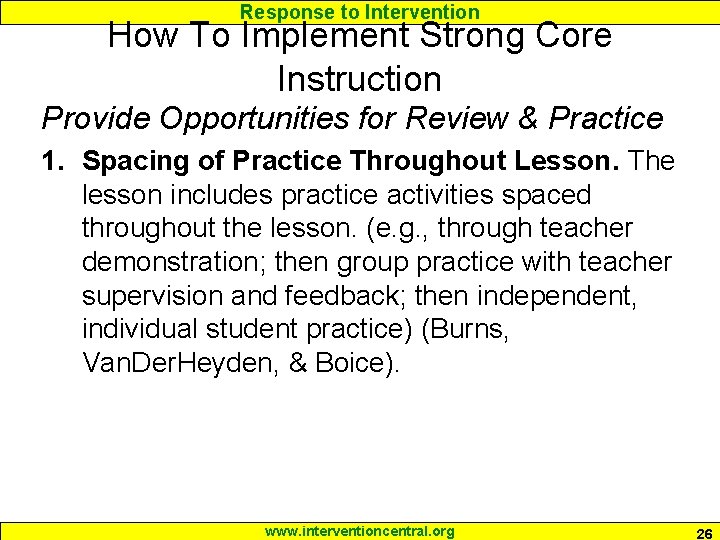
Response to Intervention How To Implement Strong Core Instruction Provide Opportunities for Review & Practice 1. Spacing of Practice Throughout Lesson. The lesson includes practice activities spaced throughout the lesson. (e. g. , through teacher demonstration; then group practice with teacher supervision and feedback; then independent, individual student practice) (Burns, Van. Der. Heyden, & Boice). www. interventioncentral. org 26
Response to Intervention How To Implement Strong Core Instruction Provide Opportunities for Review & Practice 2. Guided Practice. When teaching challenging material, the teacher provides immediate corrective feedback to each student response. When the instructor anticipates the possibility of an incorrect response, that teacher forestalls student error through use of cues, prompts, or hints. The teacher also tracks student responding and ensures sufficient success during supervised lessons before having students practice the new skills or knowledge independently (Burns, Van. Der. Heyden, & Boice, www. interventioncentral. org 2008). 27
Response to Intervention How To Implement Strong Core Instruction Provide Opportunities for Review & Practice 3. Support for Independent Practice. The teacher ensures that students have adequate support (e. g. , clear and explicit instructions; teacher monitoring) to be successful during independent seatwork practice activities (Rosenshine, 2008). 4. Distributed Practice. The teacher reviews previously taught content one or more times over a period of several weeks or months (Pashler et al. , 2007; Rosenshine & Stevens, 1995). www. interventioncentral. org 28
Response to Intervention How to: Implement Strong Core Instruction 1. Access to Instruction 2. ‘Scaffolding’ Support (Cont. ) q. Instructional Match q. Group Responding Activity: Strong q. Preview of Lesson Goal(s) Direct Instruction q. Content Review at Lesson Start q. High Rate of Student Success q. Chunking of New Material 1. Review this list of 2. elements. Support of direct ‘Scaffolding’ q. Brisk Rate of Instruction q. Fix-Up Strategies 3. Timely Performance Feedback instruction. q. Detailed Explanations & q. Regular Feedback 2. Select 1 or 2 that you Instructions find to be a particular q. Talk Alouds/Think Alouds challenge to implement q. Step-by-Step Checklists q. Work Models in the classroom--and 4. Opportunities for Review/ Practice brainstorm with your group about ways to q. Active Engagement q. Spacing of Practice Throughout successfully use them. Lesson q. Collaborative Assignments q. Guided Practice www. interventioncentral. org
Response to Intervention Identifying the Academic Problem. When teachers describe academic problems in specific terms and link them to possible causes, they increase the chances of finding interventions that work. www. interventioncentral. org 30
Response to Intervention Activity: Describe an Academic Problem: Part 1 Each member of your group will: • select one student in your room who you believe needs a Tier 1 academic intervention. • write a brief description of that student’s academic problem. • share that description with your group partners. www. interventioncentral. org 31
Response to Intervention Academic Problem Identification: 3 Steps (pp. 7 -9) 1. Describe the problem. 2. Format the problem description as a 3 part problem-identification statement. 3. Choose a hypothesis for what is the most likely cause of the problem. www. interventioncentral. org 32
Response to Intervention Academic Problem Identification: 3 Steps 1. Describe the problem. TIP 1: When available, use researchderived checklists that break global academic skills into more specific components. Evaluate the student’s skills for each of these components to locate the one that is the chief blocker to success. www. interventioncentral. org 33
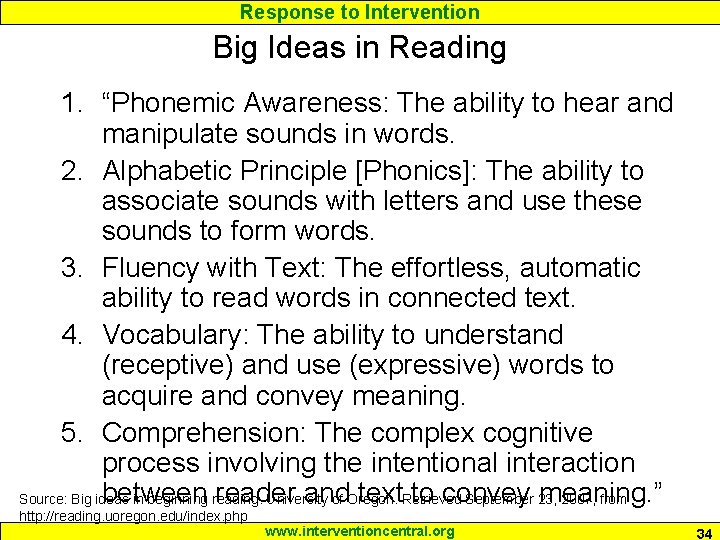
Response to Intervention Big Ideas in Reading 1. “Phonemic Awareness: The ability to hear and manipulate sounds in words. 2. Alphabetic Principle [Phonics]: The ability to associate sounds with letters and use these sounds to form words. 3. Fluency with Text: The effortless, automatic ability to read words in connected text. 4. Vocabulary: The ability to understand (receptive) and use (expressive) words to acquire and convey meaning. 5. Comprehension: The complex cognitive process involving the intentional interaction between reader and text. Retrieved to convey meaning. ” Source: Big ideas in beginning reading. University of Oregon. September 23, 2007, from http: //reading. uoregon. edu/index. php www. interventioncentral. org 34
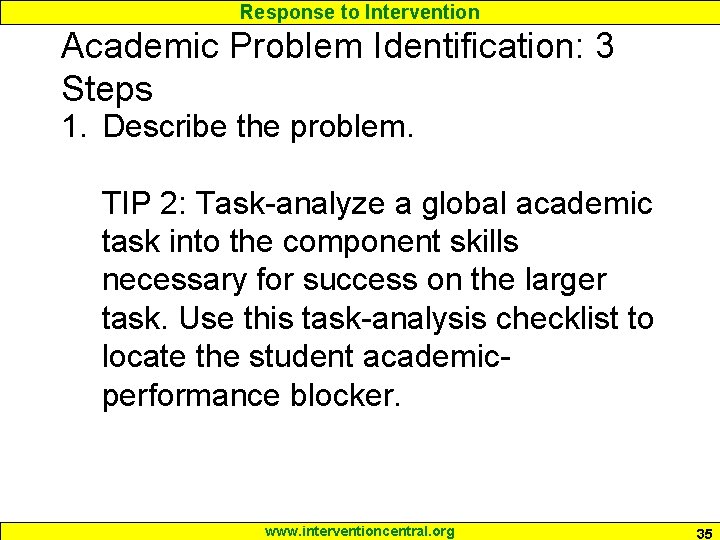
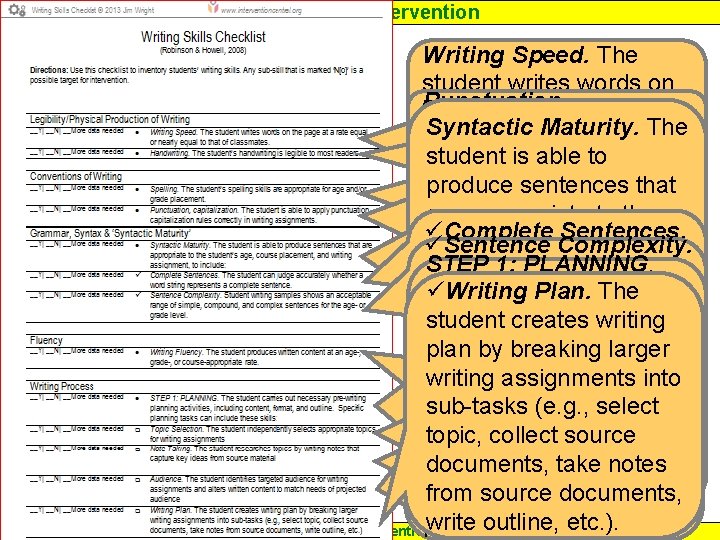
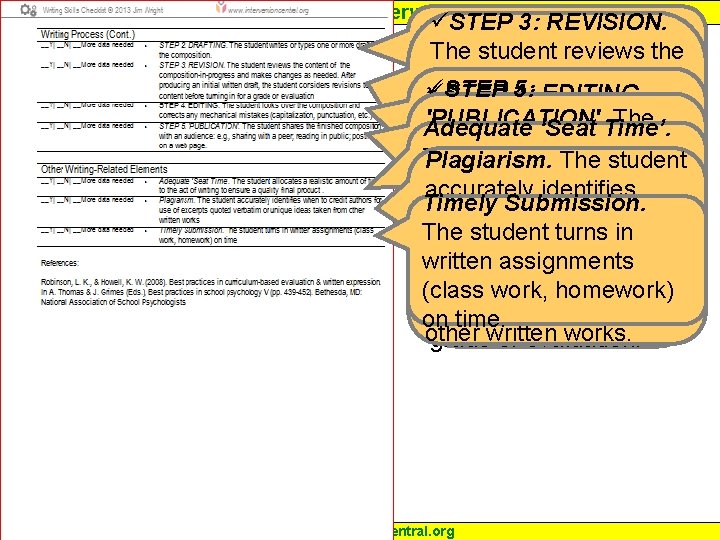
Response to Intervention Academic Problem Identification: 3 Steps 1. Describe the problem. TIP 2: Task-analyze a global academic task into the component skills necessary for success on the larger task. Use this task-analysis checklist to locate the student academicperformance blocker. www. interventioncentral. org 35
Response to Intervention Writing Speed. The student writes words on Punctuation, Handwriting. The equal the page at a rate Syntactichandwriting Maturity. The Spelling. The student’s capitalization. The student’s or nearly equal to thatisof studenttois ismost able to apply spelling skills are student able to legible readers. classmates. produce sentences appropriate for age that punctuation, are appropriate to the and/or grade placement. capitalization rules ü Complete Sentences. student’s age, course correctly in writing üSentence Complexity. The student can writing judge STEP 1: writing PLANNING. placement, and assignments. Student samples accurately whether aout Writing Fluency. The ü Writing Plan. The student carries assignment, to include: shows an acceptable word string represents a student produces written student writing necessary pre-writing range ofcreates simple, complete sentence-and content at an The age-, grade plan by breaking larger planning activities, ü Audience. compound, and complex ü Topic Selection. The use correct punctuation. -, or course-appropriate writing assignments intoor including content, ü Note-Taking. The student identifies sentences for the agestudent independently rate. sub-tasks (e. g. , select format, level. and outline. student researches targeted audience for grade selects appropriate topics topic, collect source Specific planning tasks topics by writing notes writing assignments and for writing assignments. documents, take notes can capture include skills: that key ideas alters writtenthese content to from source documents, from match needsmaterial. of write outline, etc. ). projected audience. www. interventioncentral. org
Response to Intervention üSTEP 3: REVISION. üSTEP 2: DRAFTING. The student reviews the The student writes or content of the ü STEP 5: types one more drafts 4: or EDITING. composition-in- The 'PUBLICATION'. of thestudent composition. The looks. Time’. over Adequate ‘Seat progress and makes student shares the composition and The student allocates a Plagiarism. The student changes as needed. finished composition corrects any mechanical realistic amount of time accurately identifies After producing an Timely Submission. with anact audience: e. g. , mistakes (capitalization, to the of writing to when to credit authors initial written draft, the The student turns in sharing with aetc. ). peer; punctuation, ensure a quality final for use of excerpts studentassignments considers written reading to a group; product. quoted verbatim or revisions to content (class postingwork, on ahomework) web page. unique ideas taken from before on time. turning in for a other works. gradewritten or evaluation. www. interventioncentral. org
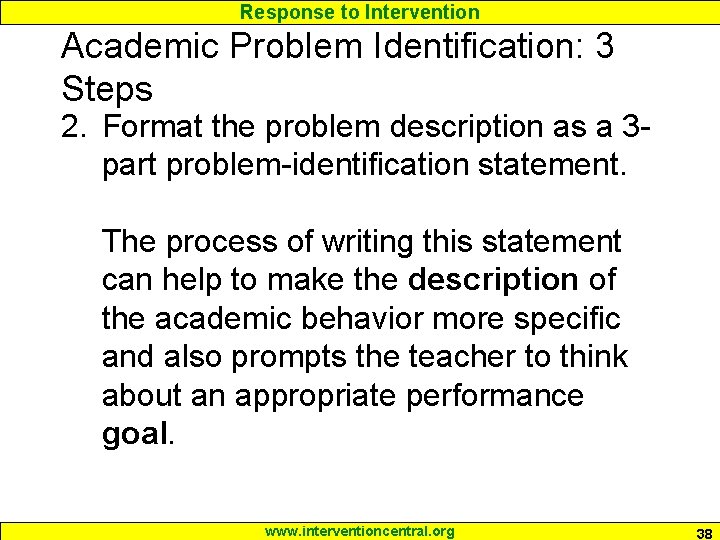
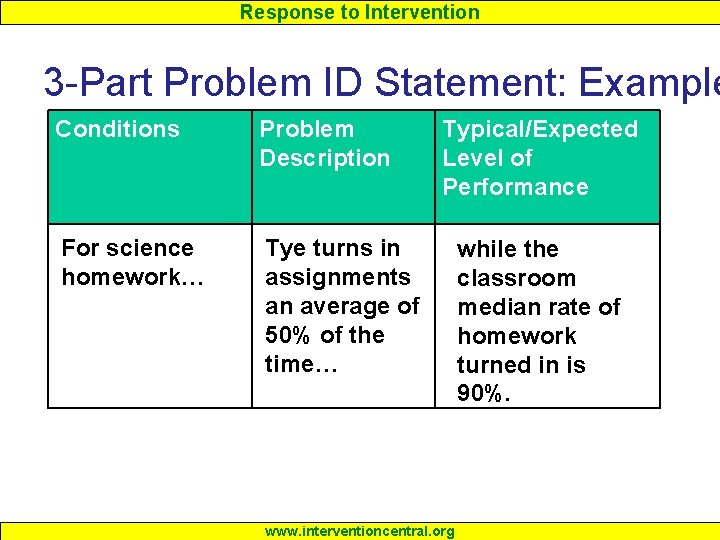
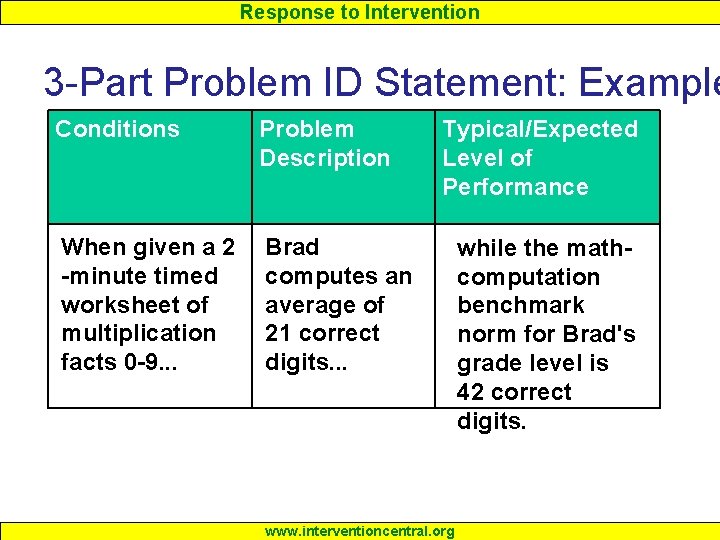
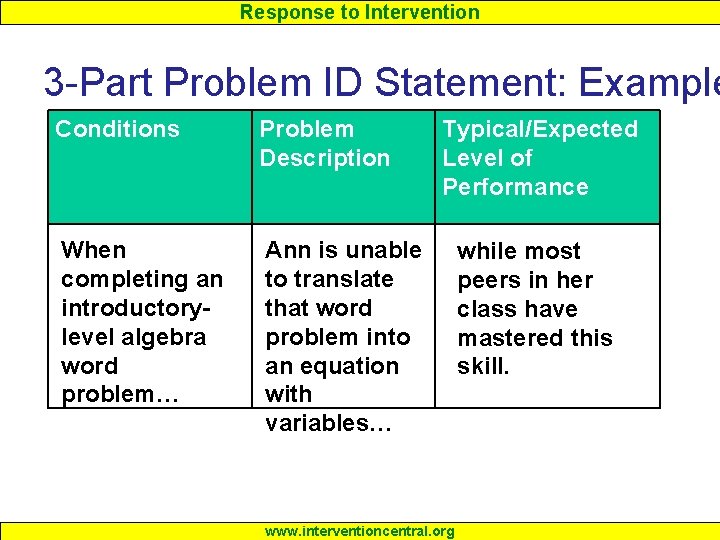
Response to Intervention Academic Problem Identification: 3 Steps 2. Format the problem description as a 3 part problem-identification statement. The process of writing this statement can help to make the description of the academic behavior more specific and also prompts the teacher to think about an appropriate performance goal. www. interventioncentral. org 38
Response to Intervention 3 -Part Problem ID Statement: Example Conditions Problem Description For science homework… Tye turns in assignments an average of 50% of the time… Typical/Expected Level of Performance www. interventioncentral. org while the classroom median rate of homework turned in is 90%.
Response to Intervention 3 -Part Problem ID Statement: Example Conditions Problem Description When given a 2 -minute timed worksheet of multiplication facts 0 -9. . . Brad computes an average of 21 correct digits. . . Typical/Expected Level of Performance www. interventioncentral. org while the mathcomputation benchmark norm for Brad's grade level is 42 correct digits.
Response to Intervention 3 -Part Problem ID Statement: Example Conditions Problem Description When completing an introductorylevel algebra word problem… Ann is unable to translate that word problem into an equation with variables… Typical/Expected Level of Performance www. interventioncentral. org while most peers in her class have mastered this skill.
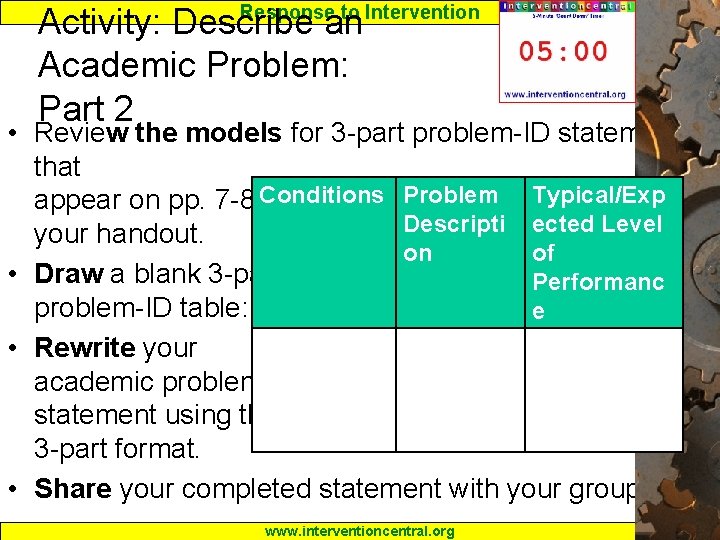
Response to Intervention Activity: Describe an Academic Problem: Part 2 • Review the models for 3 -part problem-ID statements that Problem Typical/Exp appear on pp. 7 -8 Conditions of Descripti ected Level your handout. on of • Draw a blank 3 -part Performanc problem-ID table: e • Rewrite your academic problem statement using this 3 -part format. • Share your completed statement with your group. www. interventioncentral. org 42
Response to Intervention Academic Problem Identification: 3 Steps 3. Choose a hypothesis for what is the most likely cause of the problem. www. interventioncentral. org 43
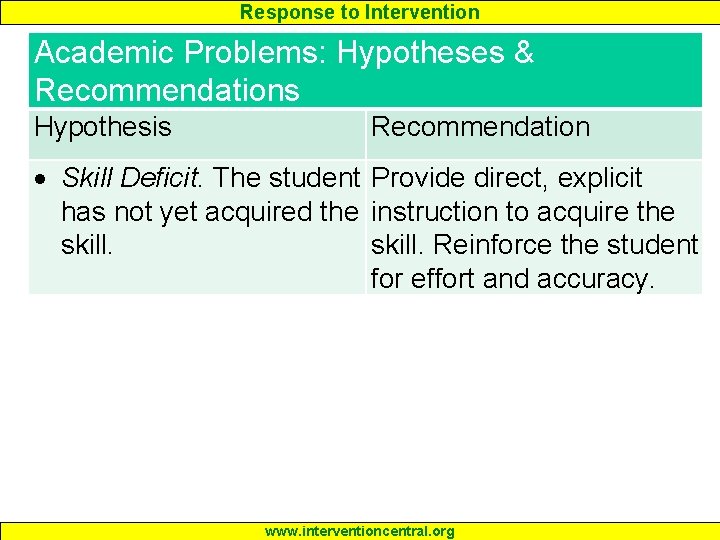
Response to Intervention Academic Problems: Hypotheses & Recommendations Hypothesis Recommendation Skill Deficit. The student Provide direct, explicit has not yet acquired the instruction to acquire the skill. Reinforce the student for effort and accuracy. www. interventioncentral. org
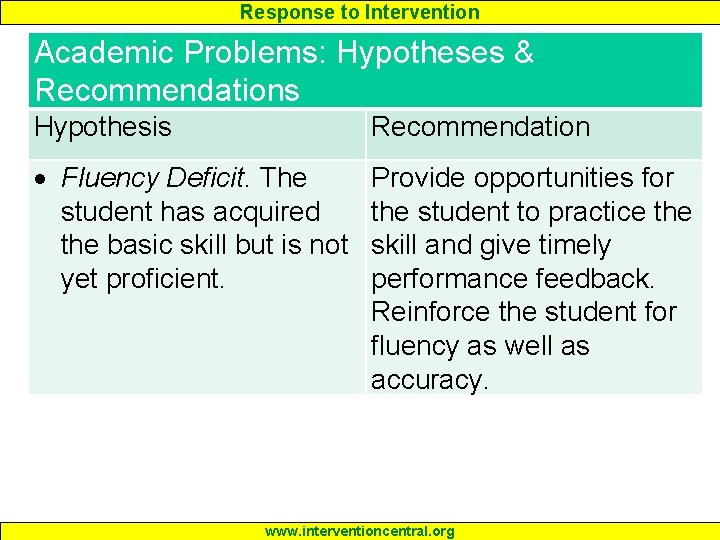
Response to Intervention Academic Problems: Hypotheses & Recommendations Hypothesis Recommendation Fluency Deficit. The student has acquired the basic skill but is not yet proficient. Provide opportunities for the student to practice the skill and give timely performance feedback. Reinforce the student for fluency as well as accuracy. www. interventioncentral. org
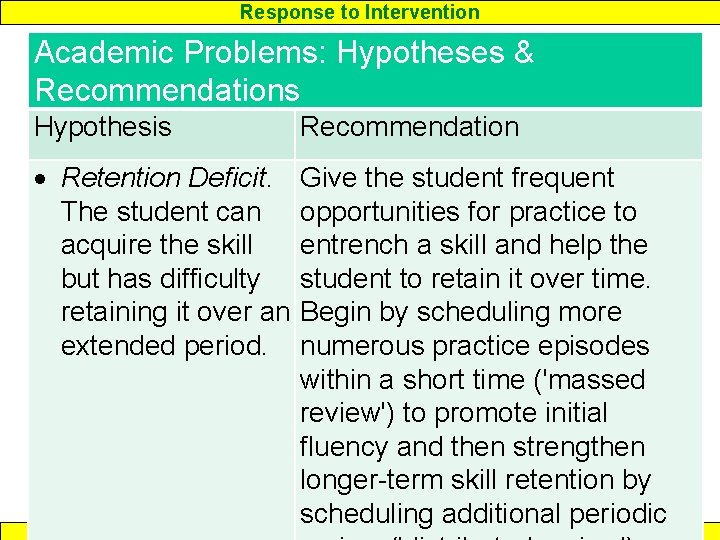
Response to Intervention Academic Problems: Hypotheses & Recommendations Hypothesis Recommendation Retention Deficit. The student can acquire the skill but has difficulty retaining it over an extended period. Give the student frequent opportunities for practice to entrench a skill and help the student to retain it over time. Begin by scheduling more numerous practice episodes within a short time ('massed review') to promote initial fluency and then strengthen longer-term skill retention by scheduling additional periodic www. interventioncentral. org
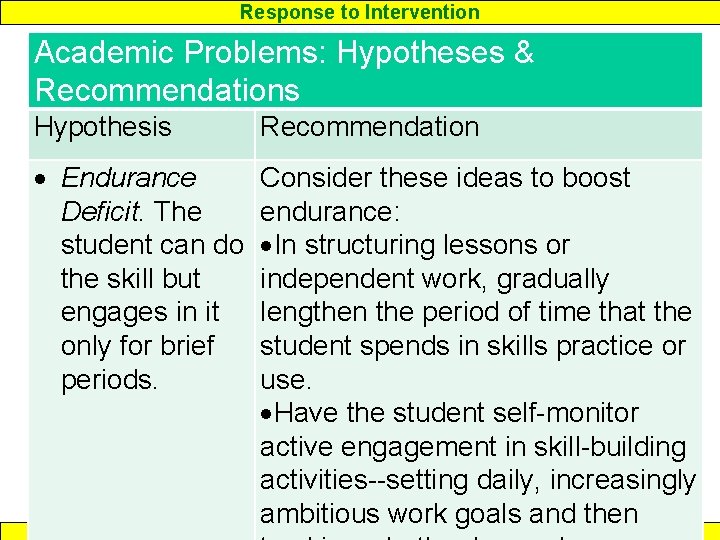
Response to Intervention Academic Problems: Hypotheses & Recommendations Hypothesis Recommendation Endurance Deficit. The student can do the skill but engages in it only for brief periods. Consider these ideas to boost endurance: In structuring lessons or independent work, gradually lengthen the period of time that the student spends in skills practice or use. Have the student self-monitor active engagement in skill-building activities--setting daily, increasingly ambitious work goals and then www. interventioncentral. org
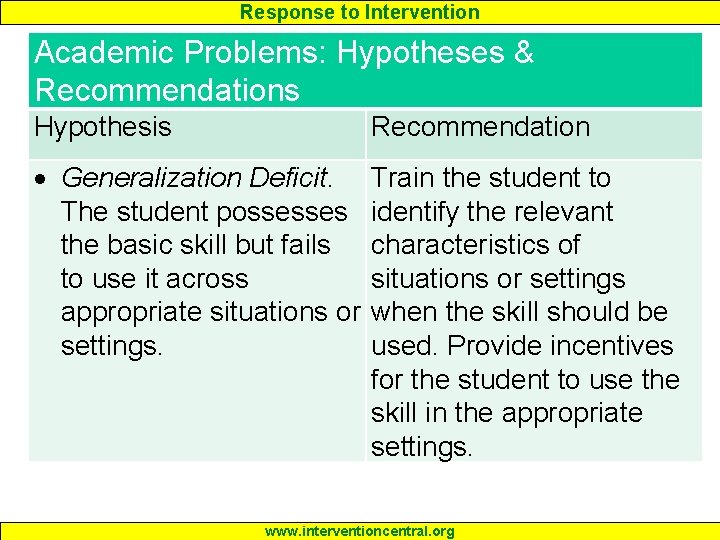
Response to Intervention Academic Problems: Hypotheses & Recommendations Hypothesis Recommendation Generalization Deficit. The student possesses the basic skill but fails to use it across appropriate situations or settings. Train the student to identify the relevant characteristics of situations or settings when the skill should be used. Provide incentives for the student to use the skill in the appropriate settings. www. interventioncentral. org
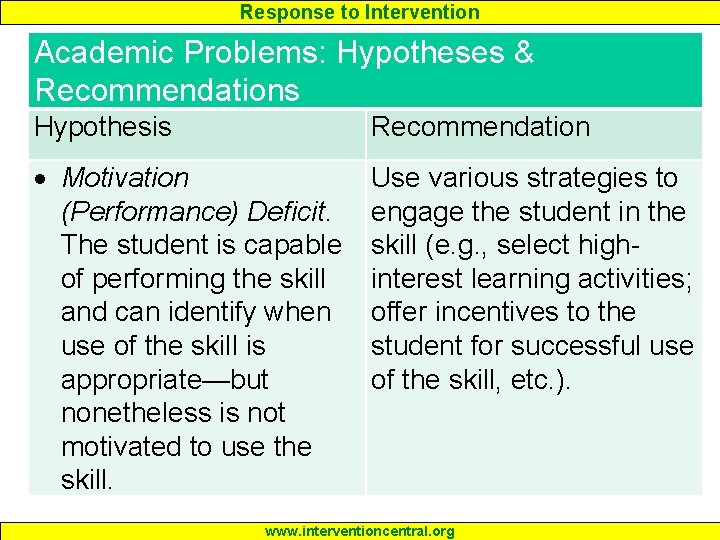
Response to Intervention Academic Problems: Hypotheses & Recommendations Hypothesis Recommendation Motivation (Performance) Deficit. The student is capable of performing the skill and can identify when use of the skill is appropriate—but nonetheless is not motivated to use the skill. Use various strategies to engage the student in the skill (e. g. , select highinterest learning activities; offer incentives to the student for successful use of the skill, etc. ). www. interventioncentral. org
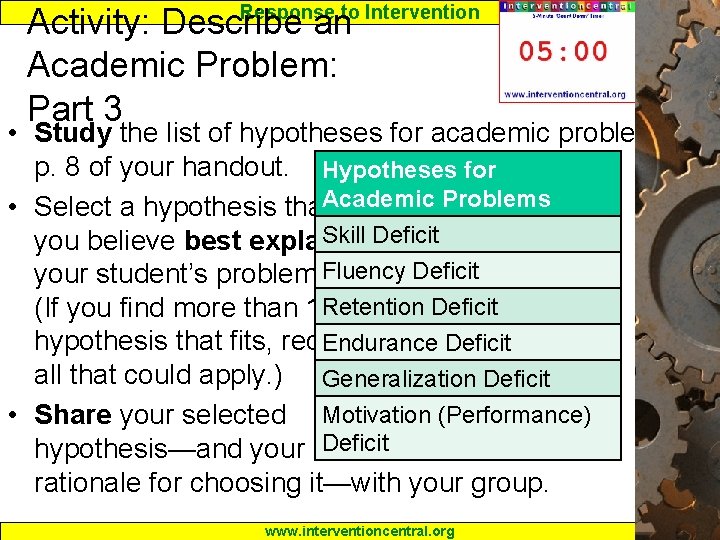
Response to Intervention Activity: Describe an Academic Problem: Part 3 • Study the list of hypotheses for academic problems on p. 8 of your handout. Hypotheses for • Select a hypothesis that. Academic Problems Skill Deficit you believe best explains your student’s problem. Fluency Deficit (If you find more than 1 Retention Deficit hypothesis that fits, record Endurance Deficit all that could apply. ) Generalization Deficit • Share your selected Motivation (Performance) hypothesis—and your Deficit rationale for choosing it—with your group. www. interventioncentral. org 50
Response to Intervention www. interventioncentral. org 51
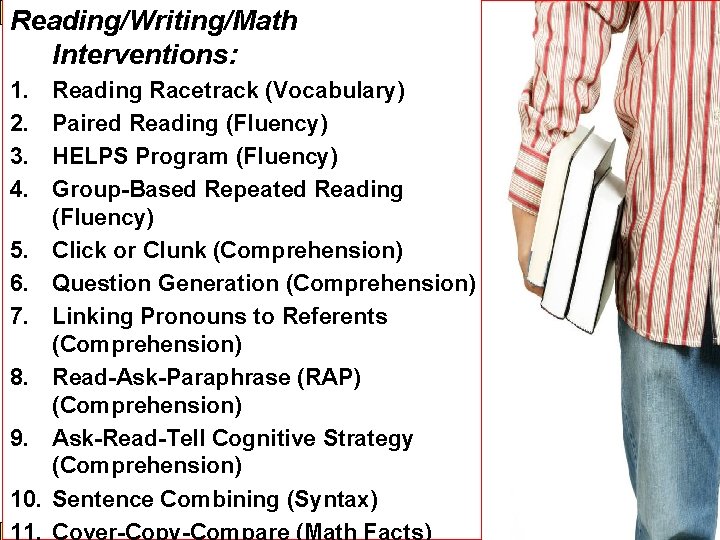
Response to Intervention Reading/Writing/Math Interventions: 1. 2. 3. 4. 5. 6. 7. 8. 9. 10. 11. Reading Racetrack (Vocabulary) Paired Reading (Fluency) HELPS Program (Fluency) Group-Based Repeated Reading (Fluency) Click or Clunk (Comprehension) Question Generation (Comprehension) Linking Pronouns to Referents (Comprehension) Read-Ask-Paraphrase (RAP) (Comprehension) Ask-Read-Tell Cognitive Strategy (Comprehension) Sentence Combining (Syntax) www. interventioncentral. org Cover-Copy-Compare (Math Facts) 52
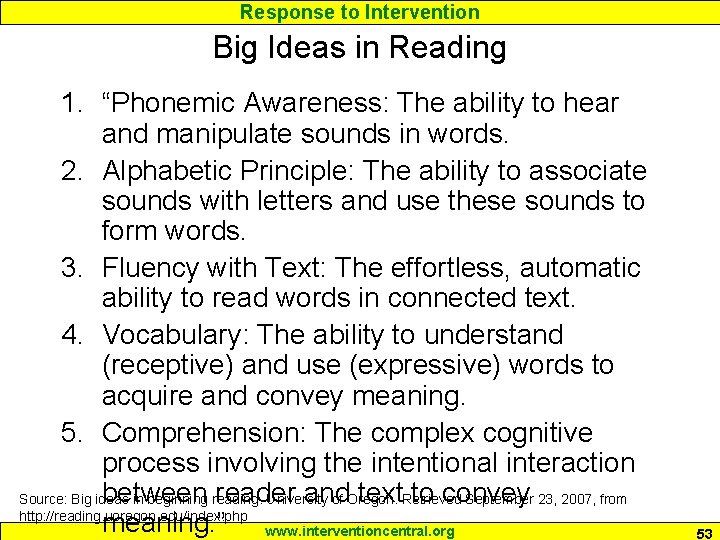
Response to Intervention Big Ideas in Reading 1. “Phonemic Awareness: The ability to hear and manipulate sounds in words. 2. Alphabetic Principle: The ability to associate sounds with letters and use these sounds to form words. 3. Fluency with Text: The effortless, automatic ability to read words in connected text. 4. Vocabulary: The ability to understand (receptive) and use (expressive) words to acquire and convey meaning. 5. Comprehension: The complex cognitive process involving the intentional interaction between reader and text. Retrieved to convey Source: Big ideas in beginning reading. University of Oregon. September 23, 2007, from http: //reading. uoregon. edu/index. php meaning. ” www. interventioncentral. org 53
Response to Intervention Sample Strategy to Promote…Sight. Word Vocabulary www. interventioncentral. org 54
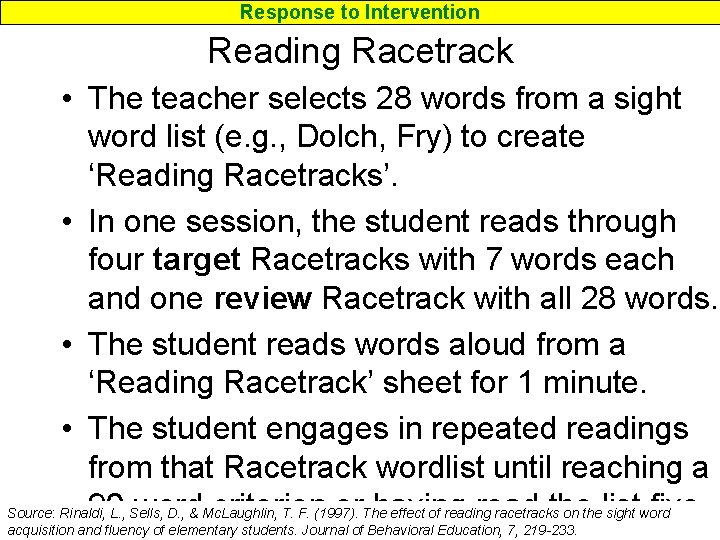
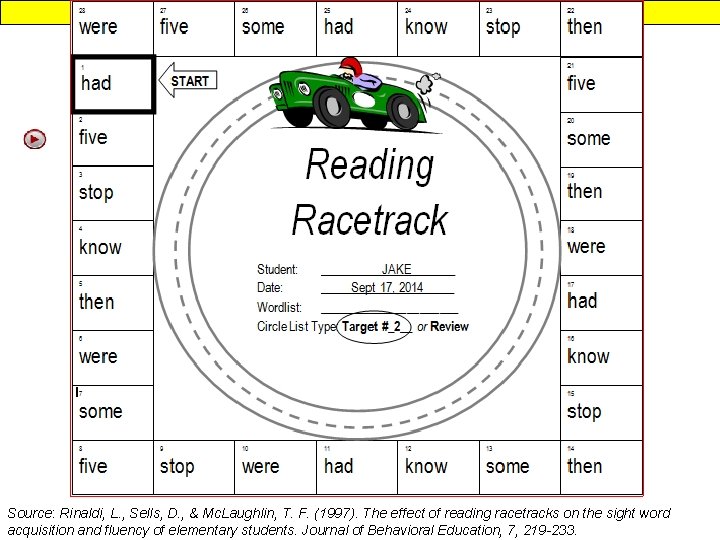
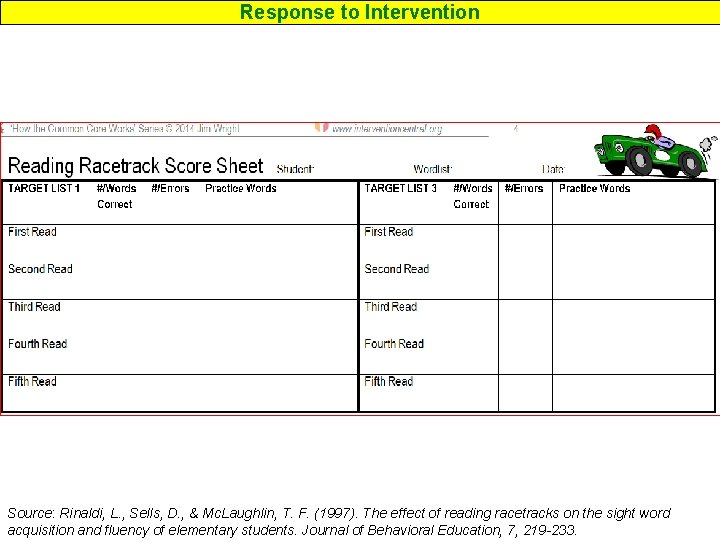
Response to Intervention Reading Racetrack • The teacher selects 28 words from a sight word list (e. g. , Dolch, Fry) to create ‘Reading Racetracks’. • In one session, the student reads through four target Racetracks with 7 words each and one review Racetrack with all 28 words. • The student reads words aloud from a ‘Reading Racetrack’ sheet for 1 minute. • The student engages in repeated readings from that Racetrack wordlist until reaching a 90 -word criterion or. Thehaving read the five Source: Rinaldi, L. , Sells, D. , & Mc. Laughlin, T. F. (1997). effect of reading racetracks on thelist sight word acquisition and fluency of elementary students. Journal of Behavioral Education, 7, 219 -233. www. interventioncentral. org 55
Response to Intervention Source: Rinaldi, L. , Sells, D. , & Mc. Laughlin, T. F. (1997). The effect of reading racetracks on the sight word acquisition and fluency of elementary students. Journal of Behavioral Education, 7, 219 -233. www. interventioncentral. org 56
Response to Intervention Source: Rinaldi, L. , Sells, D. , & Mc. Laughlin, T. F. (1997). The effect of reading racetracks on the sight word acquisition and fluency of elementary students. Journal of Behavioral Education, 7, 219 -233. www. interventioncentral. org 57
Response to Intervention Sample Strategies to Promote…Reading Fluency www. interventioncentral. org 58
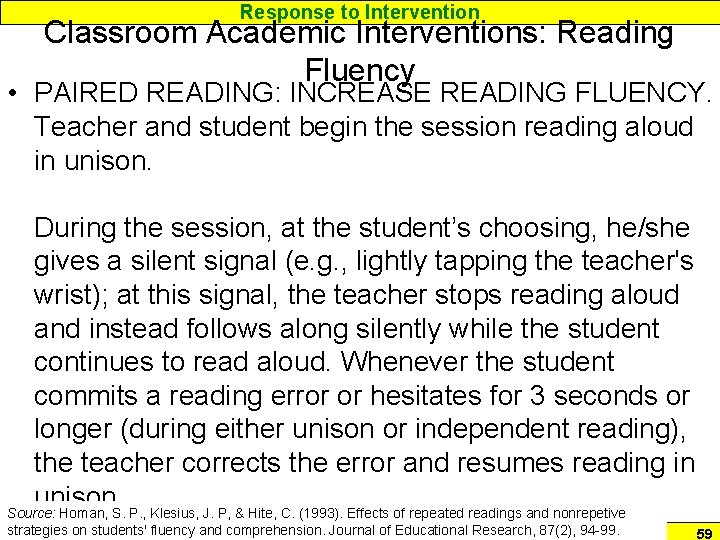
Response to Intervention Classroom Academic Interventions: Reading Fluency • PAIRED READING: INCREASE READING FLUENCY. Teacher and student begin the session reading aloud in unison. During the session, at the student’s choosing, he/she gives a silent signal (e. g. , lightly tapping the teacher's wrist); at this signal, the teacher stops reading aloud and instead follows along silently while the student continues to read aloud. Whenever the student commits a reading error or hesitates for 3 seconds or longer (during either unison or independent reading), the teacher corrects the error and resumes reading in unison. Source: Homan, S. P. , Klesius, J. P, & Hite, C. (1993). Effects of repeated readings and nonrepetive strategies on students' fluency and comprehension. Journal of Educational Research, 87(2), 94 -99. www. interventioncentral. org 59
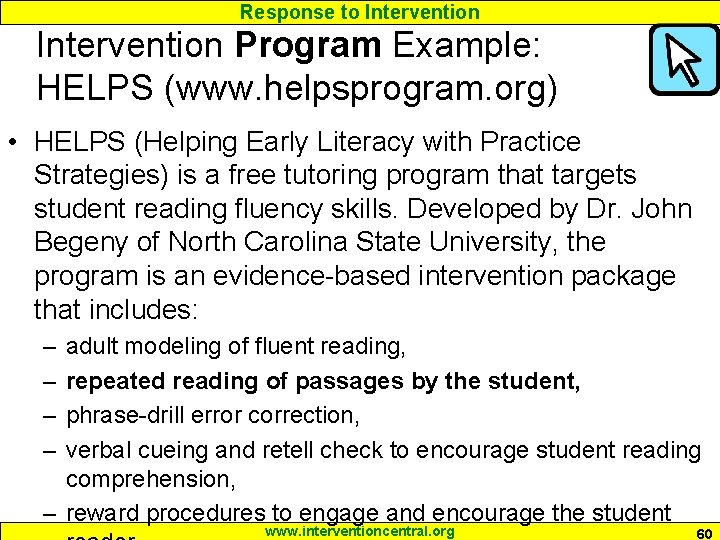
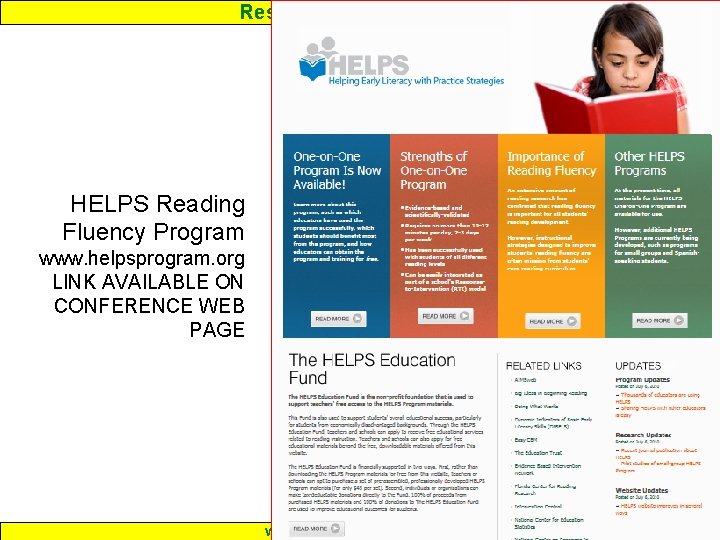
Response to Intervention Program Example: HELPS (www. helpsprogram. org) • HELPS (Helping Early Literacy with Practice Strategies) is a free tutoring program that targets student reading fluency skills. Developed by Dr. John Begeny of North Carolina State University, the program is an evidence-based intervention package that includes: – – adult modeling of fluent reading, repeated reading of passages by the student, phrase-drill error correction, verbal cueing and retell check to encourage student reading comprehension, – reward procedures to engage and encourage the student www. interventioncentral. org 60
Response to Intervention HELPS Reading Fluency Program www. helpsprogram. org LINK AVAILABLE ON CONFERENCE WEB PAGE www. interventioncentral. org
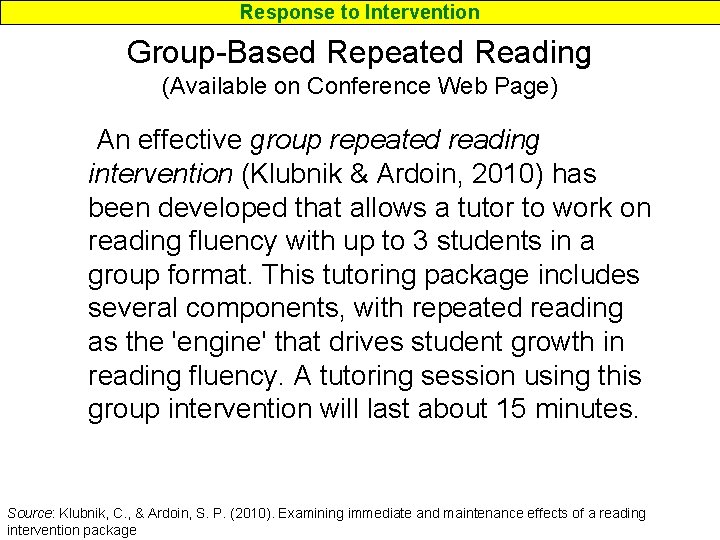
Response to Intervention Group-Based Repeated Reading (Available on Conference Web Page) An effective group repeated reading intervention (Klubnik & Ardoin, 2010) has been developed that allows a tutor to work on reading fluency with up to 3 students in a group format. This tutoring package includes several components, with repeated reading as the 'engine' that drives student growth in reading fluency. A tutoring session using this group intervention will last about 15 minutes. Source: Klubnik, C. , & Ardoin, S. P. (2010). Examining immediate and maintenance effects of a reading intervention package www. interventioncentral. org 62
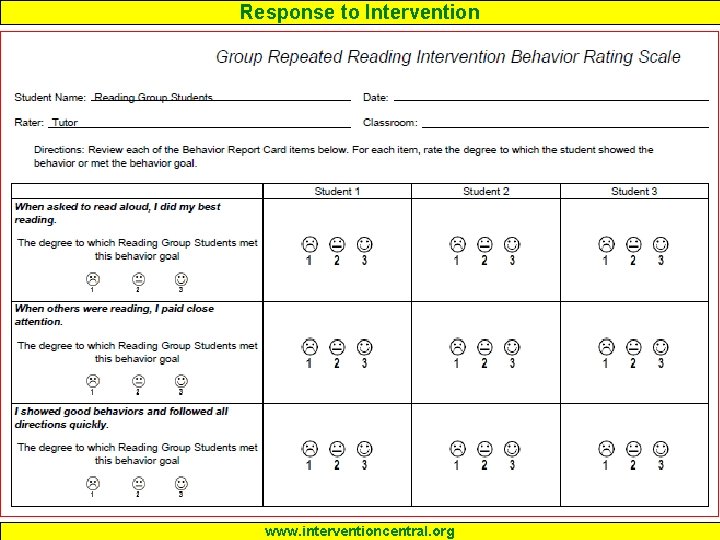
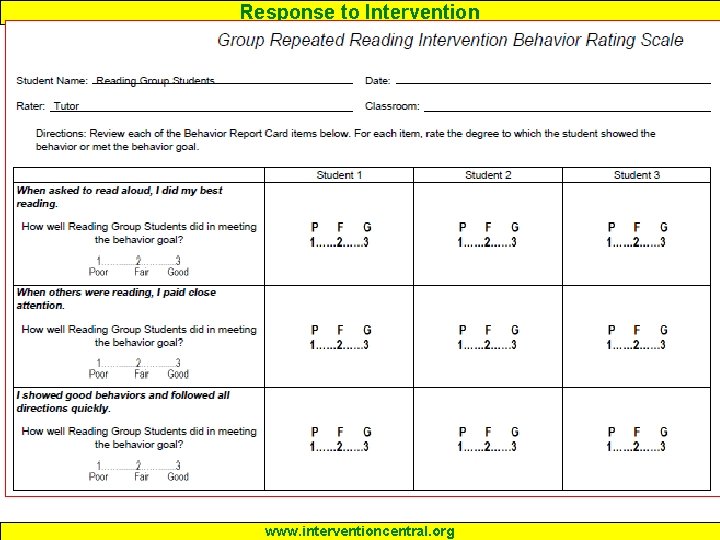
Response to Intervention Group-Based Repeated Reading Preparation. To prepare for each tutoring session, the tutor creates or obtains these materials: • 1 student reading passage: This passage should be 150 words or longer and at students' instructional level. Instructional as defined here means that students are able to correctly read at least 90% of the words in the passage. Copies of the passage are made for each student and the tutor. • 1 copy of the Group Repeated Reading Source: Klubnik, C. , & Ardoin, S. P. (2010). Examining immediate and maintenance effects of a reading Intervention Behavior Rating Scale (two versions 63 intervention package www. interventioncentral. org
Response to Intervention Group-Based Repeated Reading Procedure. The group repeated reading intervention has 4 components: passage preview, repeated readings, phrase-drill error correction, and contingent reward: 1. Passage Preview. The tutor reads the practice passage aloud once while students follow along silently, tracking their place with an index finger. During this initial read-through, the tutor stops several times at unpredictable points and asks a student selected at random to read the next word in the passage. (NOTE: This 'assisted cloze' Source: Klubnik, C. , & Ardoin, S. P. (2010). Examining immediate and maintenance effects of a reading strategy -- Homan, Klesius, & Hite, 1993 --ensures intervention package www. interventioncentral. org 64
Response to Intervention Group-Based Repeated Reading Procedure. 2. Repeated Readings. The tutor next has the students read the practice passage aloud 3 times. For each read-aloud, the students engage in sequential reading, with the process continuing in round-robin fashion until the passage is completed. When a student misreads or hesitates in reading a word for 3 seconds or longer, the tutor states the correct word. At the beginning of each repeated reading, the tutor selects a different student, to ensure that by the end of the 3 readings, each studenteffects will Source: Klubnik, C. , & Ardoin, S. P. (2010). Examining immediate and maintenance of ahave reading intervention package www. interventioncentral. org 65
Response to Intervention Group-Based Repeated Reading Procedure. 3. Phrase Drill Error Correction. At the end of each reading, the tutor reviews error words (misreads or hesitations for 3 seconds or longer) with students. The tutor points to each error word, ensures that students are looking at the word, and asks them to read the word aloud in unison. If students misread or hesitate for 3 seconds or longer, the tutor pronounces the error word and has students read the word aloud together (choral responding). Then the tutor has students read aloud a phrase of 2 -3 words that includes the error Source: Klubnik, C. , & Ardoin, S. P. (2010). Examining immediate and maintenance effects of a reading interventionword--performing package www. interventioncentral. org this action twice. 66
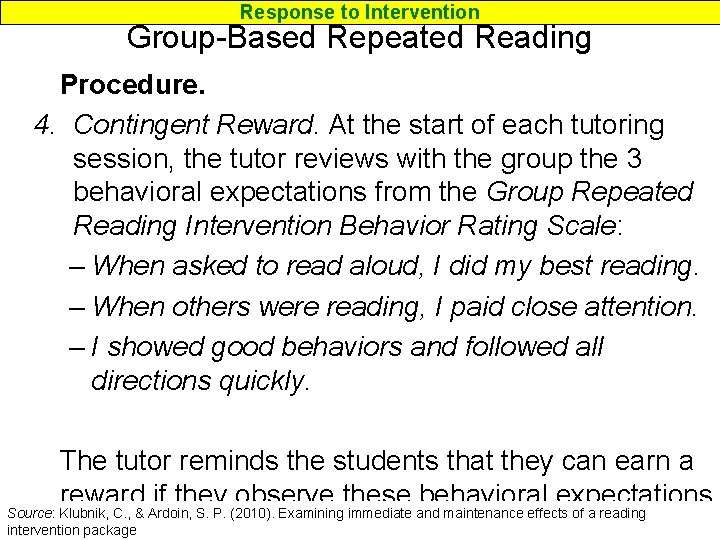
Response to Intervention Group-Based Repeated Reading Procedure. 4. Contingent Reward. At the start of each tutoring session, the tutor reviews with the group the 3 behavioral expectations from the Group Repeated Reading Intervention Behavior Rating Scale: – When asked to read aloud, I did my best reading. – When others were reading, I paid close attention. – I showed good behaviors and followed all directions quickly. The tutor reminds the students that they can earn a reward if they observe these behavioral expectations. Source: Klubnik, C. , & Ardoin, S. P. (2010). Examining immediate and maintenance effects of a reading intervention package www. interventioncentral. org 67
Response to Intervention www. interventioncentral. org
Response to Intervention www. interventioncentral. org
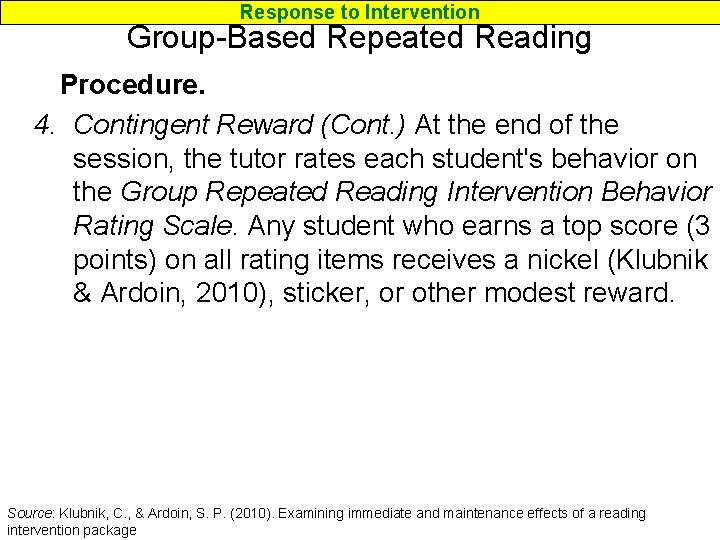
Response to Intervention Group-Based Repeated Reading Procedure. 4. Contingent Reward (Cont. ) At the end of the session, the tutor rates each student's behavior on the Group Repeated Reading Intervention Behavior Rating Scale. Any student who earns a top score (3 points) on all rating items receives a nickel (Klubnik & Ardoin, 2010), sticker, or other modest reward. Source: Klubnik, C. , & Ardoin, S. P. (2010). Examining immediate and maintenance effects of a reading intervention package www. interventioncentral. org 70
Response to Intervention Sample Strategies to Promote…Reading Comprehension www. interventioncentral. org 71
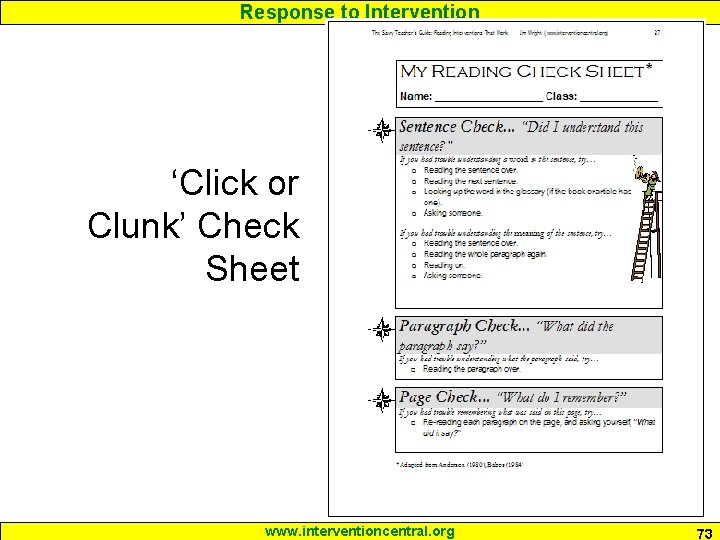
Response to Intervention Reading Comprehension: Self-Management Strategies CLICK OR CLUNK: MONITORING COMPREHENSION • The student continually checks understanding of sentences, paragraphs, and pages of text while reading. • If the student understands what is read, he/she quietly says ‘CLICK’ and continues reading. • If the student encounters problems with vocabulary or comprehension, he/she quietly says ‘CLUNK’ and uses a checklist to apply simple strategies to solve those reading difficulties. Source: Babbs, P. J. (1984). Monitoring cards help improve comprehension. The Reading Teacher, 38(2), 200 -204. www. interventioncentral. org 72
Response to Intervention ‘Click or Clunk’ Check Sheet www. interventioncentral. org 73
Response to Intervention Reading Comprehension ‘Fix-Up’ Skills: A Toolkit • [Student Strategy] Identifying or Constructing Main Idea Sentences (Question Generation) (Davey & Mc. Bride, 1986; Rosenshine, Meister & Chapman, 1996). For each paragraph in an assigned reading, the student either (a) highlights the main idea sentence or (b) highlights key details and uses them to write a ‘gist’ sentence. The student then writes the main idea of that paragraph on an index card. On the other side of the card, the student writes a question whose answer is that paragraph’s main idea sentence. This stack of ‘main idea’ cards becomes a useful tool to review assigned readings. www. interventioncentral. org 74
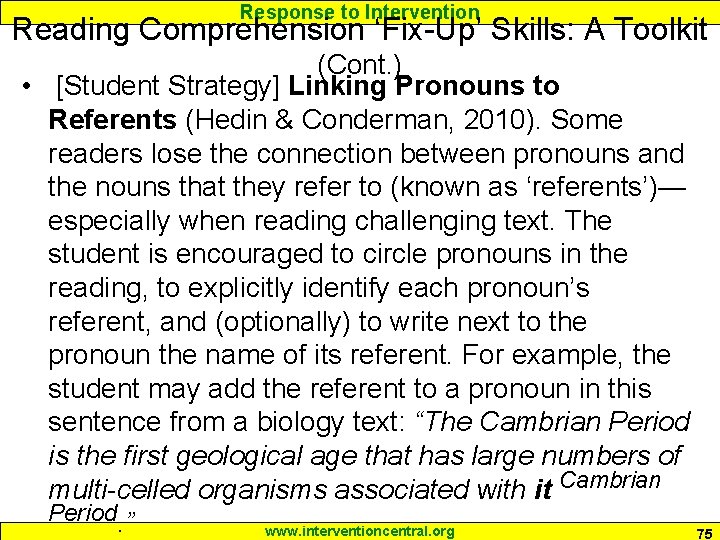
Response to Intervention Reading Comprehension ‘Fix-Up’ Skills: A Toolkit (Cont. ) • [Student Strategy] Linking Pronouns to Referents (Hedin & Conderman, 2010). Some readers lose the connection between pronouns and the nouns that they refer to (known as ‘referents’)— especially when reading challenging text. The student is encouraged to circle pronouns in the reading, to explicitly identify each pronoun’s referent, and (optionally) to write next to the pronoun the name of its referent. For example, the student may add the referent to a pronoun in this sentence from a biology text: “The Cambrian Period is the first geological age that has large numbers of multi-celled organisms associated with it Cambrian Period. ” www. interventioncentral. org 75
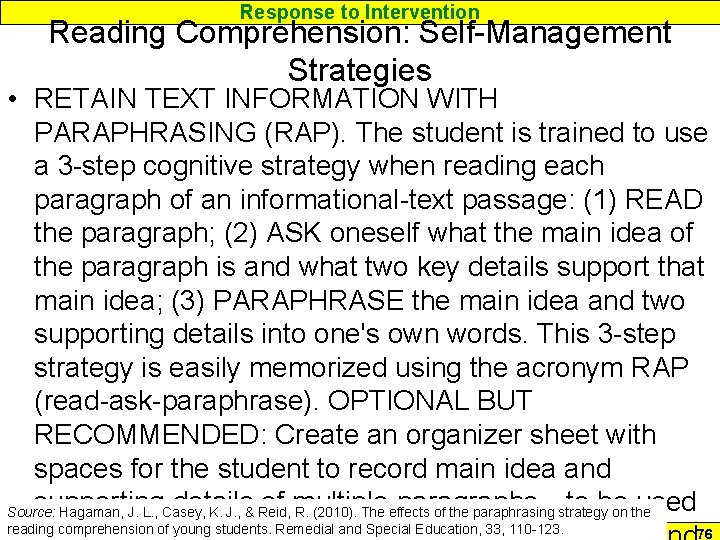
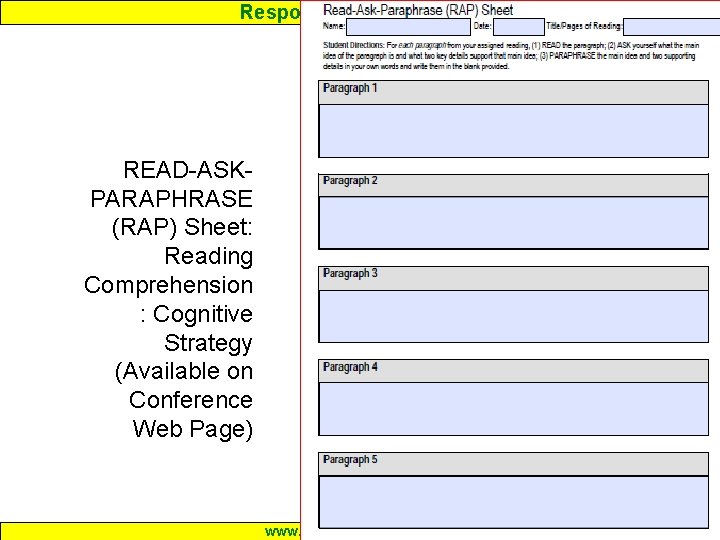
Response to Intervention Reading Comprehension: Self-Management Strategies • RETAIN TEXT INFORMATION WITH PARAPHRASING (RAP). The student is trained to use a 3 -step cognitive strategy when reading each paragraph of an informational-text passage: (1) READ the paragraph; (2) ASK oneself what the main idea of the paragraph is and what two key details support that main idea; (3) PARAPHRASE the main idea and two supporting details into one's own words. This 3 -step strategy is easily memorized using the acronym RAP (read-ask-paraphrase). OPTIONAL BUT RECOMMENDED: Create an organizer sheet with spaces for the student to record main idea and supporting details of multiple paragraphs—to be used Source: Hagaman, J. L. , Casey, K. J. , & Reid, R. (2010). The effects of the paraphrasing strategy on the reading comprehension of young students. www. interventioncentral. org Remedial and Special Education, 33, 110 -123. 76
Response to Intervention READ-ASKPARAPHRASE (RAP) Sheet: Reading Comprehension : Cognitive Strategy (Available on Conference Web Page) www. interventioncentral. org
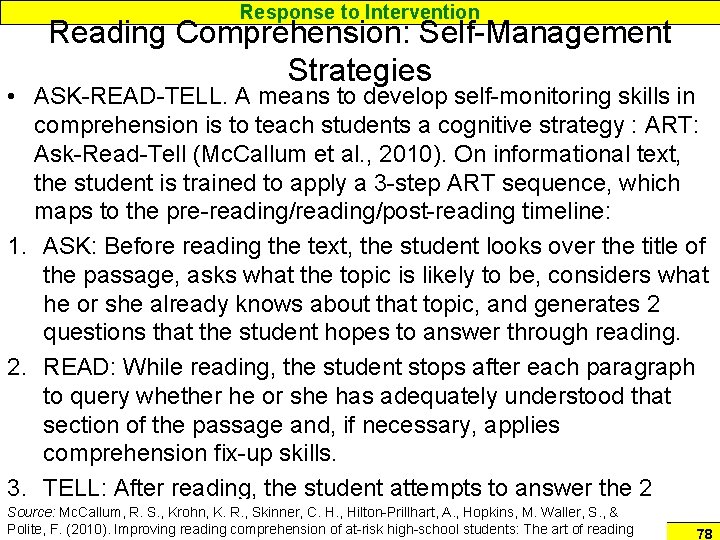
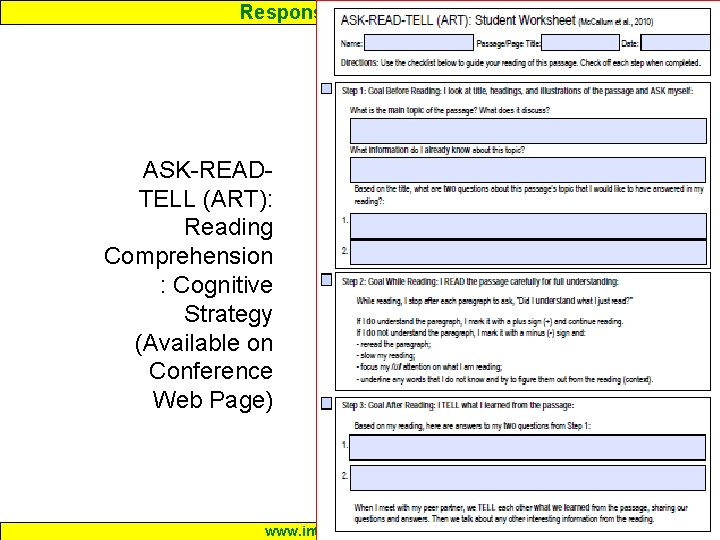
Response to Intervention Reading Comprehension: Self-Management Strategies • ASK-READ-TELL. A means to develop self-monitoring skills in comprehension is to teach students a cognitive strategy : ART: Ask-Read-Tell (Mc. Callum et al. , 2010). On informational text, the student is trained to apply a 3 -step ART sequence, which maps to the pre-reading/post-reading timeline: 1. ASK: Before reading the text, the student looks over the title of the passage, asks what the topic is likely to be, considers what he or she already knows about that topic, and generates 2 questions that the student hopes to answer through reading. 2. READ: While reading, the student stops after each paragraph to query whether he or she has adequately understood that section of the passage and, if necessary, applies comprehension fix-up skills. 3. TELL: After reading, the student attempts to answer the 2 Source: Mc. Callum, R. S. , Krohn, K. R. , Skinner, C. H. , Hilton-Prillhart, A. , Hopkins, M. Waller, S. , & questions posed earlier based on the content just read. Polite, F. (2010). Improving reading comprehension of at-risk high-school students: The art of reading www. interventioncentral. org 78
Response to Intervention ASK-READTELL (ART): Reading Comprehension : Cognitive Strategy (Available on Conference Web Page) www. interventioncentral. org
Response to Intervention Sample Strategy to Promote…Writing: Grammar & Syntax www. interventioncentral. org 80
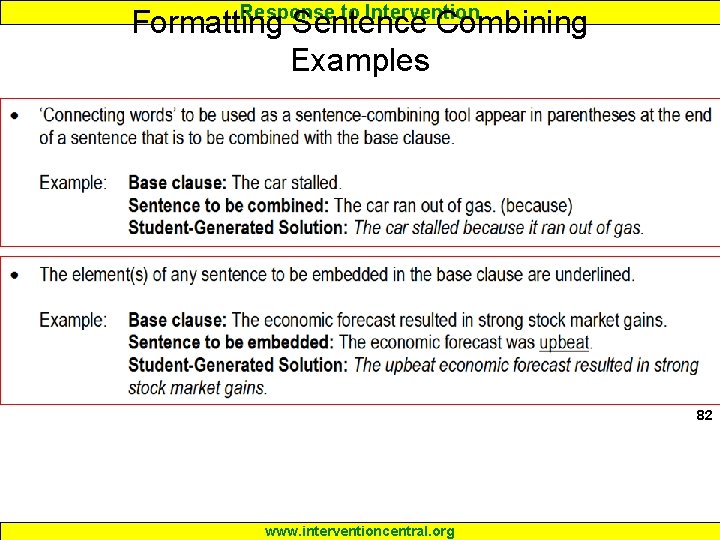
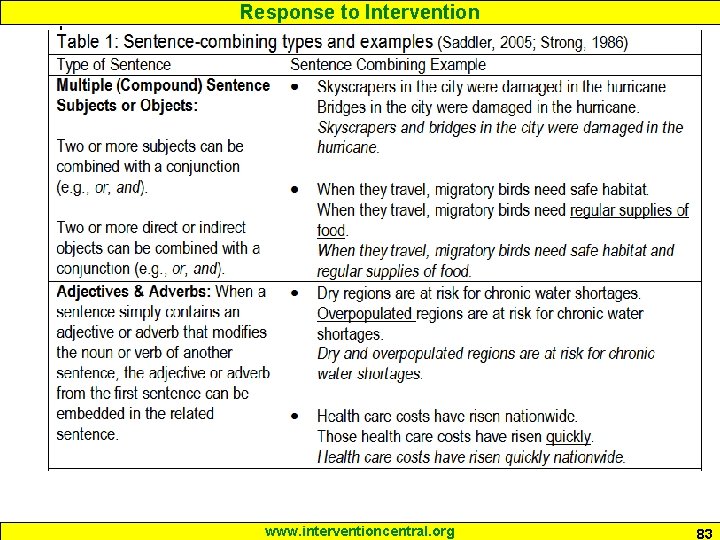
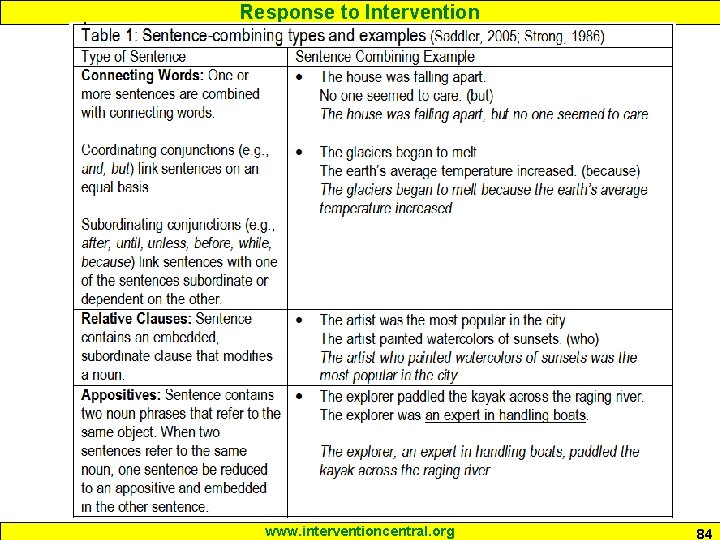
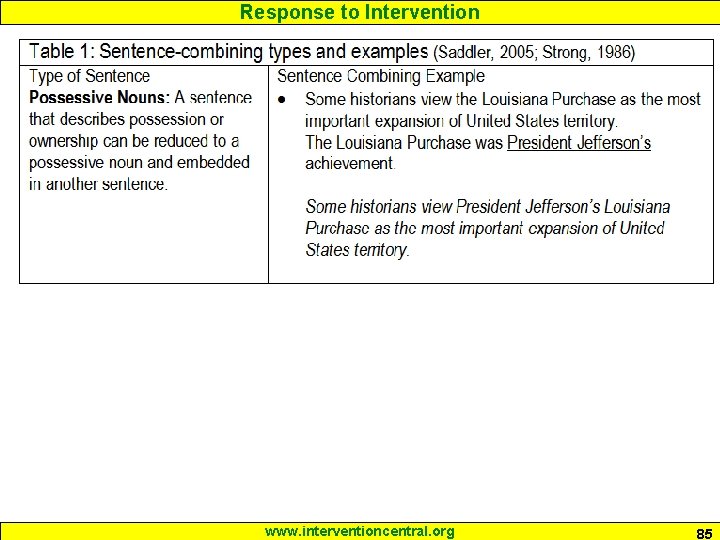
Response to Intervention Sentence Combining (Online) Students with poor writing skills often write sentences that lack ‘syntactic maturity’. Their sentences often follow a simple, stereotyped format. A promising approach to teach students use of diverse sentence structures is through sentence combining. In sentence combining, students are presented with kernel sentences and given explicit instruction in how to weld these kernel sentences into more diverse sentence types either – by using connecting words to combine multiple sentences into one or – by isolating key information from an otherwise Sources: Saddler, B. (2005). Sentence combining: A sentence-level writing intervention. The Reading superfluous sentence and embedding that important Teacher, 58, 468 -471. information into theto sentence base sentence. Strong, W. (1986). Creative approaches combining. Urbana, OL: ERIC Clearinghouse on Reading and Communication Skill & National Council of Teachers of English. www. interventioncentral. org 81
Response to Intervention Formatting Sentence Combining Examples 82 www. interventioncentral. org
Response to Intervention www. interventioncentral. org 83
Response to Intervention www. interventioncentral. org 84
Response to Intervention www. interventioncentral. org 85
Response to Intervention Sample Strategies to Promote…Math Skills www. interventioncentral. org 86
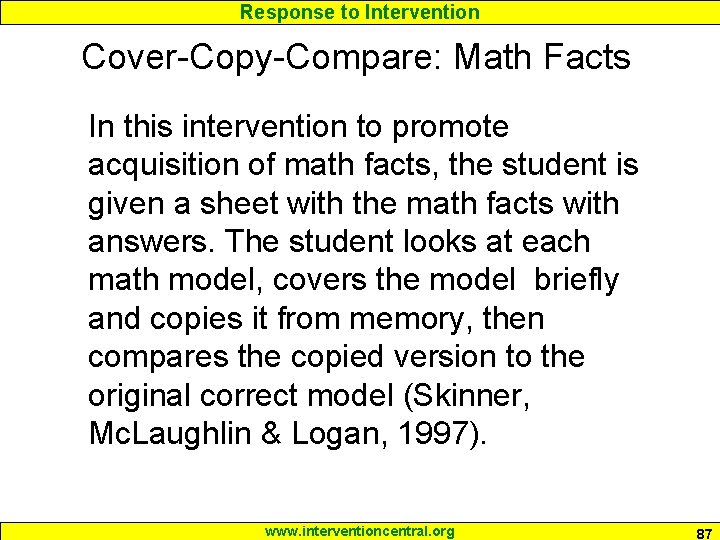
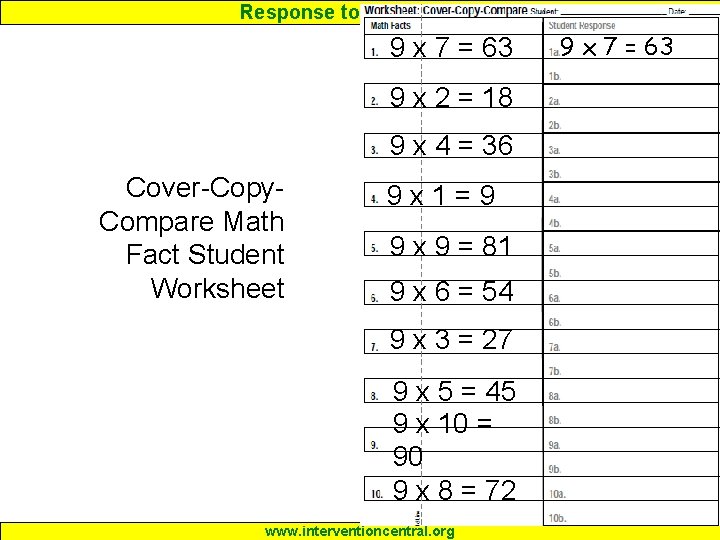
Response to Intervention Cover-Copy-Compare: Math Facts In this intervention to promote acquisition of math facts, the student is given a sheet with the math facts with answers. The student looks at each math model, covers the model briefly and copies it from memory, then compares the copied version to the original correct model (Skinner, Mc. Laughlin & Logan, 1997). www. interventioncentral. org 87
Response to Intervention 9 x 7 = 63 9 x 2 = 18 9 x 4 = 36 Cover-Copy. Compare Math Fact Student Worksheet 9 x 1=9 9 x 9 = 81 9 x 6 = 54 9 x 3 = 27 9 x 5 = 45 9 x 10 = 90 9 x 8 = 72 www. interventioncentral. org 9 x 7 = 63
Response to Intervention Peer Tutoring in Math Computation with Constant Time Delay www. interventioncentral. org
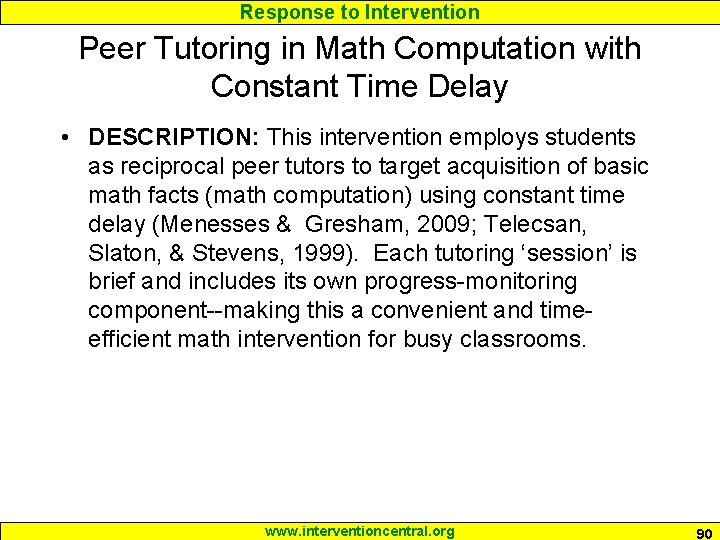
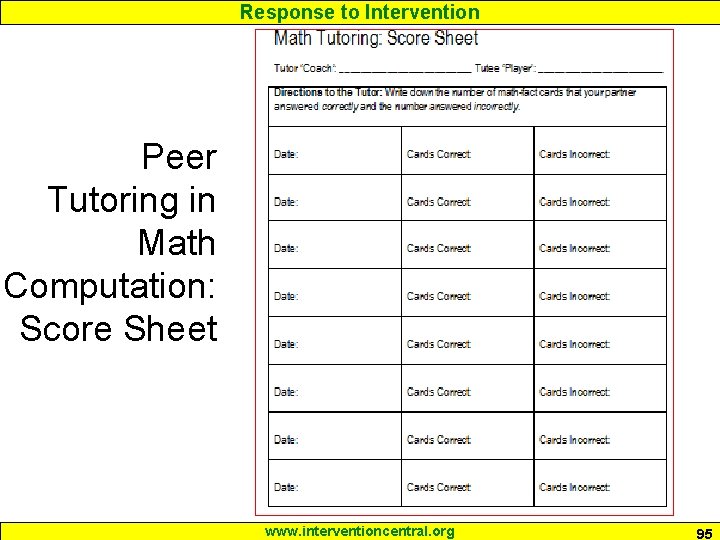
Response to Intervention Peer Tutoring in Math Computation with Constant Time Delay • DESCRIPTION: This intervention employs students as reciprocal peer tutors to target acquisition of basic math facts (math computation) using constant time delay (Menesses & Gresham, 2009; Telecsan, Slaton, & Stevens, 1999). Each tutoring ‘session’ is brief and includes its own progress-monitoring component--making this a convenient and timeefficient math intervention for busy classrooms. www. interventioncentral. org 90
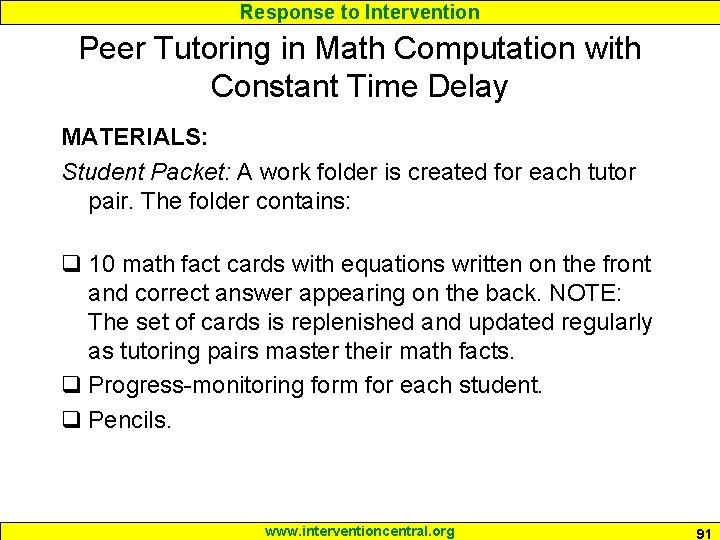
Response to Intervention Peer Tutoring in Math Computation with Constant Time Delay MATERIALS: Student Packet: A work folder is created for each tutor pair. The folder contains: q 10 math fact cards with equations written on the front and correct answer appearing on the back. NOTE: The set of cards is replenished and updated regularly as tutoring pairs master their math facts. q Progress-monitoring form for each student. q Pencils. www. interventioncentral. org 91
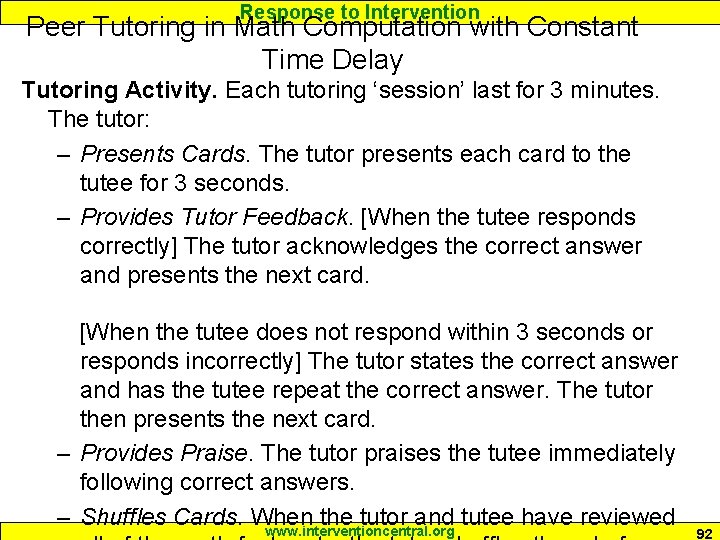
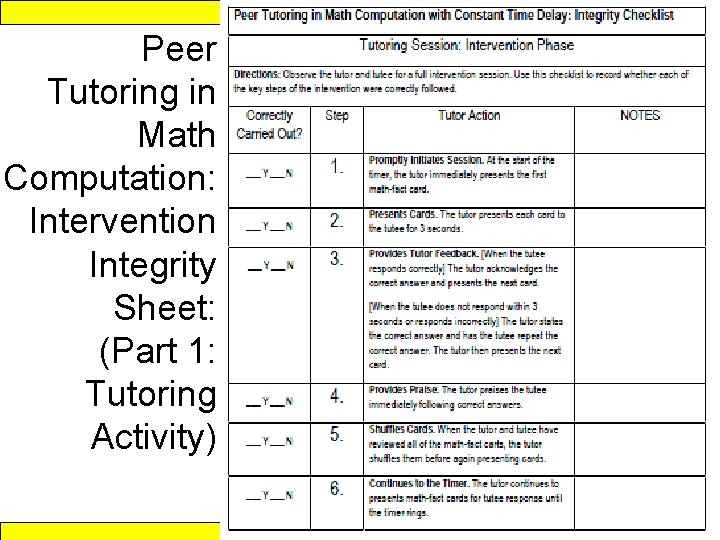
Response to Intervention Peer Tutoring in Math Computation with Constant Time Delay Tutoring Activity. Each tutoring ‘session’ last for 3 minutes. The tutor: – Presents Cards. The tutor presents each card to the tutee for 3 seconds. – Provides Tutor Feedback. [When the tutee responds correctly] The tutor acknowledges the correct answer and presents the next card. [When the tutee does not respond within 3 seconds or responds incorrectly] The tutor states the correct answer and has the tutee repeat the correct answer. The tutor then presents the next card. – Provides Praise. The tutor praises the tutee immediately following correct answers. – Shuffles Cards. When the tutor and tutee have reviewed www. interventioncentral. org 92
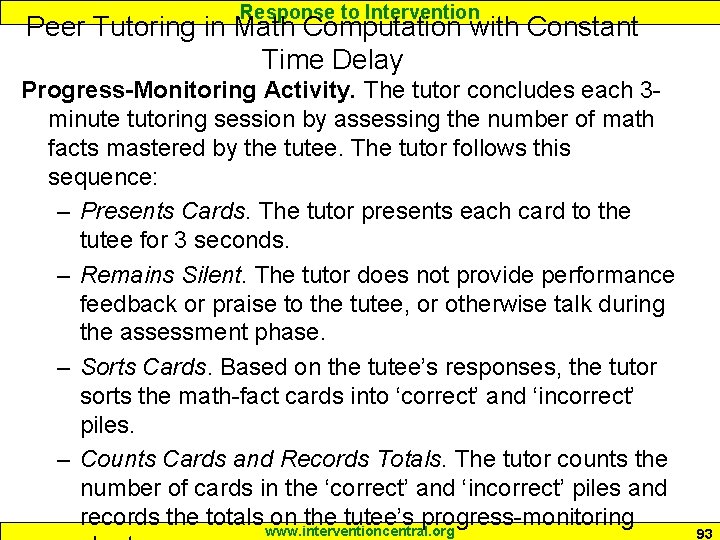
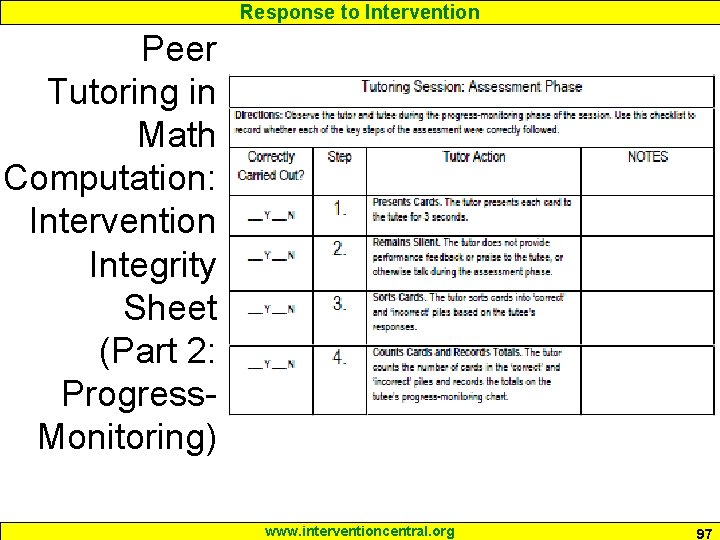
Response to Intervention Peer Tutoring in Math Computation with Constant Time Delay Progress-Monitoring Activity. The tutor concludes each 3 minute tutoring session by assessing the number of math facts mastered by the tutee. The tutor follows this sequence: – Presents Cards. The tutor presents each card to the tutee for 3 seconds. – Remains Silent. The tutor does not provide performance feedback or praise to the tutee, or otherwise talk during the assessment phase. – Sorts Cards. Based on the tutee’s responses, the tutor sorts the math-fact cards into ‘correct’ and ‘incorrect’ piles. – Counts Cards and Records Totals. The tutor counts the number of cards in the ‘correct’ and ‘incorrect’ piles and records the totals www. interventioncentral. org on the tutee’s progress-monitoring 93
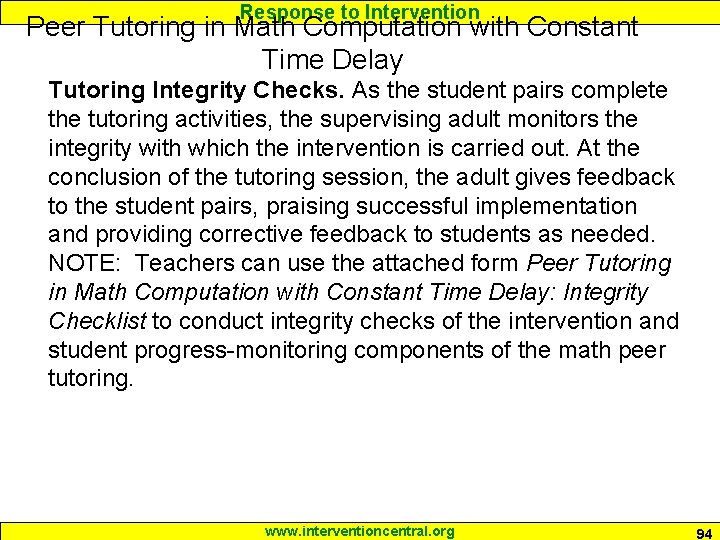
Response to Intervention Peer Tutoring in Math Computation with Constant Time Delay Tutoring Integrity Checks. As the student pairs complete the tutoring activities, the supervising adult monitors the integrity with which the intervention is carried out. At the conclusion of the tutoring session, the adult gives feedback to the student pairs, praising successful implementation and providing corrective feedback to students as needed. NOTE: Teachers can use the attached form Peer Tutoring in Math Computation with Constant Time Delay: Integrity Checklist to conduct integrity checks of the intervention and student progress-monitoring components of the math peer tutoring. www. interventioncentral. org 94
Response to Intervention Peer Tutoring in Math Computation: Score Sheet www. interventioncentral. org 95
Response to Intervention Peer Tutoring in Math Computation: Intervention Integrity Sheet: (Part 1: Tutoring Activity) www. interventioncentral. org 96
Response to Intervention Peer Tutoring in Math Computation: Intervention Integrity Sheet (Part 2: Progress. Monitoring) www. interventioncentral. org 97
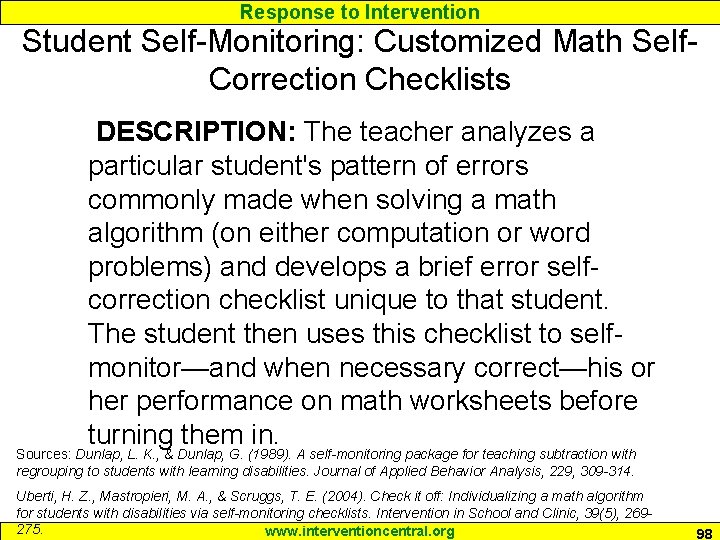
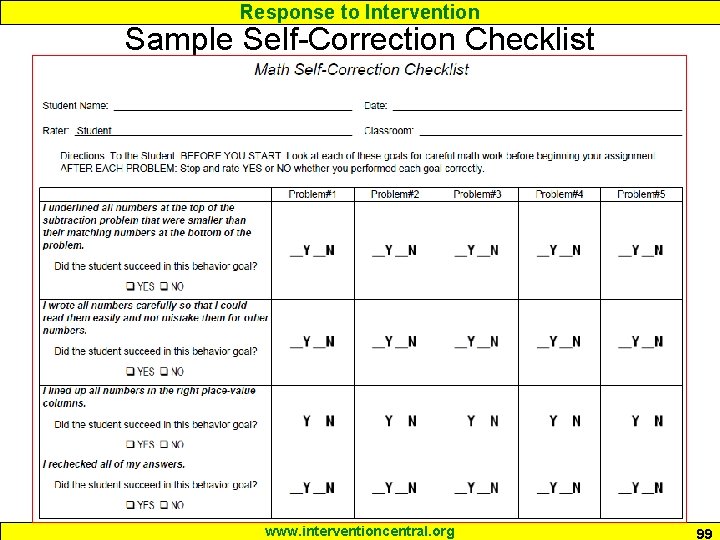
Response to Intervention Student Self-Monitoring: Customized Math Self. Correction Checklists DESCRIPTION: The teacher analyzes a particular student's pattern of errors commonly made when solving a math algorithm (on either computation or word problems) and develops a brief error selfcorrection checklist unique to that student. The student then uses this checklist to selfmonitor—and when necessary correct—his or her performance on math worksheets before turning them in. Sources: Dunlap, L. K. , & Dunlap, G. (1989). A self-monitoring package for teaching subtraction with regrouping to students with learning disabilities. Journal of Applied Behavior Analysis, 229, 309 -314. Uberti, H. Z. , Mastropieri, M. A. , & Scruggs, T. E. (2004). Check it off: Individualizing a math algorithm for students with disabilities via self-monitoring checklists. Intervention in School and Clinic, 39(5), 269275. www. interventioncentral. org 98
Response to Intervention Sample Self-Correction Checklist www. interventioncentral. org 99
Response to Intervention Teachers: Providing Classroom Reading & Writing Interventions Suggestions for Implementation: • The school or district should develop a bank of research-based intervention ideas that teachers can use immediately. • Teachers should consider teaching a particular intervention strategy to the entire class if substantial numbers of students need to learn that strategy. • The school should pull together a collection of ‘portable’ student-directed intervention ideas (e. g. , ‘Ask-Read-Tell’) that can be taught in a variety of settings, such as classrooms, study www. interventioncentral. org 100
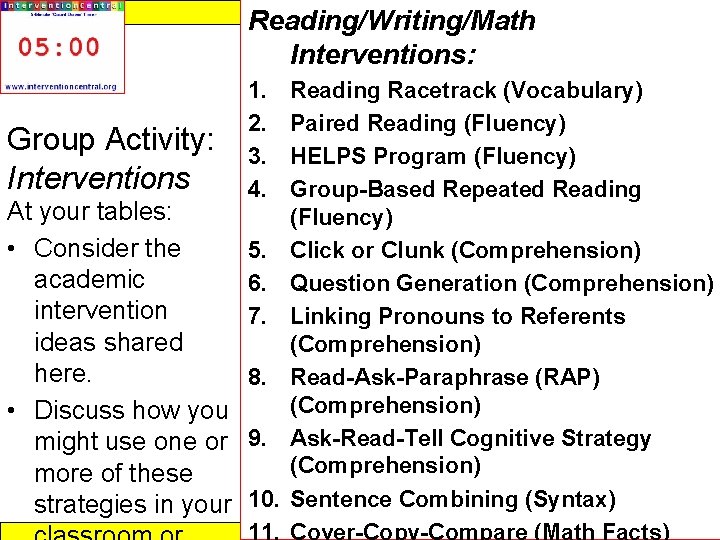
Response to Intervention Reading/Writing/Math Interventions: 1. 2. 3. 4. Reading Racetrack (Vocabulary) Paired Reading (Fluency) Group Activity: HELPS Program (Fluency) Interventions Group-Based Repeated Reading At your tables: (Fluency) • Consider the 5. Click or Clunk (Comprehension) academic 6. Question Generation (Comprehension) intervention 7. Linking Pronouns to Referents ideas shared (Comprehension) here. 8. Read-Ask-Paraphrase (RAP) (Comprehension) • Discuss how you might use one or 9. Ask-Read-Tell Cognitive Strategy (Comprehension) more of these strategies in your 10. Sentence Combining (Syntax) www. interventioncentral. org 11. Cover-Copy-Compare (Math Facts) 101
Response to Intervention Tier 1 Academic Interventions: Putting It All Together: Classroom interventions are most effective and manageable when teachers can collaborate and follow a consistent problem-solving format. www. interventioncentral. org 102
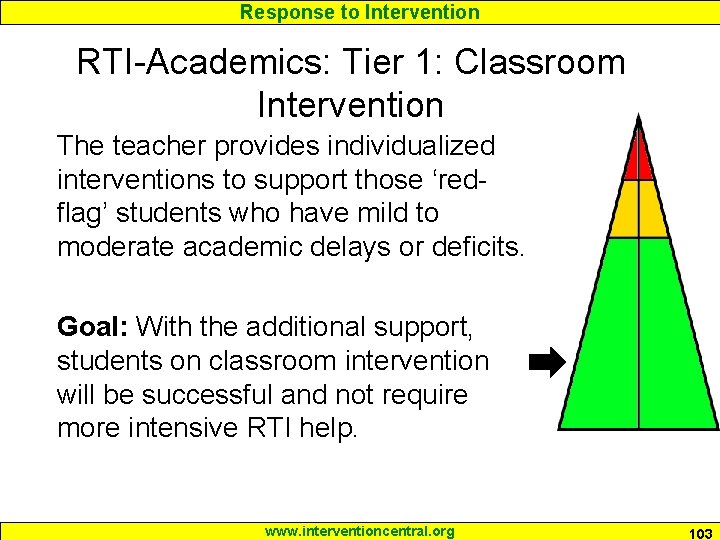
Response to Intervention RTI-Academics: Tier 1: Classroom Intervention The teacher provides individualized interventions to support those ‘redflag’ students who have mild to moderate academic delays or deficits. Goal: With the additional support, students on classroom intervention will be successful and not require more intensive RTI help. www. interventioncentral. org 103
Response to Intervention Tier 1 Intervention Plans: Essentials… • At Tier 1, problem-solving occurs when the teacher meets briefly with a team (e. g. , grade-level team, instructional team, department) or a consultant. • The teacher defines the student problem(s), selects intervention(s), decides how to monitor the intervention, and documents the intervention plan— with the guidance of the team or consultant • The teacher meets again with team or consultant several weeks later to check on the status of the intervention. • The classroom teacher is the person primarily responsible for the integrity of the Tier 1 intervention plan. www. interventioncentral. org 104
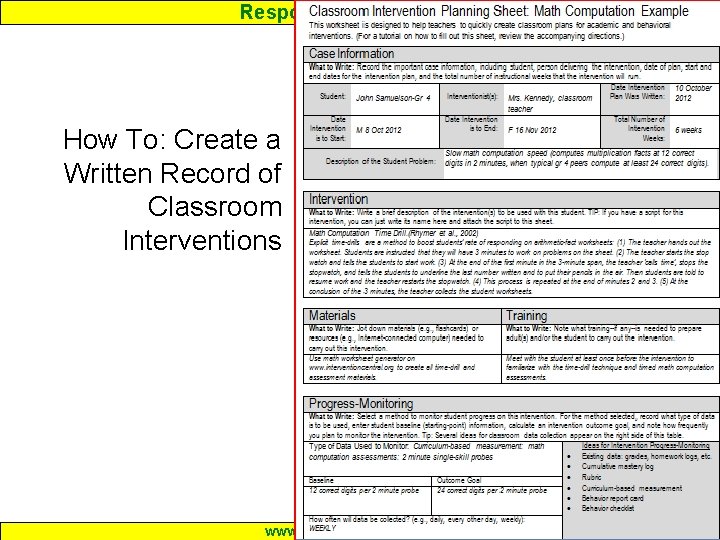
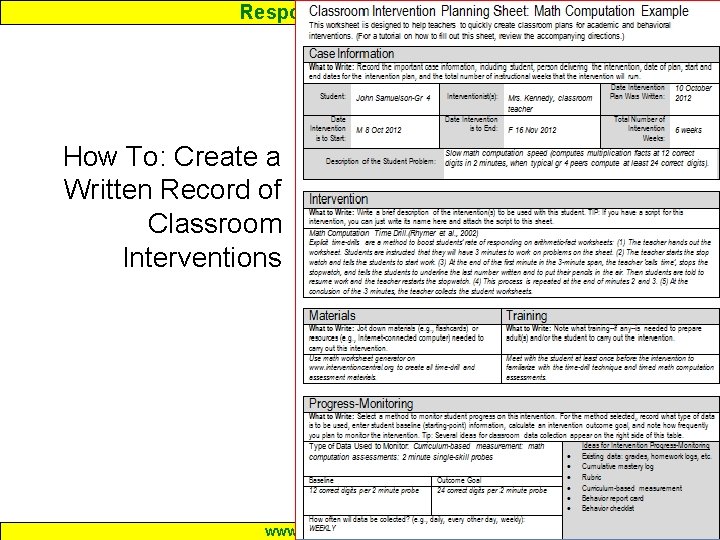
Response to Intervention How To: Create a Written Record of Classroom Interventions www. interventioncentral. org 105
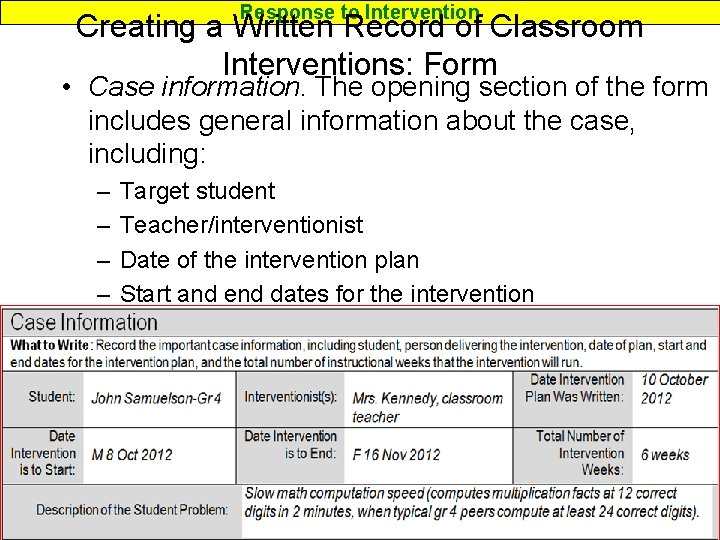
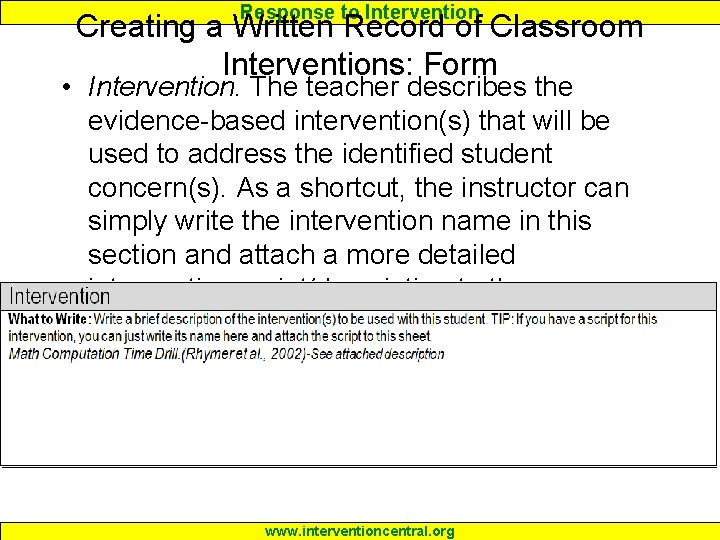
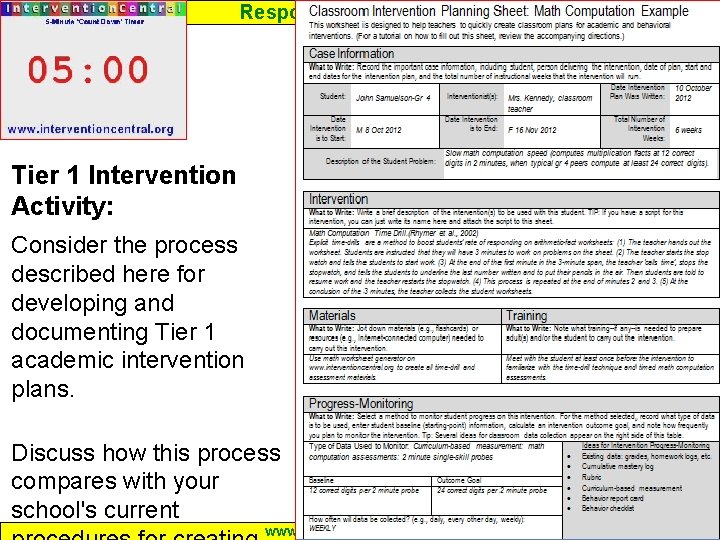
Response to Intervention Creating a Written Record of Classroom Interventions: Form • Case information. The opening section of the form includes general information about the case, including: – – – Target student Teacher/interventionist Date of the intervention plan Start and end dates for the intervention Description of the student problem to be addressed www. interventioncentral. org 106
Response to Intervention Creating a Written Record of Classroom Interventions: Form • Intervention. The teacher describes the evidence-based intervention(s) that will be used to address the identified student concern(s). As a shortcut, the instructor can simply write the intervention name in this section and attach a more detailed intervention script/description to the intervention plan. 107 www. interventioncentral. org
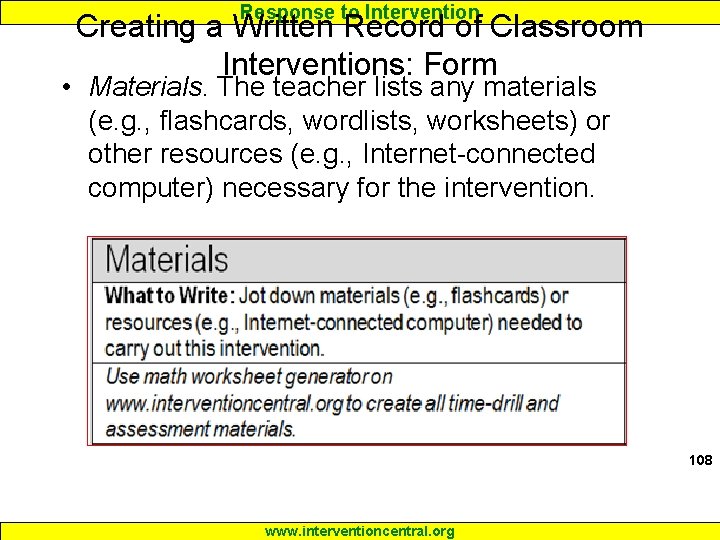
Response to Intervention Creating a Written Record of Classroom Interventions: Form • Materials. The teacher lists any materials (e. g. , flashcards, wordlists, worksheets) or other resources (e. g. , Internet-connected computer) necessary for the intervention. 108 www. interventioncentral. org
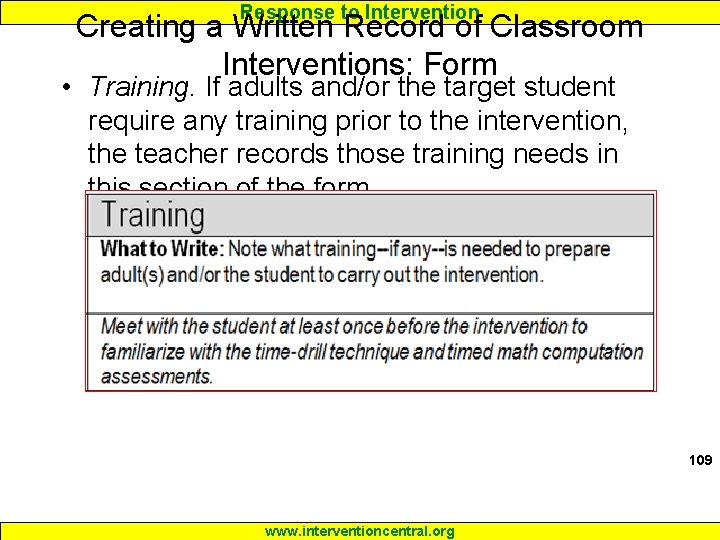
Response to Intervention Creating a Written Record of Classroom Interventions: Form • Training. If adults and/or the target student require any training prior to the intervention, the teacher records those training needs in this section of the form. 109 www. interventioncentral. org
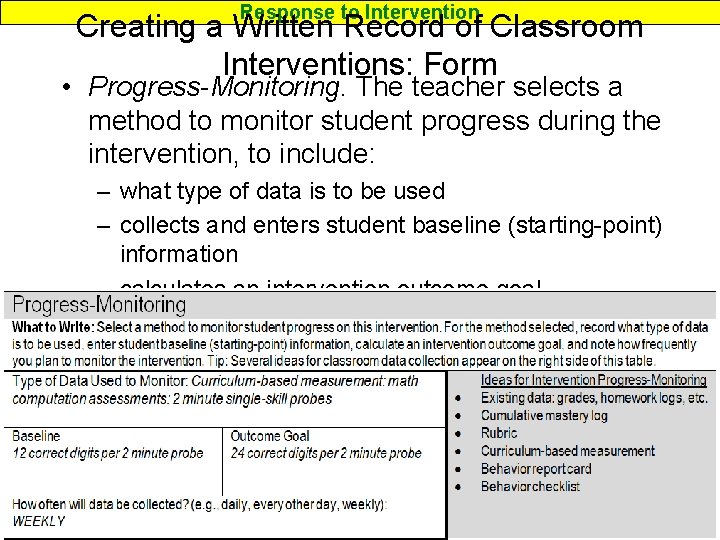
Response to Intervention Creating a Written Record of Classroom Interventions: Form • Progress-Monitoring. The teacher selects a method to monitor student progress during the intervention, to include: – what type of data is to be used – collects and enters student baseline (starting-point) information – calculates an intervention outcome goal – The frequency that data will be collected. 110 www. interventioncentral. org
Response to Intervention How To: Create a Written Record of Classroom Interventions www. interventioncentral. org 111
Response to Intervention Tier 1 Intervention Activity: Consider the process described here for developing and documenting Tier 1 academic intervention plans. Discuss how this process compares with your school's current www. interventioncentral. org 112
Response to Intervention Tier 1: Teacher Consultation/Team: Key Points • At Tier 1, problem-solving occurs when the teacher meets briefly with a team (e. g. , grade-level team, instructional team, department) or a consultant. • The teacher defines the student problem(s), selects intervention(s), decides how to monitor the intervention, and documents the intervention plan— with the guidance of the team or consultant • The teacher meets again with team or consultant several weeks later to check on the status of the intervention. • The classroom teacher is the person primarily responsible for the integrity of the Tier 1 intervention plan. www. interventioncentral. org 113