Recap Intro vector space classification Rocchio k NN



- Slides: 84
Recap Intro vector space classification Rocchio k. NN Linear classifiers > two classes Introduction to Information Retrieval h t t p: / / i n f o r ma t i o n r e t r i e v a l. or g IIR 14: Vector Space Classification Schu ¨ tze: Vector space classification 1 / 68
Recap Intro vector space classification Rocchio k. NN Linear classifiers > two classes Overview 1 Recap 2 Intro vector space classification 3 Rocchio 4 k. NN 5 Linear classifiers 6 > two classes Schu ¨ tze: Vector space classification 2 / 68
Recap Intro vector space classification Rocchio k. NN Linear classifiers > two classes Outline 1 Recap 2 Intro vector space classification 3 Rocchio 4 k. NN 5 Linear classifiers 6 > two classes Schu ¨ tze: Vector space classification 3 / 68
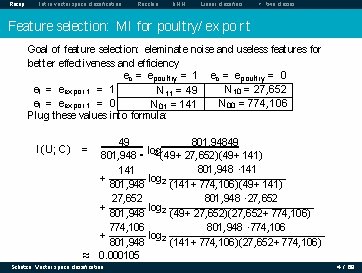
Recap Intro vector space classification Rocchio k. NN Linear classifiers > two classes Feature selection: MI for poultry/ ex por t Goal of feature selection: eleminate noise and useless features for better effectiveness and efficiency ec = epoultry = 1 ec = epoultry = 0 N 10 = 27, 652 et = eex por t = 1 N 11 = 49 et = eex por t = 0 N 00 = 774, 106 N 01 = 141 Plug these values into formula: I (U; C) 49 801, 94849 · 2 801, 948 log (49+ 27, 652)(49+ 141) 801, 948 · 141 log 2 + 801, 948 (141+ 774, 106)(49+ 141) 27, 652 801, 948 · 27, 652 + log 2 801, 948 (49+ 27, 652)(27, 652+ 774, 106) 774, 106 801, 948 · 774, 106 + log 2 801, 948 (141+ 774, 106)(27, 652+ 774, 106) ≈ 0. 000105 = Schu ¨ tze: Vector space classification 4 / 68
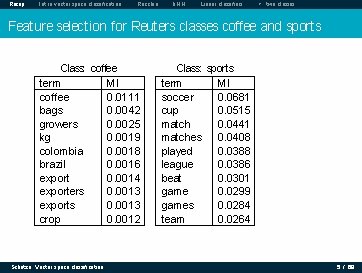
Recap Intro vector space classification Rocchio k. NN Linear classifiers > two classes Feature selection for Reuters classes coffee and sports Class: coffee term MI coffee 0. 0111 bags 0. 0042 growers 0. 0025 kg 0. 0019 colombia 0. 0018 brazil 0. 0016 export 0. 0014 exporters 0. 0013 exports 0. 0013 crop 0. 0012 Schu ¨ tze: Vector space classification Class: sports term MI soccer 0. 0681 cup 0. 0515 match 0. 0441 matches 0. 0408 played 0. 0388 league 0. 0386 beat 0. 0301 game 0. 0299 games 0. 0284 team 0. 0264 5 / 68
Recap Intro vector space classification Rocchio k. NN Linear classifiers > two classes Using language models (LMs) for IR LM = language model We view the document as a generative model that generates the query. What we need to do: Define the precise generative model we want to use Estimate parameters (different parameters for each document’s model) Smooth to avoid zeros Apply to query and find document most likely to have generated the query Present most likely document(s) to user Schu ¨ tze: Vector space classification 6 / 68
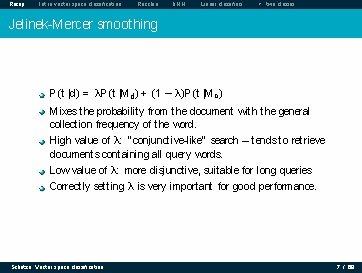
Recap Intro vector space classification Rocchio k. NN Linear classifiers > two classes Jelinek-Mercer smoothing P (t |d ) = λP (t |M d ) + (1 − λ)P (t |M c) Mixes the probability from the document with the general collection frequency of the word. High value of λ: “ conjunctive-like” search – tends to retrieve documents containing all query words. Low value of λ: more disjunctive, suitable for long queries Correctly setting λ is very important for good performance. Schu ¨ tze: Vector space classification 7 / 68
Recap Intro vector space classification Rocchio k. NN Linear classifiers > two classes Take-away today Vector space classification: Basic idea of doing text classification for documents that are represented as vectors Rocchio classifier: Rocchio relevance feedback idea applied to text classification k nearest neighbor classification Linear classifiers More than two classes Schu ¨ tze: Vector space classification 8 / 68
Recap Intro vector space classification Rocchio k. NN Linear classifiers > two classes Outline 1 Recap 2 Intro vector space classification 3 Rocchio 4 k. NN 5 Linear classifiers 6 > two classes Schu ¨ tze: Vector space classification 10 / 68
Recap Intro vector space classification Rocchio k. NN Linear classifiers > two classes Recall vector space representation • Each document is a vector, one component for each term. Terms are axes. • High dimensionality: 100, 000 s of dimensions Normalize vectors (documents) to unit length How can we do classification in this space? Schu ¨ tze: Vector space classification 10 / 68
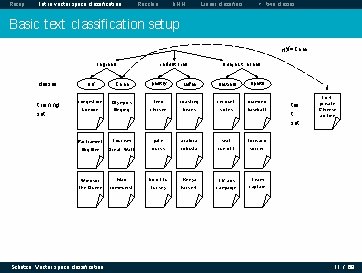
Recap Intro vector space classification Rocchio k. NN Linear classifiers > two classes Basic text classification setup γ(d ) ′= China r egions indust r ies subj ect ar eas classes: UK China poultry coffee training set: congest ion Ol y mpics f eed r oast ing r ecount diamond L ondon B eij ing chick en beans vot es basebal l elections sports Par l iament t our ism pat e ar abica seat f or war d B ig B en Gr eat Wal l duck s r obust a r un-of f soccer W indsor M ao bir d f l u K enya T V ads t eam t he Queen communist t ur k ey har vest campaign capt ain Schu ¨ tze: Vector space classification d′ tes t set: f ir st pr ivat e Chinese air l ine 11 / 68
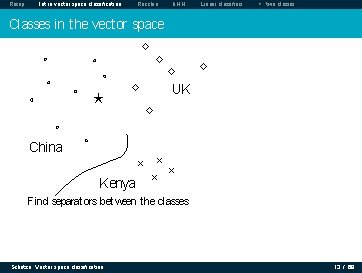
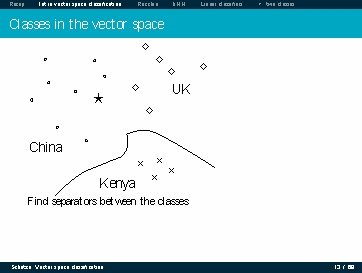
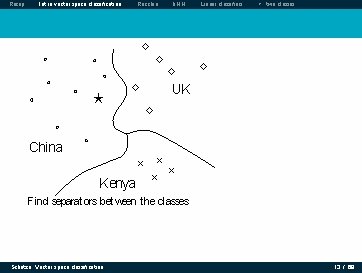
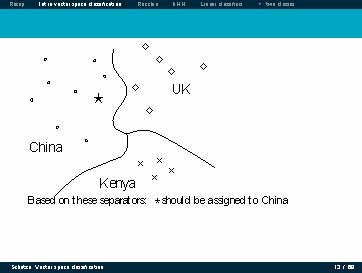
Recap Intro vector space classification Rocchio k. NN Linear classifiers > two classes Vector space classification As before, the training set is a set of documents, each labeled with its class. In vector space classification, this set corresponds to a labeled set of points or vectors in the vector space. Premise 1: Documents in the same class form a contiguous region. Premise 2: Documents from different classes don’t overlap. We define lines, surfaces, hypersurfaces to divide regions. Schu ¨ tze: Vector space classification 12 / 68
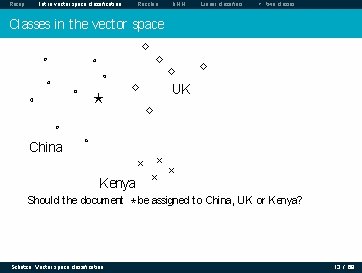
Recap Intro vector space classification Rocchio k. NN Linear classifiers > two classes Classes in the vector space ⋄ ⋆ ⋄ ⋄ ⋄ UK ⋄ China x x Kenya ⋄ x x Should the document ⋆be assigned to China, UK or Kenya? Schu ¨ tze: Vector space classification 13 / 68
Recap Intro vector space classification Rocchio k. NN Linear classifiers > two classes Classes in the vector space ⋄ ⋆ ⋄ ⋄ ⋄ UK ⋄ China x x Kenya ⋄ x x Find separators between the classes Schu ¨ tze: Vector space classification 13 / 68
Recap Intro vector space classification Rocchio k. NN Linear classifiers > two classes Classes in the vector space ⋄ ⋆ ⋄ ⋄ ⋄ UK ⋄ China x x Kenya ⋄ x x Find separators between the classes Schu ¨ tze: Vector space classification 13 / 68
Recap Intro vector space classification Rocchio k. NN Linear classifiers > two classes Classes in the vector space ⋄ ⋆ ⋄ ⋄ ⋄ UK ⋄ China x x Kenya ⋄ x x Find separators between the classes Schu ¨ tze: Vector space classification 13 / 68
Recap Intro vector space classification Rocchio k. NN Linear classifiers > two classes Classes in the vector space ⋄ ⋆ ⋄ ⋄ ⋄ UK ⋄ China x x Kenya ⋄ x x Based on these separators: ⋆should be assigned to China Schu ¨ tze: Vector space classification 13 / 68
Recap Intro vector space classification Rocchio k. NN Linear classifiers > two classes Classes in the vector space ⋄ ⋆ ⋄ ⋄ ⋄ UK ⋄ China x x Kenya ⋄ x x How do we find separators that do a good job at classifying new documents like ⋆? – Main topic of today Schu ¨ tze: Vector space classification 13 / 68
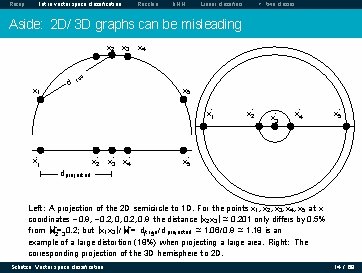
Recap Intro vector space classification Rocchio k. NN Linear classifiers > two classes Aside: 2 D/ 3 D graphs can be misleading x 2 x 3 x 4 x 1 d ru e x 5 x′ 1 x 2′ x 3′ x 4′ x 2′ x′ 3 x′ 4 x 5′ dproject ed Left: A projection of the 2 D semicircle to 1 D. For the points x 1 , x 2 , x 3 , x 4 , x 5 at x coordinates − 0. 9, − 0. 2, 0, 0. 2, 0. 9 the distance |x 2 x 3 | ≈ 0. 201 only differs by 0. 5% from |xx|2′′= 3 0. 2; but |x 1 x 3 |/|xx|′′= d 1 t rue /d proj ect ed ≈ 1. 06/0. 9 ≈ 1. 18 is an 3 example of a large distortion (18%) when projecting a large area. Right: The corresponding projection of the 3 D hemisphere to 2 D. Schu ¨ tze: Vector space classification 14 / 68
Recap Intro vector space classification Rocchio k. NN Linear classifiers > two classes Outline 1 Recap 2 Intro vector space classification 3 Rocchio 4 k. NN 5 Linear classifiers 6 > two classes Schu ¨ tze: Vector space classification 15 / 68
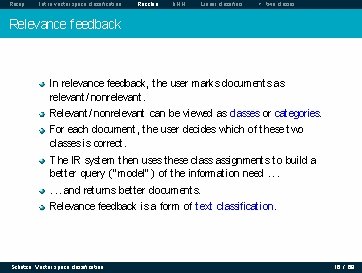
Recap Intro vector space classification Rocchio k. NN Linear classifiers > two classes Relevance feedback In relevance feedback, the user marks documents as relevant/ nonrelevant. Relevant/ nonrelevant can be viewed as classes or categories. For each document, the user decides which of these two classes is correct. The IR system then uses these class assignments to build a better query (“ model” ) of the information need. . . and returns better documents. Relevance feedback is a form of text classification. Schu ¨ tze: Vector space classification 16 / 68
Recap Intro vector space classification Rocchio k. NN Linear classifiers > two classes Using Rocchio for vector space classification The principal difference between relevance feedback and text classification: The training set is given as part of the input in text classification. It is interactively created in relevance feedback. Schu ¨ tze: Vector space classification 17 / 68
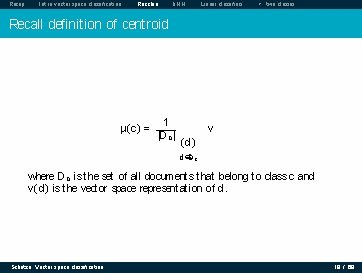
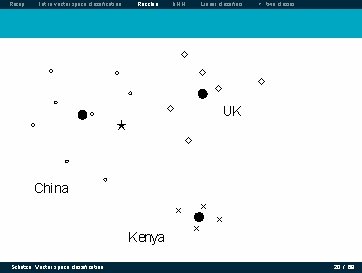
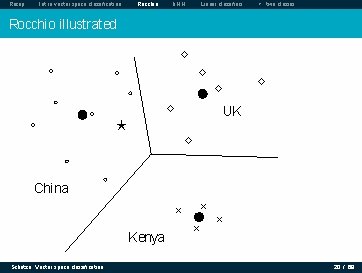
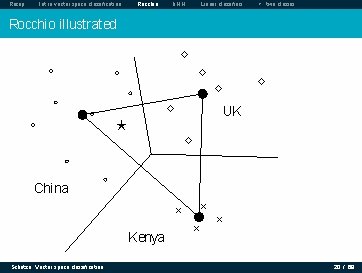
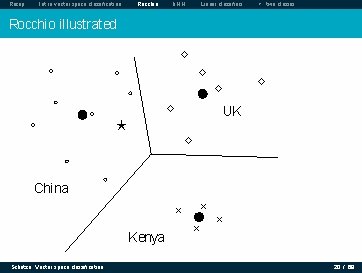
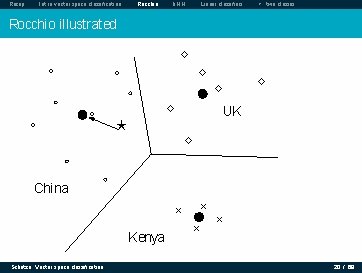
Recap Intro vector space classification Rocchio k. NN Linear classifiers > two classes Rocchio classification: Basic idea Compute a centroid for each class The centroid is the average of all documents in the class. Assign each test document to the class of its closest centroid. Schu ¨ tze: Vector space classification 18 / 68
Recap Intro vector space classification Rocchio k. NN Linear classifiers > two classes Recall definition of centroid µ(c) = 1 |Dc| v (d ) d∈D c where Dc is the set of all documents that belong to class c and v (d ) is the vector space representation of d. Schu ¨ tze: Vector space classification 19 / 68
Recap Intro vector space classification Rocchio k. NN Linear classifiers > two classes Rocchio illustrated ⋄ ⋄ ⋆ ⋄ ⋄ ⋄ UK ⋄ China x x Kenya Schu ¨ tze: Vector space classification x x 20 / 68
Recap Intro vector space classification Rocchio k. NN Linear classifiers > two classes Rocchio illustrated ⋄ ⋄ ⋆ ⋄ ⋄ ⋄ UK ⋄ China x x Kenya Schu ¨ tze: Vector space classification x x 20 / 68
Recap Intro vector space classification Rocchio k. NN Linear classifiers > two classes Rocchio illustrated ⋄ ⋄ ⋆ ⋄ ⋄ ⋄ UK ⋄ China x x Kenya Schu ¨ tze: Vector space classification x x 20 / 68
Recap Intro vector space classification Rocchio k. NN Linear classifiers > two classes Rocchio illustrated ⋄ ⋄ ⋆ ⋄ ⋄ ⋄ UK ⋄ China x x Kenya Schu ¨ tze: Vector space classification x x 20 / 68
Recap Intro vector space classification Rocchio k. NN Linear classifiers > two classes Rocchio illustrated ⋄ ⋄ ⋆ ⋄ ⋄ ⋄ UK ⋄ China x x Kenya Schu ¨ tze: Vector space classification x x 20 / 68
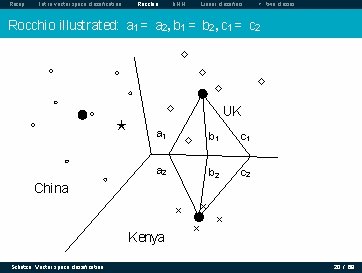
Recap Intro vector space classification Rocchio k. NN Linear classifiers > two classes Rocchio illustrated: a 1 = a 2, b 1 = b 2, c 1 = c 2 ⋄ ⋄ ⋆ ⋄ ⋄ ⋄ UK a 1 ⋄ a 2 b 1 c 1 b 2 c 2 China x x Kenya Schu ¨ tze: Vector space classification x x 20 / 68
Recap Intro vector space classification Rocchio k. NN Linear classifiers > two classes Rocchio illustrated ⋄ ⋄ ⋆ ⋄ ⋄ ⋄ UK ⋄ China x x Kenya Schu ¨ tze: Vector space classification x x 20 / 68
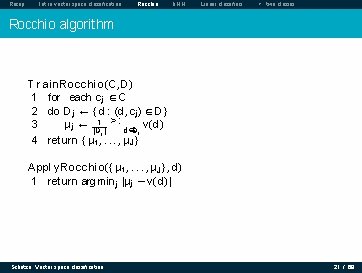
Recap Intro vector space classification Rocchio k. NN Linear classifiers > two classes Rocchio algorithm T r ain. Rocchio(C, D) 1 for each cj ∈ C 2 do Dj ← { d : (d , cj ) ∈ D} 3 µj ← |D 1 | > : d∈D j v (d ) j 4 ret urn { µ 1 , . . . , µJ } A ppl y Rocchio({ µ 1 , . . . , µJ } , d ) 1 ret urn arg minj |µj − v (d )| Schu ¨ tze: Vector space classification 21 / 68
Recap Intro vector space classification Rocchio k. NN Linear classifiers > two classes Rocchio properties Rocchio forms a simple representation for each class: the centroid We can interpret the centroid as the prototype of the class. Classification is based on similarity to / distance from centroid/ prototype. Does not guarantee that classifications are consistent with the training data! Schu ¨ tze: Vector space classification 22 / 68
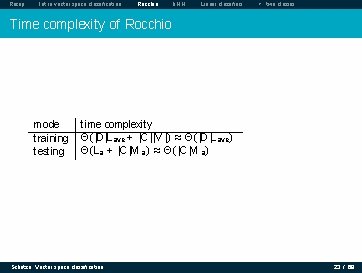
Recap Intro vector space classification Rocchio k. NN Linear classifiers > two classes Time complexity of Rocchio mode training testing time complexity Θ(|D|Lave + |C||V |) ≈ Θ(|D|Lave) Θ(La + |C|M a) ≈ Θ(|C|M a) Schu ¨ tze: Vector space classification 23 / 68
Recap Intro vector space classification Rocchio k. NN Linear classifiers > two classes Rocchio vs. Naive Bayes In many cases, Rocchio performs worse than Naive Bayes. One reason: Rocchio does not handle nonconvex, multimodal classes correctly. Schu ¨ tze: Vector space classification 24 / 68
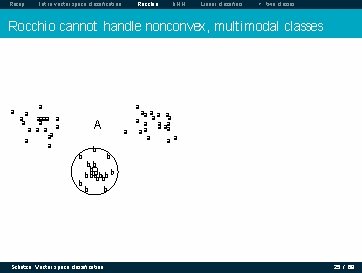
Recap Intro vector space classification Rocchio k. NN Linear classifiers > two classes Rocchio cannot handle nonconvex, multimodal classes a a aaaa a a a a a aa a A b b bb b b b. B bbbbb b Schu ¨ tze: Vector space classification 25 / 68
Recap Intro vector space classification Rocchio k. NN Linear classifiers > two classes Rocchio cannot handle nonconvex, multimodal classes a a aaaa a a a a a aa a A b b bb b b b. B bbbbb b Schu ¨ tze: Vector space classification 25 / 68
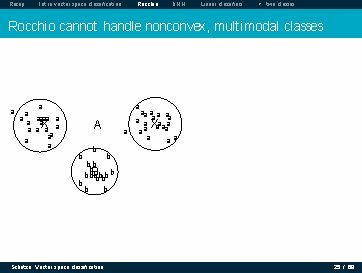
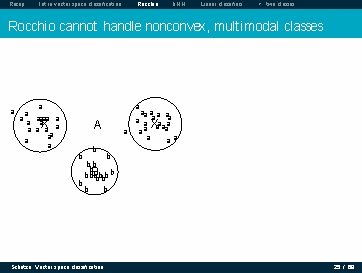
Recap Intro vector space classification Rocchio k. NN Linear classifiers > two classes Rocchio cannot handle nonconvex, multimodal classes a a aaaaa a X a a aa a a aa Xa aa a a a A b b bb b b b. B bbbbb b Schu ¨ tze: Vector space classification 25 / 68
Recap Intro vector space classification Rocchio k. NN Linear classifiers > two classes Rocchio cannot handle nonconvex, multimodal classes a a aaaaa a X a a aa a a aa Xa aa a a a A b b bb b b b. B bbbbb b Schu ¨ tze: Vector space classification 25 / 68
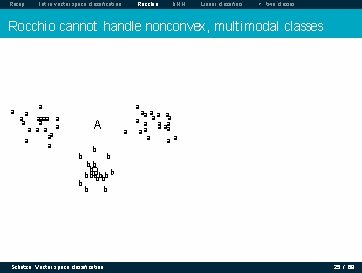
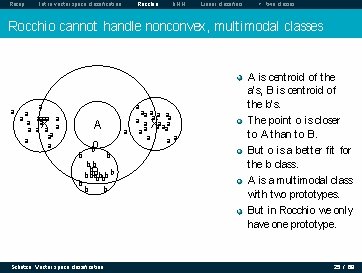
Recap Intro vector space classification Rocchio k. NN Linear classifiers > two classes Rocchio cannot handle nonconvex, multimodal classes a a aaaaa a X a a aa a a aa Xa aa a a a A b b bo b bb b b b. B bbbbb b A is centroid of the a’s, B is centroid of the b’s. The point o is closer to A than to B. But o is a better fit for the b class. A is a multimodal class with two prototypes. But in Rocchio we only have one prototype. Schu ¨ tze: Vector space classification 25 / 68
Recap Intro vector space classification Rocchio k. NN Linear classifiers > two classes Outline 1 Recap 2 Intro vector space classification 3 Rocchio 4 k. NN 5 Linear classifiers 6 > two classes Schu ¨ tze: Vector space classification 26 / 68
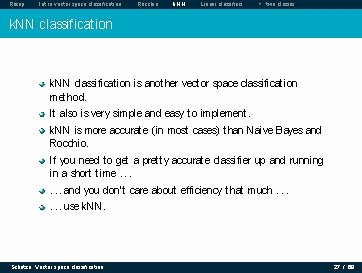
Recap Intro vector space classification Rocchio k. NN Linear classifiers > two classes k. NN classification is another vector space classification method. It also is very simple and easy to implement. k. NN is more accurate (in most cases) than Naive Bayes and Rocchio. If you need to get a pretty accurate classifier up and running in a short time. . . and you don’t care about efficiency that much. . . use k. NN. Schu ¨ tze: Vector space classification 27 / 68
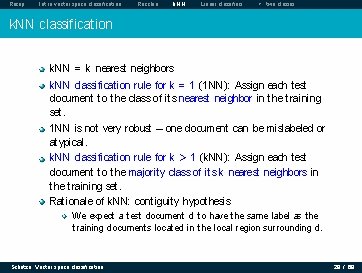
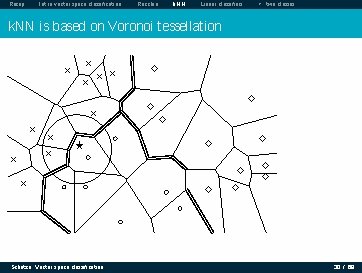
Recap Intro vector space classification Rocchio k. NN Linear classifiers > two classes k. NN classification k. NN = k nearest neighbors k. NN classification rule for k = 1 (1 NN): Assign each test document to the class of its nearest neighbor in the training set. 1 NN is not very robust – one document can be mislabeled or atypical. k. NN classification rule for k > 1 (k. NN): Assign each test document to the majority class of its k nearest neighbors in the training set. Rationale of k. NN: contiguity hypothesis We expect a test document d to have the same label as the training documents located in the local region surrounding d. Schu ¨ tze: Vector space classification 28 / 68
Recap Intro vector space classification Rocchio k. NN Linear classifiers > two classes Probabilistic k. NN Probabilistic version of k. NN: P (c|d ) = fraction of k neighbors of d that are in c k. NN classification rule for probabilistic k. NN: Assign d to class c with highest P (c|d ) Schu ¨ tze: Vector space classification 29 / 68
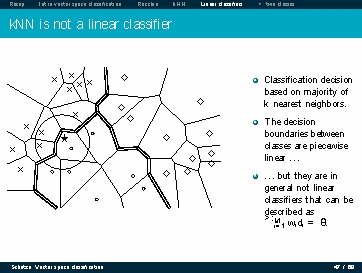
Recap Intro vector space classification Rocchio k. NN Linear classifiers > two classes k. NN is based on Voronoi tessellation x x x x x ⋆ x Schu ¨ tze: Vector space classification ⋄ ⋄ ⋄ 30 / 68
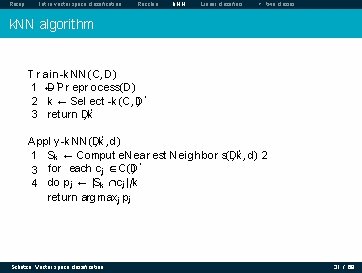
Recap Intro vector space classification Rocchio k. NN Linear classifiers > two classes k. NN algorithm T r ain-k NN(C, D) 1 ← D′ Pr epr ocess(D) 2 k ← Sel ect -k (C, D )′ ′ 3 ret urn D , k ′ d) A ppl y -k NN(D , k, ′ d) 2 1 Sk ← Comput e. Near est Neighbor s(D , k, )′ 3 for each cj ∈ C(D 4 do pj ← |Sk ∩ cj |/k ret urn arg maxj pj Schu ¨ tze: Vector space classification 31 / 68
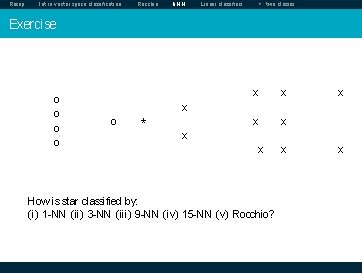
Recap Intro vector space classification Rocchio k. NN Linear classifiers > two classes Exercise o o o ⋆ x x x x How is star classified by: (i) 1 -NN (ii) 3 -NN (iii) 9 -NN (iv) 15 -NN (v) Rocchio? x x
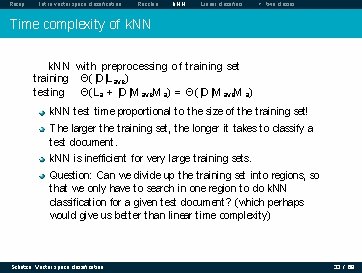
Recap Intro vector space classification Rocchio k. NN Linear classifiers > two classes Time complexity of k. NN wit h preprocessing of t raining set training Θ(|D|Lave) testing Θ(La + |D|M ave. M a) = Θ(|D|M ave. M a) k. NN test time proportional to the size of the training set! The larger the training set, the longer it takes to classify a test document. k. NN is inefficient for very large training sets. Question: Can we divide up the training set into regions, so that we only have to search in one region to do k. NN classification for a given test document? (which perhaps would give us better than linear time complexity) Schu ¨ tze: Vector space classification 33 / 68
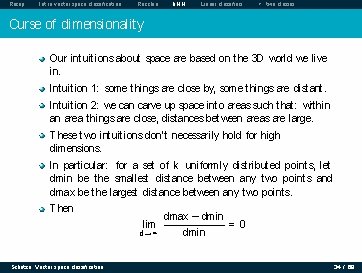
Recap Intro vector space classification Rocchio k. NN Linear classifiers > two classes Curse of dimensionality Our intuitions about space are based on the 3 D world we live in. Intuition 1: some things are close by, some things are distant. Intuition 2: we can carve up space into areas such that: within an area things are close, distances between areas are large. These two intuitions don’t necessarily hold for high dimensions. In particular: for a set of k uniformly distributed points, let dmin be the smallest distance between any two points and dmax be the largest distance between any two points. Then lim d→∞ Schu ¨ tze: Vector space classification dmax − dmin = 0 dmin 34 / 68
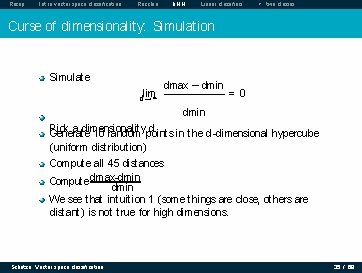
Recap Intro vector space classification Rocchio k. NN Linear classifiers > two classes Curse of dimensionality: Simulation Simulate lim d→∞ dmax − dmin = 0 dmin Pick a dimensionality d Generate 10 random points in the d -dimensional hypercube (uniform distribution) Compute all 45 distances Comput edmax−dmin We see that intuition 1 (some things are close, others are distant) is not true for high dimensions. Schu ¨ tze: Vector space classification 35 / 68
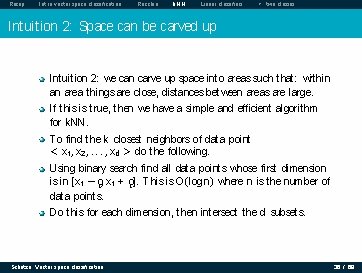
Recap Intro vector space classification Rocchio k. NN Linear classifiers > two classes Intuition 2: Space can be carved up Intuition 2: we can carve up space into areas such that: within an area things are close, distances between areas are large. If this is true, then we have a simple and efficient algorithm for k. NN. To find the k closest neighbors of data point < x 1, x 2 , . . . , xd > do the following. Using binary search find all data points whose first dimension is in [x 1 − ǫ, x 1 + ǫ]. This is O(log n) where n is the number of data points. Do this for each dimension, then intersect the d subsets. Schu ¨ tze: Vector space classification 36 / 68
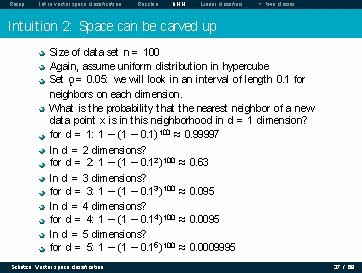
Recap Intro vector space classification Rocchio k. NN Linear classifiers > two classes Intuition 2: Space can be carved up Size of data set n = 100 Again, assume uniform distribution in hypercube Set ǫ = 0. 05: we will look in an interval of length 0. 1 for neighbors on each dimension. What is the probability that the nearest neighbor of a new data point x is in this neighborhood in d = 1 dimension? for d = 1: 1 − (1 − 0. 1) 100 ≈ 0. 99997 In d = 2 dimensions? for d = 2: 1 − (1 − 0. 12 ) 100 ≈ 0. 63 In d = 3 dimensions? for d = 3: 1 − (1 − 0. 13 ) 100 ≈ 0. 095 In d = 4 dimensions? for d = 4: 1 − (1 − 0. 14 ) 100 ≈ 0. 0095 In d = 5 dimensions? for d = 5: 1 − (1 − 0. 15 ) 100 ≈ 0. 0009995 Schu ¨ tze: Vector space classification 37 / 68
Recap Intro vector space classification Rocchio k. NN Linear classifiers > two classes Intuition 2: Space can be carved up In d = 5 dimensions? for d = 5: 1 − (1 − 0. 15 ) 100 ≈ 0. 0009995 In other words: with enough dimensions, there is only one “ local” region that will contain the nearest neighbor with high certainty: the entire search space. We cannot carve up high-dimensional space into neat neighborhoods. . . unless the “ true” dimensionality is much lower than d. Schu ¨ tze: Vector space classification 38 / 68
Recap Intro vector space classification Rocchio k. NN Linear classifiers > two classes k. NN: Discussion No training necessary But linear preprocessing of documents is as expensive as training Naive Bayes. We always preprocess the training set, so in reality training time of k. NN is linear. k. NN is very accurate if training set is large. Optimality result: asymptotically zero error if Bayes rate is zero. But k. NN can be very inaccurate if training set is small. Schu ¨ tze: Vector space classification 39 / 68
Recap Intro vector space classification Rocchio k. NN Linear classifiers > two classes Outline 1 Recap 2 Intro vector space classification 3 Rocchio 4 k. NN 5 Linear classifiers 6 > two classes Schu ¨ tze: Vector space classification 40 / 68
Recap Intro vector space classification Rocchio k. NN Linear classifiers > two classes Linear classifiers Schu ¨ tze: Vector space classification 41 / 68
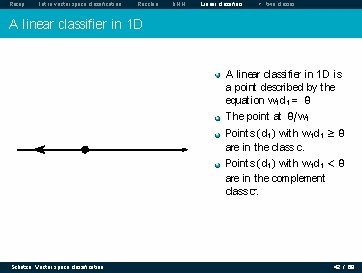
Recap Intro vector space classification Rocchio k. NN Linear classifiers > two classes A linear classifier in 1 D is a point described by the equation w 1 d 1 = θ The point at θ/w 1 Points (d 1 ) with w 1 d 1 ≥ θ are in the class c. Points (d 1 ) with w 1 d 1 < θ are in the complement class c. Schu ¨ tze: Vector space classification 42 / 68
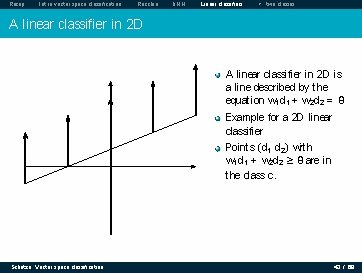
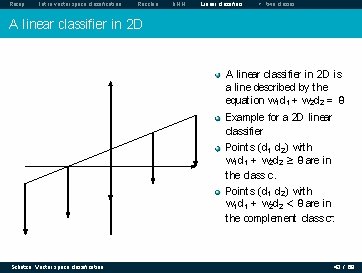
Recap Intro vector space classification Rocchio k. NN Linear classifiers > two classes A linear classifier in 2 D is a line described by the equation w 1 d 1 + w 2 d 2 = θ Example for a 2 D linear classifier Points (d 1 d 2 ) with w 1 d 1 + w 2 d 2 ≥ θ are in the class c. Schu ¨ tze: Vector space classification 43 / 68
Recap Intro vector space classification Rocchio k. NN Linear classifiers > two classes A linear classifier in 2 D is a line described by the equation w 1 d 1 + w 2 d 2 = θ Example for a 2 D linear classifier Points (d 1 d 2 ) with w 1 d 1 + w 2 d 2 ≥ θ are in the class c. Points (d 1 d 2 ) with w 1 d 1 + w 2 d 2 < θ are in the complement class c. Schu ¨ tze: Vector space classification 43 / 68
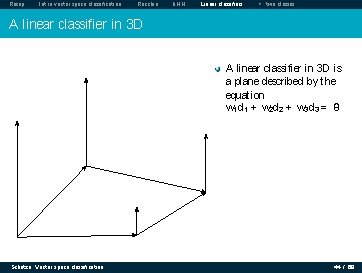
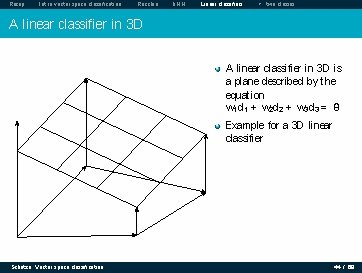
Recap Intro vector space classification Rocchio k. NN Linear classifiers > two classes A linear classifier in 3 D is a plane described by the equation w 1 d 1 + w 2 d 2 + w 3 d 3 = θ Schu ¨ tze: Vector space classification 44 / 68
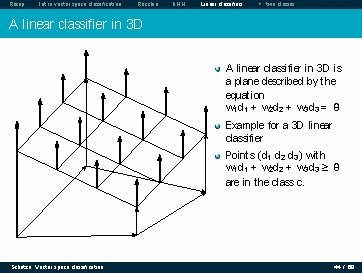
Recap Intro vector space classification Rocchio k. NN Linear classifiers > two classes A linear classifier in 3 D is a plane described by the equation w 1 d 1 + w 2 d 2 + w 3 d 3 = θ Example for a 3 D linear classifier Schu ¨ tze: Vector space classification 44 / 68
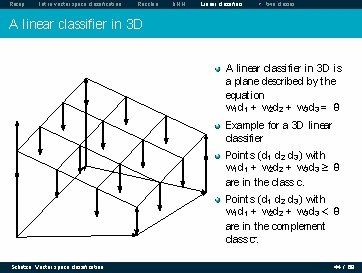
Recap Intro vector space classification Rocchio k. NN Linear classifiers > two classes A linear classifier in 3 D is a plane described by the equation w 1 d 1 + w 2 d 2 + w 3 d 3 = θ Example for a 3 D linear classifier Points (d 1 d 2 d 3) with w 1 d 1 + w 2 d 2 + w 3 d 3 ≥ θ are in the class c. Schu ¨ tze: Vector space classification 44 / 68
Recap Intro vector space classification Rocchio k. NN Linear classifiers > two classes A linear classifier in 3 D is a plane described by the equation w 1 d 1 + w 2 d 2 + w 3 d 3 = θ Example for a 3 D linear classifier Points (d 1 d 2 d 3) with w 1 d 1 + w 2 d 2 + w 3 d 3 ≥ θ are in the class c. Points (d 1 d 2 d 3) with w 1 d 1 + w 2 d 2 + w 3 d 3 < θ are in the complement class c. Schu ¨ tze: Vector space classification 44 / 68
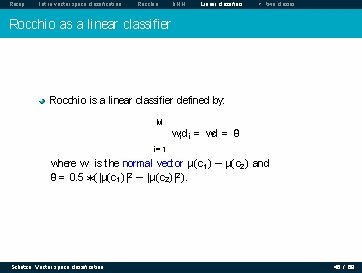
Recap Intro vector space classification Rocchio k. NN Linear classifiers > two classes Rocchio as a linear classifier Rocchio is a linear classifier defined by: M wi di = wd = θ i= 1 where w is the normal vector µ(c 1 ) − µ(c 2 ) and θ = 0. 5 ∗(|µ(c 1 )|2 − |µ(c 2 )|2 ). Schu ¨ tze: Vector space classification 45 / 68
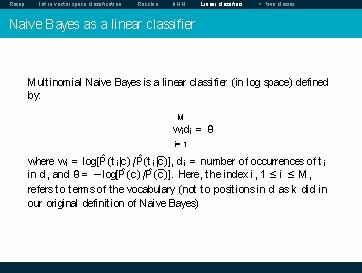
Recap Intro vector space classification Rocchio k. NN Linear classifiers > two classes Naive Bayes as a linear classifier Multinomial Naive Bayes is a linear classifier (in log space) defined by: M wi di = θ i= 1 ˆ (t i |c)/P ˆ (t i |c where wi = log[P ¯)], di = number of occurrences of t i ˆ ˆ (c in d , and θ = − log[P (c)/P ¯)]. Here, the index i , 1 ≤ i ≤ M , refers to terms of the vocabulary (not to positions in d as k did in our original definition of Naive Bayes)
Recap Intro vector space classification Rocchio k. NN Linear classifiers > two classes k. NN is not a linear classifier x x x x x ⋆ x Schu ¨ tze: Vector space classification ⋄ ⋄ ⋄ Classification decision based on majority of k nearest neighbors. The decision boundaries between classes are piecewise linear. . . but they are in general not linear classifiers that can be described as > : M w d = θ. i= 1 i i 47 / 68
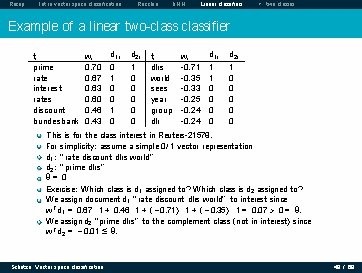
Recap Intro vector space classification Rocchio k. NN Linear classifiers > two classes Example of a linear two-classifier ti prime rate interest rates discount bundesbank wi 0. 70 0. 67 0. 63 0. 60 0. 46 0. 43 d 1 i 0 1 0 d 2 i 1 0 0 0 ti dlrs world sees year group dlr wi -0. 71 -0. 35 -0. 33 -0. 25 -0. 24 d 1 i 1 1 0 0 d 2 i 1 0 0 0 This is for the class interest in Reuters-21578. For simplicity: assume a simple 0/ 1 vector representation d 1 : “ rate discount dlrs world” d 2 : “ prime dlrs” θ= 0 Exercise: Which class is d 1 assigned to? Which class is d 2 assigned to? We assign document d 1 “ rate discount dlrs world” to interest since w T d 1 = 0. 67 · 1 + 0. 46 · 1 + ( − 0. 71) · 1 + ( − 0. 35) · 1 = 0. 07 > 0 = θ. We assign d 2 “ prime dlrs” to the complement class (not in interest) since w T d 2 = − 0. 01 ≤ θ. Schu ¨ tze: Vector space classification 48 / 68
L 1 n""ar Which hyperplane? Lr-. "'. l t l. . r'
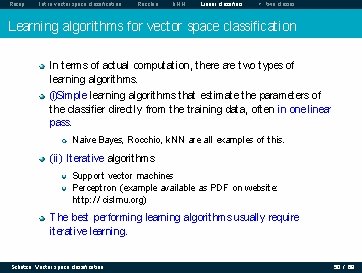
Recap Intro vector space classification Rocchio k. NN Linear classifiers > two classes Learning algorithms for vector space classification In terms of actual computation, there are two types of learning algorithms. (i)Simple learning algorithms that estimate the parameters of the classifier directly from the training data, often in one linear pass. Naive Bayes, Rocchio, k. NN are all examples of this. (ii) Iterative algorithms Support vector machines Perceptron (example available as PDF on website: http: / / cislmu. org) The best performing learning algorithms usually require iterative learning. Schu ¨ tze: Vector space classification 50 / 68
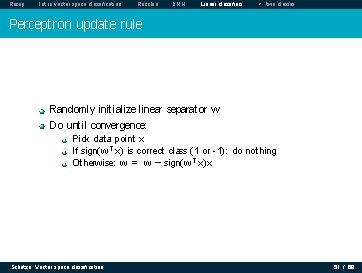
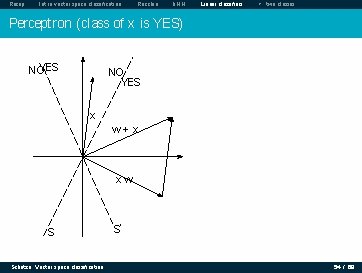
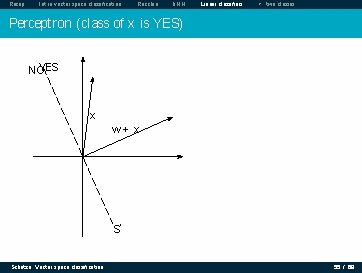
Recap Intro vector space classification Rocchio k. NN Linear classifiers > two classes Perceptron update rule Randomly initialize linear separator w Do until convergence: Pick data point x If sign(w T x ) is correct class (1 or -1): do nothing Otherwise: w = w − sign(w T x ) x Schu ¨ tze: Vector space classification 51 / 68
Recap Intro vector space classification Rocchio k. NN Linear classifiers > two classes Perceptron (class of x is YES) YES NO NO YES x w+ x xw S Schu ¨ tze: Vector space classification S′ 54 / 68
Recap Intro vector space classification Rocchio k. NN Linear classifiers > two classes Perceptron (class of x is YES) YES NO x w+ x S′ Schu ¨ tze: Vector space classification 55 / 68
L 1 n""ar Which hyperplane? Lr-. "'. l t l. . r'
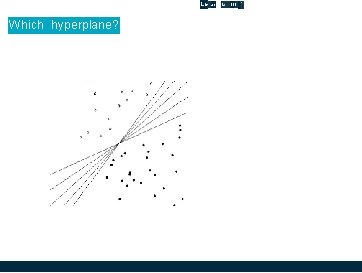
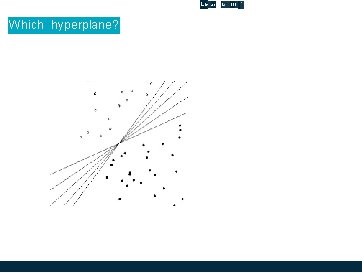
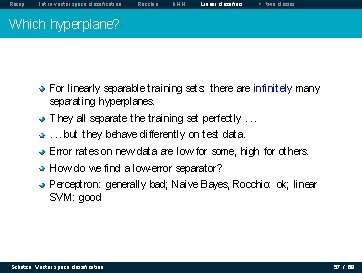
Recap Intro vector space classification Rocchio k. NN Linear classifiers > two classes Which hyperplane? For linearly separable training sets: there are infinitely many separating hyperplanes. They all separate the training set perfectly. . . but they behave differently on test data. Error rates on new data are low for some, high for others. How do we find a low-error separator? Perceptron: generally bad; Naive Bayes, Rocchio: ok; linear SVM: good Schu ¨ tze: Vector space classification 57 / 68
Recap Intro vector space classification Rocchio k. NN Linear classifiers > two classes Linear classifiers: Discussion Many common text classifiers are linear classifiers: Naive Bayes, Rocchio, logistic regression, linear support vector machines etc. Each method has a different way of selecting the separating hyperplane Huge differences in performance on test documents Can we get better performance with more powerful nonlinear classifiers? Not in general: A given amount of training data may suffice for estimating a linear boundary, but not for estimating a more complex nonlinear boundary. Schu ¨ tze: Vector space classification 58 / 68
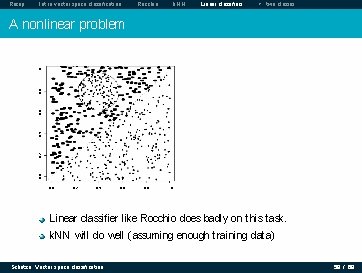
Recap Intro vector space classification Rocchio k. NN Linear classifiers > two classes 0. 0 0. 2 0. 4 0. 6 0. 8 1. 0 A nonlinear problem 0. 0 0. 2 0. 4 0. 6 0. 8 1. 0 Linear classifier like Rocchio does badly on this task. k. NN will do well (assuming enough training data) Schu ¨ tze: Vector space classification 59 / 68
Recap Intro vector space classification Rocchio k. NN Linear classifiers > two classes Which classifier do I use for a given TC problem? Is there a learning method that is optimal for all text classification problems? No, because there is a tradeoff between bias and variance. Factors to take into account: How much training data is available? How simple/ complex is the problem? (linear vs. nonlinear decision boundary) How noisy is the problem? How stable is the problem over time? For an unstable problem, it’s better to use a simple and robust classifier. Schu ¨ tze: Vector space classification 60 / 68
Recap Intro vector space classification Rocchio k. NN Linear classifiers > two classes Outline 1 Recap 2 Intro vector space classification 3 Rocchio 4 k. NN 5 Linear classifiers 6 > two classes Schu ¨ tze: Vector space classification 61 / 68
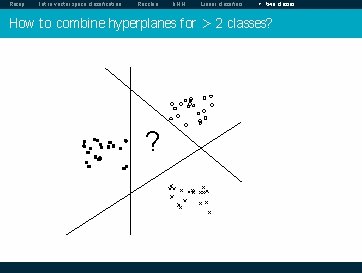
Recap Intro vector space classification Rocchio k. NN Linear classifiers > two classes How to combine hyperplanes for > 2 classes? ?
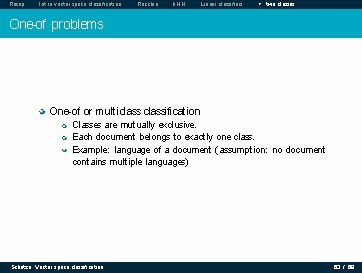
Recap Intro vector space classification Rocchio k. NN Linear classifiers > two classes One-of problems One-of or multiclassification Classes are mutually exclusive. Each document belongs to exactly one class. Example: language of a document (assumption: no document contains multiple languages) Schu ¨ tze: Vector space classification 63 / 68
Recap Intro vector space classification Rocchio k. NN Linear classifiers > two classes One-of classification with linear classifiers • Combine two-class linear classifiers as follows for one-of classification: • Run each classifier separately • Rank classifiers (e. g. , according to score) Pick the class with the highest score Schu ¨ tze: Vector space classification 64 / 68
Recap Intro vector space classification Rocchio k. NN Linear classifiers > two classes Any-of problems Any-of or multilabel classification A document can be a member of 0, 1, or many classes. A decision on one class leaves decisions open on all other classes. A type of “ independence” (but not statistical independence) Example: topic classification Usually: make decisions on the region, on the subject area, on the industry and so on “ independently” Schu ¨ tze: Vector space classification 65 / 68
Recap Intro vector space classification Rocchio k. NN Linear classifiers > two classes Any-of classification with linear classifiers Combine two-class linear classifiers as follows for any-of classification: Simply run each two-classifier separately on the test document and assign document accordingly Schu ¨ tze: Vector space classification 66 / 68
Recap Intro vector space classification Rocchio k. NN Linear classifiers > two classes Take-away today Vector space classification: Basic idea of doing text classification for documents that are represented as vectors Rocchio classifier: Rocchio relevance feedback idea applied to text classification k nearest neighbor classification Linear classifiers More than two classes Schu ¨ tze: Vector space classification 67 / 68