Predicting secure infant attachment Daniel Messinger Ph D


- Slides: 73
Predicting secure infant attachment Daniel Messinger, Ph. D.
Review �In the presence of a consistent caregiver almost all infants form an attachment �We’ve reviewed the classification of infant security of attachment in the strange situation. �But what predicts a secure versus an insecure attachment? Messinger 2
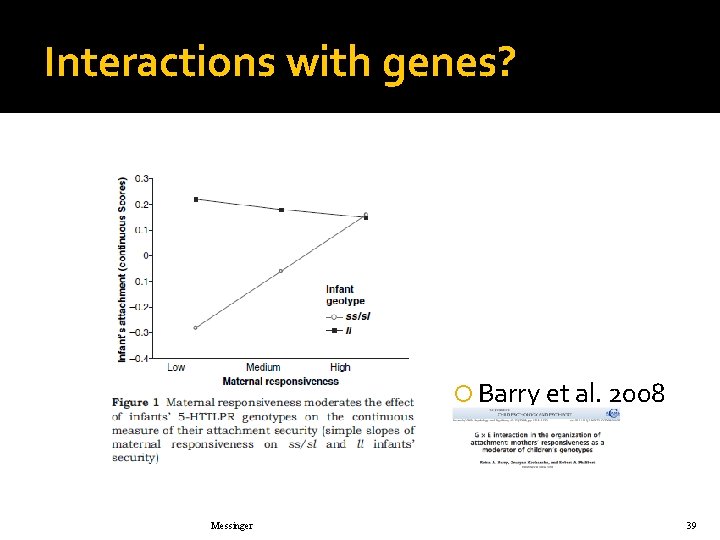
Predicting attachment security longitudinally �Is it child, environment, or caregiver? �Its sensitivity Experimental & observational (meta-analytic and large sample) evidence �But what’s sensitive? (More) evidence for the midrange model �Attachment stability and the adult attachment interview (theory & practice) �Genetic moderation of stability in attachment? Messinger 3
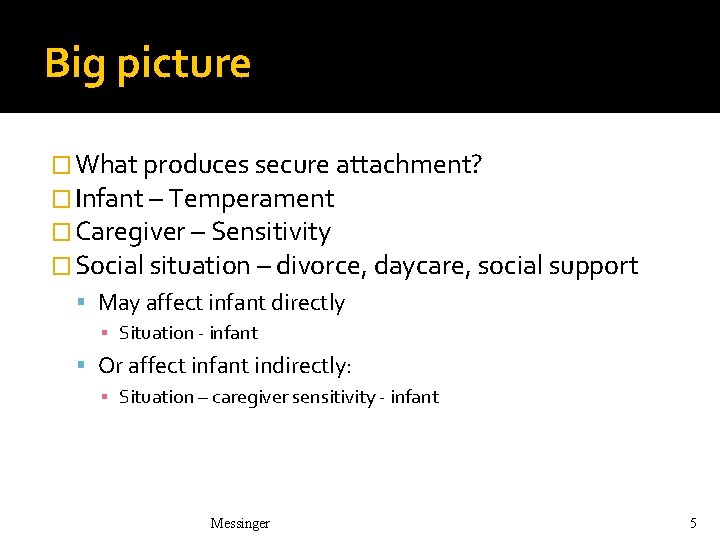
Big picture � What produces secure attachment? � Infant – Temperament � Caregiver – Sensitivity � Social situation – divorce, daycare, social support May affect infant directly ▪ Situation - infant Or affect infant indirectly: ▪ Situation – caregiver sensitivity - infant Messinger 5
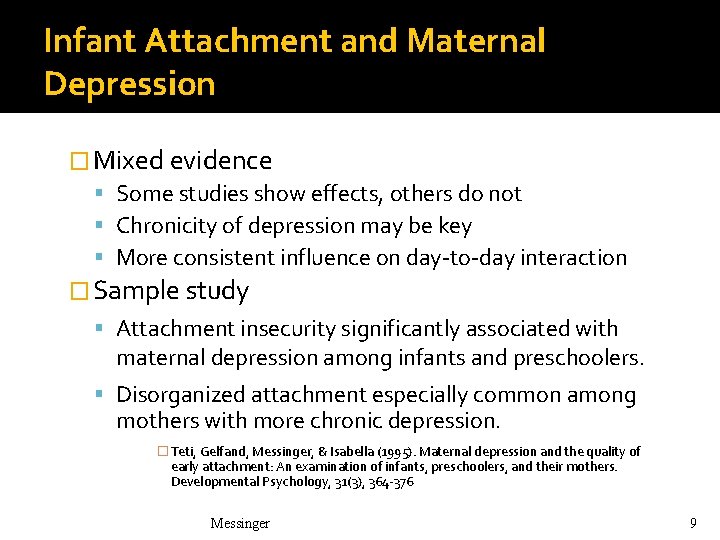
Infant Attachment and Maternal Depression � Mixed evidence Some studies show effects, others do not Chronicity of depression may be key More consistent influence on day-to-day interaction � Sample study Attachment insecurity significantly associated with maternal depression among infants and preschoolers. Disorganized attachment especially common among mothers with more chronic depression. �Teti, Gelfand, Messinger, & Isabella (1995). Maternal depression and the quality of early attachment: An examination of infants, preschoolers, and their mothers. Developmental Psychology, 31(3), 364 -376 Messinger 9
Orthodox View �Caregiver (Mother) Driven System Sensitive caregiving yields secure attachment Caregiver can adapt to any child temperament Who’s has responsibility according to this systerm? Messinger 10
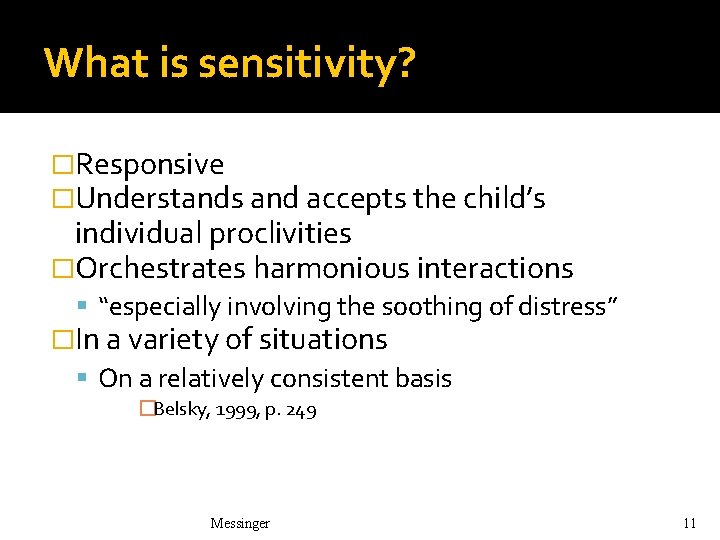
What is sensitivity? �Responsive �Understands and accepts the child’s individual proclivities �Orchestrates harmonious interactions “especially involving the soothing of distress” �In a variety of situations On a relatively consistent basis �Belsky, 1999, p. 249 Messinger 11
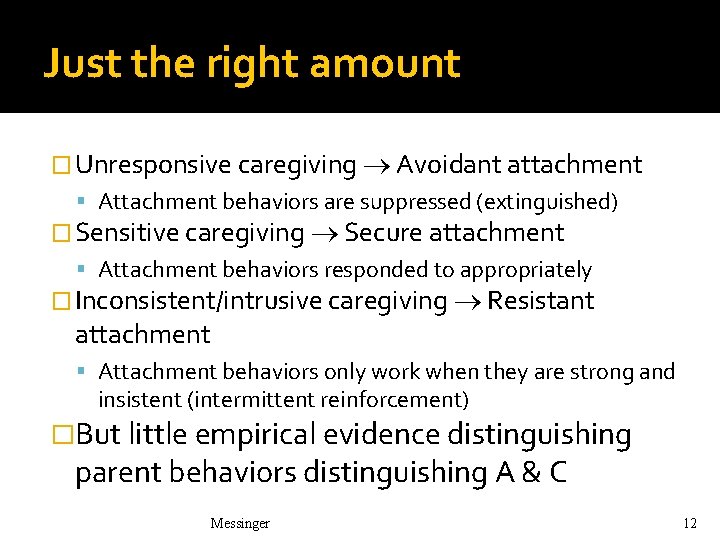
Just the right amount � Unresponsive caregiving Avoidant attachment Attachment behaviors are suppressed (extinguished) � Sensitive caregiving Secure attachment Attachment behaviors responded to appropriately � Inconsistent/intrusive caregiving Resistant attachment Attachment behaviors only work when they are strong and insistent (intermittent reinforcement) �But little empirical evidence distinguishing parent behaviors distinguishing A & C Messinger 12
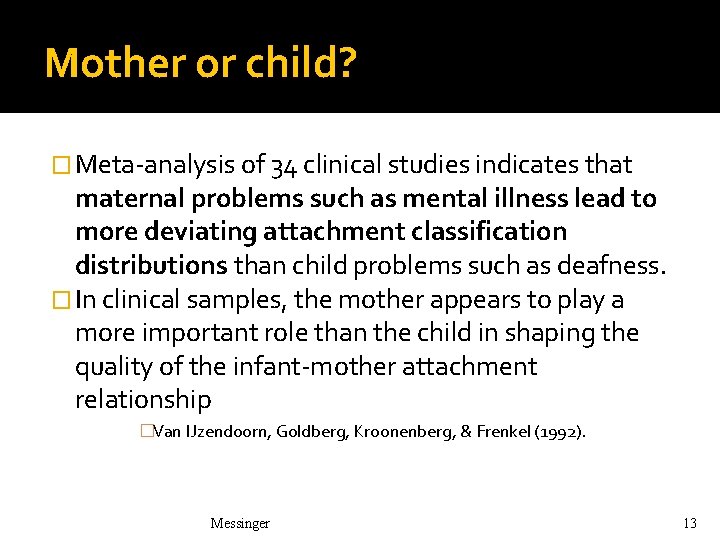
Mother or child? � Meta-analysis of 34 clinical studies indicates that maternal problems such as mental illness lead to more deviating attachment classification distributions than child problems such as deafness. � In clinical samples, the mother appears to play a more important role than the child in shaping the quality of the infant-mother attachment relationship �Van IJzendoorn, Goldberg, Kroonenberg, & Frenkel (1992). Messinger 13
More evidence for care-giving effects �Experimental �Observational Meta-analysis of quasi-experiments Messinger 14
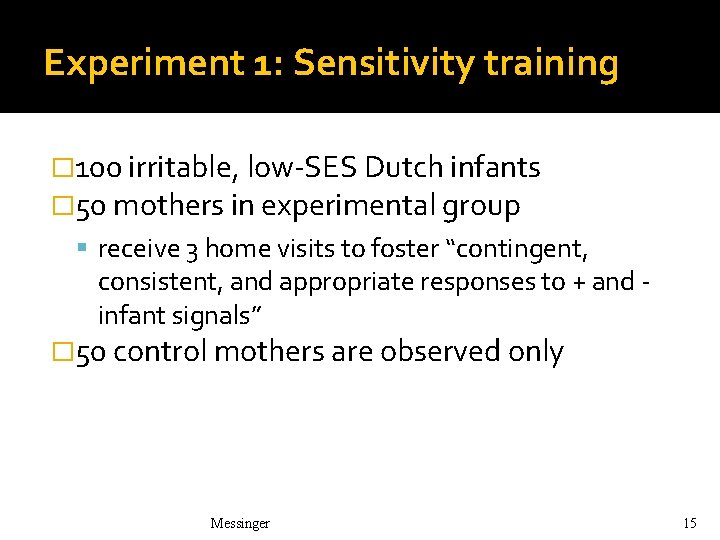
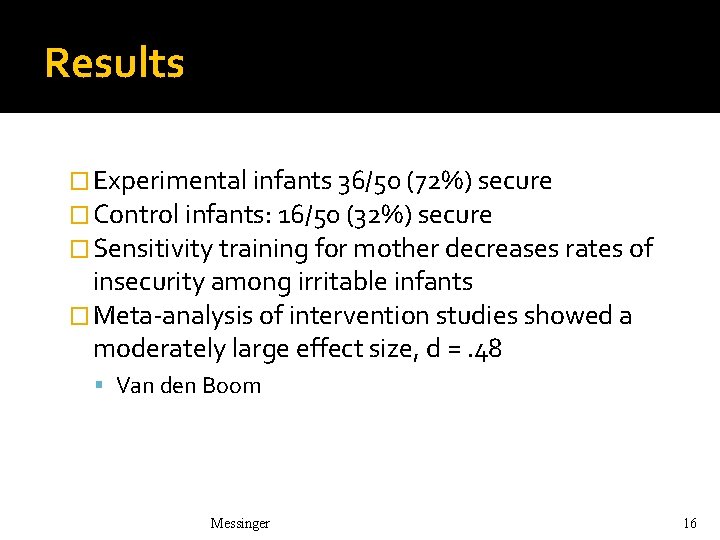
Experiment 1: Sensitivity training � 100 irritable, low-SES Dutch infants � 50 mothers in experimental group receive 3 home visits to foster “contingent, consistent, and appropriate responses to + and - infant signals” � 50 control mothers are observed only Messinger 15
Results � Experimental infants 36/50 (72%) secure � Control infants: 16/50 (32%) secure � Sensitivity training for mother decreases rates of insecurity among irritable infants � Meta-analysis of intervention studies showed a moderately large effect size, d =. 48 Van den Boom Messinger 16
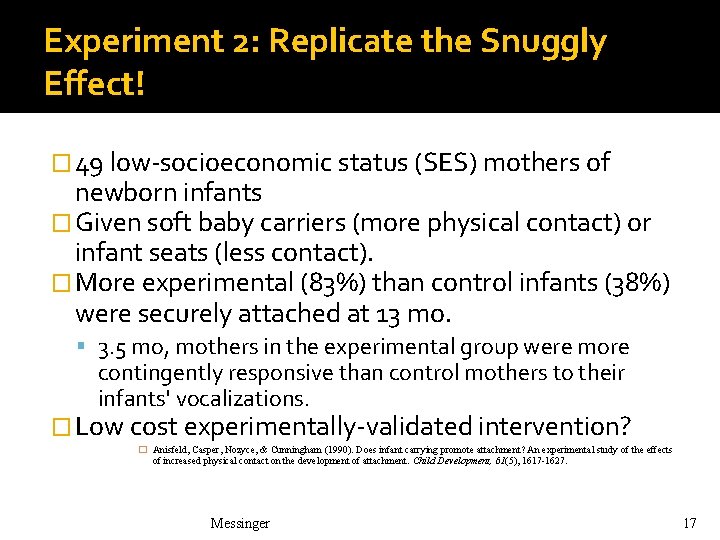
Experiment 2: Replicate the Snuggly Effect! � 49 low-socioeconomic status (SES) mothers of newborn infants � Given soft baby carriers (more physical contact) or infant seats (less contact). � More experimental (83%) than control infants (38%) were securely attached at 13 mo. 3. 5 mo, mothers in the experimental group were more contingently responsive than control mothers to their infants' vocalizations. � Low cost experimentally-validated intervention? � Anisfeld, Casper, Nozyce, & Cunningham (1990). Does infant carrying promote attachment? An experimental study of the effects of increased physical contact on the development of attachment. Child Development, 61(5), 1617 -1627. Messinger 17
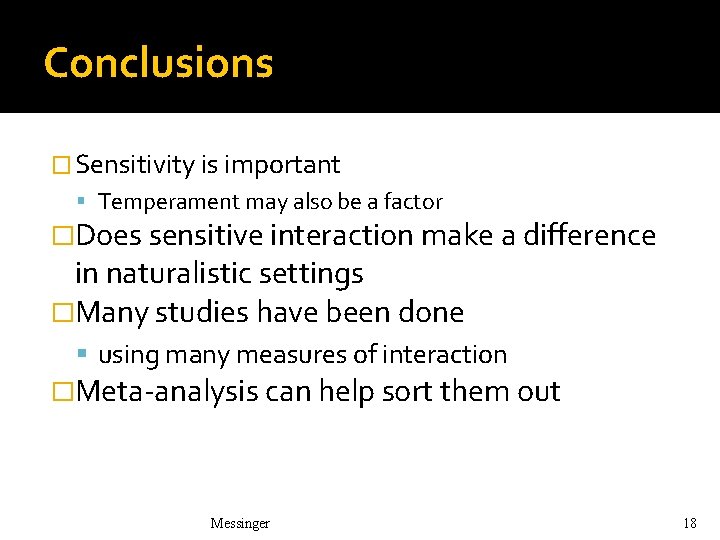
Conclusions � Sensitivity is important Temperament may also be a factor �Does sensitive interaction make a difference in naturalistic settings �Many studies have been done using many measures of interaction �Meta-analysis can help sort them out Messinger 18
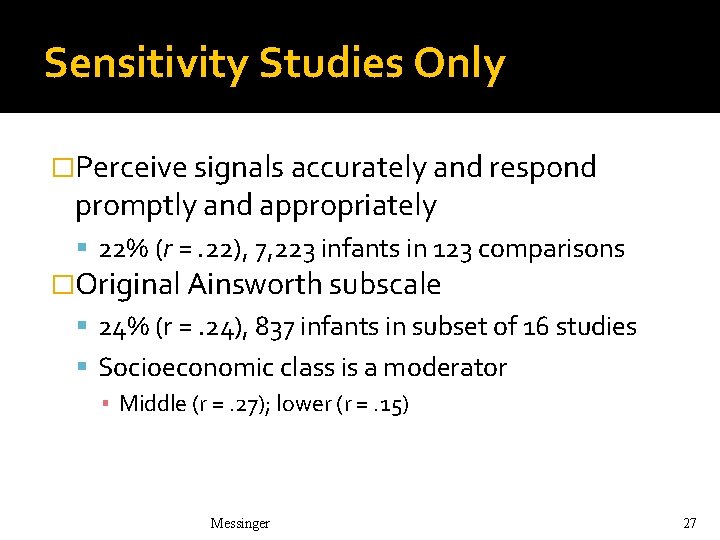
Sensitivity Studies Only �Perceive signals accurately and respond promptly and appropriately 22% (r =. 22), 7, 223 infants in 123 comparisons �Original Ainsworth subscale 24% (r =. 24), 837 infants in subset of 16 studies Socioeconomic class is a moderator ▪ Middle (r =. 27); lower (r =. 15) Messinger 27
Conclusions �Sensitivity and quality of interaction are important and consistent (but not exclusive) predictors of attachment security. �Sensitivity important but not only factor Orthodox hypothesis supported weakly Messinger 30
Disorganized attachment predicted by parent behavior �Strongly related to parental maltreatment, & moderately related to sensitivity �Unrelated to difficult infant temperament � 2 studies have linked frightening parental behavior to disorganized attachment ▪ Though not significantly related to depression ▪ van IJzendoorn, M. H. , Schuengel, C. , & Bakermans Kranenburg, M. J. (1999). Disorganized attachment in early childhood: Meta-analysis of precursors, concomitants, and sequelae. Development and Psychopathology, 11(2), 225 -249. Messinger 31
Temperament & Care giving �Child characteristics and care giving Continuously and reciprocally impact each other in day-to-day interaction and development. Little information on the process through which this occurs �But lots of information on strength of Seifer et al. respective caregiver and child influences Messinger 32
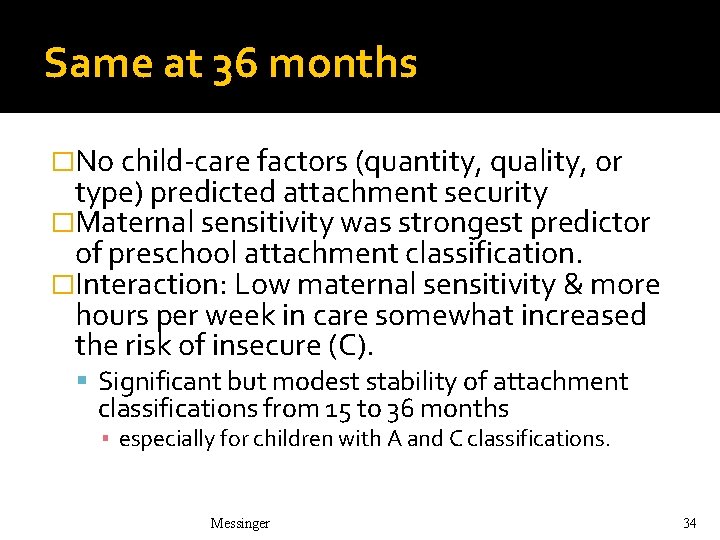
Effects of child care on infant-mother attachment security �Significant effects of maternal sensitivity and responsiveness. �No significant effects of child-care experience (amount, age entry, or type of care) on attachment security or avoidance. Interaction: more insecure when low maternal sensitivity/responsiveness combined with poor quality child care, more than minimal child care, or more than one care arrangement 1, 153 infants ▪ NICHD study of early child care. Child Development. 1997. 68(5) 860 -879 Messinger 33
Same at 36 months �No child-care factors (quantity, quality, or type) predicted attachment security �Maternal sensitivity was strongest predictor of preschool attachment classification. �Interaction: Low maternal sensitivity & more hours per week in care somewhat increased the risk of insecure (C). Significant but modest stability of attachment classifications from 15 to 36 months ▪ especially for children with A and C classifications. Messinger 34
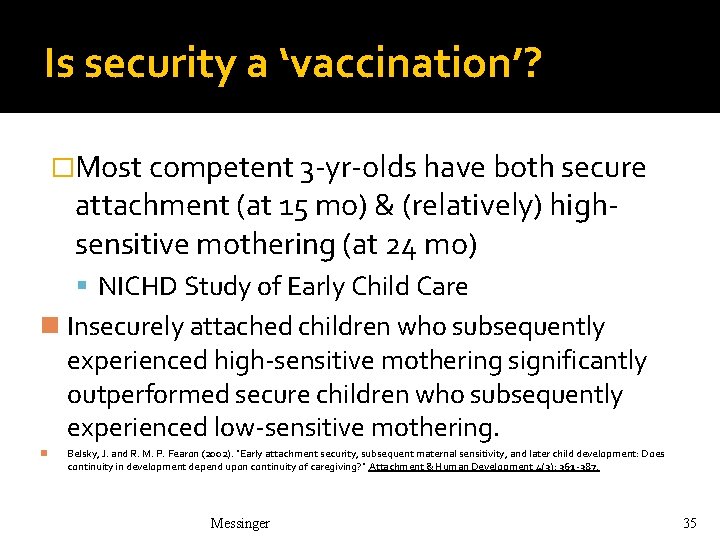
Is security a ‘vaccination’? �Most competent 3 -yr-olds have both secure attachment (at 15 mo) & (relatively) highsensitive mothering (at 24 mo) NICHD Study of Early Child Care n Insecurely attached children who subsequently experienced high-sensitive mothering significantly outperformed secure children who subsequently experienced low-sensitive mothering. n Belsky, J. and R. M. P. Fearon (2002). "Early attachment security, subsequent maternal sensitivity, and later child development: Does continuity in development depend upon continuity of caregiving? " Attachment & Human Development 4(3): 361 -387. Messinger 35
Where does security lie? �In the infant or in the caregiver-infant dyad? �A meta-analysis of infant-father attachment shows weak but significant association between security of attachment to mother and father. Does this suggest a role for temperament? Messinger 36
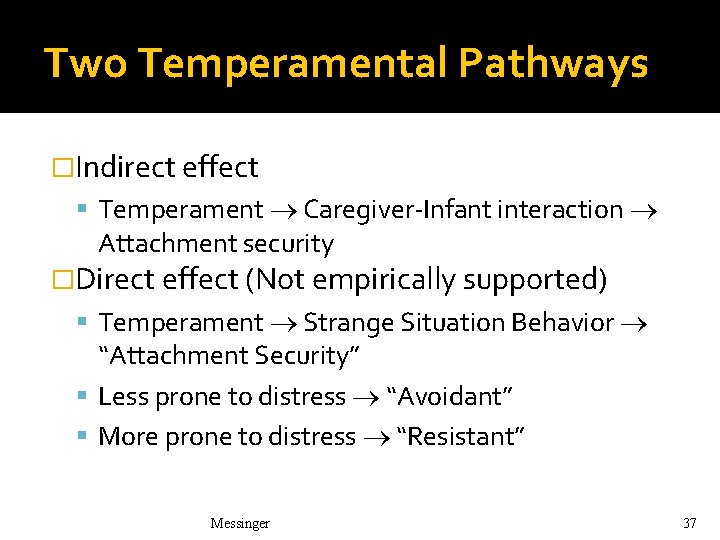
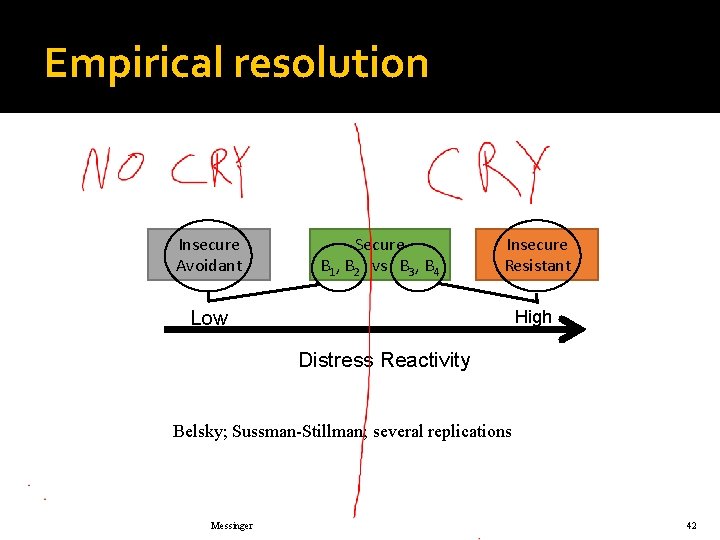
Two Temperamental Pathways �Indirect effect Temperament Caregiver-Infant interaction Attachment security �Direct effect (Not empirically supported) Temperament Strange Situation Behavior “Attachment Security” Less prone to distress “Avoidant” More prone to distress “Resistant” Messinger 37
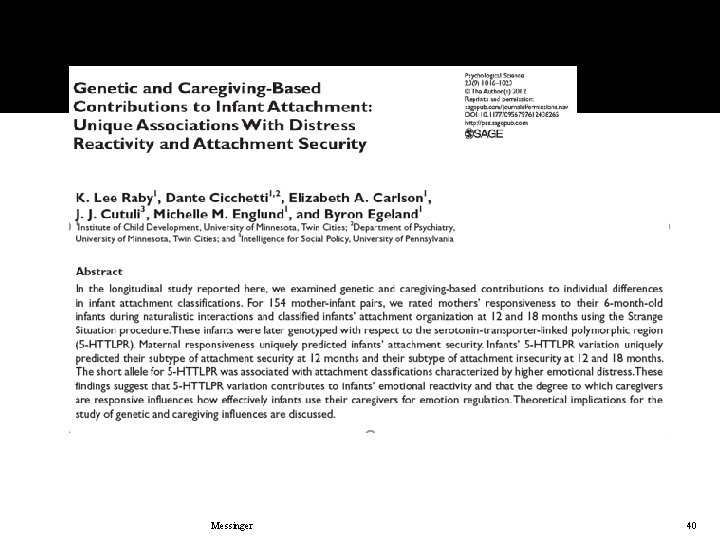
Interactions with genes? Barry et al. 2008 Messinger 39
Messinger 40
Empirical resolution Insecure Avoidant Secure B 1, B 2 vs B 3, B 4 Insecure Resistant Low High Distress Reactivity Belsky; Sussman-Stillman; several replications Messinger 42
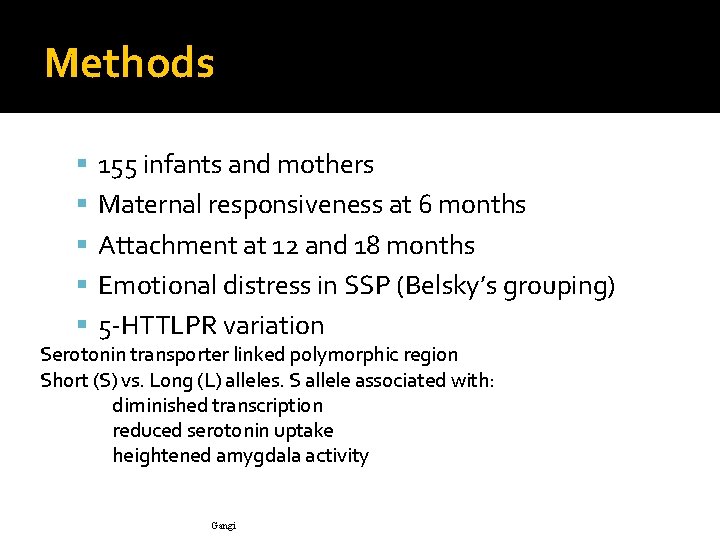
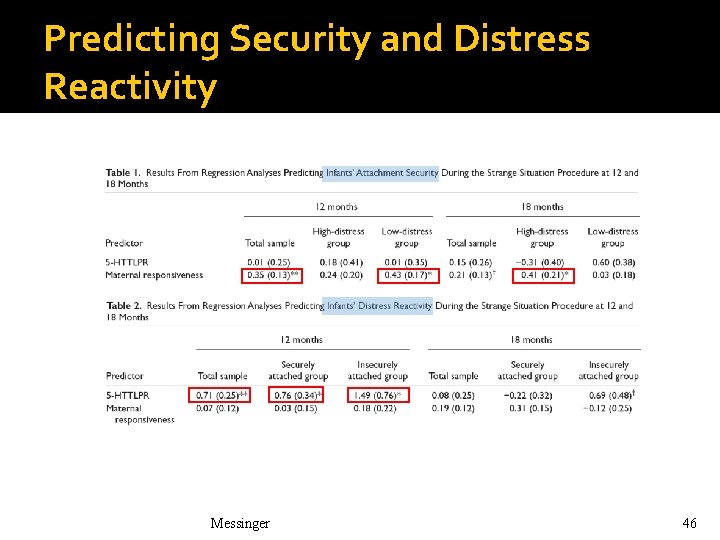
Methods 155 infants and mothers Maternal responsiveness at 6 months Attachment at 12 and 18 months Emotional distress in SSP (Belsky’s grouping) 5 -HTTLPR variation Serotonin transporter linked polymorphic region Short (S) vs. Long (L) alleles. S allele associated with: diminished transcription reduced serotonin uptake heightened amygdala activity Gangi
Predicting Security and Distress Reactivity Messinger 46
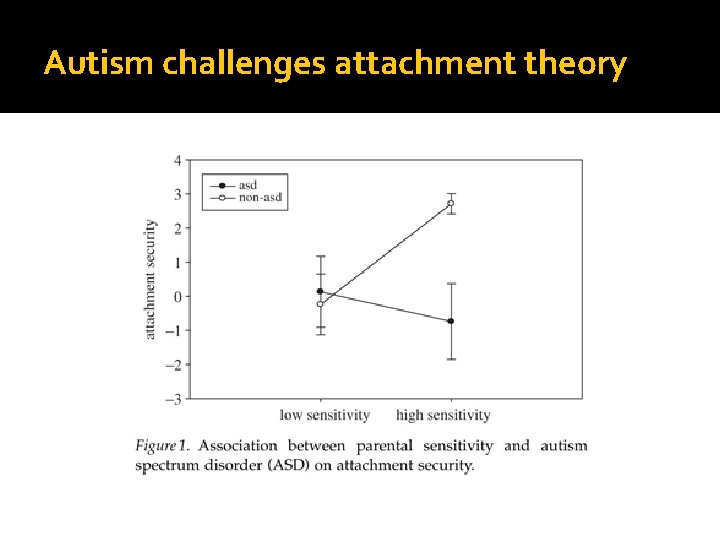
Autism challenges attachment theory
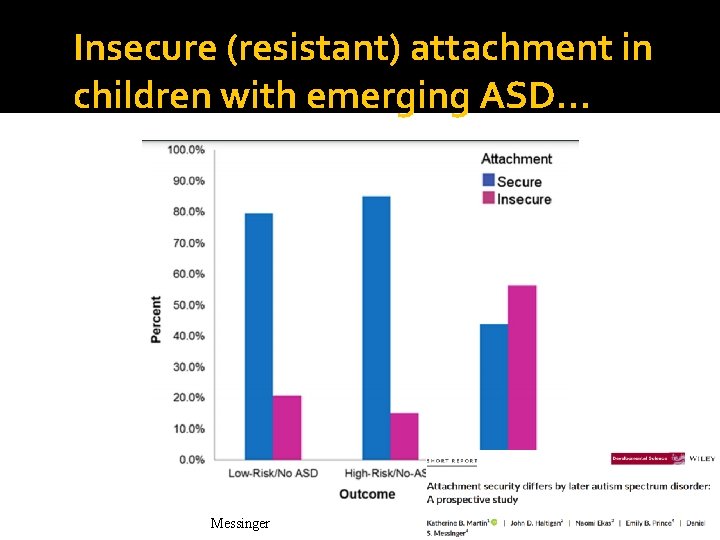
Insecure (resistant) attachment in children with emerging ASD… Messinger 57
Sensitivity �Sensitive caregiving promotes attachment. But effects are not universally found ▪ Seifer et al. , 1996 �Sensitive caregiving is underspecified �What does sensitivity look like cross-culturally and in different subcultures? Messinger 60
The Paradox of Sensitivity �Strongly predictive of many outcomes �But somewhat subjective in content Messinger 62
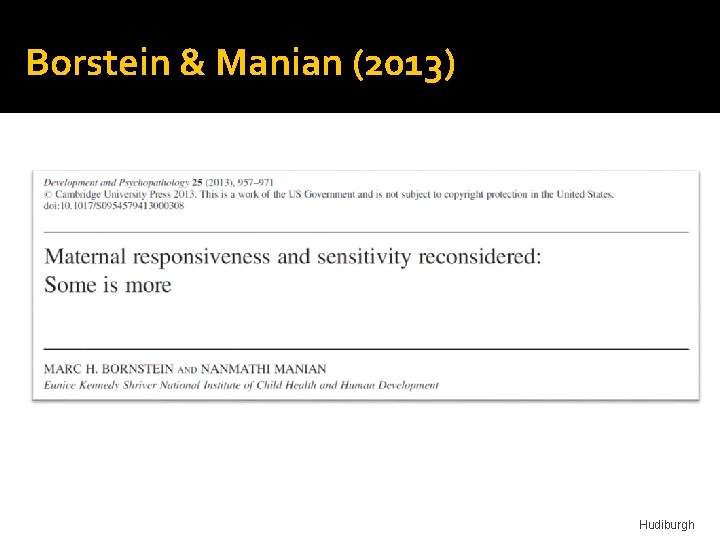
Borstein & Manian (2013) Hudiburgh
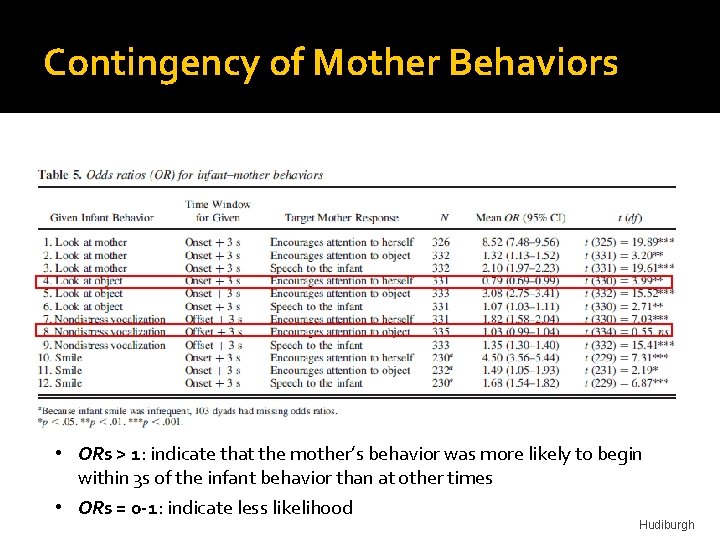
Contingency of Mother Behaviors • ORs > 1: indicate that the mother’s behavior was more likely to begin within 3 s of the infant behavior than at other times • ORs = 0 -1: indicate less likelihood Hudiburgh
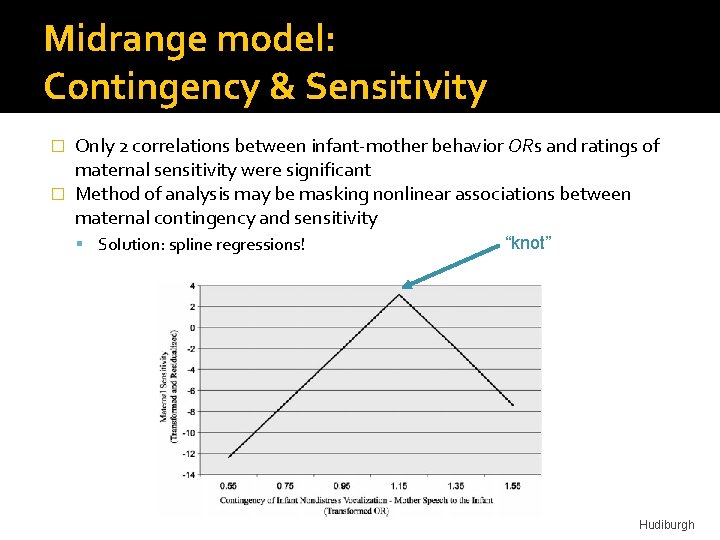
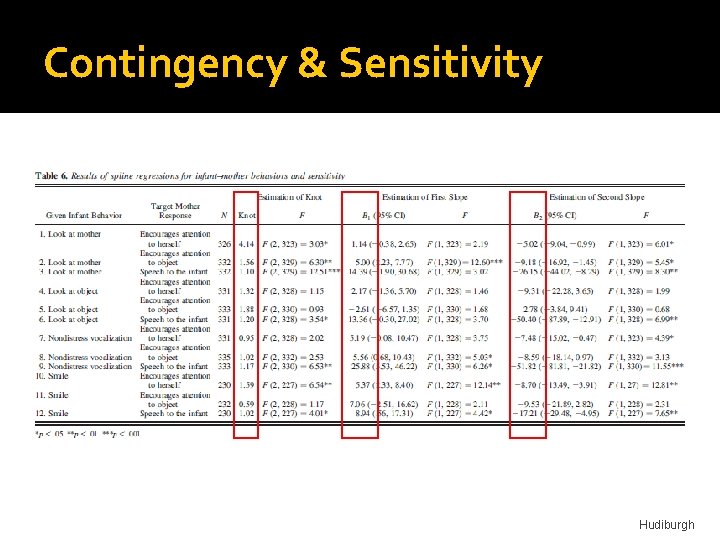
Midrange model: Contingency & Sensitivity Only 2 correlations between infant-mother behavior ORs and ratings of maternal sensitivity were significant � Method of analysis may be masking nonlinear associations between maternal contingency and sensitivity � Solution: spline regressions! “knot” Hudiburgh
Contingency & Sensitivity Hudiburgh
The Big Question �How do early experiences of attachment relationships impact later relationships? Early infancy to later infancy Infancy to childhood Infancy to adulthood Infancy to parenthood Messinger 74
Stability: Infant to adult � 2 studies report significant levels of stability between infant attachment security and adult security � 2 studies do not But 1 did not use a traditional strange situation � In all studies, negative life events associated with transitions from infant security to adult insecurity But negative life events (e. g. divorce, parental depression) are not the same in all studies Messinger 76
The Big Question �How do early experiences of attachment relationships impact later relationships? Early infancy to later infancy Infancy to adulthood Infancy to childhood Infancy to parenthood Messinger 77
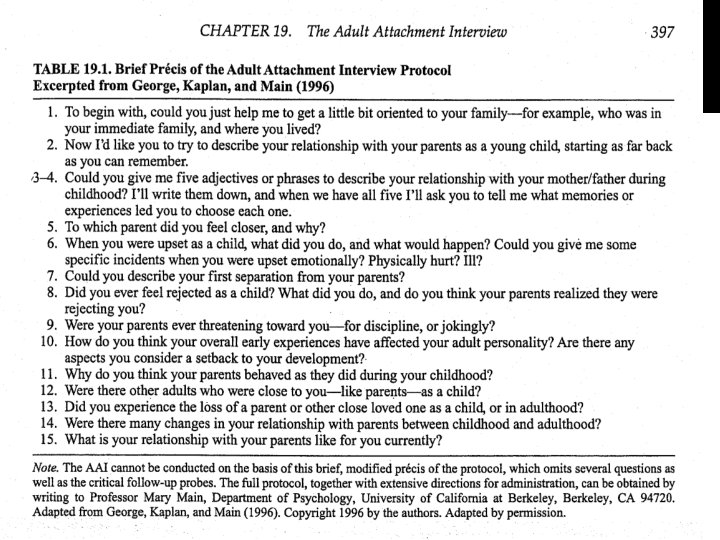
Overview �Introduction to the Adult Attachment Interview (AAI) �Correspondence between parents’ security of attachment (from AAI) and their children’s security of attachment �Practice the Adult Attachment Interview (AAI) Messinger 78
A Big Question � Do parents’ representation of their own attachment experiences relate – presumably through their own parenting behaviors – to the attachment classification of their children in the next generation? To answer such questions, attachment theory has moved to the level of representation. Messinger 79
In adulthood �Internal working models impact attachment behavior Mental representations of the availability of the attachment figure What to do when the attachment system is activated �Purpose of the Adult Attachment Interview is to classify these internal working models. Messinger 80
Interview � 18 questions with follow-up probes, semi- structured, hour-long, transcribed verbatim 5 adjectives describing each parent with supporting (or contradicting) memories what occurred when upset (when the attachment system was activated) impact of those experience on current functioning current relationship with parents Messinger 81
Messinger 82
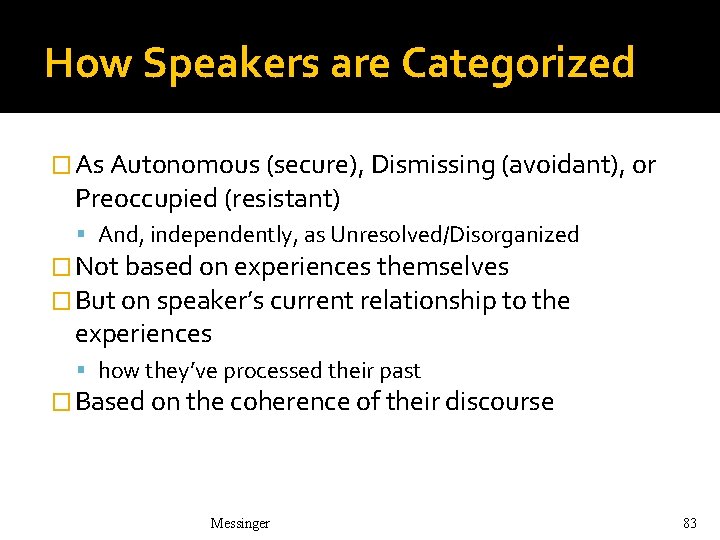
How Speakers are Categorized � As Autonomous (secure), Dismissing (avoidant), or Preoccupied (resistant) And, independently, as Unresolved/Disorganized � Not based on experiences themselves � But on speaker’s current relationship to the experiences how they’ve processed their past � Based on the coherence of their discourse Messinger 83
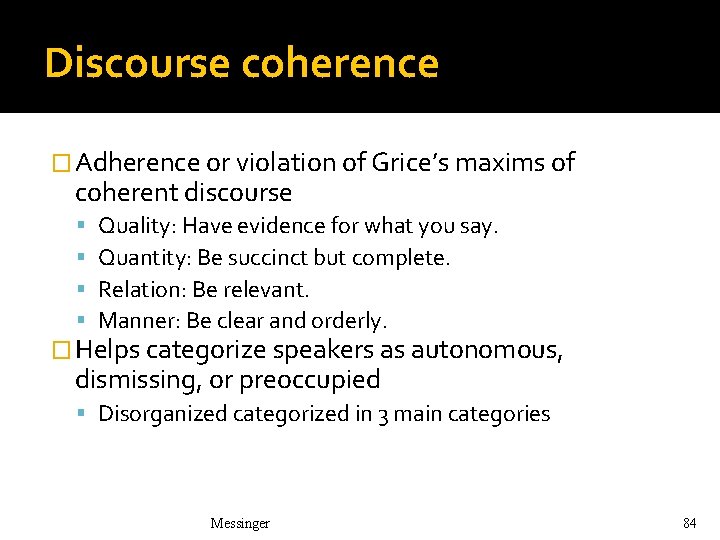
Discourse coherence � Adherence or violation of Grice’s maxims of coherent discourse Quality: Have evidence for what you say. Quantity: Be succinct but complete. Relation: Be relevant. Manner: Be clear and orderly. � Helps categorize speakers as autonomous, dismissing, or preoccupied Disorganized categorized in 3 main categories Messinger 84
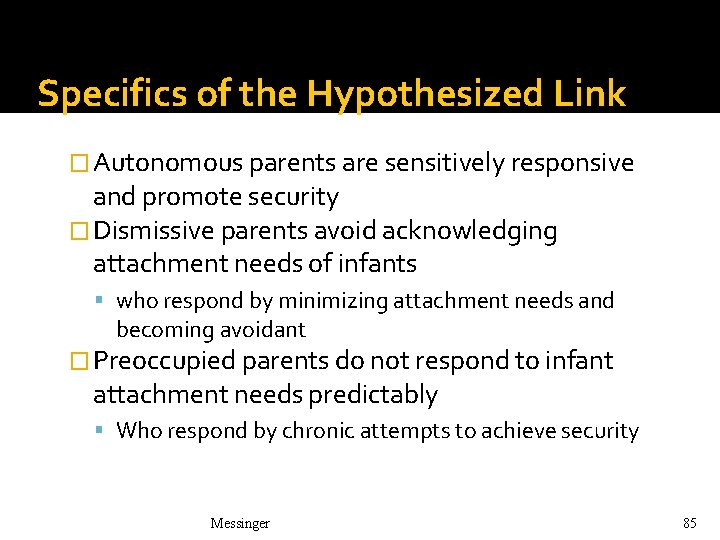
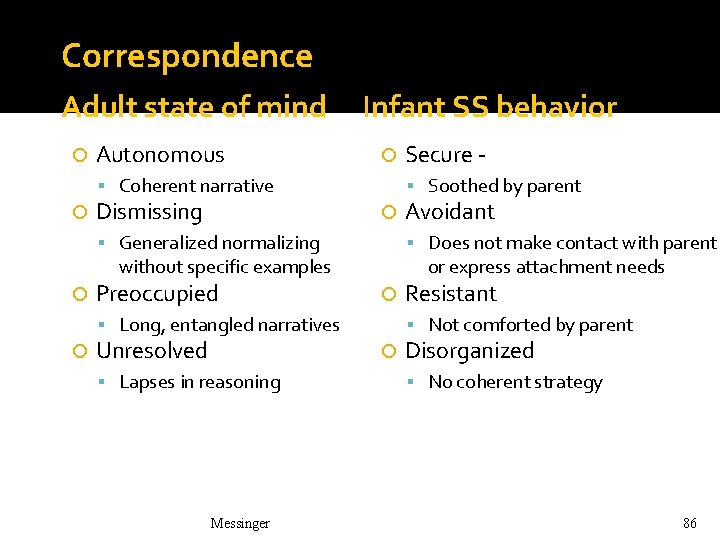
Specifics of the Hypothesized Link � Autonomous parents are sensitively responsive and promote security � Dismissive parents avoid acknowledging attachment needs of infants who respond by minimizing attachment needs and becoming avoidant � Preoccupied parents do not respond to infant attachment needs predictably Who respond by chronic attempts to achieve security Messinger 85
Correspondence Adult state of mind Autonomous Infant SS behavior Coherent narrative Dismissing Soothed by parent Generalized normalizing Preoccupied or express attachment needs Long, entangled narratives Unresolved Messinger Resistant Not comforted by parent Lapses in reasoning Avoidant Does not make contact with parent without specific examples Secure - Disorganized No coherent strategy 86
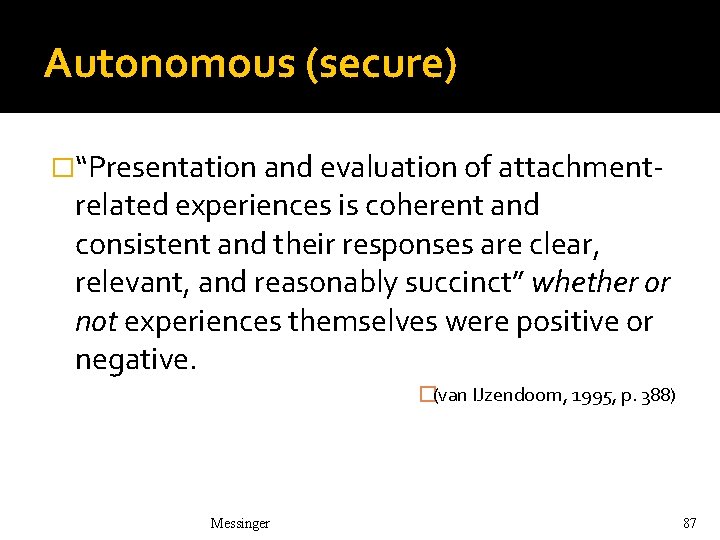
Autonomous (secure) �“Presentation and evaluation of attachment- related experiences is coherent and consistent and their responses are clear, relevant, and reasonably succinct” whether or not experiences themselves were positive or negative. �(van IJzendoorn, 1995, p. 388) Messinger 87
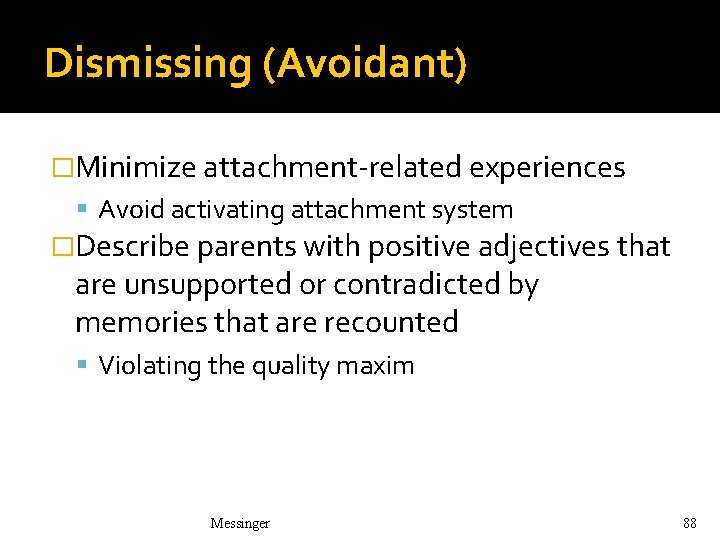
Dismissing (Avoidant) �Minimize attachment-related experiences Avoid activating attachment system �Describe parents with positive adjectives that are unsupported or contradicted by memories that are recounted Violating the quality maxim Messinger 88
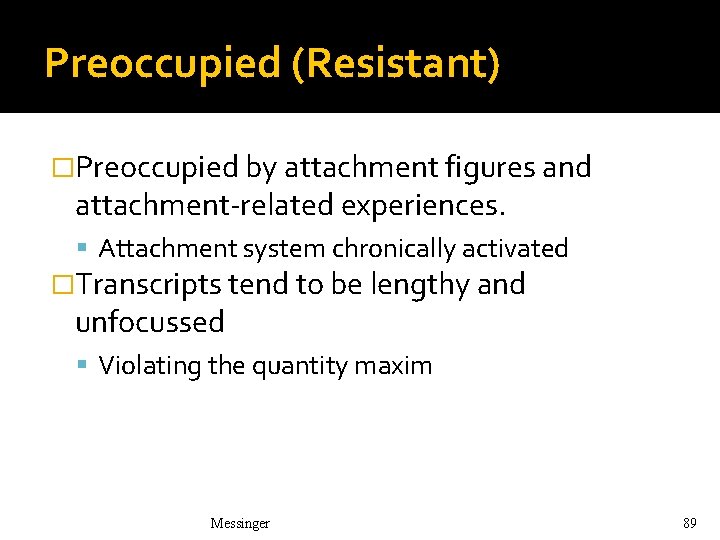
Preoccupied (Resistant) �Preoccupied by attachment figures and attachment-related experiences. Attachment system chronically activated �Transcripts tend to be lengthy and unfocussed Violating the quantity maxim Messinger 89
Unresolved - Disorganized Link �Unresolved parents are frightened or frightening in dealing with attachment issues. �Infants often respond to a parent who is threatening rather than comforting with disorganized attachment behavior No clear strategy. Messinger 90
Validity of AAI �Classifications are stable 2 months, 3 months, 1. 5 years �Not related to IQ measures 6 of 7 studies �Discourse style relates to attachment not interviews about job �Machine learning shows some ability to distinguish adult attachment in AAI Messinger 91
Parent-Infant Attachment Correspondence � Meta-analysis of 13 studies using three major categories � 75% secure vs. insecure agreement (K=. 49) � 70% three-way agreement (K=. 46) Prebirth AAI show 69% three-way agreement (K=. 44) �Bakermans-kranenburg, M. J. & Vanijzendoorn, M. H. (1993). A Psychometric Study of the Adult Attachment Interview - Reliability and Discriminant Validity. Developmental Psychology, 29, 870 -879. Messinger 92
Parent-Infant Correspondence Messinger 96
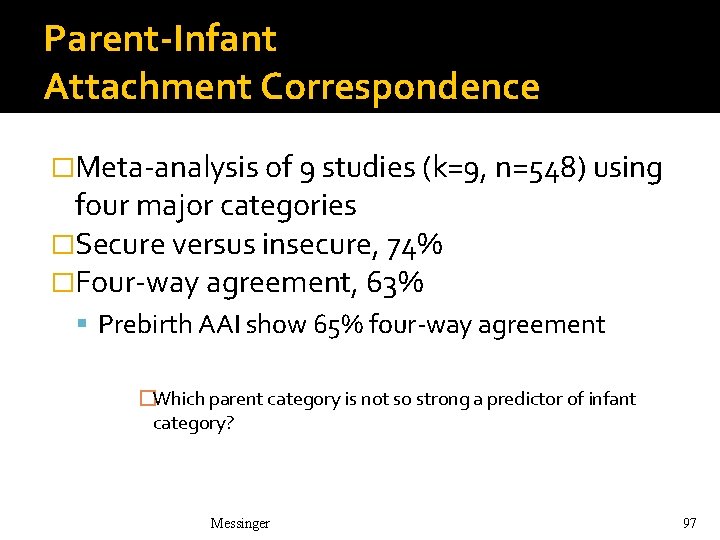
Parent-Infant Attachment Correspondence �Meta-analysis of 9 studies (k=9, n=548) using four major categories �Secure versus insecure, 74% �Four-way agreement, 63% Prebirth AAI show 65% four-way agreement �Which parent category is not so strong a predictor of infant category? Messinger 97
Parent-Infant Correspondence Messinger 98
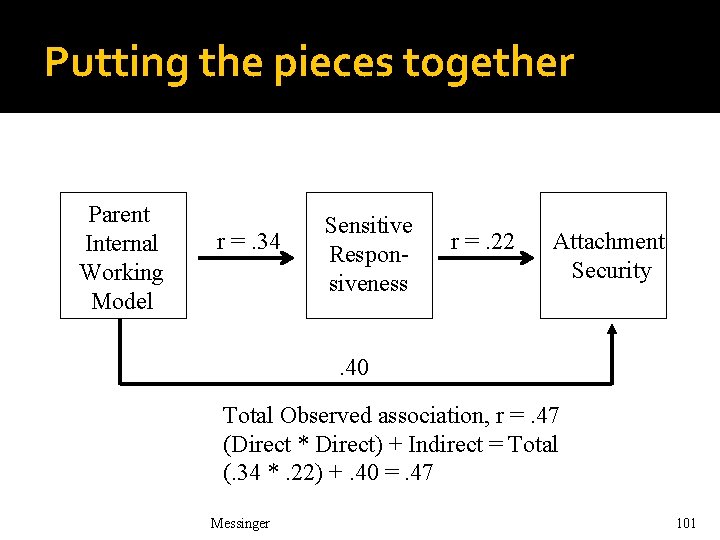
Putting the pieces together Parent Internal Working Model r =. 34 Sensitive Responsiveness r =. 22 Attachment Security . 40 Total Observed association, r =. 47 (Direct * Direct) + Indirect = Total (. 34 *. 22) +. 40 =. 47 Messinger 101
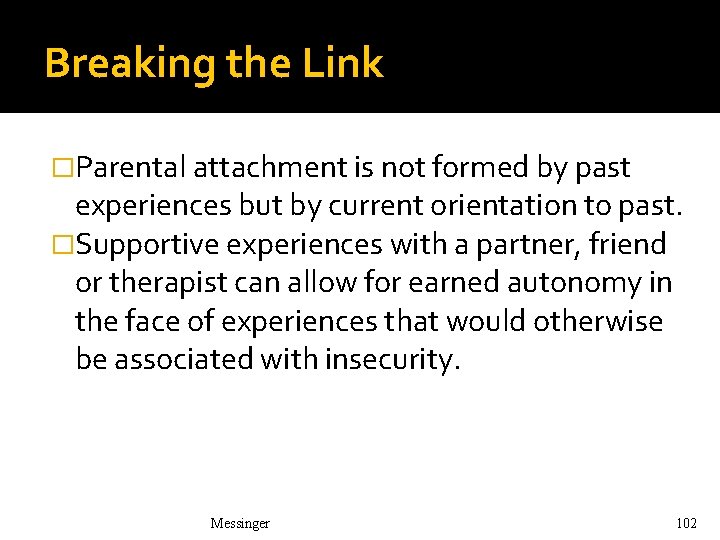
Breaking the Link �Parental attachment is not formed by past experiences but by current orientation to past. �Supportive experiences with a partner, friend or therapist can allow for earned autonomy in the face of experiences that would otherwise be associated with insecurity. Messinger 102
Interview �Interview a partner about one attachment figure focusing on questions 2 through 4 �Each person analyzes their own responses no comments form partner �Only share what you want to share Messinger 103
Adult Attachment Interview Messinger 104
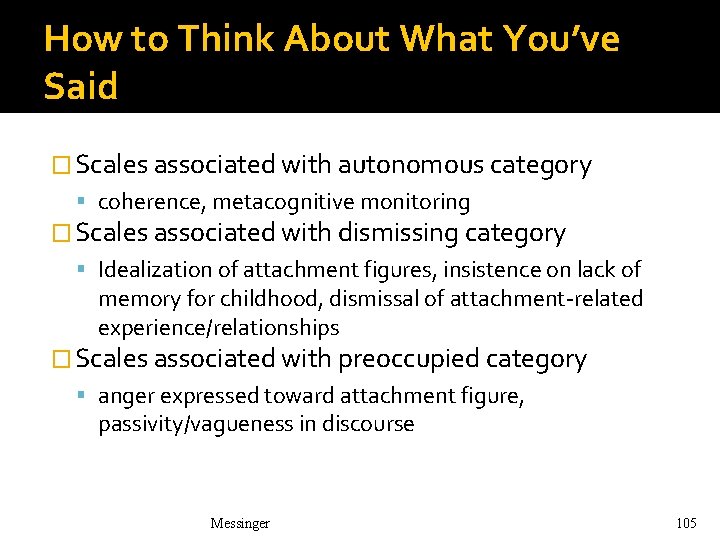
How to Think About What You’ve Said � Scales associated with autonomous category coherence, metacognitive monitoring � Scales associated with dismissing category Idealization of attachment figures, insistence on lack of memory for childhood, dismissal of attachment-related experience/relationships � Scales associated with preoccupied category anger expressed toward attachment figure, passivity/vagueness in discourse Messinger 105
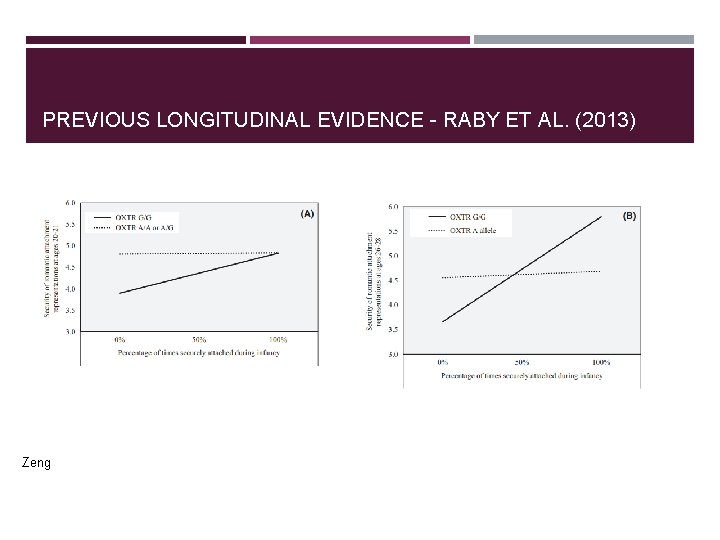
GENETIC MODERATION OF STABILITY IN ATTACHMENT SECURITY FROM EARLY CHILDHOOD TO AGE 18 YEARS: A REPLICATION STUDY RABY ET AL. (2015) Zeng
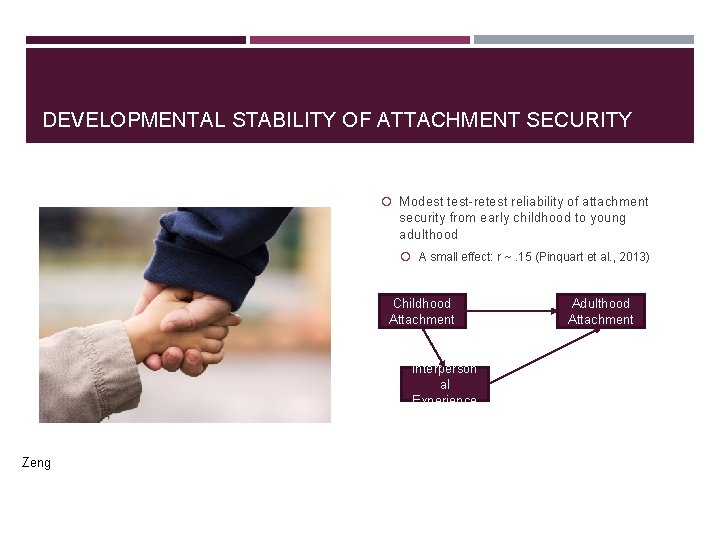
DEVELOPMENTAL STABILITY OF ATTACHMENT SECURITY Modest test-retest reliability of attachment security from early childhood to young adulthood A small effect: r ~. 15 (Pinquart et al. , 2013) Childhood Attachment Interperson al Experience Zeng Adulthood Attachment
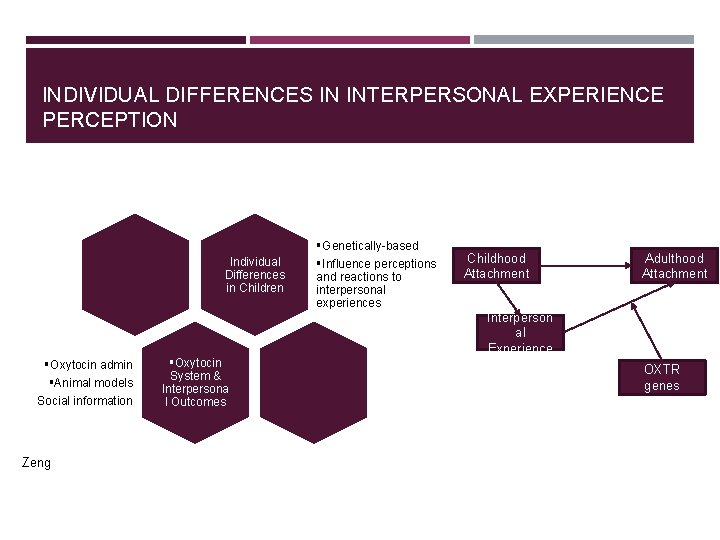
INDIVIDUAL DIFFERENCES IN INTERPERSONAL EXPERIENCE PERCEPTION Individual Differences in Children Genetically-based Influence perceptions and reactions to interpersonal experiences Childhood Attachment Adulthood Attachment Interperson al Experience Oxytocin admin Animal models Social information Zeng Oxytocin System & Interpersona l Outcomes OXTR genes
PREVIOUS LONGITUDINAL EVIDENCE - RABY ET AL. (2013) Zeng
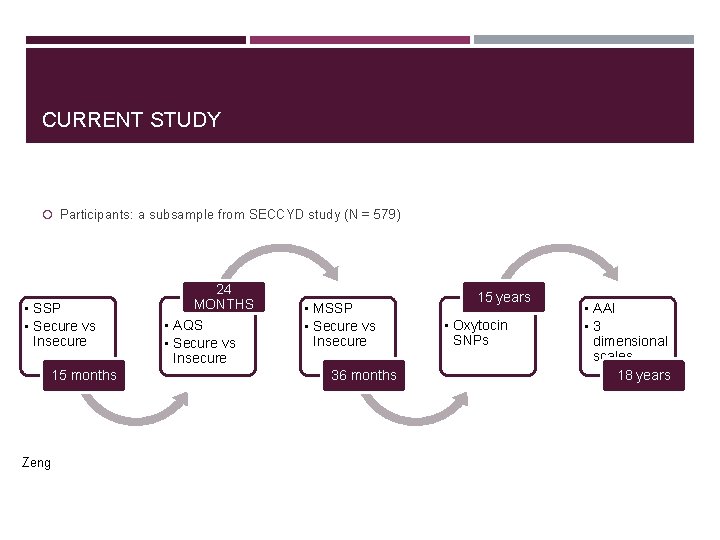
CURRENT STUDY Participants: a subsample from SECCYD study (N = 579) • SSP • Secure vs Insecure 15 months Zeng 24 MONTHS • AQS • Secure vs Insecure • MSSP • Secure vs Insecure 36 months 15 years • Oxytocin SNPs • AAI • 3 dimensional scales 18 years
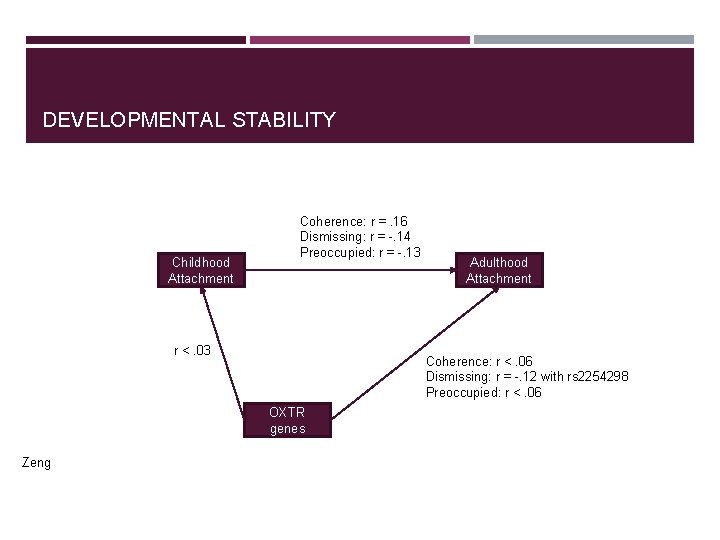
DEVELOPMENTAL STABILITY Childhood Attachment Coherence: r =. 16 Dismissing: r = -. 14 Preoccupied: r = -. 13 r <. 03 Coherence: r <. 06 Dismissing: r = -. 12 with rs 2254298 Preoccupied: r <. 06 OXTR genes Zeng Adulthood Attachment
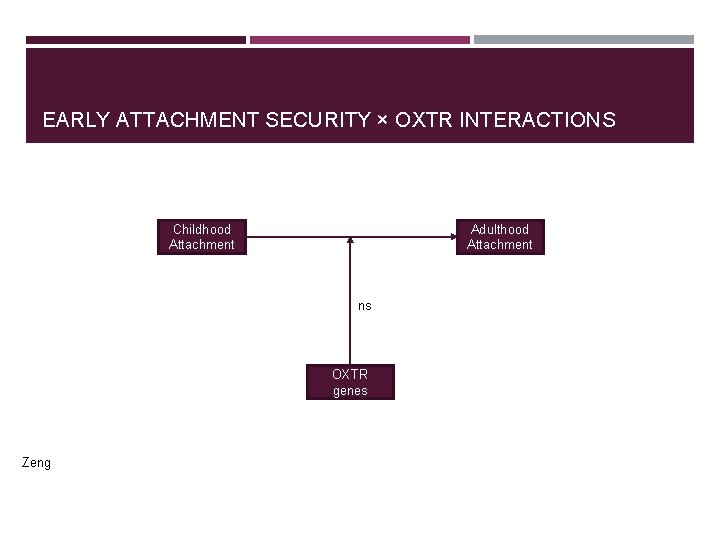
EARLY ATTACHMENT SECURITY × OXTR INTERACTIONS Childhood Attachment Adulthood Attachment ns OXTR genes Zeng
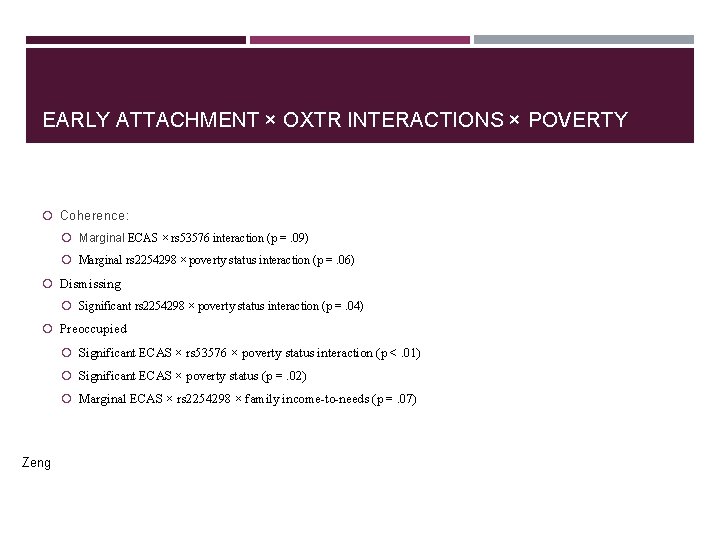
EARLY ATTACHMENT × OXTR INTERACTIONS × POVERTY Coherence: Marginal ECAS × rs 53576 interaction (p =. 09) Marginal rs 2254298 × poverty status interaction (p =. 06) Dismissing Significant rs 2254298 × poverty status interaction (p =. 04) Preoccupied Significant ECAS × rs 53576 × poverty status interaction (p <. 01) Significant ECAS × poverty status (p =. 02) Marginal ECAS × rs 2254298 × family income-to-needs (p =. 07) Zeng
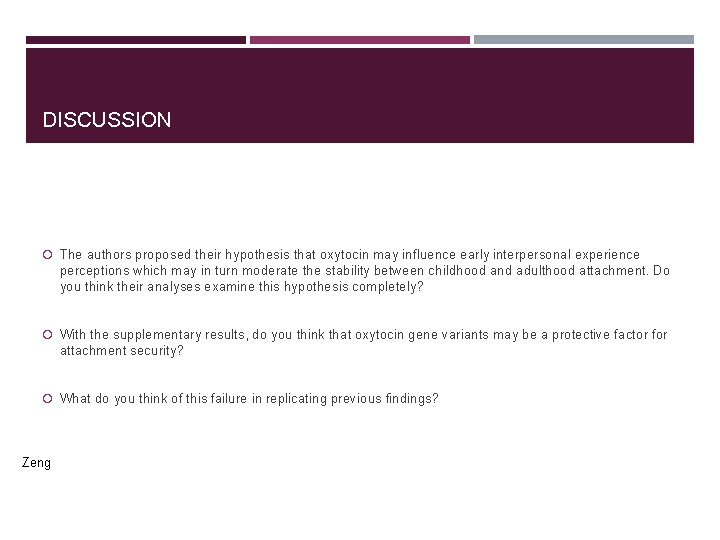
DISCUSSION The authors proposed their hypothesis that oxytocin may influence early interpersonal experience perceptions which may in turn moderate the stability between childhood and adulthood attachment. Do you think their analyses examine this hypothesis completely? With the supplementary results, do you think that oxytocin gene variants may be a protective factor for attachment security? What do you think of this failure in replicating previous findings? Zeng
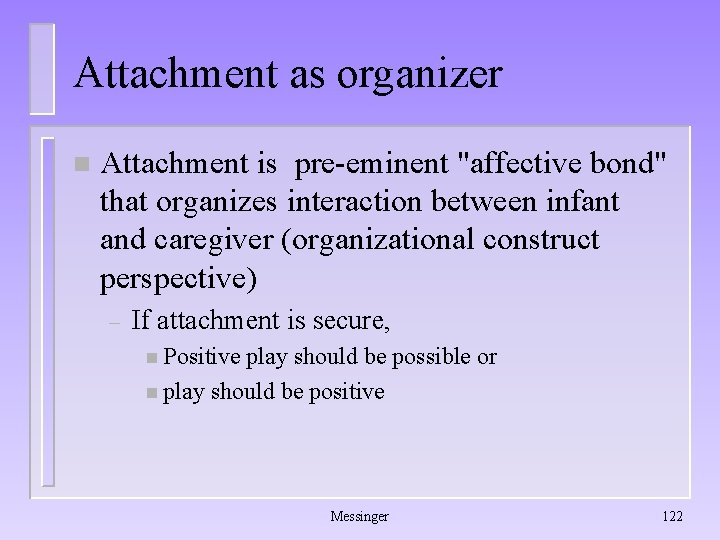
Attachment as organizer n Attachment is pre-eminent "affective bond" that organizes interaction between infant and caregiver (organizational construct perspective) – If attachment is secure, n Positive play should be possible or n play should be positive Messinger 122
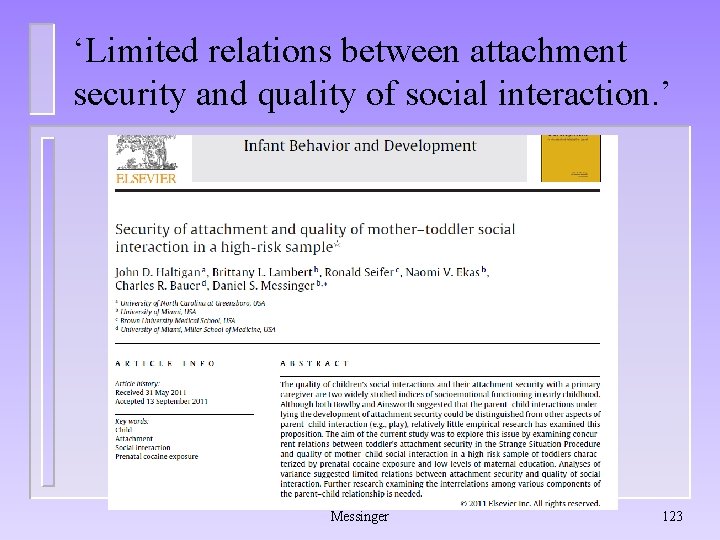
‘Limited relations between attachment security and quality of social interaction. ’ Messinger 123