Social Networks Daniel Messinger Ph D Peer play







- Slides: 29
Social Networks Daniel Messinger, Ph. D
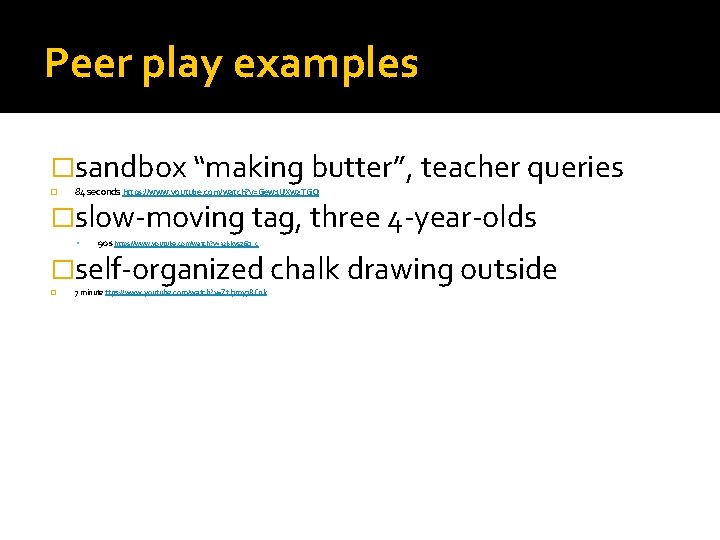
Peer play examples �sandbox “making butter”, teacher queries � 84 seconds https: //www. youtube. com/watch? v=Gew 1 UXw 2 TGQ �slow-moving tag, three 4 -year-olds 90 s https: //www. youtube. com/watch? v=32 bkysz. Gg_c �self-organized chalk drawing outside � 7 minute ttps: //www. youtube. com/watch? v=Zt. J 7 my 7 RCnk
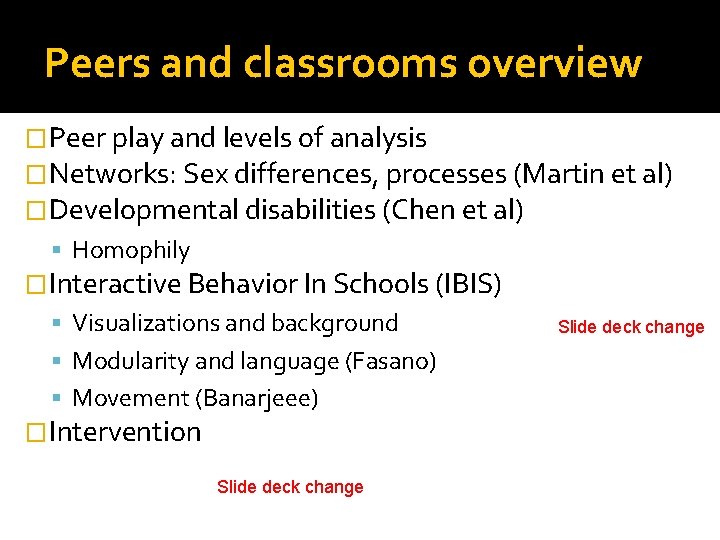
Peers and classrooms overview �Peer play and levels of analysis �Networks: Sex differences, processes (Martin et al) �Developmental disabilities (Chen et al) Homophily �Interactive Behavior In Schools (IBIS) Visualizations and background Modularity and language (Fasano) Movement (Banarjeee) �Intervention Slide deck change
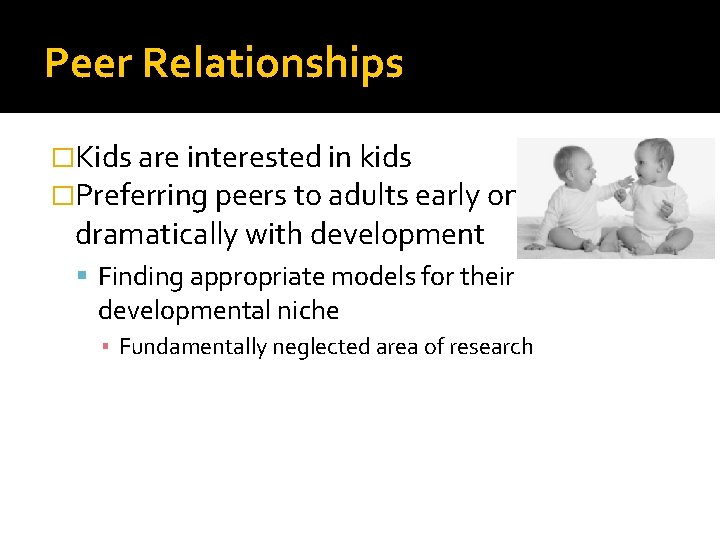
Peer Relationships �Kids are interested in kids �Preferring peers to adults early on and more dramatically with development Finding appropriate models for their developmental niche ▪ Fundamentally neglected area of research
Early development �Infants have rudimentary abilities (to 1 yr) I. e. , increased gazing at peers �Toddlers Imitate and are aware of being imitated Have reciprocal relationships with specific kids 2/20/2021 Messinger 6
Early childhood � Types of play Unoccupied, solitary, on-looking, parallel, associative, cooperative Parallel play is important transitional activity Pretend play emerges (inter-subjectivity) � Friendship emerges More prosocial and aggressive behavior with friends � As do dominance hierarchies 2/20/2021 Messinger 7
Developmental changes in nature of play behavior (Parten, 1932)
Levels of analysis � Interactions The braiding of two individual’s behavior � Relationships “succession of interactions” ▪ Friendship is a reciprocal, voluntary relationship based on affection � Groups – collection of interacting kids Defined by cohesiveness, hierarchy, heterogeneity � Networks The instantiation of all interactions in a classroom? 2/20/2021 Messinger 9
Social networks � 6 minutes on slide https: //www. youtube. com/watch? v=Pl 3_4 D 6 c 8 Io �(sociodramatic play – preschool children playing house, pretending to be doggies and kitties) http: //www. youtube. com/watch? v=pd. Owv. Zwi. Ywk& NR=1 �(let’s play kitchen)--Preschool children making hot chocolate—teacher talk http: //www. youtube. com/watch? v=JE 9 eq 3 m. Zhg 0&feature=rela ted
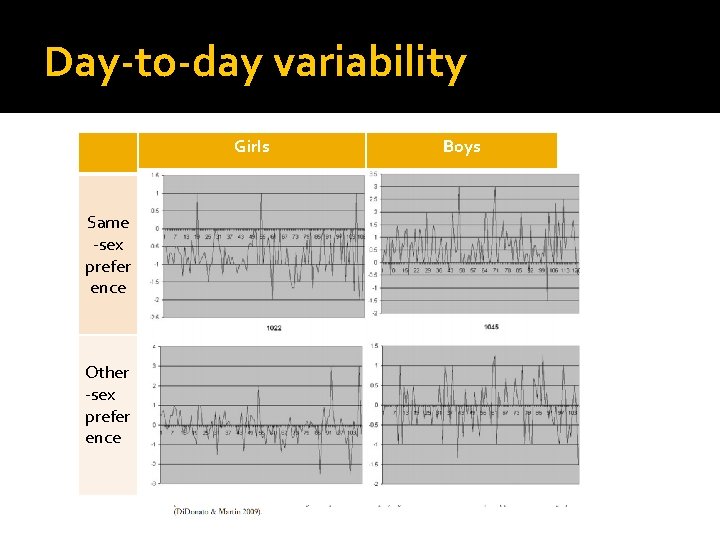
Day-to-day variability Girls Same -sex prefer ence Other -sex prefer ence Boys
State Space Grids
Jutagir | Schaefer et al. , 2010
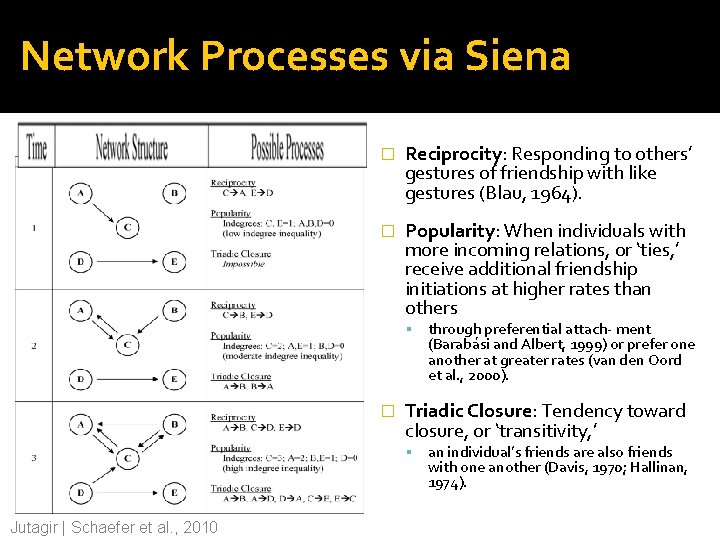
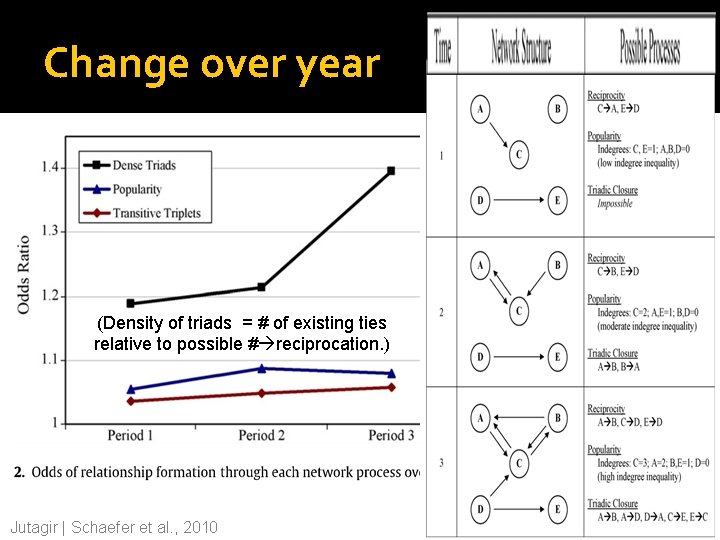
Network Processes via Siena � Reciprocity: Responding to others’ gestures of friendship with like gestures (Blau, 1964). � Popularity: When individuals with more incoming relations, or ‘ties, ’ receive additional friendship initiations at higher rates than others through preferential attach- ment (Baraba si and Albert, 1999) or prefer one another at greater rates (van den Oord et al. , 2000). � Triadic Closure: Tendency toward closure, or ‘transitivity, ’ an individual’s friends are also friends with one another (Davis, 1970; Hallinan, 1974). Jutagir | Schaefer et al. , 2010
Change over year (Density of triads = # of existing ties relative to possible # reciprocation. ) Jutagir | Schaefer et al. , 2010
The social networks of children with and without disabilities in early childhood special education classrooms Chen, Lin, Justice, & Sawyer (2017) Mitsven, 2017
Measures Classroom play and conflict networks Based on teacher ratings Play: (0 = Never play together, 4 = Always play together) Engaging in pretend play Giving and sharing toys Exploring object together Collaborating on building blocks Conflict: (0 = Never have conflict, 4 = Always have conflict) Quarreling/fighting Kicking/hitting Shouting Language ability: Clinical Evaluation of Language Fundamentals Preschool (CELF) Expressive vocabulary, sentence structure, word structure Mitsven, 2017
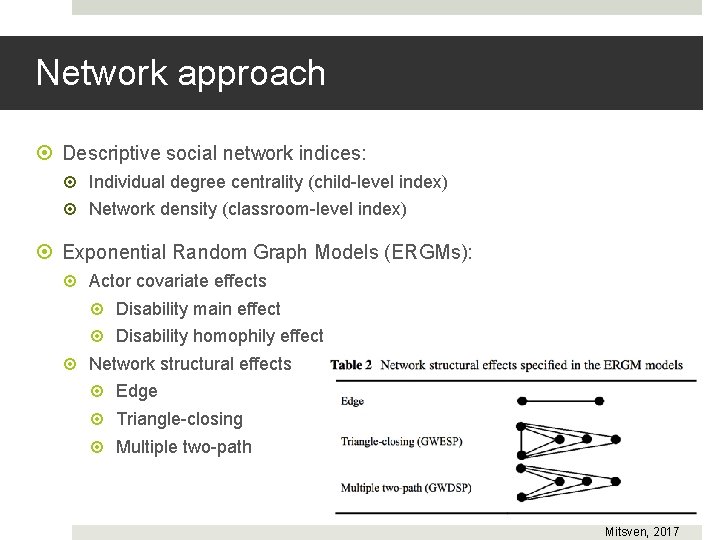
Network approach Descriptive social network indices: Individual degree centrality (child-level index) Network density (classroom-level index) Exponential Random Graph Models (ERGMs): Actor covariate effects Disability main effect Disability homophily effect Network structural effects Edge Triangle-closing Multiple two-path Mitsven, 2017
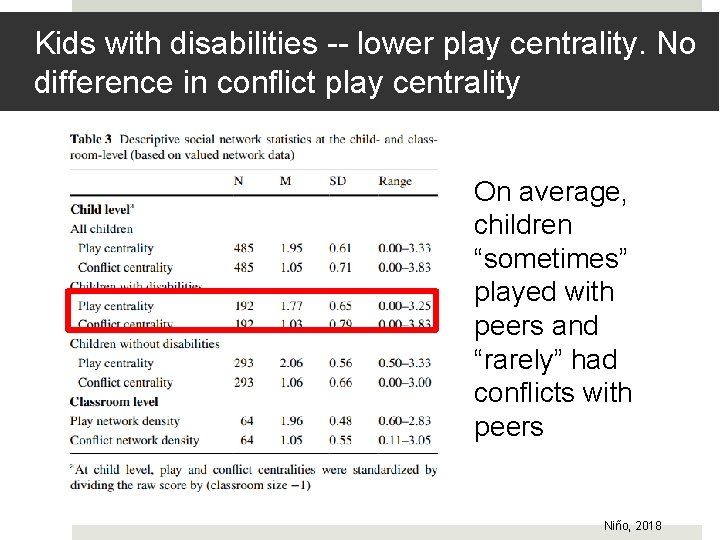
Kids with disabilities -- lower play centrality. No difference in conflict play centrality On average, children “sometimes” played with peers and “rarely” had conflicts with peers Niño, 2018
Results Mitsven, 2017
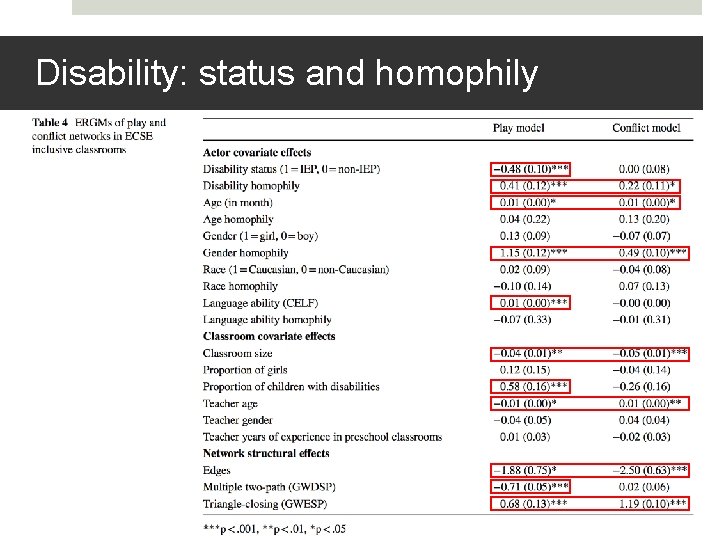
Disability: status and homophily
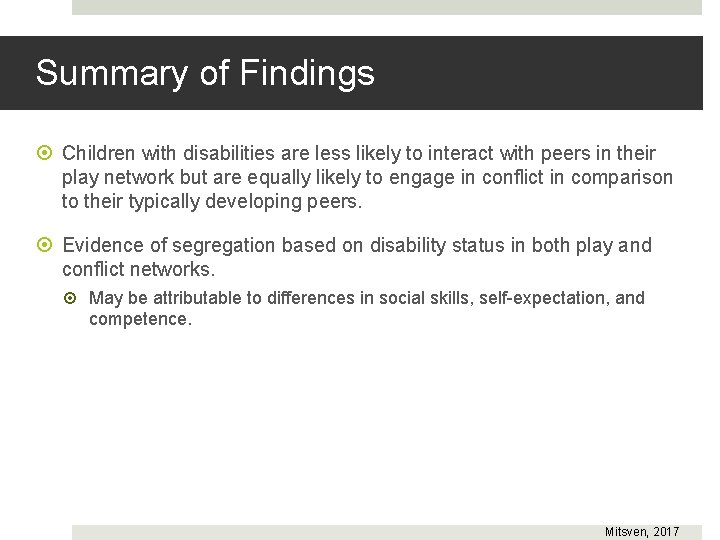
Summary of Findings Children with disabilities are less likely to interact with peers in their play network but are equally likely to engage in conflict in comparison to their typically developing peers. Evidence of segregation based on disability status in both play and conflict networks. May be attributable to differences in social skills, self-expectation, and competence. Mitsven, 2017
43
Bullying as a classroom phenomenon � Not just an individual (the bully) � Not just a dyad (bully and victim) � “Bullying more likely in classrooms characterized by poor climate, strong status hierarchy, and pro-bullying norms. � Bystanders’ responses contribute by rewarding or sanctioning the behavior of the perpetrators. � Bullying functions not only for individual perpetrators but for the whole peer group by providing a common goal and a semblance of cohesion. Saarento, S. , & Salmivalli, C. (2015). The Role of Classroom Peer Ecology and Bystanders’ Responses in Bullying. Child Development Perspectives, 9(4), 201 -205. doi: 10. 1111/cdep. 12140
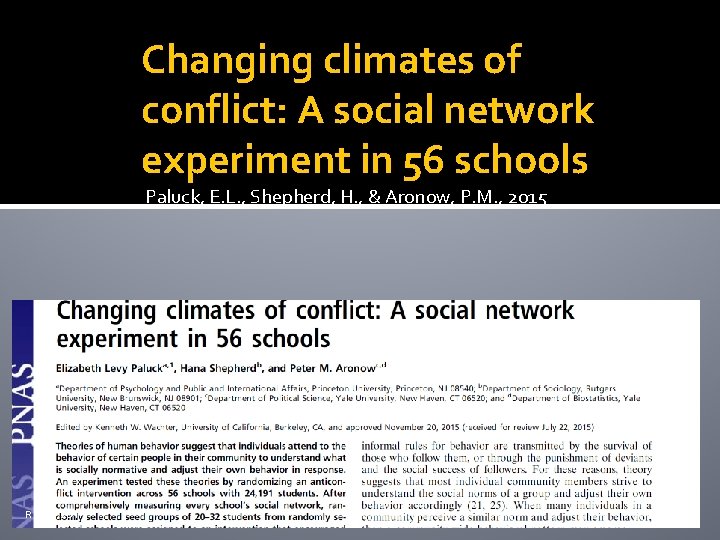
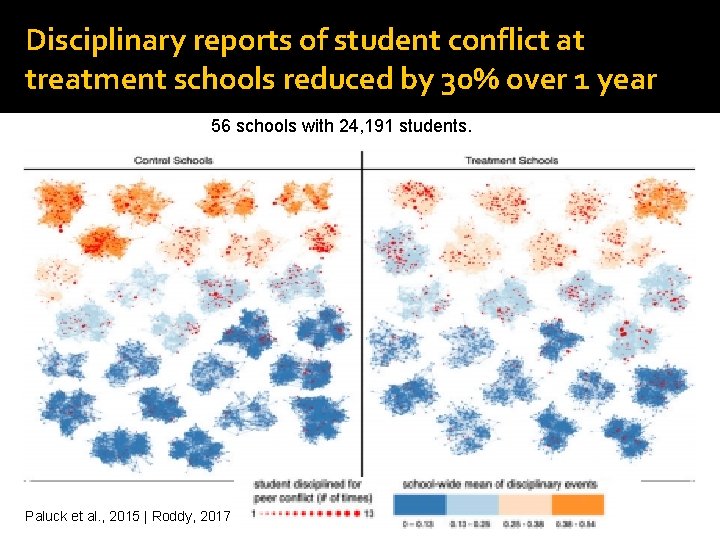
Changing climates of conflict: A social network experiment in 56 schools Paluck, E. L. , Shepherd, H. , & Aronow, P. M. , 2015 Roddy, 2017
How to influence change? �Change the individual–focus in psychology Mass education at community level Seed social networks within individuals �Social norms emerge when Support survival of the group Arbitrary historical precedent Once established, survive by punishment of deviants and success of followers Paluck et al. , 2015 | Roddy, 2017
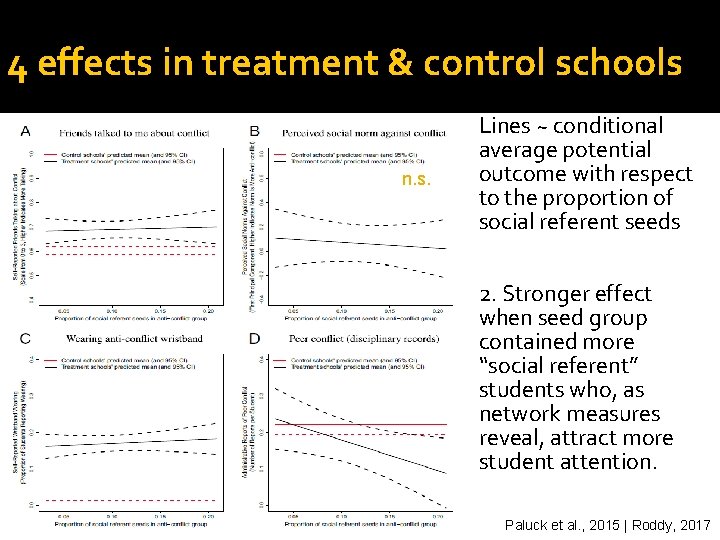
Method �Randomly selected groups of 20– 32 students from randomly selected schools assigned to intervention that encouraged their public stance against conflict. �Conflict Measured via: Survey of students Administrative disciplinary reports on peer conflict Paluck et al. , 2015 | Roddy, 2017
Disciplinary reports of student conflict at treatment schools reduced by 30% over 1 year 56 schools with 24, 191 students. Paluck et al. , 2015 | Roddy, 2017
4 effects in treatment & control schools n. s. Lines ~ conditional average potential outcome with respect to the proportion of social referent seeds 2. Stronger effect when seed group contained more “social referent” students who, as network measures reveal, attract more student attention. Paluck et al. , 2015 | Roddy, 2017