Molar Conversions Calculations Ch 11 The Mole A




- Slides: 30
Molar Conversions & Calculations Ch. 11 – The Mole
A. What is the Mole? • A counting number (like a dozen) • Avogadro’s number (NA) • 1 mol = 6. 02 1023 items A large amount!!!!
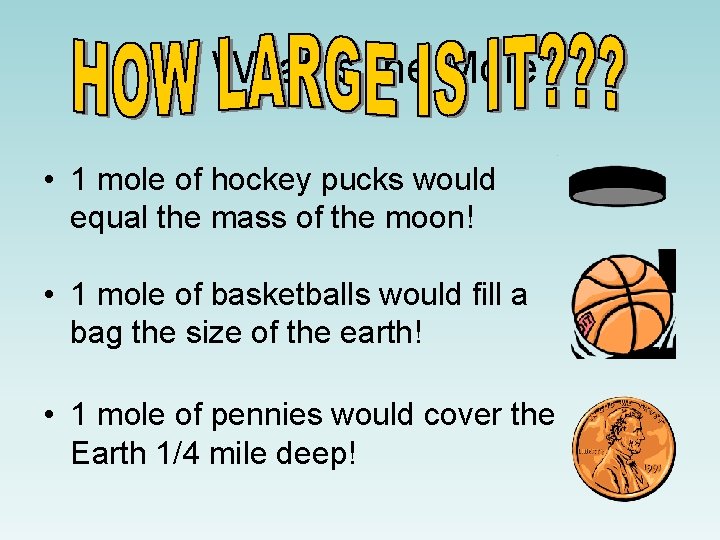
A. What is the Mole? • 1 mole of hockey pucks would equal the mass of the moon! • 1 mole of basketballs would fill a bag the size of the earth! • 1 mole of pennies would cover the Earth 1/4 mile deep!
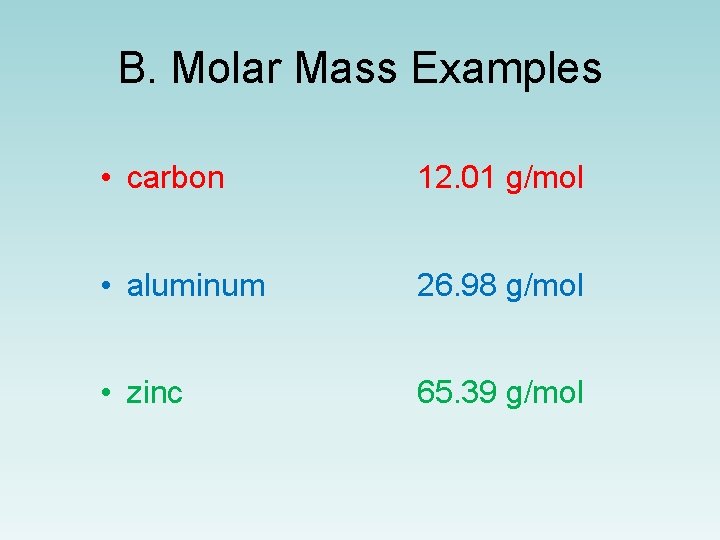
B. Molar Mass • Mass of 1 mole of an element or compound. • Atomic mass tells the. . . – atomic mass units per atom (amu) – grams per mole (g/mol) • Round to 2 decimal places
B. Molar Mass Examples • carbon 12. 01 g/mol • aluminum 26. 98 g/mol • zinc 65. 39 g/mol
B. Molar Mass Examples • water – H 2 O – 2 atoms H + 1 atom O – 2(1. 01) + 16. 00 = 18. 02 g/mol • sodium chloride – Na. Cl – 1 atom Na + 1 atom Cl – 22. 99 + 35. 45 = 58. 44 g/mol
B. Molar Mass Examples • sodium hydrogen carbonate – Na. HCO 3 – 22. 99 + 1. 01 + 12. 01 + 3(16. 00) = 84. 01 g/mol • sucrose – C 12 H 22 O 11 – 12(12. 01) + 22(1. 01) + 11(16. 00) = 342. 34 g/mol
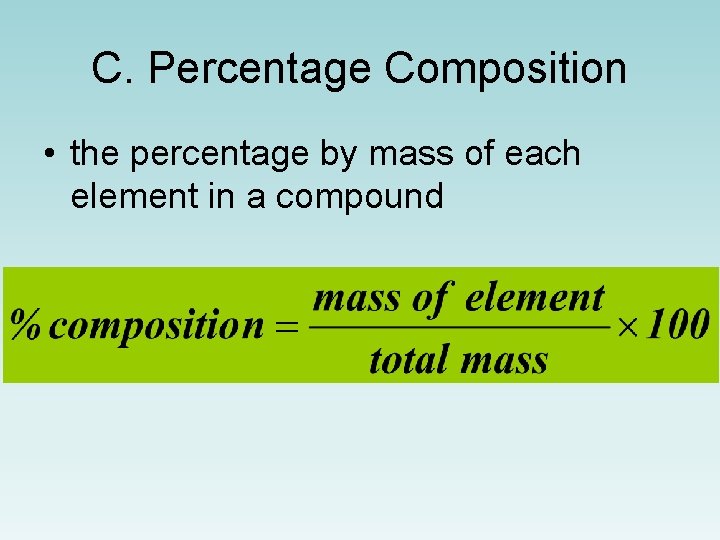
C. Percentage Composition • the percentage by mass of each element in a compound
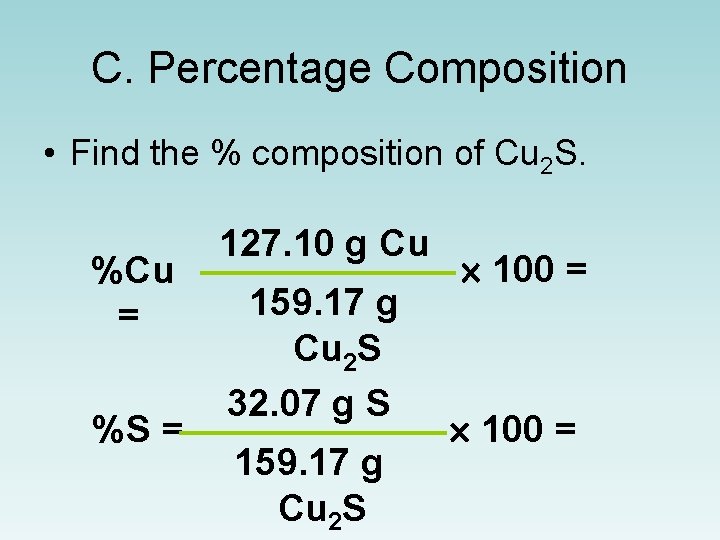
C. Percentage Composition • Find the % composition of Cu 2 S. %Cu = %S = 127. 10 g Cu 159. 17 g Cu 2 S 32. 07 g S 159. 17 g Cu 2 S 100 =
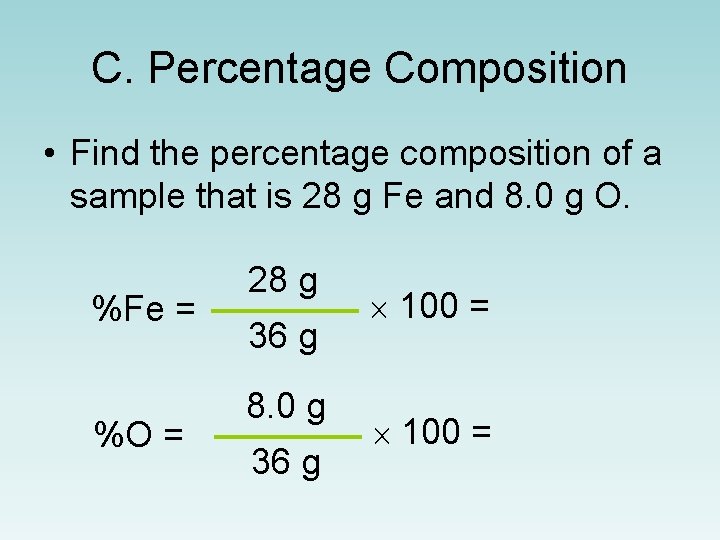
C. Percentage Composition • Find the percentage composition of a sample that is 28 g Fe and 8. 0 g O. %Fe = %O = 28 g 36 g 8. 0 g 36 g 100 =
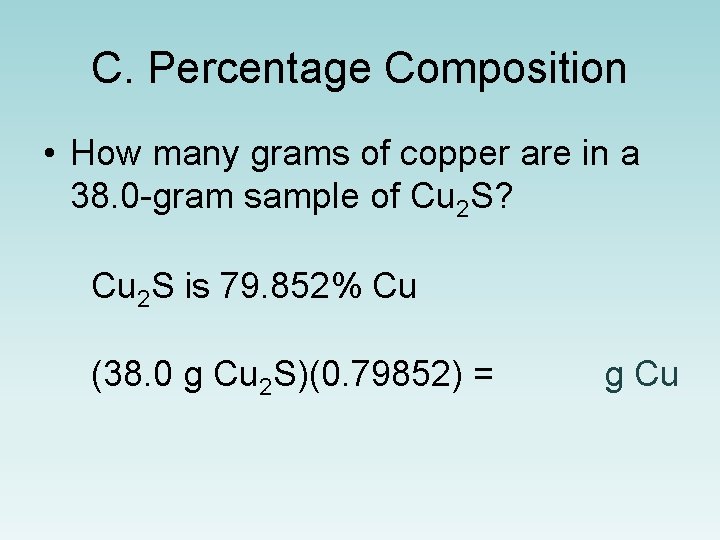
C. Percentage Composition • How many grams of copper are in a 38. 0 -gram sample of Cu 2 S? Cu 2 S is 79. 852% Cu (38. 0 g Cu 2 S)(0. 79852) = g Cu
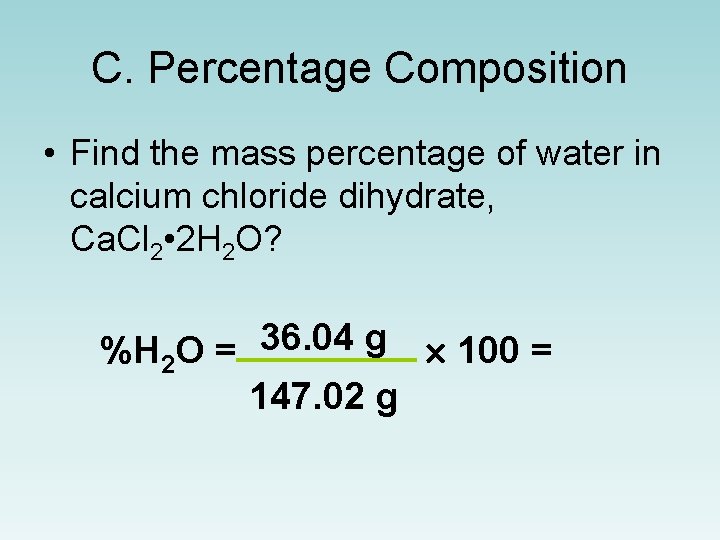
C. Percentage Composition • Find the mass percentage of water in calcium chloride dihydrate, Ca. Cl 2 • 2 H 2 O? %H 2 O = 36. 04 g 100 = 147. 02 g
Practice • P. 322 #25; p. 331 #42, 43, 45 – Answers on p. 929 and 930 • P. 347 #111, 112; p. 348 #136
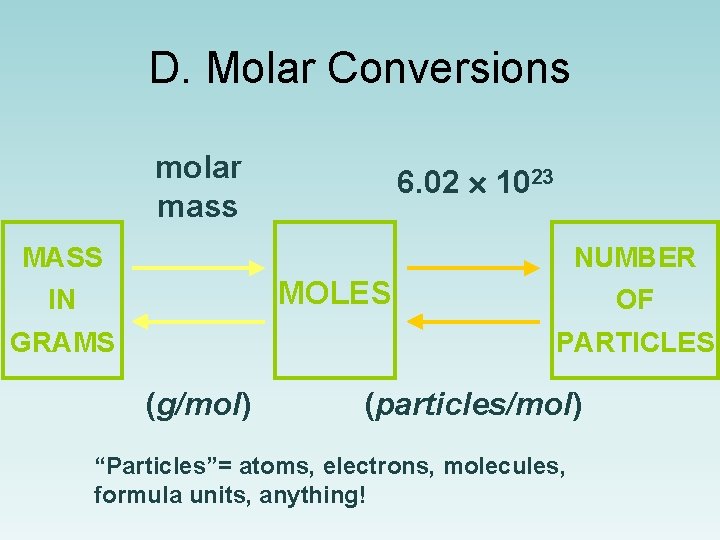
D. Molar Conversions molar mass 6. 02 1023 MASS NUMBER MOLES IN GRAMS OF PARTICLES (g/mol) (particles/mol) “Particles”= atoms, electrons, molecules, formula units, anything!
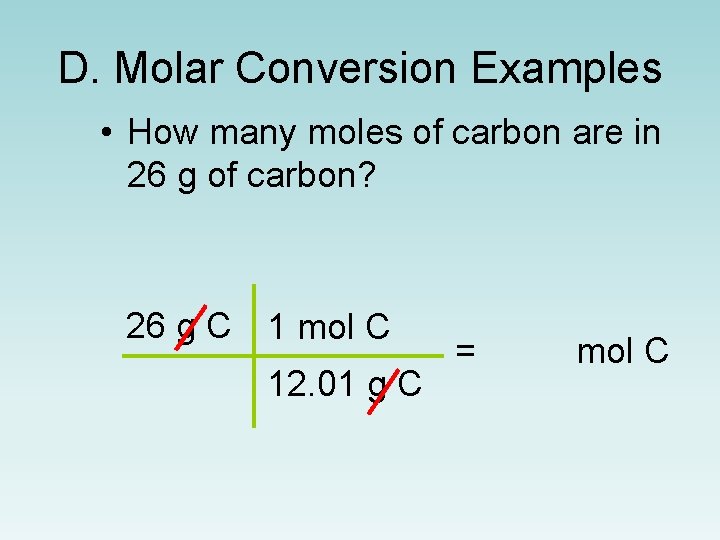
D. Molar Conversion Examples • How many moles of carbon are in 26 g of carbon? 26 g C 1 mol C 12. 01 g C = mol C
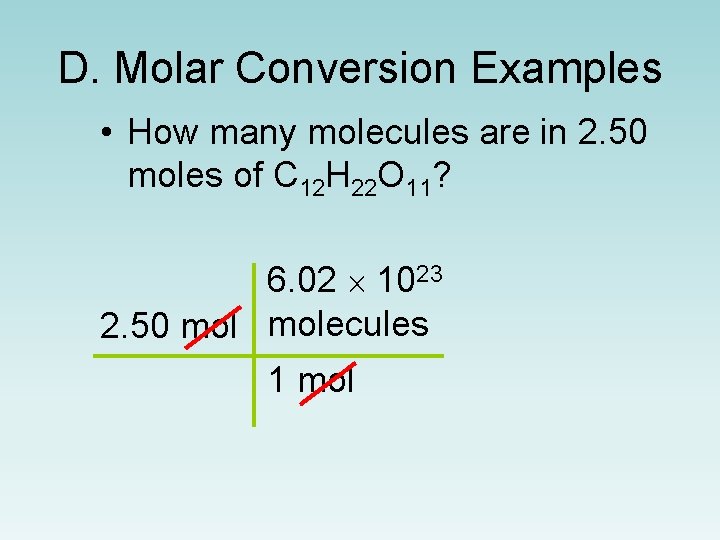
D. Molar Conversion Examples • How many molecules are in 2. 50 moles of C 12 H 22 O 11? 6. 02 1023 2. 50 molecules 1 mol
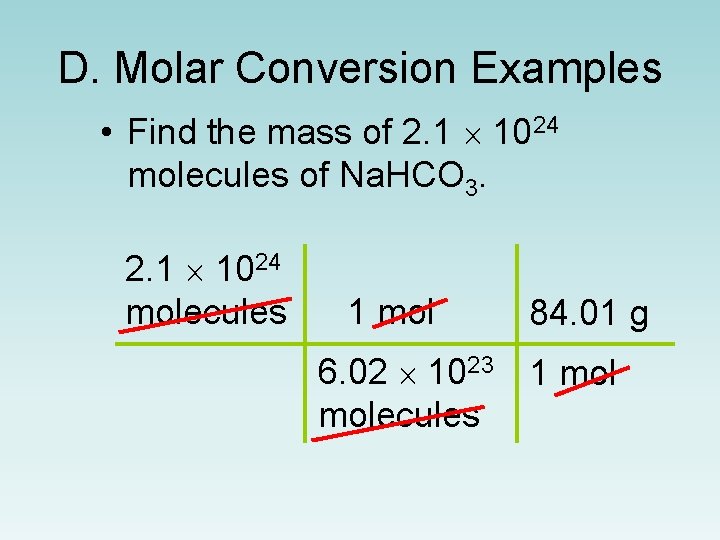
D. Molar Conversion Examples • Find the mass of 2. 1 1024 molecules of Na. HCO 3. 2. 1 1024 molecules 1 mol 84. 01 g 6. 02 1023 1 molecules
Practice • P. – Answers on p. 929 and 930 • P.
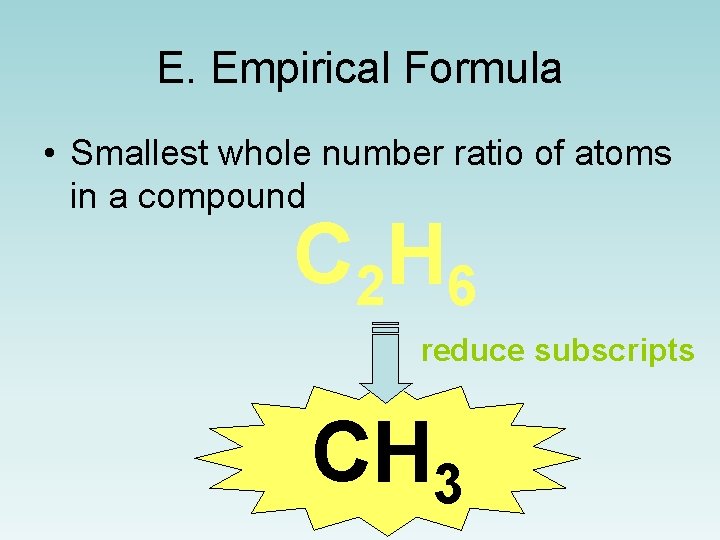
E. Empirical Formula • Smallest whole number ratio of atoms in a compound C 2 H 6 reduce subscripts CH 3
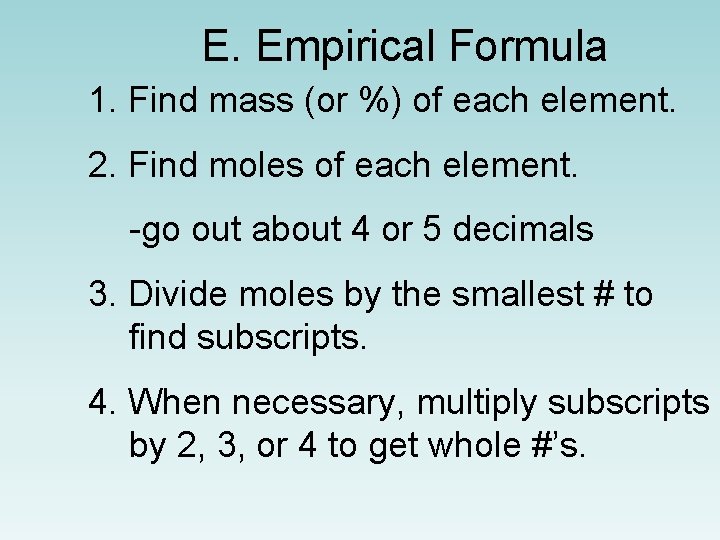
E. Empirical Formula 1. Find mass (or %) of each element. 2. Find moles of each element. -go out about 4 or 5 decimals 3. Divide moles by the smallest # to find subscripts. 4. When necessary, multiply subscripts by 2, 3, or 4 to get whole #’s.
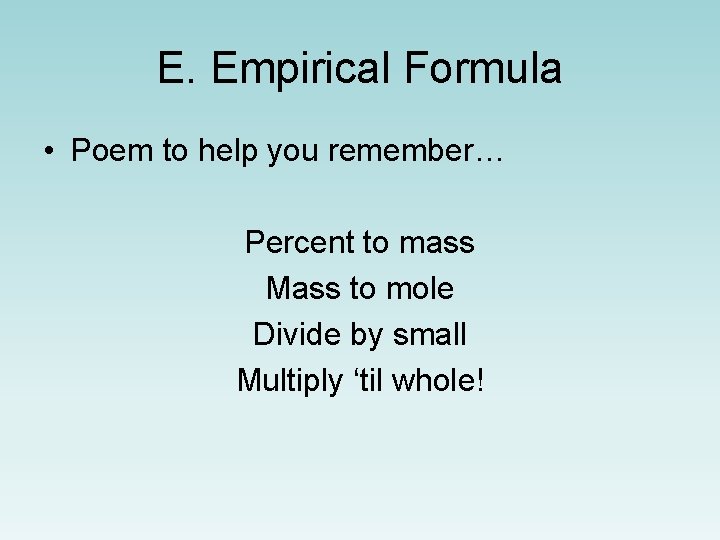
E. Empirical Formula • Poem to help you remember… Percent to mass Mass to mole Divide by small Multiply ‘til whole!
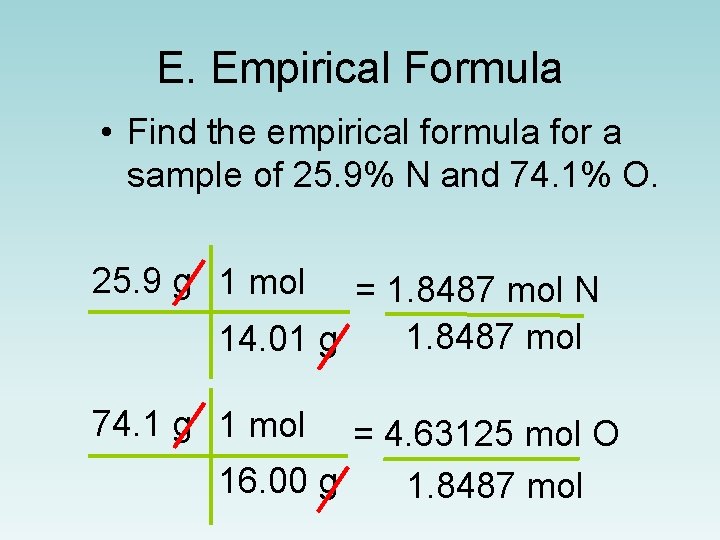
E. Empirical Formula • Find the empirical formula for a sample of 25. 9% N and 74. 1% O. 25. 9 g 1 mol = 1. 8487 mol N 1. 8487 mol 14. 01 g 74. 1 g 1 mol = 4. 63125 mol O 16. 00 g 1. 8487 mol
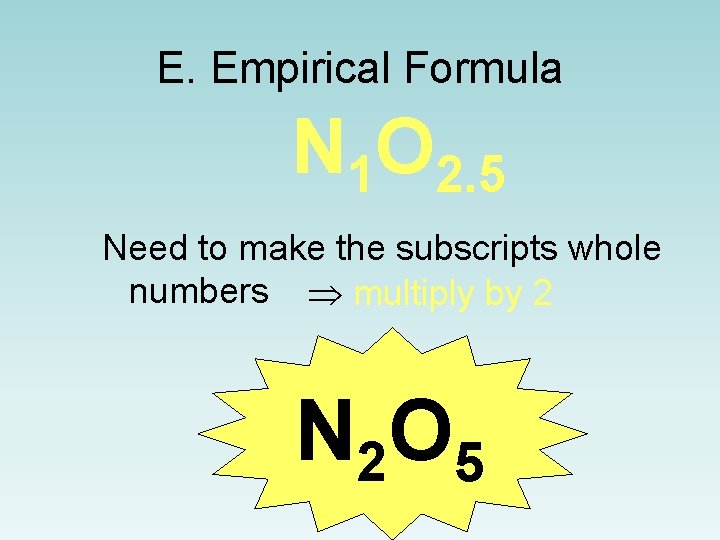
E. Empirical Formula N 1 O 2. 5 Need to make the subscripts whole numbers multiply by 2 N 2 O 5
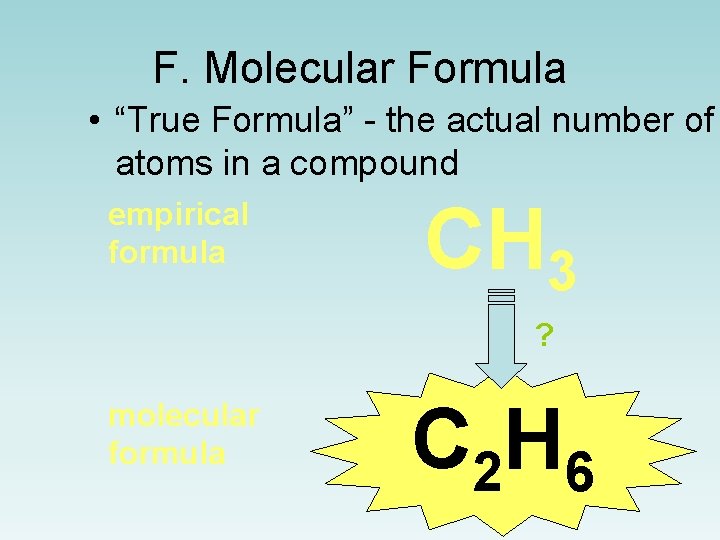
F. Molecular Formula • “True Formula” - the actual number of atoms in a compound empirical formula CH 3 ? molecular formula C 2 H 6
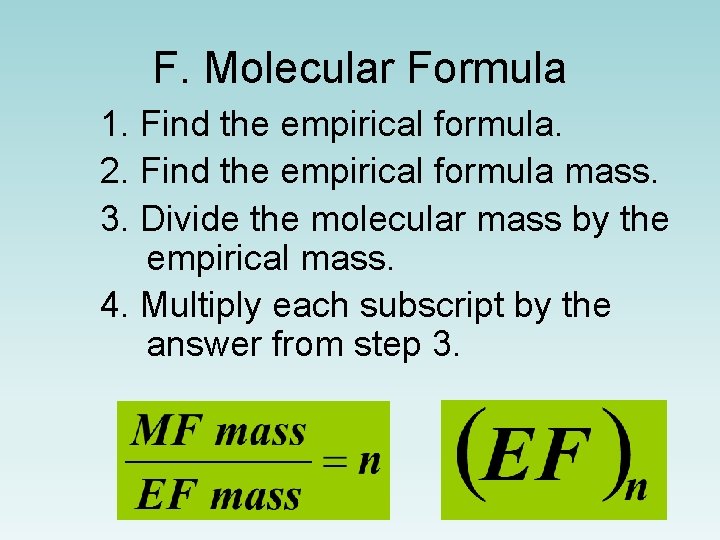
F. Molecular Formula 1. Find the empirical formula. 2. Find the empirical formula mass. 3. Divide the molecular mass by the empirical mass. 4. Multiply each subscript by the answer from step 3.
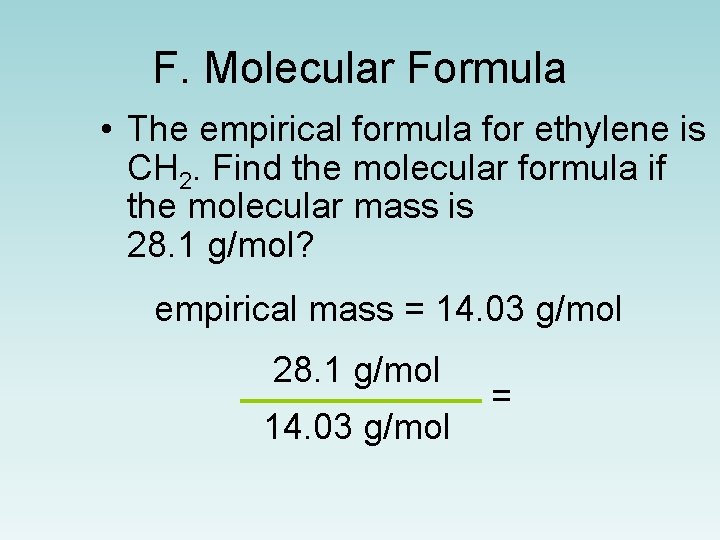
F. Molecular Formula • The empirical formula for ethylene is CH 2. Find the molecular formula if the molecular mass is 28. 1 g/mol? empirical mass = 14. 03 g/mol 28. 1 g/mol 14. 03 g/mol =
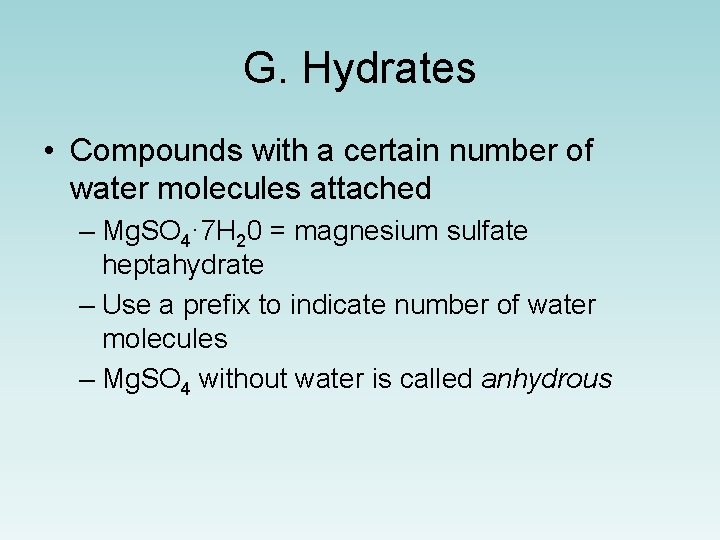
G. Hydrates • Compounds with a certain number of water molecules attached – Mg. SO 4· 7 H 20 = magnesium sulfate heptahydrate – Use a prefix to indicate number of water molecules – Mg. SO 4 without water is called anhydrous
G. Hydrates • To determine the number of water molecules, find the mole ratio of the anhydrous compound to the water • Find the moles of each • Set up a ratio: moles water/moles salt – Whole number answer is the number that goes in front of H 2 O
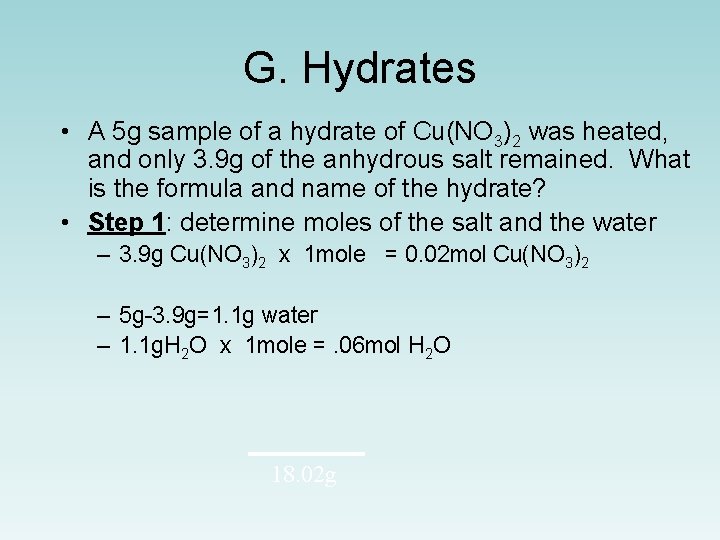
G. Hydrates • A 5 g sample of a hydrate of Cu(NO 3)2 was heated, and only 3. 9 g of the anhydrous salt remained. What is the formula and name of the hydrate? • Step 1: determine moles of the salt and the water – 3. 9 g Cu(NO 3)2 x 1 mole = 0. 02 mol Cu(NO 3)2 – 5 g-3. 9 g=1. 1 g water – 1. 1 g. H 2 O x 1 mole =. 06 mol H 2 O 18. 02 g
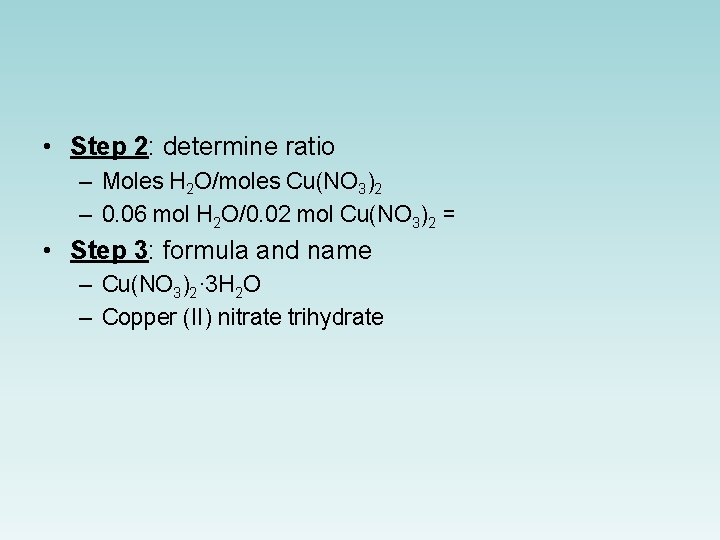
• Step 2: determine ratio – Moles H 2 O/moles Cu(NO 3)2 – 0. 06 mol H 2 O/0. 02 mol Cu(NO 3)2 = • Step 3: formula and name – Cu(NO 3)2· 3 H 2 O – Copper (II) nitrate trihydrate