
Conversions and Calculations Chapter 6 Copyright 2016 Elsevier










- Slides: 35
Conversions and Calculations Chapter 6 Copyright © 2016, Elsevier Inc. All rights reserved. 1
Lesson 6. 1 Conversions 1. 2. 3. 4. Describe the history of the International System of Units. Convert Arabic numbers into Roman numerals. Convert traditional time into international/military time. Convert Fahrenheit to Celsius. Copyright © 2016, Elsevier Inc. All rights reserved. 2
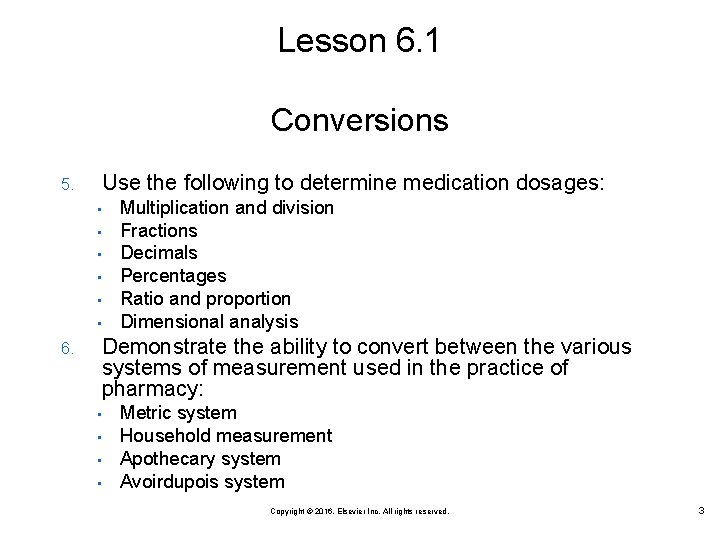
Lesson 6. 1 Conversions 5. Use the following to determine medication dosages: • • • 6. Multiplication and division Fractions Decimals Percentages Ratio and proportion Dimensional analysis Demonstrate the ability to convert between the various systems of measurement used in the practice of pharmacy: • • Metric system Household measurement Apothecary system Avoirdupois system Copyright © 2016, Elsevier Inc. All rights reserved. 3
History of Pharmacy Calculations Pharmacy measurements come from different regions of the world The United States Pharmacopeia (USP) recognizes the metric system as the official system of measurement for pharmacy Household, apothecary or avoirdupois units may also be used To acquire familiarity with measurements, start with what you know and build on it The pharmacy technician must translate the prescriber’s orders into lay terms Ø You must make the instructions easy enough for a child to understand Copyright © 2016, Elsevier Inc. All rights reserved. 4
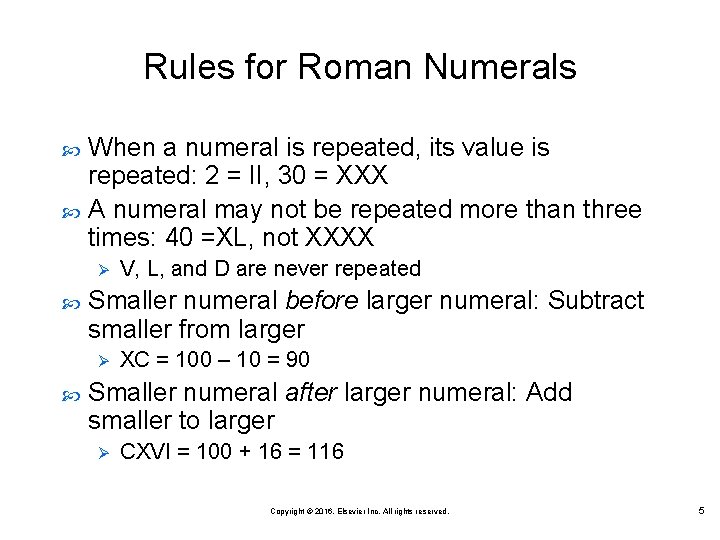
Rules for Roman Numerals When a numeral is repeated, its value is repeated: 2 = II, 30 = XXX A numeral may not be repeated more than three times: 40 =XL, not XXXX Ø Smaller numeral before larger numeral: Subtract smaller from larger Ø V, L, and D are never repeated XC = 100 ‒ 10 = 90 Smaller numeral after larger numeral: Add smaller to larger Ø CXVI = 100 + 16 = 116 Copyright © 2016, Elsevier Inc. All rights reserved. 5
International Time Orders are based on a 24 -hour day to ensure that all medical-related caretakers understand exactly when the order was written and/or the exact time for the medication or treatment Clock starts at 0000 (midnight) and runs through 2300 (11 PM) Ø Minutes are added in the last 2 places: • 1500 = 3 PM 1645 = 4: 45 PM Copyright © 2016, Elsevier Inc. All rights reserved. 6
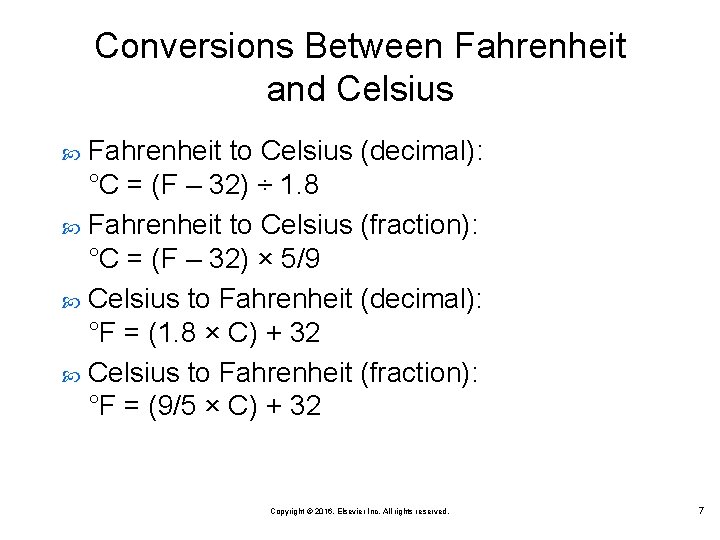
Conversions Between Fahrenheit and Celsius Fahrenheit to Celsius (decimal): °C = (F ‒ 32) ÷ 1. 8 Fahrenheit to Celsius (fraction): °C = (F ‒ 32) × 5/9 Celsius to Fahrenheit (decimal): °F = (1. 8 × C) + 32 Celsius to Fahrenheit (fraction): °F = (9/5 × C) + 32 Copyright © 2016, Elsevier Inc. All rights reserved. 7
Multiplication and Division Multiplication by a number greater than 1: Used to increase a formula Division: Same as multiplying by a proper fraction Ø Determines a part or portion of a prescription Copyright © 2016, Elsevier Inc. All rights reserved. 8
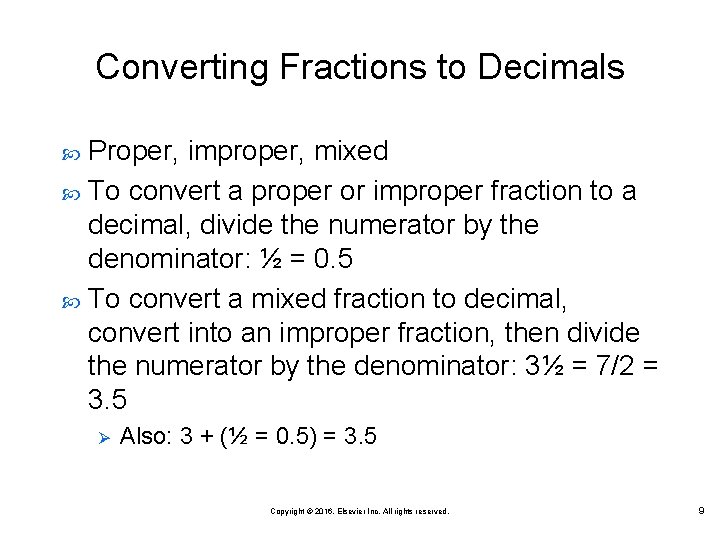
Converting Fractions to Decimals Proper, improper, mixed To convert a proper or improper fraction to a decimal, divide the numerator by the denominator: ½ = 0. 5 To convert a mixed fraction to decimal, convert into an improper fraction, then divide the numerator by the denominator: 3½ = 7/2 = 3. 5 Ø Also: 3 + (½ = 0. 5) = 3. 5 Copyright © 2016, Elsevier Inc. All rights reserved. 9
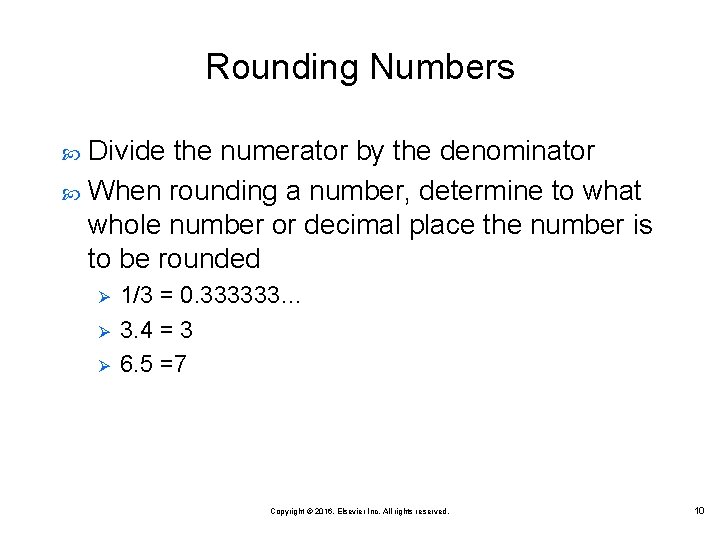
Rounding Numbers Divide the numerator by the denominator When rounding a number, determine to what whole number or decimal place the number is to be rounded Ø Ø Ø 1/3 = 0. 333333… 3. 4 = 3 6. 5 =7 Copyright © 2016, Elsevier Inc. All rights reserved. 10
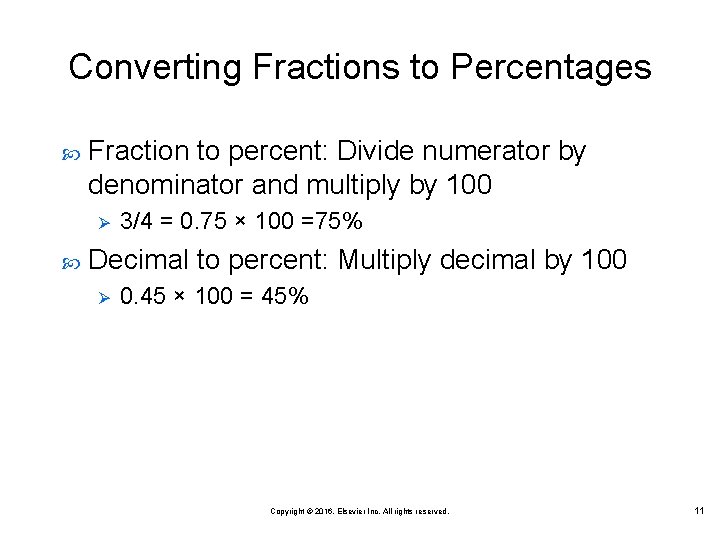
Converting Fractions to Percentages Fraction to percent: Divide numerator by denominator and multiply by 100 Ø 3/4 = 0. 75 × 100 =75% Decimal to percent: Multiply decimal by 100 Ø 0. 45 × 100 = 45% Copyright © 2016, Elsevier Inc. All rights reserved. 11
Ratios and Proportions Ratio: A relationship between two parts of a whole or between one part and the whole Proportion: A relationship between two ratios Converting ratios to percentages: Express ratio as fraction, convert to a decimal, multiply by 100 Ø 3: 4 = 3/4 = 0. 75 × 100 = 75% Copyright © 2016, Elsevier Inc. All rights reserved. 12
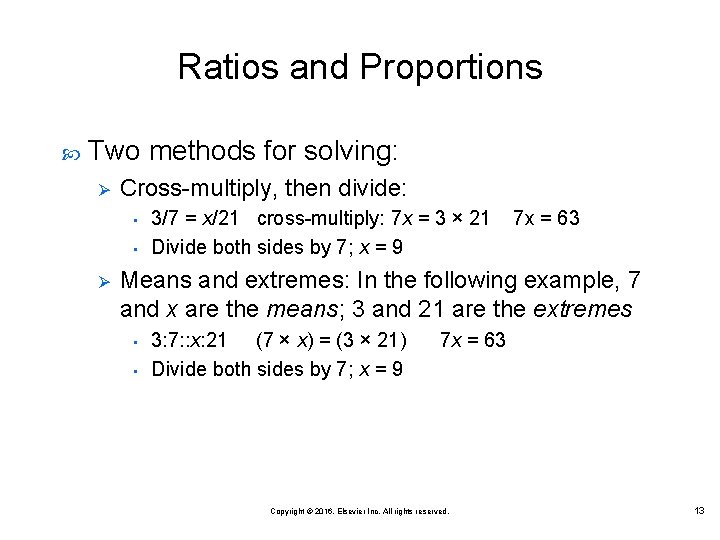
Ratios and Proportions Two methods for solving: Ø Cross-multiply, then divide: • • Ø 3/7 = x/21 cross-multiply: 7 x = 3 × 21 Divide both sides by 7; x = 9 7 x = 63 Means and extremes: In the following example, 7 and x are the means; 3 and 21 are the extremes • • 3: 7: : x: 21 (7 × x) = (3 × 21) Divide both sides by 7; x = 9 7 x = 63 Copyright © 2016, Elsevier Inc. All rights reserved. 13
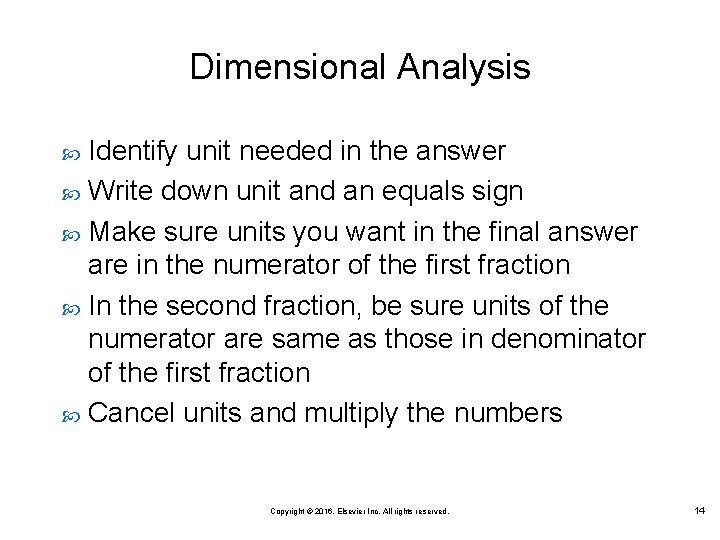
Dimensional Analysis Identify unit needed in the answer Write down unit and an equals sign Make sure units you want in the final answer are in the numerator of the first fraction In the second fraction, be sure units of the numerator are same as those in denominator of the first fraction Cancel units and multiply the numbers Copyright © 2016, Elsevier Inc. All rights reserved. 14
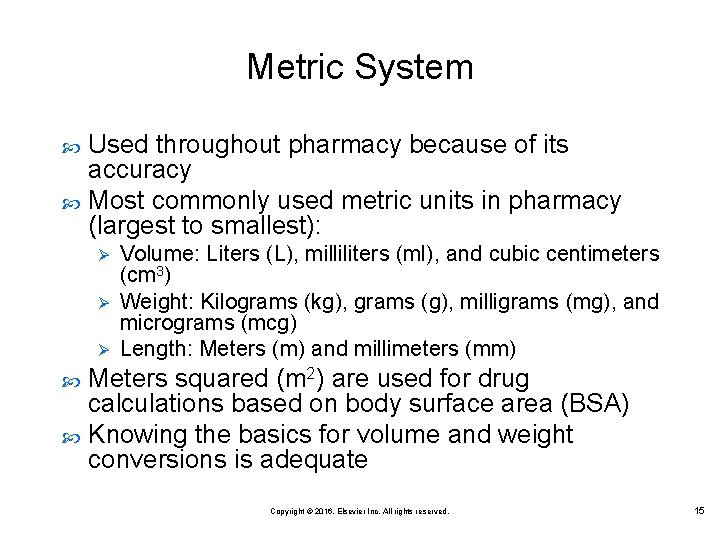
Metric System Used throughout pharmacy because of its accuracy Most commonly used metric units in pharmacy (largest to smallest): Ø Ø Ø Volume: Liters (L), milliliters (ml), and cubic centimeters (cm 3) Weight: Kilograms (kg), grams (g), milligrams (mg), and micrograms (mcg) Length: Meters (m) and millimeters (mm) Meters squared (m 2) are used for drug calculations based on body surface area (BSA) Knowing the basics for volume and weight conversions is adequate Copyright © 2016, Elsevier Inc. All rights reserved. 15
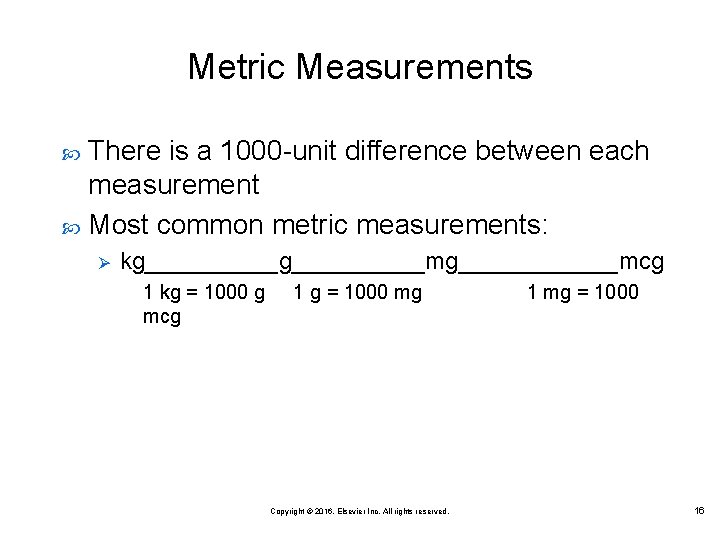
Metric Measurements There is a 1000 -unit difference between each measurement Most common metric measurements: Ø kg__________mg______mcg 1 kg = 1000 g mcg 1 g = 1000 mg Copyright © 2016, Elsevier Inc. All rights reserved. 1 mg = 1000 16
Household Measurements Most common measurement system used in the United States Variety of units; for example: Ø Ø Ø Liquids (volume): Gallon (gal), cup (c), tablespoon (Tbsp), and teaspoon (tsp) Dry weight: Pound (lb) and ounce (oz) Length (distance): Foot (ft) and inch (in) Most commonly used measurement: Teaspoon (tsp) Copyright © 2016, Elsevier Inc. All rights reserved. 17
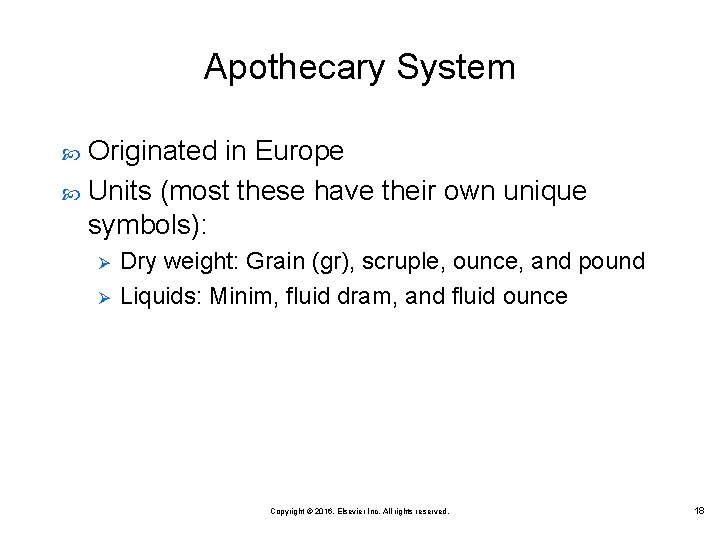
Apothecary System Originated in Europe Units (most these have their own unique symbols): Ø Ø Dry weight: Grain (gr), scruple, ounce, and pound Liquids: Minim, fluid dram, and fluid ounce Copyright © 2016, Elsevier Inc. All rights reserved. 18
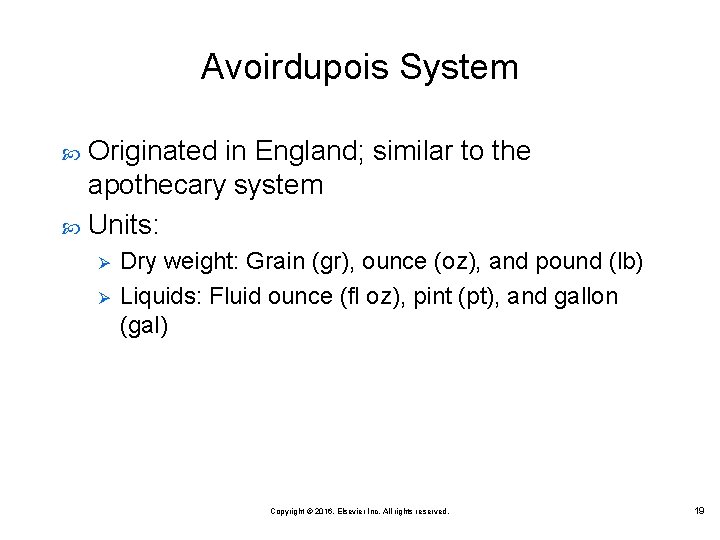
Avoirdupois System Originated in England; similar to the apothecary system Units: Ø Ø Dry weight: Grain (gr), ounce (oz), and pound (lb) Liquids: Fluid ounce (fl oz), pint (pt), and gallon (gal) Copyright © 2016, Elsevier Inc. All rights reserved. 19
Calculations With Liquid Medications Single-step problems involving liquid medications can be solved with ratio and proportion Copyright © 2016, Elsevier Inc. All rights reserved. 20
Lesson 6. 2 Formulas and Calculations 7. 8. 9. 10. 11. 12. Apply the formulas for calculating doses by body weight, body surface area (BSA), Young’s Rule, and Clark’s Rule. Calculate pediatric and geriatric dosages. Perform calculations involving units and milliequivalents. Calculate infusion rates and drip rates. Understand apply the calculations involved in dilution. Understand apply the calculations involved in alligations. Copyright © 2016, Elsevier Inc. All rights reserved. 21
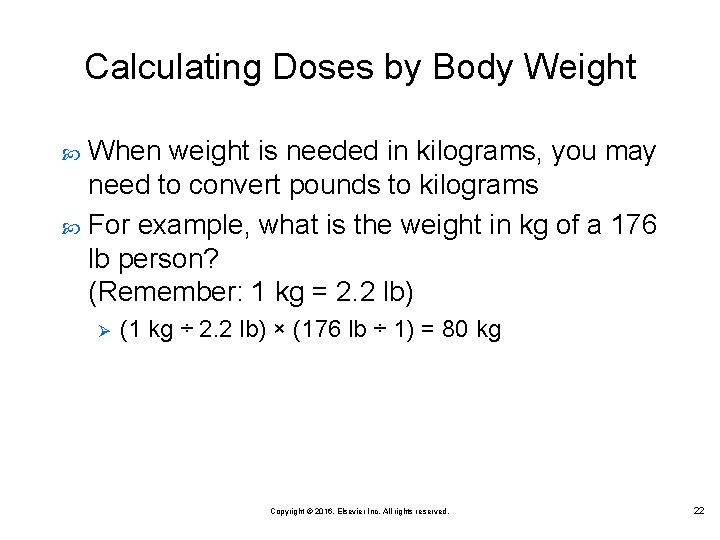
Calculating Doses by Body Weight When weight is needed in kilograms, you may need to convert pounds to kilograms For example, what is the weight in kg of a 176 lb person? (Remember: 1 kg = 2. 2 lb) Ø (1 kg ÷ 2. 2 lb) × (176 lb ÷ 1) = 80 kg Copyright © 2016, Elsevier Inc. All rights reserved. 22
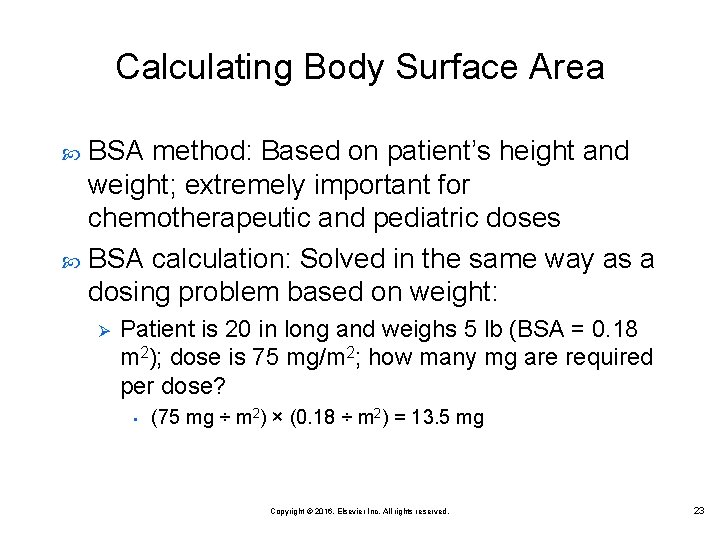
Calculating Body Surface Area BSA method: Based on patient’s height and weight; extremely important for chemotherapeutic and pediatric doses BSA calculation: Solved in the same way as a dosing problem based on weight: Ø Patient is 20 in long and weighs 5 lb (BSA = 0. 18 m 2); dose is 75 mg/m 2; how many mg are required per dose? • (75 mg ÷ m 2) × (0. 18 ÷ m 2) = 13. 5 mg Copyright © 2016, Elsevier Inc. All rights reserved. 23
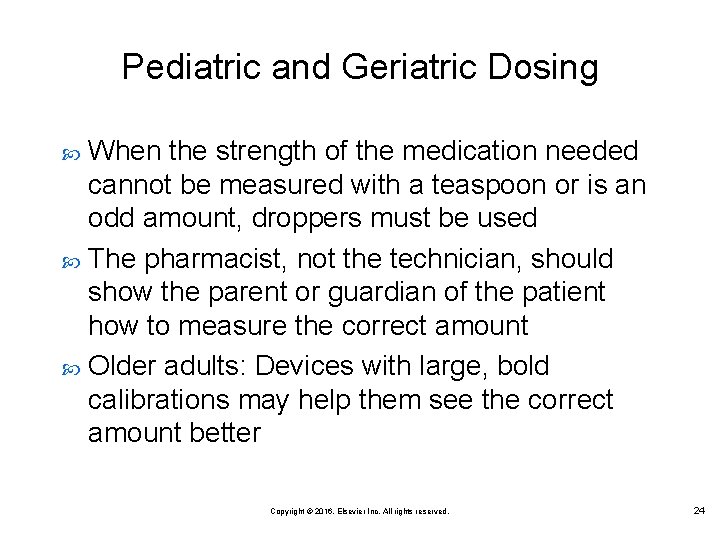
Pediatric and Geriatric Dosing When the strength of the medication needed cannot be measured with a teaspoon or is an odd amount, droppers must be used The pharmacist, not the technician, should show the parent or guardian of the patient how to measure the correct amount Older adults: Devices with large, bold calibrations may help them see the correct amount better Copyright © 2016, Elsevier Inc. All rights reserved. 24
Calculating Pediatric Dosages Pediatric age ranges Ø Ø Ø Neonates: Birth to 1 month Infant: 1 month to 1 year Early childhood: 1 year to 5 years Late childhood: 6 years through 12 years Adolescence: 13 years through 17 years Pediatric dosages can be calculated using DA Copyright © 2016, Elsevier Inc. All rights reserved. 25
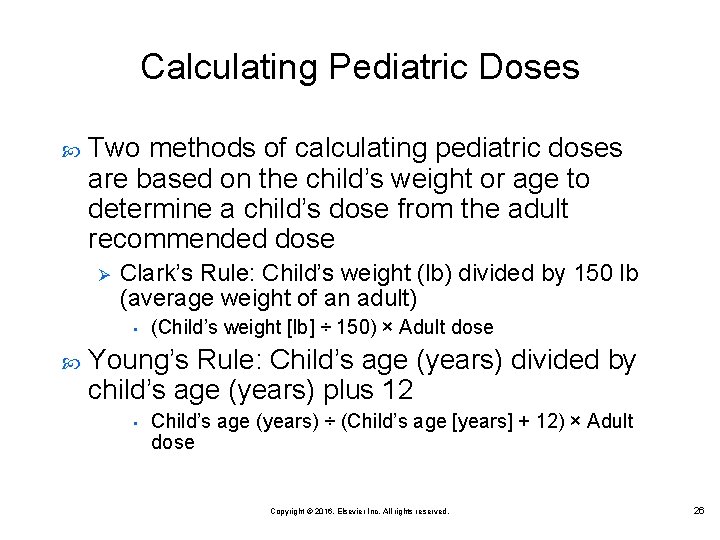
Calculating Pediatric Doses Two methods of calculating pediatric doses are based on the child’s weight or age to determine a child’s dose from the adult recommended dose Ø Clark’s Rule: Child’s weight (lb) divided by 150 lb (average weight of an adult) • (Child’s weight [lb] ÷ 150) × Adult dose Young’s Rule: Child’s age (years) divided by child’s age (years) plus 12 • Child’s age (years) ÷ (Child’s age [years] + 12) × Adult dose Copyright © 2016, Elsevier Inc. All rights reserved. 26
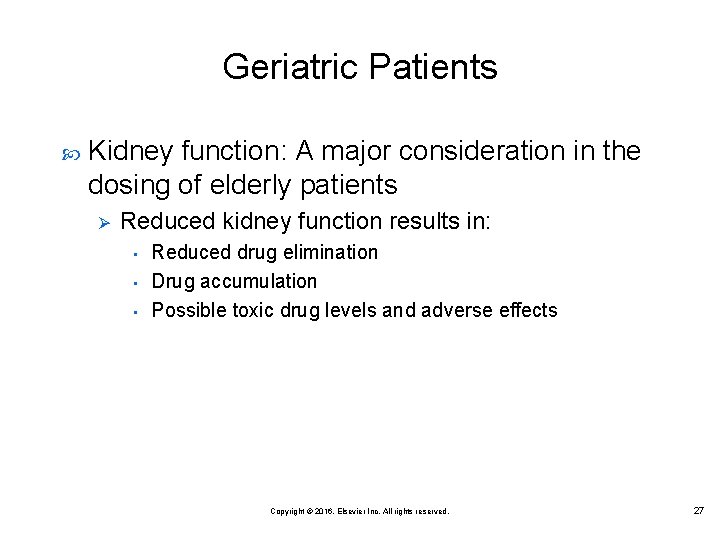
Geriatric Patients Kidney function: A major consideration in the dosing of elderly patients Ø Reduced kidney function results in: • • • Reduced drug elimination Drug accumulation Possible toxic drug levels and adverse effects Copyright © 2016, Elsevier Inc. All rights reserved. 27
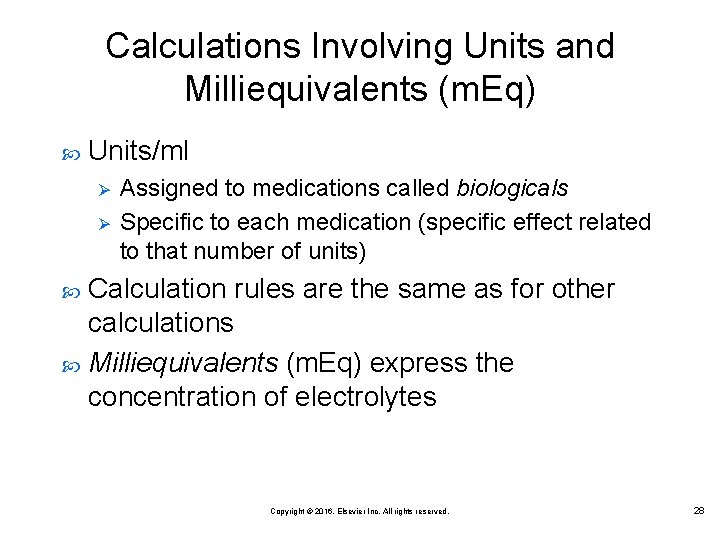
Calculations Involving Units and Milliequivalents (m. Eq) Units/ml Ø Ø Assigned to medications called biologicals Specific to each medication (specific effect related to that number of units) Calculation rules are the same as for other calculations Milliequivalents (m. Eq) express the concentration of electrolytes Copyright © 2016, Elsevier Inc. All rights reserved. 28
IV Infusions and Drip Rates Hospital pharmacy technicians deliver a 24 -hour supply of IV solutions to nursing units daily Most IV piggybacks are small volume (≤ 100 ml) IV solutions that are given over 30 to 60 minutes Large volume medications (>250 ml) need to be given at a slow rate because the veins can handle only a small volume over a given time For large volume drips, pharmacy technicians must be able to calculate the volume needed to last a certain period or must calculate how long the IV solution will last Copyright © 2016, Elsevier Inc. All rights reserved. 29
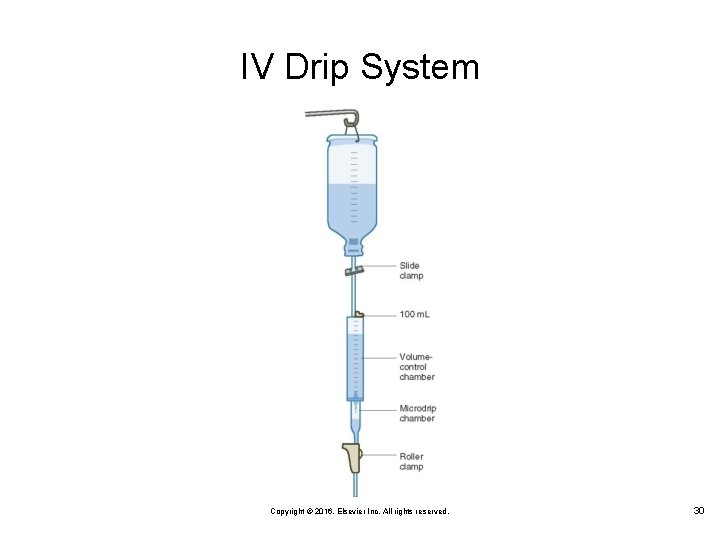
IV Drip System Copyright © 2016, Elsevier Inc. All rights reserved. 30
Infusion Flow Rates IV medication calculations involve: Ø Ø Ø Right amount to be given over time Amount needed to last a certain time Time left until an IV bag is empty Basic conversion factors: 1 hr = 60 min 24 hr = 1 day Order: Heparin 100 units/500 ml to run at 10 ml/hr. How many units will be delivered per hour? Ø (100 units ÷ 500 ml) × (10 ml ÷ 1 hr) = 2 units/hr Copyright © 2016, Elsevier Inc. All rights reserved. 31
Drip Rate Calculations Number of drops administered over a certain time Usually measured in gtt/min Drop factor: Found on tubing package Calculating drops per minute: Ø Ø Ø Identify drop factor Determine ml to be delivered per hour; then ml/min Determine drip rate (use DA) Copyright © 2016, Elsevier Inc. All rights reserved. 32
Dilution Pharmacy may receive a prescription for a liquid or solid medication that is not available commercially in the strength prescribed The commercially available product must be diluted to a lower strength Ø Dilution: Diluent or solvent is added to reach the desired strength The amount of diluent needed can be calculated by using the following equation: Ø Final weight (FW) or Final volume (FV) ‒ Initial weight (IW) or Initial volume (IV) = Amount of diluent Copyright © 2016, Elsevier Inc. All rights reserved. 33
Alligation Two strengths are combined to attain a required third strength The desired strength must be between the two strengths being mixed Calculation uses a tic-tac-toe approach Copyright © 2016, Elsevier Inc. All rights reserved. 34
Questions? Copyright © 2016, Elsevier Inc. All rights reserved. 35