MAJOR HAZARDS CONTROL Direktorat Pengawasan Norma K 3

- Slides: 58
MAJOR HAZARDS CONTROL Direktorat Pengawasan Norma K 3 Kemenakertrans
MAJOR HAZARD Danger of large accidents, with consequences not only on the plant site, but also in the surroundings : § Many dead or wounded § Heavy damage to buildings § Wide and unfavorable publicity: press, radio, TV § Emotional public reactions § Serious consequences for the company involved : § Production loss § Investigation § Insurance procedures § Additional safety requirements § Shutdown, perhaps : PERMANENT
MAJOR ACCIDENT A major accident is defined in the regulation as : “A sudden occurrence at facility causing serious danger or harm to : - a relevant person or - an at risk community or - property or - the environment whether the danger or harm occurs immediately or at a later time”. (Australian Government – Comcare)
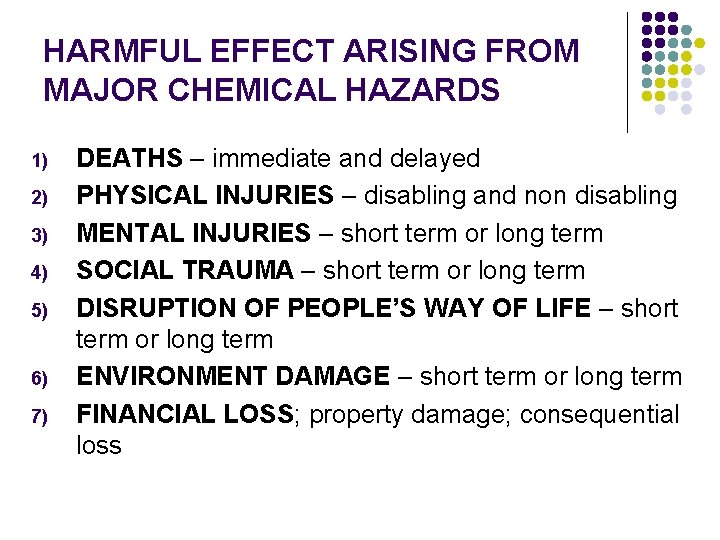
HARMFUL EFFECT ARISING FROM MAJOR CHEMICAL HAZARDS 1) 2) 3) 4) 5) 6) 7) DEATHS – immediate and delayed PHYSICAL INJURIES – disabling and non disabling MENTAL INJURIES – short term or long term SOCIAL TRAUMA – short term or long term DISRUPTION OF PEOPLE’S WAY OF LIFE – short term or long term ENVIRONMENT DAMAGE – short term or long term FINANCIAL LOSS; property damage; consequential loss
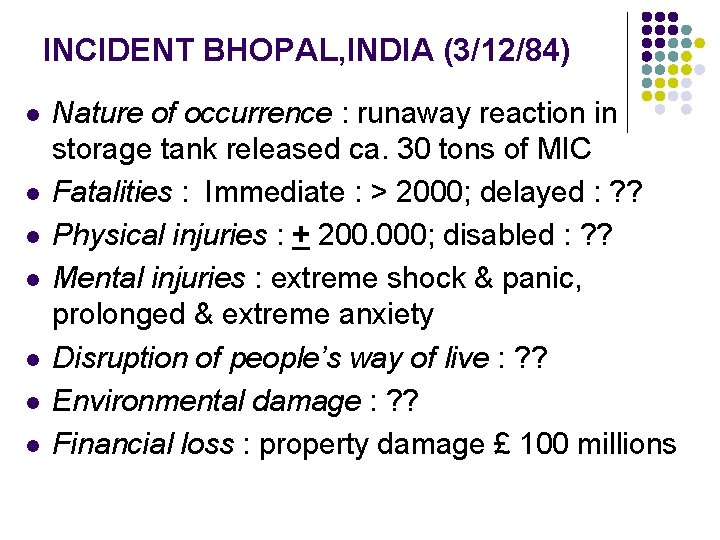
INCIDENT BHOPAL, INDIA (3/12/84) l l l l Nature of occurrence : runaway reaction in storage tank released ca. 30 tons of MIC Fatalities : Immediate : > 2000; delayed : ? ? Physical injuries : + 200. 000; disabled : ? ? Mental injuries : extreme shock & panic, prolonged & extreme anxiety Disruption of people’s way of live : ? ? Environmental damage : ? ? Financial loss : property damage £ 100 millions
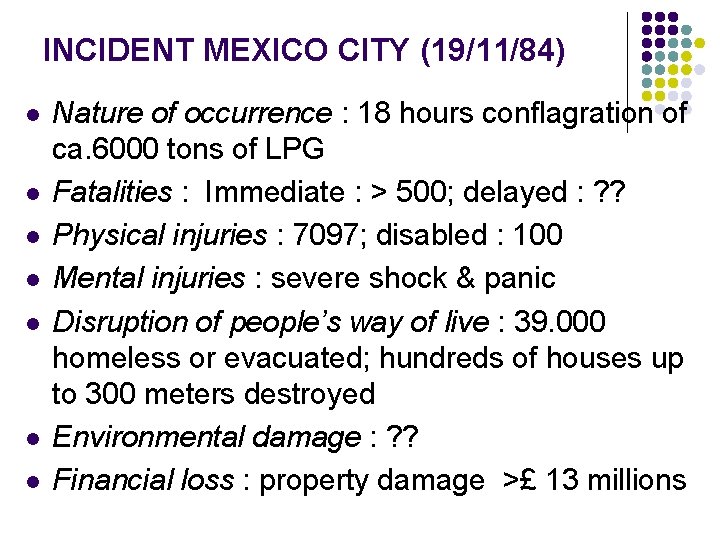
INCIDENT MEXICO CITY (19/11/84) l l l l Nature of occurrence : 18 hours conflagration of ca. 6000 tons of LPG Fatalities : Immediate : > 500; delayed : ? ? Physical injuries : 7097; disabled : 100 Mental injuries : severe shock & panic Disruption of people’s way of live : 39. 000 homeless or evacuated; hundreds of houses up to 300 meters destroyed Environmental damage : ? ? Financial loss : property damage >£ 13 millions
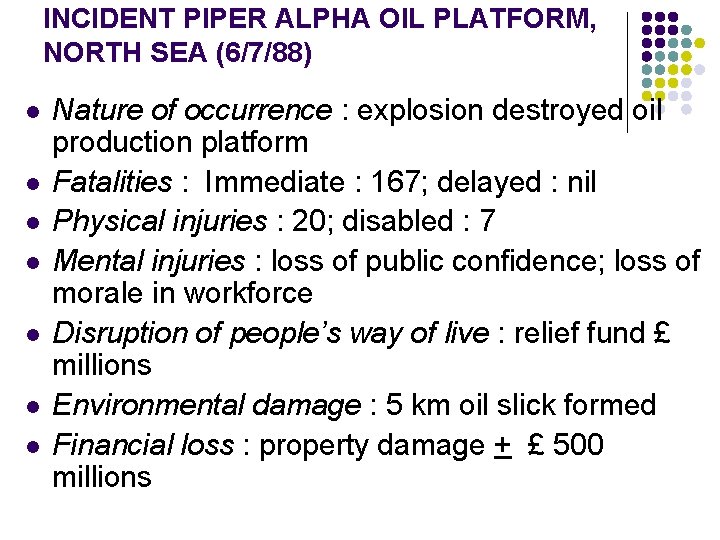
INCIDENT PIPER ALPHA OIL PLATFORM, NORTH SEA (6/7/88) l l l l Nature of occurrence : explosion destroyed oil production platform Fatalities : Immediate : 167; delayed : nil Physical injuries : 20; disabled : 7 Mental injuries : loss of public confidence; loss of morale in workforce Disruption of people’s way of live : relief fund £ millions Environmental damage : 5 km oil slick formed Financial loss : property damage + £ 500 millions
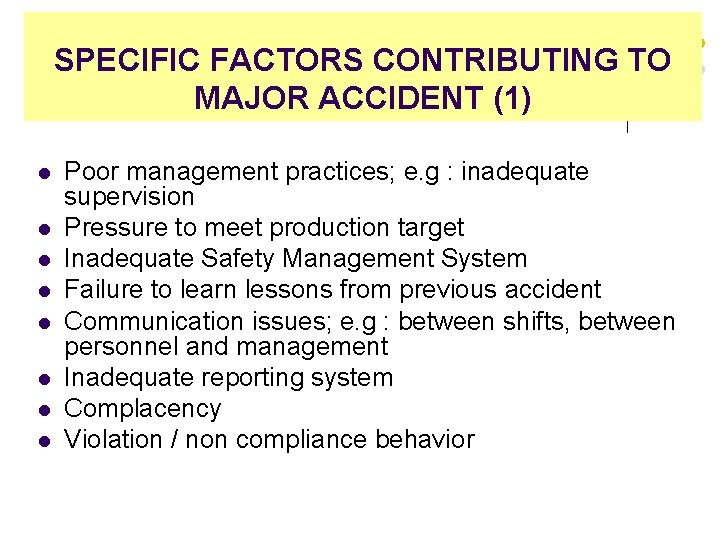
SPECIFIC FACTORS CONTRIBUTING TO MAJOR ACCIDENT (1) l l l l Poor management practices; e. g : inadequate supervision Pressure to meet production target Inadequate Safety Management System Failure to learn lessons from previous accident Communication issues; e. g : between shifts, between personnel and management Inadequate reporting system Complacency Violation / non compliance behavior
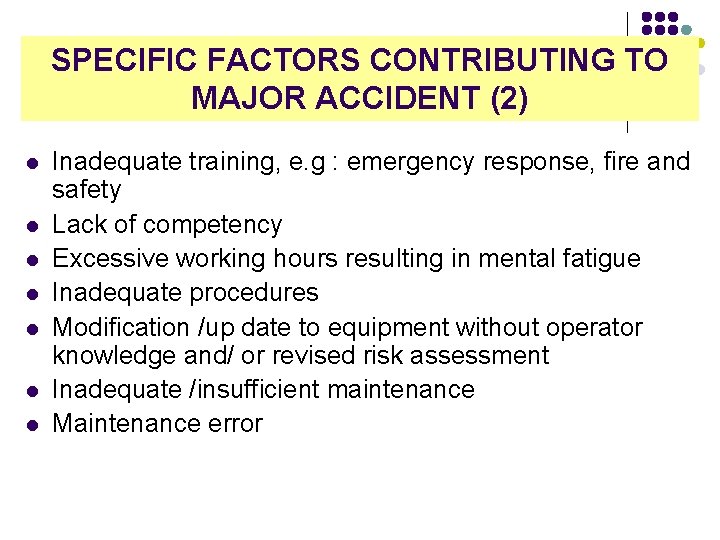
SPECIFIC FACTORS CONTRIBUTING TO MAJOR ACCIDENT (2) l l l l Inadequate training, e. g : emergency response, fire and safety Lack of competency Excessive working hours resulting in mental fatigue Inadequate procedures Modification /up date to equipment without operator knowledge and/ or revised risk assessment Inadequate /insufficient maintenance Maintenance error
MAJOR HAZARD CONTROL is Prevention of Major Accidents
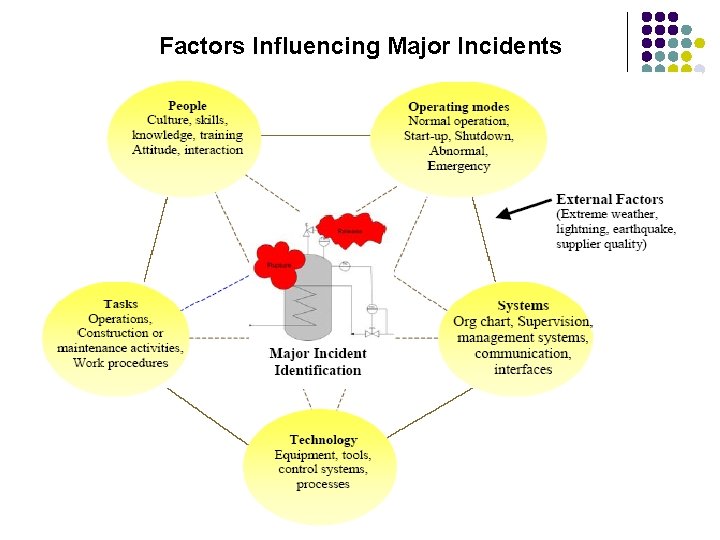
Factors Influencing Major Incidents
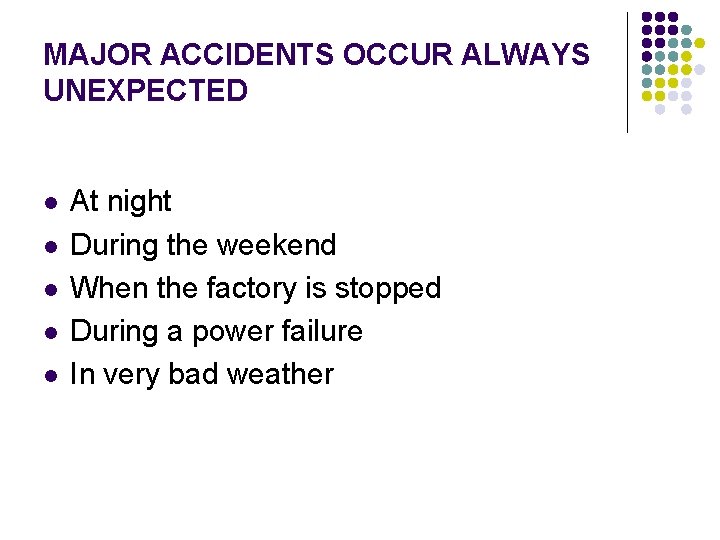
MAJOR ACCIDENTS OCCUR ALWAYS UNEXPECTED l l l At night During the weekend When the factory is stopped During a power failure In very bad weather
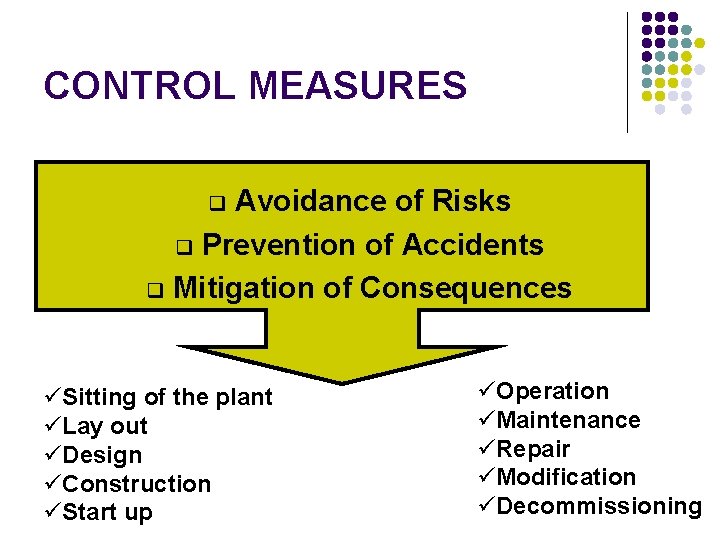
CONTROL MEASURES Avoidance of Risks q Prevention of Accidents q Mitigation of Consequences q üSitting of the plant üLay out üDesign üConstruction üStart up üOperation üMaintenance üRepair üModification üDecommissioning
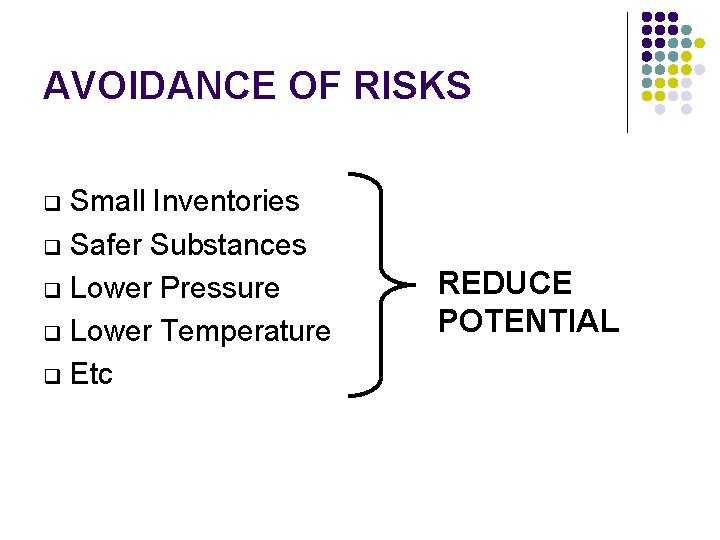
AVOIDANCE OF RISKS Small Inventories q Safer Substances q Lower Pressure q Lower Temperature q Etc q REDUCE POTENTIAL
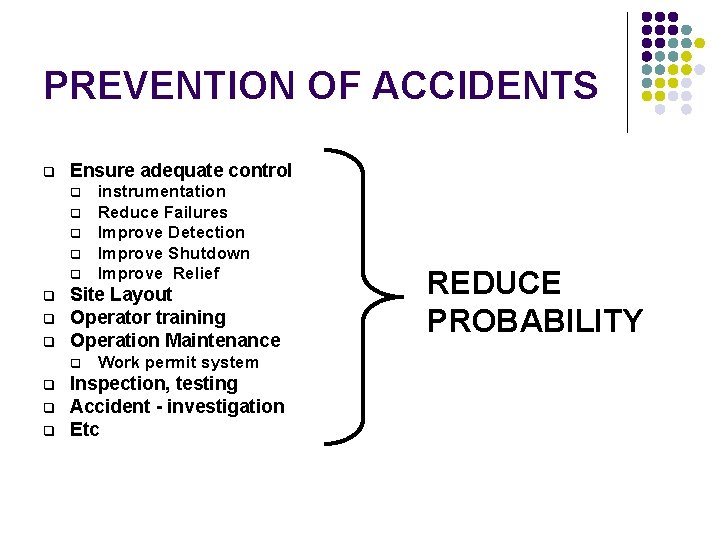
PREVENTION OF ACCIDENTS q Ensure adequate control q q q q Site Layout Operator training Operation Maintenance q q instrumentation Reduce Failures Improve Detection Improve Shutdown Improve Relief Work permit system Inspection, testing Accident - investigation Etc REDUCE PROBABILITY
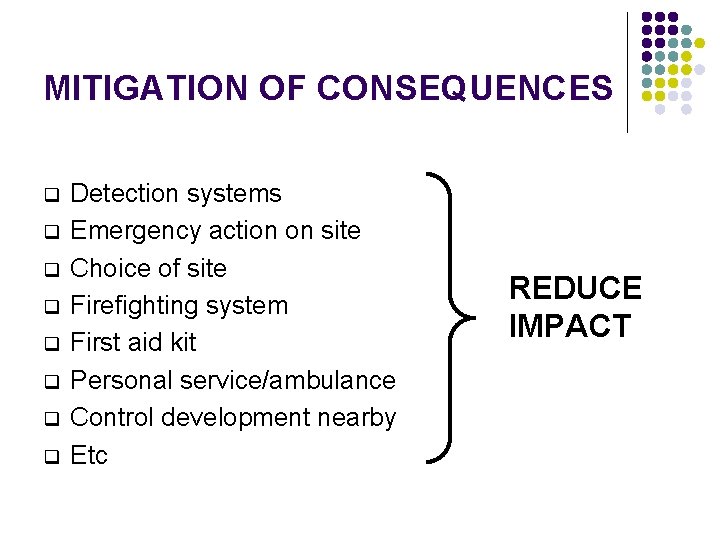
MITIGATION OF CONSEQUENCES q q q q Detection systems Emergency action on site Choice of site Firefighting system First aid kit Personal service/ambulance Control development nearby Etc REDUCE IMPACT
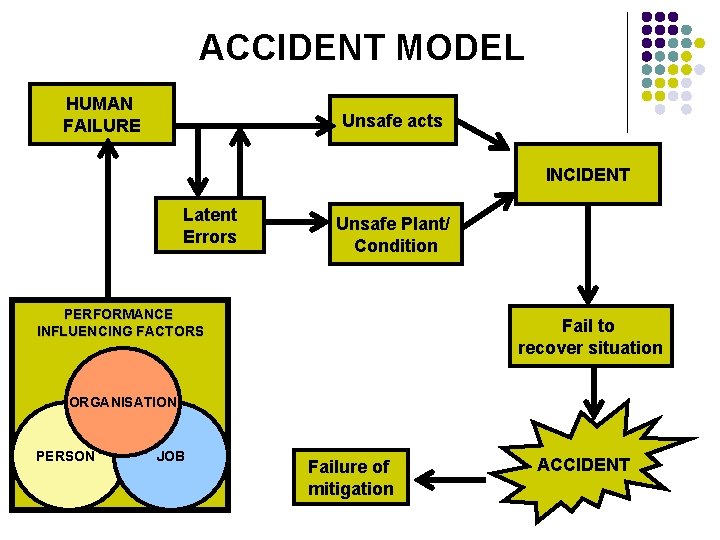
ACCIDENT MODEL HUMAN FAILURE Unsafe acts INCIDENT Latent Errors Unsafe Plant/ Condition PERFORMANCE INFLUENCING FACTORS Fail to recover situation ORGANISATION PERSON JOB Failure of mitigation ACCIDENT
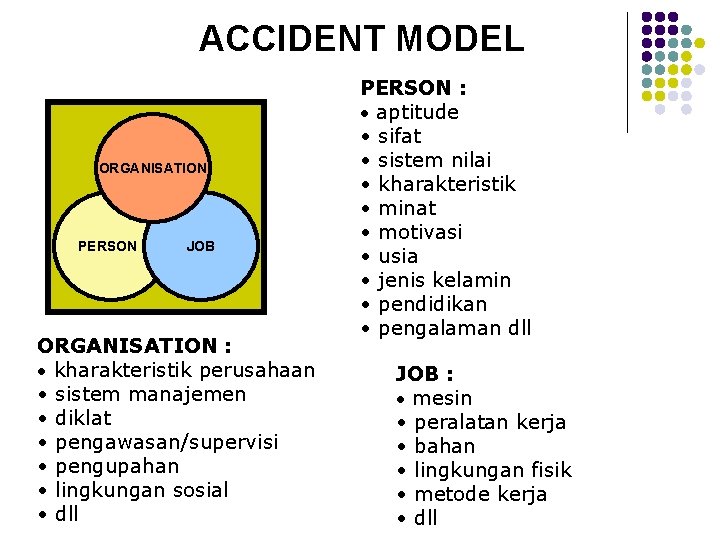
ACCIDENT MODEL ORGANISATION PERSON JOB ORGANISATION : • kharakteristik perusahaan • sistem manajemen • diklat • pengawasan/supervisi • pengupahan • lingkungan sosial • dll PERSON : • aptitude • sifat • sistem nilai • kharakteristik • minat • motivasi • usia • jenis kelamin • pendidikan • pengalaman dll JOB : • mesin • peralatan kerja • bahan • lingkungan fisik • metode kerja • dll
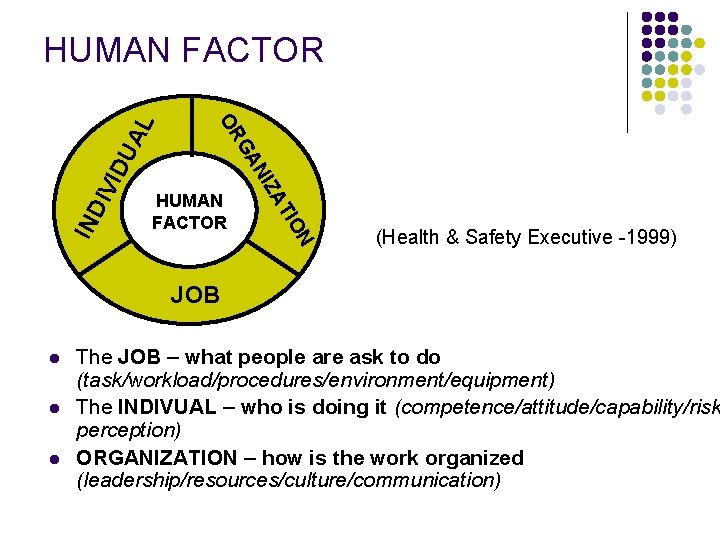
TIO IVI HUMAN FACTOR ZA N IND NI DU GA OR AL HUMAN FACTOR (Health & Safety Executive -1999) JOB l l l The JOB – what people are ask to do (task/workload/procedures/environment/equipment) The INDIVUAL – who is doing it (competence/attitude/capability/risk perception) ORGANIZATION – how is the work organized (leadership/resources/culture/communication)
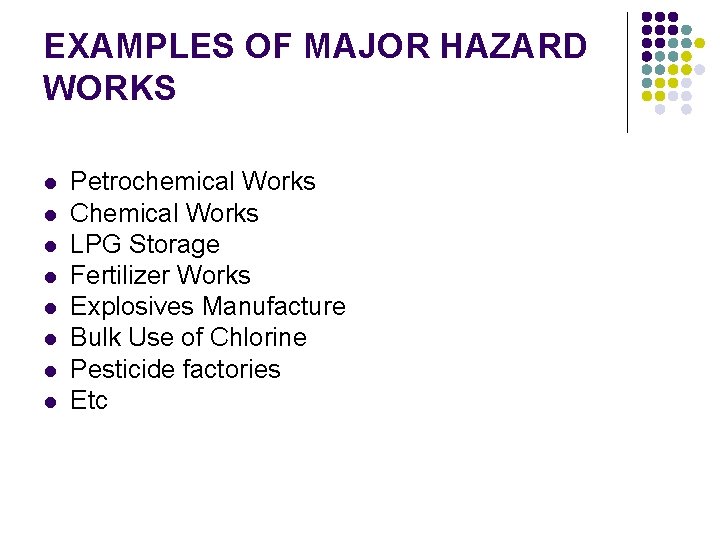
EXAMPLES OF MAJOR HAZARD WORKS l l l l Petrochemical Works Chemical Works LPG Storage Fertilizer Works Explosives Manufacture Bulk Use of Chlorine Pesticide factories Etc
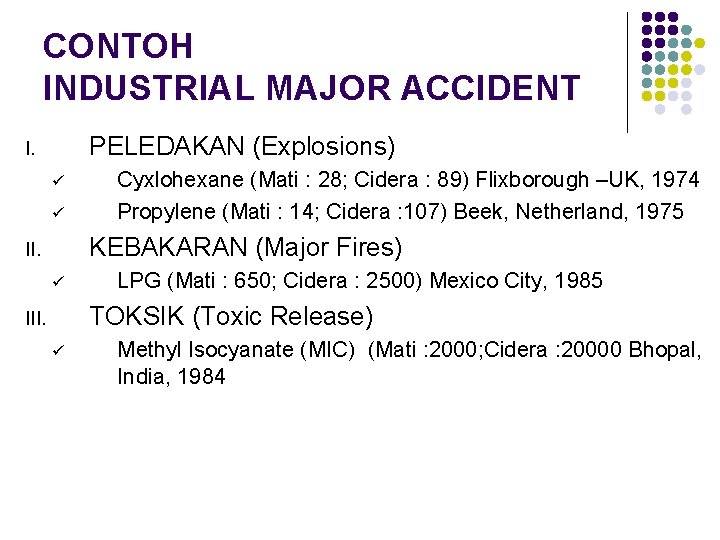
CONTOH INDUSTRIAL MAJOR ACCIDENT PELEDAKAN (Explosions) I. ü ü Cyxlohexane (Mati : 28; Cidera : 89) Flixborough –UK, 1974 Propylene (Mati : 14; Cidera : 107) Beek, Netherland, 1975 KEBAKARAN (Major Fires) II. ü LPG (Mati : 650; Cidera : 2500) Mexico City, 1985 TOKSIK (Toxic Release) III. ü Methyl Isocyanate (MIC) (Mati : 2000; Cidera : 20000 Bhopal, India, 1984
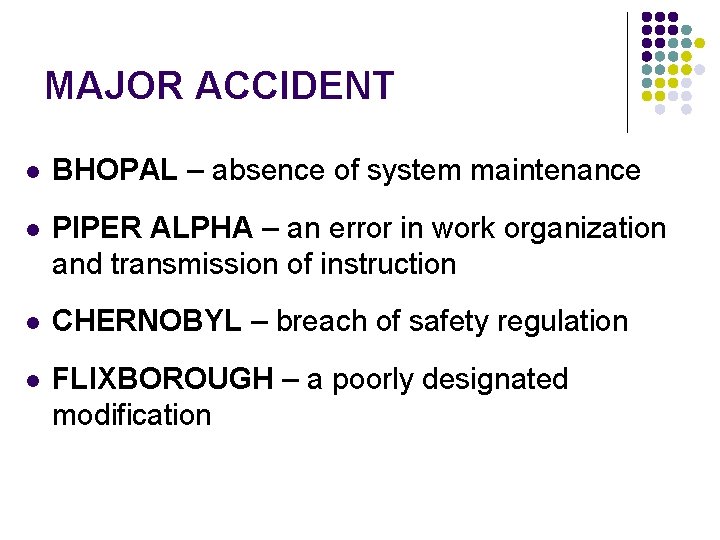
MAJOR ACCIDENT l BHOPAL – absence of system maintenance l PIPER ALPHA – an error in work organization and transmission of instruction l CHERNOBYL – breach of safety regulation l FLIXBOROUGH – a poorly designated modification
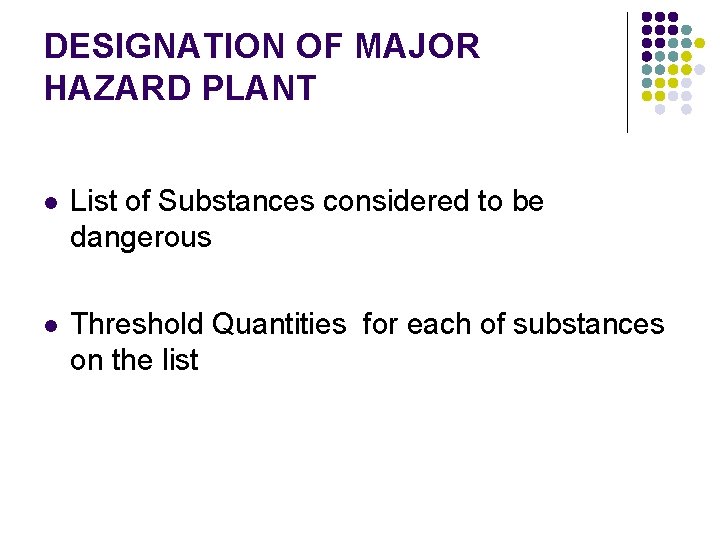
DESIGNATION OF MAJOR HAZARD PLANT l List of Substances considered to be dangerous l Threshold Quantities for each of substances on the list
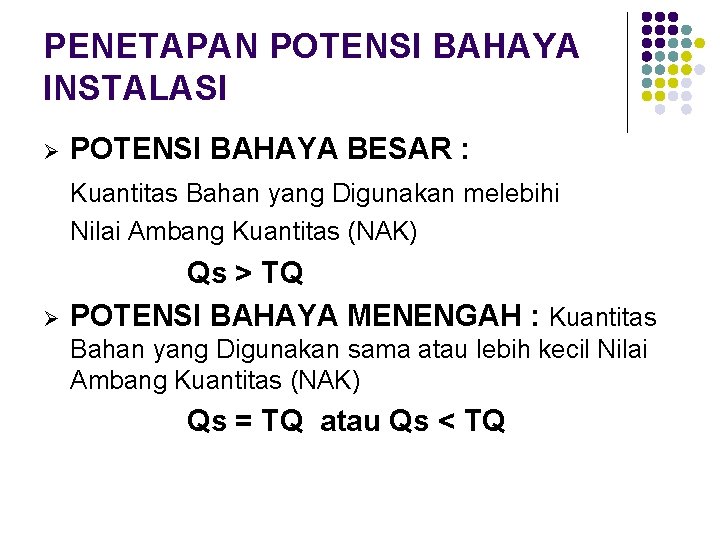
PENETAPAN POTENSI BAHAYA INSTALASI Ø POTENSI BAHAYA BESAR : Kuantitas Bahan yang Digunakan melebihi Nilai Ambang Kuantitas (NAK) Ø Qs > TQ POTENSI BAHAYA MENENGAH : Kuantitas Bahan yang Digunakan sama atau lebih kecil Nilai Ambang Kuantitas (NAK) Qs = TQ atau Qs < TQ
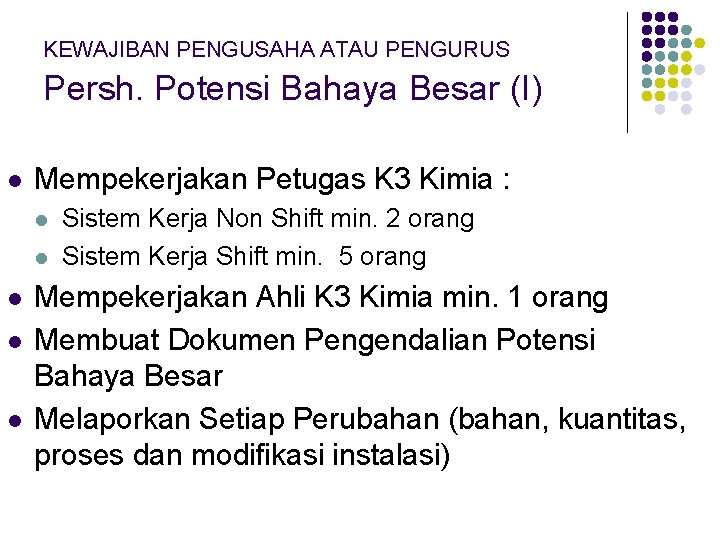
KEWAJIBAN PENGUSAHA ATAU PENGURUS Persh. Potensi Bahaya Besar (I) l Mempekerjakan Petugas K 3 Kimia : l l l Sistem Kerja Non Shift min. 2 orang Sistem Kerja Shift min. 5 orang Mempekerjakan Ahli K 3 Kimia min. 1 orang Membuat Dokumen Pengendalian Potensi Bahaya Besar Melaporkan Setiap Perubahan (bahan, kuantitas, proses dan modifikasi instalasi)
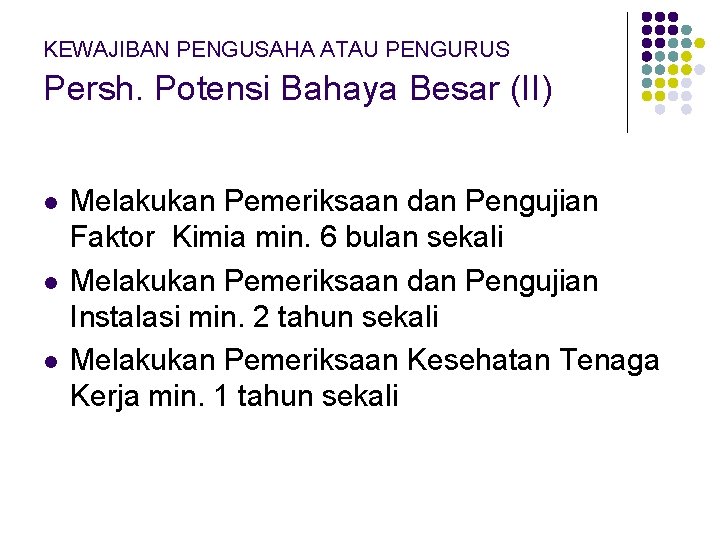
KEWAJIBAN PENGUSAHA ATAU PENGURUS Persh. Potensi Bahaya Besar (II) l l l Melakukan Pemeriksaan dan Pengujian Faktor Kimia min. 6 bulan sekali Melakukan Pemeriksaan dan Pengujian Instalasi min. 2 tahun sekali Melakukan Pemeriksaan Kesehatan Tenaga Kerja min. 1 tahun sekali
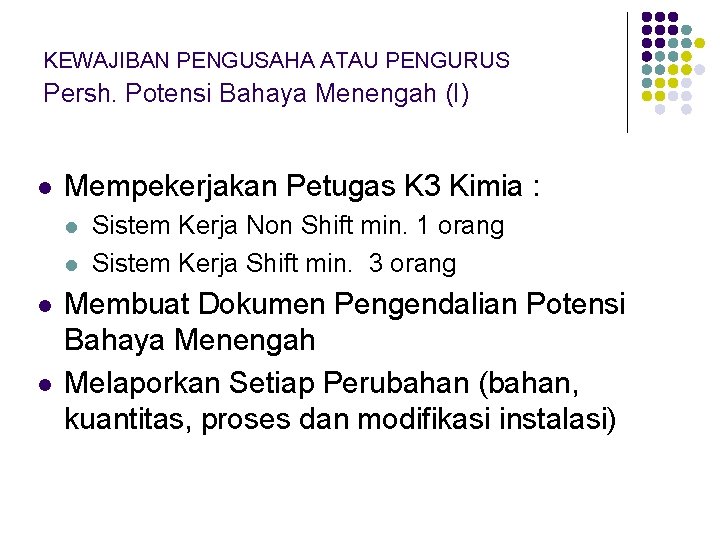
KEWAJIBAN PENGUSAHA ATAU PENGURUS Persh. Potensi Bahaya Menengah (I) l Mempekerjakan Petugas K 3 Kimia : l l Sistem Kerja Non Shift min. 1 orang Sistem Kerja Shift min. 3 orang Membuat Dokumen Pengendalian Potensi Bahaya Menengah Melaporkan Setiap Perubahan (bahan, kuantitas, proses dan modifikasi instalasi)
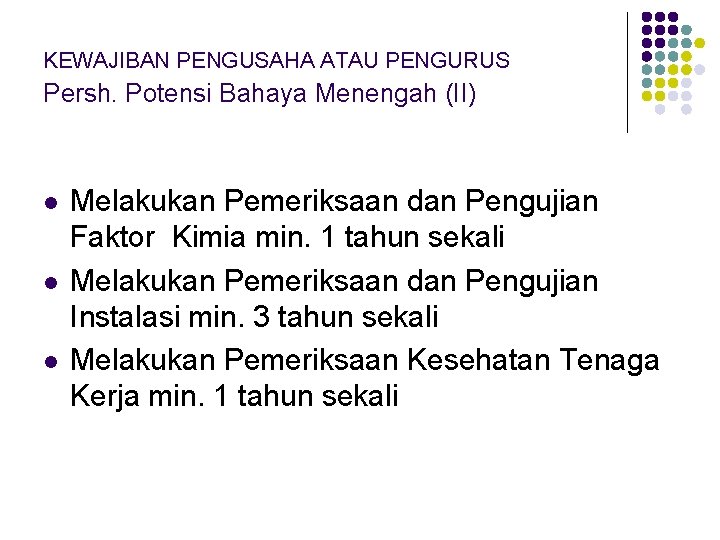
KEWAJIBAN PENGUSAHA ATAU PENGURUS Persh. Potensi Bahaya Menengah (II) l l l Melakukan Pemeriksaan dan Pengujian Faktor Kimia min. 1 tahun sekali Melakukan Pemeriksaan dan Pengujian Instalasi min. 3 tahun sekali Melakukan Pemeriksaan Kesehatan Tenaga Kerja min. 1 tahun sekali
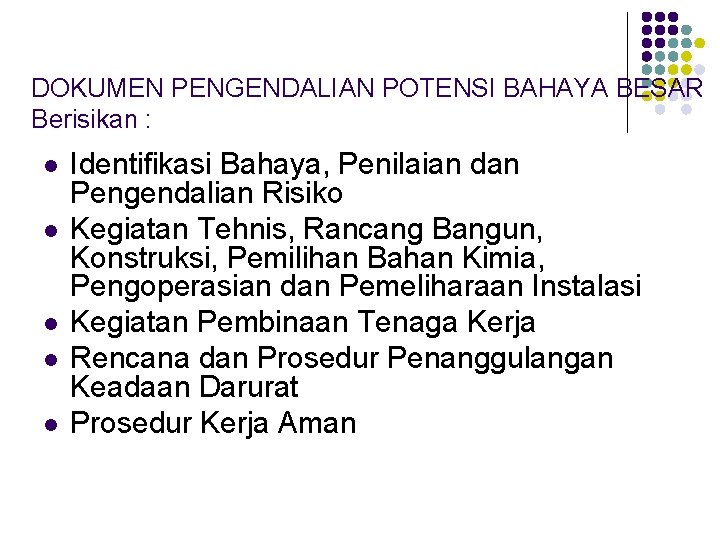
DOKUMEN PENGENDALIAN POTENSI BAHAYA BESAR Berisikan : l l l Identifikasi Bahaya, Penilaian dan Pengendalian Risiko Kegiatan Tehnis, Rancang Bangun, Konstruksi, Pemilihan Bahan Kimia, Pengoperasian dan Pemeliharaan Instalasi Kegiatan Pembinaan Tenaga Kerja Rencana dan Prosedur Penanggulangan Keadaan Darurat Prosedur Kerja Aman
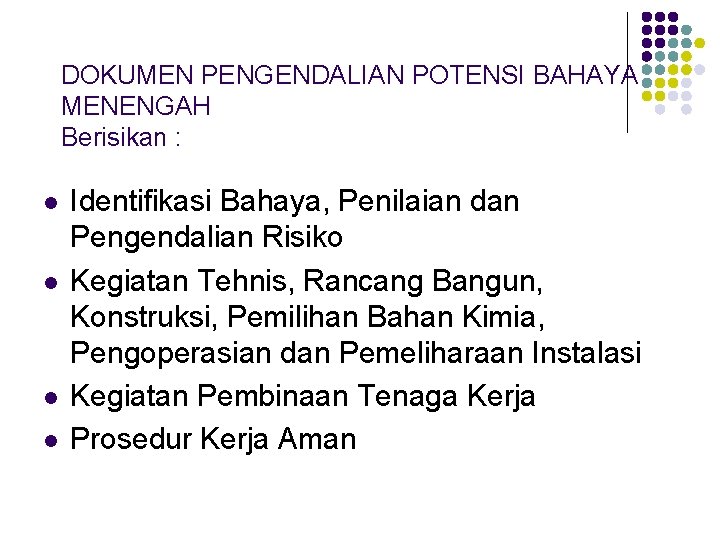
DOKUMEN PENGENDALIAN POTENSI BAHAYA MENENGAH Berisikan : l l Identifikasi Bahaya, Penilaian dan Pengendalian Risiko Kegiatan Tehnis, Rancang Bangun, Konstruksi, Pemilihan Bahan Kimia, Pengoperasian dan Pemeliharaan Instalasi Kegiatan Pembinaan Tenaga Kerja Prosedur Kerja Aman
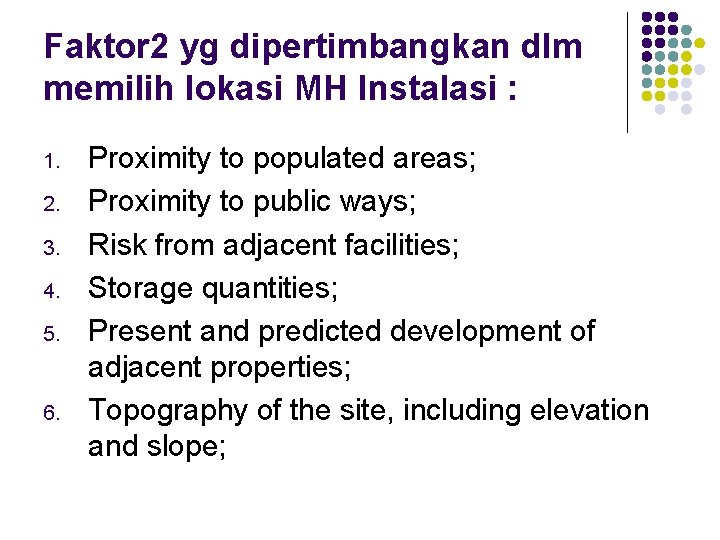
Faktor 2 yg dipertimbangkan dlm memilih lokasi MH Instalasi : 1. 2. 3. 4. 5. 6. Proximity to populated areas; Proximity to public ways; Risk from adjacent facilities; Storage quantities; Present and predicted development of adjacent properties; Topography of the site, including elevation and slope;
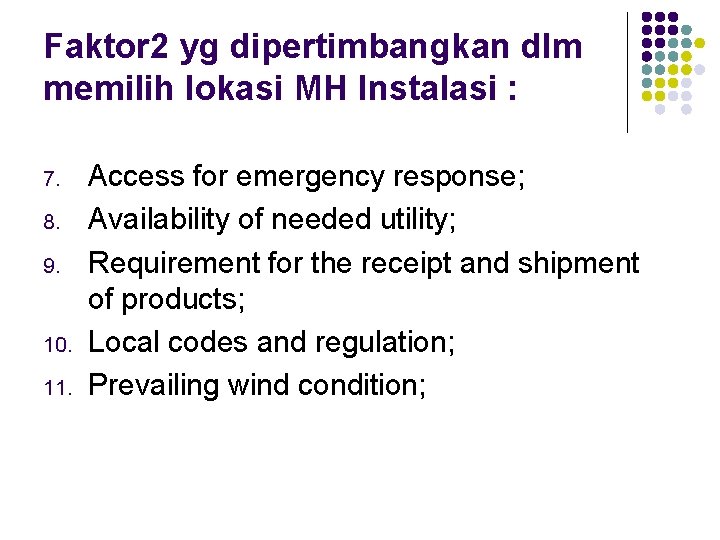
Faktor 2 yg dipertimbangkan dlm memilih lokasi MH Instalasi : 7. 8. 9. 10. 11. Access for emergency response; Availability of needed utility; Requirement for the receipt and shipment of products; Local codes and regulation; Prevailing wind condition;
IDENTIFICATION AND PRIOTISATION OF MAJOR HAZARD CONTROL 1. 2. 3. Factories Installation Plant Unit
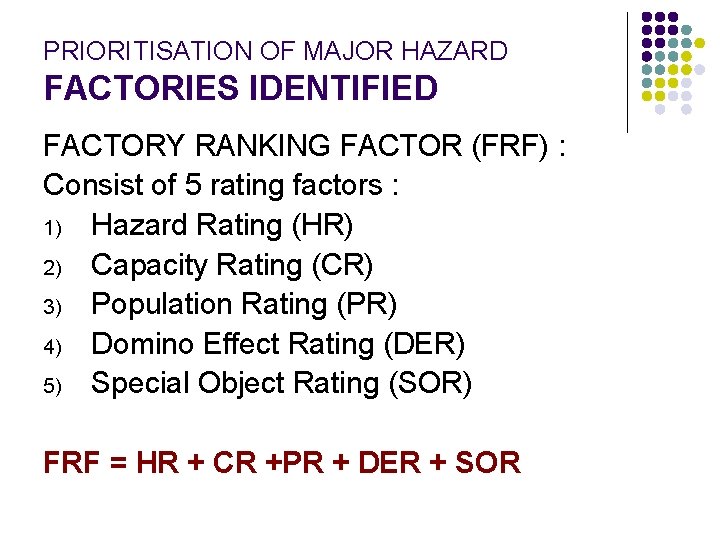
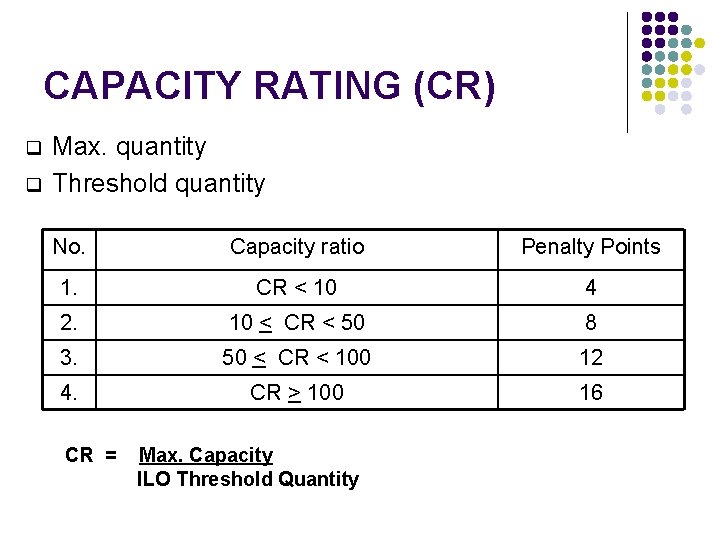
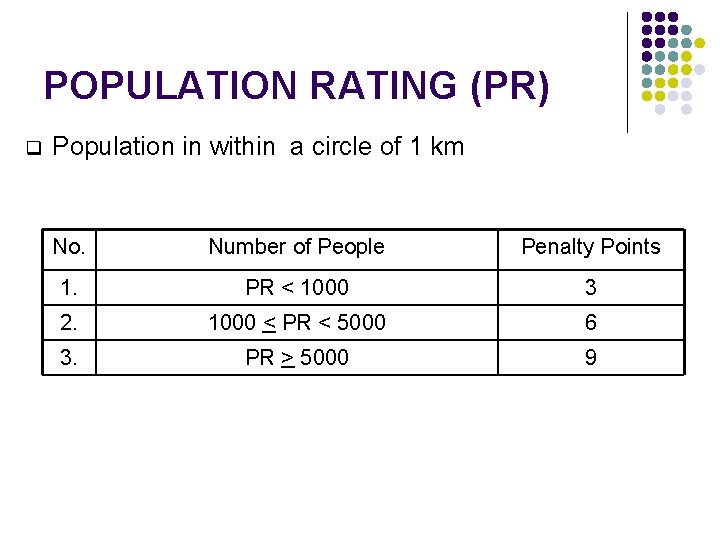
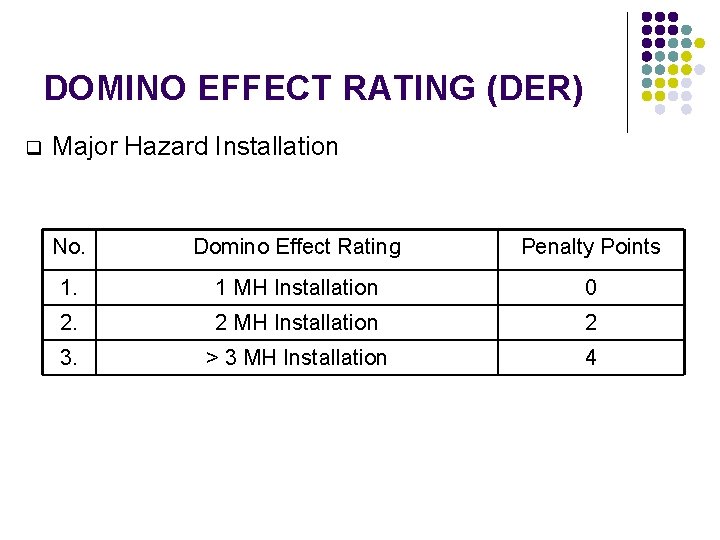
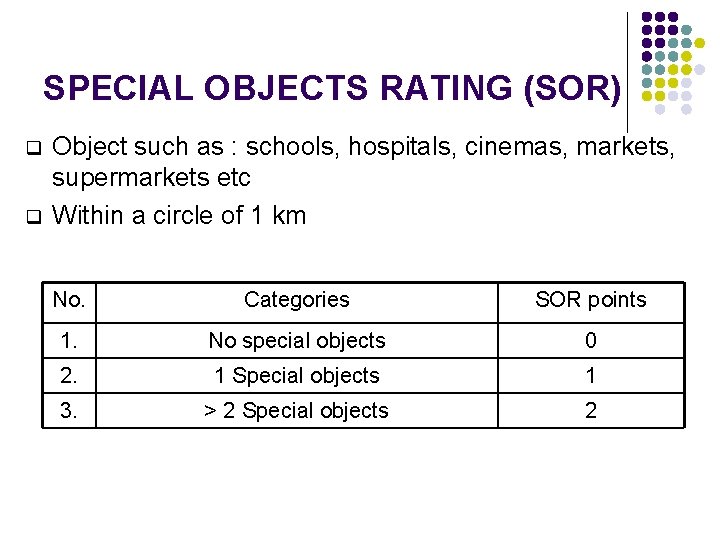
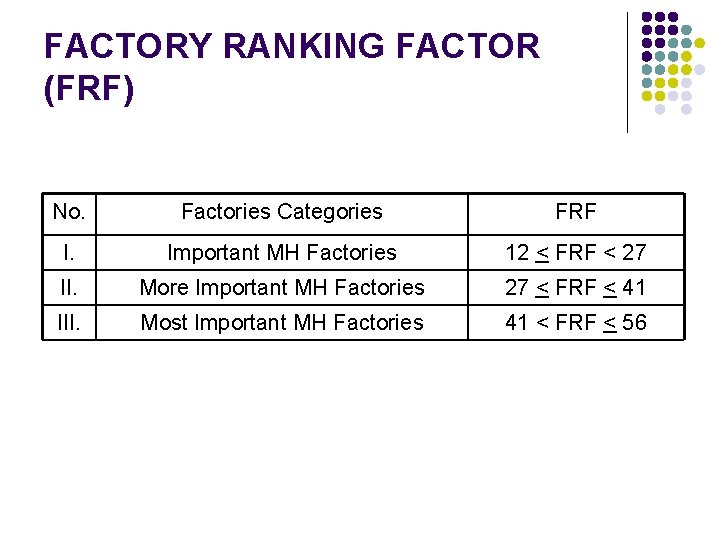
PRIORITISATION OF MAJOR HAZARD FACTORIES IDENTIFIED FACTORY RANKING FACTOR (FRF) : Consist of 5 rating factors : 1) Hazard Rating (HR) 2) Capacity Rating (CR) 3) Population Rating (PR) 4) Domino Effect Rating (DER) 5) Special Object Rating (SOR) FRF = HR + CR +PR + DER + SOR
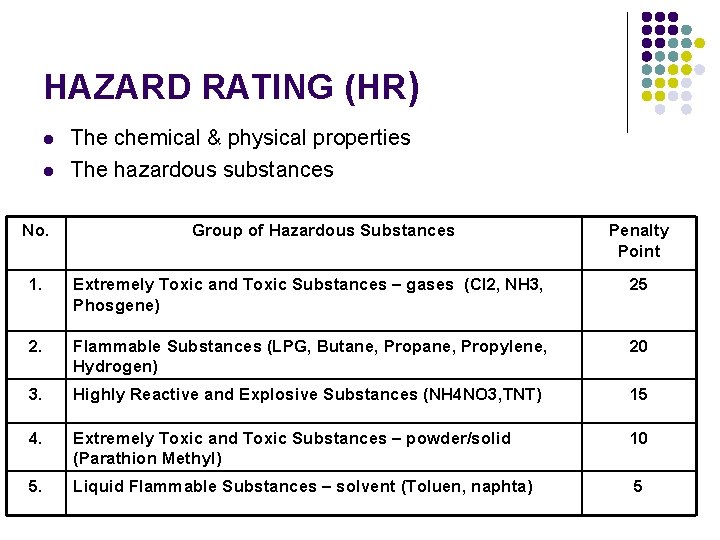
HAZARD RATING (HR) l l No. The chemical & physical properties The hazardous substances Group of Hazardous Substances Penalty Point 1. Extremely Toxic and Toxic Substances – gases (Cl 2, NH 3, Phosgene) 25 2. Flammable Substances (LPG, Butane, Propylene, Hydrogen) 20 3. Highly Reactive and Explosive Substances (NH 4 NO 3, TNT) 15 4. Extremely Toxic and Toxic Substances – powder/solid (Parathion Methyl) 10 5. Liquid Flammable Substances – solvent (Toluen, naphta) 5
CAPACITY RATING (CR) q q Max. quantity Threshold quantity No. Capacity ratio Penalty Points 1. CR < 10 4 2. 10 < CR < 50 8 3. 50 < CR < 100 12 4. CR > 100 16 CR = Max. Capacity ILO Threshold Quantity
POPULATION RATING (PR) q Population in within a circle of 1 km No. Number of People Penalty Points 1. PR < 1000 3 2. 1000 < PR < 5000 6 3. PR > 5000 9
DOMINO EFFECT RATING (DER) q Major Hazard Installation No. Domino Effect Rating Penalty Points 1. 1 MH Installation 0 2. 2 MH Installation 2 3. > 3 MH Installation 4
SPECIAL OBJECTS RATING (SOR) q q Object such as : schools, hospitals, cinemas, markets, supermarkets etc Within a circle of 1 km No. Categories SOR points 1. No special objects 0 2. 1 Special objects 1 3. > 2 Special objects 2
FACTORY RANKING FACTOR (FRF) No. Factories Categories FRF I. Important MH Factories 12 < FRF < 27 II. More Important MH Factories 27 < FRF < 41 III. Most Important MH Factories 41 < FRF < 56
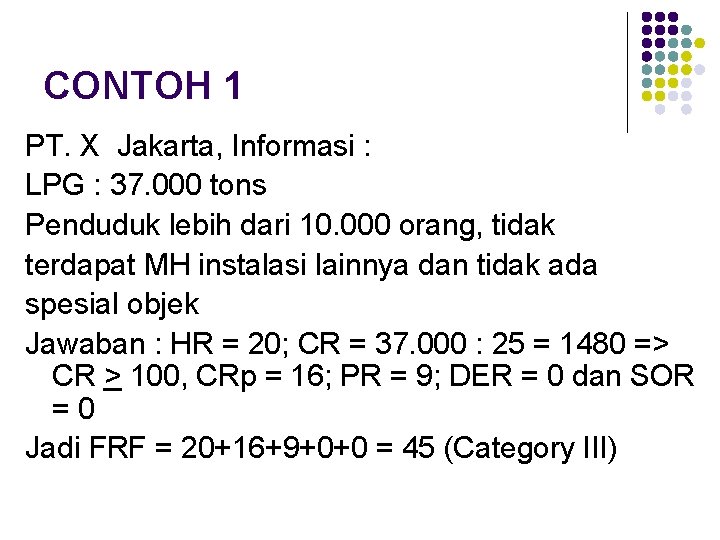
CONTOH 1 PT. X Jakarta, Informasi : LPG : 37. 000 tons Penduduk lebih dari 10. 000 orang, tidak terdapat MH instalasi lainnya dan tidak ada spesial objek Jawaban : HR = 20; CR = 37. 000 : 25 = 1480 => CR > 100, CRp = 16; PR = 9; DER = 0 dan SOR =0 Jadi FRF = 20+16+9+0+0 = 45 (Category III)
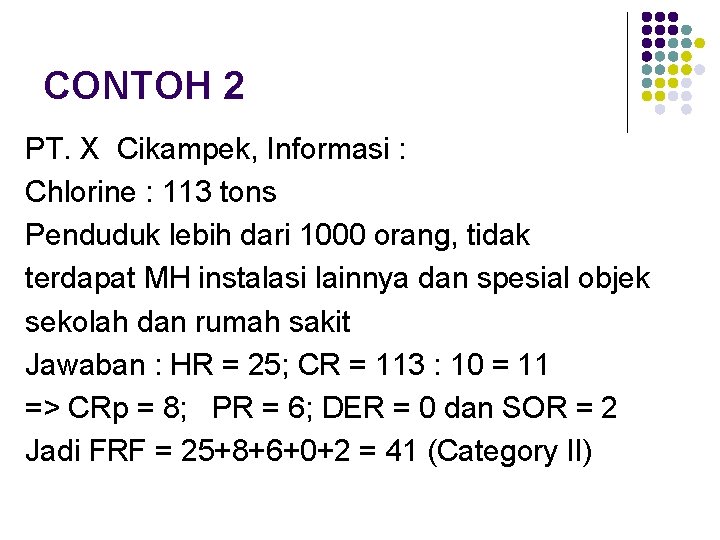
CONTOH 2 PT. X Cikampek, Informasi : Chlorine : 113 tons Penduduk lebih dari 1000 orang, tidak terdapat MH instalasi lainnya dan spesial objek sekolah dan rumah sakit Jawaban : HR = 25; CR = 113 : 10 = 11 => CRp = 8; PR = 6; DER = 0 dan SOR = 2 Jadi FRF = 25+8+6+0+2 = 41 (Category II)
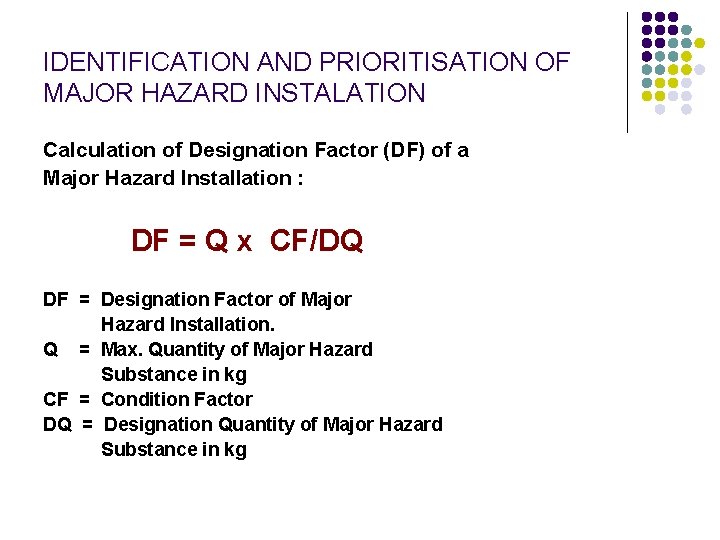
IDENTIFICATION AND PRIORITISATION OF MAJOR HAZARD INSTALATION Calculation of Designation Factor (DF) of a Major Hazard Installation : DF = Q x CF/DQ DF = Designation Factor of Major Hazard Installation. Q = Max. Quantity of Major Hazard Substance in kg CF = Condition Factor DQ = Designation Quantity of Major Hazard Substance in kg
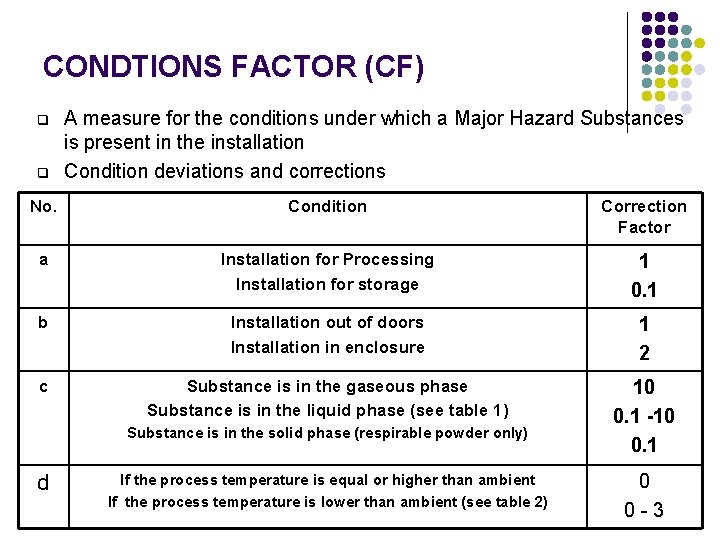
CONDTIONS FACTOR (CF) q q A measure for the conditions under which a Major Hazard Substances is present in the installation Condition deviations and corrections No. Condition Correction Factor a Installation for Processing Installation for storage 1 0. 1 b Installation out of doors Installation in enclosure 1 2 c Substance is in the gaseous phase Substance is in the liquid phase (see table 1) 10 0. 1 -10 0. 1 Substance is in the solid phase (respirable powder only) d If the process temperature is equal or higher than ambient If the process temperature is lower than ambient (see table 2) 0 0 -3
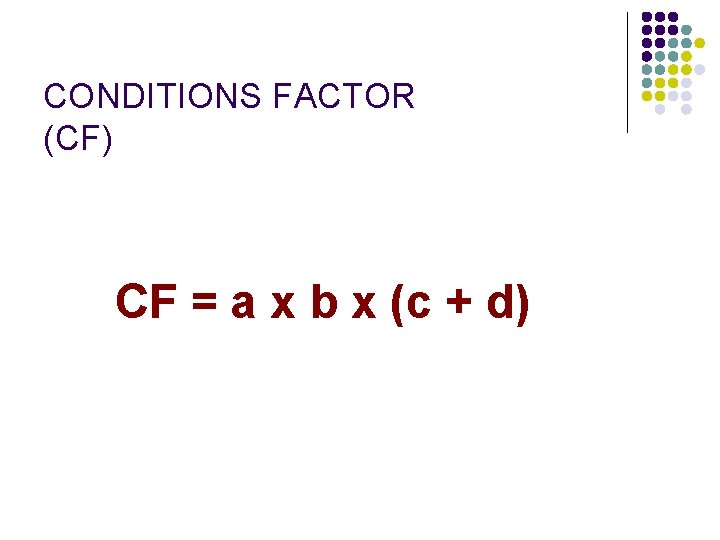
CONDITIONS FACTOR (CF) CF = a x b x (c + d)
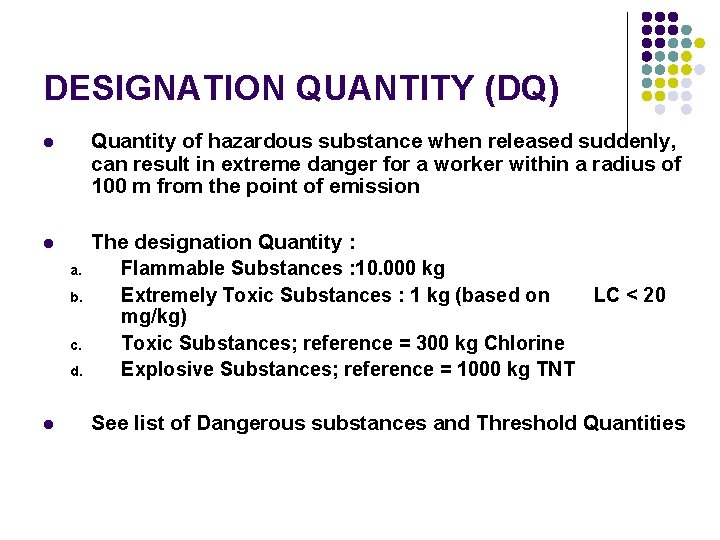
DESIGNATION QUANTITY (DQ) l Quantity of hazardous substance when released suddenly, can result in extreme danger for a worker within a radius of 100 m from the point of emission l The designation Quantity : Flammable Substances : 10. 000 kg Extremely Toxic Substances : 1 kg (based on LC < 20 mg/kg) Toxic Substances; reference = 300 kg Chlorine Explosive Substances; reference = 1000 kg TNT a. b. c. d. l See list of Dangerous substances and Threshold Quantities
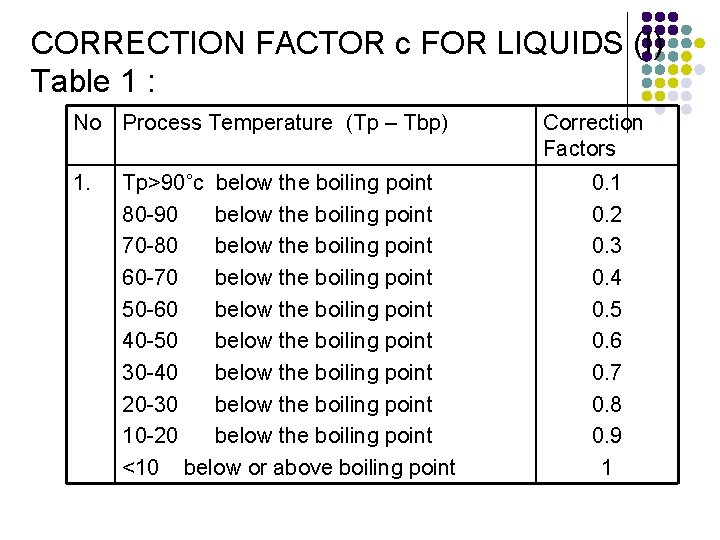
CORRECTION FACTOR c FOR LIQUIDS (I) Table 1 : No Process Temperature (Tp – Tbp) 1. Tp>90˚c below the boiling point 80 -90 below the boiling point 70 -80 below the boiling point 60 -70 below the boiling point 50 -60 below the boiling point 40 -50 below the boiling point 30 -40 below the boiling point 20 -30 below the boiling point 10 -20 below the boiling point <10 below or above boiling point Correction Factors 0. 1 0. 2 0. 3 0. 4 0. 5 0. 6 0. 7 0. 8 0. 9 1
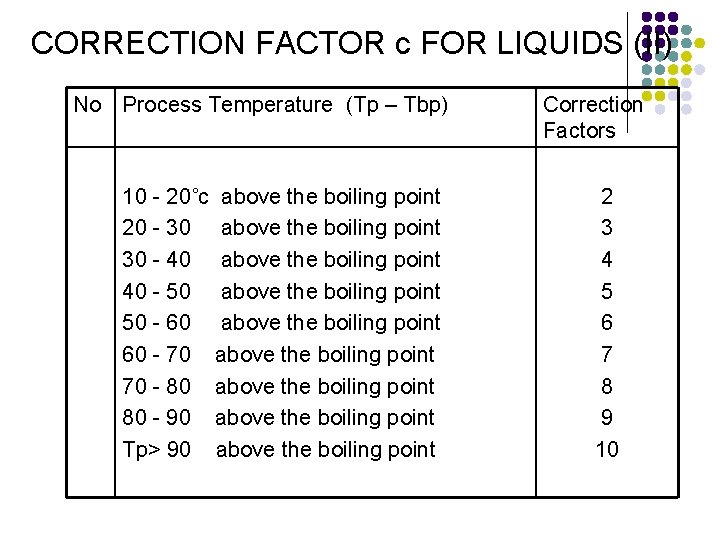
CORRECTION FACTOR c FOR LIQUIDS (II) No Process Temperature (Tp – Tbp) 10 - 20˚c above the boiling point 20 - 30 above the boiling point 30 - 40 above the boiling point 40 - 50 above the boiling point 50 - 60 above the boiling point 60 - 70 above the boiling point 70 - 80 above the boiling point 80 - 90 above the boiling point Tp> 90 above the boiling point Correction Factors 2 3 4 5 6 7 8 9 10
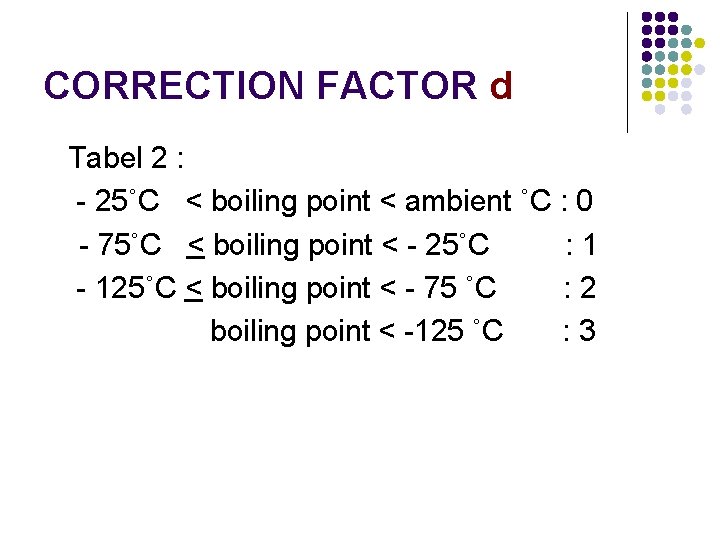
CORRECTION FACTOR d Tabel 2 : - 25˚C < boiling point < ambient ˚C : 0 - 75˚C < boiling point < - 25˚C : 1 - 125˚C < boiling point < - 75 ˚C : 2 boiling point < -125 ˚C : 3
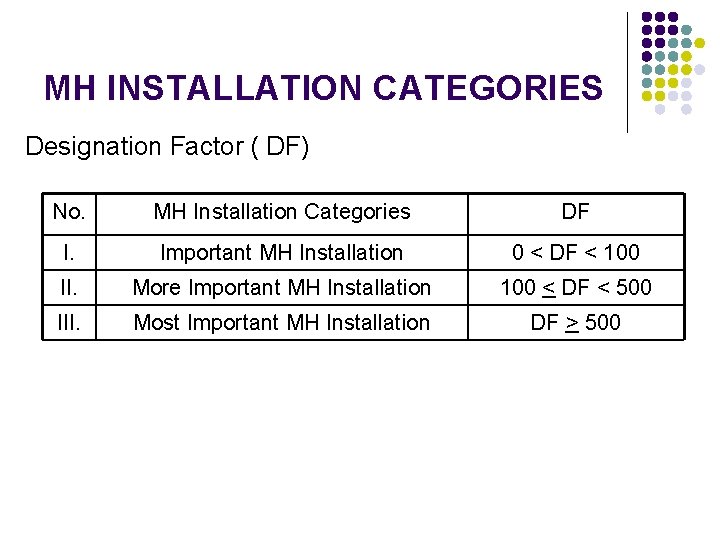
MH INSTALLATION CATEGORIES Designation Factor ( DF) No. MH Installation Categories DF I. Important MH Installation 0 < DF < 100 II. More Important MH Installation 100 < DF < 500 III. Most Important MH Installation DF > 500
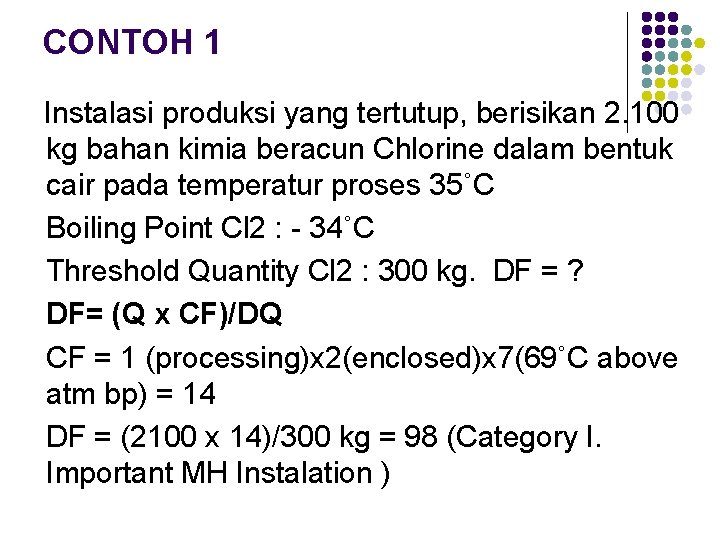
CONTOH 1 Instalasi produksi yang tertutup, berisikan 2. 100 kg bahan kimia beracun Chlorine dalam bentuk cair pada temperatur proses 35˚C Boiling Point Cl 2 : - 34˚C Threshold Quantity Cl 2 : 300 kg. DF = ? DF= (Q x CF)/DQ CF = 1 (processing)x 2(enclosed)x 7(69˚C above atm bp) = 14 DF = (2100 x 14)/300 kg = 98 (Category I. Important MH Instalation )
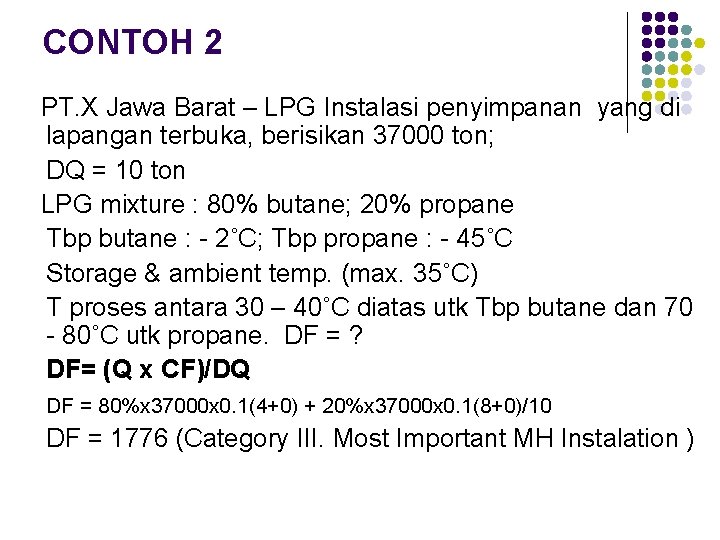
CONTOH 2 PT. X Jawa Barat – LPG Instalasi penyimpanan yang di lapangan terbuka, berisikan 37000 ton; DQ = 10 ton LPG mixture : 80% butane; 20% propane Tbp butane : - 2˚C; Tbp propane : - 45˚C Storage & ambient temp. (max. 35˚C) T proses antara 30 – 40˚C diatas utk Tbp butane dan 70 - 80˚C utk propane. DF = ? DF= (Q x CF)/DQ DF = 80%x 37000 x 0. 1(4+0) + 20%x 37000 x 0. 1(8+0)/10 DF = 1776 (Category III. Most Important MH Instalation )
CLASSIFICATION OF PLANT ELEMENT l l DOW INDEX FIRE, EXPLOSION & TOXICITY INDEX (FE&T INDEX)
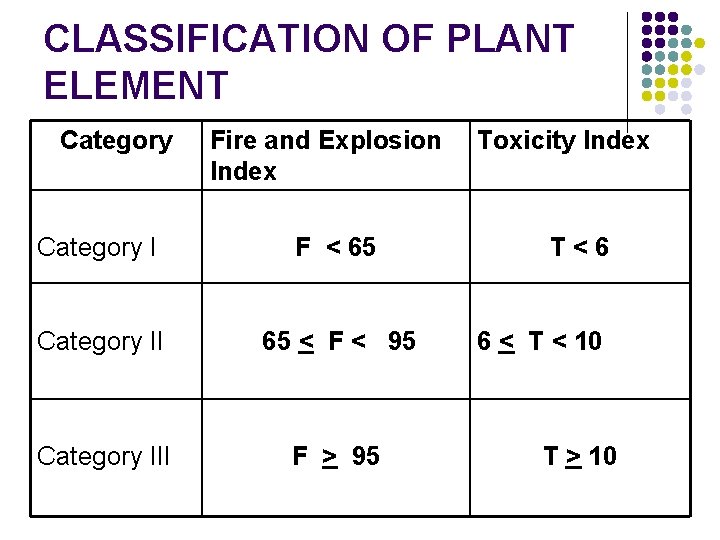
CLASSIFICATION OF PLANT ELEMENT Category Fire and Explosion Index Category I F < 65 Category II 65 < F < 95 Category III F > 95 Toxicity Index T<6 6 < T < 10 T > 10
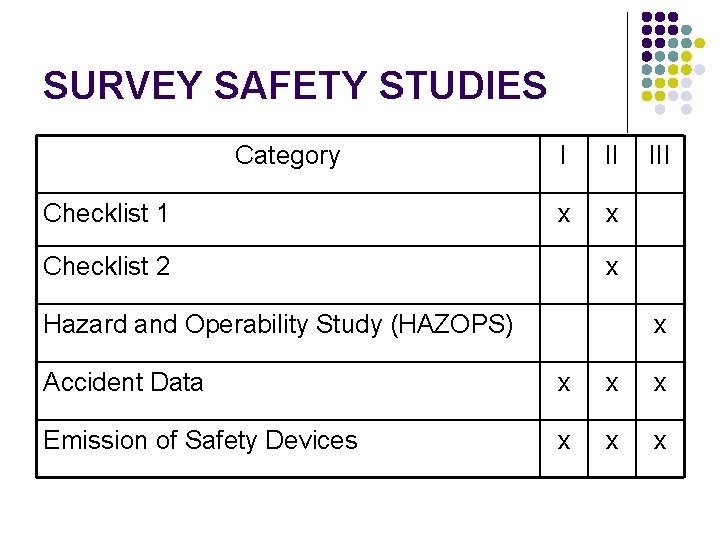
SURVEY SAFETY STUDIES Category Checklist 1 I II x x Checklist 2 III x Hazard and Operability Study (HAZOPS) x Accident Data x x x Emission of Safety Devices x x x
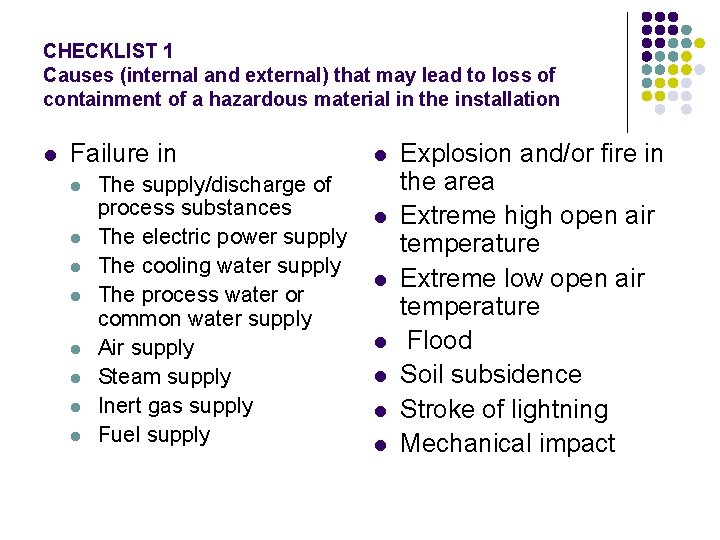
CHECKLIST 1 Causes (internal and external) that may lead to loss of containment of a hazardous material in the installation l Failure in l l l l The supply/discharge of process substances The electric power supply The cooling water supply The process water or common water supply Air supply Steam supply Inert gas supply Fuel supply l l l l Explosion and/or fire in the area Extreme high open air temperature Extreme low open air temperature Flood Soil subsidence Stroke of lightning Mechanical impact
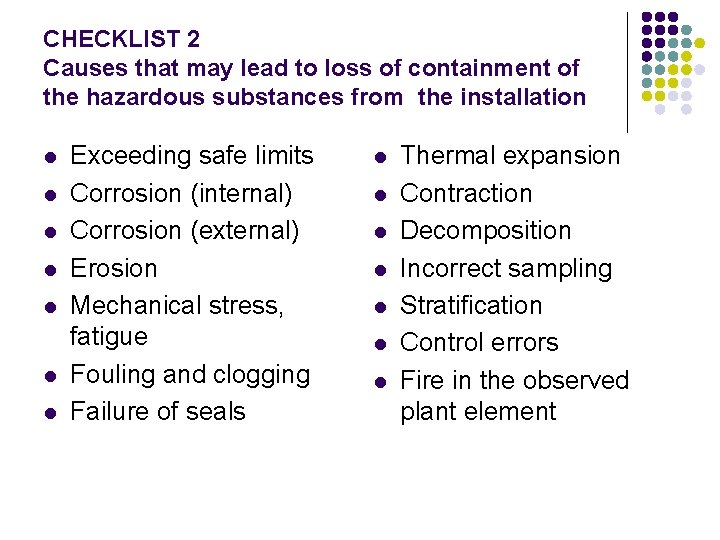
CHECKLIST 2 Causes that may lead to loss of containment of the hazardous substances from the installation l l l l Exceeding safe limits Corrosion (internal) Corrosion (external) Erosion Mechanical stress, fatigue Fouling and clogging Failure of seals l l l l Thermal expansion Contraction Decomposition Incorrect sampling Stratification Control errors Fire in the observed plant element
SEKIAN